

The Difference Between Solving Problems and Providing Emotional Support: The Neuroscience of Connection, Communication, and Conflict in Relationships
The Difference Between Solving Problems and Providing Emotional Support: The Neuroscience of Connection, Communication, and Conflict in Relationships
Why do couples struggle when one partner wants solutions, and the other wants emotional support? Learn the neuroscience behind emotional validation, nervous system regulation, communication, attachment, and healthy relationship boundaries.
Why Do So Many Couples Feel Misunderstood During Conflict?
Have you ever opened up emotionally to your partner only to receive advice when what you truly wanted was comfort?
Have you ever thought:
— “Why are they trying to fix me instead of listening?”
— “Why does every emotional conversation turn into problem-solving?”
— “Why do I feel emotionally dismissed?”
— “Why does my partner get frustrated when I simply need support?”
— “Why do our conversations escalate into conflict even when we both care about each other?”
One of the most common yet misunderstood relationship dynamics involves the difference between:
— Solving a problem and
— Providing emotional support
Many couples deeply love one another but repeatedly miss each other emotionally because they are operating from different nervous system needs during moments of distress.
At Embodied Wellness and Recovery, we frequently help couples understand how trauma, attachment wounds, nervous system dysregulation, emotional communication patterns, and blurred relational boundaries contribute to conflict, emotional disconnection, and misunderstanding. Often, the issue is not a lack of love. It is a lack of attunement.
The Difference Between Emotional Support and Problem Solving
Problem-solving focuses on:
— Fixing
— Strategizing
— Analyzing
— Offering solutions
— Reducing uncertainty
— Restoring control
Emotional support focuses on:
— Listening
— Validating
— Attuning
— Emotionally staying present
— Creating safety
— Helping someone feel emotionally understood
Both are valuable. The challenge arises when partners offer solutions instead of the emotional connection that is actually needed.
For example:
Problem Solving
“Here’s what you should do.”
“You are overthinking this.”
“Why don’t you just talk to them?”
“There’s an easy fix.”
Emotional Support
“That sounds really overwhelming.”
“I can understand why you feel hurt.”
“I’m here with you.”
“Tell me more about what this feels like.”
One approach primarily addresses the situation. The other addresses the nervous system.
Why People Try to Solve Instead of Support
Many individuals genuinely believe they are helping when they offer solutions.
In fact, problem-solving is often rooted in:
— Care
— Love
— Anxiety reduction
— Helplessness
— Discomfort with emotional distress
Some people become solution-oriented because:
— Emotions were minimized in their family system
— Vulnerability felt unsafe
— They learned to value productivity over emotional processing
— Emotional discomfort triggered anxiety
— They feel responsible for fixing pain quickly
For some individuals, witnessing a loved one’s distress activates their own nervous system discomfort. Problem-solving becomes an unconscious attempt to regulate anxiety.
The Neuroscience of Emotional Validation
From a neuroscience perspective, emotional attunement and validation help regulate the nervous system. Research related to attachment and interpersonal neurobiology suggests that humans are biologically wired for co-regulation through emotionally safe connection (Siegel, 2012).
When someone feels:
— Emotionally seen
— Understood
— Validated
— Emotionally accompanied
The nervous system often becomes less defensive and less dysregulated.
Emotional validation can reduce:
— Stress responses
— Emotional flooding
— Shame
— Loneliness
In contrast, feeling emotionally dismissed or “fixed” too quickly can unintentionally increase:
— Defensiveness
— Shame
— Frustration
— Emotional disconnection
Why “Fixing” Can Feel Invalidating
Many people interpret immediate advice giving as:
— “Your emotions are a problem.”
— “You should not feel this way.”
— “Your distress makes me uncomfortable.”
— “I need you to stop feeling this.”
Even when the intention is loving, the emotional impact may feel distancing. This is especially true for individuals with trauma histories or attachment wounds. If someone grew up feeling emotionally unheard, dismissed, criticized, or emotionally abandoned, they may become highly sensitive to interactions that feel emotionally minimizing.
Trauma and Emotional Safety in Relationships
Trauma often affects how people experience emotional connection and support.
Some trauma survivors learned:
— Emotions overwhelm people
— Vulnerability creates rejection
— Emotional expression is unsafe
— They must solve problems alone
— Needing support is a weakness
Others learned to survive by becoming hyperfunctional problem solvers themselves.
This can create relationship dynamics where:
— One partner seeks an emotional connection
— The other seeks emotional control through fixing
Both individuals may care deeply for each other while still feeling emotionally disconnected.
Emotional Support Is Not the Same as Enabling
One common misconception is that emotional support means agreeing with everything someone says or avoiding accountability.
Healthy emotional support does not require:
— Rescuing
— Overfunctioning
— Emotional caretaking
— Abandoning boundaries
Instead, emotional support means:
— Emotionally staying present
— Validating feelings
— Listening without immediately correcting
— Creating emotional safety
Problem-solving can still happen. But timing matters.
The Nervous System Often Needs Regulation Before Solutions
From a Polyvagal perspective, the nervous system processes information differently depending on whether it feels safe or threatened (Porges, 2011). When someone is emotionally flooded, anxious, or dysregulated, the brain is often less capable of:
— Reasoning
— Perspective taking
— Processing solutions
— Integrating advice
In many situations, emotional connection must come before effective problem-solving.
This is why phrases such as:
— “I’m here.”
— “I understand.”
— “That sounds painful.”
— “You make sense to me.”
can feel profoundly regulating. The nervous system calms through connection.
Blurred Boundaries and Relationship Conflict
Many couples become stuck in cycles where:
— One partner feels emotionally unheard
— The other feels chronically responsible for fixing everything
This often creates:
— Resentment
— Emotional exhaustion
— Withdrawal
— Communication breakdown
Healthy relational boundaries involve understanding:
— When emotional support is needed
— When problem-solving is needed
— When advice is welcome
— When emotional presence matters more
Sometimes asking: “Do you want support right now or help solving this?” can dramatically improve communication.
How Couples Can Improve Emotional Attunement
Pause Before Offering Advice
Ask yourself:
— “What does my partner emotionally need right now?”
— “Am I listening or trying to control discomfort?”
Validate Before Solving
Validation does not mean agreement.
It means acknowledging emotional reality.
Learn to Tolerate Emotional Discomfort
Some individuals rush to fix because distress feels intolerable.
Emotional presence often requires slowing down.
Clarify Needs Explicitly
Encourage conversations such as:
— “I need comfort right now.”
— “I’m not asking you to fix this.”
— “Can you just listen for a minute?”
Strengthen Nervous System Regulation
The more each partner becomes individually regulated, the easier emotional attunement often becomes relationally.
How Therapy Can Help
At Embodied Wellness and Recovery, we help couples explore:
— Communication patterns
— Emotional attunement
— Attachment dynamics
— Conflict cycles
— Emotional safety
— Intimacy struggles
Treatment may include:
— Attachment-focused interventions
— EMDR
— Nervous system regulation work
— Communication skill building
As couples learn to differentiate between fixing and emotionally supporting, many experience:
— Deeper intimacy
— Reduced conflict
— Improved communication
— Increased emotional safety
— Stronger relational connection
Different Nervous System Needs
Problem-solving and emotional support are both important in healthy relationships. But they serve different nervous system needs. Many people do not need immediate solutions during moments of distress.
They need:
— Emotional presence
— Attunement
— Validation
— Connection
— Reassurance that their emotional experience matters
Sometimes the most healing response is not: “Here’s how to fix it.”
Sometimes it is: “I’m here with you while you move through it.”
Reach out to schedule a complimentary 20-minute consultation with our team of therapists, trauma specialists, somatic practitioners, or relationship experts, and start working towards integrative, embodied healing today.
📞 Call us at (310) 651-8458
📱 Text us at (310) 210-7934
📩 Email us at admin@embodiedwellnessandrecovery.com
🔗 Visit us at www.embodiedwellnessandrecovery.com
👉 Check us out on Instagram @embodied_wellness_and_recovery
🌍 Explore our offerings at Linktr.ee: https://linktr.ee/laurendummit
References
1) Gottman, J. M., & Silver, N. (2015). The seven principles for making marriage work. Harmony Books.
2) Porges, S. W. (2011). The polyvagal theory: Neurophysiological foundations of emotions, attachment, communication, and self-regulation. Norton.
3) Siegel, D. J. (2012). The developing mind: How relationships and the brain interact to shape who we are. Guilford Press.
4) Sue Johnson, S. M. (2019). Attachment theory in practice: Emotionally focused therapy (EFT) with individuals, couples, and families. Guilford Press.
Trauma and the Fear of Being “Too Much”: The Neuroscience of Rejection, Emotional Safety, and Attachment Wounds
Trauma and the Fear of Being “Too Much”: The Neuroscience of Rejection, Emotional Safety, and Attachment Wounds
Do you fear being “too much” emotionally in relationships? Learn how trauma, attachment wounds, nervous system dysregulation, and fear of rejection shape emotional insecurity, people pleasing, anxiety, and intimacy struggles through a neuroscience-informed lens.
Why Do So Many People Fear They Are “Too Much” for Others?
Do you constantly worry that your emotions, needs, sensitivity, or vulnerability will overwhelm people?
Have you ever:
— Apologized for crying?
— Minimized your emotional needs?
— Felt ashamed after expressing hurt?
— Feared that asking for reassurance would push someone away?
— Worried that your anxiety, sadness, or emotional intensity would make others leave?
Many people silently carry the painful belief:
— “I am too needy.”
— “I am too emotional.”
— “I am too sensitive.”
— “I take up too much space.”
— “People eventually get overwhelmed by me.”
For some individuals, this fear becomes deeply embedded in the nervous system and shapes how they experience:
— Intimacy
— Attachment
— Vulnerability
— Emotional expression
At Embodied Wellness and Recovery, we frequently help individuals explore how trauma, attachment wounds, nervous system dysregulation, and relational experiences contribute to chronic fears of rejection, abandonment, emotional shame, and insecurity.
Often, the fear of being “too much” is not a personality flaw. It is a trauma adaptation.
Where Does the Fear of Being “Too Much” Come From?
People are rarely born believing their emotions are unacceptable.
This belief often develops through repeated relational experiences in which emotional needs were:
— Dismissed
— Ignored
— Mocked
— Punished
— Invalidated
— Emotionally abandoned
Some people grew up hearing messages such as:
— “You are too sensitive.”
— “Stop crying.”
— “Calm down.”
— “You are overreacting.”
— “Why are you so emotional?”
— “You are exhausting.”
Others may not have heard these words directly, but experienced emotional inconsistency, emotional neglect, or caregivers who became overwhelmed by emotional expression. Over time, the nervous system may begin associating vulnerability with danger.
Trauma and Attachment Wounds
From an attachment perspective, humans are biologically wired to seek:
— Connection
— Emotional safety
— Attunement
— Responsiveness
When caregivers are emotionally unavailable, rejecting, inconsistent, or dysregulated, children often internalize painful conclusions about themselves.
Rather than thinking: “My environment feels unsafe.”
Children often conclude:
— “Something is wrong with me.”
— “My emotions are a problem.”
— “My needs overwhelm people.”
— “I need to become less visible to stay connected.”
These attachment wounds can persist into adulthood and shape:
— Friendships
— Marriage
The Neuroscience of Emotional Rejection
From a neuroscience perspective, social rejection activates many of the same brain regions involved in physical pain. Research suggests the anterior cingulate cortex becomes activated during experiences of emotional rejection and exclusion (Eisenberger et al., 2003).
This helps explain why:
— Criticism can feel physically painful
— Emotional invalidation can feel overwhelming
— Abandonment fears can trigger panic
— Relational conflict can activate intense nervous system responses
For trauma survivors, especially, the nervous system may become highly sensitive to cues of:
— Rejection
— Withdrawal
— Disappointment
— Emotional disconnection
— Abandonment
The body begins anticipating emotional danger before the conscious mind fully processes it.
The Fear of “Too Much” Often Creates Self-Abandonment
Ironically, many people cope with the fear of being “too much” by becoming emotionally smaller.
They may:
— Suppress feelings
— Avoid vulnerability
— People please
— Over apologize
— Avoid asking for needs to be met
— Become hyper-independent
— Minimize pain
— Tolerate emotional neglect
— Emotionally caretaking others while abandoning themselves
Some individuals become experts at:
— Reading other people’s emotions
— Adapting to others’ needs
— Avoiding conflict
— Staying emotionally “easy”
— Becoming low maintenance
But internally, they often feel:
— Lonely
— Unseen
— Anxious
— Emotionally deprived
— Disconnected from themselves
Why Highly Sensitive People Often Struggle With This Fear
Highly empathetic or emotionally sensitive individuals often feel emotions deeply. This sensitivity is not inherently unhealthy.
However, when emotional sensitivity is met with:
— Shame
— Emotional unpredictability
— Emotional invalidation
The nervous system may begin viewing emotional expression as dangerous.
Some people become trapped in a painful cycle:
— Craving connection
— Fearing rejection
— Suppressing needs
— Feeling emotionally unseen
— Becoming resentful or anxious
— Fearing they are “too much”
Trauma Can Create Hypervigilance in Relationships
Many trauma survivors become highly attuned to subtle emotional shifts in others.
They may constantly monitor:
— Facial expressions
— Tone of voice
— Texting patterns
— Pauses in communication
— Emotional distance
— Energy shifts
This hypervigilance is often the nervous system attempting to prevent abandonment or emotional pain.
The body learns: “If I can anticipate rejection early enough, maybe I can protect myself.”
Unfortunately, this often creates chronic anxiety and relational exhaustion.
The Difference Between Healthy Needs and Trauma-Driven Fear
One of the most important parts of healing is learning that having emotional needs does not make someone “too much.”
All humans need:
— Connection
— Reassurance
— Emotional safety
— Responsiveness
— Care
— Attunement
— Belonging
The problem is not emotional need itself. The problem is often unresolved shame surrounding those needs.
Trauma frequently teaches people:
— Needing others is unsafe
— Vulnerability creates rejection
— Emotional expression drives people away
Healthy relationships, however, are built through mutual emotional responsiveness and repair.
The Nervous System Needs Co-Regulation
Humans are relational beings.
According to Polyvagal Theory, the nervous system is regulated through safe connection with others (Porges, 2011).
This means:
— Warmth matters
— Emotional presence matters
— Attunement matters
— Responsiveness matters
People do not become emotionally secure through emotional isolation. They often heal through safe, consistent, emotionally attuned relationships.
How Therapy Can Help Heal the Fear of Being “Too Much”
At Embodied Wellness and Recovery, we help individuals understand how:
— Trauma
— Nervous system dysregulation
— Shame
shape fears of rejection and emotional insecurity.
Treatment may include:
— EMDR
— Self-compassion work
As healing progresses, many individuals begin:
— Tolerating vulnerability more safely
— Developing healthier emotional boundaries
— Reducing shame around emotional needs
— Improving self-worth
— Choosing healthier relationships
— Experiencing greater emotional regulation
Relearning Emotional Safety
Healing often involves learning that safe relationships do not require:
— Emotional perfection
— Emotional suppression
— Constant self-abandonment
— Shrinking yourself to maintain connection
Healthy intimacy allows space for:
— Emotions
— Needs
— Vulnerability
— Repair
— Humanity
— Imperfection
The goal is not becoming emotionless or “less needy.” The goal is to develop relationships where emotional authenticity feels safe.
Deeply Human Needs
The fear of being “too much” is often rooted in experiences where emotional expression was not safely received. Many people learned to suppress parts of themselves in order to preserve attachment, reduce conflict, or avoid rejection. But emotional sensitivity, vulnerability, and relational needs are not evidence of weakness. They are deeply human.
Sometimes healing begins when individuals stop asking: “How do I become less emotionally difficult?”
and begin asking: “What experiences taught me my emotions were unsafe in the first place?”
Reach out to schedule a complimentary 20-minute consultation with our team of therapists, trauma specialists, somatic practitioners, or relationship experts, and start working towards integrative, embodied healing today.
📞 Call us at (310) 651-8458
📱 Text us at (310) 210-7934
📩 Email us at admin@embodiedwellnessandrecovery.com
🔗 Visit us at www.embodiedwellnessandrecovery.com
👉 Check us out on Instagram @embodied_wellness_and_recovery
🌍 Explore our offerings at Linktr.ee: https://linktr.ee/laurendummit
References
1) Eisenberger, N. I., Lieberman, M. D., & Williams, K. D. (2003). Does rejection hurt? An FMRI study of social exclusion. Science, 302(5643), 290-292.
2) Porges, S. W. (2011). The polyvagal theory: Neurophysiological foundations of emotions, attachment, communication, and self-regulation. Norton.
3) Siegel, D. J. (2012). The developing mind: How relationships and the brain interact to shape who we are. Guilford Press.
4) van der Kolk, B. A. (2014). The body keeps the score: Brain, mind, and body in the healing of trauma. Viking.
Anxiety and Emotional Contagion: The Neuroscience of Absorbing Other People’s Stress, Energy, and Nervous System States
Anxiety and Emotional Contagion: The Neuroscience of Absorbing Other People’s Stress, Energy, and Nervous System States
Do you absorb other people’s stress, anxiety, or emotions? Learn the neuroscience behind emotional contagion, empathy, nervous system sensitivity, trauma, and emotional overwhelm, along with trauma-informed strategies for emotional boundaries, regulation, and self-protection.
Why Do Some People Absorb Other People’s Stress So Deeply?
Have you ever walked into a room and immediately felt tension in your body before anyone even spoke? Do you notice yourself becoming anxious around stressed, angry, emotionally dysregulated, or emotionally heavy people?
Have you ever left a conversation feeling emotionally drained, overwhelmed, exhausted, or dysregulated without fully understanding why?
Do you often feel:
— Emotionally flooded by other people’s problems
— Hyperaware of emotional shifts in others
— Responsible for calming or helping people
— Anxious after spending time around conflict or negativity
— Deeply affected by other people’s moods or energy
Many highly empathetic individuals struggle with emotional contagion, a phenomenon in which the nervous system unconsciously absorbs and mirrors others' emotional states.
From a neuroscience and trauma-informed perspective, emotional sensitivity is not simply “being dramatic” or “too emotional.”
It is often connected to:
— Trauma adaptation
— Attachment experiences
— Hypervigilance
— Empathy
At Embodied Wellness and Recovery, we frequently help individuals understand how anxiety, trauma, attachment wounds, and nervous system sensitivity affect emotional boundaries, relationships, self-regulation, and emotional well-being.
What Is Emotional Contagion?
Emotional contagion refers to the tendency for humans to unconsciously absorb, mirror, or synchronize with others' emotions and nervous system states. Research suggests humans are biologically wired for emotional attunement and interpersonal synchronization (Hatfield, Cacioppo, & Rapson, 1993).
This means people often unconsciously pick up on:
— Tone of voice
— Facial expressions
— Emotional intensity
— Pacing
— Tension
— Stress signals
The brain and body continuously scan social environments for cues of:
— Safety
— Danger
— Connection
— Emotional threat
This process happens rapidly and often outside conscious awareness.
The Neuroscience of Absorbing Other People’s Emotions
From a neuroscience perspective, emotional contagion involves several systems related to empathy, attachment, and nervous system regulation.
Mirror Neurons
Research on mirror neurons suggests humans are neurologically wired to internally simulate or mirror the emotional states and behaviors of others (Iacoboni, 2009).
This helps explain why:
— Someone else’s anxiety can make your body tense
— Another person’s panic can increase your heart rate
— Calm, grounded people can feel regulating
— Conflict can feel physically activating
Polyvagal Theory
According to Polyvagal Theory, the nervous system constantly engages in “neuroception,” an unconscious process of detecting cues of safety or danger (Porges, 2011).
Highly sensitive individuals may unconsciously track:
— Subtle emotional shifts
— Tension
— Irritation
— Sadness
— Stress
— Emotional withdrawal
— Conflict energy
The body may respond before the mind fully processes what is happening.
Why Trauma Survivors Often Absorb Stress More Intensely
Individuals with trauma histories are often especially sensitive to emotional environments.
If someone grew up around:
— Unpredictability
— Emotional volatility
— Addiction
— Conflict
— Rage
Their nervous system may have adapted by becoming highly attuned to other people’s emotional states. This adaptation once served a survival function.
For example:
— Noticing subtle emotional shifts may have helped avoid danger
— Anticipating moods may have helped maintain emotional safety
— Monitoring others may have reduced conflict or rejection
Over time, however, this hypervigilance can become exhausting. Many people become so focused on tracking other people’s emotions that they lose connection with their own internal experience.
Signs You May Be Absorbing Other People’s Anxiety
Emotional contagion may show up as:
— Feeling anxious around stressed people
— Difficulty separating your emotions from others.’
— Emotional exhaustion after social interaction
— Overfunctioning
— Hyperresponsibility
— Becoming emotionally flooded during conflict
— Chronic nervous system activation
— Emotional overwhelm in crowds
— Feeling emotionally “heavy” after conversations
— Difficulty emotionally decompressing
Some people describe this as: “I feel everything around me.”
The Difference Between Empathy and Emotional Absorption
Empathy itself is not unhealthy.
Empathy allows humans to:
Morgane Stapleton
— Connect
— Care
— Attune
— Love
— Understand others emotionally
The challenge occurs when empathy becomes emotional overidentification.
Healthy empathy sounds like: “I care about what you are feeling.”
Emotional absorption sounds like: “I am now carrying your emotional state inside my own body.”
Without boundaries and regulation, highly empathetic individuals may become chronically overwhelmed.
Anxiety, Burnout, and Nervous System Exhaustion
When individuals consistently absorb stress from others without adequate emotional regulation, the nervous system may remain in a state of prolonged activation.
This can contribute to:
— Anxiety
— Burnout
— Emotional exhaustion
— Sleep disruption
— Irritability
— Emotional numbness
— Chronic stress
— Difficulty relaxing
— Overwhelm
— Fatigue
Research suggests chronic stress affects cortisol regulation, emotional processing, and nervous system functioning (McEwen, 2007). Many emotionally sensitive people become depleted because their nervous system rarely fully rests.
Why Boundaries Feel Difficult for Highly Sensitive People
Many emotionally attuned individuals struggle with boundaries because they fear:
— Disappointing others
— Seeming selfish
— Conflict
— Rejection
— Hurting people emotionally
Trauma and attachment wounds can intensify this pattern.
Some individuals learned early in life that:
— Other people’s emotions were their responsibility
— Emotional caretaking created safety
— Self-abandonment maintained connection
— Hyperawareness prevented conflict
As adults, they may unconsciously continue prioritizing other people’s emotional states over their own regulation and well-being.
How to Protect Your Nervous System Without Losing Compassion
Healing emotional contagion does not mean becoming emotionally cold or disconnected. It means learning how to remain compassionate without chronically absorbing emotional overwhelm.
Increase Self Awareness
Begin noticing:
— What emotions actually belong to me?
— What happens in my body around emotionally intense people?
— When do I lose connection with myself?
Strengthen Nervous System Regulation
Practices that support regulation may include:
— Mindfulness
— Movement
— Breathwork
— Sleep support
— Reducing overstimulation
— Nervous system calming practices
Learn Emotional Boundaries
Healthy boundaries may involve:
— Limiting emotional overexposure
— Stepping away from chronically dysregulated environments
— Reducing people pleasing
— Recognizing that empathy does not require self-abandonment
Reconnect With Your Own Internal Experience
Highly empathetic individuals often become externally focused.
Healing involves strengthening awareness of:
— Your own feelings
— Your own needs
— Your own body
— Your own nervous system signals
How Therapy Can Help
At Embodied Wellness and Recovery, we help individuals explore the relationship between:
— Trauma
— Anxiety
— Emotional sensitivity
— Attachment wounds
— Nervous system dysregulation
— Empathy
— Emotional overwhelm
Treatment may include:
— EMDR
— Mindfulness-based interventions
As individuals become more regulated internally, many report:
— Reduced anxiety
— Improved emotional boundaries
— Less emotional exhaustion
— Greater clarity
— Increased self-trust
— Stronger sense of self
— Healthier relationships
Attunement vs. Chronic Emotional Absorption
Emotional sensitivity is not weakness. The ability to deeply attune to others can be a profound strength. But when empathy becomes chronic emotional absorption, the nervous system may become overwhelmed, anxious, and emotionally depleted. Understanding emotional contagion through a neuroscience and trauma-informed lens can help individuals approach themselves with greater compassion rather than shame.
Sometimes the goal is not to become less caring. Sometimes the goal is learning how to stay connected to yourself while caring for others.
Reach out to schedule a complimentary 20-minute consultation with our team of therapists, trauma specialists, somatic practitioners, or relationship experts, and start working towards integrative, embodied healing today.
📞 Call us at (310) 651-8458
📱 Text us at (310) 210-7934
📩 Email us at admin@embodiedwellnessandrecovery.com
🔗 Visit us at www.embodiedwellnessandrecovery.com
👉 Check us out on Instagram @embodied_wellness_and_recovery
🌍 Explore our offerings at Linktr.ee: https://linktr.ee/laurendummit
References
Hatfield, E., Cacioppo, J. T., & Rapson, R. L. (1993). Emotional contagion. Current Directions in Psychological Science, 2(3), 96-100.
Iacoboni, M. (2009). Mirroring people: The science of empathy and how we connect with others. Picador.
McEwen, B. S. (2007). Physiology and neurobiology of stress and adaptation: Central role of the brain. Physiological Reviews, 87(3), 873-904.
Porges, S. W. (2011). The polyvagal theory: Neurophysiological foundations of emotions, attachment, communication, and self regulation. Norton.
The Role of Curiosity in Healthy Relationships: The Neuroscience of Emotional Connection, Communication, and Intimacy
The Role of Curiosity in Healthy Relationships: The Neuroscience of Emotional Connection, Communication, and Intimacy
Discover how curiosity strengthens emotional connection, communication, intimacy, and trust in relationships. Learn the neuroscience behind curiosity, nervous system regulation, attachment, and healthy couples communication from a trauma-informed perspective.
Why Do So Many Couples Feel Disconnected Over Time?
Many relationships do not fall apart because love disappears. Often, couples slowly stop being curious about one another. Instead of asking questions, they begin making assumptions. Instead of exploring each other’s inner worlds, they become reactive, defensive, distracted, or emotionally distant.
Have you ever found yourself wondering:
— Why do we keep having the same argument?
— Why does my partner feel emotionally far away lately?
— Why do I feel misunderstood in my relationship?
— Why do conversations turn into defensiveness instead of connection?
— Why do we feel more like roommates than partners?
Long-term relationships can become emotionally strained when curiosity is replaced by certainty, criticism, resentment, or emotional withdrawal.
At Embodied Wellness and Recovery, we frequently help couples understand how emotional attunement, nervous system regulation, trauma, attachment dynamics, and communication patterns affect intimacy and relational connection. One of the most overlooked yet powerful relational tools is curiosity.
What Does Curiosity Look Like in a Relationship?
Curiosity in relationships means maintaining an open, compassionate interest in your partner’s emotional world.
It sounds like:
— “Help me understand what you’re feeling.”
— “What was that experience like for you?”
— “What do you need from me right now?”
— “What is happening underneath your reaction?”
— “Can you tell me more about that?”
Curiosity is not interrogation. It is emotional openness.
Healthy curiosity communicates:
— I want to understand you.
— Your inner experience matters to me.
— I am willing to stay emotionally engaged instead of assuming or shutting down.
This creates emotional safety, which is foundational for intimacy and trust.
The Neuroscience of Curiosity and Emotional Connection
From a neuroscience perspective, curiosity helps regulate defensiveness and supports emotional connection.
When people feel criticized, misunderstood, or emotionally threatened, the nervous system often shifts into protective states:
— Fight
— Flight
— Freeze
— Shutdown
This can lead to:
— Defensiveness
— Stonewalling
— Emotional withdrawal
Curiosity, however, activates different neural pathways. Research suggests curiosity is associated with increased openness, learning, empathy, and emotional flexibility (Kashdan et al., 2013). When couples approach each other with curiosity instead of accusation, the nervous system is more likely to experience:
— Safety
— Receptivity
— Connection
— Emotional regulation
In many ways, curiosity softens threat responses.
Curiosity Helps Couples Feel Seen
One of the deepest human emotional needs is the desire to feel known and understood.
Many relationship conflicts intensify because individuals feel:
— Dismissed
— Unseen
— Misunderstood
— Emotionally alone
Curiosity helps create emotional attunement.
Instead of saying, “You always overreact,” curiosity sounds more like: “I noticed that really affected you. Can you help me understand why?”
This shift can profoundly change the nervous system's experience of conflict. The goal becomes understanding rather than winning.
Why Curiosity Often Disappears in Relationships
Curiosity tends to decline when couples become emotionally overwhelmed or stuck in protective patterns.
This commonly happens when:
— Resentment builds
— Stress increases
— Trauma is activated
— Communication becomes reactive
— Emotional safety decreases
— Assumptions replace openness
People often stop asking questions because they believe they already know the answer. But assumptions frequently create emotional distance.
For example:
— “They do not care.”
— “They are just selfish.”
— “They always shut down.”
— “They never listen.”
Sometimes what appears externally as anger, withdrawal, or defensiveness is actually:
— Fear
— Shame
— Overwhelm
— Attachment insecurity
— Nervous system dysregulation
— Fear of rejection
Curiosity helps uncover the deeper emotional reality beneath the behavior.
Trauma and the Fear of Curiosity
For individuals with trauma histories or attachment wounds, curiosity can feel vulnerable. Some people learned early in life that emotional openness was unsafe.
If someone grew up around:
— Emotional invalidation
— Unpredictability
— Rage
— Shame
They may unconsciously protect themselves through:
— Defensiveness
— Emotional withdrawal
— Shutting down
— Avoidance
— Criticism
Curiosity requires emotional risk. It asks people to stay present with uncertainty instead of rushing toward judgment or self-protection. From a Polyvagal perspective, emotional curiosity becomes more possible when the nervous system feels safe enough to remain connected during difficult conversations.
Curiosity Improves Communication
Many couples focus heavily on communication techniques while overlooking emotional tone and nervous system regulation. Curiosity changes the emotional atmosphere of conversations. Compare these two approaches:
Reactive Communication
— “Why are you always like this?”
— “You never listen.”
— “You are impossible to talk to.”
Curious Communication
— “What are you needing right now?”
— “What felt hurtful about that interaction?”
— “Can you help me understand your perspective?”
The second approach reduces shame and defensiveness while increasing emotional openness. Curiosity helps partners move from adversaries back toward connection.
Curiosity and Intimacy
Emotional intimacy often deepens when couples remain curious about one another over time. Many long-term relationships become stagnant not because people stop loving each other, but because they stop exploring each other’s evolving inner worlds.
People continue changing throughout life:
— Emotionally
— Sexually
— Psychologically
Curiosity keeps relationships dynamic and emotionally alive.
This is especially important in conversations about:
— Desire
— Attachment needs
— Vulnerability
— Emotional pain
— Dreams
— Fears
— Identity
Curiosity communicates, “I still want to know you.”
How Couples Can Practice More Curiosity
Slow Down During Conflict
Curiosity becomes difficult when the nervous system is overwhelmed. Taking a pause, regulating emotionally, and softening tone can help restore openness.
Replace Assumptions With Questions
Instead of assuming intent, ask:
— “What did you mean by that?”
— “What were you feeling?”
— “What happened for you emotionally?”
Listen to Understand, Not Just Respond
Many people listen while preparing their defense. Curiosity requires emotional presence.
Stay Open to Complexity
Partners may experience the same event very differently. Curiosity allows space for multiple emotional truths.
Remain Curious About Yourself Too
Self-curiosity matters as well.
Questions like:
— “Why did that trigger me?”
— “What am I protecting right now?”
— “What does my nervous system need?”
can improve emotional awareness and relational regulation.
How Therapy Can Help Couples Rebuild Curiosity and Connection
At Embodied Wellness and Recovery, we help couples strengthen emotional connection through trauma-informed, neuroscience-based approaches that address:
— Nervous system regulation
— Attachment dynamics
— Emotional safety
— Intimacy
Treatment may include:
— EMDR
— Attachment-focused work
— Communication skill building
— Emotional attunement interventions
As couples become more emotionally regulated and curious about one another, many experience:
— Reduced defensiveness
— Improved communication
— Deeper intimacy
— Increased empathy
— Stronger emotional connection
When Curiosity Begins Replacing Protection
Curiosity is one of the most powerful yet underestimated tools in healthy relationships. It softens defensiveness, increases emotional safety, deepens understanding, and helps couples remain emotionally connected even during conflict. Many relationships suffer not because partners stop caring, but because fear, stress, trauma, assumptions, and nervous system protection begin replacing curiosity. Sometimes healing begins with one simple question, “Help me understand your experience.”
Reach out to schedule a complimentary 20-minute consultation with our team of therapists, trauma specialists, somatic practitioners, or relationship experts, and start working towards integrative, embodied healing today.
📞 Call us at (310) 651-8458
📱 Text us at (310) 210-7934
📩 Email us at admin@embodiedwellnessandrecovery.com
🔗 Visit us at www.embodiedwellnessandrecovery.com
👉 Check us out on Instagram @embodied_wellness_and_recovery
🌍 Explore our offerings at Linktr.ee: https://linktr.ee/laurendummit
References
1) Gottman, J. M., & Silver, N. (2015). The seven principles for making marriage work. Harmony Books.
2) Kashdan, T. B., Goodman, F. R., Disabato, D. J., McKnight, P. E., Kelso, K., & Naughton, C. (2013). Curiosity has comprehensive benefits in the workplace: Developing and validating a multidimensional workplace curiosity scale in United States and German employees. Personality and Individual Differences, 55(3), 287-292.
3) Porges, S. W. (2011). The polyvagal theory: Neurophysiological foundations of emotions, attachment, communication, and self-regulation. Norton.
4) Siegel, D. J. (2012). The developing mind: How relationships and the brain interact to shape who we are. Guilford Press.
Anxiety After Graduation: The Neuroscience of the “Now What?” Phase, Fear of Failure, and Finding Direction After College
Anxiety After Graduation: The Neuroscience of the “Now What?” Phase, Fear of Failure, and Finding Direction After College
Struggling with anxiety after graduation? Learn why the transition from school to adulthood can trigger overwhelm, self-doubt, fear of failure, nervous system dysregulation, and uncertainty about the future. Discover neuroscience-informed strategies to navigate post-graduation anxiety with greater clarity, emotional resilience, and self-trust.
Why Does Graduation Feel So Emotionally Overwhelming?
Graduation is often portrayed as exciting, empowering, and hopeful. And sometimes it is.
But for many people, graduation also triggers:
— Anxiety
— Panic
— Emotional overwhelm
— Fear of failure
— Loneliness
— Uncertainty
— Exhaustion
— Identity confusion
You may find yourself wondering:
— What am I supposed to do with my life now?
— What if I choose the wrong path?
— Why does everyone else seem more confident than me?
— Why do I feel behind already?
— What if I disappoint myself or my family?
— Why do I suddenly feel so emotionally lost after reaching a goal I worked so hard for?
The transition after graduation can activate profound emotional and nervous system stress, especially in a culture that pressures people to immediately “have it all figured out.”
At Embodied Wellness and Recovery, we frequently work with young adults navigating anxiety, identity struggles, trauma, perfectionism, burnout, relationship stress and nervous system dysregulation during major life transitions.
The “Now What?” Phase Can Feel Terrifying
For years, many students live within relatively structured systems:
— Classes
— Schedules
— Deadlines
— Grades
— Academic goals
— Predictable milestones
Graduation often removes that structure abruptly.
Suddenly, people may feel pressure to:
— Find the right career
— Become financially independent
— Define their identity
— Make major life decisions
— Succeed professionally
— Maintain relationships
— Build a meaningful life
All while simultaneously trying to figure out who they actually are outside of academic achievement. This transition can feel emotionally destabilizing.
Why Anxiety Often Increases After Graduation
From a neuroscience perspective, uncertainty activates the brain’s threat detection systems. The human nervous system generally prefers predictability and perceived safety.
Graduation often introduces:
— Uncertainty
— Loss of identity structure
— Financial stress
— Fear of rejection
— Fear of failure
— Pressure to succeed
Research suggests uncertainty and unpredictability increase anxiety and stress responses in the brain, particularly involving the amygdala and stress hormone systems (Grupe & Nitschke, 2013).
For many young adults, this leads to chronic nervous system activation.
The body may respond with:
— Racing thoughts
— Insomnia
— Emotional overwhelm
— Panic
— Irritability
— Procrastination
— Emotional numbness
— Low motivation
The Pressure to “Figure Everything Out”
Modern culture often communicates the message that people should:
— Know their purpose early
— Build successful careers quickly
— Be financially stable immediately
— Appear confident and productive
— Achieve milestones rapidly
Social media intensifies this pressure.
After graduation, many individuals begin comparing themselves constantly:
— “Everyone else already has a job.”
— “Everyone seems more successful.”
— “Everyone looks happier and more certain.”
— “I feel like I am falling behind.”
This comparison can significantly affect self-esteem and emotional well-being. Research suggests social comparison processes are associated with increased anxiety, depression, and lower self-worth (Vogel et al., 2014).
Graduation Anxiety and Identity Loss
Many students unknowingly organize much of their identity around achievement.
Academic success may become tied to:
— Self-worth
— Belonging
— Validation
— Approval
— Security
— Identity
When school ends, some individuals feel emotionally untethered.
They may no longer know:
— Who they are
— What they truly want
— What matters to them
— How to trust themselves without external structure
This can create an existential type of anxiety.
Some people experience:
— Grief
— Loneliness
— Emotional confusion
— Loss of direction
— Burnout
— Perfectionistic paralysis
The Nervous System and Fear of Failure
For many individuals, post-graduation anxiety is not just about career uncertainty. It is about what failure emotionally represents.
People with trauma histories, perfectionism, attachment wounds, or emotionally critical family systems may unconsciously associate failure with:
— Shame
— Rejection
— Loss of love or approval
As a result, the nervous system may experience uncertainty as deeply threatening.
This can create patterns such as:
— Procrastination
— Panic about decision-making
— Inability to take risks
Sometimes people are not incapable. Sometimes they are terrified.
Why Some Graduates Feel Exhausted Instead of Excited
Many students graduate already emotionally depleted.
Years of:
— Academic pressure
— Sleep deprivation
— Financial stress
— Performance anxiety
— Social pressure
can leave the nervous system exhausted.
The body may enter states of:
— Burnout
— Emotional numbness
— Low dopamine
— Depression symptoms
This is why some people feel surprisingly flat after graduation rather than joyful. Their nervous system may simply need restoration.
The Importance of Nervous System Regulation During Life Transitions
Major transitions place significant demands on the nervous system.
From a Polyvagal perspective, emotional regulation improves when individuals experience:
— Safety
— Connection
— Support
— Embodiment
— Predictability
— Emotional validation
Yet many graduates isolate themselves while silently struggling.
They may believe:
— “I should be handling this better.”
— “I should already know what I’m doing.”
— “Everyone else has it figured out.”
But emerging adulthood is often inherently uncertain. The nervous system may need compassion and support rather than more pressure.
How Therapy Can Help During the Post Graduation Transition
Therapy can help individuals navigate:
— Anxiety
— Identity confusion
— Career stress
— Emotional overwhelm
— Nervous system dysregulation
At Embodied Wellness and Recovery, we approach life transitions through a trauma-informed, neuroscience based lens that recognizes how emotional health, relationships, identity, and nervous system functioning intersect.
Treatment may include:
Somatic Therapy
Somatic therapy helps individuals reconnect with their bodies, emotions, instincts, and nervous system regulation.
EMDR Therapy
EMDR may help process fear of failure, perfectionism, shame, criticism, or unresolved experiences contributing to anxiety and low self-confidence.
Attachment-Focused Therapy
Attachment work can help individuals explore how earlier relational experiences shaped beliefs about worth, achievement, success, and self-trust.
Nervous System Regulation
Helping the body feel safer can improve:
— Decision-making
— Emotional regulation
— Motivation
— Creativity
— Resilience
You Do Not Have to Have Your Entire Life Figured Out Right Now
One of the most damaging cultural myths is that adulthood arrives fully formed immediately after graduation. In reality, identity develops gradually. Careers evolve. Relationships evolve. People evolve. Very few individuals truly have everything figured out in their twenties, regardless of how it may appear externally. Life is often less linear than people expect.
Reconnecting With Yourself Instead of Performing Certainty
Sometimes the healthiest next step is not forcing yourself to know the entire future.
Sometimes it is learning to:
— Tolerate uncertainty
— Regulate your nervous system
— Reconnect with your values
— Strengthen self trust
— Explore curiosity
— Allow gradual growth
— Release perfectionistic timelines
Healing often involves shifting from: “I must prove myself immediately.” to “I am allowed to grow gradually.”
The Emotional and Nervous System Impact
Anxiety after graduation is incredibly common, particularly in a culture that glorifies achievement, comparison, productivity, and certainty. What many people experience during the “now what?” phase is not failure. It is the emotional and nervous system impact of transition, uncertainty, pressure, and identity change. The nervous system often needs support during periods of transformation.
At Embodied Wellness and Recovery, we help individuals navigate anxiety, trauma, identity struggles, perfectionism, emotional overwhelm, and life transitions through compassionate, neuroscience-informed therapy that supports both emotional and physiological healing.
Reach out to schedule a complimentary 20-minute consultation with our team of therapists, trauma specialists, somatic practitioners, or relationship experts, and start working towards integrative, embodied healing today.
📞 Call us at (310) 651-8458
📱 Text us at (310) 210-7934
📩 Email us at admin@embodiedwellnessandrecovery.com
🔗 Visit us at www.embodiedwellnessandrecovery.com
👉 Check us out on Instagram @embodied_wellness_and_recovery
🌍 Explore our offerings at Linktr.ee: https://linktr.ee/laurendummit
References
Grupe, D. W., & Nitschke, J. B. (2013). Uncertainty and anticipation in anxiety: An integrated neurobiological and psychological perspective. Nature Reviews Neuroscience, 14(7), 488-501.
Porges, S. W. (2011). The polyvagal theory: Neurophysiological foundations of emotions, attachment, communication, and self regulation. Norton.
Vogel, E. A., Rose, J. P., Roberts, L. R., & Eckles, K. (2014). Social comparison, social media, and self esteem. Psychology of Popular Media Culture, 3(4), 206-222.
Van der Kolk, B. A. (2014). The body keeps the score: Brain, mind, and body in the healing of trauma. Viking.
Learned Helplessness: The Neuroscience of Low Self-Esteem, Trauma, and How Therapy Helps You Reclaim Personal Agency
Learned Helplessness: The Neuroscience of Low Self-Esteem, Trauma, and How Therapy Helps You Reclaim Personal Agency
Discover how learned helplessness develops through trauma, chronic stress, criticism, and emotional invalidation. Learn the neuroscience behind low self-esteem, hopelessness, anxiety, and emotional shutdown, along with how therapy can help restore confidence, nervous system regulation, and personal empowerment.
Why Do Some People Feel Stuck Even When They Want Change?
Have you ever felt like no matter how hard you try, nothing really changes?
Do you struggle with thoughts like:
— “What’s the point?”
— “I’ll probably fail anyway.”
— “Nothing I do matters.”
— “Other people seem capable, but I’m not.”
— “I don’t trust myself.”
— “I feel emotionally frozen or defeated.”
Do you find yourself staying in painful situations because part of you no longer believes you have the power to change them? Many individuals struggling with low self-esteem, anxiety, depression, trauma, or chronic relationship difficultiesare not simply “unmotivated” or lacking discipline. Sometimes they are experiencing learned helplessness.
From a neuroscience and trauma-informed perspective, learned helplessness is not weakness. It is often the nervous system’s adaptation to repeated experiences of powerlessness, unpredictability, criticism, failure, emotional invalidation, or chronic stress.
At Embodied Wellness and Recovery, we frequently help individuals explore how trauma, attachment wounds, emotional neglect, nervous system dysregulation, and relational experiences shape self-worth, confidence, motivation, and personal agency.
What Is Learned Helplessness?
Learned helplessness is a psychological condition in which individuals come to believe they have little or no control over their outcomes, even when change may be possible. The concept was first developed through research by psychologist Martin Seligman in the 1960s.
Research found that when individuals or animals are repeatedly exposed to uncontrollable stress or adverse experiences, they may eventually stop attempting to change their circumstances altogether (Seligman, 1975).
In humans, learned helplessness may appear as:
— Chronic self-doubt
— Fear of failure
— Emotional shutdown
— Passivity
— Procrastination
— Hopelessness
— Difficulty making decisions
— Remaining in unhealthy relationships
— Lack of motivation
— Anxiety
— Depression
Over time, the nervous system begins internalizing: “Nothing I do will matter.”
How Learned Helplessness Develops
Learned helplessness often develops gradually through repeated emotional experiences.
Childhood Criticism or Emotional Invalidation
Children who are:
— Excessively criticized
— Emotionally dismissed
— Shamed
— Controlled
— Chronically misunderstood
— Punished unpredictably
may begin believing their needs, feelings, or efforts are unimportant.
Over time, this can erode self-trust and confidence.
Trauma and Chronic Stress
Trauma often involves experiences where individuals feel trapped, powerless, unsafe, or unable to control outcomes.
This may include:
— Emotional abuse
— Childhood neglect
— Bullying
— Addiction in the family
— Chronic instability
The nervous system adapts by prioritizing survivalover exploration, creativity, risk-taking, or self-expression.
Repeated Failure or Rejection
Repeated experiences of rejection, disappointment, or failure may also contribute to helplessness, particularly when individuals lack emotional support or tools for self-regulation.
Perfectionism and Fear-Based Conditioning
Some individuals become so afraid of failure that they stop trying altogether. Perfectionism often masks profound fear, shame, and self-protection.
The Neuroscience of Learned Helplessness
From a neuroscience perspective, chronic helplessness affects both the brain and nervous system.
Research suggests chronic stress may impact:
— The amygdala
— Hippocampus
— Prefrontal cortex
— Dopamine pathways
— Stress hormone regulation
The brain begins organizing around threat detection rather than growth, exploration, or creativity.
Individuals may experience:
— Emotional shutdown
— Low motivation
— Exhaustion
— Hopelessness
— Nervous system dysregulation
Research has also linked helplessness to alterations in serotonin and dopamine functioning, both of which play important roles in mood, motivation, and emotional regulation (Maier & Seligman, 2016). This is why learned helplessness is not simply “negative thinking.” The body itself may begin expecting defeat, disappointment, criticism, or emotional pain.
Learned Helplessness and Low Self-Esteem
One of the most painful consequences of learned helplessness is its impact on identity and self-worth.
People may begin viewing themselves as:
— Incapable
— Weak
— Inadequate
— Defective
— Powerless
— Unintelligent
— Undeserving
This can create profound shame.
Many individuals compare themselves to others and wonder: “Why can everyone else handle life better than I can?”
Yet trauma-informed therapy recognizes that these beliefs often developed as adaptive survival responses. A nervous system conditioned by fear, unpredictability, criticism, or emotional pain may naturally struggle with confidence and self-trust.
How Learned Helplessness Shows Up in Relationships
Learned helplessness frequently affects intimate relationships.
Individuals may:
— Tolerate mistreatment
— Struggle to set boundaries
— Fear conflict
— Avoid expressing needs
— Remain in emotionally unsafe relationships
— People please excessively
— Assume they are the problem
— Feel emotionally trapped
Some people unconsciously believe:
— “My feelings do not matter.”
— “I cannot ask for more.”
— “Nothing will change anyway.”
— “I should just tolerate this.”
Over time, this can deepen anxiety, resentment, emotional exhaustion, and relational disconnection.
The Difference Between Laziness and Nervous System Shutdown
Many individuals with learned helplessness harshly criticize themselves.
They may call themselves:
— Lazy
— Weak
— Unmotivated
— Incapable
— Failures
But from a somatic and neuroscience perspective, many people are not lazy. They are overwhelmed, dysregulated, emotionally exhausted, or stuck in survival responses. The nervous system sometimes shuts down when it no longer perceives effort as emotionally safe or meaningful.
This shutdown can resemble:
— Procrastination
— Avoidance
— Emotional numbness
— Depression
— Passivity
— Low energy
Compassionate understanding is often far more effective than shame.
How Therapy Helps Heal Learned Helplessness
Therapy can help individuals gradually rebuild:
— Self-trust
— Emotional safety
— Personal agency
— Emotional resilience
At Embodied Wellness and Recovery, we approach learned helplessness through an integrative, trauma-informed lens that recognizes the relationship between the body, brain, attachment experiences, and nervous system functioning.
Somatic Therapy
Somatic approaches help individuals reconnect with their bodies, emotions, boundaries, instincts, and internal experiences. This can increase feelings of empowerment and embodiment.
EMDR Therapy
EMDR may help process unresolved trauma, shame, fear, criticism, or painful memories that continue reinforcing helplessness beliefs.
Attachment Focused Therapy
Attachment work helps individuals explore how early relational experiences shaped beliefs about worth, safety, capability, and emotional expression.
Nervous System Regulation
As the nervous system becomes more regulated, many individuals report:
— Increased motivation
— Greater clarity
— Improved emotional resilience
— Stronger boundaries
— More self-confidence
— Renewed creativity
— Greater willingness to take healthy risks
Self-Compassion Work
Research suggests self-compassion improves emotional resilience and reduces shame-based thinking(Neff, 2003). People often heal more effectively through compassion than self-punishment.
Reclaiming Personal Agency
Healing learned helplessness does not usually happen all at once.
It often develops gradually through:
— Small moments of empowerment
— Emotional safety
— Supportive relationships
— Self-trust
— Consistent experiences of agency
Sometimes healing begins with very small internal shifts:
— “My feelings matter.”
— “I can make choices.”
— “I am allowed to take up space.”
— “I do not have to stay powerless.”
— “My past does not define my future.”
From Shame to Self-Compassion and Healing
Learned helplessness can profoundly affect self-esteem, motivation, relationships, emotional well-being, and identity. But what often appears externally as passivity or lack of confidence may actually reflect years of nervous system adaptation to fear, unpredictability, criticism, trauma, or emotional pain. Understanding the neuroscience behind learned helplessness can help shift the conversation away from shame and toward compassion, regulation, and healing.
At Embodied Wellness and Recovery, we help individuals reconnect with their sense of agency, emotional resilience, confidence, and self-worth through trauma-informed, neuroscience-based therapy approaches that address both the mind and the nervous system.
Contact us today to schedule a free 20-minute consultation and begin your journey toward embodied connection, clarity, and confidence.
📞 Call us at (310) 651-8458
📱 Text us at (310) 210-7934
📩 Email us at admin@embodiedwellnessandrecovery.com
🔗 Visit us at www.embodiedwellnessandrecovery.com
👉 Check us out on Instagram @embodied_wellness_and_recovery
🌍 Explore our offerings at Linktr. ee:https://linktr.ee/laurendummit
References
1) Maier, S. F., & Seligman, M. E. P. (2016). Learned helplessness at fifty: Insights from neuroscience. Psychological Review, 123(4), 349-367.
2) Neff, K. D. (2003). Self-compassion: An alternative conceptualization of a healthy attitude toward oneself. Self and Identity, 2(2), 85-101.
3) Porges, S. W. (2011). The polyvagal theory: Neurophysiological foundations of emotions, attachment, communication, and self-regulation. Norton.
4) Seligman, M. E. P. (1975). Helplessness: On depression, development, and death. Freeman.
5) Van der Kolk, B. A. (2014). The body keeps the score: Brain, mind, and body in the healing of trauma. Viking.
Understanding Nonverbal Emotional Cues in Couples: The Neuroscience of Attunement, Conflict, and Emotional Connection
Understanding Nonverbal Emotional Cues in Couples: The Neuroscience of Attunement, Conflict, and Emotional Connection
Discover how nonverbal emotional cues affect communication, conflict, intimacy, and emotional safety in relationships. Learn the neuroscience behind facial expressions, tone of voice, body language, and nervous system attunement in couples therapy.
Why Do Couples So Often Misunderstand Each Other?
Have you ever said, “That’s not what I meant,” after your partner reacted strongly to your tone or facial expression?
Have you ever felt hurt because your partner seemed cold, dismissive, distant, irritated, or emotionally unavailable, even though they insisted nothing was wrong?
Do you find yourself constantly trying to “read” your partner’s mood, body language, silence, or energy?
Many relationship conflicts are not caused solely by words. They are shaped by nonverbal emotional communication.
In fact, research suggests that much of human emotional communication occurs nonverbally through facial expressions, posture, tone of voice, eye contact, nervous system activation, touch, timing, and body language. Couples often believe they are arguing about chores, finances, parenting, sex, or communication. But beneath many conflicts is a deeper issue: emotional attunement.
At Embodied Wellness and Recovery, we frequently help couples understand how trauma, attachment wounds, nervous system dysregulation, and unconscious nonverbal cues shape emotional connection, intimacy, and conflict patterns.
What Are Nonverbal Emotional Cues?
Nonverbal emotional cues are the subtle signals people communicate without words.
These include:
— Facial expressions
— Tone of voice
— Eye contact
— Physical proximity
— Body posture
— Touch
— Timing
— Energy shifts
— Silence
— Facial tension
— Vocal intensity
Humans are biologically wired to constantly monitor these cues.
Long before language fully developed, survival depended on accurately reading others' emotional signals. As a result, the brain remains highly sensitive to perceived changes in emotional safety and connection. This is especially true in intimate relationships.
The Neuroscience of Emotional Attunement
From a neuroscience perspective, emotional attunement refers to the ability to recognize, interpret, and respond to another person’s emotional state.
Healthy attunement helps individuals feel:
— Seen
— Emotionally safe
— Understood
— Connected
— Valued
Research involving mirror neurons suggests humans are neurologically wired for interpersonal resonance and emotional synchronization (Iacoboni, 2009). Additionally, Polyvagal Theory proposes that the nervous system continuously scans for cues of safety or danger through a process called neuroception (Porges, 2011).
This means your partner’s:
— Facial expression
— Tone
— Eye contact
— Emotional responsiveness
— Tension level
— Body posture
may unconsciously influence your nervous system state.
You may logically know your partner loves you, while your body simultaneously interprets emotional distance, criticism, withdrawal, or irritation as danger.
Why Nonverbal Miscommunication Happens in Relationships
Many couples unintentionally send mixed emotional signals.
For example:
— Saying “I’m fine” with an angry tone
— Appearing emotionally distant due to stress or exhaustion
— Crossing arms defensively during conflict
— Avoiding eye contact during vulnerable conversations
— Sighing heavily without realizing its emotional impact
— Speaking sharply while believing they are being “direct.”
Often, partners respond more strongly to the nervous system message beneath the words than to the actual words themselves.
One partner may think: “I was just tired.”
The other partner’s nervous system may interpret: “You are upset with me.” “You do not want connection.” “I am emotionally unsafe right now.”
These misunderstandings can escalate quickly when couples are already emotionally dysregulated.
Trauma and Hypervigilance to Emotional Cues
Individuals with trauma histories are often especially sensitive to nonverbal communication.
If someone grew up around:
— Emotional unpredictability
— Rage
— Neglect
— Emotional withdrawal
— Inconsistency
— Conflict
Their nervous system may become hypervigilant to subtle shifts in mood, tone, or expression.
This can create patterns such as:
— Overanalyzing facial expressions
— Assuming rejection quickly
— Fear of conflict
— Emotional shutdown
— Anxious attachment
— Walking on eggshells
Research suggests trauma can increase amygdala activation, making individuals more sensitive to perceived interpersonal threat (Van der Kolk, 2014). As a result, some partners may react intensely to emotional cues that others barely notice.
The Role of Tone of Voice in Couples Communication
The tone of voice often conveys more emotional information than words alone.
A simple phrase like: “Okay”
can sound:
— Loving
— Annoyed
— Dismissive
— Sarcastic
— Hurt
— Emotionally disconnected
Depending on vocal tone and nervous system state.
Research by relationship expert Dr. John Gottman found that emotional tone and physiological regulation strongly predict relationship satisfaction and conflict outcomes (Gottman & Levenson, 2000). When couples become emotionally flooded, their nervous systems often shift into fight, flight, freeze, or shutdown responses.
This may appear as:
— Raised voices
— Defensiveness
— Withdrawal
— Contempt
— Emotional numbness
— Stonewalling
In these moments, the nervous system becomes less able to accurately interpret emotions.
Emotional Safety and Nonverbal Connection
Couples who feel emotionally connected often engage in subtle regulating behaviors without consciously realizing it.
Examples include:
— Soft eye contact
— Affectionate touch
— Gentle tone
— Responsive facial expressions
— Leaning toward each other
— Relaxed body posture
— Validating expressions
— Warm vocal pacing
These cues help regulate the nervous system and increase emotional safety.
In contrast, emotional disconnection often involves:
— Flat tone
— Lack of responsiveness
— Emotional absence
— Tension
— Rigid posture
— Minimal eye contact
Sometimes, couples focus heavily on “communication skills” while overlooking the nervous system dynamics underneath communicationitself.
Why Emotional Attunement Matters for Intimacy
Emotional attunement is deeply connected to:
— Trust
— Vulnerability
— Attachment
— Emotional safety
Many couples struggling sexually are also struggling emotionally. When partners feel chronically misunderstood, emotionally dismissed, criticized, or unsafe, the nervous system may become less receptive to closeness and vulnerability. From a somatic perspective, intimacy requires a degree of nervous system openness and safety. Emotional attunement helps create the physiological conditions necessary for deeper connection.
How Couples Can Improve Nonverbal Communication
The good news is that emotional attunement can be strengthened. Small shifts in awareness often create meaningful relational change.
Slow Down During Conflict
When nervous systems become overwhelmed, communication accuracy declines dramatically. Pausing, breathing, and regulating before responding can reduce escalation.
Become Curious About Emotional Cues
Instead of assuming intent, couples can ask:
— “You seem tense. Are you feeling stressed?”
— “Your tone sounded hurt to me. Is that what you were feeling?”
— “Did something I said feel critical?”
Curiosity often reduces defensiveness.
Improve Nervous System Regulation
Individuals who feel chronically dysregulated may unintentionally communicate tension, irritation, or emotional withdrawal through their body languageand tone.
Somatic practices, mindfulness, therapy, sleep support, and stress reduction can improve emotional presence.
Increase Repair Attempts
Research shows healthy couples are not conflict-free. They are better at repair (Meyer, 2012).
Small gestures matter:
— Softening tone
— Making eye contact
— Reaching for touch
— Validating feelings
— Expressing warmth
How Therapy Can Help Couples Improve Attunement
At Embodied Wellness and Recovery, we help couples understand how trauma, attachment dynamics, nervous system activation, and nonverbal communication patterns affect emotional and relational functioning.
Treatment may include:
— EMDR
— Nervous system regulation work
— Intimacy-focused interventions
As couples become more emotionally attuned, many report:
— Reduced conflict
— Greater emotional safety
— Improved communication
— Increased trust
— Deeperintimacy
— Stronger connection
Toward Deeper Emotional Attunement and Connection
Relationships are shaped not only by what partners say, but by how their nervous systems communicate beneath the surface. Facial expressions, tone of voice, body posture, emotional responsiveness, and nervous system regulation all influence how safe, connected, and understood people feel in intimate relationships.
Understanding nonverbal emotional cues can help couples move away from cycles of misunderstanding and toward deeper emotional attunement and connection. Sometimes the most powerful communication in a relationship is not verbal at all.It is the nervous system’s quiet experience of feeling emotionally safe in another person’s presence.
Reach out to schedule a complimentary 20-minute consultation with our team of therapists, trauma specialists, somatic practitioners, or relationship experts, and start working towards integrative, embodied healing today.
📞 Call us at (310) 651-8458
📱 Text us at (310) 210-7934
📩 Email us at admin@embodiedwellnessandrecovery.com
🔗 Visit us at www.embodiedwellnessandrecovery.com
👉 Check us out on Instagram @embodied_wellness_and_recovery
🌍 Explore our offerings at Linktr.ee: https://linktr.ee/laurendummit
References
1) Gottman, J. M., & Levenson, R. W. (2000). The timing of divorce: Predicting when a couple will divorce over a 14-year period. Journal of Marriage and Family, 62(3), 737-745.
2) Iacoboni, M. (2009). Mirroring people: The science of empathy and how we connect with others. Picador.
3) Meyer, J. (2012). Conflict Free Living: How to Build Healthy Relationships for Life. Charisma Media.
4) Porges, S. W. (2011). The polyvagal theory: Neurophysiological foundations of emotions, attachment, communication, and self-regulation. Norton.
5) Van der Kolk, B. A. (2014). The body keeps the score: Brain, mind, and body in the healing of trauma. Viking.
The Dopamine Drain: How Technology, Social Media, and Digital Overstimulation May Be Worsening Depression
The Dopamine Drain: How Technology, Social Media, and Digital Overstimulation May Be Worsening Depression
Discover how excessive screen time, social media use, dopamine dysregulation, and digital overstimulation can contribute to depression, emotional numbness, anxiety, and nervous system exhaustion. Learn the neuroscience behind tech habits and mental health, along with trauma-informed strategies to restore emotional balance and well-being.
Why Does Modern Life Feel Emotionally Exhausting?
Have you ever picked up your phone for “just a minute,” only to realize an hour had disappeared?
Do you find yourself endlessly scrolling, only to feel emotionally drained afterward?
Do you notice that your attention span feels shorter, your motivation lower, and your nervous system more restless than it used to be?
Have you ever felt strangely numb, disconnected, irritable, or depressed despite being constantly stimulated by screens, notifications, streaming platforms, social media, podcasts, and endless digital content?
Many people struggling with depression today are not simply dealing with sadness. They are navigating a nervous system that has become chronically overstimulated, emotionally fragmented, sleep-deprived, and depleted by modern technology habits.
From a neuroscience perspective, excessive technology use may profoundly affect dopamine regulation, emotional processing, stress hormones, attention, sleep quality, self-esteem, relationships, and overall mental health.
At Embodied Wellness and Recovery, we frequently help individuals explore how trauma, nervous system dysregulation, emotional disconnection, perfectionism, loneliness, and compulsive technology habits interact to impact depression and emotional well-being.
What Is Dopamine and Why Does It Matter?
Dopamine is often referred to as the brain’s “feel good” neurotransmitter, but its role is more complex than simple pleasure.
Dopamine is heavily involved in:
— Motivation
— Reward anticipation
— Learning
— Novelty seeking
— Goal-directed behavior
— Reinforcement patterns
Healthy dopamine functioning helps people feel engaged, curious, motivated, and emotionally connected to life. However, modern technology platforms are intentionally designed to capture and hold attention by repeatedly stimulating dopamine reward pathways. Social media notifications, likes, scrolling, short-form videos, gambling-style reward patterns, gaming, online shopping, and endless digital novelty can create repeated bursts of dopamine activation throughout the day. Over time, this constant stimulation may contribute to emotional fatigue, reduced attention span, decreased frustration tolerance, and diminished satisfaction from slower, real-world experiences.
The Relationship Between Technology and Depression
Research increasingly suggests a relationship between problematic technology use and depression symptoms, particularly among adolescents and young adults. A study published in JAMA Psychiatry found that increased social media use was associated with worsening depressive symptoms over time (Shensa et al., 2018).
Additional research has linked excessive screen time to:
— Increased loneliness
— Sleep disruption
— Anxiety
— Emotional dysregulation
— Reduced self-esteem
— Social comparison
— Lower mood
— Increased suicidal ideation in some populations
Importantly, technology itself is not inherently harmful. The issue is often the chronic overstimulation, compulsive use patterns, emotional avoidance, and nervous system depletionthat can result from excessive digital engagement.
The Nervous System Was Not Designed for Constant Stimulation
Human nervous systems evolved in environments vastly different from modern digital culture. Today, many individuals wake up to notifications, consume emotionally activating news before getting out of bed, multitask constantly, switch rapidly between screens, and rarely experience true mental stillness. The nervous system often remains in a subtle state of hyperarousal.
This can increase sympathetic nervous system activation, leading to:
— Restlessness
— Irritability
— Mental exhaustion
— Emotional numbness
— Sleep disruption
— Anxiety
— Burnout
— Depressive symptoms
From a Polyvagal perspective, chronic overstimulation may reduce the nervous system’s capacity to experience genuine regulation, connection, safety, and emotional presence. Ironically, many people use technology to self-soothe emotional discomfort while simultaneously increasing the dysregulation contributing to their distress.
Social Media, Comparison, and the Depressed Brain
One of the most emotionally painful aspects of social media is constant comparison. People are exposed to carefully curated images of success, beauty, productivity, relationships, fitness, wealth, and happiness throughout the day. For someone already struggling with depression, trauma, low self-worth, perfectionism, or loneliness, this can intensify shame and hopelessness. Research suggests social comparison processes can negatively affect mood, self-esteem, and emotional well-being (Vogel et al., 2014).
You may find yourself asking:
— Why does everyone else seem happier?
— Why am I struggling so much?
— Why do I feel stuck while everyone else appears successful?
— Why can I not enjoy life the way others seem to?
The depressed brain is already biased toward negative self-evaluation. Constant digital comparison can amplify this painful internal dialogue.
Dopamine Overload and Emotional Numbness
One of the paradoxes of chronic dopamine stimulation is that it can eventually reduce emotional sensitivity and pleasure responsiveness. When the brain becomes accustomed to rapid novelty and repeated stimulation, slower activities may begin to feel emotionally flat.
People may notice reduced enjoyment from:
— Reading
— Nature
— Creativity
— Intimacy
— Rest
— Quiet
— Deep focus
— Real-world social connection
This can contribute to an experience many individuals describe as emotional numbness. Some people begin feeling simultaneously overstimulated and underfulfilled. This pattern may resemble what researchers sometimes refer to as “reward deficiency” or dopamine dysregulation.
Technology as Emotional Avoidance
For many individuals, technology becomes a coping strategy.
Scrolling, gaming, binge watching, or compulsive phone use may temporarily distract from:
— Loneliness
— Anxiety
— Shame
— Emotional overwhelm
— Depression
— Fear of stillness
However, emotional avoidance often prevents the nervous system from fully processing underlying feelings and experiences. The result can be chronic emotional backlog. The body may remain physiologically activated while the mind becomes increasingly disconnected.
Sleep Disruption and Depression
Technology habits can also significantly affect sleep quality. Blue light from screens suppresses melatonin production and disrupts circadian rhythms. Late-night scrolling may increase cognitive stimulation precisely when the brain needs to downshift into restorative states. Research consistently links poor sleep quality with increased risk for depression, anxiety, emotional dysregulation, and impaired cognitive functioning (Walker, 2017).
Many people notice:
— Difficulty falling asleep
— Restless sleep
— Waking up anxious
— Emotional irritability
— Daytime fatigue
— Brain fog
— Lower stress tolerance
When sleep suffers, emotional resilience often declines dramatically.
Trauma, Depression, and Digital Overconsumption
Individuals with unresolved trauma may be especially vulnerable to compulsive technology use. Trauma survivors often live with elevated nervous system activation, emotional hypervigilance, shame, or dissociation.
Technology may provide:
— Distraction
— Numbing
— Stimulation
— Pseudo connection
— Temporary escape
— Emotional avoidance
But excessive digital stimulation may also worsen nervous system exhaustion over time.
At Embodied Wellness and Recovery, we often help clients explore the deeper emotional and physiological needs beneath compulsive screen habits while supporting nervous system regulation, emotional processing, and reconnection to embodied life.
Restoring Dopamine Balance and Emotional Well-Being
The goal is not necessarily to eliminate technology. The goal is to create healthier relationships with stimulation, attention, emotional regulation, and nervous system recovery. Small shifts can significantly support mood and mental health over time.
Nervous System Supportive Strategies
Reduce Passive Scrolling
Becoming more intentional with technology use may reduce overstimulation and emotional depletion.
Create Screen-Free Spaces
Many people benefit from avoiding screens:
— Immediately upon waking
— Before bedtime
— During meals
— During relational connection
Reconnect with Slow Dopamine Activities
Activities that restore emotional regulation often involve slower forms of engagement, including:
— Walking in nature
— Reading
— Journaling
— Creativity
— Exercise
— Face-to-face connection
— Music
Support Sleep Hygiene
Reducing nighttime screen exposure may significantly improve mood and nervous system functioning.
Address Underlying Emotional Pain
Technology habits often improve when deeper emotional wounds, trauma, loneliness, anxiety, or depression are compassionately addressed.
How Therapy Can Help
Therapy can help individuals understand the relationship between depression, trauma, nervous system dysregulation, emotional avoidance, and compulsive technology habits.
At Embodied Wellness and Recovery, we utilize integrative, neuroscience-informed approaches that may include:
— EMDR
— Mindfulness-based interventions
— Psychoeducation about dopamine and stress physiology
As individuals become more regulated and emotionally connected internally, many report reduced compulsive screen behaviors and greater capacity for presence, intimacy, creativity, joy, and emotional resilience.
Replacing Shame with Compassion
Modern technology has transformed how humans work, communicate, consume information, and seek stimulation. While technology offers many benefits, chronic overstimulation may also contribute to depression, emotional numbness, anxiety, loneliness, and nervous system exhaustion. Understanding the neuroscience of dopamine, stress, trauma, and emotional regulation can help individuals approach these struggles with greater compassion rather than shame.
Sometimes the nervous system is not asking for more stimulation. Sometimes it is asking for rest, embodiment, emotional connection, and space to breathe.
Reach out to schedule a complimentary 20-minute consultation with our team of therapists, trauma specialists, somatic practitioners, or relationship experts, and start working towards integrative, embodied healing today.
📞 Call us at (310) 651-8458
📱 Text us at (310) 210-7934
📩 Email us at admin@embodiedwellnessandrecovery.com
🔗 Visit us at www.embodiedwellnessandrecovery.com
👉 Check us out on Instagram @embodied_wellness_and_recovery
🌍 Explore our offerings at Linktr.ee: https://linktr.ee/laurendummit
References
1) Shensa, A., Escobar Viera, C. G., Sidani, J. E., Bowman, N. D., Marshal, M. P., & Primack, B. A. (2018). Problematic social media use and depressive symptoms among U.S. young adults: A nationally representative study. Social Science & Medicine, 182, 150-157.
2) Vogel, E. A., Rose, J. P., Roberts, L. R., & Eckles, K. (2014). Social comparison, social media, and self-esteem. Psychology of Popular Media Culture, 3(4), 206-222.
3) Volkow, N. D., Wang, G. J., Fowler, J. S., & Tomasi, D. (2012). Addiction circuitry in the human brain. Annual Review of Pharmacology and Toxicology, 52, 321-336.
4) Walker, M. (2017). Why we sleep: Unlocking the power of sleep and dreams. Scribner.
Imposter Syndrome in Leadership: The Neuroscience of Self-Doubt, High Achievement, and the Hidden Fear of Being “Found Out”
Imposter Syndrome in Leadership: The Neuroscience of Self-Doubt, High Achievement, and the Hidden Fear of Being “Found Out”
Struggling with imposter syndrome in leadership? Learn the neuroscience behind chronic self-doubt, perfectionism, anxiety, and fear of failure in high-achieving professionals. Discover trauma-informed, nervous system-based strategies to build confidence, emotional regulation, and authentic leadership.
Why Do So Many Successful Leaders Feel Like Frauds?
You worked hard to get where you are.
You earned the degree.
Built the business.
Led the team.
Managed the crisis.
Supported others through difficult moments.
Yet internally, you may still hear a quiet but relentless voice asking:
What if I am not actually qualified?
What if people eventually realize I do not know what I am doing?
Why does everyone else seem more confident than me?
Why do I feel anxious even after succeeding?
For many professionals, entrepreneurs, therapists, executives, physicians, creatives, and leaders, imposter syndrome can become a chronic internal struggle hidden beneath outward competence. From the outside, others may view you as intelligent, capable, accomplished, charismatic, or inspiring. Internally, however, you may feel plagued by self-doubt, perfectionism, anxiety, over-preparing, fear of criticism, emotional exhaustion, or the persistent belief that your success was accidental. Imposter syndrome is not simply insecurity. It is often deeply connected to nervous system activation, attachment wounds, trauma history, perfectionism, and the brain’s threat-detection systems.
AtEmbodied Wellness and Recovery, we frequently work with high-achieving individuals whose nervous systems have become conditioned to equate performance with safety, worthiness, acceptance, or belonging.
What Is Imposter Syndrome?
Imposter syndrome refers to the persistent belief that one’s success, intelligence, competence, or accomplishments are undeserved despite objective evidence of achievement. The term was originally introduced by psychologists Pauline Clance and Suzanne Imes in 1978 to describe high-achieving individuals who struggled to internalize success (Clance & Imes, 1978).
Common signs of imposter syndrome include:
— Fear of being exposed as incompetent
— Chronic self-doubt
— Difficulty receiving praise
— Overworking to compensate for perceived inadequacy
— Anxiety before meetings or presentations
— Overthinking decisions
— Attributing success to luck rather than skill
— Comparing yourself to others constantly
— Feeling emotionally exhausted despite accomplishments
Imposter syndrome often becomes especially intense in leadership roles because leadership inherently involves visibility, uncertainty, responsibility, and vulnerability.
The Neuroscience of Imposter Syndrome
From a neuroscience perspective, imposter syndrome is closely tied to the brain’s threat-detection systems. When the nervous system perceives evaluation, criticism, uncertainty, or visibility as dangerous, the brain may respond as though leadership itself is a threat. This activates the sympathetic nervous system, increasing cortisol and adrenaline while heightening vigilance and self-monitoring.
Research suggests chronic stress and fear-based cognition can impair emotional regulation, decision-making, and cognitive flexibility by affecting regions such as the amygdala, hippocampus, and prefrontal cortex (McEwen, 2007).
In practical terms, this can look like:
— Mentally replaying conversations after meetings
— Overanalyzing emails before sending them
— Feeling physically anxious before leadership decisions
— Becoming hypervigilant to criticism
— Struggling to trust your instincts
— Constantly seeking reassurance
— Difficulty resting or relaxing
For many leaders, the body remains in a subtle state of survival activation even when there is no actual danger present.
Why Trauma and Attachment Wounds Can Intensify Imposter Syndrome
Imposter syndrome is often rooted in earlier relational experiences. Individuals who grew up with criticism, emotional unpredictability, high expectations, emotional neglect, perfectionistic family systems, or inconsistent validation may unconsciously internalize the belief that love, approval, or safety must be earned through achievement. Children who were praised primarily for performance rather than emotional authenticity may become adults who feel valuable only when succeeding. Similarly, individuals who experienced developmental trauma may become highly attuned to mistakes, rejection, or disappointing others.
Over time, the nervous system learns:
If I fail, I may lose connection, safety, approval, or a sense of belonging.
This can create an exhausting cycle of striving, overworking, perfectionism, and chronic self-monitoring. Ironically, many people with imposter syndrome are exceptionally competent precisely because they have spent years trying to avoid failure.
The Hidden Emotional Cost of Leadership Anxiety
Leadership can activate profound emotional vulnerability.
Even highly accomplished individuals may secretly struggle with:
— Fear of disappointing others
— Fear of rejection
— Fear of conflict
— Fear of public mistakes
— Fear of not being respected
— Fear of letting people down
— Fear of appearing weak
This internal pressure can create significant emotional and physiological strain.
Research has linked chronic perfectionism and self-criticism toanxiety, depression, burnout, and emotional dysregulation (Curran & Hill, 2019).
Many leaders become trapped in cycles of over-functioning:
— Saying yes too often
— Micromanaging
— Difficulty delegating
— Working excessively long hours
— Feeling guilty while resting
— Becoming emotionally disconnected from themselves
Over time, chronic nervous system activation may contribute to insomnia, digestive issues, irritability, emotional numbness, panic symptoms, fatigue, or relationship difficulties.
Why High Achievers Often Struggle to Feel Successful
One of the most painful aspects of imposter syndrome is that external success rarely resolves the internal experience.
You may continue moving the goalpost:
— “Once I earn more money, I will feel confident.”
— “Once my business grows, I will relax.”
— “Once I receive more recognition, I will believe in myself.”
Yet the nervous system often remains organized around threat rather than safety. Without deeper emotional and somatic healing, achievement alone may never feel emotionally satisfying. This is why many successful leaders continue feeling anxious despite objective accomplishments.
The Role of the Nervous System in Authentic Confidence
Authentic confidence is not the absence of fear. It is the nervous system’s growing ability to tolerate visibility, uncertainty, vulnerability, and imperfection without collapsing into shame or panic. From a somatic and Polyvagal perspective, healing imposter syndrome often involves helping the body experience greater internal safety.
This may include:
— Learning emotional regulation skills
— Building self-compassion
— Identifying perfectionistic defenses
— Processing unresolved trauma
— Strengthening boundaries
— Reducing chronic hypervigilance
— Increasing tolerance for healthy visibility
— Developing secure attachment internally and relationally
When the nervous system becomes more regulated, individuals often report:
— Greater clarity
— Improved decision-making
— Increased creativity
— More authentic leadership
— Better work-life balance
— Increased emotional resilience
— Reduced fear of criticism
How Therapy Can Help Leaders Navigate Imposter Syndrome
Therapy can provide a powerful space to explore the deeper roots of chronic self-doubt and leadership anxiety.
AtEmbodied Wellness and Recovery, we approach imposter syndrome through a trauma-informed, neuroscience-based lens that recognizes the relationship between the body, nervous system, attachment history, and emotional regulation.
Treatment may include:
Somatic Therapy
Somatic therapy helps individuals identify how stress, fear, shame, and self-protection live within the body. This approach can increase nervous system regulation and reduce chronic hyperarousal.
EMDR Therapy
EMDR can help process unresolved memories, experiences of criticism, failure, humiliation, or perfectionistic conditioning that continue to fuel present-day anxiety and self-doubt.
Attachment-Focused Therapy
Attachment work helps individuals explore how early relational experiences shaped beliefs about worthiness, visibility, achievement, and belonging.
Mindfulness and Nervous System Regulation
Mindfulness-based interventions can improve emotional regulation and reduce excessive self-monitoring and rumination.
Self-Compassion Work
Research by Dr. Kristin Neff suggests self-compassion is associated with greater resilience, emotional well-being, and reduced shame-based thinking (Neff, 2003).
Leadership Does Not Require Perfection
Many people assume effective leadership requires certainty, flawlessness, endless productivity, or emotional invulnerability. In reality, some of the most impactful leaders cultivate emotional awareness, humility, authenticity, adaptability, and compassion. The goal is not to eliminate every trace of self-doubt. The goal is to develop a nervous system that no longer interprets imperfection as danger. Sometimes leadership becomes more sustainable when people stop trying to perform worthiness and begin learning how to inhabit it.
Shifting Away from Shame and toward Compassion
Imposter syndrome can create a painful disconnect between external success and internal experience. You may appear highly capable while privately feeling anxious, inadequate, emotionally exhausted, or terrified of making mistakes. But chronic self-doubt is not necessarily evidence that you are incapable. Often, it is evidence that your nervous system learned to associate achievement with survival. Understanding the neuroscience of imposter syndrome can help shift the conversation away from shame and toward compassion, emotional regulation, and deeper healing.
At Embodied Wellness and Recovery, we help individuals explore the connection between trauma, nervous system activation, perfectionism, relationships, leadership stress, and emotional well-being through compassionate, integrative, neuroscience-informed care.
Reach out to schedule a complimentary 20-minute consultation with our team of therapists, trauma specialists, somatic practitioners, or relationship experts, and start working towards integrative, embodied healing today.
📞 Call us at (310) 651-8458
📱 Text us at (310) 210-7934
📩 Email us at admin@embodiedwellnessandrecovery.com
🔗 Visit us at www.embodiedwellnessandrecovery.com
👉 Check us out on Instagram @embodied_wellness_and_recovery
🌍 Explore our offerings at Linktr.ee: https://linktr.ee/laurendummit
References
1) Clance, P. R., & Imes, S. A. (1978). The imposter phenomenon in high-achieving women: Dynamics and therapeutic intervention. Psychotherapy: Theory, Research & Practice, 15(3), 241-247.
2) Curran, T., & Hill, A. P. (2019). Perfectionism is increasing over time: A meta-analysis of birth cohort differences from 1989 to 2016. Psychological Bulletin, 145(4), 410-429.
3) McEwen, B. S. (2007). Physiology and neurobiology of stress and adaptation: Central role of the brain. Physiological Reviews, 87(3), 873-904.
4) Neff, K. D. (2003). Self-compassion: An alternative conceptualization of a healthy attitude toward oneself. Self and Identity, 2(2), 85-101.
The Emotional Side of Simplifying Your Life: The Neuroscience of Overwhelm, Nervous System Regulation, and Finding Peace in a Chronically Stimulated World
The Emotional Side of Simplifying Your Life: The Neuroscience of Overwhelm, Nervous System Regulation, and Finding Peace in a Chronically Stimulated World
Discover the emotional and neuroscience-informed benefits of simplifying your life. Learn how chronic overwhelm, clutter, work stress, social obligations, trauma, and nervous system dysregulation affect mental health, relationships, and emotional well-being, and explore practical ways to create more calm, clarity, and balance.
Why Does Life Feel So Overwhelming Now?
Many people today are not simply “busy.” They are neurobiologically overloaded.
The modern nervous system is being asked to manage:
— Constant notifications
— Endless information
— Chronic news exposure
— Social comparison
— Financial pressure
— Emotional labor
— Work demands
— Family responsibilities
— Digital overstimulation
— Clutter
— Unrealistic expectations
At the same time, many individuals are quietly carrying unresolved trauma, attachment wounds, perfectionism, anxiety, grief, or chronic sympathetic nervous system activation beneath the surface.
The result is that countless people move through life feeling:
— Emotionally flooded
— Mentally exhausted
— Disconnected from themselves
— Irritable
— Numb
— Chronically “on edge”
— Unable to rest fully
— Guilty whenever they slow down
You may wonder:
Why do I feel overstimulated all the time?
Why does even small stress feel overwhelming lately?
Why do I struggle to relax even when nothing is technically wrong?
Why does my home, schedule, or social life feel emotionally exhausting?
Why do I feel like I can never fully catch up?
At Embodied Wellness and Recovery, we help clients understand how trauma, nervous system dysregulation, attachment wounds, emotional overwhelm, relationships, and chronic stress impact mental and physical well-being. One of the most important truths many people discover is this:
Simplifying your life is not merely organizational. It is physiological.
The Nervous System Was Not Designed for Constant Stimulation
From a neuroscience perspective, the human nervous system evolved to operate in periods of activation followed by recovery. But modern life rarely allows for true recovery.
Many people remain trapped in chronic sympathetic nervous system activation, commonly referred to as:
— Hypervigilance
— Chronic stress activation
In this state, the body may experience:
— Elevated cortisol
— Increased heart rate
— Muscle tension
— Sleep disruption
— Irritability
— Digestive issues
— Emotional reactivity
Research suggests chronic stress can also affect:
— Memory
— Emotional regulation
— Immune functioning
— Inflammation
— Cardiovascular health
(McEwen & Gianaros, 2011).
When life becomes too crowded, overstimulating, emotionally demanding, or chronically noisy, the nervous system often struggles to distinguish between temporary stress and ongoing threat.
The Emotional Weight of Clutter and Overcommitment
Many people underestimate how much emotional energy clutter and overcommitment consume.
Physical clutter can contribute to:
— Mental fatigue
— Sensory overload
— Decision exhaustion
— Chronic stress activation
Research from UCLA’s Center on Everyday Lives and Families found that women who described their homes as cluttered experienced higher cortisol levels throughout the day.
(Saxbe & Repetti, 2010)
Similarly, emotional and social clutter can overwhelm the nervous system:
— Too many obligations
— Excessive social commitments
— Constant accessibility
— Emotional caretaking
— Inability to say no
— Overscheduled calendars
Many individuals begin living in a state of chronic internal urgency.
Why Slowing Down Can Feel Emotionally Uncomfortable
One reason simplifying life can feel surprisingly difficult is that many people unconsciously equate busyness with:
— Worth
— Productivity
— Safety
— Success
— Identity
— Belonging
For trauma survivors, especially, stillness can initially feel unfamiliar or even threatening.
When the nervous system has adapted to chronic activation, slowing down may trigger:
— Anxiety
— Guilt
— Restlessness
— Emotional discomfort
— Feelings of emptiness
This is one reason many people continue overfunctioning even when exhausted. The body becomes conditioned to intensity.
The Relationship Between Trauma and Overfunctioning
Many high-functioning individuals developed nervous system patterns rooted in survival.
For example:
— Hyper-independence
— Perfectionism
— People-pleasing
— Overachievement
— Inability to rest
These patterns often originate in environments where emotional safety felt uncertain.
The nervous system learned: “If I stay productive, vigilant, useful, or emotionally available to everyone else, I may remain safe, valued, or loved.”
Over time, however, chronic overfunctioning can lead to:
— Burnout
— Anxiety
— Resentment
— Emotional numbness
— Physical exhaustion
Simplifying Your Life Is Also About Emotional Boundaries
Simplification is not only about organizing closets or reducing possessions. It is also about learning to reduce unnecessary strain on the nervous system.
This may involve:
— Setting healthier boundaries
— Reducing emotional overextension
— Limiting overstimulation
— Protecting recovery time
— Reducing exposure to distressing media
— Creating more margin in daily life
— Learning to tolerate disappointing others
— Saying no without excessive guilt
Many people discover that the most exhausting clutter is not always physical. Sometimes it is emotional.
The Neuroscience of Rest and Regulation
Research increasingly shows that the nervous system requires intentional recovery experiences to function optimally (Chen, Cohen, & Hallett, 2002).
Activities that support parasympathetic nervous system regulation may include:
— Nature exposure
— Emotional connection
— Adequate sleep
— Reduced stimulation
— Laughter
— Music
— Safe touch
— Solitude
— Meaningful relationships
When the nervous system feels safer, people often notice:
— Clearer thinking
— Increased patience
— Better emotional regulation
— Improved relationships
— Reduced anxiety
— Greater creativity
— More presence
Why Work-Life Balance Often Feels Impossible
Many people struggle with work-life balance because modern culture rewards chronic productivity while undervaluing recovery.
There is often subtle pressure to:
— Always be available
— Constantly optimize
— Stay informed
— Remain productive
— Respond immediately
— Maintain social visibility
This creates nervous system fatigue even in people who appear highly successful externally. Some individuals eventually realize that their schedule may be full, but their nervous system feels profoundly depleted.
Relationships Often Improve When Life Simplifies
Chronic overwhelm affects intimacy and connection.
When the nervous system is overloaded, people may become:
— Impatient
— Emotionally reactive
— Withdrawn
— Distracted
— Less emotionally available
— Less sexually connected
— More conflict-prone
Emotional connection often requires:
— Presence
— Spaciousness
— Regulation
— Attentiveness
Simplifying life can create more room for:
— Meaningful conversations
— Emotional intimacy
— Nervous system co-regulation
— Rest
— Playfulness
— Connection
Questions Worth Asking Yourself
What currently overwhelms my nervous system most?
What commitments drain me emotionally?
Do I equate busyness with worth?
What parts of my life feel unnecessarily overstimulating?
Where do I need stronger boundaries?
What environments make my body feel calmer?
What would more emotional spaciousness look like in my daily life?
Simplifying Your Life Is Not About Perfection
Simplification does not mean living minimally or perfectly. It means becoming more intentional about what your nervous system can realistically sustain.
For some people, simplification may involve:
— Reducing obligations
— Cleaning or organizing spaces
— Decreasing social media exposure
— Spending more time in nature
— Limiting news consumption
— Creating slower mornings
— Prioritizing rest
— Letting go of perfectionism
The goal is not rigid control. The goal is to reduce chronic nervous system overload.
A Different Definition of Success
Many people eventually reach a point where they begin redefining success.
Not as:
— Constant productivity
— Endless striving
— External validation
— Overcommitment
…but as:
— Emotional presence
— Meaningful relationships
— Peace
— Connection
— Sustainability
— Authenticity
At Embodied Wellness and Recovery, we help clients strengthen emotional regulation, nervous system resilience, trauma recovery, relationships, intimacy, and self-understanding through somatic and neuroscience-informed therapy. Simplifying your life is not about giving up ambition or meaning. It is about creating a life your nervous system can actually inhabit.
Reach out to schedule a complimentary 20-minute consultation with our team of therapists, trauma specialists, somatic practitioners, or relationship experts, and start working towards integrative, embodied healing today.
📞 Call us at (310) 651-8458
📱 Text us at (310) 210-7934
📩 Email us at admin@embodiedwellnessandrecovery.com
🔗 Visit us at www.embodiedwellnessandrecovery.com
👉 Check us out on Instagram @embodied_wellness_and_recovery
🌍 Explore our offerings at Linktr.ee: https://linktr.ee/laurendummit
References
1) Chen, R., Cohen, L.G., Hallett, M., Nervous system reorganization following injury, Neuroscience, Volume 111, Issue 4, 2002, Pages 761-773.
2) McEwen, B. S., & Gianaros, P. J. (2011). Stress and allostasis induced brain plasticity. Annual Review of Medicine, 62, 431–445.
3) Porges, S. W. (2011). The polyvagal theory: Neurophysiological foundations of emotions, attachment, communication, and self-regulation. W. W. Norton & Company.
4) Saxbe, D. E., & Repetti, R. (2010). No place like home: Home tours correlate with daily patterns of mood and cortisol. Personality and Social Psychology Bulletin, 36(1), 71–81.
5) Siegel, D. J. (2012). The developing mind: How relationships and the brain interact to shape who we are (2nd ed.). Guilford Press.
Who Am I If I Never Become a Mother? The Neuroscience of Identity, Grief, Self-Worth, and Redefining Womanhood
Who Am I If I Never Become a Mother? The Neuroscience of Identity, Grief, Self-Worth, and Redefining Womanhood
Explore the neuroscience, psychology, and emotional impact of being childless by choice or circumstance. Learn how identity, grief, self-worth, attachment, trauma, and nervous system regulation shape the experience of redefining womanhood beyond motherhood.
“Who Am I If Motherhood Never Happens for Me?”
For many women, this question lives quietly beneath the surface for years.
Sometimes it emerges suddenly after:
Infertility struggles
— Pregnancy loss
— Divorce
— Aging
— Medical diagnoses
— Repeated disappointments
Other times, it appears more gradually. Through uncertainty, ambivalence, or the realization that motherhood may not ultimately align with the life, nervous system, or identity a woman wants for herself. Yet whether childlessness is chosen, circumstantial, or deeply unwanted, many women eventually confront an emotionally loaded question:
Who am I if I never become a mother?
Beneath that question often live many others:
Will I still matter?
Will I regret this?
Will I feel left behind?
Does this make me less feminine?
Less valuable?
Less complete?
Why does this feel so painful when I am not even sure what I truly want?
At Embodied Wellness and Recovery, we help individuals navigate grief, trauma, attachment wounds, identity shifts, relationships, sexuality, and nervous system healing through somatic and neuroscience-informed therapy. One of the deepest truths many clients discover is this:
Womanhood is far larger and more complex than the narrow cultural definitions many people inherit.
The Cultural Story Women Are Given About Motherhood
From childhood, many women absorb explicit and implicit messages that motherhood represents:
— Fulfillment
— Maturity
— Purpose
— Femininity
— Emotional success
— Relational achievement
Even women who never strongly desired children often internalize the belief thatmotherhoodis the “expected” path.
As a result, women without children may quietly struggle with:
— Shame
— Grief
— Exclusion
— Loneliness
— Confusion
— Social comparison
This emotional experience can be particularly painful because society often treats motherhood not simply as one life path among many, but as the defining experience of womanhood itself.
Ambiguous Grief and the Loss of the Imagined Future
One reason this experience can feel emotionally disorienting is that it often involves what psychologists call ambiguous grief. Ambiguous grief refers to losses that are emotionally profound but less visible or socially acknowledged.
You may be grieving:
— The child you imagined
— The family dynamic you envisioned
— A future version of yourself
— A timeline that no longer feels possible
— The identity you thought you would inhabit
Unlike other losses, reproductive grief often lacks clear rituals or communal acknowledgment. There may be no public mourning, no obvious ending, no roadmap for processing it. Yet the nervous system still experiences it as loss.
The Neuroscience of Grief, Identity, and Social Pain
Research shows that emotional pain activates many of the same neural networks involved in physical pain (Eisenberger, 2012). This helps explain why grief related to infertility, childlessness, or reproductive uncertainty can feel physically overwhelming.
The body may experience:
— Tightness in the chest
— Exhaustion
— Anxiety
— Sleep disruption
— Emotional numbness
For many women, the nervous system remains stuck in prolonged cycles of:
— Hope
— Disappointment
— Comparison
— Uncertainty
— Anticipation
— Grief
This chronic emotional activation can significantly impact mental health and self-worth.
Childfree by Choice Does Not Mean Emotionally Uncomplicated
One of the most misunderstood experiences is that women who consciously choose not to have children may still experience grief or emotional complexity.
A woman may genuinely value:
— Freedom
— Autonomy
— Creativity
— Career
— Travel
— Emotional bandwidth
…and still occasionally feel sadness, longing, or uncertainty around motherhood. Human emotions are not binary.
It is possible to feel:
— Certain and conflicted
— Peaceful and grieving
— Fulfilled and curious
— Relieved and sad
at the same time.
Trauma, Attachment, and Motherhood
For some women, reproductive decisions are deeply influenced by trauma historyand nervous system experiences.
Women who experienced:
— Emotional neglect
— Parentification
— Abuse
— Chaotic caregiving
— Chronic stress
— Attachment trauma
may unconsciously associate motherhood with:
— Depletion
— Emotional overwhelm
— Loss of identity
— Fear of inadequacy
— Nervous system exhaustion
Others may long intensely to create the nurturing family they themselves never experienced. Both responses often emerge from deeply human attachment needs.
At Embodied Wellness and Recovery, we frequently help clients explore how early attachment experiences shape:
— Intimacy
— Identity
The Invisible Pressure of Comparison
Modern culture intensifies reproductive grief and identity confusion through constant exposure to:
— Pregnancy announcements
— Parenting content
— Fertility milestones
— Idealized motherhood imagery
— Family-centered social narratives
Social comparison can activate deep feelings of:
— Exclusion
— Shame
— Loneliness
— Grief
The nervous systemis biologically wired for belonging. When women feel outside socially valued roles, emotional pain can become amplified.
Midlife, Fertility, and Identity Transitions
Questions around motherhoodoften intensify during:
— Perimenopause
— Menopause
— Aging
— Fertility decline
— Midlife reflection
For many women, these transitions trigger profound existential questions:
Who am I now?
What gives my life meaning?
What kind of future do I want?
What happens when I stop measuring myself against cultural expectations?
Midlife often becomes less about performing expected roles and more about emotional authenticity.
Redefining Womanhood Beyond Reproduction
One of the most transformative emotional shifts many women experience is recognizing that womanhood cannot be reduced to biology alone.
A meaningful life may include:
— Mentorship
— Creativity
— Friendship
— Community
— Contribution
— Artistry
— Healing
— Caregiving in many forms
Women contribute to the world in countless ways beyond motherhood. Yet many women must actively unlearn the belief that reproduction is the primary measure of feminine worth. This unlearning can feel both liberating and grief-filled.
Self-Worth Beyond Roles
Many women unconsciously develop self-worth around:
— Emotional labor
— Sacrifice
— Productivity
But when identity depends entirely on external roles, emotional stability often becomes fragile.
Therapeutic healing frequently involves cultivating a deeper sense of intrinsic worth:
— Independent of motherhood
— Independent of productivity
— Independent of social validation
— Independent of fulfilling expected roles
This process can fundamentally reshape how women relate to themselves.
Meaning, Connection, and Belonging
Research consistently shows that human well-being is strongly associated with:
— Emotional connection
— Belonging
— Purpose
— Community
— Authenticity
None of these is exclusive to parenthood.
Women without children often cultivate deeply meaningful lives through:
— Chosen family
— Creative work
— Mentorship
— Advocacy
— Friendships
— Professional purpose
— Emotional growth
Human fulfillment is multidimensional.
Questions Worth Reflecting On
What beliefs about womanhood did I inherit?
What parts of this grief belong to me, and what parts belong to cultural expectations?
What does emotional fulfillment actually mean to me personally?
What relationshipsnourish my nervous system?
What would self-compassion look like here?
How might my life expand if I stopped viewing myself through a deficit lens?
There Is More Than One Meaningful Way to Be a Woman
Some women become mothers and find deep meaning through parenthood.
Others never become mothers and discover equally profound lives filled with:
— Connection
— Love
— Creativity
— Intimacy
— Contribution
— Emotional richness
— Self-discovery
The deeper question may not be: “Did my life follow the expected path?” But rather: “Did I create a life that felt emotionally honest, connected, meaningful, and aligned with who I truly am?”
At Embodied Wellness and Recovery, we help individuals navigate identity transitions, trauma, grief, attachment wounds, relationships, sexuality, and nervous system healing through compassionate, neuroscience-informed care. Because a woman’s worth has never depended upon whether she becomes a mother.
Reach outto schedule a complimentary 20-minute consultation with our team of therapists, trauma specialists, somatic practitioners, relationship experts, or parenting coaches, and start working towards integrative, embodied healing today.
📞 Call us at (310) 651-8458
📱 Text us at (310) 210-7934
📩 Email us at admin@embodiedwellnessandrecovery.com
🔗 Visit us at www.embodiedwellnessandrecovery.com
👉 Check us out on Instagram @embodied_wellness_and_recovery
🌍 Explore our offerings at Linktr.ee: https://linktr.ee/laurendummit
References
1) Eisenberger, N. I. (2012). The neural bases of social pain: Evidence for shared representations with physical pain. Psychosomatic Medicine, 74(2), 126–135.
2) Gilligan, C. (1982). In a different voice: Psychological theory and women’s development. Harvard University Press.
3) Neff, K. D. (2011). Self-compassion: The proven power of being kind to yourself. William Morrow.
4) Porges, S. W. (2011). The polyvagal theory: Neurophysiological foundations of emotions, attachment, communication, and self-regulation. W. W.Norton & Company.
How to Argue Better in Relationships: The Neuroscience of Healthy Conflict, Emotional Regulation, and Constructive Communication
How to Argue Better in Relationships: The Neuroscience of Healthy Conflict, Emotional Regulation, and Constructive Communication
Learn how to handle conflict more healthily through neuroscience-informed communication skills. Explore constructive vs. destructive arguing, emotional regulation, attachment wounds, nervous system responses, and how healthy conflict can strengthen relationships.
Conflict Is Inevitable. Destructive Conflict Is Not.
Every close relationship eventually encounters disagreement.
Romantic partners argue.
Families misunderstand one another.Friendships experience tension.
Even the healthiest relationships involve frustration, hurt feelings, and conflict.
Yet many people secretly fear conflict because past experiences taught them that disagreement leads to:
— Rejection
— Shame
— Emotional shutdown
— Rage
— Emotional instability
— Disconnection
You may wonder:
Why do arguments escalate so quickly?
Why do I say things I regret during conflict?
Why do I shut down emotionally when tension arises?
Why do the people I love most trigger my deepest emotional reactions?
Can conflict ever actually strengthen a relationship?
The answer is yes.
Research consistently shows that healthy relationships are not conflict-free relationships. Rather, they are relationships in which people learn to navigate conflict constructively rather than destructively (Turjeman, 2022).
At Embodied Wellness and Recovery, we help individuals and couples understand how trauma, attachment wounds, nervous system dysregulation, emotional reactivity, and communication patterns shape conflict. One of the most important truths we teach clients is this:
Conflict itself is not the problem.
When conflict arises, the nervous system often determines whether relationships are damaged or strengthened.
The Neuroscience of Conflict
When conflict begins, the brain and body react long before conscious reasoning fully catches up. The nervous system constantly scans for emotional safety or threat through a process called neuroception, a concept developed by Stephen Porges in Polyvagal Theory.
During arguments, the brain may interpret:
— Criticism
— Tone of voice
— Facial expressions
— Silence
— Defensiveness
— Withdrawal
…as signs of danger.
When this happens, the autonomic nervous system can shift into survival responses such as:
— Fight
— Flight
— Freeze
— Shutdown
This explains why people may:
— Yell
— Become defensive
— Emotionally withdraw
— Say hurtful things impulsively
— Stop listening
— Become overwhelmed
In these moments, the nervous system prioritizes protection over connection.
Why Arguments Can Feel So Intense
Conflict often activates earlier relational wounds.
For example:
— Criticism may trigger childhood shame
— Emotional withdrawal may trigger abandonment fears
— Raised voices may activate trauma memories
— Disagreement may feel unsafe for people raised in chaotic homes
This is why many arguments are not simply about the surface issue itself.
A disagreement about dishes, texting back, money, intimacy, or parenting may unconsciously activate:
— Fears of rejection
— Fears of inadequacy
— Fears of emotional abandonment
— Fears of losing control
— Unresolved attachment wounds
Understanding this changes the goal of conflict. The goal shifts from “winning” to maintaining emotional safety while addressing the issue.
Constructive vs. Destructive Conflict
Research from relationship expert John Gottman has identified specific communication patterns that predict relational distress (DeAngelo, 2022).
Destructive conflict often includes:
— Contempt
— Defensiveness
— Stonewalling
— Sarcasm
— Character attacks
— Emotional flooding
Constructive conflict, however, involves:
— Emotional regulation
— Curiosity
— Accountability
— Repair attempts
— Empathy
— Respectful boundaries
— Collaborative problem-solving
The difference is not whether conflict occurs. The difference is how the nervous system and communication patterns are managed during the conflict.
Why Emotional Regulation Matters More Than Perfect Communication
Many people focus exclusively on “communication skills” without addressing nervous system regulation. But healthy communication becomes extremely difficult when the body is flooded with stress hormones.
During emotional flooding:
— Heart rate increases
— Cortisol rises
— Logical reasoning decreases
— Defensive reactivity intensifies
This is why people often say: “I don’t even know why I reacted that strongly.”
The nervous system was reacting before the rational mind fully engaged. Learning emotional regulation skills can help create the pause necessary for healthier responses.
Signs Conflict Has Become Destructive
Arguments become harmful when partners or family members begin feeling:
— Emotionally unsafe
— Chronically criticized
— Unheard
— Humiliated
— Emotionally abandoned
— Fearful during conflict
Some common destructive patterns include:
Mind Reading
Assuming intentions without clarification.
“You clearly don’t care about me.”
Global Attacks
Turning one issue into a character judgment.
“You never think about anyone but yourself.”
Escalation
Raising voices, interrupting, or intensifying conflict rapidly.
Emotional Withdrawal
Shutting down completely or refusing repair.
Scorekeeping
Using old mistakes as weapons instead of addressing present concerns.
Healthy Conflict Can Strengthen Relationships
Surprisingly, healthy conflict often deepens intimacy.
Why?
Because constructive conflict allows people to:
— Feel heard
— Practice vulnerability
— Build trust
— Repair ruptures
— Increase emotional honesty
— Strengthen attachment security
Research suggests that successful repair after conflict is one of the strongest predictors of long-term relational satisfaction. Conflict handled well can increase emotional closeness.
The Importance of Repair
Repair is one of the most essential relationship skills.
Repair means reconnecting after rupture through:
— Empathy
— Emotional presence
— Genuine effort to understand
Examples of repair include:
— “I see how that hurt you.”
— “I became defensive and stopped listening.”
— “Can we start over?”
— “I understand why you reacted that way.”
— “I do not want us to become enemies during conflict.”
Repair does not erase accountability. It restores emotional connection.
Trauma and Conflict Avoidance
Some people become highly conflict-avoidant because conflict has historically felt dangerous.
They may:
— Suppress needs
— Avoid difficult conversations
— Shut down emotionally
— Tolerate unhealthy dynamics to avoid tension
Unfortunately, avoiding conflict entirely often creates:
— Resentment
— Emotional distance
— Loneliness inside relationships
Healthy relationships require the capacity to tolerate discomfort while remaining emotionally connected.
Conflict and Intimacy
Emotional intimacy depends heavily on how couples or family members navigate difficult emotions together.
People feel emotionally safer in relationships when they believe:
— Conflict will not become abusive
— Emotions can be expressed honestly
— Mistakes can be repaired
— Vulnerability will not be weaponized
This is particularly important for individuals healing from:
— Trauma
— Betrayal
— Attachment wounds
— Emotional neglect
Questions Worth Asking Yourself During Conflict
Am I trying to understand or simply defend myself?
Is my nervous system activated right now?
What fear might be underneath my reaction?
Am I criticizing behavior or attacking character?What would emotional safety look like in this moment?
Can I remain connected while also expressing boundaries?
Skills That Improve Conflict
Healthy conflict is a skill set that can be learned and strengthened. Some of the most effective strategies include:
Pausing Before Reacting
Creating nervous system regulation before responding impulsively.
Using “I” Statements
Instead of: “You never listen.”
Try: “I feel dismissed when I do not feel heard.”
Staying Specific
Focus on the current issue instead of attacking the entire relationship.
Regulating Physiology
Deep breathing, grounding, slowing speech, and taking breaks can reduce nervous system flooding.
Repairing Quickly
Healthy relationships are not rupture-free. They are repairable.
Conflict as an Opportunity for Growth
Disagreement can become an opportunity to better understand:
— Each other’s fears
— Attachment histories
— Emotional needs
Handled constructively, conflict can strengthen:
— Trust
— Emotional safety
— Intimacy
— Resilience
Not because conflict feels pleasant, but because navigating it well creates deeper emotional security.
A Different Goal for Conflict
The goal of conflict is not domination. It is not proving who is right. It is not emotional victory.
The healthiest relationships shift from: “How do I win this argument?”
to: “How do we stay emotionally connected while working through this difficult moment together?”
At Embodied Wellness and Recovery, we help individuals and couples strengthen emotional regulation, nervous system resilience, attachment security, communication skills, and relational repair through trauma-informed and neuroscience-informed therapy.
Because healthy conflict is not the absence of disagreement. It is the presence of emotional safety, accountability, and repair within disagreement.
Reach out to schedule a complimentary 20-minute consultation with our team of therapists, trauma specialists, somatic practitioners, or relationship experts, and start working towards integrative, embodied healing today.
📞 Call us at (310) 651-8458
📱 Text us at (310) 210-7934
📩 Email us at admin@embodiedwellnessandrecovery.com
🔗 Visit us at www.embodiedwellnessandrecovery.com
👉 Check us out on Instagram @embodied_wellness_and_recovery
🌍 Explore our offerings at Linktr.ee: https://linktr.ee/laurendummit
References
DeAngelo, O. K. (2022). Imagined Interactions and Gottman Method: Predicting Relational Dissatisfaction (Doctoral dissertation, Tennessee State University).
Gottman, J. M., & Silver, N. (2015). The seven principles for making marriage work. Harmony Books.
Porges, S. W. (2011). The polyvagal theory: Neurophysiological foundations of emotions, attachment, communication, and self-regulation. W. W. Norton & Company.
Siegel, D. J. (2012). The developing mind: How relationships and the brain interact to shape who we are (2nd ed.). Guilford Press.
Tatkin, S. (2012). Wired for love: How understanding your partner's brain and attachment style can help you defuse conflict and build a secure relationship. New Harbinger Publications.
Turjeman, E. (2022). Beyond Resolution: The Invitation for Self-Growth Inherent in Conflicts (Master's thesis, University of Oregon).
Why Are So Many Women Being Diagnosed With Autism Later in Life? The Neuroscience of Masking, Misdiagnosis, and Finally Understanding Yourself
Why Are So Many Women Being Diagnosed With Autism Later in Life? The Neuroscience of Masking, Misdiagnosis, and Finally Understanding Yourself
Why are so many women receiving autism diagnoses later in life? Explore the neuroscience of autistic masking, trauma, sensory overwhelm, ADHD overlap, relationships, and the emotional impact of late autism diagnosis in women.
“How Did Nobody Notice This Earlier?”
Many women who receive an autism diagnosis later in life experience a profound mix of emotions:
Relief.
Grief.
Confusion.
Validation.
Anger.
Exhaustion.
You may look back over decades of your life and wonder:
How was this missed?
Why did I always feel different?
Why have relationships, friendships, work, or social situations felt so draining?
Why did I spend so much energy trying to appear “normal”?
Was I masking my entire life without realizing it?
For many women, a late autism diagnosis suddenly reframes years of experiences that previously felt confusing, shameful, or inexplicable.
At Embodied Wellness and Recovery, we work with many individuals exploring the intersection of neurodivergence, trauma, attachment, nervous system regulation, relationships, sexuality, and emotional identity. One of the most common experiences among late-diagnosed autistic women is realizing: They were never “too sensitive,” “too intense,” “lazy,” “dramatic,” or “broken.” Their nervous systems were processing the world differently all along.
Why Autism in Women Was Historically Missed
For decades, autism research was heavily based on studies of boys.
This created a narrow stereotype of autism that emphasized:
— Social withdrawal
— Obvious repetitive behaviors
— Limited eye contact
— Externalized behaviors
But many autistic women present very differently.
Research now suggests that women often develop sophisticated social compensation strategies that allow them to “blend in” socially, even while internally struggling with:
— Exhaustion
— Anxiety
— Emotional burnout
— Chronic masking (Hull et al., 2020)
As a result, countless girls and women went undiagnosed for years.
What Is Autistic Masking?
One of the biggest reasons autism is often missed in women is something called masking or camouflaging. Masking involves consciously or unconsciously hiding autistic traits in order to fit social expectations.
This can include:
— Forcing eye contact
— Rehearsing conversations mentally
— Mimicking social behavior
— Studying facial expressions
— Suppressing stimming behaviors
— Overanalyzing social interactions
— Becoming highly people-pleasing
Many women become so skilled at masking that even they do not realize how much effort they are exerting.
From the outside, they may appear:
— Socially capable
— High functioning
— Successful
— Empathetic
— Emotionally aware
Internally, however, they may feel chronically overwhelmed and profoundly exhausted.
The Nervous System Cost of Masking
Masking is not harmless.
Research suggests that chronic masking can contribute to:
— Anxiety
— Depression
— Burnout
— Identity confusion
— Emotional exhaustion
— Increased suicidality risk (Cassidy et al., 2018)
From a nervous system perspective, masking often keeps the body in chronic states of hypervigilance and self-monitoring.
Many women describe constantly feeling:
— “On”
— Overstimulated
— Socially drained
— Hyperaware of others’ reactions
— Afraid of being perceived as “too much” or “weird.”
This ongoing stress can significantly impact the autonomic nervous system.
Why So Many Women Were Misdiagnosed Instead
Before receiving an autism diagnosis, many women are diagnosed with:
— Depression
— ADHD
— OCD
— Eating disorders
— Borderline personality disorder
Some women genuinely meet criteria for multiple diagnoses. Others discover that autism was the underlying framework shaping many of their struggles all along.
This is particularly complicated because chronic masking itself can create trauma-like symptoms.
Years of feeling:
— Misunderstood
— Rejected
— Socially confused
— Sensory overwhelmed
— Emotionally “different”
…can profoundly shape self-worth and nervous system regulation.
Autism, Trauma, and the Female Nervous System
Many late-diagnosed autistic women carry significant relational trauma. Not necessarily because autism itself is trauma, but because existing in environments that repeatedly invalidate or misunderstand your nervous system can become traumatic over time.
Women may have spent years hearing:
— “You’re too sensitive.”
— “Why are you overreacting?”
— “You’re so dramatic.”
— “Just relax.”
— “Everyone else can handle this.”
Over time, many women learn to distrust their own internal experiences.
This can contribute to:
— Shame
— Chronic anxiety
— Emotional shutdown
— Hyper-independence
At Embodied Wellness and Recovery, we often help clients understand that what appeared to be “emotional dysregulation” was sometimes an overwhelmed nervous system attempting to survive chronic overstimulation and invalidation.
Sensory Processing and Emotional Exhaustion
Many autistic women experience heightened sensory processing.
This can include sensitivity to:
— Noise
— Crowds
— Bright lights
— Clothing textures
— Smells
— Social environments
— Emotional intensity
When the nervous system processes stimulation more intensely, everyday life can become exhausting. Yet many women learn to suppress or minimize these experiences to appear socially acceptable.
This often leads to:
— Burnout
— Shutdown
— Emotional flooding
— Fatigue
— Increased anxiety
Why Midlife Often Triggers Diagnosis
Many women are diagnosed later in life during periods of transition, such as:
— Perimenopause or menopause
— Divorce
— Career burnout
— Raising autistic children
Hormonal shifts, increased life demands, and accumulated exhaustion can make lifelong masking harder to sustain.
Many women describe reaching a point where: “I simply could not keep pretending anymore.” For some, discovering autism becomes profoundly validating. For others, it brings grief for years spent feeling misunderstood. Often, it is both.
The Emotional Impact of a Late Autism Diagnosis
A late diagnosis can create an identity reevaluation.
Women may begin revisiting:
— Childhood memories
— Social struggles
— Career experiences
— Emotional burnout
Suddenly, decades of experience begin to make sense through a new lens. This realization can be deeply emotional. Some women feel relief: “There was never something inherently wrong with me.” Others feel grief: “What would my life have looked like if someone understood sooner?” Both responses are valid.
Autism, Relationships, and Intimacy
Autism can also shape:
— Communication styles
— Emotional processing
— Attachment patterns
— Nervous system regulation in relationships
Many autistic women struggle with:
— Difficulty identifying needs
— Sensory overwhelm during intimacy
— Burnout from emotional labor
— Feeling misunderstood in relationships
Trauma-informed, neurodivergent-affirming therapy can help individuals better understand:
— Their nervous system
— Emotional boundaries
— Communication patterns
— Attachment dynamics
What Autism Looks Like in Women
While every autistic individual is different, common experiences among women may include:
— Chronic masking
— Deep empathy but social exhaustion
— Intense interests
— Difficulty recovering from social interaction
— Strong justice sensitivity
— Emotional overwhelm
— Feeling “different” since childhood
— Burnout after prolonged social performance
Importantly, autism in women often looks internalized rather than externally disruptive.
Understanding Yourself Through a Different Lens
For many women, discovering they are autistic creates a shift from shame to self-understanding. Instead of asking: “What is wrong with me?”
The question becomes: “What does my nervous system need?”
This can change:
— Self-compassion
— Work environments
— Emotional regulation
A More Compassionate Narrative
At Embodied Wellness and Recovery, we believe neurodivergence should not be viewed through a deficit-only lens.
Many autistic women possess extraordinary:
— Emotional depth
— Creativity
— Pattern recognition
— Intuition
— Empathy
— Insight
— Authenticity
The goal is not forcing people to appear “normal.” It is helping individuals understand and support their nervous systems with greater compassion and self-awareness.
Questions Worth Reflecting On
Did you spend your life feeling “different” without knowing why? Do social interactions leave you unusually exhausted? Have you been masking your needs to fit in?
Do sensory experiences affect you intensely? Have anxiety or burnout overshadowed deeper neurodivergent patterns? These questions do not diagnose autism. But they may invite deeper self-exploration.
Reach out to schedule a complimentary 20-minute consultation with our team of therapists, trauma specialists, somatic practitioners, or relationship experts, and start working towards integrative, embodied healing today.
📞 Call us at (310) 651-8458
📱 Text us at (310) 210-7934
📩 Email us at admin@embodiedwellnessandrecovery.com
🔗 Visit us at www.embodiedwellnessandrecovery.com
👉 Check us out on Instagram @embodied_wellness_and_recovery
🌍 Explore our offerings at Linktr.ee: https://linktr.ee/laurendummit
References
1) Cassidy, S., Bradley, L., Robinson, J., Allison, C., McHugh, M., & Baron-Cohen, S. (2018). Suicidal ideation and suicide plans or attempts in adults with Asperger’s syndrome attending a specialist diagnostic clinic: A clinical cohort study. The Lancet Psychiatry, 1(2), 142–147.
2) Hull, L., Petrides, K. V., Allison, C., Smith, P., Baron-Cohen, S., Lai, M. C., & Mandy, W. (2020). “Putting on my best normal”: Social camouflaging in adults with autism spectrum conditions. Journal of Autism and Developmental Disorders, 47(8), 2519–2534.
3) Lai, M. C., Lombardo, M. V., Auyeung, B., Chakrabarti, B., & Baron-Cohen, S. (2015). Sex/gender differences and autism: Setting the scene for future research. Journal of the American Academy of Child & Adolescent Psychiatry, 54(1), 11–24.
4) Price, D. (2022). Unmasking autism: Discovering the new faces of neurodiversity. Harmony Books.
Late Blooming Is Still Blooming: Why Midlife Is Not “Too Late” According to Neuroscience, Psychology, and Human Development
Late Blooming Is Still Blooming: Why Midlife Is Not “Too Late” According to Neuroscience, Psychology, and Human Development
Feeling behind in midlife? Explore the neuroscience of aging, emotional growth, reinvention, and nervous system healing after 40. Learn why midlife may be the beginning of deeper authenticity, resilience, purpose, and emotional freedom.
What If Midlife Is Not the Beginning of the End?
Many people enter midlife carrying a quiet sense of panic.
They look at their lives and wonder:
Why do I feel so behind?
Shouldn’t I have accomplished more by now?
Why am I still struggling with self-worth, relationships, or purpose?
Did I waste too much time surviving instead of truly living?
Culturally, we are often taught that youth is where possibility exists.
We absorb messages that:
— Success should happen early
— Reinvention belongs to younger people
— Aging means decline
— Midlife signals irrelevance
And for many women, especially midlife, can feel emotionally loaded with fears related to:
— Appearance
— Perimenopause or menopause
— Career transitions
— Empty nesting
— Divorce
— Identity shifts
— Feeling invisible or “past your prime.”
But psychologically and neurologically, this narrative is deeply misleading. Midlife is not simply about aging. For many people, it is the first time they begin living more authentically.
At Embodied Wellness and Recovery, we help clients navigate trauma recovery, identity transformation, nervous system healing, relationships, sexuality, grief, and emotional reinvention during midlife transitions. One of the most profound truths many clients discover is this:
Midlife is often less about decline and more about integration.
Why So Many People Feel “Behind” in Midlife
The feeling of being behind is often rooted in comparison and cultural conditioning.
Social media, achievement culture, and societal expectations create the illusion that life should unfold in a perfectly linear way:
— Career success by a certain age
— Marriage and family milestones on schedule
— Emotional confidence and certainty by midlife
But real life rarely unfolds that neatly.
Many people spend decades:
— Surviving trauma
— Living according to external expectations
— Suppressing emotions
— Staying in unhealthy relationships
— Over-functioning to gain approval or safety
When viewed through a trauma-informed lens, midlife self-doubt often reflects years of adaptation rather than failure.
The Nervous System and the Survival Years
One reason people often feel emotionally exhausted in midlife is that the nervous system can only sustain survival mode for so long.
The autonomic nervous system adapts to chronic stress through states such as:
— Anxiety
— Emotional shutdown
— Overachievement
— Emotional numbing
These strategies may have once helped you survive emotionally unsafe environments or chronic stress. But eventually, the body begins asking for something different. This is why many people experience emotional upheaval in midlife.
The nervous system may finally be saying: “I cannot continue living disconnected from myself.”
The Neuroscience of Reinvention in Midlife
One of the most hopeful discoveries in neuroscience is that the brain remains capable of change throughout adulthood. This is known as neuroplasticity.
Contrary to outdated beliefs, emotional growth and psychological transformation are not limited to youth. Research suggests that adults continue developing:
— Emotional regulation
— Self-awareness
— Empathy
— Perspective-taking
— Psychological flexibility (Carstensen et al., 2011)
In many cases, older adults demonstrate greater emotional resilience than younger adults because life experience increases emotional complexity and perspective. This means midlife is not simply a period of loss.
It can also become a season of:
— Emotional clarity
— Authenticity
— Deeper relationships
Why Midlife Often Awakens Unresolved Trauma
Many people are surprised when old wounds suddenly become more visible in their 40s or 50s.
You may find yourself asking, “Why am I struggling now when I coped for years?” The answer often lies in how the nervous system prioritizes survival.
Earlier in life, you may have stayed busy enough to avoid deeper emotional pain through:
— Career focus
— Caretaking
— Achievement
— Emotional suppression
But midlife often slows people down enough to notice:
— Burnout
— Emotional loneliness
— Relationship dissatisfaction
— Disconnection from self
This is not weakness. It is often the beginning of greater awareness.
Midlife Can Be a Time of Emotional Integration
Psychologically, midlife frequently involves reevaluating identity and meaning.
Questions begin emerging, such as:
What actually matters to me now?
Who am I outside of achievement or caretaking?
What parts of myself have I abandoned?
What kind of life feels emotionally honest?
This process can feel destabilizing because many people realize they have spent years prioritizing external validation over internal alignment.
But this reevaluation can also become transformative.
Midlife and Female Identity
Women often experience unique cultural pressures during midlife.
Many have internalized beliefs that:
— Youth equals desirability
— Aging decreases worth
— Productivity defines value
— Menopause signals decline
Yet many women simultaneously report feeling:
— More self-aware
— Less willing to tolerate unhealthy dynamics
— More connected to their intuition
— More emotionally honest
— More interested in authentic intimacy
Midlife can bring grief, but it can also bring freedom.
Emotional Maturity Often Deepens With Age
Research in developmental psychology suggests that emotional wisdom frequently increases throughout adulthood.
Older adults often become:
— Less reactive
— More reflective
— Better at emotional prioritization
— More selective about relationships
— More capable of tolerating complexity
This does not mean midlife is easy. It means growth often looks different from what it did earlier in life. Rather than chasing identity externally, many people begin developing greater internal stability.
Midlife and Relationships
Midlife often changes how people approach intimacy and connection.
Many individuals become less interested in:
— Pleasing everyone
— Staying emotionally disconnected
And more interested in:
— Vulnerability
— Emotional honesty
This can profoundly reshape:
— Friendships
At Embodied Wellness and Recovery, we often help clients understand that healthy intimacy is deeply connected to nervous system regulation. When the body feels chronically unsafe, emotional closeness can feel threatening. As healing occurs, many people discover they are capable of deeper connection than they previously imagined.
Reinvention Does Not Require Starting Over Completely
One common fear in midlife is: “I waited too long.”
But reinvention rarely means becoming an entirely different person.
More often, it means returning to parts of yourself that were buried beneath:
— Fear
— Shame
— Trauma
— Social conditioning
This may include:
— Creative rediscovery
— Career shifts
— Emotional healing
— Learning boundaries
— Developing self-trust
Questions Worth Asking Yourself in Midlife
What parts of me have been living in survival mode?
What would authenticity look like now?
What relationships nourish my nervous system?
What have I learned through pain and experience?
What if this chapter is not decline, but transformation?
Midlife Is Not Too Late for Growth
One of the most damaging cultural myths is the belief that transformation belongs only to the young.
But many people:
— Find love later in life
— Heal trauma later in life
— Discover purpose later in life
— Build emotional safety later in life
— Develop self-worth later in life
Human beings continue to evolve emotionally across the lifespan, and often midlife creates conditions for deeper honesty than earlier decades allowed.
A Different Way to Think About Midlife
What if midlife is not the beginning of disappearing?
What if it is the beginning of becoming more fully yourself?
Not through perfection.Not through endless achievement.But through integration,embodiment, emotional truth, and nervous system healing.
At Embodied Wellness and Recovery, we help clients navigate trauma, identity shifts, intimacy concerns, grief, nervous system dysregulation, and emotional reinvention through somatic therapy and neuroscience-informed care.
Because late blooming is still blooming, and some of the deepest forms of growth happen after the pressure to perform begins to soften.
Reach out to schedule a complimentary 20-minute consultation with our team of therapists, trauma specialists, somatic practitioners, or relationship experts, and start working towards integrative, embodied healing today.
📞 Call us at (310) 651-8458
📱 Text us at (310) 210-7934
📩 Email us at admin@embodiedwellnessandrecovery.com
🔗 Visit us at www.embodiedwellnessandrecovery.com
👉 Check us out on Instagram @embodied_wellness_and_recovery
🌍 Explore our offerings at Linktr.ee: https://linktr.ee/laurendummit
References
1) Carstensen, L. L., Turan, B., Scheibe, S., Ram, N., Ersner-Hershfield, H., Samanez-Larkin, G. R., ... & Nesselroade, J. R. (2011). Emotional experience improves with age: Evidence based on over 10 years of experience sampling. Psychology and Aging, 26(1), 21–33.
2) Levinson, D. J. (1978). The seasons of a man’s life. Knopf.
3) Siegel, D. J. (2012). The developing mind: How relationships and the brain interact to shape who we are (2nd ed.). Guilford Press.
4) Tedeschi, R. G., & Calhoun, L. G. (2004). Posttraumatic growth: Conceptual foundations and empirical evidence. Psychological Inquiry, 15(1), 1–18.
Redefining Masculinity, Sexual Confidence, and Emotional Intimacy: A Trauma-Informed Look at Performance Anxiety and Erectile Dysfunction
Redefining Masculinity, Sexual Confidence, and Emotional Intimacy: A Trauma-Informed Look at Performance Anxiety and Erectile Dysfunction
Struggling with sexual performance anxiety or erectile dysfunction in a loving relationship? Learn how trauma, shame, nervous system dysregulation, and cultural expectations around masculinity can impact intimacy, arousal, and emotional connection. Explore neuroscience-informed, trauma-focused approaches to healing sexual anxiety and rebuilding confidence through somatic therapy, EMDR, and relational healing.
When Sex Starts Feeling Like a Test Instead of Connection
Have you ever found yourself “in your head” during intimacy instead of actually experiencing it? Do you notice pressure building before sex, worrying whether you will “perform,” stay aroused, or disappoint your partner? Have you started avoiding intimacy altogether because the anxiety feels overwhelming?
For many men, sexual performance anxiety and situational erectile dysfunction are not simply physical problems. They are deeply connected to the nervous system, self-worth, attachment wounds, shame, relational dynamics, and cultural conditioning around masculinity.
At Embodied Wellness and Recovery, we often work with men who are intelligent, emotionally insightful, loving partners who suddenly find themselves struggling sexually in ways that feel confusing, humiliating, and frightening. Many describe feeling devastated because they deeply love and desire their partner, yet their body seems to “shut down” during intimacy.
What many people do not realize is that sexual functioning is profoundly connected to emotional safety, nervous system regulation, and psychological pressure. The more sex becomes associated with fear, self-monitoring, shame, or performance evaluation, the more difficult it often becomes for the body to relax into pleasureand connection.
The Neuroscience of Sexual Performance Anxiety
Sexual arousal does not happen through force or pressure. It emerges most naturally when the nervous system feels safe, relaxed, connected, and present.
Whenanxietyenters the picture, however, the body shifts into sympathetic nervous system activation, often referred to as “fight or flight.”
From a neuroscience perspective, this creates a physiological conflict.
The body is attempting to simultaneously:
— Monitor for threat
— Evaluate performance
— Anticipate rejection
— Engage insexual arousal
These systems are not highly compatible.
Research suggests that anxiety, stress hormones, hypervigilance, and excessive self-monitoring can interfere with erectile functioning and sexual responsiveness(Bancroft, 2009). When the brain perceives intimacy as emotionally threatening or high-pressure, the nervous system often prioritizes survival over pleasure.
This is why many men report:
— Racing thoughts during sex
— Difficulty staying present
— Feeling emotionally disconnected
— Loss of erection after becoming self-conscious
— “Spectatoring,” a term used to describe mentally observing and judging oneself during intimacy rather than experiencing it
Instead of inhabiting the body, attention becomes consumed by questions like:
— Am I hard enough?
— Am I lasting long enough?
— What if it happens again?
— What if she thinks I’m not attracted to her?
— What if I fail?
Ironically, the more pressure someone places on themselves to perform perfectly, the more difficult it often becomes for the nervous system to relax into arousal.
How Shame and Masculinity Shape Sexual Anxiety
Many men were never taught that vulnerability, tenderness, uncertainty, or emotional sensitivity could coexist with masculinity.
Instead, they absorbed messages such as:
— “Real men are always ready for sex.”
— “Men should always beconfident.”
— “Your value comes from performance.”
— “Sex proves your masculinity.”
— “If you struggle sexually, something is wrong with you.”
These beliefs are often reinforced culturally through peer dynamics, media, pornography, locker-room conversations, and relational experiences. For some men, a single humiliating sexual experience, rejection, teasing, or emotionally painful comment can become deeply encoded in the nervous system.
A man who was mocked, criticized, compared, or shamed sexually in adolescence or early adulthood may begin carrying unconscious fears such as:
— I will disappoint people.
— My worthdepends on performance.
— I could be rejected if I fail.
These experiences can remain stored not only cognitively, but somatically. The body remembers humiliation, fear, and rejection long after the conscious mind tries to move on.
Why Erectile Dysfunction Often Appears in Loving Relationships
One of the most confusing experiences for many couples is when erectile dysfunction develops in a relationship that actually feels emotionally safe and loving. In many cases, this is not because attraction is absent. In fact, the opposite is often true. The relationship matters so much emotionally that the stakes begin to feel higher.
Many couples initially experience a “honeymoon phase” characterized by novelty, intense attraction, frequent sex, elevated dopamine, and lower pressure. But as relationships deepen and routines normalize, sex naturally shifts from novelty-driven passion into a more relational, emotionally integrated experience.
This transition can activate underlying attachment wounds, fears of rejection, or performance pressure.
For example:
— A decrease in sexual frequency may unconsciously trigger fears of being unwanted
— Emotional closeness may increase fear of disappointment or failure
— The desire to maintain connection may increase anxiety surrounding performance
A loving relationship can paradoxically feel more emotionally vulnerable because there is more to lose.
The Difference Between Performance-Oriented Sex and Relational Sex
Many individuals struggling with sexual anxiety unknowingly approach intimacyfrom a performance-based framework.
Performance-oriented sex often focuses on:
— Erections
— Orgasm
— “Doing it right”
— Pleasing perfectly
— Frequency
— Endurance
— Avoiding failure
Relational sexuality, however, is fundamentally different.
It emphasizes:
— Presence
— Emotional connection
— Playfulness
— Curiosity
— Pleasure
— Affection
— Mutual attunement
When sex becomes goal-oriented, the nervous system often tightens around outcomes. But when intimacy becomes exploratory and relational, anxiety frequently decreases because the focus shifts away from evaluation and toward connection.
This is one reason trauma-informed sex therapy often incorporates sensate focus exercises, mindfulness, and somatic work designed to help couples reconnect with touch, pleasure, and emotional presence without making intercourse or orgasm the primary objective.
Trauma, the Nervous System, and Sexual Functioning
Trauma does not only refer to catastrophic events.
From a nervous system perspective, trauma can also include:
— Chronic shame
— Emotional humiliation
— Bullying
— Rejection
— Experiences that overwhelmed emotional coping capacity
The body stores these experiences physiologically. When unresolved shame or fear becomes linked to sexuality, the nervous system may begin associating intimacy with threat, pressure, or vulnerability.
This can create:
— Anticipatory anxiety
— Emotional shutdown
— Avoidance
Trauma-informed approaches such as EMDR, somatic therapy, mindfulness-based interventions, and attachment-focused psychotherapy can help individuals process unresolved emotional experiences while reducing nervous system activation associated with intimacy.
At Embodied Wellness and Recovery, we often help clients explore how early experiences, relational dynamics, shame narratives, and nervous system dysregulation contribute to present-day struggles with intimacy and sexuality.
Healing Sexual Anxiety Through Somatic and Trauma-Informed Therapy
Healing sexual performance anxiety is rarely about “trying harder.” In fact, trying harder often intensifies the problem. Instead, treatment often involves helping the nervous system experience intimacy in a different way.
Therapy may focus on:
— Reducing shame
— Increasing emotional safety
— Processing unresolved experiences
— Challenging perfectionistic beliefs
— Improving nervous system regulation
— Helping individuals reconnect to the body rather than monitoring themselves from outside of it
Trauma-informed approaches may include:
— Nervous system regulation skills
— Psychoeducation regarding anxiety and sexual functioning
The goal is not simply “better performance.”The deeper goal is helping intimacybecome:
— Emotionally connected
— Embodied
— Playful
— Authentic
— Less fear-driven
A More Compassionate Definition of Masculinity
One of the most transformative shifts many men experience in therapy is realizing that masculinity does not need to be defined by perfection, emotional suppression, or constant sexual confidence.
Healthy masculinity can also include:
— Vulnerability
— Tenderness
— Emotional honesty
— Playfulness
— Relational presence.
Sexuality becomes far less anxiety-provoking when it is no longer treated as a test of worth.
Healing often begins when men stop asking:
“How do I perform perfectly?”
and start asking:
“How do I feel safe enough to truly connect?”
Final Thoughts
Sexual performance anxietyand erectile dysfunction are often deeply misunderstood. These experiences are rarely just “physical failures.” More often, they reflect the intersection of anxiety, shame, nervous system activation, attachment dynamics, cultural conditioning, and unresolved emotional experiences. Fortunately, these patterns are highly treatable.
With compassionate, trauma-informed support, many individuals and couples are able to:
— Reduce anxiety
— Rebuild sexual confidence
— Deepen emotionalintimacy
— Increase embodiment
— Create a healthier, more connected relationship to sexuality
At Embodied Wellness and Recovery, we specialize in helping individuals and couples navigate issues related to sexuality, trauma, nervous system dysregulation, relationships, and intimacy through neuroscience-informed, compassionate care.
Reach out to schedule a complimentary 20-minute consultation with our team of therapists, trauma specialists, somatic practitioners, or relationship experts, and start working towards integrative, embodied healing today.
📞 Call us at (310) 651-8458
📱 Text us at (310) 210-7934
📩 Email us at admin@embodiedwellnessandrecovery.com
🔗 Visit us at www.embodiedwellnessandrecovery.com
👉 Check us out on Instagram @embodied_wellness_and_recovery
🌍 Explore our offerings at Linktr.ee: https://linktr.ee/laurendummit
References
1) Bancroft, J. (2009). Human sexuality and its problems (3rd ed.). Elsevier.2) Levine, P. A. (2010). In an unspoken voice: How the body releases trauma and restores goodness. North Atlantic Books.3) Porges, S. W. (2011). The polyvagal theory: Neurophysiological foundations of emotions, attachment, communication, and self-regulation. W. W. Norton & Company.4) Schnarch, D. (2009). Intimacy & desire: Awaken the passion in your relationship. Beaufort Books.5) van der Kolk, B. A. (2014). The body keeps the score: Brain, mind, and body in the healing of trauma. Viking.

The Three Essential Elements of Maternal Love: How Nurturance, Protection, and Guidance Shape a Child’s Self-Worth and Emotional Security
The Three Essential Elements of Maternal Love: How Nurturance, Protection, and Guidance Shape a Child’s Self-Worth and Emotional Security
What makes a child feel emotionally secure and worthy of love? Explore the three essential elements of maternal love—nurturance, protection, and guidance—and how attachment, neuroscience, and trauma recovery influence parenting, self-worth, and emotional resilience.
What If You Did Not Receive Enough Maternal Love Yourself?
Many mothers quietly carry a painful question:
Am I enough for my child?
This question often becomes even more emotionally charged for women who grew up feeling emotionally neglected, criticized, unsafe, unseen, or chronically misunderstood by their own mothers.
You may wonder:
How do I give my child what I never received?What if my trauma impacts my parenting?What if I unintentionally repeat unhealthy patterns?
Can I create a sense of emotional security for my child even if I struggle with my own self-worth?
These fears are incredibly common among thoughtful, emotionally attuned mothers. And paradoxically, the very fact that you are reflecting on these questions often speaks to your desire to parent consciously and compassionately.
From an attachment and neuroscience perspective, children do not need perfect mothers. They need emotionally present, responsive, and “good enough” caregivers who consistently offer three core experiences:
— Nurturance
— Protection
— Guidance
These three elements help shape a child’s nervous system, sense of self, emotional resilience, and capacity for healthy relationships later in life.
At Embodied Wellness and Recovery, we help individuals and families understand how attachment, trauma, and nervous system regulation influence parenting and emotional development across generations.
Why Maternal Love Matters So Deeply
Human infants are neurologically unfinished at birth. A child’s brain and autonomic nervous system develop largely through relational experiences. This means children learn emotional regulation, safety, and self-worth not only through words but through repeated emotional interactions with caregivers.
Research in attachment theory demonstrates that consistent emotional attunement helps children develop:
— Secure attachment
— Emotional resilience
— Healthy self-esteem
— Improved stress regulation
— Stronger interpersonal relationships (Bowlby, 1988)
When these experiences are inconsistent, absent, or frightening, children may internalize beliefs such as:
— I am not important
— My feelings are too much
— Love is unpredictable
— I must earn connection
These beliefs often persist into adulthood unless intentionally explored and healed.
1. Nurturance: The Foundation of Emotional Worth
Nurturance is the emotional experience of being soothed, comforted, emotionally seen, and lovingly responded to.
It is not only physical care. It is emotional attunement.
Nurturing mothers communicate:
— “Your feelings matter.”
— “You are worthy of care.”
— “Your needs are not a burden.”
This type of emotional responsiveness directly shapes the nervous system.
The Neuroscience of Nurturance
When a child experiences consistent nurturing:
— Cortisol levels are better regulated
— Stress recovery improves
— The nervous system learns safety through co-regulation
Research suggests that secure attachment relationships influence the development of brain regions associated with emotional regulation, including the prefrontal cortex and limbic system (Siegel, 2012).
Children who feel emotionally nurtured are more likely to develop:
— Internal self-worth
— Emotional flexibility
— Capacity for intimacy and trust
What Happens When Nurturance Was Missing?
If you grew up with emotional neglect, criticism, inconsistency, or a mother who was emotionally unavailable, you may struggle with:
— Chronic self-doubt
— Shame
— Difficulty receiving love
— Hyper-independence (Anti-dependence)
— Fear of vulnerability
Many mothers carrying these wounds become terrified of “messing up” their own children.
But parenting repair is possible.
Children benefit enormously not from perfection, but from:
— Emotional repair after conflict
— Genuine empathy
— Consistency over time
— Emotional presence
2. Protection: Helping the Nervous System Feel Safe
Protection involves helping a child feel physically and emotionally safe.
Children need caregivers who:
— Set appropriate boundaries
— Protect them from harm
— Create predictability
— Offer emotional containment during distress
Protection helps organize the child’s autonomic nervous system. Without sufficient protection, children may develop chronic hypervigilance and insecurity.
Emotional Protection Matters Too
Many parents think protection means only physical safety.
But emotional protection is equally important.
Children need adults who:
— Do not shame their emotions
— Avoid triangulating them into adult conflict
— Help them process difficult experiences safely
— Model emotional regulation
When children consistently feel emotionally unsafe, the nervous system may remain stuck in survival responses such as:
— Anxiety
— Emotional shutdown
This is especially true in homes impacted by:
— Emotional volatility
— Emotional neglect
The Intergenerational Impact of Trauma
Many mothers attempting to protect their children never experienced emotional protection themselves.
You may have learned:
— To suppress your needs
— To stay hyper-alert
— To caretake others emotionally
— That vulnerability was unsafe
These adaptations make sense in the context of your history, and they can also create exhaustion, anxiety, and self-criticism in motherhood. Trauma-informed parenting involves recognizing these patterns without shame.
3. Guidance: Helping Children Build Internal Stability
Guidance is the process of helping a child develop:
— Emotional understanding
— Values
— Decision-making skills
— Healthy boundaries
Guidance is not harsh control or perfectionism. It is compassionate leadership. Children feel safest when parents provide structure alongside emotional warmth.
Research consistently shows that authoritative parenting, which balances responsiveness with appropriate limits, is associated with healthier emotional outcomes than either overly harsh or overly permissive parenting styles (Baumrind, 1991).
Guidance Helps Children Internalize Security
Children gradually internalize the voice of their caregivers. Over time, nurturing guidance becomes the child’s inner voice.
A child who repeatedly hears:
— “You can handle hard things.”
— “Your feelings make sense.”
— “Mistakes do not define you.”
…is more likely to develop self-compassion and resilience.
By contrast, overly critical or emotionally inconsistent environments can lead to:
— Chronic shame
— Fear of failure
— Difficulty trusting oneself
Mothers Often Parent Through the Lens of Their Own Wounds
One of the most emotionally painful realities of parenting is that children can activate unresolved parts of us.
A child’s dependency, vulnerability, emotional intensity, or developmental needs may unconsciously trigger memories of:
— What we did not receive
— What we were punished for needing
— What felt unsafe in our own childhoods
This can lead mothers to feel:
— Overwhelmed
— Emotionally reactive
— Guilty
But awareness itself is profoundly important. When mothers begin exploring their own attachment histories, nervous system responses, and trauma patterns, they often become more emotionally available and regulated with their children.
What Children Truly Need
Children do not need:
— Constant happiness
— Perfect emotional regulation
— Endless patience
— Flawless parenting
They need:
— Repair after rupture
— Emotional attunement
— Safety
— Consistency
— Loving guidance
And importantly, they need caregivers willing to reflect on themselves.
Nervous System Healing Changes Parenting
At Embodied Wellness and Recovery, we often help parents understand that healing themselves is part of parenting.
As adults heal:
— Their nervous system becomes more regulated
— Emotional reactivity decreases
— Capacity for connection increases
— Shame softens
— Boundaries become healthier
This creates a different emotional environment for children. Healing is relational and intergenerational.
Questions for Reflection
What did nurturance look like in your childhood?Did you feel emotionally protected growing up?What guidance did you internalize about your worth?
How do your nervous system patterns show up in parenting?
What parts of yourself still long for care, protection, or reassurance?
The Goal Is Not Perfection. It Is Connection.
Maternal love is not defined by flawless parenting.
It is built through repeated experiences of:
— Nurturance
— Protection
— Guidance
These experiences shape how children feel about:
— Themselves
— Safety
— Love
— Belonging
And for mothers healing their own attachment wounds, the process can become deeply transformative. Not because parenting is easy but because conscious parenting often invites profound emotional growth for both parent and child.
Reach out to schedule a complimentary 20-minute consultation with our team of therapists, trauma specialists, somatic practitioners, or relationship experts, and start working towards integrative, embodied healing today.
📞 Call us at (310) 651-8458
📱 Text us at (310) 210-7934
📩 Email us at admin@embodiedwellnessandrecovery.com
🔗 Visit us at www.embodiedwellnessandrecovery.com
👉 Check us out on Instagram @embodied_wellness_and_recovery
🌍 Explore our offerings at Linktr.ee: https://linktr.ee/laurendummit
References
1) Baumrind, D. (1991). The influence of parenting style on adolescent competence and substance use. The Journal of Early Adolescence, 11(1), 56–95.
2) Bowlby, J. (1988). A secure base: Parent-child attachment and healthy human development. Basic Books.
3) Siegel, D. J. (2012). The developing mind: How relationships and the brain interact to shape who we are (2nd ed.). Guilford Press.
4) Schore, A. N. (2019). Right-brain psychotherapy. W. W. Norton & Company.
Post-Traumatic Growth and the Nervous System: Can Your Body Truly Heal After Trauma?
Post-Traumatic Growth and the Nervous System: Can Your Body Truly Heal After Trauma?
What is post-traumatic growth, and how does trauma recovery affect the autonomic nervous system? Explore the neuroscience of healing, nervous system regulation, and how therapy can help you feel safe, connected, and fully alive again after trauma.
Can You Ever Truly Feel Better After Trauma?
If you are in the middle of trauma recovery, you may find yourself wondering:
Will my body ever stop feeling so tense?
Will I always feel hypervigilant, exhausted, emotionally overwhelmed, or disconnected?
Will I ever feel safe in relationships again?
Can the nervous system ever really heal after trauma?
These questions are deeply human. Many people enter therapy hoping to “get rid of” trauma symptoms, only to discover that trauma recovery is not about erasing what happened. It is about helping the nervous system reorganize around safety, connection, flexibility, and meaning.
Post-traumatic growth does not mean the trauma was a good thing. It does not romanticize suffering or suggest that pain automatically creates wisdom. Instead, it refers to the psychological, emotional, relational, and neurobiological shifts that can occur when a person begins integrating traumatic experiences in ways that foster resilience, insight, and a deeper connection to self and others.
At Embodied Wellness and Recovery, we help clients understand trauma through a neuroscience-informed, somatic, and attachment-based lens. One of the most transformative realizations for many clients is that the nervous system can change.
What Is Post-Traumatic Growth?
Post-traumatic growth is a psychological concept developed by researchers Richard Tedeschi and Lawrence Calhoun. It refers to positive changes that can emerge after significant adversity, trauma, grief, or crisis.
Research suggests that some individuals develop:
— Greater emotional depth
— Increased appreciation for life
— More meaningful relationships
— Enhanced personal strength
— Spiritual or existential growth
— Improved self-awareness (Tedeschi & Calhoun, 2004)
Importantly, post-traumatic growth does not mean the absence of pain. A person can still experience grief, triggers, sadness, or nervous system dysregulation while also experiencing growth. Growth and pain often coexist.
Trauma Lives in the Autonomic Nervous System
To understand post-traumatic growth, we first need to understand trauma itself. Trauma is not only a memory. It is a nervous system experience. The autonomic nervous system constantly evaluates safety and danger through unconscious neuroception, a term coined by Stephen Porges, a renowned American psychologist and neuroscientist best known for developing the Polyvagal Theory, which links the autonomic nervous system to social behavior and emotional regulation.
When the brain perceives threat, the nervous system shifts into survival responses such as:
— Fight
— Flight
— Freeze
— Fawn
These responses are adaptive. They are designed to protect you. But when trauma remains unresolved, the nervous system can become chronically stuck in survival mode.
This may look like:
— Panic or anxiety
— Emotional numbness
— Chronic tension
— Difficulty trusting others
— Feeling unsafe even in calm environments
You may know, on a logical level, that you are safe while your body still reacts as if danger is present. Trauma recovery can feel confusing at times.
The Neuroscience of Trauma Recovery
One of the most hopeful findings in neuroscience is the concept of neuroplasticity. The brain and nervous system are not fixed. They can reorganize through repeated experiences of safety, regulation, and connection.
This means your nervous system can learn:
— That rest is safe
— That closeness does not always lead to harm
— That emotions can be tolerated
— That your body is no longer trapped in the past
Trauma therapy helps create these corrective experiences.
At Embodied Wellness and Recovery, we often explain to clients that healing happens through repetition, not perfection. Small moments, such as the moment your body softens slightly or that you are able to stay present while being vulnerable, or the moment you notice a trigger without becoming consumed by it, matter. These are nervous system shifts.
Why Healing Often Feels Nonlinear
Many trauma survivors become discouraged because healing is not linear. One day, you may feel grounded and hopeful. The next, emotionally flooded or exhausted. This does not mean you are failing.
Trauma recovery involves the nervous system gradually expanding its capacity to tolerate both activation and calm. As this happens, old memories, emotions, and sensations may resurface for integration.
This is especially true for individuals recovering from:
The body often releases trauma in layers.
What Post-Traumatic Growth Looks Like in Real Life
Post-traumatic growth is rarely dramatic. More often, it appears quietly.
It looks like:
—Setting boundaries without overwhelming guilt
—Feeling emotionally present with a partner
—Sleeping more deeply
—Laughing again
—Trusting your intuition
— Feeling less controlled by triggers
— Experiencing moments of peace in your body
For some people, growth also includes a deeper sense of meaning and authenticity.
Trauma has a way of stripping away illusions and forcing profound questions:
Who am I now?
What truly matters to me?
What kind of relationships do I want?
What does safety actually feel like?
These questions can become part of the healing process.
The Role of Relationships in Nervous System Repair
Human nervous systems heal in connection.
Research in attachment theory and Polyvagal Theory suggests that safe relationships help regulate the autonomic nervous system (Porges, 1998).
This is called co-regulation.
When someone feels emotionally attuned to, their body begins receiving signals of safety.
This can gradually reduce:
— Cortisol
— Defensive responses
And increase:
— Emotional flexibility
— Social engagement
— Capacity for intimacy and trust
This is why trauma often impacts relationships so deeply and why relational healing matters.
At Embodied Wellness and Recovery, we frequently work with individuals and couples navigating:
— Sexuality and intimacy concerns
— Emotional disconnection
— Trauma-related relationship patterns
Because trauma recovery is not only about symptom reduction; it is also about restoring connection.
Somatic Therapy and Nervous System Healing
Many trauma survivors spend years trying to “think” their way out of symptoms, but trauma is not only cognitive. It is embodied. This is why somatic therapies can be so powerful.
Approaches such as:
— EMDR
…help regulate the autonomic nervous system directly.
These approaches help clients:
— Notice body sensations safely
— Complete defensive responses
— Increase nervous system flexibility
— Develop greater capacity for emotional regulation
The goal is not to force the body to relax; it is to help the body learn that it no longer has to remain in survival mode.
Quetions to Reflect On During Trauma Recovery
If you are currently healing from trauma, consider:
What does safety feel like in my body?
When do I feel most regulated?
What relationships help me feel emotionally grounded?
What survival strategies am I still carrying?Where have I already grown, even subtly?
Growth is often easier to see in hindsight.
You Do Not Become the Person You Were Before
One of the hardest truths about trauma is that it changes you. But trauma recovery can also change you. Post-traumatic growth is not about returning to who you were before the pain.
It is about becoming someone with:
— Greater emotional awareness
— More nervous system flexibility
— Deeper self-understanding
— Increased capacity for connection and meaning
The goal is not perfection; the goal is integration.
Moving Toward a Body That Feels Safer
At Embodied Wellness and Recovery, we believe trauma recovery involves more than coping skills.
It involves helping the nervous system experience:
— Safety
— Connection
— Regulation
— Trust
Over time, many clients notice something profound; their body no longer feels like an enemy. And while trauma may remain part of their story, it no longer defines every moment of their life. That shift is not about “getting over it.” It is about the nervous system learning a new experience of being alive.
Reach out to schedule a complimentary 20-minute consultation with our team of therapists, trauma specialists, somatic practitioners, or relationship experts, and start working towards integrative, embodied healing today.
📞 Call us at (310) 651-8458
📱 Text us at (310) 210-7934
📩 Email us at admin@embodiedwellnessandrecovery.com
🔗 Visit us at www.embodiedwellnessandrecovery.com
👉 Check us out on Instagram @embodied_wellness_and_recovery
🌍 Explore our offerings at Linktr.ee: https://linktr.ee/laurendummit
References
1) Porges, S. W. (1998). Love: An emergent property of the mammalian autonomic nervous system. Psychoneuroendocrinology, 23(8), 837-861.
2) Porges, S. W. (2011). The polyvagal theory: Neurophysiological foundations of emotions, attachment, communication, and self-regulation. W. W. Norton & Company.
3) Siegel, D. J. (2012). The developing mind: How relationships and the brain interact to shape who we are (2nd ed.). Guilford Press.
4) Tedeschi, R. G., & Calhoun, L. G. (2004). Posttraumatic growth: Conceptual foundations and empirical evidence. Psychological Inquiry, 15(1), 1–18.
5) van der Kolk, B. A. (2014). The body keeps the score: Brain, mind, and body in the healing of trauma. Viking.
Financial Anxiety or Financial Reality? The Neuroscience of Chronic Money Fear, Trauma, and the Nervous System
Financial Anxiety or Financial Reality? The Neuroscience of Chronic Money Fear, Trauma, and the Nervous System
Do you constantly fear running out of money even when you are financially stable? Explore the neuroscience of financial anxiety, trauma, scarcity mindset, and chronic money stress, and learn how therapy and nervous system regulation can help you develop a healthier relationship with financial security and emotional safety.
Do you check your bank account compulsively even when you know there is enough money there?
Do you feel guilty spending money on yourself, even for necessities?
Do you constantly fear losing everything, even though you're financially responsible?
Do you catastrophize about the future, obsess over worst-case scenarios, or feel physically anxious whenever money is discussed?
For many people, financial fear is not just about numbers. It is deeply emotional, physiological, and relational. Money has become one of the most psychologically loaded aspects of modern life. Financial anxietycan affect sleep, relationships, parenting, dating, self-worth, sexuality, career decisions, nervous system regulation, and overall mental health. Even people with stable incomes, savings, successful careers, or supportive partners may live with chronic fear that disaster is just around the corner.
At Embodied Wellness and Recovery, we often help clients explore an important question:
“Is my financial fear realistic, or is my nervous system responding to unresolved trauma, scarcity, or chronic stress?”
The answer is often both.
Why Financial Anxiety Feels So Intense
Financial stress activates some of the most primitive survival systems in the human brain. From an evolutionary perspective, access to resources meant safety, stability, food, shelter, social belonging, and survival. Today, financial uncertainty can activate those same deeply rooted survival circuits. This is why money anxiety often feels visceral rather than merely intellectual. You may logically understand that you are financially stable, yet your body continues to react as though danger is imminent. Research consistently shows that chronic financial stress is strongly associated with anxiety disorders, depression, sleep disruption, relationship conflict, and reduced psychological well-being (Richardson et al., 2013). When financial fear becomes chronic, the nervous system may remain in a persistent state of hyperarousal.
This can lead to:
— Racing thoughts
— Compulsive budgeting or checking accounts
— Panic about spending
— Difficulty relaxing
— Irritability
— Muscle tension
— Digestive issues
— Emotional exhaustion
— Shame
— Decision paralysis
— Avoidance around finances
— Chronic fear about the future
For some individuals, financial anxiety is directly connected to present-day financial instability. But for others, the intensity of the fear exceeds the objective reality of the situation. This is where trauma, attachment history, and nervous system conditioning often enter the picture.
When Financial Fear Is Rooted in Trauma
Many people grew up in environments where money was associated with fear, chaos, unpredictability, conflict, deprivation, criticism, or emotional insecurity.
Perhaps:
— Your family struggled financially
— A parentlost a job unexpectedly
— You witnessed foreclosure, eviction, or instability
— Money discussionsled to yelling or shame
— Love and approval felt tied to achievement or productivity
— Caregivers used financial support as control
— You experienced neglect or emotional abandonment
— You learned that safety could disappear without warning
The nervous system remembers these experiences. Even decades later, financial triggers can reactivate old survival responses. This is why someone with a healthy savings account may still feel panicked buying groceries or booking a vacation. The body is not always responding to the present moment. Sometimes it is responding to unresolved emotional memory. From a neuroscience perspective, the amygdala, which helps detect threats, becomes highly activated during uncertainty. Trauma can sensitize this system, making the brain more likely to perceive future danger even when objective safety exists. In trauma survivors, the nervous system may become conditioned toward hypervigilance around security and survival. Money becomes psychologically fused with a sense of emotional safety.
Scarcity Mindset and the Nervous System
The term “scarcity mindset” has become popular online, but there is important neuroscience behind it. When the brain perceives scarcity, attention narrows toward threat detection and future planning. Research by Mullainathan and Shafir (2013) found that scarcity consumes cognitive bandwidth, making it harder to think flexibly, regulate emotions, and experience psychological spaciousness.
In chronic scarcity states, the nervous system becomes organized around:
— Anticipating danger
— Conserving resources
— Avoiding risk
— Monitoring for loss
— Preparing for catastrophe
This can happen regardless of actual income level. A person earning six figures may still experience profound internal insecurity if their nervous systemnever learned what safety feels like.
This is particularly common among:
— Adult children of emotionally immature or addicted parents
— Individuals with anxious attachment
— Perfectionists
— High achievers
— Caregivers who became emotionally parentified early in life
Many clients describe feeling as though they can never fully exhale financially.
The Relationship Between Financial Anxiety and Relationships
Money fears rarely stay contained within finances alone.
Financial anxiety often impacts:
— Dating
— Marriage
One partner may overspend to soothe emotional distress while the other compulsively saves to feel safe.
One person may avoid discussing finances altogether because it activates shame. Another may become controlling or hyper-focused on budgeting because unpredictability feels intolerable. Research shows that financial stress is one of the leading predictors of relationship conflict and dissatisfaction (Dew, 2008).
But beneath many financial argumentsare deeper nervous system fears:
— “Will we survive?”
— “Can I trust you?”
— “Am I carrying this alone?”
— “Will I lose security?”
— “Will I be abandoned?”
— “Am I enough?”
These fears are often less about math and more about attachment, emotional regulation, and perceived safety.
Is Your Financial Fear Rational or Trauma-Based?
This question deserves nuance.
Sometimes, financial anxiety is an appropriate response to real-world stressors:
— Debt
— Inflation
— Job instability
— Medical bills
— Economic uncertainty
— Caregiving burdens
Therapy should never invalidate legitimate concerns. However, it is also important to notice when the nervous systemremains activated even when objective stability exists.
Consider these questions:
— Do you constantly anticipate financial catastrophe despite evidence of stability?
— Does spending trigger disproportionate shame orpanic?
— Do financial conversationsfeel emotionally overwhelming?
— Do you struggle to enjoy what you have because you are preoccupied with losing it?
— Do you equate productivity with worthinessor safety?
— Does resting feel unsafe unless you are financially “ahead”?
— Are you unable to feel secure regardless of how much you save?
If so, your nervous system may be carrying unresolved survival fear.
The Neuroscience of Safety and Regulation
One of the most important aspects of healing chronic financial anxiety is understanding that emotional safety is not created solely through external circumstances. The nervous systemmust also learn how to recognize internal safety. This does not mean ignoring practical financial planning. It means helping the body differentiate between present reality and unresolved threat activation.
Therapeutic approaches such as:
— EMDR
— Nervous system regulation work
can help individuals process financial trauma, reduce hypervigilance, and build greater emotional flexibility around uncertainty.
Research in neuroscienceand trauma therapy suggests that regulation improves prefrontal cortex functioning, helping individuals think more clearly, make grounded decisions, and reduce catastrophic thinking (Siegel, 2020).
When the nervous system becomes less overwhelmed, people are often better able to:
— Budget realistically
— Set boundaries
— Communicate about finances
— Make thoughtful decisions
— Experience pleasure without panic
— Tolerate uncertainty
— Build healthier relationships with money
Moving Toward a Healthier Relationship With Money
Healing financial anxietydoes not mean becoming careless or unrealistic. It means developing a relationship with money that is informed by both wisdom and nervous system balance.
Some helpful starting points include:
Notice Your Emotional Triggers Around Money
Pay attention to what activates fear, shame, urgency, or panic.
Separate Present Reality From Past Survival States
Ask yourself: “Is this fear about today, or does it feel older than this moment?”
Develop Nervous System Regulation Practices
Grounding exercises, breathwork,therapy, movement, mindfulness, and somatic practicescan help reduce chronic hyperarousal.
Create Practical Financial Structure
Budgets, savings plans, and financial education can support nervous system stability when approached from grounded awareness rather than panic.
Explore Your Attachment Relationship With Money
For many people, money unconsciously represents:
— Safety
— Love
— Freedom
— Stability
— Power
— Control
— Belonging
Understanding these emotional associations can be transformative.
Final Thoughts
Financial fear is deeply human.
In today’s world, where economic uncertainty, rising costs, and cultural pressure around success are everywhere, it makes sense that many people feel overwhelmed around money. But chronic financial anxiety is not always just about finances. Sometimes it reflects a nervous system shaped by unpredictability, emotional insecurity, trauma, attachment wounds, or chronic survival stress.
The goal is not blind optimism or denial. The goal is to learn how to approach finances from a more regulated, grounded, and embodied place where practical planning and emotional safety can coexist.
At Embodied Wellness and Recovery, we specialize in helping individuals and couplesnavigate trauma, anxiety, nervous system dysregulation, relationship stress, attachment wounds, and emotional overwhelm through neuroscience-informed, somatic, and trauma-focused therapy.
Reach outto schedule a complimentary 20-minute consultation with our team of therapists, trauma specialists, somatic practitioners, or relationship experts, and start working towards integrative, embodied healing today.
📞 Call us at (310) 651-8458
📱 Text us at (310) 210-7934
📩 Email us at admin@embodiedwellnessandrecovery.com
🔗 Visit us at www.embodiedwellnessandrecovery.com
👉 Check us out on Instagram @embodied_wellness_and_recovery
🌍 Explore our offerings at Linktr.ee: https://linktr.ee/laurendummit
References
Dew, J. (2008). Changes in debt and marital satisfaction among recently married couples. Family Relations, 57(1), 60-71.
Mullainathan, S., & Shafir, E. (2013). Scarcity: Why having too little means so much. New York, NY: Times Books.
Richardson, T., Elliott, P., & Roberts, R. (2013). The relationship between personal unsecured debt and mental and physical health: A systematic review and meta-analysis. Clinical Psychology Review, 33(8), 1148-1162.
Siegel, D. J. (2020). The developing mind: How relationships and the brain interact to shape who we are (3rd ed.). New York, NY: Guilford Press.
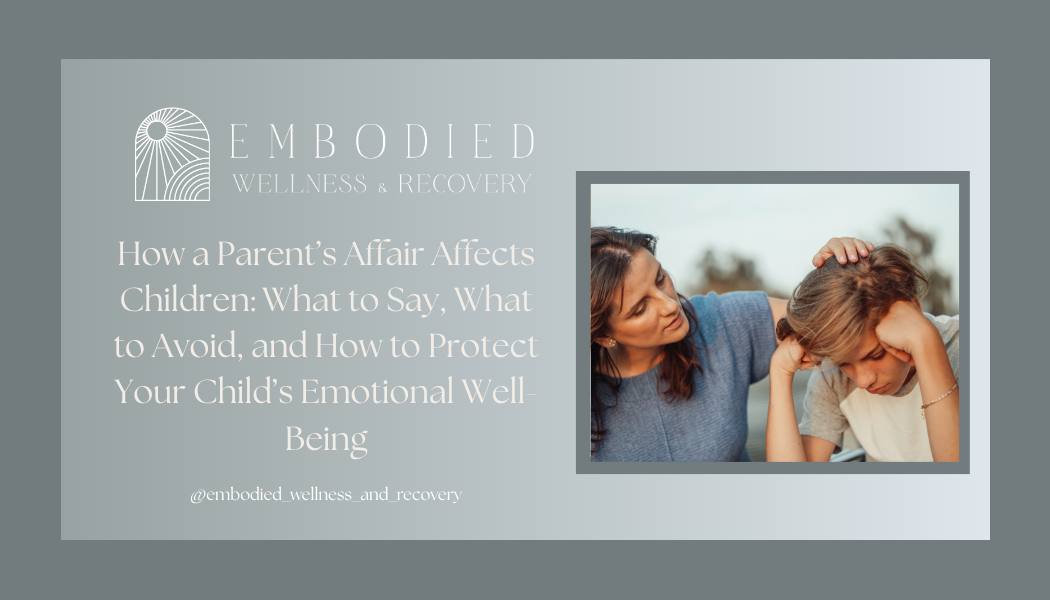
How a Parent’s Affair Affects Children: What to Say, What to Avoid, and How to Protect Your Child’s Emotional Well-Being
How a Parent’s Affair Affects Children: What to Say, What to Avoid, and How to Protect Your Child’s Emotional Well-Being
How does a parent’s affair affect children? Learn the psychological and neurological impact of infidelity on kids, plus evidence-based guidance for disclosure, co-parenting, and helping children feel safe, secure, and supported.
You may be asking yourself questions that feel impossible to answer.
Should we tell the kids about the affair?
If we do, how much do they need to know?
Will this damage their sense of safety or trust?
What if they blame themselves?
What if this changes how they see both of us?
When a parent discovers infidelity, the pain is profound. And alongside that pain is often a deep concern for how the disclosure will impact the children.
At Embodied Wellness and Recovery, we work with individuals, couples, and families navigating the aftermath of betrayal. One of the most important things to understand is this:
Children are not only affected by the affair itself, but by how it is handled, communicated, and processed within the family system.
The Psychological Impact of Infidelity on Children
Children do not need to know explicit details to feel that something has changed.
They are highly attuned to:
— Emotional tension
— Shifts in communication
— Changes in availability or mood
— Disruptions in routine
Research shows that exposure to parental conflict and instability can significantly impact a child’s emotional development, leading to increased anxiety, depression, and behavioral challenges (Cummings & Davies, 2010).
When an affair is disclosed, children may experience:
— Confusion about what is happening
— Fear about family stability
— Sadness or anger toward one or both parents
— Loyalty conflicts
— Changes in trust
You might be wondering:
Will telling them hurt them more than not telling them?
Is it better to protect them from the truth?
The answer is not simply whether you disclose, but how you disclose.
The Neuroscience of Safety and Attachment
From a neuroscience perspective, a child’s brain is wired to seek safety and predictability within their caregiving relationships. When something disrupts that system, such as infidelity or conflict, the child’s nervous system may interpret it as a threat.
This can activate:
— The amygdala, increasing fear and vigilance
— Emotional dysregulation
Repeated exposure to relational instability can, over time, affect attachment security and emotional regulation (Siegel, 2012).
Children may not fully understand the situation cognitively, but their bodies register:
Something is not right.Something has changed.Am I still safe?
How Children Interpret an Affair
Children often fill in gaps with their own interpretations.
Depending on age and developmental stage, they may think:
— “Is this my fault?”
— “Are my parents going to separate?”
— “Can I trust relationships?”
— “Do people I love leave or betray each other?”
Without guidance, these internal narratives can shape their future beliefs about:
— Trust
— Intimacy
Research on attachment suggests that early relational disruptions influence how individuals form connections later in life (Bowlby, 1988).
Should You Tell Your Children About the Affair?
There is no one-size-fits-all answer, but most clinical and research-informed perspectives agree on this:
Children benefit from age-appropriate honesty combined with emotional safety.
Avoiding the topic entirely can lead to:
— Confusion
— Increased anxiety
— Misinterpretation of events
At the same time, oversharing or exposing children to adult-level details can be overwhelming and harmful.
What to Say (and What to Avoid)
What Helps
— Keep the explanation simple and age-appropriate
— Focus on the stability of the child’s world
— Reassure them that they are not responsible
— Emphasize that both parents love them
Example:
“Something has happened between us that we are working through. It is not your fault. We both love you and are here for you.”
What to Avoid
— Blaming or criticizing the other parent
— Sharing explicit details about the affair
— Using the child as emotional support
— Involving them in adult conflict
Even if there is justified anger or pain, protecting the child from triangulation is essential for their emotional well-being.
The Role of Parental Regulation
Children co-regulate with their parents. This means your nervous system influences theirs. If you are overwhelmed, dysregulated, or emotionally reactive, your child is more likely to feel unsafe or unsettled. This does not mean you need to be perfect. It means that supporting your own healing is part of supporting your child.
Long-Term Effects of Infidelity on Children
When not addressed thoughtfully, exposure to betrayal and relational instability can contribute to:
— Difficulty trusting others
— Fear of abandonment
— Anxiety in relationships
— Avoidance of intimacy
However, this is not inevitable.
Research suggests that children can maintain emotional health when they have:
— At least one stable, attuned caregiver
— Consistent routines
— Space to express their feelings
— Appropriate support (Amato, 2010)
How to Support Your Child Through This
1. Maintain Predictability
Consistency in routines helps signal safety to the nervous system.
2. Invite Emotional Expression
Let them know it is okay to feel:
— Sad
— Confused
— Angry
Without needing to fix or minimize those feelings.
3. Reassure Stability
Remind them:
— They are loved
— They are safe
— The situation is not their responsibility
4. Model Healthy Communication
How you and your partner navigate this will shape your child’s understanding of conflict and repair.
5. Consider Professional Support
Therapy can provide a safe space for both children and parents to process what is happening.
A Trauma-Informed Perspective
At Embodied Wellness and Recovery, we view infidelity not only as a relational rupture between partners but as an experience that can impact the entire family system.
Through somatic therapy, EMDR, and attachment-focused work, we help families:
— Regulate the nervous system
— Process emotional pain safely
— Rebuild trust and connection
— Support children in making sense of their experience
Because what matters most is not that hardship occurred.
It is how it is understood, integrated, and repaired over time.
Moving through It
If you are navigating betrayal and trying to protect your child at the same time, the weight of those decisions can feel overwhelming. You may not get every step perfect.
But what matters most is your willingness to:
— Approach your child with honesty and care
— Create emotional safety
— Seek support when needed
Children are deeply perceptive. They feel what is happening. With the right support, they can move through it in a way that preserves their sense of safety, connection, and trust.
Reach out to schedule a complimentary 20-minute consultation with our team of therapists, trauma specialists, somatic practitioners, or relationship experts, and start working towards integrative, embodied healing today.
📞 Call us at (310) 651-8458
📱 Text us at (310) 210-7934
📩 Email us at admin@embodiedwellnessandrecovery.com
🔗 Visit us at www.embodiedwellnessandrecovery.com
👉 Check us out on Instagram @embodied_wellness_and_recovery
🌍 Explore our offerings at Linktr.ee: https://linktr.ee/laurendummit
References
1) Amato, P. R. (2010). Research on divorce: Continuing trends and new developments. Journal of Marriage and Family, 72(3), 650–666.
2) Bowlby, J. (1988). A secure base: Parent-child attachment and healthy human development. Basic Books.
3) Cummings, E. M., & Davies, P. T. (2010). Marital conflict and children: An emotional security perspective. Guilford Press.
4) Siegel, D. J. (2012). The developing mind: How relationships and the brain interact to shape who we are (2nd ed.). Guilford Press.
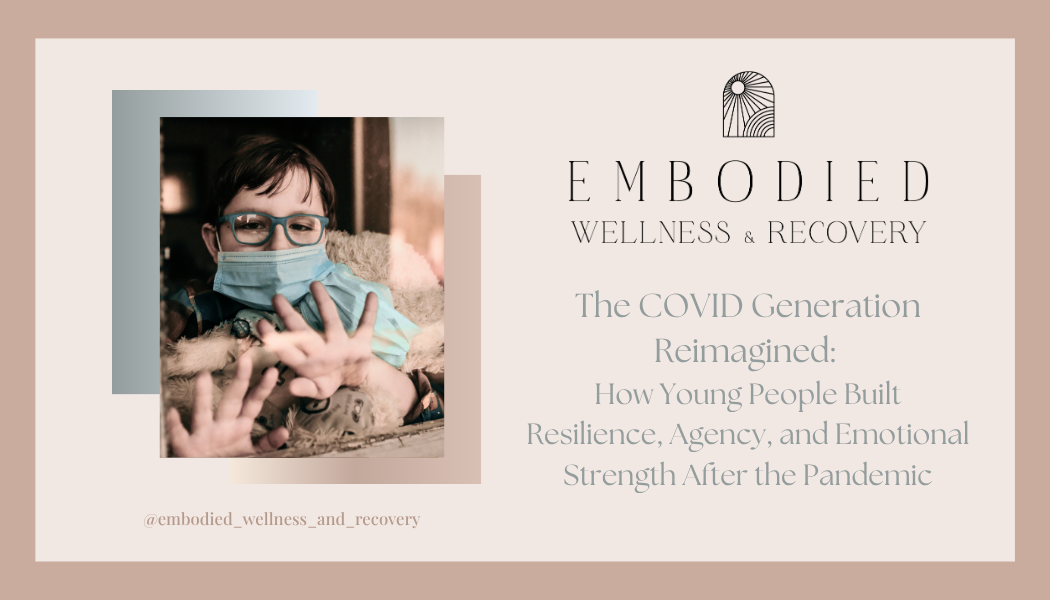
The COVID Generation Reimagined: How Young People Built Resilience, Agency, and Emotional Strength After the Pandemic
The COVID Generation Reimagined: How Young People Built Resilience, Agency, and Emotional Strength After the Pandemic
A neuroscience-informed, research-backed look at how the COVID generation may be stronger than we think. Explore youth resilience, post-traumatic growth, and how therapy can support young people in integrating their pandemic experiences into emotional strength and purpose.
A Different Story About the “COVID Generation”
For years, the dominant narrative has been clear.
Young people who came of age during the pandemic have been described as:
— Socially delayed
— Anxious and overwhelmed
— Academically disrupted
— Emotionally fragile
And to some extent, these concerns are real. Rates of anxiety, depression, and loneliness among adolescents and young adults increased during and after the COVID-19 pandemic (Loades et al., 2020).
But what if this is only part of the story? What if we have overlooked something equally important?
What if, alongside stress and disruption, many young people also developed:
— Adaptability
— Emotional awareness
— Resilience under pressure
— A deeper sense of purpose
Sociologist Lori Peek has spent her career studying how disasters impact children and youth. Her research offers a powerful reframe:
Young people are not just shaped by crisis. They are also capable of rising within it.
The Hidden Psychological Impact of Growing Up During Crisis
If you were a teenager or young adult during the pandemic, you likely experienced something profound.
— Isolation from peers
— Loss of milestones
— Uncertainty about the future
— Exposure to constant global stress
You may still find yourself asking:
— Why do I feel different now?
— Why does connection sometimes feel harder?
— Why do I feel both stronger and more exhausted at the same time?
From a neuroscience perspective, these responses make sense.
The adolescent brain is still developing, particularly in areas responsible for:
— Emotional regulation
— Risk assessment
Chronic stress during this period can alter how the brain processes threat and safety (McEwen, 2007). But the brain is also highly adaptable, and this is where the story shifts.
Resilience Is Not What You Think
Resilience is often misunderstood as the ability to “bounce back.” But research suggests something more nuanced.
Resilience is the ability to:
— Adapt to adversity
— Integrate difficult experiences
— Continue developing in meaningful ways
Studies on youth exposed to disasters show that many develop increased:
— Problem-solving skills
— Empathy
— Social awareness
— Sense of responsibility (Masten and Narayan, 2012)
This aligns with sociologist Lori Peek’s findings that young people often demonstrate active agency during crises. They do not just endure. They participate, respond, and contribute.
The Emergence of Agency in the COVID Generation
For some young people, the pandemic was not only destabilizing; it was awakening.
They began to ask:
— What matters most?
— What kind of world do I want to live in?
— What role do I want to play?
This shift toward meaning-making is consistent with research on post-traumatic growth, which describes positive psychological change following adversity (Tedeschi and Calhoun, 2004).
Examples of this growth include:
— Increased personal strength
— Greater appreciation for life
— Deeper relationships
— A stronger sense of purpose
You may recognize this in yourself or in the young people around you.
A Generation Shaped by Awareness
Today’s youth have grown up not only with the pandemic, but also with:
— Climate anxiety
— Exposure to global crises
— Awareness of social injustice
— Concerns about safety and violence
This has created a generation that is:
— Highly informed
— Emotionally attuned
— Socially conscious
While this awareness can be overwhelming, it also fosters:
👉 Critical thinking
👉 Empathy
👉 Motivation for change
These are not signs of fragility. They are signs of engagement.
The Nervous System Perspective
Even with these strengths, it is important to understand the physiological impact of prolonged stress. The nervous system of many young people has adapted to a world that feels unpredictable.
This can show up as:
— Anxiety or hypervigilance
— Difficulty relaxing
— Emotional reactivity
— Periods of shutdown or numbness
From a polyvagal perspective, the body may move between:
— Sympathetic activation (fight or flight)
— Dorsal shutdown (freeze or withdrawal)
These are adaptive responses. They are not dysfunction, but they do require support to integrate.
Why Strength and Struggle Can Coexist
One of the most important reframes is this: strength and struggle are not opposites.
A young person can be:
— Resilient and overwhelmed
— Insightful and anxious
— Capable and still processing
This duality is often missed in public narratives, but it is essential for understanding the full picture.
How to Support Integration and Growth
If you are a young person navigating the aftermath of the pandemic, or a parent or clinician supporting one, the goal is not to erase what happened.
It is to integrate it.
1. Validate the Full Experience
Avoid minimizing or overpathologizing.
Instead, acknowledge:
— What was lost
— What was learned
— What is still being processed
2. Support Nervous System Regulation
Practices that help the body feel safe are foundational.
These include:
— Breathwork
— Somatic awareness
— Grounding exercises
These approaches help shift the nervous system out of chronic activation.
3. Encourage Meaning-Making
Reflection can transform experience into growth.
Questions like:
— What did this time teach you about yourself?
— What matters more to you now?
— How have you changed?
These support identity development and integration.
4. Foster Connection
Social reconnection is critical. Even if it feels unfamiliar at times, relational experiences help regulate the nervous system and rebuild trust.
5. Seek Trauma-Informed Support
At Embodied Wellness and Recovery, we work with adolescents and young adults through a neuroscience-informed, somatic lens. We understand that healing is not just about talking.
It involves:
— The body
— The nervous system
— Emotional processing
Our approach integrates:
— EMDR
— Attachment-based work
This allows young people not only to process what they have been through but also to build capacity for what comes next.
A More Balanced Narrative
The “COVID generation” is often framed through a deficit lens, but this perspective is incomplete. Yes, there has been loss. Yes, there has been disruption.
But there has also been:
— Growth
— Awareness
— Resilience
— Emerging purpose
Young people today are not simply shaped by crisis. They are actively shaping themselves in response to it.
The Foundation of Resilience in a Changing World
If you are part of this generation, or supporting someone who is, it is worth asking, “What if the challenges you faced did not only take something from you? What if they also revealed something within you?”
The capacity to adapt.To reflect.To care deeply.To respond.
These are not small things. They are the foundation of resilience in a changing world.
Reach out to schedule a complimentary 20-minute consultation with our team of therapists, trauma specialists, somatic practitioners, or relationship experts, and start working towards integrative, embodied healing today.
📞 Call us at (310) 651-8458
📱 Text us at (310) 210-7934
📩 Email us at admin@embodiedwellnessandrecovery.com
🔗 Visit us at www.embodiedwellnessandrecovery.com
👉 Check us out on Instagram @embodied_wellness_and_recovery
🌍 Explore our offerings at Linktr.ee: https://linktr.ee/laurendummit
References
Loades, M. E., Chatburn, E., Higson-Sweeney, N., et al. (2020). Rapid systematic review: The impact of social isolation and loneliness on the mental health of children and adolescents in the context of COVID-19. Journal of the American Academy of Child and Adolescent Psychiatry, 59(11), 1218–1239.
Masten, A. S., and Narayan, A. J. (2012). Child development in the context of disaster, war, and terrorism. Annual Review of Psychology, 63, 227–257.
McEwen, B. S. (2007). Physiology and neurobiology of stress and adaptation. Physiological Reviews, 87(3), 873–904.
Peek, L. (2008). Children and disasters: Understanding vulnerability, developing capacities, and promoting resilience. Children, Youth and Environments, 18(1), 1–29.
Tedeschi, R. G., and Calhoun, L. G. (2004). Posttraumatic growth: Conceptual foundations and empirical evidence. Psychological Inquiry, 15(1), 1–18.