
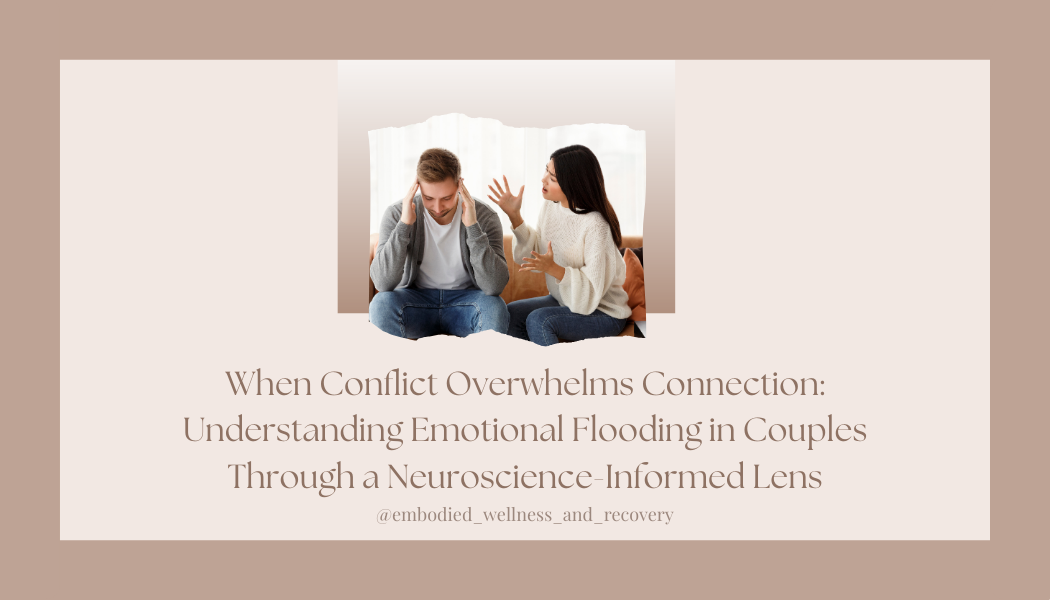
When Conflict Overwhelms Connection: Understanding Emotional Flooding in Couples Through a Neuroscience-Informed Lens
When Conflict Overwhelms Connection: Understanding Emotional Flooding in Couples Through a Neuroscience-Informed Lens
Learn what emotional flooding in couples is, why it happens during conflict, and how neuroscience-informed therapy helps restore safety and connection.
Have you ever found yourself in a disagreement with your partner where everything suddenly feels too much? Your heart races, your thoughts scatter, your body tightens, and words either spill out sharply or disappear altogether. Later, you may struggle to remember what was said, only that the conversation ended badly.
Many couples describe this experience as feeling hijacked, shut down, or out of control. This is not a communication failure. It is often emotional flooding, a nervous system response that makes constructive connection nearly impossible in the moment.
At Embodied Wellness and Recovery, we work with couples who care deeply about each other yet feel trapped in cycles of conflict fueled by emotional flooding. Understanding what flooding is and why it happens is a critical step toward repairing trust, intimacy, and emotional safety.
What Is Emotional Flooding in Relationships?
Emotional flooding occurs when the nervous system becomes overwhelmed during conflict. The body interprets relational distress as threat and shifts into survival mode.
This can look like:
— Rapid heartbeat or shallow breathing
— Feeling suddenly angry, panicked, or numb
— Losing access to language or logical thinking
— Becoming defensive, reactive, or withdrawn
— Wanting to escape the conversation at all costs
Flooding makes it difficult to listen, empathize, or problem-solve. Even well-intentioned conversations can escalate quickly once this threshold is crossed.
Why Emotional Flooding Happens in Couples
From a neuroscience perspective, emotional flooding is driven by the autonomic nervous system. When a relationship conflict activates perceived threat, the amygdala signals danger, and the body releases stress hormones. At the same time, the prefrontal cortex, which supports reasoning, empathy, and perspective, becomes less accessible. The nervous system prioritizes protection over connection.
For many people, relationship conflict is not just about the present moment. It taps into earlier experiences of rejection, abandonment, betrayal, or emotional neglect. The body responds as if the stakes are much higher than the immediate disagreement.
Common Triggers for Emotional Flooding
Emotional flooding is highly personal. Triggers often relate to attachment wounds or unresolved trauma.
Common triggers include:
— Feeling criticized or blamed
— Perceived withdrawal or emotional distance
— Raised voices or sharp tone
— Feeling misunderstood or dismissed
— Threats to the relationship or future
— Conversations about sex, money, or trust
One partner may flood quickly, while the other may appear calm or detached. This difference often leads to misunderstanding rather than compassion.
Emotional Flooding and Attachment Styles
Attachment patterns play a significant role in how flooding shows up. Anxiously attached partners may experience flooding as panic, urgency, or emotional overwhelm. They may pursue connection with intensity, fearing loss or abandonment.
Avoidantly attached partners may experience flooding as shutdown, numbness, or irritation. They may withdraw to restore a sense of control or safety.
Both responses are protective. Neither reflects a lack of care.
The Impact of Flooding on Communication
Once emotional flooding sets in, communication becomes distorted.
Partners may:
— Interrupt or escalate
— Say things they later regret
— Misinterpret neutral statements as hostile
— Shut down or stonewall
— Struggle to repair after conflict
Repeated flooding can erode trust and intimacy. Couples may either avoid difficult topics altogether or assume that conflict will always end badly.
Why Talking It Through Does Not Work During Flooding
Many couples are told to communicate better, use I statements, or stay calm. While these tools are helpful, they are ineffective when the nervous system is overwhelmed. Flooding is a physiological state, not a cognitive choice. Asking someone to reason while flooded is like asking them to swim while their body is stuck in freeze. Effective repair requires regulation before resolution.
Emotional Flooding and Trauma
Trauma history increases vulnerability to flooding. When earlier experiences taught the nervous system that closeness is dangerous or unpredictable, adult relationships can activate survival responses.
This is especially relevant in couples navigating:
— Childhood emotional neglect
— Betrayal or infidelity
— Sexual trauma
— Chronic conflict or emotional invalidation
Flooding is not a sign that a relationship is doomed. It is a sign that the nervous system needs support.
What Helps When Emotional Flooding Occurs
Healing emotional flooding does not mean eliminating conflict. It means learning how to recognize and respond to nervous system activation with care.
Helpful strategies include:
1. Naming Flooding Without Blame
Simply acknowledging what is happening can reduce escalation. Statements like "I feel overwhelmed and need a pause" shift the focus from winning to safety.
2. Taking Regulated Breaks
A break is effective only if it includes regulation. Walking, breathing slowly, or grounding the body helps stress hormones settle.
3. Returning When Both Systems Are Calmer
Repair conversations are far more successful once both partners have access to curiosity and empathy again.
4. Building Awareness of Early Signals
Learning to notice early signs of flooding enables couples to intervene before it escalates.
5. Practicing Co-Regulation
Safe eye contact, slower speech, and gentle tone can help nervous systems settle together.
How Couples Therapy Helps Address Emotional Flooding
At Embodied Wellness and Recovery, couples therapy focuses on the nervous system, not just behavior.
Our approach helps couples:
— Understand their unique flooding triggers
— Track bodily cues in real time
— Build tolerance for emotional intensity
— Repair attachment injuries
— Restore safety in conversations about intimacy, sexuality, and trust
When the nervous system feels safer, emotional expression becomes more flexible and connection more resilient.
Emotional Flooding and Sexual Intimacy
Flooding often impacts sexual connection. When the nervous system associates closeness with threat, desire, and arousal can shut down.
Couples may struggle with:
— Mismatched desire
— Avoidance of touch after conflict
— Feeling unsafe being vulnerable
— Confusion about consent and pacing
Trauma-informed couples therapy helps partners rebuild embodied safety so intimacy can emerge without pressure.
A Hopeful Perspective
If emotional flooding shows up in your relationship, it does not mean you are incompatible or that you are failing. It means your nervous system is reacting to a perceived threat. With understanding, regulation, and support, couples can learn to move through conflict with greater steadiness and care. Emotional flooding can become a signal to slow down rather than a force that drives partners apart.
Working With Embodied Wellness and Recovery
At Embodied Wellness and Recovery, we specialize in trauma-informed, neuroscience-based couples therapy. We support partners in healing nervous system patterns that interfere with communication, intimacy, and emotional connection. Our work integrates attachment theory, somatic therapy, and relational neuroscience to help couples create safer, more responsive relationships.
Reach out to schedule a complimentary 20-minute consultation with our team of therapists, trauma specialists, somatic practitioners, or relationship experts, and start working towards integrative, embodied healing today.
📞 Call us at (310) 651-8458
📱 Text us at (310) 210-7934
📩 Email us at admin@embodiedwellnessandrecovery.com
🔗 Visit us at www.embodiedwellnessandrecovery.com
👉 Check us out on Instagram @embodied_wellness_and_recovery
🌍 Explore our offerings at Linktr.ee: https://linktr.ee/laurendummit
References
1) Gottman, J. M., & Gottman, J. S. (2015). 10 principles for doing effective couples therapy. W. W. Norton & Company.
2) Johnson, S. M. (2019). Attachment theory in practice: Emotionally focused therapy with individuals, couples, and families. Guilford Press.
3) Porges, S. W. (2011). The polyvagal theory: Neurophysiological foundations of emotions, attachment, communication, and self-regulation. W. W. Norton & Company.
4) van der Kolk, B. A. (2014). The body keeps the score: Brain, mind, and body in the healing of trauma. Viking
Trauma and the Habit of Minimizing Harm: Why It Develops and How the Nervous System Learns to Tell the Truth Again
Trauma and the Habit of Minimizing Harm: Why It Develops and How the Nervous System Learns to Tell the Truth Again
Explore how trauma shapes the habit of minimizing harm, why the nervous system does this, and how trauma-informed therapy supports lasting repair.
Many people living with unresolved trauma carry a quiet, confusing habit. They downplay what happened. They soften the language. They compare their pain to others' and decide it wasn't that bad. They minimize harm even as their bodies continue to react with anxiety, shutdown, hypervigilance, or disconnection.
You might recognize this pattern in thoughts like:
— Other people had it worse.
— It was not abuse, just difficult.
— I should be over this by now.
— It did not affect me that much.
— I am probably exaggerating.
If this sounds familiar, it is not a sign of denial or weakness. It is often a trauma adaptation rooted in the nervous system.
At Embodied Wellness and Recovery, we see minimizing harm as one of the most common and misunderstood trauma responses. Understanding why it develops is a crucial step toward restoring emotional truth, nervous system regulation, and relational safety.
What Does Minimizing Harm Mean in Trauma Recovery?
Minimizing harm refers to the tendency to reduce, dismiss, or intellectualize painful experiences, even when their impact remains in the body and nervous system.
This can show up as:
— Rationalizing neglect, emotional abuse, or boundary violations
— Using humor or logic to deflect pain
— Struggling to name experiences as traumatic
— Feeling guilty for having symptoms
— Questioning whether therapy is justified
Minimization often coexists with significant trauma symptoms such as anxiety, depression, dissociation, relationship struggles, sexual difficulties, and chronic self-doubt.
Why the Nervous System Minimizes Trauma
From a neuroscience perspective, trauma is not defined by the event itself but by how the nervous system processes and contains it.
When a person experiences threat without sufficient support, the brain prioritizes survival. The amygdala detects danger. Stress hormones flood the body. The prefrontal cortex, which is responsible for meaning-making and perspective-taking, often goes offline.
If acknowledging harm would have threatened attachment, safety, or stability, the nervous system adapted by minimizing it.
This is especially common in situations involving:
— Childhood emotional neglect
— Inconsistent or unsafe caregivers
— Chronic relational stress
— Coercive control or subtle boundary violations
— Experiences where speaking up was punished or ignored
Minimization helped maintain connection, predictability, or emotional survival.
Minimizing Harm as an Attachment Strategy
For many people, minimizing harm is deeply tied to attachment.
If a child depended on caregivers who were emotionally unavailable, volatile, or dismissive, acknowledging pain could have risked abandonment or escalation. The nervous system learned that staying quiet, agreeable, or self-blaming was safer.
As adults, this can translate into:
— Difficulty trusting one’s own perceptions
— Over-functioning in relationships
— Tolerating harmful dynamics
— Suppressing anger or grief
— Confusion about boundaries and consent
This pattern often shows up in dating, long-term relationships, and sexual intimacy, where needs feel dangerous to express.
The Cost of Minimizing Harm Over Time
While minimizing harm may have once served a protective function, it often comes at a cost.
Over time, it can:
— Keep the nervous system in a state of unresolved activation
— Block emotional processing and integration
— Increase shame and self-criticism
— Undermine self-trust
— Create patterns of reenactment in relationships
— Contribute to sexual shutdown or dissociation
Many people arrive in therapy saying, I do not know why I feel this way. Nothing that bad happened. Their bodies tell a different story.
Why Insight Alone Does Not Resolve Minimization
Minimizing harm is not simply a cognitive habit. It is a nervous system pattern.
Even when someone intellectually understands that their experiences mattered, the body may still react with:
— Tightness when speaking about the past
— Emotional numbness
— Sudden anxiety or shutdown
— A strong urge to change the subject
This is because trauma is stored in subcortical regions of the brain that operate beneath conscious awareness. Healing requires bottom-up approaches that include sensation, emotion, and relational safety.
The Role of Shame in Minimizing Trauma
Shame often fuels minimization.
Trauma-related shame says:
— I am weak for being affected.
— I should have known better.
— I am overreacting.
— My needs are too much.
Shame narrows attention and reinforces silence. From a neurobiological perspective, shame activates threat circuits and inhibits social engagement.
This makes it harder to speak honestly about harm, even in supportive environments.
What Changes When Harm Is No Longer Minimized
Accurately naming harm does not mean dwelling on the past or assigning blame. It means allowing the nervous system to update.
When harm is acknowledged within a safe therapeutic relationship, several shifts become possible:
— The body no longer has to carry the truth alone
— Emotional responses begin to organize rather than overwhelm
— Boundaries become clearer
— Self-trust strengthens
— Symptoms begin to make sense
This is not about reliving trauma. It is about completing interrupted processing.
How Trauma-Informed Therapy Supports This Shift
At Embodied Wellness and Recovery, we approach minimization with respect and curiosity rather than confrontation.
Effective trauma therapy helps clients:
— Recognize minimization as a protective adaptation
— Build nervous system capacity before exploring content
— Track bodily responses to truth-telling
— Titrate emotional awareness gradually
— Integrate sensation, affect, and meaning
— Repair attachment wounds through relational safety
This process allows truth to emerge at a pace the nervous system can tolerate.
Trauma, Minimization, and Sexuality
Minimizing harm is especially common in the realm of sexuality and intimacy.
People may minimize:
— Sexual coercion
— Emotional pressure
— Violations of consent
— Chronic disconnection or obligation
— Loss of desire rooted in fear or shutdown
This can lead to confusion around desire, arousal, and boundaries. Trauma-informed sex therapy helps untangle these patterns by addressing both nervous system responses and relational meaning.
A Hopeful Reframe
If you have minimized harm, it means your nervous system found a way to survive. That strategy deserves compassion, not judgment.
The goal of healing is not to force recognition before the system is ready. It is to create enough safety that honesty no longer feels dangerous.
When the nervous system feels supported, truth becomes relieving rather than overwhelming.
Working With Embodied Wellness and Recovery
At Embodied Wellness and Recovery, we specialize in trauma-informed, neuroscience-based therapy for individuals and couples. Our work focuses on nervous system repair, attachment healing, sexuality, intimacy, and relational safety.
We help clients move from self-doubt toward embodied clarity, from minimization toward integration, and from survival-based coping toward grounded connection.
Reach out to schedule a complimentary 20-minute consultation with our team of therapists, trauma specialists, somatic practitioners, or relationship experts, and start working towards integrative, embodied healing today.
📞 Call us at (310) 651-8458
📱 Text us at (310) 210-7934
📩 Email us at admin@embodiedwellnessandrecovery.com
🔗 Visit us at www.embodiedwellnessandrecovery.com
👉 Check us out on Instagram @embodied_wellness_and_recovery
🌍 Explore our offerings at Linktr.ee: https://linktr.ee/laurendummit
References
1) Herman, J. L. (1992). Trauma and recovery. Basic Books.
2) Levine, P. A. (2010). In an unspoken voice: How the body releases trauma and restores goodness. North Atlantic Books.
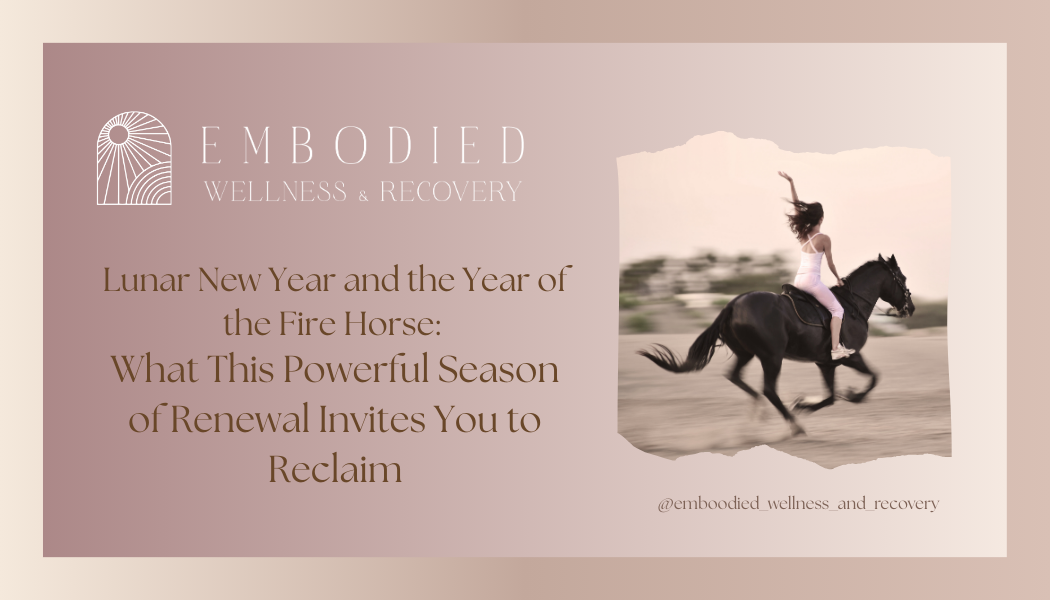
Lunar New Year and the Year of the Fire Horse: What This Powerful Season of Renewal Invites You to Reclaim
Lunar New Year and the Year of the Fire Horse: What This Powerful Season of Renewal Invites You to Reclaim
Explore Lunar New Year and the Year of the Fire Horse 2026. Learn what this powerful zodiac year symbolizes and how it supports renewal, confidence, and growth.
Lunar New Year, which began last Tuesday, marks one of the most meaningful and widely celebrated holidays across Asian cultures around the world. Observed through family reunions, ritual meals, temple visits, vibrant red decorations, and time-honored traditions, the Lunar New Year is both a cultural celebration and a psychological turning point. It invites reflection, renewal, and the symbolic clearing away of what no longer serves.
In 2026, Lunar New Year ushers in the Year of the Fire Horse, running from February 17, 2026, through February 5, 2027, on the Gregorian calendar. In Chinese astrology, this is a rare and potent combination. The Horse represents movement, independence, intelligence, and confidence. Fire amplifies energy, passion, charisma, and ambition.
Together, the Fire Horse signals a year of momentum, visibility, and forward motion. But what does that mean if you feel stuck, uncertain, or disconnected from your sense of direction? What if confidence feels far away, or optimism feels earned rather than natural?
At Embodied Wellness and Recovery, we view cultural milestones like the Lunar New Year not as predictions, but as psychological invitations. Moments that allow the nervous system to orient toward possibility, reset patterns, and imagine change from a grounded place.
Why Lunar New Year Matters Psychologically
Across cultures, seasonal transitions help regulate the nervous system. Neuroscience shows that humans are biologically attuned to cycles. Endings and beginnings offer structure, meaning, and a sense of orientation (Kleitman, N., 1949).
Lunar New Year marks the transition into spring. Light increases. Activity returns. Energy begins to rise.
When people feel stagnant, helpless, or unsure of themselves, it is often not because they lack insight, but because their nervous systems have adapted to prolonged stress, uncertainty, or emotional constraint. Rituals of renewal offer the brain something it craves: predictable moments of reset.
This is why Lunar New Year traditions emphasize:
— Clearing and cleaning the home
— Wearing red to symbolize vitality and protection
— Gathering with family and community
— Honoring ancestors and continuity
— Preparing foods associated with abundance and luck
These practices support emotional regulation, social connection, and embodied hope.
Understanding the Fire Horse in Chinese Astrology
In the Chinese zodiac, the Horse is associated with:
— Confidence and independence
— Intelligence and quick thinking
— Freedom, movement, and exploration
— Leadership and visibility
Fire, as an element, intensifies these qualities. It represents:
— Passion and vitality
— Creativity and expression
— Motivation and ambition
— Transformation through action
The Year of the Fire Horse is often associated with bold decisions, increased energy, and a desire to live more authentically. For some, this feels exhilarating. For others, especially those carrying trauma or long-term stress, increased energy can feel destabilizing rather than empowering.
This is where nervous system awareness becomes essential.
When Confidence Feels Out of Reach
Many people silently struggle with questions like:
— Why do others seem to move forward while I feel stuck?
— Why does confidence feel performative rather than embodied?
— Why do I know what I want intellectually but feel unable to act?
— Why does independence feel scary instead of freeing?
From a trauma-informed perspective, stagnation is not a personal flaw. It is often a protective state. When the nervous system has learned that visibility, risk, or desire once led to disappointment, rejection, or harm, it may prioritize safety over growth. In these cases, invitations like the Fire Horse year can stir both longing and fear.
The work is not to force momentum, but to support the system in feeling safe enough to move.
Fire Horse Energy Through a Neuroscience Lens
The Fire Horse symbolizes activation. From a neuroscience perspective, healthy activation occurs when the nervous system can move fluidly between states of rest and action. Chronic stress, trauma, or attachment wounds can disrupt this flexibility, leaving people oscillating between shutdown and overdrive, or stuck in one state altogether.
Supporting Fire Horse energy in a sustainable way means:
— Increasing capacity before increasing demand
— Reconnecting to bodily cues rather than overriding them
— Pairing ambition with regulation
— Allowing confidence to emerge from integration rather than pressure
Confidence that is embodied feels calm, grounded, and responsive. Confidence that is forced often feels brittle and exhausting.
What the Year of the Fire Horse Invites Psychologically
Rather than asking, What should I accomplish this year? A more nervous system-friendly question is:
What part of me is ready to come back online?
The Fire Horse year invites:
— Reclaiming agency after periods of helplessness
— Revisiting desires that were once suppressed
— Allowing passion without self-judgment
— Exploring independence without abandoning connection
— Taking steps forward that honor both courage and safety
This is particularly relevant in relationships, dating, sexuality, and intimacy, where confidence is deeply tied to vulnerability.
Checking Your Chinese Zodiac
Your Chinese zodiac sign is determined by your birth year and cycles every 12 years. Each sign interacts differently with the Fire Horse year.
For some signs, this year supports expansion and visibility. For others, it emphasizes discernment, grounding, and pacing. Regardless of sign, the broader invitation remains the same: align action with regulation.
When the nervous system feels supported, astrology becomes a mirror rather than a mandate.
Rituals for the Fire Horse Year That Support Emotional Health
You do not need to follow every tradition to benefit from Lunar New Year energy. Small, intentional practices can be deeply regulating.
Consider:
— Decluttering one space to symbolize release
— Wearing red or warm colors to cue vitality
— Setting one intention rooted in embodiment rather than achievement
— Sharing a meaningful meal with others
— Reflecting on what independence means to you now, not in the past
These practices send subtle signals of renewal to the brain.
When Feeling Stuck Has a Deeper Root
If stagnation persists despite intention, it may reflect unresolved trauma or nervous system dysregulation rather than a lack of motivation.
At Embodied Wellness and Recovery, we help individuals explore how early experiences shape confidence, ambition, and self-trust. We work with clients to repair nervous system patterns that interfere with movement, connection, and pleasure. True momentum follows safety.
Lunar New Year as an Opportunity, Not a Demand
The Year of the Fire Horse is not asking you to become someone else. It is asking what wants to re-emerge when fear loosens its grip. Optimism does not come from positive thinking alone. It arises when the body senses possibility. Lunar New Year offers a culturally rich and biologically meaningful moment to orient toward that possibility.
Working With Embodied Wellness and Recovery
At Embodied Wellness and Recovery, we specialize in trauma-informed, neuroscience-based therapy that supports nervous system repair, relationships, sexuality, and intimacy. We help clients move from stagnation toward embodied confidence in ways that feel authentic and sustainable. The Fire Horse year reminds us that forward motion does not require urgency. It requires integration.
Reach out to schedule a complimentary 20-minute consultation with our team of therapists, trauma specialists, somatic practitioners, or relationship experts, and start working towards integrative, embodied healing today.
📞 Call us at (310) 651-8458
📱 Text us at (310) 210-7934
📩 Email us at admin@embodiedwellnessandrecovery.com
🔗 Visit us at www.embodiedwellnessandrecovery.com
👉 Check us out on Instagram @embodied_wellness_and_recovery
🌍 Explore our offerings at Linktr.ee: https://linktr.ee/laurendummit
References
1) Hsu, F. L. K. (1996). The Chinese zodiac: Ancient wisdom for modern life. HarperCollins.
2) Kleitman, N. (1949). Biological rhythms and cycles. Physiological reviews, 29(1), 1-30.
3) Levine, P. A. (2010). In an unspoken voice: How the body releases trauma and restores goodness. North Atlantic Books.
4) Porges, S. W. (2011). The polyvagal theory: Neurophysiological foundations of emotions, attachment, communication, and self-regulation. W. W. Norton & Company.
5) van der Kolk, B. A. (2014). The body keeps the score: Brain, mind, and body in the healing of trauma. Viking.
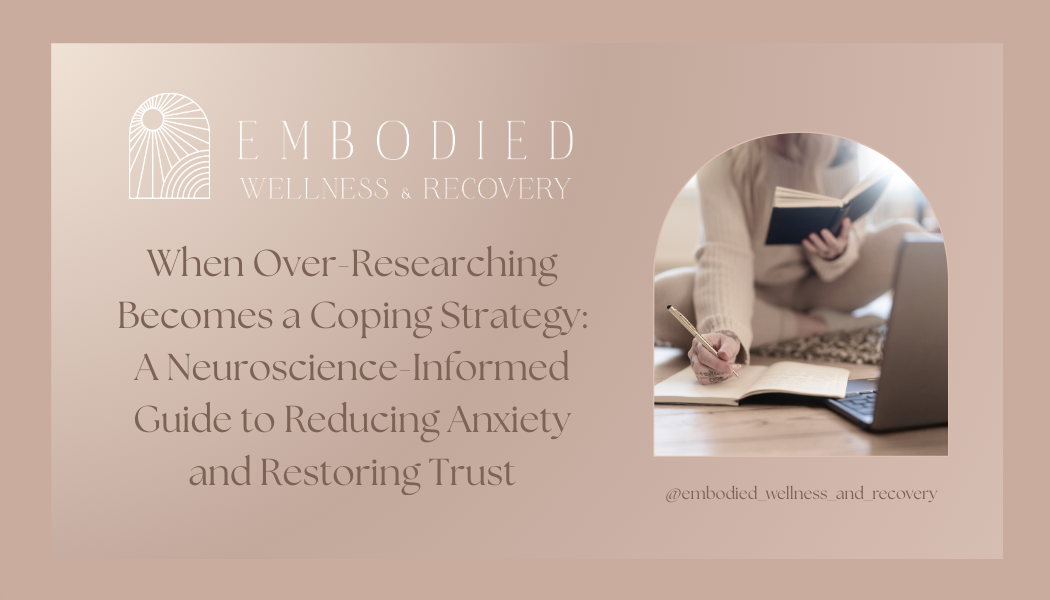
When Over-Researching Becomes a Coping Strategy: A Neuroscience-Informed Guide to Reducing Anxiety and Restoring Trust
When Over-Researching Becomes a Coping Strategy: A Neuroscience-Informed Guide to Reducing Anxiety and Restoring Trust
When researching becomes compulsive and fuels anxiety, learn how the nervous system drives over researching and what actually helps restore calm.
Have you ever noticed that the more you research something that worries you, the worse your anxiety becomes? You start with a reasonable question. A symptom. A relationship concern. A parenting fear. A dating uncertainty. An intimacy issue. Hours later, you are flooded with conflicting information, worst-case scenarios, and a nervous system that feels anything but reassured.
Many people come to therapy asking a version of this question: Why do I keep researching something that is clearly making me more anxious, and why does it feel so hard to stop? Over-researching is often misunderstood as curiosity or diligence. In reality, it is frequently a coping strategy driven by an activated nervous system, especially in people with trauma histories, chronic stress, or attachment wounds.
At Embodied Wellness and Recovery, we help clients understand not just what they are doing, but why their nervous system relies on this strategy and how to gently shift it.
What Is Over Researching Anxiety?
Over-researching, sometimes called compulsive researching or reassurance seeking, occurs when information gathering becomes repetitive, urgent, and emotionally driven rather than clarifying.
Common examples include:
— Googling symptoms late into the night and feeling worse afterward
— Repeatedly researching relationship advice after conflict
— Constantly reading about mental health diagnoses and self-monitoring
— Researching dating or attachment styles to predict rejection
— Seeking certainty through endless comparison and expert opinions
Instead of reducing anxiety, over-researching often amplifies fear, confusion, and self-doubt.
Why Over-Researching Feels So Compelling
From a neuroscience perspective, anxiety activates the amygdala, the brain’s threat detection system. When the amygdala senses danger, it signals the body to prepare for action. Heart rate increases. Muscles tense. Attention narrows.
The prefrontal cortex, which supports reasoning and perspective, tries to regain control. Researching feels like a logical solution. Information promises safety.
The problem is that trauma-conditioned nervous systems often mistake information for regulation.
Research becomes an attempt to:
— Predict and prevent harm
— Regain a sense of control
— Soothe uncertainty
— Avoid uncomfortable sensations or emotions
For a brief moment, researching can feel calming. Then the nervous system finds new threats,, and the cycle restarts.
When Researching Becomes a Trauma Response
Over researching is especially common in people who learned early that:
— Safety depended on being vigilant
— Caregivers were unpredictable or unavailable
— Mistakes had high emotional consequences
— Emotional needs were minimized or dismissed
In these contexts, the nervous system learns that knowing more equals being safer. As adults, this can manifest as intellectual overfunctioning paired with emotional overwhelm.
You may notice:
— Difficulty trusting your internal sense of knowing
— A drive to consult multiple sources before making decisions
— Fear of missing critical information
— Anxiety that escalates rather than settles
This is not a lack of insight. It is a nervous system that adapted to survive uncertainty.
The Cost of Over-Researching
While researching can feel productive, its long-term effects are often destabilizing.
Over time, it can:
— Increase anxiety and rumination
— Reduce confidence in personal judgment
— Reinforce hypervigilance
— Create paralysis in decision-making
— Undermine relational trust and intimacy
In relationships, over-researching attachment styles or dating advice can lead to constant self-analysis and monitoring of others rather than presence and connection.
In sexuality and intimacy, it can pull people out of embodied experience and into performance-based thinking.
How the Nervous System Gets Stuck in the Loop
The brain learns through repetition. Each time anxiety rises and researching follows, the nervous system pairs relief with information seeking.
This is a classic feedback loop:
1) Anxiety activates the threat response
2) Researching provides temporary relief
3) The brain reinforces researching as a coping strategy
4) Anxiety returns stronger due to information overload
Without intervention, the loop tightens.
What to Do When You Notice Over-Researching Taking Over
The goal is not to eliminate researching altogether. It is to shift from anxiety-driven researching to regulated decision-making.
1. Name What Is Happening in the Body
Before changing behavior, notice sensation.
Ask yourself:
— Where do I feel anxiety right now?
— Is there tightness, pressure, restlessness, or urgency?
Bringing attention to the body activates the insula and supports nervous system awareness. This interrupts automatic loops.
2. Pause Before Opening Another Tab
Create a brief pause. Even thirty seconds matters.
During the pause, ask:
— Am I seeking clarity or relief?
— Has this already made me more anxious today?
This is not about judgment. It is about restoring choice.
3. Shift From Information to Regulation
An anxious nervous system does not need more data. It needs safety cues.
Helpful regulation strategies include:
— Slow exhalations
— Gentle movement
— Grounding through the senses
— Brief social connection
— Warmth or hydration
As regulation increases, the urge to research often naturally decreases.
4. Limit Research Windows
Containment helps the nervous system feel safer.
Try:
— Setting a specific time limit
— Choosing one trusted source
— Writing down remaining questions instead of searching immediately
This builds tolerance for uncertainty, a core skill in anxiety reduction.
5. Rebuild Trust in Internal Signals
Trauma often teaches people to outsource authority. Healing involves reconnecting with internal wisdom.
Ask:
— What do I already know?
— What feels true in my body?
— What decision aligns with my values rather than fear?
This strengthens prefrontal integration and self-trust.
How Therapy Helps Address Over-Researching at the Root
In trauma-informed therapy, over-researching is not treated as a bad habit to eliminate. It is understood as a protective strategy.
At Embodied Wellness and Recovery, we help clients:
— Track nervous system states that trigger researching
— Build tolerance for uncertainty
— Repair attachment-based fear of getting it wrong
— Integrate somatic regulation with cognitive insight
— Address relational and developmental trauma driving hypervigilance
Over time, clients often report less urgency, improved emotional regulation, and greater confidence in relationships, dating, sexuality, and intimacy.
Helping Your Nervous System Feel Safe Enough
If you over-research, it means your nervous system is trying to protect you. It learned that vigilance once mattered. The work now is not to force yourself to stop, but to help your system feel safe enough that it no longer needs to work so hard.
Working With Embodied Wellness and Recovery
At Embodied Wellness and Recovery, we specialize in trauma-informed, neuroscience-based therapy that addresses anxiety, nervous system dysregulation, relationships, dating, sexuality, and intimacy. Our approach integrates somatic therapy, attachment theory, and relational work to help clients move from chronic vigilance toward grounded confidence and connection.
Reach out to schedule a complimentary 20-minute consultation with our team of therapists, trauma specialists, somatic practitioners, or relationship experts, and start working towards integrative, embodied healing today.
📞 Call us at (310) 651-8458
📱 Text us at (310) 210-7934
📩 Email us at admin@embodiedwellnessandrecovery.com
🔗 Visit us at www.embodiedwellnessandrecovery.com
👉 Check us out on Instagram @embodied_wellness_and_recovery
🌍 Explore our offerings at Linktr.ee: https://linktr.ee/laurendummit
References
1) Carleton, R. N. (2016). Fear of the unknown: One fear to rule them all. Journal of Anxiety Disorders, 41, 5 to 21.
2) Levine, P. A. (2010). In an unspoken voice: How the body releases trauma and restores goodness. North Atlantic Books.
3) Porges, S. W. (2011). The polyvagal theory: Neurophysiological foundations of emotions, attachment, communication, and self-regulation. W. W. Norton & Company.
4) van der Kolk, B. A. (2014). The body keeps the score: Brain, mind, and body in the healing of trauma. Viking.
Small Daily Habits That Support Depression Recovery: A Neuroscience-Informed Path Back to Motivation and Emotional Stability
Small Daily Habits That Support Depression Recovery: A Neuroscience-Informed Path Back to Motivation and Emotional Stability
Discover small daily habits that support depression recovery. Learn how nervous system regulation, routine, and body-based practices help restore motivation, emotional balance, and resilience.
Small Daily Habits That Support Depression Recovery
Depression rarely arrives all at once. It often creeps in quietly, draining energy, dulling curiosity, and making even simple tasks feel overwhelming. Getting out of a depressive episode can feel confusing and discouraging, especially when motivation is low and self-trust feels fragile.
You may find yourself asking:
— Why does everything feel so hard when nothing looks wrong on the outside?
— Why can I understand depression intellectually but still feel stuck?
— Why does advice to “do more” or “think positively” feel impossible to follow?
From a neuroscience and trauma-informed perspective, depression is not a failure of willpower. It is a state of nervous system depletion and dysregulation. Recovery does not require dramatic transformation. It begins with small, repeatable daily habits that gently support the brain and body in restoring balance.
At Embodied Wellness and Recovery, we work with individuals and couples navigating depression through a nervous system lens. We understand that meaningful change often comes from consistent, compassionate micro shifts rather than pressure to perform or improve quickly.
Depression and the Nervous System
Depression is often misunderstood as a purely cognitive or emotional condition. In reality, it is deeply physiological.
Research shows that depression is associated with:
— Reduced activity in the prefrontal cortex, which supports motivation, planning, and meaning making
— Heightened or prolonged stress hormone activation
— Altered dopamine and serotonin signaling
— A nervous system that is stuck in shutdown, collapse, or chronic conservation mode
When the nervous system is depleted, the body prioritizes survival over engagement. Energy drops. Pleasure fades. Decision-making becomes exhausting.
This is why small daily habits matter. They gently signal safety, predictability, and movement back toward engagement without overwhelming an already taxed system.
Why Small Habits Work When Motivation Is Low
Depression often blocks motivation first. Waiting to feel motivated before acting can keep people stuck.
Small habits work because they:
— Require minimal effort
— Do not rely on positive thinking
— Create rhythmic cues of safety and structure
— Gradually rebuild trust in the body and mind
Neuroscience shows that repetition strengthens neural pathways. Even modest actions done consistently can support neuroplasticity and help the brain relearn patterns of engagement and regulation.
1. Start the Day With Predictable Structure
When depression is present, mornings can feel especially heavy. Creating a simple, predictable morning rhythm helps orient the nervous system.
Examples include:
— Drinking a glass of water upon waking
— Opening the blinds to natural light
— Stretching for two minutes
— Sitting upright and taking five slow breaths
These actions support circadian rhythm regulation, which directly impacts mood, energy, and sleep quality.
Consistency matters more than intensity.
2. Gentle Movement to Reengage the Body
Depression often disconnects people from their bodies. Movement does not need to be strenuous to be effective.
Neuroscience research shows that even light movement increases blood flow to the brain and supports dopamine release.
Helpful options include:
— A ten-minute walk
— Slow yoga or stretching
— Somatic shaking or rocking
— Standing and grounding the feet into the floor
Movement sends the message to the nervous system that forward motion is possible, even when emotions feel stagnant.
3. Regulate Before You Reflect
Many people attempt to think their way out of depression. While insight can be helpful, a dysregulated nervous system cannot access clarity or hope.
Before journaling, problem-solving, or self-reflection, focus on regulation.
Simple regulation practices include:
— Placing one hand on the chest and one on the abdomen
— Lengthening the exhale
— Noticing physical sensations without judgment
— Orienting to the room by naming objects or colors
When the body feels steadier, the brain regains access to perspective and flexibility.
4. Build Micro Moments of Pleasure
Depression often numbs pleasure rather than eliminating it completely. The nervous system may need help noticing small positive cues again.
This is sometimes called pleasure tolerance.
Examples of micro-pleasures include:
— Warm beverages
— Natural textures like sunlight or water
— Music that matches your emotional state
— Comforting scents
Pleasure does not need to feel joyful to be beneficial. Neutral or mildly pleasant experiences still support nervous system repair.
5. Eat Regularly to Support Mood Stability
Depression often disrupts appetite and blood sugar regulation, which can worsen emotional instability.
Eating regularly supports:
— Glucose delivery to the brain
— Neurotransmitter production
— Stress hormone regulation
Small, balanced meals or snacks can make a significant difference in energy and mood, even when appetite is low.
This is not about dietary perfection. It is about supporting the brain with a steady supply of fuel.
6. Reduce Cognitive Load
Depression amplifies decision fatigue. Simplifying daily choices conserves energy.
Helpful strategies include:
— Wearing the same few outfits
— Repeating simple meals
— Creating written routines
— Limiting unnecessary social or informational input
Reducing cognitive load gives the nervous system space to recover.
7. Anchor the Day With One Meaningful Task
Depression often creates a sense of pointlessness. Choosing one manageable, values-aligned task each day can restore a sense of agency.
Examples include:
— Responding to one email
— Caring for a pet or plant
— Completing a small work task
— Showing up for therapy or support
Meaning grows through action, not pressure.
8. Support Social Connection Without Overwhelm
Depression can isolate, yet forced socializing can feel draining.
Low demand connection supports recovery without overload.
This might look like:
— Sitting quietly with someone
— Sending a brief text
— Attending therapy
— Sharing space without conversation
Attachment research shows that co-regulation plays a key role in emotional recovery.
9. End the Day With Down Regulation
Evenings are an opportunity to support nervous system settling and sleep.
Helpful habits include:
— Dimming lights
— Limiting stimulating media
— Gentle stretching
— Breathwork focused on longer exhales
Sleep quality is one of the strongest predictors of depression improvement.
Depression Recovery Is Not Linear
It is important to understand that depression recovery rarely follows a straight line. There will be days of movement and days of stagnation.
From a trauma-informed perspective, fluctuations are expected as the nervous system recalibrates.
Progress looks like:
— Shorter depressive dips
— Faster recovery after setbacks
— Increased emotional range
— Greater tolerance for connection and effort
How Therapy Supports Depression Recovery
While daily habits are powerful, depression often requires relational support.
At Embodied Wellness and Recovery, we integrate:
— Somatic therapy
— Trauma-informed psychotherapy
— Attachment-based approaches
— Nervous system education
— Relationship and intimacy support
Depression does not exist in isolation. It often intersects with trauma history, relational stress, identity, sexuality, and unprocessed grief. Therapy helps address these layers while supporting sustainable recovery.
A Gentle Path Forward
Depression recovery is not about doing everything right. It is about creating conditions where the nervous system can slowly reemerge from collapse into engagement.
Small daily habits act as invitations rather than demands. Over time, these invitations accumulate, strengthening resilience, restoring motivation, and rebuilding trust in the self.
About Embodied Wellness and Recovery
Embodied Wellness and Recovery specializes in trauma-informed, neuroscience-based therapy for individuals and couples navigating depression, anxiety, trauma, relationship challenges, sexuality concerns, and nervous system dysregulation. Our work supports deep, embodied change through compassionate, integrative care.
Reach out to schedule a complimentary 20-minute consultation with our team of therapists, trauma specialists, somatic practitioners, or relationship experts, and start working towards integrative, embodied healing today.
📞 Call us at (310) 651-8458
📱 Text us at (310) 210-7934
📩 Email us at admin@embodiedwellnessandrecovery.com
🔗 Visit us at www.embodiedwellnessandrecovery.com
👉 Check us out on Instagram @embodied_wellness_and_recovery
🌍 Explore our offerings at Linktr.ee: https://linktr.ee/laurendummit
References
1) Porges, S. W. (2011). The polyvagal theory: Neurophysiological foundations of emotions, attachment, communication, and self-regulation. W. W. Norton & Company.
2) Siegel, D. J. (2012). The developing mind: How relationships and the brain interact to shape who we are. Guilford Press.
3) van der Kolk, B. A. (2014). The body keeps the score: Brain, mind, and body in the healing of trauma. Viking.
When Is It Time to Let Go of a Friendship? How the Friendship Shelf Theory, Neuroscience, and Emotional Regulation Can Help You Assess Relationships without Guilt or Reactivity
When Is It Time to Let Go of a Friendship? How the Friendship Shelf Theory, Neuroscience, and Emotional Regulation Can Help You Assess Relationships without Guilt or Reactivity
When is it time to let go of a friendship? Learn how the friendship shelf theory, neuroscience, and emotional regulation can help you assess relationships without guilt or reactivity.
The Quiet Grief of Questioning a Friendship
Few decisions are as emotionally complicated as wondering whether it is time to step back from a friendship. Romantic relationships often come with clear milestones and endings. Friendships rarely do. Instead, doubt tends to arrive quietly.
You may find yourself asking questions like:
Why do I feel drained after spending time together?
Why am I always the one adjusting, explaining, or apologizing?
Why does setting a boundary feel so risky with this person?
Why do I feel smaller instead of supported?
Questioning a friendship does not mean you are disloyal or unkind. It often means your nervous system is registering something important.
At Embodied Wellness and Recovery, we see how friendship stress can activate deep attachment patterns, trauma responses, and relational anxiety. Understanding when to let go, or simply let change, requires both emotional honesty and nervous system awareness.
Why Friendships Can Be Harder to Reevaluate Than Romantic Relationships
Friendships often form during earlier seasons of life. They may have been shaped by shared environments, survival needs, or old versions of ourselves. Over time, growth can create distance.
From a psychological perspective, friendships activate attachment systems just as romantic relationships do. When a friendship feels unsafe, dismissive, or boundaryless, the nervous system can remain in a state of chronic vigilance.
Neuroscience shows that relational stress activates the same threat circuits as physical danger. When this happens repeatedly, the body begins to associate certain people with depletion rather than connection.
Signs You May Be Outgrowing a Friendship
Outgrowing a friendship does not mean something went wrong. It often means something changed.
You may notice signs such as:
— Feeling diminished or criticized after interactions
— Anxiety before seeing the person
— Difficulty setting or maintaining boundaries
— One-sided emotional labor
— A pattern of repair that never truly repairs
— Feeling responsible for their emotions
— Avoidance followed by guilt
If your body consistently tightens, braces, or shuts down around someone, it is worth paying attention. The nervous system often detects misalignment before the mind can explain it.
The Friendship Shelf Theory: A More Compassionate Framework
The friendship shelf theory offers an alternative to the all-or-nothing thinking that often accompanies relationship decisions. Instead of asking whether a friendship should continue or end, this framework invites you to ask a different question. How much energy does this relationship realistically earn at this stage of my life?
Imagine your relationships existing on different shelves. Some belong on the top shelf. These are relationships that feel mutually nourishing, emotionally safe, and aligned with your values. Others may belong on middle or lower shelves. These connections may still matter, but they require clearer boundaries, less emotional investment, or more distance. Importantly, shelf placement is not a punishment. It is information.
How the Shelf Theory Helps You See Patterns More Clearly
When friendships are evaluated individually, it can be easy to rationalize or minimize recurring harm. The shelf theory allows you to zoom out and notice patterns.
For example:
— Friends who consistently cross boundaries
— Friends who require caretaking but offer little reciprocity
— Friends who dismiss your growth or emotional needs
— Friends who engage only when it benefits them
Seeing these patterns helps shift the question from “What is wrong with me?” to “What does this relationship actually offer now?”
This shift reduces shame and supports clearer decision-making.
The Nervous System Perspective on Friendship Stress
From a neuroscience lens, friendships that feel unpredictable or emotionally unsafe can keep the nervous system stuck in a state of activation. The brain prioritizes threat monitoring over connection.
Chronic relational stress may lead to:
— Emotional exhaustion
— Difficulty trusting others
— Reduced capacity for pleasure and intimacy
— Heightened reactivity or withdrawal
Over time, this can affect not only mental health but physical well-being as well. Research consistently links strong and supportive social connections to longevity, resilience, and nervous system regulation (Holz, Tost, & Meyer-Lindenberg, 2020). Not all friendships offer this benefit equally.
Letting Go Versus Letting Change
One of the most important insights of the friendship shelf theory is that distance does not always require disconnection.
Some friendships are better suited for:
— Occasional check-ins
— Group settings rather than one-on-one
— Shared history without emotional depth
— Clear time or topic boundaries
Others may need more space or a gentle ending. Letting go does not always mean confrontation. Sometimes it means investing your energy elsewhere and allowing the relationship to naturally recalibrate.
Tools for Honestly Assessing Your Friendships
If you are unsure where a friendship belongs, consider these reflective questions:
How do I feel in my body before and after spending time together?
Do I feel seen, respected, and emotionally safe?
Am I able to be honest without fear of retaliation or withdrawal?
Is there mutual effort and repair?
Does this relationship support my current values and capacity?
Your answers offer valuable information. They are not indictments. They are data.
The Role of Trauma and Attachment in Friendship Decisions
For individuals with trauma histories, letting go of friendships can activate intense fear, guilt, or abandonment anxiety. Old survival strategies may urge you to stay, appease, or overfunction. Trauma-informed therapy helps disentangle past relational wounds from present-day decisions. It supports the nervous system in tolerating change, grief, and boundary setting without collapse or self-blame.
At Embodied Wellness and Recovery, we help clients navigate these transitions with compassion and clarity rather than impulsivity or avoidance.
Strong Social Connection Matters, But Discernment Matters Too
Research shows that meaningful relationships are one of the strongest predictors of a fulfilling life (Twenge & King, 2005). However, quantity does not replace quality.
Healthy friendships support:
— Emotional regulation
— Secure attachment
— Mutual respect
— Growth and authenticity
The friendship shelf theory honors this truth by encouraging discernment rather than disengagement from connection altogether.
A More Sustainable Way Forward
You do not need to exile people from your life to protect your well-being. Nor do you need to sacrifice yourself to maintain connection. The work is learning to allocate your energy in ways that support nervous system balance, emotional integrity, and relational health. Some friendships evolve. Some remain steady. Some gently fade. All of these outcomes can coexist with self-respect.
Becoming More Attuned
If you are questioning a friendship, it does not mean you are failing at connection. It often means you are becoming more attuned to what sustains you.
Letting go may look like distance rather than rupture. It may look like reclassification rather than rejection. And sometimes, it looks like honoring the season a relationship served without forcing it to last forever.
At Embodied Wellness and Recovery, we specialize in helping individuals navigate relational complexity through a trauma-informed, nervous system-centered lens. Friendship decisions deserve the same care and nuance as any other meaningful relationship.
Reach out to schedule a complimentary 20-minute consultation with our team of therapists, trauma specialists, somatic practitioners, or relationship experts, and start working towards integrative, embodied healing today.
📞 Call us at (310) 651-8458
📱 Text us at (310) 210-7934
📩 Email us at admin@embodiedwellnessandrecovery.com
🔗 Visit us at www.embodiedwellnessandrecovery.com
👉 Check us out on Instagram @embodied_wellness_and_recovery
🌍 Explore our offerings at Linktr.ee: https://linktr.ee/laurendummit
References
1) Holt Lunstad, J., Smith, T. B., & Layton, J. B. (2010). Social relationships and mortality risk. PLoS Medicine, 7(7), e1000316.
2) Holz, N. E., Tost, H., & Meyer-Lindenberg, A. (2020). Resilience and the brain: a key role for regulatory circuits linked to social stress and support. Molecular psychiatry, 25(2), 379-396.
3) Porges, S. W. (2011). The polyvagal theory: Neurophysiological foundations of emotions, attachment, communication, and self-regulation. W. W. Norton & Company.
3) Siegel, D. J. (2020). The developing mind: How relationships and the brain interact to shape who we are (3rd ed.). Guilford Press.
4) Twenge, J. M., & King, L. A. (2005). A good life is a personal life: Relationship fulfillment and work fulfillment in judgments of life quality. Journal of Research in Personality, 39(3), 336-353.
5) Van der Kolk, B. A. (2014). The body keeps the score: Brain, mind, and body in the healing of trauma. Viking.

Longevity Fixation Syndrome: When the Obsession With Living Longer Starts Costing You Your Life
Longevity Fixation Syndrome: When the Obsession With Living Longer Starts Costing You Your Life
What is longevity fixation syndrome? Learn how anxiety-driven health optimization can become compulsive, exhaust the nervous system, and undermine emotional well-being, relationships, and joy.
When Health Becomes a Source of Distress
Caring about your health is wise. Wanting to live longer, feel better, and prevent illness is a deeply human impulse. But what happens when the pursuit of longevity becomes relentless, rigid, and anxiety-driven?
What if optimizing your health metrics no longer brings peace, but instead fuels fear, self-surveillance, and exhaustion? What if the effort to control every variable meant to extend your life begins to shrink it?
An increasing number of people are quietly struggling with what clinicians are beginning to recognize as longevity fixation syndrome. While not a formal diagnosis, this pattern describes an anxiety-fueled obsession with prolonging life through extreme health behaviors. Strict diets, intense exercise regimens, constant biomarker tracking, supplements, oxygen therapies, sleep monitoring, and relentless self-optimization often dominate daily life. What begins as wellness can quietly morph into compulsion.
At Embodied Wellness and Recovery, we see how this fixation often reflects deeper nervous system dysregulation, trauma patterns, and fear of uncertainty rather than true health.
What Is Longevity Fixation Syndrome?
Longevity fixation syndrome refers to a psychological and physiological pattern in which the pursuit of a longer life becomes rigid, obsessive, and emotionally costly. The individual becomes preoccupied with avoiding illness, aging, or death through hypercontrol of the body.
Common features include:
— Anxiety-driven focus on health metrics
— Excessive self-monitoring and tracking
— Rigid dietary rules and exercise schedules
— Fear of missing a protocol or routine
— High financial investment in longevity treatments
— Difficulty relaxing or enjoying the present moment
— Emotional distress when routines are disrupted
Unlike balanced wellness, longevity fixation is not guided by curiosity or flexibility. It is driven by fear. The body becomes something to manage, discipline, and control rather than inhabit and listen to.
When Wellness Turns Into Compulsion
Many people who develop longevity fixation syndrome begin with good intentions. They want to feel better, age well, or recover from illness. But over time, the line between health-conscious behavior and anxiety-driven compulsion becomes blurred.
You may recognize this shift if:
— Missing a workout causes panic or guilt
— Eating outside strict rules feels dangerous
— Travel or social plans create stress due to routines
— You constantly research new protocols
— Rest feels unproductive or unsafe
— Life feels organized around preventing decline
At this point, wellness stops serving life. Life begins serving wellness routines.
The Neuroscience Behind Longevity Obsession
From a neuroscience perspective, longevity fixation syndrome is often rooted in chronic sympathetic nervous system activation. The brain interprets aging, uncertainty, or bodily sensations as threats, activating survival circuits designed for danger.
Key mechanisms include:
— Hypervigilance: The nervous system remains on high alert, scanning the body for signs of decline or illness.
— Intolerance of uncertainty: The brain seeks certainty through data, metrics, and control.
— Threat-based motivation: Health behaviors are driven by fear rather than pleasure or connection.
— Reduced prefrontal regulation: Anxiety narrows cognitive flexibility, reinforcing rigid routines.
Ironically, chronic stress itself accelerates inflammation, hormonal dysregulation, immune suppression, and cardiovascular strain. The very obsession meant to extend life may, in fact, biologically shorten it.
Trauma, Control, and the Illusion of Safety
Longevity fixation often intersects with trauma history, attachment wounds, or early experiences of unpredictability. When safety was inconsistent, control can feel like survival.
For some individuals:
— Control substitutes for emotional safety
— The body becomes the focus of mastery
— Aging symbolizes loss of agency
— Vulnerability feels intolerable
The nervous system learns that vigilance equals protection. Over time, the pursuit of health becomes a way to manage existential fear rather than promote genuine well-being.
The Emotional and Relational Cost
While longevity fixation is often framed as a form of discipline or self-improvement, its emotional cost can be significant.
People struggling with this pattern often report:
— Chronic anxiety and burnout
— Loss of spontaneity and joy
— Social isolation due to rigid routines
— Conflict in relationships
— Difficulty with intimacy and pleasure
— Emotional numbness or collapse
Partners may feel secondary to routines. Meals become battlegrounds. Vacations become stressful. Pleasure feels earned rather than natural.
At Embodied Wellness and Recovery, we often see how this fixation impacts sexuality and intimacy. When the body is treated as a project, it becomes harder to experience desire, connection, and embodied presence.
The Financial and Psychological Toll
Longevity fixation syndrome can also carry a heavy financial burden. Biohacking tools, supplements, tests, memberships, and treatments often escalate over time. The promise is always the same: more control, more certainty, more time.
Yet satisfaction rarely arrives. Each new protocol briefly soothes anxiety before it resurfaces, demanding the next optimization.
This cycle mirrors other compulsive behaviors. Relief is temporary. Fear returns.
Caring for Your Health Without Losing Your Life
Caring about your health is not the problem. The problem is when health behaviors are no longer integrated with emotional well-being, nervous system regulation, and relational connection.
Healthy longevity is supported by:
— Nervous system balance
— Emotional flexibility
— Meaningful relationships
— Rest and pleasure
— Self-compassion
— Tolerance for uncertainty
Research consistently shows that social connection, emotional regulation, and stress reduction are among the strongest predictors of long-term health and lifespan (Freund, Nikitin, & Ritter, 2009).
A Nervous System Informed Path Forward
Addressing longevity fixation syndrome requires more than loosening routines. It involves helping the nervous system relearn safety without control.
Effective approaches include:
Somatic therapy to reduce hypervigilance and increase trust in your body
Trauma-informed psychotherapy to address underlying fear and control patterns
Attachment-focused work to restore relational safety
Mindfulness and interoception to shift from monitoring to inhabiting the body
Values-based integration to reconnect with meaning beyond metrics
At Embodied Wellness and Recovery, we help clients explore what longevity truly means to them. Not just years lived, but life experienced.
Redefining Longevity
Longevity is not merely the absence of illness. It is the presence of vitality, connection, creativity, intimacy, and rest. A longer life devoid of joy, spontaneity, or emotional ease is not the goal most people truly want. Often, beneath the fixation lies a longing for safety, meaning, and peace. When the nervous system settles, health behaviors naturally become more flexible, sustainable, and life-enhancing rather than life-consuming.
Trusting Your Body Again
If your pursuit of health feels exhausting rather than nourishing, it may be time to ask a different question. What if the work is not about controlling your body, but about trusting it again?
At Embodied Wellness and Recovery, we specialize in helping individuals restore balance between health, nervous system regulation, relationships, sexuality, and emotional well-being. True longevity includes the capacity to live fully, not just longer.
Reach out to schedule a complimentary 20-minute consultation with our team of therapists, trauma specialists, somatic practitioners, or relationship experts, and start working towards integrative, embodied healing today.
📞 Call us at (310) 651-8458
📱 Text us at (310) 210-7934
📩 Email us at admin@embodiedwellnessandrecovery.com
🔗 Visit us at www.embodiedwellnessandrecovery.com
👉 Check us out on Instagram @embodied_wellness_and_recovery
🌍 Explore our offerings at Linktr.ee: https://linktr.ee/laurendummit
References
1) Freund, A. M., Nikitin, J., & Ritter, J. O. (2009). Psychological consequences of longevity: The increasing importance of self-regulation in old age. Human development, 52(1), 1-37.
2) McEwen, B. S. (2007). Physiology and neurobiology of stress and adaptation. Physiological Reviews, 87(3), 873–904.
3) Porges, S. W. (2011). The polyvagal theory: Neurophysiological foundations of emotions, attachment, communication, and self-regulation. W. W. Norton & Company.
4) Sapolsky, R. M. (2004). Why zebras do not get ulcers (3rd ed.). Henry Holt and Company.
5) Van der Kolk, B. A. (2014). The body keeps the score: Brain, mind, and body in the healing of trauma. Viking.
What Is Positive Integration? A Neuroscience-Informed Path to Feeling Whole Again
What Is Positive Integration? A Neuroscience-Informed Path to Feeling Whole Again
What is positive integration? Learn how trauma fragments the nervous system and sense of self and how positive integration helps restore emotional wholeness, safety, and connection through neuroscience-informed therapy.
What Is Positive Integration?
Have you ever felt like different parts of you are pulling in opposite directions? One part wants closeness, while the other wants distance. One part feels competent and grounded while another feels overwhelmed, reactive, or frozen.
Many people describe this experience as feeling scattered, fragmented, or emotionally divided. They often say things like, “I know what I should do, but I cannot do it,” or “I feel like I am made up of disconnected parts.” This experience is not a personal failure. It is a nervous system response to stress, trauma, and unmet attachment needs.
Positive integration is the therapeutic process of helping the brain, body, and emotional system reconnect in a way that restores internal coherence, flexibility, and safety. Rather than eliminating parts of the self, positive integration brings them into relationship with one another so they can function as a coordinated whole.
At Embodied Wellness and Recovery, we understand positive integration as both a neurological and relational process It involves repairing the communication between different brain networks, calming the nervous system, and helping the self feel internally organized rather than at war.
Why Do People Feel “In Pieces”?
Feeling fragmented is one of the most common experiences among individuals with trauma histories, chronic stress, relational wounds, or developmental attachment injuries.
You may recognize yourself in these questions:
— Why do I react so strongly even when I logically know I am safe?
— Why does part of me want intimacy while another part shuts down or pushes people away?
— Why do my thoughts, emotions, and body sensations feel disconnected?
— Why do I feel like I am constantly switching between different versions of myself?
From a neuroscience perspective, trauma disrupts integration. When the nervous system is overwhelmed, the brain prioritizes survival over connection and coherence. This leads to a separation between brain regions that normally work together.
According to interpersonal neurobiology, mental health depends on integration, the linking of differentiated parts of a system. When integration is disrupted, symptoms arise. Fragmentation is not pathology. It is an adaptation.
The Neuroscience of Integration
Positive integration is rooted in how the brain organizes experience.
A healthy nervous system allows different brain regions to communicate effectively, including:
— The prefrontal cortex, responsible for reflection, impulse control, and meaning making
— The limbic system, which processes emotion and attachment
— The brainstem and autonomic nervous system, which regulate survival responses
Trauma, chronic stress, or early relational injury can interrupt these connections. When this happens:
— Emotions override thinking
— The body reacts before the mind understands
— Memory becomes fragmented or sensory-based
— People oscillate between hyperarousal and shutdown
Neuroscientist Daniel Siegel describes integration as the foundation of mental health. When integration is restored, individuals experience greater emotional balance, resilience, empathy, and self-coherence. Positive integration does not force parts to disappear. It helps them communicate.
What Makes Integration “Positive”?
Integration becomes positive when it is guided by safety, compassion, and nervous system regulation rather than pressure or control.
Many people attempt to integrate themselves by overriding parts of themselves. They tell themselves to calm down, move on, or think differently. While cognitive strategies can be helpful, they often fail when the nervous system is dysregulated.
Positive integration differs in several key ways:
— It honors protective responses rather than pathologizing them
— It works bottom up through the body and nervous system
— It supports curiosity instead of self-judgment
— It builds capacity gradually rather than forcing change
In positive integration, parts that once felt extreme or disruptive are understood as intelligent adaptations shaped by experience. When these parts feel seen and supported, they soften naturally.
Positive Integration and Trauma Recovery
Trauma fragments experience. Positive integration restores continuity.
Unintegrated trauma often shows up as:
— Emotional reactivity that feels out of proportion
— Chronic anxiety or numbness
— Relationship patterns that repeat despite insight
— Sexual disconnection, avoidance, or shame
— A sense of not knowing who you really are
Through integrative trauma therapy approaches such as EMDR, Somatic Experiencing, attachment-focused therapy, and parts-based work, the nervous system can safely reprocess stored survival responses.
As integration increases, people often report:
— Feeling more present in their body (embodied)
— Greater emotional range without overwhelm
— Improved capacity for intimacy and repair
— A stronger, more stable sense of self
This is not about becoming someone new. It is about reclaiming parts that were organized around survival rather than connection.
Positive Integration in Relationships and Intimacy
Relational trauma often creates internal conflicts that play out between partners. One part may crave closeness while another anticipates rejection. One part may seek sexual connection while another shuts down due to past violation, shame, or fear. Without integration, these parts take turns driving behavior, often leading to confusion, conflict, or emotional distance.
Positive integration helps individuals:
— Notice internal states before acting them out
— Stay emotionally present during vulnerability
— Experience desire without panic or dissociation
— Tolerate intimacy while maintaining boundaries
At Embodied Wellness and Recovery, we see integration as essential for healthy sexuality and relational safety. When the nervous system feels regulated, the body can experience pleasure, connection, and trust without triggering old protective responses.
Signs Positive Integration Is Taking Place
Positive integration is often subtle at first. It is not a dramatic transformation but a steady shift toward internal coherence.
Signs may include:
— Feeling less reactive and more reflective
— Greater ability to name emotions and bodily sensations
— Reduced internal conflict and self-criticism
— Increased tolerance for closeness and discomfort
— A sense of continuity between past, present, and future selves
Integration does not eliminate difficult emotions. It increases the capacity to hold them without fragmentation.
How Therapy Supports Positive Integration
Positive integration rarely happens through insight alone. It requires relational safety and nervous system attunement.
Effective integrative therapy includes:
— Establishing physiological safety before processing trauma
— Working with the body, not just thoughts
— Supporting attachment repair through the therapeutic relationship
— Respecting the pace of the nervous system
— Helping clients build internal communication between parts
At Embodied Wellness and Recovery, our clinicians specialize in integrative, neuroscience-informed therapy models that address trauma, attachment, sexuality, and relational healing. We understand that integration is not about fixing what is broken but about reconnecting what was separated for protection.
A Path Toward Wholeness
If you have ever felt like different parts of you are competing, contradicting, or colliding, there is a reason. Your system learned how to survive. Positive integration offers a path toward internal collaboration rather than internal conflict. It allows the mind, body, and emotional system to work together instead of in opposition.
Wholeness does not mean perfection. It means coherence, flexibility, and the ability to stay connected to yourself and others even when life is challenging.
About Embodied Wellness and Recovery
Embodied Wellness and Recovery specializes in trauma-informed, somatic, and neuroscience-based therapy for individuals and couples navigating trauma, nervous system dysregulation, relationship challenges, sexuality concerns, and attachment wounds. Our integrative approach supports profound and lasting change by working with the whole person.
Reach out to schedule a complimentary 20-minute consultation with our team of therapists, trauma specialists, somatic practitioners, or relationship experts, and start working towards integrative, embodied healing today.
📞 Call us at (310) 651-8458
📱 Text us at (310) 210-7934
📩 Email us at admin@embodiedwellnessandrecovery.com
🔗 Visit us at www.embodiedwellnessandrecovery.com
👉 Check us out on Instagram @embodied_wellness_and_recovery
🌍 Explore our offerings at Linktr.ee: https://linktr.ee/laurendummit
References
1) Porges, S. W. (2011). The polyvagal theory: Neurophysiological foundations of emotions, attachment, communication, and self-regulation. W. W. Norton & Company.
2) Siegel, D. J. (2012). The developing mind: How relationships and the brain interact to shape who we are. Guilford Press.
3) van der Kolk, B. A. (2014). The body keeps the score: Brain, mind, and body in the healing of trauma. Viking.
When Depression Quietly Erases Curiosity: Why Life Loses Color and How It Slowly Returns
When Depression Quietly Erases Curiosity: Why Life Loses Color and How It Slowly Returns
Depression often dulls curiosity, motivation, and interest in life. Learn why this happens in the brain and nervous system and how therapy supports recovery and engagement.
When Interest in Life Slowly Disappears
Have you noticed that things you once enjoyed now feel distant or effortful?
Do conversations feel draining rather than engaging?
Do hobbies, relationships, or passions that once sparked interest now feel strangely irrelevant?
One of the most painful and misunderstood aspects of depression is the loss of curiosity. People often describe it as feeling disconnected from life itself. This symptom can be deeply unsettling because curiosity is closely tied to identity, meaning, and vitality. The loss of curiosity is not a personal failure. It is a neurobiological response to prolonged emotional strain, stress, or trauma.
What Curiosity Reveals About Mental Health
Curiosity is a sign of a flexible nervous system. It reflects the brain’s capacity to explore, engage, and remain open to experience.
When curiosity is present, people tend to feel:
— Interested in others
— Motivated to learn or create
— Able to imagine a future
— Emotionally engaged with life
When curiosity fades, it often signals that the nervous system is conserving energy and protecting against overwhelm.
Depression Is a State of Constriction, Not Disinterest
Depression is often described as sadness, but many people experience it more as emotional flatness or narrowing.
Common experiences include:
— Reduced motivation
— Difficulty feeling pleasure or interest
— Social withdrawal
— Mental fog or slowed thinking
From a neuroscience perspective, depression shifts the brain away from exploration and toward survival. Curiosity requires energy. Depression signals the system to pull inward.
The Neuroscience Behind the Loss of Curiosity
Several brain systems are involved in curiosity and engagement.
Research shows that depression is associated with:
— Reduced dopamine activity affecting motivation and reward
— Altered functioning in the prefrontal cortex, limiting flexibility and planning
— Changes in the default mode network affecting self-reflection and meaning
— Heightened threat detection that prioritizes safety over novelty
Together, these shifts make curiosity feel inaccessible rather than appealing.
Why Previously Enjoyed Activities No Longer Spark Interest
Many people with depression feel confused or ashamed that activities they once loved no longer bring satisfaction.
This happens because:
— The brain struggles to anticipate reward
— Emotional resonance is dampened
— Effort feels disproportionately costly
— Pleasure feels muted or absent
This does not mean those activities have lost value. It means the nervous system is temporarily unable to access engagement.
Depression and Disconnection From Other People
Loss of curiosity often extends to relationships. You may notice:
— Reduced interest in socializing
— Difficulty feeling emotionally present
— Increased irritability or numbness
— Avoidance of connection despite loneliness
From a nervous system lens, social engagement requires a sense of safety. Depression can make connection feel overwhelming rather than nourishing.
Trauma, Chronic Stress, and Curiosity Shutdown
Curiosity emerges when the nervous system perceives safety. Trauma and chronic stress teach the body that exploration is risky.
If exploration previously led to:
— Rejection
— Emotional pain
— Loss or disappointment
— Feeling overwhelmed
The nervous system may limit curiosity as a protective strategy. This shutdown is adaptive, even if it feels painful.
Why Trying Harder Often Makes Things Worse
People with depression are often encouraged to push themselves to re-engage. While well-intentioned, this approach can increase shame and exhaustion.
Depression does not respond well to pressure because:
— Motivation follows regulation
— Energy must be restored before interest returns
— Safety precedes exploration
Healing requires working with the nervous system rather than forcing behavior.
The Link Between Depression, Curiosity, and Identity
Curiosity plays a role in how people understand themselves. When curiosity fades, people may question who they are or whether they will ever feel like themselves again. This identity disruption is common in depression and does not reflect permanent change. As regulation improves, identity and curiosity often reemerge together.
Depression, Sexuality, and Loss of Desire
Loss of curiosity frequently extends to sexuality and intimacy.
This may include:
— Reduced sexual interest
— Disconnection from bodily sensation
— Difficulty accessing pleasure
— Emotional distancing in relationships
From a somatic perspective, this reflects nervous system conservation rather than dysfunction. Desire and curiosity often return as safety and regulation are restored.
How Curiosity Begins to Return
Curiosity rarely returns all at once. It often reemerges quietly and gradually.
Early signs may include:
— Brief moments of interest
— Sensory pleasure without excitement
— Increased tolerance for social interaction
— Slight improvement in concentration
These moments matter. They signal nervous system recovery.
Practice One: Shift From Curiosity About Life to Curiosity About Experience
When curiosity about the future feels unreachable, curiosity about the present may still be accessible.
Try asking:
— What does my body need right now?
— What feels slightly easier in this moment?
— What sensations feel neutral or steady?
This supports regulation rather than pressure.
Practice Two: Track Micro Moments of Engagement
Rather than focusing on what feels absent, notice what briefly holds attention.
Examples include:
— Enjoying a warm drink
— Noticing a sound or texture
— Feeling a moment of connection
Tracking these moments helps rebuild trust in engagement.
Practice Three: Restore Curiosity Through Safe Relationship
Curiosity often returns in the presence of another regulated nervous system.
Therapeutic relationships, friendships, and supportive communities help:
— Reduce isolation
— Model emotional flexibility
— Expand perspective
— Reintroduce shared meaning
Connection often precedes curiosity.
How Therapy Supports the Return of Curiosity
Therapy helps restore curiosity by addressing the conditions that shut it down.
Effective therapy:
— Regulates the nervous system
— Processes trauma and unresolved grief
— Reduces internal threat responses
— Rebuilds trust in exploration and connection
This creates space for curiosity to return organically.
How Embodied Wellness and Recovery Approaches Depression and Curiosity Loss
At Embodied Wellness and Recovery, we understand the loss of curiosity as a meaningful signal rather than a flaw.
Our work integrates:
— Trauma-informed psychotherapy
— Somatic and nervous system-based approaches
— Attachment-focused relational care
— Support for intimacy, sexuality, and identity
We help individuals reconnect with life at a pace that respects the body’s wisdom.
Curiosity as Possibility
If curiosity feels absent, it does not mean life has lost meaning. It means your nervous system has been carrying too much for too long. With the right support, curiosity can return, not as pressure, but as possibility.
Reach out to schedule a complimentary 20-minute consultation with our team of therapists, trauma specialists, somatic practitioners, or relationship experts, and start working towards integrative, embodied healing today.
📞 Call us at (310) 651-8458
📱 Text us at (310) 210-7934
📩 Email us at admin@embodiedwellnessandrecovery.com
🔗 Visit us at www.embodiedwellnessandrecovery.com
👉 Check us out on Instagram @embodied_wellness_and_recovery
🌍 Explore our offerings at Linktr.ee: https://linktr.ee/laurendummit
References
1) Porges, S. W. (2011). The polyvagal theory: Neurophysiological foundations of emotions, attachment, communication, and self-regulation. W. W. Norton & Company.
2) Siegel, D. J. (2012). The developing mind: How relationships and the brain interact to shape who we are (2nd ed.). Guilford Press.
3) Solomon, A. (2001). The noonday demon: An atlas of depression. Scribner.
4) van der Kolk, B. A. (2014). The body keeps the score: Brain, mind, and body in the healing of trauma. Viking.
When a Child Cannot Play Alone: How Therapy Supports Independent Play, Emotional Regulation, and Nervous System Safety
When a Child Cannot Play Alone: How Therapy Supports Independent Play, Emotional Regulation, and Nervous System Safety
Therapy for children who struggle with independent play helps strengthen emotional regulation, nervous system safety, and confidence. Learn why some children cannot play alone and how support helps.
Why Is Independent Play So Hard for Some Children?
Many parents notice that their child struggles to play alone, even for short periods. Instead of becoming absorbed in toys or imagination, the child may constantly seek adult attention, become distressed when left to play independently, or seem unable to tolerate being by themselves.
You may find yourself asking:
— Why does my child need me to be constantly with them when other children can play alone?
— Is my child anxious, overly dependent, or behind developmentally?
— Why does independent play trigger meltdowns or panic?
— Am I doing something wrong as a parent?
— Will my child ever feel comfortable being on their own?
Difficulty with independent play is a common concern, and it is often misunderstood. This challenge is rarely about defiance, laziness, or poor parenting. More often, it reflects how a child’s nervous system experiences safety, separation, and regulation.
What Independent Play Really Requires
Independent play is not simply a skill. It is a state of nervous system regulation.
For a child to play alone, several internal systems must be online:
— A sense of emotional safety
— Capacity to self-regulate
— Tolerance for separation
— Ability to sustain attention
— Imagination and curiosity
— Confidence that the connection is still available
When these systems are underdeveloped or overwhelmed, independent play can feel threatening rather than enjoyable.
The Nervous System and Play
Play emerges most naturally when a child’s nervous system is in a regulated, socially engaged state. From a neuroscience perspective, this means the child is not in fight, flight, or shutdown.
Children who struggle to play independently may be experiencing:
— Hypervigilance and anxiety
— Fear of separation
— Difficulty with emotional regulation
— Sensory overwhelm
— Attachment insecurity
— Developmental trauma
— Chronic stress
In these states, the brain prioritizes connection and safety over exploration. Play feels impossible when the nervous system is scanning for threat.
Attachment, Separation, and Independent Play
Independent play develops gradually through secure attachment. When children trust that caregivers are emotionally available and predictable, they feel safer exploring on their own.
However, children who have experienced:
— Inconsistent caregiving
— Parental stress or emotional unavailability
— Medical trauma
— Family disruption
— Early loss
— Chronic overwhelm
may experience separation as destabilizing rather than neutral.
In these cases, asking a child to play alone can activate fear rather than independence.
What Difficulty With Independent Play Can Look Like
Children who struggle with independent play may:
— Follow parents from room to room
— Interrupt frequently
— Become distressed when attention shifts elsewhere
— Require constant reassurance
— Abandon toys quickly
— Become dysregulated when asked to play alone
— Appear bored or restless
— Have trouble engaging imagination
These behaviors often signal unmet nervous system needs rather than behavioral problems.
Why Pushing Independence Can Backfire
Parents are often advised to encourage independence by stepping back or setting firm limits. While structure is important, pushing independence without addressing nervous system readiness can increase anxiety.
When a child’s nervous system does not feel safe, forced independence can:
— Increase clinginess
— Intensify meltdowns
— Reinforce fear of separation
— Create shame or self-doubt
— Reduce confidence
Supportive therapy focuses on building regulation first so independence can emerge naturally.
How Therapy Helps Children Develop Independent Play
Therapy for children who struggle with independent play focuses on regulation, safety, and relational repair rather than behavior modification.
Key therapeutic goals include:
— Strengthening nervous system regulation
— Increasing tolerance for separation
— Supporting emotional expression
— Building internal resources
— Enhancing imagination and curiosity
— Restoring a sense of safety in the body
As regulation improves, play often follows.
Play Therapy and Nervous System Repair
Play therapy provides a developmentally appropriate way for children to process emotions and build regulation.
Through play, children:
— Express feelings that are difficult to verbalize
— Practice autonomy in a safe relational context
— Develop confidence and agency
— Explore separation and reunion
— Experience attuned connection
Over time, the therapeutic relationship becomes a bridge that supports independent play outside of sessions.
The Role of Trauma and Sensory Processing
Children with trauma histories or sensory sensitivities may struggle with independent play because their nervous systems are easily overwhelmed.
Therapy may address:
— Sensory modulation
— Body awareness
— Grounding skills
— Predictability and structure
— Gradual exposure to independence
— Co-regulation strategies
This work helps the child’s system learn that play does not require constant monitoring for danger.
Supporting Parents Alongside the Child
Therapy is most effective when parents are also supported.
Parents often carry guilt, frustration, or exhaustion when their child struggles with independence.
— Understand their child’s nervous system
— Reduce self-blame
— Learn co-regulation strategies
— Respond with confidence rather than anxiety
— Create predictable routines
— Support gradual independence without pressure
When parents feel calmer, children often follow.
Independent Play as a Developmental Outcome
Independent play is not something children are forced into. It is something they grow into when safety, regulation, and connection are present.
As therapy progresses, parents often notice:
— Longer periods of self-directed play
— Increased imagination
— Greater confidence
— Reduced anxiety
— Improved emotional regulation
— More flexible separation
These changes reflect internal growth rather than compliance.
When to Seek Therapy
Parents may consider therapy if:
— Independent play consistently causes distress
— Separation anxiety interferes with daily life
— The child shows signs of chronic anxiety or shutdown
— Play skills seem stalled
— Family stress is increasing
— Parents feel overwhelmed or unsure how to help
Early support can prevent patterns from becoming entrenched.
How Embodied Wellness and Recovery Supports Children and Families
Embodied Wellness and Recovery offers trauma-informed therapy for children and families using a nervous system-based approach.
Our work supports:
— Emotional regulation
— Attachment security
— Trauma processing
— Parent-child attunement
— Developmentally appropriate independence
We understand that play is not just a skill. It reflects safety in the body.
A Compassionate Reframe for Parents
If your child struggles to play alone, it does not mean they are behind or overly dependent. It means their nervous system may still be learning that separation can be safe.
With the right support, children often discover independence organically. Curiosity replaces fear. Play becomes pleasurable rather than stressful.
Reach out to schedule a complimentary 20-minute consultation with our team of parenting coaches, therapists, trauma specialists, somatic practitioners, or relationship experts, and start working towards integrative, embodied healing today.
📞 Call us at (310) 651-8458
📱 Text us at (310) 210-7934
📩 Email us at admin@embodiedwellnessandrecovery.com
🔗 Visit us at www.embodiedwellnessandrecovery.com
👉 Check us out on Instagram @embodied_wellness_and_recovery
🌍 Explore our offerings at Linktr.ee: https://linktr.ee/laurendummit
References
1) Bowlby, J. (1988). A secure base: Parent-child attachment and healthy human development. Basic Books.
2) Porges, S. W. (2011). The polyvagal theory: Neurophysiological foundations of emotions, attachment, communication, and self-regulation. W. W. Norton & Company.
3) Siegel, D. J., & Bryson, T. P. (2020). The power of showing up. Ballantine Books.
Why Anxiety Can Make You Fear Happiness or Calm: A Neuroscience-Informed Look at the Paradox of Feeling Better
Why Anxiety Can Make You Fear Happiness or Calm: A Neuroscience-Informed Look at the Paradox of Feeling Better
Why does calm sometimes feel unsettling when you struggle with anxiety? Learn how anxiety can make happiness feel unsafe and what supports nervous system repair.
When Feeling Better Feels Worse
Have you ever noticed that just as life begins to slow down, anxiety spikes?
Do moments of calm feel strangely uncomfortable or even frightening?
Do you find yourself waiting for something bad to happen when things are going well?
For many people living with anxiety, peace and happiness do not always feel relieving. Instead, they can trigger unease, hypervigilance, or a sudden return of worry. This experience can feel confusing and deeply discouraging, especially when you long for calm.
Neuroscience and trauma research offer an important explanation. Anxiety is not simply about fear of danger. It is often about fear of safety (Simpson, 1996).
Anxiety Is a Nervous System State, Not a Personality Flaw
Anxiety is best understood as a pattern of nervous system activation. When the brain and body have learned that the world is unpredictable or threatening, they remain oriented toward detecting risk.
This hypervigilant state involves:
— Increased amygdala activity
— Heightened sympathetic nervous system arousal
— Reduced access to the prefrontal cortex
— Persistent scanning for potential threats
In this state, calmness and happiness can feel unfamiliar rather than soothing.
Why Calm Can Feel Unsafe to an Anxious Brain
The nervous system is shaped by experience. If periods of calm were historically followed by stress, conflict, or loss, the brain may learn to associate calm with danger.
From a neurobiological perspective:
— Calm reduces external stimulation
— Reduced stimulation increases internal awareness
— Internal awareness can activate unresolved fear, grief, or trauma
Instead of signaling safety, calm can expose sensations and emotions that have been kept at bay by busyness or vigilance.
The Fear of Happiness Has a Name
The experience of fearing happiness is sometimes referred to as cherophobia. While not a formal diagnosis, it reflects a common psychological pattern.
People may fear happiness because:
— Happiness feels temporary and fragile
— Joy increases vulnerability
— Calm creates space for disappointment
— Feeling good raises the stakes of potential loss
An anxious nervous system may decide that it is safer to stay guarded than to risk emotional exposure.
Trauma and the Loss of Trust in Safety
Trauma plays a significant role in this pattern. When safety is repeatedly disrupted, the nervous system adapts by remaining on alert.
Trauma teaches the body that:
— Relief is short-lived
— Calm precedes danger
— Letting down one’s guard leads to harm
As a result, happiness can feel like a setup rather than a reward.
Why Anxiety Often Increases When Life Improves
Many people report that anxiety worsens during positive life changes. This may include:
— Entering a healthy relationship
— Achieving career stability
— Experiencing physical rest
— Feeling emotionally connected
These moments challenge the nervous system’s expectation of threat. The brain may respond by increasing vigilance to restore a sense of control.
The Role of the Prefrontal Cortex and Meaning Making
The prefrontal cortex helps us contextualize experiences and hold nuance. Chronic anxiety reduces its influence.
When this occurs:
— Calm is misinterpreted as emptiness
— Happiness is misread as danger
— Neutral sensations are scanned for threat
The nervous system struggles to integrate positive states without fear.
Why Forcing Positivity Makes Anxiety Worse
Attempts to force happiness often backfire. This includes:
— Telling yourself to relax
— Pressuring yourself to feel grateful
— Dismissing fear with logic
An anxious nervous system does not respond well to coercion. Safety must be experienced, not demanded.
What Helps the Nervous System Learn That Calm Is Safe
Healing this pattern requires a gradual, body-based approach.
Effective supports include:
— Somatic therapy
— Trauma-informed psychotherapy
— Nervous system regulation practices
— Attachment-focused relational work
These approaches help the body experience safety in tolerable increments.
Practice One: Expand Capacity for Neutral States
Rather than chasing happiness, many people benefit from learning to tolerate neutrality.
Neutral states include:
— Sitting quietly for short periods
— Noticing breath without changing it
— Allowing stillness in brief doses
This builds nervous system capacity without overwhelming it.
Practice Two: Track Safety in the Body
Safety is felt through sensation, not thought.
Helpful questions include:
— What sensations signal ease right now?
— Where does my body soften, even slightly?
— What feels stable or grounded in this moment?
These practices shift attention from threat to regulation.
Practice Three: Repair the Relationship With Calm
Calm does not need to be intense or prolonged to be healing. Small moments matter.
Examples include:
— Watching a sunrise or sunset
— Listening to steady sounds
— Engaging in rhythmic movement
— Being in regulated connection with another person
Over time, the nervous system learns that calm can be trustworthy.
Anxiety, Relationships, and the Fear of Emotional Safety
Fear of calm often shows up in relationships. Emotional closeness can activate anxiety because it requires presence and vulnerability.
When emotional safety increases:
— Hypervigilance may spike
— Doubt and worry may emerge
— The urge to pull away may appear
Understanding this pattern helps couples and individuals respond with compassion rather than self-criticism.
How Therapy Supports This Work
Therapy that addresses anxiety at the nervous system level helps individuals:
— Separate safety from danger
— Build tolerance for positive emotion
— Restore trust in calm states
— Reconnect with pleasure and vitality
This process unfolds gradually and respectfully.
How Embodied Wellness and Recovery Approaches Anxiety and Fear of Calm
At Embodied Wellness and Recovery, we understand anxiety as a nervous system adaptation rather than a defect.
Our work integrates:
— Somatic therapy
— Trauma-informed care
— Attachment-focused psychotherapy
— Neuroscience-based interventions
We support individuals and couples in learning how to make safety, calm, intimacy, and joy accessible again without overwhelming the body.
A Reframe for the Anxious Mind
If happiness feels frightening, it does not mean you are broken. It means your nervous system learned to survive under difficult conditions.
With the right support, calm can become something you trust rather than fear.
Reach out to schedule a complimentary 20-minute consultation with our team of therapists, trauma specialists, somatic practitioners, or relationship experts, and start working towards integrative, embodied healing today.
📞 Call us at (310) 651-8458
📱 Text us at (310) 210-7934
📩 Email us at admin@embodiedwellnessandrecovery.com
🔗 Visit us at www.embodiedwellnessandrecovery.com
👉 Check us out on Instagram @embodied_wellness_and_recovery
🌍 Explore our offerings at Linktr.ee: https://linktr.ee/laurendummit
References:
1) Levine, P. A. (2010). In an unspoken voice: How the body releases trauma and restores goodness. North Atlantic Books.
2) Porges, S. W. (2011). The polyvagal theory: Neurophysiological foundations of emotions, attachment, communication, and self-regulation. W. W. Norton & Company.
3) Simpson, R. (1996, September). Neither clear nor present: The social construction of safety and danger. In Sociological Forum (Vol. 11, No. 3, pp. 549-562). New York: Kluwer Academic Publishers-Plenum Publishers.
4) Solomon, A. (2001). The noonday demon: An atlas of depression. Scribner.
5) van der Kolk, B. A. (2014). The body keeps the score: Brain, mind, and body in the healing of trauma. Viking.
Why Timing Matters More Than Words in Relationship Conflict: A Nervous System Perspective on Repair and Resolution
Why Timing Matters More Than Words in Relationship Conflict: A Nervous System Perspective on Repair and Resolution
Struggling with conflict in your relationship? Learn why timing matters more than words, how the nervous system shapes conflict, and what helps couples repair more effectively.
When the Right Words Still Make Things Worse
Have you ever chosen your words carefully during an argument, only to watch the conversation spiral anyway?
Do conflicts seem to escalate no matter how calm or reasonable you try to sound?
Do you leave disagreements feeling misunderstood, disconnected, or defeated?
Many couples believe that conflict resolution is primarily about communication skills. While words matter, neuroscience tells us something more foundational. Timing often matters more than language.
When conflict arises when one or both nervous systems are overwhelmed, even the most thoughtful words can come across as criticism, threat, or rejection. Understanding the role of timing can transform how couples approach disagreement and repair.
Why Conflict Feels So Hard in the Moment
Conflict activates the nervous system. When we perceive emotional threat, whether real or imagined, the brain shifts into survival mode.
This shift involves:
— Increased amygdala activation
— Reduced access to the prefrontal cortex
— Heightened emotional reactivity
— Narrowed perspective
In these moments, the brain prioritizes protection over connection. Listening, empathy, and nuance become biologically harder.
This is why conflict often feels unproductive despite good intentions.
The Neuroscience of Timing and Emotional Regulation
Effective communication requires access to the prefrontal cortex. This part of the brain supports reasoning, emotional regulation, and perspective taking.
When the nervous system is dysregulated:
— The prefrontal cortex goes offline
— The body prepares for fight, flight, freeze, or appease
— Words are filtered through threat detection rather than meaning
In this state, timing becomes critical. A conversation that might be productive later can feel intolerable now.
Why Words Alone Cannot Fix Dysregulated Conflict
Many people try to talk through conflicts immediately. This often backfires when one or both partners are emotionally flooded.
Common signs of poor timing include:
— Raised voices or rapid speech
— Defensiveness or stonewalling
— Repeating the same points
— Feeling compelled to win rather than understand
In these moments, continuing to talk often deepens disconnection rather than resolving it.
How Timing Shapes Interpretation
Timing influences not just what is said, but how it is received.
When a partner is dysregulated:
— Neutral statements can feel accusatory
— Requests can feel like demands
— Vulnerability can feel unsafe
— Silence can feel rejecting
The same words, delivered later when both nervous systems are calmer, can feel supportive or collaborative.
The Role of Trauma and Attachment in Conflict Timing
Trauma and attachment history significantly influence conflict responses.
For individuals with trauma histories:
— Conflict may trigger survival responses quickly
— Emotional intensity may feel overwhelming
— Pauses may be interpreted as abandonment
For others:
— Conflict may trigger shutdown or avoidance
— Engagement may feel threatening
— Delayed conversations may feel safer
Understanding these differences helps couples negotiate timing with compassion rather than blame.
Why Pausing Conflict Is Not Avoidance
Many couples worry that taking a break means ignoring the issue. From a nervous system perspective, pausing can be an act of care.
A regulated pause allows:
— Stress hormones to settle
— Perspective to widen
— Emotional intensity to decrease
Pausing is different from withdrawing indefinitely. The key is agreeing to return to the conversation when regulation is restored.
What Good Timing Actually Looks Like
Good timing does not mean waiting until emotions disappear. It means choosing moments when:
— Both partners can stay present
— Voices can remain steady
— Listening feels possible
— Curiosity outweighs defensiveness
This often requires intentional planning rather than reacting in the heat of the moment.
Practice One: Learn to Name Nervous System States
Couples benefit from learning to recognize signs of dysregulation.
Helpful questions include:
— Am I feeling flooded or reactive right now?
— Can I listen without interrupting?
— Does my body feel tense or braced?
Naming the state reduces shame and increases agency.
Practice Two: Create a Shared Pause Agreement
Couples therapy often helps partners create explicit agreements about pausing conflict.
An effective pause includes:
— Clear language about needing time
— Reassurance that the conversation will continue
— A specific plan for returning
This preserves safety while honoring the need for regulation.
Practice Three: Focus on Repair Before Resolution
Repair is about restoring connection, not solving the problem immediately.
Repair may include:
— Acknowledging emotional impact
— Offering reassurance
— Taking responsibility for tone or timing
Once repair happens, problem-solving becomes easier.
Why Timing Is Especially Important for Intimacy and Desire
Conflict that remains unresolved or poorly timed can directly affect emotional and sexual intimacy.
When the nervous system associates conflict with danger:
— Desire may decrease
— Emotional closeness may feel risky
— Touch may feel overstimulating
Couples who pay attention to timing often notice improvements not just in communication but also in intimacy and connection.
How Couples Therapy Helps with Timing and Conflict
Couples therapy provides a structured environment where timing, regulation, and communication can be practiced safely.
Therapy helps couples:
— Understand their nervous system patterns
— Practice conflict pauses without rupture
— Learn to return to difficult conversations productively
— Build trust in repair processes
This work shifts conflict from a threat to an opportunity for growth.
How Embodied Wellness and Recovery Approaches Conflict Repair
At Embodied Wellness and Recovery, couples therapy is grounded in trauma-informed, neuroscience-based care.
Our approach integrates:
— Nervous system regulation
— Attachment-focused interventions
— Somatic awareness
— Support for relational and sexual repair
We help couples learn not just what to say, but when and how to say it in ways that support safety and connection.
A Compassionate Reframe
If conflict in your relationship feels unmanageable, it is not a failure of communication skills. Often, it is a mismatch of timing and nervous system capacity.
When timing improves, words have a chance to land differently.
Reach out to schedule a complimentary 20-minute consultation with our team of therapists, trauma specialists, somatic practitioners, or relationship experts, and start working towards integrative, embodied healing today.
📞 Call us at (310) 651-8458
📱 Text us at (310) 210-7934
📩 Email us at admin@embodiedwellnessandrecovery.com
🔗 Visit us at www.embodiedwellnessandrecovery.com
👉 Check us out on Instagram @embodied_wellness_and_recovery
🌍 Explore our offerings at Linktr.ee: https://linktr.ee/laurendummit
References
1) Gottman, J. M., & Silver, N. (2015). The seven principles for making marriage work. Harmony Books.
2) Porges, S. W. (2011). The polyvagal theory: Neurophysiological foundations of emotions, attachment, communication, and self-regulation. W. W. Norton & Company.
3) Siegel, D. J. (2012). The developing mind: How relationships and the brain interact to shape who we are (2nd ed.). Guilford Press.
4) van der Kolk, B. A. (2014). The body keeps the score: Brain, mind, and body in the healing of trauma. Viking.
When the Body Holds the Pain of Infertility: How Somatic Therapy Supports Healing, Regulation, and Emotional Resilience
When the Body Holds the Pain of Infertility: How Somatic Therapy Supports Healing, Regulation, and Emotional Resilience
Struggling with infertility trauma? Learn how somatic therapy helps regulate the nervous system, process grief and stress, and support emotional healing during the infertility journey.
When the Infertility Journey Lives in the Body
Does your body feel tense, numb, or constantly on edge as you navigate infertility?
Do medical appointments, hormonal shifts, or pregnancy announcements trigger intense emotional or physical reactions?
Do you find yourself cycling through grief, anger, fear, and exhaustion while trying to stay hopeful?
For many individuals and couples, infertility is not only a medical challenge. It is a deeply embodied experience. The repeated uncertainty, loss of control, invasive procedures, and emotional whiplash can leave lasting imprints on the nervous system.
Somatic therapy offers a powerful approach for those struggling with infertility-related trauma by addressing how stress, grief, and fear are held in the body rather than focusing on thoughts alone.
Understanding Infertility as a Traumatic Experience
Infertility often meets the criteria for trauma even when it is not labeled that way. Trauma is not defined solely by catastrophic events. It is defined by how the nervous system responds to prolonged stress, unpredictability, and perceived threat.
Common elements of infertility trauma include:
— Repeated cycles of hope and loss
— Invasive medical procedures
— Hormonal fluctuations affecting mood and regulation
— Loss of bodily autonomy
— Social isolation and silence
— Grief that lacks cultural recognition
Over time, the body may remain in a state of vigilance or shutdown, even outside of medical contexts.
Why Infertility Affects the Nervous System
From a neuroscience perspective, infertility activates the brain’s threat detection systems. The amygdala, hypothalamus, and autonomic nervous system respond to uncertainty as if it were danger.
This can result in:
— Chronic anxiety or hypervigilance
— Emotional numbing or shutdown
— Sleep disturbances
— Somatic symptoms such as pain, fatigue, or digestive issues
— Heightened reactivity to reminders or triggers
The body is not malfunctioning. It is responding exactly as a nervous system does when safety and predictability feel compromised.
Grief Without a Clear Ending
One of the most painful aspects of infertility is its ambiguous grief. Losses may not be visible or publicly acknowledged, yet they accumulate over time.
People may grieve:
— The loss of a spontaneous conception
— The loss of trust in their body
— The loss of a timeline or imagined future
— The loss of privacy and ease
This type of grief often lives in the body as heaviness, tension, or collapse. Somatic therapy helps create space for grief without requiring it to resolve on a specific timeline.
How Trauma From Infertility Shows Up in the Body
Many people notice that infertility-related trauma expresses itself physically rather than verbally.
Common somatic expressions include:
— Tightness in the chest or throat
— Pelvic tension or discomfort
— Chronic fatigue
— Headaches or muscle pain
— A sense of disconnection from the body
These sensations are messages from the nervous system that it has been under sustained strain.
Why Talk Therapy Alone Can Feel Insufficient
Traditional talk therapy can be helpful for processing emotions and making sense of them. However, infertility trauma often persists at a physiological level.
You may understand logically that you have done nothing wrong and still feel stuck in fear or despair. This is because the nervous system does not respond to insight alone. It responds to felt safety.
Somatic therapy works bottom up by engaging sensation, movement, breath, and regulation to support healing at the level where trauma is stored.
What Is Somatic Therapy?
Somatic therapy is a body-based approach that focuses on how experiences are held in the nervous system. Rather than prioritizing narrative, it emphasizes awareness of internal states, physical sensations, and patterns of activation or shutdown.
Somatic therapy helps individuals:
— Increase awareness of bodily cues
— Regulate stress responses
— Complete interrupted survival responses
— Build tolerance for difficult emotions
— Restore a sense of agency and choice
This approach is especially effective for medical and reproductive trauma.
Somatic Therapy and Infertility Trauma
In the context of infertility, somatic therapy supports healing by addressing how repeated stress has shaped the nervous system.
Therapy may focus on:
— Reducing chronic hyperarousal
— Supporting grief without overwhelm
— Rebuilding trust in the body
— Addressing trauma from procedures or losses
— Increasing capacity for rest and pleasure
The goal is not to force positivity or acceptance, but to help the body feel more supported and resourced.
The Role of Regulation in Emotional Healing
Regulation refers to the nervous system’s ability to move flexibly between activation and rest.
When regulation improves, people often notice:
— Reduced anxiety and panic
— Improved sleep
— Greater emotional clarity
— Increased resilience during medical cycles
— More access to connection and intimacy
Somatic therapy prioritizes regulation because it creates the foundation for emotional processing and relational repair.
Infertility, Identity, and the Sense of Self
Infertility can deeply affect identity, especially for those who imagined parenthood as central to their life story.
Questions that often arise include:
— Who am I if this does not happen?
— Can I trust my body again?
— How do I live in uncertainty without losing myself?
Somatic therapy helps individuals reconnect with a sense of self that is not defined solely by reproductive outcomes.
Impact on Relationships, Sexuality, and Intimacy
Infertility often places strain on romantic relationships and sexual connection. Sex may become scheduled, medicalized, or emotionally charged.
Somatic therapy supports couples and individuals by:
— Addressing nervous system shutdown around intimacy
— Rebuilding safety and pleasure
— Creating space for grief and desire to coexist
— Supporting communication without blame
When the nervous system feels safer, intimacy often becomes more accessible.
How Embodied Wellness and Recovery Supports Infertility Trauma
At Embodied Wellness and Recovery, we understand infertility as a whole-body experience that affects emotional health, relationships, sexuality, and identity.
Our integrative approach includes:
— Trauma-informed psychotherapy
— Somatic and nervous system-based interventions
— EMDR and trauma processing
— Support for grief, loss, and medical trauma
— Couples and intimacy-focused therapy
We help clients move through the infertility journey with greater steadiness, self-compassion, and support.
Honoring the Body and the Emotional Complexity of This Journey
If infertility has left you feeling disconnected from your body or overwhelmed by emotion, there is nothing wrong with you. Your nervous system has been working hard to survive a deeply stressful experience.
Somatic therapy offers a path toward healing that honors both the body and the emotional complexity of this journey.
Reach out to schedule a complimentary 20-minute consultation with our team of therapists, trauma specialists, somatic practitioners, or relationship experts, and start working towards integrative, embodied healing today.
📞 Call us at (310) 651-8458
📱 Text us at (310) 210-7934
📩 Email us at admin@embodiedwellnessandrecovery.com
🔗 Visit us at www.embodiedwellnessandrecovery.com
👉 Check us out on Instagram @embodied_wellness_and_recovery
🌍 Explore our offerings at Linktr.ee: https://linktr.ee/laurendummit
References
1) Boss, P. (2006). Loss, trauma, and resilience: Therapeutic work with ambiguous loss. W. W. Norton & Company.
2) Porges, S. W. (2011). The polyvagal theory: Neurophysiological foundations of emotions, attachment, communication, and self-regulation. W. W. Norton & Company.
3) van der Kolk, B. A. (2014). The body keeps the score: Brain, mind, and body in the healing of trauma. Viking.
4) McEwen, B. S. (2007). Physiology and neurobiology of stress and adaptation. Physiological Reviews, 87(3), 873–904.
When a Child’s Disability Diagnosis Changes Everything: How Therapy Supports Parents Through Grief, Adjustment, and Resilience
When a Child’s Disability Diagnosis Changes Everything: How Therapy Supports Parents Through Grief, Adjustment, and Resilience
Struggling after your child’s disability diagnosis? Learn how therapy helps parents process grief, regulate the nervous system, strengthen relationships, and build emotional resilience.
When the Future You Imagined Suddenly Shifts
Did your child’s diagnosis arrive with shock, confusion, or a sense of disorientation?
Do you love your child deeply while also grieving the future you once imagined?
Are you exhausted by medical appointments, advocacy demands, and the emotional weight of holding it all together?
A child’s disability diagnosis can be life-altering for parents. Even when the diagnosis brings clarity or access to services, it often arrives alongside grief, fear, anger, guilt, and overwhelm. Many parents feel pressure to be strong, grateful, or resilient while quietly struggling inside.
Therapy offers parents a place to process the emotional impact of diagnosis, support nervous system regulation, and navigate the relational and identity shifts that often follow.
Understanding the Emotional Impact of a Disability Diagnosis
A disability diagnosis affects more than logistics. It reshapes how parents experience their child, themselves, and the future.
Common emotional responses include:
— Grief for unmet expectations
— Anxiety about the child’s future
— Guilt or self-blame
— Chronic stress and burnout
— Fear of judgment or isolation
— Conflicting feelings of love and loss
These reactions are not signs of weakness. They reflect the nervous system responding to uncertainty, responsibility, and profound change.
Grief That Does Not Follow a Straight Line
Parents often experience a form of ongoing or ambiguous grief. Unlike grief tied to a single loss, this grief can resurface at developmental milestones, school transitions, or social comparisons.
Parents may grieve:
— The loss of predictability
— The imagined version of parenthood
— Ease and spontaneity
— A sense of control or certainty
This grief can coexist with deep love and commitment to the child. Therapy helps parents hold these experiences without shame or self-judgment.
The Neuroscience of Stress and Parenting After Diagnosis
Caring for a child with a disability places sustained demands on the nervous system. Chronic stress activates the body’s threat response, often keeping parents in a state of hyper-vigilance.
From a neuroscience perspective:
— The amygdala remains highly activated, scanning for danger or setbacks
— The prefrontal cortex becomes taxed, affecting decision-making and emotional regulation
— The body may experience fatigue, sleep disruption, or somatic symptoms
Without adequate support, parents may feel emotionally depleted or disconnected from themselves and others.
When Parenting Stress Becomes Traumatic
For some parents, the diagnostic process itself can be traumatic. Medical uncertainty, invasive testing, frightening information, or feeling dismissed by professionals can leave lasting imprints on the nervous system. Therapy helps process these experiences, reduce reactivity, and restore a sense of agency.
How a Child’s Diagnosis Affects Identity
Many parents report feeling like their identity shifts overnight. Roles expand to include advocate, coordinator, protector, and educator.
Parents may ask:
— Who am I now beyond caregiving?
— Why do I feel so different from other parents?
— How do I hold my needs alongside my child’s needs?
Therapy helps parents integrate these new roles without losing their sense of self.
The Impact on Relationships and Partnerships
A child’s disability diagnosis often affects romantic partnerships and co-parenting relationships.
Common challenges include:
— Differences in coping styles
— Unequal caregiving burdens
— Financial stress
— Reduced intimacy or emotional availability
— Conflict over decisions or expectations
Therapy helps partners communicate more effectively, process shared grief, and rebuild connection under stress.
The Often Unspoken Impact on Sexuality and Intimacy
Chronic stress, exhaustion, and emotional overwhelm can affect desire, body image, and sexual connection. Many parents feel guilty for noticing these changes.
A trauma-informed therapeutic approach recognizes that intimacy is closely tied to nervous system regulation. As stress is addressed, many couples find that connection can gradually return.
Why Parents Delay Seeking Therapy
Many parents postpone therapy because:
— Their child’s needs feel more urgent
— Time and energy feel scarce
— They believe they should cope on their own
— They fear appearing ungrateful
In reality, supporting the parent’s nervous system is one of the most effective ways to support the child.
How Therapy Helps Parents Adjust and Heal
Therapy provides a dedicated space for parents to:
— Process grief and complex emotions
— Regulate chronic stress responses
— Address trauma from the diagnostic process
— Strengthen relational support systems
— Reclaim identity and meaning
— Build sustainable coping strategies
This work is not about fixing emotions. It is about creating the capacity to hold them with compassion.
A Nervous System-Informed Approach to Parenting Support
Effective therapy recognizes that parents cannot think their way out of overwhelm. The body must feel supported.
Nervous system-informed therapy may include:
— Somatic awareness and grounding
— Emotional regulation skills
— Trauma processing, such as EMDR
— Support for boundary setting and self-care
— Relational and attachment-based interventions
These approaches help parents move from survival mode toward resilience.
Parenting Resilience Is Built, Not Forced
Resilience does not mean constant positivity or acceptance. It means flexibility, support, and the ability to recover after stress.
Therapy helps parents build resilience by:
— Reducing isolation
— Normalizing emotional responses
— Strengthening internal and external resources
Over time, parents often report greater confidence, emotional steadiness, and clarity.
How Embodied Wellness and Recovery Supports Parents
At Embodied Wellness and Recovery, we understand the profound emotional impact of parenting a child with a disability.
Our integrative approach includes:
— Trauma-informed psychotherapy
— Nervous system regulation and somatic work
— EMDR and trauma processing
— Couples and family therapy
— Support for intimacy and relational strain
We help parents feel supported, grounded, and resourced as they navigate this journey.
An Evolving Process
Adjusting to a child’s disability diagnosis is not a single moment. It is an evolving process that deserves care, space, and support. Therapy offers parents a place to breathe, reflect, and rebuild from a grounded perspective rather than a constant state of urgency.
Reach out to schedule a complimentary 20-minute consultation with our team of therapists, trauma specialists, somatic practitioners, or relationship experts, and start working towards integrative, embodied healing today.
📞 Call us at (310) 651-8458
📱 Text us at (310) 210-7934
📩 Email us at admin@embodiedwellnessandrecovery.com
🔗 Visit us at www.embodiedwellnessandrecovery.com
👉 Check us out on Instagram @embodied_wellness_and_recovery
🌍 Explore our offerings at Linktr.ee: https://linktr.ee/laurendummit
References
Boss, P. (2006). Loss, trauma, and resilience: Therapeutic work with ambiguous loss. W. W. Norton & Company.
McEwen, B. S. (2007). Physiology and neurobiology of stress and adaptation. Physiological Reviews, 87(3), 873–904.
Porges, S. W. (2011). The polyvagal theory: Neurophysiological foundations of emotions, attachment, communication, and self-regulation. W. W. Norton & Company.
van der Kolk, B. A. (2014). The body keeps the score: Brain, mind, and body in the healing of trauma. Viking.
When Depression Makes You Question Who You Are: How Mood Disorders Can Distort Identity, Personality, and Purpose
When Depression Makes You Question Who You Are: How Mood Disorders Can Distort Identity, Personality, and Purpose
Does depression make you feel unrecognizable, even to yourself? Learn how depression alters personality, identity, and motivation, and how nervous system-informed therapy can help restore clarity.
When You No Longer Recognize Yourself
Do you feel quieter, flatter, or less emotionally available than you used to be?
Have your interests faded, your motivation disappeared, or your sense of humor gone quiet?
Do you wonder whether depression has changed your personality or erased the person you once were?
Many people experiencing depression do not only struggle with sadness. They struggle with disorientation. They no longer recognize themselves in their reactions, preferences, or relationships. This can lead to frightening questions about identity, purpose, and worth.
From a neuroscience and trauma-informed perspective, depression does not redefine who you are. It alters how your nervous system has access to parts of you.
Can Depression Change Your Personality?
Depression can profoundly affect how you experience yourself, but it does not permanently change your core personality.
What depression does change is:
— Emotional range
— Energy and motivation
— Cognitive flexibility
— Access to pleasure and curiosity
— Sense of meaning and purpose
These changes can feel so pervasive that people begin to believe their personality has fundamentally shifted. In reality, depression often restricts access to previously available traits.
The Neuroscience of Depression and Identity
Depression affects brain systems involved in mood, motivation, self-perception, and reward.
Key neurological changes include:
— Reduced activity in the prefrontal cortex, which supports self-reflection, planning, and perspective
— Altered functioning of the limbic system, which regulates emotion and threat response
— Dysregulation of dopamine pathways, affecting motivation and pleasure
When these systems are impacted, the brain prioritizes conservation and withdrawal. This can make you feel emotionally numb, disengaged, or disconnected from your identity. You are still there. The system that allows you to feel like yourself is offline or muted.
Why Depression Makes You Feel Shut Down
Depression is often misunderstood as sadness alone. For many people, it shows up as shutdown.
Shutdown can include:
— Emotional flatness
— Reduced desire for connection
— Difficulty speaking or thinking clearly
— Loss of creativity or spontaneity
— A sense of being behind glass while life continues
From a nervous system perspective, shutdown is a protective response. When stress, grief, trauma, or relational pain overwhelms capacity, the body may conserve energy by turning down intensity. This can feel like losing yourself, but it is actually a survival strategy.
When Depression Leads to Identity Confusion
As depression persists, people often ask:
— Who am I if I no longer enjoy what I used to love?
— Was my previous self real, or was that version just functional?
— Will I ever feel like myself again?
These questions are painful and isolating. They reflect not only mood changes, but a disruption in the continuity of self.
Depression interferes with autobiographical memory and future orientation. It narrows the sense of who you have been and who you might become.
Depression, Trauma, and the Sense of Self
For individuals with trauma histories, depression can intensify identity confusion.
Trauma shapes the nervous system to prioritize safety over self-expression. When depression emerges, it can further restrict access to:
— Desire
— Assertiveness
— Emotional range
— Sexual identity
— Relational needs
This layering effect can make people feel hollow or unfamiliar to themselves.
Understanding depression through a trauma-informed lens helps reframe identity loss as nervous system protection rather than personal failure.
How Depression Affects Relationships and Intimacy
When you no longer recognize yourself, relationships often feel strained.
Common relational impacts include:
— Pulling away from loved ones
— Feeling undeserving of connection
— Losing interest in sex or intimacy
— Feeling emotionally unavailable or disconnected
This can lead to shame and fear that depression has permanently altered your ability to love or be loved.
In reality, depression often limits access to relational energy and vulnerability. As regulation returns, connection often follows.
Why Willpower Does Not Restore Identity
Many people attempt to force themselves back into old routines, social roles, or identities.
While structure can help, willpower alone rarely restores a sense of self.
Neuroscience shows that identity is supported by:
— Emotional regulation
— Motivation circuits
— Felt safety in relationships
When these systems are compromised, effort can feel exhausting or futile.
Restoring self-access requires nervous system repair, not self-discipline.
Practice One: Separate the Condition From the Self
A critical step is learning to distinguish between depression and identity.
Helpful reframes include:
— This is depression speaking, not my whole self
— My current state is not my permanent nature
— Reduced capacity does not equal reduced worth
This separation reduces shame and creates space for compassion.
Practice Two: Track What Is Absent Rather Than Who You Are
Instead of asking, “Who have I become?” try asking, “What parts of me are currently inaccessible?”
This shifts the focus from identity loss to temporary disconnection.
Practice Three: Engage the Body, Not Just the Mind
Because depression affects nervous system regulation, body-based interventions are often essential.
These may include:
— Gentle movement
— Sensory grounding
— Breath regulation
— Somatic therapy
These practices help restore access to vitality and self-awareness over time.
How Therapy Helps Restore a Sense of Self
Psychotherapy that integrates trauma-informed and nervous system-based approaches supports identity restoration by:
— Regulating the stress response
— Reconnecting emotional awareness
— Processing unresolved grief or trauma
— Exploring identity without pressure
— Rebuilding purpose gradually
Therapy is not about forcing a return to who you were. It is about supporting the emergence of who you are becoming.
How Embodied Wellness and Recovery Approaches Depression and Identity
At Embodied Wellness and Recovery, we understand depression as a whole system experience that affects mood, body, relationships, and identity.
Our integrative approach includes:
— Trauma-informed psychotherapy
— Somatic and attachment-based interventions
— EMDR and nervous system repair
— Support for relational and sexual identity concerns
We help clients reconnect with themselves in ways that feel grounded, safe, and authentic.
A Compassionate Reframe
If depression has made you question who you are, it does not mean you are lost. It often means your nervous system has been protecting you through withdrawal and conservation. With support, clarity, vitality, and self-recognition can gradually and sustainably return.
Reach out to schedule a complimentary 20-minute consultation with our team of therapists, trauma specialists, somatic practitioners, or relationship experts, and start working towards integrative, embodied healing today.
📞 Call us at (310) 651-8458
📱 Text us at (310) 210-7934
📩 Email us at admin@embodiedwellnessandrecovery.com
🔗 Visit us at www.embodiedwellnessandrecovery.com
👉 Check us out on Instagram @embodied_wellness_and_recovery
🌍 Explore our offerings at Linktr.ee: https://linktr.ee/laurendummit
References
1) American Psychiatric Association. (2022). DSM 5 TR: Diagnostic and statistical manual of mental disorders (5th ed., text rev.). APA Publishing.
2) Porges, S. W. (2011). The polyvagal theory: Neurophysiological foundations of emotions, attachment, communication, and self-regulation. W. W. Norton & Company.
3) McEwen, B. S. (2007). Physiology and neurobiology of stress and adaptation. Physiological Reviews, 87(3), 873–904.
4) van der Kolk, B. A. (2014). The body keeps the score: Brain, mind, and body in the healing of trauma. Viking.
Couples Therapy for Power Imbalances: How to Restore Safety, Equity, and Emotional Connection
Couples Therapy for Power Imbalances: How to Restore Safety, Equity, and Emotional Connection
Struggling with power imbalances in your relationship? Learn how couples therapy addresses control, dependency, and inequality through a trauma-informed, neuroscience-based approach.
When Love Exists but Power Feels Uneven
Do you feel like one partner has more control over decisions, money, emotions, or intimacy?
Do disagreements leave one person dominating while the other shuts down or gives in?
Do you sense that the relationship feels unequal but struggle to name why?
Power imbalances are among the most common and least discussed challenges in romantic relationships. They can quietly erode trust, safety, desire, and emotional closeness even in partnerships where love and commitment are strong.
Couples therapy offers a structured, compassionate space to understand how power dynamics form, why they persist, and how they can be transformed into more equitable and connected ways of relating.
What Are Power Imbalances in Relationships?
A power imbalance occurs when one partner consistently holds more influence over emotional tone, decision-making, resources, or relational direction. This does not always involve overt control. Often, power imbalances are subtle and relational rather than intentional.
Examples include:
— One partner consistently deferring to avoid conflict
— One partner controlling finances or major decisions
— One partner’s emotional needs dominate the relationship
— Fear of upsetting one partner leading to silence or compliance
— Disparities in sexual initiation, desire, or consent
Power imbalances are not always the result of bad intentions. They are often shaped by trauma histories, attachment styles, social conditioning, and nervous system responses.
How Power Imbalances Develop
Power dynamics rarely appear overnight. They evolve through repeated interactions in which one partner learns that asserting their needs feels risky, while the other learns that leading or controlling feels safer.
Common contributors include:
— Childhood trauma or neglect
— Attachment wounds
— Gender roles and cultural expectations
— Financial disparities
— Differences in mental health, confidence, or social power
— Past relational injuries
Over time, these dynamics can solidify into patterns that feel difficult to change without support.
The Neuroscience of Power and Safety in Relationships
From a neuroscience perspective, power is deeply linked to safety. The nervous system is constantly assessing whether it is safe to express needs, disagree, or be vulnerable.
When power feels uneven:
— The partner with less power may experience chronic threat activation
— The partner with more power may experience pressure to maintain control
— Both nervous systems may remain dysregulated
Threat responses often show up as fight, flight, freeze, or appease patterns. These responses shape communication, intimacy, and conflict resolution.
Couples therapy helps both partners understand how their nervous systems interact and how to restore a sense of safety.
How Power Imbalances Affect Emotional Connection
Unequal power disrupts emotional intimacy. When one partner feels unsafe to speak honestly, emotional authenticity diminishes.
Common relational impacts include:
— Resentment and emotional withdrawal
— Escalating conflict or avoidance
— Difficulty repairing after arguments
— Loss of trust and emotional closeness
Over time, relationships can feel more transactional than collaborative.
Power Imbalances and Sexual Intimacy
Sexual dynamics are especially sensitive to power. Desire thrives on mutual agency, consent, and emotional safety.
Power imbalances can lead to:
— Pressure around sex or avoidance of sex
— Desire discrepancies
— Difficulty expressing boundaries or preferences
— Sex feeling performative or obligation-based
Couples therapy addresses these patterns by restoring agency, safety, and mutual attunement rather than focusing solely on frequency or technique.
Why Power Imbalances Are Hard to Address Alone
Many couples try to fix power struggles through communication alone. While communication skills matter, they are often insufficient when power dynamics are rooted in trauma or nervous system conditioning.
Without addressing the underlying safety and regulation:
— One partner may continue to dominate conversations
— The other may continue to minimize needs
— Attempts at balance may feel forced or unstable
Couples therapy provides a neutral container where both partners can explore these dynamics with guidance and accountability.
How Couples Therapy Helps Address Power Imbalances
Effective couples therapy focuses on understanding, not blame. The goal is not to label one partner as controlling or submissive, but to explore how both partners contribute to and are impacted by the dynamic.
Therapy helps couples:
— Identify power patterns and triggers
— Understand nervous system responses during conflict
— Develop equitable communication strategies
— Practice mutual decision making
— Rebuild trust and emotional safety
This process allows new relational patterns to emerge organically.
Practice One: Naming Power Without Judgment
A foundational step is learning to name power dynamics without shaming either partner.
Questions explored in therapy include:
— When do I feel least safe expressing myself?
— When do I feel responsible for keeping the peace?
— When do I feel the need to control outcomes?
Naming patterns reduces reactivity and increases awareness.
Practice Two: Building Tolerance for Disagreement
Healthy relationships allow for disagreement without threat. Couples therapy helps partners stay regulated while holding differing perspectives.
This helps shift power from dominance or avoidance toward collaboration.
Practice Three: Restoring Agency and Choice
Power imbalances often limit one partner’s sense of agency. Therapy focuses on restoring choice in emotional expression, setting boundaries, and making decisions.
Agency is essential for intimacy and trust.
Practice Four: Repairing Relational Injuries
Unequal power often leaves relational wounds. Couples therapy emphasizes repair through accountability, empathy, and consistency.
Repair builds safety and rebalances power over time.
The Role of Trauma in Power Dynamics
Trauma histories significantly influence how individuals experience power. Those who grew up without control may either avoid power or cling to it in adulthood.
Couples therapy helps partners understand how past experiences shape present behavior, reducing personalization and blame.
Why Power Equity Supports Long-Term Relationship Health
Relationships with shared power tend to show:
— Higher emotional satisfaction
— Better conflict resolution
— Greater sexual connection
— Stronger resilience during stress
Equity does not mean sameness. It means both partners’ needs, voices, and boundaries matter.
How Embodied Wellness and Recovery Approaches Couples Therapy
At Embodied Wellness and Recovery, couples therapy is grounded in trauma-informed, neuroscience-based care.
Our approach integrates:
— Somatic and attachment-based psychotherapy
— Nervous system regulation
— EMDR and trauma processing
— Sex therapy and intimacy-focused work
We help couples transform power struggles into opportunities for deeper understanding, safety, and connection.
A Compassionate Reframe
If power feels uneven in your relationship, it does not mean the relationship is broken. It often means old survival strategies are shaping present dynamics.
With support, couples can learn to share power in ways that foster trust, intimacy, and mutual respect.
Reach out to schedule a complimentary 20-minute consultation with our team of therapists, trauma specialists, somatic practitioners, or relationship experts, and start working towards integrative, embodied healing today.
📞 Call us at (310) 651-8458
📱 Text us at (310) 210-7934
📩 Email us at admin@embodiedwellnessandrecovery.com
🔗 Visit us at www.embodiedwellnessandrecovery.com
👉 Check us out on Instagram @embodied_wellness_and_recovery
🌍 Explore our offerings at Linktr.ee: https://linktr.ee/laurendummit
References
1) Gottman, J. M., & Silver, N. (2015). The seven principles for making marriage work. Harmony Books.
2) Porges, S. W. (2011). The polyvagal theory: Neurophysiological foundations of emotions, attachment, communication, and self-regulation. W. W. Norton & Company.
3) Herman, J. L. (2015). Trauma and recovery. Basic Books.
4) Siegel, D. J. (2012). The developing mind: How relationships and the brain interact to shape who we are (2nd ed.). Guilford Press.
What Is Somatic Sex Therapy? A Nervous System Approach to Healing Sexual Disconnection
What Is Somatic Sex Therapy? A Nervous System Approach to Healing Sexual Disconnection
What is somatic sex therapy? Learn how a body-based, neuroscience-informed approach helps heal sexual disconnection, trauma, and intimacy challenges by restoring nervous system safety.
When Sexuality Feels Distant or Numb
Do you feel disconnected from your body during intimacy?
Do you know intellectually that you want closeness, yet your body feels shut down, tense, or absent?
Do you struggle to access desire, pleasure, or safety despite caring deeply about your partner or your own sexual well-being?
For many people, sexual difficulty is not about technique, attraction, or effort. It is about the relationship between the nervous system and the body. When the body does not feel safe, sexuality often becomes muted, mechanical, or overwhelming.
Somatic sex therapy offers a body-based, trauma-informed approach to restoring sexual connection by working directly with the nervous system rather than trying to override it.
What Is Somatic Sex Therapy?
Somatic sex therapy is a form of psychotherapy that integrates talk therapy with body-based awareness to address sexual concerns. It focuses on how the body holds stress, trauma, and protective patterns that shape sexual experience. Rather than asking only what you think or believe about sex, somatic sex therapy explores what your body is communicating through sensation, tension, numbness, or avoidance. This approach recognizes that sexuality is not solely psychological. It is physiological and relational, deeply shaped by the nervous system.
How Somatic Sex Therapy Differs From Traditional Sex Therapy
Traditional sex therapy often emphasizes communication skills, education, and cognitive reframing. While these are valuable, they may not be sufficient when sexual difficulties are rooted in trauma or chronic nervous system dysregulation.
Somatic sex therapy differs by:
— Centering bodily sensation and awareness
— Working with nervous system states rather than symptoms alone
— Exploring how safety, threat, and regulation shape sexual response
— Moving at the pace of the body rather than pushing for change
This approach is especially helpful for individuals who understand their sexual challenges intellectually but continue to feel stuck physically.
The Neuroscience Behind Sexual Disconnection
Sexuality relies on a regulated nervous system. The same systems that govern safety, threat, and connection also shape arousal, desire, and pleasure.
When the nervous system perceives danger, whether from past trauma, relational stress, or internalized shame, it prioritizes protection over pleasure.
This can show up as:
— Low desire or absence of arousal
— Difficulty staying present during sex
— Dissociation or numbness
— Pain or tension in the body
— Feeling pressured or disconnected
These responses are not malfunctions. They are protective adaptations.
Trauma and the Body’s Relationship to Sex
Trauma does not have to be sexual in nature to affect sexuality. Emotional neglect, chronic criticism, boundary violations, or growing up in environments where emotions were unsafe can all shape how the body experiences intimacy. Over time, the body may learn that closeness requires vigilance or withdrawal. Sexual response becomes constrained not by lack of interest, but by the nervous system’s need to stay safe.
Somatic sex therapy works with these protective responses rather than against them.
Common Issues Addressed in Somatic Sex Therapy
Somatic sex therapy can support individuals and couples experiencing:
— Sexual numbness or disconnection
— Desire discrepancies
— Difficulty accessing pleasure
— Performance anxiety
— Pain during sex
— Trauma-related sexual shutdown
— Intimacy avoidance
— Shame around sexuality
By addressing the nervous system directly, therapy helps create the conditions where sexual responsiveness can return organically.
What Happens in Somatic Sex Therapy Sessions?
Sessions typically include a combination of verbal exploration and guided body awareness. Clients remain fully clothed and in control at all times.
Therapy may involve:
— Tracking bodily sensations while discussing sexual themes
— Learning to notice signs of activation or shutdown
— Developing skills for grounding and regulation
— Exploring boundaries and consent at a somatic level
— Increasing tolerance for pleasure and connection
The work is collaborative, paced, and deeply respectful of the body’s signals.
Why Safety Is the Foundation of Sexuality
From a nervous system perspective, desire emerges most naturally when the body feels safe enough to relax.
Somatic sex therapy emphasizes:
— Predictability and pacing
— Choice and agency
— Attunement and responsiveness
— Repair after rupture
These elements help the nervous system update old patterns and learn that intimacy can be experienced without threat.
Somatic Sex Therapy and Relationships
In relational work, somatic sex therapy helps partners understand each other’s nervous system responses rather than interpreting sexual difficulties as rejection or lack of attraction.
Couples often learn:
— How stress and trauma affect desire
— How to slow down and co-regulate
— How to create emotional and physical safety
— How to communicate boundaries without shame
This approach supports both emotional intimacy and sexual connection.
Somatic Sex Therapy for Individuals
For individuals, somatic sex therapy provides a space to reconnect with the body on one’s own terms. This can be particularly important for those who have learned to disconnect from sensation as a form of protection.
Therapy helps individuals:
— Develop embodied awareness
— Reclaim agency and choice
— Explore desire without pressure
— Build a more compassionate relationship with the body
Over time, this supports a more integrated sense of sexuality.
Why Talk Alone Is Often Not Enough
Many people have insight into their sexual history and patterns. Yet insight alone does not always lead to change. Neuroscience shows that trauma is stored in implicit memory and autonomic responses. These systems respond to sensation and experience rather than logic (Miller-Karas & Sapp, 2015).
Somatic sex therapy engages these deeper layers, allowing the body to participate in healing rather than being left behind.
How Embodied Wellness and Recovery Approaches Somatic Sex Therapy
At Embodied Wellness and Recovery, somatic sex therapy is grounded in trauma-informed, neuroscience-based care.
Our approach integrates:
— Somatic and attachment-based psychotherapy
— Nervous system regulation
— EMDR and trauma processing
— Sex therapy and intimacy-focused work
We support individuals and couples in reconnecting with their bodies, their desires, and their capacity for safe intimacy.
A Compassionate Reframe
If sexuality feels distant or complicated, it does not mean something is wrong with you. It often means your nervous system learned to protect you in ways that once made sense. With support that honors the body’s wisdom, new experiences of connection and pleasure can gradually and sustainably emerge.
Reach out to schedule a complimentary 20-minute consultation with our team of therapists, trauma specialists, somatic practitioners, or relationship experts, and start working towards integrative, embodied healing today.
📞 Call us at (310) 651-8458
📱 Text us at (310) 210-7934
📩 Email us at admin@embodiedwellnessandrecovery.com
🔗 Visit us at www.embodiedwellnessandrecovery.com
👉 Check us out on Instagram @embodied_wellness_and_recovery
🌍 Explore our offerings at Linktr.ee: https://linktr.ee/laurendummit
References
1) Levine, P. A. (2010). In an unspoken voice: How the body releases trauma and restores goodness. North Atlantic Books.
2) Miller-Karas, E., & Sapp, M. (2015). The Nervous System, Memory, and Trauma. In Building Resilience to Trauma (pp. 10-29). Routledge.
3) Porges, S. W. (2011). The polyvagal theory: Neurophysiological foundations of emotions, attachment, communication, and self-regulation. W. W. Norton & Company.
4) Siegel, D. J. (2012). The developing mind: How relationships and the brain interact to shape who we are (2nd ed.). Guilford Press.
5) van der Kolk, B. A. (2014). The body keeps the score: Brain, mind, and body in the healing of trauma. Viking.
Why Emotional Safety Is the Foundation of Sexual Desire in Long-Term Relationships
Why Emotional Safety Is the Foundation of Sexual Desire in Long-Term Relationships
Struggling with low desire in your relationship? Learn why emotional safety is essential for sexual desire and how nervous system repair restores intimacy.
When Desire Fades, but Love Remains
Do you love your partner but feel disconnected from physical desire?
Do you find yourself avoiding intimacy even though you want closeness?
Do you wonder why attraction feels blocked despite effort, communication, or therapy?
For many couples, diminished sexual desire is not a failure of attraction or commitment. It is often a signal that emotional safety has eroded. Desire does not emerge in a vacuum. It arises within a nervous system that feels secure enough to relax, receive, and open.
Understanding why emotional safety is the foundation of desire can transform how couples approach intimacy. Rather than blaming libido, bodies, or compatibility, this lens reveals desire as a relational and neurobiological process.
What Emotional Safety Actually Means
Emotional safety is not the absence of conflict. It is the presence of trust, attunement, and repair.
In emotionally safe relationships, partners feel:
— Seen and respected
— Free to express needs without fear of punishment or dismissal
— Confident that vulnerability will be met with care
— Secure enough to relax their defenses
When emotional safety is present, the nervous system shifts from threat to receptivity. Desire becomes possible.
When emotional safety is compromised, desire often shuts down to protect the body.
The Neurobiology of Desire and Safety
From a neuroscience perspective, sexual desire requires a nervous system state of relative calm and connection. The parasympathetic nervous system supports arousal, pleasure, and erotic responsiveness. Chronic stress, fear, or emotional threat activate the sympathetic nervous system, which prioritizes protection over pleasure.
This means:
— A nervous system scanning for danger cannot easily access desire
— Emotional threat suppresses sexual arousal
— Safety signals increase erotic capacity
Desire is not a purely psychological choice. It is a physiological response shaped by relational context.
Why Desire Declines When Emotional Safety Is Lost
Many couples experience a gradual erosion of emotional safety due to:
— Chronic unresolved conflict
— Criticism, contempt, or defensiveness
— Emotional neglect or lack of attunement
— Betrayal or secrecy
— Power imbalances or coercion
— Trauma histories that remain unaddressed
Even subtle patterns of emotional invalidation can condition the nervous system to stay guarded. Over time, the body learns that closeness carries risk. Desire fades not because intimacy is unwanted, but because it feels unsafe.
The Misconception That Desire Should Be Automatic
One of the most damaging myths about sexuality is that desire should arise spontaneously if attraction exists.
This belief leads many individuals to:
— Shame themselves for low libido
— Push through discomfort during sex
— Perform intimacy while feeling disconnected
— Assume the relationship is broken
In reality, desire is context-dependent. It is responsive to emotional climate, nervous system state, and relational safety.
When desire disappears, the question is not “What is wrong with me?” but “What is my body responding to?”
How Trauma Interferes With Emotional Safety and Desire
For individuals with trauma histories, emotional safety can be fragile even in loving relationships. Past experiences of betrayal, neglect, or boundary violations shape how the nervous system interprets closeness.
Trauma may lead to:
— Hypervigilance during intimacy
— Difficulty relaxing into touch
— Dissociation or shutdown during sex
— Conflicting desires for closeness and distance
Without addressing trauma at the nervous system level, attempts to increase desire often backfire.
Desire as a Barometer, Not a Problem
Low desire is often treated as the problem. In truth, it is a barometer.
It reflects:
— Emotional disconnection
— Unrepaired relational wounds
— Nervous system overload
— Lack of felt safety
Listening to desire rather than forcing it allows couples to address the underlying conditions needed for intimacy to return.
Practice One: Restore Emotional Attunement
Attunement involves responding to your partner’s emotional cues with curiosity and care.
This includes:
— Listening without interrupting or fixing
— Validating emotional experience even when you disagree
— Acknowledging impact rather than defending intent
Attunement rebuilds trust and signals safety to the nervous system.
Practice Two: Repair After Rupture
All relationships experience rupture. Emotional safety depends on repair.
Repair looks like:
— Taking responsibility for harm
— Expressing genuine remorse
— Making space for emotional processing
— Changing patterns rather than repeating apologies
When repair is consistent, the nervous system learns that conflict does not equal abandonment or danger.
Practice Three: Slow Down Physical Intimacy
For many couples, slowing down intimacy is essential to restoring desire.
This may involve:
— Prioritizing nonsexual touch
— Removing pressure for intercourse
— Naming boundaries without fear
— Focusing on connection rather than performance
Slowing down allows the body to recalibrate and associate closeness with safety again.
Practice Four: Build Predictability and Consent
Desire thrives in environments where consent is ongoing and respected.
Predictability includes:
— Checking in rather than assuming
— Accepting no without punishment
— Avoiding pressure, sulking, or withdrawal
When consent is consistently honored, desire becomes more accessible over time.
The Role of Therapy in Rebuilding Emotional Safety
Couples often struggle to rebuild emotional safety alone, especially when trauma, betrayal, or long-standing patterns are present.
Therapy provides:
— A regulated container for difficult conversations
— Support for nervous system repair
— Tools for relational repair and communication
— Space to explore sexuality without shame
At Embodied Wellness and Recovery, we specialize in helping couples understand how emotional safety, trauma, and nervous system regulation directly shape desire and intimacy.
How Embodied Wellness and Recovery Approaches Desire
Our approach integrates:
— Trauma-informed psychotherapy
— Somatic and attachment-based modalities
— Nervous system regulation and repair
— Sex therapy and intimacy-focused work
We help individuals and couples move away from blame and toward understanding desire as a relational process rooted in safety, trust, and embodiment.
Desire Often Returns When Safety Is Restored
Desire does not disappear without reason. It withdraws when the body senses threat, pressure, or disconnection.
When emotional safety is restored, desire often returns gradually, organically, and sustainably. Not because it is forced, but because the nervous system finally feels free to open.
Reach out to schedule a complimentary 20-minute consultation with our team of therapists, trauma specialists, somatic practitioners, or relationship experts, and start working towards integrative, embodied healing today.
📞 Call us at (310) 651-8458
📱 Text us at (310) 210-7934
📩 Email us at admin@embodiedwellnessandrecovery.com
🔗 Visit us at www.embodiedwellnessandrecovery.com
👉 Check us out on Instagram @embodied_wellness_and_recovery
🌍 Explore our offerings at Linktr.ee: https://linktr.ee/laurendummit
References
1) Porges, S. W. (2011). The polyvagal theory: Neurophysiological foundations of emotions, attachment, communication, and self-regulation. W. W. Norton & Company.
20 Levine, P. A. (2010). In an unspoken voice: How the body releases trauma and restores goodness. North Atlantic Books.
3) Siegel, D. J. (2012). The developing mind: How relationships and the brain interact to shape who we are (2nd ed.). Guilford Press.
4) van der Kolk, B. A. (2014). The body keeps the score: Brain, mind, and body in the healing of trauma. Viking.
How Growing Up in Chaos Shapes Adult Stress Responses and Relationship Patterns
How Growing Up in Chaos Shapes Adult Stress Responses and Relationship Patterns
Did you grow up in a chaotic home? Learn how childhood chaos shapes adult stress responses, relationships, and nervous system patterns, and what supports lasting change.
When the Past Still Lives in the Body
Do you feel chronically on edge even when life is relatively calm?
Do minor conflicts trigger outsized emotional reactions in your adult relationships?
Do you struggle with trust, emotional regulation, or a constant sense that something bad might happen?
Many adults who grew up in chaotic households carry stress responses that feel confusing or disproportionate in the present. Intellectually, you may know you are safe. Physiologically, your body may still be bracing for impact.
Growing up in chaos does not just shape memories. It shapes the nervous system, stress physiology, and relational expectations that follow us into adulthood.
What “Chaos” Means in a Developmental Context
Childhood chaos does not require obvious abuse to be impactful. From a developmental perspective, chaos refers to environments that lack predictability, emotional safety, or consistent caregiving.
Examples include:
— Chronic parental conflict or volatility
— Caregivers who were emotionally unavailable, intrusive, or inconsistent
— Substance use, compulsive behaviors, or untreated mental health issues in the home
— Frequent moves, instability, or role reversals where children became caretakers
— Homes where rules, moods, or consequences changed unpredictably
For a child’s nervous system, unpredictability itself is stressful. When the environment cannot be reliably anticipated, the brain adapts by staying alert.
How the Developing Nervous System Adapts to Chaos
Neuroscience shows that early environments shape how the brain and nervous system organize around safety and threat (Mobbs et al., 2015). When a child grows up in chaos, their nervous system often learns that vigilance is necessary for survival.
Key adaptations may include:
— Heightened sympathetic activation
— Difficulty downshifting into rest states
— Rapid threat detection
— Suppressed emotional expression to avoid escalation
— Hyperresponsibility or people pleasing
These adaptations are not pathological. They are intelligent responses to an environment that requires constant monitoring.
Why Stress Responses Persist Into Adulthood
The nervous system does not automatically update itself when circumstances change. Patterns that were once protective often become automatic.
In adulthood, this can look like:
— Feeling chronically stressed even during periods of stability
— Overreacting to criticism or perceived rejection
— Difficulty tolerating uncertainty or waiting
— Emotional shutdown during conflict
— Strong bodily responses without clear triggers
From a neurobiological standpoint, the amygdala and brainstem remain primed for threat, while access to prefrontal regulation becomes compromised under stress.
The Relationship Between Chaos and Adult Relationships
Unresolved family of origin trauma often surfaces most clearly in close relationships. Intimacy activates attachment systems, which are deeply shaped by early caregiving experiences.
Adults who grew up in chaos may notice:
— Fear of abandonment or engulfment
— Difficulty trusting consistency
— Attraction to emotionally unavailable or volatile partners
— Conflict that escalates quickly or feels overwhelming
— A tendency to self-abandon to maintain a connection
These patterns are not conscious choices. They are relational stress responses rooted in early learning in the nervous system.
How Chaos Shapes Emotional Regulation
In chaotic homes, children often do not receive consistent co-regulation. This impacts the development of emotional regulation skills.
As adults, this may show up as:
— Difficulty identifying or naming emotions
— Feeling flooded by emotion or disconnected from it
— Rapid shifts between anxiety, anger, and numbness
— Using control, perfectionism, or withdrawal to manage internal states
The body learned to manage stress on its own. Relearning regulation often requires relational and somatic support.
The Role of the Body in Unresolved Family Trauma
Trauma is not stored only in memory. It is stored in patterns of muscle tension, breath restriction, posture, and autonomic responses.
Many adults with chaotic childhoods experience:
— Chronic tension or pain
— Gastrointestinal issues
— Sleep disruption
— Fatigue or burnout
— Sensitivity to noise, tone, or unpredictability
These are not random symptoms. They reflect a nervous system that learned to stay ready.
Practice One: Recognizing Stress Responses as Learned Patterns
One of the most important steps in healing is reframing stress responses as learned adaptations rather than flaws.
Instead of asking, “What is wrong with me?”
Try asking, “What did my nervous system learn to survive?”
This shift reduces shame and opens the door to change.
Practice Two: Building Predictability in the Present
Because chaos disrupts predictability, healing often involves intentionally creating it.
Supportive practices include:
— Consistent daily routines
— Predictable sleep and meal times
— Clear boundaries in relationships
— Naming expectations rather than assuming them
Predictability signals safety to the nervous system and gradually reduces baseline stress.
Practice Three: Learning to Tolerate Calm
For many people who grew up in chaos, calm can feel unfamiliar or even uncomfortable. The absence of stimulation may be misinterpreted as danger.
Therapeutic work often involves helping the nervous system learn that calm does not equal threat. This process happens slowly through repetition and embodied experiences of safety.
Practice Four: Repairing Relationships Through Regulation
Relationship repair is not about perfect communication. It is about nervous system regulation.
When adults learn to:
— Pause before reacting
— Track bodily cues during conflict
— Name overwhelm instead of escalating
— Return to conversations after the regulation
Relationships become safer and more flexible. Intimacy grows when stress responses are understood rather than defended against.
Why Insight Alone Is Not Enough
Many adults understand intellectually that their childhood was chaotic. Yet insight alone rarely resolves physiological stress patterns.
Neuroscience explains how nervous system change occurs through:
— Repeated embodied experiences of safety
— Relational repair
— Somatic awareness
— Trauma-informed therapeutic processes
This is why talk therapy alone may feel limited for those with complex family of origin trauma.
How Embodied Wellness and Recovery Supports This Work
At Embodied Wellness and Recovery, we specialize in helping adults understand how early chaos shapes present-day stress responses, relationships, sexuality, and intimacy.
Our integrative approach includes:
— Trauma-informed psychotherapy
— Somatic and attachment-based modalities
— EMDR and nervous system repair
— Relational and intimacy-focused healing
We help clients move from chronic activation toward greater regulation, emotional flexibility, and relational safety.
When Relationships Feel Harder Than They Should
If your stress responses feel outsized or your relationships feel harder than they should, it does not mean you are failing at adulthood. It means your nervous system learned in an environment where safety was not guaranteed. With the right support, those patterns can soften. The body can learn new responses. Relationships can feel less threatening and more nourishing over time.
Reach out to schedule a complimentary 20-minute consultation with our team of therapists, trauma specialists, somatic practitioners, or relationship experts, and start working towards integrative, embodied healing today.
📞 Call us at (310) 651-8458
📱 Text us at (310) 210-7934
📩 Email us at admin@embodiedwellnessandrecovery.com
🔗 Visit us at www.embodiedwellnessandrecovery.com
👉 Check us out on Instagram @embodied_wellness_and_recovery
🌍 Explore our offerings at Linktr.ee: https://linktr.ee/laurendummit
References
1) Felitti, V. J., Anda, R. F., Nordenberg, D., Williamson, D. F., Spitz, A. M., Edwards, V., Koss, M. P., & Marks, J. S. (1998). Relationship of childhood abuse and household dysfunction to many of the leading causes of death in adults. American Journal of Preventive Medicine, 14(4), 245–258.
2) Mobbs, D., Hagan, C. C., Dalgleish, T., Silston, B., & Prévost, C. (2015). The ecology of human fear: survival optimization and the nervous system. Frontiers in neuroscience, 9, 121062.
3)Porges, S. W. (2011). The polyvagal theory: Neurophysiological foundations of emotions, attachment, communication, and self-regulation. W. W. Norton & Company.
4)Schore, A. N. (2012). The science of the art of psychotherapy. W. W. Norton & Company.
5) Siegel, D. J. (2012). The developing mind: How relationships and the brain interact to shape who we are (2nd ed.). Guilford Press.
Navigating Friendship Changes While Depressed: How to Protect Connection Without Overextending Yourself
Navigating Friendship Changes While Depressed: How to Protect Connection Without Overextending Yourself
Struggling to maintain friendships while depressed? Learn how depression affects relationships, why friendships change, and how to stay connected without overwhelming yourself.
When Depression Changes How Friendship Feels
Have you ever noticed yourself pulling away from friends without fully understanding why?
Do texts go unanswered longer than you intended?
Do invitations start to feel heavy rather than comforting?
Do you worry that your depression is quietly damaging relationships you care about?
Depression does not only affect mood. It changes energy, motivation, perception, and emotional availability. As a result, many people find themselves navigating shifts in friendship dynamics during periods of depression, often accompanied by guilt, confusion, or fear of disappointing others. Understanding how depression affects friendships is not about excusing withdrawal or forcing connection. It is about learning how to care for your nervous system while staying relationally honest and emotionally boundaried.
Why Depression Changes How We Relate to Friends
From a neuroscience perspective, depression alters the functioning of key brain systems involved in motivation, reward, and social engagement. Reduced activity in dopaminergic pathways can make social interaction feel effortful rather than energizing. Changes in the default mode network can intensify rumination and self-focused thinking, making it harder to feel present with others.
Depression also affects the nervous system. Many people oscillate between shutdown and emotional overwhelm. In these states, even meaningful friendships can feel draining, not because the relationship is unhealthy, but because the system lacks capacity.
This is not a personal failure. It is a physiological and psychological response to prolonged stress or emotional depletion.
Common Friendship Challenges During Depression
People experiencing depression often report similar struggles in their friendships, including:
— Feeling pressure to appear fine or upbeat
— Cancelling plans at the last minute due to low energy
— Losing interest in social activities once enjoyed
— Avoiding friends to prevent being a burden
— Feeling misunderstood or disconnected
— Worrying about hurting others by pulling away
These challenges can create a painful internal conflict. On one hand, connection is deeply needed. On the other hand, engagement may feel overwhelming or impossible.
The Guilt Loop: When Depression and Shame Intersect
One of the most common patterns in depression related friendship changes is the guilt loop.
It often sounds like:
— “I should respond, but I do not have it in me.”
— “They will think I do not care.”
— “I am a bad friend.”
This internal dialogue activates shame, which further suppresses social motivation and increases withdrawal. Over time, the fear of hurting others becomes another reason to isolate. Shame thrives in silence and misunderstanding. Addressing it gently and directly can reduce its hold.
Naming Capacity Without Oversharing
One of the most protective skills during depression is learning how to name limited capacity without disclosing more than feels safe.
You do not need to explain every detail of your internal experience. Simple, honest statements help maintain connection while honoring your nervous system.
Examples include:
— “I am moving more slowly right now, but I value you.”
— “I may be quieter than usual, and I appreciate your patience.”
— “I care about staying connected even if my energy is low.”
Clear communication reduces ambiguity and helps friends understand changes without making them feel personal.
Distinguishing Supportive Friendships From Draining Ones
Depression often clarifies relational dynamics. Some friendships feel grounding even when energy is low. Others feel demanding or emotionally unsafe.
A helpful reflection includes:
— Do I feel calmer or more depleted after interacting with this person?
— Do I feel pressure to perform or hide my experience?
— Does this friendship allow for flexibility and honesty?
Not all friendships will adapt easily during depression. This does not mean the relationship has failed. It may mean it needs to be redefined or paced more gently.
How Depression Alters Perception in Relationships
Depression can distort social perception. Neutral responses may be interpreted as rejection. Silence may feel confirming of fear. Friends may appear distant even when they are not. Neuroscience research shows that depression biases attention toward negative interpretations and reduces access to contextual nuance. This means your conclusions about friendships during depression may feel convincing but incomplete. Practices that slow interpretation and reintroduce curiosity can reduce misattunement.
Practice One: Separate Emotional Truth From Objective Evidence
Ask yourself:
— What am I feeling about this friendship?
— What evidence supports my fear?
— What evidence suggests another explanation could be true?
Both emotional truth and factual context matter. Holding them side by side prevents fear from becoming the only lens.
Practice Two: Shift From All or Nothing Connection
Depression often makes people feel they must either fully show up or disappear.
Instead, consider:
— Short check-in messages
— Voice notes instead of conversations
— Walking together without deep conversation
— Letting friends know you may leave early
Connection does not have to be intense to be meaningful.
Practice Three: Let Friends Support You Without Fixing You
Many people withdraw because they fear being pitied or pressured to feel better. Setting gentle boundaries can help.
You might say:
— “I do not need advice, just presence.”
— “Listening helps more than problem-solving right now.”
This allows friends to show care without creating additional stress.
When Friendships Change or Fade
Some friendships will shift during depression. This can be deeply painful.
Changes may reflect:
— Different capacity levels
— Misaligned expectations
— Life transitions rather than personal rejection
Grieving these changes is valid. Loss does not always mean failure. Sometimes it reflects growth or the need for different forms of support.
How Therapy Supports Friendship Repair and Reconnection
Therapy provides a space to explore:
— Attachment patterns that shape friendships
— Fear of burdening others
— Shame and self-criticism
— Boundaries and communication skills
— Nervous system regulation for social engagement
At Embodied Wellness and Recovery, we help clients understand how depression intersects with relational dynamics and how to rebuild connection at a pace that respects the body and nervous system. Our work integrates trauma-informed care, somatic therapy, attachment-based approaches, and relational healing to support sustainable connection.
A Compassionate Reframe
If your friendships feel different during depression, it does not mean you are failing at connection. It means your system is asking for care, pacing, and honesty.
Relationships are not measured by constant availability. They are shaped by authenticity, repair, and mutual understanding over time.
Reach out to schedule a complimentary 20-minute consultation with our team of therapists, trauma specialists, somatic practitioners, or relationship experts, and start working towards integrative, embodied healing today.
📞 Call us at (310) 651-8458
📱 Text us at (310) 210-7934
📩 Email us at admin@embodiedwellnessandrecovery.com
🔗 Visit us at www.embodiedwellnessandrecovery.com
👉 Check us out on Instagram @embodied_wellness_and_recovery
🌍 Explore our offerings at Linktr.ee: https://linktr.ee/laurendummit
References
1) Hirschfeld, R. M. A., & Weissman, M. M. (2002). Risk factors for major depression and bipolar disorder. American Journal of Psychiatry, 159(8), 1334–1345.
2) Joiner, T. E., & Coyne, J. C. (1999). The interactional nature of depression: Advances in interpersonal approaches. American Psychological Association.
3) Platt, B., Waters, A. M., Schulte-Koerne, G., Engelmann, L., & Salemink, E. (2017). A review of cognitive biases in youth depression: attention, interpretation, and memory. Cognition and emotion, 31(3), 462-483.
4) Porges, S. W. (2011). The polyvagal theory: Neurophysiological foundations of emotions, attachment, communication, and self-regulation. W. W. Norton & Company.
5) Siegel, D. J. (2012). The developing mind: How relationships and the brain interact to shape who we are (2nd ed.). Guilford Press.