
When Time Slows Down: How Depression Distorts Your Sense of Time and What the Brain Is Doing
When Time Slows Down: How Depression Distorts Your Sense of Time and What the Brain Is Doing
Depression can alter your perception of time, making days feel endless or blurred together. Learn the neuroscience behind time distortion in depression and how nervous system repair supports recovery.
Why Does Depression Make Time Feel So Strange?
Many people experiencing depression describe a similar and deeply unsettling phenomenon. Time seems to lose its shape. Hours stretch endlessly, yet weeks disappear without memory. Mornings feel heavy and slow. The future feels distant or unreachable. The past may feel closer than the present.
You may find yourself asking:
— Why do days feel unbearably long, yet months vanish?
— Why does it feel impossible to imagine the future when I am depressed?
— Why do I feel disconnected from the flow of time itself?
— Why does depression make life feel paused or stuck?
These experiences are not imagined or exaggerated. Depression profoundly affects how the brain and nervous system process time.
Depression and the Subjective Experience of Time
Time perception is not fixed. It is a subjective neurobiological process shaped by attention, emotion, memory, and physiological state.
When someone is depressed, time is often experienced as:
— Slowed or dragging
— Empty or meaningless
— Repetitive or stagnant
— Fragmented or blurry
— Disconnected from a sense of the future
This distortion contributes to one of depression’s most painful features: the sense that suffering is endless.
The Brain Systems That Shape Time Perception
Several brain regions play key roles in how humans experience time:
— The prefrontal cortex, which supports planning, anticipation, and future orientation
— The hippocampus, which organizes memory and contextualizes time
— The basal ganglia, which help regulate internal timing and rhythm
— The default mode network, which integrates self-reflection, memory, and imagination
Depression disrupts coordination among these systems.
Neuroscience research shows that depression is associated with reduced activity in the prefrontal cortex and hippocampus, while threat and rumination networks become more dominant. This shift alters how the brain tracks change, progression, and possibility (Jacob et al., 2020).
Why Time Often Feels Slower in Depression
One of the most common experiences in depression is time dilation, the sensation that time is moving painfully slowly.
This occurs because:
— Attention becomes hyper-focused on internal distress
— Positive stimulation decreases
— Novelty and reward signals are reduced
— The nervous system remains in a low-energy survival state
When little feels engaging or meaningful, the brain stops marking time through change. Without novelty or reward, moments feel elongated.
This is not laziness or lack of will. It is a neurobiological response to diminished dopamine signaling and reduced activity in motivational circuits.
Why Weeks and Months Can Feel Lost
Paradoxically, many people with depression also report that long periods of time pass without awareness. Entire weeks feel unaccounted for.
This happens because:
— Memory formation is impaired during depression
— Emotional numbing reduces encoding of experiences
— Routine and monotony blur the distinction between days
— The hippocampus is less active under chronic stress
When experiences are emotionally flat, the brain stores fewer memory markers. Looking back, time feels compressed even though it felt slow while living it.
Depression, Hopelessness, and the Collapse of Future Time
Perhaps the most devastating temporal distortion in depression is the loss of future orientation.
People often say:
— “I cannot imagine things changing.”
— “The future feels blank.”
— “I feel stuck in this moment.”
Neuroscience helps explain why. Depression dampens the brain’s ability to simulate future scenarios. The prefrontal cortex struggles to project forward, while the default mode network becomes dominated by past-oriented rumination. Without access to future imagery, hope feels inaccessible.
The Role of the Nervous System
Depression is not only a mood disorder. It is a nervous system state.
Many people with depression experience:
— Dorsal vagal shutdown
— Low energy and withdrawal
— Slowed movement and speech
— Emotional numbness
— Reduced motivation
In this state, the nervous system prioritizes conservation rather than engagement. Time perception changes accordingly. The body feels frozen in place, and time feels stalled.
Trauma, Depression, and Time Distortion
For individuals with trauma histories, time distortion may be even more pronounced.
Trauma disrupts the brain’s ability to distinguish past from present. Depressive states often pull attention backward, keeping the nervous system anchored in unresolved experience.
This can result in:
— Feeling stuck in earlier periods of life
— Difficulty feeling present
— A sense that growth or movement stopped long ago
— Loss of continuity in identity
Therapy that integrates trauma processing helps restore temporal integration.
Why Forcing Positivity Does Not Work
Many people attempt to fix depression related time distortion by pushing productivity, positivity, or motivation.
Unfortunately, this often backfires.
When the nervous system is shut down:
— Pressure increases threat perception
— Shame deepens immobilization
— Cognitive strategies lack physiological support
Time perception improves through regulation, not force.
Restoring Time Through Regulation and Connection
As the nervous system begins to regulate, time often feels different. Small shifts emerge:
— Days gain shape
— The future becomes slightly imaginable
— Memory improves
— Motivation returns gradually
— The sense of being frozen loosens
This happens because regulation restores access to neural networks involved in planning, reward, and meaning.
Therapeutic Approaches That Help
At Embodied Wellness and Recovery, depression is approached through a nervous system-informed and trauma-aware lens. Effective therapy may include:
— Somatic therapy to restore bodily regulation
— EMDR to process unresolved emotional material
— Attachment-focused therapy to rebuild relational safety
— Support with routines that gently reintroduce rhythm
— Exploration of meaning, identity, and desire
The goal is not to rush change but to help the nervous system regain flexibility.
Depression, Relationships, and Sexuality
Time distortion in depression often impacts intimacy and relationships.
People may feel:
— Emotionally unavailable
— Disconnected from desire
— Guilty for not showing up fully
— Afraid of burdening others
As regulation improves, relational time returns. Connection feels possible again. Desire becomes accessible rather than distant.
A Compassionate Reframe
If depression has distorted your sense of time, it does not mean life is passing you by. It means your nervous system has been under prolonged strain.
Time perception changes as safety returns.
Moments begin to register. The future becomes imaginable. Life resumes movement at its own pace.
How Embodied Wellness and Recovery Can Help
Embodied Wellness and Recovery specializes in trauma-informed therapy for individuals and couples navigating depression, shutdown, relational disconnection, and nervous system dysregulation.
Our integrative approach supports:
— Nervous system repair
— Emotional processing
— Reconnection to meaning and identity
— Restoration of relational and sexual vitality
Time does not need to feel lost forever.
Reach out to schedule a complimentary 20-minute consultation with our team of therapists, trauma specialists, somatic practitioners, or relationship experts, and start working towards integrative, embodied healing today.
📞 Call us at (310) 651-8458
📱 Text us at (310) 210-7934
📩 Email us at admin@embodiedwellnessandrecovery.com
🔗 Visit us at www.embodiedwellnessandrecovery.com
👉 Check us out on Instagram @embodied_wellness_and_recovery
🌍 Explore our offerings at Linktr.ee: https://linktr.ee/laurendummit
References
1) American Psychiatric Association. (2022). DSM-5-TR: Diagnostic and statistical manual of mental disorders (5th ed., text rev.). Author.
2) Bschor, T., & Baethge, C. (2013). Time experience and time judgment in major depression. Journal of Affective Disorders, 148(2–3), 176–183.
3) Jacob, Y., Morris, L. S., Huang, K. H., Schneider, M., Rutter, S., Verma, G., ... & Balchandani, P. (2020). Neural correlates of rumination in major depressive disorder: A brain network analysis. NeuroImage: Clinical, 25, 102142.
4) Thönes, S., & Oberfeld, D. (2015). Time perception in depression: A meta-analysis. Journal of Affective Disorders, 175, 359–372.
Functional Freeze: When Anxiety Looks Like Procrastination
Functional Freeze: When Anxiety Looks Like Procrastination
Functional freeze is a nervous system response where anxiety shows up as procrastination, shutdown, and shame. Learn the neuroscience behind it and how regulation supports forward movement.
Why Do I Know What I Need to Do but Still Cannot Do It?
You sit down with every intention of starting. You make the list. You open the document. Hours pass, and nothing moves forward. Instead of motivation, you feel foggy, tense, avoidant, or numb. Later comes the familiar wave of self-criticism.
Why can I get things done sometimes but feel completely stuck other times?
Why does procrastination feel less like laziness and more like paralysis?
Why does shame increase the longer I stay frozen?
Why does pushing harder seem to make it worse?
For many people, what looks like procrastination is actually functional freeze, a nervous system state rooted in anxiety and survival physiology.
What Is Functional Freeze?
Functional freeze is a state where the nervous system shifts into shutdown or immobilization while a person continues to appear outwardly functional. You may still go to work, respond to messages, or manage basic responsibilities, but internally you feel stalled, overwhelmed, or disconnected.
Unlike classic freeze, where someone feels fully immobilized, functional freeze often hides behind:
— Procrastination
— Avoidance
— Mental fog
— Emotional numbness
— Overthinking without action
— Chronic indecision
— Task initiation difficulty
This is not a motivation problem. It is a nervous system response to perceived threat.
The Neuroscience of Freeze and Shutdown
From a neuroscience perspective, functional freeze occurs when the nervous system detects excessive stress, pressure, or perceived danger and is unable to mobilize effectively.
The autonomic nervous system has multiple survival pathways:
— Fight or flight when escape or action feels possible
— Freeze or shut down when the threat feels overwhelming or inescapable.
When anxiety, perfectionism, trauma, or chronic stress accumulate, the brain may decide that action feels unsafe. The dorsal vagal branch of the parasympathetic nervous system becomes dominant, leading to immobilization, low energy, and disconnection.
This helps explain why:
— Thinking feels slow or scattered
— Motivation disappears
— Tasks feel disproportionately heavy
— The body feels tired but tense
— Shame intensifies after avoidance
The nervous system is conserving energy, not sabotaging you.
Why Functional Freeze Often Looks Like Procrastination
Functional freeze is often misinterpreted as procrastination because its outward behavior appears to be avoidance. Internally, however, the experience is very different.
People in functional freeze often report:
— Wanting to act but feeling blocked
— Knowing what to do but being unable to start
— Feeling anxious and shut down at the same time
— Oscillating between overthinking and numbness
— Feeling guilty for not doing more
This pattern is common in high-functioning individuals, caregivers, professionals, and those with trauma histories. The system learned to stay productive even when overwhelmed, until it could no longer.
The Procrastination and Shame Cycle
One of the most painful aspects of functional freeze is the shame cycle that follows.
It often looks like this:
1. Anxiety or overwhelm increases
2. The nervous system shifts into freeze
3. Tasks are avoided
4. Self-criticism escalates
5. Shame increases pressure
6. The nervous system shuts down further
Shame does not create motivation. It reinforces the threat. When the brain perceives judgment or failure, it doubles down on immobilization.
This is why telling yourself to just push through rarely works.
Functional Freeze and Trauma
Functional freeze is especially common in individuals with developmental trauma, chronic relational stress, or attachment wounds.
Early environments that demanded performance, perfection, or emotional suppression taught the nervous system that mistakes or vulnerability were dangerous. Over time, the body learned that stopping or going quiet was safer than risking exposure or failure.
This can show up later as:
— Fear of being seen
— Difficulty starting meaningful projects
— Avoidance around intimacy or creativity
— Shutdown during conflict
— Difficulty asking for help
The freeze response once served a protective purpose.
Why Productivity Tools Often Fail
Many people attempt to resolve functional freeze with productivity strategies. Timers, planners, accountability systems, and motivational techniques can help some forms of procrastination, but they often fail when the root issue is nervous system dysregulation.
When the body is in survival mode:
— Logic does not override physiology
— Pressure increases threat perception
— Motivation cannot be accessed safely
— Rest without regulation deepens shutdown
The missing piece is regulation, not discipline.
A Nervous System-Based Approach to Getting Unstuck
Healing functional freeze involves supporting the nervous system out of immobilization and into safety. This is a gradual process, not a forceful one.
Helpful strategies include:
1. Reducing Threat, Not Increasing Pressure
Instead of asking, “Why am I not doing this?” try “What feels threatening about this right now?” The answer may involve fear of failure, exposure, conflict, or loss of control.
2. Supporting the Body First
Gentle movement, temperature shifts, grounding exercises, or orienting to the environment can help the nervous system come out of shutdown.
3. Shrinking the Task
Large tasks can feel overwhelming to a frozen system. Break tasks into the smallest possible steps to reduce the threat.
4. Tracking Safety, Not Productivity
Notice what helps your body feel slightly more settled. Regulation comes before action.
5. Addressing Shame with Compassion
Shame increases immobilization. Compassion creates safety.
Functional Freeze in Relationships and Intimacy
Functional freeze not only affects work; it often shows up in relationships and sexuality.
People may experience:
— Avoidance of difficult conversations
— Shutdown during conflict
— Difficulty initiating intimacy
— Feeling emotionally distant or unavailable
— Guilt about not showing up fully
In these moments, the nervous system is protecting against perceived relational threat. Therapy focused on attachment and regulation helps restore a sense of safety in connection.
How Therapy Helps Functional Freeze
At Embodied Wellness and Recovery, functional freeze is understood through a trauma-informed, nervous system-based lens.
Effective therapy focuses on:
— Identifying survival responses rather than pathologizing behavior
— Regulating the nervous system before problem-solving
— Processing underlying anxiety and trauma
— Reducing shame and self-blame
— Restoring a sense of choice and agency
— Supporting gradual re-engagement with life, work, and relationships
Modalities such as somatic therapy, EMDR, and attachment-based approaches help the nervous system release immobilization patterns and rebuild capacity for action.
Moving Forward Without Forcing
Functional freeze is not a character flaw. It is a sign of a nervous system that has been under too much strain for too long. With the right support, the body can relearn that forward movement does not equal danger. Energy returns gradually. Motivation follows safety. Action becomes possible again.
Progress is measured in regulation, not productivity alone.
How Embodied Wellness and Recovery Can Support You
Embodied Wellness and Recovery specializes in trauma-informed therapy for individuals and couples struggling with anxiety, shutdown, perfectionism, relational stress, and nervous system dysregulation.
Our work integrates neuroscience, somatic therapy, and attachment-focused care to help clients move out of freeze and into greater clarity, connection, and capacity.
Reach out to schedule a complimentary 20-minute consultation with our team of therapists, trauma specialists, somatic practitioners, or relationship experts, and start working towards integrative, embodied healing today.
📞 Call us at (310) 651-8458
📱 Text us at (310) 210-7934
📩 Email us at admin@embodiedwellnessandrecovery.com
🔗 Visit us at www.embodiedwellnessandrecovery.com
👉 Check us out on Instagram @embodied_wellness_and_recovery
🌍 Explore our offerings at Linktr.ee: https://linktr.ee/laurendummit
References
1) Levine, P. A. (2010). In an unspoken voice: How the body releases trauma and restores goodness. North Atlantic Books.
2) Porges, S. W. (2011). The polyvagal theory: Neurophysiological foundations of emotions, attachment, communication, and self-regulation. W. W. Norton & Company.
3) van der Kolk, B. A. (2014). The body keeps the score: Brain, mind, and body in the healing of trauma. Viking.
Why Physical Touch Reduces Stress: The Neuroscience of Human Connection and Nervous System Regulation
Why Physical Touch Reduces Stress: The Neuroscience of Human Connection and Nervous System Regulation
Physical touch plays a powerful role in reducing stress and regulating the nervous system. Learn the neuroscience behind human connection and why touch supports emotional well-being.
Why Does Stress Feel So Overwhelming and Isolating?
Many people today feel chronically stressed, emotionally overwhelmed, and profoundly disconnected. Even when life looks stable on the outside, the body may feel tense, restless, or shut down. You might notice constant anxiety, difficulty relaxing, trouble sleeping, or a sense that something essential is missing.
Have you ever wondered:
— Why does my body feel tense even when I know I am safe?
— Why do I feel calmer after a hug, a massage, or holding someone’s hand?
— Why does stress feel worse when I feel disconnected from others?
— Why does loneliness affect my mental health so deeply?
These questions point to something fundamental. Stress is not just psychological. It is relational and physiological. One of the most powerful regulators of stress is physical touch.
Physical Touch and the Nervous System
From a neuroscience perspective, physical touch directly influences how the nervous system responds to stress. Humans are wired for connection. The brain and body evolved in relational environments where safety, regulation, and survival depended on closeness to others.
Touch sends signals of safety through the nervous system, particularly through pathways involving the vagus nerve. When safe touch is present, the nervous system shifts away from survival states and toward regulation.
This is why physical touch often produces immediate changes, such as:
— Slower heart rate
— Reduced muscle tension
— Deeper breathing
— Increased sense of calm
— Emotional softening
These responses are not imagined. They are biologically programmed.
The Role of the Autonomic Nervous System
The autonomic nervous system has two primary branches that shape stress responses:
— The sympathetic nervous system, which mobilizes the body for action, threat, or danger
— The parasympathetic nervous system, which supports rest, digestion, and recovery.
Chronic stress keeps the body locked in sympathetic activation. Physical touch helps activate parasympathetic pathways, especially those associated with social engagement and connection.
Stephen Porges’ polyvagal theory highlights how safe, attuned connection supports nervous system regulation. Touch, when consensual and emotionally safe, signals that vigilance is no longer required.
Oxytocin, Cortisol, and the Chemistry of Connection
Physical touch stimulates the release of oxytocin, often called the bonding hormone. Oxytocin plays a critical role in:
— Reducing stress responses
— Enhancing feelings of trust and connection
— Supporting emotional regulation
— Counteracting cortisol, the primary stress hormone
Research consistently shows that affectionate touch lowers cortisol levels and reduces physiological markers of stress (Field, 2010). This explains why touch can feel grounding during moments of anxiety or overwhelm.
Importantly, oxytocin release is strongest when touch is paired with emotional safety and attunement. Touch without consent or safety does not produce these regulatory effects.
Why Lack of Touch Increases Stress
When physical touch is limited or absent, the nervous system loses one of its most effective regulators. Chronic touch deprivation can amplify stress, anxiety, depression, and feelings of isolation.
Many adults experience touch scarcity without realizing it. Cultural norms, trauma histories, relationship ruptures, and busy lifestyles often reduce opportunities for safe physical connection.
The nervous system does not distinguish between emotional isolation and physical threat. Prolonged disconnection can keep the body in a state of low-grade alarm.
Touch, Attachment, and Emotional Safety
Attachment research shows that early experiences of touch shape how the nervous system learns safety (Porges, 2015). Consistent, nurturing touch in childhood supports emotional regulation and secure attachment. Inconsistent or unsafe touch can contribute to dysregulation later in life.
In adulthood, physical touch continues to play a role in attachment and relational safety. Healthy touch supports:
— Emotional intimacy
— Trust and bonding
— Sexual connection
— Repair after conflict
— Stress recovery within relationships
When touch is absent or associated with fear or shame, intimacy and regulation become more difficult.
Touch and Trauma Recovery
For individuals with trauma histories, physical touch can feel complex. Trauma often disrupts the nervous system’s ability to distinguish safety from threat. Some people crave touch but feel overwhelmed by it. Others avoid touch entirely.
Trauma-informed therapy approaches physical touch with care, consent, and pacing. Healing involves helping the nervous system gradually re-experience safe connection.
Somatic therapy, EMDR, and attachment-based approaches focus on restoring regulation so the body can tolerate closeness without fear.
At Embodied Wellness and Recovery, trauma work emphasizes choice, safety, and embodied awareness. Touch is never forced. Regulation comes first.
Physical Touch in Relationships and Intimacy
In romantic relationships, physical touch is a primary pathway for reducing stress and fostering emotional connection. Simple gestures such as holding hands, hugging, or sitting close can regulate both partners’ nervous systems.
When relationships are strained, touch often diminishes. Unfortunately, this can increase stress rather than relieve it.
Rebuilding physical connection in couples therapy often leads to:
— Reduced conflict reactivity
— Increased emotional safety
— Improved communication
— Enhanced sexual intimacy
Touch becomes a sharedregulatory resource rather than a source of pressure or obligation.
Practical Ways to Increase Safe Touch
Not all touch needs to be sexual or romantic to be regulating. Safe physical connection can take many forms.
Some supportive options include:
— Hugs with trusted friends or family
— Massage therapy
— Hand holding or arm contact
— Gentle self-touch, such as placing a hand on the chest
— Yoga or body-based practices
— Time with pets
The key ingredients are consent, safety, and presence.
When Touch Feels Difficult
If touch feels uncomfortable or activating, this is not a failure. It often reflects a nervous system shaped by stress or trauma.
Working with a trauma-informed therapist can help explore these responses with compassion. Regulation and safety come before expanding connection.
Over time, the nervous system can learn that closeness does not equal danger.
A Nervous System-Informed Path Forward
Stress reduction is not just about changing thoughts or behaviors. It is about restoring regulation in the body.
Physical touch is one of the most powerful and accessible tools for regulating the nervous system. When paired with emotional safety, it supports resilience, connection, and well-being.
At Embodied Wellness and Recovery, we integrate neuroscience, somatic therapy, and attachment-focused approaches to help individuals and couples reconnect with their bodies, relationships, and capacity for regulation.
Human connection is not a luxury. It is a biological need.
Reach outto schedule acomplimentary 20-minute consultation withour team of therapists,trauma specialists,somatic practitioners, orrelationship experts, and start working towards integrative, embodied healing today.
📞 Call us at (310) 651-8458
📱 Text us at (310) 210-7934
📩 Email us at admin@embodiedwellnessandrecovery.com
🔗 Visit us at www.embodiedwellnessandrecovery.com
👉 Check us out on Instagram @embodied_wellness_and_recovery
🌍 Explore our offerings at Linktr.ee: https://linktr.ee/laurendummit
References
1) Field, T. (2010). Touch for socioemotional and physical well-being: A review. Developmental review, 30(4), 367-383.Holt Lunstad, J., Smith, T. B., 2) Baker, M., Harris, T., & Stephenson, D. (2015). Loneliness and social isolation as risk factors for mortality. Perspectives on Psychological Science, 10(2), 227–237.
3) Porges, S. W. (2011). The polyvagal theory: Neurophysiological foundations of emotions, attachment, communication, and self-regulation. W. W. Norton & Company.
4) Porges, S. W. (2015). Making the world safe for our children: Down-regulating defence and up-regulating social engagement to ‘optimise’the human experience. Children Australia, 40(2), 114-123.
5) Uvnäs Moberg, K., Handlin, L., & Petersson, M. (2015). Self-soothing behaviors with particular reference to oxytocin release induced by non-noxious sensory stimulation. Frontiers in Psychology, 5, 1529.
Narcissistic Abuse in Relationships: Signs, Emotional Impact, and How to Heal
Narcissistic abuse in relationships can cause deep emotional and nervous system trauma. Learn the signs, emotional impact, and trauma-informed paths toward repair and recovery.
What Is Narcissistic Abuse in Relationships?
Narcissistic abuse refers to a pattern of emotional and psychological harm that occurs in relationships where one partner consistently prioritizes power, control, image, or self-protection at the expense of the other’s emotional safety. While narcissistic abuse is often associated with Narcissistic Personality Disorder, many people experience these dynamics without a formal diagnosis being present.
What makes narcissistic abuse particularly damaging is not a single behavior, but a repetitive relational pattern that destabilizes trust, self-perception, and nervous system regulation over time.
Many people quietly ask:
— Why do I feel anxious, confused, or emotionally exhausted in this relationship?
— Why do I doubt myself even when I know something feels wrong?
— Why does it feel so hard to leave or recover?
— Why do my symptoms feel like trauma?
These questions point to the deeper emotional and neurological impact of narcissistic abuse.
Common Signs of Narcissistic Abuse
Narcissistic abuse often unfolds subtly. Early stages may feel intoxicating or deeply connecting, which makes later harm more confusing.
Common signs include:
1. Love Bombing Followed by Withdrawal
Intense attention, affection, or idealization early in the relationship may later shift into criticism, emotional distance, or unpredictability. This creates a cycle of longing and self-doubt.
2. Gaslighting
Gaslighting involves denying, minimizing, or distorting reality in ways that cause you to question your memory, perceptions, or emotional responses. Over time, this erodes self-trust.
3. Chronic Invalidation
Your feelings, needs, or boundaries are dismissed as overreactions, selfishness, or weakness. Emotional expression becomes unsafe.
4. Shifting Blame
Conflict is rarely owned. Responsibility is redirected so you feel at fault for the other person’s reactions, moods, or behaviors.
5. Control Through Confusion
Rules change without explanation. What was acceptable one day becomes unacceptable the next. This unpredictability keeps the nervous system on alert.
6. Isolation
Subtle or overt behaviors may pull you away from friends, family, or support systems, increasing dependence on the relationship.
The Emotional Impact of Narcissistic Abuse
The emotional consequences of narcissistic abuse are often profound and long-lasting. Many people experience symptoms that mirror trauma responses.
These may include:
— Anxiety or panic
— Hypervigilance
— Emotional numbness or shutdown
— Depression or hopelessness
— Shame or self-blame
— Difficulty trusting others
— Loss of identity
— Confusion around reality or memory
— Difficulty making decisions
Importantly, these symptoms are not signs of weakness. They are adaptive responses to chronic relational threat.
Narcissistic Abuse and the Nervous System
From a neuroscience perspective, narcissistic abuse is deeply dysregulating because it involves intermittent threat and intermittent connection.
Attachment research shows that inconsistent caregiving or relational unpredictability activates the brain’s threat detection systems. Over time, the nervous system may become stuck in survival states.
Key neurological processes involved include:
— Heightened amygdala activation related to threat
— Reduced prefrontal cortex access, impairing clarity and decision-making
— Increased stress hormone release
— Disruption of the vagus nerve pathways involved in safety and regulation
This helps explain why leaving or recovering from narcissistic abuse can feel physically and emotionally overwhelming.
Trauma Bonding and Attachment Injury
One of the most misunderstood aspects of narcissistic abuse is trauma bonding. Trauma bonds form when periods of emotional pain are intermittently paired with moments of relief, affection, or validation.
The nervous system begins to associate the relationship with survival, even when harm is present. This is not addiction or weakness. It is a biological attachment response.
Trauma bonds are reinforced by:
— Intermittent reinforcement
— Fear of abandonment
— Loss of identity
—Hope that the relationship will return to its earlier closeness
Understanding this dynamic reduces shame and increases compassion for the recovery process.
Why Recovery Can Feel So Difficult
After narcissistic abuse, many people expect relief once distance is created. Instead, they may experience intensified anxiety, grief, or confusion.
This occurs because:
— The nervous system is recalibrating after a prolonged threat
— Identity has been shaped around the relationship
— Emotional regulation skills were disrupted
— Trust in self-perception needs rebuilding
Recovery is not simply cognitive. It is physiological, emotional, and relational.
How Trauma-Informed Therapy Supports Healing
At Embodied Wellness and Recovery, narcissistic abuse is approached through a trauma-informed, nervous system-based lens rather than a blame-focused or pathologizing framework.
Effective therapy focuses on:
— Restoring nervous system regulation
— Rebuilding self-trust and internal safety
— Processing attachment injury
— Addressing trauma stored in the body
— Supporting boundary development without shame
— Reconnecting with identity, desire, and agency
Modalities such as somatic therapy, EMDR, and attachment-based psychotherapy help the nervous system release threat responses and integrate experience more gently.
Narcissistic Abuse and Sexuality
Narcissistic abuse often impacts sexuality and intimacy in complex ways. Many survivors report:
— Loss of desire
— Confusion around consent
— Sexual shame
— Dissociation during intimacy
— Difficulty trusting partners
— Fear of vulnerability
Sexual healing involves restoring bodily autonomy, safety, and choice. Trauma-informed sex therapy integrates nervous system regulation with relational repair rather than performance-based expectations.
Practical Steps Toward Healing
While therapy is a central support, healing also involves daily practices that support nervous system stability.
Helpful approaches include:
— Limiting contact or exposure to triggering interactions when possible
— Practicing grounding and orienting exercises
— Rebuilding routines that support predictability
— Reconnecting with safe relationships
— Journaling to strengthen narrative coherence
— Gentle self-compassion rather than self-criticism
Healing unfolds over time. Progress is often nonlinear.
A Compassionate Reframe
If you are struggling after narcissistic abuse, it does not mean you failed or chose poorly. It means your nervous system adapted to survive a confusing and emotionally threatening environment.
With support, clarity returns. Regulation improves. Identity strengthens. Relationships can feel safer again.
How Embodied Wellness and Recovery Can Help
Embodied Wellness and Recovery specializes in trauma-informed therapy for individuals and couples impacted by emotional abuse, attachment injury, and relational trauma.
Our integrative approach addresses:
— Nervous system repair
— Trauma processing
— Attachment wounds
— Sexual and relational healing
— Identity restoration
We support clients in moving toward stability, clarity, and embodied self-trust.
Reach outto schedule acomplimentary 20-minute consultation withour team of therapists,trauma specialists,somatic practitioners, orrelationship experts, and start working towards integrative, embodied healing today.
📞 Call us at (310) 651-8458
📱 Text us at (310) 210-7934
📩 Email us at admin@embodiedwellnessandrecovery.com
🔗 Visit us at www.embodiedwellnessandrecovery.com
👉 Check us out on Instagram @embodied_wellness_and_recovery
🌍 Explore our offerings at Linktr.ee: https://linktr.ee/laurendummit
References
1) American Psychiatric Association. (2022). DSM-5-TR: Diagnostic and statistical manual of mental disorders (5th ed., text rev.). Author.
2) Herman, J. L. (2015). Trauma and recovery: The aftermath of violence from domestic abuse to political terror. Basic Books.
3) Ugarte, E., & Hastings, P. D. (2024). Assessing unpredictability in caregiver–child relationships: Insights from theoretical and empirical perspectives. Development and Psychopathology, 36(3), 1070-1089.
4) van der Kolk, B. A. (2014). The body keeps the score: Brain, mind, and body in the healing of trauma. Viking.
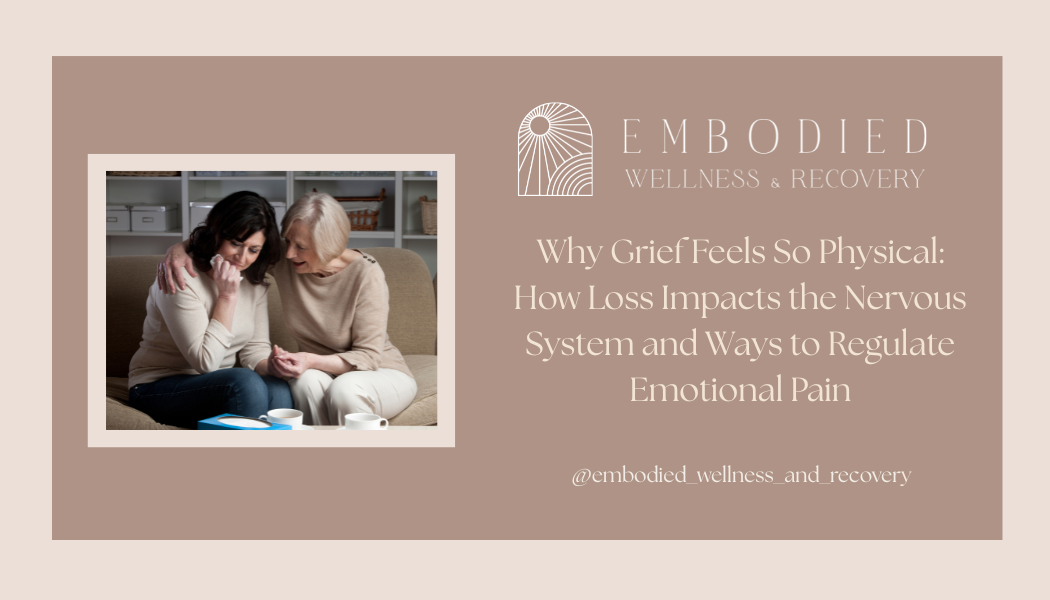
Why Grief Feels So Physical: How Loss Impacts the Nervous System and Ways to Regulate Emotional Pain
Why Grief Feels So Physical: How Loss Impacts the Nervous System and Ways to Regulate Emotional Pain
Why does grief feel so physical after the loss of a loved one? Learn how grief affects the nervous system, why emotional pain shows up in the body, and what supports regulation.
Why Does Grief Hurt So Much in the Body?
After the death of someone you love, grief often feels less like an emotion and more like a physical event. Tightness in the chest. A hollow ache in the stomach. Exhaustion that sleep does not touch. Waves of pain that arrive without warning.
Many people wonder:
— Why does grief feel so physical?
— Is it normal that loss hurts in my body, not just my heart?
— Why does my nervous system feel overwhelmed or shut down?
— Will this intensity ever change?
These questions are deeply human. Grief is not only emotional or psychological. It is a full-body experience shaped by the nervous system.
Grief and the Nervous System
From a neuroscience perspective, attachment is regulated through the nervous system. The brain and body are wired to stay close to people who provide safety, meaning, and emotional regulation. When a loved one dies, the nervous system does not simply register absence. It registers threat and loss of safety.
The brain regions most involved in grief include:
— The amygdala, which detects threat and loss
— The anterior cingulate cortex, which processes emotional and physical pain
— The insula, which tracks internal body sensations
— The hippocampus, which holds emotional memory
These systems do not distinguish cleanly between physical injury and emotional loss. This is why grief can feel excruciating in the body.
Why Grief Feels Like Physical Pain
Research shows that social and attachment loss activates the same neural pathways as physical pain. The brain interprets loss as danger because connection is essential for survival (Eisenberger, 2012).
This can result in:
— Chest pain or tightness
— Shortness of breath
— Fatigue or heaviness
— Headaches or body aches
— Changes in appetite or digestion
— Sleep disruption
— Weakened immune response
Grief is not imagined pain. It is somatic.
The Role of the Autonomic Nervous System
The autonomic nervous system governs survival responses. During grief, it often oscillates between states of activation and collapse.
Sympathetic activation may look like:
— Anxiety or panic
— Restlessness
— Racing thoughts
— Anger or agitation
— Compulsive activity or distraction
Parasympathetic shutdown may include:
— Emotional numbness
— Dissociation
— Profound fatigue
— Withdrawal
— Difficulty feeling pleasure or motivation
These responses are protective. The nervous system is trying to manage something overwhelming.
Why Grief Comes in Waves
Many grieving people describe moments of relative calm followed by sudden surges of pain. This is not regression. It reflects how the nervous system processes loss in doses. Neurobiology limits how much pain can be processed at once. The system moves in and out of grief to prevent overload. Triggers such as anniversaries, sounds, smells, or memories can reactivate neural networks associated with the loved one. This is why grief can feel unpredictable.
When Grief Becomes Dysregulating
While grief itself is not pathological, it can become dysregulating to the nervous system when:
— The loss was sudden or traumatic
— There was unresolved conflict or unfinished business
— The relationship was central to identity or safety
— Prior trauma is activated
— There is little relational support
n these cases, grief may feel unbearable, destabilizing, or endless.
Why Meaning Making Feels Impossible at First
The brain seeks coherence. Loss disrupts assumptions about safety, fairness, and predictability. When meaning collapses, the nervous system stays on alert.
This is why phrases like “everything happens for a reason” often feel unbearable in the early stages of grief. The nervous system is still trying to survive the rupture.
Meaning emerges later, when regulation returns.
How to Support the Nervous System During Grief
Healing grief does not mean eliminating pain. It means supporting the nervous system so pain can move rather than stagnate.
1. Prioritize regulation over insight
Understanding grief intellectually does not regulate the body. Gentle grounding practices help the nervous system feel safer.
Examples include:
— Slow breathing with longer exhales
— Gentle movement
— Orienting to the environment
— Temperature shifts like warm showers or cool water
2. Allow grief to be physical
Tears, heaviness, shaking, or exhaustion are signs of nervous system processing. Suppressing these responses often increases distress.
3. Reduce pressure to “function normally.”
Grief consumes significant metabolic and emotional energy. Expecting productivity too soon can worsen dysregulation.
4. Stay connected
Isolation amplifies nervous system threat. Safe connection with others helps regulate grief, even when words feel insufficient.
5. Seek trauma-informed support
Therapy that understands grief through a nervous system lens helps prevent shutdown, overwhelm, or prolonged suffering.
How Therapy Helps Regulate Grief
At Embodied Wellness and Recovery, grief is approached as both an emotional and physiological experience.
Trauma-informed therapy supports grief by:
— Stabilizing the nervous system
— Supporting emotional expression without overwhelm
— Addressing trauma stored in the body
— Helping clients track and tolerate sensation
— Integrating attachment loss with compassion
Modalities such as somatic therapy, EMDR, and attachment-based psychotherapy help grief move through the body rather than remain frozen.
Grief and Relationships
Grief often strains relationships. Partners may grieve differently. One may want closeness while the other withdraws. Sexuality and intimacy may change as the nervous system reallocates energy toward survival.Understanding these shifts as biological rather than personal can reduce shame and conflict.
Couples therapy during grief helps partners co-regulate and stay connected through loss.
A Compassionate Reframe
If grief feels unbearable, it does not mean you are doing it wrong. It means your nervous system has lost something essential. The body hurts because the bond mattered. With support, regulation can return. Pain can soften. Life can expand again, even while love remains.
How Embodied Wellness and Recovery Supports Grief
Embodied Wellness and Recovery specializes in trauma-informed, nervous system-based therapy for grief, loss, and attachment wounds.
Our approach integrates neuroscience, somatic awareness, relational repair, and compassionate presence to support clients through the physical and emotional realities of loss.
Reach out to schedule a complimentary 20-minute consultation with our team of therapists, trauma specialists, somatic practitioners, or relationship experts, and start working towards integrative, embodied healing today.
📞 Call us at (310) 651-8458
📱 Text us at (310) 210-7934
📩 Email us at admin@embodiedwellnessandrecovery.com
🔗 Visit us at www.embodiedwellnessandrecovery.com
👉 Check us out on Instagram @embodied_wellness_and_recovery
🌍 Explore our offerings at Linktr.ee: https://linktr.ee/laurendummit
References
1) Eisenberger, N. I., & Lieberman, M. D. (2004). Why rejection hurts: A common neural alarm system for physical and social pain. Trends in Cognitive Sciences, 8(7), 294–300.
2) Porges, S. W. (2011). The polyvagal theory: Neurophysiological foundations of emotions, attachment, communication, and self-regulation. Norton.
3) van der Kolk, B. A. (2014). The body keeps the score: Brain, mind, and body in the healing of trauma. Viking.
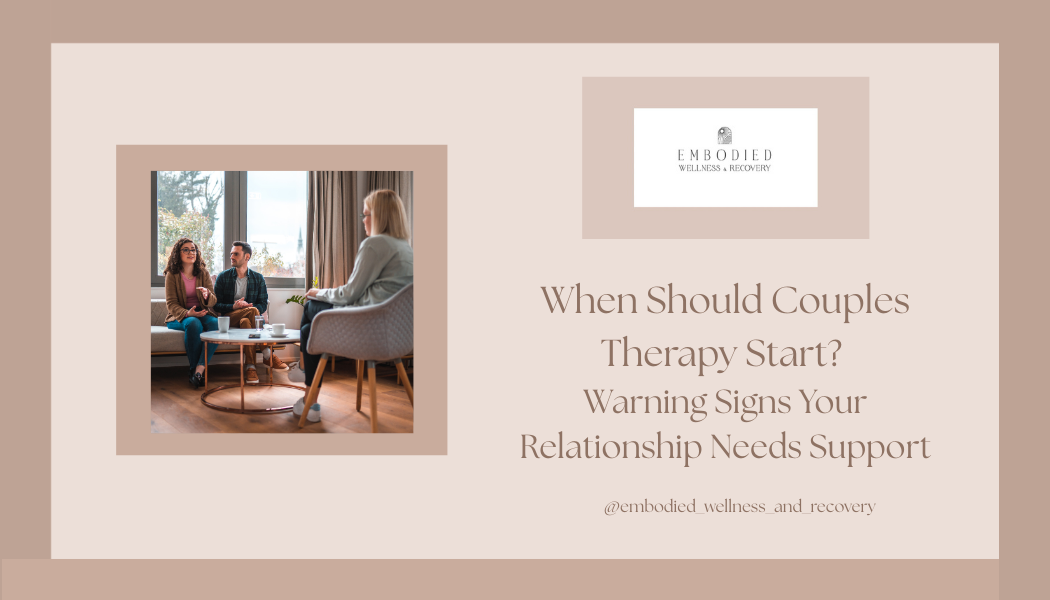
When Should Couples Therapy Start? Warning Signs Your Relationship Needs Support
When Should Couples Therapy Start? Warning Signs Your Relationship Needs Support
Wondering when couples therapy is necessary? Learn the early warning signs your relationship needs help and how therapy supports connection, safety, and emotional repair.
When Do Couples Actually Need Therapy?
Many couples wait far too long to seek therapy. Often, couples therapy is framed as a last resort, something to try only after years of conflict, emotional distance, or near separation. But the question many partners are quietly asking is much earlier and more vulnerable:
— Is what we are experiencing normal relationship stress or something more serious?
— How do we know when couples therapy is necessary?
— Are we overreacting or underreacting?
— Can things improve on their own, or do we need help?
Couples therapy is not only for relationships in crisis. In fact, research consistently shows that earlier intervention leads to stronger outcomes and less entrenched patterns.
Why Couples Delay Seeking Therapy
Couples often delay therapy because:
— They fear being judged or blamed
— One partner is more motivated than the other
— They assume problems should be handled privately
— They worry that therapy means the relationship is failing
— They hope time alone will fix things
From a neuroscience and attachment perspective, waiting often allows stress responses to become hardwired patterns, making repair more difficult later.
The Nervous System and Relationship Distress
Romantic relationships are not just emotional connections. They are nervous system partnerships.
When relationships feel safe, the nervous system settles. When relationships feel unpredictable, critical, distant, or threatening, the nervous system shifts into survival mode.
This can show up as:
— Fight responses like criticism, defensiveness, or anger
— Flight responses like withdrawal, avoidance, or overworking
— Freeze responses like numbness or emotional shutdown
— Fawn responses like people-pleasing or self-silencing
Over time, couples stop arguing about the original issue and instead react to each other’s nervous systems.
Early Warning Signs Couples Therapy Should Start
1. Conversations Go in Circles Without Resolution
If you keep having the same arguments with no change, this is not a communication failure. It is a regulation failure.
When the nervous system is activated, the brain prioritizes protection over problem-solving. Couples therapy helps slow these cycles and restore safety so conversations can actually move forward.
2. Emotional Distance Is Growing
Do you feel more like roommates than partners? Less curiosity, less affection, fewer meaningful conversations?
Emotional withdrawal is one of the most significant predictors of long-term dissatisfaction. Many couples seek therapy only after distance feels permanent, but early support can reverse this pattern.
3. Conflict Escalates Quickly
Do small issues turn into intense arguments? Does one or both partners feel flooded, overwhelmed, or reactive during conflict?
This often reflects nervous system overwhelm, not immaturity or lack of effort. Therapy helps couples learn how to co-regulate rather than escalate.
4. One Partner Feels Unheard or Invalidated
Feeling unseen or dismissed erodes emotional safety. When one partner consistently feels unheard, resentment builds and trust weakens.
Couples therapy provides a structured space for both partners to feel understood without having to fight for airtime.
5. You Avoid Important Topics
Avoidance often feels safer than conflict, but it slowly undermines intimacy.
Common avoided topics include:
— Sex and desire discrepancies
— Money or financial stress
— Parenting differences
— Family boundaries
— Past betrayals or hurts
Avoidance is a sign that the nervous system does not feel equipped to handle these conversations alone.
6. Sexual Intimacy Has Changed or Stalled
Changes in sexual desire, avoidance of intimacy, or tension around sex are often relational signals, not individual failures.
Sexual disconnection frequently reflects:
— Unresolved emotional injuries
— Stress or trauma
— Attachment insecurity
— Shame or fear around vulnerability
Couples therapy that integrates sexuality and emotional safety can help restore intimacy in a way that feels respectful and grounded.
7. Trauma Is Affecting the Relationship
When one or both partners carry unresolved trauma, it inevitably enters the relationship.
Trauma can shape:
— How partners interpret tone or intent
— How quickly conflict escalates
— How safe closeness feels
— How partners respond to vulnerability
Couples therapy that is trauma-informed helps partners understand these patterns without pathologizing each other.
8. Trust Has Been Damaged
Whether through infidelity, secrecy, broken promises, or emotional betrayal, trust injuries do not heal through time alone.
Without guided repair, the nervous system stays alert, scanning for danger. Therapy provides containment, accountability, and structure for rebuilding trust.
9. One or Both Partners Are Considering Separation
You do not need to be on the brink of separation to benefit from therapy. But if the thought has entered the conversation, it is a clear signal that support is needed.
Couples therapy helps clarify:
— What is actually driving the disconnection
— Whether repair feels possible
— What each partner truly needs moving forward
Why Earlier Therapy Works Better
From a neuroplasticity standpoint, the brain is more flexible before patterns harden.
Early couples therapy:
— Reduces stress hormones
— Strengthens emotional safety
— Interrupts reactive cycles
— Builds skills before resentment accumulates
— Preserves goodwill and empathy
Therapy is not about assigning blame. It is about changing the environment so that both nervous systems can settle.
What Couples Therapy Looks Like at Embodied Wellness and Recovery
At Embodied Wellness and Recovery, couples therapy integrates:
— Trauma-informed care
— Nervous system regulation
— Attachment-based frameworks
— Somatic awareness
— Relational repair
— Sexual and emotional intimacy work
We focus not only on what couples say but also on what their bodies and nervous systems communicate beneath the surface.
Couples learn how to:
— Recognize stress responses in real time
— Pause escalation before damage occurs
— Repair ruptures effectively
— Restore emotional and physical safety
— Rebuild intimacy through trust and presence
A Reframe Worth Considering
Needing couples therapy does not mean something is wrong with your relationship. It often means your relationship matters enough to protect. Seeking help earlier allows couples to grow together rather than drift apart.
Reach out to schedule a complimentary 20-minute consultation with our team of therapists, trauma specialists, somatic practitioners, or relationship experts, and start working towards integrative, embodied healing today.
📞 Call us at (310) 651-8458
📱 Text us at (310) 210-7934
📩 Email us at admin@embodiedwellnessandrecovery.com
🔗 Visit us at www.embodiedwellnessandrecovery.com
👉 Check us out on Instagram @embodied_wellness_and_recovery
🌍 Explore our offerings at Linktr.ee: https://linktr.ee/laurendummit
References
1) Gottman, J. M., & Silver, N. (2015). The seven principles for making marriage work. Harmony Books.
2) Johnson, S. M. (2019). Attachment theory in practice: Emotionally focused therapy with individuals, couples, and families. Guilford Press.
3) Porges, S. W. (2011). The polyvagal theory: Neurophysiological foundations of emotions, attachment, communication, and self-regulation. Norton.
Why the News Is Making You Anxious: Understanding News Anxiety, Vicarious Trauma, and Nervous System Overload
Why the News Is Making You Anxious: Understanding News Anxiety, Vicarious Trauma, and Nervous System Overload
Why does watching the news cause anxiety, panic, or emotional shutdown? Learn how news anxiety and vicarious trauma dysregulate the nervous system and what helps restore balance.
Why Does Watching the News Feel So Overwhelming?
Have you noticed your heart racing after watching the news? Trouble sleeping after reading headlines? A sense of dread, numbness, or helplessness when you try to make sense of ongoing violence, political unrest, or human suffering?
Many people are asking the same questions:
— Why does the news make me anxious?
— Why do I feel emotionally flooded or shut down after watching the news?
— Is it normal to feel traumatized by events that did not happen to me directly?
— How do I stay informed without feeling overwhelmed?
These reactions are not signs of weakness or overreaction. They are signs of a nervous system under chronic strain.
What Is News Anxiety?
News anxiety refers to heightened anxiety, distress, or nervous system dysregulation triggered by repeated exposure to news coverage, especially stories involving violence, injustice, disasters, or threat.
This can include:
— Panic or anxiety symptoms
— Emotional overwhelm or tearfulness
— Numbness or emotional shutdown
— Irritability or anger
— Difficulty concentrating
— Sleep disturbances
— A sense of hopelessness or loss of meaning
News anxiety is increasingly common in an era of constant media access, graphic imagery, and real-time updates that offer little opportunity for the nervous system to reset.
Vicarious Trauma and the Brain
From a neuroscience perspective, the brain does not clearly distinguish between direct threat and witnessed threat.
Research on vicarious trauma shows that repeated exposure to others’ suffering can activate the same neural networks involved in direct trauma exposure. When we watch violence, hear distressing stories, or repeatedly imagine worst-case scenarios, the brain’s threat detection systems respond as if danger is present.
Key brain regions involved include:
— The amygdala, which detects threat
— The hippocampus, which stores emotional memory
— The anterior cingulate cortex, which processes pain and distress
— The insula, which maps bodily sensations and emotional states
Over time, this repeated activation can lead to chronic nervous system arousal or, conversely, protective shutdown.
Nervous System Overload and Dysregulation
When the nervous system is repeatedly exposed to perceived threat without resolution, it can become stuck in survival states.
Common nervous system responses to news exposure include:
Sympathetic activation
— Anxiety
— Hypervigilance
— Racing thoughts
— Anger or agitation
— Compulsive news checking
Parasympathetic shutdown
— Emotional numbness
— Dissociation
— Fatigue
— Withdrawal
— A sense of meaninglessness
Both are adaptive responses to overwhelm. Neither indicates pathology.
Why Senseless Violence Is So Dysregulating
Human nervous systems are wired for meaning-making. When events feel random, unjust, or incomprehensible, the brain struggles to integrate them.
Senseless violence disrupts:
— Our assumptions about safety
— Our belief in predictability
— Our sense of moral order
— Our trust in institutions and community
This existential disruption is often what people mean when they say, “I cannot make sense of what is happening.” The distress is not only emotional but also deeply neurobiological.
The Role of Media Saturation
Unlike previous generations, modern news consumption is:
— Continuous
— Visual and graphic
— Algorithm-driven
— Emotionally amplified
Doomscrolling keeps the nervous system in a near-constant state of alert without offering resolution or agency. The body receives threat signals but no clear action path, which increases anxiety and helplessness.
This is particularly impactful for people with:
— A history of trauma
— High empathy
— Attachment wounds
— Anxiety disorders
— Depression or dissociation
— Caregiving or helping professions
Why Some People Feel It More Intensely
Not everyone experiences news anxiety the same way. Differences often relate to nervous system sensitivity and personal history.
People who grew up in environments marked by unpredictability, violence, emotional neglect, or chronic stress often have sensitized threat detection systems. Their bodies learned early that vigilance was necessary for survival.
For these individuals, the news does not feel informational. It feels personal.
How Trauma-Informed Therapy Helps
At Embodied Wellness and Recovery, we understand news anxiety as a nervous system response, not a cognitive failure.
Effective treatment focuses on:
— Restoring nervous system regulation
— Increasing tolerance for emotional activation
— Rebuilding a sense of safety and agency
— Addressing trauma stored in the body
— Supporting meaning-making without overwhelm
Modalities such as somatic therapy, EMDR, attachment-based therapy, and nervous system-informed psychotherapy help clients process distress without retraumatization.
Practical Ways to Reduce News-Related Anxiety
1. Shift from constant exposure to intentional consumption
Limit news intake to specific times of day. Avoid starting or ending the day with distressing content.
2. Regulate before and after exposure
Grounding practices such as slow breathing, movement, or orienting to the room help the nervous system reset.
3. Notice your body’s cues
If your body tightens, dissociates, or races, that is information. Respect it.
4. Focus on agency and connection
Engaging in meaningful action, community support, or values-based living helps counter helplessness.
5. Work with a trauma-informed therapist
Professional support helps integrate emotional responses without suppressing or escalating them.
A Compassionate Reframe
Feeling overwhelmed by the news does not mean you are fragile or disengaged. It often means you are human, empathic, and wired for connection.
Your nervous system is responding exactly as it was designed to respond to threat and uncertainty.
With support, it can also learn how to return to safety, presence, and resilience.
How Embodied Wellness and Recovery Can Help
Embodied Wellness and Recovery specializes in trauma-informed, nervous system-based therapy for individuals struggling with anxiety, emotional overwhelm, dissociation, and relational distress.
Our work integrates neuroscience, somatic awareness, attachment theory, and compassionate clinical care to help clients navigate distressing times without losing themselves in the process.
Reach out to schedule a complimentary 20-minute consultation with our team of therapists, trauma specialists, somatic practitioners, or relationship experts, and start working towards integrative, embodied healing today.
📞 Call us at (310) 651-8458
📱 Text us at (310) 210-7934
📩 Email us at admin@embodiedwellnessandrecovery.com
🔗 Visit us at www.embodiedwellnessandrecovery.com
👉 Check us out on Instagram @embodied_wellness_and_recovery
🌍 Explore our offerings at Linktr.ee: https://linktr.ee/laurendummit
References
1) Eisenberger, N. I., & Lieberman, M. D. (2004). Why rejection hurts: A common neural alarm system for physical and social pain. Trends in Cognitive Sciences, 8(7), 294–300.
2) McCann, I. L., & Pearlman, L. A. (1990). Vicarious traumatization: A framework for understanding the psychological effects of working with victims. Journal of Traumatic Stress, 3(1), 131–149.
3) van der Kolk, B. A. (2014). The body keeps the score: Brain, mind, and body in the healing of trauma. Viking.
Healing Sexual Shame After Growing Up in Purity Culture: How to Reclaim Your Body and Desire
Struggling with sexual shame after purity culture? Learn how religious sexual messaging affects the nervous system and how sexuality can be reclaimed safely.
Do you feel anxious, disconnected, or ashamed when it comes to sex, even years after leaving a religious environment? Do you struggle to feel desire, pleasure, or comfort in your body despite deeply wanting intimacy? Do you intellectually reject purity culture teachings but still feel their emotional grip?
For many adults, purity culture does not simply fade with time. Its messages about sex, bodies, desire, and worth often become embedded in the nervous system, shaping how intimacy feels long after the beliefs themselves are questioned.
At Embodied Wellness and Recovery, we understand sexual shame through a trauma-informed, neuroscience-based lens. Healing sexuality after purity culture is not about forcing confidence or overriding discomfort. It is about restoring safety, agency, and connection in the body.
What Is Purity Culture and Why Does It Leave Lasting Wounds?
Purity culture refers to a belief system that frames sexual desire as dangerous, immoral, or acceptable only under narrowly defined conditions. While its messaging varies across religious traditions, common themes include:
— Sexual worth tied to abstinence
— Bodies viewed as sources of temptation or sin
— Desire framed as something to suppress or control
— Modesty used as a measure of moral value
— Fear-based teachings about the consequences of sexual expression
For many people, these messages were introduced during critical developmental periods when identity, attachment, and nervous system regulation were still forming.
When sexuality is associated with fear, shame, or moral failure, the body learns to brace against desire rather than welcome it.
Sexual Shame Is a Nervous System Experience
Sexual shame is not only cognitive. It is physiological.
From a neuroscience perspective, repeated messages that label desire as dangerous activate the brain’s threat detection systems. Over time, the nervous system learns to associate arousal, curiosity, or pleasure with danger.
This can lead to:
— Chronic anxiety around intimacy
— Dissociation during sexual experiences
— Difficulty accessing desire or pleasure
— Pain, shutdown, or numbness in the body
— Hypervigilance about performance or morality
— Confusion between arousal and fear
These responses are not signs of dysfunction. They are adaptations to environments where sexuality was not emotionally safe.
Why Sexual Shame Persists Even After Beliefs Change
Many adults ask, “If I no longer believe these teachings, why do they still affect me?”
The answer lies in how memory and learning are stored in the brain and body. While belief systems reside largely in the prefrontal cortex, shame and fear responses are encoded in subcortical and limbic regions that support survival.
In other words, insight alone does not automatically rewire the nervous system.
Sexual shame persists when:
— Early experiences paired desire with punishment or fear
— Emotional safety was conditional
— The body never learned that pleasure could coexist with safety
— Attachment and sexuality became intertwined with compliance
Healing requires working at the level where these patterns live.
Common Ways Purity Culture Impacts Adult Sexuality
While each person’s experience is unique, many adults raised in purity culture report similar struggles, including:
— Feeling disconnected from their body during sex
— Difficulty initiating or responding to desire
— Guilt or anxiety after pleasurable experiences
— Confusion about consent, boundaries, or needs
— Fear of being “too much” or “not enough.”
— Difficulty integrating spirituality and sexuality
— Challenges with orgasm, arousal, or relaxation
These struggles are not failures of effort or desire. They reflect nervous system patterns shaped by early conditioning.
Reclaiming the Body After Sexual Shame
Healing sexuality begins with restoring a sense of safety in the body. Somatic and nervous system-informed approaches recognize that the body must learn, gradually and repeatedly, that sensation does not equal danger.
This process may involve:
— Learning to track bodily sensations without judgment
— Building tolerance for pleasure and arousal slowly
— Reconnecting with breath, movement, and grounding
— Exploring consent with yourself before others
— Developing boundaries that support choice rather than obligation
Reclaiming the body is not about pushing through discomfort. It is about cultivating attunement and agency.
Desire Is Not a Moral Failing
One of the most damaging messages of purity culture is the idea that desire itself is suspect.
From a biological perspective, sexual desire is a natural function shaped by hormones, attachment, and nervous system regulation. It is not inherently virtuous or dangerous.
When desire has been suppressed or shamed, it may return in unpredictable ways or feel overwhelming when it does emerge. Therapy helps individuals learn to relate to desire with curiosity rather than fear.
Desire becomes safer when it is allowed to exist without judgment.
Attachment, Relationships, and Sexual Shame
Purity culture often intersects with attachment patterns.
For some, love became conditional on compliance, goodness, or self-suppression. This can lead to:
— Difficulty advocating for needs in relationships
— Confusion between closeness and obligation
— Fear of disappointing partners
— Difficulty trusting desire as relationally safe
Healing sexuality often involves healing attachment. As relational safety increases, sexual expression becomes less fraught and more authentic.
How Therapy Supports Sexual Healing After Purity Culture
At Embodied Wellness and Recovery, we support clients' healing from purity culture through integrative, trauma-informed care that addresses both mind and body.
Therapeutic approaches may include:
— Somatic therapy to restore body safety and regulation
— EMDR to process shame-based memories and beliefs
— Attachment-focused therapy to build relational security
— Parts work to understand internal conflicts around desire
— Psychoeducation grounded in neuroscience and sexual health
The goal is not to replace one set of rules with another. It is to support choice, agency, and embodied self-trust.
Integrating Spirituality and Sexuality
For some individuals, healing also involves reimagining the relationship between spirituality and sexuality.
This may include:
— Grieving spiritual frameworks that caused harm
— Exploring new values that honor both faith and embodiment
— Redefining meaning outside of shame-based narratives
— Allowing complexity rather than certainty
Sexual healing does not require abandoning spirituality. It often requires disentangling spirituality from fear and control.
Sexual Healing Is a Gradual Process
Reclaiming sexuality after purity culture is not linear. There may be moments of insight followed by periods of discomfort or grief.
Progress often looks like:
— Increased curiosity about the body
— Reduced shame responses
— Greater emotional presence during intimacy
— Clearer boundaries and communication
— A growing sense of internal permission
Over time, the nervous system learns that desire can coexist with safety, dignity, and self-respect.
How Embodied Wellness and Recovery Can Help
Embodied Wellness and Recovery specializes in trauma-informed, attachment-based therapy for individuals and couples navigating sexual shame, religious trauma, intimacy challenges, and nervous system dysregulation.
Our work integrates:
— Neuroscience-informed psychotherapy
— Somatic and experiential approaches
— Trauma and attachment healing
— Relational and sexual wellness support
We help clients reclaim their bodies, their desires, and their capacity for intimacy with care, depth, and respect.
Reach out to schedule a complimentary 20-minute consultation with our team of therapists, trauma specialists, somatic practitioners, or relationship experts, and start working towards integrative, embodied healing today.
📞 Call us at (310) 651-8458
📱 Text us at (310) 210-7934
📩 Email us at admin@embodiedwellnessandrecovery.com
🔗 Visit us at www.embodiedwellnessandrecovery.com
👉 Check us out on Instagram @embodied_wellness_and_recovery
🌍 Explore our offerings at Linktr.ee: https://linktr.ee/laurendummit
References
1) Herman, J. L. (1992). Trauma and recovery: The aftermath of violence from domestic abuse to political terror. Basic Books.
2) Porges, S. W. (2011). The polyvagal theory: Neurophysiological foundations of emotions, attachment, communication, and self-regulation. W. W. Norton & Company.
3) van der Kolk, B. A. (2014). The body keeps the score: Brain, mind, and body in the healing of trauma. Viking.
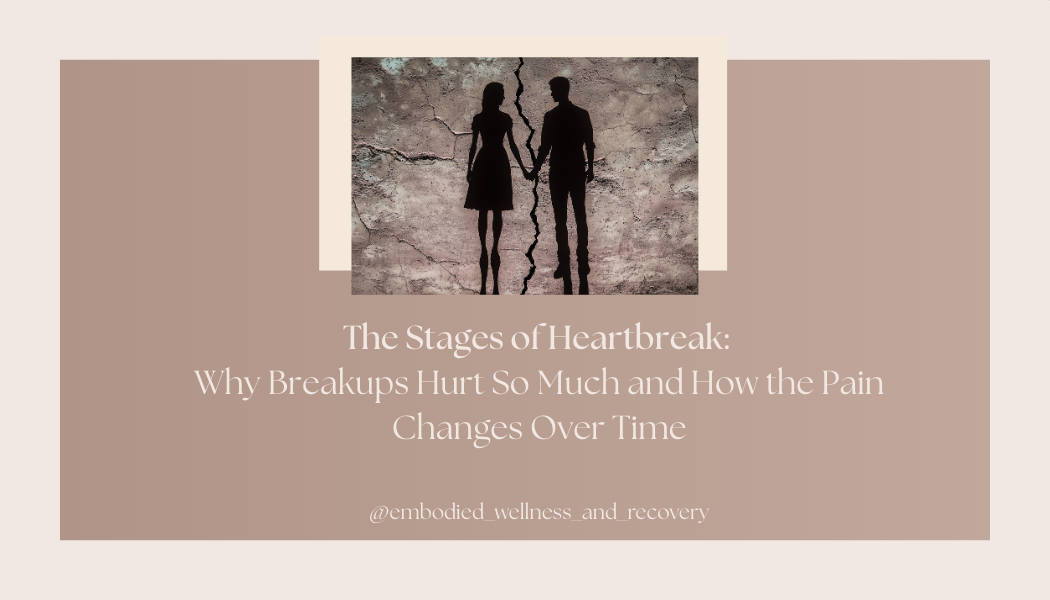
The Stages of Heartbreak: Why Breakups Hurt So Much and How the Pain Changes Over Time
Why does heartbreak feel unbearable after a breakup? Learn the stages of heartbreak, the neuroscience of breakup pain, and how grief changes over time.
Why does a breakup hurt this much?
Why does it feel impossible to focus, sleep, or imagine a future without the person you lost?
And perhaps the most painful question of all: “How long will this pain last?”
Heartbreak is not simply emotional distress. It is a full-body experience that affects the brain, the nervous system, the sense of identity, and the capacity to feel safe in the world. At Embodied Wellness and Recovery, we view heartbreak as a form of relational grief that deserves understanding, compassion, and nervous system-informed care.
This article explores the stages of heartbreak, why breakups can feel unbearable, and how the pain evolves over time through a trauma-informed and neuroscience-based lens.
Why Breakups Hurt So Much
From a neurobiological perspective, romantic attachment is not just emotional. It is wired into the brain’s survival systems.
When you bond with a partner, your brain links them to safety, comfort, regulation, and reward. Oxytocin, dopamine, and endogenous opioids all play a role in creating feelings of closeness and emotional security. When a relationship ends, the brain experiences this loss as a threat.
Research shows that social rejection and attachment loss activate the same brain regions involved in physical pain (Eisenberger & Lieberman, 2004). This is why heartbreak can feel physically unbearable, with symptoms such as chest tightness, nausea, fatigue, insomnia, and loss of appetite.
Heartbreak is grief. But it is a unique form of grief because the attachment figure is still alive, often still present in memory, and sometimes still accessible.
Heartbreak as Attachment Loss
When a relationship ends, you are not only losing the person. You are losing:
— A sense of emotional safety
— A shared future
— A source of regulation
— A familiar identity as part of a couple
— The nervous system patterns built around that bond
This is why heartbreak can feel disorienting and destabilizing. The nervous system must reorganize without a primary attachment reference point.
The Stages of Heartbreak
Heartbreak does not foltimeline, but many people experience recognizable stages as the nervous system and psyche adapt to loss. These stages often overlap and repeat.
Stage One: Shock and Disbelief
In the immediate aftermath of a breakup, many people feel numb, detached, or unreal. This is not emotional avoidance. It is the nervous system protecting against overwhelm.
You may feel:
— Emotional numbness
— Disorientation or fog
— Difficulty believing the relationship is truly over
— Alternating waves of panic and shutdown
This stage reflects acute stress activation. The nervous system is struggling to integrate a sudden loss.
Stage Two: Protest and Longing
As the reality of the breakup sets in, intense longing often emerges. This stage is marked by yearning, rumination, and a powerful urge to reconnect.
Common experiences include:
— Obsessive thoughts about the ex
— Urges to reach out or check social media
— Replaying memories or conversations
— Fantasizing about reconciliation
From a neuroscience perspective, this stage is driven by dopamine and attachment circuitry. The brain is attempting to restore connection to reestablish regulation.
This is often the most painful phase of heartbreak and the one people fear will never end.
Stage Three: Emotional Pain and Grief
As protest gives way to reality, grief deepens. Sadness, anger, despair, and hopelessness may surface.
People often ask:
— Why does the pain feel worse now?
— Am I going backward?
— Is something wrong with me?
Nothing is wrong. This stage reflects the nervous system's processing loss rather than its resistance.
You may experience:
— Deep sadness or crying spells
— Anger or resentment
— Feelings of emptiness
— Changes in sleep or appetite
— Loss of motivation or pleasure
This is where heartbreak most closely resembles bereavement.
Stage Four: Meaning Making and Integration
Over time, the intensity of pain begins to shift. This does not mean the loss stops mattering. It means the nervous system starts to adapt.
In this stage, people may begin to:
— Reflect on the relationship more clearly
— Understand patterns or dynamics
— Reconnect with parts of themselves
— Experience moments of calm between waves of grief
This stage involves integrating the loss into your life narrative rather than organizing your entire emotional world around it.
Stage Five: Reorientation and Reconnection
Eventually, the nervous system regains greater stability. The relationship is no longer the primary reference point for emotional regulation.
You may notice:
— Increased emotional steadiness
— Renewed interest in relationships or creativity
— A stronger sense of self
— Capacity for connection without intense pain
This stage does not erase grief. It allows life to expand around it again.
How Long Does Heartbreak Last?
There is no universal timeline for heartbreak. Duration is influenced by:
— Attachment style
— Trauma history
— Length and intensity of the relationship
— Whether the breakup was sudden or ambiguous
— Access to emotional support
Research suggests that acute heartbreak symptoms often peak in the first weeks to months, with gradual improvement over time (Reynolds & Hochman, 2010). However, unresolved attachment trauma or nervous system dysregulation can prolong suffering.
If the pain feels frozen or overwhelming months later, it may signal the need for trauma-informed support rather than more time alone.
Heartbreak and the Nervous System
Heartbreak dysregulates the nervous system. Many people oscillate between anxiety and shutdown.
Anxiety may look like:
— Rumination
— Panic
— Hypervigilance
— Difficulty sleeping
Shutdown may look like:
— Emotional numbness
— Fatigue
— Withdrawal
— Loss of motivation
Therapy that focuses on nervous system repair helps the body relearn safety, stability, and emotional regulation after loss.
When Heartbreak Connects to Earlier Trauma
For some individuals, breakups activate older wounds related to abandonment, neglect, or emotional unpredictability. The pain may feel disproportionately intense because the loss resonates with earlier experiences stored in the body.
In these cases, heartbreak is not only about the relationship that ended. It is about unresolved attachment trauma seeking integration.
Understanding this connection can reduce shame and clarify why the pain feels so consuming.
How Therapy Supports Recovery from Heartbreak
At Embodied Wellness and Recovery, we work with heartbreak through a trauma-informed, neuroscience-grounded approach.
Therapy may include:
— Somatic therapy to support nervous system regulation
— EMDR to process relational and attachment trauma
— Attachment-focused therapy to rebuild internal safety
— Support around identity, intimacy, and trust
— Gentle integration of grief rather than suppression
The goal is not to rush grief, but to support the body and mind as they adapt.
A Compassionate Perspective on Heartbreak
Heartbreak hurts because attachment matters. Pain reflects connection, not weakness. Over time, the nervous system can learn that safety and connection are possible again, even after profound loss.
The pain does change. It does not disappear all at once. It softens, becomes less consuming, and eventually allows space for new meaning and connection.
How Embodied Wellness and Recovery Can Help
Embodied Wellness and Recovery specializes in working with individuals and couples navigating grief, attachment loss, relational trauma, and intimacy challenges.
Our integrative approach addresses:
— Trauma stored in the nervous system
— Attachment patterns and relational wounds
— Emotional regulation after loss
— Identity and meaning after relationship endings
We help clients move through heartbreak with care, depth, and nervous system support.
Reach out to schedule a complimentary 20-minute consultation with our team of therapists, trauma specialists, somatic practitioners, orrelationship experts, and start working towards integrative, embodied healing today.
📞 Call us at (310) 651-8458
📱 Text us at (310) 210-7934
📩 Email us at admin@embodiedwellnessandrecovery.com
🔗 Visit us at www.embodiedwellnessandrecovery.com
👉 Check us out on Instagram @embodied_wellness_and_recovery
🌍 Explore our offerings at Linktr.ee: https://linktr.ee/laurendummit
References
1) Eisenberger, N. I., & Lieberman, M. D. (2004). Why rejection hurts: a common neural alarm system for physical and social pain. Trends in cognitive sciences, 8(7), 294-300.
2) Fisher, H. E. (2016). Anatomy of love: A natural history of mating, marriage, and why we stray. W. W. Norton & Company.
3) Porges, S. W. (2011). The polyvagal theory: Neurophysiological foundations of emotions, attachment, communication, and self-regulation. W. W. Norton & Company.
4) Reynolds, H. R., & Hochman, J. S. (2010). Heartbreak. European Heart Journal, 31(12), 1433-1435.
5) van der Kolk, B. A. (2014). The body keeps the score: Brain, mind, and body in the healing of trauma. Viking.
Limerence vs Love: How to Tell the Difference Between Obsession and Healthy Attachment
Limerence vs Love: How to Tell the Difference Between Obsession and Healthy Attachment
Is it love or limerence? Learn how to tell the difference between obsessive attraction and healthy attachment through neuroscience, trauma, and nervous system regulation.
Limerence vs Love: How to Tell the Difference Between Obsession and Healthy Attachment
Do you feel consumed by thoughts of one person, unable to concentrate, sleep, or emotionally settle unless you receive reassurance or contact from them? Does your mood rise and fall based on how they respond, or whether they respond at all? Do you feel driven by longing, fantasy, or uncertainty rather than mutual safety and ease?
Many people experiencing limerence describe it as feeling imprisoned by obsession. They may wonder whether what they are feeling is love, intuition, or something deeply wrong with them. In reality, limerence is not a character flaw. It is a nervous system and attachment response.
Understanding the difference between limerence and love can be profoundly relieving. At Embodied Wellness and Recovery, we approach limerence through a trauma-informed, neuroscience-based lens that prioritizes compassion, regulation, and relational repair.
What Is Limerence?
Limerence is a state of intense romantic fixation characterized by intrusive thoughts, emotional dependency, idealization, and a strong need for reciprocation. It is often fueled by uncertainty, fantasy, and intermittent reinforcement.
Common signs of limerence include:
— Persistent, intrusive thoughts about one person
— Idealizing the person while minimizing incompatibilities
— Emotional highs and lows based on contact or perceived interest
— Difficulty focusing on work, relationships, or self-care
— Strong fear of rejection or abandonment
— A sense of urgency or compulsion around connection
People often search for terms like “limerence symptoms,” “obsessive romantic thoughts,” or “why can’t I stop thinking about someone” because the experience feels overwhelming and confusing.
What Is Love?
Healthy love is grounded in mutuality, emotional safety, and nervous system regulation. While attraction and longing may be present, love does not hijack your capacity to function, self-regulate, or maintain a sense of self.
Love tends to feel:
— Steady rather than consuming
— Grounded rather than urgent
— Mutual rather than one-sided
— Regulating rather than destabilizing
— Expansive rather than constricting
In love, connection enhances your life. In limerence, connection often becomes the organizing force around which everything else revolves.
The Core Differences Between Limerence and Love
1. Obsession vs Presence
Limerence is preoccupied with the other person. Love allows presence with yourself and others.
2. Fantasy vs Reality
Limerence relies heavily on imagined futures and idealized versions of the other. Love is rooted in knowing and being known.
3. Anxiety vs Safety
Limerence activates chronic anxiety, vigilance, and emotional volatility. Love supports calm, safety, and emotional regulation.
4. Control vs Choice
Limerence feels compulsive. Love feels chosen.
The Neuroscience of Limerence
From a neuroscience perspective, limerence is strongly linked to the brain’s reward and threat systems. Dopamine plays a central role.
Dopamine is associated with motivation, anticipation, and craving. In limerence, dopamine surges are triggered by uncertainty, novelty, and intermittent reinforcement such as inconsistent texting or ambiguous signals of interest.
This creates a powerful cycle:
— Anticipation or longing
— Dopamine surge when contact occurs
— Emotional relief or euphoria
— Dopamine drop when contact fades
— Heightened craving and obsession
At the same time, the nervous system often remains in a state of sympathetic activation. This explains why limerence feels urgent, obsessive, and difficult to regulate.
Limerence and the Nervous System
Limerence is not just psychological. It is physiological. For many individuals, especially those with trauma histories, early attachment wounds, or chronic emotional neglect, the nervous system learned to associate love with unpredictability, longing, or emotional distance. In these cases, intensity can be misinterpreted as intimacy.
If calm feels unfamiliar or unsafe, the nervous system may seek activation as a way to feel alive or connected. Limerence provides that activation, even when it causes suffering.
Attachment Styles and Limerence
Limerence is commonly associated with anxious or disorganized attachment patterns.
People with anxious attachment may experience:
— Hyperfocus on romantic partners
— Strong fear of abandonment
— Emotional dependence on reassurance
— Difficulty tolerating uncertainty
Disorganized attachment may involve:
— Simultaneous longing for closeness and fear of it
— Idealization followed by devaluation
— Confusion between desire and danger
Understanding attachment patterns helps reduce shame and clarify why certain relationships feel intoxicating and destabilizing.
Why Limerence Can Feel So Imprisoning
Many people describe limerence as feeling trapped inside their own mind. Even when they recognize the relationship is unhealthy or unreciprocated, they feel unable to disengage.
This is because limerence functions as a form of affect regulation. The obsession temporarily regulates loneliness, emptiness, or emotional pain. When that regulation is threatened, distress intensifies.
Trying to force the obsession to stop without addressing the underlying nervous system needs often makes it stronger.
Love Regulates. Limerence Dysregulates.
One of the most important distinctions is how each state affects the nervous system.
Limerence:
— Increases anxiety and rumination
— Disrupts sleep and appetite
— Narrows focus and identity
— Amplifies emotional reactivity
Love:
— Supports nervous system balance
— Encourages emotional presence
— Allows flexibility and repair
— Deepens connection without self-loss
This difference is often felt in the body before it is understood cognitively.
A Trauma Informed Reframe
Limerence is not a failure of discernment or self-control. It is a survival strategy that once served a purpose.
When emotional attunement, safety, or consistency were missing early in life, the nervous system adapted. It learned to cling to intensity, fantasy, or intermittent connection as substitutes for secure attachment.
Understanding this reframes limerence as an invitation to heal rather than something to eliminate through willpower.
How Therapy Helps Resolve Limerence
At Embodied Wellness and Recovery, we help clients work with limerence by addressing its roots rather than its surface behaviors.
Treatment may include:
— Somatic therapy to build nervous system regulation
— EMDR to process attachment and relational trauma
— Parts-based therapy to understand internal dynamics
— Attachment-focused work to develop secure connection
— Psychoeducation grounded in neuroscience
As regulation increases, obsession naturally softens. As safety increases, fantasy becomes less compelling.
From Obsession to Secure Connection
The goal is not to suppress desire or romantic longing. It is to cultivate relationships that support wholeness rather than erode it. When the nervous system learns that connection can be steady, mutual, and safe, limerence loses its grip. Love becomes less dramatic but far more sustaining.
How Embodied Wellness and Recovery Can Help
Embodied Wellness and Recovery specializes in trauma-informed, attachment-based, neuroscience-grounded therapy for individuals and couples struggling with relational distress, limerence, and intimacy challenges.
Our work integrates:
— Nervous system repair
— Trauma processing
— Attachment healing
— Relational and sexual wellness
We help clients move from obsession to secure connection, from dysregulation to presence, and from longing to relational stability.
Reach out to schedule a complimentary 20-minute consultation with our team of therapists, trauma specialists, somatic practitioners, or relationship experts, and start working towards integrative, embodied healing today.
📞 Call us at (310) 651-8458
📱 Text us at (310) 210-7934
📩 Email us at admin@embodiedwellnessandrecovery.com
🔗 Visit us at www.embodiedwellnessandrecovery.com
👉 Check us out on Instagram @embodied_wellness_and_recovery
🌍 Explore our offerings at Linktr.ee: https://linktr.ee/laurendummit
References
1) Fisher, H. E. (2004). Why we love: The nature and chemistry of romantic love. Henry Holt and Company.
2) Porges, S. W. (2011). The polyvagal theory: Neurophysiological foundations of emotions, attachment, communication, and self-regulation. W. W. Norton & Company.
3) van der Kolk, B. A. (2014). The body keeps the score: Brain, mind, and body in the healing of trauma. Viking.
How a Parent’s Compulsive Sexual Behavior Affects Children’s Emotional Well-Being and Family Stability
How a Parent’s Compulsive Sexual Behavior Affects Children’s Emotional Well-Being and Family Stability
How does a parent’s compulsive sexual behavior affect children? Learn the emotional, relational, and nervous system impacts on kids and how families can restore safety and stability.
When Adult Struggles Ripple Through the Family
Many parents quietly carry a painful question they are afraid to ask out loud.
Is my child being affected by something they do not fully understand?
Even if they do not know the details, can they feel the tension, secrecy, or instability in our home?
When a parent struggles with compulsive sexual behavior, the impact rarely stays contained within the adult relationship. Children are exquisitely sensitive to emotional shifts, changes in availability, and disruptions in family routines. Even when children are shielded from explicit information, their nervous systems often register that something is wrong.
Understanding how compulsive sexual behavior affects children’s emotional well-being and family stability is not about blame. It is about awareness, repair, and creating the conditions that allow children to feel safe, regulated, and secure.
How Children Experience What They Cannot Fully Name
Children do not need explicit information to experience emotional disruption. From a neuroscience perspective, the developing brain is shaped by patterns of emotional attunement, predictability, and safety.
When a household becomes marked by secrecy, emotional distance, frequent conflict, or parental dysregulation, children often experience this as a loss of stability, even if they cannot articulate why.
Common signs children may be impacted include:
— Increased anxiety or irritability
— Emotional withdrawal or shutdown
— Heightened vigilance to parental moods
— Sleep disturbances or somatic complaints
— Acting out or regressive behaviors
— Difficulty concentrating or self-soothing
These responses are not misbehavior. They are adaptive nervous system responses to an environment that feels unpredictable or emotionally unsafe.
The Nervous System Impact of Chronic Family Stress
From a neurobiological standpoint, children rely on caregivers to help regulate their nervous systems. When a parent is preoccupied with compulsive sexual behavior or when adult partners are caught in cycles of discovery, rupture, and repair attempts, regulation within the household often becomes compromised.
Chronic stress activates the child’s sympathetic nervous system. Over time, this can interfere with:
— Emotional regulation
— Executive functioning
— Secure attachment formation
— Stress recovery
Children may oscillate between hyperarousal and collapse. They may become overly compliant and responsible or emotionally reactive and dysregulated. These patterns are not personality traits. They are survival strategies shaped by the relational environment.
The Role of Secrecy and Emotional Inconsistency
One of the most destabilizing elements for children is not knowing what is wrong while sensing that something is deeply wrong.
Children are intuitive observers. They notice:
— Abrupt changes in parental availability
— Sudden shifts in mood or affection
— Arguments that stop when they enter the room
— One parent withdrawing while the other appears overwhelmed
Secrecy does not protect children from distress. Instead, it often leads children to internalize confusion or self-blame. Many children unconsciously assume responsibility for the household's emotional climate.
When Treatment, Meetings, or Separation Enter the Picture
Recovery efforts such as therapy, treatment programs, or support meetings are necessary and often life-stabilizing for adults. However, without thoughtful integration, these changes can feel disruptive to children.
Parents may wonder:
— How do we explain why one parent is suddenly gone more often?
— What do we say when routines change?
— How much honesty is too much honesty?
Children need context without burden. Age-appropriate explanations that focus on safety, stability, and care are far more protective than silence or oversharing.
For example:
— “One of us is working on getting healthier so our family can feel better.”
— “This is adult work, and there are people helping us.”
— “You did not cause this, and you do not need to fix it.”
The Impact of Parental Conflict on Child Emotional Health
Research consistently shows that ongoing parental conflict is more distressing to children than many parents realize (Nangia, 2023). Even when arguments are not explicit, emotional tension communicates threat to a child’s nervous system.
High conflict environments can contribute to:
— Attachment insecurity
— Fear of abandonment
— Difficulty trusting relationships later in life
— Heightened stress reactivity
Children often cope by becoming emotionally vigilant or by disconnecting from their own needs to maintain peace.
What Actually Helps Protect Children
The most important protective factor for children is not perfection. It is relational repair.
What supports children’s emotional well-being includes:
— Consistent routines and predictability
— At least one emotionally available caregiver
— Reduced exposure to adult conflict
— Honest, developmentally appropriate communication
— Supportive therapeutic spaces for the family
From a nervous system lens, safety is built through repetition. Small, consistent experiences of calm presence, reliability, and emotional repair help children regain stability even during family transitions.
What to Tell Children and What Not to Share
Parents often struggle with finding the right language. Too little information can fuel confusion. Too much information can overwhelm.
Helpful guidelines include:
— Avoid graphic or explicit details
— Avoid blaming language about either parent
— Reassure children that adults are addressing adult problems
— Invite questions and answer simply
— Emphasize that feelings are welcome
Children benefit from knowing that emotions can be talked about safely and that adults are taking responsibility for restoring stability.
Long-Term Outcomes When Families Address the Impact
When families acknowledge the relational and emotional impact of compulsive sexual behavior and seek support, children demonstrate remarkable resilience.
Early intervention can:
— Support healthy attachment patterns
— Reduce long-term anxiety and shame
— Improve emotional literacy
— Strengthen family bonds through repair
Healing does not come from pretending nothing happened. It comes from addressing what happened with care, accountability, and nervous system awareness.
How Embodied Wellness and Recovery Supports Families
At Embodied Wellness and Recovery, we understand that compulsive sexual behavior is not only an individual issue. It is a relational and systemic experience that affects partners, children, and the family's emotional fabric.
Our approach integrates:
— Trauma-informed psychotherapy
— Attachment-based and somatic modalities
— Nervous system regulation and repair
— Relational and intimacy-focused healing
We help families move beyond crisis management toward sustainable emotional safety, improved communication, and restored trust. Our work centers on the well-being of children while supporting adults in taking responsibility for their healing journey.
Accountability Over Perfection
If you are worried about how your child may be affected, that concern itself matters. Awareness is the beginning of repair. Children do not need perfect parents. They need regulated, accountable adults who are willing to name what is happening in ways that foster safety rather than silence.
Support exists for families navigating these challenges. With the right guidance, it is possible to reduce harm, strengthen connection, and restore stability within the family system.
Reach out to schedule a complimentary 20-minute consultation with our team of therapists, trauma specialists, somatic practitioners, or relationship experts, and start working towards integrative, embodied healing today.
📞 Call us at (310) 651-8458
📱 Text us at (310) 210-7934
📩 Email us at admin@embodiedwellnessandrecovery.com
🔗 Visit us at www.embodiedwellnessandrecovery.com
👉 Check us out on Instagram @embodied_wellness_and_recovery
🌍 Explore our offerings at Linktr.ee: https://linktr.ee/laurendummit
References
Bowlby, J. (1988). A secure base: Parent-child attachment and healthy human development. Basic Books.
Nangia, V. (2023). Crisis of parental conflict: impact on children and families. Horyzonty Wychowania, 22(64), 71-82.
Porges, S. W. (2011). The polyvagal theory: Neurophysiological foundations of emotions, attachment, communication, and self-regulation. W. W. Norton & Company.
Schore, A. N. (2012). The science of the art of psychotherapy. W. W. Norton & Company.
Siegel, D. J. (2012). The developing mind: How relationships and the brain interact to shape who we are. Guilford Press.

Signs of ADHD Burnout: Why Pushing Harder Makes Overwhelm Worse and What Actually Helps
Signs of ADHD Burnout: Why Pushing Harder Makes Overwhelm Worse and What Actually Helps
Struggling with ADHD burnout? Learn the early signs, the neuroscience behind ADHD burnout, and how nervous system-informed therapy supports sustainable change.
Signs of ADHD Burnout
If you have ADHD, chances are you were taught some version of this message early on: Try harder. Push through. Apply more discipline.
So when life starts to feel overwhelming, when focus collapses, when motivation disappears, your instinct may be to double down. More effort. More pressure. More self-criticism. And yet, instead of improving, things often get worse.
This is where ADHD burnout comes into play. ADHD burnout is not laziness, failure, or a lack of resilience. It is a state of nervous system overload that develops when the brain and body are asked to operate beyond their capacity.
Understanding the signs of ADHD burnout can help shift the question from “Why can’t I keep up?” to “What needs to change in how I am working and caring for my nervous system?”
At Embodied Wellness and Recovery, we work with adults who have ADHD and feel exhausted by years of pushing harder instead of working differently. Burnout is not a personal shortcoming. It is a signal.
What Is ADHD Burnout?
ADHD burnout is a state of mental, emotional, and physical exhaustion that occurs when the demands placed on an ADHD nervous system consistently exceed its regulatory capacity.
Unlike situational stress, burnout does not resolve with a weekend off or a short break. It reflects prolonged strain on executive functioning, emotional regulation, and the nervous system.
People with ADHD are especially vulnerable to burnout because they often:
— Use compensatory strategies that require constant effort
— Mask symptoms to meet external expectations
— Rely on urgency and adrenaline to function
— Receive repeated messages that they are underperforming
Over time, these patterns tax the nervous system and erode flexibility.
Why Pushing Harder Backfires With ADHD
From a neuroscience perspective, ADHD is not a motivation problem. It is a regulatory difference involving dopamine pathways, executive function networks, and emotional processing systems.
When overwhelm increases, the ADHD brain does not respond well to increased pressure. Instead:
— Cognitive flexibility decreases
— Emotional reactivity increases
— Task initiation becomes harder
— Shutdown or avoidance becomes more likely
Pushing harder activates threat responses rather than problem-solving. The nervous system shifts into survival mode, where efficiency and creativity are compromised.
This is why many adults with ADHD report that their best strategies stop working just when they need them most.
Common Signs of ADHD Burnout
ADHD burnout often develops gradually. Many people do not recognize it until functioning has significantly declined.
1. Chronic Mental Exhaustion
You feel mentally drained even after rest. Thinking feels effortful. Decision-making becomes overwhelming. Simple tasks require disproportionate energy.
2. Loss of Motivation or Interest
Activities that once felt engaging now feel heavy or meaningless. Motivation does not return even when consequences are high.
3. Increased Executive Dysfunction
Planning, prioritizing, starting tasks, and following through become significantly harder. You may know what needs to be done, but feel unable to initiate.
4. Emotional Volatility or Numbness
You may feel emotionally reactive, irritable, or tearful. Alternatively, you may feel flat, disconnected, or emotionally shut down.
5. Heightened Sensitivity to Stress
Small stressors feel intolerable. Noise, interruptions, or changes in routine feel overwhelming. Recovery time increases.
6. Physical Symptoms
Headaches, muscle tension, gastrointestinal issues, fatigue, sleep disruption, and frequent illness often accompany burnout.
7. Increased Avoidance or Procrastination
Avoidance is not a character flaw. It is a nervous system strategy for reducing overload. Tasks may feel threatening rather than manageable.
8. Shame and Harsh Self-Criticism
Burnout is often accompanied by intense self-blame. You may tell yourself you are failing, lazy, or incapable, which further depletes nervous system resources.
ADHD Burnout Versus Stress or Depression
Many people struggle to distinguish ADHD burnout from anxiety or depression.
While symptoms can overlap, ADHD burnout often includes:
— A history of prolonged overcompensation
— Worsening executive dysfunction rather than sadness alone
— Improvement with nervous system support and environmental changes
— Deep exhaustion tied to cognitive effort rather than mood alone
Accurate understanding matters because treating burnout requires different interventions than treating depression or anxiety in isolation.
The Nervous System and ADHD Burnout
ADHD burnout is fundamentally a nervous system issue.
The ADHD nervous system often relies on high stimulation to engage. Deadlines, novelty, and urgency can temporarily improve focus, but they also increase stress hormones like cortisol and adrenaline.
When this becomes the primary mode of functioning, the nervous system never fully downshifts. Over time, this leads to:
— Reduced stress tolerance
— Impaired emotional regulation
— Decreased access to motivation pathways
— Shutdown responses that resemble apathy or avoidance
Burnout reflects a system that has been running in overdrive for too long.
Why Traditional Advice Often Misses the Mark
Common productivity advice often fails adults with ADHD because it assumes a nervous system that responds well to pressure, structure, and self-discipline.
Suggestions like:
— Just be more organized
— Try harder
— Push through discomfort
— Build better habits
can unintentionally increase shame and reinforce burnout. Without addressing nervous system regulation, these strategies demand more effort from an already depleted system.
What Actually Helps With ADHD Burnout
Recovery from ADHD burnout does not begin with doing more. It begins with adjusting how demands interact with your nervous system.
Nervous System Regulation
Therapy that incorporates somatic awareness, pacing, and regulation helps restore baseline capacity. When the body feels safer, cognitive flexibility improves.
Reducing Cognitive Load
Externalizing tasks, simplifying systems, and reducing unnecessary decisions conserves executive function resources.
Shifting From Urgency to Sustainability
Learning to work with interest, values, and realistic energy cycles reduces reliance on stress-driven motivation.
Addressing Shame
Shame consumes enormous nervous system bandwidth. Compassionate, trauma-informed therapy helps dismantle internalized beliefs that equate worth with productivity.
Relational Support
Burnout often improves when expectations are renegotiated in relationships and work environments. Support reduces masking and overcompensation.
ADHD Burnout and Trauma
Many adults with ADHD also have trauma histories. Chronic invalidation, repeated failure experiences, and relational stress can sensitize the nervous system to threat.
Trauma-informed care recognizes that burnout may reflect both neurodivergence and survival adaptations. Treatment must honor both.
At Embodied Wellness and Recovery, we integrate ADHD informed therapy with trauma and nervous system repair to support lasting change.
A Different Way Forward
If you recognize yourself in these signs, it does not mean you need more discipline. It means your nervous system is asking for a different approach.
When work is adjusted to fit how your brain actually functions, energy begins to return. Focus becomes more accessible. Emotional resilience increases.
Burnout is not a failure signal. It is an invitation to redesign how you live and work.
How Embodied Wellness and Recovery Can Help
Embodied Wellness and Recovery specializes in working with adults who have ADHD, burnout, trauma, and nervous system dysregulation.
Our approach integrates:
— ADHD-informed psychotherapy
— Trauma-informed care
— Nervous system regulation
— Somatic and relational therapy
We focus on helping clients move from survival-based functioning toward sustainable engagement with life, work, relationships, and intimacy.
Reach out to schedule a complimentary 20-minute consultation with our team of therapists, trauma specialists, somatic practitioners, or relationship experts, and start working towards integrative, embodied healing today.
📞 Call us at (310) 651-8458
📱 Text us at (310) 210-7934
📩 Email us at admin@embodiedwellnessandrecovery.com
🔗 Visit us at www.embodiedwellnessandrecovery.com
👉 Check us out on Instagram @embodied_wellness_and_recovery
🌍 Explore our offerings at Linktr.ee: https://linktr.ee/laurendummit
References
1) Arnsten, A. F. T. (2009). Stress signalling pathways that impair prefrontal cortex structure and function. Nature Reviews Neuroscience, 10(6), 410–422.
2) Brown, T. E. (2013). A new understanding of ADHD in children and adults: Executive function impairments. Routledge.
3) Porges, S. W. (2011). The polyvagal theory: Neurophysiological foundations of emotions, attachment, communication, and self-regulation. W. W. Norton & Company.
How Trauma-Based Shame Affects Relationships and Intimacy: Why Connection Feels So Hard
How Trauma-Based Shame Affects Relationships and Intimacy: Why Connection Feels So Hard
Trauma-based shame can sabotage trust and intimacy. Learn how its neurobiology shapes relationships and how therapy can safely soften shame.
How Trauma-Based Shame Affects Relationships and Intimacy
Do you want closeness but feel tense when someone gets close?
Do you anticipate rejection before it happens and then pull away to protect yourself?
Do you rely on avoidance, emotional distance, or self-silencing to manage the pain of wanting connection?
For many people, these patterns are not about fear of intimacy alone. They are driven by trauma-based shame, a deeply ingrained emotional state that shapes how the brain, nervous system, and body respond to relationships.
Trauma-based shame does not simply say, “Something bad happened.” It says, “Something is wrong with me.” When this belief becomes encoded in the nervous system, intimacy can feel dangerous even when love is present.
At Embodied Wellness and Recovery, we see how trauma-based shame quietly governs relational dynamics, sexuality, and emotional safety. Understanding its neurobiology helps explain why connection feels so hard and why compassion and precision are essential for change.
What Is Trauma Based Shame?
Shame is a social emotion designed to protect a sense of belonging. In healthy development, brief experiences of shame help us repair relationships and maintain social bonds. Trauma-based shame, however, forms when early experiences repeatedly communicate that safety, love, or connection are conditional.
This can occur through:
— Chronic emotional neglect
— Childhood abuse or humiliation
— Attachment disruption or inconsistent caregiving
— Sexual trauma or boundary violations
— Experiences of being blamed, silenced, or shamed during vulnerability
Over time, the nervous system learns that closeness leads to danger. Shame becomes the internal alarm system that activates whenever intimacy, dependency, or desire arises.
Why Trauma-Based Shame Makes Trust So Difficult
Trust requires the nervous system to register safety. Trauma-based shame interferes with this process at multiple levels. Shame narrows attention and increases threat sensitivity. The brain scans for signs of rejection, disappointment, or abandonment. Neutral cues are often interpreted as evidence that harm is coming.
This leads many people to ask themselves:
— What if they see the real me?
— What if I am too much or not enough?
— What if closeness exposes something shameful?
To reduce this internal threat, the nervous system often defaults to avoidance strategies such as emotional withdrawal, people pleasing, perfectionism, or self-reliance. These strategies provide short-term relief but reinforce long-term disconnection.
The Neurobiology of Trauma-Based Shame
From a neuroscience perspective, trauma-based shame is not a cognitive choice. It is a state-dependent response rooted in survival circuitry.
Key Brain and Nervous System Processes Involved
The Amygdala
Shame activates the amygdala, the brain’s threat detection center. Intimacy becomes associated with danger, even in the absence of present threat.
The Prefrontal Cortex
Under shame activation, the prefrontal cortex becomes less accessible. This limits perspective, self-compassion, and flexible thinking. Insight alone cannot override this process.
The Autonomic Nervous System
Shame often drives collapse, shutdown, or appeasement responses rather than fight-or-flight responses. These states reduce visibility and emotional exposure.
The Insula
The insula integrates bodily sensations and emotional awareness. Trauma-based shame disrupts interoception, making it difficult to interpret internal signals accurately. The body feels unreliable or unsafe. Together, these processes explain why shame feels so sticky and why it can persist even after years of insight-oriented therapy.
Why Shame Vigilantly Protects Itself
One of the most confusing aspects of trauma-based shame is how fiercely it resists change. This is not because people want to suffer. It is because shame functions as a protective strategy.
Shame believes:
— Visibility equals danger
— Vulnerability invites harm
— Dependency leads to loss
— Desire risks humiliation
As a result, shame actively avoids exposure. It discourages talking about needs. It dismisses reassurance. It mistrusts care. It interprets therapeutic attention as scrutiny rather than support.
This is why people often say:
— Therapy helps intellectually, but nothing shifts emotionally
— I understand my trauma, but still feel defective
— Compliments feel uncomfortable or unsafe
Shame protects itself by remaining hidden. Any intervention that feels corrective, confrontational, or rushed can unintentionally strengthen it.
How Traditional Treatments May Sustain Shame
While many therapeutic approaches are well-intentioned, some can inadvertently deepen shame if they do not account for nervous system state.
Overemphasis on Cognitive Insight
When therapy focuses primarily on challenging beliefs without regulating the body, clients may feel blamed for not improving faster.
Premature Exposure
Encouraging vulnerability or disclosure before safety is established can reinforce the belief that openness leads to harm.
Behavior Focus Without Context
Pressuring clients to change relational behaviors without addressing underlying shame can feel invalidating and coercive.
Pathologizing Language
Framing attachment strategies or avoidance as resistance can activate shame rather than curiosity.
Trauma-based shame requires a pace and approach that honors its protective role while gently updating the nervous system’s expectations.
How Trauma-Based Shame Affects Sexuality and Intimacy
Sexuality often intensifies shame responses because it involves exposure, desire, and bodily sensation. Many people experience:
— Difficulty accessing desire
— Fear of being seen during intimacy
— Dissociation during sex
— Avoidance of physical closeness
— Confusion between safety and arousal
These patterns are not failures of desire. They are adaptive responses shaped by a nervous system that learned intimacy was unsafe.
Healing intimacy requires restoring a sense of bodily agency and emotional safety, not forcing performance or connection.
What Helps Ease Trauma-Based Shame
Change begins when shame is met with regulation before reflection.
At Embodied Wellness and Recovery, we integrate trauma-informed, neuroscience-based, and relational approaches that help clients gradually experience safety in connection
.
Key Elements of Effective Treatment
Nervous System Regulation
Somatic interventions help reduce threat activation, allowing the brain to process new relational experiences.
Attachment Focused Therapy
Exploring relational patterns with attunement and consistency helps update expectations around closeness.
Parts-Oriented Work
Recognizing shame as a protective part reduces internal conflict and self-blame.
Relational Repair
Experiencing non-judgmental presence within therapy challenges shame’s prediction that exposure leads to harm.
Integration of Body and Mind
When bodily sensations are included, emotional learning becomes possible at a deeper level.
These approaches do not eliminate shame through force. They allow it to soften as safety becomes embodied.
Why Connection Can Become Possible Again
Trauma-based shame did not form overnight, and it does not resolve instantly. But the nervous system can learn new patterns when conditions support it.
As safety increases:
— Trust becomes more accessible
— Avoidance loosens its grip
— Desire and curiosity re-emerge
— Agency and choice return
Connection stops feeling like a threat and begins to feel like a possibility.
How Embodied Wellness and Recovery Help
At Embodied Wellness and Recovery, we specialize in helping individuals and couples work with trauma-based shame across relationships, sexuality, and intimacy.
Our approach integrates:
— Trauma-informed psychotherapy
— Nervous system repair
— Attachment-based relational work
— Somatic and experiential interventions
We understand that shame is not something to confront aggressively. It is something to approach with patience, precision, and respect for its history.
Presence, Choice, and Mutuality
If connection feels exhausting, risky, or unreachable, the problem is not a lack of effort or desire. Trauma-based shame shapes how the nervous system interprets closeness.
With the proper support, shame does not need to be eradicated. It needs to be understood, regulated, and gradually reassured that connection no longer equals danger.
When that happens, intimacy can become less about survival and more about presence, choice, and mutuality.
Reach out to schedule a complimentary 20-minute consultation with our team of therapists, trauma specialists, somatic practitioners, or relationship experts, and start working towards integrative, embodied healing today.
📞 Call us at (310) 651-8458
📱 Text us at (310) 210-7934
📩 Email us at admin@embodiedwellnessandrecovery.com
🔗 Visit us at www.embodiedwellnessandrecovery.com
👉 Check us out on Instagram @embodied_wellness_and_recovery
🌍 Explore our offerings at Linktr.ee: https://linktr.ee/laurendummit
References
1) Herman, J. L. (2015). Trauma and recovery: The aftermath of violence from domestic abuse to political terror. Basic Books.
2) Porges, S. W. (2011). The polyvagal theory: Neurophysiological foundations of emotions, attachment, communication, and self-regulation. W. W. Norton & Company.
3) Schore, A. N. (2012). The science of the art of psychotherapy. W. W. Norton & Company.
The CBT Triangle Explained: How Thoughts, Emotions, Behaviors, and the Nervous System Keep You Stuck and How Therapy Restores Choice
The CBT Triangle Explained: How Thoughts, Emotions, Behaviors, and the Nervous System Keep You Stuck and How Therapy Restores Choice
Learn how the CBT Triangle explains repeating thought, emotion, and behavior cycles and how nervous system repair restores agency and emotional regulation.
Have you ever thought, I know better, so why do I keep doing this? Or felt frustrated that insight alone does not change your anxiety, habits, or emotional reactions? This is one of the most painful and confusing experiences people bring into therapy. You understand your patterns intellectually, yet you remain caught in the same loops of thoughts, emotions, behaviors, and body-based stress responses.
The CBT Triangle, a core framework in Cognitive Behavioral Therapy, offers a powerful explanation for why this happens. It also helps illuminate how change becomes possible when therapy addresses not just thinking patterns, but emotional regulation, behavior, and the nervous system.
At Embodied Wellness and Recovery, we integrate the CBT Triangle with trauma-informed and neuroscience-based approaches to help clients move from automatic survival responses into greater agency, flexibility, and choice.
What Is the CBT Triangle?
The CBT Triangle describes the dynamic relationship between:
— Thoughts (beliefs, interpretations, internal narratives)
— Emotions (felt emotional responses)
— Behaviors (actions, avoidance, coping strategies)
Each point of the triangle influences the others. A thought can trigger an emotion, which drives a behavior, which then reinforces the original thought. Over time, these loops become automatic.
What is often missing from basic explanations is the role of the body and nervous system. Body-based stress responses are not separate from the triangle. They often drive it.
When the nervous system is activated into threat mode, it shapes thoughts, emotions, and behaviors before conscious choice has a chance to emerge.
Why Insight Alone Is Not Enough
Many people feel ashamed that understanding their patterns does not lead to change. This shame often becomes part of the loop.
From a neuroscience perspective, this makes sense. When the brain perceives threat, it prioritizes speed and survival over reflection. The prefrontal cortex, which is responsible for reasoning and decision-making, becomes less accessible. The body takes over.
This is why people can:
— Know a thought is irrational, but still feel consumed by it
— Promise themselves to behave differently and then react automatically
— Feel hijacked by anxiety, shame, or emotional urgency
The CBT Triangle explains what is happening. Trauma-informed therapy explains why.
Core Painful Problems the CBT Triangle Addresses
1. Feeling Stuck in Repeating Patterns Despite Knowing Better
This reflects a disconnect between intention and action. Automatic thought-emotion loops were learned early or reinforced repeatedly. They are efficient, not defective.
2. Harsh Inner Critic and Chronic Self-Blame
Thoughts equating worth with control, discipline, or outcomes often develop as survival strategies. The inner critic seeks safety through perfectionism.
3. Emotional Overwhelm That Leads to Automatic Coping
When emotions feel unsafe or intolerable, behaviors such as avoidance, numbing, scrolling, or overworking become the fastest route to relief.
4. Difficulty Trusting the Body’s Signals
Many clients learned that bodily sensations signaled danger or loss of control. This creates fear of emotion and physical cues rather than curiosity.
5. Anxiety-Driven Decision-Making
Decisions are made from threat mode rather than values. The nervous system seeks certainty and immediate relief, not long-term well-being.
6. All or Nothing Thinking
Perfectionism often emerges as a strategy for predictability. If everything is controlled, nothing can go wrong.
7. Feeling Disconnected From Agency and Choice
Repeated cycles reinforce a learned sense of powerlessness. Over time, people stop trusting their ability to influence outcomes.
8. Body-Based Stress Responses That Override Logic
Physiological activation narrows attention and limits cognitive flexibility. Thoughts become rigid when the body signals danger.
9. Shame Around Needing Support or Tools
Many people internalized the belief that seeking help is a sign of weakness. This belief itself becomes a barrier to change.
10. Fear That Change Requires Control or Deprivation
Past experiences of forced change teach the nervous system that growth equals punishment rather than support.
How the Nervous System Fits Into the CBT Triangle
Traditional CBT focuses on thoughts and behaviors. Modern neuroscience expands this model by emphasizing state-dependent functioning.
When the nervous system is regulated:
— Thoughts are more flexible
— Emotions are tolerable
— Behaviors are chosen rather than reactive
When the nervous system is dysregulated:
— Thoughts become catastrophic or rigid
— Emotions feel urgent or overwhelming
— Behaviors default to survival-based coping
This is why Embodied Wellness and Recovery integrates CBT with somatic therapy, attachment work, and trauma-informed care. Regulation is not a bonus. It is foundational.
Reframing the CBT Triangle Through a Trauma Informed Lens
A trauma-informed CBT Triangle shifts the question from:
What is wrong with my thinking?
to
What is my nervous system protecting me from?
Thoughts are no longer seen as errors. They are adaptations. Emotions are not problems. They are signals. Behaviors are not failures. They are attempts to regulate. This reframe reduces shame and opens the door to sustainable change.
How Therapy Interrupts Reinforcing Loops
Regulating the Body First
When physiological activation decreases, cognitive flexibility increases. Techniques may include grounding, breath work, orienting, or somatic awareness.
Identifying Automatic Thoughts With Compassion
Rather than challenging thoughts aggressively, therapy explores their protective role and updates them gently.
Expanding Emotional Capacity
Clients learn to tolerate emotions without immediately acting on them. Emotional regulation replaces emotional suppression.
Practicing New Behaviors Safely
Behavioral change is introduced in small, supported steps that signal safety rather than threat.
Restoring Agency and Choice
As loops loosen, clients experience themselves as active participants rather than victims of their reactions.
The CBT Triangle in Relationships and Intimacy
Relational dynamics often amplify CBT loops. A thought such as I am too much triggers shame, which leads to withdrawal, reinforcing disconnection.
In intimacy and sexuality, body-based stress responses can override desire and choice. Therapy helps clients recognize when reactions are rooted in past threat rather than present reality.
Couples work often involves mapping each partner’s CBT Triangle and nervous system patterns to reduce blame and increase mutual understanding.
Why the CBT Triangle Is a Tool, Not a Test
The CBT Triangle is not about getting it right. It is a map, not a measure of success.
Using it effectively means:
— Noticing patterns without judgment
— Understanding the role of the nervous system
— Allowing change to emerge through support, not force
Change does not require control or deprivation. It requires safety, curiosity, and repetition in new conditions.
How Embodied Wellness and Recovery Works With the CBT Triangle
At Embodied Wellness and Recovery, we use the CBT Triangle as part of an integrative approach that includes:
— Trauma-informed CBT
— Somatic and nervous system-based therapy
— Attachment-focused relational work
— EMDR and parts-oriented interventions
Our goal is not to eliminate thoughts or emotions, but to restore choice, flexibility, and trust in the body.
Sustainable Change
If you have felt stuck despite insight, exhausted by self-blame, or overridden by anxiety and bodily stress responses, the problem is not a lack of effort.
The CBT Triangle helps explain how intelligent, capable people become caught in reinforcing loops. Neuroscience explains how those loops were learned. Therapy offers a way to update them with compassion and precision.
When thoughts, emotions, behaviors, and the nervous system are addressed together, change becomes not only possible but sustainable.
Reach out to schedule a complimentary 20-minute consultation with our team of therapists, trauma specialists, somatic practitioners, or relationship experts, and start working towards integrative, embodied healing today.
📞 Call us at (310) 651-8458
📱 Text us at (310) 210-7934
📩 Email us at admin@embodiedwellnessandrecovery.com
🔗 Visit us at www.embodiedwellnessandrecovery.com
👉 Check us out on Instagram @embodied_wellness_and_recovery
🌍 Explore our offerings at Linktr.ee: https://linktr.ee/laurendummit
References
1) Beck, J. S. (2011). Cognitive behavior therapy: Basics and beyond. Guilford Press.
2) Porges, S. W. (2011). The polyvagal theory: Neurophysiological foundations of emotions, attachment, communication, and self-regulation. W. W. Norton & Company.
3) Siegel, D. J. (2020). The developing mind: How relationships and the brain interact to shape who we are. Guilford Press.

The 31 Types of Happiness: Expanding How We Experience Joy Beyond Feeling “Happy”
The 31 Types of Happiness: Expanding How We Experience Joy Beyond Feeling “Happy”
Happiness is more than joy. Discover the 31 types of happiness and how peace, relief, and meaning support emotional well-being and resilience.
Do you ever wonder why happiness feels so elusive, even when life looks objectively “fine”?
Why moments of peace, relief, or quiet satisfaction do not always register as happiness?
Or why the pressure to feel joyful can actually deepen exhaustion, monotony, or negative thinking?
Many people struggle not because happiness is absent, but because it is narrowly defined. When happiness is measured solely in terms of excitement, pleasure, or positivity, much of the emotional richness of human experience is overlooked.
Recent psychological research suggests that happiness is not a single emotion, but a constellation of distinct emotional states (Rossi, 2018). Some researchers identify 31 different types of happiness, each reflecting a unique way the nervous system experiences safety, meaning, or pleasure (Porges,2022). When we expand how we define happiness, it becomes more accessible, realistic, and emotionally sustainable (O’Brien, 2008).
At Embodied Wellness and Recovery, we help individuals and couples reconnect with joy by understanding how trauma, stress, and nervous system dysregulation shape emotional experience, and by broadening the ways happiness can be felt, noticed, and embodied.
Why We Struggle to Feel Happy
Searches like why am I not happy, why life feels monotonous, and why can’t I feel joy are increasingly common. Many people describe a sense of emotional flatness, boredom, or quiet dissatisfaction rather than acute distress.
This often stems from:
— Chronic stress or burnout
— Trauma or prolonged nervous system activation
— Depression or anhedonia
— Cultural pressure to feel happy all the time
— Narrow definitions of what happiness should look like
From a neuroscience perspective, happiness is closely tied to the regulation of the nervous system. When the brain is in a state of threat, overwhelm, or emotional fatigue, high arousal joy may feel inaccessible. However, lower arousal forms of happiness often remain available but go unrecognized.
Expanding the Definition of Happiness
Traditional views of happiness emphasize pleasure, excitement, or achievement. While these forms of happiness matter, they account for only a small part of how humans experience well-being.
Researchers and psychologists have identified 31 distinct types of happiness, ranging from high-energy joy to quiet, reflective, or restorative states. Some forms of happiness are fleeting, while others are deeply stabilizing.
When happiness is expanded beyond constant positivity, people often realize they experience it far more often than they thought.
The 31 Types of Happiness
Below is a framework that organizes different forms of happiness across emotional, relational, and somatic experiences. Not all types are available at all times, and that is part of their wisdom.
Restorative and Regulating Happiness
These forms are especially accessible during stress, grief, or recovery.
1) Contentment – a sense of enoughness
2) Relief – release after tension or fear
3) Peacefulness – nervous system calm
4) Safety – feeling protected and grounded
5) Ease – absence of urgency
6) Comfort – physical or emotional soothing
7) Stability – predictability and steadiness
Reflective and Meaning-Based Happiness
These forms deepen emotional resilience and identity.
1) Gratitude – appreciation without comparison
2) Meaning – connection to purpose
3) Belonging – being accepted as you are
4) Connection – emotional attunement with others
5) Nostalgia – warmth tied to memory
6) Pride – grounded self-respect
7) Fulfillment – alignment with values
Playful and Energizing Happiness
These forms often come in brief, spontaneous moments.
1) Amusement – lighthearted enjoyment
2) Playfulness – creativity and spontaneity
3) Joy – expansive positive emotion
4) Excitement – anticipation and novelty
5) Wonder – awe and curiosity
6) Delight – sensory pleasure
Relational and Intimate Happiness
These forms are central to sexuality, intimacy, and attachment.
1) Affection – warmth toward others
2) Love – emotional and relational bonding
3) Tenderness – gentle closeness
4) Trust – emotional safety with another
5) Erotic aliveness – embodied pleasure and desire
Self-Based and Integrative Happiness
These forms support long-term well-being.
1) Self-acceptance – peace with who you are
2) Autonomy – freedom and agency
3) Confidence – embodied self-trust
4) Hope – openness toward the future
5) Vitality – aliveness in the body
6) Integration – feeling whole rather than fragmented
Why Some Types of Happiness Are More Accessible Than Others
The nervous system determines which types of happiness are available at any given time. High arousal joy requires energy, safety, and emotional bandwidth. During periods of stress, grief, or trauma recovery, the nervous system may prioritize regulation over excitement.
This is not a failure. It is an adaptation.
For example:
— Someone experiencing burnout may find relief or contentment more accessible than joy
— Someone healing from trauma may experience safety and connection before excitement
— Someone struggling with depression may notice comfort or nostalgia before pleasure
Recognizing these forms as valid happiness reduces shame and expands emotional awareness.
Measuring Happiness Shapes How Much We Experience
One of the most important insights from happiness research is that the amount of happiness we experience is often based on how we measure it (Frey, 2018).
If happiness is defined only as:
— Feeling upbeat
— Being productive
— Feeling excited
— Feeling positive
Then, many meaningful emotional experiences are excluded.
When happiness is expanded to include calm, meaning, connection, and relief, people often discover that happiness is present more frequently, even in quiet or ordinary moments.
Trauma, Negative Thinking, and Emotional Narrowing
Trauma and chronic stress can narrow emotional range. The brain becomes vigilant, prioritizing threat detection over emotional nuance. This can lead to negative thinking patterns and difficulty recognizing subtle positive states.
Somatic and trauma-informed therapy helps by:
— Regulating the nervous system
— Expanding interoceptive awareness
— Increasing emotional granularity
— Helping clients notice small shifts in state
When emotional awareness widens, happiness becomes easier to recognize without forcing it. Relearning Happiness Through the Body Happiness is not only cognitive. It is embodied.
The body often experiences happiness before the mind labels it. A slower breath, relaxed shoulders, warmth in the chest, or a softening of the jaw may signal contentment or peace.
At Embodied Wellness and Recovery, we integrate somatic therapy, attachment-based work, and neuroscience-informed interventions to help clients reconnect with embodied happiness, especially when joy feels distant.
Practical Ways to Expand Your Experience of Happiness
— Notice low intensity positive states such as relief or ease
— Name different types of happiness when they appear
— Release comparison between your happiness and others
— Allow happiness to be quiet and non-performative
— Track how your body signals safety or comfort
Over time, this practice shifts attention away from what is missing and toward what is already present.
A Spectrum of Experiences
Happiness is not a single emotion or permanent state. It is a spectrum of experiences shaped by nervous system regulation, meaning, connection, and embodiment.
When we expand how we define happiness, it becomes more accessible, compassionate, and sustainable, especially during seasons of monotony, healing, or emotional fatigue.
At Embodied Wellness and Recovery, we help individuals and couples rediscover happiness by honoring all the ways it can show up, including peace, relief, intimacy, and meaning.
Reach out to schedule a complimentary 20-minute consultation with our team of therapists, trauma specialists, somatic practitioners, or relationship experts, and start working towards integrative, embodied healing today.
📞 Call us at (310) 651-8458
📱 Text us at (310) 210-7934
📩 Email us at admin@embodiedwellnessandrecovery.com
🔗 Visit us at www.embodiedwellnessandrecovery.com
👉 Check us out on Instagram @embodied_wellness_and_recovery
🌍 Explore our offerings at Linktr.ee: https://linktr.ee/laurendummit
References
Fredrickson, B. L. (2001). The role of positive emotions in positive psychology. American Psychologist, 56(3), 218–226.
Frey, B. S. (2018). Happiness can be measured. In Economics of happiness (pp. 5-11). Cham: Springer International Publishing.
Friedman, S. (2026, January 17). The Society of Happy People is hunting for happiness all week long participate in the daily challenges. Nice News.
O'Brien, C. (2008). Sustainable happiness: How happiness studies can contribute to a more sustainable future. Canadian Psychology/Psychologie canadienne, 49(4), 289.
Porges, S. W. (2011). The polyvagal theory: Neurophysiological foundations of emotions, attachment, communication, and self-regulation. W. W. Norton & Company.
Porges, S. W. (2022). Polyvagal theory: A science of safety. Frontiers in integrative neuroscience, 16, 871227.
Rossi, M. (2018). Happiness, pleasures, and emotions. Philosophical Psychology, 31(6), 898-919.
Siegel, D. J. (2020). The developing mind. Guilford Press.
Why We Reach for Our Phones When We’re Overwhelmed: How Compulsive Technology Use Regulates the Nervous System
Why We Reach for Our Phones When We’re Overwhelmed: How Compulsive Technology Use Regulates the Nervous System
Why do we reach for our phones when stressed or anxious? Explore how compulsive technology use serves as emotional regulation and what the nervous system seeks.
Compulsive Technology Use as Emotional Regulation
Have you ever noticed how quickly your hand reaches for your phone when you feel stressed, anxious, lonely, or emotionally flooded? Do you scroll without meaning to, check notifications compulsively, or lose time online when your nervous system feels overwhelmed? Do you tell yourself to stop, yet feel pulled back moments later?
For many people, compulsive phone use is not about distraction, lack of discipline, or technology addiction alone. It is about regulation. More specifically, it is about the nervous system searching for relief.
At Embodied Wellness and Recovery, we understand compulsive technology use through a trauma-informed, neuroscience-based lens. What often appears to be a bad habit is actually a sophisticated attempt by the brain and body to manage stress, emotion, and threat. This article explores why we reach for our phones when we are overwhelmed, how technology serves as emotional regulation, and how therapy can support more sustainable nervous system repair.
Compulsive Technology Use Is Not Random
People frequently search online for answers to questions like:
— Why do I scroll when I feel anxious or numb?
— Why does my phone calm me down temporarily?
— Is doomscrolling a trauma response?
— Why can’t I stop checking my phone when stressed?
These questions point to a deeper truth. Compulsive technology use is often an unconscious coping strategy. When the nervous system perceives threat, overwhelm, or emotional intensity, it looks for something fast, predictable, and soothing. Phones deliver exactly that.
From a neuroscience perspective, technology offers immediate access to stimulation, novelty, and social cues. These elements can shift brain chemistry and autonomic arousal in seconds.
The Nervous System Under Stress
When we are overwhelmed, the nervous system becomes dysregulated. The sympathetic branch of the autonomic nervous system activates, increasing heart rate, muscle tension, vigilance, and anxiety. For others, the system shifts toward dorsal vagal shutdown, leading to numbness, fog, or disconnection.
In either state, the body is not at ease.
The brain’s primary goal in these moments is not insight or long-term growth. It is survival. The nervous system seeks anything that can quickly reduce distress.
Phones provide:
— Rapid dopamine release
— Distraction from internal sensation
— A sense of connection without vulnerability
— Predictability and control
— Relief from boredom, loneliness, or uncertainty
This is why telling yourself to just put the phone down rarely works. The behavior is serving a regulatory function.
Dopamine, Relief, and the Regulation Loop
Dopamine is often described as the pleasure chemical, but it is more accurately a motivation and anticipation neurotransmitter. Novelty, scrolling, notifications, and content refreshes all activate dopamine pathways in the brain.
When you are anxious or emotionally overloaded, a brief dopamine surge can feel grounding. It shifts attention outward and dampens distress. For a moment, the nervous system settles.
The problem is not the initial relief. The problem is that the relief is short-lived.
As dopamine levels drop, the nervous system often returns to dysregulation, sometimes more intensely. This creates a loop:
— Distress or overwhelm
— Phone use
— Temporary relief
— Emotional crash
— Renewed urge to scroll
Over time, the nervous system learns that the phone is a reliable regulator. The behavior becomes compulsive, not because of weakness, but because the body has learned a fast path to relief.
Technology as a Form of Dissociation
For many people, compulsive phone use also functions as a mild form of dissociation. Dissociation is not always dramatic or obvious. It often shows up as checking out, zoning out, or disconnecting from internal experience.
Scrolling allows the mind to leave the body. It pulls attention away from uncomfortable sensations, emotions, or relational tension. This can be especially appealing for individuals with trauma histories, attachment wounds, or chronic stress.
If stillness feels unsafe, silence feels loud, or emotions feel unmanageable, the phone becomes a portable escape hatch.
Trauma, Attachment, and Compulsive Phone Use
Early attachment experiences shape how we learn to regulate emotion. When caregivers are emotionally unavailable, inconsistent, or overwhelming, children often learn to self-regulate through external means rather than through co-regulation.
Later in life, technology can fill that role.
Phones offer:
— Simulated connection without relational risk
— Control over proximity and engagement
— Relief from abandonment anxiety
— A buffer against intimacy or emotional exposure
This is why compulsive technology use often intensifies during relational stress, conflict, or loneliness. The nervous system reaches for something that feels safer than human connection, even as it longs for connection.
Why Willpower Is Not Enough
Many people feel shame about their technology use. They set limits, delete apps, or promise themselves to stop scrolling, only to feel frustrated when the behavior returns.
This approach misses the point.
If compulsive phone use is regulating the nervous system, removing the behavior without replacing the regulation will increase distress. The nervous system will simply search for another outlet.
Sustainable change begins by understanding what the behavior is doing for you.
Questions Worth Asking Instead
Rather than asking:
— Why can’t I stop?
— What is wrong with me?
It is more helpful to ask:
— What am I trying to regulate right now?
— What emotion or sensation feels intolerable in this moment?
— What does my nervous system need that I am not getting?
These questions shift the focus from control to curiosity.
How Therapy Supports Nervous System Repair
At Embodied Wellness and Recovery, we help clients understand compulsive behaviors as adaptations rather than pathologies. Treatment focuses on expanding the nervous system’s capacity to regulate without relying solely on external stimuli.
This may include:
— Somatic therapy to build awareness of bodily sensation
— Trauma-focused modalities such as EMDR
— Attachment-focused therapy to repair relational wounds
— Parts-based approaches to understand internal dynamics
— Psychoeducation grounded in neuroscience
Rather than abruptly removing coping strategies, therapy helps clients develop additional regulation strategies. Over time, the nervous system learns that it can tolerate discomfort, connection, and stillness with greater ease.
Technology, Relationships, and Intimacy
Compulsive phone use often impacts relationships and intimacy. Partners may feel disconnected, dismissed, or secondary to screens. Individuals may struggle to stay present during emotional conversations or sexual connection.
These patterns are not signs of indifference. They are signs of nervous system overload.
When the body is regulated, presence becomes possible. When regulation is outsourced to technology, intimacy often suffers.
Therapy helps individuals and couples understand these dynamics without blame and build healthier patterns of connection.
A Compassionate Reframe
Compulsive technology use is not a moral failing. It is a nervous system strategy.
The goal is not to eliminate technology, but to understand its role and reduce reliance on it as the primary regulator. With support, the nervous system can learn new ways to settle, connect, and feel safe.
How Embodied Wellness and Recovery Can Help
Embodied Wellness and Recovery specializes in trauma-informed, neuroscience-based care that addresses the root causes of nervous system dysregulation. Our work integrates somatic therapy, EMDR, attachment repair, and relational healing to support lasting change.
We help clients:
— Understand compulsive behaviors through a nervous system lens
— Build internal regulation capacity
— Repair attachment and relational wounds
— Improve intimacy and emotional presence
— Develop sustainable coping strategies rooted in the body
Reach out to schedule a complimentary 20-minute consultation with our team of therapists, trauma specialists, somatic practitioners, or relationship experts, and start working towards integrative, embodied healing today.
📞 Call us at (310) 651-8458
📱 Text us at (310) 210-7934
📩 Email us at admin@embodiedwellnessandrecovery.com
🔗 Visit us at www.embodiedwellnessandrecovery.com
👉 Check us out on Instagram @embodied_wellness_and_recovery
🌍 Explore our offerings at Linktr.ee: https://linktr.ee/laurendummit
References
1) Porges, S. W. (2011). The polyvagal theory: Neurophysiological foundations of emotions, attachment, communication, and self-regulation. W. W. Norton & Company.
2) van der Kolk, B. A. (2014). The body keeps the score: Brain, mind, and body in the healing of trauma. Viking.
3) Volkow, N. D., Koob, G. F., & McLellan, A. T. (2016). Neurobiological advances from the brain disease model of addiction. The New England Journal of Medicine, 374(4), 363–371.
How to Maintain Independence in a Relationship Without Losing Emotional Connection
How to Maintain Independence in a Relationship Without Losing Emotional Connection
Struggling to stay yourself in a relationship? Learn how emotional independence and closeness can coexist through neuroscience-informed therapy.
Have you ever wondered where you went after entering a relationship? Or felt anxious that asking for space might threaten the bond you value so deeply?
Many people struggle with a painful internal conflict: the desire to maintain independence in a relationship while also longing for emotional closeness. You may want autonomy, personal interests, and a strong sense of self, yet fear that too much independence could create distance, rejection, or disconnection.
This tension is not a failure of commitment. It is a deeply human nervous system dilemma rooted in attachment, trauma history, and how safety and connection are wired in the brain.
At Embodied Wellness and Recovery, we help individuals and couples understand how independence and intimacy are not opposites. When supported by nervous system regulation and healthy boundaries, autonomy can actually strengthen emotional connection.
Why Independence in Relationships Feels So Complicated
Do you find yourself wondering how to maintain independence in a relationship or how to stay yourself when falling in love? These questions are not uncommon, as many people feel overwhelmed by relational expectations.
Common struggles include:
— Feeling guilty for needing space or alone time
— Fear that asserting independence will hurt your partner
— Losing touch with personal interests, friendships, or identity
— Becoming overly focused on your partner’s emotional state
— Feeling responsible for maintaining closeness at all costs
These experiences often emerge not from selfishness, but from attachment patterns shaped by early relationships and past trauma.
The Neuroscience Behind Autonomy and Connection
From a neuroscience perspective, the brain is constantly assessing safety in relationships. Emotional closeness activates attachment systems that help us bond, while independence activates self-regulation and agency.
When the nervous system is regulated, these systems work together. When it is dysregulated, they can feel at odds.
Research in attachment theory and interpersonal neurobiology shows that:
— Secure attachment allows individuals to move fluidly between closeness and autonomy
— Dysregulated nervous systems may equate distance with danger or engulfment with loss of self
— Early caregiving experiences shape how safety, closeness, and independence are interpreted
For example:
— Anxiously attached individuals may fear that independence means abandonment
— Avoidantly attached individuals may fear that closeness threatens autonomy
— Trauma survivors may associate dependence with loss of control or harm
Understanding this biology helps reframe independence not as rejection, but as a nervous system need.
Independence Does Not Mean Emotional Distance
One of the most common misconceptions is that independence equals disconnection. In reality, healthy independence supports intimacy by allowing both partners to show up as whole people rather than fused or depleted.
Independence in a relationship can look like:
— Maintaining friendships and interests outside the partnership
— Having emotional boundaries around responsibility for each other’s feelings
— Being able to self-soothe rather than relying solely on your partner
— Expressing preferences, needs, and values honestly
— Allowing differences without interpreting them as threats
When both partners feel free to be themselves, emotional connection becomes more authentic and resilient.
The Role of Differentiation in Healthy Relationships
Psychologist Murray Bowen described differentiation as the ability to remain emotionally connected while maintaining a strong sense of self.
Highly differentiated individuals can:
— Stay present during conflict without collapsing or withdrawing
— Hold their own opinions while respecting their partner’s perspective
— Regulate emotions without demanding immediate reassurance
— Tolerate closeness without losing identity
Low differentiation often shows up as:
— Overfunctioning or caretaking
— Emotional fusion
— Fear of conflict or abandonment
— Difficulty making independent decisions
Therapy helps strengthen differentiation by supporting nervous system regulation and self-awareness.
How Trauma Impacts Independence and Intimacy
Trauma complicates autonomy because it disrupts internal safety. For trauma survivors, independence may have been necessary for survival, or closeness may have come with unpredictability or harm.
This can create patterns such as:
— Hyper independence paired with emotional distance
— Intense closeness followed by withdrawal
— Difficulty trusting your own needs
— Shame around wanting space or connection
Trauma-informed therapy does not push independence or closeness. Instead, it helps the body learn that both can exist safely at the same time.
Practical Ways to Maintain Independence Without Losing Connection
1. Build Nervous System Awareness
Notice when your desire for space comes from regulation versus avoidance, and when your desire for closeness comes from connection versus anxiety.
Somatic therapy helps you track these cues in the body rather than relying solely on thoughts.
2. Normalize Autonomy as a Relationship Strength
Talk openly with your partner about independence as something that benefits the relationship rather than threatens it.
Language matters. Independence can be framed as:
— Supporting mutual growth
— Preventing resentment
— Allowing desire and curiosity to stay alive
3. Practice Emotional Responsibility
Emotional independence does not mean emotional isolation. It means learning to regulate your own feelings rather than outsourcing that work entirely to your partner.
This reduces pressure and increases safety for both people.
4. Maintain Identity Anchors
Keep regular contact with the parts of your life that existed before the relationship:
— Friendships
— Creative pursuits
— Professional goals
— Spiritual or reflective practices
These anchors support self-continuity and prevent identity erosion.
5. Use Boundaries as Connection Tools
Boundaries are not walls. They clarify where you end, and your partner begins, which actually supports intimacy.
Healthy boundaries help relationships feel safer and more sustainable over time.
Independence, Desire, and Sexual Intimacy
In long term relationships, desire often fades when individuality disappears. Erotic connection thrives on curiosity, difference, and self-possession.
Research in sexuality and attachment shows that:
— Desire increases when partners feel autonomous and emotionally secure
— Over-enmeshment can reduce erotic charge
— Emotional safety supports vulnerability and pleasure
Maintaining independence allows partners to meet each other not as extensions, but as distinct people choosing connection.
How Therapy Helps Restore Balance
At Embodied Wellness and Recovery, we approach independence and intimacy through a trauma-informed, neuroscience-based lens.
Therapy may include:
— Somatic and nervous system regulation skills
— Attachment-focused couples therapy
— EMDR and trauma processing
— Parts work to explore conflicting needs for closeness and space
— Communication tools that support differentiation
Our work helps individuals and couples move beyond rigid patterns into flexible, embodied connection.
When Independence and Connection Work Together
Healthy relationships are not about choosing between autonomy and closeness. They are about developing the capacity to hold both.
When independence is supported:
— Emotional connection deepens
— Resentment decreases
— Desire becomes more sustainable
— Conflict becomes less threatening
— Partners feel chosen rather than obligated
This balance is learnable, especially when guided by therapy that understands the nervous system and relational trauma.
Needs Can Coexist
Wanting independence does not mean you love your partner less. Wanting closeness does not mean you lack strength.
These needs coexist in every healthy relationship. When the nervous system feels safe, independence and intimacy stop competing and begin supporting each other.
At Embodied Wellness and Recovery, we specialize in helping individuals cultivate this balance through compassionate, neuroscience-informed care that honors trauma history, nervous system health, sexuality, and emotional connection.
Reach out to schedule a complimentary 20-minute consultation with our team of therapists, relationship experts, trauma specialists, or somatic practitioners, and start working towards integrative, embodied healing today.
📞 Call us at (310) 651-8458
📱 Text us at (310) 210-7934
📩 Email us at admin@embodiedwellnessandrecovery.com
🔗 Visit us at www.embodiedwellnessandrecovery.com
👉 Check us out on Instagram @embodied_wellness_and_recovery
🌍 Explore our offerings at Linktr.ee: https://linktr.ee/laurendummit
References
Bowlby, J. (1988). A secure base: Parent child attachment and healthy human development. Basic Books.
Porges, S. W. (2011). The polyvagal theory: Neurophysiological foundations of emotions, attachment, communication, and self regulation. W W Norton and Company.
Siegel, D. J. (2012). The developing mind: How relationships and the brain interact to shape who we are. Guilford Press.
Why Warm Hugs Are So Powerful: The Neuroscience of Touch, Safety, and Emotional Regulation
Why Warm Hugs Are So Powerful: The Neuroscience of Touch, Safety, and Emotional Regulation
Jan 16
Written By Lauren Dummit-Schock
New neuroscience explains why warm hugs feel so regulating. Learn how touch, temperature, and safety support emotional regulation and body awareness.
When was the last time you received a hug that felt truly grounding? Not rushed. Not polite. But warm, steady, and enveloping. The kind that settles your breath and softens something inside.
Many people know intuitively that hugs are good for mental health. Research has long linked affectionate touch with lower stress, improved mood, and greater emotional resilience (Burleson & Davis, 2013). What newer neuroscience research helps explain is why certain hugs feel profoundly regulating, especially warm ones (Morrison, 2016).
Warmth is not just comforting. It is one of the brain’s earliest signals of safety, protection, and belonging. New findings suggest that warm touch does more than soothe emotion. It strengthens our sense of body ownership, our felt sense of being inside ourselves, which supports emotional regulation, grounding, and connection (Rhoads et al., 2025).
For individuals experiencing touch deprivation, trauma, or chronic stress, this research offers both validation and direction. It points toward sensory-based interventions that support nervous system repair and embodied healing.
At Embodied Wellness and Recovery, we integrate this emerging neuroscience into trauma-informed therapy for individuals and couples navigating issues around safety, intimacy, sexuality, and connection.
Touch Deprivation and the Modern Nervous System
Many people today experience significant touch deprivation, even in relationships. Work from home culture, digital connection, chronic stress, and unresolved trauma have all contributed to reduced safe physical contact.
You might notice signs such as:
— Feeling disconnected from your body
— Difficulty relaxing even when things are going well
— Longing for closeness while also feeling guarded
— Feeling emotionally flat or ungrounded
— Discomfort with touch despite craving connection
These experiences are not personality flaws. They reflect a nervous system that has learned to survive without consistent tactile signals of safety.
Human beings are wired for contact. Long before language develops, the nervous system learns through temperature, pressure, and proximity. Touch is not optional for regulation. It enhances our ability to feel real, present, and connected.
Warmth as One of Our Most Ancient Safety Signals
Temperature is one of the earliest senses to develop. In the womb, warmth signals safety. After birth, warmth accompanies feeding, holding, and caregiving. Over time, the brain links warmth with protection, bonding, and regulation.
Neuroscience shows that warm touch activates brain regions involved in:
— Emotional regulation
— Interoception, or the ability to sense internal states
— Attachment and bonding
— Body ownership and self-awareness
Recent research suggests that warm hugs enhance the brain’s integration of sensory information, helping individuals feel more securely located in their bodies. This sense of body ownership supports grounding, emotional clarity, and presence (Rhoads et al., 2025).
In other words, a warm embrace does not just feel nice. It helps the nervous system answer a fundamental question: Am I safe here?
What Is Body Ownership and Why It Matters
Body ownership refers to the brain’s ability to recognize the body as one’s own. It is the felt sense of inhabiting your own body.
When body ownership is strong, people often report:
— Feeling grounded and present
— Greater emotional clarity
— Improved capacity to tolerate stress
— Easier access to pleasure and intimacy
— A stronger sense of identity and self-continuity
When body ownership is disrupted, as is common in trauma and dissociation, people may feel detached, numb, or unreal. Emotional regulation becomes more difficult because the nervous system lacks a stable internal reference point.
Research shows that a warm touch enhances the ability to sense internal signals, such as heartbeat, breath, and emotion. This internal sensing helps anchor the mind in the body (Sciandra, n.d.).
For individuals who struggle with dissociation or chronic anxiety, this is especially meaningful. Feeling oneself from the inside is foundational to mental health.
Why Trauma Complicates Touch
For many people with trauma histories, touch is complex. The nervous system may associate closeness with danger rather than safety.
This can show up as:
— Tensing or freezing when touched
— Feeling overwhelmed by physical closeness
— Conflicting desires for intimacy and distance
— Shame or confusion around touch needs
— Difficulty trusting bodily signals
Trauma-informed therapy does not force touch. Instead, it helps the nervous system relearn safety gradually through choice, pacing, and attunement.
Understanding the role of warmth and safe contact allows therapy to incorporate sensory-based interventions that respect boundaries while supporting regulation.
The Neuroscience of Warm Hugs and Emotional Regulation
Warm touch engages the parasympathetic nervous system, particularly pathways associated with social engagement. This system supports:
— Slower heart rate
— Deeper breathing
— Reduced cortisol
— Increased oxytocin release
Oxytocin plays a key role in bonding, trust, and emotional soothing. Warmth enhances oxytocin’s effects by reinforcing the brain’s association between temperature and safety.
Studies suggest that warm touch strengthens body ownership, thereby improving emotional regulation. They can sense emotions without becoming overwhelmed and remain present rather than dissociating (Price & Hooven, 2018).
This has important implications for mental health care, especially for conditions involving anxiety, trauma, attachment wounds, and intimacy difficulties.
Implications for Therapy and Mental Health Care
The findings around warm touch and body ownership point toward sensory-based interventions that support healing at the nervous system level.
At Embodied Wellness and Recovery, this translates into approaches such as:
— Somatic therapy that builds interoceptive awareness
— Trauma-informed EMDR and parts work
— Guided resourcing exercises that use warmth imagery
— Attachment-focused therapy for couples
— Psychoeducation around touch and nervous system safety
For couples, understanding the role of warmth can transform intimacy. A warm embrace held with attunement can become a powerful regulating ritual rather than a source of pressure or misattunement.
For individuals healing from trauma, learning to experience warmth safely can support reconnection with the body over time.
Addressing Touch Deprivation with Compassion
If you find yourself longing for touch but unsure how to access it safely, that longing itself is meaningful. It reflects a nervous system seeking regulation and connection.
Therapy offers a space to explore questions such as:
— What does safety feel like in my body?
— How does my nervous system respond to closeness?
— What boundaries help me stay present?
— How can I rebuild trust in physical connection?
Touch deprivation is not resolved through willpower. It requires understanding, pacing, and education on the nervous system.
Why This Research Matters for Relationships and Intimacy
Intimacy is not only emotional or sexual. It is sensory. Warmth, proximity, and pressure all communicate safety or threat to the nervous system.
When partners struggle with mismatched touch needs, misunderstanding often follows. One partner may crave closeness while the other feels overwhelmed. Neuroscience helps reframe these dynamics not as rejection but as differing nervous system states.
Learning how warmth and touch affect regulation allows couples to develop new forms of connection that feel safer and more fulfilling for both people.
A Gentle Path Forward
Warm hugs remind us of something deeply human. Safety is felt, not argued. Regulation emerges through connection, not control.
As neuroscience continues to illuminate the roles of touch, temperature, and body ownership, mental health care is evolving toward approaches that honor the body's wisdom.
At Embodied Wellness and Recovery, we integrate these insights into trauma-informed, neuroscience-based therapy that supports nervous system repair, relational healing, sexuality, and intimacy.
Feeling grounded in yourself is not a luxury. It is a biological need.
Reach out to schedule a complimentary 20-minute consultation with our team of therapists, trauma specialists, somatic practitioners, or relationship experts, and start working towards integrative, embodied healing today.
📞 Call us at (310) 651-8458
📱 Text us at (310) 210-7934
📩 Email us at admin@embodiedwellnessandrecovery.com
🔗 Visit us at www.embodiedwellnessandrecovery.com
👉 Check us out on Instagram @embodied_wellness_and_recovery
🌍 Explore our offerings at Linktr.ee: https://linktr.ee/laurendummit
References
1) Burleson, M. H., & Davis, M. C. (2013). Social touch and resilience. In The Resilience Handbook (pp. 131-143). Routledge.
2) Crucianelli, L., Metcalf, N. K., Fotopoulou, A., and Jenkinson, P. M. (2013). Bodily pleasure matters. Velocity of touch modulates body ownership during the rubber hand illusion. Frontiers in Psychology, 4, 703.
3) Gallace, A., and Spence, C. (2010). The science of interpersonal touch. Neuroscience and Biobehavioral Reviews, 34(2), 246 to 259.
4) M5) orrison, I. (2016). Keep calm and cuddle on: social touch as a stress buffer. Adaptive Human Behavior and Physiology, 2(4), 344-362.
5) Porges, S. W. (2011). The polyvagal theory: Neurophysiological foundations of emotions, attachment, communication, and self-regulation. W W Norton and Company.
6) Price, C. J., & Hooven, C. (2018). Interoceptive awareness skills for emotion regulation: Theory and approach of mindful awareness in body-oriented therapy (MABT). Frontiers in Psychology, 9, 798.
7) Rhoads Ph D CZB, M., Murphy, M. A., Behrens, P. T., CZB, M. L., Salvo, P. T., CZB, R., ... & CZB, D. (2025). Grounded in Touch: The Science Behind Anxiety Relief and Human Connection. Journal of Transformative Touch, 4(1), 1.
8) Sciandra, F. Embodied Wisdom: An Exploration of Interoception.

Dissociative Identity Disorder vs Personality Disorders: How Trauma, Dissociation, and Misdiagnosis Shape Mental Health
Dissociative Identity Disorder vs Personality Disorders: How Trauma, Dissociation, and Misdiagnosis Shape Mental Health
Explore the differences and shared symptoms between Dissociative Identity Disorder and personality disorders, how trauma shapes both, and how therapy supports nervous system repair.
Understanding Overlapping Symptoms, Diagnostic Differences, and Trauma-Based Roots
If you have ever wondered why your inner world feels fragmented, emotionally intense, or unpredictable, you are not alone in asking difficult questions. Do you struggle with dissociation, emotional shifts, identity confusion, or relationship instability? Have clinicians debated whether your symptoms reflect Dissociative Identity Disorder or a personality disorder? Do you sense that unresolved trauma lives in your body, shaping how you think, feel, and connect?
Dissociative Identity Disorder (DID) and personality disorders are often misunderstood, frequently misdiagnosed, and sometimes confused with one another. While they are distinct clinical conditions, they share overlapping symptoms that can leave clients feeling mislabeled, misunderstood, or pathologized rather than supported.
At Embodied Wellness and Recovery, we take a trauma-informed, nervous system-focused approach to understanding both DID and personality disorders. This article explores the differences and shared features between these diagnoses through a neuroscience-based lens, emphasizing compassion, accuracy, and effective treatment.
What Is Dissociative Identity Disorder?
Dissociative Identity Disorder is a trauma-related dissociative condition that develops in response to overwhelming, chronic childhood trauma. The nervous system adapts by compartmentalizing experience, resulting in distinct self-states or identity parts.
Core features of DID include:
— Recurrent dissociation and depersonalization
— Identity fragmentation or distinct parts with their own emotional states, memories, and roles
— Gaps in memory that go beyond ordinary forgetfulness
— A sense of internal multiplicity rather than a single cohesive identity
From a neuroscience perspective, DID reflects adaptive survival responses within the brain. When early trauma overwhelms a developing nervous system, the brain organizes experience into separate neural networks. These networks may not integrate automatically, resulting in dissociated self-states that emerge under stress.
DID is not a personality disorder. It is a trauma-based dissociative condition rooted in early attachment disruption and chronic threat.
What Are Personality Disorders?
Personality disorders are characterized by enduring patterns of inner experience and behavior that deviate from cultural expectations and cause distress or relational difficulties. Common personality disorders that are often confused with DID include borderline personality disorder, narcissistic personality disorder, and avoidant personality disorder.
Common features may include:
— Emotional dysregulation
— Intense or unstable relationships
— Identity disturbance or low self-concept
— Impulsivity or rigid coping strategies
— Fear of abandonment or rejection
From a trauma-informed standpoint, many personality disorder traits represent nervous system adaptations to unsafe early environments. These adaptations become ingrained over time, shaping relational patterns, emotional responses, and self-perception.
Why Are DID and Personality Disorders Often Confused?
The overlap between dissociative symptoms and personality traits can complicate diagnosis. Many individuals with DID have been previously diagnosed with a personality disorder, particularly borderline personality disorder. This is often due to shared outward behaviors rather than an understanding of underlying mechanisms.
Shared symptoms may include:
— Emotional intensity and rapid shifts in mood
— Identity confusion or an unstable sense of self
— Dissociation during stress or relational conflict
— Self-harm behaviors or impulsive coping
— Chronic shame and relational fear
The key difference lies in internal organization. DID involves distinct dissociative parts that hold specific trauma responses, memories, or roles. Personality disorders reflect a more unified but dysregulated personality structure shaped by trauma and attachment wounds.
Key Differences Between DID and Personality Disorders
1. Internal Structure
DID is characterized by separate self-states that function independently at times. Personality disorders involve a single identity with maladaptive relational patterns.
2. Dissociation
While dissociation can occur in personality disorders, it is central and pervasive in DID. Memory gaps and internal switching are core features of DID.
3. Developmental Timing
DID emerges from chronic trauma during early childhood, typically before age nine. Personality disorders develop over time through repeated relational and environmental stressors.
4. Relationship to Trauma
All dissociative disorders are trauma-based. Many personality disorders are also trauma-related, but trauma is not always emphasized in traditional diagnostic models.
The Role of the Nervous System and the Brain
Neuroscience helps clarify why these conditions overlap. Trauma impacts the brain’s ability to integrate memory, emotion, and bodily sensation. The amygdala becomes hyperreactive, the prefrontal cortex struggles with regulation, and the autonomic nervous system remains locked in survival states.
In DID, trauma disrupts integration across neural networks, leading to dissociative compartmentalization. In personality disorders, trauma shapes chronic patterns of emotional reactivity and interpersonal defense.
Both conditions reflect nervous system adaptations, not character flaws.
How Dissociation Shows Up in Daily Life
Clients often ask:
— Why do I feel like different parts of me take over in relationships?
— Why do I disconnect or go numb during conflict?
— Why do my reactions feel bigger than the moment?
— Why does intimacy feel unsafe even when I want connection?
Dissociation can manifest as emotional shutdown, memory fog, sudden shifts in behavior, or feeling unreal. These experiences are often misinterpreted as manipulation or instability rather than survival responses.
Trauma, Attachment, and Relationships
Unresolved trauma profoundly impacts relationships and intimacy. Whether someone has DID or a personality disorder, attachment wounds shape how they experience closeness, sexuality, trust, and conflict.
Common relational struggles include:
— Fear of abandonment paired with fear of engulfment
— Difficulty tolerating emotional closeness
— Hypervigilance to rejection or criticism
— Sexual shutdown or compulsive sexual behavior
— Shame around needs, desires, or vulnerability
At Embodied Wellness and Recovery, we understand these struggles through the lens of attachment trauma and nervous system dysregulation, rather than pathology.
Effective Treatment Approaches
Healing requires more than insight. It requires nervous system repair, relational safety, and integration.
Effective therapy may include:
— Trauma-focused psychotherapy, such as EMDR and attachment-focused EMDR
— Somatic therapy modalities that address trauma stored in the body
— Parts-based approaches that support internal communication and integration
— Relational therapy that builds safety, boundaries, and secure attachment
— Psychoeducation grounded in neuroscience
Treatment is paced, collaborative, and respectful of protective adaptations. The goal is not to eliminate parts or personality traits, but to increase regulation, integration, and choice.
A Compassionate Reframe
DID and personality disorders are often misunderstood because they are framed through behavior rather than biology and trauma. When viewed through a nervous system lens, symptoms make sense.
These patterns developed for survival. Therapy helps the brain and body learn new ways of responding, connecting, and regulating.
Trauma-Informed, Neuroscience-Based Care at Embodied Wellness and Recovery
At Embodied Wellness and Recovery, we specialize in trauma-informed, neuroscience-based care for individuals navigating dissociation, complex trauma, and relational wounds. Our work integrates somatic therapy, EMDR, attachment repair, and relational healing.
We support clients in:
— Understanding their symptoms without shame
— Building internal safety and regulation
— Repairing attachment wounds
— Creating healthier relationships and intimacy
— Developing a more integrated sense of self
Our approach honors both the science of trauma and the humanity of each client.
Reach out to schedule a complimentary 20-minute consultation with our team of therapists, trauma specialists, somatic practitioners, or relationship experts, and start working towards integrative, embodied healing today.
📞 Call us at (310) 651-8458
📱 Text us at (310) 210-7934
📩 Email us at admin@embodiedwellnessandrecovery.com
🔗 Visit us at www.embodiedwellnessandrecovery.com
👉 Check us out on Instagram @embodied_wellness_and_recovery
🌍 Explore our offerings at Linktr.ee: https://linktr.ee/laurendummit
References
1) American Psychiatric Association. (2022). Diagnostic and statistical manual of mental disorders (5th ed., text rev.). APA Publishing.
2) Porges, S. W. (2011). The polyvagal theory: Neurophysiological foundations of emotions, attachment, communication, and self-regulation. W. W. Norton & Company.
3) Putnam, F. W. (1997). Dissociation in children and adolescents: A developmental perspective. Guilford Press.
4) van der Kolk, B. A. (2014). The body keeps the score: Brain, mind, and body in the healing of trauma. Viking.
What Does Somatic Therapy Feel Like Physically? A Nervous System and Neuroscience-Informed Guide
What Does Somatic Therapy Feel Like Physically? A Nervous System and Neuroscience-Informed Guide
What does somatic therapy feel like physically? Learn how body-based therapy affects sensation, tension, breath, and nervous system regulation through a neuroscience-informed lens.
If you are curious about somatic therapy, one of the most common questions is also one of the most vulnerable: What will it actually feel like in my body?
Will it be intense? Awkward? Emotional? Will something happen that feels out of control? For many people, especially those with trauma histories, the idea of paying attention to the body can feel both intriguing and unsettling at the same time.
These questions make sense. Our culture has taught us to relate to distress cognitively by thinking through problems rather than sensing them. Somatic therapy gently reverses that pattern by inviting the body into the healing process. Understanding what somatic therapy feels like physically can help reduce anxiety and create a sense of safety before beginning.
This article explores the physical experience of somatic therapy through a neuroscience and nervous system-informed lens and explains how Embodied Wellness and Recovery approaches somatic work with care, pacing, and consent.
Why Somatic Therapy Feels Different From Talk Therapy
Traditional talk therapy primarily engages the prefrontal cortex, the brain region responsible for reasoning, insight, and verbal processing. Somatic therapy also includes the brainstem and limbic system, which govern survival responses, emotional memory, and bodily regulation.
Because trauma and chronic stress are stored and expressed through the nervous system, healing often requires working with sensation, movement, and physiological cues rather than words alone. This is why somatic therapy can feel different physically. The body becomes an active participant rather than a passive background.
Common Physical Sensations People Experience in Somatic Therapy
Every body responds uniquely, but there are common physical experiences that many people notice during somatic therapy sessions. These sensations are not signs that something is wrong. They are signs that the nervous system is communicating.
Changes in Breathing
Many people notice their breath change early in somatic therapy. Breathing may deepen, slow, or become more rhythmic. Others notice shallow breathing at first, which gradually softens as safety increases. Breath is one of the fastest indicators of nervous system state and often shifts as regulation improves.
Muscle Tension and Release
Somatic therapy frequently brings awareness to areas of chronic tension, such as the jaw, shoulders, neck, chest, or hips. You may notice subtle tightening followed by warmth or softening. Sometimes tension releases gradually over multiple sessions rather than all at once.
Warmth, Tingling, or Heaviness
As circulation and nervous system regulation improve, people often describe sensations of warmth, tingling, or heaviness in different parts of the body. These sensations reflect shifts in autonomic nervous system activity and increased parasympathetic engagement.
Grounding and Weight
Many clients describe feeling more grounded, heavy, or settled in their bodies. Feet may feel more connected to the floor. The body may feel supported by the chair or couch in a way that was not noticed before.
Subtle Movement or Impulses
Some people experience gentle impulses to stretch, shift posture, yawn, sigh, or move. In somatic therapy, these impulses are respected as nervous system cues rather than suppressed. Movement is always optional and guided collaboratively.
What Somatic Therapy Does Not Feel Like
One of the most important clarifications is what somatic therapy does not feel like.
It does not involve forcing emotions or sensations.
It does not require physical touch unless explicitly discussed and consented to.
It does not involve reliving trauma in an overwhelming way.
It does not bypass cognitive understanding or insight.
At Embodied Wellness and Recovery, somatic therapy is titrated and relational. This means experiences are introduced slowly, with constant attention to nervous system capacity. The goal is not intensity but integration.
Why Physical Sensations Can Feel Emotional
The body and brain are inseparable. Emotional states are physiological states. When people ask what somatic therapy feels like emotionally, the answer is often tied to what it feels like physically.
Tears may arise without a clear story.
A sense of relief may follow a release of tension.
Fear may soften into sadness or grief.
Numbness may gradually give way to sensation.
These experiences occur because the limbic system processes emotion through bodily signals. Somatic therapy allows these signals to complete cycles that were interrupted by stress, trauma, or chronic overwhelm.
What If Sensations Feel Uncomfortable or Scary
It is common to worry that paying attention to the body will increase anxiety or discomfort. For individuals with trauma histories, body awareness can initially feel unfamiliar or even threatening.
A skilled somatic therapist closely monitors these responses. If sensations become overwhelming, the therapist helps the nervous system return to a state of regulation through grounding, orientation, and pacing. You are never expected to push through discomfort.
Somatic therapy builds tolerance gradually. Over time, what once felt frightening often becomes informative rather than alarming.
How Somatic Therapy Supports Nervous System Repair
From a neuroscience perspective, somatic therapy supports healing by strengthening communication between the brainstem, limbic system, and prefrontal cortex. This integration allows the body to move out of survival states more efficiently.
As nervous system regulation improves, physical sensations often feel less chaotic and more predictable. Clients report improved sleep, reduced chronic pain, decreased anxiety, and greater emotional resilience.
The body learns that sensation does not equal danger.
What a Somatic Therapy Session Might Look Like
A typical session at Embodied Wellness and Recovery may include:
— Checking in verbally about current stressors
— Noticing posture, breath, or sensation
— Gentle grounding or orienting exercises
— Tracking bodily responses to emotion or memory
— Integrating insight with sensation
Nothing is done without collaboration. You remain in control of pacing and participation throughout the process.
Why Curiosity Matters More Than Control
One of the most helpful shifts clients make is moving from trying to control bodily experience to becoming curious about it. Curiosity activates the prefrontal cortex and supports regulation. Control often increases tension.
Somatic therapy invites curiosity toward sensation rather than judgment. Over time, this creates a sense of trust in the body rather than fear.
Who Benefits Most From Somatic Therapy
Somatic therapy is particularly helpful for individuals experiencing:
— Trauma or developmental trauma
— Anxiety or panic symptoms
— Chronic stress or burnout
— Dissociation or numbness
— Difficulty accessing emotions
— Relationship or attachment challenges
At Embodied Wellness and Recovery, somatic therapy is integrated with trauma-informed psychotherapy, attachment work, EMDR, and relational approaches to support whole-person healing.
Reconnecting with Yourself Gradually and Safely
If you are wondering what somatic therapy feels like physically, the most honest answer is that it feels like reconnecting with yourself gradually and safely. Sensations become messages rather than threats. The body becomes a source of information rather than something to override.
Healing happens not by forcing change, but by allowing the nervous system to experience safety, presence, and completion.
Reach out to schedule a complimentary 20-minute consultation with our team of therapists, trauma specialists, somatic practitioners, or relationship experts, and start working towards integrative, embodied healing today.
📞 Call us at (310) 651-8458
📱 Text us at (310) 210-7934
📩 Email us at admin@embodiedwellnessandrecovery.com
🔗 Visit us at www.embodiedwellnessandrecovery.com
👉 Check us out on Instagram @embodied_wellness_and_recovery
🌍 Explore our offerings at Linktr.ee: https://linktr.ee/laurendummit
References
1) Damasio, A. R. (1999). The feeling of what happens: Body and emotion in the making of consciousness. Harcourt Brace.
2) Porges, S. W. (2011). The polyvagal theory: Neurophysiological foundations of emotions, attachment, communication, and self-regulation. W. W. Norton & Company.
3) van der Kolk, B. A. (2014). The body keeps the score: Brain, mind, and body in the healing of trauma. Viking.