
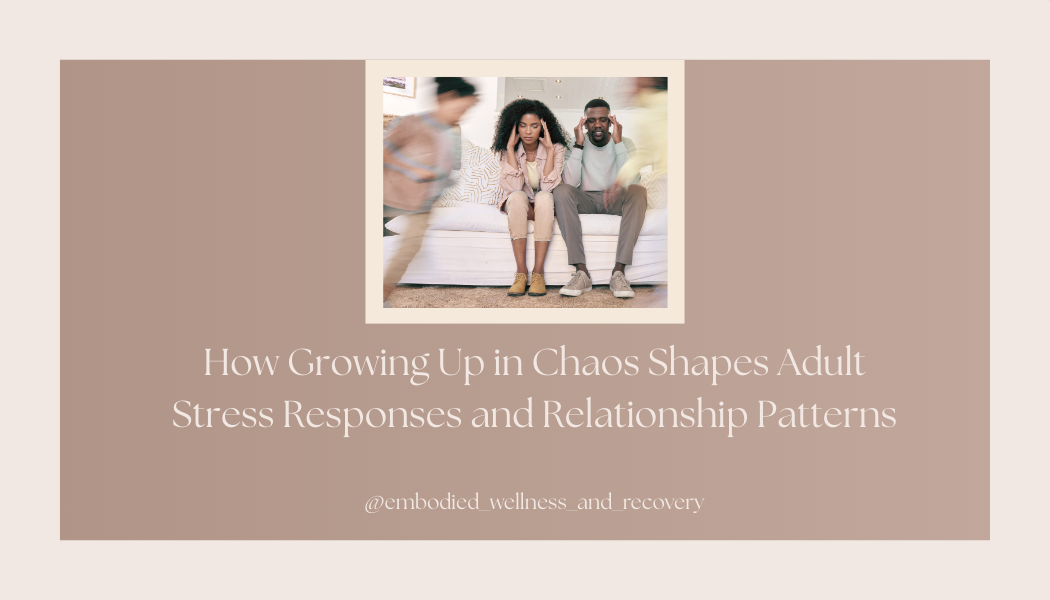
How Growing Up in Chaos Shapes Adult Stress Responses and Relationship Patterns
How Growing Up in Chaos Shapes Adult Stress Responses and Relationship Patterns
Did you grow up in a chaotic home? Learn how childhood chaos shapes adult stress responses, relationships, and nervous system patterns, and what supports lasting change.
When the Past Still Lives in the Body
Do you feel chronically on edge even when life is relatively calm?
Do minor conflicts trigger outsized emotional reactions in your adult relationships?
Do you struggle with trust, emotional regulation, or a constant sense that something bad might happen?
Many adults who grew up in chaotic households carry stress responses that feel confusing or disproportionate in the present. Intellectually, you may know you are safe. Physiologically, your body may still be bracing for impact.
Growing up in chaos does not just shape memories. It shapes the nervous system, stress physiology, and relational expectations that follow us into adulthood.
What “Chaos” Means in a Developmental Context
Childhood chaos does not require obvious abuse to be impactful. From a developmental perspective, chaos refers to environments that lack predictability, emotional safety, or consistent caregiving.
Examples include:
— Chronic parental conflict or volatility
— Caregivers who were emotionally unavailable, intrusive, or inconsistent
— Substance use, compulsive behaviors, or untreated mental health issues in the home
— Frequent moves, instability, or role reversals where children became caretakers
— Homes where rules, moods, or consequences changed unpredictably
For a child’s nervous system, unpredictability itself is stressful. When the environment cannot be reliably anticipated, the brain adapts by staying alert.
How the Developing Nervous System Adapts to Chaos
Neuroscience shows that early environments shape how the brain and nervous system organize around safety and threat (Mobbs et al., 2015). When a child grows up in chaos, their nervous system often learns that vigilance is necessary for survival.
Key adaptations may include:
— Heightened sympathetic activation
— Difficulty downshifting into rest states
— Rapid threat detection
— Suppressed emotional expression to avoid escalation
— Hyperresponsibility or people pleasing
These adaptations are not pathological. They are intelligent responses to an environment that requires constant monitoring.
Why Stress Responses Persist Into Adulthood
The nervous system does not automatically update itself when circumstances change. Patterns that were once protective often become automatic.
In adulthood, this can look like:
— Feeling chronically stressed even during periods of stability
— Overreacting to criticism or perceived rejection
— Difficulty tolerating uncertainty or waiting
— Emotional shutdown during conflict
— Strong bodily responses without clear triggers
From a neurobiological standpoint, the amygdala and brainstem remain primed for threat, while access to prefrontal regulation becomes compromised under stress.
The Relationship Between Chaos and Adult Relationships
Unresolved family of origin trauma often surfaces most clearly in close relationships. Intimacy activates attachment systems, which are deeply shaped by early caregiving experiences.
Adults who grew up in chaos may notice:
— Fear of abandonment or engulfment
— Difficulty trusting consistency
— Attraction to emotionally unavailable or volatile partners
— Conflict that escalates quickly or feels overwhelming
— A tendency to self-abandon to maintain a connection
These patterns are not conscious choices. They are relational stress responses rooted in early learning in the nervous system.
How Chaos Shapes Emotional Regulation
In chaotic homes, children often do not receive consistent co-regulation. This impacts the development of emotional regulation skills.
As adults, this may show up as:
— Difficulty identifying or naming emotions
— Feeling flooded by emotion or disconnected from it
— Rapid shifts between anxiety, anger, and numbness
— Using control, perfectionism, or withdrawal to manage internal states
The body learned to manage stress on its own. Relearning regulation often requires relational and somatic support.
The Role of the Body in Unresolved Family Trauma
Trauma is not stored only in memory. It is stored in patterns of muscle tension, breath restriction, posture, and autonomic responses.
Many adults with chaotic childhoods experience:
— Chronic tension or pain
— Gastrointestinal issues
— Sleep disruption
— Fatigue or burnout
— Sensitivity to noise, tone, or unpredictability
These are not random symptoms. They reflect a nervous system that learned to stay ready.
Practice One: Recognizing Stress Responses as Learned Patterns
One of the most important steps in healing is reframing stress responses as learned adaptations rather than flaws.
Instead of asking, “What is wrong with me?”
Try asking, “What did my nervous system learn to survive?”
This shift reduces shame and opens the door to change.
Practice Two: Building Predictability in the Present
Because chaos disrupts predictability, healing often involves intentionally creating it.
Supportive practices include:
— Consistent daily routines
— Predictable sleep and meal times
— Clear boundaries in relationships
— Naming expectations rather than assuming them
Predictability signals safety to the nervous system and gradually reduces baseline stress.
Practice Three: Learning to Tolerate Calm
For many people who grew up in chaos, calm can feel unfamiliar or even uncomfortable. The absence of stimulation may be misinterpreted as danger.
Therapeutic work often involves helping the nervous system learn that calm does not equal threat. This process happens slowly through repetition and embodied experiences of safety.
Practice Four: Repairing Relationships Through Regulation
Relationship repair is not about perfect communication. It is about nervous system regulation.
When adults learn to:
— Pause before reacting
— Track bodily cues during conflict
— Name overwhelm instead of escalating
— Return to conversations after the regulation
Relationships become safer and more flexible. Intimacy grows when stress responses are understood rather than defended against.
Why Insight Alone Is Not Enough
Many adults understand intellectually that their childhood was chaotic. Yet insight alone rarely resolves physiological stress patterns.
Neuroscience explains how nervous system change occurs through:
— Repeated embodied experiences of safety
— Relational repair
— Somatic awareness
— Trauma-informed therapeutic processes
This is why talk therapy alone may feel limited for those with complex family of origin trauma.
How Embodied Wellness and Recovery Supports This Work
At Embodied Wellness and Recovery, we specialize in helping adults understand how early chaos shapes present-day stress responses, relationships, sexuality, and intimacy.
Our integrative approach includes:
— Trauma-informed psychotherapy
— Somatic and attachment-based modalities
— EMDR and nervous system repair
— Relational and intimacy-focused healing
We help clients move from chronic activation toward greater regulation, emotional flexibility, and relational safety.
When Relationships Feel Harder Than They Should
If your stress responses feel outsized or your relationships feel harder than they should, it does not mean you are failing at adulthood. It means your nervous system learned in an environment where safety was not guaranteed. With the right support, those patterns can soften. The body can learn new responses. Relationships can feel less threatening and more nourishing over time.
Reach out to schedule a complimentary 20-minute consultation with our team of therapists, trauma specialists, somatic practitioners, or relationship experts, and start working towards integrative, embodied healing today.
📞 Call us at (310) 651-8458
📱 Text us at (310) 210-7934
📩 Email us at admin@embodiedwellnessandrecovery.com
🔗 Visit us at www.embodiedwellnessandrecovery.com
👉 Check us out on Instagram @embodied_wellness_and_recovery
🌍 Explore our offerings at Linktr.ee: https://linktr.ee/laurendummit
References
1) Felitti, V. J., Anda, R. F., Nordenberg, D., Williamson, D. F., Spitz, A. M., Edwards, V., Koss, M. P., & Marks, J. S. (1998). Relationship of childhood abuse and household dysfunction to many of the leading causes of death in adults. American Journal of Preventive Medicine, 14(4), 245–258.
2) Mobbs, D., Hagan, C. C., Dalgleish, T., Silston, B., & Prévost, C. (2015). The ecology of human fear: survival optimization and the nervous system. Frontiers in neuroscience, 9, 121062.
3)Porges, S. W. (2011). The polyvagal theory: Neurophysiological foundations of emotions, attachment, communication, and self-regulation. W. W. Norton & Company.
4)Schore, A. N. (2012). The science of the art of psychotherapy. W. W. Norton & Company.
5) Siegel, D. J. (2012). The developing mind: How relationships and the brain interact to shape who we are (2nd ed.). Guilford Press.
Navigating Friendship Changes While Depressed: How to Protect Connection Without Overextending Yourself
Navigating Friendship Changes While Depressed: How to Protect Connection Without Overextending Yourself
Struggling to maintain friendships while depressed? Learn how depression affects relationships, why friendships change, and how to stay connected without overwhelming yourself.
When Depression Changes How Friendship Feels
Have you ever noticed yourself pulling away from friends without fully understanding why?
Do texts go unanswered longer than you intended?
Do invitations start to feel heavy rather than comforting?
Do you worry that your depression is quietly damaging relationships you care about?
Depression does not only affect mood. It changes energy, motivation, perception, and emotional availability. As a result, many people find themselves navigating shifts in friendship dynamics during periods of depression, often accompanied by guilt, confusion, or fear of disappointing others. Understanding how depression affects friendships is not about excusing withdrawal or forcing connection. It is about learning how to care for your nervous system while staying relationally honest and emotionally boundaried.
Why Depression Changes How We Relate to Friends
From a neuroscience perspective, depression alters the functioning of key brain systems involved in motivation, reward, and social engagement. Reduced activity in dopaminergic pathways can make social interaction feel effortful rather than energizing. Changes in the default mode network can intensify rumination and self-focused thinking, making it harder to feel present with others.
Depression also affects the nervous system. Many people oscillate between shutdown and emotional overwhelm. In these states, even meaningful friendships can feel draining, not because the relationship is unhealthy, but because the system lacks capacity.
This is not a personal failure. It is a physiological and psychological response to prolonged stress or emotional depletion.
Common Friendship Challenges During Depression
People experiencing depression often report similar struggles in their friendships, including:
— Feeling pressure to appear fine or upbeat
— Cancelling plans at the last minute due to low energy
— Losing interest in social activities once enjoyed
— Avoiding friends to prevent being a burden
— Feeling misunderstood or disconnected
— Worrying about hurting others by pulling away
These challenges can create a painful internal conflict. On one hand, connection is deeply needed. On the other hand, engagement may feel overwhelming or impossible.
The Guilt Loop: When Depression and Shame Intersect
One of the most common patterns in depression related friendship changes is the guilt loop.
It often sounds like:
— “I should respond, but I do not have it in me.”
— “They will think I do not care.”
— “I am a bad friend.”
This internal dialogue activates shame, which further suppresses social motivation and increases withdrawal. Over time, the fear of hurting others becomes another reason to isolate. Shame thrives in silence and misunderstanding. Addressing it gently and directly can reduce its hold.
Naming Capacity Without Oversharing
One of the most protective skills during depression is learning how to name limited capacity without disclosing more than feels safe.
You do not need to explain every detail of your internal experience. Simple, honest statements help maintain connection while honoring your nervous system.
Examples include:
— “I am moving more slowly right now, but I value you.”
— “I may be quieter than usual, and I appreciate your patience.”
— “I care about staying connected even if my energy is low.”
Clear communication reduces ambiguity and helps friends understand changes without making them feel personal.
Distinguishing Supportive Friendships From Draining Ones
Depression often clarifies relational dynamics. Some friendships feel grounding even when energy is low. Others feel demanding or emotionally unsafe.
A helpful reflection includes:
— Do I feel calmer or more depleted after interacting with this person?
— Do I feel pressure to perform or hide my experience?
— Does this friendship allow for flexibility and honesty?
Not all friendships will adapt easily during depression. This does not mean the relationship has failed. It may mean it needs to be redefined or paced more gently.
How Depression Alters Perception in Relationships
Depression can distort social perception. Neutral responses may be interpreted as rejection. Silence may feel confirming of fear. Friends may appear distant even when they are not. Neuroscience research shows that depression biases attention toward negative interpretations and reduces access to contextual nuance. This means your conclusions about friendships during depression may feel convincing but incomplete. Practices that slow interpretation and reintroduce curiosity can reduce misattunement.
Practice One: Separate Emotional Truth From Objective Evidence
Ask yourself:
— What am I feeling about this friendship?
— What evidence supports my fear?
— What evidence suggests another explanation could be true?
Both emotional truth and factual context matter. Holding them side by side prevents fear from becoming the only lens.
Practice Two: Shift From All or Nothing Connection
Depression often makes people feel they must either fully show up or disappear.
Instead, consider:
— Short check-in messages
— Voice notes instead of conversations
— Walking together without deep conversation
— Letting friends know you may leave early
Connection does not have to be intense to be meaningful.
Practice Three: Let Friends Support You Without Fixing You
Many people withdraw because they fear being pitied or pressured to feel better. Setting gentle boundaries can help.
You might say:
— “I do not need advice, just presence.”
— “Listening helps more than problem-solving right now.”
This allows friends to show care without creating additional stress.
When Friendships Change or Fade
Some friendships will shift during depression. This can be deeply painful.
Changes may reflect:
— Different capacity levels
— Misaligned expectations
— Life transitions rather than personal rejection
Grieving these changes is valid. Loss does not always mean failure. Sometimes it reflects growth or the need for different forms of support.
How Therapy Supports Friendship Repair and Reconnection
Therapy provides a space to explore:
— Attachment patterns that shape friendships
— Fear of burdening others
— Shame and self-criticism
— Boundaries and communication skills
— Nervous system regulation for social engagement
At Embodied Wellness and Recovery, we help clients understand how depression intersects with relational dynamics and how to rebuild connection at a pace that respects the body and nervous system. Our work integrates trauma-informed care, somatic therapy, attachment-based approaches, and relational healing to support sustainable connection.
A Compassionate Reframe
If your friendships feel different during depression, it does not mean you are failing at connection. It means your system is asking for care, pacing, and honesty.
Relationships are not measured by constant availability. They are shaped by authenticity, repair, and mutual understanding over time.
Reach out to schedule a complimentary 20-minute consultation with our team of therapists, trauma specialists, somatic practitioners, or relationship experts, and start working towards integrative, embodied healing today.
📞 Call us at (310) 651-8458
📱 Text us at (310) 210-7934
📩 Email us at admin@embodiedwellnessandrecovery.com
🔗 Visit us at www.embodiedwellnessandrecovery.com
👉 Check us out on Instagram @embodied_wellness_and_recovery
🌍 Explore our offerings at Linktr.ee: https://linktr.ee/laurendummit
References
1) Hirschfeld, R. M. A., & Weissman, M. M. (2002). Risk factors for major depression and bipolar disorder. American Journal of Psychiatry, 159(8), 1334–1345.
2) Joiner, T. E., & Coyne, J. C. (1999). The interactional nature of depression: Advances in interpersonal approaches. American Psychological Association.
3) Platt, B., Waters, A. M., Schulte-Koerne, G., Engelmann, L., & Salemink, E. (2017). A review of cognitive biases in youth depression: attention, interpretation, and memory. Cognition and emotion, 31(3), 462-483.
4) Porges, S. W. (2011). The polyvagal theory: Neurophysiological foundations of emotions, attachment, communication, and self-regulation. W. W. Norton & Company.
5) Siegel, D. J. (2012). The developing mind: How relationships and the brain interact to shape who we are (2nd ed.). Guilford Press.

Setting Boundaries in Romantic Relationships Without Damaging Intimacy: How Honoring Your Limits Deepens Connection
Setting Boundaries in Romantic Relationships Without Damaging Intimacy: How Honoring Your Limits Deepens Connection
Struggling to set boundaries in your relationship without feeling guilty or disconnected? Learn how healthy boundaries can actually strengthen intimacy. Explore neuroscience-backed insights from Embodied Wellness and Recovery.
Can You Set Boundaries and Still Be Close?
Do you hesitate to say what you really need in your relationship, fearing it will push your partner away? Do you override your limits to “keep the peace,” only to feel resentful, disconnected, or even invisible?
For many, the idea of setting boundaries in romantic relationships stirs anxiety. We fear that asserting ourselves will be seen as rejection or selfishness. But in reality, healthy boundaries are not barriers to intimacy; they are the foundation of it.
At Embodied Wellness and Recovery, we often work with individuals and couples navigating the tension between emotional closeness and personal autonomy. Using a neuroscience-informed and trauma-sensitive approach, we help clients redefine boundaries not as walls but as acts of clarity, self-respect, and love.
The Boundary-Intimacy Myth
A common myth in relationships is that closeness means merging, sharing everything, always being available, and never saying "no." However, this model is unsustainable and often rooted in anxious attachment, trauma histories, or cultural messages that equate love with self-sacrifice.
When we consistently override our limits, it doesn’t foster deeper connection; it fuels resentment, burnout, and emotional reactivity.
Conversely, when we set clear, respectful boundaries, we create the conditions for emotional safety, mutual respect, and lasting connection.
What Are Boundaries in a Romantic Relationship?
Boundaries are internal and external limits we set to protect our time, energy, values, and emotional well-being. In romantic partnerships, boundaries help define:
— What we are and are not available for
— How we want to be treated
— What we need emotionally, physically, and mentally
— Where we end and the other begins
Boundaries are not ultimatums; they are invitations to engage more consciously and respectfully.
Why It’s Hard to Set Boundaries in Love
Many people struggle with boundary-setting because past experiences have taught them that it’s not safe to have needs or say no. This might include:
— Growing up in an enmeshed or emotionally chaotic family
— Experiencing neglect, abandonment, or criticism when asserting autonomy
— Being praised only for being “easy,” “low-maintenance,” or selfless
— Internalizing cultural or gender-based messages that discourage assertiveness
From a neuroscience perspective, setting a boundary when your nervous system has been conditioned to equate rejection with danger can feel like an existential risk. Your amygdala (the brain’s fear center) may activate a fight, flight, freeze, or fawn response, making it hard to speak up or hold your ground (Porges, 2011).
Signs You May Need Stronger Boundaries in Your Relationship
— You say yes when you want to say no and then feel resentful
— You feel responsible for your partner’s moods or reactions
— You struggle to ask for alone time without guilt
— You regularly override your own needs to avoid conflict
— You feel depleted, anxious, or unseen in the relationship
These patterns are not character flaws. They are survival strategies, often shaped by early experiences and reinforced by unspoken relational rules.
How Healthy Boundaries Enhance Intimacy
Contrary to what many believe, boundaries don’t create distance; they create clarity. Clarity is a prerequisite for true emotional intimacy.
Here’s how boundaries strengthen relationships:
— They regulate the nervous system
When you feel safe to say no or ask for space, your body shifts out of hypervigilance and into a state of connection (Siegel, 2012).
— They promote honest communication
Boundaries create space for authentic dialogue, rather than passive aggression, guilt, or withdrawal.
— They model self-respect
When you honor your needs, you invite your partner to do the same, creating a more balanced dynamic.
— They prevent emotional enmeshment
Boundaries allow you to stay connected and rooted in your own identity, reducing codependency.
How to Set Boundaries Without Damaging Intimacy
1. Start with Self-Awareness
Ask: What do I need in order to feel emotionally safe, regulated, and connected?
Tune into your body for cues, such as tightness in the chest, shallow breath, or irritability, which are often signals that a boundary is needed.
2. Use “I” Statements
Instead of: “You never give me space.”
Try: “I feel overwhelmed when I don’t have time to recharge. I’d like to carve out some alone time during the week.”
This reduces defensiveness and keeps the focus on your experience, not blame.
3. Clarify Your Intention
Let your partner know your boundary isn’t a rejection, but a way to show up more fully in the relationship.
“I’m sharing this because I want our connection to feel sustainable and supportive for both of us.”
4. Hold Boundaries with Compassion, Not Control
Boundaries don’t require the other person to change; they clarify your behavior. For example:
“I’m not available for late-night texts during the week, but I’m happy to connect in the mornings.”
5. Expect Discomfort—but Trust the Process
If your relationship has been boundary-less, change may feel destabilizing at first. However, temporary discomfort is a small price to pay for long-term emotional health and intimacy.
When Boundaries Trigger Conflict
If your partner struggles with your boundaries, it may be because:
— They’re interpreting your boundary as rejection
— They have unresolved attachment wounds or control issues
— They benefit from the status quo (even if it’s unsustainable for you)
This doesn’t mean you’re doing something wrong. But it may signal the need for deeper work, together or individually, with a therapist who understands attachment, trauma, and nervous system regulation.
At Embodied Wellness and Recovery, we help couples explore these dynamics with curiosity, rather than blame, building a foundation for secure, embodied love.
Boundaries Are an Act of Love
Healthy boundaries are not selfish, distant, or cold. They say:
“I want to stay connected, and I can only do that by honoring what’s true for me.”
In a relationship rooted in respect and trust, boundaries are not the end of intimacy; they’re the beginning.
Contact us today to schedule a free 20-minute consultation and begin your journey toward embodied connection, clarity, and confidence.
📞 Call us at (310) 651-8458
📱 Text us at (310) 210-7934
📩 Email us at admin@embodiedwellnessandrecovery.com
🔗 Visit us at www.embodiedwellnessandrecovery.com
👉 Check us out on Instagram @embodied_wellness_and_recovery
🌍 Explore our offerings at Linktr. ee: https://linktr.ee/laurendummit
References
1. Porges, S. W. (2011). The polyvagal theory: Neurophysiological foundations of emotions, attachment, communication, and self-regulation. W. W. Norton & Company
2. Siegel, D. J. (2012). The developing mind: How relationships and the brain interact to shape who we are (2nd ed.). The Guilford Press
3. Tawwab, N. G. (2021). Set Boundaries, Find Peace: A Guide to Reclaiming Yourself. TarcherPerigee.