
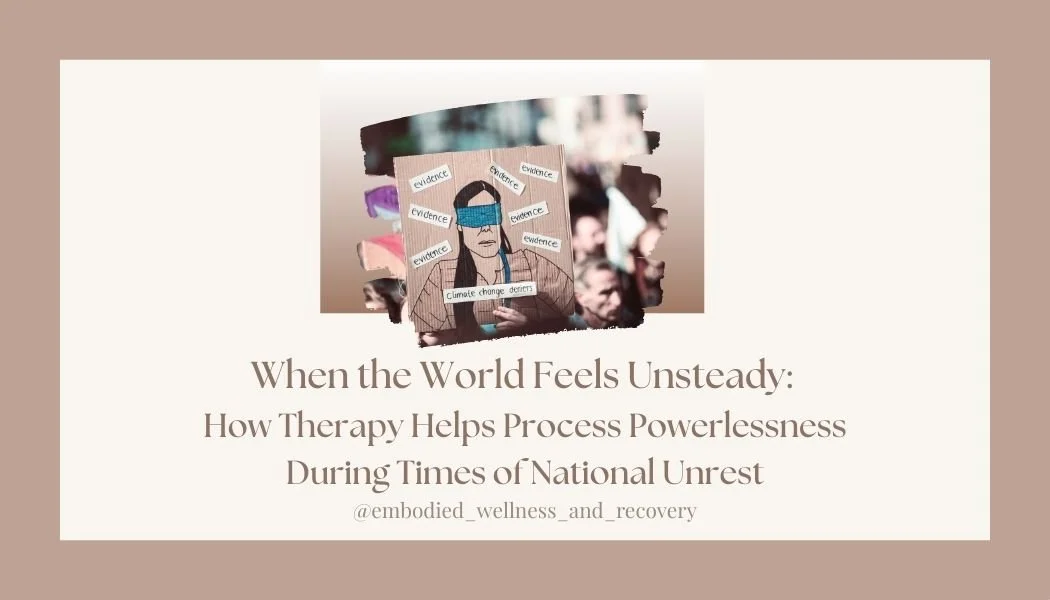
When the World Feels Unsteady: How Therapy Helps Process Powerlessness During Times of National Unrest
When the World Feels Unsteady: How Therapy Helps Process Powerlessness During Times of National Unrest
Feeling anxious or powerless during national unrest is a nervous system response, not a personal failure. Learn how therapy supports emotional regulation, resilience, and grounded action during uncertain times.
When Fear and Powerlessness Take Hold
If you feel tense, distracted, or emotionally drained by what is happening in the world right now, you are not imagining it. Periods of national unrest often activate deep fear, uncertainty, and a sense of powerlessness that can seep into daily life. News cycles, political polarization, economic instability, and social conflict can leave many people feeling overwhelmed and unsafe.
You may notice racing thoughts, difficulty sleeping, irritability, or a constant sense of vigilance. You may feel frozen, hopeless, or emotionally numb. You might ask yourself questions like:
Why do I feel anxious even when I am physically safe?
Why does everything feel out of my control?
Why am I snapping at the people I love?
Why do I feel helpless or shut down instead of motivated?
These reactions are not signs of weakness. They are nervous system responses to prolonged exposure to threat, uncertainty, and collective stress.
Therapy offers a grounded, neuroscience-informed way to process these emotions, restore regulation, and reconnect with a sense of agency during times of national unrest.
Why National Unrest Triggers Feelings of Powerlessness
Powerlessness is one of the most distressing emotional states for the human nervous system. From a biological perspective, the brain is wired to seek predictability, safety, and some degree of control. When those conditions disappear, the nervous system moves into survival mode.
National unrest often includes:
— Unpredictable political or social events
— Exposure to distressing media
— Fear about the future
— Moral injury or loss of trust in institutions
— Economic insecurity
— Social division and conflict
These factors signal danger to the brain, even in the absence of an immediate physical threat. The result is chronic activation of the stress response.
The Neuroscience of Fear and Powerlessness
When the brain perceives threat, the amygdala activates and sends signals to the body to prepare for danger. Stress hormones such as cortisol and adrenaline increase. This is adaptive in short bursts, but during ongoing national unrest, the stress response does not shut off.
Over time, this can lead to:
— Heightened anxiety
— Difficulty concentrating
— Emotional reactivity
— Sleep disruption
— Somatic symptoms such as tension or fatigue
— Emotional shutdown or numbness
t the same time, the prefrontal cortex, which supports reasoning, perspective, and decision making, becomes less effective under chronic stress. This makes it harder to feel grounded, hopeful, or capable of action.
Powerlessness emerges when the nervous system perceives threat without a clear path to safety or resolution.
Why Powerlessness Often Feels Personal
Even though national unrest is collective, the nervous system experiences it individually. For many people, current events activate older experiences of vulnerability, injustice, or loss of control.
Those with a history of trauma, chronic stress, or attachment wounds may be especially sensitive to these triggers. The body remembers past moments when safety was compromised, and present-day unrest can reactivate those imprints.
This is why some people feel overwhelmed by news that others seem able to ignore. The response is not about logic. It is about nervous system memory.
Common Coping Strategies That Stop Working
During times of unrest, many people try to cope by:
— Over-consuming news
— Avoiding information entirely
— Staying constantly busy
— Numbing with substances or screens
— Intellectualizing or minimizing feelings
While understandable, these strategies often increase dysregulation over time. Avoidance can heighten anxiety. Overexposure to media can reinforce fear. Distraction without regulation leaves the nervous system stuck in survival mode.
Therapy offers a different approach, one that works with the body and brain rather than against them.
How Therapy Helps Process Powerlessness
Therapy does not aim to eliminate fear or force optimism. Instead, it helps clients process fear safely, restore regulation, and rebuild a sense of internal agency even when external circumstances feel unstable.
At Embodied Wellness and Recovery, we approach this work through a trauma-informed, neuroscience-based lens.
1. Nervous System Regulation
Therapy helps clients understand how their nervous system is responding to ongoing threat. Through somatic techniques, breathwork, and grounding practices, the body can learn to shift out of chronic survival mode.
Regulation restores access to clarity, emotional flexibility, and choice.
2. Making Meaning of Fear
Fear becomes overwhelming when it feels chaotic or unnamed. Therapy provides space to articulate what feels frightening, what feels out of control, and what values feel threatened.
Naming these experiences engages the prefrontal cortex and reduces limbic overwhelm.
3. Processing Collective Trauma
National unrest can function as a form of collective trauma. Therapy helps differentiate between what is happening now and what belongs to past experiences. This reduces emotional flooding and reactivity.
Approaches such as EMDR can help reprocess distressing images, memories, or beliefs that become activated by current events.
4. Restoring a Sense of Agency
Powerlessness decreases when clients reconnect with what is still within their control. Therapy supports clients in identifying boundaries, values, and meaningful actions that align with their nervous system capacity.
Agency does not require fixing everything. It begins with choice, presence, and alignment.
5. Strengthening Relational Safety
Periods of unrest often strain relationships. Therapy helps clients communicate needs, manage conflict, and seek connection rather than isolation.
Safe relationships are one of the most substantial buffers against fear and despair.
Why This Work Is Especially Important Now
Chronic exposure to national unrest without support can lead to burnout, despair, and emotional exhaustion. Over time, this can impact mental health, physical health, intimacy, and parenting.
Therapy provides a consistent, stabilizing space where the nervous system can settle and integrate what it has been carrying.
This work is not about disengaging from the world. It is about engaging from a regulated, grounded place rather than from fear.
Signs Therapy Is Helping
Clients often notice:
— Reduced anxiety and hypervigilance
— Improved sleep and concentration
— Greater emotional clarity
— Less reactivity to news or social conflict
— Improved communication in relationships
— A stronger sense of internal steadiness
— Renewed access to hope and meaning
These shifts reflect nervous system regulation rather than avoidance.
Reclaiming Groundedness in an Uncertain World
It is possible to care deeply about what is happening in the world without sacrificing your mental health. Therapy helps clients hold awareness and compassion while protecting nervous system capacity.
At Embodied Wellness and Recovery, we help individuals process fear, grief, and powerlessness with respect for the body, the brain, and the complexity of this moment in history.
When the world feels unsteady, tending to your nervous system is not indulgent. It is foundational.
Moving towards Greater Resilience
Feelings of fear, anxiety, and powerlessness during times of national unrest are not signs that something is wrong with you. They are signs that your nervous system is responding to real and ongoing uncertainty.
Therapy offers a path toward regulation, integration, and grounded engagement. Through nervous system support, trauma-informed care, and relational safety, it is possible to move through this moment with greater steadiness and resilience.
At Embodied Wellness and Recovery, we specialize in helping individuals process collective stress and personal trauma so they can remain present, connected, and emotionally resourced during challenging times.
Reach out to schedule a complimentary 20-minute consultation with our team of therapists, trauma specialists, somatic practitioners, or relationship experts, and start working towards integrative, embodied healing today.
📞 Call us at (310) 651-8458
📱 Text us at (310) 210-7934
📩 Email us at admin@embodiedwellnessandrecovery.com
🔗 Visit us at www.embodiedwellnessandrecovery.com
👉 Check us out on Instagram @embodied_wellness_and_recovery
🌍 Explore our offerings at Linktr.ee: https://linktr.ee/laurendummit
References
Herman, J. L. (1992). Trauma and recovery: The aftermath of violence from domestic abuse to political terror. Basic Books.
McEwen, B. S., & Akil, H. (2020). Revisiting the stress concept: Implications for affective disorders. Journal of Neuroscience, 40(1), 12–21.
Porges, S. W. (2011). The polyvagal theory: Neurophysiological foundations of emotions, attachment, communication, and self-regulation. W. W. Norton.
van der Kolk, B. A. (2014). The body keeps the score: Brain, mind, and body in the healing of trauma. Viking.
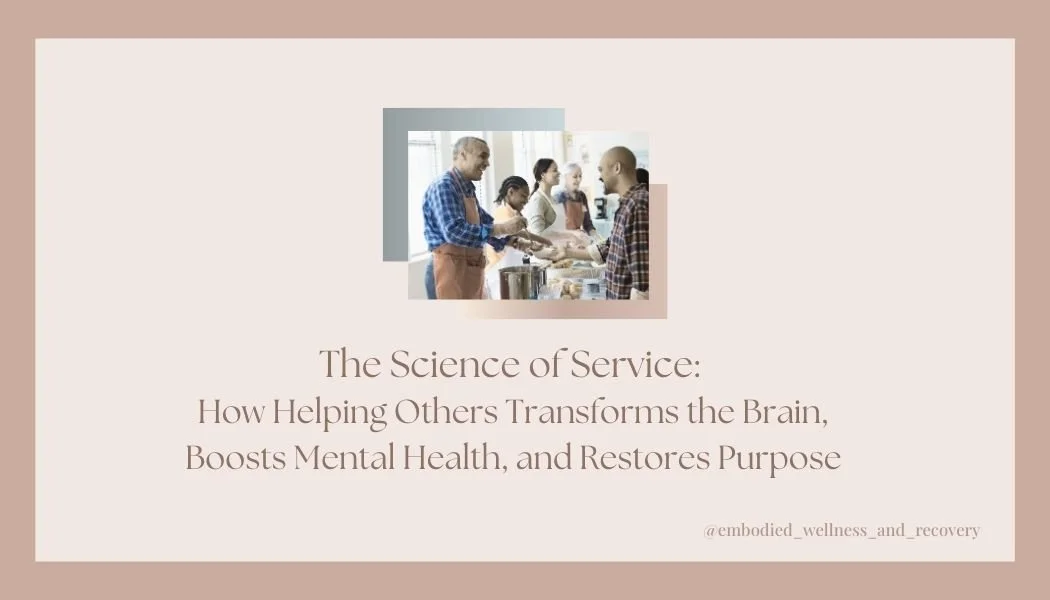
The Science of Service: How Helping Others Transforms the Brain, Boosts Mental Health, and Restores Purpose
The Science of Service: How Helping Others Transforms the Brain, Boosts Mental Health, and Restores Purpose
Discover how being of service reduces depression, anxiety, and loneliness while strengthening purpose, resilience, and mental well-being. Explore the neuroscience of kindness and the benefits of helping others.
The Science of Service: How Helping Others Transforms the Brain, Boosts Mental Health, and Restores Purpose
Have you ever noticed that you feel better when you help someone else?
Have you ever felt stuck in your own mind, only to suddenly feel clearer after supporting a friend or showing kindness to a stranger?
Have you wondered why acts of service feel grounding, meaningful, or even healing?
In a world where depression, loneliness, and stress are at record highs, millions of people are searching for ways to feel more connected, purposeful, and emotionally steady. While self-care is essential, research shows that one of the most powerful ways to support your mental and social wellness is not inward at all. It is outward. It is service. (Cowen, 1991).
Being of service activates the brain in unique ways, improves emotional regulation, helps the body shift out of survival mode, and strengthens a sense of belonging. At Embodied Wellness and Recovery, we witness every day how meaningful service shifts clients from self-centered fear and isolation into connection, confidence, and a renewed sense of purpose.
This article explores why service is such a profound path to mental health, the neuroscience behind its healing effects, and how even small, consistent acts of kindness can reshape your emotional world.
Why Service Matters: A Modern Crisis of Disconnection
Depression and loneliness often begin with thoughts like:
— “Nothing I do matters.”
— “I feel disconnected from everyone.”
— “I have no purpose.”
— “I feel stuck in my own head.”
— “My life feels small and self-focused.”
When the nervous system is overwhelmed, responsibility and self-reflection can feel heavy, or even impossible. Stress, trauma, and isolation can make your inner world so loud that it becomes hard to lift your attention outward. But the moment you do, something changes.
Service interrupts the cycle of self-rumination that fuels anxiety and depression. It invites the nervous system to shift from survival to social engagement, from hypervigilance to connection, and from stagnation to movement.
This shift is not abstract. It is deeply biological.
The Neuroscience of Being of Service
Service activates several key brain systems:
1. The Reward Circuit (Dopamine Pathways)
Helping others releases dopamine, creating a sense of pleasure, motivation, and meaning. This is sometimes called the “helper’s high.”
2. The Oxytocin System (Bonding and Safety)
Acts of kindness increase oxytocin, the hormone associated with trust, safety, bonding, and emotional warmth.
3. The Vagus Nerve (Polyvagal Social Engagement System)
Service activates the ventral vagal system, supporting calmness, emotional regulation, and connection.
4. The Prefrontal Cortex (Empathy, Perspective, Reflection)
Service enhances empathy and strengthens executive functioning, helping individuals shift away from rigid fear-based thinking.
5. Reduced Amygdala Activation (Lower Fear and Threat Response)
Helping others reduces activation in brain regions associated with fear, stress, and intense self-focus.
In other words, service is not only an emotional experience. It is a physiological event that reorganizes the nervous system.
How Being of Service Reduces Self-Focused Fear
Self-focused fear often develops when the nervous system is overwhelmed, traumatized, or disconnected from others. Thoughts can spiral into:
— “I am failing.”
— “I am not enough.”
— “Something bad will happen.”
— “I cannot handle my life.”
Service interrupts this internal loop by shifting attention outward. When you help someone else, your brain temporarily suspends catastrophic thinking and engages social circuitry instead.
This shift produces several therapeutic benefits:
1. Reduced rumination
Service pulls attention out of repetitive self-criticism.
2. Increased perspective
Seeing someone else’s humanity helps soften rigid internal narratives.
3. Emotional regulation
Kindness calms sympathetic activation and reduces stress hormones.
4. Increased self-worth
Feeling useful reinforces competence and purpose.
5. Reconnection
Service restores the relational connection that trauma often disrupts.
Service as Antidote to Loneliness
Loneliness has become a public health crisis, with research linking it to:
— Depression
— Anxiety
— Chronic illness
— Addiction relapse
— Reduced immune function
— Cognitive decline
Service directly counteracts loneliness through:
— Shared purpose
— Shared humanity
— Collective belonging
— Mutual support
— Relational meaning
Even small acts of service, like checking on a friend, helping a neighbor, or showing kindness in daily life, activate the brain’s social engagement system, which is essential for psychological health.
Purpose, Identity, and the Healing Power of Service
Purpose is a fundamental human need. Without it, life can feel flat, empty, or unmoored. Trauma, depression, and stress can strip away a sense of meaning, leaving people wondering:
— “Why am I here?”
— “What difference do I make?”
— “What am I supposed to do with my life?”
Being of service helps restore purpose by reconnecting people to their values, strengths, and capacity to contribute. It reinforces identity not through achievement but through connection.
When clients engage in service, many report:
— Increased confidence
— Improved mood
— Greater emotional resilience
— Deeper connection with their communities
— A renewed sense of direction
Even small acts can ignite profound internal shifts.
How Service Supports Trauma Recovery
Trauma often creates:
— Hypervigilance
— Isolation
— Dissociation
— Fear of connection
— Shame
— A sense of fragmentation
Service can help counteract these patterns when done mindfully and safely.
1. Being of service regulates the nervous system.
Kindness activates systems that calm the body and support safety.
2. Being of service reconnects individuals to others.
Trauma often isolates. Service rebuilds relational pathways.
3. Being of service builds self-trust
Helping others strengthens a sense of competence and agency.
4. Service repairs shame
Offering care can transform internal narratives of unworthiness.
5. Service supports meaningful identity reconstruction
After trauma, service provides direction and purpose.
At Embodied Wellness and Recovery, service is often integrated into trauma healing, helping clients cultivate resilience and connection.
Examples of Meaningful Service That Support Mental Wellness
Being of service does not require extraordinary acts. Small, consistent gestures often have the greatest effect.
Everyday acts of service:
— Sending a compassionate message to someone
— Preparing a meal for a loved one
— Volunteering at a community center
— Helping an elderly neighbor
— Supporting someone in recovery
— Participating in a cause you believe in
— Offering to listen without judgment
— Showing small acts of kindness in public spaces
The nervous system does not distinguish between small and large acts. It responds to the quality of connection, not the scale.
How to Begin a Service Practice When You Feel Low
If you feel depressed, anxious, or overwhelmed, service can feel intimidating at first. Start small. Move gently.
1. Begin with one small daily act
A text, a kind word, a moment of presence.
2. Choose something that aligns with your values
Authentic service nourishes both giver and receiver.
3. Listen to your nervous system
Choose acts that feel doable rather than draining.
4. Let service be relational, not performative
The goal is connection, not perfection.
5. Notice how your body responds
Warmth, softening, grounding, or lighter thinking often signal a shift.
A Path Toward Connection and Purpose
Being of service is not only generous. It is transformative. It supports mental health, strengthens social connection, and helps individuals rediscover purpose and emotional resilience.
At Embodied Wellness and Recovery, we help clients engage in service as part of a holistic healing process that includes:
— Somatic therapy
— EMDR
— Attachment work
— Nervous system regulation
— Relational repair
— Values-based living
Through service, clients learn to feel connected again, not because their life is perfect, but because they are part of something meaningful.
Being of service can be a profound path back to yourself.
Reach out to schedule a complimentary 20-minute consultation with our team of therapists, trauma specialists, somatic practitioners, or relationship experts, and start working towards integrative, embodied healing today.
📞 Call us at (310) 651-8458
📱 Text us at (310) 210-7934
📩 Email us at admin@embodiedwellnessandrecovery.com
🔗 Visit us at www.embodiedwellnessandrecovery.com
👉 Check us out on Instagram @embodied_wellness_and_recovery
🌍 Explore our offerings at Linktr.ee: https://linktr.ee/laurendummit
References
Brown Health. (2024). Why every day is a good day for gratitude. Brown Health.
Harvard Health Publishing. (2024). Gratitude enhances health, brings happiness, and may even lengthen lives. Harvard Medical School.
NAMI. (2022). How volunteering improves mental health. National Alliance on Mental Illness.
Cowen, E. L. (1991). In pursuit of wellness. American psychologist, 46(4), 404.