
Trauma and the Fear of Being “Too Much”: The Neuroscience of Rejection, Emotional Safety, and Attachment Wounds
Trauma and the Fear of Being “Too Much”: The Neuroscience of Rejection, Emotional Safety, and Attachment Wounds
Do you fear being “too much” emotionally in relationships? Learn how trauma, attachment wounds, nervous system dysregulation, and fear of rejection shape emotional insecurity, people pleasing, anxiety, and intimacy struggles through a neuroscience-informed lens.
Why Do So Many People Fear They Are “Too Much” for Others?
Do you constantly worry that your emotions, needs, sensitivity, or vulnerability will overwhelm people?
Have you ever:
— Apologized for crying?
— Minimized your emotional needs?
— Felt ashamed after expressing hurt?
— Feared that asking for reassurance would push someone away?
— Worried that your anxiety, sadness, or emotional intensity would make others leave?
Many people silently carry the painful belief:
— “I am too needy.”
— “I am too emotional.”
— “I am too sensitive.”
— “I take up too much space.”
— “People eventually get overwhelmed by me.”
For some individuals, this fear becomes deeply embedded in the nervous system and shapes how they experience:
— Intimacy
— Attachment
— Vulnerability
— Emotional expression
At Embodied Wellness and Recovery, we frequently help individuals explore how trauma, attachment wounds, nervous system dysregulation, and relational experiences contribute to chronic fears of rejection, abandonment, emotional shame, and insecurity.
Often, the fear of being “too much” is not a personality flaw. It is a trauma adaptation.
Where Does the Fear of Being “Too Much” Come From?
People are rarely born believing their emotions are unacceptable.
This belief often develops through repeated relational experiences in which emotional needs were:
— Dismissed
— Ignored
— Mocked
— Punished
— Invalidated
— Emotionally abandoned
Some people grew up hearing messages such as:
— “You are too sensitive.”
— “Stop crying.”
— “Calm down.”
— “You are overreacting.”
— “Why are you so emotional?”
— “You are exhausting.”
Others may not have heard these words directly, but experienced emotional inconsistency, emotional neglect, or caregivers who became overwhelmed by emotional expression. Over time, the nervous system may begin associating vulnerability with danger.
Trauma and Attachment Wounds
From an attachment perspective, humans are biologically wired to seek:
— Connection
— Emotional safety
— Attunement
— Responsiveness
When caregivers are emotionally unavailable, rejecting, inconsistent, or dysregulated, children often internalize painful conclusions about themselves.
Rather than thinking: “My environment feels unsafe.”
Children often conclude:
— “Something is wrong with me.”
— “My emotions are a problem.”
— “My needs overwhelm people.”
— “I need to become less visible to stay connected.”
These attachment wounds can persist into adulthood and shape:
— Friendships
— Marriage
The Neuroscience of Emotional Rejection
From a neuroscience perspective, social rejection activates many of the same brain regions involved in physical pain. Research suggests the anterior cingulate cortex becomes activated during experiences of emotional rejection and exclusion (Eisenberger et al., 2003).
This helps explain why:
— Criticism can feel physically painful
— Emotional invalidation can feel overwhelming
— Abandonment fears can trigger panic
— Relational conflict can activate intense nervous system responses
For trauma survivors, especially, the nervous system may become highly sensitive to cues of:
— Rejection
— Withdrawal
— Disappointment
— Emotional disconnection
— Abandonment
The body begins anticipating emotional danger before the conscious mind fully processes it.
The Fear of “Too Much” Often Creates Self-Abandonment
Ironically, many people cope with the fear of being “too much” by becoming emotionally smaller.
They may:
— Suppress feelings
— Avoid vulnerability
— People please
— Over apologize
— Avoid asking for needs to be met
— Become hyper-independent
— Minimize pain
— Tolerate emotional neglect
— Emotionally caretaking others while abandoning themselves
Some individuals become experts at:
— Reading other people’s emotions
— Adapting to others’ needs
— Avoiding conflict
— Staying emotionally “easy”
— Becoming low maintenance
But internally, they often feel:
— Lonely
— Unseen
— Anxious
— Emotionally deprived
— Disconnected from themselves
Why Highly Sensitive People Often Struggle With This Fear
Highly empathetic or emotionally sensitive individuals often feel emotions deeply. This sensitivity is not inherently unhealthy.
However, when emotional sensitivity is met with:
— Shame
— Emotional unpredictability
— Emotional invalidation
The nervous system may begin viewing emotional expression as dangerous.
Some people become trapped in a painful cycle:
— Craving connection
— Fearing rejection
— Suppressing needs
— Feeling emotionally unseen
— Becoming resentful or anxious
— Fearing they are “too much”
Trauma Can Create Hypervigilance in Relationships
Many trauma survivors become highly attuned to subtle emotional shifts in others.
They may constantly monitor:
— Facial expressions
— Tone of voice
— Texting patterns
— Pauses in communication
— Emotional distance
— Energy shifts
This hypervigilance is often the nervous system attempting to prevent abandonment or emotional pain.
The body learns: “If I can anticipate rejection early enough, maybe I can protect myself.”
Unfortunately, this often creates chronic anxiety and relational exhaustion.
The Difference Between Healthy Needs and Trauma-Driven Fear
One of the most important parts of healing is learning that having emotional needs does not make someone “too much.”
All humans need:
— Connection
— Reassurance
— Emotional safety
— Responsiveness
— Care
— Attunement
— Belonging
The problem is not emotional need itself. The problem is often unresolved shame surrounding those needs.
Trauma frequently teaches people:
— Needing others is unsafe
— Vulnerability creates rejection
— Emotional expression drives people away
Healthy relationships, however, are built through mutual emotional responsiveness and repair.
The Nervous System Needs Co-Regulation
Humans are relational beings.
According to Polyvagal Theory, the nervous system is regulated through safe connection with others (Porges, 2011).
This means:
— Warmth matters
— Emotional presence matters
— Attunement matters
— Responsiveness matters
People do not become emotionally secure through emotional isolation. They often heal through safe, consistent, emotionally attuned relationships.
How Therapy Can Help Heal the Fear of Being “Too Much”
At Embodied Wellness and Recovery, we help individuals understand how:
— Trauma
— Nervous system dysregulation
— Shame
shape fears of rejection and emotional insecurity.
Treatment may include:
— EMDR
— Self-compassion work
As healing progresses, many individuals begin:
— Tolerating vulnerability more safely
— Developing healthier emotional boundaries
— Reducing shame around emotional needs
— Improving self-worth
— Choosing healthier relationships
— Experiencing greater emotional regulation
Relearning Emotional Safety
Healing often involves learning that safe relationships do not require:
— Emotional perfection
— Emotional suppression
— Constant self-abandonment
— Shrinking yourself to maintain connection
Healthy intimacy allows space for:
— Emotions
— Needs
— Vulnerability
— Repair
— Humanity
— Imperfection
The goal is not becoming emotionless or “less needy.” The goal is to develop relationships where emotional authenticity feels safe.
Deeply Human Needs
The fear of being “too much” is often rooted in experiences where emotional expression was not safely received. Many people learned to suppress parts of themselves in order to preserve attachment, reduce conflict, or avoid rejection. But emotional sensitivity, vulnerability, and relational needs are not evidence of weakness. They are deeply human.
Sometimes healing begins when individuals stop asking: “How do I become less emotionally difficult?”
and begin asking: “What experiences taught me my emotions were unsafe in the first place?”
Reach out to schedule a complimentary 20-minute consultation with our team of therapists, trauma specialists, somatic practitioners, or relationship experts, and start working towards integrative, embodied healing today.
📞 Call us at (310) 651-8458
📱 Text us at (310) 210-7934
📩 Email us at admin@embodiedwellnessandrecovery.com
🔗 Visit us at www.embodiedwellnessandrecovery.com
👉 Check us out on Instagram @embodied_wellness_and_recovery
🌍 Explore our offerings at Linktr.ee: https://linktr.ee/laurendummit
References
1) Eisenberger, N. I., Lieberman, M. D., & Williams, K. D. (2003). Does rejection hurt? An FMRI study of social exclusion. Science, 302(5643), 290-292.
2) Porges, S. W. (2011). The polyvagal theory: Neurophysiological foundations of emotions, attachment, communication, and self-regulation. Norton.
3) Siegel, D. J. (2012). The developing mind: How relationships and the brain interact to shape who we are. Guilford Press.
4) van der Kolk, B. A. (2014). The body keeps the score: Brain, mind, and body in the healing of trauma. Viking.
Learned Helplessness: The Neuroscience of Low Self-Esteem, Trauma, and How Therapy Helps You Reclaim Personal Agency
Learned Helplessness: The Neuroscience of Low Self-Esteem, Trauma, and How Therapy Helps You Reclaim Personal Agency
Discover how learned helplessness develops through trauma, chronic stress, criticism, and emotional invalidation. Learn the neuroscience behind low self-esteem, hopelessness, anxiety, and emotional shutdown, along with how therapy can help restore confidence, nervous system regulation, and personal empowerment.
Why Do Some People Feel Stuck Even When They Want Change?
Have you ever felt like no matter how hard you try, nothing really changes?
Do you struggle with thoughts like:
— “What’s the point?”
— “I’ll probably fail anyway.”
— “Nothing I do matters.”
— “Other people seem capable, but I’m not.”
— “I don’t trust myself.”
— “I feel emotionally frozen or defeated.”
Do you find yourself staying in painful situations because part of you no longer believes you have the power to change them? Many individuals struggling with low self-esteem, anxiety, depression, trauma, or chronic relationship difficultiesare not simply “unmotivated” or lacking discipline. Sometimes they are experiencing learned helplessness.
From a neuroscience and trauma-informed perspective, learned helplessness is not weakness. It is often the nervous system’s adaptation to repeated experiences of powerlessness, unpredictability, criticism, failure, emotional invalidation, or chronic stress.
At Embodied Wellness and Recovery, we frequently help individuals explore how trauma, attachment wounds, emotional neglect, nervous system dysregulation, and relational experiences shape self-worth, confidence, motivation, and personal agency.
What Is Learned Helplessness?
Learned helplessness is a psychological condition in which individuals come to believe they have little or no control over their outcomes, even when change may be possible. The concept was first developed through research by psychologist Martin Seligman in the 1960s.
Research found that when individuals or animals are repeatedly exposed to uncontrollable stress or adverse experiences, they may eventually stop attempting to change their circumstances altogether (Seligman, 1975).
In humans, learned helplessness may appear as:
— Chronic self-doubt
— Fear of failure
— Emotional shutdown
— Passivity
— Procrastination
— Hopelessness
— Difficulty making decisions
— Remaining in unhealthy relationships
— Lack of motivation
— Anxiety
— Depression
Over time, the nervous system begins internalizing: “Nothing I do will matter.”
How Learned Helplessness Develops
Learned helplessness often develops gradually through repeated emotional experiences.
Childhood Criticism or Emotional Invalidation
Children who are:
— Excessively criticized
— Emotionally dismissed
— Shamed
— Controlled
— Chronically misunderstood
— Punished unpredictably
may begin believing their needs, feelings, or efforts are unimportant.
Over time, this can erode self-trust and confidence.
Trauma and Chronic Stress
Trauma often involves experiences where individuals feel trapped, powerless, unsafe, or unable to control outcomes.
This may include:
— Emotional abuse
— Childhood neglect
— Bullying
— Addiction in the family
— Chronic instability
The nervous system adapts by prioritizing survivalover exploration, creativity, risk-taking, or self-expression.
Repeated Failure or Rejection
Repeated experiences of rejection, disappointment, or failure may also contribute to helplessness, particularly when individuals lack emotional support or tools for self-regulation.
Perfectionism and Fear-Based Conditioning
Some individuals become so afraid of failure that they stop trying altogether. Perfectionism often masks profound fear, shame, and self-protection.
The Neuroscience of Learned Helplessness
From a neuroscience perspective, chronic helplessness affects both the brain and nervous system.
Research suggests chronic stress may impact:
— The amygdala
— Hippocampus
— Prefrontal cortex
— Dopamine pathways
— Stress hormone regulation
The brain begins organizing around threat detection rather than growth, exploration, or creativity.
Individuals may experience:
— Emotional shutdown
— Low motivation
— Exhaustion
— Hopelessness
— Nervous system dysregulation
Research has also linked helplessness to alterations in serotonin and dopamine functioning, both of which play important roles in mood, motivation, and emotional regulation (Maier & Seligman, 2016). This is why learned helplessness is not simply “negative thinking.” The body itself may begin expecting defeat, disappointment, criticism, or emotional pain.
Learned Helplessness and Low Self-Esteem
One of the most painful consequences of learned helplessness is its impact on identity and self-worth.
People may begin viewing themselves as:
— Incapable
— Weak
— Inadequate
— Defective
— Powerless
— Unintelligent
— Undeserving
This can create profound shame.
Many individuals compare themselves to others and wonder: “Why can everyone else handle life better than I can?”
Yet trauma-informed therapy recognizes that these beliefs often developed as adaptive survival responses. A nervous system conditioned by fear, unpredictability, criticism, or emotional pain may naturally struggle with confidence and self-trust.
How Learned Helplessness Shows Up in Relationships
Learned helplessness frequently affects intimate relationships.
Individuals may:
— Tolerate mistreatment
— Struggle to set boundaries
— Fear conflict
— Avoid expressing needs
— Remain in emotionally unsafe relationships
— People please excessively
— Assume they are the problem
— Feel emotionally trapped
Some people unconsciously believe:
— “My feelings do not matter.”
— “I cannot ask for more.”
— “Nothing will change anyway.”
— “I should just tolerate this.”
Over time, this can deepen anxiety, resentment, emotional exhaustion, and relational disconnection.
The Difference Between Laziness and Nervous System Shutdown
Many individuals with learned helplessness harshly criticize themselves.
They may call themselves:
— Lazy
— Weak
— Unmotivated
— Incapable
— Failures
But from a somatic and neuroscience perspective, many people are not lazy. They are overwhelmed, dysregulated, emotionally exhausted, or stuck in survival responses. The nervous system sometimes shuts down when it no longer perceives effort as emotionally safe or meaningful.
This shutdown can resemble:
— Procrastination
— Avoidance
— Emotional numbness
— Depression
— Passivity
— Low energy
Compassionate understanding is often far more effective than shame.
How Therapy Helps Heal Learned Helplessness
Therapy can help individuals gradually rebuild:
— Self-trust
— Emotional safety
— Personal agency
— Emotional resilience
At Embodied Wellness and Recovery, we approach learned helplessness through an integrative, trauma-informed lens that recognizes the relationship between the body, brain, attachment experiences, and nervous system functioning.
Somatic Therapy
Somatic approaches help individuals reconnect with their bodies, emotions, boundaries, instincts, and internal experiences. This can increase feelings of empowerment and embodiment.
EMDR Therapy
EMDR may help process unresolved trauma, shame, fear, criticism, or painful memories that continue reinforcing helplessness beliefs.
Attachment Focused Therapy
Attachment work helps individuals explore how early relational experiences shaped beliefs about worth, safety, capability, and emotional expression.
Nervous System Regulation
As the nervous system becomes more regulated, many individuals report:
— Increased motivation
— Greater clarity
— Improved emotional resilience
— Stronger boundaries
— More self-confidence
— Renewed creativity
— Greater willingness to take healthy risks
Self-Compassion Work
Research suggests self-compassion improves emotional resilience and reduces shame-based thinking(Neff, 2003). People often heal more effectively through compassion than self-punishment.
Reclaiming Personal Agency
Healing learned helplessness does not usually happen all at once.
It often develops gradually through:
— Small moments of empowerment
— Emotional safety
— Supportive relationships
— Self-trust
— Consistent experiences of agency
Sometimes healing begins with very small internal shifts:
— “My feelings matter.”
— “I can make choices.”
— “I am allowed to take up space.”
— “I do not have to stay powerless.”
— “My past does not define my future.”
From Shame to Self-Compassion and Healing
Learned helplessness can profoundly affect self-esteem, motivation, relationships, emotional well-being, and identity. But what often appears externally as passivity or lack of confidence may actually reflect years of nervous system adaptation to fear, unpredictability, criticism, trauma, or emotional pain. Understanding the neuroscience behind learned helplessness can help shift the conversation away from shame and toward compassion, regulation, and healing.
At Embodied Wellness and Recovery, we help individuals reconnect with their sense of agency, emotional resilience, confidence, and self-worth through trauma-informed, neuroscience-based therapy approaches that address both the mind and the nervous system.
Contact us today to schedule a free 20-minute consultation and begin your journey toward embodied connection, clarity, and confidence.
📞 Call us at (310) 651-8458
📱 Text us at (310) 210-7934
📩 Email us at admin@embodiedwellnessandrecovery.com
🔗 Visit us at www.embodiedwellnessandrecovery.com
👉 Check us out on Instagram @embodied_wellness_and_recovery
🌍 Explore our offerings at Linktr. ee:https://linktr.ee/laurendummit
References
1) Maier, S. F., & Seligman, M. E. P. (2016). Learned helplessness at fifty: Insights from neuroscience. Psychological Review, 123(4), 349-367.
2) Neff, K. D. (2003). Self-compassion: An alternative conceptualization of a healthy attitude toward oneself. Self and Identity, 2(2), 85-101.
3) Porges, S. W. (2011). The polyvagal theory: Neurophysiological foundations of emotions, attachment, communication, and self-regulation. Norton.
4) Seligman, M. E. P. (1975). Helplessness: On depression, development, and death. Freeman.
5) Van der Kolk, B. A. (2014). The body keeps the score: Brain, mind, and body in the healing of trauma. Viking.
Trauma and the Fear of Losing Control: Why Healing Can Feel Overwhelming and How the Nervous System Learns Safety Again
Trauma and the Fear of Losing Control: Why Healing Can Feel Overwhelming and How the Nervous System Learns Safety Again
Why does trauma healing sometimes feel like losing control? Learn the neuroscience behind trauma, emotional overwhelm, and how therapy supports nervous system regulation and stability.
Why Healing Can Feel More Frightening Than Staying Stuck
Many people enter therapy with a quiet but powerful fear:
“What if I lose control if I start feeling everything?”
“What if opening this up makes things worse?”
“What if I cannot handle what comes up?”
These fears are not irrational. They are deeply rooted in how trauma affects the brain and nervous system.
For individuals living with unresolved trauma, symptoms such as anxiety, emotional flooding, numbness, or dissociation are not signs of weakness. They are signs of a nervous system that has learned to protect itself. And paradoxically, the very process of healing can sometimes feel like the loss of that protection.
The Protective Function of Control
Control is often misunderstood. For many trauma survivors, control is not about rigidity or perfectionism. It is about stability, predictability, and survival.
You may notice patterns such as:
— Carefully managing emotions
— Avoiding certain memories or topics
— Staying busy to prevent feelings from surfacing
— Maintaining tight control over routines or relationships
These strategies often develop because, at some point, the nervous system experienced overwhelm that felt unmanageable.
From a neuroscience perspective, the brain learned:
“If I stay in control, I stay safe.”
Why Trauma Disrupts the Sense of Control
Trauma affects key brain regions involved in emotional regulation and threat detection.
Research has shown that trauma can increase amygdala activation, the brain’s alarm system, while decreasing prefrontal cortex activity, which supports reasoning and regulation (van der Kolk, 2014).
At the same time, the hippocampus, which helps contextualize memories, may function less effectively, making past experiences feel as though they are happening in the present.
This combination can lead to:
— Emotional flooding
— Intrusive memories
— Difficulty distinguishing past from present
— Heightened sensitivity to perceived threat
In this context, control becomes a way to manage an internal system that feels unpredictable.
The Fear of Emotional Flooding
One of the most common fears in trauma healing is the fear of being overwhelmed by emotion.
You might wonder:
— “What if I start crying and cannot stop?”
— “What if I feel anger that is too intense?”
— “What if I dissociate or shut down?”
These concerns are grounded in real nervous system experiences.
Trauma can narrow what psychologists refer to as the window of tolerance, the range of emotional intensity that the nervous system can process without becoming overwhelmed (Siegel, 1999).
When experiences fall outside this window, the body may move into:
— Hyperarousal, such as panic, anxiety, or agitation
— Hypoarousal, such as numbness, shutdown, or dissociation
The fear of losing control is often the fear of moving outside this window.
Why Avoidance Feels Safer
Avoidance is one of the most powerful protective strategies the nervous system uses. By avoiding triggering memories, emotions, or situations, the brain reduces immediate distress. However, avoidance can also reinforce the belief that certain internal experiences are dangerous.
Over time, this can create a cycle:
avoidance → temporary relief → increased sensitivity → more avoidance
Research on trauma andPTSD consistently shows that avoidance maintains symptoms over time, even though it feels protective in the short term (American Psychiatric Association, 2013).
The Neuroscience of Gradual Healing
Healing from trauma does not require overwhelming the nervous system. In fact, effective trauma therapy is designed to do the opposite. Approaches such as EMDR, Somatic Experiencing, and other trauma-informed modalities focus on gradual processing within the window of tolerance.
This means:
— Working with small amounts of emotional activation at a time
— Building regulation skills alongside processing
— Maintaining a sense of present-moment safety
Neuroscience research supports the idea that the brain can change through repeated experiences of safety and regulation, a process known as neuroplasticity (Doidge, 2007).
The Role of the Body in Trauma Healing
Trauma is not only stored in memory. It is also held in the body. Physical sensations such as tension, tightness, or numbness often accompany emotional experiences.
This is why body-based approaches are essential.
Somatic therapies help individuals:
— Notice internal sensations without becoming overwhelmed
— Release stored tension gradually
— Reconnect with the body as a source of information rather than threat
These practices help the nervous system learn that experiencing sensation does not have to lead to loss of control.
Rebuilding Trust in the Nervous System
One of the central goals of trauma therapy is rebuilding trust in the body’s ability to regulate itself.
This process often unfolds through:
1. Increasing Awareness
Learning to notice early signs of activation before overwhelm occurs.
2. Developing Regulation Skills
Using breath, grounding, and movement to support the nervous system.
3. Expanding Tolerance
Gradually increasing the range of emotions that can be experienced safely.
4. Integrating Experience
Processing past events in a way that allows them to feel like the past, rather than the present.
Over time, the nervous system begins to shift from:
“If I feel this, I will lose control.”
to
“I can feel this and remain grounded.”
Why the Fear Itself Deserves Compassion
The fear of losing control is not something to be eliminated. It is something to be understood. This fear often represents a part of the self that learned, at some point, that emotional overwhelm was dangerous. Approaching this fear with curiosity rather than judgment can create space for change.
How Therapy Supports This Process
At Embodied Wellness and Recovery, we understand that trauma healing requires both scientific precision and emotional sensitivity.
Our approach integrates:
— Neuroscience-informed trauma therapy
— Somatic awareness and nervous system regulation
— Relationaland experiential techniques
This allows clients to move at a pace that respects their nervous system while still supporting meaningful change. Healing is not about forcing exposure to overwhelming experiences. It is about creating conditions where the nervous system can safely expand its capacity.
Moving Toward Stability and Integration
If you find yourself afraid of losing control in the healing process, it may be helpful to consider:
What if your fear is a sign of how much your nervous system has been protecting you?
What if control was never the problem, but rather a solution that outlived its context?
What if healing could happen in a way that feels steady, contained, and manageable?
These questions invite a different relationship with the process, one that is not driven by urgency, but by understanding.
A New Relationship With Control
Over time, many people discover that healing does not require losing control. It involves developing a different kind of control, not rigid or fear-based, but flexible, responsive, and grounded, a form of internal stability that allows for emotional experience without overwhelm.
Reach out to schedule a complimentary 20-minute consultation with our team of therapists, trauma specialists, somatic practitioners, or relationship experts, and start working towards integrative, embodied healing today.
📞 Call us at (310) 651-8458
📱 Text us at (310) 210-7934
📩 Email us at admin@embodiedwellnessandrecovery.com
🔗 Visit us at www.embodiedwellnessandrecovery.com
👉 Check us out on Instagram @embodied_wellness_and_recovery
🌍 Explore our offerings at Linktr.ee: https://linktr.ee/laurendummit
References
1) American Psychiatric Association. (2013). Diagnostic and statistical manual of mental disorders (5th ed.).
2) Doidge, N. (2007). The brain that changes itself. New York: Viking.
3) Siegel, D. J. (1999). The developing mind: How relationships and the brain interact to shape who we are. New York: Guilford Press.
4) van der Kolk, B. A. (2014). The body keeps the score: Brain, mind, and body in the healing of trauma. New York: Viking.
What Trauma Processing Really Means in Therapy: A Neuroscience-Informed Guide to Healing Unresolved Trauma
What Trauma Processing Really Means in Therapy: A Neuroscience-Informed Guide to Healing Unresolved Trauma
Discover what trauma processing really means in therapy from a neuroscience and somatic-informed perspective. Learn how unresolved trauma affects the nervous system, relationships, emotional regulation, and long-term mental health. Understand trauma processing methods like EMDR, somatic therapy, and parts work. Embodied Wellness and Recovery specializes in trauma therapy, nervous system repair, intimacy healing, and relational wellness.
What Trauma Processing Really Means in Therapy
A neuroscience-informed guide to understanding the healing process and why it works
Many people come to therapy unsure about what “trauma processing” actually means. The term sounds clinical, vague, or even intimidating. You may wonder:
What exactly gets processed?
Will talking about my trauma make me feel worse?
How does processing trauma help symptoms like anxiety, depression, or relationship patterns?
Why do old experiences still affect me even when I barely think about them?
What if I do not remember everything that happened?
Does processing trauma really change anything?
These questions reflect a profound truth: many individuals have lived for years with symptoms of unresolved trauma yet feel unsure whether therapy can genuinely help.
At Embodied Wellness and Recovery, we understand that trauma processing is not simply revisiting the past. It is a structured, transformative process that helps the nervous system release old survival responses, integrate overwhelming experiences, and restore a felt sense of safety and connection.
This article offers clarity, compassion, and research-backed explanations of what trauma processing actually involves and why it works.
What Is Trauma?
Trauma is not only what happened. It is how your nervous system adapted.
Trauma is any experience that overwhelms your ability to cope. It includes events that were:
— too much
— too fast
— too soon
— without adequate support
Trauma can be significant and obvious or subtle and chronic. Examples include:
— Emotional neglect
— Childhood instability
— Abusive relationships
— Medical trauma
— Sudden loss
— Sexual trauma
— Relational betrayal
— Growing up in unpredictable environments
From a neuroscience perspective, trauma changes how the brain processes threat, emotion, memory, and connection. It affects the amygdala, hippocampus, prefrontal cortex, and vagus nerve, causing symptoms long after the event ends.
This is why unresolved trauma may show up as:
— Anxiety
— Hypervigilance
— Emotional numbness
— Difficulty trusting others
— People pleasing
— Perfectionism
— Chronic shame
— Panic attacks
— Relationship conflict
— Feeling shut down
— Body tension
— Depression
These symptoms are not character flaws. They are expressions of a nervous system that has adapted to survive.
What Trauma Processing Really Means
Trauma processing is not reliving the past. It is helping the nervous system complete what it could not complete at the time.
Many people fear that processing trauma means retelling painful memories in graphic detail or being emotionally overwhelmed. In reality, trauma processing involves:
— Reconnecting to the body in a safe, grounded way
— Gently accessing traumatic memories or sensations
— Allowing the brain and nervous system to reorganize how the memory is stored
— Integrating the emotional and sensory experience so it no longer controls present-day reactions
Trauma processing bridges two systems:
1. The emotional brain (amygdala, limbic system)
2. The thinking brain (prefrontal cortex)
When trauma occurs, these systems become disconnected. Processing repairs this connection.
Why Trauma Gets Stuck in the Body
Understanding the neuroscience of unresolved trauma
During threatening experiences, the brain initiates survival responses: fight, flight, freeze, or fawn. When the experience is overwhelming or prolonged, the nervous system may never complete these responses.
Instead, trauma becomes stored in:
— Muscle tension
— Posture
— Breathing patterns
— Emotional triggers
— Somatic flashbacks
— Relationship patterns
— Core beliefs about self and safety
This is why someone can logically understand their trauma but still feel unsafe, anxious, or reactive. The body remembers what the mind has tried to forget.
Trauma processing works because it helps the nervous system complete interrupted survival circuits.
How Trauma Processing Works in Therapy
The most effective trauma therapies work with the body and the brain together.
At Embodied Wellness and Recovery, trauma processing is done through a combination of evidence-based and somatic therapies, including:
1. EMDR (Eye Movement Desensitization and Reprocessing)
EMDR helps the brain reprocess traumatic memories so they feel resolved rather than threatening. Bilateral stimulation allows the brain to integrate the memory, reduce distress, and form healthier beliefs.
Questions often asked about EMDR include:
How does moving my eyes help my trauma?
Why do memories feel less intense afterward?
Why do new insights appear during EMDR?
Research shows EMDR activates both hemispheres of the brain, allowing emotional and cognitive integration.
2. Somatic Experiencing
Somatic therapy focuses on the nervous system and bodily sensations. Rather than focusing solely on narrative, it helps clients:
— Track sensations
— Discharge survival energy
— Unfreeze incomplete responses
— Restore regulation
This approach is essential for clients who feel shut down, overwhelmed, or disconnected from their bodies.
3. Internal Family Systems (IFS) and Parts Work
Trauma often creates young parts of the self that carry fear, shame, or pain. Parts work helps clients develop compassion, connection, and leadership from the adult self.
IFS helps answer questions like:
Why do I have conflicting emotions?
Why does part of me want to heal and part resist?
Why do I react so intensely to some situations?
Parts work supports integration rather than suppression.
4. Attachment Focused Therapy
Many trauma symptoms stem from early relational wounds. Therapy helps clients develop secure internal attachment patterns and the capacity for co-regulation.
This is foundational for healing intimacy challenges, relationship patterns, and emotional safety.
What Trauma Processing Is Not
Many people worry that trauma processing will:
— Make them fall apart
— Bring up memories they cannot handle
— Force them to relive their worst experiences
— Be retraumatizing
In modern trauma therapy, this is not the goal. Effective trauma processing is:
— Slow
— Titrated
— Grounded
— Collaborative
— Nervous system informed
— Emotionally safe
— Supported by science
Therapists help clients stay within their window of tolerance, the zone in which healing can happen without overwhelm or shutdown.
Why People Feel Skeptical That Trauma Processing Helps
Trauma shapes belief systems about what is possible
People often ask:
Why would facing the past change anything now?
What if I do not remember everything?
What if I cannot handle feeling the emotions?
What if I get worse instead of better?
These questions arise because trauma teaches the brain that avoidance equals safety. But avoidance keeps the trauma alive. The good news is that trauma processing works not by intensifying the pain but by freeing the nervous system from old patterns.
What Changes After Trauma Processing
Processing does not erase the past. It changes its impact.
Clients often describe the shift like this:
— The memory is still there, but it no longer feels dangerous.
— My body responds differently.
— I do not get triggered the same way.
— I can stay present during conflict.
— I feel more grounded and less reactive.
— I trust my emotions more.
— I feel safer in relationships.
This reflects changes in:
— Vagal tone
— Prefrontal cortex functioning
— Amygdala reactivity
— Hormonal stress responses
— Neuroplasticity
Trauma processing creates physiological, emotional, and relational transformation.
Why Trauma Processing Matters for Relationships, Intimacy, and Self-Worth
Unprocessed trauma affects:
— Who you choose
— How you trust
— How you communicate
— How you set boundaries
— How you experience intimacy
— How you respond to conflict
— How you see yourself
Trauma can make the familiar feel safe, even when the familiar is emotionally harmful.
It can make healthy relationships feel uncomfortable because the nervous system does not yet recognize safety.
Processing trauma allows the nervous system to update its definitions of:
— Love
— Safety
— Worthiness
— Connection
This is why trauma therapy is not only about the past. It is about creating a future where your choices reflect your healed self, not your wounded self.
Reclaiming Your Authentic Self
Trauma processing is not a mysterious or overwhelming concept. It is a structured, neuroscience-backed approach that helps the brain and body release old fear patterns, integrate painful experiences, and restore emotional regulation.
At Embodied Wellness and Recovery, we specialize in helping clients move from survival mode to deeper self-trust, grounded relationships, and a regulated nervous system using EMDR, somatic therapy, IFS, attachment work, and nervous system repair.
Trauma processing is not about retelling what happened. It is about reclaiming who you become.
Reach out to schedule a complimentary 20-minute consultation with our team of therapists, trauma specialists, somatic practitioners, or relationship experts, and start working towards integrative, embodied healing today.
📞 Call us at (310) 651-8458
📱 Text us at (310) 210-7934
📩 Email us at admin@embodiedwellnessandrecovery.com
🔗 Visit us at www.embodiedwellnessandrecovery.com
👉 Check us out on Instagram @embodied_wellness_and_recovery
🌍 Explore our offerings at Linktr.ee: https://linktr.ee/laurendummit
References
Levine, P. A. (2010). In an unspoken voice: How the body releases trauma and restores goodness. North Atlantic Books.
Porges, S. W. (2011). The polyvagal theory: Neurophysiological foundations of emotions, attachment, communication, and self regulation. W. W. Norton.
Shapiro, F. (2018). Eye movement desensitization and reprocessing: Basic principles, protocols, and procedures. Guilford Press.
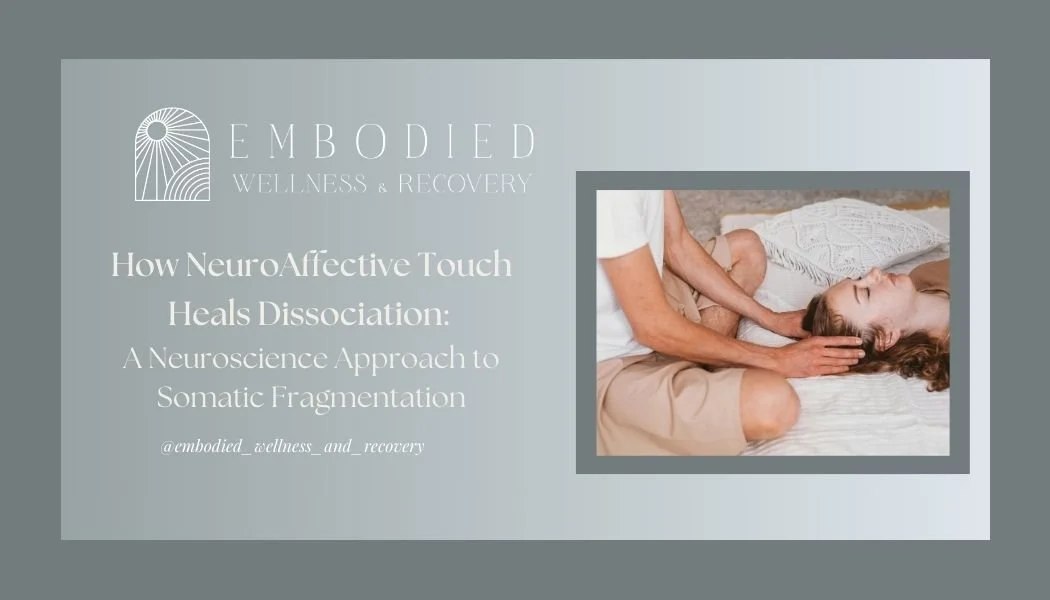
How NeuroAffective Touch Heals Dissociation: A Neuroscience Approach to Somatic Fragmentation
How NeuroAffective Touch Heals Dissociation: A Neuroscience Approach to Somatic Fragmentation
Discover how NeuroAffective Touch supports healing from dissociation, somatic fragmentation, and unresolved trauma by integrating body-based safety, nervous system repair, and relational regulation.
How NeuroAffective Touch Heals Dissociation: A Neuroscience Approach to Somatic Fragmentation
Dissociation can feel confusing, frightening, and profoundly isolating. Many people describe it as “being here but not here,” “watching life from the outside,” or “feeling disconnected from my body.” For others, it shows up as numbness, zoning out, emotional deadness, or losing time. These experiences are not a sign of weakness. They are the nervous system’s attempt to survive overwhelming experiences that the body could not process at the time.
But dissociation does not only affect thoughts. It affects the body. It fragments physical sensations, emotional presence, and a core sense of self. Trauma disrupts the relationship between mind, body, and identity, leaving people feeling scattered, unsafe, or disconnected inside their own skin.
This is where NeuroAffective Touch becomes uniquely powerful. Unlike talk therapy alone, which often cannot reach the implicit memory systems where trauma is stored, NeuroAffective Touch works directly with the nervous system to restore safety, integration, and embodied presence.
At Embodied Wellness and Recovery, NeuroAffective Touch is integrated into our trauma-informed approach to help clients restore connection, wholeness, and self-regulation from the inside out.
What Is NeuroAffective Touch?
NeuroAffective Touch is a somatic, relational, hands-on therapeutic modality developed by Dr. Aline LaPierre. It is grounded in developmental neuroscience, attachment theory, and polyvagal principles. The method uses skilled, respectful, attuned touch to regulate the nervous system and repair early attachment injuries.
Unlike massage or bodywork, NeuroAffective Touch focuses on emotional and relational development. The touch is slow, intentional, and supportive. It offers the body an experience of co-regulation and safety that may have been missing during crucial early periods of life.
NeuroAffective Touch communicates safety where words alone cannot.
Why Trauma Creates Dissociation and Fragmentation
Trauma overwhelms the brain’s capacity to regulate emotional and physiological states. When the nervous system cannot escape, fight, or seek safety, it may default to dissociation.
Dissociation serves as a biological protective mechanism by:
— Numbing overwhelming sensations
— Disconnecting from emotional pain
— Distancing from the environment
— Reducing awareness to tolerate threat
Although dissociation can protect a person in the moment, chronic dissociation impairs daily functioning. It disrupts:
— Emotional regulation
— Stable sense of self
— Physical presence
— Connection with others
— Ability to feel safe
— Capacity for intimacy
Many people with early trauma describe feeling “cut off” from their bodies or “floating through life.”
NeuroAffective Touch offers a pathway back.
The Neuroscience Behind Somatic Fragmentation
Somatic fragmentation occurs when the nervous system organizes itself around survival rather than connection. Trauma disrupts integration in several key areas:
1. The Polyvagal System
Trauma often forces the body into dorsal vagal shutdown, leading to numbness, collapse, and disconnection.
2. The Amygdala and Limbic System
Overactivation keeps the body on alert, leading to hypervigilance and emotional overwhelm.
3. The Prefrontal Cortex
Trauma reduces access to executive functioning, making grounding and presence difficult.
4. Implicit Memory Networks
Trauma is stored nonverbally in the body, not in words. These memories must be processed through sensation, movement, and relational attunement.
5. Attachment Pathways
Early relational trauma creates disrupted internal maps that shape emotional regulation, touch tolerance, and relational safety.
NeuroAffective Touch specifically targets these systems through the language of the body.
How NeuroAffective Touch Helps Heal Dissociation
NeuroAffective Touch supports dissociation recovery by working directly with the nervous system and the body’s relational wiring.
1. It Restores Safety Through Co-Regulation
Trauma often occurs without the presence of a supportive adult. Attuned touch gives the body an experience it may never have received: a safe, nurturing, regulated presence.
2. It Reconnects the Body and Mind
Touch helps reintegrate sensory, emotional, and physical awareness. Clients begin noticing sensations they previously had no access to.
3. It Heals Developmental Attachment Injuries
Gentle touch communicates attunement, presence, and care, which support the repair of early relational wounds.
4. It Supports Emotional Regulation
Slow, intentional touch stimulates the ventral vagal system, promoting calmness and resilience.
5. It Rewrites Implicit Memory
Trauma stored in the body is accessed and reorganized through therapeutic touch and relational presence.
6. It Reduces Shame and Self-Blame
The experience of being cared for at a nervous system level counters deep shame narratives that trauma often leaves behind.
7. It Supports Integration and Wholeness
Clients often describe feeling “more in their body,” “more real,” or “able to feel again.”
What a Session Looks Like
NeuroAffective Touch sessions are gentle, slow, and deeply collaborative. Clients remain fully clothed. Touch may be applied to areas associated with developmental attachment, such as the upper back, arms, hands, pelvis, or feet.
Sessions may include:
— Grounding and sensory tracking
— Guided breath awareness
— Hands-on support to specific regions of the body
— Relational attunement and co-regulation
— Verbal reflection to integrate physical experiences
The goal is always safety, choice, and honoring the client’s pace.
Who Can Benefit from NeuroAffective Touch?
Individuals experiencing:
— Dissociation
— Somatic numbness
— Emotional shutdown
— Chronic freeze
— Complex PTSD
— Developmental trauma
— Attachment wounds
— Difficulty with embodied presence
— Fragmentation or inner disconnection
— Difficulty tolerating emotional closeness
Often find NeuroAffective Touch deeply transformative.
How NeuroAffective Touch Fits into Trauma Treatment at Embodied Wellness and Recovery
At Embodied Wellness and Recovery, NeuroAffective Touch is integrated with:
— EMDR therapy
— Attachment-focused EMDR
— Somatic Experiencing
— IFS and parts work
— Polyvagal-informed therapy
— Mindfulness and breath-based regulation
— Trauma-informed relational psychotherapy
This integrative approach helps clients rebuild safety, connection, and emotional resilience at both a cognitive and cellular level.
Trauma may fracture the body’s sense of wholeness, but the nervous system is capable of profound repair when given the right conditions.
A Pathway Back to Yourself
Dissociation and somatic fragmentation are not signs of weakness. They are evidence of the body’s incredible ability to survive. NeuroAffective Touch offers a compassionate, neuroscience-informed pathway to reconnect with your body, restore emotional presence, and rebuild inner coherence.
With attuned support, the body can learn to feel safe again. The mind can return home to the body. And the fragmented parts can integrate into a grounded, connected whole.
Reach out to schedule a complimentary 20-minute consultation with our team of therapists, trauma specialists, somatic practitioners, or relationship experts, and start working towards integrative, embodied healing today.
📞 Call us at (310) 651-8458
📱 Text us at (310) 210-7934
📩 Email us at admin@embodiedwellnessandrecovery.com
🔗 Visit us at www.embodiedwellnessandrecovery.com
👉 Check us out on Instagram @embodied_wellness_and_recovery
🌍 Explore our offerings at Linktr.ee: https://linktr.ee/laurendummit
References
1) LaPierre, A. (2021). NeuroAffective Touch: Healing through the body in psychotherapy. W. W. Norton.
2) Porges, S. W. (2017). The pocket guide to the polyvagal theory: The transformative power of feeling safe. W. W. Norton.
3) Siegel, D. J. (2020). The developing mind: How relationships and the brain interact to shape who we become (3rd ed.). Guilford Press.

The Power of Self-Forgiveness: Why It’s So Hard and How to Release Shame for Good
The Power of Self-Forgiveness: Why It’s So Hard and How to Release Shame for Good
Struggling with self-forgiveness and stuck in the shame spiral? Discover why it’s so difficult and explore expert-backed steps to release shame, rebuild self-worth and restore emotional resilience.
Can You Relate?
Have you ever wondered why you can forgive others so easily, yet find it in yourself to forgive your own mistakes feels nearly impossible? Why do you keep looping in that internal voice of criticism, replaying the past, and sinking deeper into shame? Self-forgiveness is one of the most elusive yet powerful acts of healing, especially when trauma, nervous-system dysregulation, or relational wounding are involved. At Embodied Wellness and Recovery, we specialize in working with these underlying dynamics, helping clients move beyond self‐condemnation and toward embodied worth, emotional freedom, and genuine connection.
Why Self-Forgiveness Feels So Difficult
The Shame Spiral and Its Toll
You may ask:
— Why do I replay that moment I hurt someone over and over when I’ve apologised already?
— Why can’t I stop feeling like I’m defined by one bad choice or one failure?
— Why does feeling “less than” have more power than feeling hopeful in me?
These aren’t simple questions; they point to how shame and self-judgment work in our brains and bodies. Shame is not just guilt (“I made a mistake”) but a painful feeling about who we are (“I am bad”). And neuroscience shows that shame activates brain regions like the anterior cingulate cortex, parahippocampal gyrus, and medial frontal gyrus, areas tied to self-evaluation, moral emotions, and social threat.
The Brain Behind the Burden
Self-forgiveness research points to another layer: people who are better at forgiving themselves show stronger self-compassion, greater resilience, and even measurable brain differences. For example, a recent MRI study found that individuals with high self-forgiveness had greater gray matter volumes in regions associated with self-compassion and moral processing. This means that self-forgiveness is not just a “soft” concept; it is linked to tangible brain and nervous system shifts.
When shame dominates, the nervous system can stay locked in threat mode: high heart rate, tight muscles, foggy attention, and craving avoidance or escape. That physiological stress makes it nearly impossible to access safety, let alone compassion for ourselves.
The Key Obstacles to Self-Forgiveness
1) Unrelenting self-judgment
If your inner critic is louder than your inner ally, you’ll likely stay trapped in shame. The more you judge yourself, the more you activate threat networks in your brain.
2) Fear that forgiving yourself means you “let yourself off the hook”
Many people resist self-forgiveness because they believe accountability means punishment. In fact, unresolved self-shame often leads to self-sabotage.
3) Lack of nervous system regulation
Trauma, chronic stress, or emotional neglect diminishes our capacity to regulate. Without regulation, self-compassion and forgiveness feel unsafe or impossible.
4) Misunderstanding the process
Self-forgiveness is rarely a one-time event; it is a layered, ongoing stance of compassion, responsibility, and integration. Research shows it is best understood as a “mixed emotional experience” rather than a single moment of letting go.
Expert Advice for Releasing Shame and Cultivating Self-Forgiveness
Step 1: Ground your body
Begin by calming your nervous system. Before you even approach the memory or the thought:
— Take slow belly breaths, activating your vagus nerve and shifting the system toward safety.
— Scan your body and notice where tension, tightness, or contraction is held. Allow softening, shifting from fight or freeze mode into rest-and-digest.
Once the body is better regulated, the brain can engage in reflection without the immediate threat.
Step 2: Name and Witness Your Story
Ask yourself: What triggered the shame? What did I need at that moment that I did not receive or give myself? Use present-tense statements such as:
“I did X. I felt Y. I needed Z.”
The act of naming gives you agency and moves shame from implicit somatic memory into conscious narrative.
Step 3: Shift the Relationship to the Self
Replace condemnation with compassion. Self-compassion research (Neff, 2022) shows that treating ourselves with kindness allows for emotional regulation, neural flexibility, and healing.
Use mindful statements:
“I recognise that I acted from the best I knew at that time.”
“I choose to care for this part of me that carries the pain.”
These re-frames don’t undo the past, but they re-shape your nervous system’s story about the past—moving from threat to possibility.
Step 4: Repair and Re-engage with Your Values
Self-forgiveness also involves alignment with deeper values: integrity, kindness, and connection. Ask: “What can I do now (even in a small way) that affirms who I truly am, not who I fear I was?”
Making symbolic or practical reparative actions without waiting for perfection, but taking conscious steps toward values, gives your nervous system real data: you can choose differently now.
Step 5: When Trauma’s Tootprint Runs Deep
If you find yourself stuck: repeating shame loops, dissociation, overwhelming guilt, or you are unsure how to move forward, then a trauma-informed, somatic approach is essential. At Embodied Wellness and Recovery, we integrate somatic experiencing, nervous system regulation, EMDR, parts work, and relational therapy to help you reclaim your embodied life, restore boundaries, and nurture inner safety.
The Hope of Self-Forgiveness: Reclaiming Your Life
Imagine this: you're no longer defined by the mistake you made or the moment you regret. Your nervous system no longer lights up at the memory. Instead, you respond with: “I took responsibility, I learned, I am worthy of connection and rest.” That shift transforms not only how you feel about yourself, but how you show up relationally, how you live in your body, how you move through the world.
Self-forgiveness is not indulgence; it is an act of integration. When you forgive yourself, you free energy previously locked in shame. You reclaim your capacity for intimacy, pleasure, creativity, and connection. The burden of self-condemnation lifts, and you begin to live with internal freedom.
Why Embodied Wellness & Recovery Brings a Unique Approach
At Embodied Wellness and Recovery, we do more than talk about self-forgiveness. We practise it somatically, relationally, and neuro-scientifically. We help you:
— Feel safety in your nervous system.
— Rewrite the body’s memory of shame.
— Reconnect with parts of you you thought were lost.
— Build relational trust with yourself, your body, and others.
When shame dissolves and forgiveness takes root, your life becomes a place of curiosity and renewal rather than fear and concealment.
Reclaim a Life That Reflects Safety, Integrity, and Connection
Struggling with self-forgiveness is not a sign that you're “weak.” It often means your body, mind, and nervous system have carried too much for too long. The shame spiral is real, painful, but also a doorway to profound change. Through grounding, naming the story, softening self-criticism, aligning with values, and (when needed) trauma-informed support, you can shift your neural pathways, regulate your nervous system, and reclaim a life that reflects safety, integrity, and connection.
If you’re ready to explore this journey toward embodied self-compassion, clearer relationships, and nervous-system regulation in depth, discover how Embodied Wellness and Recovery can support you in reclaiming your wholeness.
Reach out to schedule a free 20-minute consultation with our team of therapists, trauma specialists, somatic practitioners, relationship experts and begin practicing self-compassion today.
📞 Call us at (310) 651-8458
📱 Text us at (310) 210-7934
📩 Email us at admin@embodiedwellnessandrecovery.com
🔗 Visit us at www.embodiedwellnessandrecovery.com
👉 Check us out on Instagram @embodied_wellness_and_recovery
🌍 Explore our offerings at Linktr.ee: https://linktr.ee/laurendummit
References
Kim, H.-J., & colleagues. (2023). Self-forgiveness is associated with increased volumes of … Scientific Reports. https://doi.org/10.1038/s41598-023-32731-0 Nature
Michl, P., et al. (2012). Neurobiological underpinnings of shame and guilt: A pilot functional magnetic resonance imaging study. Frontiers in Psychology. PMC
Woodyatt, L., & colleagues. (2025). What makes self-forgiveness so difficult? Self and Identity. Taylor & Francis Onlin

Why Asking ‘Why Me?’ Can Be the First Step to Healing Trauma and Reclaiming Meaning
Why Asking ‘Why Me?’ Can Be the First Step to Healing Trauma and Reclaiming Meaning
Wondering "Why me?" after trauma? Learn how this question can become a catalyst for healing, meaning-making, and deep nervous system repair.
Why Asking “Why Me?” Can Be the First Step to Healing Trauma and Reclaiming Meaning
Trauma has a way of shattering the stories we tell ourselves about the world, about safety, fairness, identity, and control. And in the aftermath, one of the most common and agonizing questions that arises is: “Why me?”
Maybe you’ve asked this in a quiet moment, tears streaming down your face. Perhaps you’ve screamed it into the void. Or maybe it’s lingered silently, under the surface of your day-to-day functioning, driving your anxiety, depression, or shame.
At Embodied Wellness and Recovery, we’ve heard this question from countless clients, survivors of abuse, betrayal, chronic illness, accidents, abandonment, and more. And while the question may feel like a roadblock, it can actually be a profound doorway: a starting point for meaning-making, nervous system repair, and more profound healing than you ever thought possible.
Why “Why Me?” Hurts So Much
The question “Why me?” often arises from a place of shock, grief, or injustice. It's a cry from the part of us that still believes in a moral universe, where if we do good, we should receive good. So when trauma strikes, it’s not just painful; it feels disorienting, even existential.
This question becomes especially heavy when paired with:
— Survivor’s guilt
— Self-blame or shame
— A history of repeated trauma
— Unprocessed childhood attachment wounds
It’s natural to seek meaning after trauma. In fact, meaning-making is one of the key predictors of post-traumatic growth, a concept in trauma research that describes the possibility of becoming more resilient, self-aware, and connected after surviving adversity (Tedeschi & Calhoun, 2004).
But Neuroscience Tells Us This: Trauma Disconnects Before It Can Integrate
When a traumatic event occurs, the amygdala (the brain’s threat detection system) hijacks the nervous system. The prefrontal cortex, responsible for logic, language, and meaning, goes offline. This is why you might find yourself stuck in repetitive thoughts, emotional flooding, or dissociation.
Asking “Why me?” can feel like searching for answers in the fog. But that doesn’t mean the question is wrong; it means your nervous system needs support to process it. This is where somatic and trauma-informed approaches like EMDR (Eye Movement Desensitization and Reprocessing), Somatic Experiencing, and parts work come in. At Embodied Wellness and Recovery, we help clients slow down, regulate, and return to the question from a place of curiosity rather than collapse.
When “Why Me?” Becomes a Catalyst for Healing
The transformation happens not by dismissing the question, but by expanding it:
— What meaning am I attaching to this event?
— What old wounds or beliefs has this trauma reactivated?
— What needs to be grieved, acknowledged, or reclaimed?
— How might I grow from this, not despite it, but because of how I tend to it?
This is the work of narrative integration, the process of transforming trauma into a story, chaos into coherence, and pain into purpose. According to Dr. Dan Siegel’s research on mindsight and narrative repair, this kind of integration strengthens brain functioning, self-awareness, and emotional regulation (Siegel, 2010).
Reclaiming Agency Through Meaning-Making
Here’s the shift: “Why me?” is no longer a question asked from powerlessness, but from self-inquiry.
Consider how trauma-informed therapy can help reframe and rewire:
Old Thought New Perspective Through Healing
Why did this happen to me? What is this pain inviting me to learn or unlearn?
I must have done something wrong. No one deserves to be hurt; this wasn’t my fault.
I’ll never be the same. I’ve changed, but I get to decide what that means.
In EMDR, for example, clients reprocess not only memories but also the core beliefs that accompany them. These might include “I’m unsafe,” “I’m broken,” or “I’m unlovable.” Through bilateral stimulation and targeted memory work, these beliefs are replaced with adaptive truths, like “I survived,” “I’m resilient,” and “I can trust myself again.”
From Suffering to Sacred Inquiry
In many spiritual and philosophical traditions, the question “Why me?” is not viewed as futile but as sacred. It’s the human impulse to understand, to connect, to assign value to our pain. In this way, the question itself is an act of resilience.
At Embodied Wellness and Recovery, we invite clients to explore not only the psychological but also the spiritual dimensions of trauma recovery. This includes:
— Rebuilding a sense of trust in self, others, or the universe
— Exploring existential beliefs that were fractured by trauma
— Engaging in practices of self-compassion, embodiment, and ritual
These elements can be deeply grounding for survivors who feel emotionally fragmented or disconnected from a larger sense of purpose.
How We Help Clients Turn “Why Me?” Into “What Now?”
Our trauma-informed, somatic, and neuroscience-based approach includes:
1. EMDR Therapy
To reprocess the stuck memories and beliefs that keep the nervous system in survival mode.
2. Somatic Therapy
To bring the body into the healing process through grounding, movement, and interoception, helping clients feel safe and present again.
3. Parts Work/Internal Family Systems (IFS)
To build inner relationships with the wounded parts that carry the shame, fear, and grief associated with trauma.
4. Narrative and Meaning-Making Therapy
To support the integration of trauma into a coherent, empowered personal story.
What If the Question Isn’t the Problem?
What if “Why me?” is not something to silence or escape but something to stay with, gently, until the nervous system is ready to metabolize the pain?
At Embodied Wellness and Recovery, we don’t rush this process. We walk with you through it. Our team specializes in trauma, mental health, relationships, sexuality, and intimacy because we know trauma touches every layer of who we are. You don’t have to erase the question. You get to rewrite the story in which it resides. Reach out to schedule a free 20-minute consultation with our team of top-rated therapists and take the next step toward a regulated nervous system today.
📞 Call us at (310) 651-8458
📱 Text us at (310) 210-7934
📩 Email us at admin@embodiedwellnessandrecovery.com
🔗 Visit us at www.embodiedwellnessandrecovery.com
👉 Check us out on Instagram @embodied_wellness_and_recovery
🌍 Explore our offerings at Linktr.ee: https://linktr.ee/laurendummit
References
Siegel, D. J. (2010). The Mindful Therapist: A Clinician's Guide to Mindsight and Neural Integration. W. W. Norton & Company.
Tedeschi, R. G., & Calhoun, L. G. (2004). Posttraumatic Growth: Conceptual Foundations and Empirical Evidence. Psychological Inquiry, 15(1), 1–18. https://doi.org/10.1207/s15327965pli1501_01
Van der Kolk, B. (2014). The Body Keeps the Score: Brain, Mind, and Body in the Healing of Trauma. Viking.