
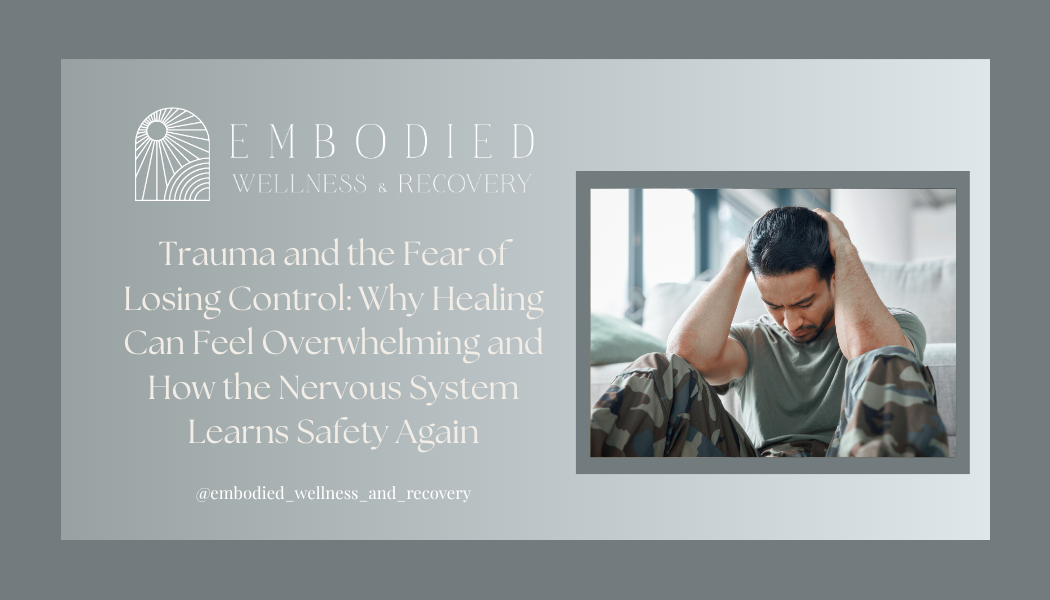
Trauma and the Fear of Losing Control: Why Healing Can Feel Overwhelming and How the Nervous System Learns Safety Again
Trauma and the Fear of Losing Control: Why Healing Can Feel Overwhelming and How the Nervous System Learns Safety Again
Why does trauma healing sometimes feel like losing control? Learn the neuroscience behind trauma, emotional overwhelm, and how therapy supports nervous system regulation and stability.
Why Healing Can Feel More Frightening Than Staying Stuck
Many people enter therapy with a quiet but powerful fear:
“What if I lose control if I start feeling everything?”
“What if opening this up makes things worse?”
“What if I cannot handle what comes up?”
These fears are not irrational. They are deeply rooted in how trauma affects the brain and nervous system.
For individuals living with unresolved trauma, symptoms such as anxiety, emotional flooding, numbness, or dissociation are not signs of weakness. They are signs of a nervous system that has learned to protect itself. And paradoxically, the very process of healing can sometimes feel like the loss of that protection.
The Protective Function of Control
Control is often misunderstood. For many trauma survivors, control is not about rigidity or perfectionism. It is about stability, predictability, and survival.
You may notice patterns such as:
— Carefully managing emotions
— Avoiding certain memories or topics
— Staying busy to prevent feelings from surfacing
— Maintaining tight control over routines or relationships
These strategies often develop because, at some point, the nervous system experienced overwhelm that felt unmanageable.
From a neuroscience perspective, the brain learned:
“If I stay in control, I stay safe.”
Why Trauma Disrupts the Sense of Control
Trauma affects key brain regions involved in emotional regulation and threat detection.
Research has shown that trauma can increase amygdala activation, the brain’s alarm system, while decreasing prefrontal cortex activity, which supports reasoning and regulation (van der Kolk, 2014).
At the same time, the hippocampus, which helps contextualize memories, may function less effectively, making past experiences feel as though they are happening in the present.
This combination can lead to:
— Emotional flooding
— Intrusive memories
— Difficulty distinguishing past from present
— Heightened sensitivity to perceived threat
In this context, control becomes a way to manage an internal system that feels unpredictable.
The Fear of Emotional Flooding
One of the most common fears in trauma healing is the fear of being overwhelmed by emotion.
You might wonder:
— “What if I start crying and cannot stop?”
— “What if I feel anger that is too intense?”
— “What if I dissociate or shut down?”
These concerns are grounded in real nervous system experiences.
Trauma can narrow what psychologists refer to as the window of tolerance, the range of emotional intensity that the nervous system can process without becoming overwhelmed (Siegel, 1999).
When experiences fall outside this window, the body may move into:
— Hyperarousal, such as panic, anxiety, or agitation
— Hypoarousal, such as numbness, shutdown, or dissociation
The fear of losing control is often the fear of moving outside this window.
Why Avoidance Feels Safer
Avoidance is one of the most powerful protective strategies the nervous system uses. By avoiding triggering memories, emotions, or situations, the brain reduces immediate distress. However, avoidance can also reinforce the belief that certain internal experiences are dangerous.
Over time, this can create a cycle:
avoidance → temporary relief → increased sensitivity → more avoidance
Research on trauma andPTSD consistently shows that avoidance maintains symptoms over time, even though it feels protective in the short term (American Psychiatric Association, 2013).
The Neuroscience of Gradual Healing
Healing from trauma does not require overwhelming the nervous system. In fact, effective trauma therapy is designed to do the opposite. Approaches such as EMDR, Somatic Experiencing, and other trauma-informed modalities focus on gradual processing within the window of tolerance.
This means:
— Working with small amounts of emotional activation at a time
— Building regulation skills alongside processing
— Maintaining a sense of present-moment safety
Neuroscience research supports the idea that the brain can change through repeated experiences of safety and regulation, a process known as neuroplasticity (Doidge, 2007).
The Role of the Body in Trauma Healing
Trauma is not only stored in memory. It is also held in the body. Physical sensations such as tension, tightness, or numbness often accompany emotional experiences.
This is why body-based approaches are essential.
Somatic therapies help individuals:
— Notice internal sensations without becoming overwhelmed
— Release stored tension gradually
— Reconnect with the body as a source of information rather than threat
These practices help the nervous system learn that experiencing sensation does not have to lead to loss of control.
Rebuilding Trust in the Nervous System
One of the central goals of trauma therapy is rebuilding trust in the body’s ability to regulate itself.
This process often unfolds through:
1. Increasing Awareness
Learning to notice early signs of activation before overwhelm occurs.
2. Developing Regulation Skills
Using breath, grounding, and movement to support the nervous system.
3. Expanding Tolerance
Gradually increasing the range of emotions that can be experienced safely.
4. Integrating Experience
Processing past events in a way that allows them to feel like the past, rather than the present.
Over time, the nervous system begins to shift from:
“If I feel this, I will lose control.”
to
“I can feel this and remain grounded.”
Why the Fear Itself Deserves Compassion
The fear of losing control is not something to be eliminated. It is something to be understood. This fear often represents a part of the self that learned, at some point, that emotional overwhelm was dangerous. Approaching this fear with curiosity rather than judgment can create space for change.
How Therapy Supports This Process
At Embodied Wellness and Recovery, we understand that trauma healing requires both scientific precision and emotional sensitivity.
Our approach integrates:
— Neuroscience-informed trauma therapy
— Somatic awareness and nervous system regulation
— Relationaland experiential techniques
This allows clients to move at a pace that respects their nervous system while still supporting meaningful change. Healing is not about forcing exposure to overwhelming experiences. It is about creating conditions where the nervous system can safely expand its capacity.
Moving Toward Stability and Integration
If you find yourself afraid of losing control in the healing process, it may be helpful to consider:
What if your fear is a sign of how much your nervous system has been protecting you?
What if control was never the problem, but rather a solution that outlived its context?
What if healing could happen in a way that feels steady, contained, and manageable?
These questions invite a different relationship with the process, one that is not driven by urgency, but by understanding.
A New Relationship With Control
Over time, many people discover that healing does not require losing control. It involves developing a different kind of control, not rigid or fear-based, but flexible, responsive, and grounded, a form of internal stability that allows for emotional experience without overwhelm.
Reach out to schedule a complimentary 20-minute consultation with our team of therapists, trauma specialists, somatic practitioners, or relationship experts, and start working towards integrative, embodied healing today.
📞 Call us at (310) 651-8458
📱 Text us at (310) 210-7934
📩 Email us at admin@embodiedwellnessandrecovery.com
🔗 Visit us at www.embodiedwellnessandrecovery.com
👉 Check us out on Instagram @embodied_wellness_and_recovery
🌍 Explore our offerings at Linktr.ee: https://linktr.ee/laurendummit
References
1) American Psychiatric Association. (2013). Diagnostic and statistical manual of mental disorders (5th ed.).
2) Doidge, N. (2007). The brain that changes itself. New York: Viking.
3) Siegel, D. J. (1999). The developing mind: How relationships and the brain interact to shape who we are. New York: Guilford Press.
4) van der Kolk, B. A. (2014). The body keeps the score: Brain, mind, and body in the healing of trauma. New York: Viking.
Why the News Is Making You Anxious: Understanding News Anxiety, Vicarious Trauma, and Nervous System Overload
Why the News Is Making You Anxious: Understanding News Anxiety, Vicarious Trauma, and Nervous System Overload
Why does watching the news cause anxiety, panic, or emotional shutdown? Learn how news anxiety and vicarious trauma dysregulate the nervous system and what helps restore balance.
Why Does Watching the News Feel So Overwhelming?
Have you noticed your heart racing after watching the news? Trouble sleeping after reading headlines? A sense of dread, numbness, or helplessness when you try to make sense of ongoing violence, political unrest, or human suffering?
Many people are asking the same questions:
— Why does the news make me anxious?
— Why do I feel emotionally flooded or shut down after watching the news?
— Is it normal to feel traumatized by events that did not happen to me directly?
— How do I stay informed without feeling overwhelmed?
These reactions are not signs of weakness or overreaction. They are signs of a nervous system under chronic strain.
What Is News Anxiety?
News anxiety refers to heightened anxiety, distress, or nervous system dysregulation triggered by repeated exposure to news coverage, especially stories involving violence, injustice, disasters, or threat.
This can include:
— Panic or anxiety symptoms
— Emotional overwhelm or tearfulness
— Numbness or emotional shutdown
— Irritability or anger
— Difficulty concentrating
— Sleep disturbances
— A sense of hopelessness or loss of meaning
News anxiety is increasingly common in an era of constant media access, graphic imagery, and real-time updates that offer little opportunity for the nervous system to reset.
Vicarious Trauma and the Brain
From a neuroscience perspective, the brain does not clearly distinguish between direct threat and witnessed threat.
Research on vicarious trauma shows that repeated exposure to others’ suffering can activate the same neural networks involved in direct trauma exposure. When we watch violence, hear distressing stories, or repeatedly imagine worst-case scenarios, the brain’s threat detection systems respond as if danger is present.
Key brain regions involved include:
— The amygdala, which detects threat
— The hippocampus, which stores emotional memory
— The anterior cingulate cortex, which processes pain and distress
— The insula, which maps bodily sensations and emotional states
Over time, this repeated activation can lead to chronic nervous system arousal or, conversely, protective shutdown.
Nervous System Overload and Dysregulation
When the nervous system is repeatedly exposed to perceived threat without resolution, it can become stuck in survival states.
Common nervous system responses to news exposure include:
Sympathetic activation
— Anxiety
— Hypervigilance
— Racing thoughts
— Anger or agitation
— Compulsive news checking
Parasympathetic shutdown
— Emotional numbness
— Dissociation
— Fatigue
— Withdrawal
— A sense of meaninglessness
Both are adaptive responses to overwhelm. Neither indicates pathology.
Why Senseless Violence Is So Dysregulating
Human nervous systems are wired for meaning-making. When events feel random, unjust, or incomprehensible, the brain struggles to integrate them.
Senseless violence disrupts:
— Our assumptions about safety
— Our belief in predictability
— Our sense of moral order
— Our trust in institutions and community
This existential disruption is often what people mean when they say, “I cannot make sense of what is happening.” The distress is not only emotional but also deeply neurobiological.
The Role of Media Saturation
Unlike previous generations, modern news consumption is:
— Continuous
— Visual and graphic
— Algorithm-driven
— Emotionally amplified
Doomscrolling keeps the nervous system in a near-constant state of alert without offering resolution or agency. The body receives threat signals but no clear action path, which increases anxiety and helplessness.
This is particularly impactful for people with:
— A history of trauma
— High empathy
— Attachment wounds
— Anxiety disorders
— Depression or dissociation
— Caregiving or helping professions
Why Some People Feel It More Intensely
Not everyone experiences news anxiety the same way. Differences often relate to nervous system sensitivity and personal history.
People who grew up in environments marked by unpredictability, violence, emotional neglect, or chronic stress often have sensitized threat detection systems. Their bodies learned early that vigilance was necessary for survival.
For these individuals, the news does not feel informational. It feels personal.
How Trauma-Informed Therapy Helps
At Embodied Wellness and Recovery, we understand news anxiety as a nervous system response, not a cognitive failure.
Effective treatment focuses on:
— Restoring nervous system regulation
— Increasing tolerance for emotional activation
— Rebuilding a sense of safety and agency
— Addressing trauma stored in the body
— Supporting meaning-making without overwhelm
Modalities such as somatic therapy, EMDR, attachment-based therapy, and nervous system-informed psychotherapy help clients process distress without retraumatization.
Practical Ways to Reduce News-Related Anxiety
1. Shift from constant exposure to intentional consumption
Limit news intake to specific times of day. Avoid starting or ending the day with distressing content.
2. Regulate before and after exposure
Grounding practices such as slow breathing, movement, or orienting to the room help the nervous system reset.
3. Notice your body’s cues
If your body tightens, dissociates, or races, that is information. Respect it.
4. Focus on agency and connection
Engaging in meaningful action, community support, or values-based living helps counter helplessness.
5. Work with a trauma-informed therapist
Professional support helps integrate emotional responses without suppressing or escalating them.
A Compassionate Reframe
Feeling overwhelmed by the news does not mean you are fragile or disengaged. It often means you are human, empathic, and wired for connection.
Your nervous system is responding exactly as it was designed to respond to threat and uncertainty.
With support, it can also learn how to return to safety, presence, and resilience.
How Embodied Wellness and Recovery Can Help
Embodied Wellness and Recovery specializes in trauma-informed, nervous system-based therapy for individuals struggling with anxiety, emotional overwhelm, dissociation, and relational distress.
Our work integrates neuroscience, somatic awareness, attachment theory, and compassionate clinical care to help clients navigate distressing times without losing themselves in the process.
Reach out to schedule a complimentary 20-minute consultation with our team of therapists, trauma specialists, somatic practitioners, or relationship experts, and start working towards integrative, embodied healing today.
📞 Call us at (310) 651-8458
📱 Text us at (310) 210-7934
📩 Email us at admin@embodiedwellnessandrecovery.com
🔗 Visit us at www.embodiedwellnessandrecovery.com
👉 Check us out on Instagram @embodied_wellness_and_recovery
🌍 Explore our offerings at Linktr.ee: https://linktr.ee/laurendummit
References
1) Eisenberger, N. I., & Lieberman, M. D. (2004). Why rejection hurts: A common neural alarm system for physical and social pain. Trends in Cognitive Sciences, 8(7), 294–300.
2) McCann, I. L., & Pearlman, L. A. (1990). Vicarious traumatization: A framework for understanding the psychological effects of working with victims. Journal of Traumatic Stress, 3(1), 131–149.
3) van der Kolk, B. A. (2014). The body keeps the score: Brain, mind, and body in the healing of trauma. Viking.

Stuck in Worst-Case Scenarios? Therapy Can Calm Your Anxious Brain
Stuck in Worst-Case Scenarios? Therapy Can Calm Your Anxious Brain
Constantly imagining the worst? Discover how therapy helps rewire the brain and end the cycle of catastrophic thinking. Explore neuroscience-backed strategies from the experts at Embodied Wellness and Recovery.
Rewiring Fear: How Therapy Stops Catastrophic Thinking in Its Tracks
Do you ever feel like your mind is always jumping to the worst possible outcome?
Do you spiral into worst-case scenarios when your partner doesn’t text back? Do minor problems trigger overwhelming fear? If so, you may be caught in a cycle of catastrophic thinking—a common yet painful experience, especially for those living with anxiety, trauma, or chronic stress.
At Embodied Wellness and Recovery, we often hear clients say:
– “I can’t stop obsessing about what might go wrong.”
– “I know it doesn’t make sense, but I still feel panicked.”
– “It feels like my brain is always preparing for disaster.”
Sound familiar? You are not alone. Even in the depths of struggle, there exists the capacity for growth, repair, and reconnection. Although the process of healing may be complex, through therapy, it is possible to calm your nervous system, challenge anxious thoughts, and create new patterns in the brain.
🧠 What Is Catastrophic Thinking?
Catastrophic thinking (also known as catastrophizing) is a type of cognitive distortion where the mind automatically leaps to the worst possible conclusion, often without evidence.
Examples include:
– "I made a mistake at work—I'm going to get fired."
– "My child has a cough—what if it’s something serious?"
– "They didn’t text me back—they must be mad at me."
These thoughts feel real because they activate the brain's threat system, causing physiological symptoms like a racing heart, muscle tension, and difficulty concentrating.
🌿 The Neuroscience Behind Catastrophizing
When you're caught in catastrophic thinking, the amygdala (the brain’s fear center) goes into overdrive. It hijacks the prefrontal cortex (the part of the brain responsible for logic and reasoning), making it harder to access rational thought.
Over time, this pattern becomes wired into the brain through neuroplasticity. The more you catastrophize, the more easily the brain defaults to those fear-based pathways.
However, therapy helps create new neural pathways that support safety, regulation, and calm.
💡 How Therapy Helps You Interrupt the Cycle
1. Cognitive Behavioral Therapy (CBT)
CBT is a gold-standard treatment for anxiety and catastrophizing. It helps you:
– Identify and challenge distorted thoughts
– Gather evidence for and against those thoughts
– Replace catastrophic thinking with more balanced, grounded beliefs
This process strengthens the prefrontal cortex, improving emotional regulation and decision-making (Beck, 2011).
2. Somatic Therapy
Sometimes, the body reacts before the mind can catch up. Somatic therapy helps you tune into physical sensations and discharge stored tension. You learn how to:
– Ground through breath and movement
– Notice where anxiety lives in the body
– Create a felt sense of safety
When the nervous system feels safe, catastrophic thoughts lose their grip.
3. EMDR (Eye Movement Desensitization and Reprocessing)
EMDR helps reprocess traumatic memories and reduce their emotional charge. By targeting past experiences that fuel current anxiety, EMDR can reduce the intensity of fear responses and help the brain recognize that the danger is no longer present (Shapiro, 2018).
4. Mindfulness and Compassion-Based Therapies
Mindfulness-based therapy teaches you to observe thoughts without judgment. Over time, this helps reduce the reactivity and urgency that often accompany catastrophizing. You become better able to say, “This is just a thought—not a fact.”
Self-compassion practices can also soothe the inner critic that often drives catastrophic thinking, helping you respond to fear with kindness instead of panic (Neff, 2011).
📈 What Catastrophic Thinking Can Lead To (If Left Untreated)
If not addressed, chronic catastrophic thinking can contribute to:
– Generalized Anxiety Disorder (GAD)
– Insomnia
– Depression
– Strained relationships
– Burnout and decision paralysis
It can also keep you stuck in avoidance, preventing you from pursuing goals, setting boundaries, or enjoying meaningful connections.
❤️ You Are Not Your Thoughts
One of the most powerful shifts therapy offers is this:
You are not your thoughts. You are the awareness behind them.
When you begin to observe your thinking instead of fusing with it, you regain agency. You can pause, reframe, and choose differently. This is the foundation of emotional freedom.
🌿 At Embodied Wellness and Recovery, We Can Help
Our integrative approach includes:
– Cognitive Behavioral Therapy (CBT)
– Somatic Experiencing and nervous system regulation
– EMDR for trauma-related anxiety
– Mindfulness and compassion-focused therapy
– Relationship and attachment work to address the deeper roots of fear and insecurity
Whether you’re struggling with anxious thoughts, trauma, or relationship stress, we help you build the tools to regulate your nervous system, rewire your brain, and reclaim peace.
🔍 Start Rewiring Your Thinking Today
If you find yourself persistently anticipating the worst, it’s important to recognize that this pattern is not fixed—and change is possible.
You can learn to calm your mind, connect with your body, and respond to life with clarity and resilience.
Ready to begin?
Reach out to Embodied Wellness and Recovery to schedule a free 20-minute consultation with our team of top-rated mental health experts and somatic practitioners to begin your healing today.. Let’s work together to transform catastrophic thinking into compassionate clarity.
📱 Text us at (310) 210-7934
📩 Email us at admin@embodiedwellnessandrecovery.com
🔗 Visit us at www.embodiedwellnessandrecovery.com
👉 Check us out on Instagram @embodied_wellness_and_recovery
🌍 Explore our offerings at Linktr.ee: https://linktr.ee/laurendummit
📓 References
Beck, J. S. (2011). Cognitive behavior therapy: Basics and beyond (2nd ed.). Guilford Press.
Neff, K. (2011). Self-compassion: The proven power of being kind to yourself. William Morrow.
Shapiro, F. (2018). Eye movement desensitization and reprocessing (EMDR) therapy: Basic principles, protocols, and procedures (3rd ed.). Guilford Press.