
Why Physical Touch Reduces Stress: The Neuroscience of Human Connection and Nervous System Regulation
Why Physical Touch Reduces Stress: The Neuroscience of Human Connection and Nervous System Regulation
Physical touch plays a powerful role in reducing stress and regulating the nervous system. Learn the neuroscience behind human connection and why touch supports emotional well-being.
Why Does Stress Feel So Overwhelming and Isolating?
Many people today feel chronically stressed, emotionally overwhelmed, and profoundly disconnected. Even when life looks stable on the outside, the body may feel tense, restless, or shut down. You might notice constant anxiety, difficulty relaxing, trouble sleeping, or a sense that something essential is missing.
Have you ever wondered:
— Why does my body feel tense even when I know I am safe?
— Why do I feel calmer after a hug, a massage, or holding someone’s hand?
— Why does stress feel worse when I feel disconnected from others?
— Why does loneliness affect my mental health so deeply?
These questions point to something fundamental. Stress is not just psychological. It is relational and physiological. One of the most powerful regulators of stress is physical touch.
Physical Touch and the Nervous System
From a neuroscience perspective, physical touch directly influences how the nervous system responds to stress. Humans are wired for connection. The brain and body evolved in relational environments where safety, regulation, and survival depended on closeness to others.
Touch sends signals of safety through the nervous system, particularly through pathways involving the vagus nerve. When safe touch is present, the nervous system shifts away from survival states and toward regulation.
This is why physical touch often produces immediate changes, such as:
— Slower heart rate
— Reduced muscle tension
— Deeper breathing
— Increased sense of calm
— Emotional softening
These responses are not imagined. They are biologically programmed.
The Role of the Autonomic Nervous System
The autonomic nervous system has two primary branches that shape stress responses:
— The sympathetic nervous system, which mobilizes the body for action, threat, or danger
— The parasympathetic nervous system, which supports rest, digestion, and recovery.
Chronic stress keeps the body locked in sympathetic activation. Physical touch helps activate parasympathetic pathways, especially those associated with social engagement and connection.
Stephen Porges’ polyvagal theory highlights how safe, attuned connection supports nervous system regulation. Touch, when consensual and emotionally safe, signals that vigilance is no longer required.
Oxytocin, Cortisol, and the Chemistry of Connection
Physical touch stimulates the release of oxytocin, often called the bonding hormone. Oxytocin plays a critical role in:
— Reducing stress responses
— Enhancing feelings of trust and connection
— Supporting emotional regulation
— Counteracting cortisol, the primary stress hormone
Research consistently shows that affectionate touch lowers cortisol levels and reduces physiological markers of stress (Field, 2010). This explains why touch can feel grounding during moments of anxiety or overwhelm.
Importantly, oxytocin release is strongest when touch is paired with emotional safety and attunement. Touch without consent or safety does not produce these regulatory effects.
Why Lack of Touch Increases Stress
When physical touch is limited or absent, the nervous system loses one of its most effective regulators. Chronic touch deprivation can amplify stress, anxiety, depression, and feelings of isolation.
Many adults experience touch scarcity without realizing it. Cultural norms, trauma histories, relationship ruptures, and busy lifestyles often reduce opportunities for safe physical connection.
The nervous system does not distinguish between emotional isolation and physical threat. Prolonged disconnection can keep the body in a state of low-grade alarm.
Touch, Attachment, and Emotional Safety
Attachment research shows that early experiences of touch shape how the nervous system learns safety (Porges, 2015). Consistent, nurturing touch in childhood supports emotional regulation and secure attachment. Inconsistent or unsafe touch can contribute to dysregulation later in life.
In adulthood, physical touch continues to play a role in attachment and relational safety. Healthy touch supports:
— Emotional intimacy
— Trust and bonding
— Sexual connection
— Repair after conflict
— Stress recovery within relationships
When touch is absent or associated with fear or shame, intimacy and regulation become more difficult.
Touch and Trauma Recovery
For individuals with trauma histories, physical touch can feel complex. Trauma often disrupts the nervous system’s ability to distinguish safety from threat. Some people crave touch but feel overwhelmed by it. Others avoid touch entirely.
Trauma-informed therapy approaches physical touch with care, consent, and pacing. Healing involves helping the nervous system gradually re-experience safe connection.
Somatic therapy, EMDR, and attachment-based approaches focus on restoring regulation so the body can tolerate closeness without fear.
At Embodied Wellness and Recovery, trauma work emphasizes choice, safety, and embodied awareness. Touch is never forced. Regulation comes first.
Physical Touch in Relationships and Intimacy
In romantic relationships, physical touch is a primary pathway for reducing stress and fostering emotional connection. Simple gestures such as holding hands, hugging, or sitting close can regulate both partners’ nervous systems.
When relationships are strained, touch often diminishes. Unfortunately, this can increase stress rather than relieve it.
Rebuilding physical connection in couples therapy often leads to:
— Reduced conflict reactivity
— Increased emotional safety
— Improved communication
— Enhanced sexual intimacy
Touch becomes a sharedregulatory resource rather than a source of pressure or obligation.
Practical Ways to Increase Safe Touch
Not all touch needs to be sexual or romantic to be regulating. Safe physical connection can take many forms.
Some supportive options include:
— Hugs with trusted friends or family
— Massage therapy
— Hand holding or arm contact
— Gentle self-touch, such as placing a hand on the chest
— Yoga or body-based practices
— Time with pets
The key ingredients are consent, safety, and presence.
When Touch Feels Difficult
If touch feels uncomfortable or activating, this is not a failure. It often reflects a nervous system shaped by stress or trauma.
Working with a trauma-informed therapist can help explore these responses with compassion. Regulation and safety come before expanding connection.
Over time, the nervous system can learn that closeness does not equal danger.
A Nervous System-Informed Path Forward
Stress reduction is not just about changing thoughts or behaviors. It is about restoring regulation in the body.
Physical touch is one of the most powerful and accessible tools for regulating the nervous system. When paired with emotional safety, it supports resilience, connection, and well-being.
At Embodied Wellness and Recovery, we integrate neuroscience, somatic therapy, and attachment-focused approaches to help individuals and couples reconnect with their bodies, relationships, and capacity for regulation.
Human connection is not a luxury. It is a biological need.
Reach outto schedule acomplimentary 20-minute consultation withour team of therapists,trauma specialists,somatic practitioners, orrelationship experts, and start working towards integrative, embodied healing today.
📞 Call us at (310) 651-8458
📱 Text us at (310) 210-7934
📩 Email us at admin@embodiedwellnessandrecovery.com
🔗 Visit us at www.embodiedwellnessandrecovery.com
👉 Check us out on Instagram @embodied_wellness_and_recovery
🌍 Explore our offerings at Linktr.ee: https://linktr.ee/laurendummit
References
1) Field, T. (2010). Touch for socioemotional and physical well-being: A review. Developmental review, 30(4), 367-383.Holt Lunstad, J., Smith, T. B., 2) Baker, M., Harris, T., & Stephenson, D. (2015). Loneliness and social isolation as risk factors for mortality. Perspectives on Psychological Science, 10(2), 227–237.
3) Porges, S. W. (2011). The polyvagal theory: Neurophysiological foundations of emotions, attachment, communication, and self-regulation. W. W. Norton & Company.
4) Porges, S. W. (2015). Making the world safe for our children: Down-regulating defence and up-regulating social engagement to ‘optimise’the human experience. Children Australia, 40(2), 114-123.
5) Uvnäs Moberg, K., Handlin, L., & Petersson, M. (2015). Self-soothing behaviors with particular reference to oxytocin release induced by non-noxious sensory stimulation. Frontiers in Psychology, 5, 1529.
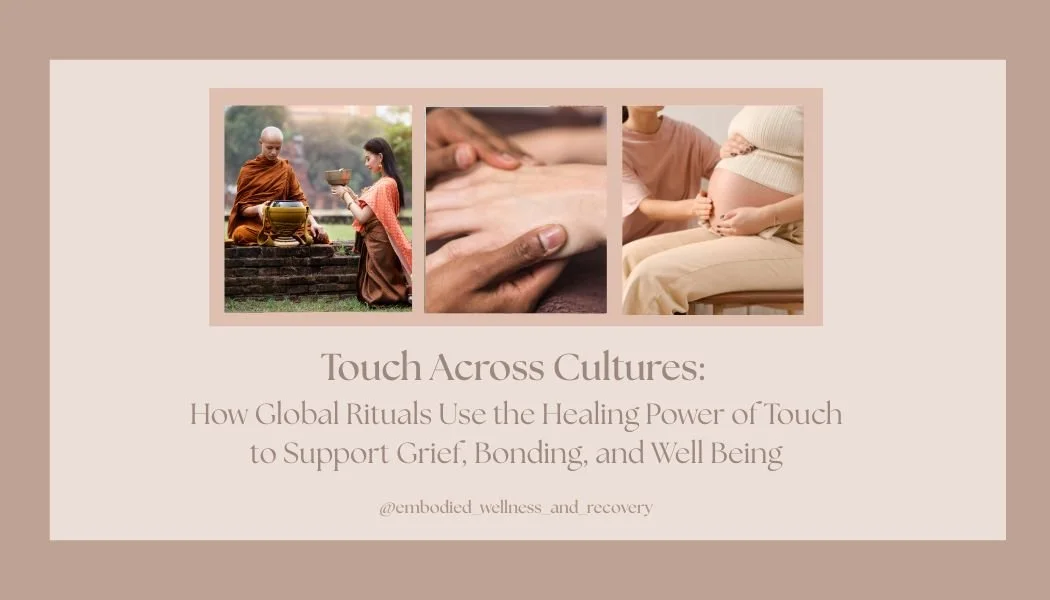
Touch Across Cultures: How Global Rituals Use the Healing Power of Touch to Support Grief, Bonding, and Well Being
Touch Across Cultures: How Global Rituals Use the Healing Power of Touch to Support Grief, Bonding, and Well Being
Explore how cultures around the world use touch in healing rituals, rites of passage, and community practices. Learn how touch deprivation affects mental health and how somatic therapy supports connection and nervous system healing.
One of the Most Fundamental Human Needs
Before infants understand language, they know touch. Before we form memories, our bodies learn safety, connection, and emotional comfort through contact. Yet many people today feel touch-deprived.
Do you ever feel like your body is starving for comfort, closeness, or warmth?
Do you struggle to initiate touch because of trauma, shame, or cultural conditioning?
Do you sense that something inside you feels disconnected or longing, but you cannot put it into words?
Touch deprivation is not a minor issue. Research shows that chronic lack of meaningful physical contact can increase stress, anxiety, depression, inflammation, and loneliness. The nervous system depends on co-regulation through touch. Without it, the body often shifts toward survival states (Dillon, n.d.).
What is fascinating is that around the world, almost every culture has traditions that use touch to soothe, connect, guide, or heal. Although the meaning, style, and context of touch vary widely, the intention is often the same: to foster a sense of belonging and restore emotional well-being.
At Embodied Wellness and Recovery, we help clients rebuild their relationship to touch by drawing on neuroscience, somatic therapy, and cross-cultural wisdom. This article explores how different societies use touch in rituals of healing and connection, and how these practices can illuminate your own path back to embodied comfort.
Why Touch Matters: The Neuroscience of Connection
Touch activates core regulatory systems in the nervous system, including:
1. Oxytocin Release
Touch increases oxytocin, which supports bonding, trust, and emotional safety.
2. Vagus Nerve Activation
Gentle contact engages the ventral vagal system, promoting calmness, social engagement, and a sense of grounded presence.
3. Stress Reduction
Touch lowers cortisol and reduces amygdala activation, easing fear and hypervigilance.
4. Co-Regulation
When someone touches us with warmth and attunement, our heartbeat, breath, and nervous system shift toward connection and balance.
5. Emotional Integration
Touch supports the integration of implicit memories, easing dissociation and fragmentation.
Humans do not simply benefit from touch. We require it for psychological stability, relational health, and physical well-being.
How Touch Deprivation Impacts Mental Health
Touch deprivation often shows up as:
— Chronic tension or numbness
— Difficulty trusting others
— Anxiety in intimate relationships
— Low mood
— Emotional isolation
— Difficulty self-soothing
— Overreliance on digital connection
— Oyperindependence
— Craving affection but feeling afraid of it
These patterns make sense. Trauma, family dynamics, and cultural norms shape how comfortable we feel giving and receiving touch. Some clients at Embodied Wellness and Recovery grew up in environments where touch was punitive, unsafe, or inconsistent. Others came from cultures that minimized physical affection, leaving the body confused about how to receive warmth.
Understanding cultural context can help reduce shame and increase insight.
Cultural Variations in Touch: What Different Societies Teach Us
Across the world, touch plays a central role in rituals of healing, bonding, and meaning-making. Here are some examples of how societies intentionally use touch.
1. Latin American and Mediterranean Cultures: Touch as Social Warmth
Many Latin American, Italian, Greek, and Spanish communities use touch as an essential relational language. Hugs, cheek kisses, hand holding, and gestures of warmth communicate belonging and emotional closeness.
Healing rituals often include:
— Collective grieving with physical closeness
— Communal gatherings after loss
— Holding hands or embracing during prayer
— Dancing as a form of shared regulation
These cultures teach that touch is not limited to romantic intimacy. It is a daily expression of connection.
2. African Traditions: Touch in Community and Ancestral Rituals
In many African communities, touch plays an important role in rites of passage, mourning, and communal bonding.
Examples include:
— Placing hands on a grieving family member
— Communal dancing to process emotion
— Carrying babies on the body for co-regulation
— Supportive touch during rituals honoring ancestors
Touch is a bridge between generations, the body, and the spirit.
3. South Asian Cultures: Touch in Spiritual and Familial Care
South Asian traditions integrate touch into both physical and spiritual healing.
Common practices include:
— Ayurvedic massage (Abhyanga)
— Touching elders’ feet as a sign of respect
— Applying oils to the scalp
— Placing hands on the heart during prayer
— Communal bathing rituals
These practices nourish the body while reinforcing relational bonds.
4. East Asian Cultures: Touch as Subtle and Regulated
Cultures in Japan, Korea, or China often emphasize modesty and emotional restraint, leading to more subtle touch norms. Yet touch still plays a meaningful role in healing rituals.
Examples include:
— Shiatsu and acupressure
— Traditional medicine focused on energy pathways
— Coordinated movement in Tai Chi or Qigong
— Family baths (onsen culture in Japan)
Touch is often ritualized rather than spontaneous.
5. Middle Eastern Cultures: Touch as Hospitality and Trust
Many Middle Eastern cultures value close, same gender affection and physical warmth.
Healing and bonding may involve:
— Supportive touch among male or female relatives
— Embracing during celebration or mourning
— Henna ceremonies involving hands-on care
— Ritual washing and massage
Touch communicates respect, hospitality, and spiritual connection.
6. Indigenous Traditions: Touch as Sacred Regulation
Indigenous healing practices frequently use touch to reconnect individuals to their bodies, communities, and the land.
Practices often include:
— Body painting for rites of passage
— Ceremonial drumming that synchronizes the nervous system
— Group dancing
— Laying of hands during healing rituals
Touch is part of a holistic system of relational regulation.
How Cultural Wisdom Helps Us Understand Touch Deprivation
Comparing global touch traditions reveals something important:
Touch is not optional in human health. It is fundamental.
Many people in the United States report feeling touch-deprived due to:
— Fast-paced lifestyles
— Digital communication replacing physical presence
— Cultural norms that emphasize independence
— Trauma or relational wounds
— Shame around physical affection
— Fear of vulnerability
Understanding that other cultures normalize touch can reduce self-judgment. It can also expand what is possible for your own healing.
How Somatic Therapy Helps Rebuild Comfort With Touch
At Embodied Wellness and Recovery, somatic therapy and attachment-focused work help clients explore:
— What types of touch feel safe
— How their cultural background shaped their body’s responses
— Where the nervous system contracts or disconnects
— How trauma influenced touch tolerance
— How to receive nurturing touch without fear
This work can include grounding, resourcing, breathwork, guided touch exploration, and practices that strengthen the ventral vagal system.
Healing does not require dramatic gestures. It begins with small moments of attunement, presence, and choice.
How to Reintroduce Touch Into Your Life Intentionally
If you feel touch-deprived or touch-avoidant, here are gentle ways to reconnect:
1. Start with self-touch
Place a hand on your heart, belly, or cheek. Let your body feel your presence.
2. Use grounding textures
Weighted blankets, soft fabrics, warm compresses.
3. Practice safe relational touch
Holding hands, hugs, resting your head on someone’s shoulder.
4. Explore community-based touch
Massage, dance classes, somatic workshops.
5. Engage in synchronized activities
Yoga, breathwork, chanting, or partner meditation.
6. Work with a somatic therapist
Therapeutic touch can help repair early attachment patterns.
Connection Lives in the Body
Touch is a universal language that humans have used for thousands of years to comfort one another, strengthen communities, honor transitions, and restore emotional balance. Although cultures vary widely in their touch norms, every tradition recognizes the power of physical connection.
When you understand how touch has shaped societies across time, you can begin to understand your own body more deeply. With compassionate support and intentional somatic work, the capacity for connection can grow again. Your body can learn safety, softness, and closeness in ways that feel grounded and empowering.
Reach out to schedule a complimentary 20-minute consultation with our team of therapists, trauma specialists, somatic practitioners, or relationship experts, and start working towards integrative, embodied healing today.
📞 Call us at (310) 651-8458
📱 Text us at (310) 210-7934
📩 Email us at admin@embodiedwellnessandrecovery.com
🔗 Visit us at www.embodiedwellnessandrecovery.com
👉 Check us out on Instagram @embodied_wellness_and_recovery
🌍 Explore our offerings at Linktr.ee: https://linktr.ee/laurendummit
References
1) Dillon, C. Holistic Integrative Therapies in Mental Health: Addressing Biology, Emotions and Psychology For Improved Outcomes in PTSD, Anxiety, Depression and Chronic Stress.2) Field, T. (2014). Touch. MIT Press.
3) Porges, S. W. (2017). The pocket guide to the polyvagal theory: The transformative power of feeling safe. W. W. Norton.
4) Keltner, D. (2016). The power paradox: How we gain and lose influence. Penguin Books.