
The Role of Curiosity in Healthy Relationships: The Neuroscience of Emotional Connection, Communication, and Intimacy
The Role of Curiosity in Healthy Relationships: The Neuroscience of Emotional Connection, Communication, and Intimacy
Discover how curiosity strengthens emotional connection, communication, intimacy, and trust in relationships. Learn the neuroscience behind curiosity, nervous system regulation, attachment, and healthy couples communication from a trauma-informed perspective.
Why Do So Many Couples Feel Disconnected Over Time?
Many relationships do not fall apart because love disappears. Often, couples slowly stop being curious about one another. Instead of asking questions, they begin making assumptions. Instead of exploring each other’s inner worlds, they become reactive, defensive, distracted, or emotionally distant.
Have you ever found yourself wondering:
— Why do we keep having the same argument?
— Why does my partner feel emotionally far away lately?
— Why do I feel misunderstood in my relationship?
— Why do conversations turn into defensiveness instead of connection?
— Why do we feel more like roommates than partners?
Long-term relationships can become emotionally strained when curiosity is replaced by certainty, criticism, resentment, or emotional withdrawal.
At Embodied Wellness and Recovery, we frequently help couples understand how emotional attunement, nervous system regulation, trauma, attachment dynamics, and communication patterns affect intimacy and relational connection. One of the most overlooked yet powerful relational tools is curiosity.
What Does Curiosity Look Like in a Relationship?
Curiosity in relationships means maintaining an open, compassionate interest in your partner’s emotional world.
It sounds like:
— “Help me understand what you’re feeling.”
— “What was that experience like for you?”
— “What do you need from me right now?”
— “What is happening underneath your reaction?”
— “Can you tell me more about that?”
Curiosity is not interrogation. It is emotional openness.
Healthy curiosity communicates:
— I want to understand you.
— Your inner experience matters to me.
— I am willing to stay emotionally engaged instead of assuming or shutting down.
This creates emotional safety, which is foundational for intimacy and trust.
The Neuroscience of Curiosity and Emotional Connection
From a neuroscience perspective, curiosity helps regulate defensiveness and supports emotional connection.
When people feel criticized, misunderstood, or emotionally threatened, the nervous system often shifts into protective states:
— Fight
— Flight
— Freeze
— Shutdown
This can lead to:
— Defensiveness
— Stonewalling
— Emotional withdrawal
Curiosity, however, activates different neural pathways. Research suggests curiosity is associated with increased openness, learning, empathy, and emotional flexibility (Kashdan et al., 2013). When couples approach each other with curiosity instead of accusation, the nervous system is more likely to experience:
— Safety
— Receptivity
— Connection
— Emotional regulation
In many ways, curiosity softens threat responses.
Curiosity Helps Couples Feel Seen
One of the deepest human emotional needs is the desire to feel known and understood.
Many relationship conflicts intensify because individuals feel:
— Dismissed
— Unseen
— Misunderstood
— Emotionally alone
Curiosity helps create emotional attunement.
Instead of saying, “You always overreact,” curiosity sounds more like: “I noticed that really affected you. Can you help me understand why?”
This shift can profoundly change the nervous system's experience of conflict. The goal becomes understanding rather than winning.
Why Curiosity Often Disappears in Relationships
Curiosity tends to decline when couples become emotionally overwhelmed or stuck in protective patterns.
This commonly happens when:
— Resentment builds
— Stress increases
— Trauma is activated
— Communication becomes reactive
— Emotional safety decreases
— Assumptions replace openness
People often stop asking questions because they believe they already know the answer. But assumptions frequently create emotional distance.
For example:
— “They do not care.”
— “They are just selfish.”
— “They always shut down.”
— “They never listen.”
Sometimes what appears externally as anger, withdrawal, or defensiveness is actually:
— Fear
— Shame
— Overwhelm
— Attachment insecurity
— Nervous system dysregulation
— Fear of rejection
Curiosity helps uncover the deeper emotional reality beneath the behavior.
Trauma and the Fear of Curiosity
For individuals with trauma histories or attachment wounds, curiosity can feel vulnerable. Some people learned early in life that emotional openness was unsafe.
If someone grew up around:
— Emotional invalidation
— Unpredictability
— Rage
— Shame
They may unconsciously protect themselves through:
— Defensiveness
— Emotional withdrawal
— Shutting down
— Avoidance
— Criticism
Curiosity requires emotional risk. It asks people to stay present with uncertainty instead of rushing toward judgment or self-protection. From a Polyvagal perspective, emotional curiosity becomes more possible when the nervous system feels safe enough to remain connected during difficult conversations.
Curiosity Improves Communication
Many couples focus heavily on communication techniques while overlooking emotional tone and nervous system regulation. Curiosity changes the emotional atmosphere of conversations. Compare these two approaches:
Reactive Communication
— “Why are you always like this?”
— “You never listen.”
— “You are impossible to talk to.”
Curious Communication
— “What are you needing right now?”
— “What felt hurtful about that interaction?”
— “Can you help me understand your perspective?”
The second approach reduces shame and defensiveness while increasing emotional openness. Curiosity helps partners move from adversaries back toward connection.
Curiosity and Intimacy
Emotional intimacy often deepens when couples remain curious about one another over time. Many long-term relationships become stagnant not because people stop loving each other, but because they stop exploring each other’s evolving inner worlds.
People continue changing throughout life:
— Emotionally
— Sexually
— Psychologically
Curiosity keeps relationships dynamic and emotionally alive.
This is especially important in conversations about:
— Desire
— Attachment needs
— Vulnerability
— Emotional pain
— Dreams
— Fears
— Identity
Curiosity communicates, “I still want to know you.”
How Couples Can Practice More Curiosity
Slow Down During Conflict
Curiosity becomes difficult when the nervous system is overwhelmed. Taking a pause, regulating emotionally, and softening tone can help restore openness.
Replace Assumptions With Questions
Instead of assuming intent, ask:
— “What did you mean by that?”
— “What were you feeling?”
— “What happened for you emotionally?”
Listen to Understand, Not Just Respond
Many people listen while preparing their defense. Curiosity requires emotional presence.
Stay Open to Complexity
Partners may experience the same event very differently. Curiosity allows space for multiple emotional truths.
Remain Curious About Yourself Too
Self-curiosity matters as well.
Questions like:
— “Why did that trigger me?”
— “What am I protecting right now?”
— “What does my nervous system need?”
can improve emotional awareness and relational regulation.
How Therapy Can Help Couples Rebuild Curiosity and Connection
At Embodied Wellness and Recovery, we help couples strengthen emotional connection through trauma-informed, neuroscience-based approaches that address:
— Nervous system regulation
— Attachment dynamics
— Emotional safety
— Intimacy
Treatment may include:
— EMDR
— Attachment-focused work
— Communication skill building
— Emotional attunement interventions
As couples become more emotionally regulated and curious about one another, many experience:
— Reduced defensiveness
— Improved communication
— Deeperintimacy
— Increased empathy
— Stronger emotional connection
When Curiosity Begins Replacing Protection
Curiosity is one of the most powerful yet underestimated tools in healthy relationships. It softens defensiveness, increases emotional safety, deepens understanding, and helps couples remain emotionally connected even during conflict. Many relationships suffer not because partners stop caring, but because fear, stress, trauma, assumptions, and nervous system protection begin replacing curiosity. Sometimes healing begins with one simple question, “Help me understand your experience.”
Reach out to schedule a complimentary 20-minute consultation with our team of therapists, trauma specialists, somatic practitioners, or relationship experts, and start working towards integrative, embodied healing today.
📞 Call us at (310) 651-8458
📱 Text us at (310) 210-7934
📩 Email us at admin@embodiedwellnessandrecovery.com
🔗 Visit us at www.embodiedwellnessandrecovery.com
👉 Check us out on Instagram @embodied_wellness_and_recovery
🌍 Explore our offerings at Linktr.ee: https://linktr.ee/laurendummit
References
1) Gottman, J. M., & Silver, N. (2015). The seven principles for making marriage work. Harmony Books.
2) Kashdan, T. B., Goodman, F. R., Disabato, D. J., McKnight, P. E., Kelso, K., & Naughton, C. (2013). Curiosity has comprehensive benefits in the workplace: Developing and validating a multidimensional workplace curiosity scale in United States and German employees. Personality and Individual Differences, 55(3), 287-292.
3) Porges, S. W. (2011). The polyvagal theory: Neurophysiological foundations of emotions, attachment, communication, and self-regulation. Norton.
4) Siegel, D. J. (2012). The developing mind: How relationships and the brain interact to shape who we are. Guilford Press.
The Power of Somatic Therapy at Home: Neuroscience-Based Practices to Regulate Your Nervous System and Reconnect with Your Body
The Power of Somatic Therapy at Home: Neuroscience-Based Practices to Regulate Your Nervous System and Reconnect with Your Body
Discover how somatic practices help regulate the nervous system, reduce anxiety, and heal trauma. Learn neuroscience-backed techniques for embodiment you can do at home to improve emotional regulation, connection, and well-being.
Have you ever felt stuck in your head, disconnected from your body, or unable to “think” your way out of anxiety?
Do you notice that even when you understand your triggers, your body still reacts with tension, fear, or shutdown?
If so, you are not alone in this experience. And more importantly, nothing about this is irrational. Trauma, stress, and chronic overwhelm do not just live in the mind. They live in the nervous system.
This is why more people are turning to somatic therapy exercises, nervous system regulation techniques, and embodiment practices at home to support healing in a deeper, more sustainable way.
At Embodied Wellness and Recovery, we integrate somatic therapy, EMDR, attachment-focused work, and neuroscience-informed care to help clients move beyond insight into true nervous system change. The videos referenced in this article introduce powerful, accessible somatic tools that can be practiced at home to support that process.
Why Somatic Practices Work When Talk Therapy Alone Is Not Enough
Many clients arrive in therapy with strong intellectual insight. They know why they feel the way they do. They can explain their childhood experiences.
They can identify patterns in their relationships. And yet, their body still reacts. This is because trauma is stored not only as narrative memory, but as implicit memory, held in the body and nervous system (van der Kolk, 2014).
From a neuroscience perspective, when the brain perceives threat, the amygdala activates survival responses, while the prefrontal cortex becomes less effective. This is why logic often fails during moments of anxiety or triggering. Somatic practices work because they target the bottom-up pathways of the nervous system. They help the body feel safe first, and from there, the mind follows.
Understanding Nervous System Regulation
To understand why somatic practices are effective, it is helpful to understand the autonomic nervous system. According to Polyvagal Theory, developed by Dr. Stephen Porges, the nervous system shifts between three primary states:
— Ventral vagal (regulated): calm, connected, safe
— Sympathetic (fight/flight): anxious, activated, mobilized
— Dorsal vagal (freeze/shutdown): numb, disconnected, fatigued
When someone has experienced trauma or chronic stress, their nervous system may become “stuck” in patterns of hyperactivation or shutdown.
This is why you might:
— Feel anxious even when nothing is wrong
— Experience tension in your body without a clear reason
— Shut down emotionally in relationships
— Feel disconnected from yourself
Somatic exercises help gently guide the nervous system back toward regulation and flexibility.
Somatic Practices You Can Do at Home
The following categories reflect the types of exercises rooted in trauma-informed somatic work.
1. Grounding and Orientation
Grounding exercises help the brain and body recognize that you are safe in the present moment.
Examples include:
— Orienting to your environment by slowly looking around
— Naming five things you can see, hear, or feel
— Placing your feet firmly on the ground and noticing pressure
Research shows that grounding techniques can reduce symptoms of dissociation and anxiety by increasing present-moment awareness (Ogden & Fisher, 2015).
When to use:
— During anxiety spikes
— After a triggering interaction
— Before sleep
2. Self-Soothing Touch and Bilateral Stimulation
Practices like the butterfly hug or gentle tapping activate bilateral stimulation, similar to EMDR.
These techniques:
— Calm the amygdala
— Increase parasympathetic activation
— Support emotional processing
Touch-based practices such as self-havening can also release oxytocin, promoting a sense of safety and comfort.
When to use:
— During emotional overwhelm
— When processing difficult memories
— As part of a daily regulation routine
3. Breathwork for Nervous System Regulation
Breath is one of the most direct ways to influence the nervous system.
Slow, controlled breathing can:
— Reduce cortisol levels
— Activate the vagus nerve
— Shift the body out of fight-or-flight
Try:
— Extending your exhale longer than your inhale
— Breathing slowly through the nose
— Placing one hand on your chest and one on your belly
Research supports that breath regulation improves emotional control and reduces anxiety symptoms (Jerath et al., 2015).
When to use:
— During panic or anxiety
— Before stressful events
— To support sleep
4. Gentle Somatic Movement
Trauma often disrupts the body’s natural ability to complete stress responses.
Gentle movement helps:
— Release stored tension
— Restore mobility and flow
— Increase body awareness
Examples include:
— Swaying
— Stretching
— Slow, mindful movement
These movements are not about performance. They are about presence.
When to use:
— When feeling stuck or frozen
— After long periods of sitting
— To reconnect with your body
5. Pendulation and Titration
Two core concepts from Somatic Experiencing:
— Pendulation: moving between states of activation and calm
— Titration: approaching difficult sensations slowly, in small doses
These techniques prevent overwhelm and help the nervous system build tolerance for emotional experiences. Instead of diving into distress, you gently touch it and return to safety. Over time, this builds resilience.
Common Barriers to Somatic Practice
Many adults initially struggle with embodiment work.
You might notice thoughts like:
— “I feel silly doing this.”
— “This isn’t working.”
— “I’d rather just think this through.”
These reactions are often protective. For many people, especially those with trauma histories, being in the body has not always felt safe. This is why pacing matters. Start small. Even 2 to 5 minutes per day can begin to shift your nervous system.
How Somatic Work Supports Trauma Healing, Relationships, and Intimacy
Somatic practices do more than reduce anxiety. They fundamentally change how you experience yourself and others.
When your nervous system becomes more regulated, you may notice:
— Improved emotional regulation
— Increased capacity for connection
— Reduced reactivity in relationships
— Greater access to pleasure and presence
— Improved communication and boundaries
From an attachment perspective, regulation is the foundation of secure connection. You cannot feel safe with others if your body does not feel safe within itself.
Integrating Somatic Practices Into Daily Life
Consistency matters more than intensity. A realistic structure might look like:
— Daily (2 to 5 minutes): grounding or breathwork
— 2 to 3 times per week: movement-based practices
— As needed: regulation tools during triggers
The goal is not perfection. The goal is relationship with your body.
A Direct Pathway to Change
Healing is not only about understanding your story. It is about helping your body feel something new. Somatic practices offer a direct pathway to this kind of change. They allow the nervous system to experience safety, connection, and regulation, often for the first time.
At Embodied Wellness and Recovery, we guide clients through this process using somatic therapy, EMDR intensives, and attachment-focused care that integrates neuroscience with compassionate, individualized treatment. Because lasting change does not happen through insight alone. It happens when the body learns it no longer has to stay in survival mode.
Reach out to schedule a complimentary 20-minute consultation with our team of therapists, trauma specialists, somatic practitioners, or relationship experts, and start working towards integrative, embodied healing today.
📞 Call us at (310) 651-8458
📱 Text us at (310) 210-7934
📩 Email us at admin@embodiedwellnessandrecovery.com
🔗 Visit us at www.embodiedwellnessandrecovery.com
👉 Check us out on Instagram @embodied_wellness_and_recovery
🌍 Explore our offerings at Linktr.ee: https://linktr.ee/laurendummit
References
1) Jerath, R., Edry, J. W., Barnes, V. A., & Jerath, V. (2015). Physiology of long pranayamic breathing. Medical Hypotheses, 85(5), 486–496.
2) Ogden, P., & Fisher, J. (2015). Sensorimotor psychotherapy: Interventions for trauma and attachment. W. W. Norton & Company.
3) van der Kolk, B. A. (2014). The body keeps the score: Brain, mind, and body in the healing of trauma. Viking.
Can 7 Days of Meditation Really Change Your Brain? The Neuroscience of Mindfulness, Anxiety Relief, and Calming Monkey Mind
Can 7 Days of Meditation Really Change Your Brain? The Neuroscience of Mindfulness, Anxiety Relief, and Calming Monkey Mind
Can just 7 days of meditation change your brain? Explore the neuroscience of mindfulness, nervous system regulation, and how a simple daily meditation practice can reduce anxiety, calm monkey mind, and improve emotional resilience.
Do you ever feel like your mind never stops talking?
You replay conversations. You anticipate worst-case scenarios. You create imaginary arguments. You rehearse things that may never happen.
Your body is tired, but your thoughts keep sprinting.
This experience is often called “monkey mind,” the restless, overactive mental chatter that makes it difficult to feel calm, present, or emotionally grounded. For many people, monkey mind is not just overthinking. It is anxiety, nervous system activation, unresolved trauma, perfectionism, and a brain trained to stay alert for danger.
So when people hear the phrase, just meditate, it can feel frustratingly simplistic. But neuroscience offers something interesting: Even a short meditation practice, sometimes in as little as seven days, can begin to shift how the brain responds to stress.
At Embodied Wellness and Recovery, we approach meditation not as spiritual perfection or forced silence, but as a nervous system intervention. Meditation can support trauma recovery, emotional regulation, relationship health, and a deeper connection to self.
The question is not whether meditation makes you instantly peaceful. The real question is: can seven days begin to change your brain’s relationship to stress? The answer is yes.
What Is Monkey Mind, Really?
Monkey mind refers to rapid, repetitive, often anxious thought patterns that pull attention away from the present moment.
It may sound like:
— “What if I said the wrong thing?”
— “Why did they not text back?”
— “What if something bad happens tomorrow?”
— “I should be doing more.”
— “Why can’t I just relax?”
This mental hyperactivity is often tied to the brain’s default mode network (DMN), a group of brain regions associated with self-referential thinking, rumination, and mental time travel.
When the DMN becomes overactive, people tend to experience:
— Anxiety
— Depression
— Rumination
— Sleep difficulties
— Emotional reactivity
— Difficulty focusing
For trauma survivors, monkey mind is often the mind’s attempt to create safety through control. If I think about everything, maybe nothing bad will happen. Unfortunately, it usually creates more suffering, not less.
What Happens in the Brain During Meditation?
Meditation does not erase thoughts. It changes your relationship to them. Research shows mindfulness meditation can reduce activity in the amygdala (the brain’s alarm system) while increasing regulation from the prefrontal cortex, the area responsible for decision-making, emotional regulation, and self-awareness (Hölzel et al., 2011).
This means meditation helps the brain move from:
reactivity → responsepanic → presencesurvival mode → regulation
Meditation also affects:
The Default Mode Network
Studies using fMRI show that experienced meditators exhibit decreased activity in the default mode network, leading to less rumination and less compulsive mental looping (Brewer et al., 2011).
Cortisol and Stress Hormones
Mindfulness practices can reduce cortisol levels, improving nervous system balance and reducing chronic stress load.
Neuroplasticity
The brain changes based on repetition. Even brief daily mindfulness creates new neural pathways associated with attention, calm, and emotional resilience. This is neuroplasticity in action.
Can 7 Days Really Make a Difference?
Yes, but perhaps not in the dramatic way social media promises. You may not become instantly serene, enlightened, or emotionally untouchable. But research suggests measurable shifts can begin quickly. A study published in Proceedings of the National Academy of Sciences found that even short-term mindfulness training improved attention and reduced mind wandering. Other studies show that brief daily meditation practices can improve stress resilience and emotional regulation within one week of consistent practice (Tang et al., 2007).
What often changes first is not silence.
It is awareness.
You notice the thought before you become it.
You pause before reacting.
You breathe before spiraling.
That pause matters.
That pause is often where healing begins.
Why Meditation Feels Hard for Anxious People
Many people quit meditation because they believe they are “bad at it.”
They say:
— “I cannot stop thinking.”
— “It makes me more anxious.”
— “I get restless.”
— “I feel like I am failing.”
But meditation is not the absence of thought. It is the practice of noticing thought without being consumed by it. If you have trauma, anxiety, ADHD, or chronic stress, stillness may initially feel uncomfortable because silence removes distraction and allows the nervous system to become more visible. That discomfort does not mean meditation is wrong. It often means your body is finally being noticed. This is why trauma-informed meditation matters.
At Embodied Wellness and Recovery, we often pair mindfulness with somatic therapy, breathwork, EMDR, and nervous system education so clients feel supported rather than overwhelmed.
A Simple 7-Day Meditation Reset
You do not need an hour. You do not need perfect posture. You do not need to “clear your mind.”
Start here:
Day 1–2: Two Minutes of Breath Awareness
Sit comfortably. Notice your inhale. Notice your exhale. When the mind wanders, gently return.
That return is the practice.
Day 3–4: Body Scan
Notice tension in your jaw, chest, shoulders, and stomach.
Ask: Where am I holding stress?
Awareness creates choice.
Day 5: Naming Thoughts
Instead of becoming the thought, label it:
“Planning”“Worrying”“Judging”“Remembering”
This builds separation from mental spirals.
Day 6: Self-Compassion Pause
Place a hand on your chest and say:
“This is a hard moment.”I am allowed to slow down.”
This helps regulate shame and internal criticism.
Day 7: Walking Meditation
Take a slow walk without your phone.
Notice your feet. Notice your breath. Notice the world.
Presence is portable.
Meditation and Relationships
Monkey mind rarely stays private. It affects intimacy.
Overthinking creates:
— Conflict escalation
— Emotional shutdown
— Difficulty receiving love
— Hypervigilance in relationships
— Attachment anxiety
Meditation helps people become less reactive and more emotionally available. When your nervous system feels safer, so do relationships. This is why mindfulness supports not only anxiety relief, but also intimacy, sexuality, parenting, and partnership. Regulation is relational.
Meditation Is Not About Becoming a Different Person
It is about becoming more available to the person you already are beneath the surface of survival mode. The goal is not perfection; the goal is presence. Seven days may not transform your entire life, but it may change your morning, your conflict, your reaction, or your ability to breathe before panic takes over. That matters.
At Embodied Wellness and Recovery, we help individuals and couples heal trauma, regulate the nervous system, and reconnect with emotional safety through somatic therapy, EMDR, mindfulness, and relational healing. Sometimes peace does not begin with a major life change. Sometimes it begins with one quiet breath.
Reach out to schedule a complimentary 20-minute consultation with our team of therapists, trauma specialists, somatic practitioners, or relationship experts, and start working towards integrative, embodied healing today.
📞 Call us at (310) 651-8458
📱 Text us at (310) 210-7934
📩 Email us at admin@embodiedwellnessandrecovery.com
🔗 Visit us at www.embodiedwellnessandrecovery.com
👉 Check us out on Instagram @embodied_wellness_and_recovery
🌍 Explore our offerings at Linktr.ee: https://linktr.ee/laurendummit
References
1) Brewer, J. A., Worhunsky, P. D., Gray, J. R., Tang, Y. Y., Weber, J., & Kober, H. (2011). Meditation experience is associated with differences in default mode network activity and connectivity. Proceedings of the National Academy of Sciences, 108(50), 20254–20259.
2) Hölzel, B. K., Carmody, J., Vangel, M., Congleton, C., Yerramsetti, S. M., Gard, T., & Lazar, S. W. (2011). Mindfulness practice leads to increases in regional brain gray matter density. Psychiatry Research: Neuroimaging, 191(1), 36–43.
3) Tang, Y. Y., Ma, Y., Wang, J., Fan, Y., Feng, S., Lu, Q., Yu, Q., Sui, D., Rothbart, M. K., Fan, M., & Posner, M. I. (2007). Short-term meditation training improves attention and self-regulation. Proceedings of the National Academy of Sciences, 104(43), 17152–17156.
Depression and Difficulty Receiving Love: The Neuroscience of Feeling Unlovable and How Therapy Restores Connection
Depression and Difficulty Receiving Love: The Neuroscience of Feeling Unlovable and How Th
Why does depression make it so hard to receive love? Explore the neuroscience of depression, attachment wounds, and emotional disconnection—and how therapy can help you feel worthy of connection, intimacy, and support.
Have you ever been deeply loved by someone and still felt emotionally unreachable?
Have you ever heard kind words from a partner, friend, or family member and immediately dismissed, doubted, or felt uncomfortable receiving them?
Do you find yourself pulling away from intimacy, assuming people will leave, or believing that if they truly knew you, they would love you less?
For many people living with depression, the pain is not only sadness, exhaustion, or low motivation. It is also the quiet and persistent belief: I am difficult to love.
Depression often creates an internal world where affection feels suspicious, support feels undeserved, and closeness feels unsafe. Even when love is offered, the nervous system may struggle to receive it.
At Embodied Wellness and Recovery, we understand depression through a trauma-informed, neuroscience-based lens. Depression is not simply a mood problem. It often reflects unresolved attachment wounds, nervous system dysregulation, shame, and deeply rooted beliefs about worthiness and belonging.
Understanding why depression affects intimacy can be the first step toward reconnecting with yourself and the people who care about you.
Why Depression Makes Love Feel Difficult to Receive
Depression affects far more than mood. It influences perception, body awareness, attachment patterns, and emotional safety. Research shows that depression is associated with negative cognitive bias, meaning the brain becomes more likely to notice rejection, interpret neutral interactions as criticism, and minimize positive relational experiences (Disner et al., 2011).
This means when someone says, “I care about you,” a depressed mind may translate it into:
— “They are just being polite.”
— “They do not really know me.”
— “They will leave eventually.”
— “I do not deserve this.”
This is not stubbornness. It is often the nervous system attempting to protect against disappointment, abandonment, or shame.
People with depression frequently struggle with:
— Difficulty accepting compliments
— Emotional withdrawal in relationships
— Fear of vulnerability
— Feeling like a burden
— Avoidance of intimacy
— People-pleasing mixed with resentment
— Self-sabotaging healthy relationships
These patterns are especially common when depression is connected to childhood trauma, neglect, inconsistent caregiving, or emotionally unavailable parents.
Attachment Wounds and the Fear of Being Loved
If love was inconsistent, conditional, or unsafe in childhood, receiving love as an adult can feel surprisingly threatening. Attachment theory helps explain why.
Children develop internal working models of love based on early relationships. If affection came with criticism, abandonment, unpredictability, or emotional neglect, the brain may associate closeness with danger rather than comfort.
As adults, this can sound like:
— “I do not trust kindness.”
— “If I depend on someone, I will get hurt.”
— “Love always comes with pain.”
— “I have to earn affection.”
Depression often intensifies these beliefs by reinforcing shame and hopelessness. A study by Joiner and Timmons (2009) found that perceived burdensomeness and social disconnection are strongly associated with depressive symptoms. Many depressed individuals do not simply feel sad; they feel fundamentally disconnected from belonging. This is why depression and relationship struggles are so deeply intertwined.
The Nervous System and Emotional Receiving
Receiving love is not just emotional. It is physiological. If your nervous system is stuck in chronic fight, flight, freeze, or collapse, intimacy can feel overstimulating rather than soothing.
Someone offers affection, and instead of warmth, you feel:
— Tension
— Irritation
— Numbness
— Emotional shutdown
— A sudden urge to withdraw
This is where Polyvagal Theory becomes important. Dr. Stephen Porges’ work explains that connection requires a sense of nervous system safety. When the body perceives threat, even healthy intimacy can feel unsafe.
In depression, many people exist in a dorsal vagal shutdown state, i.e., low energy, emotional numbness, disconnection, and collapse. In this state, receiving love can feel inaccessible, even when it is genuinely present. This is why simply telling someone to “let people love you” often does not work. The body must first experience safety.
Shame: The Hidden Barrier to Intimacy
Shame is one of the most powerful drivers of depression.
Unlike guilt, which says I made a mistake, shame says I am the mistake.
When shame becomes internalized, love feels incompatible with identity.
You may think:
— “If they knew the real me, they would leave.”
— “I am too much.”
— “I am too damaged.”
— “I should be stronger by now.”
Dr. Brené Brown’s research consistently shows that shame thrives in secrecy and disconnection, while vulnerability and empathy weaken its grip. Yet depression often pushes people toward isolation, the very place shame grows strongest.
This creates a painful cycle:
Depression → isolation → shame → disconnection → deeper depression
Therapy helps interrupt that cycle.
How Therapy Helps You Receive Love Again
Depression treatment is not only about symptom reduction. It is also about restoring relational capacity. At Embodied Wellness and Recovery, we work with depression by addressing both the mind and the body.
EMDR for Core Beliefs and Attachment Trauma
EMDR helps process unresolved experiences that shaped beliefs like:
— I am not lovable
— I am too much
— I will always be abandoned
— Love is unsafe
When these memories are reprocessed, the emotional charge around intimacy often begins to shift.
Somatic Therapy for Nervous System Repair
Somatic therapy helps clients recognize where depression and relational fear live in the body. Instead of focusing solely on disconnection, we help clients learn to safely experience physical connection through breath, grounding, movement, and co-regulation.
Couples Therapy and Relational Repair
Sometimes depression creates distance in romantic relationships that feels confusing to both partners. Couples therapy helps partners understand depression not as rejection, but as a nervous system response. This creates space for repair rather than blame.
Internal Family Systems and Self-Compassion
Parts work helps identify protective parts that push love away. Often, the part that withdraws is trying to prevent heartbreak. Therapy helps build trust with these protective parts instead of fighting them.
Questions Worth Asking Yourself
— Do I struggle to believe people when they say they care about me?
— Do I feel safer being needed than being loved?
— Do compliments make me uncomfortable?
— Do I sabotage closeness when relationships start to feel secure?
— Do I confuse emotional numbness with independence?
— Do I secretly believe I am too damaged for healthy love?
These questions are not signs of failure. They are invitations to deepen your understanding of your emotional blueprint.
Love Is Not Always the Problem; Sometimes Safety Is
Many people with depression are not resisting love. They are protecting themselves from what love once cost them. The goal of therapy is not to force vulnerability. It is to create enough internal safety that closeness no longer feels like danger.
When depression is treated through attachment, trauma, and nervous system repair, something profound begins to shift: Love stops feeling like something you must earn and starts feeling like something you can actually receive. That shift changes everything.
At Embodied Wellness and Recovery, we help individuals and couples navigate depression, attachment wounds,intimacy struggles, and nervous system dysregulation with warmth, depth, and evidence-based care. Because connection is not a luxury. It is part of how we heal.
Reach out to schedule a complimentary 20-minute consultation with our team of therapists, trauma specialists, somatic practitioners, or relationship experts, and start working towards integrative, embodied healing today.
📞 Call us at (310) 651-8458
📱 Text us at (310) 210-7934
📩 Email us at admin@embodiedwellnessandrecovery.com
🔗 Visit us at www.embodiedwellnessandrecovery.com
👉 Check us out on Instagram @embodied_wellness_and_recovery
🌍 Explore our offerings at Linktr.ee: https://linktr.ee/laurendummit
References
1) Brown, B. (2012). Daring greatly: How the courage to be vulnerable transforms the way we live, love, parent, and lead. Gotham Books.
2) Disner, S. G., Beevers, C. G., Haigh, E. A. P., & Beck, A. T. (2011). Neural mechanisms of the cognitive model of depression. Nature Reviews Neuroscience, 12(8), 467–477.
3) Joiner, T. E., & Timmons, K. A. (2009). Depression in its interpersonal context. In I. H. Gotlib & C. L. Hammen (Eds.), Handbook of depression (2nd ed., pp. 322–339). Guilford Press.
4) Porges, S. W. (2011). The polyvagal theory: Neurophysiological foundations of emotions, attachment, communication, and self-regulation. W. W. Norton & Company.
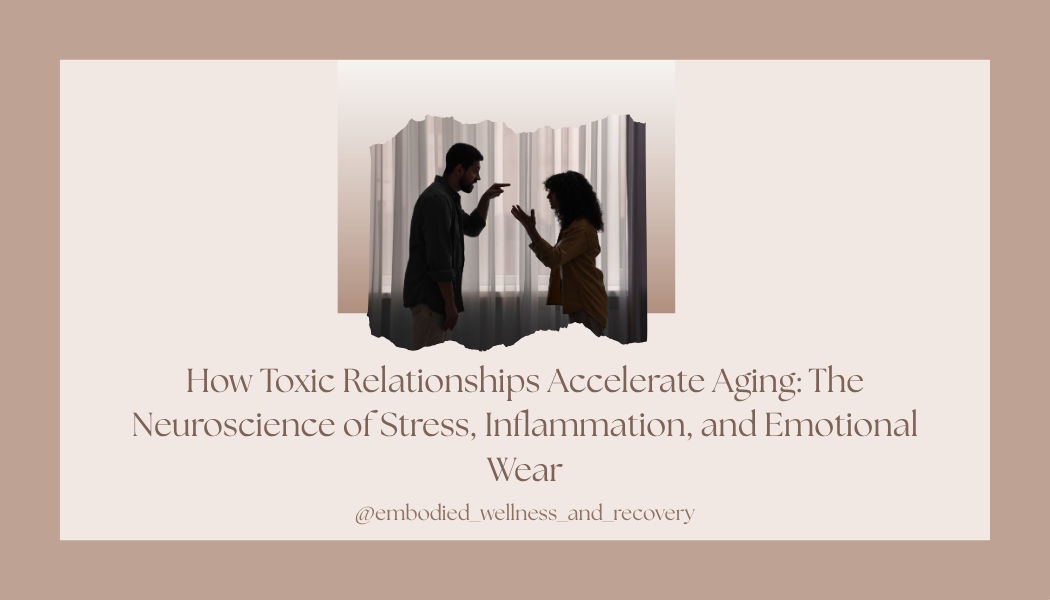
How Toxic Relationships Accelerate Aging: The Neuroscience of Stress, Inflammation, and Emotional Wear
How Toxic Relationships Accelerate Aging: The Neuroscience of Stress, Inflammation, and Emotional Wear
Can a stressful relationship make you age faster? Discover how chronic conflict, emotional tension, and unresolved relational stress increase cortisol, inflammation, and biological aging—and how therapy can help restore nervous system regulation and long-term health.
How Ongoing Stressful Relationships Can Actually Age Your Body Faster
Have you ever noticed that some relationships leave you feeling physically exhausted? Not just emotionally drained but tense, inflamed, foggy, fatigued, and somehow older?
Maybe your chest tightens every time your partner walks into the room. Maybe conflict feels constant, or emotional safety feels impossible. Maybe you spend so much time anticipating criticism, defending yourself, or trying to keep the peace that your body never fully relaxes.
If you are living inside ongoing relational stress, your nervous system may be paying a much higher price than you realize. Research increasingly shows that chronic stress from conflict-filled relationships does not stay in the mind. It also lives in the body (Honkasalo, 2001).
Repeated exposure to criticism, unpredictability, emotional neglect, hostility, or chronic tension can elevate cortisol, increase systemic inflammation, dysregulate the nervous system, and even accelerate biological aging. In other words, unhealthy relationships can literally make your body age faster.
At Embodied Wellness and Recovery, we help individuals and couples understand how trauma, attachment wounds, and chronic relational stress affect both emotional health and physical well-being. Healing relationships is not just about feeling better emotionally; it is often about protecting your long-term health.
What Is Biological Aging?
Chronological age is how many birthdays you have had. Biological age is how your body is actually functioning. Two people can both be 45 years old chronologically, but one may have the cardiovascular health, inflammation levels, immune function, and cellular repair capacity of someone much older. This is called accelerated biological aging.
Researchers now use epigenetic markers, particularly DNA methylation “aging clocks,” to measure how quickly the body is aging on a cellular level. These biomarkers help us understand how stress, trauma, lifestyle, and relationships influence health beyond simple age. One 2026 study published in PNAS found that negative social ties, or “hasslers,” people who frequently create problems, tension, or emotional difficulty, were significantly associated with faster biological aging, increased inflammation, and greater multimorbidity.
Each additional “hassler” in someone’s close network was associated with approximately:
— 1.5% faster pace of biological aging
— Nearly 9 months older biological age
— Higher depression and anxiety severity
— Increased BMI and inflammatory markers
— Greater chronic health burden
That is not small. That is your nervous system keeping score.
Why Conflict-Filled Relationships Create Chronic Stress
Healthy stress is temporary. Toxic relational stress is repetitive. When your body perceives ongoing emotional threat, criticism, rejection, emotional unpredictability, betrayal, or walking on eggshells, it activates the hypothalamic-pituitary-adrenal (HPA) axis, your core stress response system.
This releases:
— Cortisol
— Adrenaline
— Norepinephrine
These chemicals are helpful during true danger. But when they are elevated day after day, they become damaging.
This can lead to:
— Sleep disruption
— Digestive issues
— Anxiety and hypervigilance
— Depression
— Immune dysfunction
— Hormonal imbalance
— Increased inflammation
— Reduced cognitive flexibility
— Cardiovascular strain
— Accelerated cellular aging
The body is not designed to live in a constant state of defense, and many people in chronically stressful relationships do exactly that.
Your Relationship May Be Keeping Your Nervous System in Survival Mode
Ask yourself:
— Do I feel physically tense around my partner?
— Do I constantly monitor someone else’s mood?
— Do I feel emotionally unsafe expressing needs?
— Do I recover slowly after conflict?
— Do I feel more exhausted after interactions than before?
— Do I feel guilty resting because I am always managing someone else’s emotions?
These are not just “communication problems.” These are often signs of nervous system dysregulation. When relationships repeatedly trigger fear, abandonment, shame, or emotional instability, the body often responds as though survival is at stake. Because developmentally, connection has always been tied to survival. This is why attachment wounds feel so physical.
Why Family Conflict Can Be Especially Aging
Interestingly, the 2026 PNAS study found that family-related negative ties were the strongest predictors of accelerated aging, even stronger than spousal stress in some cases. Why? Because family relationships are often emotionally loaded, historically rooted, and difficult to escape.
Parents, siblings, adult children, and other close relatives often carry:
— Unresolved childhood trauma
— Loyalty conflicts
— Guilt
— Emotional unpredictability
— Longstanding attachment wounds
Unlike friendships, family systems can feel inescapable. The nervous system interprets this as ongoing threat without resolution. That creates profound physiological wear.
Inflammation: The Hidden Cost of Relational Stress
One of the clearest pathways between emotional stress and physical aging is inflammation. When stress is chronic, the immune system remains activated. The body begins producing more inflammatory proteins, even when no infection is present.
Over time, this low-grade chronic inflammation contributes to:
— Heart disease
— Autoimmune conditions
— Depression
— Metabolic dysfunction
— Cognitive decline
— Chronic fatigue
— Accelerated aging
The PNAS study specifically found that greater exposure to negative social ties was associated with increased inflammation markers and poorer health outcomes across multiple systems. This is why relational stress often first manifests as physical symptoms. The body often speaks before the mind fully understands.
Can Therapy Reverse the Damage?
Yes, but not through insight alone. Healing requires nervous system repair.
At Embodied Wellness and Recovery, we approach this through a neuroscience-informed, somatic lens.
This may include:
Attachment-focused therapy
Understanding how early relational wounds shape present-day relationship patterns.
EMDR and trauma processing
Helping the body release unresolved trauma that keeps the stress response activated.
Somatic therapy
Teaching the nervous system how to recognize safety again.
Couples therapy
Creating emotional safety, boundary clarity, and healthier patterns of repair.
Boundary work
Reducing exposure to chronic relational stressors when repair is not possible. Sometimes healing means improving the relationship. Sometimes it means changing your proximity to dysfunction. Both are valid.
Emotional Safety Is Preventive Medicine
We often think of wellness as:
— Supplements
— Exercise
— Sleep
— Nutrition
And those matter. But emotional safety belongs on that list because your body cannot fully heal in an environment it experiences as unsafe. Love should not feel like chronic cortisol. Connection should not require nervous system collapse. The quality of your closest relationships shapes your physiology more than most people realize, and protecting your peace is not selfish. It is biological.
Your Body Notices
A stressful relationship does not just affect your mood. It also affects your immune system, inflammation, hormones, sleep, aging, and long-term health. When chronic conflict becomes the norm, people often stop noticing how much their bodies are carrying. But your body notices. It always notices. The good news is that the nervous system is adaptable. With the right support, safety can be relearned, regulation can be restored, and relational patterns can change.
At Embodied Wellness and Recovery, we specialize in helping individuals and couples understand the deep connection between trauma, relationships, and physical well-being because healing is never just emotional. It is embodied.
Reach out to schedule a complimentary 20-minute consultation with our team of therapists, trauma specialists, somatic practitioners, or relationship experts, and start working towards integrative, embodied healing today.
📞 Call us at (310) 651-8458
📱 Text us at (310) 210-7934
📩 Email us at admin@embodiedwellnessandrecovery.com
🔗 Visit us at www.embodiedwellnessandrecovery.com
👉 Check us out on Instagram @embodied_wellness_and_recovery
🌍 Explore our offerings at Linktr.ee: https://linktr.ee/laurendummit
References
Epel, E. S., Blackburn, E. H., Lin, J., Dhabhar, F. S., Adler, N. E., Morrow, J. D., & Cawthon, R. M. (2004). Accelerated telomere shortening in response to life stress. Proceedings of the National Academy of Sciences, 101(49), 17312–17315.
Honkasalo, M. L. (2001). Vicissitudes of pain and suffering: chronic pain and liminality. Medical Anthropology, 19(4), 319-353.
Kiecolt-Glaser, J. K., Wilson, S. J., & Madison, A. (2019). Marriage and gut (microbiome) feelings: Tracing novel dyadic pathways to accelerated aging. Psychosomatic Medicine, 81(8), 704–710.
Lee, B., Ciciurkaite, G., Peng, S., Mitchell, C., & Perry, B. L. (2026). Negative social ties as emerging risk factors for accelerated aging, inflammation, and multimorbidity. Proceedings of the National Academy of Sciences, 123(8), e2515331123.
McEwen, B. S. (1998). Protective and damaging effects of stress mediators. New England Journal of Medicine, 338(3), 171–179.
Why Laughter Is Good Medicine: The Neuroscience of Stress Relief, Longevity, and Emotional Resilience
Why Laughter Is Good Medicine:The Neuroscience of Stress Relief, Longevity, and Emotional Resilience
Discover the health benefits of laughter through a neuroscience-informed lens. Learn how laughter reduces stress, improves nervous system regulation, strengthens relationships, supports emotional resilience, and even contributes to longevity. Explore why laughter is more than joy; it is powerful medicine for the mind and body.
When was the last time you laughed so hard your stomach hurt? Not the polite smile you give in passing. Not the quick chuckle at a text message. Real laughter. The kind that makes your body soften, your shoulders drop, and your mind feel lighter. For many adults, especially high-achievers, caregivers, trauma survivors, and those carrying chronic stress, laughter becomes surprisingly rare.
Life gets serious. Responsibilities pile up. Anxiety tightens the nervous system. Depression dulls pleasure. Trauma teaches vigilance. Perfectionism convinces us there is always something more urgent than joy. And slowly, many people begin living as though laughter is a luxury instead of a biological necessity. But neuroscience tells us something important: laughter is not frivolous. It is regulation. Laughter shifts physiology without denying reality. It does not erase grief, stress, or uncertainty. It simply interrupts the body’s stress response long enough for perspective, flexibility, and higher cognitive functioning to return. In that sense, laughter is not avoidance. It is medicine.
At Embodied Wellness and Recovery, we help clients understand that healing often happens through nervous system repair, not just insight. Sometimes, regulation arrives through deep therapy work. Sometimes it arrives through movement, nature, connection, and surprisingly often, laughter.
Because laughter is not separate from healing. It is part of it.
The Science of Laughter and Stress Relief
Have you ever noticed how impossible it is to stay physically rigid during genuine laughter? That is not accidental. Laughter directly affects the autonomic nervous system, which regulates stress, safety, and survival responses. When we are anxious, overwhelmed, or stuck in trauma activation, the sympathetic nervous system dominates. Heart rate increases. Muscles tighten. Breathing becomes shallow. Cortisol rises. The brain becomes more focused on threat than creativity or connection. Laughter interrupts that pattern.
Research shows that genuine laughter lowers stress hormones such as cortisol and epinephrine while increasing dopamine, serotonin, and endorphins, chemicals associated with pleasure, bonding, and emotional regulation (Bennett & Lengacher, 2006). This is why laughter often creates an immediate feeling of relief. It is a nervous system reset disguised as play. Even ten to fifteen minutes of genuine laughter increases heart rate and blood flow in ways comparable to light physical exercise. It improves circulation, oxygenation, and cardiovascular functioning. In other words, laughter is not simply emotional wellness. It is physical wellness.
Can Laughter Help Anxiety and Depression?
If you struggle with anxiety, depression, chronic stress, or emotional rigidity, you may wonder whether laughter can truly help. The answer is yes, but not because it solves your problems. It helps because it changes your physiological state. Anxiety often narrows perception. Depression often flattens motivation and pleasure. Trauma often keeps the nervous system trapped in hypervigilance or shutdown.
Laughter creates temporary flexibility in that system. It widens perspective. It creates psychological distance from catastrophic thinking. It allows the prefrontal cortex, the part of the brain responsible for reasoning, problem-solving, and decision-making, to come back online.
This matters clinically. When someone is deeply activated, logic rarely helps first. Regulation does. Laughter softens the grip of seriousness long enough for adaptability to return.
Ask yourself:
— Have I become so focused on surviving that I have forgotten how to play?
— Do I feel guilty when I experience joy during difficult seasons?
— Have I mistaken constant seriousness for responsibility?
These are not small questions. They often reveal how disconnected we have become from our own emotional flexibility.
Laughter and Longevity: Do People Who Laugh Live Longer?
Surprisingly, yes. Large cohort studies suggest that people who laugh regularly, especially weekly or daily, have lower mortality rates and improved long-term health outcomes (Ohira & Ichiki, 2022). A study published in Geriatrics & Gerontology International found that older adults who laughed less frequently had a significantly higher risk of functional disability over time (Hayashi et al., 2016). Other population-based studies suggest that frequent laughter is associated with lower cardiovascular risk and longer lifespan.
Why? Because chronic stress is inflammatory. Long-term sympathetic activation contributes to immune dysfunction, hypertension, poor sleep, digestive issues, anxiety disorders, and depression. Laughter helps counterbalance this. It improves immune function, lowers blood pressure, and reduces muscular tension. This does not mean laughter replaces therapy, medication, or medical care. It means it supports them. Small daily doses of laughter improve resilience, adaptability, and emotional recovery. That matters.
Shared Laughter Is Relational Medicine
Laughter is best shared with good company. This is where its power becomes even deeper. Shared laughter strengthens attachment bonds. It creates safety between people. It signals trust.
From a relational neuroscience perspective, laughter is co-regulation. It tells the nervous system, "I am safe here." Couples who laugh together often recover from conflict more effectively. Friendships deepen through shared humor. Families build resilience when play remains possible, even in hard seasons.
This is especially important in relationships impacted by trauma, betrayal, or chronic stress. Many couples come to therapy believing intimacy requires only serious conversations. But intimacy also requires play. Without laughter, relationships can become emotionally efficient but spiritually starved. Humor creates room for softness. It allows repair without defensiveness. It reminds us that connection is not only built through pain, but through joy.
At Embodied Wellness and Recovery, this is often part of couples' work. Emotional safety is not only built through conflict resolution. It is built through moments of shared humanity, silliness, and relief.
Laughter is relational medicine.
Laughter Does Not Mean Denial
This part matters. Many people unconsciously believe that laughing during hard times means they are minimizing pain. It does not. You do not lose permission to laugh when life is sad, serious, or uncertain.
Grief and laughter can coexist. Trauma and joy can coexist. Depression and humor can coexist. In fact, sometimes laughter is exactly what keeps people emotionally afloat during difficult seasons. It offers perspective without invalidation. It says, “This is hard, and I am still alive inside it.”
That is not denial. That is resilience. People who recover well from stress are not people who avoid pain. They are people who can move flexibly between pain and restoration. Laughter helps create that movement.
How to Invite More Laughter Into Daily Life
You do not need to force joy. You simply need to make room for it.
Try asking:
— Who makes me laugh and why have I not called them lately?
— What used to feel playful before life became so heavy?
— Where have I confused emotional control with emotional health?
Simple nervous system supports include:
— Spending time with people who feel easy and safe
— Watching something genuinely funny, not just distracting
— Allowing spontaneity instead of over-structuring every hour
— Playing with children or animals
— Noticing absurdity instead of only urgency
— Giving yourself permission to be imperfect and human
Sometimes the most therapeutic moment in a week is not profound insight. Sometimes it is laughing so hard you remember your body still knows how to exhale.
Laughter is the Best Medicine
Laughter is often dismissed because it looks simple, but simplicity does not mean insignificance. It regulates physiology. It improves cardiovascular health. It lowers stress hormones. It strengthens relationships. It supports emotional flexibility and resilience. It helps us think better, love better, and recover faster. And perhaps most importantly, it reminds us that healing is not only about processing pain. It is also about remembering pleasure.
At Embodied Wellness and Recovery, we believe nervous system repair includes both depth and delight. Trauma work matters. Attachment work matters. Somatic therapy matters. So does laughter. Especially laughter. Sometimes the most profound medicine does not arrive as a breakthrough. Sometimes it arrives in the middle of a shared joke, a ridiculous moment, or the sudden relief of remembering you are still capable of joy. And that matters more than most people realize.
Reach out to schedule a complimentary 20-minute consultation with our team of therapists, trauma specialists, somatic practitioners, or relationship experts, and start working towards integrative, embodied healing today.
📞 Call us at (310) 651-8458
📱 Text us at (310) 210-7934
📩 Email us at admin@embodiedwellnessandrecovery.com
🔗 Visit us at www.embodiedwellnessandrecovery.com
👉 Check us out on Instagram @embodied_wellness_and_recovery
🌍 Explore our offerings at Linktr.ee: https://linktr.ee/laurendummit
References
1) Bennett, M. P., & Lengacher, C. (2006). Humor and laughter may influence health: III. Laughter and health outcomes. Evidence-Based Complementary and Alternative Medicine, 3(1), 61–63.
2) Hayashi, T., Kawai, K., Miyamoto, M., et al. (2016). Is laughter the best medicine? A cross-sectional study of cardiovascular disease among older Japanese adults. Journal of Epidemiology, 26(10), 546–552.
3) Ohira, T., & Ichiki, M. (2022). Laughter is the best therapy for happiness and healthy life expectancy. In Healthy aging in Asia (pp. 229-240). CRC Press.
4) Martin, R. A. (2001). Humor, laughter, and physical health: Methodological issues and research findings. Psychological Bulletin, 127(4), 504–519.
The Hidden Emotional Cost of Masking Anxiety: Why High Functioning Anxiety Feels Exhausting and How Therapy Supports Nervous System Regulation
The Hidden Emotional Cost of Masking Anxiety: Why High Functioning Anxiety Feels Exhausting and How Therapy Supports Nervous System Regulation
Struggling with anxiety but feel pressure to hide it? Learn the emotional and neurological cost of masking anxiety and how therapy supports nervous system regulation, authenticity, and deeper connection.
Many people live with anxiety that is largely invisible to the outside world. They show up to work on time. They meet deadlines. They maintain relationships. They appear calm, competent, and composed. Yet internally, their experience can feel very different. Racing thoughts. Constant mental rehearsal. Fear of making mistakes. A persistent sense that something might go wrong. For many individuals, managing anxiety is not only about coping with the symptoms themselves. It is also about masking those symptoms so others do not notice.
Have you ever found yourself wondering:
Why does anxiety feel so exhausting even when I appear to be functioning well?
Why do I feel like I am constantly performing calmness rather than actually feeling calm?
Why does it feel difficult to show people how overwhelmed I truly am?
Why do I feel disconnected from others even when I am surrounded by people?
The emotional cost of masking anxiety can be significant. Over time, the effort required to hide internal distress may lead to burnout, loneliness, and a sense of living behind a carefully managed façade. Understanding what happens in the brain and nervous system when anxiety is masked can help illuminate why this pattern is so draining.
What Does It Mean to Mask Anxiety?
Masking anxiety refers to the process of concealing internal distress in order to appear composed, capable, or socially acceptable.
People who mask anxiety often develop sophisticated strategies to hide their symptoms.
These strategies may include:
— Smiling or joking while feeling internally overwhelmed
— Over-preparing for tasks to avoid mistakes
— Saying "I am fine" when feeling anxious or distressed
— Avoiding situations where anxiety might become visible
— Pushing through exhaustion in order to appear productive
In many cases, masking develops early in life. Children who grow up in environments where emotional expression is discouraged often learn that showing anxiety may lead to criticism, dismissal, or misunderstanding. Over time, masking can become an automatic coping strategy.
The Neuroscience of Anxiety and Emotional Suppression
From a neuroscience perspective, anxiety involves activation of the brain's threat detection system, particularly the amygdala and related stress circuits.
When the brain perceives potential danger or uncertainty, it activates the body's stress response.
This response can include:
— Increased heart rate
— Muscle tension
When individuals attempt to suppress or hide anxiety rather than process it, the nervous system often remains activated beneath the surface.
Research suggests that emotional suppression can increase rather than reduce physiological stress responses (Gross & Levenson, 1997).
In other words, masking anxiety may make the nervous system work harder. The brain must simultaneously manage the internal experience of anxiety while also maintaining the outward appearance of calm. This dual process can be mentally and emotionally exhausting.
High Functioning Anxiety and the Pressure to Appear Composed
Many individuals who mask anxiety fall into the category commonly referred to as high-functioning anxiety. These individuals may appear successful and capable. Yet their internal experience may include persistent worry, perfectionism, and difficulty relaxing.
High functioning anxiety often involves:
— Constant self-monitoring
— Fear of disappointing others
— Difficulty slowing down
— Chronic mental overthinking
While these patterns can sometimes lead to achievement and productivity, they often come at a significant emotional cost.
The nervous system rarely experiences true rest.
The Emotional Consequences of Masking Anxiety
Over time, masking anxiety can influence several aspects of psychological well-being.
Emotional Exhaustion
Maintaining a calm exterior while managing internal distress requires considerable emotional energy. Many individuals report feeling depleted after social interactions or workdays because they have spent hours monitoring and managing their outward behavior.
Loneliness and Disconnection
When anxiety remains hidden, others may never fully understand what someone is experiencing internally. This can create a painful sense of isolation.
People may think:
If others knew how anxious I really feel, they might see me differently.
Because anxiety is concealed, opportunities for empathy and support may never occur.
Loss of Authenticity
Masking anxiety can lead to the feeling that one's external identity no longer matches one's internal experience.
Individuals may begin to wonder, “Who am I when I am not performing calmness?” This disconnection from authenticity can influence self-esteem and identity.
Increased Stress on the Nervous System
When anxiety is continuously suppressed, the nervous system may remain stuck in a heightened state of vigilance. Research on stress physiology suggests that chronic activation of the stress response can affect sleep, concentration, immune functioning, and emotional regulation (McEwen, 2007).
Why Many People Feel Pressure to Hide Anxiety
Several cultural and social factors contribute to the tendency to mask anxiety.
Cultural Expectations Around Productivity
Modern culture often values productivity, composure, and achievement.
Many people worry that revealing anxiety may make them appear less capable.
Professional Environments
Workplaces sometimes reward individuals who appear calm under pressure. As a result, employees may feel reluctant to disclose emotional struggles.
Social Media and Comparison
Online environments frequently present curated images of confidence and success. This can reinforce the belief that others are managing life effortlessly.
Early Life Experiences
Individuals who grew up in environments where vulnerability was discouraged often develop strong habits of emotional concealment.
Anxiety, Trauma, and the Nervous System
For some individuals, anxiety masking is closely connected to earlier experiences of trauma or chronic stress. When the nervous system learns that vulnerability may lead to negative consequences, it may develop protective strategies to minimize exposure. These strategies can include emotional suppression, hyperindependence, or perfectionism.
From a trauma-informed perspective, masking anxiety can be understood as an adaptive survival response. However, patterns that once helped protect emotional safety may later contribute to exhaustion and disconnection.
Counseling for Anxiety and Emotional Authenticity
Therapy offers a space where individuals can gradually shift from masking anxiety toward a more authentic and regulated internal experience. At Embodied Wellness and Recovery, clinicians work with clients to address the deeper roots of anxiety while supporting nervous system regulation and relational safety.
Approaches may include:
Nervous System Regulation
Therapy often includes techniques that support the nervous system in moving out of chronic threat states.
These may involve:
— Breathing and grounding exercises
— Developing tolerance for emotional sensations
Research on Polyvagal Theory highlights the importance of felt safety in regulating the autonomic nervous system (Porges, 2017).
Trauma Informed Therapy
When anxiety is connected to earlier life experiences, trauma-informed therapy helps individuals process unresolved emotional patterns.
Relational Therapy
Therapy also supports the development of healthier relational dynamics. As clients learn to express vulnerability in safe environments, they often experience deeper emotional connection with others.
Identity and Self-Compassion Work
Another important element of therapy involves exploring how self-expectations and internal narratives influence anxiety. Developing self-compassion can help individuals relate to anxiety with greater understanding rather than criticism.
Moving Toward Authentic Emotional Experience
Shifting away from masking anxiety does not mean revealing every emotion to everyone. Instead, the goal is to develop a more flexible relationship with internal experiences.
Over time, individuals often learn to:
— Recognize early signs of anxiety in the body
— Communicate needs more clearly in relationships
— Reduce self-criticism related to emotional experiences
— Create space for rest and nervous system recovery
These changes can foster greater alignment between internal experience and outward life.
Anxiety Treatment at Embodied Wellness and Recovery
At Embodied Wellness and Recovery, therapists specialize in treating anxiety through an integrative approach that considers the relationship between the brain, body, and relational environment.
Our clinicians work with individuals and couples navigating challenges related to:
— Anxiety and chronic stress
— Trauma and nervous system dysregulation
— Relationship conflict and emotional disconnection
— Intimacy and sexuality concerns
— Identity transitions and life stressors
By integrating neuroscience-informed therapy, somatic approaches, and relational counseling, treatment addresses not only the symptoms of anxiety but also the underlying patterns that maintain it. When individuals develop new ways of relating to their internal experiences, they often discover that the effort required to maintain a mask gradually decreases. The nervous system begins to experience more moments of genuine calm rather than simply performing calmness.
Reach out to schedule a complimentary 20-minute consultation with our team of therapists, trauma specialists, somatic practitioners, or relationship experts, and start working towards integrative, embodied healing today.
📞 Call us at (310) 651-8458
📱 Text us at (310) 210-7934
📩 Email us at admin@embodiedwellnessandrecovery.com
🔗 Visit us at www.embodiedwellnessandrecovery.com
👉 Check us out on Instagram @embodied_wellness_and_recovery
🌍 Explore our offerings at Linktr.ee: https://linktr.ee/laurendummit
References
1) Gross, J. J., & Levenson, R. W. (1997). Hiding feelings: The acute effects of inhibiting positive and negative emotion. Journal of Abnormal Psychology, 106(1), 95 to 103.
2) McEwen, B. S. (2007). Physiology and neurobiology of stress and adaptation. Physiological Reviews, 87(3), 873 to 904.
3) Porges, S. W. (2017). The pocket guide to the polyvagal theory. Norton.
Why Insight Alone Does Not Reorganize the Nervous System: A Somatic Path to Self-Worth After Trauma
Learn why insight alone does not rewire the nervous system and how somatic therapy supports lasting self-worth after trauma.
Many people arrive in therapy highly insightful. They can trace their struggles with self-worth back to childhood. They can name the critical parent voice. They understand how comparison, perfectionism, or people-pleasing developed as coping strategies. They can talk eloquently about their patterns.
And yet, the shame response remains.
If this sounds familiar, you may find yourself asking:
Why do I still feel defective even though I understand where this comes from?
Why does my body react with anxiety or collapse when my mind knows better?
Why has talk therapy helped me understand myself, but not feel fundamentally different?
These questions point to an essential truth that neuroscience and trauma research continue to confirm. Insight alone does not reorganize the nervous system. And without nervous system change, self-worth struggles rooted in trauma often persist.
At Embodied Wellness and Recovery, we help clients understand why self-worth cannot be corrected by logic alone and how somatic, nervous-system-informed therapy creates bigger, more lasting change.
The Limits of Insight-Based Healing
Insight is powerful. It brings meaning to experience and reduces confusion and self-blame. It helps clients see that their struggles did not come out of nowhere.
But insight lives primarily in the cognitive brain. Trauma, shame, and self-worth are encoded elsewhere.
You can intellectually know that you were not the problem as a child and still feel like you are. You can understand that a parent was critical because of their own wounds and still feel a tight chest when you make a mistake. You can recognize a pattern of choosing unavailable partners and still feel unworthy of consistent love.
This gap between knowing and feeling is not resistance or lack of motivation. It is neurobiology.
How Trauma Shapes Self-Worth in the Nervous System
Self-worth is not formed through reasoning. It develops through lived, relational experience.
From early childhood, the nervous system learns who we are based on how we respond. Safety, attunement, and consistency support a felt sense of worth. Chronic criticism, neglect, unpredictability, or emotional absence shape a very different internal landscape.
When attachment relationships are unsafe or misattuned, the nervous system adapts. Children learn to monitor others closely. They learn to minimize needs. They learn to perform or disappear. Over time, these adaptations become encoded as bodily states associated with shame, fear, or hypervigilance.
These patterns are stored as procedural memory. They are felt as sensation, posture, breath, and emotional tone. They are not accessible through insight alone because they were never learned through language in the first place.
Why Shame Persists Despite Understanding
Shame is not just a belief. It is a physiological state.
Neuroscience shows that shame activates threat circuits in the brain and nervous system. Heart rate changes. Muscles tense or collapse. Breathing shifts. Attention narrows inward. The body prepares for danger, even when none is present.
This is why shame can feel overwhelming and immediate. It is not a thought that you choose. It is a state that happens to you.
When therapy focuses only on reframing thoughts without addressing the underlying nervous system activation, clients often feel frustrated. They may think they are doing something wrong or that they are failing in therapy.
In reality, their nervous system has not yet had the experiences required to update.
Talk Therapy and the Thinking Brain
Traditional talk therapy primarily engages the prefrontal cortex. This part of the brain supports reflection, insight, and meaning-making. These capacities are essential and valuable.
However, during moments of shame or threat, the prefrontal cortex becomes less accessible. The brain shifts toward survival. This is why insight disappears in moments of activation. It is not that you forgot what you know. It is your nervous system that is driving.
Without addressing the body and its learned responses, therapy can remain informative rather than transformative.
Self-Worth as a Nervous System State
Self-worth is not simply a positive belief about oneself. It is a baseline nervous system experience of safety and belonging.
When the nervous system feels regulated, people naturally experience more self-compassion, flexibility, and resilience. When the nervous system is dysregulated, self-criticism and shame intensify.
This is why self-worth improves when people feel safe in their bodies and relationships, not just when they think differently.
It must be addressed at the level where it was formed.
The Role of Somatic Therapy
Somatic therapy works directly with the nervous system. It helps clients notice internal sensations, track activation and settling, and build tolerance for states that once felt unsafe.
Rather than trying to override shame with logic, somatic approaches help the body learn something new through experience. This may include slowing down, orienting to safety, completing stress responses, or experiencing attuned connection in the therapeutic relationship.
Over time, the nervous system updates its expectations. What once felt dangerous becomes more tolerable. What once triggered collapse or self-attack begins to soften.
This is not about forcing change. It is about creating the conditions for change to occur.
Attachment, Relational Memory, and Self-Worth
Because self-worth is relational, it often heals in relationship.
Trauma-informed therapy recognizes that the therapeutic relationship itself is a powerful site of nervous system learning. Consistent attunement, repair after misattunement, and emotional safety provide experiences that contradict earlier relational patterns.
These experiences are felt, not explained. They are stored in implicit memory. They gradually reshape the nervous system's response to closeness, feedback, and vulnerability.
This is why self-worth often improves not through affirmations, but through repeated experiences of being met without judgment.
Why Forcing Positive Thinking Backfires
Many clients have tried to think their way out of low self-worth. Affirmations, reframes, and insight-based exercises may offer temporary relief but often feel hollow.
When the nervous system is dysregulated, positive statements can feel false or even threatening. The body resists what it does not yet believe is safe.
Somatic therapy respects this resistance. It does not push the nervous system faster than it can go. It prioritizes regulation over persuasion.
As the nervous system settles, positive beliefs often emerge naturally, without effort.
Signs That Somatic Work Is Supporting Change
Progress in somatic therapy is often subtle. Clients may notice that shame arises less intensely or resolves more quickly. They may feel more grounded in their bodies. They may find it easier to tolerate mistakes or receive care.
These shifts indicate nervous system reorganization. They are markers of deep change, even if the old narrative occasionally resurfaces.
Insight becomes more effective when it is supported by a regulated nervous system.
Integrating Insight and Somatic Healing
This is not an argument against insight. It is an argument for integration.
Insight provides context and meaning. Somatic work provides regulation and change. Together, they support lasting healing.
When clients understand their patterns and feel safe enough in their bodies to experience something different, self-worth begins to reorganize at its roots.
How Embodied Wellness and Recovery Approaches Self-Worth
At Embodied Wellness and Recovery, we specialize in trauma-informed, nervous system-based therapy. Our work integrates neuroscience, attachment theory, and somatic approaches to support clients who feel stuck despite deep insight.
We help clients move beyond understanding toward embodied change. This includes working with the body, tracking nervous system states, and supporting relational repair.
Self-worth does not need to be earned or argued into existence. It emerges when the nervous system learns safety.
A Different Kind of Hope
If you have done years of work and still struggle with shame, nothing has gone wrong. Your nervous system has been doing exactly what it learned to do.
With the right support, it can learn something new.
Healing self-worth is not about convincing yourself you are worthy. It is about helping your body feel safe enough to know it.
Reach out to schedule a complimentary 20-minute consultation with our team of therapists, trauma specialists, somatic practitioners, or relationship experts, and start working towards integrative, embodied healing today.
📞 Call us at (310) 651-8458
📱 Text us at (310) 210-7934
📩 Email us at admin@embodiedwellnessandrecovery.com
🔗 Visit us at www.embodiedwellnessandrecovery.com
👉 Check us out on Instagram @embodied_wellness_and_recovery
🌍 Explore our offerings at Linktr.ee: https://linktr.ee/laurendummit
References
1) Levine, P. A. (2010). In an unspoken voice: How the body releases trauma and restores goodness. North Atlantic Books.
2) Porges, S. W. (2011). The polyvagal theory: Neurophysiological foundations of emotions, attachment, communication, and self-regulation. W. W. Norton & Company.
3) Siegel, D. J. (2020). The developing mind: How relationships and the brain interact to shape who we are. Guilford Press.
4) van der Kolk, B. A. (2014). The body keeps the score: Brain, mind, and body in the healing of trauma. Viking.
Fear vs. Facts: Neuroscience-Informed Practices to Calm Anxiety, Reduce Rumination, and Restore Emotional Clarity
Fear vs. Facts: Neuroscience-Informed Practices to Calm Anxiety, Reduce Rumination, and Restore Emotional Clarity
Struggling to tell fear from facts? Learn neuroscience-informed practices to reduce anxiety, interrupt rumination, and restore clarity when your mind feels overwhelmed.
When Fear Feels Like the Truth
Have you ever noticed how anxiety can make imagined outcomes feel just as real as actual events?
Do your thoughts spiral into worst-case scenarios even when there is little evidence that something bad is happening?
Do you find yourself exhausted from constantly monitoring for danger, replaying conversations, or anticipating what might go wrong?
When fear dominates the nervous system, it becomes difficult to distinguish between what is actually happening and what the brain is predicting might happen. This is not a failure of logic. It is a neurobiological response shaped by stress, trauma, and prolonged nervous system activation. Learning to untangle fear from facts is one of the most powerful skills for reducing anxiety, calming rumination, and restoring emotional balance.
Why the Brain Confuses Fear With Reality
From a neuroscience perspective, fear-based thinking is driven by the brain's survival circuitry. The amygdala and related limbic structures are designed to detect threat quickly, not accurately. When the nervous system perceives danger, the brain prioritizes speed over nuance.
This means:
— The brain fills in gaps with worst-case interpretations
— Neutral cues are interpreted as threatening
— Uncertainty is experienced as danger
— Thought loops emerge as the brain attempts to regain control
When this system stays activated too long, fear-based predictions begin to feel like facts.
For individuals with trauma histories, chronic stress, or anxiety disorders, this threat-focused processing can become the default mode.
The Cost of Living Inside Fear-Based Thinking
When fear and facts become fused, anxiety tends to intensify rather than resolve. People often report:
— Persistent rumination and mental looping
— Difficulty making decisions
— Sleep disruption
— Emotional reactivity in relationships
— Loss of trust in one’s own perception
Over time, this pattern erodes emotional safety and increases a sense of overwhelm. The nervous system becomes stuck in anticipation rather than presence.
Untangling fear from facts is not about forcing positive thinking. It is about helping the nervous system reestablish accurate threat assessment.
Practice One: Name Fear as a Signal, Not a Conclusion
One of the most effective anxiety regulation tools is learning to identify fear as a signal rather than a verdict.
Instead of asking, “What if this is true?”
Try asking, “What is my nervous system responding to right now?”
This subtle shift engages the prefrontal cortex and creates space between sensation and interpretation.
Helpful language includes:
— “This is a fear response, not a fact.”
— “My body feels threatened, even if the situation may not be.”
This practice reduces cognitive fusion and restores agency.
Practice Two: Separate What Is Happening From What Might Happen
Anxiety thrives on future-oriented thinking. One way to interrupt rumination is to gently separate present facts from feared outcomes.
— What is verifiably happening right now?
— What am I predicting without evidence?
For example:
— Fact: I have not received a response yet.
— Fear: This means I am being rejected.
Writing this out can be especially helpful. Externalizing fear-based thoughts reduces their emotional intensity and improves cognitive clarity.
Practice Three: Use the Body to Ground the Mind
Fear-based thinking cannot be resolved through logic alone because it originates in the nervous system. Grounding practices help signal safety to the body, allowing the mind to recalibrate.
Effective grounding practices include:
— Feeling the weight of your body in a chair
— Pressing your feet gently into the floor
— Placing one hand on the chest and one on the belly
— Slow breathing with extended exhales
As the nervous system settles, fear-based interpretations often soften without direct effort.
Practice Four: Orient to Present Safety
Trauma-informed therapy emphasizes orientation as a key regulation skill. Orientation involves consciously noticing cues of safety in the present environment.
Try this:
— Name five things you can see
— Name three things you can hear
— Notice one physical sensation that feels neutral or supportive
This practice helps the brain update its internal threat map. The nervous system begins to recognize that the present moment is different from past danger.
Practice Five: Question Fear With Compassion, Not Criticism
Fear often intensifies when people try to argue with it or shame themselves for feeling anxious.
Instead, approach fear with curiosity:
— What is this fear trying to protect me from?
— When did this pattern first develop?
Compassionate inquiry reduces internal conflict and increases emotional regulation. Fear does not need to be eliminated in order for clarity to return.
Practice Six: Reclaim Choice Through Cognitive Flexibility
Neuroscience research shows that anxiety narrows cognitive flexibility (Park & Moghaddam, 2017). People feel locked into one outcome or interpretation.
To expand perspective, ask:
— What are three other explanations that could be true?
— What would I tell a friend in this situation?
This practice does not deny fear. It widens the field of possibility so fear no longer monopolizes perception.
How These Practices Support Relationships and Intimacy
When fear dominates perception, it often spills into relationships. Individuals may:
— Misinterpret tone or silence
— Assume rejection or abandonment
— React defensively or withdraw
Learning to separate fear from facts improves communication, emotional safety, and intimacy. Partners feel less blamed and more understood. The nervous system becomes more receptive to connection. This is especially important in relationships impacted by trauma, betrayal, or attachment wounds.
Why Repetition Matters More Than Insight
Insight alone rarely resolves anxiety. The nervous system learns through repetition. Each time fear is met with grounding, orientation, and compassionate inquiry, neural pathways associated with regulation strengthen. Over time, the brain becomes better at distinguishing perceived threat from actual danger.
This is how nervous system repair occurs.
How Embodied Wellness and Recovery Supports This Work
At Embodied Wellness and Recovery, we specialize in helping individuals and couples understand how fear-based patterns develop and how to restore clarity through nervous system-informed care.
Our work integrates:
— Trauma-informed psychotherapy
— Somatic and attachment-based approaches
— EMDR and nervous system regulation
— Relational and intimacy-focused healing
We help clients move beyond chronic rumination and anxiety toward increased emotional flexibility, safety, and connection.
A Grounded Reflection
Fear often speaks loudly, but it is not always accurate. When you learn to slow down, regulate the body, and gently examine your thoughts, fear loses its grip on reality. Clarity does not come from eliminating fear. It comes from helping the nervous system feel safe enough to see what is actually true.
Reach out to schedule a complimentary 20-minute consultation with our team of therapists, trauma specialists, somatic practitioners, or relationship experts, and start working towards integrative, embodied healing today.
📞 Call us at (310) 651-8458
📱 Text us at (310) 210-7934
📩 Email us at admin@embodiedwellnessandrecovery.com
🔗 Visit us at www.embodiedwellnessandrecovery.com
👉 Check us out on Instagram @embodied_wellness_and_recovery
🌍 Explore our offerings at Linktr.ee: https://linktr.ee/laurendummit
References
LeDoux, J. E. (2015). Anxious: Using the brain to understand and treat fear and anxiety. Viking.
Park, J., & Moghaddam, B. (2017). Impact of anxiety on prefrontal cortex encoding of cognitive flexibility. Neuroscience, 345, 193-202.
Porges, S. W. (2011). The polyvagal theory: Neurophysiological foundations of emotions, attachment, communication, and self-regulation. W. W. Norton & Company.
Siegel, D. J. (2012). The developing mind: How relationships and the brain interact to shape who we are (2nd ed.). Guilford Press.
van der Kolk, B. A. (2014). The body keeps the score: Brain, mind, and body in the healing of trauma. Viking.
Emotional Whiplash in a Fast-Changing World: How Rapid Cultural Change Impacts Mental Health, Relationships, and the Nervous System
Emotional Whiplash in a Fast-Changing World: How Rapid Cultural Change Impacts Mental Health, Relationships, and the Nervous System
Rapid cultural change can overwhelm the nervous system, leaving many people feeling anxious, disconnected, and emotionally exhausted. Learn how emotional whiplash affects the brain and body and how nervous system-informed therapy can help restore stability, meaning, and connection.
The Pace of Cultural Change
The pace of cultural change today is unprecedented. Technology evolves faster than our brains can comfortably adapt. Social norms shift in real time. Language, values, expectations, and identities feel like moving targets. For many people, this constant acceleration creates a profound sense of emotional whiplash.
You may find yourself asking questions like:
Why do I feel constantly on edge even when nothing is “wrong”?
Why does it feel harder to trust my instincts or feel grounded in my identity?
Why do relationships feel more fragile, more polarized, or more confusing than they used to?
These reactions are not signs of weakness or failure. They are predictable nervous system responses to rapid cultural change.
At Embodied Wellness and Recovery, we work with individuals and couples who feel overwhelmed, destabilized, and disconnected amid social, political, technological, and relational shifts. Understanding how cultural acceleration impacts the brain and body is a powerful first step toward restoring steadiness, agency, and emotional coherence.
What Is Emotional Whiplash?
Emotional whiplash refers to the psychological and physiological stress that occurs when external change outpaces the nervous system’s capacity to adapt. Much like physical whiplash, emotional whiplash is not caused by movement alone, but by sudden, repeated, or unpredictable shifts.
Cultural whiplash can show up as:
— Chronic anxiety or agitation
— Emotional numbness or shutdown
— Irritability and reactivity
— Difficulty concentrating or making decisions
— A sense of grief for a world that feels lost
— Confusion about values, identity, or belonging
These experiences are increasingly common in modern life, especially during periods of rapid technological innovation, social change, political polarization, and shifting norms around relationships, gender, sexuality, and work.
The Neuroscience of Overwhelm in Times of Rapid Change
From a neuroscience perspective, the human brain evolved for predictability, pattern recognition, and relational safety. While the brain is remarkably adaptable, it requires time, repetition, and a sense of coherence to integrate change.
When cultural shifts happen too quickly, the nervous system struggles to find stable reference points. The amygdala, which scans for threat, becomes more vigilant. The prefrontal cortex, responsible for reflection, empathy, and decision making, becomes less accessible under chronic stress. The result is a nervous system that remains in a prolonged state of activation or collapse.
Stephen Porges’ Polyvagal Theory helps explain why people respond so differently to rapid cultural change. Some become hypervigilant, argumentative, or anxious. Others withdraw, dissociate, or shut down. Both responses are adaptive survival strategies, not character flaws.
Why Cultural Change Can Feel So Personal
One of the most destabilizing aspects of rapid cultural change is how deeply personal it feels. Shifts in language, values, and social expectations often touch core areas of identity, including:
— Beliefs about family, partnership, and intimacy
— Ideas about success, worth, and belonging
— Expectations around gender, sexuality, and roles
— Definitions of safety, morality, and truth
When the external world no longer mirrors the internal framework we relied on for meaning, the nervous system experiences this as loss. Even when we intellectually support progress or change, the body may still register uncertainty and grief.
This internal conflict can lead to shame, self-doubt, or relational tension. Many people wonder why they feel unsettled when they believe they should feel empowered or excited. The answer lies not in ideology, but in biology.
Emotional Whiplash and Relationships
Rapid cultural change does not just affect individuals. It profoundly impacts relationships. Partners, families, and communities often adapt at different speeds, leading to misunderstandings, polarization, and rupture.
Common relational patterns we see include:
— Couples struggling with mismatched values or worldviews
— Increased conflict around parenting, gender roles, or intimacy
— Difficulty repairing after disagreements
— Withdrawal or avoidance of difficult conversations
When nervous systems are overwhelmed, relational safety becomes harder to access. Empathy narrows. Listening becomes defensive. Connection feels fragile.
At Embodied Wellness and Recovery, we help couples and families understand how nervous system dysregulation, not incompatibility, often drives these relational struggles.
The Link Between Trauma and Cultural Overwhelm
For individuals with a trauma history, rapid cultural change can be especially destabilizing. Trauma sensitizes the nervous system to unpredictability and loss of control. When the external world feels chaotic, old survival responses can resurface quickly.
This may look like:
— Heightened anxiety or panic
— Strong emotional reactions to news or social media
— Difficulty tolerating ambiguity
— A sense of being emotionally flooded or frozen
Trauma-informed therapy recognizes that present-day overwhelm often echoes earlier experiences of instability, betrayal, or lack of safety. Addressing emotional whiplash requires working not only with thoughts, but with the body and nervous system.
Social Media, Technology, and Nervous System Fatigue
Digital culture accelerates emotional whiplash. Constant exposure to information, comparisons, outrage cycles, and conflicting narratives keeps the nervous system in a state of near-continuous stimulation.
Neuroscience research shows that frequent context switching and chronic alertness reduce emotional regulation, impair memory, and increase anxiety and depression (Gul & Ahmad, 2014).
The brain struggles to distinguish between real-time threats and symbolic ones, especially when images and headlines are emotionally charged.
Without intentional regulation, technology can erode the very sense of coherence and meaning we need to adapt to change.
How Nervous System Repair Restores Stability
While we cannot slow cultural change, we can strengthen our capacity to respond to it. Nervous system-informed therapy focuses on helping the body regain flexibility, resilience, and a sense of internal safety.
At Embodied Wellness and Recovery, our approach integrates:
— Somatic therapy to support regulation and embodiment
— EMDR to process trauma and restore adaptive responses
— Attachment-focused work to rebuild relational safety
— Polyvagal-informed interventions to increase nervous system flexibility
These modalities help clients move out of survival mode and back into states of connection, curiosity, and grounded presence.
Reclaiming Meaning and Agency in a Changing World
One of the most important antidotes to emotional whiplash is meaning-making. The brain and nervous system stabilize when experiences can be integrated into a coherent narrative.
Therapy provides a space to:
— Explore grief for what has changed or been lost
— Clarify personal values amid shifting norms
— Develop internal anchors that do not depend on external stability
— Strengthen relationships through attuned communication
Rather than reacting to every cultural shift, clients learn to respond from a regulated, values-based place.
A Path Forward That Honors Both Change and Stability
Rapid cultural change is not inherently harmful. Growth, evolution, and expanded awareness are part of collective progress. The problem arises when change outpaces our nervous system’s ability to integrate it. Emotional whiplash is a signal, not a failure. It points to the need for regulation, reflection, and relational support.
Embodied Wellness and Recovery specializes in helping individuals and couples navigate these challenges with compassion, depth, and neuroscience-informed care. By addressing the nervous system directly, therapy becomes a place where stability can coexist with change, and where identity, intimacy, and meaning can be reclaimed even in uncertain times.
Reach out to schedule a complimentary 20-minute consultation with our team of therapists, trauma specialists, somatic practitioners, or relationship experts, and start working towards integrative, embodied healing today.
📞 Call us at (310) 651-8458
📱 Text us at (310) 210-7934
📩 Email us at admin@embodiedwellnessandrecovery.com
🔗 Visit us at www.embodiedwellnessandrecovery.com
👉 Check us out on Instagram @embodied_wellness_and_recovery
🌍 Explore our offerings at Linktr.ee: https://linktr.ee/laurendummit
References
Gul, A., & Ahmad, H. (2014). Cognitive deficits and emotion regulation strategies in patients with psychogenic nonepileptic seizures: a task-switching study. Epilepsy & Behavior, 32, 108-113.
McEwen, B. S., & Morrison, J. H. (2013). The brain on stress: Vulnerability and plasticity of the prefrontal cortex over the life course. Neuron, 79(1), 16 to 29.
Porges, S. W. (2011). The polyvagal theory: Neurophysiological foundations of emotions, attachment, communication, and self-regulation. New York, NY: Norton.
Siegel, D. J. (2020). The developing mind: How relationships and the brain interact to shape who we are. New York, NY: Guilford Press.
van der Kolk, B. A. (2014). The body keeps the score: Brain, mind, and body in the healing of trauma. New York, NY: Viking.
Why the News Is Making You Anxious: Understanding News Anxiety, Vicarious Trauma, and Nervous System Overload
Why the News Is Making You Anxious: Understanding News Anxiety, Vicarious Trauma, and Nervous System Overload
Why does watching the news cause anxiety, panic, or emotional shutdown? Learn how news anxiety and vicarious trauma dysregulate the nervous system and what helps restore balance.
Why Does Watching the News Feel So Overwhelming?
Have you noticed your heart racing after watching the news? Trouble sleeping after reading headlines? A sense of dread, numbness, or helplessness when you try to make sense of ongoing violence, political unrest, or human suffering?
Many people are asking the same questions:
— Why does the news make me anxious?
— Why do I feel emotionally flooded or shut down after watching the news?
— Is it normal to feel traumatized by events that did not happen to me directly?
— How do I stay informed without feeling overwhelmed?
These reactions are not signs of weakness or overreaction. They are signs of a nervous system under chronic strain.
What Is News Anxiety?
News anxiety refers to heightened anxiety, distress, or nervous system dysregulation triggered by repeated exposure to news coverage, especially stories involving violence, injustice, disasters, or threat.
This can include:
— Panic or anxiety symptoms
— Emotional overwhelm or tearfulness
— Numbness or emotional shutdown
— Irritability or anger
— Difficulty concentrating
— Sleep disturbances
— A sense of hopelessness or loss of meaning
News anxiety is increasingly common in an era of constant media access, graphic imagery, and real-time updates that offer little opportunity for the nervous system to reset.
Vicarious Trauma and the Brain
From a neuroscience perspective, the brain does not clearly distinguish between direct threat and witnessed threat.
Research on vicarious trauma shows that repeated exposure to others’ suffering can activate the same neural networks involved in direct trauma exposure. When we watch violence, hear distressing stories, or repeatedly imagine worst-case scenarios, the brain’s threat detection systems respond as if danger is present.
Key brain regions involved include:
— The amygdala, which detects threat
— The hippocampus, which stores emotional memory
— The anterior cingulate cortex, which processes pain and distress
— The insula, which maps bodily sensations and emotional states
Over time, this repeated activation can lead to chronic nervous system arousal or, conversely, protective shutdown.
Nervous System Overload and Dysregulation
When the nervous system is repeatedly exposed to perceived threat without resolution, it can become stuck in survival states.
Common nervous system responses to news exposure include:
Sympathetic activation
— Anxiety
— Hypervigilance
— Racing thoughts
— Anger or agitation
— Compulsive news checking
Parasympathetic shutdown
— Emotional numbness
— Dissociation
— Fatigue
— Withdrawal
— A sense of meaninglessness
Both are adaptive responses to overwhelm. Neither indicates pathology.
Why Senseless Violence Is So Dysregulating
Human nervous systems are wired for meaning-making. When events feel random, unjust, or incomprehensible, the brain struggles to integrate them.
Senseless violence disrupts:
— Our assumptions about safety
— Our belief in predictability
— Our sense of moral order
— Our trust in institutions and community
This existential disruption is often what people mean when they say, “I cannot make sense of what is happening.” The distress is not only emotional but also deeply neurobiological.
The Role of Media Saturation
Unlike previous generations, modern news consumption is:
— Continuous
— Visual and graphic
— Algorithm-driven
— Emotionally amplified
Doomscrolling keeps the nervous system in a near-constant state of alert without offering resolution or agency. The body receives threat signals but no clear action path, which increases anxiety and helplessness.
This is particularly impactful for people with:
— A history of trauma
— High empathy
— Attachment wounds
— Anxiety disorders
— Depression or dissociation
— Caregiving or helping professions
Why Some People Feel It More Intensely
Not everyone experiences news anxiety the same way. Differences often relate to nervous system sensitivity and personal history.
People who grew up in environments marked by unpredictability, violence, emotional neglect, or chronic stress often have sensitized threat detection systems. Their bodies learned early that vigilance was necessary for survival.
For these individuals, the news does not feel informational. It feels personal.
How Trauma-Informed Therapy Helps
At Embodied Wellness and Recovery, we understand news anxiety as a nervous system response, not a cognitive failure.
Effective treatment focuses on:
— Restoring nervous system regulation
— Increasing tolerance for emotional activation
— Rebuilding a sense of safety and agency
— Addressing trauma stored in the body
— Supporting meaning-making without overwhelm
Modalities such as somatic therapy, EMDR, attachment-based therapy, and nervous system-informed psychotherapy help clients process distress without retraumatization.
Practical Ways to Reduce News-Related Anxiety
1. Shift from constant exposure to intentional consumption
Limit news intake to specific times of day. Avoid starting or ending the day with distressing content.
2. Regulate before and after exposure
Grounding practices such as slow breathing, movement, or orienting to the room help the nervous system reset.
3. Notice your body’s cues
If your body tightens, dissociates, or races, that is information. Respect it.
4. Focus on agency and connection
Engaging in meaningful action, community support, or values-based living helps counter helplessness.
5. Work with a trauma-informed therapist
Professional support helps integrate emotional responses without suppressing or escalating them.
A Compassionate Reframe
Feeling overwhelmed by the news does not mean you are fragile or disengaged. It often means you are human, empathic, and wired for connection.
Your nervous system is responding exactly as it was designed to respond to threat and uncertainty.
With support, it can also learn how to return to safety, presence, and resilience.
How Embodied Wellness and Recovery Can Help
Embodied Wellness and Recovery specializes in trauma-informed, nervous system-based therapy for individuals struggling with anxiety, emotional overwhelm, dissociation, and relational distress.
Our work integrates neuroscience, somatic awareness, attachment theory, and compassionate clinical care to help clients navigate distressing times without losing themselves in the process.
Reach out to schedule a complimentary 20-minute consultation with our team of therapists, trauma specialists, somatic practitioners, or relationship experts, and start working towards integrative, embodied healing today.
📞 Call us at (310) 651-8458
📱 Text us at (310) 210-7934
📩 Email us at admin@embodiedwellnessandrecovery.com
🔗 Visit us at www.embodiedwellnessandrecovery.com
👉 Check us out on Instagram @embodied_wellness_and_recovery
🌍 Explore our offerings at Linktr.ee: https://linktr.ee/laurendummit
References
1) Eisenberger, N. I., & Lieberman, M. D. (2004). Why rejection hurts: A common neural alarm system for physical and social pain. Trends in Cognitive Sciences, 8(7), 294–300.
2) McCann, I. L., & Pearlman, L. A. (1990). Vicarious traumatization: A framework for understanding the psychological effects of working with victims. Journal of Traumatic Stress, 3(1), 131–149.
3) van der Kolk, B. A. (2014). The body keeps the score: Brain, mind, and body in the healing of trauma. Viking.
The 31 Types of Happiness: Expanding How We Experience Joy Beyond Feeling “Happy”
The 31 Types of Happiness: Expanding How We Experience Joy Beyond Feeling “Happy”
Happiness is more than joy. Discover the 31 types of happiness and how peace, relief, and meaning support emotional well-being and resilience.
Do you ever wonder why happiness feels so elusive, even when life looks objectively “fine”?
Why moments of peace, relief, or quiet satisfaction do not always register as happiness?
Or why the pressure to feel joyful can actually deepen exhaustion, monotony, or negative thinking?
Many people struggle not because happiness is absent, but because it is narrowly defined. When happiness is measured solely in terms of excitement, pleasure, or positivity, much of the emotional richness of human experience is overlooked.
Recent psychological research suggests that happiness is not a single emotion, but a constellation of distinct emotional states (Rossi, 2018). Some researchers identify 31 different types of happiness, each reflecting a unique way the nervous system experiences safety, meaning, or pleasure (Porges,2022). When we expand how we define happiness, it becomes more accessible, realistic, and emotionally sustainable (O’Brien, 2008).
At Embodied Wellness and Recovery, we help individuals and couples reconnect with joy by understanding how trauma, stress, and nervous system dysregulation shape emotional experience, and by broadening the ways happiness can be felt, noticed, and embodied.
Why We Struggle to Feel Happy
Searches like why am I not happy, why life feels monotonous, and why can’t I feel joy are increasingly common. Many people describe a sense of emotional flatness, boredom, or quiet dissatisfaction rather than acute distress.
This often stems from:
— Chronic stress or burnout
— Trauma or prolonged nervous system activation
— Depression or anhedonia
— Cultural pressure to feel happy all the time
— Narrow definitions of what happiness should look like
From a neuroscience perspective, happiness is closely tied to the regulation of the nervous system. When the brain is in a state of threat, overwhelm, or emotional fatigue, high arousal joy may feel inaccessible. However, lower arousal forms of happiness often remain available but go unrecognized.
Expanding the Definition of Happiness
Traditional views of happiness emphasize pleasure, excitement, or achievement. While these forms of happiness matter, they account for only a small part of how humans experience well-being.
Researchers and psychologists have identified 31 distinct types of happiness, ranging from high-energy joy to quiet, reflective, or restorative states. Some forms of happiness are fleeting, while others are deeply stabilizing.
When happiness is expanded beyond constant positivity, people often realize they experience it far more often than they thought.
The 31 Types of Happiness
Below is a framework that organizes different forms of happiness across emotional, relational, and somatic experiences. Not all types are available at all times, and that is part of their wisdom.
Restorative and Regulating Happiness
These forms are especially accessible during stress, grief, or recovery.
1) Contentment – a sense of enoughness
2) Relief – release after tension or fear
3) Peacefulness – nervous system calm
4) Safety – feeling protected and grounded
5) Ease – absence of urgency
6) Comfort – physical or emotional soothing
7) Stability – predictability and steadiness
Reflective and Meaning-Based Happiness
These forms deepen emotional resilience and identity.
1) Gratitude – appreciation without comparison
2) Meaning – connection to purpose
3) Belonging – being accepted as you are
4) Connection – emotional attunement with others
5) Nostalgia – warmth tied to memory
6) Pride – grounded self-respect
7) Fulfillment – alignment with values
Playful and Energizing Happiness
These forms often come in brief, spontaneous moments.
1) Amusement – lighthearted enjoyment
2) Playfulness – creativity and spontaneity
3) Joy – expansive positive emotion
4) Excitement – anticipation and novelty
5) Wonder – awe and curiosity
6) Delight – sensory pleasure
Relational and Intimate Happiness
These forms are central to sexuality, intimacy, and attachment.
1) Affection – warmth toward others
2) Love – emotional and relational bonding
3) Tenderness – gentle closeness
4) Trust – emotional safety with another
5) Erotic aliveness – embodied pleasure and desire
Self-Based and Integrative Happiness
These forms support long-term well-being.
1) Self-acceptance – peace with who you are
2) Autonomy – freedom and agency
3) Confidence – embodied self-trust
4) Hope – openness toward the future
5) Vitality – aliveness in the body
6) Integration – feeling whole rather than fragmented
Why Some Types of Happiness Are More Accessible Than Others
The nervous system determines which types of happiness are available at any given time. High arousal joy requires energy, safety, and emotional bandwidth. During periods of stress, grief, or trauma recovery, the nervous system may prioritize regulation over excitement.
This is not a failure. It is an adaptation.
For example:
— Someone experiencing burnout may find relief or contentment more accessible than joy
— Someone healing from trauma may experience safety and connection before excitement
— Someone struggling with depression may notice comfort or nostalgia before pleasure
Recognizing these forms as valid happiness reduces shame and expands emotional awareness.
Measuring Happiness Shapes How Much We Experience
One of the most important insights from happiness research is that the amount of happiness we experience is often based on how we measure it (Frey, 2018).
If happiness is defined only as:
— Feeling upbeat
— Being productive
— Feeling excited
— Feeling positive
Then, many meaningful emotional experiences are excluded.
When happiness is expanded to include calm, meaning, connection, and relief, people often discover that happiness is present more frequently, even in quiet or ordinary moments.
Trauma, Negative Thinking, and Emotional Narrowing
Trauma and chronic stress can narrow emotional range. The brain becomes vigilant, prioritizing threat detection over emotional nuance. This can lead to negative thinking patterns and difficulty recognizing subtle positive states.
Somatic and trauma-informed therapy helps by:
— Regulating the nervous system
— Expanding interoceptive awareness
— Increasing emotional granularity
— Helping clients notice small shifts in state
When emotional awareness widens, happiness becomes easier to recognize without forcing it. Relearning Happiness Through the Body Happiness is not only cognitive. It is embodied.
The body often experiences happiness before the mind labels it. A slower breath, relaxed shoulders, warmth in the chest, or a softening of the jaw may signal contentment or peace.
At Embodied Wellness and Recovery, we integrate somatic therapy, attachment-based work, and neuroscience-informed interventions to help clients reconnect with embodied happiness, especially when joy feels distant.
Practical Ways to Expand Your Experience of Happiness
— Notice low intensity positive states such as relief or ease
— Name different types of happiness when they appear
— Release comparison between your happiness and others
— Allow happiness to be quiet and non-performative
— Track how your body signals safety or comfort
Over time, this practice shifts attention away from what is missing and toward what is already present.
A Spectrum of Experiences
Happiness is not a single emotion or permanent state. It is a spectrum of experiences shaped by nervous system regulation, meaning, connection, and embodiment.
When we expand how we define happiness, it becomes more accessible, compassionate, and sustainable, especially during seasons of monotony, healing, or emotional fatigue.
At Embodied Wellness and Recovery, we help individuals and couples rediscover happiness by honoring all the ways it can show up, including peace, relief, intimacy, and meaning.
Reach out to schedule a complimentary 20-minute consultation with our team of therapists, trauma specialists, somatic practitioners, or relationship experts, and start working towards integrative, embodied healing today.
📞 Call us at (310) 651-8458
📱 Text us at (310) 210-7934
📩 Email us at admin@embodiedwellnessandrecovery.com
🔗 Visit us at www.embodiedwellnessandrecovery.com
👉 Check us out on Instagram @embodied_wellness_and_recovery
🌍 Explore our offerings at Linktr.ee: https://linktr.ee/laurendummit
References
Fredrickson, B. L. (2001). The role of positive emotions in positive psychology. American Psychologist, 56(3), 218–226.
Frey, B. S. (2018). Happiness can be measured. In Economics of happiness (pp. 5-11). Cham: Springer International Publishing.
Friedman, S. (2026, January 17). The Society of Happy People is hunting for happiness all week long participate in the daily challenges. Nice News.
O'Brien, C. (2008). Sustainable happiness: How happiness studies can contribute to a more sustainable future. Canadian Psychology/Psychologie canadienne, 49(4), 289.
Porges, S. W. (2011). The polyvagal theory: Neurophysiological foundations of emotions, attachment, communication, and self-regulation. W. W. Norton & Company.
Porges, S. W. (2022). Polyvagal theory: A science of safety. Frontiers in integrative neuroscience, 16, 871227.
Rossi, M. (2018). Happiness, pleasures, and emotions. Philosophical Psychology, 31(6), 898-919.
Siegel, D. J. (2020). The developing mind. Guilford Press.
Why We Reach for Our Phones When We’re Overwhelmed: How Compulsive Technology Use Regulates the Nervous System
Why We Reach for Our Phones When We’re Overwhelmed: How Compulsive Technology Use Regulates the Nervous System
Why do we reach for our phones when stressed or anxious? Explore how compulsive technology use serves as emotional regulation and what the nervous system seeks.
Compulsive Technology Use as Emotional Regulation
Have you ever noticed how quickly your hand reaches for your phone when you feel stressed, anxious, lonely, or emotionally flooded? Do you scroll without meaning to, check notifications compulsively, or lose time online when your nervous system feels overwhelmed? Do you tell yourself to stop, yet feel pulled back moments later?
For many people, compulsive phone use is not about distraction, lack of discipline, or technology addiction alone. It is about regulation. More specifically, it is about the nervous system searching for relief.
At Embodied Wellness and Recovery, we understand compulsive technology use through a trauma-informed, neuroscience-based lens. What often appears to be a bad habit is actually a sophisticated attempt by the brain and body to manage stress, emotion, and threat. This article explores why we reach for our phones when we are overwhelmed, how technology serves as emotional regulation, and how therapy can support more sustainable nervous system repair.
Compulsive Technology Use Is Not Random
People frequently search online for answers to questions like:
— Why do I scroll when I feel anxious or numb?
— Why does my phone calm me down temporarily?
— Is doomscrolling a trauma response?
— Why can’t I stop checking my phone when stressed?
These questions point to a deeper truth. Compulsive technology use is often an unconscious coping strategy. When the nervous system perceives threat, overwhelm, or emotional intensity, it looks for something fast, predictable, and soothing. Phones deliver exactly that.
From a neuroscience perspective, technology offers immediate access to stimulation, novelty, and social cues. These elements can shift brain chemistry and autonomic arousal in seconds.
The Nervous System Under Stress
When we are overwhelmed, the nervous system becomes dysregulated. The sympathetic branch of the autonomic nervous system activates, increasing heart rate, muscle tension, vigilance, and anxiety. For others, the system shifts toward dorsal vagal shutdown, leading to numbness, fog, or disconnection.
In either state, the body is not at ease.
The brain’s primary goal in these moments is not insight or long-term growth. It is survival. The nervous system seeks anything that can quickly reduce distress.
Phones provide:
— Rapid dopamine release
— Distraction from internal sensation
— A sense of connection without vulnerability
— Predictability and control
— Relief from boredom, loneliness, or uncertainty
This is why telling yourself to just put the phone down rarely works. The behavior is serving a regulatory function.
Dopamine, Relief, and the Regulation Loop
Dopamine is often described as the pleasure chemical, but it is more accurately a motivation and anticipation neurotransmitter. Novelty, scrolling, notifications, and content refreshes all activate dopamine pathways in the brain.
When you are anxious or emotionally overloaded, a brief dopamine surge can feel grounding. It shifts attention outward and dampens distress. For a moment, the nervous system settles.
The problem is not the initial relief. The problem is that the relief is short-lived.
As dopamine levels drop, the nervous system often returns to dysregulation, sometimes more intensely. This creates a loop:
— Distress or overwhelm
— Phone use
— Temporary relief
— Emotional crash
— Renewed urge to scroll
Over time, the nervous system learns that the phone is a reliable regulator. The behavior becomes compulsive, not because of weakness, but because the body has learned a fast path to relief.
Technology as a Form of Dissociation
For many people, compulsive phone use also functions as a mild form of dissociation. Dissociation is not always dramatic or obvious. It often shows up as checking out, zoning out, or disconnecting from internal experience.
Scrolling allows the mind to leave the body. It pulls attention away from uncomfortable sensations, emotions, or relational tension. This can be especially appealing for individuals with trauma histories, attachment wounds, or chronic stress.
If stillness feels unsafe, silence feels loud, or emotions feel unmanageable, the phone becomes a portable escape hatch.
Trauma, Attachment, and Compulsive Phone Use
Early attachment experiences shape how we learn to regulate emotion. When caregivers are emotionally unavailable, inconsistent, or overwhelming, children often learn to self-regulate through external means rather than through co-regulation.
Later in life, technology can fill that role.
Phones offer:
— Simulated connection without relational risk
— Control over proximity and engagement
— Relief from abandonment anxiety
— A buffer against intimacy or emotional exposure
This is why compulsive technology use often intensifies during relational stress, conflict, or loneliness. The nervous system reaches for something that feels safer than human connection, even as it longs for connection.
Why Willpower Is Not Enough
Many people feel shame about their technology use. They set limits, delete apps, or promise themselves to stop scrolling, only to feel frustrated when the behavior returns.
This approach misses the point.
If compulsive phone use is regulating the nervous system, removing the behavior without replacing the regulation will increase distress. The nervous system will simply search for another outlet.
Sustainable change begins by understanding what the behavior is doing for you.
Questions Worth Asking Instead
Rather than asking:
— Why can’t I stop?
— What is wrong with me?
It is more helpful to ask:
— What am I trying to regulate right now?
— What emotion or sensation feels intolerable in this moment?
— What does my nervous system need that I am not getting?
These questions shift the focus from control to curiosity.
How Therapy Supports Nervous System Repair
At Embodied Wellness and Recovery, we help clients understand compulsive behaviors as adaptations rather than pathologies. Treatment focuses on expanding the nervous system’s capacity to regulate without relying solely on external stimuli.
This may include:
— Somatic therapy to build awareness of bodily sensation
— Trauma-focused modalities such as EMDR
— Attachment-focused therapy to repair relational wounds
— Parts-based approaches to understand internal dynamics
— Psychoeducation grounded in neuroscience
Rather than abruptly removing coping strategies, therapy helps clients develop additional regulation strategies. Over time, the nervous system learns that it can tolerate discomfort, connection, and stillness with greater ease.
Technology, Relationships, and Intimacy
Compulsive phone use often impacts relationships and intimacy. Partners may feel disconnected, dismissed, or secondary to screens. Individuals may struggle to stay present during emotional conversations or sexual connection.
These patterns are not signs of indifference. They are signs of nervous system overload.
When the body is regulated, presence becomes possible. When regulation is outsourced to technology, intimacy often suffers.
Therapy helps individuals and couples understand these dynamics without blame and build healthier patterns of connection.
A Compassionate Reframe
Compulsive technology use is not a moral failing. It is a nervous system strategy.
The goal is not to eliminate technology, but to understand its role and reduce reliance on it as the primary regulator. With support, the nervous system can learn new ways to settle, connect, and feel safe.
How Embodied Wellness and Recovery Can Help
Embodied Wellness and Recovery specializes in trauma-informed, neuroscience-based care that addresses the root causes of nervous system dysregulation. Our work integrates somatic therapy, EMDR, attachment repair, and relational healing to support lasting change.
We help clients:
— Understand compulsive behaviors through a nervous system lens
— Build internal regulation capacity
— Repair attachment and relational wounds
— Improve intimacy and emotional presence
— Develop sustainable coping strategies rooted in the body
Reach out to schedule a complimentary 20-minute consultation with our team of therapists, trauma specialists, somatic practitioners, or relationship experts, and start working towards integrative, embodied healing today.
📞 Call us at (310) 651-8458
📱 Text us at (310) 210-7934
📩 Email us at admin@embodiedwellnessandrecovery.com
🔗 Visit us at www.embodiedwellnessandrecovery.com
👉 Check us out on Instagram @embodied_wellness_and_recovery
🌍 Explore our offerings at Linktr.ee: https://linktr.ee/laurendummit
References
1) Porges, S. W. (2011). The polyvagal theory: Neurophysiological foundations of emotions, attachment, communication, and self-regulation. W. W. Norton & Company.
2) van der Kolk, B. A. (2014). The body keeps the score: Brain, mind, and body in the healing of trauma. Viking.
3) Volkow, N. D., Koob, G. F., & McLellan, A. T. (2016). Neurobiological advances from the brain disease model of addiction. The New England Journal of Medicine, 374(4), 363–371.
How to Maintain Independence in a Relationship Without Losing Emotional Connection
How to Maintain Independence in a Relationship Without Losing Emotional Connection
Struggling to stay yourself in a relationship? Learn how emotional independence and closeness can coexist through neuroscience-informed therapy.
Have you ever wondered where you went after entering a relationship? Or felt anxious that asking for space might threaten the bond you value so deeply?
Many people struggle with a painful internal conflict: the desire to maintain independence in a relationship while also longing for emotional closeness. You may want autonomy, personal interests, and a strong sense of self, yet fear that too much independence could create distance, rejection, or disconnection.
This tension is not a failure of commitment. It is a deeply human nervous system dilemma rooted in attachment, trauma history, and how safety and connection are wired in the brain.
At Embodied Wellness and Recovery, we help individuals and couples understand how independence and intimacy are not opposites. When supported by nervous system regulation and healthy boundaries, autonomy can actually strengthen emotional connection.
Why Independence in Relationships Feels So Complicated
Do you find yourself wondering how to maintain independence in a relationship or how to stay yourself when falling in love? These questions are not uncommon, as many people feel overwhelmed by relational expectations.
Common struggles include:
— Feeling guilty for needing space or alone time
— Fear that asserting independence will hurt your partner
— Losing touch with personal interests, friendships, or identity
— Becoming overly focused on your partner’s emotional state
— Feeling responsible for maintaining closeness at all costs
These experiences often emerge not from selfishness, but from attachment patterns shaped by early relationships and past trauma.
The Neuroscience Behind Autonomy and Connection
From a neuroscience perspective, the brain is constantly assessing safety in relationships. Emotional closeness activates attachment systems that help us bond, while independence activates self-regulation and agency.
When the nervous system is regulated, these systems work together. When it is dysregulated, they can feel at odds.
Research in attachment theory and interpersonal neurobiology shows that:
— Secure attachment allows individuals to move fluidly between closeness and autonomy
— Dysregulated nervous systems may equate distance with danger or engulfment with loss of self
— Early caregiving experiences shape how safety, closeness, and independence are interpreted
For example:
— Anxiously attached individuals may fear that independence means abandonment
— Avoidantly attached individuals may fear that closeness threatens autonomy
— Trauma survivors may associate dependence with loss of control or harm
Understanding this biology helps reframe independence not as rejection, but as a nervous system need.
Independence Does Not Mean Emotional Distance
One of the most common misconceptions is that independence equals disconnection. In reality, healthy independence supports intimacy by allowing both partners to show up as whole people rather than fused or depleted.
Independence in a relationship can look like:
— Maintaining friendships and interests outside the partnership
— Having emotional boundaries around responsibility for each other’s feelings
— Being able to self-soothe rather than relying solely on your partner
— Expressing preferences, needs, and values honestly
— Allowing differences without interpreting them as threats
When both partners feel free to be themselves, emotional connection becomes more authentic and resilient.
The Role of Differentiation in Healthy Relationships
Psychologist Murray Bowen described differentiation as the ability to remain emotionally connected while maintaining a strong sense of self.
Highly differentiated individuals can:
— Stay present during conflict without collapsing or withdrawing
— Hold their own opinions while respecting their partner’s perspective
— Regulate emotions without demanding immediate reassurance
— Tolerate closeness without losing identity
Low differentiation often shows up as:
— Overfunctioning or caretaking
— Emotional fusion
— Fear of conflict or abandonment
— Difficulty making independent decisions
Therapy helps strengthen differentiation by supporting nervous system regulation and self-awareness.
How Trauma Impacts Independence and Intimacy
Trauma complicates autonomy because it disrupts internal safety. For trauma survivors, independence may have been necessary for survival, or closeness may have come with unpredictability or harm.
This can create patterns such as:
— Hyper independence paired with emotional distance
— Intense closeness followed by withdrawal
— Difficulty trusting your own needs
— Shame around wanting space or connection
Trauma-informed therapy does not push independence or closeness. Instead, it helps the body learn that both can exist safely at the same time.
Practical Ways to Maintain Independence Without Losing Connection
1. Build Nervous System Awareness
Notice when your desire for space comes from regulation versus avoidance, and when your desire for closeness comes from connection versus anxiety.
Somatic therapy helps you track these cues in the body rather than relying solely on thoughts.
2. Normalize Autonomy as a Relationship Strength
Talk openly with your partner about independence as something that benefits the relationship rather than threatens it.
Language matters. Independence can be framed as:
— Supporting mutual growth
— Preventing resentment
— Allowing desire and curiosity to stay alive
3. Practice Emotional Responsibility
Emotional independence does not mean emotional isolation. It means learning to regulate your own feelings rather than outsourcing that work entirely to your partner.
This reduces pressure and increases safety for both people.
4. Maintain Identity Anchors
Keep regular contact with the parts of your life that existed before the relationship:
— Friendships
— Creative pursuits
— Professional goals
— Spiritual or reflective practices
These anchors support self-continuity and prevent identity erosion.
5. Use Boundaries as Connection Tools
Boundaries are not walls. They clarify where you end, and your partner begins, which actually supports intimacy.
Healthy boundaries help relationships feel safer and more sustainable over time.
Independence, Desire, and Sexual Intimacy
In long term relationships, desire often fades when individuality disappears. Erotic connection thrives on curiosity, difference, and self-possession.
Research in sexuality and attachment shows that:
— Desire increases when partners feel autonomous and emotionally secure
— Over-enmeshment can reduce erotic charge
— Emotional safety supports vulnerability and pleasure
Maintaining independence allows partners to meet each other not as extensions, but as distinct people choosing connection.
How Therapy Helps Restore Balance
At Embodied Wellness and Recovery, we approach independence and intimacy through a trauma-informed, neuroscience-based lens.
Therapy may include:
— Somatic and nervous system regulation skills
— Attachment-focused couples therapy
— EMDR and trauma processing
— Parts work to explore conflicting needs for closeness and space
— Communication tools that support differentiation
Our work helps individuals and couples move beyond rigid patterns into flexible, embodied connection.
When Independence and Connection Work Together
Healthy relationships are not about choosing between autonomy and closeness. They are about developing the capacity to hold both.
When independence is supported:
— Emotional connection deepens
— Resentment decreases
— Desire becomes more sustainable
— Conflict becomes less threatening
— Partners feel chosen rather than obligated
This balance is learnable, especially when guided by therapy that understands the nervous system and relational trauma.
Needs Can Coexist
Wanting independence does not mean you love your partner less. Wanting closeness does not mean you lack strength.
These needs coexist in every healthy relationship. When the nervous system feels safe, independence and intimacy stop competing and begin supporting each other.
At Embodied Wellness and Recovery, we specialize in helping individuals cultivate this balance through compassionate, neuroscience-informed care that honors trauma history, nervous system health, sexuality, and emotional connection.
Reach out to schedule a complimentary 20-minute consultation with our team of therapists, relationship experts, trauma specialists, or somatic practitioners, and start working towards integrative, embodied healing today.
📞 Call us at (310) 651-8458
📱 Text us at (310) 210-7934
📩 Email us at admin@embodiedwellnessandrecovery.com
🔗 Visit us at www.embodiedwellnessandrecovery.com
👉 Check us out on Instagram @embodied_wellness_and_recovery
🌍 Explore our offerings at Linktr.ee: https://linktr.ee/laurendummit
References
Bowlby, J. (1988). A secure base: Parent child attachment and healthy human development. Basic Books.
Porges, S. W. (2011). The polyvagal theory: Neurophysiological foundations of emotions, attachment, communication, and self regulation. W W Norton and Company.
Siegel, D. J. (2012). The developing mind: How relationships and the brain interact to shape who we are. Guilford Press.
Why Warm Hugs Are So Powerful: The Neuroscience of Touch, Safety, and Emotional Regulation
Why Warm Hugs Are So Powerful: The Neuroscience of Touch, Safety, and Emotional Regulation
Jan 16
Written By Lauren Dummit-Schock
New neuroscience explains why warm hugs feel so regulating. Learn how touch, temperature, and safety support emotional regulation and body awareness.
When was the last time you received a hug that felt truly grounding? Not rushed. Not polite. But warm, steady, and enveloping. The kind that settles your breath and softens something inside.
Many people know intuitively that hugs are good for mental health. Research has long linked affectionate touch with lower stress, improved mood, and greater emotional resilience (Burleson & Davis, 2013). What newer neuroscience research helps explain is why certain hugs feel profoundly regulating, especially warm ones (Morrison, 2016).
Warmth is not just comforting. It is one of the brain’s earliest signals of safety, protection, and belonging. New findings suggest that warm touch does more than soothe emotion. It strengthens our sense of body ownership, our felt sense of being inside ourselves, which supports emotional regulation, grounding, and connection (Rhoads et al., 2025).
For individuals experiencing touch deprivation, trauma, or chronic stress, this research offers both validation and direction. It points toward sensory-based interventions that support nervous system repair and embodied healing.
At Embodied Wellness and Recovery, we integrate this emerging neuroscience into trauma-informed therapy for individuals and couples navigating issues around safety, intimacy, sexuality, and connection.
Touch Deprivation and the Modern Nervous System
Many people today experience significant touch deprivation, even in relationships. Work from home culture, digital connection, chronic stress, and unresolved trauma have all contributed to reduced safe physical contact.
You might notice signs such as:
— Feeling disconnected from your body
— Difficulty relaxing even when things are going well
— Longing for closeness while also feeling guarded
— Feeling emotionally flat or ungrounded
— Discomfort with touch despite craving connection
These experiences are not personality flaws. They reflect a nervous system that has learned to survive without consistent tactile signals of safety.
Human beings are wired for contact. Long before language develops, the nervous system learns through temperature, pressure, and proximity. Touch is not optional for regulation. It enhances our ability to feel real, present, and connected.
Warmth as One of Our Most Ancient Safety Signals
Temperature is one of the earliest senses to develop. In the womb, warmth signals safety. After birth, warmth accompanies feeding, holding, and caregiving. Over time, the brain links warmth with protection, bonding, and regulation.
Neuroscience shows that warm touch activates brain regions involved in:
— Emotional regulation
— Interoception, or the ability to sense internal states
— Attachment and bonding
— Body ownership and self-awareness
Recent research suggests that warm hugs enhance the brain’s integration of sensory information, helping individuals feel more securely located in their bodies. This sense of body ownership supports grounding, emotional clarity, and presence (Rhoads et al., 2025).
In other words, a warm embrace does not just feel nice. It helps the nervous system answer a fundamental question: Am I safe here?
What Is Body Ownership and Why It Matters
Body ownership refers to the brain’s ability to recognize the body as one’s own. It is the felt sense of inhabiting your own body.
When body ownership is strong, people often report:
— Feeling grounded and present
— Greater emotional clarity
— Improved capacity to tolerate stress
— Easier access to pleasure and intimacy
— A stronger sense of identity and self-continuity
When body ownership is disrupted, as is common in trauma and dissociation, people may feel detached, numb, or unreal. Emotional regulation becomes more difficult because the nervous system lacks a stable internal reference point.
Research shows that a warm touch enhances the ability to sense internal signals, such as heartbeat, breath, and emotion. This internal sensing helps anchor the mind in the body (Sciandra, n.d.).
For individuals who struggle with dissociation or chronic anxiety, this is especially meaningful. Feeling oneself from the inside is foundational to mental health.
Why Trauma Complicates Touch
For many people with trauma histories, touch is complex. The nervous system may associate closeness with danger rather than safety.
This can show up as:
— Tensing or freezing when touched
— Feeling overwhelmed by physical closeness
— Conflicting desires for intimacy and distance
— Shame or confusion around touch needs
— Difficulty trusting bodily signals
Trauma-informed therapy does not force touch. Instead, it helps the nervous system relearn safety gradually through choice, pacing, and attunement.
Understanding the role of warmth and safe contact allows therapy to incorporate sensory-based interventions that respect boundaries while supporting regulation.
The Neuroscience of Warm Hugs and Emotional Regulation
Warm touch engages the parasympathetic nervous system, particularly pathways associated with social engagement. This system supports:
— Slower heart rate
— Deeper breathing
— Reduced cortisol
— Increased oxytocin release
Oxytocin plays a key role in bonding, trust, and emotional soothing. Warmth enhances oxytocin’s effects by reinforcing the brain’s association between temperature and safety.
Studies suggest that warm touch strengthens body ownership, thereby improving emotional regulation. They can sense emotions without becoming overwhelmed and remain present rather than dissociating (Price & Hooven, 2018).
This has important implications for mental health care, especially for conditions involving anxiety, trauma, attachment wounds, and intimacy difficulties.
Implications for Therapy and Mental Health Care
The findings around warm touch and body ownership point toward sensory-based interventions that support healing at the nervous system level.
At Embodied Wellness and Recovery, this translates into approaches such as:
— Somatic therapy that builds interoceptive awareness
— Trauma-informed EMDR and parts work
— Guided resourcing exercises that use warmth imagery
— Attachment-focused therapy for couples
— Psychoeducation around touch and nervous system safety
For couples, understanding the role of warmth can transform intimacy. A warm embrace held with attunement can become a powerful regulating ritual rather than a source of pressure or misattunement.
For individuals healing from trauma, learning to experience warmth safely can support reconnection with the body over time.
Addressing Touch Deprivation with Compassion
If you find yourself longing for touch but unsure how to access it safely, that longing itself is meaningful. It reflects a nervous system seeking regulation and connection.
Therapy offers a space to explore questions such as:
— What does safety feel like in my body?
— How does my nervous system respond to closeness?
— What boundaries help me stay present?
— How can I rebuild trust in physical connection?
Touch deprivation is not resolved through willpower. It requires understanding, pacing, and education on the nervous system.
Why This Research Matters for Relationships and Intimacy
Intimacy is not only emotional or sexual. It is sensory. Warmth, proximity, and pressure all communicate safety or threat to the nervous system.
When partners struggle with mismatched touch needs, misunderstanding often follows. One partner may crave closeness while the other feels overwhelmed. Neuroscience helps reframe these dynamics not as rejection but as differing nervous system states.
Learning how warmth and touch affect regulation allows couples to develop new forms of connection that feel safer and more fulfilling for both people.
A Gentle Path Forward
Warm hugs remind us of something deeply human. Safety is felt, not argued. Regulation emerges through connection, not control.
As neuroscience continues to illuminate the roles of touch, temperature, and body ownership, mental health care is evolving toward approaches that honor the body's wisdom.
At Embodied Wellness and Recovery, we integrate these insights into trauma-informed, neuroscience-based therapy that supports nervous system repair, relational healing, sexuality, and intimacy.
Feeling grounded in yourself is not a luxury. It is a biological need.
Reach out to schedule a complimentary 20-minute consultation with our team of therapists, trauma specialists, somatic practitioners, or relationship experts, and start working towards integrative, embodied healing today.
📞 Call us at (310) 651-8458
📱 Text us at (310) 210-7934
📩 Email us at admin@embodiedwellnessandrecovery.com
🔗 Visit us at www.embodiedwellnessandrecovery.com
👉 Check us out on Instagram @embodied_wellness_and_recovery
🌍 Explore our offerings at Linktr.ee: https://linktr.ee/laurendummit
References
1) Burleson, M. H., & Davis, M. C. (2013). Social touch and resilience. In The Resilience Handbook (pp. 131-143). Routledge.
2) Crucianelli, L., Metcalf, N. K., Fotopoulou, A., and Jenkinson, P. M. (2013). Bodily pleasure matters. Velocity of touch modulates body ownership during the rubber hand illusion. Frontiers in Psychology, 4, 703.
3) Gallace, A., and Spence, C. (2010). The science of interpersonal touch. Neuroscience and Biobehavioral Reviews, 34(2), 246 to 259.
4) M5) orrison, I. (2016). Keep calm and cuddle on: social touch as a stress buffer. Adaptive Human Behavior and Physiology, 2(4), 344-362.
5) Porges, S. W. (2011). The polyvagal theory: Neurophysiological foundations of emotions, attachment, communication, and self-regulation. W W Norton and Company.
6) Price, C. J., & Hooven, C. (2018). Interoceptive awareness skills for emotion regulation: Theory and approach of mindful awareness in body-oriented therapy (MABT). Frontiers in Psychology, 9, 798.
7) Rhoads Ph D CZB, M., Murphy, M. A., Behrens, P. T., CZB, M. L., Salvo, P. T., CZB, R., ... & CZB, D. (2025). Grounded in Touch: The Science Behind Anxiety Relief and Human Connection. Journal of Transformative Touch, 4(1), 1.
8) Sciandra, F. Embodied Wisdom: An Exploration of Interoception.
Dissociative Identity Disorder vs Personality Disorders: How Trauma, Dissociation, and Misdiagnosis Shape Mental Health
Dissociative Identity Disorder vs Personality Disorders: How Trauma, Dissociation, and Misdiagnosis Shape Mental Health
Explore the differences and shared symptoms between Dissociative Identity Disorder and personality disorders, how trauma shapes both, and how therapy supports nervous system repair.
Understanding Overlapping Symptoms, Diagnostic Differences, and Trauma-Based Roots
If you have ever wondered why your inner world feels fragmented, emotionally intense, or unpredictable, you are not alone in asking difficult questions. Do you struggle with dissociation, emotional shifts, identity confusion, or relationship instability? Have clinicians debated whether your symptoms reflect Dissociative Identity Disorder or a personality disorder? Do you sense that unresolved trauma lives in your body, shaping how you think, feel, and connect?
Dissociative Identity Disorder (DID) and personality disorders are often misunderstood, frequently misdiagnosed, and sometimes confused with one another. While they are distinct clinical conditions, they share overlapping symptoms that can leave clients feeling mislabeled, misunderstood, or pathologized rather than supported.
At Embodied Wellness and Recovery, we take a trauma-informed, nervous system-focused approach to understanding both DID and personality disorders. This article explores the differences and shared features between these diagnoses through a neuroscience-based lens, emphasizing compassion, accuracy, and effective treatment.
What Is Dissociative Identity Disorder?
Dissociative Identity Disorder is a trauma-related dissociative condition that develops in response to overwhelming, chronic childhood trauma. The nervous system adapts by compartmentalizing experience, resulting in distinct self-states or identity parts.
Core features of DID include:
— Recurrent dissociation and depersonalization
— Identity fragmentation or distinct parts with their own emotional states, memories, and roles
— Gaps in memory that go beyond ordinary forgetfulness
— A sense of internal multiplicity rather than a single cohesive identity
From a neuroscience perspective, DID reflects adaptive survival responses within the brain. When early trauma overwhelms a developing nervous system, the brain organizes experience into separate neural networks. These networks may not integrate automatically, resulting in dissociated self-states that emerge under stress.
DID is not a personality disorder. It is a trauma-based dissociative condition rooted in early attachment disruption and chronic threat.
What Are Personality Disorders?
Personality disorders are characterized by enduring patterns of inner experience and behavior that deviate from cultural expectations and cause distress or relational difficulties. Common personality disorders that are often confused with DID include borderline personality disorder, narcissistic personality disorder, and avoidant personality disorder.
Common features may include:
— Emotional dysregulation
— Intense or unstable relationships
— Identity disturbance or low self-concept
— Impulsivity or rigid coping strategies
— Fear of abandonment or rejection
From a trauma-informed standpoint, many personality disorder traits represent nervous system adaptations to unsafe early environments. These adaptations become ingrained over time, shaping relational patterns, emotional responses, and self-perception.
Why Are DID and Personality Disorders Often Confused?
The overlap between dissociative symptoms and personality traits can complicate diagnosis. Many individuals with DID have been previously diagnosed with a personality disorder, particularly borderline personality disorder. This is often due to shared outward behaviors rather than an understanding of underlying mechanisms.
Shared symptoms may include:
— Emotional intensity and rapid shifts in mood
— Identity confusion or an unstable sense of self
— Dissociation during stress or relational conflict
— Self-harm behaviors or impulsive coping
— Chronic shame and relational fear
The key difference lies in internal organization. DID involves distinct dissociative parts that hold specific trauma responses, memories, or roles. Personality disorders reflect a more unified but dysregulated personality structure shaped by trauma and attachment wounds.
Key Differences Between DID and Personality Disorders
1. Internal Structure
DID is characterized by separate self-states that function independently at times. Personality disorders involve a single identity with maladaptive relational patterns.
2. Dissociation
While dissociation can occur in personality disorders, it is central and pervasive in DID. Memory gaps and internal switching are core features of DID.
3. Developmental Timing
DID emerges from chronic trauma during early childhood, typically before age nine. Personality disorders develop over time through repeated relational and environmental stressors.
4. Relationship to Trauma
All dissociative disorders are trauma-based. Many personality disorders are also trauma-related, but trauma is not always emphasized in traditional diagnostic models.
The Role of the Nervous System and the Brain
Neuroscience helps clarify why these conditions overlap. Trauma impacts the brain’s ability to integrate memory, emotion, and bodily sensation. The amygdala becomes hyperreactive, the prefrontal cortex struggles with regulation, and the autonomic nervous system remains locked in survival states.
In DID, trauma disrupts integration across neural networks, leading to dissociative compartmentalization. In personality disorders, trauma shapes chronic patterns of emotional reactivity and interpersonal defense.
Both conditions reflect nervous system adaptations, not character flaws.
How Dissociation Shows Up in Daily Life
Clients often ask:
— Why do I feel like different parts of me take over in relationships?
— Why do I disconnect or go numb during conflict?
— Why do my reactions feel bigger than the moment?
— Why does intimacy feel unsafe even when I want connection?
Dissociation can manifest as emotional shutdown, memory fog, sudden shifts in behavior, or feeling unreal. These experiences are often misinterpreted as manipulation or instability rather than survival responses.
Trauma, Attachment, and Relationships
Unresolved trauma profoundly impacts relationships and intimacy. Whether someone has DID or a personality disorder, attachment wounds shape how they experience closeness, sexuality, trust, and conflict.
Common relational struggles include:
— Fear of abandonment paired with fear of engulfment
— Difficulty tolerating emotional closeness
— Hypervigilance to rejection or criticism
— Sexual shutdown or compulsive sexual behavior
— Shame around needs, desires, or vulnerability
At Embodied Wellness and Recovery, we understand these struggles through the lens of attachment trauma and nervous system dysregulation, rather than pathology.
Effective Treatment Approaches
Healing requires more than insight. It requires nervous system repair, relational safety, and integration.
Effective therapy may include:
— Trauma-focused psychotherapy, such as EMDR and attachment-focused EMDR
— Somatic therapy modalities that address trauma stored in the body
— Parts-based approaches that support internal communication and integration
— Relational therapy that builds safety, boundaries, and secure attachment
— Psychoeducation grounded in neuroscience
Treatment is paced, collaborative, and respectful of protective adaptations. The goal is not to eliminate parts or personality traits, but to increase regulation, integration, and choice.
A Compassionate Reframe
DID and personality disorders are often misunderstood because they are framed through behavior rather than biology and trauma. When viewed through a nervous system lens, symptoms make sense.
These patterns developed for survival. Therapy helps the brain and body learn new ways of responding, connecting, and regulating.
Trauma-Informed, Neuroscience-Based Care at Embodied Wellness and Recovery
At Embodied Wellness and Recovery, we specialize in trauma-informed, neuroscience-based care for individuals navigating dissociation, complex trauma, and relational wounds. Our work integrates somatic therapy, EMDR, attachment repair, and relational healing.
We support clients in:
— Understanding their symptoms without shame
— Building internal safety and regulation
— Repairing attachment wounds
— Creating healthier relationships and intimacy
— Developing a more integrated sense of self
Our approach honors both the science of trauma and the humanity of each client.
Reach out to schedule a complimentary 20-minute consultation with our team of therapists, trauma specialists, somatic practitioners, or relationship experts, and start working towards integrative, embodied healing today.
📞 Call us at (310) 651-8458
📱 Text us at (310) 210-7934
📩 Email us at admin@embodiedwellnessandrecovery.com
🔗 Visit us at www.embodiedwellnessandrecovery.com
👉 Check us out on Instagram @embodied_wellness_and_recovery
🌍 Explore our offerings at Linktr.ee: https://linktr.ee/laurendummit
References
1) American Psychiatric Association. (2022). Diagnostic and statistical manual of mental disorders (5th ed., text rev.). APA Publishing.
2) Porges, S. W. (2011). The polyvagal theory: Neurophysiological foundations of emotions, attachment, communication, and self-regulation. W. W. Norton & Company.
3) Putnam, F. W. (1997). Dissociation in children and adolescents: A developmental perspective. Guilford Press.
4) van der Kolk, B. A. (2014). The body keeps the score: Brain, mind, and body in the healing of trauma. Viking.
Re-Entry Anxiety After the Holidays: How Therapy Helps Your Nervous System Adjust to the Return to Daily Life
Re-Entry Anxiety After the Holidays: How Therapy Helps Your Nervous System Adjust to the Return to Daily Life
Struggling with anxiety after the holidays? Learn how therapy supports nervous system regulation, emotional balance, and smoother re-entry into daily life.
Re-Entry Anxiety After the Holidays: Why the Return Feels So Hard
Do you feel a knot in your stomach as the calendar flips back to workdays, school schedules, and responsibilities? Does the structure of daily life feel oddly overwhelming after a holiday break that was meant to be restorative? Are you more irritable, anxious, fatigued, or emotionally raw than you expected to be?
This experience is often referred to as re-entry anxiety after holiday breaks, and it is far more common than most people realize. At Embodied Wellness and Recovery, we see clients across all stages of life struggling with heightened anxiety, emotional dysregulation, relationship tension, and nervous system overload when transitioning back into the so-called daily grind.
Re-entry anxiety is not a personal failure or lack of motivation. It is a nervous system response to abrupt shifts in rhythm, expectation, and demand. Therapy that is trauma-informed and neuroscience-based can help the body and brain recalibrate, restoring steadiness, clarity, and emotional resilience.
What Is Re-Entry Anxiety After a Holiday Break?
Re-entry anxiety refers to the emotional and physiological distress that arises when returning to work, school, parenting demands, or routine obligations after time away. While commonly associated with post-vacation blues, this form of anxiety often runs deeper than disappointment that the holidays are over.
Common signs include:
— Racing thoughts about productivity and performance
— Difficulty concentrating or feeling mentally foggy
— Sleep disruption or early-morning anxiety
— Increased irritability or emotional sensitivity
— Somatic symptoms such as a tight chest, shallow breathing, headaches, or fatigue
— Heightened conflict in relationships
— A sense of dread or internal pressure as routines resume
For individuals with trauma histories, anxiety disorders, perfectionism, attachment wounds, or chronic stress, re-entry anxiety can feel particularly intense.
The Neuroscience of Re-Entry Anxiety
From a neuroscience perspective, holiday breaks often place the nervous system in a different state of arousal. Even when holidays include stress, travel, or family tension, they usually disrupt habitual demands and time pressures.
During breaks:
— The sympathetic nervous system may downshift slightly due to fewer deadlines
— The parasympathetic system may have more opportunity for rest, social connection, and play
— Daily cues associated with performance, evaluation, and urgency are temporarily reduced
When routine resumes abruptly, the nervous system can perceive this shift as a threat rather than a neutral transition. The brain prioritizes safety and predictability. Sudden increases in expectation, structure, and responsibility activate survival circuits, particularly in individuals whose nervous systems have learned to associate productivity or performance with danger or rejection.
Research in affective neuroscience and polyvagal theory shows that transitions are inherently activating for the nervous system, especially when they involve loss of autonomy, increased evaluation, or relational strain (Gharbo, 2020).
Why Re-Entry Anxiety Feels Worse for Some People
Not everyone experiences re-entry anxiety in the same way. Therapy often reveals that this anxiety is amplified by underlying factors such as:
1. Trauma and Chronic Stress
Trauma sensitizes the nervous system to change. Even positive transitions can feel destabilizing when the body has learned to anticipate overwhelm or harm.
2. Attachment Patterns
For individuals with anxious or avoidant attachment styles, holidays may increase closeness or distance in relationships. Returning to routine can reactivate fears around abandonment, disconnection, or emotional exposure.
3. Perfectionism and High Achievement
People who tie self-worth to productivity often experience intense pressure when returning to work. The nervous system interprets performance demands as high-stakes survival tasks.
4. Relationship and Family Dynamics
Holiday interactions may surface unresolved relational wounds. Re-entry anxiety can reflect unfinished emotional processing rather than resistance to routine itself.
5. Burnout
If life before the break was already overwhelming, the return highlights how unsustainable the pace truly is.
Therapy for Re-Entry Anxiety: A Nervous System–Informed Approach
At Embodied Wellness and Recovery, therapy for re-entry anxiety focuses on regulation rather than suppression. The goal is not to eliminate anxiety but to help the nervous system regain flexibility, safety, and choice.
1. Somatic Therapy and Nervous System Regulation
Somatic therapy helps clients identify how re-entry anxiety lives in the body. Through gentle tracking of sensation, breath, posture, and movement, the nervous system learns that transitions can be navigated without collapsing or becoming hyperaroused.
This approach draws on research showing that bottom-up regulation supports emotional stability more effectively than cognitive strategies alone (Chiesa, Serretti, & Jakobsen, 2013).
2. EMDR and Trauma-Informed Interventions
For clients whose re-entry anxiety connects to earlier experiences of pressure, punishment, or emotional neglect, EMDR therapy can help process stored memories that are being unconsciously reactivated by present-day demands.
When the brain no longer associates routine with threat, anxiety often softens naturally.
3. Attachment-Focused Therapy
Therapy can explore how returning to routine affects connection, intimacy, and relational safety. Understanding attachment dynamics helps clients navigate transitions with greater compassion toward themselves and others.
This is especially important for couples who notice increased conflict or distance after holidays.
4. Cognitive and Parts-Based Approaches
Anxiety often reflects competing internal parts. One part may crave structure, while another resists constraint. Therapy helps clients listen to these parts without judgment, reducing internal conflict and exhaustion.
5. Building Sustainable Rhythms
Rather than forcing a return to pre-holiday intensity, therapy supports the creation of nervous system–friendly routines that balance productivity with restoration.
Practical Strategies Supported in Therapy
Clients often integrate these tools alongside therapeutic work:
— Gradual re-entry rather than immediate overload
— Anchoring practices such as breathwork or sensory grounding before transitions
— Redefining productivity in realistic and humane terms
— Scheduling micro-moments of pleasure and rest
— Establishing clear relational boundaries around availability and expectations
These practices are most effective when tailored to the individual nervous system rather than applied as generic self-help advice.
How Re-Entry Anxiety Affects Relationships, Sexuality, and Intimacy
Re-entry anxiety does not exist in isolation. Heightened stress impacts emotional availability, desire, and communication. Partners may misinterpret anxiety as withdrawal or irritability. Libido often decreases when the nervous system is in survival mode.
Therapy helps clients and couples understand how stress physiology affects intimacy, allowing for more accurate communication and reduced shame. When the nervous system feels safer, connection often follows.
Why Choose Embodied Wellness and Recovery
Embodied Wellness and Recovery specializes in neuroscience-informed, trauma-focused therapy that addresses anxiety at its roots. Our clinicians understand that symptoms like re-entry anxiety are not flaws to be corrected but signals from a nervous system seeking support.
We work with individuals and couples navigating:
— Anxiety and stress transitions
— Trauma and nervous system dysregulation
— Relationship and attachment challenges
— Sexuality and intimacy concerns
— Burnout and emotional overwhelm
Our approach integrates somatic therapy, EMDR, attachment theory, and relational neuroscience to support lasting change rather than short-term coping.
Moving Forward with Greater Ease
Re-entry anxiety after holiday breaks offers valuable information. It points toward unmet needs, unsustainable rhythms, and nervous system patterns shaped by experience. Therapy creates space to listen to that information with curiosity instead of judgment.
With the right support, transitions can become opportunities for recalibration rather than sources of dread.
Reach out to schedule a complimentary 20-minute consultation with our team of therapists, trauma specialists, somatic practitioners, or relationship experts, and start working towards integrative, embodied healing today.
📞 Call us at (310) 651-8458
📱 Text us at (310) 210-7934
📩 Email us at admin@embodiedwellnessandrecovery.com
🔗 Visit us at www.embodiedwellnessandrecovery.com
👉 Check us out on Instagram @embodied_wellness_and_recovery
🌍 Explore our offerings at Linktr.ee: https://linktr.ee/laurendummit
References
1) Chiesa, A., Serretti, A., & Jakobsen, J. C. (2013). Mindfulness: Top–down or bottom–up emotion regulation strategy?. Clinical psychology review, 33(1), 82-96.
2) Gharbo, R. S. (2020). Autonomic rehabilitation: Adapting to change. Physical Medicine and Rehabilitation Clinics, 31(4), 633-648.
3) Porges, S. W. (2011). The polyvagal theory: Neurophysiological foundations of emotions, attachment, communication, and self-regulation. W. W. Norton & Company.
4) Schore, A. N. (2012). The science of the art of psychotherapy. W. W. Norton & Company.
5) van der Kolk, B. A. (2014). The body keeps the score: Brain, mind, and body in the healing of trauma. Viking.
Before Words: How Preverbal Trauma Shapes the Brainstem and What It Takes to Heal
Before Words: How Preverbal Trauma Shapes the Brainstem and What It Takes to Heal
Learn how preverbal trauma stored in the brainstem affects emotional regulation, attachment, and the nervous system, and discover somatic and relational ways to heal.
Before Memory: The Invisible Blueprint
There is a kind of trauma that happens before memory. Before language. Before we have words for fear or safety, it lives not in stories, but in sensations. It is stored in the brainstem and shapes the body at a level so deep that it can feel impossible to access. This is preverbal trauma, and for many people, it becomes the invisible blueprint that determines how they respond to stress, form relationships, regulate emotions, and navigate intimacy.
Do you often feel overwhelmed by emotions you cannot explain? Do you shut down when you feel closeness or conflict? Do you experience chronic anxiety, dissociation, or a sense that something is wrong without knowing why? These can be signs of trauma that happened long before you had language to understand it.
Preverbal trauma is not a life sentence. Modern neuroscience and somatic therapies now offer ways to work directly with the brain regions that house these early imprints. At Embodied Wellness and Recovery, we specialize in healing developmental trauma through nervous system repair, somatic therapy, EMDR, attachment-based work, and experiential neurobiological interventions that reach the brainstem.
This article will help you understand what preverbal trauma is, how it shows up in adulthood, and the therapies that can gently bring the nervous system back into connection and safety.
What Is Preverbal Trauma and Why Does It Affect the Brainstem?
Preverbal trauma refers to overwhelming emotional or physical experiences that occur in the first months or years of life, when the brain is still forming its basic wiring for safety, connection, and regulation.
This can include:
— Inconsistent caregiving
— Medical trauma
— Neglect
— Prenatal stress
— Early attachment disruptions
— Exposure to chaos or violence
— Early hospitalizations
— Caregiver depression or addiction
Because the thinking brain and memory systems are not yet developed, the trauma becomes stored in the brainstem and lower limbic structures, which control basic functions such as:
— Heart rate
— Breathing
— Startle responses
— Sleep
— Muscle tension
— Regulation
— Threat detection
Preverbal trauma is encoded through sensory patterns, autonomic responses, and implicit memories, not through narrative memory. This is why people often say, “I do not know why I react this way” or “Something feels off, but I cannot explain it.”
From a polyvagal perspective, early trauma alters the development of:
— The vagus nerve
— The social engagement system
— The ability to self-regulate
— The capacity to form secure attachment
When the brainstem stores threat, the body continues living as if the past is still happening.
How Preverbal Trauma Shows Up in Adults
Because preverbal trauma is stored outside of conscious awareness, its symptoms often look like personality traits or lifelong patterns. Many people do not recognize these symptoms as trauma-related because they are all they have ever known.
Common signs include:
1. Chronic anxiety with no apparent cause
The nervous system is always “on guard” because the brainstem learned early on that safety cannot be assumed.
2. Dissociation or emotional numbing
The body disconnects to avoid sensations it never learned to regulate.
3. Difficulty forming secure relationships
People may feel unsafe with closeness, overwhelmed by intimacy, or confused by connection.
4. Shut down responses during conflict
Instead of communicating, the body freezes. This is brainstem dominance.
5. Fear of expressing needs
If early needs were not met, the adult nervous system does not trust that needs will be cared for.
6. Somatic symptoms
Chronic tension, digestive issues, migraines, jaw clenching, and body-based anxiety are common.
7. Feeling “wrong” or defective
A deep, preverbal sense of unsafety often becomes internalized as self-blame.
8. Unexplained grief or emptiness
The body remembers what the mind never encoded.
These symptoms are not character flaws. They are the nervous system’s attempt to protect you based on its earliest blueprint.
Why Traditional Talk Therapy Often Falls Short
Talk therapy works best when the problem is stored in language, memory, and conscious understanding. Preverbal trauma lives in the body and in the primitive brain, so talking often does not reach the root of the issue.
People often say:
— “I understand the problem, but nothing changes.”
— “I feel stuck in patterns I cannot explain.”
— “Talking about it makes sense, but my body still reacts.”
This is because the brainstem learns through sensation, movement, rhythm, and relationship, not through words. To heal preverbal trauma, therapy must include somatic, relational, and neurobiological elements.
How to Heal Trauma Stored in the Brainstem
Healing preverbal trauma is deeply possible. The key is to approach the body gently, slowly, and with attuned support.
At Embodied Wellness and Recovery, we use a combination of modalities that reach the deeper layers of the nervous system.
1. Somatic Experiencing and Body-Based Therapies
Somatic therapy helps clients track internal sensations in small, manageable doses. This supports:
— Increased interoception
— Improved regulation
— Completion of stuck survival responses
— Integration of implicit memory
The body begins to communicate in ways that words never could.
2. NeuroAffective Touch
NeuroAffective Touch is explicitly designed for developmental and preverbal trauma. Through slow, attuned contact, the therapist connects with the implicit nervous system to support:
— Regulation
— Trust
— Safety
— Attachment repair
— Brainstem calming
This works directly with the part of the brain where preverbal trauma is stored.
3. EMDR with Early Attachment Protocols
EMDR can be adapted for clients with early trauma through:
— Resourcing
— Bilateral stimulation
— Early childhood templates
— Attachment-focused EMDR
— Somatic interweaves
These approaches help integrate nonverbal emotional memory.
4. Polyvagal Informed Therapy
Polyvagal techniques help strengthen the social engagement system and shift the nervous system toward safety.
This can include:
— Breath patterns
— Vocalization
— Eye contact attunement
— Grounding rhythms
— Gentle movement
When the vagus nerve feels supported, the brainstem signals shift.
5. Parts Work and Internal Attachment Repair
IFS and parts work help clients connect with the preverbal self that never received the co-regulation it needed.
This work helps the adult self become the source of:
— Safety
— Compassion
— Reassurance
— Connection
This internal repair is powerful for those who have never experienced secure attachment in infancy.
6. Relational Therapy and Co-Regulation
Preverbal trauma is relational injury. The antidote is relational repair.
Healing happens through:
— Attuned presence
— Emotional consistency
— Steady pacing
— Co-regulated interactions
— Deep listening
A regulated other helps regulate the parts of the nervous system that never learned to regulate themselves.
7. Sensory Integration and Brainstem Calming
Activities that soothe the lower brain are essential, such as:
— Rocking
— Weighted blankets
— Warm compresses
— Rhythmic breathing
— Sensory grounding
— Gentle self-touch
These can help the nervous system shift out of stored threat responses.
Real Hope for Deep Trauma
Although preverbal trauma lives in the oldest part of the brain, it is also one of the most responsive to somatic and attachment-based therapies. The brainstem is plastic throughout life. With the proper support, it can learn safety, regulation, and connection.
At Embodied Wellness and Recovery, we specialize in this kind of deep healing. Our trauma-informed clinicians work through the body, the nervous system, the relational field, and the brain’s natural capacity to reorganize.
You can develop a new internal blueprint, one built on safety, trust, and connection. You can learn to feel secure inside your own body. You can create relationships that feel nourishing instead of overwhelming. You can cultivate a sense of steadiness that was never available early on.
Preverbal trauma is powerful, but the human capacity for repair is even more profound.
Reach out to schedule a complimentary 20-minute consultation with our team of therapists, trauma specialists, somatic practitioners, or relationship experts, and start working towards integrative, embodied healing today.
📞 Call us at (310) 651-8458
📱 Text us at (310) 210-7934
📩 Email us at admin@embodiedwellnessandrecovery.com
🔗 Visit us at www.embodiedwellnessandrecovery.com
👉 Check us out on Instagram @embodied_wellness_and_recovery
🌍 Explore our offerings at Linktr.ee: https://linktr.ee/laurendummit
References
1) Badenoch, B. (2018). The heart of trauma: Healing the embodied brain in the context of relationships. W. W. Norton.
2) Levine, P. A. (2010). In an unspoken voice: How the body releases trauma and restores goodness. North Atlantic Books.
3) Porges, S. W. (2011). The polyvagal theory: Neurophysiological foundations of emotions, attachment, communication, and self-regulation. W. W. Norton.
Touch Across Cultures: How Global Rituals Use the Healing Power of Touch to Support Grief, Bonding, and Well Being
Touch Across Cultures: How Global Rituals Use the Healing Power of Touch to Support Grief, Bonding, and Well Being
Explore how cultures around the world use touch in healing rituals, rites of passage, and community practices. Learn how touch deprivation affects mental health and how somatic therapy supports connection and nervous system healing.
One of the Most Fundamental Human Needs
Before infants understand language, they know touch. Before we form memories, our bodies learn safety, connection, and emotional comfort through contact. Yet many people today feel touch-deprived.
Do you ever feel like your body is starving for comfort, closeness, or warmth?
Do you struggle to initiate touch because of trauma, shame, or cultural conditioning?
Do you sense that something inside you feels disconnected or longing, but you cannot put it into words?
Touch deprivation is not a minor issue. Research shows that chronic lack of meaningful physical contact can increase stress, anxiety, depression, inflammation, and loneliness. The nervous system depends on co-regulation through touch. Without it, the body often shifts toward survival states (Dillon, n.d.).
What is fascinating is that around the world, almost every culture has traditions that use touch to soothe, connect, guide, or heal. Although the meaning, style, and context of touch vary widely, the intention is often the same: to foster a sense of belonging and restore emotional well-being.
At Embodied Wellness and Recovery, we help clients rebuild their relationship to touch by drawing on neuroscience, somatic therapy, and cross-cultural wisdom. This article explores how different societies use touch in rituals of healing and connection, and how these practices can illuminate your own path back to embodied comfort.
Why Touch Matters: The Neuroscience of Connection
Touch activates core regulatory systems in the nervous system, including:
1. Oxytocin Release
Touch increases oxytocin, which supports bonding, trust, and emotional safety.
2. Vagus Nerve Activation
Gentle contact engages the ventral vagal system, promoting calmness, social engagement, and a sense of grounded presence.
3. Stress Reduction
Touch lowers cortisol and reduces amygdala activation, easing fear and hypervigilance.
4. Co-Regulation
When someone touches us with warmth and attunement, our heartbeat, breath, and nervous system shift toward connection and balance.
5. Emotional Integration
Touch supports the integration of implicit memories, easing dissociation and fragmentation.
Humans do not simply benefit from touch. We require it for psychological stability, relational health, and physical well-being.
How Touch Deprivation Impacts Mental Health
Touch deprivation often shows up as:
— Chronic tension or numbness
— Difficulty trusting others
— Anxiety in intimate relationships
— Low mood
— Emotional isolation
— Difficulty self-soothing
— Overreliance on digital connection
— Oyperindependence
— Craving affection but feeling afraid of it
These patterns make sense. Trauma, family dynamics, and cultural norms shape how comfortable we feel giving and receiving touch. Some clients at Embodied Wellness and Recovery grew up in environments where touch was punitive, unsafe, or inconsistent. Others came from cultures that minimized physical affection, leaving the body confused about how to receive warmth.
Understanding cultural context can help reduce shame and increase insight.
Cultural Variations in Touch: What Different Societies Teach Us
Across the world, touch plays a central role in rituals of healing, bonding, and meaning-making. Here are some examples of how societies intentionally use touch.
1. Latin American and Mediterranean Cultures: Touch as Social Warmth
Many Latin American, Italian, Greek, and Spanish communities use touch as an essential relational language. Hugs, cheek kisses, hand holding, and gestures of warmth communicate belonging and emotional closeness.
Healing rituals often include:
— Collective grieving with physical closeness
— Communal gatherings after loss
— Holding hands or embracing during prayer
— Dancing as a form of shared regulation
These cultures teach that touch is not limited to romantic intimacy. It is a daily expression of connection.
2. African Traditions: Touch in Community and Ancestral Rituals
In many African communities, touch plays an important role in rites of passage, mourning, and communal bonding.
Examples include:
— Placing hands on a grieving family member
— Communal dancing to process emotion
— Carrying babies on the body for co-regulation
— Supportive touch during rituals honoring ancestors
Touch is a bridge between generations, the body, and the spirit.
3. South Asian Cultures: Touch in Spiritual and Familial Care
South Asian traditions integrate touch into both physical and spiritual healing.
Common practices include:
— Ayurvedic massage (Abhyanga)
— Touching elders’ feet as a sign of respect
— Applying oils to the scalp
— Placing hands on the heart during prayer
— Communal bathing rituals
These practices nourish the body while reinforcing relational bonds.
4. East Asian Cultures: Touch as Subtle and Regulated
Cultures in Japan, Korea, or China often emphasize modesty and emotional restraint, leading to more subtle touch norms. Yet touch still plays a meaningful role in healing rituals.
Examples include:
— Shiatsu and acupressure
— Traditional medicine focused on energy pathways
— Coordinated movement in Tai Chi or Qigong
— Family baths (onsen culture in Japan)
Touch is often ritualized rather than spontaneous.
5. Middle Eastern Cultures: Touch as Hospitality and Trust
Many Middle Eastern cultures value close, same gender affection and physical warmth.
Healing and bonding may involve:
— Supportive touch among male or female relatives
— Embracing during celebration or mourning
— Henna ceremonies involving hands-on care
— Ritual washing and massage
Touch communicates respect, hospitality, and spiritual connection.
6. Indigenous Traditions: Touch as Sacred Regulation
Indigenous healing practices frequently use touch to reconnect individuals to their bodies, communities, and the land.
Practices often include:
— Body painting for rites of passage
— Ceremonial drumming that synchronizes the nervous system
— Group dancing
— Laying of hands during healing rituals
Touch is part of a holistic system of relational regulation.
How Cultural Wisdom Helps Us Understand Touch Deprivation
Comparing global touch traditions reveals something important:
Touch is not optional in human health. It is fundamental.
Many people in the United States report feeling touch-deprived due to:
— Fast-paced lifestyles
— Digital communication replacing physical presence
— Cultural norms that emphasize independence
— Trauma or relational wounds
— Shame around physical affection
— Fear of vulnerability
Understanding that other cultures normalize touch can reduce self-judgment. It can also expand what is possible for your own healing.
How Somatic Therapy Helps Rebuild Comfort With Touch
At Embodied Wellness and Recovery, somatic therapy and attachment-focused work help clients explore:
— What types of touch feel safe
— How their cultural background shaped their body’s responses
— Where the nervous system contracts or disconnects
— How trauma influenced touch tolerance
— How to receive nurturing touch without fear
This work can include grounding, resourcing, breathwork, guided touch exploration, and practices that strengthen the ventral vagal system.
Healing does not require dramatic gestures. It begins with small moments of attunement, presence, and choice.
How to Reintroduce Touch Into Your Life Intentionally
If you feel touch-deprived or touch-avoidant, here are gentle ways to reconnect:
1. Start with self-touch
Place a hand on your heart, belly, or cheek. Let your body feel your presence.
2. Use grounding textures
Weighted blankets, soft fabrics, warm compresses.
3. Practice safe relational touch
Holding hands, hugs, resting your head on someone’s shoulder.
4. Explore community-based touch
Massage, dance classes, somatic workshops.
5. Engage in synchronized activities
Yoga, breathwork, chanting, or partner meditation.
6. Work with a somatic therapist
Therapeutic touch can help repair early attachment patterns.
Connection Lives in the Body
Touch is a universal language that humans have used for thousands of years to comfort one another, strengthen communities, honor transitions, and restore emotional balance. Although cultures vary widely in their touch norms, every tradition recognizes the power of physical connection.
When you understand how touch has shaped societies across time, you can begin to understand your own body more deeply. With compassionate support and intentional somatic work, the capacity for connection can grow again. Your body can learn safety, softness, and closeness in ways that feel grounded and empowering.
Reach out to schedule a complimentary 20-minute consultation with our team of therapists, trauma specialists, somatic practitioners, or relationship experts, and start working towards integrative, embodied healing today.
📞 Call us at (310) 651-8458
📱 Text us at (310) 210-7934
📩 Email us at admin@embodiedwellnessandrecovery.com
🔗 Visit us at www.embodiedwellnessandrecovery.com
👉 Check us out on Instagram @embodied_wellness_and_recovery
🌍 Explore our offerings at Linktr.ee: https://linktr.ee/laurendummit
References
1) Dillon, C. Holistic Integrative Therapies in Mental Health: Addressing Biology, Emotions and Psychology For Improved Outcomes in PTSD, Anxiety, Depression and Chronic Stress.2) Field, T. (2014). Touch. MIT Press.
3) Porges, S. W. (2017). The pocket guide to the polyvagal theory: The transformative power of feeling safe. W. W. Norton.
4) Keltner, D. (2016). The power paradox: How we gain and lose influence. Penguin Books.
“We Mode” and the Nervous System: How Shared Joy and Connection Boost Mental Health and Happiness
“We Mode” and the Nervous System: How Shared Joy and Connection Boost Mental Health and Happiness
Explore the neuroscience of the we mode and learn how shared joy, connection, and positive group experiences improve mental health, reduce loneliness, strengthen resilience, and enhance overall well-being.
“We Mode” and the Nervous System: How Shared Joy and Connection Boost Mental Health and Happiness
Have you ever noticed how different you feel when you are laughing with a friend, singing in a group, sharing a meaningful conversation, or participating in an activity with others who share similar values? That warm, grounded, connected feeling that seems to soften anxiety and lift your mood is not random. It is biological. Neuroscientists call it “we mode,” a shared state of connection that strengthens the nervous system and enhances well-being.
But many people struggle to access that sense of connection.
Do you ever feel isolated, even when surrounded by people?
Do you crave meaningful relationships but find it hard to initiate them?
Do stress, trauma, or self-doubt make you withdraw from others instead of reaching toward them?
These experiences are common, especially in cultures that emphasize independence and individual achievement. Yet human beings are wired for connection. The nervous system depends on meaningful relationships to regulate, heal, and thrive. “We mode” is one of the most powerful ways to shift from disconnection to belonging.
At Embodied Wellness and Recovery, we help clients understand the science of connection and intentionally cultivate the relational experiences that support mental health, emotional resilience, and healing from trauma. This article explores what “we mode” is, why it matters, and how you can invite more of it into your life.
What Is “We Mode”?
“We mode” refers to a shared emotional state that emerges when people connect through positive, meaningful, or synchronized experiences. It is the felt sense of “us,” a moment when individual nervous systems harmonize and create safety, joy, or resonance through human presence.
Examples of “we mode” include:
— Laughing together
— Singing, dancing, or playing music as a group
— Participating in team sports
— Engaging in creative activities with others
— Sharing a heartfelt conversation
— Meditating or breathing in sync
— Working collaboratively toward a shared goal
— Experiencing deep presence with a partner or friend
“We mode” creates a sense of belonging, resonance, and emotional coherence. It is the opposite of isolation.
The Neuroscience of “We Mode”
When we share positive emotional experiences with others, several powerful neurobiological systems become activated.
1. The Social Engagement System (Ventral Vagal Activation)
Shared connection cues safety to the nervous system and supports emotional regulation, groundedness, and calmness.
2. Oxytocin Release
Oxytocin, the bonding hormone, increases dramatically during shared positive experiences, creating trust, warmth, and closeness.
3. Mirror Neuron Activation
Our brains begin to synchronize with the emotions and movements of those around us, fostering empathy and attunement.
4. Dopamine and Reward Circuits
Experiencing joy together heightens pleasure and motivation, reinforcing social connection.
5. Lower Cortisol Levels
Connection reduces stress hormones and decreases inflammation, improving overall health.
The result is a state of emotional and physiological coherence that nourishes the body and mind in ways that individual experiences often cannot.
Why Disconnection Hurts
Humans are biologically wired for community. When we feel separate, isolated, or unsupported, the nervous system shifts toward survival states such as:
— Hypervigilance
— Numbness
— Withdrawal
— Anxiety
— Overwhelm
— Rumination
These states are not moral failings. They are biological responses to a lack of co-regulation.
Trauma, attachment wounds, and chronic stress make we mode difficult to access because the body may not trust connection. Many clients at Embodied Wellness and Recovery arrive feeling lonely, disconnected, or frozen in self-protective patterns. Rebuilding the capacity for “we mode” helps restore regulation, relational safety, and emotional resilience.
How We Mode Supports Mental and Physical Health
We mode has wide-ranging benefits across psychological, emotional, and physical domains.
1. Improved Mood and Emotional Resilience
Shared experiences activate brain circuits linked to joy, motivation, and emotional stability.
2. Reduced Anxiety and Stress
Co-regulation through connection quiets the amygdala and lowers cortisol.
3. Greater Sense of Belonging
Feeling part of something larger is essential to mental well-being.
4. Strengthened Immune Function
Studies show that meaningful social connection boosts immune response and longevity (Vila, 2021).
5. Improved Self-Worth and Confidence
Being witnessed and valued by others reinforces identity and self-esteem.
6. Enhanced Cognitive Function
Connection supports neuroplasticity, memory, and executive functioning.
7. Better Relationship Skills
Experiencing “we mode” helps individuals build emotional attunement and relational safety.
How Trauma Interferes with “We Mode”
Trauma creates patterns of protection that make connection difficult. Individuals who have experienced early attachment wounds, relational trauma, or chronic stress may:
— Distrust closeness
— Feel anxious in groups
— Struggle to feel present with others
— Disconnect during emotional conversations
— Avoid pleasure or play
— Fear vulnerability
— Sense a lack of belonging
These responses are adaptive survival strategies. They are not character flaws. Trauma teaches the body to guard against others because connection once felt unsafe or unpredictable.
At Embodied Wellness and Recovery, we help clients gently restore their capacity for connection using somatic therapy, attachment work, EMDR, and nervous system healing. “We mode” becomes more accessible as safety grows.
How to Cultivate We Mode Intentionally
“We mode” does not require large groups or extroversion. It simply requires shared presence.
Here are ways to experience it intentionally:
1. Engage in Shared Movement
Dance classes, yoga, hiking, walking with a friend, or even stretching together.
2. Create Rituals with Loved Ones
Evening check-ins, shared meals, morning coffee dates.
3. Participate in Group Activities
Book clubs, workouts, meditation groups, creative workshops.
4. Seek Out Shared Joy
Watch something funny, play a game, and cook together.
5. Practice Co-Regulation
Breathe together, place a hand on each other’s back, or sit in synchronized stillness.
6. Reduce Digital Distraction
True “we mode” requires presence.
7. Join a Supportive Community
12-step groups, therapy groups, or spiritual communities foster resonance and a sense of belonging.
8. Prioritize Relational Repair
Healing old attachment patterns opens the nervous system’s capacity for shared joy. Even small moments of connection can shift the body out of survival and into relational safety.
“We Mode” at Embodied Wellness and Recovery
Connection is at the center of healing. At Embodied Wellness and Recovery, we integrate:
— Somatic therapy
— Attachment-focused EMDR
— Parts work
— Polyvagal-informed treatment
— Relational psychotherapy
— Group work
— Community-focused healing
“We mode” is not just a concept. It is a living experience we cultivate through attunement, presence, and relational safety. Through this work, clients learn to feel more grounded, more connected, and more capable of joy.
A Path Back to Connection
In a world where disconnection is typical, “we mode” offers a powerful antidote. It restores emotional balance, strengthens the nervous system, and reminds us of our inherent social nature. Shared joy and collective presence are not luxuries. They are essential to human health.
When we connect intentionally, we create the conditions for resilience, well-being, and deep emotional fulfillment.
Reach out to schedule a complimentary 20-minute consultation with our team of therapists, trauma specialists, somatic practitioners, or relationship experts, and start working towards integrative, embodied healing today.
📞 Call us at (310) 651-8458
📱 Text us at (310) 210-7934
📩 Email us at admin@embodiedwellnessandrecovery.com
🔗 Visit us at www.embodiedwellnessandrecovery.com
👉 Check us out on Instagram @embodied_wellness_and_recovery
🌍 Explore our offerings at Linktr.ee: https://linktr.ee/laurendummit
References
1) Cacioppo, J. T., & Patrick, W. (2008). Loneliness: Human nature and the need for social connection. W. W. Norton.
2) Keltner, D. (2016). The Power Paradox: How we gain and lose influence. Penguin Books.
3) Porges, S. W. (2017). The Pocket Guide to the Polyvagal Theory: The transformative power of feeling safe. W. W. Norton.
4) Vila, J. (2021). Social support and longevity: Meta-analysis-based evidence and psychobiological mechanisms. Frontiers in Psychology, 12, 717164.