
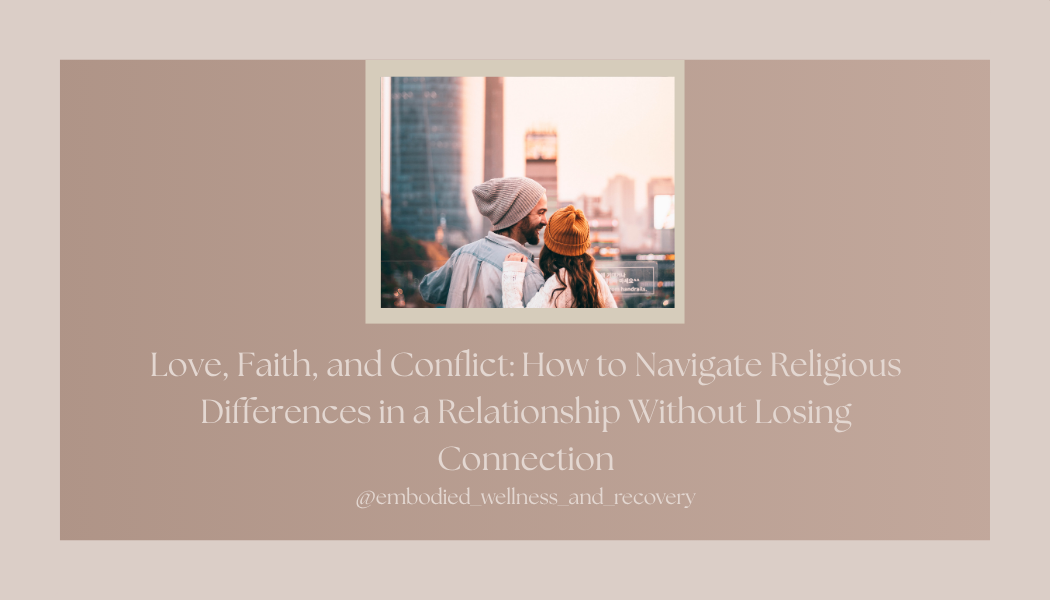
Love, Faith, and Conflict: How to Navigate Religious Differences in a Relationship Without Losing Connection
Love, Faith, and Conflict: How to Navigate Religious Differences in a Relationship Without Losing Connection
Learn how to navigate religious differences in a relationship or marriage with practical, neuroscience-informed strategies. Discover how couples can communicate across faith differences, reduce conflict, and build deeper emotional connection.
What happens when the person you love sees the world through a fundamentally different spiritual or religious lens?
Maybe you were aligned in the beginning, and something shifted. Maybe one of you deepened your faith while the other stepped away. Or perhaps you entered the relationship already knowing your beliefs were different, but assumed love would be enough.
And now you find yourselves asking:
— Why does this topic escalate so quickly into conflict?
— How do we raise children with different religious values?
— Can emotional intimacy survive such a core difference in worldview?
— Why does it feel so personal, even when we try to stay logical?
Navigating religious differences in a relationship is one of the most complex and emotionally charged challenges couples face. At Embodied Wellness and Recovery, we see this often, especially when these differences intersect with attachment wounds, identity, and nervous system dysregulation. This is not just a communication issue. It is a neurobiological, relational, and meaning-making issue.
Why Religious Differences Feel So Intense in Relationships
Religious beliefs are not just ideas. They are deeply tied to:
— Identity
— Moral frameworks
— Community belonging
— Early attachment experiences
From a neuroscience perspective, when our core beliefs are challenged, the brain can register it as a threat to safety and belonging.
Research in social neuroscience shows that perceived threats to identity activate the amygdala, the brain’s alarm system, increasing emotional reactivity and reducing access to the prefrontal cortex, which supports empathy and rational thinking(Kapogiannis et al., 2009).
This is why conversations about religion often feel like:
— Defensiveness instead of curiosity
— Reactivity instead of openness
— Disconnection instead of understanding
You are not just debating beliefs. You are navigating felt safety, attachment, and meaning.
Common Pain Points Couples Experience
Couples navigating different religious beliefs in marriage often struggle with:
1. Value Misalignment
One partner may prioritize faith-based decision-making, while the other leans toward autonomy or secular values.
2. Parenting Conflicts
Questions like:
— Will our children be raised in a specific religion?
— What traditions will we practice?
— What happens if our child chooses differently?
These can become deeply divisive.
3. Extended Family Pressure
Family expectations can intensify conflict:
— Pressure to convert
— Judgment or exclusion
— Cultural or religious rituals
4. Sexuality and Intimacy Differences
Religious beliefs often shape:
— Views on sex
— Boundaries and expectations
This can create tension in emotional and physical intimacy.
5. Fear of Losing Connection
Underneath the conflict is often a quieter fear:
If we see the world so differently, can we truly understand each other?
The Nervous System Lens: Why Conversations Escalate
From a somatic and polyvagal perspective, religious conflict often activates:
— Sympathetic arousal: anger, defensiveness, urgency
— Dorsal shutdown: withdrawal, emotional numbness, avoidance
This explains why couples may:
— Talk in circles
— Shut down mid-conversation
— Feel flooded and unable to listen
Research on couples' communication shows that emotional flooding reduces the ability to process information and increases misinterpretation of a partner’s intentions (Gottman & Levenson, 1992). Without regulation, even well-intended conversations can become cycles of rupture.
How to Navigate Religious Differences in a Relationship
1. Shift From Debate to Understanding
The goal is not to win. It is to understand.
Instead of:
— “That doesn’t make sense.”
Try:
— “Help me understand what this belief means to you emotionally.”
This moves the conversation from cognitive argument to relational connection.
2. Differentiate Beliefs From Attachment Needs
Often, what sounds like a belief conflict is actually an attachment need.
For example:
— “I want our children raised in my religion.”
May actually mean:
— “I want them to feel the same sense of belonging I did.”
When couples can identify the emotional need beneath the belief, empathy increases.
3. Regulate Before You Communicate
If your nervous system is activated, productive conversation is unlikely.
Signs you need to pause:
— Racing heart
— Urge to interrupt or defend
— Feeling overwhelmed
Practices that help:
— Slow breathing with long exhales
— Grounding through physical sensation
— Taking structured breaks
At Embodied Wellness and Recovery, we emphasize that regulation is a prerequisite for connection.
4. Create Shared Meaning Without Requiring Agreement
Research on successful long-term couples highlights the importance of shared meaning systems, even when beliefs differ (Gottman, 2011).
Ask:
— What values do we both care about?
— How can we create rituals that honor both perspectives?
Examples:
— Celebrating multiple traditions
— Creating new rituals unique to your relationship
— Agreeing on shared ethical principles
5. Set Clear Boundaries With Extended Family
Religious differences often become amplified through family dynamics.
Healthy boundaries may include:
— Deciding together what is shared with family
— Protecting your partner from criticism
— Presenting a united front
This supports relational safety and trust.
6. Have Explicit Conversations About Parenting
Avoiding this topic creates long-term conflict.
— Religious education
— Participation in rituals
— Exposure to both belief systems
The goal is not perfect agreement, but intentional decision-making.
7. Address Power Dynamics
If one partner feels pressured to:
— Convert
— Conform
— Silence their beliefs
Resentment builds.
Healthy relationships require:
— Mutual respect
— Autonomy
— Emotional safety
When Religious Differences Trigger Deeper Wounds
For some individuals, religious conflict activates:
— Shame
— Fear of rejection
— Trauma related to rigid or punitive belief systems
— Loss of identity or community
In these cases, the conflict is not just about the present relationship. It is connected to past experiences stored in the body and nervous system.
This is where integrative approaches, such as:
— EMDR
…can help process the deeper emotional layers influencing the relationship.
A New Way Forward: Integration Instead of Polarization
The most resilient couples do not eliminate differences. They learn how to integrate them.
This looks like:
— Staying connected in the presence of disagreement
— Holding curiosity alongside conviction
— Valuing the relationship over being right
Over time, this creates:
— Deeper emotional intimacy
— Greater psychological flexibility
— A more expansive sense of identity
How Therapy Can Help Couples Navigate Religious Differences
At Embodied Wellness and Recovery, we approach interfaith and religious conflictin relationships through a trauma-informed, neuroscience-based lens.
Our work focuses on:
— Nervous system regulation to reduce reactivity
— Identifying attachment needsbeneath beliefconflicts
— Repairing communication breakdowns
— Supporting identity integration
— Strengthening emotional and physical intimacy
Couples often find that when the nervous system is regulated and emotional safety is restored, conversations that once felt impossible become more grounded, respectful, and meaningful.
From an Immovable Barrier to an Invitation for Deeper Understanding, Growth, and Relational Depth
Religious differences can feel like an immovable barrier. But they can also become invitations to deeper understanding, growth, and relational depth.
The question is not:
— Can we agree on everything?
But rather:
— Can we stay connected, respectful, and emotionally attuned even when we do not?
That is where transformation happens.
Reach out to schedule a complimentary 20-minute consultation with our team of therapists, trauma specialists, somatic practitioners, or relationship experts, and start working towards integrative, embodied healing today.
📞 Call us at (310) 651-8458
📱 Text us at (310) 210-7934
📩 Email us at admin@embodiedwellnessandrecovery.com
🔗 Visit us at www.embodiedwellnessandrecovery.com
👉 Check us out on Instagram @embodied_wellness_and_recovery
🌍 Explore our offerings at Linktr.ee: https://linktr.ee/laurendummit
References
1) Gottman, J. M., & Levenson, R. W. (1992). Marital processes predictive of later dissolution. Journal of Personality and Social Psychology, 63(2), 221–233.
2) Gottman, J. M. (2011). The science of trust: Emotional attunement for couples. W. W. Norton & Company.
3) Kapogiannis, D., Barbey, A. K., Su, M., Zamboni, G., Krueger, F., & Grafman, J. (2009). Cognitive and neural foundations of religious belief. Proceedings of the National Academy of Sciences, 106(12), 4876–4881.
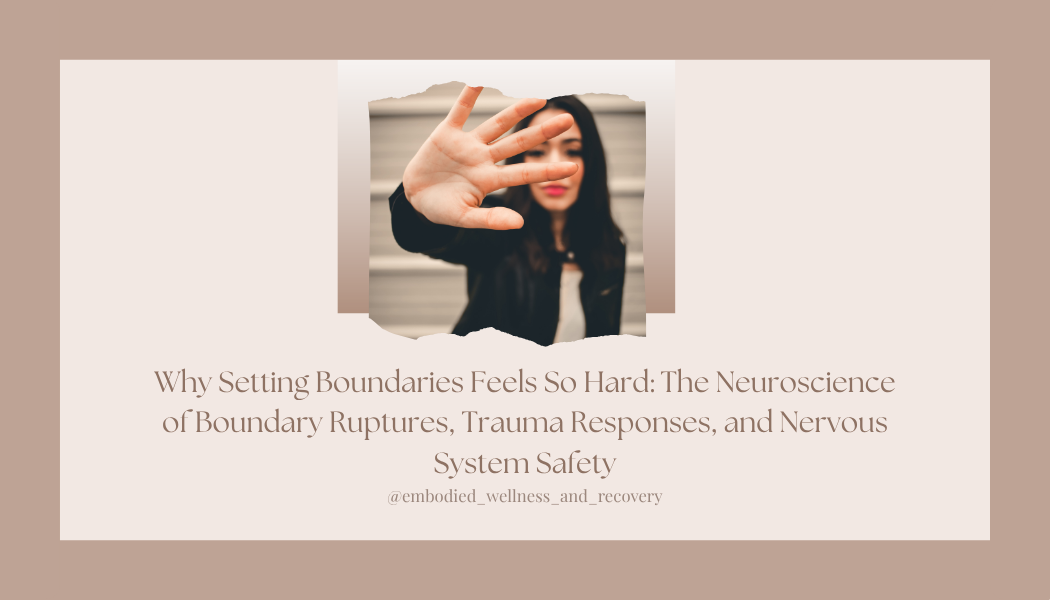
Why Setting Boundaries Feels So Hard: The Neuroscience of Boundary Ruptures, Trauma Responses, and Nervous System Safety
Why Setting Boundaries Feels So Hard: The Neuroscience of Boundary Ruptures, Trauma Responses, and Nervous System Safety
Struggling with boundaries in relationships? Learn the neuroscience behind boundary ruptures, guilt after saying no, and why trauma and nervous system patterns make limit setting difficult. Discover therapeutic strategies for healthier boundaries.
Many people believe that boundary challenges are primarily communication problems. The common advice is simple. Speak up. Say no. Be clear. Yet for countless individuals, boundary setting is far from simple. You might agree to something you do not want to do and later feel resentment or emotional withdrawal. You might attempt to set a limit with a partner, family member, or coworker and feel a sudden wave of anxiety, guilt, or panic immediately afterward. Perhaps you notice your heart racing, your stomach tightening, or your thoughts spiraling into worry about disappointing someone.
These reactions are not merely behavioral habits or personality quirks. In many cases, they are nervous system responses shaped by earlier relational experiences.
Understanding the neuroscience of boundaries can shift the conversation from self-criticism toward compassion and clarity. When we examine how attachment, trauma, and physiological regulation shape our ability to set limits, a deeper path toward healthier relationships becomes possible.
At Embodied Wellness and Recovery, we frequently see how boundary difficulties are intertwined with trauma, nervous system dysregulation, and relational history. Addressing boundaries from a somatic and neuroscience-informed perspective can transform how individuals experience autonomy, safety, and connection.
When Boundaries Trigger the Nervous System
Why can something as simple as saying "no" feel physically uncomfortable or even frightening? From a neuroscience perspective, boundaries are deeply tied to attachment safety. Human brains evolved to prioritize connection. For early humans, social belonging was essential for survival. Being rejected or excluded from a group could mean serious danger. Modern neuroscience shows that social threat activates many of the same brain circuits involved in physical pain (Eisenberger & Lieberman, 2004). For individuals whose early environments linked limit setting with relational consequences, the nervous system may interpret boundaries as risky.
Examples might include:
— Caregivers who reacted with anger or withdrawal when a child expressed needs — Family environments where harmony depended on compliance
— Relationships where asserting oneself led to criticism or punishment — Cultural expectations that rewarded self-sacrifice over autonomy
When boundaries historically threatened attachment, the body adapted. Instead of confidently asserting needs, the nervous system learned strategies that preserved connection.
These strategies often include:
— Avoiding conflict
— Agreeing despite internal discomfort
These patterns are not character flaws. They are adaptive survival responses.
Boundary Ruptures as Nervous System Adaptations
A boundary rupture occurs when personal limits are crossed or when someone struggles to express them in the first place. In therapy, boundary ruptures often reveal themselves through experiences such as:
— Agreeing to plans you do not want
— Taking on emotional labor for others
— Saying yes when your body feels tense or resistant
— Feeling resentment toward someone who never actually knew your true preference
Later, the emotional aftermath appears. You might feel confused about why you agreed. You might distance yourself from the person involved. You might criticize yourself for not speaking up. These responses are often linked to states of the nervous system. According to Polyvagal Theory, the autonomic nervous system constantly evaluates whether environments feel safe, dangerous, or overwhelming (Porges, 2011).
When boundary setting historically triggered relational threat, the nervous system may respond in several ways:
—- Fawn response: The body moves toward appeasing or accommodating others to maintain safety.
—- Fight response: A sudden surge of anger or defensiveness emerges after feeling overwhelmed.
—- Freeze response: The individual struggles to speak or assert themselves under pressure.
Understanding these physiological patterns helps explain why boundaries are not simply about willpower or communication skills. They involve the entire nervous system.
The Emotional Cost of Unclear Boundaries
When boundaries repeatedly rupture, relationships often become strained.
You may notice patterns such as:
— Chronic resentment toward loved ones — Emotional withdrawal after social interactions — Exhaustion from constantly meeting others' needs — Difficulty trusting your own preferences
Over time, unclear boundaries can also impact mental health. Research shows that individuals who struggle with assertiveness often experience higher levels of anxiety, depression, and relational stress (Speed, Goldstein, & Goldfried, 2018). At the same time, setting boundaries can initially feel destabilizing for individuals whose nervous systems associate limit setting with relational risk. This creates a painful dilemma. The very behavior that protects emotional well-being may also trigger anxiety.
Why Guilt Often Appears After Setting Boundaries
Many clients report a surprising reaction after asserting a boundary. They do it successfully. They say no. They express a need. Then guilt appears immediately afterward. This reaction is often misunderstood. Guilt in these moments is not necessarily evidence that the boundary was wrong. Instead, it may reflect the nervous system adjusting to unfamiliar relational territory. If earlier relationships linked boundaries with disapproval or abandonment, the body may react with anxiety when a new behavior challenges that pattern. Over time, as individuals experience safe relational responses to boundaries, their nervous systems begin to recalibrate. Limit setting starts to feel less threatening and more stabilizing.
The Role of Somatic Awareness in Boundary Repair
Traditional communication skills remain important when learning to set boundaries. However, many individuals benefit from incorporating body awareness and nervous system regulation into this process. Somatic therapy approaches emphasize noticing physiological signals that arise before and during boundary moments.
Examples include:
— Tightness in the chest when agreeing to something unwanted — A sinking feeling in the stomach when personal limits are crossed — Rapid breathing during conflict conversations
These signals often appear before conscious awareness. Developing sensitivity to these cues allows individuals to pause and evaluate what their body may be communicating. Research in neuroscience suggests that interoception, the ability to perceive internal bodily states, plays a crucial role in emotional awareness and decision making (Craig, 2009). Strengthening this awareness can support more authentic relational choices.
Repairing Boundary Ruptures in Relationships
Boundary challenges are not limited to individual experiences. They frequently arise within intimate relationships, families, and workplaces. Repairing these ruptures requires both internal and relational work.
Helpful steps often include:
1. Identifying the pattern
Notice where boundaries consistently become difficult. Are there specific relationships or situations that trigger anxiety or compliance?
2. Exploring the relational history
Many boundary patterns trace back to early attachment experiences. Understanding these origins helps reduce shame and increase clarity.
3. Practicing nervous system regulation
Breathwork, grounding exercises, and somatic awareness can support calm during difficult conversations.
4. Communicating limits gradually
Boundaries do not always need to appear suddenly or dramatically. Incremental changes often feel safer for the nervous system.
A Trauma-Informed Approach to Boundaries
In trauma-informed therapy, boundaries are not viewed as rigid walls separating people from one another. Instead, they are understood as dynamic relational processes. Healthy boundaries allow individuals to remain connected to others while maintaining authenticity and autonomy.
This approach emphasizes several key principles:
— Curiosity rather than judgment toward protective patterns — Compassion for nervous system adaptations shaped by earlier experiences — Gradual expansion of tolerance for vulnerability and self-expression
Over time, individuals often discover that boundaries can actually deepen relationships. When people feel able to express preferences honestly, connection becomes more genuine and sustainable.
How Therapy Can Support Boundary Development
For individuals whose boundary struggles are rooted in trauma, attachment injuries, or chronic anxiety, therapy can provide a structured environment for exploring these patterns.
At Embodied Wellness and Recovery, boundary work often includes:
— Somatic therapy to regulate the nervous system
— Attachment-focused therapy to explore relational history
— EMDR and trauma therapies to process earlier experiences
— Communication skill development for real-world conversations
Through this integrative approach, many individuals begin to experience boundaries not as threats to connection but as foundations for relational safety. When the nervous system learns that expressing needs does not automatically lead to rejection or abandonment, limit setting becomes less frightening. It becomes a form of self-respect that supports healthier relationships.
A New Understanding
Boundary challenges are rarely simple communication problems. They often reflect deeply ingrained nervous system patterns shaped by earlier experiences of attachment, safety, and relational threat. When individuals approach these patterns with curiosity and compassion, a new understanding emerges.
Setting boundaries is not only a relational skill. It is also a process of recalibrating the nervous system. With supportive relationships, somatic awareness, and trauma-informed therapy, many people discover that boundaries can coexist with closeness rather than threaten it. And in that space, relationships often become clearer, more authentic, and more sustainable.
Reach out to schedule a complimentary 20-minute consultation with our team of therapists, trauma specialists, somatic practitioners, or relationship experts, and start working towards integrative, embodied healing today.
📞 Call us at (310) 651-8458
📱 Text us at (310) 210-7934
📩 Email us at admin@embodiedwellnessandrecovery.com
🔗 Visit us at www.embodiedwellnessandrecovery.com
👉 Check us out on Instagram @embodied_wellness_and_recovery
🌍 Explore our offerings at Linktr.ee: https://linktr.ee/laurendummit
References
1) Craig, A. D. (2009). How do you feel now? The anterior insula and human awareness. Nature Reviews Neuroscience, 10(1), 59–70.
2) Eisenberger, N. I., & Lieberman, M. D. (2004). Why rejection hurts. A common neural alarm system for physical and social pain. Trends in Cognitive Sciences, 8(7), 294–300.
3) Porges, S. W. (2011). The polyvagal theory. Neurophysiological foundations of emotions, attachment, communication, and self-regulation. W. W. Norton & Company.
4) Speed, B. C., Goldstein, B. L., & Goldfried, M. R. (2018). Assertiveness training. A forgotten evidence-based treatment. Clinical Psychology Science and Practice, 25(1), e12216.