
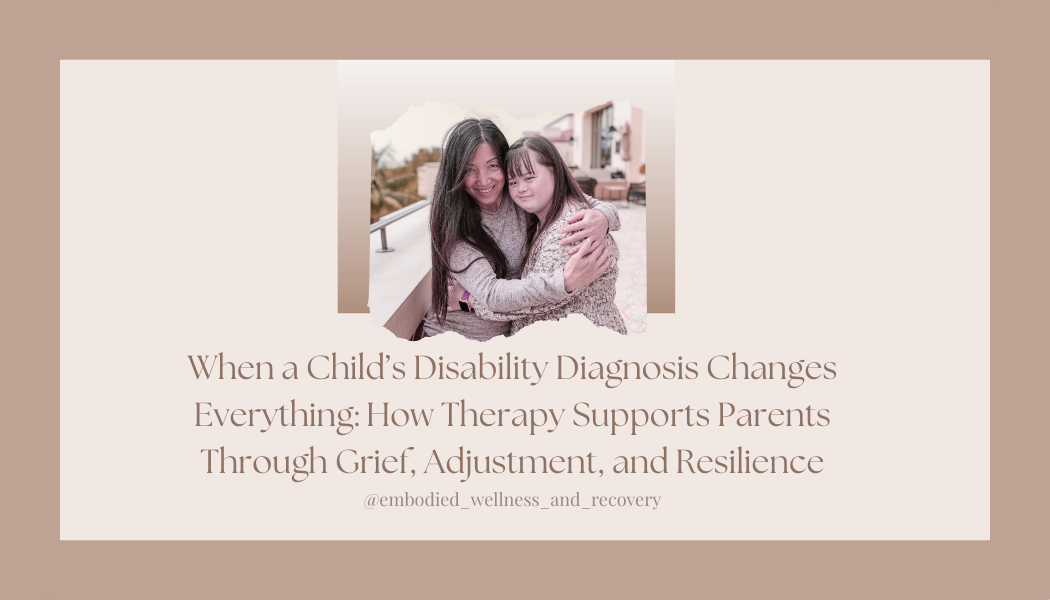
When a Child’s Disability Diagnosis Changes Everything: How Therapy Supports Parents Through Grief, Adjustment, and Resilience
When a Child’s Disability Diagnosis Changes Everything: How Therapy Supports Parents Through Grief, Adjustment, and Resilience
Struggling after your child’s disability diagnosis? Learn how therapy helps parents process grief, regulate the nervous system, strengthen relationships, and build emotional resilience.
When the Future You Imagined Suddenly Shifts
Did your child’s diagnosis arrive with shock, confusion, or a sense of disorientation?
Do you love your child deeply while also grieving the future you once imagined?
Are you exhausted by medical appointments, advocacy demands, and the emotional weight of holding it all together?
A child’s disability diagnosis can be life-altering for parents. Even when the diagnosis brings clarity or access to services, it often arrives alongside grief, fear, anger, guilt, and overwhelm. Many parents feel pressure to be strong, grateful, or resilient while quietly struggling inside.
Therapy offers parents a place to process the emotional impact of diagnosis, support nervous system regulation, and navigate the relational and identity shifts that often follow.
Understanding the Emotional Impact of a Disability Diagnosis
A disability diagnosis affects more than logistics. It reshapes how parents experience their child, themselves, and the future.
Common emotional responses include:
— Grief for unmet expectations
— Anxiety about the child’s future
— Guilt or self-blame
— Chronic stress and burnout
— Fear of judgment or isolation
— Conflicting feelings of love and loss
These reactions are not signs of weakness. They reflect the nervous system responding to uncertainty, responsibility, and profound change.
Grief That Does Not Follow a Straight Line
Parents often experience a form of ongoing or ambiguous grief. Unlike grief tied to a single loss, this grief can resurface at developmental milestones, school transitions, or social comparisons.
Parents may grieve:
— The loss of predictability
— The imagined version of parenthood
— Ease and spontaneity
— A sense of control or certainty
This grief can coexist with deep love and commitment to the child. Therapy helps parents hold these experiences without shame or self-judgment.
The Neuroscience of Stress and Parenting After Diagnosis
Caring for a child with a disability places sustained demands on the nervous system. Chronic stress activates the body’s threat response, often keeping parents in a state of hyper-vigilance.
From a neuroscience perspective:
— The amygdala remains highly activated, scanning for danger or setbacks
— The prefrontal cortex becomes taxed, affecting decision-making and emotional regulation
— The body may experience fatigue, sleep disruption, or somatic symptoms
Without adequate support, parents may feel emotionally depleted or disconnected from themselves and others.
When Parenting Stress Becomes Traumatic
For some parents, the diagnostic process itself can be traumatic. Medical uncertainty, invasive testing, frightening information, or feeling dismissed by professionals can leave lasting imprints on the nervous system. Therapy helps process these experiences, reduce reactivity, and restore a sense of agency.
How a Child’s Diagnosis Affects Identity
Many parents report feeling like their identity shifts overnight. Roles expand to include advocate, coordinator, protector, and educator.
Parents may ask:
— Who am I now beyond caregiving?
— Why do I feel so different from other parents?
— How do I hold my needs alongside my child’s needs?
Therapy helps parents integrate these new roles without losing their sense of self.
The Impact on Relationships and Partnerships
A child’s disability diagnosis often affects romantic partnerships and co-parenting relationships.
Common challenges include:
— Differences in coping styles
— Unequal caregiving burdens
— Financial stress
— Reduced intimacy or emotional availability
— Conflict over decisions or expectations
Therapy helps partners communicate more effectively, process shared grief, and rebuild connection under stress.
The Often Unspoken Impact on Sexuality and Intimacy
Chronic stress, exhaustion, and emotional overwhelm can affect desire, body image, and sexual connection. Many parents feel guilty for noticing these changes.
A trauma-informed therapeutic approach recognizes that intimacy is closely tied to nervous system regulation. As stress is addressed, many couples find that connection can gradually return.
Why Parents Delay Seeking Therapy
Many parents postpone therapy because:
— Their child’s needs feel more urgent
— Time and energy feel scarce
— They believe they should cope on their own
— They fear appearing ungrateful
In reality, supporting the parent’s nervous system is one of the most effective ways to support the child.
How Therapy Helps Parents Adjust and Heal
Therapy provides a dedicated space for parents to:
— Process grief and complex emotions
— Regulate chronic stress responses
— Address trauma from the diagnostic process
— Strengthen relational support systems
— Reclaim identity and meaning
— Build sustainable coping strategies
This work is not about fixing emotions. It is about creating the capacity to hold them with compassion.
A Nervous System-Informed Approach to Parenting Support
Effective therapy recognizes that parents cannot think their way out of overwhelm. The body must feel supported.
Nervous system-informed therapy may include:
— Somatic awareness and grounding
— Emotional regulation skills
— Trauma processing, such as EMDR
— Support for boundary setting and self-care
— Relational and attachment-based interventions
These approaches help parents move from survival mode toward resilience.
Parenting Resilience Is Built, Not Forced
Resilience does not mean constant positivity or acceptance. It means flexibility, support, and the ability to recover after stress.
Therapy helps parents build resilience by:
— Reducing isolation
— Normalizing emotional responses
— Strengthening internal and external resources
Over time, parents often report greater confidence, emotional steadiness, and clarity.
How Embodied Wellness and Recovery Supports Parents
At Embodied Wellness and Recovery, we understand the profound emotional impact of parenting a child with a disability.
Our integrative approach includes:
— Trauma-informed psychotherapy
— Nervous system regulation and somatic work
— EMDR and trauma processing
— Couples and family therapy
— Support for intimacy and relational strain
We help parents feel supported, grounded, and resourced as they navigate this journey.
An Evolving Process
Adjusting to a child’s disability diagnosis is not a single moment. It is an evolving process that deserves care, space, and support. Therapy offers parents a place to breathe, reflect, and rebuild from a grounded perspective rather than a constant state of urgency.
Reach out to schedule a complimentary 20-minute consultation with our team of therapists, trauma specialists, somatic practitioners, or relationship experts, and start working towards integrative, embodied healing today.
📞 Call us at (310) 651-8458
📱 Text us at (310) 210-7934
📩 Email us at admin@embodiedwellnessandrecovery.com
🔗 Visit us at www.embodiedwellnessandrecovery.com
👉 Check us out on Instagram @embodied_wellness_and_recovery
🌍 Explore our offerings at Linktr.ee: https://linktr.ee/laurendummit
References
Boss, P. (2006). Loss, trauma, and resilience: Therapeutic work with ambiguous loss. W. W. Norton & Company.
McEwen, B. S. (2007). Physiology and neurobiology of stress and adaptation. Physiological Reviews, 87(3), 873–904.
Porges, S. W. (2011). The polyvagal theory: Neurophysiological foundations of emotions, attachment, communication, and self-regulation. W. W. Norton & Company.
van der Kolk, B. A. (2014). The body keeps the score: Brain, mind, and body in the healing of trauma. Viking.