
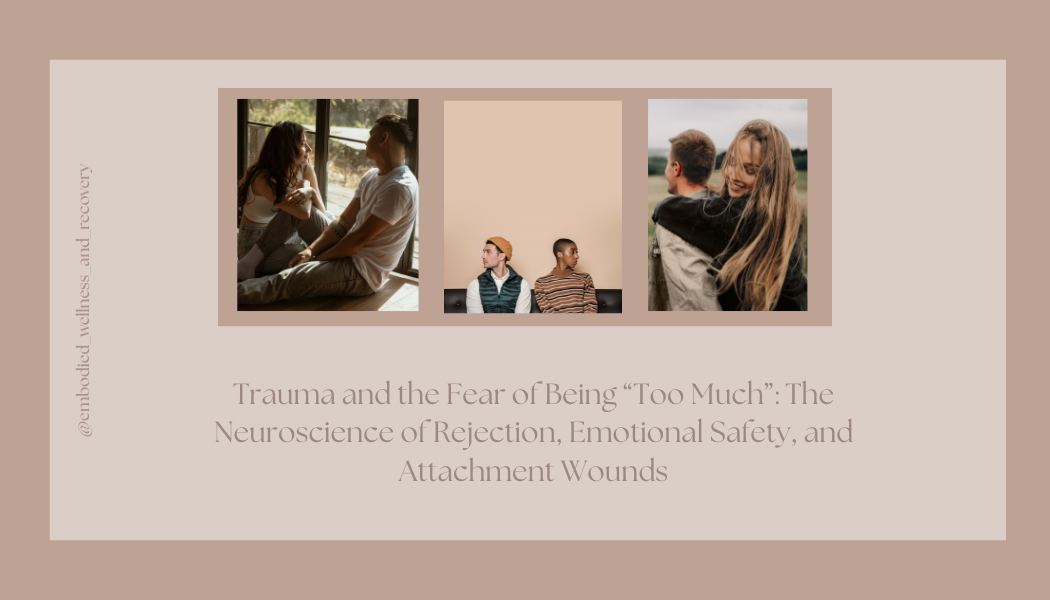
Trauma and the Fear of Being “Too Much”: The Neuroscience of Rejection, Emotional Safety, and Attachment Wounds
Trauma and the Fear of Being “Too Much”: The Neuroscience of Rejection, Emotional Safety, and Attachment Wounds
Do you fear being “too much” emotionally in relationships? Learn how trauma, attachment wounds, nervous system dysregulation, and fear of rejection shape emotional insecurity, people pleasing, anxiety, and intimacy struggles through a neuroscience-informed lens.
Why Do So Many People Fear They Are “Too Much” for Others?
Do you constantly worry that your emotions, needs, sensitivity, or vulnerability will overwhelm people?
Have you ever:
— Apologized for crying?
— Minimized your emotional needs?
— Felt ashamed after expressing hurt?
— Feared that asking for reassurance would push someone away?
— Worried that your anxiety, sadness, or emotional intensity would make others leave?
Many people silently carry the painful belief:
— “I am too needy.”
— “I am too emotional.”
— “I am too sensitive.”
— “I take up too much space.”
— “People eventually get overwhelmed by me.”
For some individuals, this fear becomes deeply embedded in the nervous system and shapes how they experience:
— Intimacy
— Attachment
— Vulnerability
— Emotional expression
At Embodied Wellness and Recovery, we frequently help individuals explore how trauma, attachment wounds, nervous system dysregulation, and relational experiences contribute to chronic fears of rejection, abandonment, emotional shame, and insecurity.
Often, the fear of being “too much” is not a personality flaw. It is a trauma adaptation.
Where Does the Fear of Being “Too Much” Come From?
People are rarely born believing their emotions are unacceptable.
This belief often develops through repeated relational experiences in which emotional needs were:
— Dismissed
— Ignored
— Mocked
— Punished
— Invalidated
— Emotionally abandoned
Some people grew up hearing messages such as:
— “You are too sensitive.”
— “Stop crying.”
— “Calm down.”
— “You are overreacting.”
— “Why are you so emotional?”
— “You are exhausting.”
Others may not have heard these words directly, but experienced emotional inconsistency, emotional neglect, or caregivers who became overwhelmed by emotional expression. Over time, the nervous system may begin associating vulnerability with danger.
Trauma and Attachment Wounds
From an attachment perspective, humans are biologically wired to seek:
— Connection
— Emotional safety
— Attunement
— Responsiveness
When caregivers are emotionally unavailable, rejecting, inconsistent, or dysregulated, children often internalize painful conclusions about themselves.
Rather than thinking: “My environment feels unsafe.”
Children often conclude:
— “Something is wrong with me.”
— “My emotions are a problem.”
— “My needs overwhelm people.”
— “I need to become less visible to stay connected.”
These attachment wounds can persist into adulthood and shape:
— Friendships
— Marriage
The Neuroscience of Emotional Rejection
From a neuroscience perspective, social rejection activates many of the same brain regions involved in physical pain. Research suggests the anterior cingulate cortex becomes activated during experiences of emotional rejection and exclusion (Eisenberger et al., 2003).
This helps explain why:
— Criticism can feel physically painful
— Emotional invalidation can feel overwhelming
— Abandonment fears can trigger panic
— Relational conflict can activate intense nervous system responses
For trauma survivors, especially, the nervous system may become highly sensitive to cues of:
— Rejection
— Withdrawal
— Disappointment
— Emotional disconnection
— Abandonment
The body begins anticipating emotional danger before the conscious mind fully processes it.
The Fear of “Too Much” Often Creates Self-Abandonment
Ironically, many people cope with the fear of being “too much” by becoming emotionally smaller.
They may:
— Suppress feelings
— Avoid vulnerability
— People please
— Over apologize
— Avoid asking for needs to be met
— Become hyper-independent
— Minimize pain
— Tolerate emotional neglect
— Emotionally caretaking others while abandoning themselves
Some individuals become experts at:
— Reading other people’s emotions
— Adapting to others’ needs
— Avoiding conflict
— Staying emotionally “easy”
— Becoming low maintenance
But internally, they often feel:
— Lonely
— Unseen
— Anxious
— Emotionally deprived
— Disconnected from themselves
Why Highly Sensitive People Often Struggle With This Fear
Highly empathetic or emotionally sensitive individuals often feel emotions deeply. This sensitivity is not inherently unhealthy.
However, when emotional sensitivity is met with:
— Shame
— Emotional unpredictability
— Emotional invalidation
The nervous system may begin viewing emotional expression as dangerous.
Some people become trapped in a painful cycle:
— Craving connection
— Fearing rejection
— Suppressing needs
— Feeling emotionally unseen
— Becoming resentful or anxious
— Fearing they are “too much”
Trauma Can Create Hypervigilance in Relationships
Many trauma survivors become highly attuned to subtle emotional shifts in others.
They may constantly monitor:
— Facial expressions
— Tone of voice
— Texting patterns
— Pauses in communication
— Emotional distance
— Energy shifts
This hypervigilance is often the nervous system attempting to prevent abandonment or emotional pain.
The body learns: “If I can anticipate rejection early enough, maybe I can protect myself.”
Unfortunately, this often creates chronic anxiety and relational exhaustion.
The Difference Between Healthy Needs and Trauma-Driven Fear
One of the most important parts of healing is learning that having emotional needs does not make someone “too much.”
All humans need:
— Connection
— Reassurance
— Emotional safety
— Responsiveness
— Care
— Attunement
— Belonging
The problem is not emotional need itself. The problem is often unresolved shame surrounding those needs.
Trauma frequently teaches people:
— Needing others is unsafe
— Vulnerability creates rejection
— Emotional expression drives people away
Healthy relationships, however, are built through mutual emotional responsiveness and repair.
The Nervous System Needs Co-Regulation
Humans are relational beings.
According to Polyvagal Theory, the nervous system is regulated through safe connection with others (Porges, 2011).
This means:
— Warmth matters
— Emotional presence matters
— Attunement matters
— Responsiveness matters
People do not become emotionally secure through emotional isolation. They often heal through safe, consistent, emotionally attuned relationships.
How Therapy Can Help Heal the Fear of Being “Too Much”
At Embodied Wellness and Recovery, we help individuals understand how:
— Trauma
— Nervous system dysregulation
— Shame
shape fears of rejection and emotional insecurity.
Treatment may include:
— EMDR
— Self-compassion work
As healing progresses, many individuals begin:
— Tolerating vulnerability more safely
— Developing healthier emotional boundaries
— Reducing shame around emotional needs
— Improving self-worth
— Choosing healthier relationships
— Experiencing greater emotional regulation
Relearning Emotional Safety
Healing often involves learning that safe relationships do not require:
— Emotional perfection
— Emotional suppression
— Constant self-abandonment
— Shrinking yourself to maintain connection
Healthy intimacy allows space for:
— Emotions
— Needs
— Vulnerability
— Repair
— Humanity
— Imperfection
The goal is not becoming emotionless or “less needy.” The goal is to develop relationships where emotional authenticity feels safe.
Deeply Human Needs
The fear of being “too much” is often rooted in experiences where emotional expression was not safely received. Many people learned to suppress parts of themselves in order to preserve attachment, reduce conflict, or avoid rejection. But emotional sensitivity, vulnerability, and relational needs are not evidence of weakness. They are deeply human.
Sometimes healing begins when individuals stop asking: “How do I become less emotionally difficult?”
and begin asking: “What experiences taught me my emotions were unsafe in the first place?”
Reach out to schedule a complimentary 20-minute consultation with our team of therapists, trauma specialists, somatic practitioners, or relationship experts, and start working towards integrative, embodied healing today.
📞 Call us at (310) 651-8458
📱 Text us at (310) 210-7934
📩 Email us at admin@embodiedwellnessandrecovery.com
🔗 Visit us at www.embodiedwellnessandrecovery.com
👉 Check us out on Instagram @embodied_wellness_and_recovery
🌍 Explore our offerings at Linktr.ee: https://linktr.ee/laurendummit
References
1) Eisenberger, N. I., Lieberman, M. D., & Williams, K. D. (2003). Does rejection hurt? An FMRI study of social exclusion. Science, 302(5643), 290-292.
2) Porges, S. W. (2011). The polyvagal theory: Neurophysiological foundations of emotions, attachment, communication, and self-regulation. Norton.
3) Siegel, D. J. (2012). The developing mind: How relationships and the brain interact to shape who we are. Guilford Press.
4) van der Kolk, B. A. (2014). The body keeps the score: Brain, mind, and body in the healing of trauma. Viking.
Learned Helplessness: The Neuroscience of Low Self-Esteem, Trauma, and How Therapy Helps You Reclaim Personal Agency
Learned Helplessness: The Neuroscience of Low Self-Esteem, Trauma, and How Therapy Helps You Reclaim Personal Agency
Discover how learned helplessness develops through trauma, chronic stress, criticism, and emotional invalidation. Learn the neuroscience behind low self-esteem, hopelessness, anxiety, and emotional shutdown, along with how therapy can help restore confidence, nervous system regulation, and personal empowerment.
Why Do Some People Feel Stuck Even When They Want Change?
Have you ever felt like no matter how hard you try, nothing really changes?
Do you struggle with thoughts like:
— “What’s the point?”
— “I’ll probably fail anyway.”
— “Nothing I do matters.”
— “Other people seem capable, but I’m not.”
— “I don’t trust myself.”
— “I feel emotionally frozen or defeated.”
Do you find yourself staying in painful situations because part of you no longer believes you have the power to change them? Many individuals struggling with low self-esteem, anxiety, depression, trauma, or chronic relationship difficultiesare not simply “unmotivated” or lacking discipline. Sometimes they are experiencing learned helplessness.
From a neuroscience and trauma-informed perspective, learned helplessness is not weakness. It is often the nervous system’s adaptation to repeated experiences of powerlessness, unpredictability, criticism, failure, emotional invalidation, or chronic stress.
At Embodied Wellness and Recovery, we frequently help individuals explore how trauma, attachment wounds, emotional neglect, nervous system dysregulation, and relational experiences shape self-worth, confidence, motivation, and personal agency.
What Is Learned Helplessness?
Learned helplessness is a psychological condition in which individuals come to believe they have little or no control over their outcomes, even when change may be possible. The concept was first developed through research by psychologist Martin Seligman in the 1960s.
Research found that when individuals or animals are repeatedly exposed to uncontrollable stress or adverse experiences, they may eventually stop attempting to change their circumstances altogether (Seligman, 1975).
In humans, learned helplessness may appear as:
— Chronic self-doubt
— Fear of failure
— Emotional shutdown
— Passivity
— Procrastination
— Hopelessness
— Difficulty making decisions
— Remaining in unhealthy relationships
— Lack of motivation
— Anxiety
— Depression
Over time, the nervous system begins internalizing: “Nothing I do will matter.”
How Learned Helplessness Develops
Learned helplessness often develops gradually through repeated emotional experiences.
Childhood Criticism or Emotional Invalidation
Children who are:
— Excessively criticized
— Emotionally dismissed
— Shamed
— Controlled
— Chronically misunderstood
— Punished unpredictably
may begin believing their needs, feelings, or efforts are unimportant.
Over time, this can erode self-trust and confidence.
Trauma and Chronic Stress
Trauma often involves experiences where individuals feel trapped, powerless, unsafe, or unable to control outcomes.
This may include:
— Emotional abuse
— Childhood neglect
— Bullying
— Addiction in the family
— Chronic instability
The nervous system adapts by prioritizing survivalover exploration, creativity, risk-taking, or self-expression.
Repeated Failure or Rejection
Repeated experiences of rejection, disappointment, or failure may also contribute to helplessness, particularly when individuals lack emotional support or tools for self-regulation.
Perfectionism and Fear-Based Conditioning
Some individuals become so afraid of failure that they stop trying altogether. Perfectionism often masks profound fear, shame, and self-protection.
The Neuroscience of Learned Helplessness
From a neuroscience perspective, chronic helplessness affects both the brain and nervous system.
Research suggests chronic stress may impact:
— The amygdala
— Hippocampus
— Prefrontal cortex
— Dopamine pathways
— Stress hormone regulation
The brain begins organizing around threat detection rather than growth, exploration, or creativity.
Individuals may experience:
— Emotional shutdown
— Low motivation
— Exhaustion
— Hopelessness
— Nervous system dysregulation
Research has also linked helplessness to alterations in serotonin and dopamine functioning, both of which play important roles in mood, motivation, and emotional regulation (Maier & Seligman, 2016). This is why learned helplessness is not simply “negative thinking.” The body itself may begin expecting defeat, disappointment, criticism, or emotional pain.
Learned Helplessness and Low Self-Esteem
One of the most painful consequences of learned helplessness is its impact on identity and self-worth.
People may begin viewing themselves as:
— Incapable
— Weak
— Inadequate
— Defective
— Powerless
— Unintelligent
— Undeserving
This can create profound shame.
Many individuals compare themselves to others and wonder: “Why can everyone else handle life better than I can?”
Yet trauma-informed therapy recognizes that these beliefs often developed as adaptive survival responses. A nervous system conditioned by fear, unpredictability, criticism, or emotional pain may naturally struggle with confidence and self-trust.
How Learned Helplessness Shows Up in Relationships
Learned helplessness frequently affects intimate relationships.
Individuals may:
— Tolerate mistreatment
— Struggle to set boundaries
— Fear conflict
— Avoid expressing needs
— Remain in emotionally unsafe relationships
— People please excessively
— Assume they are the problem
— Feel emotionally trapped
Some people unconsciously believe:
— “My feelings do not matter.”
— “I cannot ask for more.”
— “Nothing will change anyway.”
— “I should just tolerate this.”
Over time, this can deepen anxiety, resentment, emotional exhaustion, and relational disconnection.
The Difference Between Laziness and Nervous System Shutdown
Many individuals with learned helplessness harshly criticize themselves.
They may call themselves:
— Lazy
— Weak
— Unmotivated
— Incapable
— Failures
But from a somatic and neuroscience perspective, many people are not lazy. They are overwhelmed, dysregulated, emotionally exhausted, or stuck in survival responses. The nervous system sometimes shuts down when it no longer perceives effort as emotionally safe or meaningful.
This shutdown can resemble:
— Procrastination
— Avoidance
— Emotional numbness
— Depression
— Passivity
— Low energy
Compassionate understanding is often far more effective than shame.
How Therapy Helps Heal Learned Helplessness
Therapy can help individuals gradually rebuild:
— Self-trust
— Emotional safety
— Personal agency
— Emotional resilience
At Embodied Wellness and Recovery, we approach learned helplessness through an integrative, trauma-informed lens that recognizes the relationship between the body, brain, attachment experiences, and nervous system functioning.
Somatic Therapy
Somatic approaches help individuals reconnect with their bodies, emotions, boundaries, instincts, and internal experiences. This can increase feelings of empowerment and embodiment.
EMDR Therapy
EMDR may help process unresolved trauma, shame, fear, criticism, or painful memories that continue reinforcing helplessness beliefs.
Attachment Focused Therapy
Attachment work helps individuals explore how early relational experiences shaped beliefs about worth, safety, capability, and emotional expression.
Nervous System Regulation
As the nervous system becomes more regulated, many individuals report:
— Increased motivation
— Greater clarity
— Improved emotional resilience
— Stronger boundaries
— More self-confidence
— Renewed creativity
— Greater willingness to take healthy risks
Self-Compassion Work
Research suggests self-compassion improves emotional resilience and reduces shame-based thinking(Neff, 2003). People often heal more effectively through compassion than self-punishment.
Reclaiming Personal Agency
Healing learned helplessness does not usually happen all at once.
It often develops gradually through:
— Small moments of empowerment
— Emotional safety
— Supportive relationships
— Self-trust
— Consistent experiences of agency
Sometimes healing begins with very small internal shifts:
— “My feelings matter.”
— “I can make choices.”
— “I am allowed to take up space.”
— “I do not have to stay powerless.”
— “My past does not define my future.”
From Shame to Self-Compassion and Healing
Learned helplessness can profoundly affect self-esteem, motivation, relationships, emotional well-being, and identity. But what often appears externally as passivity or lack of confidence may actually reflect years of nervous system adaptation to fear, unpredictability, criticism, trauma, or emotional pain. Understanding the neuroscience behind learned helplessness can help shift the conversation away from shame and toward compassion, regulation, and healing.
At Embodied Wellness and Recovery, we help individuals reconnect with their sense of agency, emotional resilience, confidence, and self-worth through trauma-informed, neuroscience-based therapy approaches that address both the mind and the nervous system.
Contact us today to schedule a free 20-minute consultation and begin your journey toward embodied connection, clarity, and confidence.
📞 Call us at (310) 651-8458
📱 Text us at (310) 210-7934
📩 Email us at admin@embodiedwellnessandrecovery.com
🔗 Visit us at www.embodiedwellnessandrecovery.com
👉 Check us out on Instagram @embodied_wellness_and_recovery
🌍 Explore our offerings at Linktr. ee:https://linktr.ee/laurendummit
References
1) Maier, S. F., & Seligman, M. E. P. (2016). Learned helplessness at fifty: Insights from neuroscience. Psychological Review, 123(4), 349-367.
2) Neff, K. D. (2003). Self-compassion: An alternative conceptualization of a healthy attitude toward oneself. Self and Identity, 2(2), 85-101.
3) Porges, S. W. (2011). The polyvagal theory: Neurophysiological foundations of emotions, attachment, communication, and self-regulation. Norton.
4) Seligman, M. E. P. (1975). Helplessness: On depression, development, and death. Freeman.
5) Van der Kolk, B. A. (2014). The body keeps the score: Brain, mind, and body in the healing of trauma. Viking.