
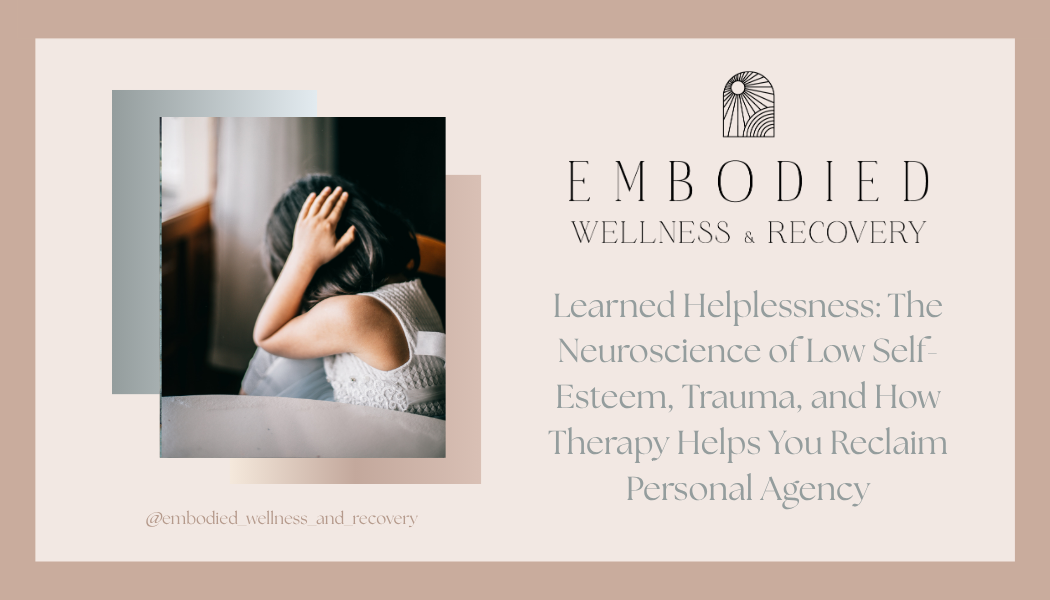
Learned Helplessness: The Neuroscience of Low Self-Esteem, Trauma, and How Therapy Helps You Reclaim Personal Agency
Learned Helplessness: The Neuroscience of Low Self-Esteem, Trauma, and How Therapy Helps You Reclaim Personal Agency
Discover how learned helplessness develops through trauma, chronic stress, criticism, and emotional invalidation. Learn the neuroscience behind low self-esteem, hopelessness, anxiety, and emotional shutdown, along with how therapy can help restore confidence, nervous system regulation, and personal empowerment.
Why Do Some People Feel Stuck Even When They Want Change?
Have you ever felt like no matter how hard you try, nothing really changes?
Do you struggle with thoughts like:
— “What’s the point?”
— “I’ll probably fail anyway.”
— “Nothing I do matters.”
— “Other people seem capable, but I’m not.”
— “I don’t trust myself.”
— “I feel emotionally frozen or defeated.”
Do you find yourself staying in painful situations because part of you no longer believes you have the power to change them? Many individuals struggling with low self-esteem, anxiety, depression, trauma, or chronic relationship difficultiesare not simply “unmotivated” or lacking discipline. Sometimes they are experiencing learned helplessness.
From a neuroscience and trauma-informed perspective, learned helplessness is not weakness. It is often the nervous system’s adaptation to repeated experiences of powerlessness, unpredictability, criticism, failure, emotional invalidation, or chronic stress.
At Embodied Wellness and Recovery, we frequently help individuals explore how trauma, attachment wounds, emotional neglect, nervous system dysregulation, and relational experiences shape self-worth, confidence, motivation, and personal agency.
What Is Learned Helplessness?
Learned helplessness is a psychological condition in which individuals come to believe they have little or no control over their outcomes, even when change may be possible. The concept was first developed through research by psychologist Martin Seligman in the 1960s.
Research found that when individuals or animals are repeatedly exposed to uncontrollable stress or adverse experiences, they may eventually stop attempting to change their circumstances altogether (Seligman, 1975).
In humans, learned helplessness may appear as:
— Chronic self-doubt
— Fear of failure
— Emotional shutdown
— Passivity
— Procrastination
— Hopelessness
— Difficulty making decisions
— Remaining in unhealthy relationships
— Lack of motivation
— Anxiety
— Depression
Over time, the nervous system begins internalizing: “Nothing I do will matter.”
How Learned Helplessness Develops
Learned helplessness often develops gradually through repeated emotional experiences.
Childhood Criticism or Emotional Invalidation
Children who are:
— Excessively criticized
— Emotionally dismissed
— Shamed
— Controlled
— Chronically misunderstood
— Punished unpredictably
may begin believing their needs, feelings, or efforts are unimportant.
Over time, this can erode self-trust and confidence.
Trauma and Chronic Stress
Trauma often involves experiences where individuals feel trapped, powerless, unsafe, or unable to control outcomes.
This may include:
— Emotional abuse
— Childhood neglect
— Bullying
— Addiction in the family
— Chronic instability
The nervous system adapts by prioritizing survivalover exploration, creativity, risk-taking, or self-expression.
Repeated Failure or Rejection
Repeated experiences of rejection, disappointment, or failure may also contribute to helplessness, particularly when individuals lack emotional support or tools for self-regulation.
Perfectionism and Fear-Based Conditioning
Some individuals become so afraid of failure that they stop trying altogether. Perfectionism often masks profound fear, shame, and self-protection.
The Neuroscience of Learned Helplessness
From a neuroscience perspective, chronic helplessness affects both the brain and nervous system.
Research suggests chronic stress may impact:
— The amygdala
— Hippocampus
— Prefrontal cortex
— Dopamine pathways
— Stress hormone regulation
The brain begins organizing around threat detection rather than growth, exploration, or creativity.
Individuals may experience:
— Emotional shutdown
— Low motivation
— Exhaustion
— Hopelessness
— Nervous system dysregulation
Research has also linked helplessness to alterations in serotonin and dopamine functioning, both of which play important roles in mood, motivation, and emotional regulation (Maier & Seligman, 2016). This is why learned helplessness is not simply “negative thinking.” The body itself may begin expecting defeat, disappointment, criticism, or emotional pain.
Learned Helplessness and Low Self-Esteem
One of the most painful consequences of learned helplessness is its impact on identity and self-worth.
People may begin viewing themselves as:
— Incapable
— Weak
— Inadequate
— Defective
— Powerless
— Unintelligent
— Undeserving
This can create profound shame.
Many individuals compare themselves to others and wonder: “Why can everyone else handle life better than I can?”
Yet trauma-informed therapy recognizes that these beliefs often developed as adaptive survival responses. A nervous system conditioned by fear, unpredictability, criticism, or emotional pain may naturally struggle with confidence and self-trust.
How Learned Helplessness Shows Up in Relationships
Learned helplessness frequently affects intimate relationships.
Individuals may:
— Tolerate mistreatment
— Struggle to set boundaries
— Fear conflict
— Avoid expressing needs
— Remain in emotionally unsafe relationships
— People please excessively
— Assume they are the problem
— Feel emotionally trapped
Some people unconsciously believe:
— “My feelings do not matter.”
— “I cannot ask for more.”
— “Nothing will change anyway.”
— “I should just tolerate this.”
Over time, this can deepen anxiety, resentment, emotional exhaustion, and relational disconnection.
The Difference Between Laziness and Nervous System Shutdown
Many individuals with learned helplessness harshly criticize themselves.
They may call themselves:
— Lazy
— Weak
— Unmotivated
— Incapable
— Failures
But from a somatic and neuroscience perspective, many people are not lazy. They are overwhelmed, dysregulated, emotionally exhausted, or stuck in survival responses. The nervous system sometimes shuts down when it no longer perceives effort as emotionally safe or meaningful.
This shutdown can resemble:
— Procrastination
— Avoidance
— Emotional numbness
— Depression
— Passivity
— Low energy
Compassionate understanding is often far more effective than shame.
How Therapy Helps Heal Learned Helplessness
Therapy can help individuals gradually rebuild:
— Self-trust
— Emotional safety
— Personal agency
— Emotional resilience
At Embodied Wellness and Recovery, we approach learned helplessness through an integrative, trauma-informed lens that recognizes the relationship between the body, brain, attachment experiences, and nervous system functioning.
Somatic Therapy
Somatic approaches help individuals reconnect with their bodies, emotions, boundaries, instincts, and internal experiences. This can increase feelings of empowerment and embodiment.
EMDR Therapy
EMDR may help process unresolved trauma, shame, fear, criticism, or painful memories that continue reinforcing helplessness beliefs.
Attachment Focused Therapy
Attachment work helps individuals explore how early relational experiences shaped beliefs about worth, safety, capability, and emotional expression.
Nervous System Regulation
As the nervous system becomes more regulated, many individuals report:
— Increased motivation
— Greater clarity
— Improved emotional resilience
— Stronger boundaries
— More self-confidence
— Renewed creativity
— Greater willingness to take healthy risks
Self-Compassion Work
Research suggests self-compassion improves emotional resilience and reduces shame-based thinking(Neff, 2003). People often heal more effectively through compassion than self-punishment.
Reclaiming Personal Agency
Healing learned helplessness does not usually happen all at once.
It often develops gradually through:
— Small moments of empowerment
— Emotional safety
— Supportive relationships
— Self-trust
— Consistent experiences of agency
Sometimes healing begins with very small internal shifts:
— “My feelings matter.”
— “I can make choices.”
— “I am allowed to take up space.”
— “I do not have to stay powerless.”
— “My past does not define my future.”
From Shame to Self-Compassion and Healing
Learned helplessness can profoundly affect self-esteem, motivation, relationships, emotional well-being, and identity. But what often appears externally as passivity or lack of confidence may actually reflect years of nervous system adaptation to fear, unpredictability, criticism, trauma, or emotional pain. Understanding the neuroscience behind learned helplessness can help shift the conversation away from shame and toward compassion, regulation, and healing.
At Embodied Wellness and Recovery, we help individuals reconnect with their sense of agency, emotional resilience, confidence, and self-worth through trauma-informed, neuroscience-based therapy approaches that address both the mind and the nervous system.
Contact us today to schedule a free 20-minute consultation and begin your journey toward embodied connection, clarity, and confidence.
📞 Call us at (310) 651-8458
📱 Text us at (310) 210-7934
📩 Email us at admin@embodiedwellnessandrecovery.com
🔗 Visit us at www.embodiedwellnessandrecovery.com
👉 Check us out on Instagram @embodied_wellness_and_recovery
🌍 Explore our offerings at Linktr. ee:https://linktr.ee/laurendummit
References
1) Maier, S. F., & Seligman, M. E. P. (2016). Learned helplessness at fifty: Insights from neuroscience. Psychological Review, 123(4), 349-367.
2) Neff, K. D. (2003). Self-compassion: An alternative conceptualization of a healthy attitude toward oneself. Self and Identity, 2(2), 85-101.
3) Porges, S. W. (2011). The polyvagal theory: Neurophysiological foundations of emotions, attachment, communication, and self-regulation. Norton.
4) Seligman, M. E. P. (1975). Helplessness: On depression, development, and death. Freeman.
5) Van der Kolk, B. A. (2014). The body keeps the score: Brain, mind, and body in the healing of trauma. Viking.
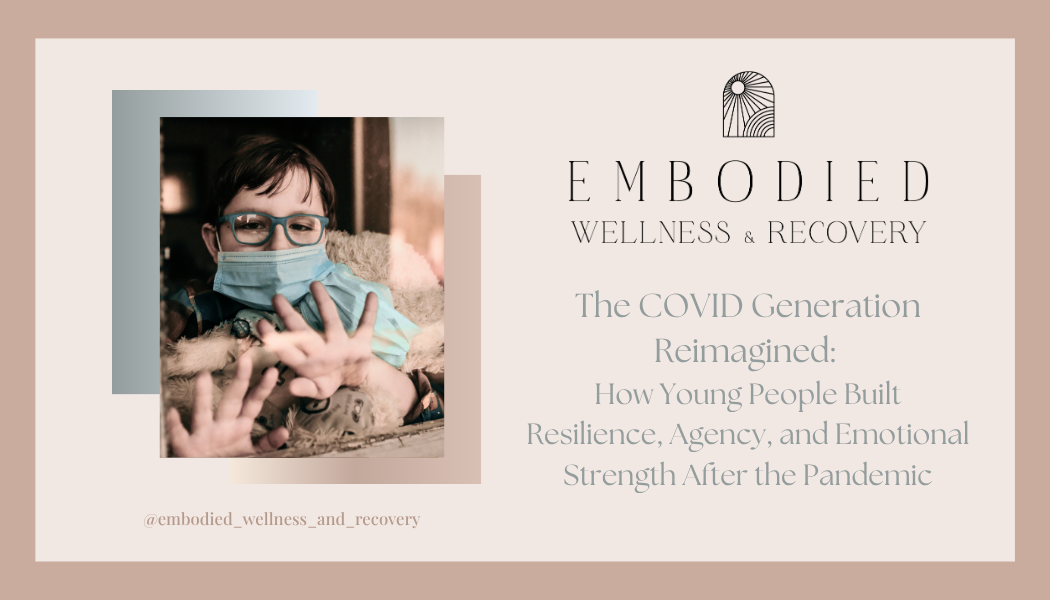
The COVID Generation Reimagined: How Young People Built Resilience, Agency, and Emotional Strength After the Pandemic
The COVID Generation Reimagined: How Young People Built Resilience, Agency, and Emotional Strength After the Pandemic
A neuroscience-informed, research-backed look at how the COVID generation may be stronger than we think. Explore youth resilience, post-traumatic growth, and how therapy can support young people in integrating their pandemic experiences into emotional strength and purpose.
A Different Story About the “COVID Generation”
For years, the dominant narrative has been clear.
Young people who came of age during the pandemic have been described as:
— Socially delayed
— Anxious and overwhelmed
— Academically disrupted
— Emotionally fragile
And to some extent, these concerns are real. Rates of anxiety, depression, and loneliness among adolescents and young adults increased during and after the COVID-19 pandemic (Loades et al., 2020).
But what if this is only part of the story? What if we have overlooked something equally important?
What if, alongside stress and disruption, many young people also developed:
— Adaptability
— Emotional awareness
— Resilience under pressure
— A deeper sense of purpose
Sociologist Lori Peek has spent her career studying how disasters impact children and youth. Her research offers a powerful reframe:
Young people are not just shaped by crisis. They are also capable of rising within it.
The Hidden Psychological Impact of Growing Up During Crisis
If you were a teenager or young adult during the pandemic, you likely experienced something profound.
— Isolation from peers
— Loss of milestones
— Uncertainty about the future
— Exposure to constant global stress
You may still find yourself asking:
— Why do I feel different now?
— Why does connection sometimes feel harder?
— Why do I feel both stronger and more exhausted at the same time?
From a neuroscience perspective, these responses make sense.
The adolescent brain is still developing, particularly in areas responsible for:
— Emotional regulation
— Risk assessment
Chronic stress during this period can alter how the brain processes threat and safety (McEwen, 2007). But the brain is also highly adaptable, and this is where the story shifts.
Resilience Is Not What You Think
Resilience is often misunderstood as the ability to “bounce back.” But research suggests something more nuanced.
Resilience is the ability to:
— Adapt to adversity
— Integrate difficult experiences
— Continue developing in meaningful ways
Studies on youth exposed to disasters show that many develop increased:
— Problem-solving skills
— Empathy
— Social awareness
— Sense of responsibility (Masten and Narayan, 2012)
This aligns with sociologist Lori Peek’s findings that young people often demonstrate active agency during crises. They do not just endure. They participate, respond, and contribute.
The Emergence of Agency in the COVID Generation
For some young people, the pandemic was not only destabilizing; it was awakening.
They began to ask:
— What matters most?
— What kind of world do I want to live in?
— What role do I want to play?
This shift toward meaning-making is consistent with research on post-traumatic growth, which describes positive psychological change following adversity (Tedeschi and Calhoun, 2004).
Examples of this growth include:
— Increased personal strength
— Greater appreciation for life
— Deeper relationships
— A stronger sense of purpose
You may recognize this in yourself or in the young people around you.
A Generation Shaped by Awareness
Today’s youth have grown up not only with the pandemic, but also with:
— Climate anxiety
— Exposure to global crises
— Awareness of social injustice
— Concerns about safety and violence
This has created a generation that is:
— Highly informed
— Emotionally attuned
— Socially conscious
While this awareness can be overwhelming, it also fosters:
👉 Critical thinking
👉 Empathy
👉 Motivation for change
These are not signs of fragility. They are signs of engagement.
The Nervous System Perspective
Even with these strengths, it is important to understand the physiological impact of prolonged stress. The nervous system of many young people has adapted to a world that feels unpredictable.
This can show up as:
— Anxiety or hypervigilance
— Difficulty relaxing
— Emotional reactivity
— Periods of shutdown or numbness
From a polyvagal perspective, the body may move between:
— Sympathetic activation (fight or flight)
— Dorsal shutdown (freeze or withdrawal)
These are adaptive responses. They are not dysfunction, but they do require support to integrate.
Why Strength and Struggle Can Coexist
One of the most important reframes is this: strength and struggle are not opposites.
A young person can be:
— Resilient and overwhelmed
— Insightful and anxious
— Capable and still processing
This duality is often missed in public narratives, but it is essential for understanding the full picture.
How to Support Integration and Growth
If you are a young person navigating the aftermath of the pandemic, or a parent or clinician supporting one, the goal is not to erase what happened.
It is to integrate it.
1. Validate the Full Experience
Avoid minimizing or overpathologizing.
Instead, acknowledge:
— What was lost
— What was learned
— What is still being processed
2. Support Nervous System Regulation
Practices that help the body feel safe are foundational.
These include:
— Breathwork
— Somatic awareness
— Grounding exercises
These approaches help shift the nervous system out of chronic activation.
3. Encourage Meaning-Making
Reflection can transform experience into growth.
Questions like:
— What did this time teach you about yourself?
— What matters more to you now?
— How have you changed?
These support identity development and integration.
4. Foster Connection
Social reconnection is critical. Even if it feels unfamiliar at times, relational experiences help regulate the nervous system and rebuild trust.
5. Seek Trauma-Informed Support
At Embodied Wellness and Recovery, we work with adolescents and young adults through a neuroscience-informed, somatic lens. We understand that healing is not just about talking.
It involves:
— The body
— The nervous system
— Emotional processing
Our approach integrates:
— EMDR
— Attachment-based work
This allows young people not only to process what they have been through but also to build capacity for what comes next.
A More Balanced Narrative
The “COVID generation” is often framed through a deficit lens, but this perspective is incomplete. Yes, there has been loss. Yes, there has been disruption.
But there has also been:
— Growth
— Awareness
— Resilience
— Emerging purpose
Young people today are not simply shaped by crisis. They are actively shaping themselves in response to it.
The Foundation of Resilience in a Changing World
If you are part of this generation, or supporting someone who is, it is worth asking, “What if the challenges you faced did not only take something from you? What if they also revealed something within you?”
The capacity to adapt.To reflect.To care deeply.To respond.
These are not small things. They are the foundation of resilience in a changing world.
Reach out to schedule a complimentary 20-minute consultation with our team of therapists, trauma specialists, somatic practitioners, or relationship experts, and start working towards integrative, embodied healing today.
📞 Call us at (310) 651-8458
📱 Text us at (310) 210-7934
📩 Email us at admin@embodiedwellnessandrecovery.com
🔗 Visit us at www.embodiedwellnessandrecovery.com
👉 Check us out on Instagram @embodied_wellness_and_recovery
🌍 Explore our offerings at Linktr.ee: https://linktr.ee/laurendummit
References
Loades, M. E., Chatburn, E., Higson-Sweeney, N., et al. (2020). Rapid systematic review: The impact of social isolation and loneliness on the mental health of children and adolescents in the context of COVID-19. Journal of the American Academy of Child and Adolescent Psychiatry, 59(11), 1218–1239.
Masten, A. S., and Narayan, A. J. (2012). Child development in the context of disaster, war, and terrorism. Annual Review of Psychology, 63, 227–257.
McEwen, B. S. (2007). Physiology and neurobiology of stress and adaptation. Physiological Reviews, 87(3), 873–904.
Peek, L. (2008). Children and disasters: Understanding vulnerability, developing capacities, and promoting resilience. Children, Youth and Environments, 18(1), 1–29.
Tedeschi, R. G., and Calhoun, L. G. (2004). Posttraumatic growth: Conceptual foundations and empirical evidence. Psychological Inquiry, 15(1), 1–18.
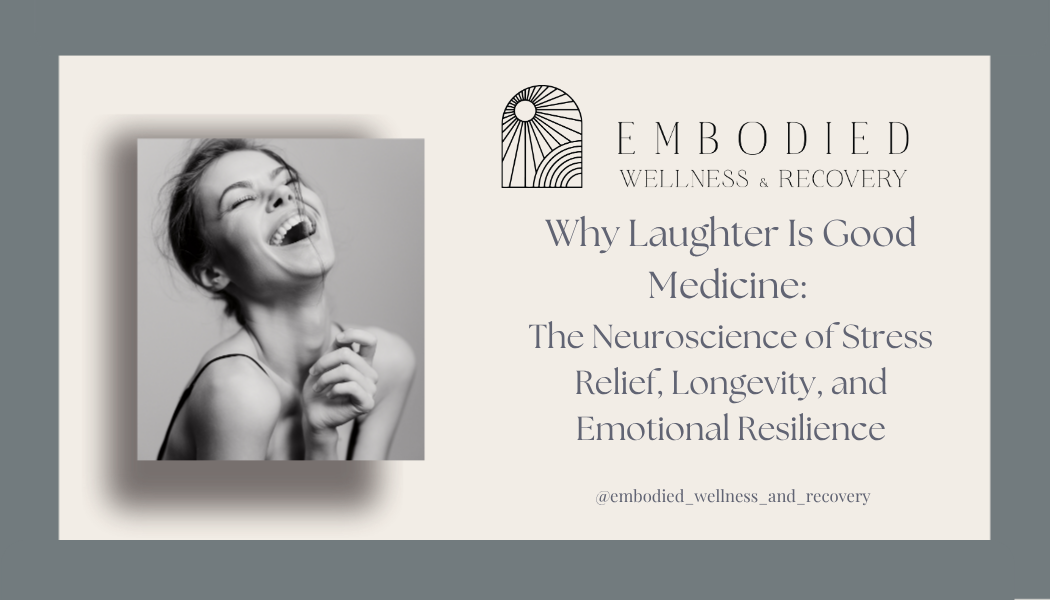
Why Laughter Is Good Medicine: The Neuroscience of Stress Relief, Longevity, and Emotional Resilience
Why Laughter Is Good Medicine:The Neuroscience of Stress Relief, Longevity, and Emotional Resilience
Discover the health benefits of laughter through a neuroscience-informed lens. Learn how laughter reduces stress, improves nervous system regulation, strengthens relationships, supports emotional resilience, and even contributes to longevity. Explore why laughter is more than joy; it is powerful medicine for the mind and body.
When was the last time you laughed so hard your stomach hurt? Not the polite smile you give in passing. Not the quick chuckle at a text message. Real laughter. The kind that makes your body soften, your shoulders drop, and your mind feel lighter. For many adults, especially high-achievers, caregivers, trauma survivors, and those carrying chronic stress, laughter becomes surprisingly rare.
Life gets serious. Responsibilities pile up. Anxiety tightens the nervous system. Depression dulls pleasure. Trauma teaches vigilance. Perfectionism convinces us there is always something more urgent than joy. And slowly, many people begin living as though laughter is a luxury instead of a biological necessity. But neuroscience tells us something important: laughter is not frivolous. It is regulation. Laughter shifts physiology without denying reality. It does not erase grief, stress, or uncertainty. It simply interrupts the body’s stress response long enough for perspective, flexibility, and higher cognitive functioning to return. In that sense, laughter is not avoidance. It is medicine.
At Embodied Wellness and Recovery, we help clients understand that healing often happens through nervous system repair, not just insight. Sometimes, regulation arrives through deep therapy work. Sometimes it arrives through movement, nature, connection, and surprisingly often, laughter.
Because laughter is not separate from healing. It is part of it.
The Science of Laughter and Stress Relief
Have you ever noticed how impossible it is to stay physically rigid during genuine laughter? That is not accidental. Laughter directly affects the autonomic nervous system, which regulates stress, safety, and survival responses. When we are anxious, overwhelmed, or stuck in trauma activation, the sympathetic nervous system dominates. Heart rate increases. Muscles tighten. Breathing becomes shallow. Cortisol rises. The brain becomes more focused on threat than creativity or connection. Laughter interrupts that pattern.
Research shows that genuine laughter lowers stress hormones such as cortisol and epinephrine while increasing dopamine, serotonin, and endorphins, chemicals associated with pleasure, bonding, and emotional regulation (Bennett & Lengacher, 2006). This is why laughter often creates an immediate feeling of relief. It is a nervous system reset disguised as play. Even ten to fifteen minutes of genuine laughter increases heart rate and blood flow in ways comparable to light physical exercise. It improves circulation, oxygenation, and cardiovascular functioning. In other words, laughter is not simply emotional wellness. It is physical wellness.
Can Laughter Help Anxiety and Depression?
If you struggle with anxiety, depression, chronic stress, or emotional rigidity, you may wonder whether laughter can truly help. The answer is yes, but not because it solves your problems. It helps because it changes your physiological state. Anxiety often narrows perception. Depression often flattens motivation and pleasure. Trauma often keeps the nervous system trapped in hypervigilance or shutdown.
Laughter creates temporary flexibility in that system. It widens perspective. It creates psychological distance from catastrophic thinking. It allows the prefrontal cortex, the part of the brain responsible for reasoning, problem-solving, and decision-making, to come back online.
This matters clinically. When someone is deeply activated, logic rarely helps first. Regulation does. Laughter softens the grip of seriousness long enough for adaptability to return.
Ask yourself:
— Have I become so focused on surviving that I have forgotten how to play?
— Do I feel guilty when I experience joy during difficult seasons?
— Have I mistaken constant seriousness for responsibility?
These are not small questions. They often reveal how disconnected we have become from our own emotional flexibility.
Laughter and Longevity: Do People Who Laugh Live Longer?
Surprisingly, yes. Large cohort studies suggest that people who laugh regularly, especially weekly or daily, have lower mortality rates and improved long-term health outcomes (Ohira & Ichiki, 2022). A study published in Geriatrics & Gerontology International found that older adults who laughed less frequently had a significantly higher risk of functional disability over time (Hayashi et al., 2016). Other population-based studies suggest that frequent laughter is associated with lower cardiovascular risk and longer lifespan.
Why? Because chronic stress is inflammatory. Long-term sympathetic activation contributes to immune dysfunction, hypertension, poor sleep, digestive issues, anxiety disorders, and depression. Laughter helps counterbalance this. It improves immune function, lowers blood pressure, and reduces muscular tension. This does not mean laughter replaces therapy, medication, or medical care. It means it supports them. Small daily doses of laughter improve resilience, adaptability, and emotional recovery. That matters.
Shared Laughter Is Relational Medicine
Laughter is best shared with good company. This is where its power becomes even deeper. Shared laughter strengthens attachment bonds. It creates safety between people. It signals trust.
From a relational neuroscience perspective, laughter is co-regulation. It tells the nervous system, "I am safe here." Couples who laugh together often recover from conflict more effectively. Friendships deepen through shared humor. Families build resilience when play remains possible, even in hard seasons.
This is especially important in relationships impacted by trauma, betrayal, or chronic stress. Many couples come to therapy believing intimacy requires only serious conversations. But intimacy also requires play. Without laughter, relationships can become emotionally efficient but spiritually starved. Humor creates room for softness. It allows repair without defensiveness. It reminds us that connection is not only built through pain, but through joy.
At Embodied Wellness and Recovery, this is often part of couples' work. Emotional safety is not only built through conflict resolution. It is built through moments of shared humanity, silliness, and relief.
Laughter is relational medicine.
Laughter Does Not Mean Denial
This part matters. Many people unconsciously believe that laughing during hard times means they are minimizing pain. It does not. You do not lose permission to laugh when life is sad, serious, or uncertain.
Grief and laughter can coexist. Trauma and joy can coexist. Depression and humor can coexist. In fact, sometimes laughter is exactly what keeps people emotionally afloat during difficult seasons. It offers perspective without invalidation. It says, “This is hard, and I am still alive inside it.”
That is not denial. That is resilience. People who recover well from stress are not people who avoid pain. They are people who can move flexibly between pain and restoration. Laughter helps create that movement.
How to Invite More Laughter Into Daily Life
You do not need to force joy. You simply need to make room for it.
Try asking:
— Who makes me laugh and why have I not called them lately?
— What used to feel playful before life became so heavy?
— Where have I confused emotional control with emotional health?
Simple nervous system supports include:
— Spending time with people who feel easy and safe
— Watching something genuinely funny, not just distracting
— Allowing spontaneity instead of over-structuring every hour
— Playing with children or animals
— Noticing absurdity instead of only urgency
— Giving yourself permission to be imperfect and human
Sometimes the most therapeutic moment in a week is not profound insight. Sometimes it is laughing so hard you remember your body still knows how to exhale.
Laughter is the Best Medicine
Laughter is often dismissed because it looks simple, but simplicity does not mean insignificance. It regulates physiology. It improves cardiovascular health. It lowers stress hormones. It strengthens relationships. It supports emotional flexibility and resilience. It helps us think better, love better, and recover faster. And perhaps most importantly, it reminds us that healing is not only about processing pain. It is also about remembering pleasure.
At Embodied Wellness and Recovery, we believe nervous system repair includes both depth and delight. Trauma work matters. Attachment work matters. Somatic therapy matters. So does laughter. Especially laughter. Sometimes the most profound medicine does not arrive as a breakthrough. Sometimes it arrives in the middle of a shared joke, a ridiculous moment, or the sudden relief of remembering you are still capable of joy. And that matters more than most people realize.
Reach out to schedule a complimentary 20-minute consultation with our team of therapists, trauma specialists, somatic practitioners, or relationship experts, and start working towards integrative, embodied healing today.
📞 Call us at (310) 651-8458
📱 Text us at (310) 210-7934
📩 Email us at admin@embodiedwellnessandrecovery.com
🔗 Visit us at www.embodiedwellnessandrecovery.com
👉 Check us out on Instagram @embodied_wellness_and_recovery
🌍 Explore our offerings at Linktr.ee: https://linktr.ee/laurendummit
References
1) Bennett, M. P., & Lengacher, C. (2006). Humor and laughter may influence health: III. Laughter and health outcomes. Evidence-Based Complementary and Alternative Medicine, 3(1), 61–63.
2) Hayashi, T., Kawai, K., Miyamoto, M., et al. (2016). Is laughter the best medicine? A cross-sectional study of cardiovascular disease among older Japanese adults. Journal of Epidemiology, 26(10), 546–552.
3) Ohira, T., & Ichiki, M. (2022). Laughter is the best therapy for happiness and healthy life expectancy. In Healthy aging in Asia (pp. 229-240). CRC Press.
4) Martin, R. A. (2001). Humor, laughter, and physical health: Methodological issues and research findings. Psychological Bulletin, 127(4), 504–519.
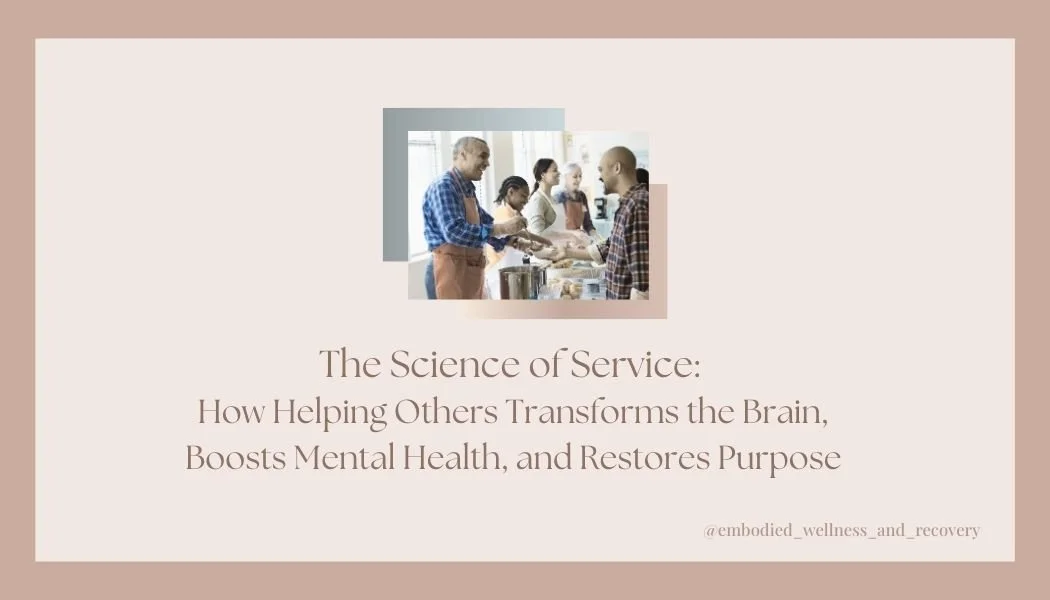
The Science of Service: How Helping Others Transforms the Brain, Boosts Mental Health, and Restores Purpose
The Science of Service: How Helping Others Transforms the Brain, Boosts Mental Health, and Restores Purpose
Discover how being of service reduces depression, anxiety, and loneliness while strengthening purpose, resilience, and mental well-being. Explore the neuroscience of kindness and the benefits of helping others.
The Science of Service: How Helping Others Transforms the Brain, Boosts Mental Health, and Restores Purpose
Have you ever noticed that you feel better when you help someone else?
Have you ever felt stuck in your own mind, only to suddenly feel clearer after supporting a friend or showing kindness to a stranger?
Have you wondered why acts of service feel grounding, meaningful, or even healing?
In a world where depression, loneliness, and stress are at record highs, millions of people are searching for ways to feel more connected, purposeful, and emotionally steady. While self-care is essential, research shows that one of the most powerful ways to support your mental and social wellness is not inward at all. It is outward. It is service. (Cowen, 1991).
Being of service activates the brain in unique ways, improves emotional regulation, helps the body shift out of survival mode, and strengthens a sense of belonging. At Embodied Wellness and Recovery, we witness every day how meaningful service shifts clients from self-centered fear and isolation into connection, confidence, and a renewed sense of purpose.
This article explores why service is such a profound path to mental health, the neuroscience behind its healing effects, and how even small, consistent acts of kindness can reshape your emotional world.
Why Service Matters: A Modern Crisis of Disconnection
Depression and loneliness often begin with thoughts like:
— “Nothing I do matters.”
— “I feel disconnected from everyone.”
— “I have no purpose.”
— “I feel stuck in my own head.”
— “My life feels small and self-focused.”
When the nervous system is overwhelmed, responsibility and self-reflection can feel heavy, or even impossible. Stress, trauma, and isolation can make your inner world so loud that it becomes hard to lift your attention outward. But the moment you do, something changes.
Service interrupts the cycle of self-rumination that fuels anxiety and depression. It invites the nervous system to shift from survival to social engagement, from hypervigilance to connection, and from stagnation to movement.
This shift is not abstract. It is deeply biological.
The Neuroscience of Being of Service
Service activates several key brain systems:
1. The Reward Circuit (Dopamine Pathways)
Helping others releases dopamine, creating a sense of pleasure, motivation, and meaning. This is sometimes called the “helper’s high.”
2. The Oxytocin System (Bonding and Safety)
Acts of kindness increase oxytocin, the hormone associated with trust, safety, bonding, and emotional warmth.
3. The Vagus Nerve (Polyvagal Social Engagement System)
Service activates the ventral vagal system, supporting calmness, emotional regulation, and connection.
4. The Prefrontal Cortex (Empathy, Perspective, Reflection)
Service enhances empathy and strengthens executive functioning, helping individuals shift away from rigid fear-based thinking.
5. Reduced Amygdala Activation (Lower Fear and Threat Response)
Helping others reduces activation in brain regions associated with fear, stress, and intense self-focus.
In other words, service is not only an emotional experience. It is a physiological event that reorganizes the nervous system.
How Being of Service Reduces Self-Focused Fear
Self-focused fear often develops when the nervous system is overwhelmed, traumatized, or disconnected from others. Thoughts can spiral into:
— “I am failing.”
— “I am not enough.”
— “Something bad will happen.”
— “I cannot handle my life.”
Service interrupts this internal loop by shifting attention outward. When you help someone else, your brain temporarily suspends catastrophic thinking and engages social circuitry instead.
This shift produces several therapeutic benefits:
1. Reduced rumination
Service pulls attention out of repetitive self-criticism.
2. Increased perspective
Seeing someone else’s humanity helps soften rigid internal narratives.
3. Emotional regulation
Kindness calms sympathetic activation and reduces stress hormones.
4. Increased self-worth
Feeling useful reinforces competence and purpose.
5. Reconnection
Service restores the relational connection that trauma often disrupts.
Service as Antidote to Loneliness
Loneliness has become a public health crisis, with research linking it to:
— Depression
— Anxiety
— Chronic illness
— Addiction relapse
— Reduced immune function
— Cognitive decline
Service directly counteracts loneliness through:
— Shared purpose
— Shared humanity
— Collective belonging
— Mutual support
— Relational meaning
Even small acts of service, like checking on a friend, helping a neighbor, or showing kindness in daily life, activate the brain’s social engagement system, which is essential for psychological health.
Purpose, Identity, and the Healing Power of Service
Purpose is a fundamental human need. Without it, life can feel flat, empty, or unmoored. Trauma, depression, and stress can strip away a sense of meaning, leaving people wondering:
— “Why am I here?”
— “What difference do I make?”
— “What am I supposed to do with my life?”
Being of service helps restore purpose by reconnecting people to their values, strengths, and capacity to contribute. It reinforces identity not through achievement but through connection.
When clients engage in service, many report:
— Increased confidence
— Improved mood
— Greater emotional resilience
— Deeper connection with their communities
— A renewed sense of direction
Even small acts can ignite profound internal shifts.
How Service Supports Trauma Recovery
Trauma often creates:
— Hypervigilance
— Isolation
— Dissociation
— Fear of connection
— Shame
— A sense of fragmentation
Service can help counteract these patterns when done mindfully and safely.
1. Being of service regulates the nervous system.
Kindness activates systems that calm the body and support safety.
2. Being of service reconnects individuals to others.
Trauma often isolates. Service rebuilds relational pathways.
3. Being of service builds self-trust
Helping others strengthens a sense of competence and agency.
4. Service repairs shame
Offering care can transform internal narratives of unworthiness.
5. Service supports meaningful identity reconstruction
After trauma, service provides direction and purpose.
At Embodied Wellness and Recovery, service is often integrated into trauma healing, helping clients cultivate resilience and connection.
Examples of Meaningful Service That Support Mental Wellness
Being of service does not require extraordinary acts. Small, consistent gestures often have the greatest effect.
Everyday acts of service:
— Sending a compassionate message to someone
— Preparing a meal for a loved one
— Volunteering at a community center
— Helping an elderly neighbor
— Supporting someone in recovery
— Participating in a cause you believe in
— Offering to listen without judgment
— Showing small acts of kindness in public spaces
The nervous system does not distinguish between small and large acts. It responds to the quality of connection, not the scale.
How to Begin a Service Practice When You Feel Low
If you feel depressed, anxious, or overwhelmed, service can feel intimidating at first. Start small. Move gently.
1. Begin with one small daily act
A text, a kind word, a moment of presence.
2. Choose something that aligns with your values
Authentic service nourishes both giver and receiver.
3. Listen to your nervous system
Choose acts that feel doable rather than draining.
4. Let service be relational, not performative
The goal is connection, not perfection.
5. Notice how your body responds
Warmth, softening, grounding, or lighter thinking often signal a shift.
A Path Toward Connection and Purpose
Being of service is not only generous. It is transformative. It supports mental health, strengthens social connection, and helps individuals rediscover purpose and emotional resilience.
At Embodied Wellness and Recovery, we help clients engage in service as part of a holistic healing process that includes:
— Somatic therapy
— EMDR
— Attachment work
— Nervous system regulation
— Relational repair
— Values-based living
Through service, clients learn to feel connected again, not because their life is perfect, but because they are part of something meaningful.
Being of service can be a profound path back to yourself.
Reach out to schedule a complimentary 20-minute consultation with our team of therapists, trauma specialists, somatic practitioners, or relationship experts, and start working towards integrative, embodied healing today.
📞 Call us at (310) 651-8458
📱 Text us at (310) 210-7934
📩 Email us at admin@embodiedwellnessandrecovery.com
🔗 Visit us at www.embodiedwellnessandrecovery.com
👉 Check us out on Instagram @embodied_wellness_and_recovery
🌍 Explore our offerings at Linktr.ee: https://linktr.ee/laurendummit
References
Brown Health. (2024). Why every day is a good day for gratitude. Brown Health.
Harvard Health Publishing. (2024). Gratitude enhances health, brings happiness, and may even lengthen lives. Harvard Medical School.
NAMI. (2022). How volunteering improves mental health. National Alliance on Mental Illness.
Cowen, E. L. (1991). In pursuit of wellness. American psychologist, 46(4), 404.