
The Emotional Side of Simplifying Your Life: The Neuroscience of Overwhelm, Nervous System Regulation, and Finding Peace in a Chronically Stimulated World
The Emotional Side of Simplifying Your Life: The Neuroscience of Overwhelm, Nervous System Regulation, and Finding Peace in a Chronically Stimulated World
Discover the emotional and neuroscience-informed benefits of simplifying your life. Learn how chronic overwhelm, clutter, work stress, social obligations, trauma, and nervous system dysregulation affect mental health, relationships, and emotional well-being, and explore practical ways to create more calm, clarity, and balance.
Why Does Life Feel So Overwhelming Now?
Many people today are not simply “busy.” They are neurobiologically overloaded.
The modern nervous system is being asked to manage:
— Constant notifications
— Endless information
— Chronic news exposure
— Social comparison
— Financial pressure
— Emotional labor
— Work demands
— Family responsibilities
— Digital overstimulation
— Clutter
— Unrealistic expectations
At the same time, many individuals are quietly carrying unresolved trauma, attachment wounds, perfectionism, anxiety, grief, or chronic sympathetic nervous system activation beneath the surface.
The result is that countless people move through life feeling:
— Emotionally flooded
— Mentally exhausted
— Disconnected from themselves
— Irritable
— Numb
— Chronically “on edge”
— Unable to rest fully
— Guilty whenever they slow down
You may wonder:
Why do I feel overstimulated all the time?
Why does even small stress feel overwhelming lately?
Why do I struggle to relax even when nothing is technically wrong?
Why does my home, schedule, or social life feel emotionally exhausting?
Why do I feel like I can never fully catch up?
At Embodied Wellness and Recovery, we help clients understand how trauma, nervous system dysregulation, attachment wounds, emotional overwhelm, relationships, and chronic stress impact mental and physical well-being. One of the most important truths many people discover is this:
Simplifying your life is not merely organizational. It is physiological.
The Nervous System Was Not Designed for Constant Stimulation
From a neuroscience perspective, the human nervous system evolved to operate in periods of activation followed by recovery. But modern life rarely allows for true recovery.
Many people remain trapped in chronic sympathetic nervous system activation, commonly referred to as:
— Hypervigilance
— Chronic stress activation
In this state, the body may experience:
— Elevated cortisol
— Increased heart rate
— Muscle tension
— Sleep disruption
— Irritability
— Digestive issues
— Emotional reactivity
Research suggests chronic stress can also affect:
— Memory
— Emotional regulation
— Immune functioning
— Inflammation
— Cardiovascular health
(McEwen & Gianaros, 2011).
When life becomes too crowded, overstimulating, emotionally demanding, or chronically noisy, the nervous system often struggles to distinguish between temporary stress and ongoing threat.
The Emotional Weight of Clutter and Overcommitment
Many people underestimate how much emotional energy clutter and overcommitment consume.
Physical clutter can contribute to:
— Mental fatigue
— Sensory overload
— Decision exhaustion
— Chronic stress activation
Research from UCLA’s Center on Everyday Lives and Families found that women who described their homes as cluttered experienced higher cortisol levels throughout the day.
(Saxbe & Repetti, 2010)
Similarly, emotional and social clutter can overwhelm the nervous system:
— Too many obligations
— Excessive social commitments
— Constant accessibility
— Emotional caretaking
— Inability to say no
— Overscheduled calendars
Many individuals begin living in a state of chronic internal urgency.
Why Slowing Down Can Feel Emotionally Uncomfortable
One reason simplifying life can feel surprisingly difficult is that many people unconsciously equate busyness with:
— Worth
— Productivity
— Safety
— Success
— Identity
— Belonging
For trauma survivors, especially, stillness can initially feel unfamiliar or even threatening.
When the nervous system has adapted to chronic activation, slowing down may trigger:
— Anxiety
— Guilt
— Restlessness
— Emotional discomfort
— Feelings of emptiness
This is one reason many people continue overfunctioning even when exhausted. The body becomes conditioned to intensity.
The Relationship Between Trauma and Overfunctioning
Many high-functioning individuals developed nervous system patterns rooted in survival.
For example:
— Hyper-independence
— Perfectionism
— People-pleasing
— Overachievement
— Inability to rest
These patterns often originate in environments where emotional safety felt uncertain.
The nervous system learned: “If I stay productive, vigilant, useful, or emotionally available to everyone else, I may remain safe, valued, or loved.”
Over time, however, chronic overfunctioning can lead to:
— Burnout
— Anxiety
— Resentment
— Emotional numbness
— Physical exhaustion
Simplifying Your Life Is Also About Emotional Boundaries
Simplification is not only about organizing closets or reducing possessions. It is also about learning to reduce unnecessary strain on the nervous system.
This may involve:
— Setting healthier boundaries
— Reducing emotional overextension
— Limiting overstimulation
— Protecting recovery time
— Reducing exposure to distressing media
— Creating more margin in daily life
— Learning to tolerate disappointing others
— Saying no without excessive guilt
Many people discover that the most exhausting clutter is not always physical. Sometimes it is emotional.
The Neuroscience of Rest and Regulation
Research increasingly shows that the nervous system requires intentional recovery experiences to function optimally (Chen, Cohen, & Hallett, 2002).
Activities that support parasympathetic nervous system regulation may include:
— Nature exposure
— Emotional connection
— Adequate sleep
— Reduced stimulation
— Laughter
— Music
— Safe touch
— Solitude
— Meaningful relationships
When the nervous system feels safer, people often notice:
— Clearer thinking
— Increased patience
— Better emotional regulation
— Improved relationships
— Reduced anxiety
— Greater creativity
— More presence
Why Work-Life Balance Often Feels Impossible
Many people struggle with work-life balance because modern culture rewards chronic productivity while undervaluing recovery.
There is often subtle pressure to:
— Always be available
— Constantly optimize
— Stay informed
— Remain productive
— Respond immediately
— Maintain social visibility
This creates nervous system fatigue even in people who appear highly successful externally. Some individuals eventually realize that their schedule may be full, but their nervous system feels profoundly depleted.
Relationships Often Improve When Life Simplifies
Chronic overwhelm affects intimacy and connection.
When the nervous system is overloaded, people may become:
— Impatient
— Emotionally reactive
— Withdrawn
— Distracted
— Less emotionally available
— Less sexually connected
— More conflict-prone
Emotional connection often requires:
— Presence
— Spaciousness
— Regulation
— Attentiveness
Simplifying life can create more room for:
— Meaningful conversations
— Emotional intimacy
— Nervous system co-regulation
— Rest
— Playfulness
— Connection
Questions Worth Asking Yourself
What currently overwhelms my nervous system most?
What commitments drain me emotionally?
Do I equate busyness with worth?
What parts of my life feel unnecessarily overstimulating?
Where do I need stronger boundaries?
What environments make my body feel calmer?
What would more emotional spaciousness look like in my daily life?
Simplifying Your Life Is Not About Perfection
Simplification does not mean living minimally or perfectly. It means becoming more intentional about what your nervous system can realistically sustain.
For some people, simplification may involve:
— Reducing obligations
— Cleaning or organizing spaces
— Decreasing social media exposure
— Spending more time in nature
— Limiting news consumption
— Creating slower mornings
— Prioritizing rest
— Letting go of perfectionism
The goal is not rigid control. The goal is to reduce chronic nervous system overload.
A Different Definition of Success
Many people eventually reach a point where they begin redefining success.
Not as:
— Constant productivity
— Endless striving
— External validation
— Overcommitment
…but as:
— Emotional presence
— Meaningful relationships
— Peace
— Connection
— Sustainability
— Authenticity
At Embodied Wellness and Recovery, we help clients strengthen emotional regulation, nervous system resilience, trauma recovery, relationships, intimacy, and self-understanding through somatic and neuroscience-informed therapy. Simplifying your life is not about giving up ambition or meaning. It is about creating a life your nervous system can actually inhabit.
Reach out to schedule a complimentary 20-minute consultation with our team of therapists, trauma specialists, somatic practitioners, or relationship experts, and start working towards integrative, embodied healing today.
📞 Call us at (310) 651-8458
📱 Text us at (310) 210-7934
📩 Email us at admin@embodiedwellnessandrecovery.com
🔗 Visit us at www.embodiedwellnessandrecovery.com
👉 Check us out on Instagram @embodied_wellness_and_recovery
🌍 Explore our offerings at Linktr.ee: https://linktr.ee/laurendummit
References
1) Chen, R., Cohen, L.G., Hallett, M., Nervous system reorganization following injury, Neuroscience, Volume 111, Issue 4, 2002, Pages 761-773.
2) McEwen, B. S., & Gianaros, P. J. (2011). Stress and allostasis induced brain plasticity. Annual Review of Medicine, 62, 431–445.
3) Porges, S. W. (2011). The polyvagal theory: Neurophysiological foundations of emotions, attachment, communication, and self-regulation. W. W. Norton & Company.
4) Saxbe, D. E., & Repetti, R. (2010). No place like home: Home tours correlate with daily patterns of mood and cortisol. Personality and Social Psychology Bulletin, 36(1), 71–81.
5) Siegel, D. J. (2012). The developing mind: How relationships and the brain interact to shape who we are (2nd ed.). Guilford Press.
Trauma and the Fear of Losing Control: Why Healing Can Feel Overwhelming and How the Nervous System Learns Safety Again
Trauma and the Fear of Losing Control: Why Healing Can Feel Overwhelming and How the Nervous System Learns Safety Again
Why does trauma healing sometimes feel like losing control? Learn the neuroscience behind trauma, emotional overwhelm, and how therapy supports nervous system regulation and stability.
Why Healing Can Feel More Frightening Than Staying Stuck
Many people enter therapy with a quiet but powerful fear:
“What if I lose control if I start feeling everything?”
“What if opening this up makes things worse?”
“What if I cannot handle what comes up?”
These fears are not irrational. They are deeply rooted in how trauma affects the brain and nervous system.
For individuals living with unresolved trauma, symptoms such as anxiety, emotional flooding, numbness, or dissociation are not signs of weakness. They are signs of a nervous system that has learned to protect itself. And paradoxically, the very process of healing can sometimes feel like the loss of that protection.
The Protective Function of Control
Control is often misunderstood. For many trauma survivors, control is not about rigidity or perfectionism. It is about stability, predictability, and survival.
You may notice patterns such as:
— Carefully managing emotions
— Avoiding certain memories or topics
— Staying busy to prevent feelings from surfacing
— Maintaining tight control over routines or relationships
These strategies often develop because, at some point, the nervous system experienced overwhelm that felt unmanageable.
From a neuroscience perspective, the brain learned:
“If I stay in control, I stay safe.”
Why Trauma Disrupts the Sense of Control
Trauma affects key brain regions involved in emotional regulation and threat detection.
Research has shown that trauma can increase amygdala activation, the brain’s alarm system, while decreasing prefrontal cortex activity, which supports reasoning and regulation (van der Kolk, 2014).
At the same time, the hippocampus, which helps contextualize memories, may function less effectively, making past experiences feel as though they are happening in the present.
This combination can lead to:
— Emotional flooding
— Intrusive memories
— Difficulty distinguishing past from present
— Heightened sensitivity to perceived threat
In this context, control becomes a way to manage an internal system that feels unpredictable.
The Fear of Emotional Flooding
One of the most common fears in trauma healing is the fear of being overwhelmed by emotion.
You might wonder:
— “What if I start crying and cannot stop?”
— “What if I feel anger that is too intense?”
— “What if I dissociate or shut down?”
These concerns are grounded in real nervous system experiences.
Trauma can narrow what psychologists refer to as the window of tolerance, the range of emotional intensity that the nervous system can process without becoming overwhelmed (Siegel, 1999).
When experiences fall outside this window, the body may move into:
— Hyperarousal, such as panic, anxiety, or agitation
— Hypoarousal, such as numbness, shutdown, or dissociation
The fear of losing control is often the fear of moving outside this window.
Why Avoidance Feels Safer
Avoidance is one of the most powerful protective strategies the nervous system uses. By avoiding triggering memories, emotions, or situations, the brain reduces immediate distress. However, avoidance can also reinforce the belief that certain internal experiences are dangerous.
Over time, this can create a cycle:
avoidance → temporary relief → increased sensitivity → more avoidance
Research on trauma andPTSD consistently shows that avoidance maintains symptoms over time, even though it feels protective in the short term (American Psychiatric Association, 2013).
The Neuroscience of Gradual Healing
Healing from trauma does not require overwhelming the nervous system. In fact, effective trauma therapy is designed to do the opposite. Approaches such as EMDR, Somatic Experiencing, and other trauma-informed modalities focus on gradual processing within the window of tolerance.
This means:
— Working with small amounts of emotional activation at a time
— Building regulation skills alongside processing
— Maintaining a sense of present-moment safety
Neuroscience research supports the idea that the brain can change through repeated experiences of safety and regulation, a process known as neuroplasticity (Doidge, 2007).
The Role of the Body in Trauma Healing
Trauma is not only stored in memory. It is also held in the body. Physical sensations such as tension, tightness, or numbness often accompany emotional experiences.
This is why body-based approaches are essential.
Somatic therapies help individuals:
— Notice internal sensations without becoming overwhelmed
— Release stored tension gradually
— Reconnect with the body as a source of information rather than threat
These practices help the nervous system learn that experiencing sensation does not have to lead to loss of control.
Rebuilding Trust in the Nervous System
One of the central goals of trauma therapy is rebuilding trust in the body’s ability to regulate itself.
This process often unfolds through:
1. Increasing Awareness
Learning to notice early signs of activation before overwhelm occurs.
2. Developing Regulation Skills
Using breath, grounding, and movement to support the nervous system.
3. Expanding Tolerance
Gradually increasing the range of emotions that can be experienced safely.
4. Integrating Experience
Processing past events in a way that allows them to feel like the past, rather than the present.
Over time, the nervous system begins to shift from:
“If I feel this, I will lose control.”
to
“I can feel this and remain grounded.”
Why the Fear Itself Deserves Compassion
The fear of losing control is not something to be eliminated. It is something to be understood. This fear often represents a part of the self that learned, at some point, that emotional overwhelm was dangerous. Approaching this fear with curiosity rather than judgment can create space for change.
How Therapy Supports This Process
At Embodied Wellness and Recovery, we understand that trauma healing requires both scientific precision and emotional sensitivity.
Our approach integrates:
— Neuroscience-informed trauma therapy
— Somatic awareness and nervous system regulation
— Relationaland experiential techniques
This allows clients to move at a pace that respects their nervous system while still supporting meaningful change. Healing is not about forcing exposure to overwhelming experiences. It is about creating conditions where the nervous system can safely expand its capacity.
Moving Toward Stability and Integration
If you find yourself afraid of losing control in the healing process, it may be helpful to consider:
What if your fear is a sign of how much your nervous system has been protecting you?
What if control was never the problem, but rather a solution that outlived its context?
What if healing could happen in a way that feels steady, contained, and manageable?
These questions invite a different relationship with the process, one that is not driven by urgency, but by understanding.
A New Relationship With Control
Over time, many people discover that healing does not require losing control. It involves developing a different kind of control, not rigid or fear-based, but flexible, responsive, and grounded, a form of internal stability that allows for emotional experience without overwhelm.
Reach out to schedule a complimentary 20-minute consultation with our team of therapists, trauma specialists, somatic practitioners, or relationship experts, and start working towards integrative, embodied healing today.
📞 Call us at (310) 651-8458
📱 Text us at (310) 210-7934
📩 Email us at admin@embodiedwellnessandrecovery.com
🔗 Visit us at www.embodiedwellnessandrecovery.com
👉 Check us out on Instagram @embodied_wellness_and_recovery
🌍 Explore our offerings at Linktr.ee: https://linktr.ee/laurendummit
References
1) American Psychiatric Association. (2013). Diagnostic and statistical manual of mental disorders (5th ed.).
2) Doidge, N. (2007). The brain that changes itself. New York: Viking.
3) Siegel, D. J. (1999). The developing mind: How relationships and the brain interact to shape who we are. New York: Guilford Press.
4) van der Kolk, B. A. (2014). The body keeps the score: Brain, mind, and body in the healing of trauma. New York: Viking.
Emotional Overwhelm Is Not Resistance: The Neuroscience of Emotional Tolerance and Why Your Nervous System Shuts Down
Emotional overwhelm in therapy is often a nervous system capacity issue rather than resistance. Learn how emotional tolerance develops and how somatic therapy helps.
Have you ever been in therapy and suddenly felt your mind go blank just as something important was about to emerge? Perhaps the conversation was getting close to a painful memory or a vulnerable realization. You wanted to stay present. You wanted to talk about it. Yet your thoughts scattered, your body tightened, or your emotions flooded beyond what you could tolerate. Or maybe the opposite happened. Instead of intense emotion, you felt nothing at all. You became numb, detached, or distant, even though you knew something meaningful was happening.
Many therapy clients assume these experiences mean they are avoiding the work. They worry they are resistant, unmotivated, or sabotaging their own healing.
But emotional overwhelm is rarely resistance. Most of the time, it is capacity.
At Embodied Wellness and Recovery, we help clients understand that emotional tolerance is a skill of the nervous system. When emotional activation exceeds the system’s capacity to process it, the brain shifts into survival modes such as shutdown, dissociation, or emotional flooding. Understanding this shift can transform how you relate to your own reactions in therapy, relationships, and emotionally charged conversations.
Why Emotional Overwhelm Happens
The human nervous system is designed to keep us safe. When the brain perceives a threat, it automatically activates protective responses.
These responses include:
— Fight: anger, defensiveness, agitation
— Flight: anxiety, urgency, escape behaviors
— Freeze: immobility, blankness, confusion
— Collapse or shutdown: numbness, dissociation, fatigue
These states are controlled by subcortical brain systems that prioritize survival over reflection. When activation becomes too intense, the brain regions responsible for insight, language, and reasoning temporarily go offline. This is why someone can intellectually understand their trauma or relationship patterns yet struggle to stay present when discussing them. Insight requires access to the prefrontal cortex. Overwhelm shifts the brain away from that region.
Emotional Tolerance and the Window of Regulation
Neuroscience researchers often describe emotional capacity using the concept of the window of tolerance. This window represents the range of emotional activation the nervous system can handle while remaining regulated and present. Within this window, a person can think clearly, feel emotions, and remain connected to themselves and others.
When activation rises above the window, emotional flooding occurs. People may experience panic, racing thoughts, or intense distress. When activation falls below the window, the system shuts down. Individuals may feel numb, detached, or mentally foggy. Trauma often narrows this window, making emotional activation more difficult to tolerate.
Why Emotional Shutdown Happens Mid-Session
Many therapy clients notice that emotional shutdown appears precisely when something important emerges. You may begin describing a childhood experience, a painful relationship pattern, or a vulnerable feeling, only to suddenly find yourself unable to find words. Your therapist might ask a question, and your mind goes blank. You might think, “I should be able to talk about this. Why can’t I stay present?”
The answer lies in nervous system capacity. When emotional intensity increases faster than the nervous system can regulate it, protective mechanisms activate automatically. The brain interrupts conscious processing in order to prevent overwhelming distress. This response is not a failure. It is a survival strategy.
Emotional Flooding in Relationships
Emotional overwhelm does not only happen in therapy. Many people experience similar responses in close relationships.
You might notice that during difficult conversations with a partner or friend:
— Your heart races, and your mind becomes scattered
— You struggle to articulate what you mean
— You feel an urge to escape the conversation
— Tears come quickly and intensely
— Or you suddenly feel numb and disconnected
In these moments, people often accuse themselves or each other of avoidance. Yet the nervous system may simply be exceeding its emotional tolerance. Without sufficient regulation, insight collapses under activation.
Dissociation and Emotional Protection
For individuals with trauma histories, dissociation can become a common response to emotional overwhelm.
Dissociation may involve:
— Feeling detached from your body
— Experiencing emotional numbness
— Losing track of time or memory
— Feeling distant from the conversation or environment
These responses developed as protective mechanisms during earlier overwhelming experiences. The nervous system learned that distancing from emotion was safer than feeling it fully. While dissociation can interfere with therapy and relationships, it also reflects the intelligence of the body’s survival system.
Understanding this response reduces shame and opens space for gradual change.
Why Insight Alone Is Not Enough
Many therapy clients are highly insightful. They understand their patterns and can articulate the origins of their struggles. Yet insight alone does not expand emotional capacity. Emotional tolerance develops through repeated experiences of feeling manageable levels of emotion while remaining regulated. These experiences help the nervous system learn that activation does not necessarily mean danger. Somatic and nervous system-oriented therapies focus on gradually building this capacity. Instead of pushing clients into overwhelming emotional material, these approaches help the body learn to stay present with emotion in small increments.
Building Emotional Tolerance
Developing emotional tolerance is similar to strengthening a muscle. It requires pacing, repetition, and support. Several practices can help expand the nervous system’s ability to stay present during emotional experiences.
Tracking Body Sensations
Noticing subtle physical sensations allows the nervous system to process emotional activation before it becomes overwhelming. Clients might learn to observe breath, muscle tension, warmth, or movement within the body. This awareness helps regulate activation early rather than after flooding occurs.
Slowing the Pace
When therapy moves too quickly into intense emotional material, the nervous system may shut down. Slowing the conversation allows emotional processing to remain within the window of tolerance. Small insights integrated gradually often lead to more lasting change than rapid breakthroughs followed by overwhelm.
Orienting to Safety
Simple grounding practices can help the brain recognize safety during emotional activation. Examples include noticing the room, feeling the chair beneath the body, or focusing on the rhythm of breathing. These cues signal to the nervous system that the present moment differs from past threats.
Co-Regulation Through Relationship
The human nervous system regulates through connections. The presence of an attuned therapist or supportive partner can help stabilize emotional activation.
Tone of voice, pacing, and emotional responsiveness all influence how safe the nervous system feels during difficult conversations. This is why therapeutic relationships play a powerful role in trauma recovery.
Emotional Capacity and Self-Compassion
Many people criticize themselves when they become overwhelmed or shut down. They may interpret these responses as weakness or avoidance.
In reality, emotional tolerance is shaped by the development of the nervous system, attachment history, and past experiences. Self-compassion allows space for growth without adding additional stress to the system. When individuals approach their reactions with curiosity instead of judgment, the nervous system often becomes more flexible.
How Embodied Wellness and Recovery Approaches Emotional Overwhelm
At Embodied Wellness and Recovery, we specialize in trauma-informed, nervous-system-oriented therapy. Our approach integrates neuroscience, somatic therapy, and attachment-based interventions to support emotional regulation and relational healing.
We help clients:
— Understand the nervous system dynamics behind overwhelm
— Expand emotional tolerance safely and gradually
— Reduce dissociation and shutdown responses
— Improve communication in relationships
— Rebuild connection with their own emotional experience
Emotional overwhelm is not a sign that therapy is failing. Often, it indicates that the work is approaching meaningful territory. With the right pacing and support, the nervous system can learn to stay present with experiences that once felt intolerable.
A Different Perspective on Emotional Shutdown
The next time your mind goes blank during therapy or you feel flooded in a difficult conversation, consider a different interpretation. Your nervous system may not be resisting the work. It may simply be reaching the edge of its current capacity. When therapy focuses on expanding that capacity rather than pushing past it, insight and emotional presence begin to align. Over time, the same experiences that once triggered overwhelm can become manageable, integrated, and meaningful parts of your story.
Reach out to schedule a complimentary 20-minute consultation with our team of therapists, trauma specialists, somatic practitioners, or relationship experts, and start working towards integrative, embodied healing today.
📞 Call us at (310) 651-8458
📱 Text us at (310) 210-7934
📩 Email us at admin@embodiedwellnessandrecovery.com
🔗 Visit us at www.embodiedwellnessandrecovery.com
👉 Check us out on Instagram @embodied_wellness_and_recovery
🌍 Explore our offerings at Linktr.ee: https://linktr.ee/laurendummit
References
1) Levine, P. A. (2010). In an unspoken voice: How the body releases trauma and restores goodness. North Atlantic Books.
2) Porges, S. W. (2011). The polyvagal theory: Neurophysiological foundations of emotions, attachment, communication, and self-regulation. W. W. Norton & Company.
3) Siegel, D. J. (2020). The developing mind: How relationships and the brain interact to shape who we are. Guilford Press.
4) van der Kolk, B. A. (2014). The body keeps the score: Brain, mind, and body in the healing of trauma. Viking.
Fear vs. Facts: Neuroscience-Informed Practices to Calm Anxiety, Reduce Rumination, and Restore Emotional Clarity
Fear vs. Facts: Neuroscience-Informed Practices to Calm Anxiety, Reduce Rumination, and Restore Emotional Clarity
Struggling to tell fear from facts? Learn neuroscience-informed practices to reduce anxiety, interrupt rumination, and restore clarity when your mind feels overwhelmed.
When Fear Feels Like the Truth
Have you ever noticed how anxiety can make imagined outcomes feel just as real as actual events?
Do your thoughts spiral into worst-case scenarios even when there is little evidence that something bad is happening?
Do you find yourself exhausted from constantly monitoring for danger, replaying conversations, or anticipating what might go wrong?
When fear dominates the nervous system, it becomes difficult to distinguish between what is actually happening and what the brain is predicting might happen. This is not a failure of logic. It is a neurobiological response shaped by stress, trauma, and prolonged nervous system activation. Learning to untangle fear from facts is one of the most powerful skills for reducing anxiety, calming rumination, and restoring emotional balance.
Why the Brain Confuses Fear With Reality
From a neuroscience perspective, fear-based thinking is driven by the brain's survival circuitry. The amygdala and related limbic structures are designed to detect threat quickly, not accurately. When the nervous system perceives danger, the brain prioritizes speed over nuance.
This means:
— The brain fills in gaps with worst-case interpretations
— Neutral cues are interpreted as threatening
— Uncertainty is experienced as danger
— Thought loops emerge as the brain attempts to regain control
When this system stays activated too long, fear-based predictions begin to feel like facts.
For individuals with trauma histories, chronic stress, or anxiety disorders, this threat-focused processing can become the default mode.
The Cost of Living Inside Fear-Based Thinking
When fear and facts become fused, anxiety tends to intensify rather than resolve. People often report:
— Persistent rumination and mental looping
— Difficulty making decisions
— Sleep disruption
— Emotional reactivity in relationships
— Loss of trust in one’s own perception
Over time, this pattern erodes emotional safety and increases a sense of overwhelm. The nervous system becomes stuck in anticipation rather than presence.
Untangling fear from facts is not about forcing positive thinking. It is about helping the nervous system reestablish accurate threat assessment.
Practice One: Name Fear as a Signal, Not a Conclusion
One of the most effective anxiety regulation tools is learning to identify fear as a signal rather than a verdict.
Instead of asking, “What if this is true?”
Try asking, “What is my nervous system responding to right now?”
This subtle shift engages the prefrontal cortex and creates space between sensation and interpretation.
Helpful language includes:
— “This is a fear response, not a fact.”
— “My body feels threatened, even if the situation may not be.”
This practice reduces cognitive fusion and restores agency.
Practice Two: Separate What Is Happening From What Might Happen
Anxiety thrives on future-oriented thinking. One way to interrupt rumination is to gently separate present facts from feared outcomes.
— What is verifiably happening right now?
— What am I predicting without evidence?
For example:
— Fact: I have not received a response yet.
— Fear: This means I am being rejected.
Writing this out can be especially helpful. Externalizing fear-based thoughts reduces their emotional intensity and improves cognitive clarity.
Practice Three: Use the Body to Ground the Mind
Fear-based thinking cannot be resolved through logic alone because it originates in the nervous system. Grounding practices help signal safety to the body, allowing the mind to recalibrate.
Effective grounding practices include:
— Feeling the weight of your body in a chair
— Pressing your feet gently into the floor
— Placing one hand on the chest and one on the belly
— Slow breathing with extended exhales
As the nervous system settles, fear-based interpretations often soften without direct effort.
Practice Four: Orient to Present Safety
Trauma-informed therapy emphasizes orientation as a key regulation skill. Orientation involves consciously noticing cues of safety in the present environment.
Try this:
— Name five things you can see
— Name three things you can hear
— Notice one physical sensation that feels neutral or supportive
This practice helps the brain update its internal threat map. The nervous system begins to recognize that the present moment is different from past danger.
Practice Five: Question Fear With Compassion, Not Criticism
Fear often intensifies when people try to argue with it or shame themselves for feeling anxious.
Instead, approach fear with curiosity:
— What is this fear trying to protect me from?
— When did this pattern first develop?
Compassionate inquiry reduces internal conflict and increases emotional regulation. Fear does not need to be eliminated in order for clarity to return.
Practice Six: Reclaim Choice Through Cognitive Flexibility
Neuroscience research shows that anxiety narrows cognitive flexibility (Park & Moghaddam, 2017). People feel locked into one outcome or interpretation.
To expand perspective, ask:
— What are three other explanations that could be true?
— What would I tell a friend in this situation?
This practice does not deny fear. It widens the field of possibility so fear no longer monopolizes perception.
How These Practices Support Relationships and Intimacy
When fear dominates perception, it often spills into relationships. Individuals may:
— Misinterpret tone or silence
— Assume rejection or abandonment
— React defensively or withdraw
Learning to separate fear from facts improves communication, emotional safety, and intimacy. Partners feel less blamed and more understood. The nervous system becomes more receptive to connection. This is especially important in relationships impacted by trauma, betrayal, or attachment wounds.
Why Repetition Matters More Than Insight
Insight alone rarely resolves anxiety. The nervous system learns through repetition. Each time fear is met with grounding, orientation, and compassionate inquiry, neural pathways associated with regulation strengthen. Over time, the brain becomes better at distinguishing perceived threat from actual danger.
This is how nervous system repair occurs.
How Embodied Wellness and Recovery Supports This Work
At Embodied Wellness and Recovery, we specialize in helping individuals and couples understand how fear-based patterns develop and how to restore clarity through nervous system-informed care.
Our work integrates:
— Trauma-informed psychotherapy
— Somatic and attachment-based approaches
— EMDR and nervous system regulation
— Relational and intimacy-focused healing
We help clients move beyond chronic rumination and anxiety toward increased emotional flexibility, safety, and connection.
A Grounded Reflection
Fear often speaks loudly, but it is not always accurate. When you learn to slow down, regulate the body, and gently examine your thoughts, fear loses its grip on reality. Clarity does not come from eliminating fear. It comes from helping the nervous system feel safe enough to see what is actually true.
Reach out to schedule a complimentary 20-minute consultation with our team of therapists, trauma specialists, somatic practitioners, or relationship experts, and start working towards integrative, embodied healing today.
📞 Call us at (310) 651-8458
📱 Text us at (310) 210-7934
📩 Email us at admin@embodiedwellnessandrecovery.com
🔗 Visit us at www.embodiedwellnessandrecovery.com
👉 Check us out on Instagram @embodied_wellness_and_recovery
🌍 Explore our offerings at Linktr.ee: https://linktr.ee/laurendummit
References
LeDoux, J. E. (2015). Anxious: Using the brain to understand and treat fear and anxiety. Viking.
Park, J., & Moghaddam, B. (2017). Impact of anxiety on prefrontal cortex encoding of cognitive flexibility. Neuroscience, 345, 193-202.
Porges, S. W. (2011). The polyvagal theory: Neurophysiological foundations of emotions, attachment, communication, and self-regulation. W. W. Norton & Company.
Siegel, D. J. (2012). The developing mind: How relationships and the brain interact to shape who we are (2nd ed.). Guilford Press.
van der Kolk, B. A. (2014). The body keeps the score: Brain, mind, and body in the healing of trauma. Viking.
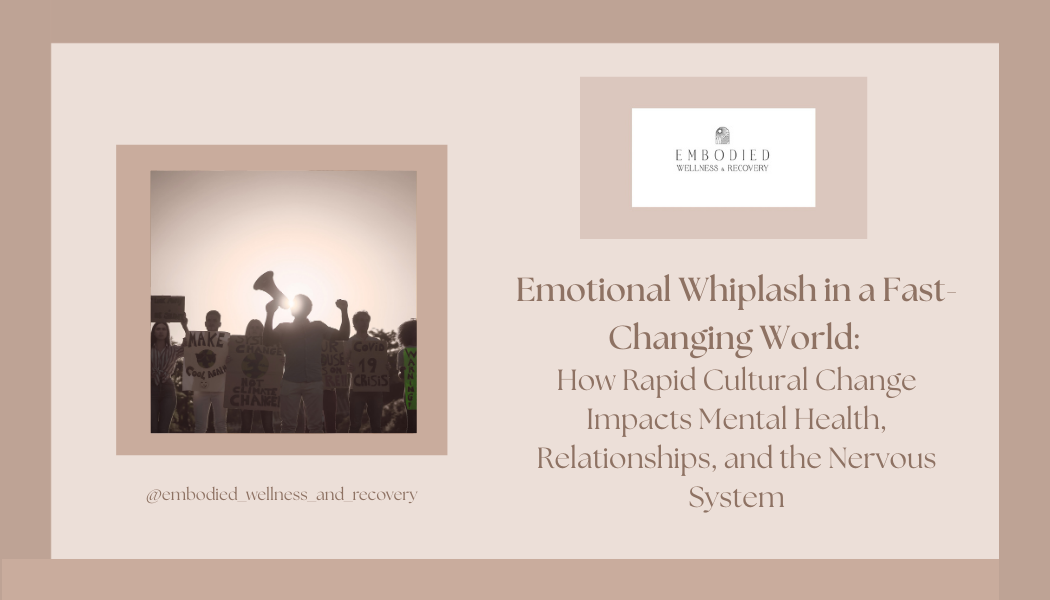
Emotional Whiplash in a Fast-Changing World: How Rapid Cultural Change Impacts Mental Health, Relationships, and the Nervous System
Emotional Whiplash in a Fast-Changing World: How Rapid Cultural Change Impacts Mental Health, Relationships, and the Nervous System
Rapid cultural change can overwhelm the nervous system, leaving many people feeling anxious, disconnected, and emotionally exhausted. Learn how emotional whiplash affects the brain and body and how nervous system-informed therapy can help restore stability, meaning, and connection.
The Pace of Cultural Change
The pace of cultural change today is unprecedented. Technology evolves faster than our brains can comfortably adapt. Social norms shift in real time. Language, values, expectations, and identities feel like moving targets. For many people, this constant acceleration creates a profound sense of emotional whiplash.
You may find yourself asking questions like:
Why do I feel constantly on edge even when nothing is “wrong”?
Why does it feel harder to trust my instincts or feel grounded in my identity?
Why do relationships feel more fragile, more polarized, or more confusing than they used to?
These reactions are not signs of weakness or failure. They are predictable nervous system responses to rapid cultural change.
At Embodied Wellness and Recovery, we work with individuals and couples who feel overwhelmed, destabilized, and disconnected amid social, political, technological, and relational shifts. Understanding how cultural acceleration impacts the brain and body is a powerful first step toward restoring steadiness, agency, and emotional coherence.
What Is Emotional Whiplash?
Emotional whiplash refers to the psychological and physiological stress that occurs when external change outpaces the nervous system’s capacity to adapt. Much like physical whiplash, emotional whiplash is not caused by movement alone, but by sudden, repeated, or unpredictable shifts.
Cultural whiplash can show up as:
— Chronic anxiety or agitation
— Emotional numbness or shutdown
— Irritability and reactivity
— Difficulty concentrating or making decisions
— A sense of grief for a world that feels lost
— Confusion about values, identity, or belonging
These experiences are increasingly common in modern life, especially during periods of rapid technological innovation, social change, political polarization, and shifting norms around relationships, gender, sexuality, and work.
The Neuroscience of Overwhelm in Times of Rapid Change
From a neuroscience perspective, the human brain evolved for predictability, pattern recognition, and relational safety. While the brain is remarkably adaptable, it requires time, repetition, and a sense of coherence to integrate change.
When cultural shifts happen too quickly, the nervous system struggles to find stable reference points. The amygdala, which scans for threat, becomes more vigilant. The prefrontal cortex, responsible for reflection, empathy, and decision making, becomes less accessible under chronic stress. The result is a nervous system that remains in a prolonged state of activation or collapse.
Stephen Porges’ Polyvagal Theory helps explain why people respond so differently to rapid cultural change. Some become hypervigilant, argumentative, or anxious. Others withdraw, dissociate, or shut down. Both responses are adaptive survival strategies, not character flaws.
Why Cultural Change Can Feel So Personal
One of the most destabilizing aspects of rapid cultural change is how deeply personal it feels. Shifts in language, values, and social expectations often touch core areas of identity, including:
— Beliefs about family, partnership, and intimacy
— Ideas about success, worth, and belonging
— Expectations around gender, sexuality, and roles
— Definitions of safety, morality, and truth
When the external world no longer mirrors the internal framework we relied on for meaning, the nervous system experiences this as loss. Even when we intellectually support progress or change, the body may still register uncertainty and grief.
This internal conflict can lead to shame, self-doubt, or relational tension. Many people wonder why they feel unsettled when they believe they should feel empowered or excited. The answer lies not in ideology, but in biology.
Emotional Whiplash and Relationships
Rapid cultural change does not just affect individuals. It profoundly impacts relationships. Partners, families, and communities often adapt at different speeds, leading to misunderstandings, polarization, and rupture.
Common relational patterns we see include:
— Couples struggling with mismatched values or worldviews
— Increased conflict around parenting, gender roles, or intimacy
— Difficulty repairing after disagreements
— Withdrawal or avoidance of difficult conversations
When nervous systems are overwhelmed, relational safety becomes harder to access. Empathy narrows. Listening becomes defensive. Connection feels fragile.
At Embodied Wellness and Recovery, we help couples and families understand how nervous system dysregulation, not incompatibility, often drives these relational struggles.
The Link Between Trauma and Cultural Overwhelm
For individuals with a trauma history, rapid cultural change can be especially destabilizing. Trauma sensitizes the nervous system to unpredictability and loss of control. When the external world feels chaotic, old survival responses can resurface quickly.
This may look like:
— Heightened anxiety or panic
— Strong emotional reactions to news or social media
— Difficulty tolerating ambiguity
— A sense of being emotionally flooded or frozen
Trauma-informed therapy recognizes that present-day overwhelm often echoes earlier experiences of instability, betrayal, or lack of safety. Addressing emotional whiplash requires working not only with thoughts, but with the body and nervous system.
Social Media, Technology, and Nervous System Fatigue
Digital culture accelerates emotional whiplash. Constant exposure to information, comparisons, outrage cycles, and conflicting narratives keeps the nervous system in a state of near-continuous stimulation.
Neuroscience research shows that frequent context switching and chronic alertness reduce emotional regulation, impair memory, and increase anxiety and depression (Gul & Ahmad, 2014).
The brain struggles to distinguish between real-time threats and symbolic ones, especially when images and headlines are emotionally charged.
Without intentional regulation, technology can erode the very sense of coherence and meaning we need to adapt to change.
How Nervous System Repair Restores Stability
While we cannot slow cultural change, we can strengthen our capacity to respond to it. Nervous system-informed therapy focuses on helping the body regain flexibility, resilience, and a sense of internal safety.
At Embodied Wellness and Recovery, our approach integrates:
— Somatic therapy to support regulation and embodiment
— EMDR to process trauma and restore adaptive responses
— Attachment-focused work to rebuild relational safety
— Polyvagal-informed interventions to increase nervous system flexibility
These modalities help clients move out of survival mode and back into states of connection, curiosity, and grounded presence.
Reclaiming Meaning and Agency in a Changing World
One of the most important antidotes to emotional whiplash is meaning-making. The brain and nervous system stabilize when experiences can be integrated into a coherent narrative.
Therapy provides a space to:
— Explore grief for what has changed or been lost
— Clarify personal values amid shifting norms
— Develop internal anchors that do not depend on external stability
— Strengthen relationships through attuned communication
Rather than reacting to every cultural shift, clients learn to respond from a regulated, values-based place.
A Path Forward That Honors Both Change and Stability
Rapid cultural change is not inherently harmful. Growth, evolution, and expanded awareness are part of collective progress. The problem arises when change outpaces our nervous system’s ability to integrate it. Emotional whiplash is a signal, not a failure. It points to the need for regulation, reflection, and relational support.
Embodied Wellness and Recovery specializes in helping individuals and couples navigate these challenges with compassion, depth, and neuroscience-informed care. By addressing the nervous system directly, therapy becomes a place where stability can coexist with change, and where identity, intimacy, and meaning can be reclaimed even in uncertain times.
Reach out to schedule a complimentary 20-minute consultation with our team of therapists, trauma specialists, somatic practitioners, or relationship experts, and start working towards integrative, embodied healing today.
📞 Call us at (310) 651-8458
📱 Text us at (310) 210-7934
📩 Email us at admin@embodiedwellnessandrecovery.com
🔗 Visit us at www.embodiedwellnessandrecovery.com
👉 Check us out on Instagram @embodied_wellness_and_recovery
🌍 Explore our offerings at Linktr.ee: https://linktr.ee/laurendummit
References
Gul, A., & Ahmad, H. (2014). Cognitive deficits and emotion regulation strategies in patients with psychogenic nonepileptic seizures: a task-switching study. Epilepsy & Behavior, 32, 108-113.
McEwen, B. S., & Morrison, J. H. (2013). The brain on stress: Vulnerability and plasticity of the prefrontal cortex over the life course. Neuron, 79(1), 16 to 29.
Porges, S. W. (2011). The polyvagal theory: Neurophysiological foundations of emotions, attachment, communication, and self-regulation. New York, NY: Norton.
Siegel, D. J. (2020). The developing mind: How relationships and the brain interact to shape who we are. New York, NY: Guilford Press.
van der Kolk, B. A. (2014). The body keeps the score: Brain, mind, and body in the healing of trauma. New York, NY: Viking.
Why the News Is Making You Anxious: Understanding News Anxiety, Vicarious Trauma, and Nervous System Overload
Why the News Is Making You Anxious: Understanding News Anxiety, Vicarious Trauma, and Nervous System Overload
Why does watching the news cause anxiety, panic, or emotional shutdown? Learn how news anxiety and vicarious trauma dysregulate the nervous system and what helps restore balance.
Why Does Watching the News Feel So Overwhelming?
Have you noticed your heart racing after watching the news? Trouble sleeping after reading headlines? A sense of dread, numbness, or helplessness when you try to make sense of ongoing violence, political unrest, or human suffering?
Many people are asking the same questions:
— Why does the news make me anxious?
— Why do I feel emotionally flooded or shut down after watching the news?
— Is it normal to feel traumatized by events that did not happen to me directly?
— How do I stay informed without feeling overwhelmed?
These reactions are not signs of weakness or overreaction. They are signs of a nervous system under chronic strain.
What Is News Anxiety?
News anxiety refers to heightened anxiety, distress, or nervous system dysregulation triggered by repeated exposure to news coverage, especially stories involving violence, injustice, disasters, or threat.
This can include:
— Panic or anxiety symptoms
— Emotional overwhelm or tearfulness
— Numbness or emotional shutdown
— Irritability or anger
— Difficulty concentrating
— Sleep disturbances
— A sense of hopelessness or loss of meaning
News anxiety is increasingly common in an era of constant media access, graphic imagery, and real-time updates that offer little opportunity for the nervous system to reset.
Vicarious Trauma and the Brain
From a neuroscience perspective, the brain does not clearly distinguish between direct threat and witnessed threat.
Research on vicarious trauma shows that repeated exposure to others’ suffering can activate the same neural networks involved in direct trauma exposure. When we watch violence, hear distressing stories, or repeatedly imagine worst-case scenarios, the brain’s threat detection systems respond as if danger is present.
Key brain regions involved include:
— The amygdala, which detects threat
— The hippocampus, which stores emotional memory
— The anterior cingulate cortex, which processes pain and distress
— The insula, which maps bodily sensations and emotional states
Over time, this repeated activation can lead to chronic nervous system arousal or, conversely, protective shutdown.
Nervous System Overload and Dysregulation
When the nervous system is repeatedly exposed to perceived threat without resolution, it can become stuck in survival states.
Common nervous system responses to news exposure include:
Sympathetic activation
— Anxiety
— Hypervigilance
— Racing thoughts
— Anger or agitation
— Compulsive news checking
Parasympathetic shutdown
— Emotional numbness
— Dissociation
— Fatigue
— Withdrawal
— A sense of meaninglessness
Both are adaptive responses to overwhelm. Neither indicates pathology.
Why Senseless Violence Is So Dysregulating
Human nervous systems are wired for meaning-making. When events feel random, unjust, or incomprehensible, the brain struggles to integrate them.
Senseless violence disrupts:
— Our assumptions about safety
— Our belief in predictability
— Our sense of moral order
— Our trust in institutions and community
This existential disruption is often what people mean when they say, “I cannot make sense of what is happening.” The distress is not only emotional but also deeply neurobiological.
The Role of Media Saturation
Unlike previous generations, modern news consumption is:
— Continuous
— Visual and graphic
— Algorithm-driven
— Emotionally amplified
Doomscrolling keeps the nervous system in a near-constant state of alert without offering resolution or agency. The body receives threat signals but no clear action path, which increases anxiety and helplessness.
This is particularly impactful for people with:
— A history of trauma
— High empathy
— Attachment wounds
— Anxiety disorders
— Depression or dissociation
— Caregiving or helping professions
Why Some People Feel It More Intensely
Not everyone experiences news anxiety the same way. Differences often relate to nervous system sensitivity and personal history.
People who grew up in environments marked by unpredictability, violence, emotional neglect, or chronic stress often have sensitized threat detection systems. Their bodies learned early that vigilance was necessary for survival.
For these individuals, the news does not feel informational. It feels personal.
How Trauma-Informed Therapy Helps
At Embodied Wellness and Recovery, we understand news anxiety as a nervous system response, not a cognitive failure.
Effective treatment focuses on:
— Restoring nervous system regulation
— Increasing tolerance for emotional activation
— Rebuilding a sense of safety and agency
— Addressing trauma stored in the body
— Supporting meaning-making without overwhelm
Modalities such as somatic therapy, EMDR, attachment-based therapy, and nervous system-informed psychotherapy help clients process distress without retraumatization.
Practical Ways to Reduce News-Related Anxiety
1. Shift from constant exposure to intentional consumption
Limit news intake to specific times of day. Avoid starting or ending the day with distressing content.
2. Regulate before and after exposure
Grounding practices such as slow breathing, movement, or orienting to the room help the nervous system reset.
3. Notice your body’s cues
If your body tightens, dissociates, or races, that is information. Respect it.
4. Focus on agency and connection
Engaging in meaningful action, community support, or values-based living helps counter helplessness.
5. Work with a trauma-informed therapist
Professional support helps integrate emotional responses without suppressing or escalating them.
A Compassionate Reframe
Feeling overwhelmed by the news does not mean you are fragile or disengaged. It often means you are human, empathic, and wired for connection.
Your nervous system is responding exactly as it was designed to respond to threat and uncertainty.
With support, it can also learn how to return to safety, presence, and resilience.
How Embodied Wellness and Recovery Can Help
Embodied Wellness and Recovery specializes in trauma-informed, nervous system-based therapy for individuals struggling with anxiety, emotional overwhelm, dissociation, and relational distress.
Our work integrates neuroscience, somatic awareness, attachment theory, and compassionate clinical care to help clients navigate distressing times without losing themselves in the process.
Reach out to schedule a complimentary 20-minute consultation with our team of therapists, trauma specialists, somatic practitioners, or relationship experts, and start working towards integrative, embodied healing today.
📞 Call us at (310) 651-8458
📱 Text us at (310) 210-7934
📩 Email us at admin@embodiedwellnessandrecovery.com
🔗 Visit us at www.embodiedwellnessandrecovery.com
👉 Check us out on Instagram @embodied_wellness_and_recovery
🌍 Explore our offerings at Linktr.ee: https://linktr.ee/laurendummit
References
1) Eisenberger, N. I., & Lieberman, M. D. (2004). Why rejection hurts: A common neural alarm system for physical and social pain. Trends in Cognitive Sciences, 8(7), 294–300.
2) McCann, I. L., & Pearlman, L. A. (1990). Vicarious traumatization: A framework for understanding the psychological effects of working with victims. Journal of Traumatic Stress, 3(1), 131–149.
3) van der Kolk, B. A. (2014). The body keeps the score: Brain, mind, and body in the healing of trauma. Viking.

When Anxiety Wears the Mask of Anger: The Neuroscience Behind Irritability and Emotional Overwhelm
When Anxiety Wears the Mask of Anger: The Neuroscience Behind Irritability and Emotional Overwhelm
Discover why anxiety often manifests as irritability or anger. Learn the neuroscience behind emotional dysregulation and how trauma-informed therapy can support emotional resilience. Explore expert insight from Embodied Wellness and Recovery.
Have you ever snapped at someone you care about, only to later realize your anger had nothing to do with them? Do you find yourself quick to react, simmering beneath the surface, wondering why everything feels so overwhelming? If you’re struggling with irritability, mood swings, or unexplained bursts of anger, it might surprise you to learn that what you’re experiencing isn’t just frustration; it could be anxiety in disguise.
At Embodied Wellness and Recovery, we frequently hear from clients who feel ashamed of their irritability or overwhelmed by their quick temper, not realizing these reactions are rooted in deeper emotional states like fear, stress, and nervous system dysregulation. Understanding why anxiety so often shows up as anger is a powerful first step toward greater emotional balance, self-compassion, and healthier relationships.
What Does It Mean When Anxiety Shows Up as Anger?
Anxiety is often characterized by worry, panic, or rumination, but for many people, it doesn’t look like that at all. Instead, it shows up as restlessness, tension, and irritability. Over time, unprocessed anxiety can manifest as sudden outbursts, defensiveness, or even rage.
So, what’s happening beneath the surface?
Anxiety activates the body’s threat detection system, specifically the amygdala, the brain’s alarm center. When the amygdala perceives a threat (real or imagined), it kicks off a cascade of responses via the sympathetic nervous system: increased heart rate, muscle tension, shallow breathing. If that heightened arousal doesn’t get discharged or soothed, it builds.
And when there’s no safe outlet for the fear or uncertainty, the body often converts that charge into anger.
In other words, anger becomes a protective strategy, an attempt to regain control, create distance, or defend against vulnerability.
Why Does This Happen? A Look at the Neuroscience
Neuroscience research shows that anxiety and anger are more closely linked than we once believed. Both originate from the limbic system, particularly the amygdala and hypothalamus, which mediate our stress and emotional responses (LeDoux, 2015).
When anxiety becomes chronic, the nervous system remains in a state of hypervigilance, interpreting even benign interactions as threatening. Over time, this creates what some researchers call “emotional misfiring,” reactivity to perceived threats that aren’t actually dangerous (Porges, 2011).
This misfiring means that someone who lives with anxiety might:
— Perceive neutral facial expressions as hostile
— Feel easily annoyed by sounds, interruptions, or clutter
— React to constructive feedback as personal criticism
All of this is undergirded by a nervous system on high alert, constantly scanning for danger and reacting with anger when it finds what it believes is a threat.
The Role of Childhood Trauma and Attachment
For many people, especially those with histories of childhood trauma or insecure attachment, the link between anxiety and anger is even more deeply wired.
Children who grew up in unpredictable, emotionally unsafe environments may have learned to express their needs or fears through defensive aggression, because anger often received more attention than sadness or fear. In adulthood, this survival strategy can persist long after the original threat is gone.
At Embodied Wellness and Recovery, we often see this dynamic in individuals who say:
— “I don't know why I get so angry. It's like something just takes over.”
— “I’m constantly irritable, even when nothing’s wrong.”
— “I hate how reactive I get, but I can’t seem to stop.”
This isn’t a personality flaw. It’s a trauma-informed nervous system response that can be reshaped with the right support.
Common Signs Anxiety Is Showing Up as Anger or Irritability
If you're wondering whether your anger might actually be anxiety in disguise, here are some signs to look for:
— You feel keyed up or “on edge” most of the time
— You overreact to small inconveniences
— You have a hard time letting things go
— You feel exhausted but can't relax
— You struggle to tolerate noise, interruptions, or chaos
— You often feel misunderstood, unappreciated, or disrespected
— You ruminate after an argument, replaying the interaction repeatedly
These symptoms are not random. They are the body’s way of communicating unresolved fear, chronic stress, or overstimulation.
What Helps: From Reaction to Regulation
There is good news: the nervous system can learn a new pattern. The key is regulation over repression, learning how to work with your body instead of against it.
Here are some trauma-informed, neuroscience-backed strategies we use at Embodied Wellness and Recovery to help clients manage anxiety-driven anger:
1. Track and Name the Sensation
Start by recognizing what anxiety feels like in your body. Is it tightness in your chest? Clenched jaw? A buzzing in your hands? Naming the sensation increases interoceptive awareness, a proven method for enhancing emotional regulation.
“Name it to tame it,” as Dr. Dan Siegel puts it.
2. Practice Nervous System Soothing
Soothing techniques help signal safety to your body. Try:
— Vagus nerve stimulation (humming, gargling, cold splash)
— Rhythmic movement (rocking, swaying, walking)
— Co-regulation with a calm person or pet
— Grounding through the senses (notice 5 things you see, 4 things you feel, etc.)
3. Somatic Therapy and EMDR
Somatic Experiencing and EMDR allow us to resolve trauma at the level of the body, not just the mind. These approaches help discharge stuck energy from the nervous system and develop internal resources for safety and resilience.
4. Boundary and Communication Work
Anxiety often stems from unspoken needs or unacknowledged boundaries. Learning to identify and express your limits reduces the internal tension that can build into irritability or resentment.
Real Transformation Is Possible
When anger is understood not as a failing but as a form of protection, it becomes easier to meet yourself with compassion. Anxiety-driven anger is a signal, not of brokenness, but of a nervous system working overtime to protect you.
At Embodied Wellness and Recovery, we specialize in helping individuals regulate anxiety, heal trauma, and build meaningful connections through a nervous system-informed, relational approach. Our team of experts supports clients in discovering how early experiences shape current behaviors and provides tools to create new patterns of response.
Healing with Safe, Attuned Connection
If you recognize yourself in these patterns, know this: you are responding in ways that make sense based on your history, biology, and stress load. And you can learn new ways to feel, respond, and relate with less reactivity and more inner peace.
Reach out today to schedule a free 20-minute consultation with a trauma-informed, somatic therapist at Embodied Wellness and Recovery and begin your journey toward emotional clarity, nervous system balance, and healthier relationships.
📞 Call us at (310) 651-8458
📱 Text us at (310) 210-7934
📩 Email us at admin@embodiedwellnessandrecovery.com
🔗 Visit us at www.embodiedwellnessandrecovery.com
👉 Check us out on Instagram @embodied_wellness_and_recovery
🌍 Explore our offerings at Linktr.ee: https://linktr.ee/laurendummit
References:
LeDoux, J. E. (2015). Anxious: Using the Brain to Understand and Treat Fear and Anxiety. Viking.
Porges, S. W. (2011). The Polyvagal Theory: Neurophysiological Foundations of Emotions, Attachment, Communication, and Self-Regulation. W. W. Norton & Company.
Siegel, D. J. (2012). The Developing Mind: How Relationships and the Brain Interact to Shape Who We Are (2nd ed.). The Guilford Press.