
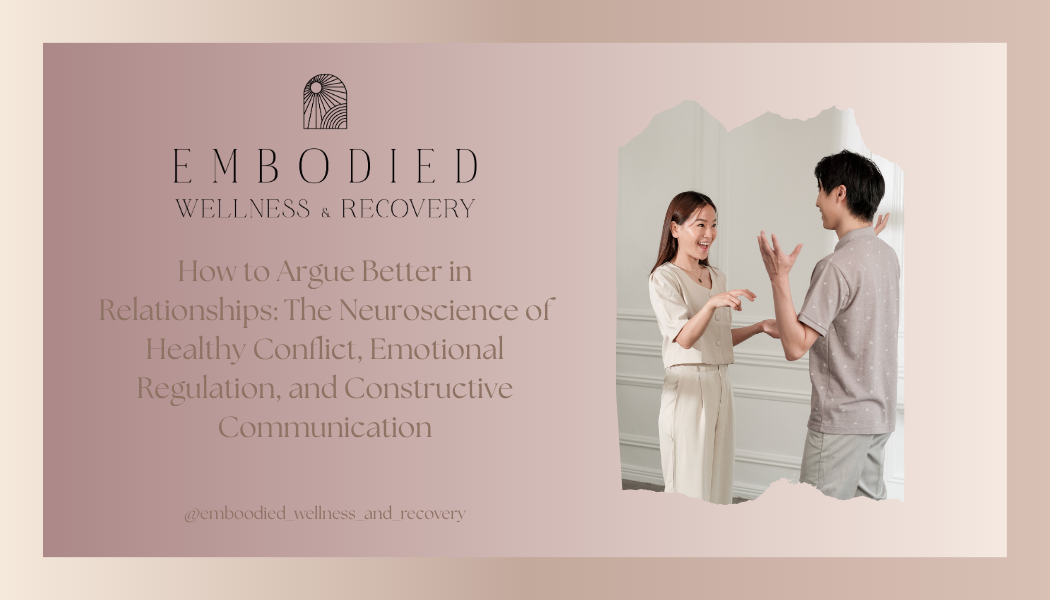
How to Argue Better in Relationships: The Neuroscience of Healthy Conflict, Emotional Regulation, and Constructive Communication
How to Argue Better in Relationships: The Neuroscience of Healthy Conflict, Emotional Regulation, and Constructive Communication
Learn how to handle conflict more healthily through neuroscience-informed communication skills. Explore constructive vs. destructive arguing, emotional regulation, attachment wounds, nervous system responses, and how healthy conflict can strengthen relationships.
Conflict Is Inevitable. Destructive Conflict Is Not.
Every close relationship eventually encounters disagreement.
Romantic partners argue.
Families misunderstand one another. Friendships experience tension.
Even the healthiest relationships involve frustration, hurt feelings, and conflict.
Yet many people secretly fear conflict because past experiences taught them that disagreement leads to:
— Rejection
— Shame
— Emotional shutdown
— Rage
— Emotional instability
— Disconnection
You may wonder:
Why do arguments escalate so quickly?
Why do I say things I regret during conflict?
Why do I shut down emotionally when tension arises?
Why do the people I love most trigger my deepest emotional reactions?
Can conflict ever actually strengthen a relationship?
The answer is yes.
Research consistently shows that healthy relationships are not conflict-free relationships. Rather, they are relationships in which people learn to navigate conflict constructively rather than destructively (Turjeman, 2022).
At Embodied Wellness and Recovery, we help individuals and couples understand how trauma, attachment wounds, nervous system dysregulation, emotional reactivity, and communication patterns shape conflict. One of the most important truths we teach clients is this:
Conflict itself is not the problem.
When conflict arises, the nervous system often determines whether relationships are damaged or strengthened.
The Neuroscience of Conflict
When conflict begins, the brain and body react long before conscious reasoning fully catches up. The nervous system constantly scans for emotional safety or threat through a process called neuroception, a concept developed by Stephen Porges in Polyvagal Theory.
During arguments, the brain may interpret:
— Criticism
— Tone of voice
— Facial expressions
— Silence
— Defensiveness
— Withdrawal
…as signs of danger.
When this happens, the autonomic nervous system can shift into survival responses such as:
— Fight
— Flight
— Freeze
— Shutdown
This explains why people may:
— Yell
— Become defensive
— Emotionally withdraw
— Say hurtful things impulsively
— Stop listening
— Become overwhelmed
In these moments, the nervous system prioritizes protection over connection.
Why Arguments Can Feel So Intense
Conflict often activates earlier relational wounds.
For example:
— Criticism may trigger childhood shame
— Emotional withdrawal may trigger abandonment fears
— Raised voices may activate trauma memories
— Disagreement may feel unsafe for people raised in chaotic homes
This is why many arguments are not simply about the surface issue itself.
A disagreement about dishes, texting back, money, intimacy, or parenting may unconsciously activate:
— Fears of rejection
— Fears of inadequacy
— Fears of emotional abandonment
— Fears of losing control
— Unresolved attachment wounds
Understanding this changes the goal of conflict. The goal shifts from “winning” to maintaining emotional safety while addressing the issue.
Constructive vs. Destructive Conflict
Research from relationship expert John Gottman has identified specific communication patterns that predict relational distress (DeAngelo, 2022).
Destructive conflict often includes:
— Contempt
— Defensiveness
— Stonewalling
— Sarcasm
— Character attacks
— Emotional flooding
Constructive conflict, however, involves:
— Emotional regulation
— Curiosity
— Accountability
— Repair attempts
— Empathy
— Respectful boundaries
— Collaborative problem-solving
The difference is not whether conflict occurs. The difference is how the nervous system and communication patterns are managed during the conflict.
Why Emotional Regulation Matters More Than Perfect Communication
Many people focus exclusively on “communication skills” without addressing nervous system regulation. But healthy communication becomes extremely difficult when the body is flooded with stress hormones.
During emotional flooding:
— Heart rate increases
— Cortisol rises
— Logical reasoning decreases
— Defensive reactivity intensifies
This is why people often say: “I don’t even know why I reacted that strongly.”
The nervous system was reacting before the rational mind fully engaged. Learning emotional regulation skills can help create the pause necessary for healthier responses.
Signs Conflict Has Become Destructive
Arguments become harmful when partners or family members begin feeling:
— Emotionally unsafe
— Chronically criticized
— Unheard
— Humiliated
— Emotionally abandoned
— Fearful during conflict
Some common destructive patterns include:
Mind Reading
Assuming intentions without clarification.
“You clearly don’t care about me.”
Global Attacks
Turning one issue into a character judgment.
“You never think about anyone but yourself.”
Escalation
Raising voices, interrupting, or intensifying conflict rapidly.
Emotional Withdrawal
Shutting down completely or refusing repair.
Scorekeeping
Using old mistakes as weapons instead of addressing present concerns.
Healthy Conflict Can Strengthen Relationships
Surprisingly, healthy conflict often deepens intimacy.
Why?
Because constructive conflict allows people to:
— Feel heard
— Practice vulnerability
— Build trust
— Repair ruptures
— Increase emotional honesty
— Strengthen attachment security
Research suggests that successful repair after conflict is one of the strongest predictors of long-term relational satisfaction. Conflict handled well can increase emotional closeness.
The Importance of Repair
Repair is one of the most essential relationship skills.
Repair means reconnecting after rupture through:
— Empathy
— Emotional presence
— Genuine effort to understand
Examples of repair include:
— “I see how that hurt you.”
— “I became defensive and stopped listening.”
— “Can we start over?”
— “I understand why you reacted that way.”
— “I do not want us to become enemies during conflict.”
Repair does not erase accountability. It restores emotional connection.
Trauma and Conflict Avoidance
Some people become highly conflict-avoidant because conflict has historically felt dangerous.
They may:
— Suppress needs
— Avoid difficult conversations
— Shut down emotionally
— Tolerate unhealthy dynamics to avoid tension
Unfortunately, avoiding conflict entirely often creates:
— Resentment
— Emotional distance
— Loneliness inside relationships
Healthy relationships require the capacity to tolerate discomfort while remaining emotionally connected.
Conflict and Intimacy
Emotional intimacy depends heavily on how couples or family members navigate difficult emotions together.
People feel emotionally safer in relationships when they believe:
— Conflict will not become abusive
— Emotions can be expressed honestly
— Mistakes can be repaired
— Vulnerability will not be weaponized
This is particularly important for individuals healing from:
— Trauma
— Betrayal
— Attachment wounds
— Emotional neglect
Questions Worth Asking Yourself During Conflict
Am I trying to understand or simply defend myself?
Is my nervous system activated right now?
What fear might be underneath my reaction?
Am I criticizing behavior or attacking character?What would emotional safety look like in this moment?
Can I remain connected while also expressing boundaries?
Skills That Improve Conflict
Healthy conflict is a skill set that can be learned and strengthened. Some of the most effective strategies include:
Pausing Before Reacting
Creating nervous system regulation before responding impulsively.
Using “I” Statements
Instead of: “You never listen.”
Try: “I feel dismissed when I do not feel heard.”
Staying Specific
Focus on the current issue instead of attacking the entire relationship.
Regulating Physiology
Deep breathing, grounding, slowing speech, and taking breaks can reduce nervous system flooding.
Repairing Quickly
Healthy relationships are not rupture-free. They are repairable.
Conflict as an Opportunity for Growth
Disagreement can become an opportunity to better understand:
— Each other’s fears
— Attachment histories
— Emotional needs
Handled constructively, conflict can strengthen:
— Trust
— Emotional safety
— Intimacy
— Resilience
Not because conflict feels pleasant, but because navigating it well creates deeper emotional security.
A Different Goal for Conflict
The goal of conflict is not domination. It is not proving who is right. It is not emotional victory.
The healthiest relationships shift from: “How do I win this argument?”
to: “How do we stay emotionally connected while working through this difficult moment together?”
At Embodied Wellness and Recovery, we help individuals and couples strengthen emotional regulation, nervous system resilience, attachment security, communication skills, and relational repair through trauma-informed and neuroscience-informed therapy.
Because healthy conflict is not the absence of disagreement. It is the presence of emotional safety, accountability, and repair within disagreement.
Reach out to schedule a complimentary 20-minute consultation with our team of therapists, trauma specialists, somatic practitioners, or relationship experts, and start working towards integrative, embodied healing today.
📞 Call us at (310) 651-8458
📱 Text us at (310) 210-7934
📩 Email us at admin@embodiedwellnessandrecovery.com
🔗 Visit us at www.embodiedwellnessandrecovery.com
👉 Check us out on Instagram @embodied_wellness_and_recovery
🌍 Explore our offerings at Linktr.ee: https://linktr.ee/laurendummit
References
DeAngelo, O. K. (2022). Imagined Interactions and Gottman Method: Predicting Relational Dissatisfaction (Doctoral dissertation, Tennessee State University).
Gottman, J. M., & Silver, N. (2015). The seven principles for making marriage work. Harmony Books.
Porges, S. W. (2011). The polyvagal theory: Neurophysiological foundations of emotions, attachment, communication, and self-regulation. W. W. Norton & Company.
Siegel, D. J. (2012). The developing mind: How relationships and the brain interact to shape who we are (2nd ed.). Guilford Press.
Tatkin, S. (2012). Wired for love: How understanding your partner's brain and attachment style can help you defuse conflict and build a secure relationship. New Harbinger Publications.
Turjeman, E. (2022). Beyond Resolution: The Invitation for Self-Growth Inherent in Conflicts (Master's thesis, University of Oregon).

How to Feel Loved and Why It Matters More Than You Think: The Neuroscience of Connection, Happiness, and Emotional Fulfillment
How to Feel Loved and Why It Matters More Than You Think: The Neuroscience of Connection, Happiness, and Emotional Fulfillment
Feeling loved is a core driver of happiness. Learn why it matters, what neuroscience reveals, and how to cultivate deeper connection in your life.
Many people pursue happiness by improving productivity, optimizing health, or striving for success, only to find that something still feels missing. You may have a full life on paper and yet feel lonely, disconnected, or emotionally unseen. You might wonder why contentment feels fleeting, even when things are going well. If you have ever asked yourself, Why do I still feel unsatisfied? Or why don’t I feel deeply loved, even when I am surrounded by people? You are asking an essential question.
According to Dr. Sonja Lyubomirsky, a professor, author, and leading researcher in the science of happiness, happiness is shaped by many factors. Gratitude, optimism, generosity, purpose, and mindset all matter. Yet if she had to identify one especially powerful driver of happiness, it would be this: feeling loved. At Embodied Wellness and Recovery, we see this truth reflected every day in our work with individuals and couples. Feeling loved is not a luxury. It is a nervous system need.
Why Feeling Loved Is Central to Happiness
Feeling loved is not the same as being loved. Many people are loved by partners, friends, or family members and still do not feel it. This distinction matters. From a neuroscience perspective, feeling loved means the nervous system registers safety, attunement, and a sense of belonging. It is a felt experience, not a cognitive conclusion.
Research consistently shows that strong relational bonds are among the most reliable predictors of life satisfaction, emotional resilience, and even physical health. Human brains evolved in connection (Feldman, 2020). Our nervous systems are designed to regulate through relationship. When people feel emotionally connected, supported, and understood, stress hormones decrease, immune functioning improves, and emotional regulation becomes more accessible. When people feel disconnected or unseen, the nervous system shifts into a state of threat, even in subtle ways.
The Cost of Not Feeling Loved
A lack of felt love often shows up quietly. It may look like chronic dissatisfaction, low-grade sadness, irritability, or numbness. It may show up as overworking, people-pleasing, or cycling through relationships that never quite satisfy.
You might notice patterns such as:
— Feeling lonely even in relationships
— Doubting your worth despite external validation
— Feeling unseen or unheard in conversations
— Staying in relationships that feel emotionally empty
— Struggling to let go of relationships that are not nourishing
These experiences are not personal failures. They are signals from the nervous system that something essential is missing.
What the Brain Needs to Feel Loved
Feeling loved requires more than presence or commitment. It requires attunement. Attunement means being emotionally met. It involves being listened to, responded to, and impacted by another person. Neuroscience shows that attuned interactions regulate the nervous system through facial expression, tone of voice, pacing, and emotional responsiveness. This is why someone can spend hours with others and still feel alone. Without attunement, connection does not register at the level the brain needs.
For individuals with trauma histories, attachment wounds, or emotionally inconsistent caregiving, the nervous system may struggle to recognize or trust love, even when it is present. In these cases, feeling loved often requires intentional repair and relational experiences that feel safe and consistent.
Listening Better, Not More
Dr. Lyubomirsky highlights listening as a key pathway to feeling loved. This does not mean listening longer or offering solutions. It means listening in a way that communicates presence and care.
Listening better involves:
— Putting away distractions
— Reflecting back what you hear
— Staying curious rather than defensive
— Allowing emotion without rushing to fix it
When someone feels truly listened to, the nervous system settles. The body registers safety. Over time, these moments accumulate into a felt sense of being loved.
Focus on One Relationship at a Time
Many people spread their emotional energy thin, hoping that more connections will ease loneliness. In reality, depth matters more than quantity. Focusing on one relationship at a time allows space for trust, vulnerability, and emotional investment to grow. Whether it is a partner, friend, or family member, prioritizing depth helps the nervous system experience consistency and reliability. This does not mean isolating from others. It means recognizing that feeling loved often emerges from sustained, meaningful connection rather than constant social stimulation.
Knowing When to Let Go
One of the most difficult but important steps in feeling loved is being honest about relationships that are no longer nourishing. Staying in emotionally unavailable or misaligned relationships can reinforce feelings of unworthiness and loneliness. Even when a relationship is familiar, it may continue to signal disappointment or emotional absence to the nervous system. Letting go does not mean blaming or shaming. It means acknowledging reality. Ending or redefining relationships that consistently fail to meet emotional needs can create space for deeper connection elsewhere, including with oneself.
Trauma, Attachment, and the Ability to Feel Loved
Early attachment experiences shape how love is perceived and tolerated. If love was inconsistent, conditional, or overwhelming in childhood, the nervous system may associate closeness with anxiety, shame, or fear. In adulthood, this can look like pushing love away, doubting it, or feeling uncomfortable when someone is emotionally available. These patterns are adaptive responses, not flaws. Therapy can help individuals gently explore these responses, regulate the nervous system, and develop new relational experiences that support feeling loved rather than threatened by it.
Feeling Loved as a Somatic Experience
Feeling loved lives in the body. It may be felt as warmth, ease, relaxation, or openness. It may show up as the ability to rest, to receive care, or to trust others with vulnerability. Somatic therapy helps individuals track these sensations and build tolerance for them. For some people, feeling loved is unfamiliar or even unsettling at first. The nervous system may need time to adjust. Through attuned therapeutic relationships and body-based work, the nervous system can learn that love is safe, steady, and sustainable.
How Embodied Wellness and Recovery Supports Connection
At Embodied Wellness and Recovery, we help individuals and couples understand the nervous system foundations of connection and love. Our work integrates neuroscience, attachment theory, and somatic approaches to support deeper emotional fulfillment.
We help clients:
— Identify patterns that block feeling loved
— Regulate nervous system responses to closeness
— Strengthen emotional communication
— Heal attachment wounds
— Cultivate relationships that feel safe and nourishing
Feeling loved is not about perfection. It is about safety, presence, and repair.
A Different Definition of Happiness
Happiness is not constant joy or positivity. It is the ability to feel connected, supported, and emotionally held, even in difficult times. When people feel loved, they are more resilient. Stress feels more manageable. Life feels more meaningful. This is why feeling loved matters more than you might realize. It is not something to earn or optimize. It is something to experience, slowly and relationally. If happiness feels elusive, it may not be because you are doing life wrong. It may be because your nervous system is longing for a deeper connection.
Reach out to schedule a complimentary 20-minute consultation with our team of therapists, trauma specialists, somatic practitioners, or relationship experts, and start working towards integrative, embodied healing today.
📞 Call us at (310) 651-8458
📱 Text us at (310) 210-7934
📩 Email us at admin@embodiedwellnessandrecovery.com
🔗 Visit us at www.embodiedwellnessandrecovery.com
👉 Check us out on Instagram @embodied_wellness_and_recovery
🌍 Explore our offerings at Linktr.ee: https://linktr.ee/laurendummit
References
1) Feldman, R. (2020). What is resilience: an affiliative neuroscience approach. World psychiatry, 19(2), 132-150.
2) Hazan, C., & Shaver, P. (1987). Romantic love is conceptualized as an attachment process. Journal of Personality and Social Psychology, 52(3), 511–524.
3) Lyubomirsky, S. (2008). The how of happiness: A scientific approach to getting the life you want. Penguin Press.
4) Porges, S. W. (2011). The polyvagal theory: Neurophysiological foundations of emotions, attachment, communication, and self-regulation. W. W. Norton & Company.
5) Siegel, D. J. (2020). The developing mind: How relationships and the brain interact to shape who we are. Guilford Press.
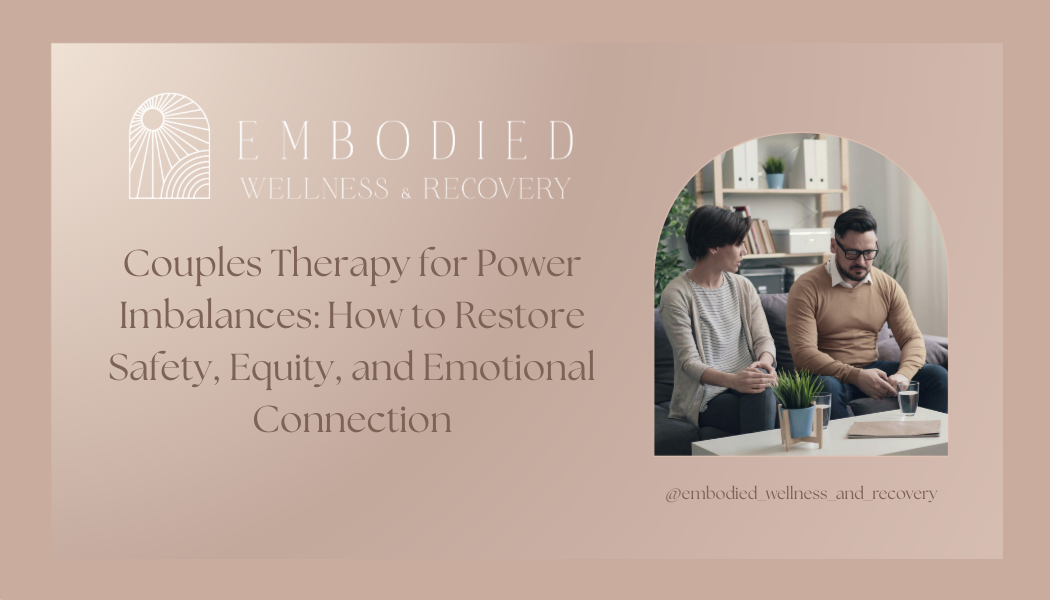
Couples Therapy for Power Imbalances: How to Restore Safety, Equity, and Emotional Connection
Couples Therapy for Power Imbalances: How to Restore Safety, Equity, and Emotional Connection
Struggling with power imbalances in your relationship? Learn how couples therapy addresses control, dependency, and inequality through a trauma-informed, neuroscience-based approach.
When Love Exists but Power Feels Uneven
Do you feel like one partner has more control over decisions, money, emotions, or intimacy?
Do disagreements leave one person dominating while the other shuts down or gives in?
Do you sense that the relationship feels unequal but struggle to name why?
Power imbalances are among the most common and least discussed challenges in romantic relationships. They can quietly erode trust, safety, desire, and emotional closeness even in partnerships where love and commitment are strong.
Couples therapy offers a structured, compassionate space to understand how power dynamics form, why they persist, and how they can be transformed into more equitable and connected ways of relating.
What Are Power Imbalances in Relationships?
A power imbalance occurs when one partner consistently holds more influence over emotional tone, decision-making, resources, or relational direction. This does not always involve overt control. Often, power imbalances are subtle and relational rather than intentional.
Examples include:
— One partner consistently deferring to avoid conflict
— One partner controlling finances or major decisions
— One partner’s emotional needs dominate the relationship
— Fear of upsetting one partner leading to silence or compliance
— Disparities in sexual initiation, desire, or consent
Power imbalances are not always the result of bad intentions. They are often shaped by trauma histories, attachment styles, social conditioning, and nervous system responses.
How Power Imbalances Develop
Power dynamics rarely appear overnight. They evolve through repeated interactions in which one partner learns that asserting their needs feels risky, while the other learns that leading or controlling feels safer.
Common contributors include:
— Childhood trauma or neglect
— Attachment wounds
— Gender roles and cultural expectations
— Financial disparities
— Differences in mental health, confidence, or social power
— Past relational injuries
Over time, these dynamics can solidify into patterns that feel difficult to change without support.
The Neuroscience of Power and Safety in Relationships
From a neuroscience perspective, power is deeply linked to safety. The nervous system is constantly assessing whether it is safe to express needs, disagree, or be vulnerable.
When power feels uneven:
— The partner with less power may experience chronic threat activation
— The partner with more power may experience pressure to maintain control
— Both nervous systems may remain dysregulated
Threat responses often show up as fight, flight, freeze, or appease patterns. These responses shape communication, intimacy, and conflict resolution.
Couples therapy helps both partners understand how their nervous systems interact and how to restore a sense of safety.
How Power Imbalances Affect Emotional Connection
Unequal power disrupts emotional intimacy. When one partner feels unsafe to speak honestly, emotional authenticity diminishes.
Common relational impacts include:
— Resentment and emotional withdrawal
— Escalating conflict or avoidance
— Difficulty repairing after arguments
— Loss of trust and emotional closeness
Over time, relationships can feel more transactional than collaborative.
Power Imbalances and Sexual Intimacy
Sexual dynamics are especially sensitive to power. Desire thrives on mutual agency, consent, and emotional safety.
Power imbalances can lead to:
— Pressure around sex or avoidance of sex
— Desire discrepancies
— Difficulty expressing boundaries or preferences
— Sex feeling performative or obligation-based
Couples therapy addresses these patterns by restoring agency, safety, and mutual attunement rather than focusing solely on frequency or technique.
Why Power Imbalances Are Hard to Address Alone
Many couples try to fix power struggles through communication alone. While communication skills matter, they are often insufficient when power dynamics are rooted in trauma or nervous system conditioning.
Without addressing the underlying safety and regulation:
— One partner may continue to dominate conversations
— The other may continue to minimize needs
— Attempts at balance may feel forced or unstable
Couples therapy provides a neutral container where both partners can explore these dynamics with guidance and accountability.
How Couples Therapy Helps Address Power Imbalances
Effective couples therapy focuses on understanding, not blame. The goal is not to label one partner as controlling or submissive, but to explore how both partners contribute to and are impacted by the dynamic.
Therapy helps couples:
— Identify power patterns and triggers
— Understand nervous system responses during conflict
— Develop equitable communication strategies
— Practice mutual decision making
— Rebuild trust and emotional safety
This process allows new relational patterns to emerge organically.
Practice One: Naming Power Without Judgment
A foundational step is learning to name power dynamics without shaming either partner.
Questions explored in therapy include:
— When do I feel least safe expressing myself?
— When do I feel responsible for keeping the peace?
— When do I feel the need to control outcomes?
Naming patterns reduces reactivity and increases awareness.
Practice Two: Building Tolerance for Disagreement
Healthy relationships allow for disagreement without threat. Couples therapy helps partners stay regulated while holding differing perspectives.
This helps shift power from dominance or avoidance toward collaboration.
Practice Three: Restoring Agency and Choice
Power imbalances often limit one partner’s sense of agency. Therapy focuses on restoring choice in emotional expression, setting boundaries, and making decisions.
Agency is essential for intimacy and trust.
Practice Four: Repairing Relational Injuries
Unequal power often leaves relational wounds. Couples therapy emphasizes repair through accountability, empathy, and consistency.
Repair builds safety and rebalances power over time.
The Role of Trauma in Power Dynamics
Trauma histories significantly influence how individuals experience power. Those who grew up without control may either avoid power or cling to it in adulthood.
Couples therapy helps partners understand how past experiences shape present behavior, reducing personalization and blame.
Why Power Equity Supports Long-Term Relationship Health
Relationships with shared power tend to show:
— Higher emotional satisfaction
— Better conflict resolution
— Greater sexual connection
— Stronger resilience during stress
Equity does not mean sameness. It means both partners’ needs, voices, and boundaries matter.
How Embodied Wellness and Recovery Approaches Couples Therapy
At Embodied Wellness and Recovery, couples therapy is grounded in trauma-informed, neuroscience-based care.
Our approach integrates:
— Somatic and attachment-based psychotherapy
— Nervous system regulation
— EMDR and trauma processing
— Sex therapy and intimacy-focused work
We help couples transform power struggles into opportunities for deeper understanding, safety, and connection.
A Compassionate Reframe
If power feels uneven in your relationship, it does not mean the relationship is broken. It often means old survival strategies are shaping present dynamics.
With support, couples can learn to share power in ways that foster trust, intimacy, and mutual respect.
Reach out to schedule a complimentary 20-minute consultation with our team of therapists, trauma specialists, somatic practitioners, or relationship experts, and start working towards integrative, embodied healing today.
📞 Call us at (310) 651-8458
📱 Text us at (310) 210-7934
📩 Email us at admin@embodiedwellnessandrecovery.com
🔗 Visit us at www.embodiedwellnessandrecovery.com
👉 Check us out on Instagram @embodied_wellness_and_recovery
🌍 Explore our offerings at Linktr.ee: https://linktr.ee/laurendummit
References
1) Gottman, J. M., & Silver, N. (2015). The seven principles for making marriage work. Harmony Books.
2) Porges, S. W. (2011). The polyvagal theory: Neurophysiological foundations of emotions, attachment, communication, and self-regulation. W. W. Norton & Company.
3) Herman, J. L. (2015). Trauma and recovery. Basic Books.
4) Siegel, D. J. (2012). The developing mind: How relationships and the brain interact to shape who we are (2nd ed.). Guilford Press.

When Love Languages Clash: How to Reconnect, Build Emotional Safety, and Strengthen Your Relationship
When Love Languages Clash: How to Reconnect, Build Emotional Safety, and Strengthen Your Relationship
Feeling unloved in your relationship? Learn how mismatched love languages create distance—and how to bridge the gap with compassion and neuroscience-backed tools.
When Love Languages Clash: How to Reconnect, Build Emotional Safety, and Strengthen Your Relationship
Have you ever found yourself thinking, “I’m doing everything I can to show my partner love so why do they still seem distant or unhappy?”
Or perhaps you’ve felt neglected or invisible, even though your partner insists they care.
Experiencing a disconnect due to mismatched love languages can be challenging, but it's a common hurdle many couples face, a deeply misunderstood issue that can quietly erode even the strongest bonds over time.
At Embodied Wellness and Recovery, we see every day how relational struggles like this are less about “not loving enough” and more about how love is communicated and received through the lens of our individual emotional and neurological wiring.
Understanding how to bridge this gap without losing your authentic self is crucial for cultivating lasting intimacy, security, and mutual respect.
The Love Language Disconnect: Why It Hurts So Much
Dr. Gary Chapman’s The Five Love Languages popularized the idea that each person has a primary way of giving and receiving love:
– Words of Affirmation
– Acts of Service
– Receiving Gifts
– Quality Time
– Physical Touch
While this framework is powerful, it often oversimplifies the emotional experience couples go through when their natural love languages don’t align.
From a neuroscience perspective, humans are wired to seek co-regulation through connection. When love isn’t expressed in a way our nervous system intuitively recognizes, our bodies may interpret it as a subtle form of emotional neglect even if the love itself is present (Porges, 2011).
This can lead to painful internal narratives:
– “They must not care about me.”
– “Maybe I’m not lovable.”
– “I’m giving so much and getting nothing back.”
In truth, these misunderstandings are not character flaws. They are attachment wounds and neurobiological misfires that can be repaired with awareness and skill.
Signs Your Love Languages Are Clashing
– You feel chronically unseen, unheard, or underappreciated.
– Small conflicts escalate into larger emotional ruptures.
– Acts of love are misinterpreted or dismissed by your partner.
– One or both partners feel pressure to perform affection rather than authentically feel it.
– Conversations about needs trigger defensiveness or shutdown.
Respecting Differences Instead of Forcing Sameness
When faced with a love language mismatch, many couples fall into the trap of trying to “convert” each other:
“If you just said ‘I love you’ more often, everything would be fine.”
“Why can’t you show love the way I need it?”
But forcing sameness not only disrespects the uniqueness of each partner; it also inadvertently creates more emotional distance.
Instead, successful couples learn to translate love across their differences with empathy, curiosity, and mutual regulation.
Here’s how to begin:
1. Identify and Own Your Primary Love Language (and Nervous System Preferences)
Understanding your own wiring is the first step.
– What gestures make you feel emotionally safe and connected?
– How does your nervous system physically respond to different kinds of affection?
Recognizing your core needs without shame allows you to advocate for them clearly and receive love more openly.
2. Get Curious About Your Partner’s Inner World
Rather than assuming malice or carelessness, explore:
– How does my partner instinctively express love?
– What messages were they taught about affection growing up?
– What feels “safe” and “unsafe” for their nervous system when giving or receiving love?
As Dr. Stan Tatkin’s work on Wired for Love suggests, attuned couples act as each other’s “secure functioning home base” (Tatkin, 2011)—which requires understanding, not judgment.
3. Use Micro-Attunements, Not Grand Gestures
Tiny, consistent adjustments, like offering a word of appreciation before asking for a favor, or giving an unexpected hug, can do more to bridge a love language gap than a once-a-year grand romantic gesture.
Micro-moments of attunement soothe the nervous system, activate oxytocin release (the “bonding hormone”), and build relational trust (Cozolino, 2006).
4. Practice Co-Regulation Through Sensory Input
When in doubt, use the body.
– Soft eye contact,
– Warm vocal tones,
– Gentle touch on the arm or hand,
…all signal safety and connection at a primal level, even before words are processed by the thinking brain.
Sensory cues help regulate both partners’ nervous systems, laying the groundwork for emotional and sexual intimacy.
5. Negotiate New Rituals of Connection
Instead of demanding change, co-create rituals that honor both partners’ needs:
– A 5-minute nightly check-in (for the one who values Quality Time).
– A spontaneous “I appreciate you because…” text (for the one who needs Words of Affirmation).
– A quick shoulder squeeze before leaving the house (for the one who craves Physical Touch).
Think of these small rituals as investment deposits in your relational “emotional bank account.”
When Deeper Healing is Needed
If chronic disconnection persists despite best efforts, it often signals that unresolved attachment wounds, relational trauma, or nervous system dysregulation are interfering with connection.
This is where working with a therapist trained in somatic therapy, trauma recovery, and relational dynamics, like our team at Embodied Wellness and Recovery, can make all the difference.
Through approaches grounded in polyvagal theory, somatic experiencing, Attachment-focused EMDR, and relational therapy, we help couples not just talk about their issues but to heal the underlying emotional and physiological blocks to love.
Because at its core, healthy intimacy isn’t about being perfect—it’s about feeling safe enough to be human with each other.
Love Languages Are a Translation, Not a Test
When love languages clash, it’s not a sign of incompatibility; it’s an invitation to deepen your connection through empathy, embodiment, and emotional growth.
By learning to translate love in ways that soothe both your nervous systems, you’re not just building a betten relationship; you’re creating a safer, more vibrant internal world for each of you. And that, ultimately, is what true partnership is all about.
Reach out today to schedule a free 20-minute consultation with our team of top-rated therapists, trauma specialists, somatic practitioners, or relationship experts. Growth is a continuous process. Discover how we can help you achieve emotional balance and support your healing journey.
📞 Call us at (310) 651-8458
📱 Text us at (310) 210-7934
📩 Email us at admin@embodiedwellnessandrecovery.com
🔗 Visit us at www.embodiedwellnessandrecovery.com
👉 Check us out on Instagram @embodied_wellness_and_recovery
🌍 Explore our offerings at Linktr.ee: https://linktr.ee/laurendummit
References
Cozolino, L. (2006). The Neuroscience of Human Relationships: Attachment and the Developing Social Brain. W. W. Norton & Company.
Porges, S. W. (2011). The Polyvagal Theory: Neurophysiological Foundations of Emotions, Attachment, Communication, and Self-Regulation. W. W. Norton & Company.
Tatkin, S. (2011). Wired for Love: How Understanding Your Partner’s Brain and Attachment Style Can Help You Defuse Conflict and Build a Secure Relationship. New Harbinger Publications.