
Trauma and the Fear of Being “Too Much”: The Neuroscience of Rejection, Emotional Safety, and Attachment Wounds
Trauma and the Fear of Being “Too Much”: The Neuroscience of Rejection, Emotional Safety, and Attachment Wounds
Do you fear being “too much” emotionally in relationships? Learn how trauma, attachment wounds, nervous system dysregulation, and fear of rejection shape emotional insecurity, people pleasing, anxiety, and intimacy struggles through a neuroscience-informed lens.
Why Do So Many People Fear They Are “Too Much” for Others?
Do you constantly worry that your emotions, needs, sensitivity, or vulnerability will overwhelm people?
Have you ever:
— Apologized for crying?
— Minimized your emotional needs?
— Felt ashamed after expressing hurt?
— Feared that asking for reassurance would push someone away?
— Worried that your anxiety, sadness, or emotional intensity would make others leave?
Many people silently carry the painful belief:
— “I am too needy.”
— “I am too emotional.”
— “I am too sensitive.”
— “I take up too much space.”
— “People eventually get overwhelmed by me.”
For some individuals, this fear becomes deeply embedded in the nervous system and shapes how they experience:
— Intimacy
— Attachment
— Vulnerability
— Emotional expression
At Embodied Wellness and Recovery, we frequently help individuals explore how trauma, attachment wounds, nervous system dysregulation, and relational experiences contribute to chronic fears of rejection, abandonment, emotional shame, and insecurity.
Often, the fear of being “too much” is not a personality flaw. It is a trauma adaptation.
Where Does the Fear of Being “Too Much” Come From?
People are rarely born believing their emotions are unacceptable.
This belief often develops through repeated relational experiences in which emotional needs were:
— Dismissed
— Ignored
— Mocked
— Punished
— Invalidated
— Emotionally abandoned
Some people grew up hearing messages such as:
— “You are too sensitive.”
— “Stop crying.”
— “Calm down.”
— “You are overreacting.”
— “Why are you so emotional?”
— “You are exhausting.”
Others may not have heard these words directly, but experienced emotional inconsistency, emotional neglect, or caregivers who became overwhelmed by emotional expression. Over time, the nervous system may begin associating vulnerability with danger.
Trauma and Attachment Wounds
From an attachment perspective, humans are biologically wired to seek:
— Connection
— Emotional safety
— Attunement
— Responsiveness
When caregivers are emotionally unavailable, rejecting, inconsistent, or dysregulated, children often internalize painful conclusions about themselves.
Rather than thinking: “My environment feels unsafe.”
Children often conclude:
— “Something is wrong with me.”
— “My emotions are a problem.”
— “My needs overwhelm people.”
— “I need to become less visible to stay connected.”
These attachment wounds can persist into adulthood and shape:
— Friendships
— Marriage
The Neuroscience of Emotional Rejection
From a neuroscience perspective, social rejection activates many of the same brain regions involved in physical pain. Research suggests the anterior cingulate cortex becomes activated during experiences of emotional rejection and exclusion (Eisenberger et al., 2003).
This helps explain why:
— Criticism can feel physically painful
— Emotional invalidation can feel overwhelming
— Abandonment fears can trigger panic
— Relational conflict can activate intense nervous system responses
For trauma survivors, especially, the nervous system may become highly sensitive to cues of:
— Rejection
— Withdrawal
— Disappointment
— Emotional disconnection
— Abandonment
The body begins anticipating emotional danger before the conscious mind fully processes it.
The Fear of “Too Much” Often Creates Self-Abandonment
Ironically, many people cope with the fear of being “too much” by becoming emotionally smaller.
They may:
— Suppress feelings
— Avoid vulnerability
— People please
— Over apologize
— Avoid asking for needs to be met
— Become hyper-independent
— Minimize pain
— Tolerate emotional neglect
— Emotionally caretaking others while abandoning themselves
Some individuals become experts at:
— Reading other people’s emotions
— Adapting to others’ needs
— Avoiding conflict
— Staying emotionally “easy”
— Becoming low maintenance
But internally, they often feel:
— Lonely
— Unseen
— Anxious
— Emotionally deprived
— Disconnected from themselves
Why Highly Sensitive People Often Struggle With This Fear
Highly empathetic or emotionally sensitive individuals often feel emotions deeply. This sensitivity is not inherently unhealthy.
However, when emotional sensitivity is met with:
— Shame
— Emotional unpredictability
— Emotional invalidation
The nervous system may begin viewing emotional expression as dangerous.
Some people become trapped in a painful cycle:
— Craving connection
— Fearing rejection
— Suppressing needs
— Feeling emotionally unseen
— Becoming resentful or anxious
— Fearing they are “too much”
Trauma Can Create Hypervigilance in Relationships
Many trauma survivors become highly attuned to subtle emotional shifts in others.
They may constantly monitor:
— Facial expressions
— Tone of voice
— Texting patterns
— Pauses in communication
— Emotional distance
— Energy shifts
This hypervigilance is often the nervous system attempting to prevent abandonment or emotional pain.
The body learns: “If I can anticipate rejection early enough, maybe I can protect myself.”
Unfortunately, this often creates chronic anxiety and relational exhaustion.
The Difference Between Healthy Needs and Trauma-Driven Fear
One of the most important parts of healing is learning that having emotional needs does not make someone “too much.”
All humans need:
— Connection
— Reassurance
— Emotional safety
— Responsiveness
— Care
— Attunement
— Belonging
The problem is not emotional need itself. The problem is often unresolved shame surrounding those needs.
Trauma frequently teaches people:
— Needing others is unsafe
— Vulnerability creates rejection
— Emotional expression drives people away
Healthy relationships, however, are built through mutual emotional responsiveness and repair.
The Nervous System Needs Co-Regulation
Humans are relational beings.
According to Polyvagal Theory, the nervous system is regulated through safe connection with others (Porges, 2011).
This means:
— Warmth matters
— Emotional presence matters
— Attunement matters
— Responsiveness matters
People do not become emotionally secure through emotional isolation. They often heal through safe, consistent, emotionally attuned relationships.
How Therapy Can Help Heal the Fear of Being “Too Much”
At Embodied Wellness and Recovery, we help individuals understand how:
— Trauma
— Nervous system dysregulation
— Shame
shape fears of rejection and emotional insecurity.
Treatment may include:
— EMDR
— Self-compassion work
As healing progresses, many individuals begin:
— Tolerating vulnerability more safely
— Developing healthier emotional boundaries
— Reducing shame around emotional needs
— Improving self-worth
— Choosing healthier relationships
— Experiencing greater emotional regulation
Relearning Emotional Safety
Healing often involves learning that safe relationships do not require:
— Emotional perfection
— Emotional suppression
— Constant self-abandonment
— Shrinking yourself to maintain connection
Healthy intimacy allows space for:
— Emotions
— Needs
— Vulnerability
— Repair
— Humanity
— Imperfection
The goal is not becoming emotionless or “less needy.” The goal is to develop relationships where emotional authenticity feels safe.
Deeply Human Needs
The fear of being “too much” is often rooted in experiences where emotional expression was not safely received. Many people learned to suppress parts of themselves in order to preserve attachment, reduce conflict, or avoid rejection. But emotional sensitivity, vulnerability, and relational needs are not evidence of weakness. They are deeply human.
Sometimes healing begins when individuals stop asking: “How do I become less emotionally difficult?”
and begin asking: “What experiences taught me my emotions were unsafe in the first place?”
Reach out to schedule a complimentary 20-minute consultation with our team of therapists, trauma specialists, somatic practitioners, or relationship experts, and start working towards integrative, embodied healing today.
📞 Call us at (310) 651-8458
📱 Text us at (310) 210-7934
📩 Email us at admin@embodiedwellnessandrecovery.com
🔗 Visit us at www.embodiedwellnessandrecovery.com
👉 Check us out on Instagram @embodied_wellness_and_recovery
🌍 Explore our offerings at Linktr.ee: https://linktr.ee/laurendummit
References
1) Eisenberger, N. I., Lieberman, M. D., & Williams, K. D. (2003). Does rejection hurt? An FMRI study of social exclusion. Science, 302(5643), 290-292.
2) Porges, S. W. (2011). The polyvagal theory: Neurophysiological foundations of emotions, attachment, communication, and self-regulation. Norton.
3) Siegel, D. J. (2012). The developing mind: How relationships and the brain interact to shape who we are. Guilford Press.
4) van der Kolk, B. A. (2014). The body keeps the score: Brain, mind, and body in the healing of trauma. Viking.
Who Am I If I Never Become a Mother? The Neuroscience of Identity, Grief, Self-Worth, and Redefining Womanhood
Who Am I If I Never Become a Mother? The Neuroscience of Identity, Grief, Self-Worth, and Redefining Womanhood
Explore the neuroscience, psychology, and emotional impact of being childless by choice or circumstance. Learn how identity, grief, self-worth, attachment, trauma, and nervous system regulation shape the experience of redefining womanhood beyond motherhood.
“Who Am I If Motherhood Never Happens for Me?”
For many women, this question lives quietly beneath the surface for years.
Sometimes it emerges suddenly after:
Infertility struggles
— Pregnancy loss
— Divorce
— Aging
— Medical diagnoses
— Repeated disappointments
Other times, it appears more gradually. Through uncertainty, ambivalence, or the realization that motherhood may not ultimately align with the life, nervous system, or identity a woman wants for herself. Yet whether childlessness is chosen, circumstantial, or deeply unwanted, many women eventually confront an emotionally loaded question:
Who am I if I never become a mother?
Beneath that question often live many others:
Will I still matter?
Will I regret this?
Will I feel left behind?
Does this make me less feminine?
Less valuable?
Less complete?
Why does this feel so painful when I am not even sure what I truly want?
At Embodied Wellness and Recovery, we help individuals navigate grief, trauma, attachment wounds, identity shifts, relationships, sexuality, and nervous system healing through somatic and neuroscience-informed therapy. One of the deepest truths many clients discover is this:
Womanhood is far larger and more complex than the narrow cultural definitions many people inherit.
The Cultural Story Women Are Given About Motherhood
From childhood, many women absorb explicit and implicit messages that motherhood represents:
— Fulfillment
— Maturity
— Purpose
— Femininity
— Emotional success
— Relational achievement
Even women who never strongly desired children often internalize the belief that motherhood is the “expected” path.
As a result, women without children may quietly struggle with:
— Shame
— Grief
— Exclusion
— Loneliness
— Confusion
— Social comparison
This emotional experience can be particularly painful because society often treats motherhood not simply as one life path among many, but as the defining experience of womanhood itself.
Ambiguous Grief and the Loss of the Imagined Future
One reason this experience can feel emotionally disorienting is that it often involves what psychologists call ambiguous grief. Ambiguous grief refers to losses that are emotionally profound but less visible or socially acknowledged.
You may be grieving:
— The child you imagined
— The family dynamic you envisioned
— A future version of yourself
— A timeline that no longer feels possible
— The identity you thought you would inhabit
Unlike other losses, reproductive grief often lacks clear rituals or communal acknowledgment. There may be no public mourning, no obvious ending, no roadmap for processing it. Yet the nervous system still experiences it as loss.
The Neuroscience of Grief, Identity, and Social Pain
Research shows that emotional pain activates many of the same neural networks involved in physical pain (Eisenberger, 2012). This helps explain why grief related to infertility, childlessness, or reproductive uncertainty can feel physically overwhelming.
The body may experience:
— Tightness in the chest
— Exhaustion
— Anxiety
— Sleep disruption
— Emotional numbness
For many women, the nervous system remains stuck in prolonged cycles of:
— Hope
— Disappointment
— Comparison
— Uncertainty
— Anticipation
— Grief
This chronic emotional activation can significantly impact mental health and self-worth.
Childfree by Choice Does Not Mean Emotionally Uncomplicated
One of the most misunderstood experiences is that women who consciously choose not to have children may still experience grief or emotional complexity.
A woman may genuinely value:
— Freedom
— Autonomy
— Creativity
— Career
— Travel
— Emotional bandwidth
…and still occasionally feel sadness, longing, or uncertainty around motherhood. Human emotions are not binary.
It is possible to feel:
— Certain and conflicted
— Peaceful and grieving
— Fulfilled and curious
— Relieved and sad
at the same time.
Trauma, Attachment, and Motherhood
For some women, reproductive decisions are deeply influenced by trauma history and nervous system experiences.
Women who experienced:
— Emotional neglect
— Parentification
— Abuse
— Chaotic caregiving
— Chronic stress
— Attachment trauma
may unconsciously associate motherhood with:
— Depletion
— Emotional overwhelm
— Loss of identity
— Fear of inadequacy
— Nervous system exhaustion
Others may long intensely to create the nurturing family they themselves never experienced. Both responses often emerge from deeply human attachment needs.
At Embodied Wellness and Recovery, we frequently help clients explore how early attachment experiences shape:
— Intimacy
— Identity
The Invisible Pressure of Comparison
Modern culture intensifies reproductive grief and identity confusion through constant exposure to:
— Pregnancy announcements
— Parenting content
— Fertility milestones
— Idealized motherhood imagery
— Family-centered social narratives
Social comparison can activate deep feelings of:
— Exclusion
— Shame
— Loneliness
— Grief
The nervous system is biologically wired for belonging. When women feel outside socially valued roles, emotional pain can become amplified.
Midlife, Fertility, and Identity Transitions
Questions around motherhood often intensify during:
— Perimenopause
— Menopause
— Aging
— Fertility decline
— Midlife reflection
For many women, these transitions trigger profound existential questions:
Who am I now?
What gives my life meaning?
What kind of future do I want?
What happens when I stop measuring myself against cultural expectations?
Midlife often becomes less about performing expected roles and more about emotional authenticity.
Redefining Womanhood Beyond Reproduction
One of the most transformative emotional shifts many women experience is recognizing that womanhood cannot be reduced to biology alone.
A meaningful life may include:
— Mentorship
— Creativity
— Friendship
— Community
— Contribution
— Artistry
— Healing
— Caregiving in many forms
Women contribute to the world in countless ways beyond motherhood. Yet many women must actively unlearn the belief that reproduction is the primary measure of feminine worth. This unlearning can feel both liberating and grief-filled.
Self-Worth Beyond Roles
Many women unconsciously develop self-worth around:
— Emotional labor
— Sacrifice
— Productivity
But when identity depends entirely on external roles, emotional stability often becomes fragile.
Therapeutic healing frequently involves cultivating a deeper sense of intrinsic worth:
— Independent of motherhood
— Independent of productivity
— Independent of social validation
— Independent of fulfilling expected roles
This process can fundamentally reshape how women relate to themselves.
Meaning, Connection, and Belonging
Research consistently shows that human well-being is strongly associated with:
— Emotional connection
— Belonging
— Purpose
— Community
— Authenticity
None of these is exclusive to parenthood.
Women without children often cultivate deeply meaningful lives through:
— Chosen family
— Creative work
— Mentorship
— Advocacy
— Friendships
— Professional purpose
— Emotional growth
Human fulfillment is multidimensional.
Questions Worth Reflecting On
What beliefs about womanhood did I inherit?
What parts of this grief belong to me, and what parts belong to cultural expectations?
What does emotional fulfillment actually mean to me personally?
What relationships nourish my nervous system?
What would self-compassion look like here?
How might my life expand if I stopped viewing myself through a deficit lens?
There Is More Than One Meaningful Way to Be a Woman
Some women become mothers and find deep meaning through parenthood.
Others never become mothers and discover equally profound lives filled with:
— Connection
— Love
— Creativity
— Intimacy
— Contribution
— Emotional richness
— Self-discovery
The deeper question may not be: “Did my life follow the expected path?” But rather: “Did I create a life that felt emotionally honest, connected, meaningful, and aligned with who I truly am?”
At Embodied Wellness and Recovery, we help individuals navigate identity transitions, trauma, grief, attachment wounds, relationships, sexuality, and nervous system healing through compassionate, neuroscience-informed care. Because a woman’s worth has never depended upon whether she becomes a mother.
Reach out to schedule a complimentary 20-minute consultation with our team of therapists, trauma specialists, somatic practitioners, relationship experts, or parenting coaches, and start working towards integrative, embodied healing today.
📞 Call us at (310) 651-8458
📱 Text us at (310) 210-7934
📩 Email us at admin@embodiedwellnessandrecovery.com
🔗 Visit us at www.embodiedwellnessandrecovery.com
👉 Check us out on Instagram @embodied_wellness_and_recovery
🌍 Explore our offerings at Linktr.ee: https://linktr.ee/laurendummit
References
1) Eisenberger, N. I. (2012). The neural bases of social pain: Evidence for shared representations with physical pain. Psychosomatic Medicine, 74(2), 126–135.
2) Gilligan, C. (1982). In a different voice: Psychological theory and women’s development. Harvard University Press.
3) Neff, K. D. (2011). Self-compassion: The proven power of being kind to yourself. William Morrow.
4) Porges, S. W. (2011). The polyvagal theory: Neurophysiological foundations of emotions, attachment, communication, and self-regulation. W. W.Norton & Company.
Depression and Difficulty Receiving Love: The Neuroscience of Feeling Unlovable and How Therapy Restores Connection
Depression and Difficulty Receiving Love: The Neuroscience of Feeling Unlovable and How Th
Why does depression make it so hard to receive love? Explore the neuroscience of depression, attachment wounds, and emotional disconnection—and how therapy can help you feel worthy of connection, intimacy, and support.
Have you ever been deeply loved by someone and still felt emotionally unreachable?
Have you ever heard kind words from a partner, friend, or family member and immediately dismissed, doubted, or felt uncomfortable receiving them?
Do you find yourself pulling away from intimacy, assuming people will leave, or believing that if they truly knew you, they would love you less?
For many people living with depression, the pain is not only sadness, exhaustion, or low motivation. It is also the quiet and persistent belief: I am difficult to love.
Depression often creates an internal world where affection feels suspicious, support feels undeserved, and closeness feels unsafe. Even when love is offered, the nervous system may struggle to receive it.
At Embodied Wellness and Recovery, we understand depression through a trauma-informed, neuroscience-based lens. Depression is not simply a mood problem. It often reflects unresolved attachment wounds, nervous system dysregulation, shame, and deeply rooted beliefs about worthiness and belonging.
Understanding why depression affects intimacy can be the first step toward reconnecting with yourself and the people who care about you.
Why Depression Makes Love Feel Difficult to Receive
Depression affects far more than mood. It influences perception, body awareness, attachment patterns, and emotional safety. Research shows that depression is associated with negative cognitive bias, meaning the brain becomes more likely to notice rejection, interpret neutral interactions as criticism, and minimize positive relational experiences (Disner et al., 2011).
This means when someone says, “I care about you,” a depressed mind may translate it into:
— “They are just being polite.”
— “They do not really know me.”
— “They will leave eventually.”
— “I do not deserve this.”
This is not stubbornness. It is often the nervous system attempting to protect against disappointment, abandonment, or shame.
People with depression frequently struggle with:
— Difficulty accepting compliments
— Emotional withdrawal in relationships
— Fear of vulnerability
— Feeling like a burden
— Avoidance of intimacy
— People-pleasing mixed with resentment
— Self-sabotaging healthy relationships
These patterns are especially common when depression is connected to childhood trauma, neglect, inconsistent caregiving, or emotionally unavailable parents.
Attachment Wounds and the Fear of Being Loved
If love was inconsistent, conditional, or unsafe in childhood, receiving love as an adult can feel surprisingly threatening. Attachment theory helps explain why.
Children develop internal working models of love based on early relationships. If affection came with criticism, abandonment, unpredictability, or emotional neglect, the brain may associate closeness with danger rather than comfort.
As adults, this can sound like:
— “I do not trust kindness.”
— “If I depend on someone, I will get hurt.”
— “Love always comes with pain.”
— “I have to earn affection.”
Depression often intensifies these beliefs by reinforcing shame and hopelessness. A study by Joiner and Timmons (2009) found that perceived burdensomeness and social disconnection are strongly associated with depressive symptoms. Many depressed individuals do not simply feel sad; they feel fundamentally disconnected from belonging. This is why depression and relationship struggles are so deeply intertwined.
The Nervous System and Emotional Receiving
Receiving love is not just emotional. It is physiological. If your nervous system is stuck in chronic fight, flight, freeze, or collapse, intimacy can feel overstimulating rather than soothing.
Someone offers affection, and instead of warmth, you feel:
— Tension
— Irritation
— Numbness
— Emotional shutdown
— A sudden urge to withdraw
This is where Polyvagal Theory becomes important. Dr. Stephen Porges’ work explains that connection requires a sense of nervous system safety. When the body perceives threat, even healthy intimacy can feel unsafe.
In depression, many people exist in a dorsal vagal shutdown state, i.e., low energy, emotional numbness, disconnection, and collapse. In this state, receiving love can feel inaccessible, even when it is genuinely present. This is why simply telling someone to “let people love you” often does not work. The body must first experience safety.
Shame: The Hidden Barrier to Intimacy
Shame is one of the most powerful drivers of depression.
Unlike guilt, which says I made a mistake, shame says I am the mistake.
When shame becomes internalized, love feels incompatible with identity.
You may think:
— “If they knew the real me, they would leave.”
— “I am too much.”
— “I am too damaged.”
— “I should be stronger by now.”
Dr. Brené Brown’s research consistently shows that shame thrives in secrecy and disconnection, while vulnerability and empathy weaken its grip. Yet depression often pushes people toward isolation, the very place shame grows strongest.
This creates a painful cycle:
Depression → isolation → shame → disconnection → deeper depression
Therapy helps interrupt that cycle.
How Therapy Helps You Receive Love Again
Depression treatment is not only about symptom reduction. It is also about restoring relational capacity. At Embodied Wellness and Recovery, we work with depression by addressing both the mind and the body.
EMDR for Core Beliefs and Attachment Trauma
EMDR helps process unresolved experiences that shaped beliefs like:
— I am not lovable
— I am too much
— I will always be abandoned
— Love is unsafe
When these memories are reprocessed, the emotional charge around intimacy often begins to shift.
Somatic Therapy for Nervous System Repair
Somatic therapy helps clients recognize where depression and relational fear live in the body. Instead of focusing solely on disconnection, we help clients learn to safely experience physical connection through breath, grounding, movement, and co-regulation.
Couples Therapy and Relational Repair
Sometimes depression creates distance in romantic relationships that feels confusing to both partners. Couples therapy helps partners understand depression not as rejection, but as a nervous system response. This creates space for repair rather than blame.
Internal Family Systems and Self-Compassion
Parts work helps identify protective parts that push love away. Often, the part that withdraws is trying to prevent heartbreak. Therapy helps build trust with these protective parts instead of fighting them.
Questions Worth Asking Yourself
— Do I struggle to believe people when they say they care about me?
— Do I feel safer being needed than being loved?
— Do compliments make me uncomfortable?
— Do I sabotage closeness when relationships start to feel secure?
— Do I confuse emotional numbness with independence?
— Do I secretly believe I am too damaged for healthy love?
These questions are not signs of failure. They are invitations to deepen your understanding of your emotional blueprint.
Love Is Not Always the Problem; Sometimes Safety Is
Many people with depression are not resisting love. They are protecting themselves from what love once cost them. The goal of therapy is not to force vulnerability. It is to create enough internal safety that closeness no longer feels like danger.
When depression is treated through attachment, trauma, and nervous system repair, something profound begins to shift: Love stops feeling like something you must earn and starts feeling like something you can actually receive. That shift changes everything.
At Embodied Wellness and Recovery, we help individuals and couples navigate depression, attachment wounds,intimacy struggles, and nervous system dysregulation with warmth, depth, and evidence-based care. Because connection is not a luxury. It is part of how we heal.
Reach out to schedule a complimentary 20-minute consultation with our team of therapists, trauma specialists, somatic practitioners, or relationship experts, and start working towards integrative, embodied healing today.
📞 Call us at (310) 651-8458
📱 Text us at (310) 210-7934
📩 Email us at admin@embodiedwellnessandrecovery.com
🔗 Visit us at www.embodiedwellnessandrecovery.com
👉 Check us out on Instagram @embodied_wellness_and_recovery
🌍 Explore our offerings at Linktr.ee: https://linktr.ee/laurendummit
References
1) Brown, B. (2012). Daring greatly: How the courage to be vulnerable transforms the way we live, love, parent, and lead. Gotham Books.
2) Disner, S. G., Beevers, C. G., Haigh, E. A. P., & Beck, A. T. (2011). Neural mechanisms of the cognitive model of depression. Nature Reviews Neuroscience, 12(8), 467–477.
3) Joiner, T. E., & Timmons, K. A. (2009). Depression in its interpersonal context. In I. H. Gotlib & C. L. Hammen (Eds.), Handbook of depression (2nd ed., pp. 322–339). Guilford Press.
4) Porges, S. W. (2011). The polyvagal theory: Neurophysiological foundations of emotions, attachment, communication, and self-regulation. W. W. Norton & Company.
Limerence vs Love: How to Tell the Difference Between Obsession and Healthy Attachment
Limerence vs Love: How to Tell the Difference Between Obsession and Healthy Attachment
Is it love or limerence? Learn how to tell the difference between obsessive attraction and healthy attachment through neuroscience, trauma, and nervous system regulation.
Limerence vs Love: How to Tell the Difference Between Obsession and Healthy Attachment
Do you feel consumed by thoughts of one person, unable to concentrate, sleep, or emotionally settle unless you receive reassurance or contact from them? Does your mood rise and fall based on how they respond, or whether they respond at all? Do you feel driven by longing, fantasy, or uncertainty rather than mutual safety and ease?
Many people experiencing limerence describe it as feeling imprisoned by obsession. They may wonder whether what they are feeling is love, intuition, or something deeply wrong with them. In reality, limerence is not a character flaw. It is a nervous system and attachment response.
Understanding the difference between limerence and love can be profoundly relieving. At Embodied Wellness and Recovery, we approach limerence through a trauma-informed, neuroscience-based lens that prioritizes compassion, regulation, and relational repair.
What Is Limerence?
Limerence is a state of intense romantic fixation characterized by intrusive thoughts, emotional dependency, idealization, and a strong need for reciprocation. It is often fueled by uncertainty, fantasy, and intermittent reinforcement.
Common signs of limerence include:
— Persistent, intrusive thoughts about one person
— Idealizing the person while minimizing incompatibilities
— Emotional highs and lows based on contact or perceived interest
— Difficulty focusing on work, relationships, or self-care
— Strong fear of rejection or abandonment
— A sense of urgency or compulsion around connection
People often search for terms like “limerence symptoms,” “obsessive romantic thoughts,” or “why can’t I stop thinking about someone” because the experience feels overwhelming and confusing.
What Is Love?
Healthy love is grounded in mutuality, emotional safety, and nervous system regulation. While attraction and longing may be present, love does not hijack your capacity to function, self-regulate, or maintain a sense of self.
Love tends to feel:
— Steady rather than consuming
— Grounded rather than urgent
— Mutual rather than one-sided
— Regulating rather than destabilizing
— Expansive rather than constricting
In love, connection enhances your life. In limerence, connection often becomes the organizing force around which everything else revolves.
The Core Differences Between Limerence and Love
1. Obsession vs Presence
Limerence is preoccupied with the other person. Love allows presence with yourself and others.
2. Fantasy vs Reality
Limerence relies heavily on imagined futures and idealized versions of the other. Love is rooted in knowing and being known.
3. Anxiety vs Safety
Limerence activates chronic anxiety, vigilance, and emotional volatility. Love supports calm, safety, and emotional regulation.
4. Control vs Choice
Limerence feels compulsive. Love feels chosen.
The Neuroscience of Limerence
From a neuroscience perspective, limerence is strongly linked to the brain’s reward and threat systems. Dopamine plays a central role.
Dopamine is associated with motivation, anticipation, and craving. In limerence, dopamine surges are triggered by uncertainty, novelty, and intermittent reinforcement such as inconsistent texting or ambiguous signals of interest.
This creates a powerful cycle:
— Anticipation or longing
— Dopamine surge when contact occurs
— Emotional relief or euphoria
— Dopamine drop when contact fades
— Heightened craving and obsession
At the same time, the nervous system often remains in a state of sympathetic activation. This explains why limerence feels urgent, obsessive, and difficult to regulate.
Limerence and the Nervous System
Limerence is not just psychological. It is physiological. For many individuals, especially those with trauma histories, early attachment wounds, or chronic emotional neglect, the nervous system learned to associate love with unpredictability, longing, or emotional distance. In these cases, intensity can be misinterpreted as intimacy.
If calm feels unfamiliar or unsafe, the nervous system may seek activation as a way to feel alive or connected. Limerence provides that activation, even when it causes suffering.
Attachment Styles and Limerence
Limerence is commonly associated with anxious or disorganized attachment patterns.
People with anxious attachment may experience:
— Hyperfocus on romantic partners
— Strong fear of abandonment
— Emotional dependence on reassurance
— Difficulty tolerating uncertainty
Disorganized attachment may involve:
— Simultaneous longing for closeness and fear of it
— Idealization followed by devaluation
— Confusion between desire and danger
Understanding attachment patterns helps reduce shame and clarify why certain relationships feel intoxicating and destabilizing.
Why Limerence Can Feel So Imprisoning
Many people describe limerence as feeling trapped inside their own mind. Even when they recognize the relationship is unhealthy or unreciprocated, they feel unable to disengage.
This is because limerence functions as a form of affect regulation. The obsession temporarily regulates loneliness, emptiness, or emotional pain. When that regulation is threatened, distress intensifies.
Trying to force the obsession to stop without addressing the underlying nervous system needs often makes it stronger.
Love Regulates. Limerence Dysregulates.
One of the most important distinctions is how each state affects the nervous system.
Limerence:
— Increases anxiety and rumination
— Disrupts sleep and appetite
— Narrows focus and identity
— Amplifies emotional reactivity
Love:
— Supports nervous system balance
— Encourages emotional presence
— Allows flexibility and repair
— Deepens connection without self-loss
This difference is often felt in the body before it is understood cognitively.
A Trauma Informed Reframe
Limerence is not a failure of discernment or self-control. It is a survival strategy that once served a purpose.
When emotional attunement, safety, or consistency were missing early in life, the nervous system adapted. It learned to cling to intensity, fantasy, or intermittent connection as substitutes for secure attachment.
Understanding this reframes limerence as an invitation to heal rather than something to eliminate through willpower.
How Therapy Helps Resolve Limerence
At Embodied Wellness and Recovery, we help clients work with limerence by addressing its roots rather than its surface behaviors.
Treatment may include:
— Somatic therapy to build nervous system regulation
— EMDR to process attachment and relational trauma
— Parts-based therapy to understand internal dynamics
— Attachment-focused work to develop secure connection
— Psychoeducation grounded in neuroscience
As regulation increases, obsession naturally softens. As safety increases, fantasy becomes less compelling.
From Obsession to Secure Connection
The goal is not to suppress desire or romantic longing. It is to cultivate relationships that support wholeness rather than erode it. When the nervous system learns that connection can be steady, mutual, and safe, limerence loses its grip. Love becomes less dramatic but far more sustaining.
How Embodied Wellness and Recovery Can Help
Embodied Wellness and Recovery specializes in trauma-informed, attachment-based, neuroscience-grounded therapy for individuals and couples struggling with relational distress, limerence, and intimacy challenges.
Our work integrates:
— Nervous system repair
— Trauma processing
— Attachment healing
— Relational and sexual wellness
We help clients move from obsession to secure connection, from dysregulation to presence, and from longing to relational stability.
Reach out to schedule a complimentary 20-minute consultation with our team of therapists, trauma specialists, somatic practitioners, or relationship experts, and start working towards integrative, embodied healing today.
📞 Call us at (310) 651-8458
📱 Text us at (310) 210-7934
📩 Email us at admin@embodiedwellnessandrecovery.com
🔗 Visit us at www.embodiedwellnessandrecovery.com
👉 Check us out on Instagram @embodied_wellness_and_recovery
🌍 Explore our offerings at Linktr.ee: https://linktr.ee/laurendummit
References
1) Fisher, H. E. (2004). Why we love: The nature and chemistry of romantic love. Henry Holt and Company.
2) Porges, S. W. (2011). The polyvagal theory: Neurophysiological foundations of emotions, attachment, communication, and self-regulation. W. W. Norton & Company.
3) van der Kolk, B. A. (2014). The body keeps the score: Brain, mind, and body in the healing of trauma. Viking.
Dissociative Identity Disorder vs Personality Disorders: How Trauma, Dissociation, and Misdiagnosis Shape Mental Health
Dissociative Identity Disorder vs Personality Disorders: How Trauma, Dissociation, and Misdiagnosis Shape Mental Health
Explore the differences and shared symptoms between Dissociative Identity Disorder and personality disorders, how trauma shapes both, and how therapy supports nervous system repair.
Understanding Overlapping Symptoms, Diagnostic Differences, and Trauma-Based Roots
If you have ever wondered why your inner world feels fragmented, emotionally intense, or unpredictable, you are not alone in asking difficult questions. Do you struggle with dissociation, emotional shifts, identity confusion, or relationship instability? Have clinicians debated whether your symptoms reflect Dissociative Identity Disorder or a personality disorder? Do you sense that unresolved trauma lives in your body, shaping how you think, feel, and connect?
Dissociative Identity Disorder (DID) and personality disorders are often misunderstood, frequently misdiagnosed, and sometimes confused with one another. While they are distinct clinical conditions, they share overlapping symptoms that can leave clients feeling mislabeled, misunderstood, or pathologized rather than supported.
At Embodied Wellness and Recovery, we take a trauma-informed, nervous system-focused approach to understanding both DID and personality disorders. This article explores the differences and shared features between these diagnoses through a neuroscience-based lens, emphasizing compassion, accuracy, and effective treatment.
What Is Dissociative Identity Disorder?
Dissociative Identity Disorder is a trauma-related dissociative condition that develops in response to overwhelming, chronic childhood trauma. The nervous system adapts by compartmentalizing experience, resulting in distinct self-states or identity parts.
Core features of DID include:
— Recurrent dissociation and depersonalization
— Identity fragmentation or distinct parts with their own emotional states, memories, and roles
— Gaps in memory that go beyond ordinary forgetfulness
— A sense of internal multiplicity rather than a single cohesive identity
From a neuroscience perspective, DID reflects adaptive survival responses within the brain. When early trauma overwhelms a developing nervous system, the brain organizes experience into separate neural networks. These networks may not integrate automatically, resulting in dissociated self-states that emerge under stress.
DID is not a personality disorder. It is a trauma-based dissociative condition rooted in early attachment disruption and chronic threat.
What Are Personality Disorders?
Personality disorders are characterized by enduring patterns of inner experience and behavior that deviate from cultural expectations and cause distress or relational difficulties. Common personality disorders that are often confused with DID include borderline personality disorder, narcissistic personality disorder, and avoidant personality disorder.
Common features may include:
— Emotional dysregulation
— Intense or unstable relationships
— Identity disturbance or low self-concept
— Impulsivity or rigid coping strategies
— Fear of abandonment or rejection
From a trauma-informed standpoint, many personality disorder traits represent nervous system adaptations to unsafe early environments. These adaptations become ingrained over time, shaping relational patterns, emotional responses, and self-perception.
Why Are DID and Personality Disorders Often Confused?
The overlap between dissociative symptoms and personality traits can complicate diagnosis. Many individuals with DID have been previously diagnosed with a personality disorder, particularly borderline personality disorder. This is often due to shared outward behaviors rather than an understanding of underlying mechanisms.
Shared symptoms may include:
— Emotional intensity and rapid shifts in mood
— Identity confusion or an unstable sense of self
— Dissociation during stress or relational conflict
— Self-harm behaviors or impulsive coping
— Chronic shame and relational fear
The key difference lies in internal organization. DID involves distinct dissociative parts that hold specific trauma responses, memories, or roles. Personality disorders reflect a more unified but dysregulated personality structure shaped by trauma and attachment wounds.
Key Differences Between DID and Personality Disorders
1. Internal Structure
DID is characterized by separate self-states that function independently at times. Personality disorders involve a single identity with maladaptive relational patterns.
2. Dissociation
While dissociation can occur in personality disorders, it is central and pervasive in DID. Memory gaps and internal switching are core features of DID.
3. Developmental Timing
DID emerges from chronic trauma during early childhood, typically before age nine. Personality disorders develop over time through repeated relational and environmental stressors.
4. Relationship to Trauma
All dissociative disorders are trauma-based. Many personality disorders are also trauma-related, but trauma is not always emphasized in traditional diagnostic models.
The Role of the Nervous System and the Brain
Neuroscience helps clarify why these conditions overlap. Trauma impacts the brain’s ability to integrate memory, emotion, and bodily sensation. The amygdala becomes hyperreactive, the prefrontal cortex struggles with regulation, and the autonomic nervous system remains locked in survival states.
In DID, trauma disrupts integration across neural networks, leading to dissociative compartmentalization. In personality disorders, trauma shapes chronic patterns of emotional reactivity and interpersonal defense.
Both conditions reflect nervous system adaptations, not character flaws.
How Dissociation Shows Up in Daily Life
Clients often ask:
— Why do I feel like different parts of me take over in relationships?
— Why do I disconnect or go numb during conflict?
— Why do my reactions feel bigger than the moment?
— Why does intimacy feel unsafe even when I want connection?
Dissociation can manifest as emotional shutdown, memory fog, sudden shifts in behavior, or feeling unreal. These experiences are often misinterpreted as manipulation or instability rather than survival responses.
Trauma, Attachment, and Relationships
Unresolved trauma profoundly impacts relationships and intimacy. Whether someone has DID or a personality disorder, attachment wounds shape how they experience closeness, sexuality, trust, and conflict.
Common relational struggles include:
— Fear of abandonment paired with fear of engulfment
— Difficulty tolerating emotional closeness
— Hypervigilance to rejection or criticism
— Sexual shutdown or compulsive sexual behavior
— Shame around needs, desires, or vulnerability
At Embodied Wellness and Recovery, we understand these struggles through the lens of attachment trauma and nervous system dysregulation, rather than pathology.
Effective Treatment Approaches
Healing requires more than insight. It requires nervous system repair, relational safety, and integration.
Effective therapy may include:
— Trauma-focused psychotherapy, such as EMDR and attachment-focused EMDR
— Somatic therapy modalities that address trauma stored in the body
— Parts-based approaches that support internal communication and integration
— Relational therapy that builds safety, boundaries, and secure attachment
— Psychoeducation grounded in neuroscience
Treatment is paced, collaborative, and respectful of protective adaptations. The goal is not to eliminate parts or personality traits, but to increase regulation, integration, and choice.
A Compassionate Reframe
DID and personality disorders are often misunderstood because they are framed through behavior rather than biology and trauma. When viewed through a nervous system lens, symptoms make sense.
These patterns developed for survival. Therapy helps the brain and body learn new ways of responding, connecting, and regulating.
Trauma-Informed, Neuroscience-Based Care at Embodied Wellness and Recovery
At Embodied Wellness and Recovery, we specialize in trauma-informed, neuroscience-based care for individuals navigating dissociation, complex trauma, and relational wounds. Our work integrates somatic therapy, EMDR, attachment repair, and relational healing.
We support clients in:
— Understanding their symptoms without shame
— Building internal safety and regulation
— Repairing attachment wounds
— Creating healthier relationships and intimacy
— Developing a more integrated sense of self
Our approach honors both the science of trauma and the humanity of each client.
Reach out to schedule a complimentary 20-minute consultation with our team of therapists, trauma specialists, somatic practitioners, or relationship experts, and start working towards integrative, embodied healing today.
📞 Call us at (310) 651-8458
📱 Text us at (310) 210-7934
📩 Email us at admin@embodiedwellnessandrecovery.com
🔗 Visit us at www.embodiedwellnessandrecovery.com
👉 Check us out on Instagram @embodied_wellness_and_recovery
🌍 Explore our offerings at Linktr.ee: https://linktr.ee/laurendummit
References
1) American Psychiatric Association. (2022). Diagnostic and statistical manual of mental disorders (5th ed., text rev.). APA Publishing.
2) Porges, S. W. (2011). The polyvagal theory: Neurophysiological foundations of emotions, attachment, communication, and self-regulation. W. W. Norton & Company.
3) Putnam, F. W. (1997). Dissociation in children and adolescents: A developmental perspective. Guilford Press.
4) van der Kolk, B. A. (2014). The body keeps the score: Brain, mind, and body in the healing of trauma. Viking.
Before Words: How Preverbal Trauma Shapes the Brainstem and What It Takes to Heal
Before Words: How Preverbal Trauma Shapes the Brainstem and What It Takes to Heal
Learn how preverbal trauma stored in the brainstem affects emotional regulation, attachment, and the nervous system, and discover somatic and relational ways to heal.
Before Memory: The Invisible Blueprint
There is a kind of trauma that happens before memory. Before language. Before we have words for fear or safety, it lives not in stories, but in sensations. It is stored in the brainstem and shapes the body at a level so deep that it can feel impossible to access. This is preverbal trauma, and for many people, it becomes the invisible blueprint that determines how they respond to stress, form relationships, regulate emotions, and navigate intimacy.
Do you often feel overwhelmed by emotions you cannot explain? Do you shut down when you feel closeness or conflict? Do you experience chronic anxiety, dissociation, or a sense that something is wrong without knowing why? These can be signs of trauma that happened long before you had language to understand it.
Preverbal trauma is not a life sentence. Modern neuroscience and somatic therapies now offer ways to work directly with the brain regions that house these early imprints. At Embodied Wellness and Recovery, we specialize in healing developmental trauma through nervous system repair, somatic therapy, EMDR, attachment-based work, and experiential neurobiological interventions that reach the brainstem.
This article will help you understand what preverbal trauma is, how it shows up in adulthood, and the therapies that can gently bring the nervous system back into connection and safety.
What Is Preverbal Trauma and Why Does It Affect the Brainstem?
Preverbal trauma refers to overwhelming emotional or physical experiences that occur in the first months or years of life, when the brain is still forming its basic wiring for safety, connection, and regulation.
This can include:
— Inconsistent caregiving
— Medical trauma
— Neglect
— Prenatal stress
— Early attachment disruptions
— Exposure to chaos or violence
— Early hospitalizations
— Caregiver depression or addiction
Because the thinking brain and memory systems are not yet developed, the trauma becomes stored in the brainstem and lower limbic structures, which control basic functions such as:
— Heart rate
— Breathing
— Startle responses
— Sleep
— Muscle tension
— Regulation
— Threat detection
Preverbal trauma is encoded through sensory patterns, autonomic responses, and implicit memories, not through narrative memory. This is why people often say, “I do not know why I react this way” or “Something feels off, but I cannot explain it.”
From a polyvagal perspective, early trauma alters the development of:
— The vagus nerve
— The social engagement system
— The ability to self-regulate
— The capacity to form secure attachment
When the brainstem stores threat, the body continues living as if the past is still happening.
How Preverbal Trauma Shows Up in Adults
Because preverbal trauma is stored outside of conscious awareness, its symptoms often look like personality traits or lifelong patterns. Many people do not recognize these symptoms as trauma-related because they are all they have ever known.
Common signs include:
1. Chronic anxiety with no apparent cause
The nervous system is always “on guard” because the brainstem learned early on that safety cannot be assumed.
2. Dissociation or emotional numbing
The body disconnects to avoid sensations it never learned to regulate.
3. Difficulty forming secure relationships
People may feel unsafe with closeness, overwhelmed by intimacy, or confused by connection.
4. Shut down responses during conflict
Instead of communicating, the body freezes. This is brainstem dominance.
5. Fear of expressing needs
If early needs were not met, the adult nervous system does not trust that needs will be cared for.
6. Somatic symptoms
Chronic tension, digestive issues, migraines, jaw clenching, and body-based anxiety are common.
7. Feeling “wrong” or defective
A deep, preverbal sense of unsafety often becomes internalized as self-blame.
8. Unexplained grief or emptiness
The body remembers what the mind never encoded.
These symptoms are not character flaws. They are the nervous system’s attempt to protect you based on its earliest blueprint.
Why Traditional Talk Therapy Often Falls Short
Talk therapy works best when the problem is stored in language, memory, and conscious understanding. Preverbal trauma lives in the body and in the primitive brain, so talking often does not reach the root of the issue.
People often say:
— “I understand the problem, but nothing changes.”
— “I feel stuck in patterns I cannot explain.”
— “Talking about it makes sense, but my body still reacts.”
This is because the brainstem learns through sensation, movement, rhythm, and relationship, not through words. To heal preverbal trauma, therapy must include somatic, relational, and neurobiological elements.
How to Heal Trauma Stored in the Brainstem
Healing preverbal trauma is deeply possible. The key is to approach the body gently, slowly, and with attuned support.
At Embodied Wellness and Recovery, we use a combination of modalities that reach the deeper layers of the nervous system.
1. Somatic Experiencing and Body-Based Therapies
Somatic therapy helps clients track internal sensations in small, manageable doses. This supports:
— Increased interoception
— Improved regulation
— Completion of stuck survival responses
— Integration of implicit memory
The body begins to communicate in ways that words never could.
2. NeuroAffective Touch
NeuroAffective Touch is explicitly designed for developmental and preverbal trauma. Through slow, attuned contact, the therapist connects with the implicit nervous system to support:
— Regulation
— Trust
— Safety
— Attachment repair
— Brainstem calming
This works directly with the part of the brain where preverbal trauma is stored.
3. EMDR with Early Attachment Protocols
EMDR can be adapted for clients with early trauma through:
— Resourcing
— Bilateral stimulation
— Early childhood templates
— Attachment-focused EMDR
— Somatic interweaves
These approaches help integrate nonverbal emotional memory.
4. Polyvagal Informed Therapy
Polyvagal techniques help strengthen the social engagement system and shift the nervous system toward safety.
This can include:
— Breath patterns
— Vocalization
— Eye contact attunement
— Grounding rhythms
— Gentle movement
When the vagus nerve feels supported, the brainstem signals shift.
5. Parts Work and Internal Attachment Repair
IFS and parts work help clients connect with the preverbal self that never received the co-regulation it needed.
This work helps the adult self become the source of:
— Safety
— Compassion
— Reassurance
— Connection
This internal repair is powerful for those who have never experienced secure attachment in infancy.
6. Relational Therapy and Co-Regulation
Preverbal trauma is relational injury. The antidote is relational repair.
Healing happens through:
— Attuned presence
— Emotional consistency
— Steady pacing
— Co-regulated interactions
— Deep listening
A regulated other helps regulate the parts of the nervous system that never learned to regulate themselves.
7. Sensory Integration and Brainstem Calming
Activities that soothe the lower brain are essential, such as:
— Rocking
— Weighted blankets
— Warm compresses
— Rhythmic breathing
— Sensory grounding
— Gentle self-touch
These can help the nervous system shift out of stored threat responses.
Real Hope for Deep Trauma
Although preverbal trauma lives in the oldest part of the brain, it is also one of the most responsive to somatic and attachment-based therapies. The brainstem is plastic throughout life. With the proper support, it can learn safety, regulation, and connection.
At Embodied Wellness and Recovery, we specialize in this kind of deep healing. Our trauma-informed clinicians work through the body, the nervous system, the relational field, and the brain’s natural capacity to reorganize.
You can develop a new internal blueprint, one built on safety, trust, and connection. You can learn to feel secure inside your own body. You can create relationships that feel nourishing instead of overwhelming. You can cultivate a sense of steadiness that was never available early on.
Preverbal trauma is powerful, but the human capacity for repair is even more profound.
Reach out to schedule a complimentary 20-minute consultation with our team of therapists, trauma specialists, somatic practitioners, or relationship experts, and start working towards integrative, embodied healing today.
📞 Call us at (310) 651-8458
📱 Text us at (310) 210-7934
📩 Email us at admin@embodiedwellnessandrecovery.com
🔗 Visit us at www.embodiedwellnessandrecovery.com
👉 Check us out on Instagram @embodied_wellness_and_recovery
🌍 Explore our offerings at Linktr.ee: https://linktr.ee/laurendummit
References
1) Badenoch, B. (2018). The heart of trauma: Healing the embodied brain in the context of relationships. W. W. Norton.
2) Levine, P. A. (2010). In an unspoken voice: How the body releases trauma and restores goodness. North Atlantic Books.
3) Porges, S. W. (2011). The polyvagal theory: Neurophysiological foundations of emotions, attachment, communication, and self-regulation. W. W. Norton.
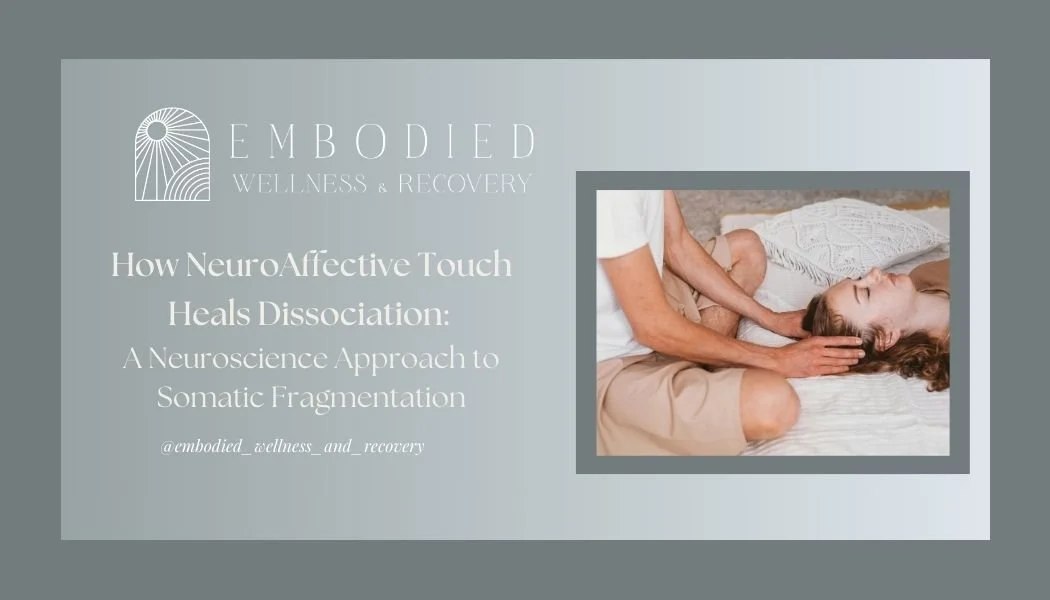
How NeuroAffective Touch Heals Dissociation: A Neuroscience Approach to Somatic Fragmentation
How NeuroAffective Touch Heals Dissociation: A Neuroscience Approach to Somatic Fragmentation
Discover how NeuroAffective Touch supports healing from dissociation, somatic fragmentation, and unresolved trauma by integrating body-based safety, nervous system repair, and relational regulation.
How NeuroAffective Touch Heals Dissociation: A Neuroscience Approach to Somatic Fragmentation
Dissociation can feel confusing, frightening, and profoundly isolating. Many people describe it as “being here but not here,” “watching life from the outside,” or “feeling disconnected from my body.” For others, it shows up as numbness, zoning out, emotional deadness, or losing time. These experiences are not a sign of weakness. They are the nervous system’s attempt to survive overwhelming experiences that the body could not process at the time.
But dissociation does not only affect thoughts. It affects the body. It fragments physical sensations, emotional presence, and a core sense of self. Trauma disrupts the relationship between mind, body, and identity, leaving people feeling scattered, unsafe, or disconnected inside their own skin.
This is where NeuroAffective Touch becomes uniquely powerful. Unlike talk therapy alone, which often cannot reach the implicit memory systems where trauma is stored, NeuroAffective Touch works directly with the nervous system to restore safety, integration, and embodied presence.
At Embodied Wellness and Recovery, NeuroAffective Touch is integrated into our trauma-informed approach to help clients restore connection, wholeness, and self-regulation from the inside out.
What Is NeuroAffective Touch?
NeuroAffective Touch is a somatic, relational, hands-on therapeutic modality developed by Dr. Aline LaPierre. It is grounded in developmental neuroscience, attachment theory, and polyvagal principles. The method uses skilled, respectful, attuned touch to regulate the nervous system and repair early attachment injuries.
Unlike massage or bodywork, NeuroAffective Touch focuses on emotional and relational development. The touch is slow, intentional, and supportive. It offers the body an experience of co-regulation and safety that may have been missing during crucial early periods of life.
NeuroAffective Touch communicates safety where words alone cannot.
Why Trauma Creates Dissociation and Fragmentation
Trauma overwhelms the brain’s capacity to regulate emotional and physiological states. When the nervous system cannot escape, fight, or seek safety, it may default to dissociation.
Dissociation serves as a biological protective mechanism by:
— Numbing overwhelming sensations
— Disconnecting from emotional pain
— Distancing from the environment
— Reducing awareness to tolerate threat
Although dissociation can protect a person in the moment, chronic dissociation impairs daily functioning. It disrupts:
— Emotional regulation
— Stable sense of self
— Physical presence
— Connection with others
— Ability to feel safe
— Capacity for intimacy
Many people with early trauma describe feeling “cut off” from their bodies or “floating through life.”
NeuroAffective Touch offers a pathway back.
The Neuroscience Behind Somatic Fragmentation
Somatic fragmentation occurs when the nervous system organizes itself around survival rather than connection. Trauma disrupts integration in several key areas:
1. The Polyvagal System
Trauma often forces the body into dorsal vagal shutdown, leading to numbness, collapse, and disconnection.
2. The Amygdala and Limbic System
Overactivation keeps the body on alert, leading to hypervigilance and emotional overwhelm.
3. The Prefrontal Cortex
Trauma reduces access to executive functioning, making grounding and presence difficult.
4. Implicit Memory Networks
Trauma is stored nonverbally in the body, not in words. These memories must be processed through sensation, movement, and relational attunement.
5. Attachment Pathways
Early relational trauma creates disrupted internal maps that shape emotional regulation, touch tolerance, and relational safety.
NeuroAffective Touch specifically targets these systems through the language of the body.
How NeuroAffective Touch Helps Heal Dissociation
NeuroAffective Touch supports dissociation recovery by working directly with the nervous system and the body’s relational wiring.
1. It Restores Safety Through Co-Regulation
Trauma often occurs without the presence of a supportive adult. Attuned touch gives the body an experience it may never have received: a safe, nurturing, regulated presence.
2. It Reconnects the Body and Mind
Touch helps reintegrate sensory, emotional, and physical awareness. Clients begin noticing sensations they previously had no access to.
3. It Heals Developmental Attachment Injuries
Gentle touch communicates attunement, presence, and care, which support the repair of early relational wounds.
4. It Supports Emotional Regulation
Slow, intentional touch stimulates the ventral vagal system, promoting calmness and resilience.
5. It Rewrites Implicit Memory
Trauma stored in the body is accessed and reorganized through therapeutic touch and relational presence.
6. It Reduces Shame and Self-Blame
The experience of being cared for at a nervous system level counters deep shame narratives that trauma often leaves behind.
7. It Supports Integration and Wholeness
Clients often describe feeling “more in their body,” “more real,” or “able to feel again.”
What a Session Looks Like
NeuroAffective Touch sessions are gentle, slow, and deeply collaborative. Clients remain fully clothed. Touch may be applied to areas associated with developmental attachment, such as the upper back, arms, hands, pelvis, or feet.
Sessions may include:
— Grounding and sensory tracking
— Guided breath awareness
— Hands-on support to specific regions of the body
— Relational attunement and co-regulation
— Verbal reflection to integrate physical experiences
The goal is always safety, choice, and honoring the client’s pace.
Who Can Benefit from NeuroAffective Touch?
Individuals experiencing:
— Dissociation
— Somatic numbness
— Emotional shutdown
— Chronic freeze
— Complex PTSD
— Developmental trauma
— Attachment wounds
— Difficulty with embodied presence
— Fragmentation or inner disconnection
— Difficulty tolerating emotional closeness
Often find NeuroAffective Touch deeply transformative.
How NeuroAffective Touch Fits into Trauma Treatment at Embodied Wellness and Recovery
At Embodied Wellness and Recovery, NeuroAffective Touch is integrated with:
— EMDR therapy
— Attachment-focused EMDR
— Somatic Experiencing
— IFS and parts work
— Polyvagal-informed therapy
— Mindfulness and breath-based regulation
— Trauma-informed relational psychotherapy
This integrative approach helps clients rebuild safety, connection, and emotional resilience at both a cognitive and cellular level.
Trauma may fracture the body’s sense of wholeness, but the nervous system is capable of profound repair when given the right conditions.
A Pathway Back to Yourself
Dissociation and somatic fragmentation are not signs of weakness. They are evidence of the body’s incredible ability to survive. NeuroAffective Touch offers a compassionate, neuroscience-informed pathway to reconnect with your body, restore emotional presence, and rebuild inner coherence.
With attuned support, the body can learn to feel safe again. The mind can return home to the body. And the fragmented parts can integrate into a grounded, connected whole.
Reach out to schedule a complimentary 20-minute consultation with our team of therapists, trauma specialists, somatic practitioners, or relationship experts, and start working towards integrative, embodied healing today.
📞 Call us at (310) 651-8458
📱 Text us at (310) 210-7934
📩 Email us at admin@embodiedwellnessandrecovery.com
🔗 Visit us at www.embodiedwellnessandrecovery.com
👉 Check us out on Instagram @embodied_wellness_and_recovery
🌍 Explore our offerings at Linktr.ee: https://linktr.ee/laurendummit
References
1) LaPierre, A. (2021). NeuroAffective Touch: Healing through the body in psychotherapy. W. W. Norton.
2) Porges, S. W. (2017). The pocket guide to the polyvagal theory: The transformative power of feeling safe. W. W. Norton.
3) Siegel, D. J. (2020). The developing mind: How relationships and the brain interact to shape who we become (3rd ed.). Guilford Press.

Attracting Healthy Love by Rewiring Your Autonomic Nervous System: A Neuroscience Approach to Secure Relationships
Attracting Healthy Love by Rewiring Your Autonomic Nervous System: A Neuroscience Approach to Secure Relationships
Learn how your autonomic nervous system influences who you are attracted to, why you repeat unhealthy relationship patterns, and how somatic and trauma-informed practices can help you attract and sustain healthy love. Discover neuroscience-based tools used at Embodied Wellness and Recovery to regulate your nervous system, transform attachment patterns, and create emotionally secure relationships.
Attracting Healthy Love by Rewiring Your Autonomic Nervous System
Why does love feel so different for each person?
Why do some people find themselves repeatedly drawn to emotionally unavailable, unpredictable, or unsafe partners?
Why does part of you crave deep connection, while another part shuts down, gets anxious, or feels overwhelmed when love becomes real?
These patterns are not reflections of weakness or poor judgment. They reflect the autonomic nervous system. The body chooses partners long before the mind does. Attraction is often shaped by familiarity, not necessarily by what is healthy.
At Embodied Wellness and Recovery, we help clients understand the neuroscience behind their attachment patterns and learn how to regulate the nervous system in ways that support secure, stable, nourishing love. When your nervous system feels safe, you stop being drawn to chaos, intensity, or inconsistency and begin to feel attracted to partnership that is emotionally steady and supportive.
Why We Attract the Same Unhealthy Patterns
If you find yourself asking questions like:
— Why do I keep choosing partners who emotionally abandon me?
— Why am I only attracted to people who are unpredictable or difficult to read?
— Why do secure partners feel boring or unfamiliar?
— Why do I lose interest when someone treats me with kindness?
— Why does my anxiety spike in healthy relationships?
The answer often lies in autonomic conditioning. The nervous system seeks out what it has learned to interpret as familiar, even if early experiences of emotional inconsistency, rejection, chaos, or neglect shaped that familiarity.
Trauma research shows that the nervous system stores implicit memories of what love felt like in childhood. If love was inconsistent, confusing, or painful, the body may unconsciously recreate that pattern in adulthood.
This is not self-sabotage. It is survival learning.
The Autonomic Nervous System: Your Internal Compass in Love
The autonomic nervous system has three main pathways that shape how you respond to intimacy:
1. Ventral Vagal State (Safety and Connection)
In this state, your body feels calm, stable, open, and capable of emotional presence. You can tolerate intimacy, vulnerability, and healthy dependence. This is the foundation of secure attachment.
2. Sympathetic State (Fight or Flight)
When early attachment wounds are activated, the body may shift into anxiety, fear, or hypervigilance. You may feel panicked by closeness, desperate to keep someone from leaving, or easily triggered by emotional ambiguity.
3. Dorsal Vagal State (Freeze or Shutdown)
If the connection feels overwhelming or unsafe, the body may collapse into numbness, disconnection, or withdrawal. You may lose interest quickly, feel shut down during conflict, or detach emotionally.
When the autonomic nervous system learns unsafe patterns early in life, it may interpret healthy, stable love as unfamiliar. It may interpret intensity, emotional distance, or inconsistency as a sign of connection.
This is why rewiring the autonomic nervous system is essential for attracting healthy love.
How Trauma Shapes Attraction and Relationship Patterns
Trauma does not only affect how you think. It affects how you feel, sense, and interpret the world.
Neuroscience shows that:
— The amygdala becomes sensitized to familiar emotional patterns
— The vagus nerve influences attachment and connection
— The prefrontal cortex goes offline during triggers
— The nervous system can misread healthy love as unsafe
— Old relational templates guide attraction automatically
You may feel drawn to partners who replicate old wounds because the nervous system confuses familiarity with safety. This can show up as:
— Feeling more drawn to partners who are emotionally unpredictable
— Losing interest when someone is available and attuned
— Confusing chemistry with chaos
— Mistaking anxiety for passion
— Tolerating emotional inconsistency because it feels known
The nervous system learns love through repetition. To attract healthy love, the body must learn a new template for safety.
Rewiring Your Nervous System to Attract Healthy Love
At Embodied Wellness and Recovery, our work integrates somatic therapy, Attachment Focused EMDR, polyvagal theory, and trauma-informed relationship work to help the nervous system rewire patterns at their root.
Below are the core components of the transformation process.
1. Increasing Autonomic Awareness
The first step toward secure love is learning how to identify your nervous system states.
Questions we explore with clients include:
— Does your body tighten or relax around emotionally available partners?
— Do you mistake intensity for connection?
— What sensations tell you that you are shifting into anxiety or withdrawal?
— What does safety feel like in your body?
— What triggers your nervous system in relationships?
Awareness creates choice.
2. Building Somatic Safety
Healthy love requires the ability to feel safe in connection. Your body must learn how to tolerate closeness without going into fight, flight, or freeze.
Somatic practices we use include:
— Grounding and sensory awareness
— Diaphragmatic breathwork
— Orienting
— Bilateral stimulation
— Co-regulation exercises
— Interoceptive tracking
When the body feels safe, you naturally gravitate toward partners who feel safe too.
3. EMDR to Heal Attachment Wounds
Attachment-Focused EMDR helps process childhood memories that shaped your nervous system’s template for love. When these wounds are healed, the emotional charge that pulls you into unhealthy relationships fades.
Clients often say that unhealthy patterns suddenly feel less appealing, while steadier partners become more interesting and emotionally attractive.
4. Repatterning Attraction Through Consistency
The nervous system learns through repetition.
We help clients create new emotional experiences of:
— Steady attention
— Healthy boundaries
— Emotional attunement
— Reliability
— Repair during conflict
Over time, your body begins to interpret these qualities as the new baseline for connection.
This is the foundation of secure love.
5. Aligning Relationships With a Regulated Nervous System
A regulated nervous system helps you:
— Choose partners who can meet you emotionally
— Identify red flags sooner
— Communicate without panic or shutdown
— Stay present during conflict
— Trust consistency
— Cultivate deeper intimacy
— Create secure attachment
Healthy love is not built from the mind alone. It emerges from a nervous system that feels safe.
Why Doing This Work Matters
Suppose you have been drawn to emotionally avoidant partners, chaotic relationships, or relationships that leave you anxious, depleted, or confused. In that case, your nervous system may be holding on to old emotional imprints that need attention.
At Embodied Wellness and Recovery, we understand that love begins in the body.
By helping clients regulate their nervous systems, heal early attachment wounds, and experience emotional safety, we create the conditions for meaningful, stable, and mutually supportive relationships.
Attraction can change.
Your patterns can transform.
And your nervous system can learn a new way to love.
Reach out to schedule a complimentary 20-minute consultation with our team of therapists, trauma specialists, somatic practitioners, or relationship experts, and start working towards integrative, embodied healing today.
📞 Call us at (310) 651-8458
📱 Text us at (310) 210-7934
📩 Email us at admin@embodiedwellnessandrecovery.com
🔗 Visit us at www.embodiedwellnessandrecovery.com
👉 Check us out on Instagram @embodied_wellness_and_recovery
🌍 Explore our offerings at Linktr.ee: https://linktr.ee/laurendummit
References
1) Levine, A., & Heller, R. (2010). Attached: The new science of adult attachment and how it can help you find and keep love. TarcherPerigee.
2) Porges, S. W. (2011). The polyvagal theory: Neurophysiological foundations of emotions, attachment, communication, and self-regulation. W. W. Norton and Company.
3) Schore, A. N. (2012). The science of the art of psychotherapy. W. W. Norton and Company.
When Attachment Shapes the Self: How Early Wounds Influence Personality and Adult Relationships
When Attachment Shapes the Self: How Early Wounds Influence Personality and Adult Relationships
Explore how early attachment wounds affect personality development, emotional regulation, and adult relationships, and how trauma-informed therapy supports healing.
When Attachment Shapes the Self: How Early Wounds Influence Personality and Adult Relationships
Why do certain relationships feel overwhelming, confusing, or emotionally intense?
Why do some people shut down, while others cling, lash out, or spiral into fear when conflict arises?
Why does love feel safe for some and threatening for others?
These struggles often trace back to early attachment wounds, which are powerful imprints on the developing brain and nervous system. For many adults, these imprints can influence personality, identity, emotional regulation, and ultimately the way they show up in relationships.
In fact, research shows that early attachment experiences have a measurable effect on brain wiring, shaping everything from stress responses to interpersonal sensitivity and contributing to the development of certain personality disorders. These are not character flaws. They are adaptations formed in environments where connection was inconsistent, unpredictable, frightening, or absent.
At Embodied Wellness and Recovery, we see daily how early relational trauma shapes adult suffering, and how compassionate, somatic, attachment focused therapy offers a path toward integration and emotional stability.
Understanding Attachment Wounds: The Foundation of Personality
Attachment is not simply a psychological concept. It is a physiological process, grounded in the nervous system and relational experience. During infancy and childhood, our brains rely on caregivers to regulate stress, interpret the world, and shape our sense of self.
When caregivers are consistent, attuned, and emotionally available, children develop secure attachment, fostering resilience, emotional regulation, and a healthy sense of identity.
But when caregivers are:
— Unpredictable
— Emotionally volatile
— Dismissive or critical
— Chronically misattuned
— Frightening, chaotic, or neglectful
— Emotionally absent even when physically present
The developing child experiences profound nervous system dysregulation. Over time, these experiences become associated with identity formation, emotional expectations in relationships, and patterns of survival based on protection rather than connection.
These early adaptations can influence the emergence of personality disorders, particularly those characterized by emotional reactivity, relational instability, abandonment fears, dissociation, or rigid self-protection.
The Neuroscience: How Early Wounds Reshape the Brain
Attachment relationships shape early brain development, especially:
— The amygdala
— The hippocampus
— The prefrontal cortex
— The vagus nerve and the autonomic nervous system
When a child is consistently stressed by chaotic relationships or emotional absence, the brain shifts into a survival-based pattern.
Common neurobiological impacts include:
1. Overactivation of the Amygdala
This leads to hypervigilance, fear-based responses, emotional reactivity, and difficulty trusting others.
2. Underdevelopment of Prefrontal Integration
This impairs emotional regulation, impulse control, self-reflection, and the ability to tolerate distress.
3. Disrupted hippocampal Development
This affects memory integration, narrative coherence, and the ability to make sense of past experiences.
4. A Dysregulated Vagus Nerve
This results in chronic sympathetic arousal or shutdown patterns often seen in trauma and personality disorders.
Over time, these patterns can solidify into characteristic traits that resemble borderline personality disorder, narcissistic adaptations, avoidant personality structures, and other relationally rooted patterns.
These are not personality flaws. They are neurobiological adaptations to emotional environments that did not support safety, attunement, or healthy development.
How Early Attachment Wounds Show Up in Adult Relationships
Clients often describe patterns like:
— Intense fear of abandonment
— Difficulty trusting or depending on others
— Emotional flooding or shutdown during conflict
— Engaging in people pleasing or perfectionism
— Pushing others away when they get too close
— Becoming clingy, controlling, or hypervigilant
— Attracting emotionally unavailable partners
— Alternating between idealizing and devaluing loved ones
— Feeling chronically misunderstood or unseen
— Struggling to manage anger, shame, or emptiness
These are not signs of weakness. They are signs of early attachment adaptations still operating in an adult nervous system.
Attachment wounds create internal working models such as:
— “I am too much.”
— “I am not enough.”
— “People leave.”
— “Love is unpredictable.”
— “I must perform to be accepted.”
— “Closeness is dangerous.”
— “If I rely on others, I will be disappointed.”
These beliefs influence emotional responses, relational patterns, and how a person navigates intimacy, conflict, and vulnerability.
The Link to Personality Disorders
Many personality disorders are deeply rooted in early relational trauma.
This includes:
— Borderline Personality Disorder
— Narcissistic Personality Disorder
— Avoidant Personality Disorder
— Dependent Personality Disorder
— Obsessive Compulsive Personality Disorder
— Paranoid Personality Disorder
While each presents differently, they share a common thread:
a developing self that struggled to form securely in the absence of consistent, attuned caregiving.
For example:
Borderline Adaptations
Emerge from inconsistent caregiving, unpredictability, or emotional volatility. The nervous system becomes primed for threat, leading to abandonment fears and difficulty regulating emotions.
Narcissistic Adaptations
Often emerge when a child’s emotional needs are ignored, minimized, or shamed. The child develops protective self-enhancement to survive emotional neglect.
Avoidant Adaptations
Come from dismissive or emotionally unavailable caregivers, teaching the child that vulnerability is unsafe and emotions must be suppressed.
Dependent Patterns
Develop when caregivers are intrusive, overcontrolling, or fail to support autonomy. The child learns they cannot trust themselves.
These are relational injuries, not inherent character flaws.
Hope Through Healing: How Somatic and Attachment Focused Therapy Helps
The good news is that the brain is capable of profound change through neuroplasticity.
Therapy that focuses on nervous system regulation, compassionate attunement, and trauma integration helps repair early attachment injuries.
At Embodied Wellness and Recovery, our approach blends:
— Somatic therapy
— EMDR
— Attachment-focused EMDR
— Polyvagal-informed interventions
— IFS parts work
— Trauma-informed psychotherapy
— Interpersonal neurobiology
— Relational repair
— Nervous system stabilization
— Boundary work
— Emotional regulation skills
Clients learn to:
— Track internal sensations rather than fear them
— Regulate intense emotions without shutting down
— Build secure internal attachment templates
— Explore their parts with compassion
— Form healthier, more stable relationships
— Expand their capacity for intimacy
— Reduce shame and self-blame
— Heal the nervous system patterns created long ago
Therapy does not erase early wounds, but it transforms their impact and creates new patterns of relating, connecting, and experiencing the world.
A Path Forward
If early attachment wounds continue to shape your relationships, reactions, or sense of self, there is a path toward transformation rooted in compassion, neuroscience, and safety.
At Embodied Wellness and Recovery, we specialize in treating attachment trauma, personality disorder adaptations, and nervous system dysregulation with a deeply attuned, body-based, relational approach.
Your early environment shaped your beginnings, but it does not define your future.
Reach out to schedule a complimentary 20-minute consultation with our team of therapists, trauma specialists, somatic practitioners, or relationship experts, and start working towards integrative, embodied healing and attuned connection today.
📞 Call us at (310) 651-8458
📱 Text us at (310) 210-7934
📩 Email us at admin@embodiedwellnessandrecovery.com
🔗 Visit us at www.embodiedwellnessandrecovery.com
👉 Check us out on Instagram @embodied_wellness_and_recovery
🌍 Explore our offerings at Linktr.ee: https://linktr.ee/laurendummit
References (APA)
Siegel, D. J. (2012). The developing mind: How relationships and the brain interact to shape who we are. Guilford Press.
Schore, A. N. (2003). Affect dysregulation and disorders of the self. W. W. Norton.
Van der Kolk, B. A. (2014). The body keeps the score: Brain, mind, and body in the healing of trauma. Viking.