
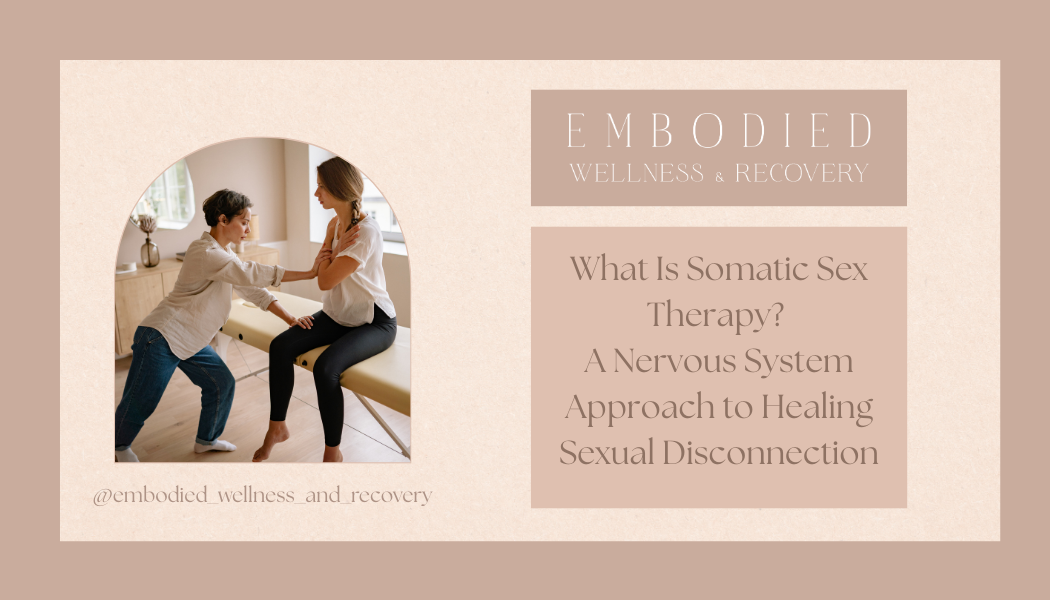
What Is Somatic Sex Therapy? A Nervous System Approach to Healing Sexual Disconnection
What Is Somatic Sex Therapy? A Nervous System Approach to Healing Sexual Disconnection
What is somatic sex therapy? Learn how a body-based, neuroscience-informed approach helps heal sexual disconnection, trauma, and intimacy challenges by restoring nervous system safety.
When Sexuality Feels Distant or Numb
Do you feel disconnected from your body during intimacy?
Do you know intellectually that you want closeness, yet your body feels shut down, tense, or absent?
Do you struggle to access desire, pleasure, or safety despite caring deeply about your partner or your own sexual well-being?
For many people, sexual difficulty is not about technique, attraction, or effort. It is about the relationship between the nervous system and the body. When the body does not feel safe, sexuality often becomes muted, mechanical, or overwhelming.
Somatic sex therapy offers a body-based, trauma-informed approach to restoring sexual connection by working directly with the nervous system rather than trying to override it.
What Is Somatic Sex Therapy?
Somatic sex therapy is a form of psychotherapy that integrates talk therapy with body-based awareness to address sexual concerns. It focuses on how the body holds stress, trauma, and protective patterns that shape sexual experience. Rather than asking only what you think or believe about sex, somatic sex therapy explores what your body is communicating through sensation, tension, numbness, or avoidance. This approach recognizes that sexuality is not solely psychological. It is physiological and relational, deeply shaped by the nervous system.
How Somatic Sex Therapy Differs From Traditional Sex Therapy
Traditional sex therapy often emphasizes communication skills, education, and cognitive reframing. While these are valuable, they may not be sufficient when sexual difficulties are rooted in trauma or chronic nervous system dysregulation.
Somatic sex therapy differs by:
— Centering bodily sensation and awareness
— Working with nervous system states rather than symptoms alone
— Exploring how safety, threat, and regulation shape sexual response
— Moving at the pace of the body rather than pushing for change
This approach is especially helpful for individuals who understand their sexual challenges intellectually but continue to feel stuck physically.
The Neuroscience Behind Sexual Disconnection
Sexuality relies on a regulated nervous system. The same systems that govern safety, threat, and connection also shape arousal, desire, and pleasure.
When the nervous system perceives danger, whether from past trauma, relational stress, or internalized shame, it prioritizes protection over pleasure.
This can show up as:
— Low desire or absence of arousal
— Difficulty staying present during sex
— Dissociation or numbness
— Pain or tension in the body
— Feeling pressured or disconnected
These responses are not malfunctions. They are protective adaptations.
Trauma and the Body’s Relationship to Sex
Trauma does not have to be sexual in nature to affect sexuality. Emotional neglect, chronic criticism, boundary violations, or growing up in environments where emotions were unsafe can all shape how the body experiences intimacy. Over time, the body may learn that closeness requires vigilance or withdrawal. Sexual response becomes constrained not by lack of interest, but by the nervous system’s need to stay safe.
Somatic sex therapy works with these protective responses rather than against them.
Common Issues Addressed in Somatic Sex Therapy
Somatic sex therapy can support individuals and couples experiencing:
— Sexual numbness or disconnection
— Desire discrepancies
— Difficulty accessing pleasure
— Performance anxiety
— Pain during sex
— Trauma-related sexual shutdown
— Intimacy avoidance
— Shame around sexuality
By addressing the nervous system directly, therapy helps create the conditions where sexual responsiveness can return organically.
What Happens in Somatic Sex Therapy Sessions?
Sessions typically include a combination of verbal exploration and guided body awareness. Clients remain fully clothed and in control at all times.
Therapy may involve:
— Tracking bodily sensations while discussing sexual themes
— Learning to notice signs of activation or shutdown
— Developing skills for grounding and regulation
— Exploring boundaries and consent at a somatic level
— Increasing tolerance for pleasure and connection
The work is collaborative, paced, and deeply respectful of the body’s signals.
Why Safety Is the Foundation of Sexuality
From a nervous system perspective, desire emerges most naturally when the body feels safe enough to relax.
Somatic sex therapy emphasizes:
— Predictability and pacing
— Choice and agency
— Attunement and responsiveness
— Repair after rupture
These elements help the nervous system update old patterns and learn that intimacy can be experienced without threat.
Somatic Sex Therapy and Relationships
In relational work, somatic sex therapy helps partners understand each other’s nervous system responses rather than interpreting sexual difficulties as rejection or lack of attraction.
Couples often learn:
— How stress and trauma affect desire
— How to slow down and co-regulate
— How to create emotional and physical safety
— How to communicate boundaries without shame
This approach supports both emotional intimacy and sexual connection.
Somatic Sex Therapy for Individuals
For individuals, somatic sex therapy provides a space to reconnect with the body on one’s own terms. This can be particularly important for those who have learned to disconnect from sensation as a form of protection.
Therapy helps individuals:
— Develop embodied awareness
— Reclaim agency and choice
— Explore desire without pressure
— Build a more compassionate relationship with the body
Over time, this supports a more integrated sense of sexuality.
Why Talk Alone Is Often Not Enough
Many people have insight into their sexual history and patterns. Yet insight alone does not always lead to change. Neuroscience shows that trauma is stored in implicit memory and autonomic responses. These systems respond to sensation and experience rather than logic (Miller-Karas & Sapp, 2015).
Somatic sex therapy engages these deeper layers, allowing the body to participate in healing rather than being left behind.
How Embodied Wellness and Recovery Approaches Somatic Sex Therapy
At Embodied Wellness and Recovery, somatic sex therapy is grounded in trauma-informed, neuroscience-based care.
Our approach integrates:
— Somatic and attachment-based psychotherapy
— Nervous system regulation
— EMDR and trauma processing
— Sex therapy and intimacy-focused work
We support individuals and couples in reconnecting with their bodies, their desires, and their capacity for safe intimacy.
A Compassionate Reframe
If sexuality feels distant or complicated, it does not mean something is wrong with you. It often means your nervous system learned to protect you in ways that once made sense. With support that honors the body’s wisdom, new experiences of connection and pleasure can gradually and sustainably emerge.
Reach out to schedule a complimentary 20-minute consultation with our team of therapists, trauma specialists, somatic practitioners, or relationship experts, and start working towards integrative, embodied healing today.
📞 Call us at (310) 651-8458
📱 Text us at (310) 210-7934
📩 Email us at admin@embodiedwellnessandrecovery.com
🔗 Visit us at www.embodiedwellnessandrecovery.com
👉 Check us out on Instagram @embodied_wellness_and_recovery
🌍 Explore our offerings at Linktr.ee: https://linktr.ee/laurendummit
References
1) Levine, P. A. (2010). In an unspoken voice: How the body releases trauma and restores goodness. North Atlantic Books.
2) Miller-Karas, E., & Sapp, M. (2015). The Nervous System, Memory, and Trauma. In Building Resilience to Trauma (pp. 10-29). Routledge.
3) Porges, S. W. (2011). The polyvagal theory: Neurophysiological foundations of emotions, attachment, communication, and self-regulation. W. W. Norton & Company.
4) Siegel, D. J. (2012). The developing mind: How relationships and the brain interact to shape who we are (2nd ed.). Guilford Press.
5) van der Kolk, B. A. (2014). The body keeps the score: Brain, mind, and body in the healing of trauma. Viking.
Talking About Sex Without Fear: A Neuroscience-Informed Guide to Healthier Conversations About Sexual Expectations
Talking About Sex Without Fear: A Neuroscience-Informed Guide to Healthier Conversations About Sexual Expectations
Struggling to talk about sexual expectations can create distance and resentment. Learn how trauma-informed, neuroscience-based therapy helps couples communicate intimacy needs with safety and clarity.
Why Conversations About Sexual Expectations Feel So Hard
Many people long for deeper sexual connection yet find themselves avoiding conversations about sex altogether. You may want to talk about desire, frequency, boundaries, or dissatisfaction, but when the moment comes, your throat tightens, your mind goes blank, or conflict quickly erupts.
You might be asking yourself:
Why is it so hard to talk about sex with the person I love?
Why do these conversations turn into arguments or shutdown?
Why do I feel ashamed or anxious about asking for what I need?
Why does my partner seem defensive or distant when I bring this up?
Difficulty communicating sexual expectations is not a sign that something is wrong with your relationship. It is often a sign that intimacy is activating vulnerable places in the nervous system shaped by attachment history, trauma, and early messaging about sex.
Understanding this through a neuroscience and trauma-informed lens changes everything.
Sex, Vulnerability, and the Nervous System
Sexuality is not just a physical act. It is deeply tied to emotional safety, attachment, and self-worth. When we talk about sex, we are often talking about:
— Feeling wanted or rejected
— Fear of being too much or not enough
— Shame around desire or pleasure
— Vulnerability around our bodies
— Early experiences of consent or coercion
From a neuroscience perspective, conversations about sex activate the same brain regions involved in threat detection and social bonding. If the nervous system perceives danger, even subtle emotional danger, the body shifts into fight, flight, freeze, or appease.
This can look like defensiveness, withdrawal, people pleasing, or emotional shutdown.
Why Sexual Expectations Go Unspoken
Many people were never taught how to talk about sex in a healthy way. Cultural, familial, and religious messages often frame sex as taboo, shameful, or something to endure rather than explore.
Common internalized beliefs include:
— Wanting sex makes me needy
— Talking about sex will hurt my partner
— Desire should be spontaneous, not discussed
— Good partners should just know
— Conflict about sex means the relationship is failing
These beliefs keep sexual expectations buried, where they often emerge as resentment, avoidance, or loss of desire.
Attachment Styles and Sexual Communication
Attachment patterns strongly influence how people communicate about intimacy.
— Anxiously attached individuals may fear rejection and soften or suppress their needs to maintain connection.
— Avoidantly attached individuals may feel overwhelmed by sexual conversations and withdraw to protect autonomy.
— Disorganized attachment can create cycles of craving closeness and then feeling unsafe once intimacy increases.
Therapy helps partners recognize these patterns without blame and learn new ways of staying connected during difficult conversations.
How Trauma Impacts Sexual Conversations
Trauma, including emotional neglect, sexual shame, or past violations of consent, shapes how safe it feels to talk about sex. Even when trauma is not consciously remembered, the body remembers.
A nervous system shaped by trauma may associate sexual conversations with danger, loss of control, or emotional exposure. This is why logic alone rarely fixes intimacy struggles.
Healing requires working with the nervous system, not against it.
What Healthier Conversations About Sexual Expectations Look Like
Healthier conversations about sexual expectations are not about persuasion or performance. They are about mutual understanding and emotional safety.
These conversations include:
— Curiosity rather than accusation
— Speaking from personal experience rather than blame
— Pacing that respects nervous system limits
— Willingness to listen without fixing
— Room for difference without threat
When safety is present, honesty becomes possible.
A Neuroscience-Informed Framework for Sexual Conversations
1. Regulate Before You Communicate
Before initiating a conversation about sex, check in with your body. Are you already activated, anxious, or resentful? If so, your nervous system may not be ready for connection.
Grounding practices such as slow breathing, orienting to the room, or gentle movement help bring the nervous system into a more regulated state.
2. Speak From the Inside Out
Use language that reflects your internal experience rather than your partner’s behavior.
Instead of:
“You never want sex.”
Try:
“I notice I feel lonely and insecure when we do not connect physically.”
This keeps the nervous system engaged rather than defensive.
3. Normalize Difference
Differences in desire, frequency, and preferences are normal. Treating differences as a problem to solve rather than a threat reduces shame and power struggles.
4. Separate Desire From Worth
Desire fluctuates over time and is influenced by stress, health, hormones, trauma, and emotional safety. Therapy helps decouple sexual desire from self-worth so rejection is not experienced as abandonment.
5. Slow the Conversation Down
Many sexual conflicts escalate because partners try to resolve everything at once. Slowing down allows the nervous system to stay present and responsive.
How Therapy Supports Sexual Communication
At Embodied Wellness and Recovery, we help individuals and couples develop healthier sexual conversations through trauma-informed, nervous system-based therapy.
Therapy supports this work by:
— Identifying nervous system triggers around intimacy
— Processing shame and unexpressed emotions
— Repairing attachment injuries
— Rebuilding trust and emotional safety
— Teaching communication skills that align with regulation
This work often involves somatic therapy, EMDR, and attachment-focused approaches that address both mind and body.
Sexuality, Consent, and Emotional Safety
Healthy sexual conversations also require a shared understanding of consent. Consent is not just about yes or no. It includes emotional readiness, safety, and agency.
Therapy helps couples move away from obligation-based sex and toward connection-based intimacy.
What Changes When Sexual Expectations Are Spoken
When sexual expectations are communicated safely, couples often notice:
— Reduced resentment
— Increased emotional closeness
— Clearer boundaries
— More responsive desire
— Improved trust
— Greater sexual satisfaction
These changes reflect nervous system regulation and relational repair.
Why Professional Support Matters
Sexual communication is one of the most vulnerable areas of a relationship. Trying to navigate it without support can feel overwhelming, especially when trauma or attachment wounds are present.
Therapy offers a structured, compassionate space to explore these conversations without pressure or judgment.
At Embodied Wellness and Recovery, we specialize in helping individuals and couples develop emotionally safe, embodied, and sustainable intimacy.
Transform Intimacy
Struggling to talk about sexual expectations does not mean your relationship is broken. It implies intimacy is touching something important.
Through a neuroscience-informed, trauma-aware approach, therapy helps transform silence, shame, and conflict into clarity, connection, and mutual understanding.
Healthy sexual conversations are not about perfection. They are about presence, safety, and the courage to be known.
Reach out to schedule a complimentary 20-minute consultation with our team of therapists, trauma specialists, somatic practitioners, or relationship experts, and start working towards integrative, embodied healing today.
📞 Call us at (310) 651-8458
📱 Text us at (310) 210-7934
📩 Email us at admin@embodiedwellnessandrecovery.com
🔗 Visit us at www.embodiedwellnessandrecovery.com
👉 Check us out on Instagram @embodied_wellness_and_recovery
🌍 Explore our offerings at Linktr.ee: https://linktr.ee/laurendummit
References
1) Bancroft, J., Graham, C. A., Janssen, E., & Sanders, S. A. (2009). The dual control model: Current status and future directions. Journal of Sex Research, 46(2–3), 121–142.
2) Porges, S. W. (2011). The polyvagal theory: Neurophysiological foundations of emotions, attachment, communication, and self-regulation. W. W. Norton.
3) Siegel, D. J. (2012). The developing mind: How relationships and the brain interact to shape who we are. Guilford Press.
4) van der Kolk, B. A. (2014). The body keeps the score: Brain, mind, and body in the healing of trauma. Viking.

When Trust Shatters: How to Heal Emotional Exile After Betrayal
When Trust Shatters: How to Heal Emotional Exile After Betrayal
Feeling emotionally exiled after betraying your partner’s trust? Learn the neuroscience behind betrayal trauma and discover expert strategies to rebuild connection, trust, and intimacy from the team at Embodied Wellness & Recovery.
What Happens When Love Turns to Distance?
Have you ever felt like you're living in the same house as your partner, but you’re a stranger to them now? After a betrayal, many people describe feeling banished to an emotional wasteland. The partner who once offered affection and safety now withdraws, suspicious, guarded, and cold.
If you're the one who broke the trust—through infidelity, lies, or emotional secrecy—you may be desperately asking:
“How do I get them to trust me again?”
“Why can’t we just move forward?”
“What more can I do?”
These are valid questions. And while the answers aren’t simple, they are within reach—with compassion, neuroscience, and long-term relational work.
At Embodied Wellness & Recovery, we help individuals and couples navigate the storm of betrayal with grounded, trauma-informed care. Let’s explore what’s really happening in the brain and body when betrayal occurs—and what you can do to rebuild emotional connection, step by step.
The Neuroscience of Betrayal: Why It Hurts So Much
When trust is broken in a relationship, primarily through intimate betrayal like cheating or secret-keeping, the brain often reacts the same way it would to trauma. According to recent neurobiological research, betrayal activates the amygdala, the brain's fear center, flooding the body with stress hormones like cortisol and adrenaline (Van der Kolk, 2015).
This stress response makes sense: our attachments are wired for survival. When the person we rely on for safety becomes the source of pain, the brain enters a state of hypervigilance—constantly scanning for danger, inconsistencies, or further harm.
Your partner may experience:
– Emotional flashbacks
– Difficulty sleeping
– Obsessive thoughts about the betrayal
– Sudden waves of rage, despair, or numbness
– A need to ask repetitive questions or revisit painful details
These aren’t signs of being unforgiving. They are neurobiological symptoms of trauma.
Why “I’m Sorry” Isn’t Enough
If you're the partner who caused the betrayal, you may feel tempted to smooth things over quickly:
– “It didn’t mean anything.”
– “I said I’m sorry—what more do you want?”
– “You’re being too sensitive.”
These responses may be defensive, but they often come from shame. And yet, shame isn’t helpful in the healing process. What’s needed instead is accountability and empathy.
Accountability means fully owning the impact of your actions—not just what you did but how it made your partner feel.
Empathy means showing up emotionally, even when your partner is triggered or angry.
At Embodied Wellness & Recovery, we often tell our clients:
"You're not just rebuilding trust. You're rebuilding the nervous system’s sense of safety."
What Emotional Exile Feels Like
When your partner no longer trusts you, they may pull away in every possible way:
– Physically: avoiding eye contact, affection, or sexual connection
– Emotionally: closing off communication, withdrawing from conversation
– Relationally: becoming suspicious, controlling, or dismissive
This emotional exile feels excruciating—for both partners.
You might feel like:
– A ghost in your own home
– Every interaction is walking on eggshells
– Nothing you do is “enough” to prove your remorse
– You’re being punished indefinitely
But here’s the truth: the exile is not about punishment—it’s about protection. Your partner’s nervous system is on high alert. They are grieving what they thought your relationship was—and learning how to trust themselves again.
5 Expert-Backed Steps to Rebuild Trust and Safety
1. Radical Responsibility
Stop minimizing, blaming, or defending. Own what happened. Say:
“This is what I did. I see the pain it caused. I am committed to making it right.”
Neuroscience shows that emotional attunement—when one partner mirrors the other's pain without judgment—activates the brain’s soothing system (Siegel, 2012).
2. Practice Full Transparency
Trust is rebuilt through consistency and predictability. This may mean temporarily sharing phone passwords, schedules, or check-ins—not as punishment but as a container for safety.
Note: Transparency is not about being policed; it’s about becoming voluntarily trustworthy.
3. Validate Your Partner’s Emotions Every Time
Every wave of emotion, every trigger, and every moment of mistrust is an opportunity for you to practice empathy. Say:
“That makes sense. I understand why you feel that way.”
Avoid rushing your partner to heal on your timeline.
4. Repair in Small Moments
Big gestures can fall flat when trust is broken. What matters more are micro-moments of honesty, presence, and follow-through:
– Call when you say you will.
– Tell the truth even when it’s uncomfortable.
– Show emotional availability when your partner is upset.
These actions speak volumes to the nervous system.
5. Get Professional Support
Healing betrayal isn’t a DIY project. Trauma-informed couples therapy, EMDR, and somatic work can help regulate both partners’ nervous systems and rebuild a secure bond.
At Embodied Wellness & Recovery, our integrative approach combines:
– Attachment-focused couples therapy
– Somatic Experiencing and trauma work
– Sex therapy to repair intimacy
– EMDR for relational trauma
– Psychoeducation and accountability coaching
Hope Is Possible—Even After Deep Hurt
It may feel impossible now, but couples can come back from betrayal stronger, wiser, and more connected. Not because they forget what happened—but because they face it fully, with courage and consistency.
Remember: rebuilding trust is a process, not a performance.
You don’t have to get it perfect. You just have to show up—day after day—with openness, humility, and a willingness to grow.
Are You Ready to Begin Again—with Integrity?
If you’re stuck in emotional exile after betrayal—either as the one who betrayed or the one who was betrayed—know this:
You are not alone.
You are not broken.
And it is never too late to begin the repair work.
At Embodied Wellness & Recovery, we’re here to walk with you every step of the way.
Book a free 20-minute consultation with our team of top-rated therapists or parenting coaches today to begin your healing journey—with guidance from trauma-informed relationship experts who understand the neuroscience of trust, love, and repair.
References
Siegel, D. J. (2012). The Developing Mind: How Relationships and the Brain Interact to Shape Who We Are (2nd ed.). Guilford Press.
Van der Kolk, B. (2015). The Body Keeps the Score: Brain, Mind, and Body in the Healing of Trauma. Viking.
Weiss, R. (2017). Out of the Doghouse: A Step-by-Step Relationship-Saving Guide for Men Caught Cheating. Health Communications Inc.