
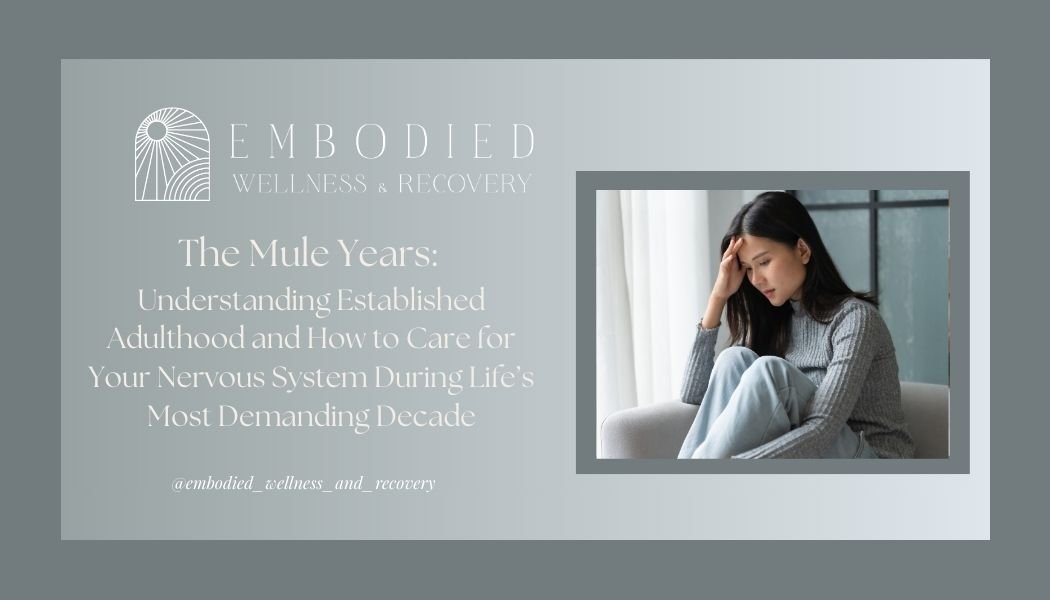
The Mule Years: Understanding Established Adulthood and How to Care for Your Nervous System During Life’s Most Demanding Decade
The Mule Years: Understanding Established Adulthood and How to Care for Your Nervous System During Life’s Most Demanding Decade
Established adulthood, often called the Mule Years, refers to the ages 30 to 45, when career pressure, parenting, and relationships collide. Learn how neuroscience-informed therapy supports resilience, balance, and well-being during this intense life stage.
Why So Many Adults Feel Exhausted Right Now
If you are in your thirties or early forties and feel constantly tired, emotionally stretched, or quietly overwhelmed, you may not be failing at adulthood. You may be living squarely in what psychologists now call “established adulthood.”
Coined in 2020 by developmental psychology professor Clare M. Mehta, established adulthood refers to the period between approximately ages 30 and 45. This stage captures a reality many people recognize instantly. These are the years when individuals are deeply invested in career development, sustaining long-term romantic partnerships, raising children, caring for aging parents, managing finances, and holding the emotional center of their families.
It is not young adulthood, which can stretch from 18 to 45 and lacks specificity. It is not middle adulthood, which often extends to age 65, and does not reflect the intensity of responsibility concentrated in this earlier window. Established adulthood is narrower, heavier, and more demanding.
Many people have started calling this phase “the mule years.” The image fits. A mule carries a heavy load, steadily and reliably, often without complaint. But even the strongest nervous system has limits.
What Is Established Adulthood and Why Does It Feel So Hard?
Established adulthood is often described as the most intense, demanding, and rewarding period of life. It is also one of the most physiologically stressful.
During this stage, many people are simultaneously:
— Building or maintaining career momentum
— Managing financial pressure and long-term planning
— Parenting young or school-age children
— Supporting a partner’s emotional and professional needs
— Navigating changes in identity, body, and sexuality
— Carrying unresolved trauma or attachment wounds
— Managing chronic stress with little downtime
You may find yourself asking:
Why am I so exhausted even when things are going well?
Why do I feel like I am always behind, no matter how hard I work?
Why does my nervous system feel fried by the end of the day?
Why do my relationships feel strained even though I care deeply?
These questions are not signs of weakness. They are signals from a nervous system under sustained load.
The Neuroscience of the Mule Years
From a neuroscience perspective, established adulthood places prolonged demands on the brain and body without adequate opportunities for recovery.
Chronic stress during this phase activates the hypothalamic-pituitary-adrenal axis, increasing cortisol and adrenaline over the long term. While these stress hormones are helpful in short bursts, sustained activation can impair sleep, emotional regulation, memory, immune function, and mood.
The prefrontal cortex, responsible for planning, decision making, and impulse control, becomes overtaxed when demands outpace rest. Meanwhile, the amygdala, the brain’s threat detection center, becomes more reactive, increasing anxiety, irritability, and emotional overwhelm.
Over time, the nervous system may adapt by staying in a state of low-grade hyperarousal or emotional shutdown. This can look like:
— Feeling constantly “on.”
— Difficulty relaxing even during downtime
— Emotional numbness or irritability
— Loss of pleasure or desire
— Increased conflict in relationships
— Physical symptoms like tension, headaches, or fatigue
In other words, the Mule Years are not just psychologically demanding. They are biologically taxing.
Why Established Adulthood Often Triggers Old Wounds
This life stage also has a way of activating unresolved trauma and attachment patterns.
Caring for children can stir up memories of how you were cared for. Career pressure can trigger old beliefs about worth and success. Relationship strain can activate fears of abandonment, inadequacy, or disconnection.
Many adults find that symptoms they thought they had outgrown resurface during this phase. Anxiety, perfectionism, people pleasing, emotional shutdown, or compulsive coping behaviors may intensify.
This is not regression. It is exposure. The nervous system is being asked to do more with fewer reserves.
Why Self-Care Advice Often Falls Flat During the Mule Years
Many people in established adulthood are told to practice better self-care. Take a bath. Meditate. Exercise more. While these practices can be helpful, they often fail to address the core issue.
The problem is not a lack of effort. It is a lack of nervous system support.
When stress is chronic and relational, it requires interventions that work with the body, not just the mind. This is where neuroscience-informed therapy becomes essential.
How Therapy Supports the Nervous System During Established Adulthood
At Embodied Wellness and Recovery, we specialize in helping adults navigate the Mule Years with greater regulation, resilience, and self-understanding.
Therapy during this phase is not about adding more to your to-do list. It is about helping your nervous system recover its capacity.
Key approaches include:
Somatic Therapy
Somatic therapy helps clients notice and regulate physical stress responses. Learning to track bodily sensations allows the nervous system to release stored tension and return to a state of balance.
Attachment Focused Work
Exploring attachment patterns helps adults understand why certain relationships feel especially draining or triggering during this stage. Strengthening secure attachment supports emotional resilience.
Trauma-Informed EMDR
EMDR helps reprocess past experiences that continue to drive stress responses in the present. This is particularly helpful for adults whose early trauma resurfaces during parenting or partnership challenges.
Nervous System Education
Understanding how stress affects the brain reduces shame and increases self-compassion. When clients understand their biology, they stop blaming themselves for symptoms that have a physiological basis.
Redefining Strength During the Mule Years
One of the most damaging myths of established adulthood is that strength means endurance without rest.
Neuroscience tells a different story. Resilience is not about pushing harder. It is about creating enough safety for the nervous system to recover.
True strength during this phase looks like:
— Recognizing limits without shame
— Building rhythms of rest and effort
— Asking for support rather than carrying everything alone
— Prioritizing regulation over productivity
— Allowing identity to evolve rather than clinging to outdated expectations
A New Way to Think About the Mule Years
Rather than viewing established adulthood as something to survive, it can be reframed as a period of profound integration.
These years ask us to integrate ambition with care, responsibility with pleasure, and effort with rest. They invite us to examine what we are carrying and whether it is sustainable.
With the proper support, this stage can become a time of deep growth, emotional maturity, and embodied wisdom.
You Are Carrying a Lot, and Your Body Knows It
If you are in your thirties or forties and feel like life is relentless, there is nothing wrong with you. You are living in a developmentally intense phase that places real demands on the nervous system.
Therapy offers a place to set the load down, even temporarily. It provides tools to help your brain and body recover, regulate, and reconnect.
At Embodied Wellness and Recovery, we help adults navigate established adulthood with compassion, neuroscience-informed care, and deep respect for the weight they are carrying.
You do not have to become lighter to survive the Mule Years. You need support that helps you carry the load differently.
Reach out to schedule a complimentary 20-minute consultation with our team of therapists, trauma specialists, somatic practitioners, or relationship experts, and start working towards integrative, embodied healing today.
📞 Call us at (310) 651-8458
📱 Text us at (310) 210-7934
📩 Email us at admin@embodiedwellnessandrecovery.com
🔗 Visit us at www.embodiedwellnessandrecovery.com
👉 Check us out on Instagram @embodied_wellness_and_recovery
🌍 Explore our offerings at Linktr.ee: https://linktr.ee/laurendummit
References (APA Format)
Mehta, C. M., Arnett, J. J., Palmer, C. G., & Nelson, L. J. (2020). Established adulthood: A new conception of ages 30 to 45. American Psychologist, 75(4), 431–444.
McEwen, B. S., & Akil, H. (2020). Revisiting the stress concept: Implications for affective disorders. Journal of Neuroscience, 40(1), 12–21.
Porges, S. W. (2011). The polyvagal theory: Neurophysiological foundations of emotions, attachment, communication, and self regulation. W. W. Norton.
van der Kolk, B. A. (2014). The body keeps the score: Brain, mind, and body in the healing of trauma. Viking.