
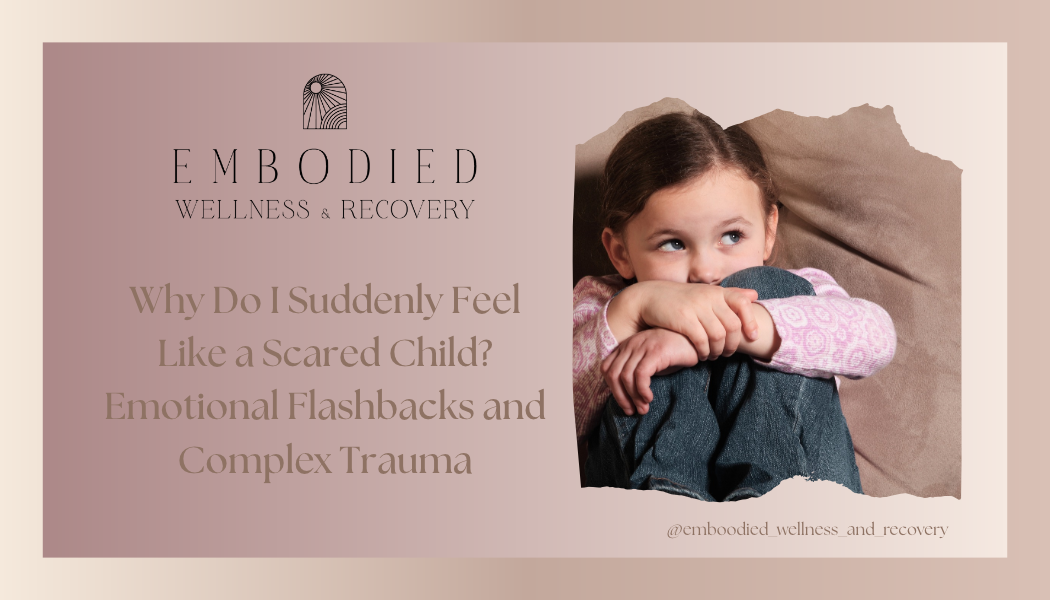
Why Do I Suddenly Feel Like a Scared Child? Emotional Flashbacks and Complex Trauma
Why Do I Suddenly Feel Like a Scared Child? Emotional Flashbacks and Complex Trauma
Suddenly feel small, scared, or ashamed? Learn about emotional flashbacks, complex trauma, and ways to feel grounded and regain choice.
You are answering an email, disagreeing with your partner, or listening to someone’s disappointed tone. Suddenly, you feel small. Your chest tightens. Words disappear. You want to apologize, hide, or make everything okay. Minutes earlier, you felt like a capable adult. Now, you feel terrified of getting in trouble.
Why does an ordinary interaction sometimes carry such extraordinary emotional weight? For some people, experiences described as emotional flashbacks offer one way to understand this shift. Understanding the pattern can help you respond with greater clarity and compassion.
What Is an Emotional Flashback?
An “Emotional flashback” describes an abrupt return of overwhelming feelings tied to earlier experiences, sometimes without a clear visual memory. Someone might feel helpless, ashamed, or frightened in a way that seems strikingly familiar.
The term is used in trauma discussions, but it is not a separate diagnosis in the DSM-5-TR or ICD-11. Feeling young or overwhelmed does not, by itself, establish PTSD, complex PTSD, or a history of abuse.
Research on PTSD flashbacks emphasizes involuntary re-experiencing and a sense that something from the past is happening now (Brewin, 2015). That research helps illuminate trauma-related experiences, but not every intense emotional reaction is a flashback. Your distress deserves attention without requiring you to diagnose it immediately.
Why Can Childhood Trauma Affect Adult Reactions?
Did disagreement once lead to punishment? Did you learn to monitor someone’s mood before expressing a need?
When earlier relationships involved danger or repeated intimidation, present-day cues may resemble what once preceded harm. A sharp voice or withdrawal can carry meanings that extend beyond the current moment.
Possible experiences include:
— Feeling powerless despite having choices.
— Becoming intensely ashamed after mild criticism.
— Struggling to speak or think clearly during conflict.
— Apologizing automatically to prevent someone’s displeasure.
— Wanting closeness while feeling compelled to escape.
These experiences can have several explanations, including anxiety, current relationship stress, and dissociation. A thoughtful assessment considers your history, present circumstances, and functioning rather than relying on a checklist.
Emotional Flashbacks and Complex PTSD
Complex trauma generally describes exposure to repeated or prolonged traumatic experiences. Complex PTSD is a specific ICD-11 diagnosis, requiring PTSD symptoms alongside persistent difficulties with emotion regulation, negative self-concept, and relationships.
Research developing the International Trauma Questionnaire used community and clinical samples to assess these symptom patterns (Cloitre et al., 2018). It supports distinguishing PTSD and complex PTSD within that framework, rather than treating every relational difficulty as evidence of complex trauma.
You can benefit from therapy whether or not you meet diagnostic criteria. The question is what support helps you feel more present and able to choose.
What Neuroscience Can Tell Us
Trauma responses involve interacting systems for threat detection, memory, attention, and emotional regulation.
Lanius et al. (2010) reviewed neuroimaging evidence suggesting that PTSD can involve different patterns: heightened emotional reactivity in some circumstances and dissociation or emotional detachment in others. Findings implicated networks involving the amygdala and prefrontal regions.
These are group-level findings, not a brain scan explanation for any individual moment. Still, they challenge the assumption that distress always looks like visible panic. You might feel flooded with fear. Instead, you might feel distant or blank. Neither response means you have failed at being an adult.
What to Do When You Suddenly Feel Small or Scared
The immediate goal is to regain enough steadiness to notice your options.
1. Check the present situation
Ask, “Am I facing danger or coercion right now?” If someone is threatening or intimidating you, prioritize distance and support. Grounding should not become a way to tolerate mistreatment.
2. Orient to where you are
Keep your eyes open if that feels easier. Name the room, today’s date, and a few objects you see. Try: “I am here, in this room. I can pause before answering.”
3. Choose one manageable point of contact
Notice your feet against the floor or the chair supporting you. If focusing inside your body increases distress, look outward and describe something neutral nearby. You do not need to force deep breathing.
4. Give yourself permission to pause
Try: “I want to continue this conversation, but I need a moment.” During intimacy, you can stop, change activities, or ask for space. Consent remains yours throughout an interaction.
5. Explore the pattern later
Once settled, ask what happened just before the shift. What did you fear would happen next? What helped? Avoid forcing memories or assuming bodily sensations prove an event you cannot remember.
How Trauma Therapy Can Help
Treatment can address both distressing memories nand the beliefs that keep present relationships feeling dangerous. In a randomized trial involving 121 adults with childhood-abuse-related PTSD, both EMDR alone and skills training followed by EMDR produced significant improvements, without significant differences between groups (van Vliet et al., 2021).
The findings support access to trauma-focused treatment without assuming everyone requires the same preparation sequence. Treatment still needs collaborative pacing, ongoing assessment, and attention to current safety.
At Embodied Wellness and Recovery, our expertise spans trauma, nervous system regulation, relationships, sexuality, and intimacy. Our approach to nervous system repair emphasizes flexibility, connection, and choice. We integrate trauma-focused and somatic work according to each client’s needs.
You do not have to shame yourself into feeling grown-up. Therapy can help you recognize when an old fear is present, respond to what is happening now, and practice choices that were once unavailable.
Reach out to schedule a free 20-minute consultation with our team of therapists, trauma specialists, somatic practitioners, or relationship experts, and begin the process of reconnecting with your life force energy today.
📞 Call us at (310) 651-8458
📱 Text us at (310) 210-7934
📩 Email us at admin@embodiedwellnessandrecovery.com
🔗 Visit us at www.embodiedwellnessandrecovery.com
👉 Check us out on Instagram @embodied_wellness_and_recovery
🌍 Explore our offerings at Linktr.ee: https://linktr.ee/laurendummit
References
Brewin, C. R. (2015). Re-experiencing traumatic events in PTSD: New avenues in research on intrusive memories and flashbacks. European Journal of Psychotraumatology, 6(1), Article 27180.
Cloitre, M., Shevlin, M., Brewin, C. R., Bisson, J. I., Roberts, N. P., Maercker, A., Karatzias, T., & Hyland, P. (2018). The International Trauma Questionnaire: Development of a self-report measure of ICD-11 PTSD and complex PTSD. Acta Psychiatrica Scandinavica, 138(6), 536-546.
Lanius, R. A., Vermetten, E., Loewenstein, R. J., Brand, B., Schmahl, C., Bremner, J. D., & Spiegel, D. (2010). Emotion modulation in PTSD: Clinical and neurobiological evidence for a dissociative subtype. American Journal of Psychiatry, 167(6), 640-647.
van Vliet, N. I., Huntjens, R. J. C., van Dijk, M. K., Bachrach, N., Meewisse, M.-L., & de Jongh, A. (2021). Phase-based treatment versus immediate trauma-focused treatment for post-traumatic stress disorder due to childhood abuse: Randomized clinical trial. BJPsych Open, 7(6), Article e211.
Redefining Masculinity, Sexual Confidence, and Emotional Intimacy: A Trauma-Informed Look at Performance Anxiety and Erectile Dysfunction
Redefining Masculinity, Sexual Confidence, and Emotional Intimacy: A Trauma-Informed Look at Performance Anxiety and Erectile Dysfunction
Struggling with sexual performance anxiety or erectile dysfunction in a loving relationship? Learn how trauma, shame, nervous system dysregulation, and cultural expectations around masculinity can impact intimacy, arousal, and emotional connection. Explore neuroscience-informed, trauma-focused approaches to healing sexual anxiety and rebuilding confidence through somatic therapy, EMDR, and relational healing.
When Sex Starts Feeling Like a Test Instead of Connection
Have you ever found yourself “in your head” during intimacy instead of actually experiencing it? Do you notice pressure building before sex, worrying whether you will “perform,” stay aroused, or disappoint your partner? Have you started avoiding intimacy altogether because the anxiety feels overwhelming?
For many men, sexual performance anxiety and situational erectile dysfunction are not simply physical problems. They are deeply connected to the nervous system, self-worth, attachment wounds, shame, relational dynamics, and cultural conditioning around masculinity.
At Embodied Wellness and Recovery, we often work with men who are intelligent, emotionally insightful, loving partners who suddenly find themselves struggling sexually in ways that feel confusing, humiliating, and frightening. Many describe feeling devastated because they deeply love and desire their partner, yet their body seems to “shut down” during intimacy.
What many people do not realize is that sexual functioning is profoundly connected to emotional safety, nervous system regulation, and psychological pressure. The more sex becomes associated with fear, self-monitoring, shame, or performance evaluation, the more difficult it often becomes for the body to relax into pleasureand connection.
The Neuroscience of Sexual Performance Anxiety
Sexual arousal does not happen through force or pressure. It emerges most naturally when the nervous system feels safe, relaxed, connected, and present.
Whenanxietyenters the picture, however, the body shifts into sympathetic nervous system activation, often referred to as “fight or flight.”
From a neuroscience perspective, this creates a physiological conflict.
The body is attempting to simultaneously:
— Monitor for threat
— Evaluate performance
— Anticipate rejection
— Engage insexual arousal
These systems are not highly compatible.
Research suggests that anxiety, stress hormones, hypervigilance, and excessive self-monitoring can interfere with erectile functioning and sexual responsiveness(Bancroft, 2009). When the brain perceives intimacy as emotionally threatening or high-pressure, the nervous system often prioritizes survival over pleasure.
This is why many men report:
— Racing thoughts during sex
— Difficulty staying present
— Feeling emotionally disconnected
— Loss of erection after becoming self-conscious
— “Spectatoring,” a term used to describe mentally observing and judging oneself during intimacy rather than experiencing it
Instead of inhabiting the body, attention becomes consumed by questions like:
— Am I hard enough?
— Am I lasting long enough?
— What if it happens again?
— What if she thinks I’m not attracted to her?
— What if I fail?
Ironically, the more pressure someone places on themselves to perform perfectly, the more difficult it often becomes for the nervous system to relax into arousal.
How Shame and Masculinity Shape Sexual Anxiety
Many men were never taught that vulnerability, tenderness, uncertainty, or emotional sensitivity could coexist with masculinity.
Instead, they absorbed messages such as:
— “Real men are always ready for sex.”
— “Men should always beconfident.”
— “Your value comes from performance.”
— “Sex proves your masculinity.”
— “If you struggle sexually, something is wrong with you.”
These beliefs are often reinforced culturally through peer dynamics, media, pornography, locker-room conversations, and relational experiences. For some men, a single humiliating sexual experience, rejection, teasing, or emotionally painful comment can become deeply encoded in the nervous system.
A man who was mocked, criticized, compared, or shamed sexually in adolescence or early adulthood may begin carrying unconscious fears such as:
— I will disappoint people.
— My worthdepends on performance.
— I could be rejected if I fail.
These experiences can remain stored not only cognitively, but somatically. The body remembers humiliation, fear, and rejection long after the conscious mind tries to move on.
Why Erectile Dysfunction Often Appears in Loving Relationships
One of the most confusing experiences for many couples is when erectile dysfunction develops in a relationship that actually feels emotionally safe and loving. In many cases, this is not because attraction is absent. In fact, the opposite is often true. The relationship matters so much emotionally that the stakes begin to feel higher.
Many couples initially experience a “honeymoon phase” characterized by novelty, intense attraction, frequent sex, elevated dopamine, and lower pressure. But as relationships deepen and routines normalize, sex naturally shifts from novelty-driven passion into a more relational, emotionally integrated experience.
This transition can activate underlying attachment wounds, fears of rejection, or performance pressure.
For example:
— A decrease in sexual frequency may unconsciously trigger fears of being unwanted
— Emotional closeness may increase fear of disappointment or failure
— The desire to maintain connection may increase anxiety surrounding performance
A loving relationship can paradoxically feel more emotionally vulnerable because there is more to lose.
The Difference Between Performance-Oriented Sex and Relational Sex
Many individuals struggling with sexual anxiety unknowingly approach intimacyfrom a performance-based framework.
Performance-oriented sex often focuses on:
— Erections
— Orgasm
— “Doing it right”
— Pleasing perfectly
— Frequency
— Endurance
— Avoiding failure
Relational sexuality, however, is fundamentally different.
It emphasizes:
— Presence
— Emotional connection
— Playfulness
— Curiosity
— Pleasure
— Affection
— Mutual attunement
When sex becomes goal-oriented, the nervous system often tightens around outcomes. But when intimacy becomes exploratory and relational, anxiety frequently decreases because the focus shifts away from evaluation and toward connection.
This is one reason trauma-informed sex therapy often incorporates sensate focus exercises, mindfulness, and somatic work designed to help couples reconnect with touch, pleasure, and emotional presence without making intercourse or orgasm the primary objective.
Trauma, the Nervous System, and Sexual Functioning
Trauma does not only refer to catastrophic events.
From a nervous system perspective, trauma can also include:
— Chronic shame
— Emotional humiliation
— Bullying
— Rejection
— Experiences that overwhelmed emotional coping capacity
The body stores these experiences physiologically. When unresolved shame or fear becomes linked to sexuality, the nervous system may begin associating intimacy with threat, pressure, or vulnerability.
This can create:
— Anticipatory anxiety
— Emotional shutdown
— Avoidance
Trauma-informed approaches such as EMDR, somatic therapy, mindfulness-based interventions, and attachment-focused psychotherapy can help individuals process unresolved emotional experiences while reducing nervous system activation associated with intimacy.
At Embodied Wellness and Recovery, we often help clients explore how early experiences, relational dynamics, shame narratives, and nervous system dysregulation contribute to present-day struggles with intimacy and sexuality.
Healing Sexual Anxiety Through Somatic and Trauma-Informed Therapy
Healing sexual performance anxiety is rarely about “trying harder.” In fact, trying harder often intensifies the problem. Instead, treatment often involves helping the nervous system experience intimacy in a different way.
Therapy may focus on:
— Reducing shame
— Increasing emotional safety
— Processing unresolved experiences
— Challenging perfectionistic beliefs
— Improving nervous system regulation
— Helping individuals reconnect to the body rather than monitoring themselves from outside of it
Trauma-informed approaches may include:
— Nervous system regulation skills
— Psychoeducation regarding anxiety and sexual functioning
The goal is not simply “better performance.”The deeper goal is helping intimacybecome:
— Emotionally connected
— Embodied
— Playful
— Authentic
— Less fear-driven
A More Compassionate Definition of Masculinity
One of the most transformative shifts many men experience in therapy is realizing that masculinity does not need to be defined by perfection, emotional suppression, or constant sexual confidence.
Healthy masculinity can also include:
— Vulnerability
— Tenderness
— Emotional honesty
— Playfulness
— Relational presence.
Sexuality becomes far less anxiety-provoking when it is no longer treated as a test of worth.
Healing often begins when men stop asking:
“How do I perform perfectly?”
and start asking:
“How do I feel safe enough to truly connect?”
Final Thoughts
Sexual performance anxietyand erectile dysfunction are often deeply misunderstood. These experiences are rarely just “physical failures.” More often, they reflect the intersection of anxiety, shame, nervous system activation, attachment dynamics, cultural conditioning, and unresolved emotional experiences. Fortunately, these patterns are highly treatable.
With compassionate, trauma-informed support, many individuals and couples are able to:
— Reduce anxiety
— Rebuild sexual confidence
— Deepen emotionalintimacy
— Increase embodiment
— Create a healthier, more connected relationship to sexuality
At Embodied Wellness and Recovery, we specialize in helping individuals and couples navigate issues related to sexuality, trauma, nervous system dysregulation, relationships, and intimacy through neuroscience-informed, compassionate care.
Reach out to schedule a complimentary 20-minute consultation with our team of therapists, trauma specialists, somatic practitioners, or relationship experts, and start working towards integrative, embodied healing today.
📞 Call us at (310) 651-8458
📱 Text us at (310) 210-7934
📩 Email us at admin@embodiedwellnessandrecovery.com
🔗 Visit us at www.embodiedwellnessandrecovery.com
👉 Check us out on Instagram @embodied_wellness_and_recovery
🌍 Explore our offerings at Linktr.ee: https://linktr.ee/laurendummit
References
1) Bancroft, J. (2009). Human sexuality and its problems (3rd ed.). Elsevier.2) Levine, P. A. (2010). In an unspoken voice: How the body releases trauma and restores goodness. North Atlantic Books.3) Porges, S. W. (2011). The polyvagal theory: Neurophysiological foundations of emotions, attachment, communication, and self-regulation. W. W. Norton & Company.4) Schnarch, D. (2009). Intimacy & desire: Awaken the passion in your relationship. Beaufort Books.5) van der Kolk, B. A. (2014). The body keeps the score: Brain, mind, and body in the healing of trauma. Viking.
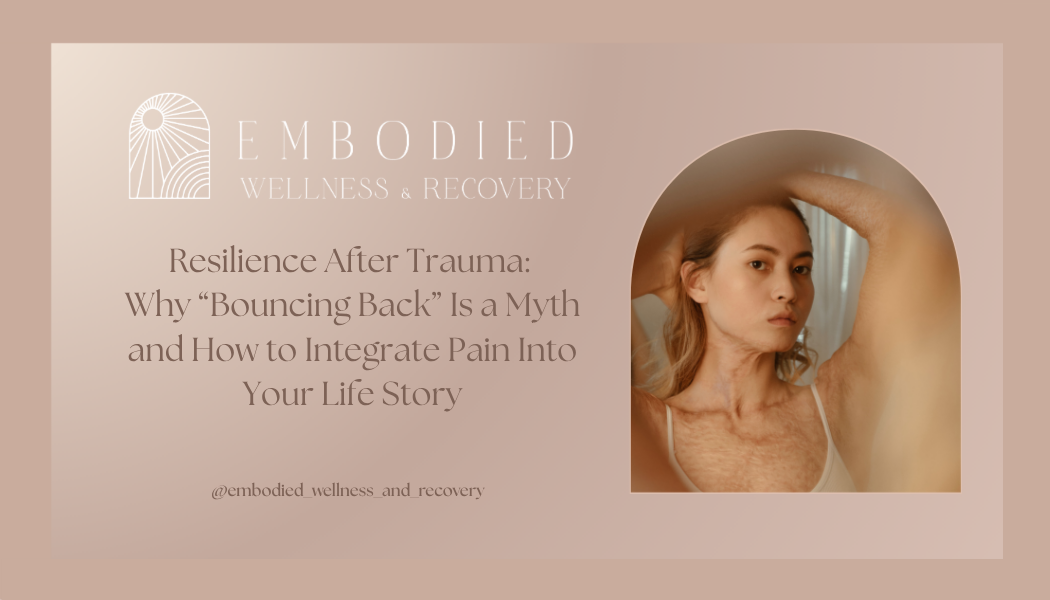
Resilience After Trauma: Why “Bouncing Back” Is a Myth and How to Integrate Pain Into Your Life Story
Resilience After Trauma: Why “Bouncing Back” Is a Myth and How to Integrate Pain Into Your Life Story
Is “bouncing back” from trauma realistic? Discover the neuroscience of resilience, trauma recovery, and emotional integration. Learn how therapy helps you process grief, regulate your nervous system, and rebuild connection in relationships.
Why “Bouncing Back” After Trauma Feels Impossible
Have you ever wondered why you cannot just “move on”?
Why certain memories still feel raw, even years later?
Why your body reacts before your mind can make sense of it?
Why grief seems to return in waves instead of fading away?
The idea of “bouncing back” after trauma or loss is deeply embedded in our culture. It suggests that resilience means returning to who you were before the event. It implies that strength looks like recovery without visible scars.
But neuroscience and clinical psychology tell a different story. Resilience is not about returning to a previous version of yourself. It is about integrating what happened into your life in a way that allows you to move forward with greater awareness, capacity, and meaning.
At Embodied Wellness and Recovery, we work with clients who are navigating trauma, grief, relationship challenges, and nervous system dysregulation. One of the most important shifts we help people make is redefining what resilience actually means.
The Myth of “Bouncing Back”
The phrase “bouncing back” implies elasticity. It suggests that after a stressful or traumatic experience, you should snap back into place, unchanged. But trauma changes the brain and the body.
Research shows that traumatic experiences can alter the functioning of the amygdala, hippocampus, and prefrontal cortex. The amygdala becomes more reactive, scanning for danger. The hippocampus can struggle to properly encode memories, making past events feel like they are happening in the present. The prefrontal cortex, responsible for reasoning and regulation, may become less effective under stress (van der Kolk, 2014). These are not signs of weakness. They are adaptations.
So when someone says, “Why am I not over this yet?” the more accurate question might be, “How has my nervous system adapted to protect me?”
Trauma Lives in the Body, Not Just the Mind
One of the most misunderstood aspects of trauma is that it is not only a psychological experience. It is physiological.
You may logically know that you are safe, yet your body still reacts with:
— Muscle tension
— Emotional numbness
— Difficulty trusting others
This is because trauma is stored in the nervous system.
According to Polyvagal Theory, developed by Stephen Porges, the autonomic nervous system continuously evaluates safety and threat. When the body perceives danger, it shifts into survival states such as fight, flight, freeze, or fawn. These states can persist long after the original threat has passed (Porges, 2011). This is why resilience cannot be achieved through willpower alone. It requires nervous system repair.
What Resilience Actually Means
If resilience is not bouncing back, what is it? Resilience is the ability to integrate difficult experiences into your life story without becoming defined or overwhelmed by them. It is the capacity to hold both pain and meaning.
Resilience looks like:
— Being able to remember what happened without becoming flooded
— Experiencing grief without losing your sense of self
— Building relationships even after betrayal or loss
— Developing emotional flexibility rather than rigidity
— Finding moments of connection, creativity, or purpose alongside pain
This concept aligns with research on posttraumatic growth, which suggests that individuals can experience increased psychological strength, deeper relationships, and greater appreciation for life following adversity (Tedeschi & Calhoun, 2004). This does not mean trauma is beneficial. It means that the human nervous system is capable of adapting in ways that create new forms of meaning.
Why Ignoring Pain Does Not Work
Many people attempt to cope by minimizing or avoiding their experiences.
They tell themselves:
“It was not that bad.”
”I should be over it.”
”Other people have it worse.”
Or they stay busy, distract themselves, or disconnect emotionally. But avoidance often prolongs suffering.
When emotions are not processed, they remain active in the nervous system. This can lead to:
— Chronic anxiety
— Depression
— Somatic symptoms such as headaches or fatigue
— Repetitive relational patterns
Research in affective neuroscience shows that suppressing emotions does not eliminate them. It increases physiological stress and reduces emotional regulation capacity (Gross, 2002). Integration, not avoidance, is what allows the nervous system to settle.
The Role of Relationships in Resilience
Healing does not happen in isolation. Human beings are wired for connection. Safe, attuned relationships play a critical role in regulating the nervous system and supporting trauma recovery. When you feel seen, understood, and emotionally held, your brain begins to reinterpret safety. Oxytocin is released, cortisol decreases, and the body shifts out of survival mode.
But if your experiences involved relational trauma, such as betrayal, neglect, or emotional inconsistency, closeness can feel threatening.
You may find yourself:
— Pulling away when things feel too intimate
— Struggling to trust even safe people
— Feeling unworthy of love or support
— Repeating patterns that reinforce disconnection
This is not self-sabotage. It is a learned adaptation. Part of resilience is relearning how to engage in connection safely.
Therapy as a Path Toward Integration
At Embodied Wellness and Recovery, we approach resilience through a somatic, attachment-based, and neuroscience-informed lens.
This includes modalities such as:
— EMDR to process and reframe traumatic memories
— Somatic therapy to regulate the nervous system and release stored activation
— Parts work to understand internal conflicts and protective patterns
— Relational therapy to rebuild trust, intimacy, and emotional safety
The goal is not to erase the past. It is to change your relationship to it.
Through therapy, clients begin to:
— Experience memories without being overwhelmed
— Develop greater emotional regulation
— Reconnect with their bodies
— Build healthier relationships
— Integrate their experiences into a coherent narrative
This process transforms trauma from something that controls your present into something that informs your growth.
Questions to Reflect On
If you have experienced trauma or profound grief, consider:
What parts of your story feel unresolved?
Where does your body still hold tension or fear?
Do you feel pressure to “move on” before you are ready?
What would it look like to honor your experience instead of minimizing it?
Where have you already demonstrated resilience, even in small ways?
These questions are not about judgment. They are about awareness.
Redefining Strength
Strength is often misunderstood. It is not the absence of emotion. It is not the ability to push through pain without support. It is not pretending that something did not affect you. Strength is the willingness to engage honestly with your experience.
It is allowing grief to exist without letting it define you. It is seeking connection when it feels vulnerable.It is learning to regulate your nervous system rather than override it. It is integrating your past into a life that still includes meaning, connection, and growth.
Moving Forward Without Leaving Yourself Behind
You do not return to who you were before trauma. You become someone who has lived through something meaningful and complex. Resilience is not about going backward. It is about moving forward with integration.
At Embodied Wellness and Recovery, we support clients in developing the capacity to hold their full story while building lives that feel grounded, connected, and intentional. Because the goal is not to erase what happened, it is to create a life where your past no longer controls your present.
Reach out to schedule a complimentary 20-minute consultation with our team of therapists, trauma specialists, somatic practitioners, or relationship experts, and start working towards integrative, embodied healing today.
📞 Call us at (310) 651-8458
📱 Text us at (310) 210-7934
📩 Email us at admin@embodiedwellnessandrecovery.com
🔗 Visit us at www.embodiedwellnessandrecovery.com
👉 Check us out on Instagram @embodied_wellness_and_recovery
🌍 Explore our offerings at Linktr.ee: https://linktr.ee/laurendummit
References
1) Gross, J. J. (2002). Emotion regulation: Affective, cognitive, and social consequences. Psychophysiology, 39(3), 281–291. https://doi.org/10.1017/S0048577201393198
2) Porges, S. W. (2011). The polyvagal theory: Neurophysiological foundations of emotions, attachment, communication, and self-regulation. W. W. Norton & Company.
3) Tedeschi, R. G., & Calhoun, L. G. (2004). Posttraumatic growth: Conceptual foundations and empirical evidence. Psychological Inquiry, 15(1), 1–18.
4) van der Kolk, B. A. (2014). The body keeps the score: Brain, mind, and body in the healing of trauma. Viking.
EMDR and Family Therapy for Foster Youth: Healing Attachment Trauma Through the Adaptive Information Processing Model
EMDR and Family Therapy for Foster Youth: Healing Attachment Trauma Through the Adaptive Information Processing Model
Discover how EMDR and family therapy help foster youth heal attachment trauma, emotional dysregulation, and trust wounds through the Adaptive Information Processing Model. Learn how trauma-informed treatment supports nervous system repair, relational safety, and long-term emotional resilience.
Why does trust feel so dangerous?
Why does closeness sometimes feel more threatening than distance?
Why does a kind gesture from a caregiver trigger suspicion instead of comfort?
For many foster youth, these questions are not abstract. They are lived experiences shaped by early attachment wounds, developmental trauma, disrupted caregiving, and repeated experiences of loss.
A child who has experienced neglect, abuse, abandonment, or multiple placement disruptions is not simply “acting out.” Their nervous system has learned that relationships may not be safe. This is where trauma-informed treatment matters.
At Embodied Wellness and Recovery, we understand that foster youth often carry trauma not just in memory, but in the body, the attachment system, and the nervous system itself. One of the most effective approaches for this work is the integration of Eye Movement Desensitization and Reprocessing (EMDR) with family therapy, guided by the Adaptive Information Processing (AIP) model.
This approach helps children and adolescents move beyond survival-based behaviors and toward trust, emotional regulation, and relational safety.
Understanding Attachment Trauma in Foster Youth
Attachment trauma occurs when the people who were supposed to provide safety become a source of fear, inconsistency, neglect, or abandonment.
For foster youth, trauma may include:
— Physical or emotional abuse
— Sexual abuse
— Chronic neglect
— Parental addiction
— Domestic violence exposure
— Multiple foster placements
— Separation from siblings
— Loss of biological caregivers
— Institutional instability
— Repeated relational ruptures
Research consistently shows that children in foster care experience significantly higher rates of PTSD symptoms, anxiety, depression, dissociation, and emotional dysregulation compared to the general population (Pecora et al., 2009).
These symptoms are often misunderstood as oppositional behavior, defiance, or emotional immaturity. But behavior is communication. And trauma often speaks through protection.
The Adaptive Information Processing (AIP) Model
EMDR therapy is grounded in Francine Shapiro’s Adaptive Information Processing (AIP) model. The AIP model proposes that our thoughts, emotions, beliefs, body sensations, and reactions in present-day life are shaped by how past experiences were stored in the brain.
Ordinary life experiences are usually processed and stored adaptively. But when overwhelming trauma occurs, especially in childhood, the nervous system may become overloaded. The brain’s natural processing system becomes disrupted. Instead of being integrated, the experience is stored in raw form with the original emotions, sensations, beliefs, and perceptions attached. This means the child is not just remembering trauma. They are re-experiencing it.
A foster child who was repeatedly abandoned may react to a foster parent leaving for work as if abandonment is happening again in real time. There is no sense of time in maladaptive memory networks, only threat. Shapiro (2018) emphasizes that pathology is often rooted in earlier unprocessed experiences that continue to shape present responses until they are reprocessed and stored adaptively.
Why Foster Youth Struggle with Trust
If early life taught a child that adults are unpredictable, unsafe, or unavailable, the nervous system builds protective strategies.
These may look like:
— Aggression
— Emotional shutdown
— Lying or stealing
— Hyper-independence
— Testing caregivers
— Rejecting closeness before being rejected
These are not signs that the child does not want connection, but signs that connection feels dangerous. The body protects before the mind understands. This is why traditional talk therapy alone is often insufficient. Trauma stored in the nervous system requires body-based, attachment-informed treatment.
EMDR Therapy for Foster Youth
EMDR therapy does not focus only on behavior. It treats the memory networks underneath the behavior. Rather than asking, “Why are you reacting this way?” EMDR asks, “What unresolved experience is still shaping this response?”
Through bilateral stimulation and carefully paced trauma processing, EMDR helps children:
— Reduce emotional flooding
— Decrease triggers and reactivity
— Improve self-regulation
— Build healthier self-beliefs
— Process grief and loss
— Increase felt safety in relationships
Instead of carrying beliefs like:
“I am bad.”
“No one stays.”
“I cannot trust anyone.”
Children begin to internalize:
“I am worthy.”
“Some adults are safe.”
“I can ask for help.”
The memory changes, and with it, the child’s internal world changes too.
The Integrative Attachment Trauma Protocol for Children (IATP-C)
Debra Wesselmann’s Integrative Attachment Trauma Protocol for Children (IATP-C) was specifically designed for children with attachment trauma who struggle with trust, dysregulation, and relational safety.
This protocol combines:
— Family therapy activities
— Attachment repair interventions
— Gentle trauma processing
— Safe relational experiences
It recognizes that trauma healing for foster youth cannot happen in isolation. The family system must be involved. Wesselmann et al. (2014) found that IATP-C improves trust, cooperation, emotional regulation, and family functioning while reducing defensive behaviors and dysregulation. This is especially important for foster families, where healing must happen both internally and relationally.
Why Family Therapy Matters
Trauma recovery is not just individual. It is relational. A foster child may intellectually know that a foster parent is safe, but their nervous system may not yet believe it.
Family therapy helps bridge that gap.
It supports:
— Secure attachment development
— Co-regulation during distress
— Repair after rupture
— Consistency and predictability
— Reduced shame and blame
Foster parents also need support. Caring for a traumatized child can trigger helplessness, frustration, and secondary trauma.
Family therapy helps caregivers understand that difficult behaviors are often survival responses, not personal rejection. This shift changes everything.
The Neuroscience of Relational Repair
According to Polyvagal Theory, safety is not taught through logic. It is experienced through the nervous system (Porges, 2011).
Tone of voice.
Facial expression.
Predictability.
Repair after conflict.
Emotional presence.
These become the language of safety. Children do not heal because they are told they are safe. They heal because their body begins to believe it. This takes repetition, consistency, and relationships strong enough to tolerate testing, rupture, and repair.
What Healing Looks Like
Healing does not always look dramatic.
Sometimes it looks like:
A child asking for help instead of shutting down.
A teen tolerating closeness without pushing it away.
A foster parent staying calm during emotional storms.
A family repairing after conflict instead of reenacting abandonment.
A child finally believing:
Maybe I am not too much.Maybe I am not unlovable.Maybe this relationship can stay.
These moments matter; they are how trauma stops repeating itself.
Treating Trauma at Its Root
Foster youth do not need more behavior management. They need nervous system safety. They need relationships that can hold complexity. They need therapy that treats trauma at its root, not just its symptoms.
At Embodied Wellness and Recovery, we believe EMDR and family therapy offer one of the most powerful pathways for healing attachment trauma because they honor both the brain and the body, the child and the family, the wound and the possibility of repair. When memory shifts, attachment can shift, and when attachment shifts, an entirely different future becomes possible.
Reach out to schedule a complimentary 20-minute consultation with our team of therapists, trauma specialists, somatic practitioners, or relationship experts, and start working towards integrative, embodied healing today.
📞 Call us at (310) 651-8458
📱 Text us at (310) 210-7934
📩 Email us at admin@embodiedwellnessandrecovery.com
🔗 Visit us at www.embodiedwellnessandrecovery.com
👉 Check us out on Instagram @embodied_wellness_and_recovery
🌍 Explore our offerings at Linktr.ee: https://linktr.ee/laurendummit
References
1) Bowlby, J. (1988). A secure base: Parent-child attachment and healthy human development. Basic Books.
2) Pecora, P. J., White, C. R., Jackson, L. J., & Wiggins, T. (2009). Mental health of current and former recipients of foster care: A review of recent studies in the USA. Child & Family Social Work, 14(2), 132–146. https://doi.org/10.1111/j.1365-2206.2009.00619.x
3) Porges, S. W. (2011). The polyvagal theory: Neurophysiological foundations of emotions, attachment, communication, and self-regulation. W. W. Norton & Company.
4) Shapiro, F. (2018). Eye movement desensitization and reprocessing (EMDR therapy): Basic principles, protocols, and procedures (3rd ed.). Guilford Press.
5) Wesselmann, D., Armstrong, S., Schweitzer, C., Davidson, J., & Potter, A. (2014). An integrative attachment trauma protocol for children: A trauma-informed approach to treating attachment disruptions in families. Journal of EMDR Practice and Research, 8(4), 201–209. https://doi.org/10.1891/1933-3196.8.4.201