
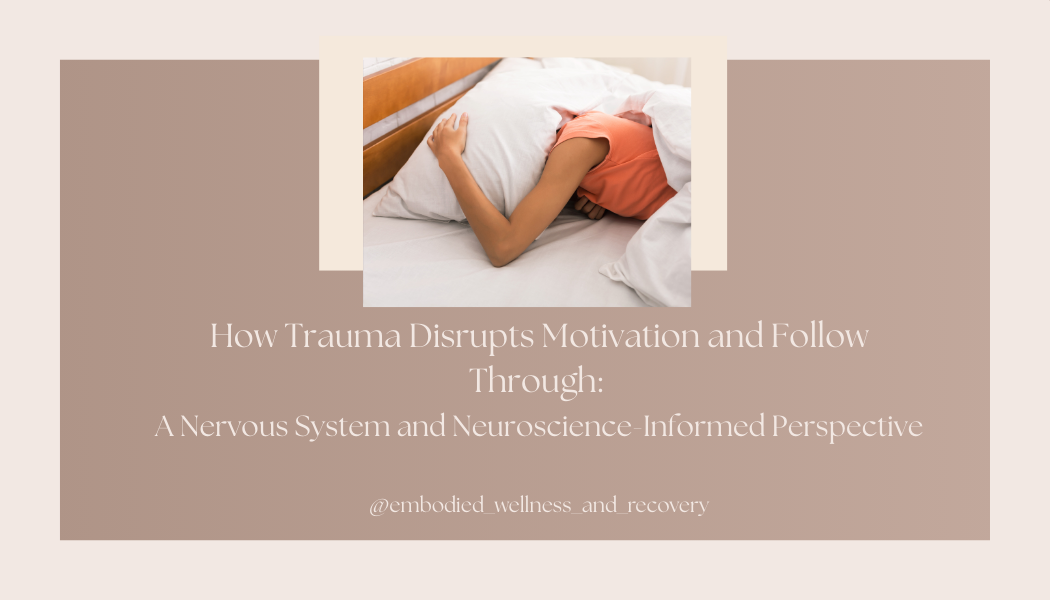
How Trauma Disrupts Motivation and Follow Through: A Nervous System and Neuroscience-Informed Perspective
How Trauma Disrupts Motivation and Follow Through:
A Nervous System and Neuroscience-Informed Perspective
Trauma can disrupt motivation and follow-through by dysregulating the nervous system. Learn the neuroscience behind shutdown, procrastination, and trauma recovery.
Have you ever wondered why you want to follow through, but your body seems to refuse?
Why you understand what needs to be done, care deeply about the outcome, and yet feel frozen, exhausted, distracted, or unable to start or finish tasks?
Do you find yourself asking:
— Why can I plan but not execute?
— Why do simple tasks feel overwhelming?
— Why does motivation disappear when pressure rises?
— Why do I feel ashamed about procrastination or inconsistency?
For many people, difficulty with motivation and follow-through is not due to a lack of discipline, character, or willpower. It is a nervous system issue shaped by unresolved trauma and chronic stress.
At Embodied Wellness and Recovery, we specialize in trauma-informed, nervous system-based therapy that helps clients understand why motivation falters and how to restore capacity for action, engagement, and completion in sustainable ways.
Motivation Is a Nervous System Function
Motivation is often framed as a psychological trait. From a neuroscience perspective, motivation is deeply physiological.
Initiating and completing tasks requires:
— A regulated autonomic nervous system
— Access to energy without overwhelm
— A sense of safety while engaging effort
— Integration between emotional, cognitive, and motor systems
When the nervous system is regulated, motivation feels accessible. When it is dysregulated, action can feel impossible even when desire is present.
This is why trauma can profoundly disrupt motivation and follow-through.
How Trauma Changes the Brain and Body
Trauma alters how the brain processes threat, safety, and energy.
When the nervous system perceives danger, the brain prioritizes survival over productivity. Blood flow shifts away from the prefrontal cortex, which supports planning, focus, and decision making, toward subcortical regions responsible for defense.
Neuroscience research shows that chronic stress and trauma impact the functioning of the prefrontal cortex, basal ganglia, and limbic system, all of which play key roles in motivation, initiation, and persistence (Arnsten, 2009).
This means that trauma can interfere with:
— Starting tasks
— Sustaining effort
— Organizing steps
— Completing goals
— Experiencing reward or satisfaction
Motivation struggles are often misinterpreted as laziness when they are actually signs of nervous system overload or shutdown.
Fight, Flight, Freeze, and Shutdown
Trauma responses are commonly described as fight, flight, freeze, and collapse or shutdown.
Each of these states affects motivation differently:
— Fight may show up as overworking, followed by burnout
— Flight may look like constant busyness without completion
— Freeze often presents as procrastination or indecision
— Shutdown can feel like exhaustion, numbness, or apathy
When freeze or shutdown dominates, the body conserves energy by limiting movement and engagement. From the nervous system’s perspective, this is protective.
Trying to push through these states with pressure or self-criticism often intensifies dysregulation.
Trauma, Dopamine, and the Reward System
Motivation is closely tied to dopamine, a neurotransmitter involved in anticipation, reward, and goal-directed behavior.
Trauma and chronic stress can disrupt dopamine signaling. Research suggests that prolonged stress alters reward processing, making effort feel less rewarding and completion less satisfying (Pizzagalli, 2014).
This can lead to:
— Difficulty feeling motivated by future rewards
— Loss of pleasure or interest
— Reduced sense of accomplishment
— Increased reliance on short-term distractions
Without adequate dopamine signaling, the nervous system struggles to mobilize energy toward long-term goals.
Why Insight Alone Is Not Enough
Many high-functioning individuals understand their trauma history and patterns clearly. Yet motivation remains inconsistent.
This is because insight primarily engages the thinking brain. Motivation requires coordination between cognitive, emotional, and physiological systems.
As Joseph LeDoux’s research demonstrates, threat responses can bypass conscious thought entirely (LeDoux, 2015). When the nervous system detects danger, it limits access to executive functioning regardless of insight.
This explains why people often say:
— I know what to do, but I cannot make myself do it
— I feel blocked even when nothing is wrong
— I shut down when expectations rise
The body must feel safe enough to engage effort.
Trauma, Shame, and Follow Through
Shame often accompanies motivation struggles.
Many people internalize messages such as:
— I am lazy
— I lack discipline
— Something is wrong with me
From a trauma-informed perspective, shame further dysregulates the nervous system. It reinforces threat and withdrawal, making follow-through even harder.
Shame also activates relational threat. For individuals with attachment trauma, pressure to perform may unconsciously signal risk of rejection or failure, leading to freeze or shutdown responses.
Addressing shame is a critical component of restoring motivation.
How Trauma Affects Relationships and Intimacy
Motivation disruptions rarely exist in isolation. They often affect relationships, sexuality, and intimacy.
Clients may struggle with:
— Initiating connection
— Following through on commitments
— Maintaining desire or arousal
— Feeling present during intimacy
— Balancing autonomy and closeness
When the nervous system is overwhelmed, it prioritizes conservation over engagement. This can be misinterpreted by partners as a lack of care or effort.
Trauma-informed therapy helps reframe these patterns as nervous system responses rather than relational failures.
Restoring Motivation Through Nervous System Repair
Lasting change requires working with the nervous system rather than against it.
Trauma-informed, somatic, and attachment-based approaches focus on:
— Increasing nervous system regulation
— Expanding tolerance for activation
— Supporting completion of stress responses
— Restoring access to energy and engagement
At Embodied Wellness and Recovery, we integrate modalities such as:
— Somatic therapy
— Attachment-focused EMDR
— Parts work and Internal Family Systems
— Polyvagal-informed interventions
These approaches help clients rebuild capacity for action without forcing or shaming the system.
Small Steps and Nervous System Safety
For traumatized nervous systems, motivation often returns through small, manageable actions rather than large goals.
Micro completion builds safety and confidence. Each completed step signals to the nervous system that effort does not equal danger.
This may include:
— Short periods of focused activity
— Clear boundaries around rest
— Predictable routines
— Attuned support and co-regulation
Over time, these experiences rewire neural pathways associated with motivation and reward.
How Therapy Helps Reclaim Follow Through
Therapy provides more than insight. It offers a regulated relational space where the nervous system can learn new patterns.
Through consistent, attuned therapeutic relationships, clients experience:
— Reduced threat activation
— Increased emotional regulation
— Greater access to motivation and energy
— Improved follow-through without burnout
Motivation emerges as a byproduct of safety rather than pressure.
How Embodied Wellness and Recovery Approaches Motivation
At Embodied Wellness and Recovery, we understand difficulties with motivation through a trauma-informed and neuroscience-based lens.
We help clients explore:
— How trauma shaped their nervous system responses
— Why does following through feel unsafe or overwhelming
— How to restore regulation and capacity gradually
— How motivation intersects with relationships and intimacy
Our work honors the intelligence of the nervous system while supporting meaningful change.
Motivation Returns When Safety Leads
Motivation is not something to force. It is something that emerges when the nervous system feels supported, regulated, and resourced.
By addressing trauma at the level of the body and brain, individuals can reconnect with their natural capacity for engagement, creativity, and completion.
Reach out to schedule a complimentary 20-minute consultation with our team of therapists, trauma specialists, somatic practitioners, or relationship experts, and start working towards integrative, embodied healing today.
📞 Call us at (310) 651-8458
📱 Text us at (310) 210-7934
📩 Email us at admin@embodiedwellnessandrecovery.com
🔗 Visit us at www.embodiedwellnessandrecovery.com
👉 Check us out on Instagram @embodied_wellness_and_recovery
🌍 Explore our offerings at Linktr.ee: https://linktr.ee/laurendummit
References
1) Arnsten, A. F. T. (2009). Stress signalling pathways that impair the structure and function of the prefrontal cortex. Nature Reviews Neuroscience, 10(6), 410–422.
2) LeDoux, J. E. (2015). Anxious: Using the brain to understand and treat fear and anxiety. Viking.
3) Pizzagalli, D. A. (2014). Depression, stress, and anhedonia: Toward a synthesis and integrated model. Annual Review of Clinical Psychology, 10, 393–423.