
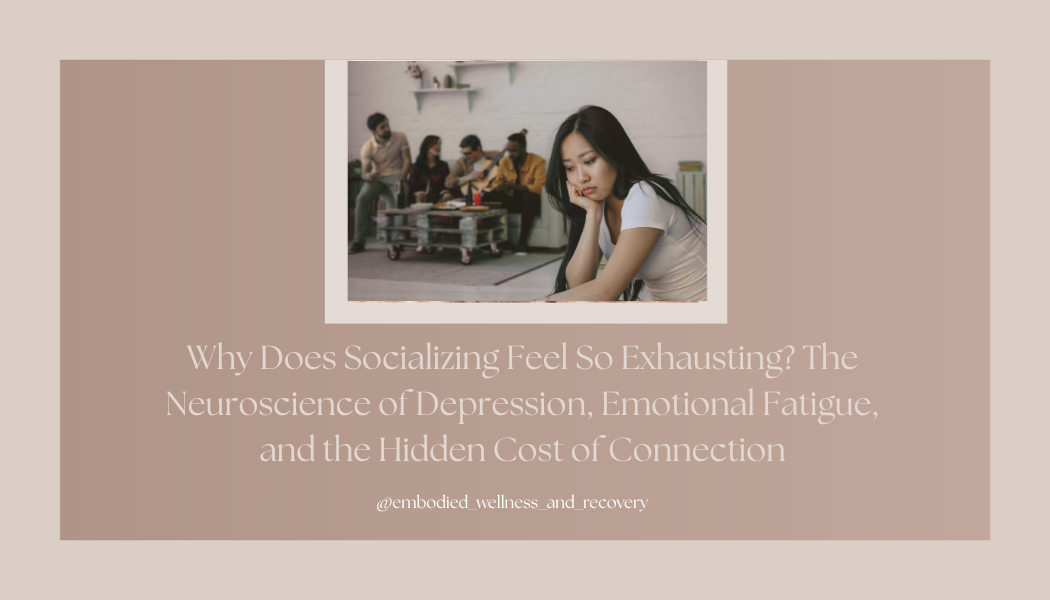
Why Does Socializing Feel So Exhausting? The Neuroscience of Depression, Emotional Fatigue, and the Hidden Cost of Connection
Why Does Socializing Feel So Exhausting? The Neuroscience of Depression, Emotional Fatigue, and the Hidden Cost of Connection
Why does depression make socializing feel exhausting? Discover the neuroscience behind depression, emotional fatigue, low energy, and social withdrawal, and learn how trauma-informed therapy, nervous system regulation, and meaningful connection can support recovery.
You used to enjoy spending time with friends. Now, even answering a text message feels overwhelming. You cancel plans at the last minute, not because you do not care, but because you simply cannot imagine finding the energy to engage. The thought of making conversation, smiling politely, or deciding what to wear feels surprisingly draining. Then the guilt sets in.
You wonder:
“Why am I avoiding people I love?”
“Am I becoming antisocial?”
“Why does everyone else seem to have energy for this except me?”
“Is something wrong with me?”
If you struggle with depression, trauma, chronic stress, or nervous system dysregulation, social exhaustion is not uncommon. In fact, what may look like isolation from the outside is often the result of a brain and body working incredibly hard simply to make it through the day.
Depression Does Not Just Affect Mood
One of the biggest misconceptions about depression is that it is simply prolonged sadness. Depression often affects motivation, concentration, memory, decision making, physical energy, sleep, appetite, and the ability to experience pleasure. Many individuals describe it less as feeling sad and more as feeling emotionally and physically depleted. Research has shown that major depressive disorder is associated with alterations in motivation, reward processing, cognitive function, and psychomotor activity, all of which can make even ordinary tasks feel effortful (Cléry-Melin et al., 2019).
Why Being Around People Can Feel So Draining
Social interaction requires remarkable neurological coordination.
Your brain is constantly:
— Reading facial expressions
— Interpreting tone of voice
— Monitoring social cues
— Regulating emotions
— Generating responses
— Suppressing distractions
— Tracking conversations
— Managing self-awareness
When depression is present, these processes may require significantly more effort. What once felt natural can begin to feel like running a marathon.
The Brain Conserves Energy
From a neuroscience perspective, depression may involve changes in brain networks responsible for motivation, reward, attention, and executive functioning. When these systems are affected, the brain often shifts into energy conservation. This is one reason everyday activities such as showering, grocery shopping, returning messages, or attending social gatherings may feel disproportionately exhausting. The issue is rarely laziness. It is often reduced access to cognitive and emotional resources.
Social Withdrawal Can Become a Painful Cycle
Ironically, while depression often leads people to withdraw, meaningful social connection is one of the factors associated with psychological resilience and emotional well-being.
The cycle frequently looks like this:
Depression leads to low energy. Low energy leads to canceled plans. Canceled plans increase isolation. Isolation intensifies loneliness. Loneliness deepens depressive symptoms. Over time, individuals may begin to believe they no longer belong or that others would be better off without them, despite evidence to the contrary.
Trauma Can Intensify Social Fatigue
For individuals with unresolved trauma or attachment wounds, social interaction may involve additional hidden labor. You may unconsciously monitor whether others are judging you. You may scan for rejection or conflict. You may overthink every conversationafterward. You may work hard to appear “fine” even while struggling internally. This constant vigilance consumes mental and physiological resources. What appears to others as introversion may actually reflect nervous system activation.
Masking Is Exhausting
Many people living with depression become experts at masking. They smile. They make jokes. They appear successful. Then they return home completely depleted. Masking requires suppressing internal experiences while presenting a socially acceptable version of oneself. Over time, this disconnect between internal reality and external presentation can increase emotional fatigue.
The Nervous System and Social Engagement
According to Polyvagal Theory, feelings of safety play an important role in social engagement. When the nervous system perceives safety, individuals are more likely to connect, communicate, and remain emotionally present. When the body detects threat, even subtle interpersonal stressors can trigger withdrawal, shutdown, or avoidance. For some people, depression is accompanied by a physiological state that makes connection feel effortful rather than restorative.
Why You Might Want Connection but Avoid It Anyway
Many people with depression experience a confusing contradiction. They desperately want closeness. They simply lack the energy to pursue it. This discrepancy often creates shame. Friends may interpret canceled plans as disinterest. Family members may assume avoidance reflects indifference. In reality, the individual may care deeply while struggling with profound emotional fatigue.
The Difference Between Solitude and Isolation
Choosing occasional solitude can be healthy. Isolation driven by hopelessness, fear, or depletion is different. Healthy solitude restores. Depression-driven withdrawal often leaves people feeling even more disconnected from themselves and others. Recognizing this distinction can help reduce self-criticism and encourage intentional choices about connection.
What Actually Helps?
Well-meaning advice such as "just get out more" rarely addresses the underlying problem. Instead, recovery often involves gradually increasing experiences of manageable, meaningful connection while simultaneously addressing the biological, emotional, and relational factors contributing to depression.
Helpful interventions may include:
—Trauma-informed psychotherapy
— EMDR
— Nervous system regulation
— Behavioral activation
— Sleep optimization
— Movement appropriate to one's capacity
— Compassionate social support
Importantly, quality of connection often matters more than quantity. One emotionally safe conversation may be more restorative than attending a crowded event.
Give Yourself Permission to Start Small
If socializing feels overwhelming, consider lowering the threshold.
Perhaps connection today looks like:
— Sending one text message
— Meeting a trusted friend for coffee
— Taking a brief walk with someone you love
— Having a ten-minute phone call
— Sitting quietly with another person without pressure to entertain
These moments still count.
How Embodied Wellness and Recovery Can Help
At Embodied Wellness and Recovery, we recognize that depression is not simply a disorder of mood. It often reflects complex interactions among trauma, attachment experiences, nervous system dysregulation, relationships, and the body itself.
Our clinicians integrate somatic therapy, EMDR, neuroscience-informed psychotherapy, attachment-focused care, and evidence-based interventions to help clients better understand the roots of emotional exhaustion while strengthening resilience, connection, and self-compassion. We also specialize in relationship challenges, sexuality, intimacy, and trauma recovery, recognizing that meaningful healing often occurs within safe and attuned relationships.
Because forcing yourself to be more social is rarely the answer. Understanding why connection feels so difficult and helping your nervous system experience safety again can create space for relationships to become nourishing rather than depleting. And sometimes, the most courageous social step is simply allowing another person to sit beside you exactly as you are.
Reach out to schedule a complimentary 20-minute consultation with our team of therapists, trauma specialists, somatic practitioners, or relationship experts, and start working towards integrative, embodied healing today.
📞 Call us at (310) 651-8458
📱 Text us at (310) 210-7934
📩 Email us at admin@embodiedwellnessandrecovery.com
🔗 Visit us at www.embodiedwellnessandrecovery.com
👉 Check us out on Instagram @embodied_wellness_and_recovery
🌍 Explore our offerings at Linktr.ee: https://linktr.ee/laurendummit
American Psychiatric Association. (2022). Diagnostic and statistical manual of mental disorders (5th ed., text rev.).
Cacioppo, J. T., & Cacioppo, S. (2018). Loneliness: Human nature and the need for social connection. W. W. Norton & Company.
Cléry-Melin, M. L., Jollant, F., & Gorwood, P. (2019). Reward systems and cognitions in Major Depressive Disorder. CNS spectrums, 24(1), 64-77
Disner, S. G., Beevers, C. G., Haigh, E. A. P., & Beck, A. T. (2011). Neural mechanisms of the cognitive model of depression. Nature Reviews Neuroscience, 12(8), 467-477. https://doi.org/10.1038/nrn3027
Porges, S. W. (2011). The polyvagal theory: Neurophysiological foundations of emotions, attachment, communication, and self-regulation. W. W. Norton & Company.
van der Kolk, B. A. (2014). The body keeps the score: Brain, mind, and body in the healing of trauma. Viking.