
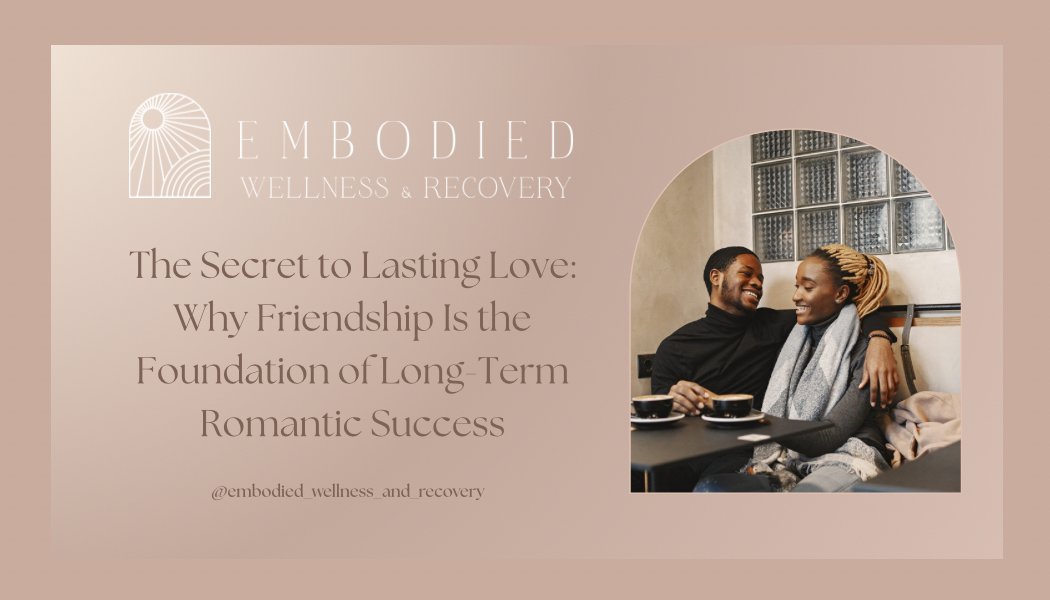
The Secret to Lasting Love: Why Friendship Is the Foundation of Long-Term Romantic Success
The Secret to Lasting Love: Why Friendship Is the Foundation of Long-Term Romantic Success
Discover why friendship is one of the strongest predictors of long-term relationship success. Learn how emotional intimacy, trust, friendship, attachment, and neuroscience influence lasting love and relationship satisfaction.
Is Your Partner Also Your Friend?
When people think about romantic relationships, they often focus on:
— Chemistry
— Attraction
— Passion
— Shared goals
While these factors certainly matter, decades of relationship research suggest that one of the strongest predictors of long-term relationship satisfaction may be something far simpler:
Friendship.
In fact, renowned relationship researcher John Gottman has spent decades studying couples and repeatedly found that strong friendships form the foundation of healthy, lasting relationships.
Yet man couples find themselves asking:
— Why do we feel more like roommates than partners?
— Where did our connection go?
— Why don't we talk like we used to?
— Why do I feel lonely even though I'm in a relationship?
— Why does it seem like we're always discussing logistics rather than truly connecting?
If these questions feel familiar, you are not alone in wondering whether friendship has quietly faded from your relationship.
At Embodied Wellness and Recovery, we frequently help individuals and couples rediscover the power of friendship as a pathway toward deeper intimacy, emotional safety, and relational resilience.
Friendship Is More Than Enjoying the Same Activities
When people hear the word friendship, they often think of shared hobbies or common interests. While those can be important, friendship in a romantic relationship runs much deeper.
Healthy friendship includes:
— Emotional curiosity
— Trust
— Affection
— Admiration
— Playfulness
— Emotional support
— Mutual respect
— Genuine interest in one another's inner worlds
A strong friendship allows partners to feel seen, understood, and valued beyond their roles as spouses, parents, or co-managers of daily life. Friendship creates a sense of companionship that helps sustain relationships through inevitable periods of stress and change.
What Research Says About Friendship and Relationship Satisfaction
Research consistently demonstrates that friendship is one of the most important predictors of marital satisfaction and long-term relationship success.
According to Gottman's research, happy couples maintain what he calls a strong "friendship system." These couples actively cultivate:
— Affection
— Admiration
— Emotional connection
— Curiosity about one another
— Shared meaning (Gottman, 2016).
Rather than assuming they already know everything about their partner, they continue learning about each other's evolving thoughts, dreams, fears, and experiences.
Research suggests that couples who maintain emotional friendship experience:
— Higher relationship satisfaction
— Greater emotional intimacy
— Stronger sexual satisfaction
— Improved conflict resolution
— Increased relationship stability
(Gottman & Silver, 2015).
In other words, friendship is not merely a nice bonus in healthy relationships. It may be one of the primary mechanisms through which relationships remain resilient.
The Neuroscience of Friendship and Connection
From a neuroscience perspective, friendship serves a critical regulatory function. Human beings are wired for connection. The nervous system continuously scans for cues of safety and danger.
When we experience emotional attunement from a trusted partner, the brain often releases neurochemicals associated with connection and well-being, including:
— Oxytocin
— Dopamine
— Serotonin
These chemicals can support:
— Emotional regulation
— Stress reduction
— Bonding
— Feelings of safety
Research suggests that emotionally supportive relationships can buffer the effects of stress and improve both mental and physical health (Coan et al., 2006).
When friendship is present, partners often become sources of co-regulation.
A reassuring touch.
A shared laugh.
A meaningful conversation.
These seemingly small moments can have profound effects on the nervous system.
Why Friendship Often Fades
Many couples do not intentionally stop being friends.
Life simply becomes busy.
Over time, conversations may become dominated by:
— Finances
— Schedules
— Responsibilities
— Household management
The relationship gradually shifts from connection to coordination. The problem is that emotional intimacy requires ongoing investment.
Without intentional friendship-building, partners can begin feeling:
— Disconnected
— Lonely
— Misunderstood
— Emotionally neglected
Even when they continue functioning well as a team. This is one reason many couples report feeling isolated despite living under the same roof.
Friendship Creates Emotional Safety
One of the most important functions of friendship is emotional safety.
Emotional safety develops when partners consistently experience:
— Acceptance
— Responsiveness
— Validation
— Empathy
— Respect
When emotional safety is present, individuals are more likely to:
— Express vulnerability
— Seek support
— Remain emotionally engaged
For individuals with attachment wounds or trauma histories, emotional safety can be especially important.
Many people enter relationships carrying fears of:
— Rejection
— Emotional neglect
Friendship helps counter these fears by creating experiences of consistent care and connection.
Friendship and Sexual Intimacy
Many couples assume that friendship and romance exist separately. In reality, the two are often deeply intertwined. Research suggests that emotional intimacy frequently enhances sexual intimacy (Brock & Jennings, 2007).
When partners feel:
— Emotionally connected
— Respected
— Appreciated
— Understood
They often experience greater desire and relational satisfaction. Friendship creates an atmosphere in which vulnerability feels safer. It allows intimacy to become more than physical attraction. It becomes an extension of emotional connection. This is particularly important in long-term relationships where novelty naturally decreases over time. Friendship often becomes the glue that sustains desire through life's inevitable seasons.
Small Moments Matter More Than Grand Gestures
Many people believe stronger relationships require dramatic changes. In reality, relationship research suggests that small moments of connection often matter most.
Examples include:
— Expressing appreciation
— Sharing humor
— Showing curiosity
— Checking in emotionally
— Spending intentional time together
— Responding positively to bids for connection
These moments may appear insignificant. Yet over time, they create the emotional infrastructure of friendship. A strong relationship is rarely built through occasional grand gestures alone.
It is built through thousands of small interactions that communicate:
"I see you."
"I care about you."
"You matter to me."
Rebuilding Friendship in Your Relationship
If friendship has faded, it can be rebuilt.
Consider asking yourself:
— When was the last time we laughed together?
— How often do we discuss topics beyond logistics?
— Do I know what currently excites or worries my partner?
— How curious am I about their inner world?
— When was the last time we spent meaningful time together without distractions?
Small steps can create meaningful change.
Try:
— Scheduling regular date nights
— Taking walks together
— Asking open-ended questions
— Expressing daily appreciation
— Sharing new experiences
— Practicing active listening
The goal is not perfection. The goal is cultivating emotional closeness through consistent connection.
How Therapy Can Help
At Embodied Wellness and Recovery, we help couples strengthen the friendship at the heart of their relationship.
Through a trauma-informed, neuroscience-based approach, couples can learn to:
— Improve communication
— Rebuild trust
— Increase emotional safety
— Understand attachment patterns
— Strengthen friendship and connection
When couples feel emotionally connected, many other relationship challenges become easier to navigate.
Curiosity, Support, and Connection
Passion may spark a relationship. Commitment may sustain it. But friendship often helps it flourish. When partners remain curious about one another, support each other's growth, and maintain emotional connection, relationships become more resilient, satisfying, and fulfilling. Long-term romantic success is rarely built on attraction alone. It is built on a foundation of friendship that continues evolving throughout the lifespan of the relationship.
Reach out to schedule a complimentary 20-minute consultation with our team of therapists, trauma specialists, somatic practitioners, or relationship experts, and start working towards integrative, embodied healing today.
📞 Call us at (310) 651-8458
📱 Text us at (310) 210-7934
📩 Email us at admin@embodiedwellnessandrecovery.com
🔗 Visit us at www.embodiedwellnessandrecovery.com
👉 Check us out on Instagram @embodied_wellness_and_recovery
🌍 Explore our offerings at Linktr.ee: https://linktr.ee/laurendummit
References
1) Brock, L. J., & Jennings, G. (2007). Sexuality and intimacy. Handbook of gerontology: Evidence-based approaches to theory, practice, and policy, 244-268.
2) Coan, J. A., Schaefer, H. S., & Davidson, R. J. (2006). Lending a hand: Social regulation of the neural response to threat. Psychological Science, 17(12), 1032-1039.
3) Gottman, J. M., & Silver, N. (2015). The seven principles for making marriage work. Harmony Books.
4) Gottman, J. S. (Ed.). (2016). The marriage clinic casebook. WW Norton & Company.
5) Reis, H. T., & Gable, S. L. (2015). Responsiveness. Current Opinion in Psychology, 1, 67-71.
6) Siegel, D. J. (2012). The developing mind: How relationships and the brain interact to shape who we are. Guilford Press.