
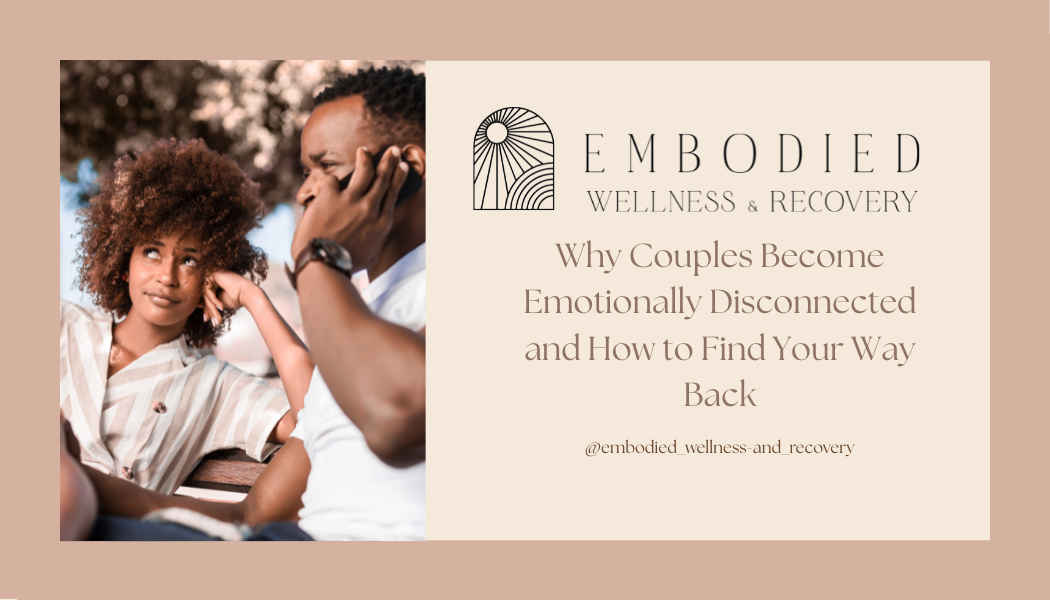
Why Couples Become Emotionally Disconnected and How to Find Your Way Back
Why Couples Become Emotionally Disconnected and How to Find Your Way Back
Feeling disconnected from your partner? Discover how attachment wounds, nervous system patterns, and couples therapy can help you reconnect.
You didn't fall out of love. You fell out of safety.
That distinction, subtle as it sounds, changes everything about how couples understand disconnection, and what it actually takes to heal it.
If you and your partner have been feeling more like roommates than romantic partners, or if the same arguments keep surfacing without resolution, or if one of you has gone quiet while the other keeps reaching, you're experiencing one of the most common patterns couples face. And you're not necessarily in a relationship that's beyond repair.
You may simply be in a relationship where the nervous system has stopped feeling safe enough to stay open.
What Is Emotional Disconnection?
Emotional disconnection doesn't usually happen all at once. It accumulates, in small moments of missing each other, in bids for connection that go unmet, in conversations that feel increasingly risky to have.
Over time, the nervous system begins to associate vulnerability in the relationship with threat. And when the nervous system perceives threat, it does what it's always done: it protects.
This is not a character flaw. It's not a sign that you chose the wrong person. It's biology doing exactly what it was designed to do.
The Pursue-Withdraw Cycle
One of the most well-documented patterns in couples therapy is what researchers call the pursue-withdraw cycle. When disconnection grows, partners typically fall into one of two protective roles: the pursuer and the withdrawer.
The pursuer, sensing the growing distance, reaches harder. They initiate conversations, express frustration, and push for resolution. From the outside, this can look like neediness or criticism. Underneath, it's an attachment system in alarm. It's someone terrified of losing connection.
The withdrawer, feeling overwhelmed or flooded by the pursuit, pulls back. They go quiet, shut down, or disengage. From the outside, this can look like indifference or emotional unavailability. Underneath, it's a nervous system overwhelmed and seeking regulation.
Here's what makes this cycle so painful: the pursuer's urgency triggers more withdrawal. The withdrawer's distance triggers more pursuit. Both partners are trying to feel safe. Neither strategy is working.
Neither person is the villain. Both people are scared.
What's Really Driving the Disconnection
Most couples try to solve disconnection at the level of the argument, the finances, the parenting disagreement, the intimacy, the household responsibilities.
But the argument is rarely what it seems to be about.
Beneath almost every recurring conflict is an unspoken attachment question:
Are you still there for me?
Do I still matter to you?
Am I safe with you?
These are not questions we ask out loud. They live in the nervous system, in the body, in the way we brace before a difficult conversation or shut down when we feel criticized.
Until those underlying questions are addressed, until both partners feel genuinely safe enough to be vulnerable, the surface arguments will keep returning.
Disconnection is a signal, not a verdict.
The most important reframe I offer couples in therapy is this: emotional disconnection is not evidence that your relationship is over. It's a signal that your relationship needs a different kind of safety.
Not more effort. Not better arguments. A deeper understanding of what each of you actually needs to feel secure and a new way of reaching for each other that the nervous system can actually receive.
Reconnection is possible. But it requires going beneath the conflict, the silence, and the resentment to the vulnerability underneath.
How Couples Therapy Can Help
At Embodied Wellness and Recovery, our approach to couples therapy is grounded in attachment theory, neuroscience, and somatic psychology. We don't simply teach communication skills. We help partners understand their own nervous system responses, recognize each other's attachment needs, and build the kind of safety that allows genuine intimacy to return.
This work is particularly effective for couples navigating:
— Emotional disconnection and growing distance
— The pursue-withdraw cycle
— Recurring conflict without resolution
— Intimacy and desire challenges
— Recovery from betrayal or infidelity
— Major life transitions affecting the relationship
We offer couples therapy in Nashville, West LA, and virtually. If you and your partner are ready to find your way back to each other, we'd love to support you.
Reach out to schedule a complimentary 20-minute consultation with our team of therapists, trauma specialists, somatic practitioners, or relationship experts, and start working towards integrative, embodied healing today.
📞 Call us at (310) 651-8458
📱 Text us at (310) 210-7934
📩 Email us at admin@embodiedwellnessandrecovery.com
🔗 Visit us at www.embodiedwellnessandrecovery.com
👉 Check us out on Instagram @embodied_wellness_and_recovery
🌍 Explore our offerings at Linktr.ee: https://linktr.ee/laurendummit
—
Dr. Lauren Dummit, LMFT, CSAT-S. Clinical Sexologist
Founder, Embodied Wellness and Recovery
embodiedwellnessandrecovery.com
References
Bowlby, J. (1988). A secure base: Parent-child attachment and healthy human development. Basic Books.
Gottman, J. M., Coan, J., Carrere, S., & Swanson, C. (1998). Predicting marital happiness and stability from newlywed interactions. Journal of Marriage and Family, 60(1), 5-22.
Gottman, J. M., & Silver, N. (2015). The seven principles for making marriage work (Revised ed.). Harmony Books.
Johnson, S. M., & Greenberg, L. S. (1985). Emotionally focused couples therapy: An outcome study. Journal of Marital and Family Therapy, 11(3), 313-317.
Johnson, S. M. (2019). Attachment theory in practice: Emotionally focused therapy (EFT) with individuals, couples, and families. Guilford Press.
Porges, S. W. (2011). The polyvagal theory: Neurophysiological foundations of emotions, attachment, communication, and self-regulation. W. W. Norton & Company.
Siegel, D. J. (2020). The developing mind: How relationships and the brain interact to shape who we are (3rd ed.). Guilford Press.
Tatkin, S. (2012). Wired for love: How understanding your partner's brain and attachment style can help you defuse conflict and build a secure relationship. New Harbinger Publications.
van der Kolk, B. A. (2014). The body keeps the score: Brain, mind, and body in the healing of trauma. Viking.
The Quiet Erosion of Love: How to Heal Micro Hurts That Add Up in Long-Term Relationships
The Quiet Erosion of Love: How to Heal Micro Hurts That Add Up in Long-Term Relationships
Micro-hurts in long-term relationships can quietly build into resentment and emotional distance. Learn how nervous system repair, relational repair, and trauma-informed therapy help couples heal minor wounds before they harden.
The Quiet Isidiousness of Unspoken Hurts
Most long-term relationships do not fall apart because of one catastrophic betrayal. They unravel through something quieter and more insidious. Small disappointments. Missed bids for connection. Unspoken hurts. Subtle dismissals. Over time, these moments accumulate, shaping resentment, emotional distance, and a sense that something precious has been lost.
You might recognize the feeling. Why do I feel irritated over small things? Why does my partner’s tone feel loaded? Why does affection feel harder to access? Why do I keep replaying old arguments that were supposedly resolved?
These questions point to what relationship researchers and trauma-informed clinicians call micro hurts. They are minor relational injuries that do not seem significant in isolation, but when left unaddressed, they reshape the nervous system and the emotional climate of a partnership.
At Embodied Wellness and Recovery, we work with couples and individuals who lack love, commitment, or effort. They are struggling with the cumulative weight of unresolved micro hurts that have never had space to be metabolized.
What Are Micro Hurts in Relationships?
Micro hurts are subtle relational wounds that often go unnamed. They include moments like:
— Feeling unheard or interrupted repeatedly
— A partner forgetting something meaningful
— Emotional bids being met with distraction or defensiveness
— Sarcasm that lands as contempt
— Sexual advances that are ignored or misread
— Conflict that ends without repair
These moments do not register as major betrayals, yet the body records them. Each one sends a small signal of unsafety, disappointment, or disconnection.
Over time, the nervous system learns to brace.
Why Micro Hurts Create Such Lasting Damage
From a neuroscience perspective, the brain is not designed to track events based on logical importance. It tracks emotional and relational significance. When moments of disconnection happen repeatedly with the same attachment figure, the brain begins to predict threat.
This process involves:
— Increased amygdala activation, heightening sensitivity to tone and facial expression
— Reduced access to the prefrontal cortex, making reflection and empathy harder during conflict
— Activation of the autonomic nervous system into fight, flight, or shutdown.
When these patterns repeat, partners stop responding to the present moment and start reacting to an entire history stored in the nervous system.
This is why arguments escalate so quickly. The nervous system is not responding to this disagreement. It is responding to everything that came before.
How Pent Up Resentment Develops
Resentment is not anger that is too big. It is anger that has been too contained for too long.
Many people in long-term relationships silence their discomfort in the name of harmony, loyalty, or fear of conflict. They tell themselves it is not worth bringing up. They rationalize. They adapt.
But the body does not forget.
Over time, resentment shows up as:
— Emotional withdrawal or numbness
— Chronic irritability
— Loss of sexual desire
— Passive aggression
— Fantasizing about being alone or understood elsewhere
Resentment is a signal that repair has been deferred for too long.
The Role of Attachment and Trauma History
Micro hurts land differently depending on attachment history and unresolved trauma. For someone with developmental trauma or inconsistent caregiving, small moments of dismissal can echo early experiences of emotional abandonment.
This does not mean the current partner is causing the pain. It means the nervous system is layering present experiences onto old templates.
Without understanding this dynamic, couples often get stuck in blame cycles that miss the deeper repair that is needed.
Why Talking It Out Often Is Not Enough
Many couples attempt to heal micro hurts through conversation alone. While communication matters, words alone cannot override a dysregulated nervous system.
When partners are in survival states, they may:
— Defend rather than listen
— Minimize impact to protect themselves from shame
— Struggle to access empathy even when they want to
Proper repair requires addressing the physiological state underneath the conversation.
This is where trauma-informed, nervous system-centered couples therapy becomes essential.
How to Begin Healing Micro Hurts
Healing does not start with revisiting every past slight. It begins with creating enough safety for the nervous system to stand down.
Key elements include:
1. Slowing Down the Nervous System
Before repair can happen, both partners need support in regulating arousal. This may include breathwork, grounding, pacing conversations, or learning to pause when escalation begins.
2. Naming Impact Without Blame
Repair focuses on impact rather than intent. This shifts the conversation from proving who is right to understanding how the nervous system was affected.
3. Repairing in the Present
Each successful repair teaches the nervous system that rupture does not equal abandonment. This rewires expectation over time.
4. Tending to the Accumulated Story
Micro hurts often carry themes. Feeling unseen. Feeling unchosen. Feeling alone. Therapy helps identify and tend to these themes with compassion.
Micro Hurts and Sexual Intimacy
Sexual distance in long-term relationships is often not about desire mismatch alone. It is about unresolved relational injury.
The body cannot access openness, pleasure, or vulnerability when it does not feel emotionally safe. Micro hurts that go unaddressed often settle in the body as tension, avoidance, or shutdown around intimacy.
Sex therapy that integrates attachment and nervous system repair helps couples restore safety and erotic connection without pressure or performance.
Why Avoidance Makes Things Worse
Avoiding conflict does not prevent harm. It delays repair. When micro hurts are avoided, the nervous system fills in the gaps with meaning. Silence becomes interpreted as indifference. Distance becomes interpreted as rejection. Over time, partners begin living alongside each other rather than with each other.
At Embodied Wellness and Recovery, we help couples and individuals understand that resentment is not a failure of love. It is a sign that care has been deferred.
Our approach integrates:
— Trauma-informed couples therapy
— Somatic and nervous system-based interventions
— Attachment-focused repair work
— Sex and intimacy therapy grounded in safety and consent
Healing micro hurts is not about perfection. It is about building a relationship that can metabolize rupture and return to connection.
What Changes When Micro Hurts Are Repaired
When repair becomes consistent, couples often report:
— Less reactivity during conflict
— Increased emotional closeness
— Renewed sexual connection
— Greater trust in the relationship’s resilience
— A felt sense of being on the same team
The nervous system begins to learn that connection can be restored, even after disappointment.
More than Commitment
Long-term relationships require more than commitment. They require ongoing repair. Micro hurts do not disappear when ignored. They accumulate in the nervous system, shaping how love is experienced.
When couples learn how to recognize, regulate, and repair these minor wounds, intimacy becomes more sustainable and less fragile.
Reach out to schedule a complimentary 20-minute consultation with our team of therapists, trauma specialists, somatic practitioners, or relationship experts, and start working towards integrative, embodied healing today.
📞 Call us at (310) 651-8458
📱 Text us at (310) 210-7934
📩 Email us at admin@embodiedwellnessandrecovery.com
🔗 Visit us at www.embodiedwellnessandrecovery.com
👉 Check us out on Instagram @embodied_wellness_and_recovery
🌍 Explore our offerings at Linktr.ee: https://linktr.ee/laurendummit
References
1) Gottman, J. M., & Silver, N. (2015). The seven principles for making marriage work. Harmony Books.
2) Porges, S. W. (2011). The polyvagal theory: Neurophysiological foundations of emotions, attachment, communication, and self-regulation. W. W. Norton & Company.
3) Siegel, D. J. (2012). The developing mind: How relationships and the brain interact to shape who we are. Guilford Press.
4) Van der Kolk, B. A. (2014). The body keeps the score: Brain, mind, and body in the healing of trauma. Viking.