
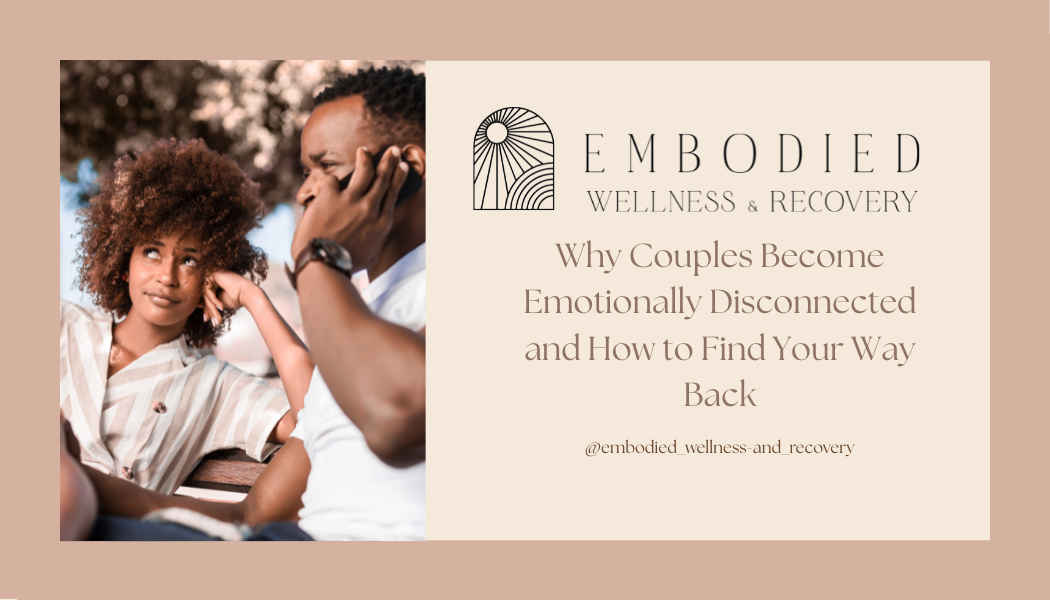
Why Couples Become Emotionally Disconnected and How to Find Your Way Back
Why Couples Become Emotionally Disconnected and How to Find Your Way Back
Feeling disconnected from your partner? Discover how attachment wounds, nervous system patterns, and couples therapy can help you reconnect.
You didn't fall out of love. You fell out of safety.
That distinction, subtle as it sounds, changes everything about how couples understand disconnection, and what it actually takes to heal it.
If you and your partner have been feeling more like roommates than romantic partners, or if the same arguments keep surfacing without resolution, or if one of you has gone quiet while the other keeps reaching, you're experiencing one of the most common patterns couples face. And you're not necessarily in a relationship that's beyond repair.
You may simply be in a relationship where the nervous system has stopped feeling safe enough to stay open.
What Is Emotional Disconnection?
Emotional disconnection doesn't usually happen all at once. It accumulates, in small moments of missing each other, in bids for connection that go unmet, in conversations that feel increasingly risky to have.
Over time, the nervous system begins to associate vulnerability in the relationship with threat. And when the nervous system perceives threat, it does what it's always done: it protects.
This is not a character flaw. It's not a sign that you chose the wrong person. It's biology doing exactly what it was designed to do.
The Pursue-Withdraw Cycle
One of the most well-documented patterns in couples therapy is what researchers call the pursue-withdraw cycle. When disconnection grows, partners typically fall into one of two protective roles: the pursuer and the withdrawer.
The pursuer, sensing the growing distance, reaches harder. They initiate conversations, express frustration, and push for resolution. From the outside, this can look like neediness or criticism. Underneath, it's an attachment system in alarm. It's someone terrified of losing connection.
The withdrawer, feeling overwhelmed or flooded by the pursuit, pulls back. They go quiet, shut down, or disengage. From the outside, this can look like indifference or emotional unavailability. Underneath, it's a nervous system overwhelmed and seeking regulation.
Here's what makes this cycle so painful: the pursuer's urgency triggers more withdrawal. The withdrawer's distance triggers more pursuit. Both partners are trying to feel safe. Neither strategy is working.
Neither person is the villain. Both people are scared.
What's Really Driving the Disconnection
Most couples try to solve disconnection at the level of the argument, the finances, the parenting disagreement, the intimacy, the household responsibilities.
But the argument is rarely what it seems to be about.
Beneath almost every recurring conflict is an unspoken attachment question:
Are you still there for me?
Do I still matter to you?
Am I safe with you?
These are not questions we ask out loud. They live in the nervous system, in the body, in the way we brace before a difficult conversation or shut down when we feel criticized.
Until those underlying questions are addressed, until both partners feel genuinely safe enough to be vulnerable, the surface arguments will keep returning.
Disconnection is a signal, not a verdict.
The most important reframe I offer couples in therapy is this: emotional disconnection is not evidence that your relationship is over. It's a signal that your relationship needs a different kind of safety.
Not more effort. Not better arguments. A deeper understanding of what each of you actually needs to feel secure and a new way of reaching for each other that the nervous system can actually receive.
Reconnection is possible. But it requires going beneath the conflict, the silence, and the resentment to the vulnerability underneath.
How Couples Therapy Can Help
At Embodied Wellness and Recovery, our approach to couples therapy is grounded in attachment theory, neuroscience, and somatic psychology. We don't simply teach communication skills. We help partners understand their own nervous system responses, recognize each other's attachment needs, and build the kind of safety that allows genuine intimacy to return.
This work is particularly effective for couples navigating:
— Emotional disconnection and growing distance
— The pursue-withdraw cycle
— Recurring conflict without resolution
— Intimacy and desire challenges
— Recovery from betrayal or infidelity
— Major life transitions affecting the relationship
We offer couples therapy in Nashville, West LA, and virtually. If you and your partner are ready to find your way back to each other, we'd love to support you.
Reach out to schedule a complimentary 20-minute consultation with our team of therapists, trauma specialists, somatic practitioners, or relationship experts, and start working towards integrative, embodied healing today.
📞 Call us at (310) 651-8458
📱 Text us at (310) 210-7934
📩 Email us at admin@embodiedwellnessandrecovery.com
🔗 Visit us at www.embodiedwellnessandrecovery.com
👉 Check us out on Instagram @embodied_wellness_and_recovery
🌍 Explore our offerings at Linktr.ee: https://linktr.ee/laurendummit
—
Dr. Lauren Dummit, LMFT, CSAT-S. Clinical Sexologist
Founder, Embodied Wellness and Recovery
embodiedwellnessandrecovery.com
References
Bowlby, J. (1988). A secure base: Parent-child attachment and healthy human development. Basic Books.
Gottman, J. M., Coan, J., Carrere, S., & Swanson, C. (1998). Predicting marital happiness and stability from newlywed interactions. Journal of Marriage and Family, 60(1), 5-22.
Gottman, J. M., & Silver, N. (2015). The seven principles for making marriage work (Revised ed.). Harmony Books.
Johnson, S. M., & Greenberg, L. S. (1985). Emotionally focused couples therapy: An outcome study. Journal of Marital and Family Therapy, 11(3), 313-317.
Johnson, S. M. (2019). Attachment theory in practice: Emotionally focused therapy (EFT) with individuals, couples, and families. Guilford Press.
Porges, S. W. (2011). The polyvagal theory: Neurophysiological foundations of emotions, attachment, communication, and self-regulation. W. W. Norton & Company.
Siegel, D. J. (2020). The developing mind: How relationships and the brain interact to shape who we are (3rd ed.). Guilford Press.
Tatkin, S. (2012). Wired for love: How understanding your partner's brain and attachment style can help you defuse conflict and build a secure relationship. New Harbinger Publications.
van der Kolk, B. A. (2014). The body keeps the score: Brain, mind, and body in the healing of trauma. Viking.
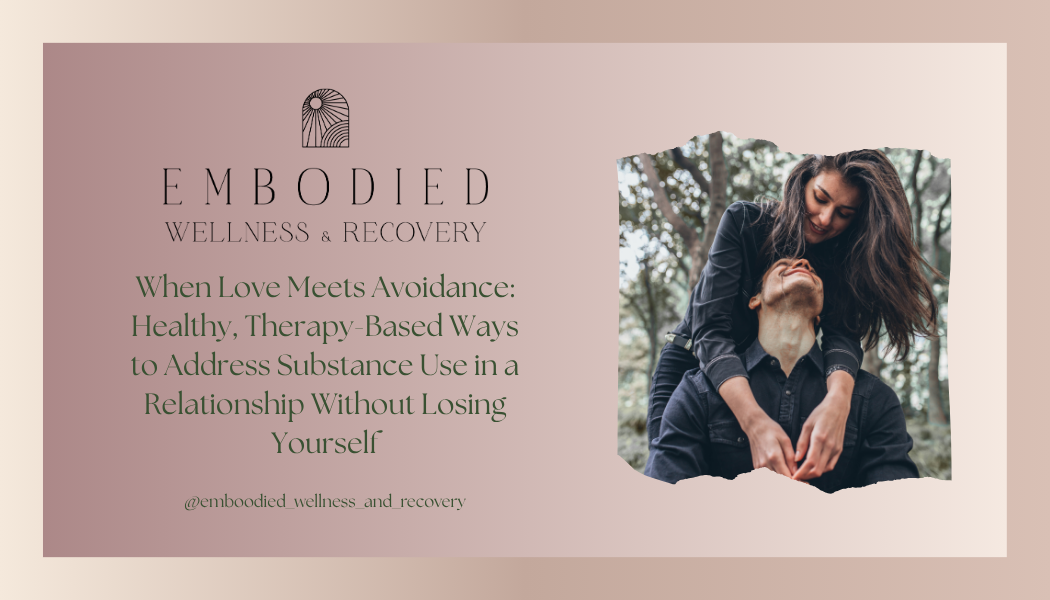
When Love Meets Avoidance: Healthy, Therapy-Based Ways to Address Substance Use in a Relationship Without Losing Yourself
When Love Meets Avoidance: Healthy, Therapy-Based Ways to Address Substance Use in a Relationship Without Losing Yourself
Worried about substance use in your relationship? Discover healthy, neuroscience-informed ways therapy helps couples address destructive behavior, rebuild trust, regulate the nervous system, and restore emotional intimacy.
Substance use rarely impacts only one person.
In intimate relationships, problematic alcohol or drug use often quietly reshapes the emotional climate of the partnership. What begins as concern about drinking, pills, cannabis, cocaine, or other substances can evolve into chronic hypervigilance, secrecy, resentment, disrupted intimacy, financial stress, and painful cycles of conflict and repair attempts that never fully land.
Do you find yourself wondering:
— Am I overreacting, or is this actually becoming a problem?
— Why do I feel like I’m constantly monitoring their mood, tone, or behavior?
— Why does every conversation about drinking or drug use end in defensiveness or shutdown?
— Why do I feel lonelier in this relationship than ever before?
— How has substance use changed our sex life, trust, or emotional connection?
— Why do I feel guilty for wanting boundaries?
These questions are not simply “relationship problems.” They often reflect the way substance use disorder, trauma, and nervous system dysregulation interact within attachment bonds.
At Embodied Wellness and Recovery, we help couples and individuals address substance use in relationships through a somatic, trauma-informed, neuroscience-based therapy lens that protects connection while also supporting truth, accountability, and safety.
Why substance use changes the entire relationship system
Problematic substance use does not occur in a vacuum. Research consistently shows that substance misuse alters communication, attachment security, conflict recovery, emotional responsiveness, and sexual intimacy within couples (McCrady & Epstein, 2013). A partner may begin to experience:
— Emotional unpredictability
— Walking on eggshells
— Fear of bringing things up
— Over-functioning and caretaking
— Distrust and checking behaviors
— Shame around staying
— Resentment around parenting or finances
— Increased anxiety and sleep disturbance
— Loss of sexual desire or emotional safety
From a neuroscience perspective, repeated unpredictability activates the partner’s threat-detection networks, particularly the amygdala and salience systems, leading to chronic sympathetic activation. This is why many loved ones of someone with substance use begin to feel physically tense, obsessive, emotionally reactive, or exhausted.
The body is responding to inconsistency. This is especially true when the relationship already contains unresolved attachment wounds, betrayal trauma, or childhood experiences of chaos.
The Difference Between Support and Unintentional Enabling
One of the most painful dynamics for partners is not knowing whether they are being supportive or inadvertently reinforcing the problem.
Healthy support asks:
— What helps create accountability and safety?
— What protects my own emotional well-being?
— What invites honesty instead of secrecy?
Unhealthy over-accommodation often looks like:
— Covering up consequences
— Lying for your partner
— Rescuing financially
— Taking over responsibilities
— Minimizing the problem
— Suppressing your own needs
— Repeatedly abandoning boundaries to reduce conflict
Therapy helps distinguish compassion from self-abandonment.
This distinction matters because chronic self-betrayal often creates a secondary trauma response in the non-using partner, leading to anxiety, resentment, and loss of self-trust.
Healthy Ways Therapy Helps Couples Address Substance Use
The most effective treatment approaches do not focus only on stopping the substance. They address the relationship ecosystem around the substance use.
1) Rebuilding emotional safety before high-stakes conversations
Many couples try to discuss substance use when both nervous systems are already escalated.
This usually leads to:
— Blame
— Minimization
— Rage
— Shutdown
— Defensiveness
A therapy-informed approach first helps each partner regulate their nervous system before discussing the issue.
This may include:
— Slowing pace and tone
— Body awareness
— Containment skills
— Structured turn-taking
— Identifying shame activation
When the brain shifts out of survival mode, insight becomes possible.
2) Addressing the shame cycle that fuels use
Substance use in relationships is often maintained by shame. A person may use because they already feel inadequate, pressured, traumatized, lonely, or emotionally cut off. After using, shame increases, which can then trigger more avoidance or more use.
This creates a closed feedback loop.
Therapy helps interrupt this by exploring:
— Grief
— Performance pressure
— Depression and anxiety
Research on addiction neuroscience demonstrates that repeated substance use impacts reward pathways, stress circuits, and executive functioning, making shame-based confrontation far less effective than attuned accountability (Koob & Volkow, 2016).
3) Creating boundaries that protect connection and self-respect
Healthy boundaries are not punishments. They are nervous system stabilizers.
Examples may include:
— Refusing to engage in conflict when someone is intoxicated
— Separating finances
— Protecting children from exposure
— Requiring treatment participation
— Naming what behaviors erode trust
— Clarifying what happens if lying continues
— Protecting sleep and physical safety
— Creating sexual boundaries when trust is compromised
In therapy, boundaries become clearer, less reactive, and more aligned with values.
4) Healing the impact on intimacy and sexuality
One of the least discussed consequences of substance use in relationshipsis the impact on desire, trust, and sexual safety.
Substances may:
— Impair consent clarity
— Reduce emotional presence
— Create performance issues
— Increase avoidance
— Amplify shame
— Lead to betrayal dynamics
— Disconnect sexfrom authentic intimacy
For many partners, desire naturally decreases when the nervous system no longer experiences the relationship as safe. This is not rejection. It is neurobiology.
A somatic and relational therapy approach helps restore:
— Embodied safety
— Honest communication
— Emotional responsiveness
This is a core specialty at Embodied Wellness and Recovery, where we integrate trauma treatment with couples therapy, sexuality work, and attachment repair.
5) Treating the underlying trauma beneath the substance use
Many substance use struggles are adaptive attempts to regulate unbearable internal states. Research strongly links trauma exposure with later substance misuse, particularly when individuals lack safe relational co-regulation or internal emotional skills (Najavits, 2002).
This is why trauma-focused work often becomes central.
Approaches may include:
— EMDR
— Somatic therapy
— Shame resilience work
— Relapse trigger mapping
— Grief and betrayal repair
The goal is not simply abstinence. The deeper goal is to help the person no longer need the substance to regulate what the body and psyche have never fully metabolized.
What Partners Need Support for, Too
Loved ones often need their own therapyspace.
Not because they caused the problem, but because proximity to chronic substance use can create:
— Anxiety
— Compulsive monitoring
— People-pleasing
— Sleep disturbance
— Rage
— Emotional numbing
Therapyhelps partners restore:
— Clarity
— Self-trust
— Boundaryconfidence
— Emotional regulation
— Secure attachment behaviors
— Freedom from compulsive caretaking
— Reconnection to desire, identity, and future vision
A Healthier Path Forward
The healthiest way to address substance use in a relationshipis not through ultimatums driven by panic or endless accommodation driven by fear.
It is through a structured therapeutic process that addresses:
— The substance use
— The shameunderneath it
— The nervous system dysregulation around conflict
— The attachment injuries in the relationship
— The impact on trust, intimacy, and sexuality
At Embodied Wellness and Recovery, we specialize in helping couples and individuals navigate these layered dynamics with compassion, accountability, and neuroscience-informed care. The relationship does not improve merely because the substance decreases. It improves when safety, truth, and secure connection are rebuilt in the body, the mind, and the bond itself.
Reach out to schedule a complimentary 20-minute consultation with our team of therapists, trauma specialists, somatic practitioners, or relationship experts, and start working towards integrative, embodied healing today.
📞 Call us at (310) 651-8458
📱 Text us at (310) 210-7934
📩 Email us at admin@embodiedwellnessandrecovery.com
🔗 Visit us at www.embodiedwellnessandrecovery.com
👉 Check us out on Instagram @embodied_wellness_and_recovery
🌍 Explore our offerings at Linktr.ee: https://linktr.ee/laurendummit
References
1) Koob, G. F., & Nora Volkow, N. D. (2016). Neurobiology of addiction: A neurocircuitry analysis. The Lancet Psychiatry, 3(8), 760-773.
2) McCrady, B. S., & Epstein, E. E. (2013). Addictions: A comprehensive guidebook. Oxford University Press.
3) Najavits, L. M. (2002). Seeking safety: A treatment manual for PTSD and substance abuse. Guilford Press.

Integrative Behavioral Couples Therapy (IBCT): Balancing Acceptance and Change for Lasting Relationship Growth
Integrative Behavioral Couples Therapy (IBCT): Balancing Acceptance and Change for Lasting Relationship Growth
Discover how Integrative Behavioral Couples Therapy (IBCT) blends emotional acceptance with practical growth strategies to help couples overcome conflict, deepen intimacy, and strengthen their bond. Learn how neuroscience supports IBCT’s unique balance of acceptance and change.
The Tension Between Change and Acceptance
Have you ever found yourself asking, “Should I push my partner to change, or should I practice acceptance?” This dilemma is one of the most common sources of conflict in intimate relationships. Many couples struggle with feeling torn between love and frustration, between setting firm boundaries and offering unconditional tolerance.
Integrative Behavioral Couples Therapy (IBCT) offers a powerful framework for navigating this exact challenge. Unlike traditional approaches that focus mainly on behavior modification, IBCT combines strategies of emotional acceptance with practical problem-solving, helping couples grow without demanding perfection.
At Embodied Wellness and Recovery, we use this integrative model, rooted in both neuroscience and relational theory, to help couples create deeper, more sustainable connections.
What is Integrative Behavioral Couples Therapy (IBCT)?
IBCT is a therapeutic approach designed to address persistent patterns of conflict in relationships. Developed by Andrew Christensen and Neil Jacobson, IBCT blends two essential elements:
1. Acceptance – Helping partners soften defensiveness and embrace differences with compassion.
2. Change – Equipping couples with tools to communicate more effectively, resolve conflicts, and shift unhelpful behaviors.
This balance allows couples to reduce emotional gridlock while fostering closeness and trust.
Why Do Couples Struggle with Acceptance and Change?
It’s natural to wish your partner would “just change” in ways that feel easier for you, whether that means being more affectionate, managing finances differently, or improving communication. But neuroscience tells us that habits and personality traits are deeply rooted in brain circuitry.
— The amygdala often triggers defensive reactions during conflict.
— The prefrontal cortex, responsible for self-regulation, can be “hijacked” when emotions run high.
— Repeated relational stress activates the sympathetic nervous system, making it harder to stay open and connected.
When couples push too hard for change without acceptance, the nervous system stays in a state of threat. Conversely, when acceptance is present without any effort toward growth, resentment can build. IBCT helps couples find the balance.
The Core Strategies of IBCT
1. Emotional Acceptance
IBCT emphasizes learning to tolerate and even embrace differences. Instead of seeing your partner’s quirks or struggles as flaws to be eliminated, acceptance encourages empathy. This does not mean passivity; it means cultivating a compassionate stance that reduces reactivity.
2. Unified Detachment
Partners are guided to step back and view their struggles as a shared pattern rather than a personal attack. This helps couples approach conflict with curiosity rather than blame.
3. Tolerance Building
Through structured exercises, partners learn to reduce negative emotional reactivity and develop humor, perspective, and flexibility.
4. Targeted Behavior Change
Once acceptance reduces emotional defensiveness, IBCT introduces practical tools, communication skills, boundary-setting, and problem-solving techniques that support growth and adaptation.
Common Relationship Questions IBCT Addresses
— Should I give my partner an ultimatum, or should I practice acceptance?
— How do I know when to set a firm boundary versus when to let go?
— Is it possible to accept my partner fully while still wanting things to change?
These questions reflect the core tension IBCT helps couples explore with compassion, depth, and strategy.
Neuroscience and IBCT: Why It Works
Neuroscience supports the principles of IBCT. Research on neuroplasticity shows that emotional patterns can change with new relational experiences. Couples who practice acceptance and compassion activate calming pathways in the parasympathetic nervous system, making it easier to engage in constructive problem-solving.
Furthermore, shared positive experiences strengthen dopamine and oxytocin circuits, reinforcing bonding and trust. By blending acceptance and change, IBCT leverages both the emotional and neurobiological systems that sustain long-term intimacy.
How IBCT Differs from Traditional Couples Therapy
Traditional behavioral therapy often focuses heavily on problem-solving and behavior change. While this can be effective, it sometimes overlooks the emotional layer of acceptance. IBCT stands out because it acknowledges that some issues may never fully change, but couples can learn to relate to them differently.
This shift from “fixing” to “understanding” helps reduce power struggles and fosters resilience.
Practical Takeaways for Couples
If you and your partner are struggling with conflict, consider these IBCT-inspired practices:
1. Pause Before Reacting – When triggered, take deep breaths and engage your parasympathetic nervous system.
2. Name the Pattern, Not the Person – Instead of saying, “You always…” try, “We tend to get stuck when…”
3. Balance Boundaries with Empathy – Hold your needs firmly, but also seek to understand your partner’s emotional world.
4. Practice Tolerance Rituals – Cultivate humor, shared perspective, and gratitude even amidst differences.
A Path Toward Sustainable Love
Relationships are not about choosing between acceptance and change; they are about learning to weave both together. Integrative Behavioral Couples Therapy offers a roadmap for couples who want to grow while staying deeply connected.
At Embodied Wellness and Recovery, we guide couples through this process with compassion, neuroscience-informed strategies, and a belief in the resilience of love. If you find yourself stuck between frustration and hope, IBCT can help you find clarity, balance, and renewed intimacy.
Reach out to schedule a free 20-minute consultation with our team of couples therapists, relationship experts, or somatic practitioners and begin the process of reconnecting today.
📞 Call us at (310) 651-8458
📱 Text us at (310) 210-7934
📩 Email us at admin@embodiedwellnessandrecovery.com
🔗 Visit us at www.embodiedwellnessandrecovery.com
👉 Check us out on Instagram @embodied_wellness_and_recovery
🌍 Explore our offerings at Linktr.ee: https://linktr.ee/laurendummit
References
1. Christensen, A., & Jacobson, N. S. (2000). Reconcilable Differences. New York: Guilford Press.
2. Jacobson, N. S., Christensen, A., Prince, S. E., Cordova, J., & Eldridge, K. (2000). Integrative behavioral couple therapy: An acceptance-based, promising new treatment for couple discord. Journal of Consulting and Clinical Psychology, 68(2), 351–355.
3. Siegel, D. J. (2012). The Developing Mind: How relationships and the brain interact to shape who we are. Guilford Press.

The Science of Presence: How Your Energy Speaks Before You Do
The Science of Presence: How Your Energy Speaks Before You Do
Your body broadcasts emotion, energy, and intention before you ever say a word. Learn how the heart’s electromagnetic field, nervous system regulation, and somatic awareness impact your relationships, communication, and emotional well-being.
Did you know your heart emits an electromagnetic field up to three feet outside your body?
That’s not a metaphor; it’s measurable. Research from the HeartMath Institute has shown that the heart produces the strongest rhythmic electromagnetic field in the body. And this field is not only real; it shifts and responds based on your emotional state.
This means that even before you speak, your presence is already communicating.
Your energy precedes your words.
Your body is telling a story long before you open your mouth.
You Are Always Communicating, Even in Silence
So often, we think communication starts with words. But in reality, it begins in the nervous system.
When you’re calm and grounded, your body signals safety to others. When you’re anxious, guarded, or overwhelmed, your heart rate, posture, facial expressions, and even your subtle energy field broadcast those cues outward, whether you’re conscious of it or not. This is called neuroception, your body’s ability to detect safety or danger without conscious awareness (Porges, 2011). It’s how we pick up on “vibes,” even when nothing explicit is being said.
The Body as a Field of Wisdom
Your body is more than just flesh and bones. It is a living, breathing broadcast of emotion, energy, and intention. When you walk into a room, your nervous system is already engaging with others. Your presence becomes a form of communication.
When you feel regulated, aligned, and authentic, you naturally emanate calm and clarity.
When you’re dysregulated, fragmented, or disconnected from your truth, that too is felt.
In somatic therapy, we teach clients how to listen to these signals, not just in others, but in themselves. Because embodiment is the first step to congruent communication. When you know what you’re feeling and can stay with it, you can offer your presence without distortion.
Regulating Your Nervous System to Shift Your Energy Field
Want to change how others experience your presence? Start by regulating your nervous system. Here’s how:
1. Breathe Coherently
Slow, rhythmic breathing (like inhaling for 4 counts, exhaling for 6) balances the sympathetic and parasympathetic branches of the autonomic nervous system (McCraty & Zayas, 2014).
2. Ground Through the Senses
Feel your feet on the floor. Notice the sounds around you. Sensory awareness anchors you in the present moment, which translates to a more grounded presence.
3. Feel Without Judgment
Allow emotional sensations in the body to arise and move without immediately fixing or suppressing them. This builds emotional tolerance and coherence.
4. Practice Somatic Awareness
Learn the language of your body. Notice posture, breath,and micro-movements. These subtle shifts shape how you show up.
Your Presence Is Power
If you’ve been doubting your impact…
If you’ve been feeling invisible or unsure whether your voice matters…
Let this be your reminder:
You are already communicating.
Your nervous system is a tuning fork.
Your heart is a transmitter.
Even your silence is speaking.
You don’t have to “do” more to matter.
You already are.
Ready to Embody the Power of Your Presence?
At Embodied Wellness and Recovery, we help you reconnect with your authentic self by healing trauma, regulating your nervous system, and learning to trust your body’s wisdom. Whether you’re navigating anxiety, relationship struggles, or emotional burnout, our somatic, neuroscience-informed approach supports deep, lasting transformation.
Contact us today to schedule a free 20-minute consultation with our team of top-rated somatic practitioners, trauma specialists, or relationship experts, and begin your journey toward embodied connection, clarity, and confidence.
📞 Call us at (310) 651-8458
📱 Text us at (310) 210-7934
📩 Email us at admin@embodiedwellnessandrecovery.com
🔗 Visit us at www.embodiedwellnessandrecovery.com
👉 Check us out on Instagram @embodied_wellness_and_recovery
🌍 Explore our offerings at Linktr.ee: https://linktr.ee/laurendummi
References:
HeartMath Institute. (n.d.). Science of the Heart: Exploring the Role of the Heart in Human Performance. McCraty, R., & Zayas, M. A. (2014). Cardiac coherence, self-regulation, autonomic stability, and psychosocial well-being. Frontiers in Psychology, 5, 1090.
Porges, S. W. (2011). The Polyvagal Theory: Neurophysiological Foundations of Emotions, Attachment, Communication, and Self-Regulation. W.W. Norton & Company.