
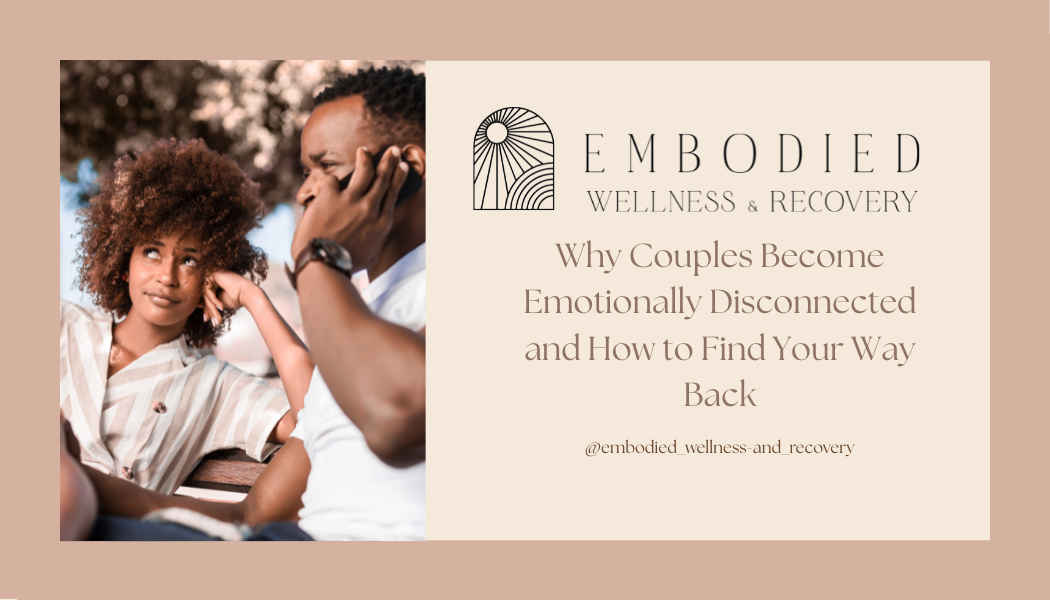
Why Couples Become Emotionally Disconnected and How to Find Your Way Back
Why Couples Become Emotionally Disconnected and How to Find Your Way Back
Feeling disconnected from your partner? Discover how attachment wounds, nervous system patterns, and couples therapy can help you reconnect.
You didn't fall out of love. You fell out of safety.
That distinction, subtle as it sounds, changes everything about how couples understand disconnection, and what it actually takes to heal it.
If you and your partner have been feeling more like roommates than romantic partners, or if the same arguments keep surfacing without resolution, or if one of you has gone quiet while the other keeps reaching, you're experiencing one of the most common patterns couples face. And you're not necessarily in a relationship that's beyond repair.
You may simply be in a relationship where the nervous system has stopped feeling safe enough to stay open.
What Is Emotional Disconnection?
Emotional disconnection doesn't usually happen all at once. It accumulates, in small moments of missing each other, in bids for connection that go unmet, in conversations that feel increasingly risky to have.
Over time, the nervous system begins to associate vulnerability in the relationship with threat. And when the nervous system perceives threat, it does what it's always done: it protects.
This is not a character flaw. It's not a sign that you chose the wrong person. It's biology doing exactly what it was designed to do.
The Pursue-Withdraw Cycle
One of the most well-documented patterns in couples therapy is what researchers call the pursue-withdraw cycle. When disconnection grows, partners typically fall into one of two protective roles: the pursuer and the withdrawer.
The pursuer, sensing the growing distance, reaches harder. They initiate conversations, express frustration, and push for resolution. From the outside, this can look like neediness or criticism. Underneath, it's an attachment system in alarm. It's someone terrified of losing connection.
The withdrawer, feeling overwhelmed or flooded by the pursuit, pulls back. They go quiet, shut down, or disengage. From the outside, this can look like indifference or emotional unavailability. Underneath, it's a nervous system overwhelmed and seeking regulation.
Here's what makes this cycle so painful: the pursuer's urgency triggers more withdrawal. The withdrawer's distance triggers more pursuit. Both partners are trying to feel safe. Neither strategy is working.
Neither person is the villain. Both people are scared.
What's Really Driving the Disconnection
Most couples try to solve disconnection at the level of the argument, the finances, the parenting disagreement, the intimacy, the household responsibilities.
But the argument is rarely what it seems to be about.
Beneath almost every recurring conflict is an unspoken attachment question:
Are you still there for me?
Do I still matter to you?
Am I safe with you?
These are not questions we ask out loud. They live in the nervous system, in the body, in the way we brace before a difficult conversation or shut down when we feel criticized.
Until those underlying questions are addressed, until both partners feel genuinely safe enough to be vulnerable, the surface arguments will keep returning.
Disconnection is a signal, not a verdict.
The most important reframe I offer couples in therapy is this: emotional disconnection is not evidence that your relationship is over. It's a signal that your relationship needs a different kind of safety.
Not more effort. Not better arguments. A deeper understanding of what each of you actually needs to feel secure and a new way of reaching for each other that the nervous system can actually receive.
Reconnection is possible. But it requires going beneath the conflict, the silence, and the resentment to the vulnerability underneath.
How Couples Therapy Can Help
At Embodied Wellness and Recovery, our approach to couples therapy is grounded in attachment theory, neuroscience, and somatic psychology. We don't simply teach communication skills. We help partners understand their own nervous system responses, recognize each other's attachment needs, and build the kind of safety that allows genuine intimacy to return.
This work is particularly effective for couples navigating:
— Emotional disconnection and growing distance
— The pursue-withdraw cycle
— Recurring conflict without resolution
— Intimacy and desire challenges
— Recovery from betrayal or infidelity
— Major life transitions affecting the relationship
We offer couples therapy in Nashville, West LA, and virtually. If you and your partner are ready to find your way back to each other, we'd love to support you.
Reach out to schedule a complimentary 20-minute consultation with our team of therapists, trauma specialists, somatic practitioners, or relationship experts, and start working towards integrative, embodied healing today.
📞 Call us at (310) 651-8458
📱 Text us at (310) 210-7934
📩 Email us at admin@embodiedwellnessandrecovery.com
🔗 Visit us at www.embodiedwellnessandrecovery.com
👉 Check us out on Instagram @embodied_wellness_and_recovery
🌍 Explore our offerings at Linktr.ee: https://linktr.ee/laurendummit
—
Dr. Lauren Dummit, LMFT, CSAT-S. Clinical Sexologist
Founder, Embodied Wellness and Recovery
embodiedwellnessandrecovery.com
References
Bowlby, J. (1988). A secure base: Parent-child attachment and healthy human development. Basic Books.
Gottman, J. M., Coan, J., Carrere, S., & Swanson, C. (1998). Predicting marital happiness and stability from newlywed interactions. Journal of Marriage and Family, 60(1), 5-22.
Gottman, J. M., & Silver, N. (2015). The seven principles for making marriage work (Revised ed.). Harmony Books.
Johnson, S. M., & Greenberg, L. S. (1985). Emotionally focused couples therapy: An outcome study. Journal of Marital and Family Therapy, 11(3), 313-317.
Johnson, S. M. (2019). Attachment theory in practice: Emotionally focused therapy (EFT) with individuals, couples, and families. Guilford Press.
Porges, S. W. (2011). The polyvagal theory: Neurophysiological foundations of emotions, attachment, communication, and self-regulation. W. W. Norton & Company.
Siegel, D. J. (2020). The developing mind: How relationships and the brain interact to shape who we are (3rd ed.). Guilford Press.
Tatkin, S. (2012). Wired for love: How understanding your partner's brain and attachment style can help you defuse conflict and build a secure relationship. New Harbinger Publications.
van der Kolk, B. A. (2014). The body keeps the score: Brain, mind, and body in the healing of trauma. Viking.
The Secret to Lasting Love: Why Friendship Is the Foundation of Long-Term Romantic Success
The Secret to Lasting Love: Why Friendship Is the Foundation of Long-Term Romantic Success
Discover why friendship is one of the strongest predictors of long-term relationship success. Learn how emotional intimacy, trust, friendship, attachment, and neuroscience influence lasting love and relationship satisfaction.
Is Your Partner Also Your Friend?
When people think about romantic relationships, they often focus on:
— Chemistry
— Attraction
— Passion
— Shared goals
While these factors certainly matter, decades of relationship research suggest that one of the strongest predictors of long-term relationship satisfaction may be something far simpler:
Friendship.
In fact, renowned relationship researcher John Gottman has spent decades studying couples and repeatedly found that strong friendships form the foundation of healthy, lasting relationships.
Yet man couples find themselves asking:
— Why do we feel more like roommates than partners?
— Where did our connection go?
— Why don't we talk like we used to?
— Why do I feel lonely even though I'm in a relationship?
— Why does it seem like we're always discussing logistics rather than truly connecting?
If these questions feel familiar, you are not alone in wondering whether friendship has quietly faded from your relationship.
At Embodied Wellness and Recovery, we frequently help individuals and couples rediscover the power of friendship as a pathway toward deeper intimacy, emotional safety, and relational resilience.
Friendship Is More Than Enjoying the Same Activities
When people hear the word friendship, they often think of shared hobbies or common interests. While those can be important, friendship in a romantic relationship runs much deeper.
Healthy friendship includes:
— Emotional curiosity
— Trust
— Affection
— Admiration
— Playfulness
— Emotional support
— Mutual respect
— Genuine interest in one another's inner worlds
A strong friendship allows partners to feel seen, understood, and valued beyond their roles as spouses, parents, or co-managers of daily life. Friendship creates a sense of companionship that helps sustain relationships through inevitable periods of stress and change.
What Research Says About Friendship and Relationship Satisfaction
Research consistently demonstrates that friendship is one of the most important predictors of marital satisfaction and long-term relationship success.
According to Gottman's research, happy couples maintain what he calls a strong "friendship system." These couples actively cultivate:
— Affection
— Admiration
— Emotional connection
— Curiosity about one another
— Shared meaning (Gottman, 2016).
Rather than assuming they already know everything about their partner, they continue learning about each other's evolving thoughts, dreams, fears, and experiences.
Research suggests that couples who maintain emotional friendship experience:
— Higher relationship satisfaction
— Greater emotional intimacy
— Stronger sexual satisfaction
— Improved conflict resolution
— Increased relationship stability
(Gottman & Silver, 2015).
In other words, friendship is not merely a nice bonus in healthy relationships. It may be one of the primary mechanisms through which relationships remain resilient.
The Neuroscience of Friendship and Connection
From a neuroscience perspective, friendship serves a critical regulatory function. Human beings are wired for connection. The nervous system continuously scans for cues of safety and danger.
When we experience emotional attunement from a trusted partner, the brain often releases neurochemicals associated with connection and well-being, including:
— Oxytocin
— Dopamine
— Serotonin
These chemicals can support:
— Emotional regulation
— Stress reduction
— Bonding
— Feelings of safety
Research suggests that emotionally supportive relationships can buffer the effects of stress and improve both mental and physical health (Coan et al., 2006).
When friendship is present, partners often become sources of co-regulation.
A reassuring touch.
A shared laugh.
A meaningful conversation.
These seemingly small moments can have profound effects on the nervous system.
Why Friendship Often Fades
Many couples do not intentionally stop being friends.
Life simply becomes busy.
Over time, conversations may become dominated by:
— Finances
— Schedules
— Responsibilities
— Household management
The relationship gradually shifts from connection to coordination. The problem is that emotional intimacy requires ongoing investment.
Without intentional friendship-building, partners can begin feeling:
— Disconnected
— Lonely
— Misunderstood
— Emotionally neglected
Even when they continue functioning well as a team. This is one reason many couples report feeling isolated despite living under the same roof.
Friendship Creates Emotional Safety
One of the most important functions of friendship is emotional safety.
Emotional safety develops when partners consistently experience:
— Acceptance
— Responsiveness
— Validation
— Empathy
— Respect
When emotional safety is present, individuals are more likely to:
— Express vulnerability
— Seek support
— Remain emotionally engaged
For individuals with attachment wounds or trauma histories, emotional safety can be especially important.
Many people enter relationships carrying fears of:
— Rejection
— Emotional neglect
Friendship helps counter these fears by creating experiences of consistent care and connection.
Friendship and Sexual Intimacy
Many couples assume that friendship and romance exist separately. In reality, the two are often deeply intertwined. Research suggests that emotional intimacy frequently enhances sexual intimacy (Brock & Jennings, 2007).
When partners feel:
— Emotionally connected
— Respected
— Appreciated
— Understood
They often experience greater desire and relational satisfaction. Friendship creates an atmosphere in which vulnerability feels safer. It allows intimacy to become more than physical attraction. It becomes an extension of emotional connection. This is particularly important in long-term relationships where novelty naturally decreases over time. Friendship often becomes the glue that sustains desire through life's inevitable seasons.
Small Moments Matter More Than Grand Gestures
Many people believe stronger relationships require dramatic changes. In reality, relationship research suggests that small moments of connection often matter most.
Examples include:
— Expressing appreciation
— Sharing humor
— Showing curiosity
— Checking in emotionally
— Spending intentional time together
— Responding positively to bids for connection
These moments may appear insignificant. Yet over time, they create the emotional infrastructure of friendship. A strong relationship is rarely built through occasional grand gestures alone.
It is built through thousands of small interactions that communicate:
"I see you."
"I care about you."
"You matter to me."
Rebuilding Friendship in Your Relationship
If friendship has faded, it can be rebuilt.
Consider asking yourself:
— When was the last time we laughed together?
— How often do we discuss topics beyond logistics?
— Do I know what currently excites or worries my partner?
— How curious am I about their inner world?
— When was the last time we spent meaningful time together without distractions?
Small steps can create meaningful change.
Try:
— Scheduling regular date nights
— Taking walks together
— Asking open-ended questions
— Expressing daily appreciation
— Sharing new experiences
— Practicing active listening
The goal is not perfection. The goal is cultivating emotional closeness through consistent connection.
How Therapy Can Help
At Embodied Wellness and Recovery, we help couples strengthen the friendship at the heart of their relationship.
Through a trauma-informed, neuroscience-based approach, couples can learn to:
— Improve communication
— Rebuild trust
— Increase emotional safety
— Understand attachment patterns
— Strengthen friendship and connection
When couples feel emotionally connected, many other relationship challenges become easier to navigate.
Curiosity, Support, and Connection
Passion may spark a relationship. Commitment may sustain it. But friendship often helps it flourish. When partners remain curious about one another, support each other's growth, and maintain emotional connection, relationships become more resilient, satisfying, and fulfilling. Long-term romantic success is rarely built on attraction alone. It is built on a foundation of friendship that continues evolving throughout the lifespan of the relationship.
Reach out to schedule a complimentary 20-minute consultation with our team of therapists, trauma specialists, somatic practitioners, or relationship experts, and start working towards integrative, embodied healing today.
📞 Call us at (310) 651-8458
📱 Text us at (310) 210-7934
📩 Email us at admin@embodiedwellnessandrecovery.com
🔗 Visit us at www.embodiedwellnessandrecovery.com
👉 Check us out on Instagram @embodied_wellness_and_recovery
🌍 Explore our offerings at Linktr.ee: https://linktr.ee/laurendummit
References
1) Brock, L. J., & Jennings, G. (2007). Sexuality and intimacy. Handbook of gerontology: Evidence-based approaches to theory, practice, and policy, 244-268.
2) Coan, J. A., Schaefer, H. S., & Davidson, R. J. (2006). Lending a hand: Social regulation of the neural response to threat. Psychological Science, 17(12), 1032-1039.
3) Gottman, J. M., & Silver, N. (2015). The seven principles for making marriage work. Harmony Books.
4) Gottman, J. S. (Ed.). (2016). The marriage clinic casebook. WW Norton & Company.
5) Reis, H. T., & Gable, S. L. (2015). Responsiveness. Current Opinion in Psychology, 1, 67-71.
6) Siegel, D. J. (2012). The developing mind: How relationships and the brain interact to shape who we are. Guilford Press.
The Lost Art of Listening: 5 Neuroscience-Backed Ways to Re-Tune Your Ears for Deeper Connection, Better Relationships, and a More Meaningful Life
The Lost Art of Listening: 5 Neuroscience-Backed Ways to Re-Tune Your Ears for Deeper Connection, Better Relationships, and a More Meaningful Life
Are we losing the ability to listen? Discover the neuroscience of conscious listening, how noise, technology, stress, and trauma impact attention, and five powerful ways to improve listening skills, strengthen relationships, and reconnect with the world around you.
When was the last time you truly listened?
Not waiting for your turn to speak.
Not checking your phone.
Not mentally rehearsing a response.
Not half-listening while scrolling, driving, working, or multitasking.
Just listening.
If that question gives you pause, you are not alone in the experience.
Research suggests that we spend approximately 60% of our communication time listening, yet we retain only about 25% of what we hear (Nichols, 1961). In a world saturated with notifications, podcasts, social media feeds, advertisements, emails, texts, headlines, and constant noise, listening has become one of the most overlooked skills in modern life.
And the consequences extend far beyond missed information. Poor listening affects relationships, intimacy, emotional connection, workplace communication, conflict resolution, parenting, and even mental health. Many people today feel profoundly disconnected despite being more digitally connected than ever. Could part of the problem be that we are no longer listening?
The Modern Epidemic of Noise
Take a moment to consider the sheer volume of information your brain processes each day. Your phone vibrates. Emails arrive. News alerts appear. Social media platforms compete for your attention. Televisions play in waiting rooms. Music streams in stores. Podcasts fill quiet moments. Conversations occur while multitasking.
Our nervous systems rarely experience silence. The result is what researchers call cognitive overload. The brain evolved to process information selectively. Yet modern environments bombard us with more auditory and visual stimulation than previous generations could have imagined. This constant stimulation has consequences. Listening requires attention. Attention requires energy. And energy is finite.
When the brain becomes overwhelmed, listening quality declines. We hear words without absorbing meaning. We respond without understanding. We become physically present but psychologically absent.
Why Listening Matters More Than Ever
Listening is not merely a communication skill. It is a relationship skill. It is an emotional regulation skill. It is a nervous system skill.
At its core, listening communicates:
"You matter."
"I want to understand."
"Your experience is important."
Research in attachment theory suggests that feeling heard and understood is a foundational element of emotional safety (Feeley, 2023). In romantic relationships, friendships, families, and therapeutic settings, people are often less concerned with whether someone agrees and more concerned with whether someone genuinely understands.
Listening creates connection. Listening builds trust. Listening regulates the nervous system. Listening strengthens intimacy. Yet many of us are losing the capacity for sustained attention. We have become accustomed to sound bites rather than conversations.
Personal broadcasting often replaces genuine dialogue. We speak more. We listen less. And many people feel increasingly lonely because of it.
The Neuroscience of Listening
Listening is far more complex than simply hearing sounds. Hearing is passive. Listening is active. Effective listening requires coordination between multiple brain regions involved in attention, emotional regulation, language processing, empathy, and memory.
The prefrontal cortex helps sustain attention. The limbic system helps interpret emotional meaning. Mirror neuron systems contribute to empathy and social understanding. When we listen deeply, we are engaging complex neural networks that support human connection. Interestingly, chronic stress and trauma can interfere with listening. When the nervous system perceives threat, attention narrows toward survival.
People become more focused on self-protection and less able to remain curious about another person's experience. This is one reason why nervous system regulation is so critical for healthy communication. When we feel safe, we listen differently.
Are We Becoming Desensitized?
Another challenge facing modern listeners is desensitization. To capture attention, media platforms often rely on outrage, sensationalism, urgency, and emotional intensity. Headlines scream. Notifications demand. Algorithms reward extremes.
Over time, the nervous system adapts. The dramatic captures attention. The subtle becomes harder to notice. The quiet voice. The nuanced perspective. The emotional undertone in someone's words. The beauty of birdsong. The sound of rain. The silence between thoughts. When our attention becomes conditioned toward stimulation, we can lose sensitivity to life's quieter experiences. Yet many of the most meaningful aspects of life exist in those quieter spaces.
Five Ways to Re-Tune Your Ears for Conscious Listening
The good news is that listening is a skill. And like any skill, it can be strengthened.
1. Practice Three Minutes of Intentional Silence Daily
Most people have become uncomfortable with silence. Yet silence is where listening begins.
For three minutes each day:
— Turn off music
— Put away your phone
— Stop multitasking
— Simply listen
— Notice distant sounds
— Notice subtle sounds.
— Notice your own breathing
This simple practice helps recalibrate attention and trains the brain to tolerate stillness.
2. Listen to Understand Rather Than Respond
Many conversations become competitions for airtime. Instead, experiment with a different goal.
When someone is speaking, ask yourself:
"What is this person trying to communicate beyond their words?"
Focus on understanding rather than preparing a reply.
Research suggests that active listening improves relationship satisfaction, conflict resolution, and emotional intimacy (Sathyamurthy et al., 2024).
3. Notice the Emotional Content Beneath the Words
People rarely communicate only information. They communicate emotions.
The statement:
"I'm fine."
Can mean:
— I'm hurt.
— I'm overwhelmed.
— I'm disappointed.
— I don't feel safe sharing more.
Conscious listening involves paying attention to tone, pacing, facial expressions, and emotional energy. This deeper level of listening strengthens empathy and connection.
4. Create Technology-Free Conversations
Technology fragments attention. Even the presence of a smartphone can reduce the perceived quality of conversations.
Consider creating intentional technology-free spaces:
— During meals
— Before bed
— During walks
— During date nights
— During family conversations
These moments provide opportunities for deeper listening and meaningful connection.
5. Listen to the World Around You
Conscious listening extends beyond relationships.
It includes listening to:
— Nature
— Music
— Silence
— Your emotions
Research demonstrates that spending time in nature can reduce stress, improve attention, and support nervous system regulation (Yao, Zhang, & Gong, 2021). Listening to birds, wind, rain, or ocean waves helps activate parasympathetic nervous system responses associated with calm and restoration. Sometimes the world is communicating in ways we have forgotten how to hear.
Listening to Your Own Nervous System
Perhaps the most important form of listening is learning to listen inward. Many people can identify the needs of everyone around them while remaining disconnected from their own internal experience.
What is your body trying to tell you?
What emotions have you been avoiding?
What signals of fatigue, grief, stress, loneliness, or longing have been drowned out by busyness?
Trauma often teaches people to disconnect from internal cues. Healing often involves relearning how to listen. Not only to others. But to ourselves.
The Future of Connection Depends on Listening
The ability to listen deeply may become one of the most valuable skills of the modern era. In a culture that rewards speed, reaction, distraction, and performance, listening offers something increasingly rare:
Presence.
Connection.
Understanding.
At Embodied Wellness and Recovery, we often help clients explore how trauma, nervous system dysregulation, attachment wounds, relationship challenges, sexuality concerns, and emotional overwhelm can interfere with the capacity to listen, connect, and feel fully present.
Through EMDR, somatic therapy, attachment-focused treatment, couples therapy, and nervous system-informed approaches, individuals and couples can strengthen their ability to communicate with greater awareness, empathy, and authenticity. Listening is not merely hearing what is said. It is creating enough space for something meaningful to be received.
Reach out to schedule a complimentary 20-minute consultation with our team of therapists, trauma specialists, somatic practitioners, or relationship experts, and start working towards integrative, embodied healing today.
📞 Call us at (310) 651-8458
📱 Text us at (310) 210-7934
📩 Email us at admin@embodiedwellnessandrecovery.com
🔗 Visit us at www.embodiedwellnessandrecovery.com
👉 Check us out on Instagram @embodied_wellness_and_recovery
🌍 Explore our offerings at Linktr.ee: https://linktr.ee/laurendummit
References
1) Feeley, C. (2023). Cultivating emotional safety, the cornerstone of safe, relational care. In Skilled heartfelt midwifery practice: safe, relational care for alternative physiological births (pp. 39-59). Cham: Springer International Publishing.
2) Goleman, D. (2013). Focus: The Hidden Driver of Excellence. Harper.
3) Nichols, R. G. (1961). Do we know how to listen? Practical helps in a modern age. Communication Education, 10(2), 118-124.
4) Rogers, C. R., & Farson, R. E. (1987). Active Listening. Industrial Relations Center, University of Chicago.
5) Sathyamurthy, M., Nair, V. V., Mohamed, I. S., & TS, D. (2024). Interpersonal communication, emotional intelligence, conflict resolution, and relational satisfaction among intimate partners. Public Administration and Law Review, (4 (20)), 65-72.
6) Siegel, D. J. (2020). The Developing Mind: How Relationships and the Brain Interact to Shape Who We Are (3rd ed.). Guilford Press.
7) Turkle, S. (2015). Reclaiming Conversation: The Power of Talk in a Digital Age. Penguin Press.
8) Weger, H., Castle Bell, G., Minei, E. M., & Robinson, M. C. (2014). The relative effectiveness of active listening in initial interactions. International Journal of Listening, 28(1), 13-31.
9) Yao, W., Zhang, X., & Gong, Q. (2021). The effect of exposure to the natural environment on stress reduction: A meta-analysis. Urban forestry & urban greening, 57, 126932.

The Difference Between Solving Problems and Providing Emotional Support: The Neuroscience of Connection, Communication, and Conflict in Relationships
The Difference Between Solving Problems and Providing Emotional Support: The Neuroscience of Connection, Communication, and Conflict in Relationships
Why do couples struggle when one partner wants solutions, and the other wants emotional support? Learn the neuroscience behind emotional validation, nervous system regulation, communication, attachment, and healthy relationship boundaries.
Why Do So Many Couples Feel Misunderstood During Conflict?
Have you ever opened up emotionally to your partner only to receive advice when what you truly wanted was comfort?
Have you ever thought:
— “Why are they trying to fix me instead of listening?”
— “Why does every emotional conversation turn into problem-solving?”
— “Why do I feel emotionally dismissed?”
— “Why does my partner get frustrated when I simply need support?”
— “Why do our conversations escalate into conflict even when we both care about each other?”
One of the most common yet misunderstood relationship dynamics involves the difference between:
— Solving a problem and
— Providing emotional support
Many couples deeply love one another but repeatedly miss each other emotionally because they are operating from different nervous system needs during moments of distress.
At Embodied Wellness and Recovery, we frequently help couples understand how trauma, attachment wounds, nervous system dysregulation, emotional communication patterns, and blurred relational boundaries contribute to conflict, emotional disconnection, and misunderstanding. Often, the issue is not a lack of love. It is a lack of attunement.
The Difference Between Emotional Support and Problem Solving
Problem-solving focuses on:
— Fixing
— Strategizing
— Analyzing
— Offering solutions
— Reducing uncertainty
— Restoring control
Emotional support focuses on:
— Listening
— Validating
— Attuning
— Emotionally staying present
— Creating safety
— Helping someone feel emotionally understood
Both are valuable. The challenge arises when partners offer solutions instead of the emotional connection that is actually needed.
For example:
Problem Solving
“Here’s what you should do.”
“You are overthinking this.”
“Why don’t you just talk to them?”
“There’s an easy fix.”
Emotional Support
“That sounds really overwhelming.”
“I can understand why you feel hurt.”
“I’m here with you.”
“Tell me more about what this feels like.”
One approach primarily addresses the situation. The other addresses the nervous system.
Why People Try to Solve Instead of Support
Many individuals genuinely believe they are helping when they offer solutions.
In fact, problem-solving is often rooted in:
— Care
— Love
— Anxiety reduction
— Helplessness
— Discomfort with emotional distress
Some people become solution-oriented because:
— Emotions were minimized in their family system
— Vulnerability felt unsafe
— They learned to value productivity over emotional processing
— Emotional discomfort triggered anxiety
— They feel responsible for fixing pain quickly
For some individuals, witnessing a loved one’s distress activates their own nervous system discomfort. Problem-solving becomes an unconscious attempt to regulate anxiety.
The Neuroscience of Emotional Validation
From a neuroscience perspective, emotional attunement and validation help regulate the nervous system. Research related to attachment and interpersonal neurobiology suggests that humans are biologically wired for co-regulation through emotionally safe connection (Siegel, 2012).
When someone feels:
— Emotionally seen
— Understood
— Validated
— Emotionally accompanied
The nervous system often becomes less defensive and less dysregulated.
Emotional validation can reduce:
— Stress responses
— Emotional flooding
— Shame
— Loneliness
In contrast, feeling emotionally dismissed or “fixed” too quickly can unintentionally increase:
— Defensiveness
— Shame
— Frustration
— Emotional disconnection
Why “Fixing” Can Feel Invalidating
Many people interpret immediate advice giving as:
— “Your emotions are a problem.”
— “You should not feel this way.”
— “Your distress makes me uncomfortable.”
— “I need you to stop feeling this.”
Even when the intention is loving, the emotional impact may feel distancing. This is especially true for individuals with trauma histories or attachment wounds. If someone grew up feeling emotionally unheard, dismissed, criticized, or emotionally abandoned, they may become highly sensitive to interactions that feel emotionally minimizing.
Trauma and Emotional Safety in Relationships
Trauma often affects how people experience emotional connection and support.
Some trauma survivors learned:
— Emotions overwhelm people
— Vulnerability creates rejection
— Emotional expression is unsafe
— They must solve problems alone
— Needing support is a weakness
Others learned to survive by becoming hyperfunctional problem solvers themselves.
This can create relationship dynamics where:
— One partner seeks an emotional connection
— The other seeks emotional control through fixing
Both individuals may care deeply for each other while still feeling emotionally disconnected.
Emotional Support Is Not the Same as Enabling
One common misconception is that emotional support means agreeing with everything someone says or avoiding accountability.
Healthy emotional support does not require:
— Rescuing
— Overfunctioning
— Emotional caretaking
— Abandoning boundaries
Instead, emotional support means:
— Emotionally staying present
— Validating feelings
— Listening without immediately correcting
— Creating emotional safety
Problem-solving can still happen. But timing matters.
The Nervous System Often Needs Regulation Before Solutions
From a Polyvagal perspective, the nervous system processes information differently depending on whether it feels safe or threatened (Porges, 2011). When someone is emotionally flooded, anxious, or dysregulated, the brain is often less capable of:
— Reasoning
— Perspective taking
— Processing solutions
— Integrating advice
In many situations, emotional connection must come before effective problem-solving.
This is why phrases such as:
— “I’m here.”
— “I understand.”
— “That sounds painful.”
— “You make sense to me.”
can feel profoundly regulating. The nervous system calms through connection.
Blurred Boundaries and Relationship Conflict
Many couples become stuck in cycles where:
— One partner feels emotionally unheard
— The other feels chronically responsible for fixing everything
This often creates:
— Resentment
— Emotional exhaustion
— Withdrawal
— Communication breakdown
Healthy relational boundaries involve understanding:
— When emotional support is needed
— When problem-solving is needed
— When advice is welcome
— When emotional presence matters more
Sometimes asking: “Do you want support right now or help solving this?” can dramatically improve communication.
How Couples Can Improve Emotional Attunement
Pause Before Offering Advice
Ask yourself:
— “What does my partner emotionally need right now?”
— “Am I listening or trying to control discomfort?”
Validate Before Solving
Validation does not mean agreement.
It means acknowledging emotional reality.
Learn to Tolerate Emotional Discomfort
Some individuals rush to fix because distress feels intolerable.
Emotional presence often requires slowing down.
Clarify Needs Explicitly
Encourage conversations such as:
— “I need comfort right now.”
— “I’m not asking you to fix this.”
— “Can you just listen for a minute?”
Strengthen Nervous System Regulation
The more each partner becomes individually regulated, the easier emotional attunement often becomes relationally.
How Therapy Can Help
At Embodied Wellness and Recovery, we help couples explore:
— Communication patterns
— Emotional attunement
— Attachment dynamics
— Conflict cycles
— Emotional safety
— Intimacy struggles
Treatment may include:
— Attachment-focused interventions
— EMDR
— Nervous system regulation work
— Communication skill building
As couples learn to differentiate between fixing and emotionally supporting, many experience:
— Deeper intimacy
— Reduced conflict
— Improved communication
— Increased emotional safety
— Stronger relational connection
Different Nervous System Needs
Problem-solving and emotional support are both important in healthy relationships. But they serve different nervous system needs. Many people do not need immediate solutions during moments of distress.
They need:
— Emotional presence
— Attunement
— Validation
— Connection
— Reassurance that their emotional experience matters
Sometimes the most healing response is not: “Here’s how to fix it.”
Sometimes it is: “I’m here with you while you move through it.”
Reach out to schedule a complimentary 20-minute consultation with our team of therapists, trauma specialists, somatic practitioners, or relationship experts, and start working towards integrative, embodied healing today.
📞 Call us at (310) 651-8458
📱 Text us at (310) 210-7934
📩 Email us at admin@embodiedwellnessandrecovery.com
🔗 Visit us at www.embodiedwellnessandrecovery.com
👉 Check us out on Instagram @embodied_wellness_and_recovery
🌍 Explore our offerings at Linktr.ee: https://linktr.ee/laurendummit
References
1) Gottman, J. M., & Silver, N. (2015). The seven principles for making marriage work. Harmony Books.
2) Porges, S. W. (2011). The polyvagal theory: Neurophysiological foundations of emotions, attachment, communication, and self-regulation. Norton.
3) Siegel, D. J. (2012). The developing mind: How relationships and the brain interact to shape who we are. Guilford Press.
4) Sue Johnson, S. M. (2019). Attachment theory in practice: Emotionally focused therapy (EFT) with individuals, couples, and families. Guilford Press.
Understanding Nonverbal Emotional Cues in Couples: The Neuroscience of Attunement, Conflict, and Emotional Connection
Understanding Nonverbal Emotional Cues in Couples: The Neuroscience of Attunement, Conflict, and Emotional Connection
Discover how nonverbal emotional cues affect communication, conflict, intimacy, and emotional safety in relationships. Learn the neuroscience behind facial expressions, tone of voice, body language, and nervous system attunement in couples therapy.
Why Do Couples So Often Misunderstand Each Other?
Have you ever said, “That’s not what I meant,” after your partner reacted strongly to your tone or facial expression?
Have you ever felt hurt because your partner seemed cold, dismissive, distant, irritated, or emotionally unavailable, even though they insisted nothing was wrong?
Do you find yourself constantly trying to “read” your partner’s mood, body language, silence, or energy?
Many relationship conflicts are not caused solely by words. They are shaped by nonverbal emotional communication.
In fact, research suggests that much of human emotional communication occurs nonverbally through facial expressions, posture, tone of voice, eye contact, nervous system activation, touch, timing, and body language. Couples often believe they are arguing about chores, finances, parenting, sex, or communication. But beneath many conflicts is a deeper issue: emotional attunement.
At Embodied Wellness and Recovery, we frequently help couples understand how trauma, attachment wounds, nervous system dysregulation, and unconscious nonverbal cues shape emotional connection, intimacy, and conflict patterns.
What Are Nonverbal Emotional Cues?
Nonverbal emotional cues are the subtle signals people communicate without words.
These include:
— Facial expressions
— Tone of voice
— Eye contact
— Physical proximity
— Body posture
— Touch
— Timing
— Energy shifts
— Silence
— Facial tension
— Vocal intensity
Humans are biologically wired to constantly monitor these cues.
Long before language fully developed, survival depended on accurately reading others' emotional signals. As a result, the brain remains highly sensitive to perceived changes in emotional safety and connection. This is especially true in intimate relationships.
The Neuroscience of Emotional Attunement
From a neuroscience perspective, emotional attunement refers to the ability to recognize, interpret, and respond to another person’s emotional state.
Healthy attunement helps individuals feel:
— Seen
— Emotionally safe
— Understood
— Connected
— Valued
Research involving mirror neurons suggests humans are neurologically wired for interpersonal resonance and emotional synchronization (Iacoboni, 2009). Additionally, Polyvagal Theory proposes that the nervous system continuously scans for cues of safety or danger through a process called neuroception (Porges, 2011).
This means your partner’s:
— Facial expression
— Tone
— Eye contact
— Emotional responsiveness
— Tension level
— Body posture
may unconsciously influence your nervous system state.
You may logically know your partner loves you, while your body simultaneously interprets emotional distance, criticism, withdrawal, or irritation as danger.
Why Nonverbal Miscommunication Happens in Relationships
Many couples unintentionally send mixed emotional signals.
For example:
— Saying “I’m fine” with an angry tone
— Appearing emotionally distant due to stress or exhaustion
— Crossing arms defensively during conflict
— Avoiding eye contact during vulnerable conversations
— Sighing heavily without realizing its emotional impact
— Speaking sharply while believing they are being “direct.”
Often, partners respond more strongly to the nervous system message beneath the words than to the actual words themselves.
One partner may think: “I was just tired.”
The other partner’s nervous system may interpret: “You are upset with me.” “You do not want connection.” “I am emotionally unsafe right now.”
These misunderstandings can escalate quickly when couples are already emotionally dysregulated.
Trauma and Hypervigilance to Emotional Cues
Individuals with trauma histories are often especially sensitive to nonverbal communication.
If someone grew up around:
— Emotional unpredictability
— Rage
— Neglect
— Emotional withdrawal
— Inconsistency
— Conflict
Their nervous system may become hypervigilant to subtle shifts in mood, tone, or expression.
This can create patterns such as:
— Overanalyzing facial expressions
— Assuming rejection quickly
— Fear of conflict
— Emotional shutdown
— Anxious attachment
— Walking on eggshells
Research suggests trauma can increase amygdala activation, making individuals more sensitive to perceived interpersonal threat (Van der Kolk, 2014). As a result, some partners may react intensely to emotional cues that others barely notice.
The Role of Tone of Voice in Couples Communication
The tone of voice often conveys more emotional information than words alone.
A simple phrase like: “Okay”
can sound:
— Loving
— Annoyed
— Dismissive
— Sarcastic
— Hurt
— Emotionally disconnected
Depending on vocal tone and nervous system state.
Research by relationship expert Dr. John Gottman found that emotional tone and physiological regulation strongly predict relationship satisfaction and conflict outcomes (Gottman & Levenson, 2000). When couples become emotionally flooded, their nervous systems often shift into fight, flight, freeze, or shutdown responses.
This may appear as:
— Raised voices
— Defensiveness
— Withdrawal
— Contempt
— Emotional numbness
— Stonewalling
In these moments, the nervous system becomes less able to accurately interpret emotions.
Emotional Safety and Nonverbal Connection
Couples who feel emotionally connected often engage in subtle regulating behaviors without consciously realizing it.
Examples include:
— Soft eye contact
— Affectionate touch
— Gentle tone
— Responsive facial expressions
— Leaning toward each other
— Relaxed body posture
— Validating expressions
— Warm vocal pacing
These cues help regulate the nervous system and increase emotional safety.
In contrast, emotional disconnection often involves:
— Flat tone
— Lack of responsiveness
— Emotional absence
— Tension
— Rigid posture
— Minimal eye contact
Sometimes, couples focus heavily on “communication skills” while overlooking the nervous system dynamics underneath communicationitself.
Why Emotional Attunement Matters for Intimacy
Emotional attunement is deeply connected to:
— Trust
— Vulnerability
— Attachment
— Emotional safety
Many couples struggling sexually are also struggling emotionally. When partners feel chronically misunderstood, emotionally dismissed, criticized, or unsafe, the nervous system may become less receptive to closeness and vulnerability. From a somatic perspective, intimacy requires a degree of nervous system openness and safety. Emotional attunement helps create the physiological conditions necessary for deeper connection.
How Couples Can Improve Nonverbal Communication
The good news is that emotional attunement can be strengthened. Small shifts in awareness often create meaningful relational change.
Slow Down During Conflict
When nervous systems become overwhelmed, communication accuracy declines dramatically. Pausing, breathing, and regulating before responding can reduce escalation.
Become Curious About Emotional Cues
Instead of assuming intent, couples can ask:
— “You seem tense. Are you feeling stressed?”
— “Your tone sounded hurt to me. Is that what you were feeling?”
— “Did something I said feel critical?”
Curiosity often reduces defensiveness.
Improve Nervous System Regulation
Individuals who feel chronically dysregulated may unintentionally communicate tension, irritation, or emotional withdrawal through their body languageand tone.
Somatic practices, mindfulness, therapy, sleep support, and stress reduction can improve emotional presence.
Increase Repair Attempts
Research shows healthy couples are not conflict-free. They are better at repair (Meyer, 2012).
Small gestures matter:
— Softening tone
— Making eye contact
— Reaching for touch
— Validating feelings
— Expressing warmth
How Therapy Can Help Couples Improve Attunement
At Embodied Wellness and Recovery, we help couples understand how trauma, attachment dynamics, nervous system activation, and nonverbal communication patterns affect emotional and relational functioning.
Treatment may include:
— EMDR
— Nervous system regulation work
— Intimacy-focused interventions
As couples become more emotionally attuned, many report:
— Reduced conflict
— Greater emotional safety
— Improved communication
— Increased trust
— Deeperintimacy
— Stronger connection
Toward Deeper Emotional Attunement and Connection
Relationships are shaped not only by what partners say, but by how their nervous systems communicate beneath the surface. Facial expressions, tone of voice, body posture, emotional responsiveness, and nervous system regulation all influence how safe, connected, and understood people feel in intimate relationships.
Understanding nonverbal emotional cues can help couples move away from cycles of misunderstanding and toward deeper emotional attunement and connection. Sometimes the most powerful communication in a relationship is not verbal at all.It is the nervous system’s quiet experience of feeling emotionally safe in another person’s presence.
Reach out to schedule a complimentary 20-minute consultation with our team of therapists, trauma specialists, somatic practitioners, or relationship experts, and start working towards integrative, embodied healing today.
📞 Call us at (310) 651-8458
📱 Text us at (310) 210-7934
📩 Email us at admin@embodiedwellnessandrecovery.com
🔗 Visit us at www.embodiedwellnessandrecovery.com
👉 Check us out on Instagram @embodied_wellness_and_recovery
🌍 Explore our offerings at Linktr.ee: https://linktr.ee/laurendummit
References
1) Gottman, J. M., & Levenson, R. W. (2000). The timing of divorce: Predicting when a couple will divorce over a 14-year period. Journal of Marriage and Family, 62(3), 737-745.
2) Iacoboni, M. (2009). Mirroring people: The science of empathy and how we connect with others. Picador.
3) Meyer, J. (2012). Conflict Free Living: How to Build Healthy Relationships for Life. Charisma Media.
4) Porges, S. W. (2011). The polyvagal theory: Neurophysiological foundations of emotions, attachment, communication, and self-regulation. Norton.
5) Van der Kolk, B. A. (2014). The body keeps the score: Brain, mind, and body in the healing of trauma. Viking.

The Neuroscience of Attachment: Understanding How Early Bonds Influence Adult Relationships
The Neuroscience of Attachment: Understanding How Early Bonds Influence Adult Relationships
Explore how early attachment experiences shape adult relationships. Learn how understanding the neuroscience of attachment can transform resentment into empathy and strengthen your connections.
Can You Relate?
Have you ever found yourself reacting strongly to your partner’s seemingly minor habits? Perhaps a forgotten text or a missed call triggers feelings of abandonment or anger. These intense reactions may not be about the present moment but are rooted in early attachment experiences.
Understanding the neuroscience of attachment provides insights into why we respond the way we do in relationships. By exploring these patterns, we can move from cycles of resentment to deeper empathy and connection.
The Foundations of Attachment
Attachment theory, developed by John Bowlby, posits that early interactions with caregivers form “internal working models” that guide our expectations in relationships. These models influence how we perceive and respond to intimacy, trust, and conflict.
There are four primary attachment styles:
1. Secure Attachment: Characterized by comfort with intimacy and autonomy.
2. Anxious Attachment: Marked by a deep desire for closeness and fear of abandonment.
3. Avoidant Attachment: Involves discomfort with closeness and a preference for independence.
4. Disorganized Attachment: A combination of anxious and avoidant behaviors, often resulting from trauma.
These styles are not fixed and can evolve with self-awareness and therapeutic intervention.
Neuroscience and Attachment
Our brains are wired to seek connection. The limbic system, particularly the amygdala, plays a crucial role in processing emotions and memories related to attachment. When early attachment needs are unmet, the brain may become hypersensitive to perceived threats in relationships.
For instance, the amygdala can trigger a fight-or-flight response when it senses danger, even if the threat is emotional rather than physical. This response can manifest as heightened anxiety or withdrawal in adult relationships.
Neurotransmitters like oxytocin, often called the “love hormone,” facilitate bonding and trust. However, early attachment disruptions can affect oxytocin pathways, making it challenging to form secure connections later in life.
Recognizing Attachment Triggers
Understanding your attachment style can help identify triggers in relationships. Common triggers include:
– Perceived Rejection: Not receiving a timely response to messages.
– Loss of Connection: Feeling ignored or unimportant.
– Fear of Abandonment: Partner spending time with others.
These triggers often stem from past experiences and may not reflect the current relationship’s reality.
Transforming Resentment into Empathy
Resentment can erode relationships, but understanding its roots can lead to healing. Here’s how:
1. Self-Awareness: Recognize your attachment style and how it influences your reactions.
2 Open Communication: Share your feelings and fears with your partner without blame.
3. Therapeutic Support: Engage in therapy to explore and heal past attachment wounds.
4. Mindfulness Practices: Develop techniques to stay present and reduce emotional reactivity.
By addressing the underlying causes of resentment, couples can foster empathy and strengthen their bond.
Embodied Wellness and Recovery: Your Partner in Healing
At Embodied Wellness and Recovery, we specialize in helping individuals and couples navigate the complexities of attachment and relationships. Our approach integrates neuroscience, somatic therapy, and mindfulness to address trauma and foster secure connections.
Through personalized therapy sessions, we help clients understand their attachment styles, recognize triggers, and develop healthier relationship patterns.
From Resentment to Empathy
Attachment styles, shaped by early experiences, profoundly influence adult relationships. By delving into the neuroscience of attachment, individuals can gain insights into their behaviors and emotions, transforming resentment into empathy. With awareness, communication, and support, it’s possible to build secure, fulfilling relationships.
Contact us today to schedule a free 20-minute consultation with our team of top-rated therapists, relationship experts, trauma specialists, or somatic practitioners. Your story is unique and ever-changing. Allow us to guide you towards emotional clarity and support your healing process.
📞 Call us at (310) 651-8458
📱 Text us at (310) 210-7934
📩 Email us at admin@embodiedwellnessandrecovery.com
🔗 Visit us at www.embodiedwellnessandrecovery.com
👉 Check us out on Instagram @embodied_wellness_and_recovery
🌍 Explore our offerings at Linktr.ee: https://linktr.ee/laurendummit
References
– Bowlby, J. (1982). Attachment and Loss: Vol. 1. Attachment. Basic Books.
– Cozolino, L. (2006). The Neuroscience of Human Relationships: Attachment and the Developing Social Brain. W. W. Norton & Company.
– Tatkin, S. (2012). Wired for Love: How Understanding Your Partner’s Brain and Attachment Style Can Help You Defuse Conflict and Build a Secure Relationship. New Harbinger Publications.

Beyond Communication Skills: Why Emotional Regulation Is the Real Key to Conflict Resolution
Beyond Communication Skills: Why Emotional Regulation Is the Real Key to Conflict Resolution
Discover how emotional regulation and co-regulation techniques can transform conflict resolution in relationships, moving beyond traditional communication strategies.
Can You Relate?
Have you ever found yourself stuck in repetitive arguments with your partner, wondering why the same issues keep resurfacing despite your best efforts to communicate effectively? Traditional advice often emphasizes using “I-statements” and active listening. While these tools are valuable, they may not address the underlying emotional dynamics that fuel conflicts.
At Embodied Wellness and Recovery, we understand that the root of many relational conflicts lies not just in communication breakdowns but in emotional dysregulation. By focusing on emotional regulation and co-regulation, couples can navigate conflicts more effectively, fostering deeper connection and understanding.
The Limitations of Traditional Communication Strategies
Standard communication techniques, such as “I-statements” and reflective listening, are designed to promote clarity and reduce defensiveness. However, during heated moments, these strategies can fall short. When emotions run high, the brain’s prefrontal cortex, the area responsible for rational thinking, can become overwhelmed, making it difficult to process information logically.
In such states, even the most well-intentioned communication tools may fail to de-escalate the situation. This is where emotional regulation becomes crucial.
Understanding Emotional Regulation and Co-Regulation
Emotional Regulation refers to the ability to manage and respond to emotional experiences in a healthy way. It involves recognizing emotional triggers, understanding the resulting feelings, and employing strategies to modulate emotional responses.
Co-regulation is the process by which individuals in a relationship influence and help regulate each other’s emotional states. In close relationships, partners can serve as external regulators, providing comfort and stability during times of stress.
By developing skills in both emotional regulation and co-regulation, couples can create a supportive environment that mitigates conflict and enhances intimacy.
The Neuroscience Behind Emotional Regulation
Neuroscientific research has shown that emotional regulation is linked to the brain’s prefrontal cortex, which governs decision-making and impulse control. During conflicts, heightened emotional arousal can impair this region’s functioning, leading to reactive behaviors.
Practicing emotional regulation techniques can strengthen neural pathways associated with self-control and empathy, enabling individuals to respond to conflicts with greater composure and understanding.
Practical Somatic Tools for Emotional Regulation
Mindful Breathing: Engage in deep, diaphragmatic breathing to activate the parasympathetic nervous system, promoting relaxation and reducing stress.
Progressive Muscle Relaxation: Systematically tense and relax muscle groups to release physical tension associated with emotional stress.
Grounding Exercises: Focus on physical sensations, such as feeling your feet on the ground, to anchor yourself in the present moment.
Body Scanning: Pay attention to bodily sensations to identify areas of tension and consciously relax them.
Physical Movement: Engage in activities like walking or stretching to dissipate built-up emotional energy.
These somatic practices can help individuals regulate their emotional states, making it easier to approach conflicts with clarity and calmness.
Co-Regulation Strategies for Couples
Mindful Breathing: Engage in deep, diaphragmatic breathing to activate the parasympathetic nervous system, promoting relaxation and reducing stress.
Progressive Muscle Relaxation: Systematically tense and relax muscle groups to release physical tension associated with emotional stress.
Grounding Exercises: Focus on physical sensations, such as feeling your feet on the ground, to anchor yourself in the present moment.
Body Scanning: Pay attention to bodily sensations to identify areas of tension and consciously relax them.
Physical Movement: Engage in activities like walking or stretching to dissipate built-up emotional energy.
Implementing these co-regulation techniques can help couples navigate conflicts more effectively, reducing emotional reactivity and fostering mutual support.
Embodied Wellness and Recovery: Supporting Your Journey
At Embodied Wellness and Recovery, we specialize in helping individuals and couples develop emotional regulation and co-regulation skills. Our approach integrates somatic therapy, neuroscience, and relational techniques to address the underlying emotional patterns that contribute to conflict.
By working with our experienced therapists, couples can cultivate a deeper understanding of their emotional dynamics, leading to more harmonious and fulfilling relationships.
Conclusion
While effective communication is essential in relationships, it is not sufficient on its own to resolve conflicts. Emotional regulation and co-regulation are foundational skills that enable couples to manage emotional arousal and respond to challenges with empathy and composure.
By embracing these practices, couples can move beyond surface-level communication strategies and build resilient, connected partnerships.
Reach out today to schedule a free 20-minute consultation with our team of top-rated therapists, somatic practitioners, trauma specialists, or relationship experts. Discover how we can help you feel more emotionally aligned and embodied, and support your healing together.
📞 Call us at (310) 651-8458
📱 Text us at (310) 210-7934
📩 Email us at admin@embodiedwellnessandrecovery.com
🔗 Visit us at www.embodiedwellnessandrecovery.com
👉 Check us out on Instagram @embodied_wellness_and_recovery
🌍 Explore our offerings at Linktr.ee: https://linktr.ee/laurendummit
References
– Coan, J. A. (2008). Toward a Neuroscience of Attachment. In J. Cassidy & P. R. Shaver (Eds.), Handbook of Attachment: Theory, Research, and Clinical Applications (2nd ed., pp. 241–265). Guilford Press.
– Porges, S. W. (2011). The Polyvagal Theory: Neurophysiological Foundations of Emotions, Attachment, Communication, and Self-Regulation. W. W. Norton & Company.
– Siegel, D. J. (1999). The Developing Mind: How Relationships and the Brain Interact to Shape Who We Are. Guilford Press.
Resentment Is a Signal: Decoding the Emotional Message Behind the Bitterness
Resentment Is a Signal: Decoding the Emotional Message Behind the Bitterness
Explore how resentment in relationships serves as a vital indicator of unmet needs, internalized narratives, and misaligned relational expectations. Learn how to interpret this emotion constructively and foster deeper connection and understanding.
Resentment, a Silent Undercurrent
Resentment often surfaces in relationships as a silent undercurrent, manifesting through passive-aggressive comments, emotional withdrawal, or simmering frustration. While commonly perceived as a negative emotion to be suppressed or eliminated, resentment can actually serve as a valuable signal, highlighting deeper issues that require attention.
At Embodied Wellness and Recovery, we recognize resentment not as a flaw but as an informative emotion that, when understood, can lead to profound personal and relational growth.
The Neuroscience Behind Resentment
Through the lens of neuroscience, resentment activates the brain's stress response system, particularly the amygdala and hypothalamus. This activation leads to heightened vigilance and a sense of threat, even in non-threatening situations. Over time, this can result in increased anxiety, irritability, and a pervasive sense of insecurity within the relationship. Understanding this physiological response highlights the importance of addressing resentment not just emotionally, but also somatically, by acknowledging how it manifests in the body.
Recognizing the Signs of Resentment
Identifying resentment early can prevent it from festering and causing deeper relational rifts. Common indicators include:
– Emotional Withdrawal: Pulling away from intimacy or shared activities.
– Passive-Aggressive Behavior: Expressing negative feelings indirectly through sarcasm or backhanded comments.
– Persistent Irritation: Feeling consistently annoyed or frustrated with your partner over minor issues.
– Negative Internal Dialogue: Harboring thoughts that cast your partner in a consistently negative light.
– Misaligned Expectations: Discrepancies between what we expect from our partners and what they deliver can lead to chronic dissatisfaction and resentment.
Acknowledging these signs is the first step toward addressing the underlying causes of resentment.
Transforming Resentment into Insight
Rather than suppressing resentment, consider it an invitation to explore deeper emotional truths. Here's how to approach this transformation:
1. Identify Unmet Needs
Reflect on what specific needs are not being met in the relationship. Is it emotional support, physical affection, or shared responsibilities? Clearly articulating these needs can guide constructive conversations with your partner.
2. Examine Internal Narratives
Assess the stories you tell yourself about your partner's actions. Are these narratives based on evidence, or do past experiences and insecurities influence them? Challenging these narratives can open the door to empathy and understanding.
3. Clarify Expectations
Openly discuss your expectations with your partner. Ensure that both of you have a mutual understanding of each other's needs and boundaries. This alignment can prevent future misunderstandings and resentment.
Strategies for Addressing Resentment
Implementing practical strategies can help mitigate resentment and foster a healthier relationship dynamic:
– Open Communication: Engage in honest, non-confrontational dialogues about your feelings and needs.
– Active Listening: Truly hear your partner's perspective without immediately formulating a response.
– Therapeutic Support: Consider couples therapy to navigate complex emotions and improve relational patterns.
– Self-Reflection: Regularly assess your own behaviors and attitudes that may contribute to relational tension.
These approaches can create a foundation for mutual respect and emotional safety.
Embodied Wellness and Recovery: Guiding You Through Emotional Complexity
At Embodied Wellness and Recovery, we specialize in helping individuals and couples navigate the complex landscape of emotions, such as resentment. Our integrative approach combines somatic therapy, neuroscience-informed practices, and relational counseling to address the root causes of emotional distress.
We believe that by understanding the messages behind emotions, clients can achieve greater self-awareness, improved communication, and deeper intimacy in their relationships.
Resentment as a Cue
Resentment, while often viewed negatively, holds the potential to illuminate areas of personal and relational growth. By approaching it with curiosity and compassion, individuals can uncover unmet needs, challenge unhelpful narratives, and realign relational expectations. This journey, though challenging, can lead to more authentic and fulfilling connections.
Reach out today to schedule a free 20-minute consultation with our team of top-rated therapists, relationship experts, somatic practitioners, or trauma specialists to begin working towards greater self-awareness and healthier relationships. Let us help you and your partner transform resentment into clarity, emotional regulation, andauthentic connection.
📞 Call us at (310) 651-8458
📱 Text us at (310) 210-7934
📩 Email us at admin@embodiedwellnessandrecovery.com
🔗 Visit us at www.embodiedwellnessandrecovery.com
👉 Check us out on Instagram @embodied_wellness_and_recovery
🌍 Explore our offerings at Linktr.ee: https://linktr.ee/laurendummit
References
– Eisenberger, N. I., Lieberman, M. D., & Williams, K. D. (2003). Does Rejection Hurt? An fMRI Study of Social Exclusion. Science, 302(5643), 290-292.
– Breitenstein, J. (2022). When Your Internal Narratives Sabotage Your Relationships.
– Mindfulness Center. (n.d.). Resentment & Unmet Needs.
– Vox Mental Health. (n.d.). Unmet Needs in Relationships | Attachment Theory.

From Co-Existence to Co-Creation: Reimagining Partnership as a Living, Breathing Work of Art
From Co-Existence to Co-Creation: Reimagining Partnership as a Living, Breathing Work of Art
Feeling stuck in your relationship? Discover how to transform stagnation into vibrant connection by reimagining your partnership as a dynamic, creative collaboration.
From Novelty to Stagnation
In the early stages of a relationship, passion and novelty often come effortlessly. Over time, however, many couples find themselves settling into routines, leading to feelings of stagnation and disconnection. At Embodied Wellness and Recovery, we believe that relationships can evolve beyond mere coexistence into co-creation, a dynamic, intentional partnership that fosters growth, intimacy, and shared purpose.
The Neuroscience of Connection
Understanding the brain's role in relationships can illuminate why stagnation occurs and how to counteract it. Neurochemicals like oxytocin and dopamine play crucial roles in bonding and pleasure. Oxytocin, often called the "love hormone," promotes feelings of trust and attachment, while dopamine is associated with reward and motivation. Engaging in new, shared experiences can stimulate these chemicals, reinforcing connection and excitement..
Recognizing Stagnation in Your Relationship
Signs that your relationship may be in a state of co-existence include:
— Routine Conversations: Discussions revolve around logistics rather than emotional connection.
— Lack of Physical Intimacy: Touch and affection have diminished.
— Emotional Distance: You feel more like roommates than romantic partners.
— Absence of Shared Goals: There's little collaboration on future plans or dreams.
Acknowledging these patterns is the first step toward transformation.
Transitioning to Co-Creation
Moving from co-existence to co-creation involves intentional actions and mindset shifts:
1. Cultivate Curiosity
Approach your partner with genuine interest. Ask open-ended questions about their thoughts, feelings, and aspirations. This fosters deeper understanding and connection.
2. Engage in Novel Experiences Together
Trying new activities as a couple can reignite excitement and stimulate bonding neurochemicals. Consider taking a class, traveling to a new destination, or exploring a shared hobby.
3. Establish Shared Goals
Collaborate on setting mutual objectives, whether they're related to personal growth, health, finances, or other areas. Working toward common goals reinforces partnership and purpose.
4. Practice Mindful Communication
Engage in active listening and express appreciation regularly. Mindful communication strengthens emotional intimacy and trust.
5. Seek Professional Support
Therapy can provide tools and insights to navigate challenges and deepen your connection. At Embodied Wellness and Recovery, we specialize in helping couples transform their relationships through evidence-based approaches.
Embracing the Journey
Reimagining your relationship as a co-creative endeavor is an ongoing process. It requires commitment, vulnerability, and a willingness to grow together. By embracing this mindset, couples can move beyond stagnation and cultivate a vibrant, fulfilling partnership.
If your relationship feels more like a routine than a romance, it's time to infuse it with creativity and intention. At Embodied Wellness and Recovery, we specialize in helping couples transition from mere coexistence to vibrant co-creation. Through our integrative approach, we help partners rediscover connection, foster intimacy, and build a shared vision for the future. Schedule a free 20-minute consultation with our expert team today and embark on a journey toward a more fulfilling relationship.
📞 Call us at (310) 651-8458
📱 Text us at (310) 210-7934
📩 Email us at admin@embodiedwellnessandrecovery.com
🔗 Visit us at www.embodiedwellnessandrecovery.com
👉 Check us out on Instagram @embodied_wellness_and_recovery
🌍 Explore our offerings at Linktr.ee: https://linktr.ee/laurendummit
References
— Brides. (2024). 15 Ways to Reconnect With Your Partner and Rekindle the Spark in Your Relationship. Retrieved from https://www.brides.com/how-reconnect-with-partner-8733400
— Harvard Medical School. (n.d.). Love and the Brain.
— Self. (2007). 4 Steps to Sparking a Love Reaction.