
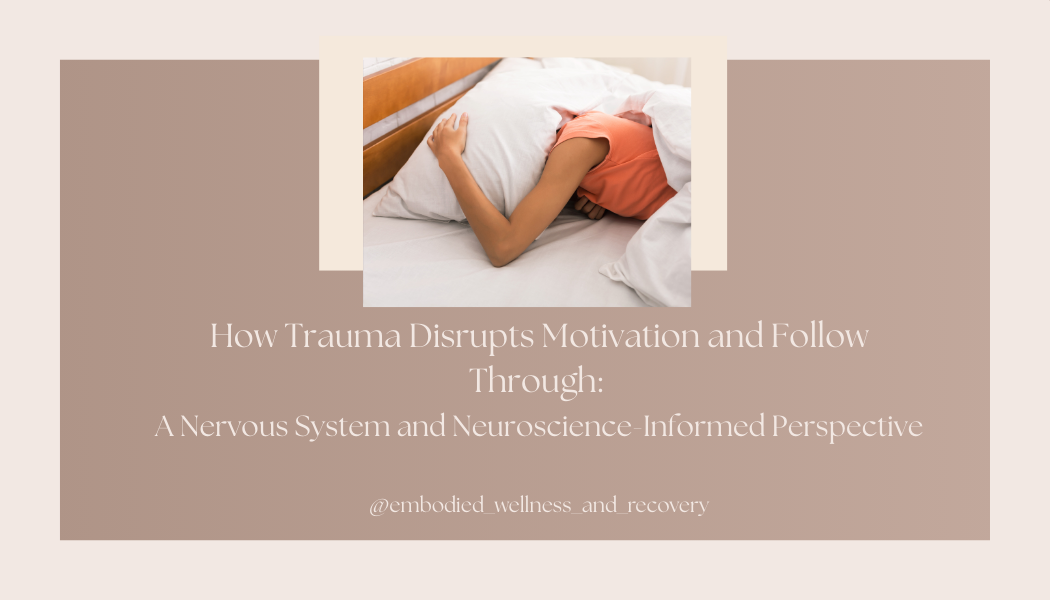
How Trauma Disrupts Motivation and Follow Through: A Nervous System and Neuroscience-Informed Perspective
How Trauma Disrupts Motivation and Follow Through:
A Nervous System and Neuroscience-Informed Perspective
Trauma can disrupt motivation and follow-through by dysregulating the nervous system. Learn the neuroscience behind shutdown, procrastination, and trauma recovery.
Have you ever wondered why you want to follow through, but your body seems to refuse?
Why you understand what needs to be done, care deeply about the outcome, and yet feel frozen, exhausted, distracted, or unable to start or finish tasks?
Do you find yourself asking:
— Why can I plan but not execute?
— Why do simple tasks feel overwhelming?
— Why does motivation disappear when pressure rises?
— Why do I feel ashamed about procrastination or inconsistency?
For many people, difficulty with motivation and follow-through is not due to a lack of discipline, character, or willpower. It is a nervous system issue shaped by unresolved trauma and chronic stress.
At Embodied Wellness and Recovery, we specialize in trauma-informed, nervous system-based therapy that helps clients understand why motivation falters and how to restore capacity for action, engagement, and completion in sustainable ways.
Motivation Is a Nervous System Function
Motivation is often framed as a psychological trait. From a neuroscience perspective, motivation is deeply physiological.
Initiating and completing tasks requires:
— A regulated autonomic nervous system
— Access to energy without overwhelm
— A sense of safety while engaging effort
— Integration between emotional, cognitive, and motor systems
When the nervous system is regulated, motivation feels accessible. When it is dysregulated, action can feel impossible even when desire is present.
This is why trauma can profoundly disrupt motivation and follow-through.
How Trauma Changes the Brain and Body
Trauma alters how the brain processes threat, safety, and energy.
When the nervous system perceives danger, the brain prioritizes survival over productivity. Blood flow shifts away from the prefrontal cortex, which supports planning, focus, and decision making, toward subcortical regions responsible for defense.
Neuroscience research shows that chronic stress and trauma impact the functioning of the prefrontal cortex, basal ganglia, and limbic system, all of which play key roles in motivation, initiation, and persistence (Arnsten, 2009).
This means that trauma can interfere with:
— Starting tasks
— Sustaining effort
— Organizing steps
— Completing goals
— Experiencing reward or satisfaction
Motivation struggles are often misinterpreted as laziness when they are actually signs of nervous system overload or shutdown.
Fight, Flight, Freeze, and Shutdown
Trauma responses are commonly described as fight, flight, freeze, and collapse or shutdown.
Each of these states affects motivation differently:
— Fight may show up as overworking, followed by burnout
— Flight may look like constant busyness without completion
— Freeze often presents as procrastination or indecision
— Shutdown can feel like exhaustion, numbness, or apathy
When freeze or shutdown dominates, the body conserves energy by limiting movement and engagement. From the nervous system’s perspective, this is protective.
Trying to push through these states with pressure or self-criticism often intensifies dysregulation.
Trauma, Dopamine, and the Reward System
Motivation is closely tied to dopamine, a neurotransmitter involved in anticipation, reward, and goal-directed behavior.
Trauma and chronic stress can disrupt dopamine signaling. Research suggests that prolonged stress alters reward processing, making effort feel less rewarding and completion less satisfying (Pizzagalli, 2014).
This can lead to:
— Difficulty feeling motivated by future rewards
— Loss of pleasure or interest
— Reduced sense of accomplishment
— Increased reliance on short-term distractions
Without adequate dopamine signaling, the nervous system struggles to mobilize energy toward long-term goals.
Why Insight Alone Is Not Enough
Many high-functioning individuals understand their trauma history and patterns clearly. Yet motivation remains inconsistent.
This is because insight primarily engages the thinking brain. Motivation requires coordination between cognitive, emotional, and physiological systems.
As Joseph LeDoux’s research demonstrates, threat responses can bypass conscious thought entirely (LeDoux, 2015). When the nervous system detects danger, it limits access to executive functioning regardless of insight.
This explains why people often say:
— I know what to do, but I cannot make myself do it
— I feel blocked even when nothing is wrong
— I shut down when expectations rise
The body must feel safe enough to engage effort.
Trauma, Shame, and Follow Through
Shame often accompanies motivation struggles.
Many people internalize messages such as:
— I am lazy
— I lack discipline
— Something is wrong with me
From a trauma-informed perspective, shame further dysregulates the nervous system. It reinforces threat and withdrawal, making follow-through even harder.
Shame also activates relational threat. For individuals with attachment trauma, pressure to perform may unconsciously signal risk of rejection or failure, leading to freeze or shutdown responses.
Addressing shame is a critical component of restoring motivation.
How Trauma Affects Relationships and Intimacy
Motivation disruptions rarely exist in isolation. They often affect relationships, sexuality, and intimacy.
Clients may struggle with:
— Initiating connection
— Following through on commitments
— Maintaining desire or arousal
— Feeling present during intimacy
— Balancing autonomy and closeness
When the nervous system is overwhelmed, it prioritizes conservation over engagement. This can be misinterpreted by partners as a lack of care or effort.
Trauma-informed therapy helps reframe these patterns as nervous system responses rather than relational failures.
Restoring Motivation Through Nervous System Repair
Lasting change requires working with the nervous system rather than against it.
Trauma-informed, somatic, and attachment-based approaches focus on:
— Increasing nervous system regulation
— Expanding tolerance for activation
— Supporting completion of stress responses
— Restoring access to energy and engagement
At Embodied Wellness and Recovery, we integrate modalities such as:
— Somatic therapy
— Attachment-focused EMDR
— Parts work and Internal Family Systems
— Polyvagal-informed interventions
These approaches help clients rebuild capacity for action without forcing or shaming the system.
Small Steps and Nervous System Safety
For traumatized nervous systems, motivation often returns through small, manageable actions rather than large goals.
Micro completion builds safety and confidence. Each completed step signals to the nervous system that effort does not equal danger.
This may include:
— Short periods of focused activity
— Clear boundaries around rest
— Predictable routines
— Attuned support and co-regulation
Over time, these experiences rewire neural pathways associated with motivation and reward.
How Therapy Helps Reclaim Follow Through
Therapy provides more than insight. It offers a regulated relational space where the nervous system can learn new patterns.
Through consistent, attuned therapeutic relationships, clients experience:
— Reduced threat activation
— Increased emotional regulation
— Greater access to motivation and energy
— Improved follow-through without burnout
Motivation emerges as a byproduct of safety rather than pressure.
How Embodied Wellness and Recovery Approaches Motivation
At Embodied Wellness and Recovery, we understand difficulties with motivation through a trauma-informed and neuroscience-based lens.
We help clients explore:
— How trauma shaped their nervous system responses
— Why does following through feel unsafe or overwhelming
— How to restore regulation and capacity gradually
— How motivation intersects with relationships and intimacy
Our work honors the intelligence of the nervous system while supporting meaningful change.
Motivation Returns When Safety Leads
Motivation is not something to force. It is something that emerges when the nervous system feels supported, regulated, and resourced.
By addressing trauma at the level of the body and brain, individuals can reconnect with their natural capacity for engagement, creativity, and completion.
Reach out to schedule a complimentary 20-minute consultation with our team of therapists, trauma specialists, somatic practitioners, or relationship experts, and start working towards integrative, embodied healing today.
📞 Call us at (310) 651-8458
📱 Text us at (310) 210-7934
📩 Email us at admin@embodiedwellnessandrecovery.com
🔗 Visit us at www.embodiedwellnessandrecovery.com
👉 Check us out on Instagram @embodied_wellness_and_recovery
🌍 Explore our offerings at Linktr.ee: https://linktr.ee/laurendummit
References
1) Arnsten, A. F. T. (2009). Stress signalling pathways that impair the structure and function of the prefrontal cortex. Nature Reviews Neuroscience, 10(6), 410–422.
2) LeDoux, J. E. (2015). Anxious: Using the brain to understand and treat fear and anxiety. Viking.
3) Pizzagalli, D. A. (2014). Depression, stress, and anhedonia: Toward a synthesis and integrated model. Annual Review of Clinical Psychology, 10, 393–423.
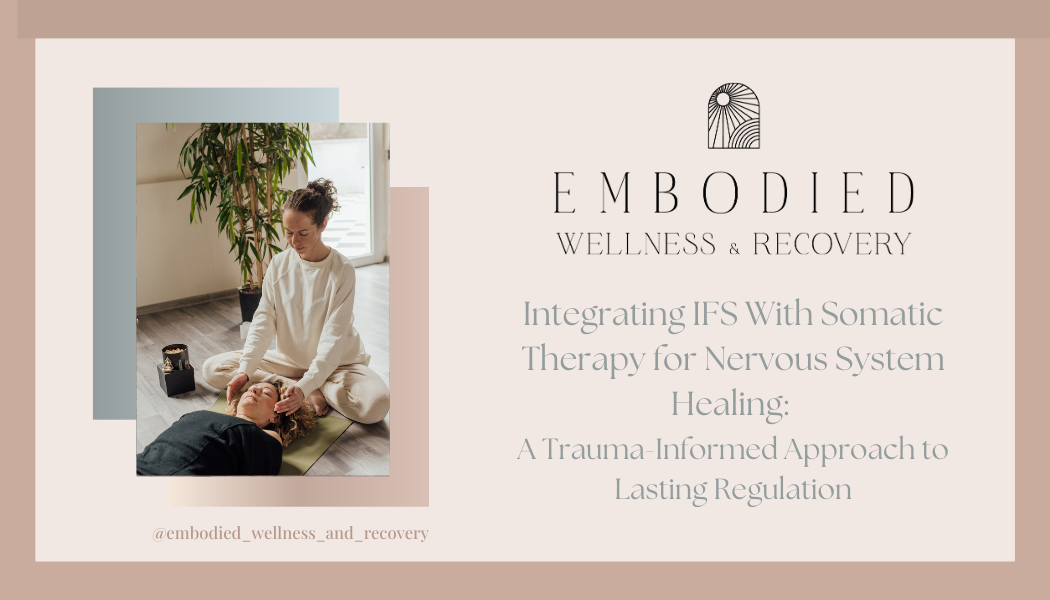
Integrating IFS With Somatic Therapy for Nervous System Healing: A Trauma-Informed Approach to Lasting Regulation
Integrating IFS With Somatic Therapy for Nervous System Healing: A Trauma-Informed Approach to Lasting Regulation
Learn how integrating Internal Family Systems with somatic therapy supports nervous system healing, trauma recovery, and emotional regulation beyond talk therapy.
Have you ever understood your trauma intellectually but still felt stuck in anxiety, shutdown, reactivity, or emotional numbness?
Do you find yourself wondering:
— Why does my body stay on edge even when I know I am safe?
— Why do certain triggers hijack me before I can think?
— Why does insight help me understand my patterns but not change them?
— Why does my nervous system feel exhausted, hypervigilant, or shut down no matter how much I process my story?
These questions point to a growing recognition in modern psychotherapy. Trauma and chronic stress do not live only in the mind. They live in the nervous system. And while insight is essential, it is often not enough on its own.
At Embodied Wellness and Recovery, we integrate Internal Family Systems therapy and somatic therapy to address trauma at both the psychological and physiological levels. This combined approach allows clients to work with their inner world while supporting nervous system repair in a way that feels grounded, attuned, and sustainable.
Why Trauma Lives in the Nervous System
From a neuroscience perspective, traumatic experiences are encoded across multiple levels of the brain and body. When a threat is perceived, the autonomic nervous system mobilizes to protect survival. Heart rate increases. Muscles tense. Breath changes. Attention narrows.
When a threat cannot be resolved or escaped, the nervous system may remain organized around danger long after the event has passed.
Research shows that traumatic memory is often stored in subcortical regions of the brain, including the amygdala, brainstem, and autonomic pathways (Miller-Karas & Sapp, 2015). These systems operate outside conscious awareness and do not respond reliably to logic or insight alone.
This is why many people experience:
— Chronic nervous system dysregulation
— Persistent anxiety or irritability
— Emotional shutdown or numbness
— Somatic symptoms with no clear medical cause
— Relationship reactivity that feels automatic
Understanding what happened does not automatically teach the nervous system that it is safe now.
What Is Internal Family Systems Therapy
Internal Family Systems therapy is a parts-based model developed by Richard Schwartz. It is grounded in the idea that the mind is made up of distinct parts, each with its own emotions, beliefs, and protective roles.
In IFS, symptoms are not seen as pathology. They are understood as protective strategies developed in response to overwhelming experiences.
Key elements of IFS include:
— Protective parts that manage daily life or react strongly to perceived threat
— Exiled parts that carry pain, fear, shame, or unmet needs
— Self energy, a core state characterized by curiosity, compassion, clarity, and calm
IFS helps clients build a relationship with their internal system rather than fighting against it. This approach reduces shame and increases internal cooperation.
However, while IFS offers profound psychological insight and emotional repair, many clients notice that their bodies still react automatically. This is where somatic therapy becomes essential.
What Is Somatic Therapy and Why It Matters
Somatic therapy focuses on the body as a primary pathway for healing. It works with sensation, movement, posture, breath, and autonomic responses to support nervous system regulation.
Trauma-informed somatic approaches recognize that the body often holds unfinished survival responses. Fight, flight, freeze, or collapse may remain activated when the nervous system lacks the opportunity to complete these responses safely.
Somatic therapy helps clients:
— Track internal sensations without overwhelm
— Recognize patterns of activation and shutdown
— Restore capacity for regulation and flexibility
— Reconnect with bodily cues of safety and agency
Neuroscience supports this bottom-up approach. Stephen Porges demonstrated that the nervous system constantly evaluates safety and danger through unconscious processes. When safety is present, social engagement and emotional regulation become possible.
Without addressing these physiological states, cognitive and emotional insight may not fully integrate.
Why Integrating IFS With Somatic Therapy Is So Effective
IFS and somatic therapy address different but deeply connected layers of trauma. IFS helps clients understand who inside is reacting.
Somatic therapy helps clients understand what the body is doing.
When combined, these approaches allow for healing that is both emotionally meaningful and biologically stabilizing.
For example:
— A protective part may intellectually agree that a situation is safe
— The body may still respond with tension, panic, or shutdown
— Somatic awareness helps that part notice what the nervous system is experiencing
— IFS Self energy provides curiosity and compassion toward that response
This integration prevents clients from bypassing the body or becoming overwhelmed by sensation alone.
Neuroscience and the Integration of Parts and Body
Research in affective neuroscience shows that emotional regulation depends on communication between cortical and subcortical brain regions (Pavuluri, Herbener, & Sweeney, 2005). Joseph LeDoux demonstrated that emotional responses can occur before conscious thought.
IFS supports top-down integration by engaging reflective awareness and meaning-making. Somatic therapy supports bottom-up integration by stabilizing autonomic states.
Together, they promote:
— Increased vagal tone
— Reduced threat reactivity
— Improved emotional regulation
— Greater relational flexibility
This combination allows the nervous system to learn safety not just as an idea, but as a lived experience.
How Chronic Nervous System Dysregulation Develops
Many clients seeking therapy are not dealing with a single traumatic event. Instead, they experience the cumulative impact of:
— Developmental trauma
— Attachment wounds
— Chronic stress
— Relational instability
— Repeated boundary violations
Over time, the nervous system adapts by staying mobilized or shutting down. This may show up as:
— Hypervigilance and anxiety
— Difficulty relaxing or sleeping
— Emotional overcontrol or emotional flooding
— Sexual shutdown or difficulty with intimacy
— Persistent exhaustion
IFS helps identify which parts are carrying these adaptations. Somatic therapy helps the body learn that constant defense is no longer required.
The Role of Relationship in Nervous System Healing
Healing does not occur in isolation. Both IFS and somatic therapy emphasize the importance of attunement and relational safety.
The nervous system regulates through connection. When therapy provides a consistent experience of being seen, understood, and not overwhelmed, the body gradually reorganizes around a sense of safety.
This is particularly important for clients struggling with:
— Relationship conflict
— Attachment anxiety or avoidance
— Sexual intimacy challenges
— Difficulty trusting others
By integrating parts work with somatic regulation, therapy becomes a space where relational repair can occur at both emotional and physiological levels.
How Embodied Wellness and Recovery Integrates IFS and Somatic Therapy
At Embodied Wellness and Recovery, we specialize in trauma-informed, nervous-system-based care that addresses the full complexity of the human experience.
Our clinicians integrate:
Internal Family Systems therapy
— Somatic Experiencing principles
— Attachment-focused EMDR
— Polyvagal-informed interventions
— Relational and co-regulation practices
This integrative approach allows us to support clients navigating trauma, chronic nervous system dysregulation, relationship challenges, sexuality concerns, and intimacy issues with depth and precision. We do not rush the nervous system. We work at the pace of safety.
When Insight and the Body Work Together
Many clients arrive in therapy with years of insight and self-awareness. What they often lack is a nervous system that trusts those insights.
Integrating IFS with somatic therapy helps bridge this gap. Parts feel understood. The body feels supported. Regulation becomes more accessible. Patterns begin to shift not through force, but through integration. This is where meaningful change tends to occur.
Reach out to schedule a complimentary 20-minute consultation with our team of therapists, trauma specialists, somatic practitioners, or relationship experts, and start working towards integrative, embodied healing today.
📞 Call us at (310) 651-8458
📱 Text us at (310) 210-7934
📩 Email us at admin@embodiedwellnessandrecovery.com
🔗 Visit us at www.embodiedwellnessandrecovery.com
👉 Check us out on Instagram @embodied_wellness_and_recovery
🌍 Explore our offerings at Linktr.ee: https://linktr.ee/laurendummit
References
1) LeDoux, J. E. (2015). Anxious: Using the brain to understand and treat fear and anxiety. Viking.
2) Miller-Karas, E., & Sapp, M. (2015). The Nervous System, Memory, and Trauma. In Building Resilience to Trauma (pp. 10-29). Routledge.
3) Pavuluri, M. N., Herbener, E. S., & Sweeney, J. A. (2005). Affect regulation: a systems neuroscience perspective. Neuropsychiatric Disease and Treatment, 1(1), 9-15.
4) Porges, S. W. (2011). The polyvagal theory: Neurophysiological foundations of emotions, attachment, communication, and self-regulation. W. W. Norton & Company.
5) Schwartz, R. C. (2021). No bad parts: Healing trauma and restoring wholeness with the Internal Family Systems model. Sounds True.

Why Talking Is Not Enough to Process Anger Stored in the Body
Why Talking Is Not Enough to Process Anger Stored in the Body
Talking can help you understand anger, but it cannot release it from the nervous system. Learn why stored anger lives in the body and how somatic therapy helps.
Have you ever talked through your anger endlessly, understood exactly why you feel the way you do, and still found yourself snapping, shutting down, clenching your jaw, or feeling simmering resentment beneath the surface?
Do you find yourself asking:
— Why do I still feel angry even after years of therapy?
— Why does my body react before my mind can intervene?
— Why does anger show up as tension, headaches, stomach issues, or emotional withdrawal?
— Why does resentment linger even when I logically understand my story?
These questions point to a truth that modern neuroscience and trauma research continue to confirm. Anger is not only a thought or emotion. It is a physiological state stored in the nervous system. And while talking can create insight, it is often insufficient for releasing anger that lives in the body.
At Embodied Wellness and Recovery, we specialize in trauma-informed, nervous system-based therapies that go beyond insight alone. We help clients understand why anger persists and how to work with the body to restore regulation, safety, and relational health.
Anger Is a Nervous System Response, Not Just an Emotion
Anger is frequently misunderstood as a character flaw or a problem with emotional control. From a neuroscience perspective, anger is a protective survival response.
When the brain perceives threat, whether physical, emotional, or relational, it activates the autonomic nervous system. The sympathetic branch mobilizes energy for action. Heart rate increases. Muscles tighten. Breath becomes shallow. Blood flow shifts away from digestion toward survival.
This response is adaptive in the moment. The challenge arises when anger is activated repeatedly or never fully discharged.
Research in affective neuroscience shows that emotional memories are encoded not only in the cortex where language lives, but also in subcortical structures such as the amygdala, basal ganglia, and brainstem. These regions operate largely outside conscious awareness and do not respond to language in the same way the thinking brain does.
This is why clients often say:
— I know I should not feel this way, but my body reacts anyway.
— I can explain my anger perfectly, but it does not go away.
— I feel tense and on edge even when I am calm on the surface.
Talking accesses the prefrontal cortex. Anger stored in the body lives elsewhere.
Why Talk Therapy Alone Often Falls Short
Traditional talk therapy emphasizes insight, narrative, and cognitive understanding. These tools are valuable. They help clients make meaning of their experiences and reduce shame.
However, insight alone does not automatically regulate the nervous system.
From a neurobiological standpoint, top-down approaches that rely primarily on thinking and verbal processing may not reach the bottom-up systems that store anger. When anger is encoded as muscle tension, breath holding, postural collapse, or hypervigilance, it requires interventions that engage sensation, movement, and physiological awareness.
This explains why many high-functioning individuals experience:
— Chronic resentment in relationships
— Anger that turns inward as depression or anxiety
— Explosive reactions that feel disproportionate
— Emotional numbing followed by sudden outbursts
Without addressing the body, anger remains unresolved at the level where it was first stored.
The Body Keeps the Score on Anger
Trauma research has repeatedly demonstrated that the body remembers what the mind tries to move past. The book, The Body Keeps the Score by Bessel van der Kolk, describes how unprocessed emotions are stored in the nervous system, muscles, and autonomic responses long after the original event ends.
Anger that could not be expressed safely in childhood, relationships, or traumatic situations often becomes inhibited anger. The body stays braced, alert, or constricted as if the threat is still present.
Common signs of anger stored in the body include:
— Chronic muscle tension in the jaw, neck, shoulders, or hips
— Shallow breathing or frequent breath holding
— Digestive issues or nausea
— Restlessness or agitation
— Emotional withdrawal or shutdown
— Difficulty with sexual desire or intimacy
These symptoms are not random. They reflect a nervous system that has not completed its defensive response.
Polyvagal Theory and the Physiology of Anger
Polyvagal Theory helps explain why anger is deeply relational and physiological. According to Stephen Porges, the nervous system continuously scans for cues of safety and danger.
When safety is present, the ventral vagal system supports connection, emotional regulation, and flexibility. When safety is compromised, the nervous system shifts into sympathetic activation or dorsal vagal shutdown.
Anger often emerges when:
— Boundaries are violated
— Needs are ignored
— Power is taken away
— Attachment feels threatened
If these experiences recur without repair, the nervous system learns to remain mobilized. Talking about anger without addressing these physiological states can inadvertently reinforce frustration and self-blame.
Why Anger Often Shows Up in Relationships and Intimacy
Anger stored in the body frequently surfaces in close relationships. This is not accidental.
Attachment bonds activate the same neural circuits involved in threat and safety. When relational wounds go unprocessed, anger may appear as:
— Irritability with partners
— Emotional distance or stonewalling
— Sexual shutdown or avoidance
— Conflict cycles that repeat despite insight
— Difficulty trusting or softening
From a somatic perspective, intimacy requires a regulated nervous system. When anger remains stored as tension or hyper arousal, the body struggles to access states associated with closeness, pleasure, and vulnerability.
This is why relationship therapy that integrates nervous system repair is often more effective than communication skills alone.
How Somatic Therapy Helps Release Stored Anger
Somatic therapy works bottom up. It helps clients track sensations, impulses, posture, breath, and movement patterns associated with anger.
Rather than asking, Why are you angry? somatic work asks:
— Where do you feel anger in your body?
— What happens in your breath when anger arises?
— What impulse wants to complete itself?
— What happens when the body feels supported and safe?
By gently guiding the nervous system through completion of defensive responses, anger can be discharged without overwhelm or harm.
Approaches used at Embodied Wellness and Recovery include:
— Somatic Experiencing
— Attachment-focused EMDR
— Trauma-informed parts work
— Nervous system regulation skills
— Relational and co-regulation practices
These modalities help the body learn that the threat has passed and that new responses are available.
The Neuroscience of Bottom-Up Healing
Neuroscience research shows that emotional regulation improves when sensory and motor pathways are engaged. Joseph LeDoux demonstrated that emotional responses can bypass conscious thought entirely.
This means lasting change often occurs through:
— Tracking bodily sensations
— Engaging rhythm and movement
— Using breath to influence vagal tone
— Experiencing safe relational attunement
When the body feels safe, the mind can integrate new narratives. The reverse is far less reliable.
Anger Is Not the Enemy
Anger carries information. It signals unmet needs, violated boundaries, and unresolved grief. When approached through a nervous system lens, anger becomes a guide rather than a problem to eliminate.
Processing anger somatically does not mean acting it out or suppressing it. It means allowing the body to release what it has been holding while restoring choice and agency.
Clients often report:
— Reduced reactivity
— Greater emotional clarity
— Improved relationships
— Increased capacity for intimacy
— A deeper sense of internal steadiness
How Embodied Wellness and Recovery Approaches Anger
At Embodied Wellness and Recovery, we integrate neuroscience, trauma research, and somatic therapy to address anger at its roots. Our clinicians are trained to work with the nervous system, attachment patterns, and relational dynamics that underlie persistent anger and resentment.
We specialize in supporting individuals and couples navigating:
— Trauma and developmental wounds
— Nervous system dysregulation
— Relationship and intimacy challenges
— Sexuality and desire concerns
— Chronic emotional stress and burnout
Our approach honors insight while recognizing that the body must be included in the healing process.
When Talking Becomes Integrated with the Body
Talking is not the problem. Talking without the body is a limitation.
When verbal processing is paired with somatic awareness, the nervous system can reorganize. Anger no longer needs to stay trapped as tension, reactivity, or resentment. It becomes information that can be felt, understood, and resolved.
For many clients, this shift marks the difference between years of insight without relief and meaningful, embodied change.
Reach out to schedule a complimentary 20-minute consultation with our team of therapists, trauma specialists, somatic practitioners, or relationship experts, and start working towards integrative, embodied healing today.
📞 Call us at (310) 651-8458
📱 Text us at (310) 210-7934
📩 Email us at admin@embodiedwellnessandrecovery.com
🔗 Visit us at www.embodiedwellnessandrecovery.com
👉 Check us out on Instagram @embodied_wellness_and_recovery
🌍 Explore our offerings at Linktr.ee: https://linktr.ee/laurendummit
References
1) LeDoux, J. E. (2015). Anxious: Using the brain to understand and treat fear and anxiety. Viking.
2) Porges, S. W. (2011). The polyvagal theory: Neurophysiological foundations of emotions, attachment, communication, and self-regulation. W. W. Norton & Company.
3) van der Kolk, B. A. (2014). The body keeps the score: Brain, mind, and body in the healing of trauma. Viking.