
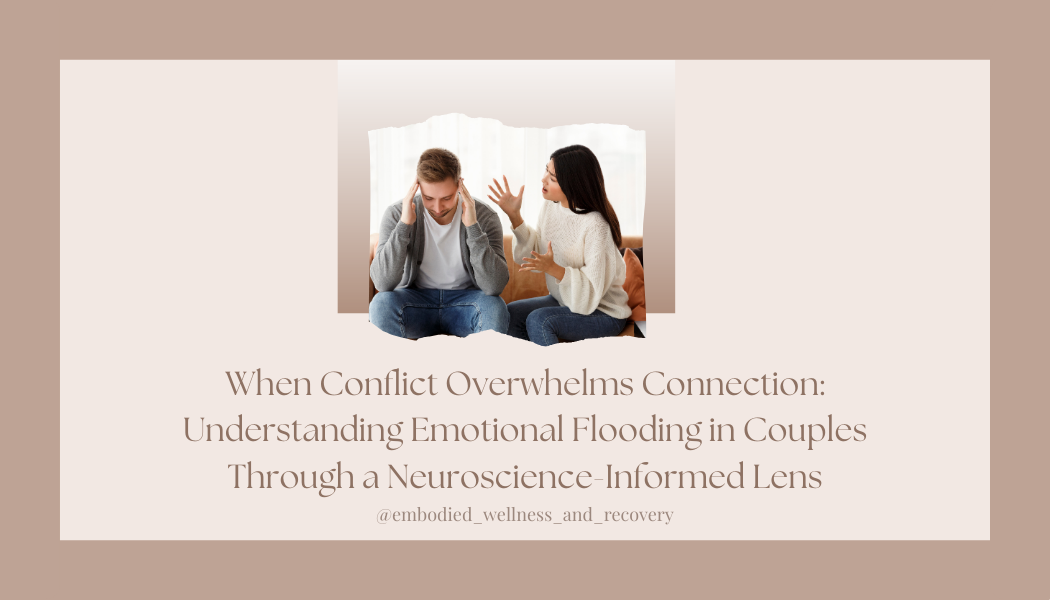
When Conflict Overwhelms Connection: Understanding Emotional Flooding in Couples Through a Neuroscience-Informed Lens
When Conflict Overwhelms Connection: Understanding Emotional Flooding in Couples Through a Neuroscience-Informed Lens
Learn what emotional flooding in couples is, why it happens during conflict, and how neuroscience-informed therapy helps restore safety and connection.
Have you ever found yourself in a disagreement with your partner where everything suddenly feels too much? Your heart races, your thoughts scatter, your body tightens, and words either spill out sharply or disappear altogether. Later, you may struggle to remember what was said, only that the conversation ended badly.
Many couples describe this experience as feeling hijacked, shut down, or out of control. This is not a communication failure. It is often emotional flooding, a nervous system response that makes constructive connection nearly impossible in the moment.
At Embodied Wellness and Recovery, we work with couples who care deeply about each other yet feel trapped in cycles of conflict fueled by emotional flooding. Understanding what flooding is and why it happens is a critical step toward repairing trust, intimacy, and emotional safety.
What Is Emotional Flooding in Relationships?
Emotional flooding occurs when the nervous system becomes overwhelmed during conflict. The body interprets relational distress as threat and shifts into survival mode.
This can look like:
— Rapid heartbeat or shallow breathing
— Feeling suddenly angry, panicked, or numb
— Losing access to language or logical thinking
— Becoming defensive, reactive, or withdrawn
— Wanting to escape the conversation at all costs
Flooding makes it difficult to listen, empathize, or problem-solve. Even well-intentioned conversations can escalate quickly once this threshold is crossed.
Why Emotional Flooding Happens in Couples
From a neuroscience perspective, emotional flooding is driven by the autonomic nervous system. When a relationship conflict activates perceived threat, the amygdala signals danger, and the body releases stress hormones. At the same time, the prefrontal cortex, which supports reasoning, empathy, and perspective, becomes less accessible. The nervous system prioritizes protection over connection.
For many people, relationship conflict is not just about the present moment. It taps into earlier experiences of rejection, abandonment, betrayal, or emotional neglect. The body responds as if the stakes are much higher than the immediate disagreement.
Common Triggers for Emotional Flooding
Emotional flooding is highly personal. Triggers often relate to attachment wounds or unresolved trauma.
Common triggers include:
— Feeling criticized or blamed
— Perceived withdrawal or emotional distance
— Raised voices or sharp tone
— Feeling misunderstood or dismissed
— Threats to the relationship or future
— Conversations about sex, money, or trust
One partner may flood quickly, while the other may appear calm or detached. This difference often leads to misunderstanding rather than compassion.
Emotional Flooding and Attachment Styles
Attachment patterns play a significant role in how flooding shows up. Anxiously attached partners may experience flooding as panic, urgency, or emotional overwhelm. They may pursue connection with intensity, fearing loss or abandonment.
Avoidantly attached partners may experience flooding as shutdown, numbness, or irritation. They may withdraw to restore a sense of control or safety.
Both responses are protective. Neither reflects a lack of care.
The Impact of Flooding on Communication
Once emotional flooding sets in, communication becomes distorted.
Partners may:
— Interrupt or escalate
— Say things they later regret
— Misinterpret neutral statements as hostile
— Shut down or stonewall
— Struggle to repair after conflict
Repeated flooding can erode trust and intimacy. Couples may either avoid difficult topics altogether or assume that conflict will always end badly.
Why Talking It Through Does Not Work During Flooding
Many couples are told to communicate better, use I statements, or stay calm. While these tools are helpful, they are ineffective when the nervous system is overwhelmed. Flooding is a physiological state, not a cognitive choice. Asking someone to reason while flooded is like asking them to swim while their body is stuck in freeze. Effective repair requires regulation before resolution.
Emotional Flooding and Trauma
Trauma history increases vulnerability to flooding. When earlier experiences taught the nervous system that closeness is dangerous or unpredictable, adult relationships can activate survival responses.
This is especially relevant in couples navigating:
— Childhood emotional neglect
— Betrayal or infidelity
— Sexual trauma
— Chronic conflict or emotional invalidation
Flooding is not a sign that a relationship is doomed. It is a sign that the nervous system needs support.
What Helps When Emotional Flooding Occurs
Healing emotional flooding does not mean eliminating conflict. It means learning how to recognize and respond to nervous system activation with care.
Helpful strategies include:
1. Naming Flooding Without Blame
Simply acknowledging what is happening can reduce escalation. Statements like "I feel overwhelmed and need a pause" shift the focus from winning to safety.
2. Taking Regulated Breaks
A break is effective only if it includes regulation. Walking, breathing slowly, or grounding the body helps stress hormones settle.
3. Returning When Both Systems Are Calmer
Repair conversations are far more successful once both partners have access to curiosity and empathy again.
4. Building Awareness of Early Signals
Learning to notice early signs of flooding enables couples to intervene before it escalates.
5. Practicing Co-Regulation
Safe eye contact, slower speech, and gentle tone can help nervous systems settle together.
How Couples Therapy Helps Address Emotional Flooding
At Embodied Wellness and Recovery, couples therapy focuses on the nervous system, not just behavior.
Our approach helps couples:
— Understand their unique flooding triggers
— Track bodily cues in real time
— Build tolerance for emotional intensity
— Repair attachment injuries
— Restore safety in conversations about intimacy, sexuality, and trust
When the nervous system feels safer, emotional expression becomes more flexible and connection more resilient.
Emotional Flooding and Sexual Intimacy
Flooding often impacts sexual connection. When the nervous system associates closeness with threat, desire, and arousal can shut down.
Couples may struggle with:
— Mismatched desire
— Avoidance of touch after conflict
— Feeling unsafe being vulnerable
— Confusion about consent and pacing
Trauma-informed couples therapy helps partners rebuild embodied safety so intimacy can emerge without pressure.
A Hopeful Perspective
If emotional flooding shows up in your relationship, it does not mean you are incompatible or that you are failing. It means your nervous system is reacting to a perceived threat. With understanding, regulation, and support, couples can learn to move through conflict with greater steadiness and care. Emotional flooding can become a signal to slow down rather than a force that drives partners apart.
Working With Embodied Wellness and Recovery
At Embodied Wellness and Recovery, we specialize in trauma-informed, neuroscience-based couples therapy. We support partners in healing nervous system patterns that interfere with communication, intimacy, and emotional connection. Our work integrates attachment theory, somatic therapy, and relational neuroscience to help couples create safer, more responsive relationships.
Reach out to schedule a complimentary 20-minute consultation with our team of therapists, trauma specialists, somatic practitioners, or relationship experts, and start working towards integrative, embodied healing today.
📞 Call us at (310) 651-8458
📱 Text us at (310) 210-7934
📩 Email us at admin@embodiedwellnessandrecovery.com
🔗 Visit us at www.embodiedwellnessandrecovery.com
👉 Check us out on Instagram @embodied_wellness_and_recovery
🌍 Explore our offerings at Linktr.ee: https://linktr.ee/laurendummit
References
1) Gottman, J. M., & Gottman, J. S. (2015). 10 principles for doing effective couples therapy. W. W. Norton & Company.
2) Johnson, S. M. (2019). Attachment theory in practice: Emotionally focused therapy with individuals, couples, and families. Guilford Press.
3) Porges, S. W. (2011). The polyvagal theory: Neurophysiological foundations of emotions, attachment, communication, and self-regulation. W. W. Norton & Company.
4) van der Kolk, B. A. (2014). The body keeps the score: Brain, mind, and body in the healing of trauma. Viking
Attachment Focused EMDR for Couples: How Trauma Healing Rewires the Brain for Lasting Love
Attachment Focused EMDR for Couples:How Trauma Healing Rewires the Brain for Lasting Love
Discover how Attachment Focused EMDR helps couples reduce emotional triggers, repair attachment wounds, strengthen communication, and create secure connections. Learn how trauma affects the nervous system in relationships and how Embodied Wellness and Recovery uses EMDR, somatic therapy, and neuroscience to help couples build trust, repair intimacy, and reconnect more deeply.
Attachment Focused EMDR for Couples: A Neuroscience Backed Approach to Secure Love
Relationships are where our deepest longings come to the surface. The need to feel loved, chosen, safe, and emotionally understood is wired directly into the brain. Yet many couples find themselves caught in cycles of emotional triggers, miscommunication, and conflict that seem impossible to resolve.
Have you ever wondered why a small comment from your partner can feel overwhelming?
Why a disagreement quickly escalates into panic, shutdown, or withdrawal?
Why you sometimes struggle to trust reassurance even when your partner means well?
Why intimacy, closeness, or vulnerability brings up fear rather than comfort?
So many couples try to fix the present-day conflict without realizing that the reactions happening in the relationship are often rooted in earlier attachment wounds stored in the nervous system.
This is where Attachment Focused EMDR offers something profoundly transformative. Rather than simply teaching communication strategies or conflict resolution skills, Attachment Focused EMDR helps couples rewire the brain, soothe the nervous system, and heal the deeper emotional injuries that fuel repetitive relationship patterns.
At Embodied Wellness and Recovery, we specialize in helping couples understand the neuroscience behind their reactions, heal long-standing attachment wounds, and strengthen the emotional safety that makes secure, enduring love possible.
Why Couples Get Triggered: The Neuroscience Behind Emotional Reactivity
When you feel dismissed, misunderstood, or criticized by your partner, your brain does not respond to the moment. It responds to the entire history of moments that looked or felt similar.
Neuroscience shows that:
— The amygdala stores emotional memories of threat
— The hippocampus contributes to contextual memory and meaning
— The prefrontal cortex controls self-regulation, empathy, and problem-solving.
When early attachment wounds are activated, the amygdala quickly overrides the prefrontal cortex. The nervous system shifts into fight, flight, or freeze before you even have a chance to think.
Couples often describe this as:
— Feeling overwhelmed out of nowhere
— Becoming defensive even when they do not want to
— Shutting down and feeling emotionally numb
— Feeling panicked, abandoned, or rejected
— Reacting in ways that feel out of character
This is not a relationship failure. It is a nervous system response.
Attachment-Focused EMDR helps couples access and heal the root of these reactions so that present-day interactions become less charged, more grounded, and more connected.
What Is Attachment Focused EMDR and How Is It Different?
Traditional EMDR primarily focuses on trauma processing. Attachment-Focused EMDR, developed by Laurel Parnell, is designed to heal relational wounds that formed early in life and continue to shape how adults connect, love, and respond to stress.
Attachment-Focused EMDR combines:
— EMDR bilateral stimulation
— Attachment repair
— Inner child work
— Somatic awareness
— Resourcing and nervous system regulation
— Corrective relational experiences
— Deep emotional attunement
In couples work, the therapist helps each partner understand how their nervous system has been shaped by childhood experiences and past relationships. The goal is not to assign blame. The goal is to create compassion for each partner's emotional blueprint and to transform old patterns into new, healthier ways of relating.
Why Attachment Focused EMDR Works So Powerfully for Couples
1. It repairs the emotional injuries underneath recurring conflict.
Arguments about dishes, text replies, tone of voice, finances, or intimacy are rarely about the present moment. They often reflect:
— Abandonment fears
— Mistrust
— Fear of vulnerability
— Fear of being controlled
— Rejection sensitivity
— Childhood emotional neglect
— Loss of safety in previous relationships
Attachment-Focused EMDR helps couples process the original wound so it stops playing out in the relationship.
2. It calms the nervous system and reduces emotional flooding.
When couples are triggered, the nervous system moves into protective survival mode. This makes it nearly impossible to listen, empathize, or respond calmly.
Attachment-Focused EMDR helps the brain reorganize these threat responses so the body returns to a regulated state more easily. As a result, couples experience:
— Fewer emotional outbursts
— Less shutdown
— Less reactivity
— Greater emotional presence
— Increased ability to stay connected during conflict
3. It helps partners understand each other with more profound compassion.
When couples see how early experiences shaped each person's nervous system, conflict becomes less personal. There is greater empathy, patience, and willingness to stay engaged. For many couples, this is the first time they feel genuinely understood.
4. It strengthens emotional intimacy and secure attachment.
Attachment-Focused EMDR creates new neural pathways that support:
— Trust
— Emotional safety
— Healthy vulnerability
— Repair after conflict
— Consistency
— Secure bonding
Couples often describe feeling closer, more connected, and more seen than they ever have before.
How Attachment Focused EMDR Works at Embodied Wellness and Recovery
Our approach integrates EMDR, somatic therapy, polyvagal theory, and trauma-informed couples therapy to help partners repair emotional wounds and create a secure connection.
Step 1: Understanding Each Partner’s Nervous System
We explore how childhood experiences, trauma, and attachment patterns show up in present-day relationships.
Step 2: Strengthening internal and relational resources
Partners learn how to co-regulate and self-regulate using somatic and polyvagal-informed tools.
Step 3: EMDR processing to heal attachment wounds
Using bilateral stimulation, each partner processes old emotional injuries that drive conflict, fear, or emotional distance.
Step 4: Repairing communication from a place of safety
With a regulated nervous system, partners can speak with clarity, listen with openness, and understand one another with depth.
Step 5: Rebuilding secure attachment
Couples learn how to create the emotional consistency, connection, and attunement that support lasting love.
Is Attachment Focused EMDR Right for Your Relationship?
This approach can be beneficial if you and your partner experience:
— Repetitive arguments
— Emotional flooding
— High conflict cycles
— Shutdown or withdrawal
— Fear of abandonment
— Rejection sensitivity
— Difficulty repairing after conflict
— Trauma histories
— Trust issues
— Intimacy challenges
— Feeling distant even when you want closeness
Attachment-Focused EMDR is designed to help couples change the deeper emotional and neurological patterns that keep them stuck.
The Future of Love: Healing the Brain to Heal the Relationship
Secure relationships are not built from perfect communication.
They are built from emotional safety.
Attachment-Focused EMDR helps couples cultivate this safety from the inside out.
When the nervous system feels safe, connection becomes natural.
When old emotional wounds are healed, love becomes easier.
When partners understand each other's internal worlds, intimacy deepens.
At Embodied Wellness and Recovery, we help couples heal the trauma that lives in the body, strengthen their emotional foundation, and build the secure, meaningful connection they have always longed for.
Reach out to schedule a complimentary 20-minute consultation with our team of therapists, trauma specialists, somatic practitioners, or relationship experts, and start working towards integrative, embodied healing today.
📞 Call us at (310) 651-8458
📱 Text us at (310) 210-7934
📩 Email us at admin@embodiedwellnessandrecovery.com
🔗 Visit us at www.embodiedwellnessandrecovery.com
👉 Check us out on Instagram @embodied_wellness_and_recovery
🌍 Explore our offerings at Linktr.ee: https://linktr.ee/laurendummit
References
1) Parnell, L. (2013). Attachment-focused EMDR: Healing relational trauma. W. W. Norton and Company.
2) Porges, S. W. (2011). The Polyvagal Theory: Neurophysiological foundations of emotions, attachment, communication, and self-regulation. W. W. Norton and Company.
3) Siegel, D. J. (2012). The developing mind: How relationships and the brain interact to shape who we are. Guilford Press.

Touch-Starved Relationships: How Nervous System Literacy Can Rekindle Desire
Touch-Starved Relationships: How Nervous System Literacy Can Rekindle Desire
Explore how chronic stress, trauma, and nervous system dysregulation contribute to touch aversion in relationships, and discover somatic strategies to rebuild safe, affectionate touch and rekindle intimacy.
Yearning for Closeness yet Growing More Distant
In many intimate relationships, partners find themselves yearning for closeness yet feeling a growing distance. One partner may crave physical affection, while the other recoils, leading to confusion, frustration, and emotional pain. This phenomenon, often rooted in nervous system dysregulation, is more common than many realize.
At Embodied Wellness and Recovery, we specialize in addressing the intricate interplay between trauma, the nervous system, and intimacy. By understanding how our bodies respond to stress and employing somatic strategies, couples can navigate the challenges of touch aversion and rediscover the warmth of affectionate connection.
Understanding Touch Aversion and the Nervous System
Touch aversion isn't merely a preference; it's a physiological response. When individuals experience trauma or chronic stress, their nervous systems can become dysregulated, leading to heightened sensitivity to touch. This response is a protective mechanism, where the body perceives touch as a potential threat, even in safe environments.
Research indicates that individuals with avoidant attachment styles often exhibit negative feelings towards physical touch, especially in anxiety-provoking situations. This aversion can manifest as discomfort with gestures like holding hands or cuddling, further complicating intimate relationships.
The Role of Trauma in Touch Aversion
Traumatic experiences, particularly those involving physical or emotional abuse, can profoundly impact one's relationship with touch. The body, in its effort to protect, may associate touch with danger, leading to avoidance behaviors. This protective stance, while adaptive in threatening situations, can hinder intimacy in safe, loving relationships. Understanding this connection is crucial. Recognizing that touch aversion may stem from past trauma allows for compassion and patience, both for oneself and one's partner.
Somatic Strategies to Rebuild Affectionate Touch
Reconnecting through touch requires a gentle, informed approach. Somatic strategies focus on body awareness and nervous system regulation, offering pathways to reintroduce touch in a safe and comforting manner.
1. Mindful Breathing and Grounding
Engaging in deep, diaphragmatic breathing can activate the parasympathetic nervous system, promoting relaxation. Grounding exercises, such as feeling one's feet on the floor or holding a comforting object, can anchor individuals in the present moment, reducing anxiety associated with touch.
2. Gradual Exposure to Touch
Start with non-threatening forms of touch, like holding hands or a gentle touch on the shoulder. Over time, as comfort increases, couples can explore more intimate forms of physical connection. This gradual approach respects individual boundaries and fosters trust.
3. Engaging in Shared Activities
Participating in activities that involve synchronized movement, such as dancing or yoga, can enhance physical attunement between partners. These shared experiences promote a sense of unity and can ease the reintroduction of affectionate touch.
4. Seeking Professional Support
Working with a therapist trained in somatic experiencing can provide personalized guidance. Therapists can help individuals and couples navigate the complexities of touch aversion, offering tools to regulate the nervous system and rebuild intimacy.
The Importance of Nervous System Literacy
Understanding the nervous system's role in emotional and physical responses empowers individuals to navigate their experiences with greater awareness. Recognizing signs of dysregulation, such as increased heart rate or muscle tension, allows for timely interventions, like grounding techniques or mindful breathing.
By cultivating nervous system literacy, couples can better understand each other's responses, fostering empathy and reducing misunderstandings. This shared knowledge becomes a foundation for rebuilding trust and intimacy.
Embodied Wellness and Recovery: Supporting Your Journey
At Embodied Wellness and Recovery, we are dedicated to helping individuals and couples navigate the challenges of touch aversion and intimacy. Our integrative approach combines somatic therapy, trauma-informed care, and relational counseling to address the root causes of touch aversion.
Through personalized sessions, we guide clients in developing nervous system literacy, practicing somatic strategies, and fostering compassionate communication. Our goal is to support you in rediscovering the joy of affectionate touch and deepening your connection with your partner.
Rebuilding Affectionate Touch and Rekindling Desire
Touch is a fundamental aspect of human connection, yet for many, it becomes a source of distress due to past traumas and nervous system dysregulation. By understanding the body's responses and employing somatic strategies, couples can navigate the complexities of touch aversion. With patience, empathy, and support, it's possible to rebuild affectionate touch and rekindle desire in relationships.
Reach out today to schedule a free 20-minute consultation with our team of top-rated therapists, somatic practitioners, trauma specialists, or relationship experts. Discover how we can help you feel more emotionally aligned and embodied, and support your healing process.
📞 Call us at (310) 651-8458
📱 Text us at (310) 210-7934
📩 Email us at admin@embodiedwellnessandrecovery.com
🔗 Visit us at www.embodiedwellnessandrecovery.com
👉 Check us out on Instagram @embodied_wellness_and_recovery
🌍 Explore our offerings at Linktr.ee: https://linktr.ee/laurendummit
References
1. 1. Field, T. (1985). Attachment as Psychobiological Attunement: Being on the Same Wavelength. In M. Reite & T. Field (Eds.), The Psychobiology of Attachment and Separation (pp. 455–480). Academic Press.Psychology Today
2. Levine, P. A. (1997). Waking the Tiger: Healing Trauma. North Atlantic Books.Wikipedia
3. orges, S. W. (2011). The Polyvagal Theory: Neurophysiological Foundations of Emotions, Attachment, Communication, and Self-Regulation. W. W. Norton & Company.