
What Happens in the Body When Your Heart Is Broken? The Neuroscience of Heartbreak, Grief, and Nervous System Healing
What Happens in the Body When Your Heart Is Broken? The Neuroscience of Heartbreak, Grief, and Nervous System Healing
Why does heartbreak hurt so much? Discover what happens in the brain and body after a breakup or betrayal, how attachment and the nervous system contribute to emotional pain, and evidence-based ways to support recovery and reconnect with yourself.
A relationship ends. A partner leaves. An affair is discovered. A dream about your future disappears overnight. Suddenly, your chest aches, your stomach tightens, your appetite vanishes, your sleep is disrupted, and your mind replays memories you wish you could forget.
You may wonder:
Why does this hurt so much?
Why can't I stop thinking about them?
Why does my body feel like it's in survival mode?
Will this pain ever ease?
If you have experienced heartbreak, the intensity of your suffering is not simply "all in your head." Modern neuroscience shows that profound relational loss affects the brain, nervous system, hormones, and even physical health. Heartbreak is an emotional experience, but it is also a physiological one.
Why Heartbreak Feels Physical
People often describe heartbreak with physical language:
"My chest hurts."
"I feel sick."
"I can't catch my breath."
"I feel like someone punched me in the stomach."
Interestingly, brain imaging research suggests that social rejection and emotional pain activate many of the same neural networks involved in processing physical pain. From an evolutionary perspective, this makes sense. Human survival has long depended on secure attachment and social connection. Losing an important relationship can therefore activate powerful alarm systems designed to protect us from separation.
Your Nervous System Goes Into Survival Mode
When an attachment bond is threatened or broken, the autonomic nervous system often responds as though danger is present.
You may notice:
— A racing heart
— Muscle tension
— Digestive changes
— Sleep disturbance
— Emotional numbness
— Panic or anxiety
— Fatigue
— Tearfulness
For some individuals, heartbreak creates cycles of sympathetic activation, commonly known as fight or flight, while others experience shutdown, emotional collapse, or profound exhaustion. Neither response is a sign of weakness. They are adaptive physiological responses to perceived loss and threat.
The Brain Misses More Than the Person
When relationships are healthy, they become integrated into our daily routines and emotional regulation systems. A partner may help regulate stress through touch, shared rituals, humor, reassurance, or simple presence. When that relationship ends, the brain is not only grieving the individual. It is grieving the loss of co-regulation. This helps explain why even routine moments such as waking up, driving home, or eating dinner alone can trigger intense waves of sadness.
Attachment Shapes the Intensity of Heartbreak
People with histories of inconsistent caregiving, abandonment, or emotional neglect may experience heartbreak differently than those with secure attachment histories. Old wounds can become intertwined with present loss.
A breakup may unconsciously reactivate beliefs such as:
"People always leave."
"I will never be chosen."
The nervous system responds not only to today's separation but also to unresolved experiences from the past.
Why You Cannot Stop Thinking About Them
Many people feel frustrated by persistent rumination after a breakup. But attachment bonds are deeply encoded within the brain. Your mind repeatedly revisits memories in an attempt to understand what happened, predict future outcomes, or restore a sense of connection. Unfortunately, repeated mental replay often intensifies emotional distress rather than resolving it.
Stress Hormones Can Flood the Body
Heartbreak is frequently associated with elevated stress hormones, including cortisol.
Chronic activation may contribute to:
— Sleep disruption
— Reduced appetite or emotional eating
— Weakened concentration
— Immune changes
— Fatigue
— Increased anxiety
Some individuals even experience symptoms that resemble depression or panic disorders during acute relational loss.
Broken Heart Syndrome Is Real
In rare cases, severe emotional stress can trigger a condition known as stress cardiomyopathy, or Takotsubo syndrome, sometimes referred to as "broken heart syndrome." Although often temporary, this condition demonstrates the remarkable connection between emotional experiences and cardiovascular function. The phrase "heartbroken" is more than poetic language. The body genuinely responds to profound emotional pain.
Why Trauma Can Make Heartbreak Feel Unbearable
For individuals with unresolved trauma, heartbreak often activates survival responses that extend beyond the current relationship. The end of one attachment may awaken years of grief, rejection, betrayal, or unmet childhood needs.
Without recognizing these deeper layers, people often conclude:
"I shouldn't still feel this way."
In reality, the nervous system may be processing multiple losses simultaneously.
Healing Requires More Than Time
People often say, "Time heals all wounds."
Time helps. But intentional experiences matter too. The nervous system benefits from repeated moments of safety, connection, movement, nourishment, and emotional processing. Simply waiting while remaining isolated may prolong suffering.
What Actually Helps the Brain and Body Recover?
Research and clinical experience suggest several supportive practices:
— Maintaining daily routines
— Spending time with emotionally safe people
— Physical movement
— Adequate sleep
— Self-compassion
— Limiting obsessive monitoring of an ex-partner
— Gradual engagement in meaningful activities
For individuals with trauma histories, therapies that address both cognitive and physiological processes may be especially beneficial.
Bottom-Up Healing After Heartbreak
Heartbreak is not stored solely as a story. It is also experienced through bodily sensations, autonomic activation, and implicit memory. Somatic therapy and Eye Movement Desensitization and Reprocessing (EMDR) can help individuals process painful relational experiences while supporting nervous system regulation and reducing persistent emotional activation. As the body begins to experience safety again, intrusive thoughts often decrease, and emotional flexibility increases.
The Meaning You Create Matters
Heartbreak often invites painful conclusions:
"I wasn't lovable."
"I'll never trust again."
"I wasted years."
Yet these interpretations are not inevitable. With support and reflection, many individuals discover that grief can coexist with growth, wisdom, stronger boundaries, and deeper self-understanding.
How Embodied Wellness and Recovery Can Help
At Embodied Wellness and Recovery, we understand that heartbreak is not simply an emotional event. It is an experience that can reverberate through the brain, nervous system, attachment system, and body.
Our clinicians integrate somatic therapy, EMDR, neuroscience-informed psychotherapy, and attachment-focused treatment to help individuals process grief, betrayal, relationship loss, and trauma while rebuilding emotional resilience and restoring a sense of internal safety. We also specialize in sexuality, intimacy, and complex relationship dynamics, recognizing that meaningful recovery involves both the mind and the body.
The opposite of heartbreak is not forgetting. It is gradually reaching a place where memories no longer overwhelm your nervous system and where connection with yourself becomes as meaningful as connection with another person.
Reach out to schedule a complimentary 20-minute consultation with our team of therapists, trauma specialists, somatic practitioners, or relationship experts, and start working towards integrative, embodied healing today.
📞 Call us at (310) 651-8458
📱 Text us at (310) 210-7934
📩 Email us at admin@embodiedwellnessandrecovery.com
🔗 Visit us at www.embodiedwellnessandrecovery.com
👉 Check us out on Instagram @embodied_wellness_and_recovery
🌍 Explore our offerings at Linktr.ee: https://linktr.ee/laurendummit
References
Eisenberger, N. I. (2012). The pain of social disconnection: Examining the shared neural underpinnings of physical and social pain. Nature Reviews Neuroscience, 13(6), 421-434.
O'Connor, M. F. (2019). The grieving brain: The surprising science of how we learn from love and loss. HarperOne.
Porges, S. W. (2011). The polyvagal theory: Neurophysiological foundations of emotions, attachment, communication, and self-regulation. W. W. Norton & Company.
van der Kolk, B. A. (2014). The body keeps the score: Brain, mind, and body in the healing of trauma. Viking.
Wittstein, I. S. (2012). Stress cardiomyopathy: A syndrome of catecholamine-mediated myocardial stunning? Cellular and Molecular Neurobiology, 32(5), 847-857.
Why Do I Get Sick After Stress Ends? The Neuroscience of Post-Stress Illness, Nervous System Exhaustion, and Immune System Recovery
Why Do I Get Sick After Stress Ends? The Neuroscience of Post-Stress Illness, Nervous System Exhaustion, and Immune System Recovery
Why do you get sick after stress finally ends? Discover the neuroscience behind post-stress illness, nervous system dysregulation, immune function, and the body's response to chronic stress. Learn why colds, flu, fatigue, and inflammation often appear after high-pressure periods and what you can do to support recovery.
Have you ever noticed that you power through weeks or months of intense stress only to get sick the moment things finally calm down?
Perhaps you made it through a major work project, final exams, a wedding, a move, a family crisis, caregiving responsibilities, divorce proceedings, holiday obligations, or a demanding season of parenting.
You held it together. You pushed through. You stayed focused. Then, almost immediately after the pressure lifted, you developed a cold, flu-like symptoms, a migraine, digestive problems, fatigue, body aches, or another illness.
If this pattern sounds familiar, you are not imagining it. Many people experience what researchers sometimes refer to as the "let-down effect," a phenomenon in which physical illness appears shortly after a period of prolonged stress comes to an end. The experience can feel confusing.
Why would the body wait until after the stressful event is over to become sick? Why not during the crisis itself? The answer lies in the remarkable relationship between the nervous system, the immune system, stress hormones, and the brain.
The Body Was Never Designed for Chronic Stress
The human nervous system evolved to help us survive short-term threats. When the brain perceives danger, the sympathetic nervous system activates the body's stress response.
Adrenaline and cortisol are released. Heart rate increases. Blood pressure rises. Attention narrows. Energy is redirected toward immediate survival. This response can be lifesaving when facing an actual threat. The problem is that modern stressors often last weeks, months, or even years.
Instead of escaping a predator, we may be navigating:
— Work deadlines
— Financial stress
— Infertility struggles
— Pregnancy complications
— Chronic illness
— Major life transitions
The nervous system often responds to these stressors as though survival is at stake.
Why You Often Do Not Get Sick During the Crisis
One of the most fascinating aspects of stress physiology is that the body often prioritizes performance over recovery. During periods of prolonged stress, cortisol levels frequently remain elevated.
Cortisol serves several important functions:
— Increases available energy
— Improves short-term focus
— Helps regulate inflammation
— Temporarily suppresses certain immune responses
In many cases, stress hormones help the body maintain functionality despite enormous demands. From a biological perspective, this makes sense. If your brain believes survival is the priority, it is not an ideal time to pause for rest and recovery. Instead, the body mobilizes resources to keep going.
You may feel exhausted, but you continue functioning. You may ignore symptoms. You may postpone rest. You may rely on willpower, caffeine, perfectionism, people-pleasing, or hypervigilance to keep moving forward. Eventually, however, the stressful event ends. And that is when the body often begins collecting its debt.
The "Let-Down Effect" and Post-Stress Illness
Researchers have documented an increased likelihood of illness following periods of intense stress (Salleh, 2008).
Some individuals report becoming sick immediately after:
— Completing a major project
— Returning from a stressful trip
— Finishing exams
— Going on vacation
— Completing a wedding
— Resolving a family crisis
— Finalizing a divorce
— Finishing caregiving responsibilities
During this transition, cortisol levels may decline rapidly. The immune system begins recalibrating. Inflammatory processes that were previously suppressed may become more noticeable. Viruses that were already present may gain an opportunity to emerge.
The result can be:
— Colds
— Influenza
— Respiratory infections
— Migraines
— Digestive distress
— Chronic fatigue
— Autoimmune flare-ups
— Increased pain
— Fibromyalgia symptoms
— Skin flare-ups
Many people mistakenly believe the illness appeared suddenly. In reality, the physiological groundwork may have been building for weeks.
The Neuroscience of Nervous System Exhaustion
Stress is not only psychological. It is neurobiological. The amygdala, often referred to as the brain's threat detection center, becomes increasingly active during periods of chronic stress.
Meanwhile, prolonged cortisol exposure can affect regions such as:
— The hippocampus
— The prefrontal cortex
— The autonomic nervous system
— The hypothalamic-pituitary-adrenal (HPA) axis
Over time, the nervous system becomes less efficient at shifting between activation and recovery. Instead of smoothly moving between effort and rest, many individuals become stuck in a state of chronic sympathetic arousal.
Common symptoms include:
— Difficulty relaxing
— Sleep disruption
— Anxiety
— Irritability
— Muscle tension
— Digestive issues
When the stressor finally ends, the nervous system may abruptly move toward exhaustion. Many people describe feeling as though they "crash."
Trauma Can Amplify the Cycle
For individuals with unresolved trauma, the relationship between stress and illness can become even more pronounced. Trauma teaches the nervous system to remain alert for danger. Even when external threats are absent, the body may continue operating as though protection is necessary.
This can lead to:
— Chronic sympathetic activation
— Elevated inflammation
— Increased sensitivity to stress
— Greater vulnerability to illness
— Difficulty recovering after demanding experiences
Research suggests that adverse childhood experiences and unresolved trauma are associated with increased risk for numerous physical health conditions, including autoimmune disorders, cardiovascular disease, chronic pain, and immune dysfunction (Molden, 2021). The body remembers what the mind may no longer consciously recognize.
Why High Achievers Often Experience This Pattern
Many high-functioning individuals become experts at overriding their body's signals. They pride themselves on resilience. They push through fatigue. They ignore discomfort. They stay productive despite emotional distress. From the outside, they appear successful. Internally, however, the nervous system may be operating under significant strain.
Many clients at Embodied Wellness and Recovery describe feeling blindsided when illness arrives after they have finally "made it through" a stressful season. In reality, the illness may represent the body's attempt to reclaim recovery that was postponed.
The Connection Between Stress, Relationships, and Intimacy
Chronic stress not only affects physical health. It also impacts relationships, sexuality, and emotional connection.
When the nervous system remains focused on survival, it often becomes more difficult to access:
— Playfulness
— Curiosity
— Patience
— Compassion
— Presence
Many couples notice increased conflict during prolonged periods of stress. Others experience decreased libido, emotional withdrawal, or communication difficulties. This is not simply a relationship issue. It is often a nervous system issue. The body prioritizes survival before connection.
How to Support Your Nervous System Before the Crash
The goal is not to eliminate stress. The goal is to increase recovery. Research consistently demonstrates that the nervous system requires intentional periods of restoration (Chen, Cohen, & Hallett, 2002).
Helpful practices may include:
Prioritizing Sleep
Sleep remains one of the most powerful tools for immune function and nervous system repair.
Somatic Regulation
Breathwork, yoga, walking, stretching, and body-based therapies help complete stress cycles.
Mindfulness Practices
Mindfulness has been shown to reduce stress reactivity and improve emotional regulation.
Healthy Boundaries
Reducing chronic over commitment decreases cumulative physiological stress.
Trauma-Informed Therapy
EMDR, somatic therapy, and attachment-focused therapy can help resolve patterns that keep the nervous system chronically activated.
The Body Is Not Betraying You
When illness appears after stress ends, many people become frustrated with their bodies. But from a neuroscience perspective, your body is not failing. It is communicating. It is signaling that recovery is needed. It is asking for restoration after sustained effort.
At Embodied Wellness and Recovery, we help individuals understand the relationship between trauma, chronic stress, nervous system dysregulation, physical health, relationships, sexuality, and emotional well-being. Through EMDR, somatic therapy, attachment-focused treatment, and nervous system-informed care, clients learn how to create greater resilience, flexibility, and recovery capacity in both mind and body.
Sometimes getting sick after stress ends is not evidence of weakness. It may be evidence of a nervous system that has been carrying more than anyone realized.
Reach out to schedule a complimentary 20-minute consultation with our team of therapists, trauma specialists, somatic practitioners, or relationship experts, and start working towards integrative, embodied healing today.
📞 Call us at (310) 651-8458
📱 Text us at (310) 210-7934
📩 Email us at admin@embodiedwellnessandrecovery.com
🔗 Visit us at www.embodiedwellnessandrecovery.com
👉 Check us out on Instagram @embodied_wellness_and_recovery
🌍 Explore our offerings at Linktr.ee: https://linktr.ee/laurendummit
References
1) Chen, R., Cohen, L. G., & Hallett, M. (2002). Nervous system reorganization following injury. Neuroscience, 111(4), 761-773.
2) Cohen, S., Janicki-Deverts, D., & Miller, G. E. (2007). Psychological stress and disease. JAMA, 298(14), 1685-1687.
3) McEwen, B. S. (2004). Protection and damage from acute and chronic stress: Allostasis, allostatic load, and overload. Neuroimmunomodulation, 11(1), 2-4.
4) Molden, E. J. (2021). Adverse childhood experiences and their connection to autoimmune disease in adulthood.

Is Laughter Really the Best Medicine? The Neuroscience of Stress Relief, Immune Health, and Emotional Connection
Is Laughter Really the Best Medicine? The Neuroscience of Stress Relief, Immune Health, and Emotional Connection
Can laughter reduce stress and anxiety, and improve your health? Explore the neuroscience of laughter, its impact on the nervous system, immune function, and relationships, and how therapy can help you reconnect with joy and emotional regulation.
Why Laughter Feels So Powerful When You Are Stressed
When was the last time you laughed so hard your body relaxed afterward? Not a polite smile, not a quick chuckle, but a full, unfiltered laugh that shifted something inside you. If you are navigating chronic stress, anxiety, trauma, or emotional overwhelm, you may notice that laughter feels harder to access. Life can start to feel heavy, serious, and effortful.
You might find yourself asking:
Why do I feel so tense all the time?
Why does everything feel overwhelming?
Why do I feel disconnected from joy or from other people?
In these moments, laughter can feel distant, almost irrelevant, but neuroscience and clinical research suggest something important:
Laughter is not just a fleeting emotional reaction. It is a powerful physiological and psychological regulator.
Laughter Is Not Just Emotional. It Is Biological
Laughter is often thought of as something that happens in the mind. But it is actually a whole-body experience.
When you laugh:
— Your breathing pattern changes
— Your heart rate increases temporarily
— Your muscles contract and then release
— Your nervous system shifts states
After the initial activation, the body tends to settle into a more relaxed state. This pattern mirrors a natural stress release cycle.
From a neuroscience perspective, laughter engages multiple brain regions, including the limbic system, which processes emotion, and the prefrontal cortex, which supports regulation and meaning-making. This is one reason laughter can feel like a reset.
The Stress-Reducing Effects of Laughter
If you live in a constant state of stress or anxiety, your body may be stuck in sympathetic activation, also known as fight or flight.
This can look like:
— Muscle tension
— Irritability
— Difficulty relaxing
— Feeling constantly on edge
Research suggests that laughter may help counteract this. Some studies show that laughter can temporarily reduce levels of cortisol, the body’s primary stress hormone, while increasing endorphins, which are associated with pleasure and pain relief (Bennett & Lengacher, 2008).
This creates a shift in the nervous system, from activation to regulation. Even if that shift is temporary, repeated experiences of regulation can help retrain the body over time.
Laughter and Mental Health
Can laughter really improve mental health?
A 2022 review found that laughter may:
— Improve mood
— Increase overall well-being
— Reduce symptoms of anxiety and depression
— Decrease fatigue and emotional exhaustion
These findings are particularly relevant for individuals experiencing chronic stress or trauma-related symptoms. When the brain is under prolonged stress, it can become biased toward threat detection. This makes it harder to access positive emotional states. Laughter interrupts this pattern. It provides a moment when the brain shifts from vigilance to safety.
The Connection Between Laughter and Pain Tolerance
One of the more surprising findings in research is the relationship between laughter and physical pain. Some studies suggest that laughter can increase pain tolerance, likely by releasing endorphins, the body’s natural painkillers (Dunbar et al., 2012).
This has important implications for both physical and emotional pain. When you are in distress, your nervous system becomes more sensitive. Pain, whether physical or emotional, can feel amplified. Laughter may not remove the source of pain, but it can change how the body experiences it.
Laughter and the Immune System
Can laughter actually strengthen your immune system? Research suggests it might.
In one study, participants who watched a humorous video for an hour showed increases in:
— Natural killer cell activity
— White blood cell function
These components play a key role in immune defense. While these effects may be temporary, they highlight the connection between emotional states and physical health. Chronic stress suppresses immune function. Moments of positive emotional activation, like laughter, may support it.
Laughter and Heart Health
Laughter also appears to influence cardiovascular functioning.
When you laugh:
— Your heart rate increases temporarily
— Blood vessels expand
— Blood flow improves
Some research suggests that regular laughter may support vascular health and could be associated with a reduced risk of cardiovascular disease over time. This aligns with a broader understanding in health psychology:
Emotional regulation is directly linked to physical health outcomes.
Why Laughter Can Feel Hard After Trauma
If laughter is so beneficial, why does it sometimes feel inaccessible?
For individuals with trauma histories, the nervous system may be chronically oriented toward safety and threat detection.
In this state:
— The body may remain guarded
— Joy can feel unfamiliar or even uncomfortable
— Lightness may be replaced by vigilance
This is not a personal failure. It is a physiological adaptation. The nervous system prioritizes survival over spontaneity.
At Embodied Wellness and Recovery, we often work with clients who say:
“I want to feel lighter, but I don’t know how.”
“I feel disconnected from joy.”
“I can’t relax even when things are okay.”
These experiences are deeply rooted in the body.
Laughter as a Pathway to Connection
Laughter is not only about individual well-being. It is also relational.
Shared laughter:
— Builds trust
— Increases bonding
— Enhances feelings of belonging
— Strengthens intimacy
From a neuroscience perspective, laughter can activate social engagement systems that support connection and co-regulation. This is especially important for people who feel isolated or disconnected. If you have ever laughed with someone and felt instantly closer to them, you have experienced this process.
Can You “Force” Laughter?
You might be wondering, “Does laughter have to be spontaneous to be effective?”
Interestingly, research on laughter therapy suggests that even intentional or simulated laughter can produce some of the same physiological benefits as spontaneous laughter. The body does not always differentiate between genuine and voluntary laughter in terms of physical response. However, the emotional and relational benefits tend to be stronger when laughter is authentic and shared.
Integrating Laughter Into Daily Life
If you are feeling overwhelmed, anxious, or disconnected, the idea of “just laughing more” might feel unrealistic.
Instead, consider gentle ways to reintroduce lightness:
— Watching something that reliably makes you laugh
— Spending time with people who feel safe and easy
— Engaging in playful or creative activities
— Allowing moments of humor, even in difficult situations
These are not distractions from real life. They are part of regulating the nervous system.
Therapy and the Capacity for Joy
At Embodied Wellness and Recovery, we approach healing through a combination of:
— EMDR
— Attachment-focused work
While much of therapy involves processing pain, it also involves expanding the capacity for positive emotional experiences.
This includes:
— Joy
— Play
— Connection
— Laughter
Because resilience is not just about tolerating distress. It is also about being able to access states of safety and pleasure.
A Different Way to Think About Laughter
Laughter is not a cure-all. It does not erase trauma, eliminate stress, or resolve complex life challenges. But it is a meaningful signal.
It tells the body, “For this moment, you are safe.” And those moments matter. Over time, they help reshape the nervous system, making it easier to move between states of stress and regulation.
Questions to Reflect On
When was the last time you experienced genuine laughter?
What environments make it easier or harder for you to access joy?
Do you allow space for lightness, or does it feel undeserved?
How might your nervous system respond to small moments of humor?
The Bottom Line
Laughter is more than a temporary mood boost.
It is a physiological process that influences:
— Stress regulation
— Immune function
— Pain perception
— Cardiovascular health
— Emotional connection
For individuals navigating stress, anxiety, trauma, or relational challenges, laughter can be one of many pathways back to regulation and connection. Not as a replacement for deeper work, but as a complement to it.
Reach out to schedule a complimentary 20-minute consultation with our team of therapists, trauma specialists, somatic practitioners, or relationship experts, and start working towards integrative, embodied healing today.
📞 Call us at (310) 651-8458
📱 Text us at (310) 210-7934
📩 Email us at admin@embodiedwellnessandrecovery.com
🔗 Visit us at www.embodiedwellnessandrecovery.com
👉 Check us out on Instagram @embodied_wellness_and_recovery
🌍 Explore our offerings at Linktr.ee: https://linktr.ee/laurendummit
References
1) Bennett, M. P., & Lengacher, C. (2008). Humor and laughter may influence health: III. Laughter and health outcomes. Evidence-Based Complementary and Alternative Medicine, 5(1), 37–40.
2) Dunbar, R. I. M., Baron, R., Frangou, A., Pearce, E., van Leeuwen, E. J. C., Stow, J., ... & Korstjens, A. H. (2012). Social laughter is correlated with an elevated pain threshold. Proceedings of the Royal Society B: Biological Sciences, 279(1731), 1161–1167.
3) Martin, R. A., & Ford, T. (2018). The psychology of humor: An integrative approach. Academic Press.
4)) Savage, B. M., Lujan, H. L., Thipparthi, R. R., & DiCarlo, S. E. (2022). Humor, laughter, learning, and health: A brief review. Advances in Physiology Education, 46(1), 1–7.

Reflective and Mindful New Year Practices: A Gentle Alternative to Pressure-Driven Goal Setting
Reflective and Mindful New Year Practices: A Gentle Alternative to Pressure-Driven Goal Setting
Feeling exhausted by performance-driven New Year goals? Discover reflective and mindful New Year practices that support rest, emotional integration, and nervous system repair instead of pressure.
From Pressure Fatigue to Rest and Restoration
The transition from one year to the next is often framed as a time for ambition, reinvention, and productivity. Social feeds fill with goal lists, vision boards, and declarations of what must be accomplished next. Yet for many people, this season evokes something very different. Fatigue. Grief. Mixed emotions. A deep longing to rest rather than strive.
If you find yourself feeling overwhelmed by the pressure to optimize your life every January, you are not imagining it. Many people experience what can be called pressure fatigue, a form of emotional and nervous-system exhaustion caused by constant performance-oriented goal-setting.
Reflective and mindful New Year practices offer an alternative. Instead of asking, What should I do next?, they ask, What needs tending right now?
At Embodied Wellness and Recovery, we support this gentler approach because it aligns with neuroscience, trauma-informed care, and what the nervous system actually needs to reset and restore.
When New Year Goals Become a Source of Stress
Have you ever felt discouraged before the new year even begins? Do goal-setting rituals leave you anxious, numb, or self-critical rather than inspired? Do you feel pressure to have clarity, motivation, and excitement when what you actually feel is tired or uncertain?
From a nervous system perspective, these reactions make sense. Performance-based goal setting often activates the sympathetic nervous system, the system responsible for effort, striving, and threat response. While this state can be helpful in short bursts, prolonged activation leads to burnout, anxiety, and eventual shutdown.
For individuals with trauma histories, chronic stress, or attachment wounds, the demand to immediately move forward can feel unsafe. The body may respond with resistance, collapse, or emotional disconnection.
Why Reflection Matters for the Nervous System
Reflection is not passive. It is a regulatory process.
Neuroscience shows that when we slow down to reflect, integrate, and make sense of experiences, we engage brain regions associated with emotional regulation, coherence, and self-awareness. This process supports nervous system settling and reduces stress physiology.
Reflection allows the brain to complete cycles that were interrupted by stress. Without this integration, the body carries unfinished emotional material into the new year, increasing fatigue and emotional reactivity.
Mindful New Year practices help close the chapter gently rather than tearing the page.
Reflective Journaling as Nervous System Integration
One of the most accessible reflective practices is journaling, not as a productivity tool, but as a space for honest emotional integration.
Reflective journaling may include prompts such as:
— What moments from this year still feel alive in my body?
— What losses or disappointments need acknowledgment?
— What sustained me during difficult times?
— Where did I adapt, even if it did not feel triumphant?
Research on expressive writing shows that naming emotional experiences helps regulate the limbic system and reduce physiological stress responses (Lepore, Greenberg, Bruno, & Smyth, 2002). The goal is not positivity, but coherence.
At Embodied Wellness and Recovery, we often encourage journaling that honors ambivalence. Gratitude and grief can coexist. Pride and exhaustion can both be genuine.
Creating Memory Boxes and Meaning-Making Rituals
Memory boxes are a tangible way to integrate the year. This practice involves gathering physical items that represent moments of meaning, challenge, or connection. Notes, photos, small objects, or written reflections can all become part of the box.
From a psychological perspective, rituals like this help the brain process time and transition. They provide emotional containment, which is especially helpful for individuals who feel overwhelmed by reflection.
The act of choosing what to place in the box invites discernment rather than judgment. You are not ranking experiences. You are acknowledging them.
This practice can be done alone, with a partner, or as a family, supporting relational connection without pressure.
Choosing Calm Connection Over Busy Celebrations
Many people feel obligated to celebrate the New Year in ways that do not match their nervous system capacity. Loud environments, late nights, and social performance can increase stress rather than joy.
Choosing calm connection may look like:
— A quiet dinner with one or two trusted people
— A shared reflective conversation
— A walk, bath, or grounding ritual
— Going to bed early without apology
From a trauma-informed lens, honoring your capacity is an act of self-attunement. It teaches the nervous system that rest and safety are allowed.
This is particularly important for those who associate celebration with emotional labor or past relational strain.
Honoring Grief, Exhaustion, and Gratitude Together
The end of the year often brings a collision of emotions. There may be gratitude for survival, grief for what was lost, and exhaustion from enduring prolonged stress.
Mindful New Year practices do not require emotional resolution. They allow emotional truth.
Neuroscience tells us that emotional suppression increases physiological stress. Allowing emotion to be named and felt in safe ways supports parasympathetic regulation and emotional resilience.
At Embodied Wellness and Recovery, we view emotional honesty as a foundation for long-term mental health rather than a barrier to growth.
Letting Go of Traditional Goal Lists
Traditional goal lists often imply that the current self is insufficient. They prioritize outcomes over internal state. For many people, this framing reinforces shame and urgency.
Reflective practices shift the focus from doing to being. Instead of asking what must be achieved, they ask:
— What feels complete?
— What needs gentleness?
— What pace supports sustainability?
This does not mean abandoning growth. It means allowing growth to emerge from regulation rather than pressure.
Intentions as Nervous System Anchors
If future orientation feels appropriate, intentions can be a gentler alternative to goals. Intentions focus on the quality of experience rather than performance.
Examples include:
— Moving through the year with more spaciousness
— Prioritizing rest and repair
— Practicing honesty in relationships
— Staying attuned to bodily signals
Intentions act as nervous system anchors, guiding attention without demanding outcomes. They allow flexibility when capacity fluctuates.
The Role of Therapy in Mindful Transitions
For individuals carrying trauma, grief, or relational wounds, the New Year can amplify unresolved material. Therapy provides a space to process these transitions with support.
At Embodied Wellness and Recovery, we integrate somatic therapy, attachment theory, and nervous system science to help clients:
— Release pressure-based narratives
— Restore nervous system regulation
— Reconnect with meaning and agency
— Approach change without overwhelm
Mindful New Year practices are not about avoiding growth. They are about creating conditions that make growth possible.
A New Year That Honors What Is
You do not need clarity, motivation, or a five-year plan to start the new year well. You need honesty, rest, and permission to move at the pace your nervous system allows.
Reflective and mindful New Year practices invite peace with what is. From that place, change becomes grounded rather than forced.
Reach out to schedule a complimentary 20-minute consultation with our team of therapists, trauma specialists, somatic practitioners, or relationship experts, and start working towards integrative, embodied wellness today.
📞 Call us at (310) 651-8458
📱 Text us at (310) 210-7934
📩 Email us at admin@embodiedwellnessandrecovery.com
🔗 Visit us at www.embodiedwellnessandrecovery.com
👉 Check us out on Instagram @embodied_wellness_and_recovery
🌍 Explore our offerings at Linktr.ee: https://linktr.ee/laurendummit
References
Lepore, S. J., Greenberg, M. A., Bruno, M., & Smyth, J. M. (2002). Expressive writing and health: Self-regulation of emotion-related experience, physiology, and behavior.
Pennebaker, J. W., & Chung, C. K. (2011). Expressive writing and its links to mental and physical health. Oxford handbook of health psychology, 417–437.
Porges, S. W. (2011). The polyvagal theory: Neurophysiological foundations of emotions, attachment, communication, and self regulation. W. W. Norton & Company.
Siegel, D. J. (2012). The developing mind: How relationships and the brain interact to shape who we are. Guilford Press.
van der Kolk, B. A. (2014). The body keeps the score: Brain, mind, and body in the healing of trauma. Viking.
What Makes Someone Likable? 5 Key Factors That Shape How People Perceive You
What Makes Someone Likable? 5 Key Factors That Shape How People Perceive You
What makes someone likable? Explore five neuroscience-informed factors that shape how others perceive you and how nervous system regulation, authenticity, and relational safety matter more than people pleasing.
Why does likability seem to matter so much?
Whether we are talking about friendships, romantic relationships, leadership, parenting, or professional success, many people quietly carry the belief that being likable is the price of belonging. If others approve of me, I will be safe. If I am easy, agreeable, or pleasant, I will be valued. If I am not likable, I risk rejection, exclusion, or failure.
These beliefs do not arise in a vacuum. They are shaped by culture, attachment history, power dynamics, and nervous system conditioning. And while likability does influence social outcomes, the way most people try to achieve it often works against genuine connection and long-term well-being.
At Embodied Wellness and Recovery, we see the cost of likability-driven living every day. Anxiety, burnout, resentment, relational exhaustion, sexual shutdown, and loss of self are common consequences of trying to manage others’ perceptions rather than inhabiting one’s own embodied presence.
The good news is this. Neuroscience and relational psychology show that genuine likability is not about performance. It is about regulation, authenticity, and emotional safety.
Why We Are Conditioned to Chase Likability
From early childhood, many people learn that approval equals safety. Caregivers may have been overwhelmed, inconsistent, or emotionally unavailable. In those environments, being agreeable, helpful, or invisible often became a survival strategy.
As adults, this conditioning shows up as questions like:
— Why do I feel anxious about how I come across?
— Why do I edit myself constantly in relationships?
— Why does conflict feel so threatening?
— Why am I exhausted from trying to be liked at work or socially?
In a culture that rewards charm, productivity, and emotional labor, likability becomes currency. But the nervous system cannot sustain constant self-monitoring without cost. Understanding what actually makes someone likable requires shifting from a personality lens to a nervous system and relational lens.
Factor One: Nervous System Regulation
One of the most potent drivers of likability is not charisma or confidence. It is nervous system regulation.
Humans are biologically wired to sense safety in others. Long before words are processed, the nervous system picks up cues through facial expression, tone of voice, posture, pacing, and breath.
According to Stephen Porges, the social engagement system allows us to detect whether someone feels safe or threatening. A regulated nervous system communicates calm, presence, and attunement. A dysregulated nervous system communicates urgency, anxiety, or withdrawal.
People often describe regulated individuals as:
— Easy to be around
— Grounded
— Trustworthy
— Good listeners
This is not because they are trying to be likable. It is because their nervous system signals safety.
When therapy focuses on nervous system repair rather than social performance, clients often notice that relationships begin to shift organically.
Factor Two: Authentic Emotional Presence
Authenticity is often misunderstood as saying everything you think or feel. In reality, authentic presence means being internally congruent. People tend to trust and feel drawn to individuals whose words, emotions, and body language align. When someone is overly curated, agreeable, or performative, the nervous system senses the mismatch.
This mismatch can show up as:
— Forced positivity
— Chronic people pleasing
— Over-sharing without grounding
— Emotional caretaking at the expense of self
Neuroscience shows that emotional incongruence creates subtle relational tension. Even when intentions are good, the body registers something as off.
Authenticity does not mean being unfiltered. It means being self-connected.
Factor Three: Attuned Listening
One of the most consistent predictors of likability is the experience of being felt and understood.
Attuned listening involves:
— Eye contact that is present but not invasive
— Reflecting emotion rather than fixing
— Allowing pauses without rushing
— Curiosity without interrogation
According to Daniel Siegel, attunement supports neural integration and relational safety. When someone feels listened to at a nervous system level, their body relaxes. People often mistake likability for being interesting. In reality, people feel most drawn to those who help them feel more themselves.
Factor Four: Boundaries and Self Respect
This may sound counterintuitive, but clear boundaries increase likability.
When someone has a stable sense of self and appropriate limits, others feel safer. Boundaries reduce resentment, confusion, and emotional volatility. They also signal self-respect.
Chronic accommodation, on the other hand, often leads to:
— Passive resentment
— Emotional burnout
— Inauthentic connection
— Sudden withdrawal or anger
According to Gabor Maté, when people are unable to say no, the body often does it for them through illness, anxiety, or shutdown. Boundaries are not relational threats. They are relational stabilizers.
Factor Five: Emotional Responsibility
Likable people tend to take responsibility for their internal states without making others responsible for regulating them.
This includes:
— Naming feelings without blaming
— Managing stress responses rather than acting them out
— Repairing ruptures rather than avoiding them
— Apologizing without collapsing into shame
Relational neuroscience shows that repair builds trust more than perfection. When someone can acknowledge impact and stay present, relationships deepen.
This is especially important in romantic and professional settings, where unaddressed emotional reactivity often erodes connection over time.
The Cost of Confusing Likability With Worth
Many people equate being likable with being lovable, successful, or safe. This belief often develops in environments where approval was conditional.
Over time, this confusion can lead to:
— Chronic anxiety
— Loss of identity
— Sexual disconnection
— Relational exhaustion
— Difficulty accessing anger or desire
Therapy that addresses trauma and attachment helps untangle this equation. Likability becomes a byproduct of presence rather than a goal.
Likability, Sexuality, and Intimacy
In intimate relationships, likability often shows up as sexual compliance, emotional overavailability, or fear of disappointing a partner. When desire is shaped by approval rather than agency, sexuality becomes disconnected from embodiment. Nervous system informed sex therapy helps restore choice, safety, and authentic desire. True intimacy thrives not on likability but on mutual regulation, honesty, and repair.
A Nervous System-Informed Path Forward
At Embodied Wellness and Recovery, we help clients shift from performing likability to inhabiting presence.
Our work integrates:
— Trauma-informed psychotherapy
— Somatic and nervous system-based interventions
— Attachment-focused relational work
— Sex and intimacy therapy grounded in safety and agency
When the nervous system learns that authenticity does not threaten connection, social and professional relationships often improve naturally.
When Regulation Replaces Reactivity
Likability does influence social and professional outcomes. That reality does not have to trap people in performance. When regulation replaces reactivity, authenticity replaces self-monitoring, and boundaries replace appeasement, connection becomes sustainable. Being likable stops being something you chase and starts being something others experience.
Reach out to schedule a complimentary 20-minute consultation with our team of therapists, trauma specialists, somatic practitioners, or relationship experts, and start working towards integrative, embodied healing today.
📞 Call us at (310) 651-8458
📱 Text us at (310) 210-7934
📩 Email us at admin@embodiedwellnessandrecovery.com
🔗 Visit us at www.embodiedwellnessandrecovery.com
👉 Check us out on Instagram @embodied_wellness_and_recovery
🌍 Explore our offerings at Linktr.ee: https://linktr.ee/laurendummit
References
Brown, B. (2018). Dare to lead. Random House.
Maté, G. (2022). The myth of normal: Trauma, illness, and healing in a toxic culture. Avery.
Porges, S. W. (2011). The polyvagal theory: Neurophysiological foundations of emotions, attachment, communication, and self regulation. W. W. Norton & Company.
Siegel, D. J. (2012). The developing mind: How relationships and the brain interact to shape who we are. Guilford Press
Fear, Action, and the Nervous System: Why Taking Action Builds Confidence and Restores Motivation
ear, Action, and the Nervous System: Why Taking Action Builds Confidence and Restores Motivation
Struggling with fear, low motivation, or lack of confidence? Learn how action changes the nervous system, reduces anxiety, and restores momentum through neuroscience-informed, trauma-aware therapy.
“Fear kills action, but action kills fear.”
— Mel Robbins
This quote resonates because it captures something profoundly true about the human nervous system. Fear does not disappear through insight alone. Confidence does not arrive before movement. Motivation is not a prerequisite for action. In many cases, the sequence we have been taught is precisely backward.
For people struggling with low confidence, stalled motivation, or a loss of inspiration, this reversal can feel devastating. You may know what you want to do. You may understand your patterns. And yet your body will not move. Over time, this can slide into hopelessness, depression, or a state of dorsal vagal shutdown where life feels heavy, flat, or distant.
At Embodied Wellness and Recovery, we see this not as laziness or lack of willpower, but as a nervous system doing precisely what it learned to do to survive.
Why Fear Freezes Action at the Nervous System Level
Fear is not just a thought. It is a physiological state.
When the nervous system perceives threat, the brain shifts into survival mode. Blood flow changes. Muscles brace or collapse. Attention narrows. Creativity, motivation, and future-oriented thinking decrease. This is adaptive when danger is real. It becomes limiting when fear is tied to emotional risk, relational exposure, or past trauma.
If you find yourself asking questions like:
— Why do I feel stuck even when I want change?
— Why does starting feel impossible?
— Why do I lose motivation so quickly?
— Why does confidence feel out of reach?
The answer often lives in the autonomic nervous system rather than in mindset.
Dorsal Vagal Shutdown and the Loss of Motivation
When fear persists without resolution, many people do not stay in high anxiety forever. Instead, the nervous system shifts into dorsal vagal shutdown. This state is associated with:
— Low energy and fatigue
— Emotional numbness or apathy
— Loss of motivation or desire
— Depression or hopelessness
— Difficulty initiating tasks
— Disconnection from pleasure, sexuality, or intimacy
From a neuroscience perspective, this is not failure. It is conservation. The body reduces output to survive prolonged stress.
In this state, waiting to feel inspired before acting rarely works. Inspiration requires energy. Energy returns through movement.
Why Action Reduces Fear in the Brain
Neuroscience research shows that action provides corrective information to the brain. When the body takes even small, manageable steps, the nervous system receives new data:
— I moved and survived
— I engaged and was not overwhelmed
— I took a risk and remained safe
This process rewires threat prediction circuits in the brain, particularly in the amygdala and prefrontal cortex. Action becomes evidence. Fear loosens because the nervous system updates its expectations.
This is why action kills fear, not the other way around.
The Myth of Confidence Before Action
Culturally, we are taught that confidence precedes movement. In reality, confidence is an outcome of repeated regulated action.
Confidence emerges when the nervous system learns:
— I can tolerate discomfort
— I can recover after stress
— I can repair when things go wrong
For people with trauma histories, attachment wounds, or chronic stress, the nervous system learned different lessons early in life. Action may have led to shame, rejection, danger, or abandonment. Avoidance became protective.
Therapy helps identify these patterns, not to override them, but to work with them safely.
Action Through a Trauma-Informed Lens
Not all action is helpful. Forcing yourself forward without regulation can increase fear, collapse, or burnout. This is why trauma-informed care emphasizes pacing, choice, and nervous system awareness.
Helpful action is:
— Small enough to feel tolerable
— Chosen rather than imposed
— Supported by grounding and regulation
— Oriented toward connection, not performance
This may look like sending one email rather than finishing a project. Standing up and stretching rather than starting a workout. Speaking one honest sentence rather than having the whole conversation.
Each step matters.
Action, Relationships, and Attachment
Fear often shows up most powerfully in relational contexts. You may struggle to:
— Speak up in relationships
— Set boundaries
— Initiate intimacy
— Ask for support
— Leave unhealthy dynamics
Attachment-based fear is especially potent because connection once meant survival. Taking relational action can activate deep nervous system responses.
From a relational neuroscience perspective, safe action in relationships often requires co-regulation. Therapy provides a space where action is practiced in connection rather than isolation.
Action, Sexuality, and Desire
Low desire and sexual shutdown are often linked to dorsal vagal states. When the nervous system is collapsed or numb, desire does not emerge spontaneously.
Sex therapy informed by neuroscience focuses on restoring safety, curiosity, and agency rather than pushing arousal. Action may begin with:
— Reconnecting to bodily sensation
— Naming preferences
— Allowing choice without pressure
— Exploring touch slowly and intentionally
As regulation returns, desire follows.
Rebuilding Motivation Through the Body
Motivation is not a moral trait. It is a physiological state supported by dopamine, regulation, and a felt sense of safety.
Movement increases motivation by:
— Increasing blood flow and energy
— Activating reward circuits
— Interrupting rumination loops
— Reintroducing novelty and engagement
This is why somatic approaches are so practical for depression and shutdown. They work bottom-up rather than top-down.
How Therapy at Embodied Wellness and Recovery Supports Action
At Embodied Wellness and Recovery, we integrate trauma-informed psychotherapy, somatic approaches, attachment theory, and nervous system science.
We help clients:
— Understand fear as a body-based response
— Identify shutdown versus anxiety states
— Take action that restores agency without overwhelm
— Rebuild confidence through lived experience
— Reconnect to motivation, desire, and vitality
Action is never forced. It is invited.
A Different Relationship With Fear
Fear does not disappear because you outthink it. It changes because the nervous system learns something new.
When action is supported, paced, and embodied, fear becomes information rather than an obstacle. Confidence becomes experiential rather than performative. Motivation becomes sustainable rather than fragile.
Action Does Not Require Certainty
If you have been waiting to feel ready, inspired, or confident before moving forward, consider this instead. What is one small action your nervous system could tolerate today?
Action does not require certainty. It involves safety, support, and permission to begin imperfectly.
Reach out to schedule a complimentary 20-minute consultation with our team of therapists, trauma specialists, somatic practitioners, or relationship experts, and start working towards integrative, embodied healing today.
📞 Call us at (310) 651-8458
📱 Text us at (310) 210-7934
📩 Email us at admin@embodiedwellnessandrecovery.com
🔗 Visit us at www.embodiedwellnessandrecovery.com
👉 Check us out on Instagram @embodied_wellness_and_recovery
🌍 Explore our offerings at Linktr.ee: https://linktr.ee/laurendummit
References
1) Levine, P. A. (2010). In an unspoken voice: How the body releases trauma and restores goodness. North Atlantic Books.
2) Porges, S. W. (2011). The polyvagal theory: Neurophysiological foundations of emotions, attachment, communication, and self-regulation. W. W. Norton & Company.
3) Siegel, D. J. (2012). The developing mind: How relationships and the brain interact to shape who we are. Guilford Press.
4) van der Kolk, B. A. (2014). The body keeps the score: Brain, mind, and body in the healing of trauma. Viking.

Feminism and Mental Health: How Gendered Stress Shapes Women’s Psychological Well-Being
Feminism and Mental Health: How Gendered Stress Shapes Women’s Psychological Well-Being
How does gendered oppression affect women’s mental health? Explore the neuroscience of gendered stress, trauma, and nervous system overload, and how feminist, trauma-informed therapy supports psychological well-being.
Why do so many women experience chronic anxiety, burnout, depression, autoimmune issues, and relational distress even when they are competent, accomplished, and deeply self-aware? Why does stress seem to accumulate in women’s bodies and nervous systems in ways that feel relentless and invisible?
These questions sit at the intersection of feminism and mental health, an area of growing research, cultural dialogue, and clinical urgency. Gendered oppression is not only a social or political issue. It is both psychological and physiological. When women live within systems shaped by power imbalance, chronic evaluation, and emotional labor expectations, their nervous systems adapt in ways that profoundly impact mental health.
At Embodied Wellness and Recovery, we understand gendered stress as a form of cumulative trauma that affects the brain, body, relationships, sexuality, and sense of self. Addressing it requires more than coping strategies. It requires a trauma-informed, nervous system-centered, and relationally aware approach to healing.
What Is Gendered Stress?
Gendered stress refers to the chronic psychological and physiological strain women experience as a result of systemic inequality, social conditioning, and cultural expectations placed on femininity.
This stress is not limited to overt discrimination or abuse. It includes:
— Chronic pressure to be agreeable, attractive, productive, and emotionally available
— Socialization to suppress anger and prioritize others’ needs
— Disproportionate caregiving and emotional labor
— Exposure to sexism, objectification, and subtle invalidation
— Fear-based adaptations around safety, sexuality, and power
Over time, these experiences shape how women relate to their bodies, emotions, boundaries, and relationships.
The Neuroscience of Gendered Oppression
From a neuroscience perspective, chronic gendered stress keeps the autonomic nervous system in a state of heightened vigilance. When the brain repeatedly perceives threat or lack of agency, it prioritizes survival over restoration.
Key systems affected include:
— The amygdala, which becomes sensitized to social threat and criticism
— The hypothalamic pituitary adrenal axis, leading to sustained cortisol release
— The vagus nerve, which governs emotional regulation, digestion, and heart rate
This chronic activation contributes to anxiety disorders, depression, sleep disruption, immune dysregulation, and somatic symptoms. Research in affective neuroscience shows that the body does not distinguish between physical danger and social threat. Gendered oppression, even when subtle, registers as a threat at a biological level.
Mental Health Symptoms Linked to Gendered Stress
Many women seek therapy believing something is wrong with them individually, without realizing their symptoms make sense in context.
Common presentations include:
— High-functioning anxiety and perfectionism
— Burnout and emotional exhaustion
— Depression marked by numbness rather than sadness
— Autoimmune conditions and chronic pain
— Disordered eating or body image distress
— Sexual shutdown or difficulty accessing desire
— Relational patterns rooted in people pleasing or emotional over-responsibility
These are not character flaws. They are adaptive responses to living in systems that demand self-erasure while rewarding compliance.
Why Traditional Mental Health Models Often Fall Short
Historically, mental health frameworks have pathologized women’s responses to oppression rather than contextualizing them. Diagnoses have been applied without sufficient attention to social power dynamics, trauma history, or embodied experience.
For example:
— Anger is reframed as irritability rather than boundary intelligence
— Burnout is treated as poor stress management rather than systemic overload
— Sexual distress is individualized rather than linked to cultural conditioning
— Anxiety is medicalized without addressing chronic safety concerns
A feminist, trauma-informed lens does not deny the reality of mental health diagnoses. It deepens understanding by asking a different question: What has the nervous system adapted to survive?
Gender, Trauma, and the Body
Trauma research shows that experiences involving powerlessness, lack of voice, and bodily threat are encoded somatically. For women, gendered oppression often involves repeated microtraumas that accumulate over time.
These may include:
— Early sexualization or boundary violations
— Chronic invalidation of emotional experience
— Fear-based socialization around safety
— Suppression of anger and assertion
According to Bessel van der Kolk, trauma is stored not only in memory but in the body. This explains why women often experience symptoms that feel physical rather than psychological alone.
Somatic symptoms are not secondary to mental health. They are central to it.
Relationships, Attachment, and Gendered Stress
Gendered conditioning shapes attachment patterns and relational dynamics. Many women learn that connection requires accommodation, emotional labor, and self-minimization.
In adult relationships, this can lead to:
— Difficulty setting boundaries
— Fear of conflict or abandonment
— Over-functioning in emotional roles
— Sexual compliance disconnected from desire
— Loss of authentic self-expression
These patterns are reinforced by cultural narratives that frame women as responsible for relational harmony while minimizing their needs.
Therapy that integrates attachment theory, and feminism helps women reclaim relational agency without guilt or fear.
Sexuality and the Impact of Gendered Trauma
Sexuality is often where gendered oppression becomes most embodied. Cultural messages about desirability, purity, availability, and performance shape how women experience their bodies and pleasure.
Mental health symptoms related to sexuality may include:
— Low desire or arousal difficulties
— Dissociation during sex
— Shame around pleasure or boundaries
— Difficulty voicing needs
A nervous system-informed approach recognizes that sexual distress is often a survival response, not a dysfunction. Safety, agency, and attuned connection are prerequisites for desire.
A Nervous System-Informed Feminist Approach to Healing
Healing gendered stress requires addressing both the individual nervous system and the relational contexts in which stress developed.
At Embodied Wellness and Recovery, we integrate:
— Trauma-informed psychotherapy
— Somatic and body-based interventions
— Attachment-focused relational work
— Psychoeducation grounded in neuroscience
— Exploration of power, agency, and identity
This approach supports the nervous system in moving from chronic survival states toward regulation, presence, and vitality.
Key therapeutic goals include:
— Restoring internal authority and bodily trust
— Increasing capacity for emotional expression
— Reclaiming anger as boundary information
— Supporting relational repair and mutuality
— Reconnecting women to desire, agency, and embodiment
Why Feminism Belongs in Mental Health Care
Feminism in therapy is not a political ideology. It is contextual accuracy.
Understanding how power imbalance shapes psychological experience allows clinicians to treat symptoms without reinforcing shame. It validates women’s experiences while supporting real change at the level of nervous system regulation and relational functioning.
When mental health care acknowledges gendered stress, women no longer have to carry the belief that their suffering is a personal failure.
Embodied Wellness and Recovery: Expertise at the Intersection of Gender and Mental Health
Embodied Wellness and Recovery specializes in treating trauma, nervous system dysregulation, relational distress, sexuality, and intimacy through a neuroscience-informed and feminist lens.
Our clinicians understand that mental health does not exist in a vacuum. It is shaped by culture, power, relationships, and lived experience. We work collaboratively with clients to support embodied healing that honors both psychological insight and physiological regulation.
A Collective Readiness to Address Gendered Oppression
Gendered oppression has shaped women’s mental health for centuries. The rising demand for content and care that links feminism with psychological well-being reflects a collective readiness to address this reality with depth and integrity.
When mental health care integrates neuroscience, trauma theory, and gender justice, it creates space for meaningful and lasting change.
Reach out to schedule a complimentary 20-minute consultation with our team of therapists, trauma specialists, somatic practitioners, or relationship experts, and start working towards integrative, embodied healing today.
📞 Call us at (310) 651-8458
📱 Text us at (310) 210-7934
📩 Email us at admin@embodiedwellnessandrecovery.com
🔗 Visit us at www.embodiedwellnessandrecovery.com
👉 Check us out on Instagram @embodied_wellness_and_recovery
🌍 Explore our offerings at Linktr.ee: https://linktr.ee/laurendummit
References
1) Herman, J. L. (1992). Trauma and recovery: The aftermath of violence from domestic abuse to political terror. Basic Books.
2) Maté, G. (2022). The myth of normal: Trauma, illness, and healing in a toxic culture. Avery.
3) Porges, S. W. (2011). The polyvagal theory: Neurophysiological foundations of emotions, attachment, communication, and self-regulation. W. W. Norton & Company.
4) van der Kolk, B. A. (2014). The body keeps the score: Brain, mind, and body in the healing of trauma. Viking.
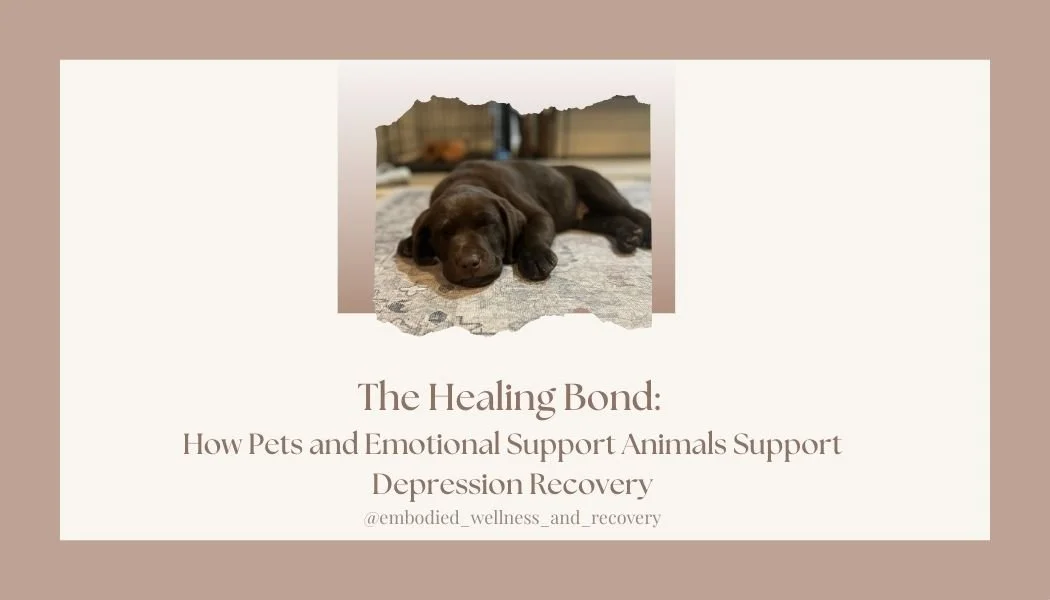
The Healing Bond: How Pets and Emotional Support Animals Support Depression Recovery
The Healing Bond: How Pets and Emotional Support Animals Support Depression Recovery
Struggling with depression? Learn how pets and emotional support animals support nervous system regulation, reduce isolation, and promote emotional resilience through neuroscience-informed care.
Depression and the Experience of Disconnection
Depression often feels less like sadness and more like disconnection. Disconnection from pleasure. From motivation. From meaning. From others.
You may find yourself asking:
Why do I feel numb or withdrawn?
Why does connection feel exhausting?
Why do I feel calmer around animals than people?
For many individuals, pets provide a unique form of emotional regulation and relational safety that supports recovery from depression in meaningful ways.
The Neuroscience of Human Animal Bonding
Interaction with animals activates oxytocin, a hormone involved in bonding and stress reduction. At the same time, cortisol levels often decrease.
From a nervous system perspective, animals offer nonjudgmental presence and predictable responses. This creates a sense of safety that the depressed nervous system often craves.
Why Animals Feel Easier Than People During Depression
Depression can heighten sensitivity to social cues and perceived rejection. Animals do not require conversation, emotional performance, or explanation.
Their presence allows the nervous system to settle without demand.
Emotional Support Animals and Regulation
Emotional support animals are not service animals, but they play an important role in emotional regulation. Routine care provides structure. Physical touch offers grounding. Eye contact supports connection.
These experiences help counteract isolation and withdrawal.
Pets and Attachment Repair
For individuals with relational trauma, animals can serve as safe attachment figures. They provide consistency, affection, and responsiveness.
Over time, this can gently reshape expectations of connection and trust.
Movement, Routine, and Purpose
Depression often disrupts daily rhythms. Caring for a pet introduces routine and movement, both of which support mood regulation through circadian and neurotransmitter pathways.
Small acts of care can restore a sense of usefulness and purpose.
Limits and Considerations
Pets are not a replacement for therapy. They do not resolve trauma or depression on their own. However, when integrated into a broader treatment plan, they can provide meaningful support.
Therapy and Animal Assisted Healing
At Embodied Wellness and Recovery, we view pets as part of a larger relational ecosystem. Therapy helps individuals understand why animals feel regulating and how to translate that safety into human relationships.
The bond between humans and animals reflects the nervous system’s deep need for connection. In depression recovery, this bond can offer comfort, rhythm, and emotional warmth that support healing over time.
Reach out to schedule a complimentary 20-minute consultation with our team of therapists, trauma specialists, somatic practitioners, or relationship experts, and start working towards integrative, embodied healing today.
📞 Call us at (310) 651-8458
📱 Text us at (310) 210-7934
📩 Email us at admin@embodiedwellnessandrecovery.com
🔗 Visit us at www.embodiedwellnessandrecovery.com
👉 Check us out on Instagram @embodied_wellness_and_recovery
🌍 Explore our offerings at Linktr.ee: https://linktr.ee/laurendummit
References
1) Beetz, A., Uvnäs Moberg, K., Julius, H., & Kotrschal, K. (2012). Psychosocial and psychophysiological effects of human animal interactions. Frontiers in Psychology, 3, 234.
2) Fine, A. H. (2019). Handbook on animal-assisted therapy. Academic Press.
) Odendaal, J. S. J. (2000). Animal-assisted therapy. Journal of Psychosomatic Research, 49(4), 275–280.
4) Porges, S. W. (2011). The polyvagal theory. W. W. Norton.
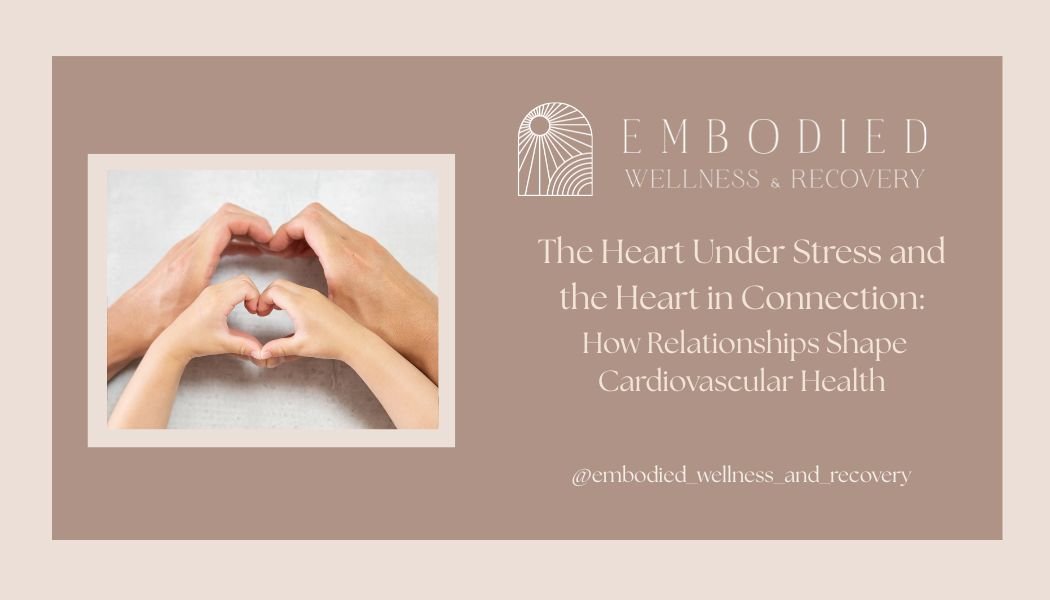
The Heart Under Stress and the Heart in Connection: How Relationships Shape Cardiovascular Health
The Heart Under Stress and the Heart in Connection: How Relationships Shape Cardiovascular Health
Can love and connection support heart health? Explore the neuroscience behind broken heart syndrome, cardiovascular disease, and how supportive relationships help regulate the nervous system and protect the heart.
Can emotional pain actually damage the heart? And if so, can emotional connection help repair it?
For many people living with cardiovascular disease or recovering from a profound emotional loss, these questions are not abstract. They are deeply personal. Chest tightness after grief. Palpitations during loneliness. A sense that the heart is carrying more than physical strain alone.
Medical science is increasingly confirming what poets, philosophers, and therapists have long observed. The heart responds not only to cholesterol, blood pressure, and genetics, but also to emotional safety, attachment, and relational stress. In some cases, intense emotional loss can lead to a temporary but serious condition known as broken heart syndrome. Even more compelling is the growing evidence that strong, supportive relationships may actively improve heart health for people with cardiovascular disease.
At Embodied Wellness and Recovery, we approach heart health through a trauma-informed, nervous-system-centered lens that honors the inseparable relationship between emotional life, relational experiences, and physiological regulation.
When Emotional Loss Becomes Physical: Understanding Broken Heart Syndrome
Broken heart syndrome, clinically referred to as stress-induced cardiomyopathy or Takotsubo cardiomyopathy, occurs when acute emotional or physical stress leads to sudden weakening of the heart muscle. It often follows events such as the death of a loved one, betrayal, divorce, or overwhelming fear.
Many people experiencing broken heart syndrome report symptoms that mirror a heart attack. These may include chest pain, shortness of breath, dizziness, or irregular heartbeat. Unlike a traditional heart attack, however, the coronary arteries are not blocked. Instead, the heart muscle temporarily loses its ability to pump effectively.
From a neuroscience and psychophysiology perspective, this condition highlights the powerful role of the autonomic nervous system. During intense emotional distress, the body releases a surge of stress hormones such as adrenaline and cortisol. These chemicals can temporarily stun the heart muscle, altering cardiac function.
This raises a profound question. If emotional stress can injure the heart, could emotional safety and connection support its recovery?
The Social Heart: How Relationships Influence Cardiovascular Health
Emerging research suggests that the opposite of broken heart syndrome may also exist. Supportive relationships appear to have measurable protective effects on cardiovascular health.
People with strong social connections tend to have lower rates of heart disease, better recovery outcomes after cardiac events, and a reduced risk of mortality. Loneliness and chronic relational stress, on the other hand, are associated with increased inflammation, higher blood pressure, and greater risk of cardiovascular complications.
From a nervous system perspective, this makes sense. The human body is wired for connection. Safe relationships help regulate heart rate variability, reduce sympathetic nervous system overactivation, and promote parasympathetic states associated with rest, repair, and cardiovascular stability.
Supportive relationships are not merely emotionally comforting. They are biologically stabilizing.
The Nervous System as the Bridge Between Love and the Heart
The heart does not function in isolation. It is in constant dialogue with the brain through neural pathways that monitor safety, threat, and social engagement.
When a person feels emotionally supported, understood, and securely attached, the vagus nerve helps slow the heart rate, lower blood pressure, and improve heart rate variability. These changes support cardiovascular resilience and recovery.
In contrast, chronic relational stress keeps the nervous system in a state of vigilance. This sustained activation of stress pathways contributes to inflammation, endothelial dysfunction, and metabolic strain that directly impact heart health.
Neuroscience now recognizes that emotional regulation is not a purely psychological process. It is a physiological one. And relationships play a central role in shaping that regulation.
Heart Disease and Emotional Isolation: The Hidden Risk Factor
Many people living with cardiovascular disease struggle silently with emotional isolation. They may feel ashamed of their diagnosis, fearful of becoming a burden, or disconnected from intimacy due to medical trauma or body-based anxiety.
You might recognize questions like these:
— Why does my chest tighten when I feel lonely or emotionally overwhelmed?
— Why do medical appointments trigger panic rather than reassurance?
— Why does my heart condition feel intertwined with grief, fear, or unresolved trauma?
— Why do I feel disconnected from desire or intimacy after a cardiac event?
These experiences are not signs of weakness. They reflect how the nervous system responds to threat, loss of control, and perceived vulnerability.
Addressing heart health without addressing emotional safety leaves an essential piece of healing untouched.
Supportive Relationships as a Form of Cardiac Care
Supportive relationships do not require perfection. They require presence, emotional attunement, and nervous system regulation.
Healthy relational support can include:
— Partners who respond with curiosity rather than fear
— Friends who offer consistent emotional availability
— Therapeutic relationships that help process grief, trauma, and anxiety
— Group spaces that reduce isolation and normalize vulnerability
Research shows that people who feel emotionally supported are more likely to adhere to medical treatment, engage in heart-healthy behaviors, and experience improved quality of life after cardiac events (Rowland et al., 2018).
At Embodied Wellness and Recovery, we integrate relational therapy, somatic interventions, and trauma-informed care to help clients rebuild trust in both their bodies and their connections.
Trauma, Attachment, and the Heart
Cardiovascular disease often intersects with earlier life stress, attachment wounds, and chronic emotional strain. Childhood adversity, relational trauma, and long-term stress patterns shape how the nervous system responds to threat throughout adulthood.
For some individuals, the heart becomes a symbolic and literal site of stored emotional burden. Medical trauma can compound this by reinforcing fear and loss of bodily trust.
Therapeutic work that addresses attachment patterns, unresolved grief, and somatic memory helps reduce the physiological load carried by the heart. When emotional processing occurs in a regulated relational context, the nervous system gains new pathways for safety and repair.
Sexuality, Intimacy, and Cardiovascular Health
Heart health challenges often disrupt intimacy. Fear of physical exertion, body image changes, or anxiety about triggering symptoms can lead to emotional withdrawal and sexual disconnection.
Yet intimacy itself can be a powerful regulator of the nervous system when approached with safety and attunement. Touch, emotional closeness, and relational reassurance activate parasympathetic pathways that support cardiovascular stability.
Therapy that addresses sexuality and intimacy within the context of heart health helps couples reconnect without pressure, fear, or shame. It restores the experience of closeness as supportive rather than threatening.
A Nervous System-Informed Path Forward
Healing the heart involves more than medication and lifestyle modification. It involves restoring a sense of safety within the body and within relationships.
A nervous system-informed approach may include:
— Somatic therapy to reduce chronic stress activation
— Trauma processing for grief and medical trauma
— Attachment-focused therapy to strengthen relational security
— Mindfulness and breathwork practices that support vagal tone
— Relational repair that fosters emotional connection and trust
These interventions support cardiovascular health by addressing the underlying physiological stress patterns that strain the heart.
The Expertise of Embodied Wellness and Recovery
Embodied Wellness and Recovery specializes in treating trauma, nervous system dysregulation, relational distress, sexuality, and intimacy through an integrative, neuroscience-informed lens.
We understand that heart health is not only a medical issue. It is a relational and emotional one. Our clinicians work collaboratively with clients to address the psychological and somatic dimensions of cardiovascular stress, helping restore balance, connection, and resilience.
When emotional pain and physical vulnerability meet skilled relational care, the nervous system learns new patterns of regulation that support both emotional well-being and heart health.
The Heart Listens to Connection
The heart responds to loss. It responds to fear. And it also responds to love, safety, and support.
While broken heart syndrome demonstrates the profound impact of emotional stress on the heart, growing research affirms something equally powerful. Strong, supportive relationships can help regulate the nervous system, reduce cardiovascular strain, and support healing in people with heart disease.
The heart is not just a pump. It is a responsive organ shaped by connection.
Reach out to schedule a complimentary 20-minute consultation with our team of therapists, trauma specialists, somatic practitioners, or relationship experts, and start working towards integrative, embodied healing today.
📞 Call us at (310) 651-8458
📱 Text us at (310) 210-7934
📩 Email us at admin@embodiedwellnessandrecovery.com
🔗 Visit us at www.embodiedwellnessandrecovery.com
👉 Check us out on Instagram @embodied_wellness_and_recovery
🌍 Explore our offerings at Linktr.ee: https://linktr.ee/laurendummit
References
1) Cacioppo, J. T., Cacioppo, S., & Boomsma, D. I. (2014). Evolutionary mechanisms for loneliness. Cognition and Emotion, 28(1), 3–21.
2) Porges, S. W. (2011). The polyvagal theory: Neurophysiological foundations of emotions, attachment, communication, and self-regulation. W. W. Norton & Company.
3) Steptoe, A., & Kivimäki, M. (2012). Stress and cardiovascular disease. Nature Reviews Cardiology, 9(6), 360–370.
4) Rowland, S. A., Schumacher, K. L., Leinen, D. D., Phillips, B. G., Schulz, P. S., & Yates, B. C. (2018). Couples' experiences with healthy lifestyle behaviors after cardiac rehabilitation. Journal of cardiopulmonary rehabilitation and prevention, 38(3), 170-174.
5) Tawakol, A., Ishai, A., Takx, R. A. P., et al. (2017). Relation between resting amygdalar activity and cardiovascular events. The Lancet, 389(10071), 834–845.

Reclaiming Your Well-Being in a World That Never Stops: What Latin Culture Teaches Us About Resilience and Joy
Reclaiming Your Well-Being in a World That Never Stops: What Latin Culture Teaches Us About Resilience and Joy
Discover why Latin cultures often “dance through crisis” while Western cultures panic, and what neuroscience reveals about reclaiming balance, resilience, and well-being in a modern world that never stops moving.
The Exhaustion of a World That Never Stops
Do you ever feel like the world is moving faster than your body and mind can keep up? From the moment you wake up, your phone buzzes with emails, texts, and news updates. Deadlines pile up at work, family responsibilities feel never-ending, and even leisure time can feel like another task on the to-do list.
It is no wonder that burnout has become one of the most widely searched terms on Google. Stress, anxiety, and emotional fatigue are not only common; they are becoming normalized in Western culture. But does it have to be this way?
In contrast, many Latin cultures embody a different rhythm. Even in times of political, social, or economic crisis, communities find ways to dance, gather, and celebrate life. What allows some cultures to embrace resilience and joy while others collapse into panic and burnout? And more importantly, what can we learn from this wisdom to reclaim our own well-being?
Latin Culture: Dancing Through Crisis
Across Latin America, festivals, community gatherings, and dance are woven into everyday life. Music fills the streets, families gather weekly for meals, and movement is not reserved for special occasions; it is part of how people connect and regulate stress.
During crises, rather than shutting down, people often lean more deeply into community, ritual, and rhythm. Neuroscience helps explain why:
— Movement regulates the nervous system. Dancing, walking, and rhythmic movement activate the vagus nerve, helping the body move out of fight-or-flight and into a state of calm.
— Community fosters resilience. Social connection releases oxytocin, the “bonding hormone,” which counters stress and strengthens our capacity to endure challenges.
— Joy amplifies coping. Even brief moments of pleasure, laughter, music, and shared meals help the brain release dopamine and serotonin, creating emotional balance even in adversity.
This way of meeting crisis with rhythm and community does not minimize hardship. Instead, it shows us that humans are wired not only to survive but to find meaning and even joy amid difficulty.
Western Culture: The Trap of Panic and Productivity
In contrast, many Western cultures approach crisis through the lens of hyper-productivity control. When things feel unstable, the instinct is often to work harder, plan more rigidly, or numb with distractions. While understandable, these strategies leave the nervous system in chronic overdrive.
Have you ever noticed how quickly panic spreads in a workplace, a family system, or even a society? Neuroscience reveals that our brains are wired with mirror neurons, which means anxiety is contagious. One person’s stress can ripple through an entire group, creating collective burnout.
This is the painful reality for so many:
— Why can’t I just relax, even when I have downtime?
— Why does my body feel tense all the time?
— Why do I feel disconnected from joy, even when life looks good on the outside?
The truth is, without rituals of rest, movement, and connection, the nervous system does not know how to shift gears. The result is exhaustion, disconnection, and an inability to feel present in our own lives.
Neuroscience of Resilience: Why Rhythm Heals
Neuroscience provides insight into why the Latin approach of rhythm, dance, and community can be so powerful. The autonomic nervous system, which controls our stress and relaxation responses, is constantly scanning for cues of safety or danger.
— When we are stressed, the sympathetic nervous system (fight-or-flight) takes over, flooding the body with adrenaline and cortisol.
— When we feel safe and connected, the parasympathetic nervous system activates, supporting digestion, rest, and healing.
— The vagus nerve plays a central role, carrying signals between the brain and body. Practices like dancing, singing, humming, and deep breathing stimulate the vagus nerve, allowing the nervous system to regulate.
In other words, resilience is not just about mindset. It is about rhythm, connection, and embodied practices that remind the body it is safe enough to rest, connect, and even experience joy.
Lessons for Reclaiming Well-Being
So what can those of us living in high-stress Western cultures learn from Latin traditions? Here are practical, neuroscience-backed steps to reclaim balance and well-being in a world that never stops:
1. Prioritize Rhythm Over Perfection
Instead of trying to control every detail of life, focus on creating daily rhythms that support the nervous system. This might mean morning stretches, evening walks, or weekly family meals. Rhythm matters more than rigid perfection.
2. Move Your Body—Daily
Dance in your kitchen, walk with a friend, or try a somatic exercise that brings attention to your breath and posture. Movement is not just fitness; it is nervous system repair.
3. Connect in Community
Schedule intentional time with friends, family, or supportive groups. Connection is medicine. As Latin cultures show us, gathering is not frivolous; it is essential for survival and well-being.
4. Create Micro-Moments of Joy
Joy is not the absence of stress; it is the nervous system’s antidote to it. Light a candle, savor a meal, listen to music, or laugh with someone you love. These small practices add up to resilience.
5. Seek Trauma-Informed Support
If stress or past trauma has left your nervous system feeling “stuck” in overdrive, professional support can help. Trauma-focused therapies such as Somatic Experiencing, EMDR, or mindfulness-based approaches can reset patterns in the brain and body, making space for safety and connection again.
How Embodied Wellness and Recovery Can Help
At Embodied Wellness and Recovery, we understand the toll that living in a fast-paced, always-on culture can take on the nervous system, relationships, and overall well-being. Our approach integrates:
— Somatic therapy to restore regulation in the body
— Attachment-focused care to repair relational wounds
— Neuroscience-based practices for trauma recovery
— Support for intimacy and sexuality so clients can feel fully alive in their bodies
Reclaiming well-being is not about doing more; it is about learning to move with rhythm, regulate the nervous system, and reconnect to joy.
Learning to Dance With Life
The Latin way of dancing through crisis is more than a cultural curiosity; it is a profound reminder that resilience is built through movement, rhythm, and connection. In a world that never stops, we must choose to slow down, reconnect with our bodies, and reclaim practices that honor both survival and joy.
Burnout may feel like an inevitable part of modern life, but it does not have to define us. By integrating neuroscience, somatic wisdom, and cultural lessons of resilience, we can learn to dance with life instead of panicking through it.
Reach out to schedule a free 20-minute consultation with our team of top-rated therapists and somatic practitioners and begin the process of rediscovering your sense of aliveness and joy today.
📞 Call us at (310) 651-8458
📱 Text us at (310) 210-7934
📩 Email us at admin@embodiedwellnessandrecovery.com
🔗 Visit us at www.embodiedwellnessandrecovery.com
👉 Check us out on Instagram @embodied_wellness_and_recovery
🌍 Explore our offerings at Linktr.ee: https://linktr.ee/laurendummit
References
Porges, S. W. (2011). The polyvagal theory: Neurophysiological foundations of emotions, attachment, communication, and self-regulation. W.W. Norton & Company.
Ratey, J. J. (2008). Spark: The revolutionary new science of exercise and the brain. Little, Brown Spark.
Van der Kolk, B. A. (2014). The Body Keeps the Score: Brain, Mind, and Body in the Healing of Trauma. Penguin Books.