
AI Anxiety Is Real: How Constant Exposure to Artificial Intelligence News Is Affecting Mental Health, Stress, and the Nervous System
AI Anxiety Is Real: How Constant Exposure to Artificial Intelligence News Is Affecting Mental Health, Stress, and the Nervous System
Constant exposure to AI news can increase anxiety, overwhelm, uncertainty, and nervous system dysregulation. Learn the neuroscience behind AI anxiety, information overload, and practical strategies for protecting mental health in an age of rapid technological change.
Why Does AI News Feel So Emotionally Overwhelming?
Artificial intelligence is everywhere.
Every day, headlines warn that AI may replace jobs, transform relationships, disrupt education, reshape healthcare, alter creativity, and fundamentally change the future of humanity. Social media feeds are saturated with predictions ranging from extraordinary optimism to existential catastrophe. For many people, keeping up with AI developments feels less like staying informed and more like riding an emotional roller coaster.
Have you found yourself asking:
— Am I going to lose my job because of AI?
— Will my skills become obsolete?
— Why do I feel anxious every time I read AI news?
— Why can't I stop checking for updates about artificial intelligence?
— Why do I feel overwhelmed by how quickly technology is changing?
— Why do I feel exhausted, distracted, or hopeless after scrolling through AI content?
If so, you are experiencing something increasingly recognized by psychologists and mental health professionals: the emotional impact of chronic exposure to uncertainty, technological disruption, and information overload.
The issue is not simply artificial intelligence itself. The issue is how our brains and nervous systems respond to constant exposure to rapid, unpredictable change.
The Human Brain Was Not Designed for Infinite Information
One of the defining characteristics of modern life is the unprecedented volume of information available at every moment. Research has consistently demonstrated that excessive information consumption can contribute to stress, anxiety, cognitive fatigue, and emotional overwhelm (Bawden & Robinson, 2020). The human brain evolved to process manageable amounts of information within relatively stable environments. Today's reality is dramatically different.
Every hour brings new headlines:
— AI replacing workers
— AI transforming healthcare
— AI-generated misinformation
— AI companions and relationships
— AI breakthroughs
— AI safety concerns
— AI regulations
— AI existential risk
The nervous system struggles to distinguish between information that requires immediate action and information that is merely interesting. As a result, many people remain in a chronic state of vigilance.
The Neuroscience of AI Anxiety
From a neuroscience perspective, uncertainty is one of the most powerful triggers of stress. The brain's threat detection system, particularly the amygdala, is constantly scanning for potential danger. When future outcomes feel unpredictable, the brain often responds by increasing attention, vigilance, and worry.
Researchers have found that uncertainty can activate neural circuits associated with fear and anxiety (Grupe & Nitschke, 2013). In some cases, uncertainty may be experienced as more stressful than known negative outcomes because the brain continues searching for answers that do not yet exist.
AI news creates a perfect storm of uncertainty because:
— The technology is evolving rapidly.
— Experts often disagree about future outcomes.
— Predictions range from utopian to catastrophic.
— Individuals feel they have limited control over the changes.
When uncertainty becomes chronic, the nervous system may remain activated long after the news article has been read.
Doomscrolling Meets Artificial Intelligence
Many people report compulsively checking AI news despite feeling worse afterward.
Why?
The answer involves dopamine and the brain's reward system. Novel information activates reward pathways that encourage learning and exploration. Each new AI announcement promises potentially important information about the future. The brain begins seeking updates in the hope of gaining certainty. Ironically, each new update often introduces additional uncertainty.
This creates a cycle:
Anxiety about AI.
Search for information.
Temporary relief.
Exposure to more uncertainty.
Increased anxiety.
Return to information seeking.
Over time, this pattern can resemble other forms of compulsive digital consumption.
How AI News Can Affect Mental Health
Increased Anxiety
Many individuals experience heightened anxiety about employment, financial security, education, and societal change.
Information Overload
The sheer volume of AI content can create cognitive fatigue, making concentration and decision-making more difficult.
Existential Worry
Questions about human identity, purpose, creativity, and meaning often emerge when discussing artificial intelligence.
Sleep Disturbance
Consuming stimulating or anxiety-provoking information before bedtime can interfere with sleep quality and nervous system recovery.
Feelings of Helplessness
Constant exposure to large-scale societal issues can create a sense that personal actions no longer matter.
Why Trauma Survivors May Be Especially Vulnerable
At Embodied Wellness and Recovery, we often see how trauma influences responses to uncertainty.
Individuals with histories of:
— Emotional neglect
— Chronic stress
— Attachment trauma
— Family instability
may experience technological uncertainty differently.
Trauma can sensitize the nervous system to unpredictability. When AI headlines repeatedly signal that the future is uncertain, the body may respond as though a threat is imminent. What appears to be an overreaction may actually reflect a nervous system attempting to protect itself in light of prior experiences.
The Relationship Between AI Anxiety and Nervous System Dysregulation
Many people focus exclusively on their thoughts. However, anxiety is not solely a cognitive experience. It is also physiological.
You may notice:
— Muscle tension
— Digestive issues
— Fatigue
— Irritability
— Sleep disruption
These symptoms reflect nervous system activation. When the body remains in prolonged states of sympathetic arousal, stress becomes harder to regulate. This is why simply telling yourself to "stop worrying" rarely works The nervous system must also experience safety.
How AI News Is Affecting Relationships
An often overlooked consequence of AI anxiety is its impact on relationships.
When individuals become preoccupied with fear, uncertainty, or excessive information consumption, emotional availability may decrease.
Couples may argue about:
— Technology use
— Career decisions
— Financial planning
— Future security
Some individuals withdraw emotionally, while others become consumed with researching future threats. The result can be increased disconnection at the very moment human connection is most needed. Healthy relationships remain one of the strongest protective factors against chronic stress.
Five Ways to Protect Your Mental Health in the Age of AI
1. Limit AI News Consumption
Being informed does not require constant exposure. Consider establishing designated times for consuming technology news.
2. Notice What Happens in Your Body
Pay attention to physical signs of activation. Awareness is often the first step toward regulation.
3. Strengthen Real Human Connection
The antidote to technological overwhelm is often meaningful human connection. Prioritize conversations, relationships, and experiences that reinforce a sense of belonging.
4. Focus on What You Can Control
The brain feels safer when attention shifts toward actionable steps rather than hypothetical futures.
5. Support Nervous System Regulation
Activities such as exercise, mindfulness, somatic therapy, breathwork, yoga, exposure to nature, and adequate sleep can help restore physiological balance.
A More Balanced Relationship With AI
Artificial intelligence will likely continue influencing every aspect of modern life, but constant fear and hypervigilance are not requirements for adaptation. The healthiest approach often involves remaining informed without becoming consumed. Curious without becoming obsessive. Prepared without becoming paralyzed. Technology will continue evolving. The question is whether our nervous systems will be given opportunities to adapt alongside it.
Finding Stability in an Uncertain Future
At Embodied Wellness and Recovery, we help individuals understand how trauma, anxiety, chronic stress, attachment patterns, and nervous system dysregulation influence their responses to uncertainty and change.
Whether the source of distress is AI, career concerns, relationship challenges, or broader societal shifts, lasting well-being often requires more than changing thoughts. It involves supporting the brain, the body, and the nervous system simultaneously.
When individuals learn to regulate stress, cultivate emotional resilience, strengthen relationships, and reconnect with a sense of agency, they become better equipped to navigate uncertainty without being overwhelmed by it. The future may remain uncertain, but your relationship with uncertainty does not have to.
Reach out to schedule a complimentary 20-minute consultation with our team of therapists, trauma specialists, somatic practitioners, or relationship experts, and start working towards integrative, embodied healing today.
📞 Call us at (310) 651-8458
📱 Text us at (310) 210-7934
📩 Email us at admin@embodiedwellnessandrecovery.com
🔗 Visit us at www.embodiedwellnessandrecovery.com
👉 Check us out on Instagram @embodied_wellness_and_recovery
🌍 Explore our offerings at Linktr.ee: https://linktr.ee/laurendummit
References
Bawden, D., & Robinson, L. (2020). Information overload: An overview.
Brosschot, J. F., Gerin, W., & Thayer, J. F. (2006). The perseverative cognition hypothesis: A review of worry, prolonged stress-related physiological activation, and health. Journal of Psychosomatic Research, 60(2), 113-124.
Grupe, D. W., & Nitschke, J. B. (2013). Uncertainty and anticipation in anxiety: an integrated neurobiological and psychological perspective. Nature Reviews Neuroscience, 14(7), 488-501.
Hirsh, J. B., Mar, R. A., & Peterson, J. B. (2012). Psychological entropy: A framework for understanding uncertainty-related anxiety. Psychological Review, 119(2), 304-320.
LeDoux, J. E. (2000). Emotion circuits in the brain. Annual Review of Neuroscience, 23, 155-184.
Rosen, L. D., Lim, A. F., Carrier, L. M., & Cheever, N. A. (2011). An empirical examination of the educational impact of text message-induced task switching in the classroom. Educational Psychology, 31(6), 793-807.
Sapolsky, R. M. (2004). Why zebras don't get ulcers (3rd ed.). Henry Holt and Company.
Why Feeling Unappreciated in a Relationship Can Slowly Destroy Love: The Neuroscience of Emotional Neglect, Resentment, and Lasting Connection
Why Feeling Unappreciated in a Relationship Can Slowly Destroy Love: The Neuroscience of Emotional Neglect, Resentment, and Lasting Connection
Feeling unappreciated in your relationship can quietly erode intimacy, trust, and emotional safety over time. Discover the neuroscience behind feeling taken for granted and learn practical ways to rebuild appreciation, strengthen attachment, and restore connection.
Why Does Feeling Unappreciated Hurt So Much?
Have you ever thought:
— Why do I feel invisible in my own relationship?
— Why am I doing everything for my partner without feeling valued?
— Why do small acts of neglect hurt more than major arguments?
— Why have I become resentful when nothing "big" seems wrong?
— Why does my partner seem oblivious to everything I contribute?
For many couples, relationships do not unravel because of one catastrophic event. Instead, they slowly deteriorate over thousands of unnoticed moments in which effort goes unrecognized, emotional labor goes unseen, and gratitude fades into expectation.
Feeling unappreciated is not merely an inconvenience. It can become a chronic relational stressor that changes how partners think, feel, communicate, and even how their nervous systems respond to one another.
At Embodied Wellness and Recovery, we frequently help individuals and couples understand that appreciation is more than politeness. It is an essential ingredient for emotional security, nervous system regulation, healthy sexuality, and long-term relationship satisfaction.
Why Appreciation Matters to the Human Brain
From an evolutionary perspective, humans survived through connection and cooperation. Feeling valued within close relationships signals safety, belonging, and mutual investment.
Neuroscience suggests that positive social interactions activate reward pathways involving dopamine and oxytocin while helping regulate stress responses mediated by cortisol and the amygdala. Expressions of gratitude and recognition can reinforce attachment bonds and increase feelings of trust and emotional closeness.
When appreciation disappears, the opposite may occur. The brain begins scanning for evidence of rejection, unfairness, or emotional abandonment. Over time, repeated disappointment can strengthen negative cognitive biases and increase emotional vigilance.
A person who once eagerly helped their partner may eventually think:
"Why bother? Nothing I do seems to matter anyway."
Emotional Neglect Is Often Quiet
Most people imagine relationship damage occurring through betrayal, explosive conflict, or major deception. Yet emotional neglect often whispers instead of screams.
It appears in everyday moments:
— The dinner that receives no acknowledgment.
— The parent carrying the invisible mental load without thanks.
— The spouse who works tirelessly while their sacrifices go unnoticed.
— The partner whose emotional support is expected but rarely reciprocated.
— The countless acts of service that slowly become viewed as obligations instead of gifts.
Over months or years, appreciation quietly transforms into assumption. Assumption breeds entitlement. Entitlement leads to resentment. Resentment erodes connection.
The Neuroscience of Feeling Taken for Granted
Our nervous systems are constantly evaluating whether relationships feel safe and reciprocal. When appreciation consistently disappears, many individuals experience a subtle activation of the body's threat-detection systems. The brain may interpret repeated emotional dismissal as social exclusion, which can activate neural circuits that overlap with those involved in physical pain processing.
As stress accumulates:
— Cortisol levels may remain elevated.
— Emotional regulation becomes more difficult.
— Irritability increases.
— Defensive communication becomes more likely.
— Intimacy may decline.
— Sexual desire may diminish.
For trauma survivors or individuals with attachment wounds, feeling chronically unappreciated may reactivate earlier experiences of invisibility, neglect, criticism, or conditional love. The present relationship begins carrying echoes of the past.
Why Resentment Builds So Slowly
One fascinating aspect of resentment is that it rarely arrives overnight. Instead, it accumulates through repeated unmet expectations.
A partner may initially think:
"It's okay. They're busy."
Months later:
"I wish they noticed how hard I'm trying."
Eventually:
"I don't think they care about me anymore."
By the time resentment surfaces openly, the emotional bank account may already be significantly depleted. This gradual erosion often surprises couples who insist they "never really fought."
The Hidden Cost to Intimacy and Sexual Connection
Feeling appreciated is deeply intertwined with emotional and physical intimacy. When people feel emotionally unseen, they often become less interested in vulnerability, affection, and sexual connection. This is particularly true when one partner carries disproportionate household responsibilities, parenting duties, or emotional labor. Desire frequently flourishes in environments where people feel cherished, respected, admired, and emotionally safe. Feeling consistently taken for granted can create emotional distance that extends into the bedroom.
Trauma Can Magnify the Experience
People with histories of childhood emotional neglect, family conflict, abandonment, or relational trauma may experience perceived lack of appreciation more intensely.
Their nervous systems may already be sensitized to cues suggesting:
— "I don't matter."
— "My needs are too much."
— "I'm only valuable for what I provide."
— "Love has to be earned."
Without realizing it, current disappointments become layered upon old attachment injuries. This does not mean their reactions are irrational. Rather, their brains are integrating present experiences with prior learning.
Five Signs Feeling Unappreciated Is Damaging Your Relationship
1. You keep score.
You mentally track chores, sacrifices, or emotional labor because reciprocity feels absent.
2. Small disappointments create outsized reactions.
Minor oversights trigger surprisingly intense frustration because they symbolize a larger unmet need.
3. Gratitude has disappeared from daily conversations.
Interactions become transactional rather than relational.
4. You withdraw emotionally.
Instead of asking for appreciation, you stop offering effort altogether.
5. Affection and intimacy decline.
Emotional disconnection often precedes physical distance.
Appreciation Is More Than Saying "Thank You"
Healthy appreciation involves consistent recognition of another person's humanity, effort, and internal experience.
This can include:
— Verbal gratitude.
— Genuine curiosity.
— Physical affection.
— Validation of invisible labor.
— Public acknowledgment.
— Emotional responsiveness.
— Acts of kindness that communicate, "I see you."
The goal is not perfection. The goal is to help your partner feel emotionally witnessed.
How Couples Can Rebuild Appreciation
Small changes practiced consistently often create significant improvements.
Consider trying these exercises:
Name one thing every day.
Before bed, each partner identifies one specific action they appreciated that day.
Replace assumptions with acknowledgment.
Instead of expecting contributions, intentionally notice them.
Express admiration out loud.
Research consistently demonstrates that positive sentiment strengthens relational resilience (Stephens et al., 2013).
Become curious.
Ask questions about your partner's emotional world rather than focusing solely on logistics.
Repair quickly.
When appreciation has been absent, sincere acknowledgment paired with behavioral change often matters more than grand gestures.
A Nervous System Perspective
At Embodied Wellness and Recovery, we recognize that relationship distress is not solely about communication skills. Sometimes partners intellectually understand one another while their nervous systems remain chronically activated.
Trauma-informed therapy, somatic interventions, attachment-focused work, EMDR, and neuroscience-informed couples treatment can help individuals identify old relational patterns that continue influencing present-day interactions. When the body begins to experience greater safety, appreciation often becomes easier to both express and receive.
Hope for Couples Feeling Stuck
If appreciation has faded from your relationship, it does not necessarily mean love has disappeared. Many couples become trapped in cycles in which both partners feel unseen yet long to be recognized. One withdraws because they feel unvalued. The other becomes defensive because they feel criticized. The resulting distance reinforces itself until neither partner feels emotionally nourished.
Fortunately, awareness can interrupt that cycle. By intentionally cultivating gratitude, strengthening emotional attunement, understanding attachment dynamics, and addressing underlying nervous system patterns, couples often rediscover warmth that had quietly faded over time.
At Embodied Wellness and Recovery, our clinicians integrate neuroscience, trauma-informed care, somatic approaches, relationship expertise, and evidence-based interventions to help individuals and couples restore emotional connection, deepen intimacy, and build relationships in which appreciation becomes part of daily life rather than an occasional afterthought.
When people consistently feel seen, valued, and emotionally understood, relationships become more resilient, conflicts become more manageable, and love gains the conditions it needs to thrive.
Reach out to schedule a complimentary 20-minute consultation with our team of therapists, trauma specialists, somatic practitioners, or relationship experts, and start working towards integrative, embodied healing today.
📞 Call us at (310) 651-8458
📱 Text us at (310) 210-7934
📩 Email us at admin@embodiedwellnessandrecovery.com
🔗 Visit us at www.embodiedwellnessandrecovery.com
👉 Check us out on Instagram @embodied_wellness_and_recovery
🌍 Explore our offerings at Linktr.ee: https://linktr.ee/laurendummit
References
Algoe, S. B. (2012). Find, remind, and bind: The functions of gratitude in everyday relationships. Social and Personality Psychology Compass, 6(6), 455 to 469.
Coan, J. A., & Sbarra, D. A. (2015). Social baseline theory: The social regulation of risk and effort. Current Opinion in Psychology, 1, 87 to 91.
Gottman, J. M., & Silver, N. (2015). The seven principles for making marriage work (Revised ed.). Harmony Books.
Porges, S. W. (2021). Polyvagal safety: Attachment, communication, self-regulation. W. W. Norton & Company.
Stephens, J. P., Heaphy, E. D., Carmeli, A., Spreitzer, G. M., & Dutton, J. E. (2013). Relationship quality and virtuousness: Emotional carrying capacity as a source of individual and team resilience. The Journal of Applied Behavioral Science, 49(1), 13-41.
Can the Brain Repress Traumatic Memories? The Controversial Science of Repressed Memory, PTSD, and What the Body Actually Remembers
Can the Brain Repress Traumatic Memories? The Controversial Science of Repressed Memory, PTSD, and What the Body Actually Remembers
Can traumatic memories be repressed and later recovered? Explore the neuroscience of trauma, PTSD, fragmented memory, body-based symptoms, and the ongoing scientific debate about repressed memories with a balanced, evidence-based perspective.
If you've survived trauma, you may have wondered:
Why can't I remember parts of what happened?
Why do certain smells, sounds, or situations make my body react before my mind understands why?
Why do I avoid thinking about certain experiences, even when I know they occurred?
Can the brain truly bury traumatic memories outside conscious awareness?
These questions sit at the center of one of psychology's longest-running and most controversial debates: the science of repressed memories.
For decades, some theories proposed that overwhelming trauma could be unconsciously repressed and stored outside conscious awareness, only to emerge years later through symptoms or recovered memories. Others argued that while trauma undeniably affects the brain and body, there is insufficient evidence to conclude that the mind routinely buries accurate autobiographical memories in a special unconscious vault awaiting retrieval.
The truth is more nuanced than either extreme suggests.
The Origins of Repressed Memory Theory
The concept of repression emerged from psychoanalytic theory, most notably through the work of Sigmund Freud, who proposed that the mind could unconsciously exclude distressing thoughts or memories from awareness as a defense mechanism. According to this perspective, traumatic experiences might remain inaccessible to conscious recall while continuing to influence emotions, relationships, and physical symptoms. Over time, this idea became deeply embedded in popular culture and some therapeutic traditions.
What Does Modern Memory Science Say?
Contemporary memory research paints a more complicated picture. Most cognitive scientists agree that memory is reconstructive rather than perfectly reproductive. Memories are encoded, stored, and retrieved through dynamic neural processes influenced by attention, emotion, repetition, and subsequent experiences. Trauma can profoundly affect these processes.
However, many researchers caution against assuming that symptoms or bodily sensations necessarily indicate the existence of completely inaccessible traumatic memories waiting to be uncovered. Instead, trauma may influence how memories are encoded, organized, and retrieved rather than whether they exist at all.
Trauma Often Produces Fragmented Rather Than Forgotten Memories
Paradoxically, many individuals with post-traumatic stress disorder (PTSD) struggle not because they cannot remember traumatic events, but because they remember them too vividly. They may experience intrusive images, nightmares, flashbacks, physiological reactivity, or persistent reminders.
At the same time, certain contextual details may remain fragmented, incomplete, or difficult to place in chronological order. High levels of stress hormones can interfere with aspects of memory consolidation, producing recollections that feel disjointed or sensory-based rather than coherent narratives.
Avoidance Is Not the Same as Repression
One of the most important distinctions in trauma psychology is the difference between actively or unconsciously avoiding painful memories and having no access whatsoever to those memories. Many survivors understandably avoid discussing traumatic events because remembering them feels emotionally overwhelming or physically activating.
This avoidance can reduce opportunities to process the experience and may contribute to persistent symptoms. Avoidance is a well-recognized feature of PTSD and should not automatically be interpreted as evidence that memories have been repressed.
Can the Body Remember Trauma?
The phrase "the body keeps the score" has become widely recognized, but it is often misunderstood. There is broad scientific agreement that traumatic stress can produce lasting physiological changes. Stress-related activation of hormones such as cortisol, adrenaline, and noradrenaline influences multiple body systems and may contribute to elevated blood pressure, digestive symptoms, sleep disruption, sexual difficulties, hypervigilance, and chronic muscle tension.
Trauma survivors may also experience nausea, panic attacks, rapid breathing, exhaustion, or persistent feelings of unsafety. These bodily experiences are real and deserve compassionate clinical attention. However, saying that the body stores the effects of trauma is different from saying that the body stores hidden autobiographical memories in a way that bypasses the brain's memory systems. Current neuroscience supports the former far more clearly than the latter.
The Risks of Oversimplification
The debate surrounding repressed memories became particularly heated during the 1980s and 1990s when some individuals recovered previously unremembered memories during therapy, while others raised concerns about the possibility of suggestion, false memories, and memory distortion.
Today, many experts encourage clinicians to maintain a balanced position:
— Trauma is real.
— Trauma affects the brain and body.
— Memory can become fragmented and incomplete.
— Individuals may avoid recalling painful experiences for many reasons.
At the same time, memories are malleable and can be influenced by suggestion, expectation, and repeated imagination. Responsible trauma treatment emphasizes curiosity, careful assessment, and avoiding assumptions about events that cannot be independently verified.
Why Certain Triggers Feel So Powerful
Many trauma survivors notice that their bodies react before conscious thought catches up. Triggers may include a sound, a scent, a facial expression, or a location. These triggers may activate emotional learning networks associated with prior experiences without requiring deliberate recollection. This phenomenon helps explain why someone may experience physiological distress despite struggling to articulate exactly why. The nervous system has learned patterns of prediction and protection.
PTSD Is Both Psychological and Physiological
Post-traumatic stress disorder is characterized by more than distressing memories.
Common symptoms include:
— Intrusive recollections
— Avoidance of reminders
— Difficulty sleeping
— Exaggerated startle responses
— Emotional numbing
— Irritability
— Persistent physiological arousal
These experiences reflect complex interactions among the brain, autonomic nervous system, endocrine system, and psychological processes.
Does Healing Require Recovering Every Memory?
Fortunately, no. Many individuals experience meaningful improvement without recovering additional autobiographical details. Therapeutic progress often comes through helping the nervous system become more regulated, processing emotions in the present, improving relationships, and reducing patterns of avoidance. The goal is not necessarily to excavate forgotten memories. The goal is to reduce suffering and increase flexibility, safety, and connection.
A Neuroscience-Informed, Trauma-Sensitive Approach
At Embodied Wellness and Recovery, we approach trauma with both compassion and scientific humility. We recognize that trauma can profoundly affect emotions, relationships, sexuality, identity, and the nervous system. We also appreciate the complexity of memory research and avoid simplistic conclusions about what bodily symptoms necessarily mean.
Our clinicians integrate somatic therapy, EMDR, attachment-focused psychotherapy, and neuroscience-informed interventions to help clients process trauma while strengthening emotional regulation and restoring a greater sense of internal safety. We specialize in trauma recovery, nervous system repair, relationships, sexuality, and intimacy, supporting individuals through evidence-based care that respects both lived experience and the evolving scientific literature.
Understanding trauma does not require certainty about every memory. Often, it begins with recognizing how the brain and body have adapted to survive, approaching those adaptations with curiosity rather than judgment, and creating conditions where the nervous system can gradually experience greater flexibility and peace.
Reach out to schedule a complimentary 20-minute consultation with our team of therapists, trauma specialists, somatic practitioners, or relationship experts, and start working towards integrative, embodied healing today.
📞 Call us at (310) 651-8458
📱 Text us at (310) 210-7934
📩 Email us at admin@embodiedwellnessandrecovery.com
🔗 Visit us at www.embodiedwellnessandrecovery.com
👉 Check us out on Instagram @embodied_wellness_and_recovery
🌍 Explore our offerings at Linktr.ee: https://linktr.ee/laurendummit
References
Brewin, C. R. (2014). Episodic memory, perceptual memory, and their interaction: Foundations for a theory of posttraumatic stress disorder. Psychological Bulletin, 140(1), 69-97.
Lynn, S. J., Lilienfeld, S. O., Merckelbach, H., Giesbrecht, T., & van der Kloet, D. (2014). Dissociation and dissociative disorders: Challenging conventional wisdom. Current Directions in Psychological Science, 23(1), 48-53.
McNally, R. J. (2003). Remembering trauma. Harvard University Press.
Porges, S. W. (2011). The polyvagal theory: Neurophysiological foundations of emotions, attachment, communication, and self-regulation. W. W. Norton & Company.
Shin, L. M., & Liberzon, I. (2010). The neurocircuitry of fear, stress, and anxiety disorders. Neuropsychopharmacology, 35(1), 169-191.
How Trauma and Shame Shape the Stories We Tell Ourselves: The Neuroscience of Accountability, Victimhood, and Lasting Change
How Trauma and Shame Shape the Stories We Tell Ourselves: The Neuroscience of Accountability, Victimhood, and Lasting Change
What is a metastatic story? Discover how shame, trauma, victim narratives, and self-protective beliefs influence the brain, relationships, and personal accountability. Learn how changing the questions you ask can transform your future.
An idea can alter the course of a life. Not because it is objectively true, but because it becomes unquestioned.
In the film Inception, a character describes an idea as resilient, highly contagious, and almost impossible to eradicate once planted. Neuroscience and psychology suggest something remarkably similar. The human brain constantly constructs narratives to organize experience, reduce uncertainty, and preserve emotional survival. Those narratives become the framework through which we interpret ourselves, our relationships, and the world around us.
Sometimes those stories create resilience. Other times, they metastasize.
At Embodied Wellness and Recovery, we call this the metastatic story, the self-protective narrative that begins with a painful event or wound and gradually spreads into every corner of life, shaping beliefs, questions, behaviors, and perceived possibilities. Rooted in partial truths and reinforced by shame and fear, it can quietly become more influential than reality itself.
When Shame Becomes the Author of Your Life
Perhaps your private behaviors, infidelity, addiction, compulsive sexual behavior, financial deception, or hidden life suddenly became public. The exposure is devastating.
You may feel consumed by humiliation, panic, despair, rage, or a sense of profound injustice. You may wonder:
— Why is everyone judging me?
— Why are they trying to destroy my life?
— Why can't they see what I've been through?
— Why won't anyone understand my pain?
— Why does this feel so unfair?
These questions are understandable. Public exposure can activate the brain's threat detection systems in ways that resemble physical danger. Research suggests that experiences of social rejection and humiliation engage overlapping neural networks involved in physical pain, including the anterior cingulate cortex and the insula (Eisenberger, 2012).
Yet there is another question hiding underneath those reactions. What story has your mind begun constructing in order to survive this moment?
The Narrative That Started Long Before Discovery
The metastatic story rarely begins when the secret is exposed. More often, it started years earlier.
Perhaps it sounded like:
— I have always been misunderstood.
— Nothing is ever my fault because life has been unfair.
— My childhood damaged me beyond repair.
— My partner pushed me into this.
— My stressful career left me no choice.
— Everyone expects too much from me.
— I deserve relief after everything I have endured.
Many of these statements contain elements of truth. Childhood trauma matters. Attachment injuries matter. High-stress environments matter. Betrayal matters.
But the brain often takes valid pain and unconsciously turns it into an organizing principle for identity. Over time, suffering becomes the lens through which every event is interpreted. The narrative metastasizes.
Why the Brain Clings to Victim Narratives
The nervous system is fundamentally designed for survival.
When overwhelming shame threatens our sense of self, defensive processes activate almost instantly. The brain recruits mechanisms such as rationalization, projection, denial, minimization, and externalization to preserve psychological integrity.
From a neuroscience perspective, intense emotional distress can reduce flexible thinking and increase reliance on habitual cognitive patterns. Stress hormones influence activity within the amygdala while diminishing reflective functioning supported by regions of the prefrontal cortex.
The result? Blaming others often feels safer than confronting unbearable shame.
The story becomes:
— My parents made me this way.
— My employer drove me to addiction.
— Society forced these choices.
— If people had treated me differently, none of this would have happened.
Ironically, this narrative provides temporary relief while extending long-term suffering.
Valid Pain Does Not Justify Harm
One of the most difficult truths therapy asks people to hold is this: Your pain may be completely valid, and it still does not justify harming yourself or others. Understanding trauma is not the same as excusing behavior. Recognizing childhood wounds is not the same as relinquishing accountability.
In fact, true accountability often becomes possible only after compassionately acknowledging the origins of one's pain without allowing those origins to dictate the future. Multiple truths can coexist. You may have experienced profound neglect. You may have developed attachment injuries. You may have learned secrecy and emotional avoidance to survive, and you may still bear responsibility for the choices you made. Holding both truths simultaneously requires remarkable psychological flexibility and nervous system regulation.
Better Questions Create Better Possibilities
One hallmark of the metastatic story is that it trains us to ask questions that reinforce victimhood.
Why is this happening to me?
Who ruined my life?
Who should be blamed?
Why can't people move on?
These questions generate answers that deepen resentment and helplessness.
Therapeutic change often begins by replacing those questions with different ones.
— What was I trying to protect?
— What emotions felt too dangerous to experience directly?
— What need was I attempting to meet?
— What truth have I been avoiding?
— What responsibility belongs to me?
— What values do I want to live by now?
The difference between these two sets of questions is profound. One spreads suffering. The other invites transformation.
Shame Thrives in Secrecy and Defensiveness
Researchers such as Dr. Brené Brown have distinguished shame from guilt in important ways.
Guilt says, "I made a mistake."
Shame says, "I am the mistake."
When shame dominates identity, people often become defensive because accountability feels psychologically annihilating. Every invitation to reflect is interpreted as evidence of worthlessness.
The paradox is striking. The more someone avoids responsibility to escape shame, the more shame expands. Owning behavior, while painful, often reduces the need for defensive storytelling.
Trauma Can Explain Patterns Without Becoming Destiny
Many individuals who struggle with addiction, compulsive sexual behavior, infidelity, or emotional avoidance have histories of attachment trauma, developmental adversity, or chronic nervous system dysregulation.
Research consistently demonstrates associations between adverse childhood experiences and later mental health challenges (Schilling et al., 2007). Yet explanation is different from justification.
Trauma may explain why secrecy developed. It does not require secrecy to continue. Neuroplasticity research shows that the brain retains the capacity for change throughout adulthood (Leung et al., 2015). Through repeated corrective experiences, emotional awareness, relational safety, and intentional practice, individuals can develop healthier patterns of regulation and connection.
Rewriting the Metastatic Story Through Embodied Healing
At Embodied Wellness and Recovery, we believe cognitive insight alone is rarely sufficient. The body often continues carrying implicit memories, procedural defenses, and survival responses that operate beneath conscious awareness.
Integrative approaches, including somatic therapy, EMDR, attachment-focused interventions, mindfulness, and neuroscience-informed psychotherapy, help clients recognize the protective strategies that once ensured survival but now interfere with authenticity, intimacy, and accountability.
As nervous system regulation improves, people become increasingly able to tolerate shame without collapsing into it. That creates space for curiosity. Curiosity creates space for honesty. Honesty creates space for repair.
Accountability Is Not Punishment
Many people fear that accepting responsibility means condemning themselves forever. In reality, accountability is often the beginning of integrity.
It means acknowledging:
— I understand the impact of my actions.
— I can tolerate discomfort without hiding behind excuses.
— I can make amends where appropriate.
— I can choose differently moving forward.
— I can allow truth to replace distortion.
This shift is not about perfection. It is about congruence between one's values and one's behavior.
Reflection: What Story Are You Living Inside?
Consider the hardest chapter of your life. What story has your mind constructed around it? Has that story led you toward greater honesty, compassion, accountability, and freedom? Or has it spread quietly through your relationships, reinforcing blame, resentment, and hopelessness?
Sometimes, the most important therapeutic intervention is not finding better answers. It is learning to ask better questions. Stop asking only why life happened to you. Begin asking what you have been protecting. Move beyond searching for someone else to blame. Become curious about what is true. The difference between those two paths may determine whether your story continues to metastasize or finally changes direction.
Embodied Wellness and Recovery
Embodied Wellness and Recovery specializes in trauma treatment, nervous system regulation, attachment wounds, relationships, sexuality, intimacy, betrayal trauma, and compulsive behaviors. Through neuroscience-informed, evidence-based, and somatically integrated approaches, our clinicians help clients develop the resilience to face painful truths with compassion, strengthen their sense of accountability, and cultivate healthier ways of relating to themselves and others.
Reach out to schedule a complimentary 20-minute consultation with our team of therapists, trauma specialists, somatic practitioners, or relationship experts, and start working towards integrative, embodied healing today.
📞 Call us at (310) 651-8458
📱 Text us at (310) 210-7934
📩 Email us at admin@embodiedwellnessandrecovery.com
🔗 Visit us at www.embodiedwellnessandrecovery.com
👉 Check us out on Instagram @embodied_wellness_and_recovery
🌍 Explore our offerings at Linktr.ee: https://linktr.ee/laurendummit
References
Brown, B. (2012). Daring greatly: How the courage to be vulnerable transforms the way we live, love, parent, and lead. Gotham Books.
Eisenberger, N. I. (2012). The pain of social disconnection: examining the shared neural underpinnings of physical and social pain. Nature Reviews Neuroscience, 13(6), 421-434.
Felitti, V. J., Anda, R. F., Nordenberg, D., Williamson, D. F., Spitz, A. M., Edwards, V., Koss, M. P., & Marks, J. S. (1998). Relationship of childhood abuse and household dysfunction to many of the leading causes of death in adults. American Journal of Preventive Medicine, 14(4), 245-258.
Leung, N. T., Tam, H. M., Chu, L. W., Kwok, T. C., Chan, F., Lam, L. C., ... & Lee, T. M. (2015). Neural plastic effects of cognitive training on the aging brain. Neural plasticity, 2015(1), 535618.
Lieberman, M. D., & Eisenberger, N. I. (2009). Pains and pleasures of social life. Science, 323(5916), 890-891.
Schilling, E. A., Aseltine Jr, R. H., & Gore, S. (2007). Adverse childhood experiences and mental health in young adults: a longitudinal survey. BMC Public Health, 7(1), 30.
Siegel, D. J. (2020). The developing mind: How relationships and the brain interact to shape who we are (3rd ed.). Guilford Press.
van der Kolk, B. A. (2014). The body keeps the score: Brain, mind, and body in the healing of trauma. Viking.
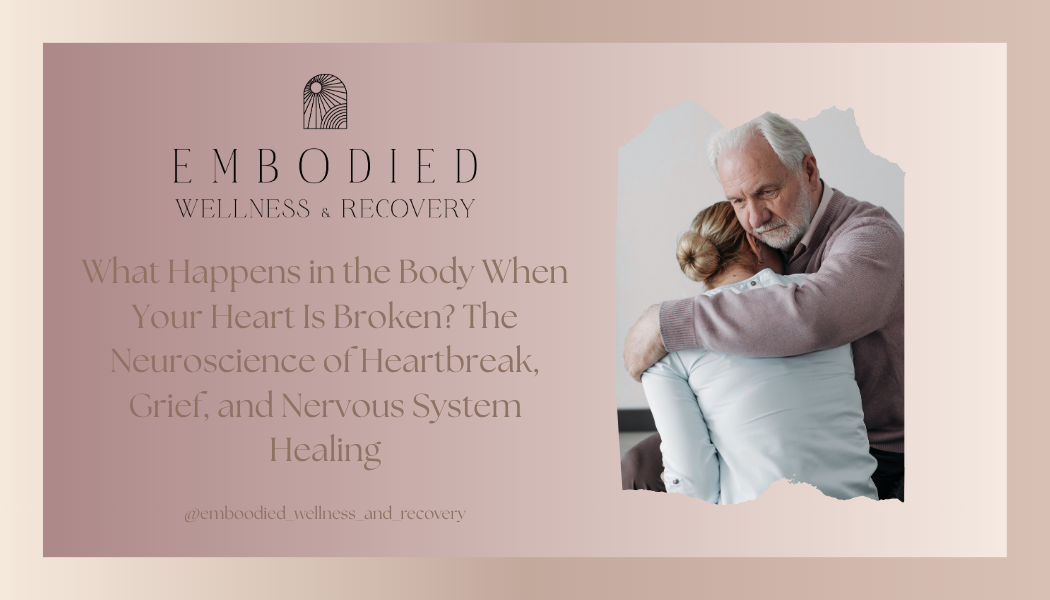
What Happens in the Body When Your Heart Is Broken? The Neuroscience of Heartbreak, Grief, and Nervous System Healing
What Happens in the Body When Your Heart Is Broken? The Neuroscience of Heartbreak, Grief, and Nervous System Healing
Why does heartbreak hurt so much? Discover what happens in the brain and body after a breakup or betrayal, how attachment and the nervous system contribute to emotional pain, and evidence-based ways to support recovery and reconnect with yourself.
A relationship ends. A partner leaves. An affair is discovered. A dream about your future disappears overnight. Suddenly, your chest aches, your stomach tightens, your appetite vanishes, your sleep is disrupted, and your mind replays memories you wish you could forget.
You may wonder:
Why does this hurt so much?
Why can't I stop thinking about them?
Why does my body feel like it's in survival mode?
Will this pain ever ease?
If you have experienced heartbreak, the intensity of your suffering is not simply "all in your head." Modern neuroscience shows that profound relational loss affects the brain, nervous system, hormones, and even physical health. Heartbreak is an emotional experience, but it is also a physiological one.
Why Heartbreak Feels Physical
People often describe heartbreak with physical language:
"My chest hurts."
"I feel sick."
"I can't catch my breath."
"I feel like someone punched me in the stomach."
Interestingly, brain imaging research suggests that social rejection and emotional pain activate many of the same neural networks involved in processing physical pain. From an evolutionary perspective, this makes sense. Human survival has long depended on secure attachment and social connection. Losing an important relationship can therefore activate powerful alarm systems designed to protect us from separation.
Your Nervous System Goes Into Survival Mode
When an attachment bond is threatened or broken, the autonomic nervous system often responds as though danger is present.
You may notice:
— A racing heart
— Muscle tension
— Digestive changes
— Sleep disturbance
— Emotional numbness
— Panic or anxiety
— Fatigue
— Tearfulness
For some individuals, heartbreak creates cycles of sympathetic activation, commonly known as fight or flight, while others experience shutdown, emotional collapse, or profound exhaustion. Neither response is a sign of weakness. They are adaptive physiological responses to perceived loss and threat.
The Brain Misses More Than the Person
When relationships are healthy, they become integrated into our daily routines and emotional regulation systems. A partner may help regulate stress through touch, shared rituals, humor, reassurance, or simple presence. When that relationship ends, the brain is not only grieving the individual. It is grieving the loss of co-regulation. This helps explain why even routine moments such as waking up, driving home, or eating dinner alone can trigger intense waves of sadness.
Attachment Shapes the Intensity of Heartbreak
People with histories of inconsistent caregiving, abandonment, or emotional neglect may experience heartbreak differently than those with secure attachment histories. Old wounds can become intertwined with present loss.
A breakup may unconsciously reactivate beliefs such as:
"People always leave."
"I will never be chosen."
The nervous system responds not only to today's separation but also to unresolved experiences from the past.
Why You Cannot Stop Thinking About Them
Many people feel frustrated by persistent rumination after a breakup. But attachment bonds are deeply encoded within the brain. Your mind repeatedly revisits memories in an attempt to understand what happened, predict future outcomes, or restore a sense of connection. Unfortunately, repeated mental replay often intensifies emotional distress rather than resolving it.
Stress Hormones Can Flood the Body
Heartbreak is frequently associated with elevated stress hormones, including cortisol.
Chronic activation may contribute to:
— Sleep disruption
— Reduced appetite or emotional eating
— Weakened concentration
— Immune changes
— Fatigue
— Increased anxiety
Some individuals even experience symptoms that resemble depression or panic disorders during acute relational loss.
Broken Heart Syndrome Is Real
In rare cases, severe emotional stress can trigger a condition known as stress cardiomyopathy, or Takotsubo syndrome, sometimes referred to as "broken heart syndrome." Although often temporary, this condition demonstrates the remarkable connection between emotional experiences and cardiovascular function. The phrase "heartbroken" is more than poetic language. The body genuinely responds to profound emotional pain.
Why Trauma Can Make Heartbreak Feel Unbearable
For individuals with unresolved trauma, heartbreak often activates survival responses that extend beyond the current relationship. The end of one attachment may awaken years of grief, rejection, betrayal, or unmet childhood needs.
Without recognizing these deeper layers, people often conclude:
"I shouldn't still feel this way."
In reality, the nervous system may be processing multiple losses simultaneously.
Healing Requires More Than Time
People often say, "Time heals all wounds."
Time helps. But intentional experiences matter too. The nervous system benefits from repeated moments of safety, connection, movement, nourishment, and emotional processing. Simply waiting while remaining isolated may prolong suffering.
What Actually Helps the Brain and Body Recover?
Research and clinical experience suggest several supportive practices:
— Maintaining daily routines
— Spending time with emotionally safe people
— Physical movement
— Adequate sleep
— Self-compassion
— Limiting obsessive monitoring of an ex-partner
— Gradual engagement in meaningful activities
For individuals with trauma histories, therapies that address both cognitive and physiological processes may be especially beneficial.
Bottom-Up Healing After Heartbreak
Heartbreak is not stored solely as a story. It is also experienced through bodily sensations, autonomic activation, and implicit memory. Somatic therapy and Eye Movement Desensitization and Reprocessing (EMDR) can help individuals process painful relational experiences while supporting nervous system regulation and reducing persistent emotional activation. As the body begins to experience safety again, intrusive thoughts often decrease, and emotional flexibility increases.
The Meaning You Create Matters
Heartbreak often invites painful conclusions:
"I wasn't lovable."
"I'll never trust again."
"I wasted years."
Yet these interpretations are not inevitable. With support and reflection, many individuals discover that grief can coexist with growth, wisdom, stronger boundaries, and deeper self-understanding.
How Embodied Wellness and Recovery Can Help
At Embodied Wellness and Recovery, we understand that heartbreak is not simply an emotional event. It is an experience that can reverberate through the brain, nervous system, attachment system, and body.
Our clinicians integrate somatic therapy, EMDR, neuroscience-informed psychotherapy, and attachment-focused treatment to help individuals process grief, betrayal, relationship loss, and trauma while rebuilding emotional resilience and restoring a sense of internal safety. We also specialize in sexuality, intimacy, and complex relationship dynamics, recognizing that meaningful recovery involves both the mind and the body.
The opposite of heartbreak is not forgetting. It is gradually reaching a place where memories no longer overwhelm your nervous system and where connection with yourself becomes as meaningful as connection with another person.
Reach out to schedule a complimentary 20-minute consultation with our team of therapists, trauma specialists, somatic practitioners, or relationship experts, and start working towards integrative, embodied healing today.
📞 Call us at (310) 651-8458
📱 Text us at (310) 210-7934
📩 Email us at admin@embodiedwellnessandrecovery.com
🔗 Visit us at www.embodiedwellnessandrecovery.com
👉 Check us out on Instagram @embodied_wellness_and_recovery
🌍 Explore our offerings at Linktr.ee: https://linktr.ee/laurendummit
References
Eisenberger, N. I. (2012). The pain of social disconnection: Examining the shared neural underpinnings of physical and social pain. Nature Reviews Neuroscience, 13(6), 421-434.
O'Connor, M. F. (2019). The grieving brain: The surprising science of how we learn from love and loss. HarperOne.
Porges, S. W. (2011). The polyvagal theory: Neurophysiological foundations of emotions, attachment, communication, and self-regulation. W. W. Norton & Company.
van der Kolk, B. A. (2014). The body keeps the score: Brain, mind, and body in the healing of trauma. Viking.
Wittstein, I. S. (2012). Stress cardiomyopathy: A syndrome of catecholamine-mediated myocardial stunning? Cellular and Molecular Neurobiology, 32(5), 847-857.
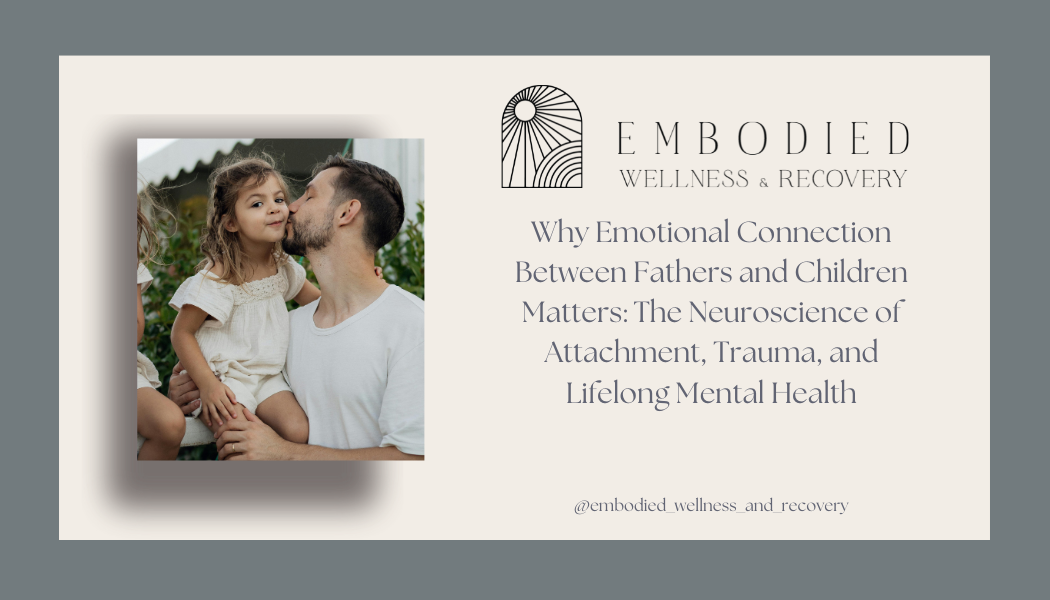
Why Emotional Connection Between Fathers and Children Matters: The Neuroscience of Attachment, Trauma, and Lifelong Mental Health
Why Emotional Connection Between Fathers and Children Matters: The Neuroscience of Attachment, Trauma, and Lifelong Mental Health
How does a father's emotional connection shape a child's brain and relationships? Discover the neuroscience of father-child attachment, the effects of emotional distance, and how healing is possible at any stage of life through secure relationships and nervous system regulation.
A father can provide for his family financially, attend every sporting event, and make sure the bills are paid, yet his child may still grow up feeling emotionally unseen. Conversely, a father who is consistently curious, emotionally available, and engaged can profoundly shape a child's sense of safety, self-worth, and resilience.
If you grew up with an emotionally distant father, you may find yourself asking:
— Why do I struggle to trust people?
— Why do I constantly seek approval or validation?
— Why do I feel uncomfortable expressing emotions?
— Why do I crave closeness but fear rejection?
— Why do I choose emotionally unavailable partners?
— Why do I still long for something I never received?
These questions are not signs of weakness. They often reflect the enduring influence of early attachment experiences and the ways our nervous systems adapt to relational environments.
Fathers Shape More Than Childhood Memories
Historically, research focused heavily on mothers and early attachment. Today, developmental science demonstrates that fathers play a unique and significant role in children's emotional, cognitive, and social development. Children do not simply benefit from a father's physical presence.
They benefit from emotional presence. Feeling seen, comforted, encouraged, and accepted by a father can become part of the internal blueprint that guides future relationships.
Emotional Connection Helps Build the Developing Brain
Secure relationships help organize the developing nervous system.
When children experience responsive caregiving, their brains repeatedly learn:
— My emotions matter.
— Someone will help me when I am distressed.
— Relationships are safe.
— I can depend on others.
— I am worthy of care.
These repeated experiences strengthen emotional regulation, stress tolerance, and secure attachment. Over time, children internalize these interactions and begin regulating themselves more effectively.
When Emotional Distance Becomes the Norm
Some fathers deeply love their children but struggle to express affection due to their own upbringing, cultural expectations, trauma histories, depression, anxiety, or emotional suppression. Children rarely interpret this complexity accurately.
Instead, they may conclude:
— I'm too much.
— My feelings don't matter.
— I have to earn love.
— I shouldn't need anyone.
— Vulnerability is dangerous.
These beliefs often persist into adulthood unless intentionally examined.
The Nervous System Learns Relationships Through Experience
From a neuroscience perspective, attachment experiences influence how the brain predicts safety and connection. An emotionally attuned father can help regulate a child's stress response by providing reassurance, warmth, and consistency. When emotional attunement is missing, the child may become chronically vigilant, emotionally withdrawn, or excessively independent. These adaptations often make perfect sense in the context of early experiences.
Emotional Availability Is More Important Than Perfection
Children do not require flawless parents. They benefit from caregivers who notice their emotions, repair misunderstandings, and communicate genuine interest in their inner worlds.
Simple interactions matter:
— Listening without immediately solving.
— Validating disappointment.
— Offering physical affection when welcomed.
— Admitting mistakes.
— Returning after conflict to reconnect.
These moments teach children that relationships can survive imperfection.
How Father Wounds Can Influence Adult Relationships
Adults who lacked emotional connection with a father sometimes notice recurring patterns such as:
— Fear of abandonment
— Attraction to emotionally unavailable partners
— Difficulty setting boundaries
— Avoidance of vulnerability
— Excessive self-reliance
— Anxiety in close relationships
These patterns are not destiny. They often represent adaptive strategies learned early in life.
Sons and Daughters Are Both Affected
While experiences vary across families, emotionally engaged fathers contribute positively to children of all genders. Research has linked paternal warmth and involvement with improved emotional regulation, stronger self-esteem, better academic functioning, and healthier interpersonal relationships. The essential ingredient is not gender. It is connection.
Fathers Teach Emotional Literacy
Many adults grew up hearing messages like:
"Be tough."
"Stop crying."
"Get over it."
Although often well-intentioned, these messages can disconnect children from their emotional experiences. When fathers instead model emotional awareness, accountability, and empathy, children learn that strength includes the capacity to identify and express feelings.
Trauma Can Be Intergenerational
Emotionally distant fathers are not necessarily uncaring fathers. Some grew up in environments where emotional expression was discouraged or unsafe. Others experienced trauma that limited their own capacity for connection. Understanding these histories does not excuse harmful behavior, but it can create space for compassion and interrupt intergenerational patterns.
Can Adults Heal From Father Wounds?
Absolutely. The brain remains capable of change throughout life. Corrective emotional experiences in therapy, healthy friendships, romantic relationships, mentorships, and parenting can reshape expectations about safety and attachment. Healing often involves recognizing that the unmet needs of childhood deserve acknowledgment rather than dismissal. It also involves learning that emotional closeness can feel unfamiliar without being dangerous.
What Fathers Can Do Today
If you are a father, your greatest influence may not come from providing answers. It may come from providing presence. Ask questions. Stay curious. Repair after conflict. Make eye contact. Listen without immediately fixing. Tell your child you are proud of them for who they are, not only for what they accomplish. Small moments of emotional attunement accumulate into lifelong memories.
How Embodied Wellness and Recovery Can Help
At Embodied Wellness and Recovery, we understand that early relationships with caregivers. including fathers, shape the nervous system, attachment patterns, self-concept, and future intimacy. Experiences of emotional neglect or disconnection can influence mental health, relationships, sexuality, and the ability to feel safe with others long into adulthood.
Our clinicians integrate somatic therapy, EMDR, attachment-focused psychotherapy, and neuroscience-informed care to help individuals process relational wounds, strengthen emotional regulation, and cultivate healthier patterns of connection. We specialize in trauma, nervous system repair, relationships, sexuality, and intimacy, supporting clients in creating new experiences of trust and belonging that extend beyond their earliest family dynamics.
The presence of an emotionally connected father does not guarantee a perfect life. But the experience of feeling seen, soothed, valued, and understood can become a powerful foundation for resilience, secure attachment, and meaningful relationships throughout the lifespan.
Reach out to schedule a complimentary 20-minute consultation with our team of therapists, trauma specialists, somatic practitioners, or relationship experts, and start working towards integrative, embodied healing today.
📞 Call us at (310) 651-8458
📱 Text us at (310) 210-7934
📩 Email us at admin@embodiedwellnessandrecovery.com
🔗 Visit us at www.embodiedwellnessandrecovery.com
👉 Check us out on Instagram @embodied_wellness_and_recovery
🌍 Explore our offerings at Linktr.ee: https://linktr.ee/laurendummit
References
Grossmann, K., Grossmann, K. E., Kindler, H., & Zimmermann, P. (2008). A wider view of attachment and exploration: Stability and change during the years of immaturity. In J. Cassidy & P. R. Shaver (Eds.), Handbook of attachment: Theory, research, and clinical applications (2nd ed., pp. 857-879). Guilford Press.
Lamb, M. E. (2010). The role of the father in child development (5th ed.). Wiley.
Porges, S. W. (2011). The polyvagal theory: Neurophysiological foundations of emotions, attachment, communication, and self-regulation. W. W. Norton & Company.
Siegel, D. J., & Bryson, T. P. (2020). The power of showing up: How parental presence shapes who our kids become and how their brains get wired. Ballantine Books.
Sroufe, L. A. (2005). Attachment and development: A prospective, longitudinal study from birth to adulthood. Attachment & Human Development, 7(4), 349-367.
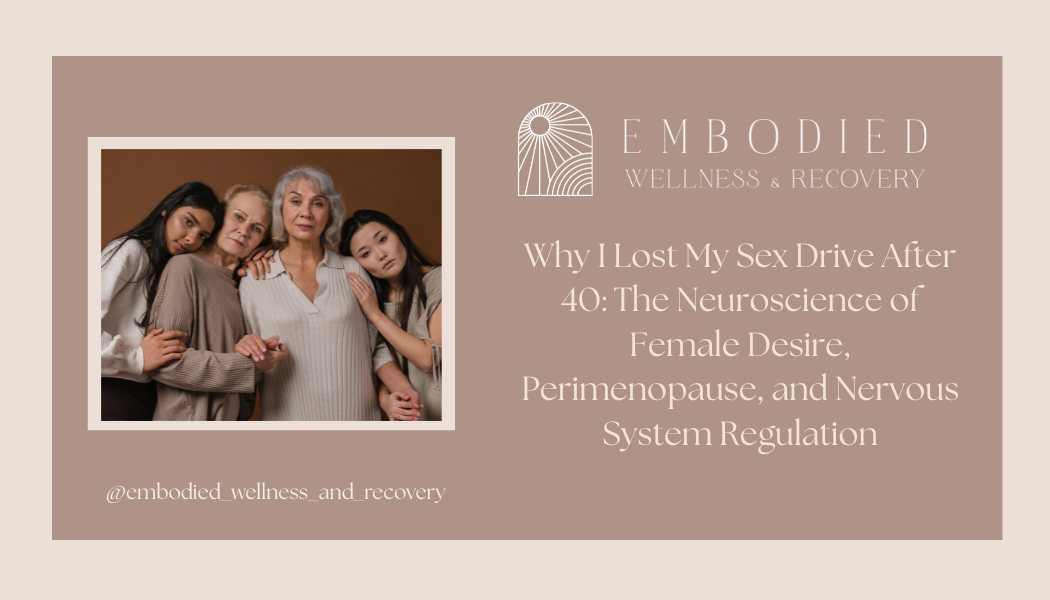
Why I Lost My Sex Drive After 40: The Neuroscience of Female Desire, Perimenopause, and Nervous System Regulation
Why I Lost My Sex Drive After 40: The Neuroscience of Female Desire, Perimenopause, and Nervous System Regulation
Has your sex drive changed after 40? Learn how perimenopause, hormones, stress, trauma, and nervous system dysregulation influence female libido and discover neuroscience-informed strategies to reconnect with desire and intimacy.
You love your partner. You still value intimacy. But somewhere along the way, your desire for sex seems to have faded. Maybe you used to initiate. Now you rarely think about it. Maybe your body feels different. Intercourse is less comfortable, your mind is distracted, and exhaustion seems to overshadow any spark of desire.
Or perhaps you're asking yourself questions you never expected to ask:
Why don't I want sex anymore?
Is something wrong with me?
Is this just aging?
Will I ever feel like myself again?
For many women over 40, these concerns emerge during perimenopause and menopause, often accompanied by guilt, shame, confusion, or fear that their relationship is suffering. The good news is that female sexual desire is remarkably complex and deeply influenced by hormones, stress, relationships, trauma history, sleep, physical health, and the nervous system. Understanding those interactions is often the first step toward reconnecting with your sexuality.
Female Desire Is More Than Hormones
While estrogen, progesterone, and testosterone all influence libido, they tell only part of the story. Sexual desire emerges from a dynamic conversation between the brain and body. It reflects emotional safety, physical comfort, relationship quality, novelty, body image, stress levels, and previous experiences. Desire is not simply a switch that turns on or off. It is a system that responds to context.
Why Perimenopause Can Affect Libido
Perimenopause often begins years before menopause and is characterized by fluctuating hormone levels rather than a steady decline.
These changes may contribute to:
— Reduced spontaneous desire
— Vaginal dryness or discomfort
— Sleep disruption
— Mood changes
— Hot flashes
— Brain fog
— Fatigue
— Changes in arousal and orgasm
When intimacy becomes physically uncomfortable or emotional resources are depleted, desire may naturally decrease. This is not a personal failure. It is often a physiological adaptation.
The Brain Plays a Central Role in Sexual Desire
The same brain that supports pleasure must also monitor safety. If your nervous system is overwhelmed by stress, caregiving demands, chronic anxiety, trauma, or burnout, resources may shift away from erotic engagement and toward survival priorities. From a neuroscience perspective, the body tends to prioritize protection before pleasure.
When your brain perceives ongoing stress, desire may become quieter, not because sexuality disappears, but because the system is allocating energy elsewhere.
Stress Is One of the Most Powerful Libido Suppressors
Many women in their 40s and 50s find themselves balancing careers, parenting, aging parents, financial concerns, household management, and relationship responsibilities. This constant cognitive load can leave little capacity for erotic curiosity. You cannot always scheduledesire into an already overwhelmed nervous system. Mental load, chronic sympathetic activation, and emotional exhaustion can all play a role.
Trauma Can Influence Sexuality for Decades
Past experiences of sexual trauma, emotional neglect, relational betrayal, or chronic criticismmay continue shaping intimacy long after the original events occurred. For some women, perimenopause coincides with life transitions that reactivate unresolved attachment wounds or increase awareness of unmet emotional needs. The body remembers experiences stored in implicit memory. As a result, sexual difficulties may reflect nervous system protection rather than a lack of attraction or love.
Responsive Desire Is Normal
Many women mistakenly believe desire should appear spontaneously. However, research on female sexuality suggests that desire often emerges responsively rather than automatically. In other words, interest in intimacy may grow after emotional closeness, affectionate touch, relaxation, or positive sexual experiences have already begun. Waiting to "feel in the mood" before engaging in connection may unintentionally reduce opportunities for desire to awaken. This distinction can reduce shame and create more flexible expectations.
Body Image Matters More Than Many Realize
Hormonal changes often coincide with weight redistribution, skin changes, altered muscle tone, or shifts in confidence. Negative body image can interfere with attention, arousal, and enjoyment by increasing self-monitoring during intimacy. Instead of experiencing sensation, many women become preoccupied with evaluation. Pleasure requires presence. Shame interrupts presence.
Relationship Dynamics Shape Desire
Sexuality does not exist in isolation. Unresolved conflict, resentment, emotional disconnection, lack of appreciation, unequal household labor, or chronic criticism can significantly influence libido.
Many couples mistakenly interpret low desire as rejection when the underlying issue involves emotional safety or relational stress. Desire frequently flourishes in environments where partners feel respected, emotionally connected, and free from performance pressure.
The Nervous System and Pleasure
The autonomic nervous system plays a critical role in sexual functioning. When the body perceives safety, parasympathetic activation supports relaxation, arousal, and receptivity. When the body perceives threat, sympathetic activation redirects resources toward vigilance and protection. This is one reason many women report that they intellectually want intimacy but physically cannot access desire. The body has shifted into survival rather than connection.
Practical Ways to Reconnect With Desire
Rather than asking, "How do I force myself to want sex again?" consider asking:
— Am I chronically stressed?
— Am I sleeping enough?
— Do I feel emotionally connected to my partner?
— Am I carrying unresolved trauma?
— Have hormonal changes affected my body?
— Do I feel safe and relaxed during intimacy?
— Have I been expecting spontaneous desire when my body experiences responsive desire?
Addressing these questions often creates more meaningful change than simply focusing on libido itself.
A Whole Person Approach to Sexual Wellness
For many women, reclaiming sexuality after 40 involves a combination of:
— Medical evaluation for hormonal changes
— Open communication with a partner
— Addressing pain or physical discomfort
— Stress reduction
— Improved sleep
— Trauma-informed psychotherapy
— EMDR
— Mindfulness and body awareness
— Self-compassion and realistic expectations
The goal is not to return to a younger version of yourself. It is to cultivate a sexual relationship that fits the person you are today.
How Embodied Wellness and Recovery Can Help
At Embodied Wellness and Recovery, we recognize that changes in libido are rarely explained by hormones alone. Female sexuality reflects an intricate interplay among neuroscience, attachment, trauma history, relationship dynamics, stress physiology, and nervous system regulation.
Our clinicians integrate somatic therapy, EMDR, neuroscience-informed psychotherapy, and specialized sex therapy to help women explore the emotional and physiological factors influencing desire while strengthening intimacy, embodiment, and relational connection. We also specialize in trauma recovery, nervous system repair, relationships, and sexuality, offering compassionate, evidence-based care tailored to the whole person.
Diminished desire is often less about losing your sexuality and more about understanding the conditions your mind and body need in order to access it. Sometimes the most profound shift occurs when you stop asking why your body changed and begin listening to what it has been trying to communicate all along.
Reach out to schedule a complimentary 20-minute consultation with our team of therapists, trauma specialists, somatic practitioners, or relationship experts, and start working towards integrative, embodied healing today.
📞 Call us at (310) 651-8458
📱 Text us at (310) 210-7934
📩 Email us at admin@embodiedwellnessandrecovery.com
🔗 Visit us at www.embodiedwellnessandrecovery.com
👉 Check us out on Instagram @embodied_wellness_and_recovery
🌍 Explore our offerings at Linktr.ee:https://linktr.ee/laurendummit
1) Ainsworth, M. D. S., Blehar, M. C., Waters, E., & Wall, S. (1978). Patterns of attachment: A psychological study of the strange situation. Lawrence Erlbaum Associates.
2) Johnson, S. M. (2019). Attachment theory in practice: Emotionally focused therapy (EFT) with individuals, couples, and families. Guilford Press.
3) Porges, S. W. (2011). The polyvagal theory: Neurophysiological foundations of emotions, attachment, communication, and self-regulation. W. W. Norton & Company.
4) Schore, A. N. (2012). The science of the art of psychotherapy. W. W. Norton & Company.
5) van der Kolk, B. A. (2014). The body keeps the score: Brain, mind, and body in the healing of trauma. Viking.
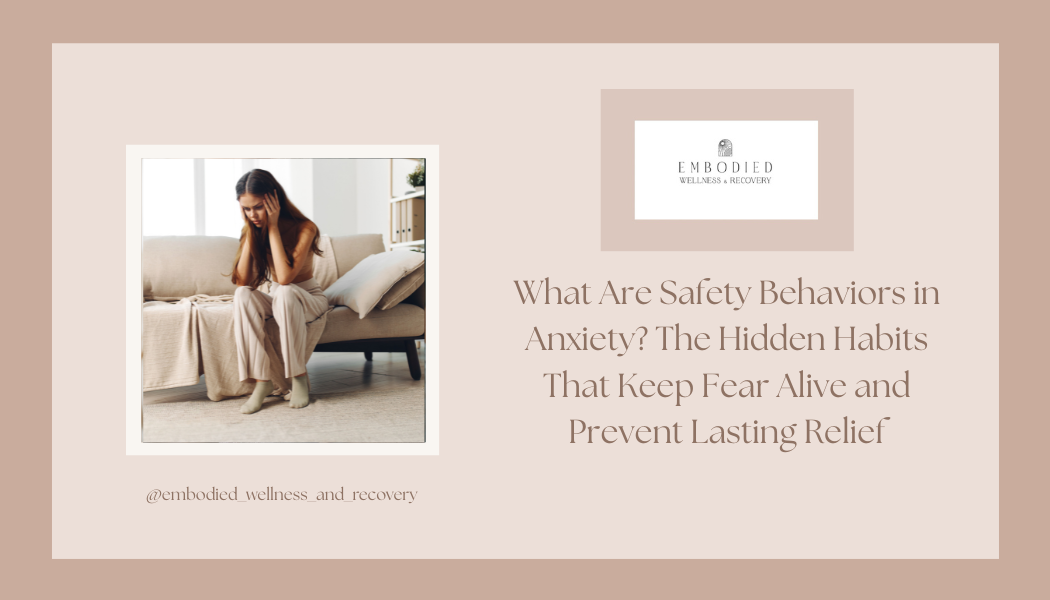
What Are Safety Behaviors in Anxiety? The Hidden Habits That Keep Fear Alive and Prevent Lasting Relief
What Are Safety Behaviors in Anxiety? The Hidden Habits That Keep Fear Alive and Prevent Lasting Relief
Do you constantly seek reassurance, avoid uncertainty, or rely on rituals to feel safe? Learn how safety behaviors maintain anxiety, affect the nervous system, and discover neuroscience-informed approaches to build lasting confidence and resilience.
You check that the front door is locked. Then you check again. You rehearse every conversation before it happens. You always sit near the exit. You carry medication "just in case." You text a loved one for reassurance before making a decision. You avoid driving on the freeway, speaking up in meetings, or attending crowded events because it simply feels safer not to.
If these behaviors sound familiar, you are not weak or irrational. You may be relying on what psychologists call safety behaviors: strategies designed to reduce anxiety or prevent feared outcomes. While these habits often provide temporary relief, they can unintentionally reinforce fear and keep anxiety disorders alive.
Do You Feel Like You're Constantly Trying to Stay Safe?
Have you ever wondered:
— Why do I need constant reassurance?
— Why can't I stop checking, planning, or preparing?
— Why does avoiding stressful situations make me feel better in the moment but worse in the long run?
— Why does my body never seem to believe that I'm actually safe?
— Why do I know logically that I'm okay but still feel anxious?
These questions reflect a common struggle among people living with anxiety, panic, trauma, obsessive compulsive symptoms, and chronic stress. The answer often lies in understanding how the brain learns safety and threat.
What Are Safety Behaviors?
Safety behaviors are actions intended to reduce perceived danger or prevent feared consequences.
Examples include:
— Repeatedly seeking reassurance
— Checking locks, appliances, or health symptoms
— Avoiding certain places or situations
— Constantly carrying "just in case" items
— Overpreparing for conversations or presentations
— Sitting near exits
— Monitoring bodily sensations
— Excessively researching medical concerns
— Needing another person nearby to feel comfortable
— Avoiding emotional vulnerability
In the short term, these behaviors decrease anxiety. In the long term, they often strengthen it.
Why the Brain Keeps Using Them
The brain is designed to repeat behaviors that appear to increase survival. Imagine someone experiences panic while driving over a bridge. The next time they avoid the bridge, their anxiety immediately decreases.
The brain concludes:
"Avoiding the bridge kept me safe."
The relief becomes reinforcing. Soon, more bridges are avoided. Then highways. Then driving altogether. This process, known as negative reinforcement, teaches the nervous system that avoidance rather than capability prevents disaster.
The Neuroscience of Feeling Unsafe
Anxiety is deeply connected to the brain's threat detection systems. The amygdala rapidly evaluates potential danger and activates physiological responses such as increased heart rate, muscle tension, and hypervigilance. When repeated safety behaviors prevent corrective experiences, the brain never receives evidence that feared situations can be tolerated successfully. The nervous system remains stuck in prediction mode, continually expecting catastrophe.
The Body Wants Certainty
One of anxiety's defining characteristics is intolerance of uncertainty. Safety behaviors often function as attempts to create predictability. You might repeatedly review an email before sending it. Call your partner multiple times to ensure they arrived safely. Research every possible outcome before making a decision. Unfortunately, certainty is impossible. The more you chase it, the more elusive it becomes.
Trauma and Safety Behaviors
For individuals with trauma histories, safety behaviors often make perfect sense. If your environment was once unpredictable, dangerous, or emotionally invalidating, your nervous system adapted by becoming highly vigilant. Checking, preparing, scanning, and avoiding were not irrational. They were adaptive. The challenge arises when these same strategies persist long after circumstances have changed. The body continues responding to past threats rather than present reality.
Common Safety Behaviors You Might Not Recognize
Many behaviors appear responsible or conscientious but may actually be anxiety-driven.
Examples include:
— Excessive apologizing
— Constant list making
— Avoiding disagreement
— Needing immediate text replies
— Repeatedly asking others if everything is okay
— Delaying decisions until absolute certainty exists
The key question is not whether the behavior is useful. It is whether you believe you cannot cope without it.
Why Safety Behaviors Feel So Effective
Safety behaviors work. At least temporarily. Your anxiety decreases. You feel calmer. The problem is that your brain credits the behavior rather than your own resilience.
Instead of learning:
"I handled that."
It learns:
"I survived because I checked five times."
This distinction matters enormously. One builds confidence. The other builds dependence.
The Cost of Constant Protection
Over time, excessive safety behaviors can shrink your world. You may begin avoiding travel, relationships, career opportunities, public speaking, intimacy, or new experiences. Anxiety starts making decisions on your behalf. The nervous system becomes increasingly convinced that life is dangerous and that constant vigilance is required. Ironically, the pursuit of safety often produces chronic fear.
What Actually Helps?
Research consistently supports treatments that help individuals gradually experience feared situations while reducing reliance on safety behaviors (Helbig-Lang & Petermann, 2010). This allows the brain to update its predictions and learn that discomfort is tolerable and catastrophe is far less likely than expected. At the same time, many individuals benefit from approaches that address the body's physiological responses to fear.
Bottom-Up Healing and Nervous System Regulation
For people with trauma or chronic anxiety, lasting change often requires more than intellectual insight.
Somatic therapy, Eye Movement Desensitization and Reprocessing (EMDR), mindfulness practices, and other body-based interventions help regulate autonomic arousal while increasing tolerance for uncertainty and internal sensations. As the nervous system becomes more regulated, many safety behaviors naturally lose their grip.
The body begins to trust what the mind has long understood:
"I can handle this."
Safety Comes From Within
Perhaps the greatest misconception about anxiety is that safety comes from eliminating every possible risk. In reality, emotional resilience develops by learning that uncertainty can be tolerated and that difficult emotions can be survived. True confidence does not come from controlling every outcome. It comes from trusting your capacity to respond when life is unpredictable.
How Embodied Wellness and Recovery Can Help
At Embodied Wellness and Recovery, we recognize that anxiety and safety behaviors are often rooted in trauma, attachment experiences, nervous system dysregulation, and deeply learned survival strategies rather than personal weakness.
Our clinicians integrate somatic therapy, EMDR, neuroscience-informed psychotherapy, attachment-focused interventions, and evidence-based treatment to help clients understand the origins of their anxiety while cultivating greater flexibility, emotional regulation, and self-trust. We also specialize in relationships, sexuality, intimacy, and trauma recovery, helping individuals reconnect with a sense of safety that arises from within rather than from rituals or avoidance.
The goal is not to eliminate uncertainty from life. It is to help your brain and body discover that you are capable of navigating uncertainty with resilience, wisdom, and courage. Lasting safety is not found in checking one more time. It is found in learning that you can trust yourself, even when the future cannot be guaranteed.
Reach out to schedule a complimentary 20-minute consultation with our team of therapists, trauma specialists, somatic practitioners, or relationship experts, and start working towards integrative, embodied healing today.
📞 Call us at (310) 651-8458
📱 Text us at (310) 210-7934
📩 Email us at admin@embodiedwellnessandrecovery.com
🔗 Visit us at www.embodiedwellnessandrecovery.com
👉 Check us out on Instagram @embodied_wellness_and_recovery
🌍 Explore our offerings at Linktr.ee: https://linktr.ee/laurendummit
References
1) Craske, M. G., Treanor, M., Conway, C. C., Zbozinek, T., & Vervliet, B. (2014). Maximizing exposure therapy: An inhibitory learning approach. Behaviour Research and Therapy, 58, 10-23.
2) Helbig-Lang, S., & Petermann, F. (2010). Tolerate or eliminate? A systematic review on the effects of safety behavior across anxiety disorders. Clinical Psychology: Science and Practice, 17(3), 218.
3) Porges, S. W. (2011). The polyvagal theory: Neurophysiological foundations of emotions, attachment, communication, and self-regulation. W. W. Norton & Company.
4) Salkovskis, P. M. (1991). The importance of behaviour in the maintenance of anxiety and panic: A cognitive account. Behavioural Psychotherapy, 19(1), 6-19.
5) van der Kolk, B. A. (2014). The body keeps the score: Brain, mind, and body in the healing of trauma. Viking.
Why Some Parents Struggle to Let Their Kids Fail: The Neuroscience of Parenting Anxiety, Overprotection, and Raising Resilient Children
Why Some Parents Struggle to Let Their Kids Fail: The Neuroscience of Parenting Anxiety, Overprotection, and Raising Resilient Children
Why is it so hard to let your child fail? Learn how parenting anxiety, trauma, attachment, and nervous system responses can lead to overprotection and discover how allowing age-appropriate failure fosters resilience, confidence, and emotional growth.
Your child forgot their homework. Your teenager bombed a test. Your college student made a costly mistake. And somehow, your heart feels as though it is happening to you.
You replay every decision. You wonder whether you should have stepped in sooner. You feel an overwhelming urge to fix the problem, call the teacher, solve the conflict, or protect your child from disappointment. If this sounds familiar, you are far from unusual.
Many loving parents struggle to tolerate their children's failures, not because they are controlling or permissive, but because their own nervous systems experience their child's distress as a threat.
Do You Feel Responsible for Preventing Every Mistake?
Have you ever found yourself asking:
— "What if this failure ruins their future?"
— "Should I intervene before they get hurt?"
— "Am I being a bad parent if I let this happen?"
— "What if they lose confidence?"
— "What if they resent me for not helping?"
If so, your anxiety may be rooted in something deeper than parenting philosophy. It may reflect attachment, past experiences, and the way your brain and body have learned to respond to uncertainty.
Why Failure Feels So Threatening to Parents
Parents are biologically wired to protect their children. The attachment system motivates caregivers to respond quickly when a child is in distress, increasing the likelihood of safety and survival. But modern parenting often presents emotional rather than physical threats, such as a disappointing grade, a friendship conflict, a sports loss, a college rejection.
For some parents, these experiences activate the same physiological alarm systems that once evolved to respond to genuine danger. The result is an intense urge to rescue.
The Neuroscience of Parenting Anxiety
The brain is constantly scanning for potential threats. When parents perceive their child is struggling, regions involved in emotional processing and threat detection may become highly activated, prompting a cascade of stress hormones and sympathetic nervous system arousal.
This can create a powerful internal message:
"Do something now."
The challenge is that not every uncomfortable experience is harmful. In many cases, it is precisely these experiences that foster resilience, adaptability, and self-confidence.
Trauma Can Make Letting Go Feel Impossible
Parents with unresolved trauma or chronic anxiety may find it especially difficult to tolerate uncertainty. Perhaps you grew up in chaos. Perhaps mistakes were punished harshly. Perhaps no one protected you when you needed support. In response, your nervous system may have learned that constant vigilance is necessary to prevent catastrophe.
Without realizing it, you may begin trying to create safety by controlling every variable in your child's life. Ironically, this often increases anxiety for both parent and child.
The Difference Between Protection and Overprotection
Healthy parenting provides guidance, structure, and emotional support while allowing children to develop competence through experience. Overprotection occurs when adults repeatedly remove age-appropriate challenges or consequences in an attempt to reduce discomfort.
Examples include:
— Completing school projects for a child.
— Frequently intervening in peer conflicts.
— Preventing natural consequences.
— Solving problems before a child attempts to.
— Avoiding situations where failure is possible.
Although well intentioned, these behaviors may unintentionally communicate:
"I don't believe you can handle this."
Why Children Need Opportunities to Fail
Research in developmental psychology consistently suggests that resilience develops not from avoiding adversity but from successfully navigating manageable challenges with appropriate support.
Failure teaches children to:
— Solve problems independently.
— Tolerate frustration.
— Build persistence.
— Develop emotional regulation.
— Increase self-efficacy.
— Learn flexibility.
— Recover from setbacks.
Confidence is not created by never struggling. It is created by discovering, "I struggled and found my way through."
The Hidden Message of Constant Rescue
When parents consistently remove obstacles, children may internalize beliefs such as:
— "I can't do hard things."
— "Someone else has to fix my problems."
— "Mistakes are dangerous."
— "Failure means I'm inadequate."
Over time, these beliefs can contribute to perfectionism, anxiety, avoidance, and diminished self-confidence.
Your Child's Nervous System Is Learning From Yours
Children are remarkably sensitive to their caregivers' emotional states. When a parent responds to setbacks with panic, catastrophizing, or intense distress, children may absorb the message that ordinary failures are emergencies.
Conversely, when parents remain regulated and communicate calm confidence, children learn that disappointment is survivable. In this way, resilience is often co-regulated before it is self-regulated.
What Letting Them Fail Actually Looks Like
Allowing failure does not mean withholding support. It means offering support without removing every obstacle.
For example, instead of fixing the forgotten homework assignment, help your child reflect on how to remember it next time. Instead of calling the coach after your teenager loses playing time, encourage them to discuss it respectfully themselves. Instead of preventing disappointment, help them process disappointment. The goal is not to eliminate struggle. It is to increase capability.
The Parent's Work Is Often Internal
Many parents discover that their greatest challenge is not managing their child's emotions but regulating their own.
Ask yourself:
— Is this situation truly dangerous, or is it merely uncomfortable?
— Am I responding to my child's needs or to my own anxiety?
— What belief gets activated when my child struggles?
— What would happen if I trusted them to work through this?
These questions invite reflection rather than reactivity.
How Nervous System Regulation Changes Parenting
When parents cultivate greater emotional regulation, remarkable shifts often occur. They pause before intervening. They tolerate uncertainty. They communicate confidence rather than fear. They become a secure base from which children can explore, fail, recover, and grow. Rather than rescuing every time their child falls, they remain close enough to offer encouragement while allowing the child to stand back up.
How Embodied Wellness and Recovery Can Help
At Embodied Wellness and Recovery, we recognize that parenting anxiety often extends beyond concerns about a child's behavior. It may reflect unresolved trauma, attachment patterns, perfectionism, or a nervous system conditioned to anticipate danger.
Our clinicians integrate somatic therapy, EMDR, neuroscience-informed psychotherapy, attachment-based approaches, and evidence-based parenting support to help adults regulate anxiety, strengthen resilience, and foster healthier family relationships. We also specialize in trauma recovery, nervous system repair, relationships, sexuality, and intimacy, recognizing that the way we parent is often deeply connected to the way we ourselves were parented.
The ultimate goal of parenting is not to ensure a child never fails. It is to help them discover that setbacks, disappointment, and mistakes can become opportunities for learning, resilience, and growth. Sometimes the most loving response is not stepping in. It is standing beside your child with quiet confidence while they discover their own capacity to rise.
Reach out to schedule a complimentary 20-minute consultation with our team of therapists, trauma specialists, somatic practitioners, or relationship experts, and start working towards integrative, embodied healing today.
📞 Call us at (310) 651-8458
📱 Text us at (310) 210-7934
📩 Email us at admin@embodiedwellnessandrecovery.com
🔗 Visit us at www.embodiedwellnessandrecovery.com
👉 Check us out on Instagram @embodied_wellness_and_recovery
🌍 Explore our offerings at Linktr.ee: https://linktr.ee/laurendummit
References
Dweck, C. S. (2006). Mindset: The new psychology of success. Random House.
Masten, A. S. (2014). Ordinary magic: Resilience in development. Guilford Press.
Porges, S. W. (2011). The polyvagal theory: Neurophysiological foundations of emotions, attachment, communication, and self-regulation. W. W. Norton & Company.
Siegel, D. J., & Bryson, T. P. (2020). The power of showing up: How parental presence shapes who our kids become and how their brains get wired. Ballantine Books.
Sroufe, L. A. (2005). Attachment and development: A prospective, longitudinal study from birth to adulthood. Attachment & Human Development, 7(4), 349-367.
Why Do I Feel So Hurt by My Partner’s Criticism? The Neuroscience of Shame, Attachment, and Emotional Safety in Relationships
Why Do I Feel So Hurt by My Partner’s Criticism? The Neuroscience of Shame, Attachment, and Emotional Safety in Relationships
Do you feel constantly criticized by your partner? Discover how criticism affects the brain, nervous system, attachment, and self-worth, and learn how trauma-informed couples therapy and emotional repair can help rebuild connection and trust.
You forgot to unload the dishwasher. You arrived home later than expected. You misunderstood a text message.
Your partner sighs, rolls their eyes, or says, “Why do you always do this?”
The comment may seem minor on the surface, yet your body reacts as though something much bigger has happened. Your chest tightens. Your stomach drops. You replay the conversation for hours. You begin questioning yourself and wondering if you are failing the person you love.
If this sounds familiar, you may be experiencing more than frustration. You may be experiencing the profound emotional impact of chronic criticism.
Does Every Conversation Leave You Feeling Like You Are Falling Short?
Have you started walking on eggshells around your partner? Do you find yourself apologizing for things that are not your fault? Do you constantly second guess your decisions because you fear they will be criticized? Do you feel like nothing you do is ever good enough? Do you notice your confidence shrinking over time?
When criticism becomes a recurring feature of a relationship, it can quietly erode self-esteem, emotional safety, and intimacy. For individuals with trauma histories or insecure attachment patterns, its effects may be even more profound.
Criticism Is More Than Negative Feedback
Healthy relationships include feedback, accountability, and difficult conversations.
Criticism is different.
Constructive feedback focuses on a specific behavior and leaves room for growth:
“I felt hurt when you interrupted me.”
Criticism often attacks character or identity:
“You’re so selfish.”
“You never think about anyone else.”
“You always mess things up.”
According to decades of research by relationship expert John Gottman, persistent criticism is one of the strongest predictors of relationship distress because it shifts the conversation from behavior to personal defect.
Why Criticism Hurts So Much
Humans are wired for connection. Our closest relationships are not simply sources of companionship. They are attachment bonds that influence our sense of safety, belonging, and identity. When a trusted partner criticizes us repeatedly, the nervous system may interpret that experience as a threat to connection itself.
The result is often not just hurt feelings. It is physiological activation. Heart rate increases. Stress hormones rise. Attention narrows. The body prepares to defend, withdraw, or appease.
The Neuroscience of Emotional Pain
Neuroimaging research suggests that social rejection and emotional pain activate many of the same neural networks involved in processing physical pain (Eisenberger, 2012). From an evolutionary perspective, this makes sense. Maintaining close relationships has long been essential for survival.
When criticism feels relentless or deeply personal, the brain may respond as though social belonging itself is at risk. This is one reason seemingly small comments can produce disproportionately intense reactions.
Trauma Changes the Meaning of Criticism
For someone with a history of emotional neglect, bullying, perfectionism, or chronic invalidation, present-day criticism may awaken memories and physiological responses rooted in the past.
A simple comment such as:
“You forgot to call.”
may be experienced internally as:
“I disappoint everyone.”
“I’m not enough.”
“I always fail.”
The nervous system is not responding only to the current interaction. It is responding to years of accumulated learning.
Shame Grows in Relationships Where Safety Shrinks
Guilt says:
“I made a mistake.”
Shame says:
“I am the mistake.”
Over time, chronic shame can undermine confidence, authenticity, and emotional openness. People begin censoring themselves, avoiding vulnerability, or abandoning their own needs in an attempt to avoid further criticism. Ironically, these protective strategies often create even greater emotional distance between partners.
The Pursue Defend Withdraw Cycle
Many couples unknowingly become trapped in a predictable pattern. One partner criticizes because they long for change or connection. The other partner becomes defensive, shuts down, or withdraws. The criticism intensifies. The withdrawal deepens. Neither partner feels heard. Neither partner feels emotionally safe. Without intervention, the cycle repeats until resentment replaces curiosity and fear replaces intimacy.
The Cost of Walking on Eggshells
Living under chronic criticism often creates subtle but significant psychological consequences.
You may notice:
— Anxiety
— Emotional numbing
— Difficulty making decisions
— Decreased sexual desire
— Increased people-pleasing
— Reduced confidence
— Feeling lonely within the relationship
Many individuals begin shrinking themselves in an attempt to preserve harmony. Unfortunately, self-abandonment rarely strengthens intimacy.
What Emotional Safety Actually Looks Like
Emotionally safe relationships are not relationships without conflict. They are relationships in which both partners believe they can make mistakes without losing love or respect.
Emotional safety includes:
— Curiosity instead of contempt
— Accountability instead of blame
— Repair after conflict
— Compassion during vulnerability
— Respectful communication
— The ability to disagree without attacking character
Safety allows the nervous system to relax enough for authentic connection to emerge.
Replacing Criticism with Curiosity
Consider the difference:
Instead of:
“You never listen.”
Try:
“I miss feeling heard when we talk.”
Instead of:
“You’re impossible.”
Try:
“I’m feeling overwhelmed and want us to solve this together.”
Small shifts in language can dramatically alter how feedback is received. The goal is not to avoid difficult conversations. It is to make those conversations safer.
Healing the Wounds Beneath the Words
For many couples, the issue is not simply communication skills. It is unresolved attachment pain, trauma, or nervous system dysregulation.
Body based approaches such as somatic therapy and Eye Movement Desensitization and Reprocessing (EMDR), along with attachment-focused couples therapy, can help individuals process old wounds that amplify present day criticism and strengthen their capacity for emotional regulation and repair. When partners understand the physiology beneath conflict, they often move from blame to empathy.
How Embodied Wellness and Recovery Can Help
At Embodied Wellness and Recovery, we understand that feeling constantly criticized is about more than hurt feelings. It can activate old attachment wounds, reinforce shame, dysregulate the nervous system, and create profound disconnection in relationships.
Our clinicians integrate neuroscience-informed psychotherapy, somatic therapy, EMDR, attachment-based interventions, and evidence-based couples therapy to help individuals and partners understand the deeper mechanisms driving criticism, defensiveness, and emotional pain. We also specialize in trauma recovery, nervous system repair, sexuality, intimacy, and relationship healing, creating a space where insight is paired with meaningful relational change.
Thriving relationships are not built by eliminating conflict. They are built by creating enough emotional safety that conflict no longer threatens each person's sense of worth. Sometimes the most transformative words a partner can hear are not, “You need to change.” They are, “I want to understand what this experience is like for you.”
Reach out to schedule a complimentary 20-minute consultation with our team of therapists, trauma specialists, somatic practitioners, or relationship experts, and start working towards integrative, embodied healing today.
📞 Call us at (310) 651-8458
📱 Text us at (310) 210-7934
📩 Email us at admin@embodiedwellnessandrecovery.com
🔗 Visit us at www.embodiedwellnessandrecovery.com
👉 Check us out on Instagram @embodied_wellness_and_recovery
🌍 Explore our offerings at Linktr.ee: https://linktr.ee/laurendummit
References
Eisenberger, N. I. (2012). The pain of social disconnection: Examining the shared neural underpinnings of physical and social pain. Nature Reviews Neuroscience, 13(6), 421-434.
Gottman, J. M., & Silver, N. (2015). The seven principles for making marriage work (Revised ed.). Harmony Books.
Johnson, S. M. (2019). Attachment theory in practice: Emotionally focused therapy (EFT) with individuals, couples, and families. Guilford Press.
Porges, S. W. (2011). The polyvagal theory: Neurophysiological foundations of emotions, attachment, communication, and self-regulation. W. W. Norton & Company.
van der Kolk, B. A. (2014). The body keeps the score: Brain, mind, and body in the healing of trauma. Viking.
Why Does Socializing Feel So Exhausting? The Neuroscience of Depression, Emotional Fatigue, and the Hidden Cost of Connection
Why Does Socializing Feel So Exhausting? The Neuroscience of Depression, Emotional Fatigue, and the Hidden Cost of Connection
Why does depression make socializing feel exhausting? Discover the neuroscience behind depression, emotional fatigue, low energy, and social withdrawal, and learn how trauma-informed therapy, nervous system regulation, and meaningful connection can support recovery.
You used to enjoy spending time with friends. Now, even answering a text message feels overwhelming. You cancel plans at the last minute, not because you do not care, but because you simply cannot imagine finding the energy to engage. The thought of making conversation, smiling politely, or deciding what to wear feels surprisingly draining. Then the guilt sets in.
You wonder:
“Why am I avoiding people I love?”
“Am I becoming antisocial?”
“Why does everyone else seem to have energy for this except me?”
“Is something wrong with me?”
If you struggle with depression, trauma, chronic stress, or nervous system dysregulation, social exhaustion is not uncommon. In fact, what may look like isolation from the outside is often the result of a brain and body working incredibly hard simply to make it through the day.
Depression Does Not Just Affect Mood
One of the biggest misconceptions about depression is that it is simply prolonged sadness. Depression often affects motivation, concentration, memory, decision making, physical energy, sleep, appetite, and the ability to experience pleasure. Many individuals describe it less as feeling sad and more as feeling emotionally and physically depleted. Research has shown that major depressive disorder is associated with alterations in motivation, reward processing, cognitive function, and psychomotor activity, all of which can make even ordinary tasks feel effortful (Cléry-Melin et al., 2019).
Why Being Around People Can Feel So Draining
Social interaction requires remarkable neurological coordination.
Your brain is constantly:
— Reading facial expressions
— Interpreting tone of voice
— Monitoring social cues
— Regulating emotions
— Generating responses
— Suppressing distractions
— Tracking conversations
— Managing self-awareness
When depression is present, these processes may require significantly more effort. What once felt natural can begin to feel like running a marathon.
The Brain Conserves Energy
From a neuroscience perspective, depression may involve changes in brain networks responsible for motivation, reward, attention, and executive functioning. When these systems are affected, the brain often shifts into energy conservation. This is one reason everyday activities such as showering, grocery shopping, returning messages, or attending social gatherings may feel disproportionately exhausting. The issue is rarely laziness. It is often reduced access to cognitive and emotional resources.
Social Withdrawal Can Become a Painful Cycle
Ironically, while depression often leads people to withdraw, meaningful social connection is one of the factors associated with psychological resilience and emotional well-being.
The cycle frequently looks like this:
Depression leads to low energy. Low energy leads to canceled plans. Canceled plans increase isolation. Isolation intensifies loneliness. Loneliness deepens depressive symptoms. Over time, individuals may begin to believe they no longer belong or that others would be better off without them, despite evidence to the contrary.
Trauma Can Intensify Social Fatigue
For individuals with unresolved trauma or attachment wounds, social interaction may involve additional hidden labor. You may unconsciously monitor whether others are judging you. You may scan for rejection or conflict. You may overthink every conversationafterward. You may work hard to appear “fine” even while struggling internally. This constant vigilance consumes mental and physiological resources. What appears to others as introversion may actually reflect nervous system activation.
Masking Is Exhausting
Many people living with depression become experts at masking. They smile. They make jokes. They appear successful. Then they return home completely depleted. Masking requires suppressing internal experiences while presenting a socially acceptable version of oneself. Over time, this disconnect between internal reality and external presentation can increase emotional fatigue.
The Nervous System and Social Engagement
According to Polyvagal Theory, feelings of safety play an important role in social engagement. When the nervous system perceives safety, individuals are more likely to connect, communicate, and remain emotionally present. When the body detects threat, even subtle interpersonal stressors can trigger withdrawal, shutdown, or avoidance. For some people, depression is accompanied by a physiological state that makes connection feel effortful rather than restorative.
Why You Might Want Connection but Avoid It Anyway
Many people with depression experience a confusing contradiction. They desperately want closeness. They simply lack the energy to pursue it. This discrepancy often creates shame. Friends may interpret canceled plans as disinterest. Family members may assume avoidance reflects indifference. In reality, the individual may care deeply while struggling with profound emotional fatigue.
The Difference Between Solitude and Isolation
Choosing occasional solitude can be healthy. Isolation driven by hopelessness, fear, or depletion is different. Healthy solitude restores. Depression-driven withdrawal often leaves people feeling even more disconnected from themselves and others. Recognizing this distinction can help reduce self-criticism and encourage intentional choices about connection.
What Actually Helps?
Well-meaning advice such as "just get out more" rarely addresses the underlying problem. Instead, recovery often involves gradually increasing experiences of manageable, meaningful connection while simultaneously addressing the biological, emotional, and relational factors contributing to depression.
Helpful interventions may include:
—Trauma-informed psychotherapy
— EMDR
— Nervous system regulation
— Behavioral activation
— Sleep optimization
— Movement appropriate to one's capacity
— Compassionate social support
Importantly, quality of connection often matters more than quantity. One emotionally safe conversation may be more restorative than attending a crowded event.
Give Yourself Permission to Start Small
If socializing feels overwhelming, consider lowering the threshold.
Perhaps connection today looks like:
— Sending one text message
— Meeting a trusted friend for coffee
— Taking a brief walk with someone you love
— Having a ten-minute phone call
— Sitting quietly with another person without pressure to entertain
These moments still count.
How Embodied Wellness and Recovery Can Help
At Embodied Wellness and Recovery, we recognize that depression is not simply a disorder of mood. It often reflects complex interactions among trauma, attachment experiences, nervous system dysregulation, relationships, and the body itself.
Our clinicians integrate somatic therapy, EMDR, neuroscience-informed psychotherapy, attachment-focused care, and evidence-based interventions to help clients better understand the roots of emotional exhaustion while strengthening resilience, connection, and self-compassion. We also specialize in relationship challenges, sexuality, intimacy, and trauma recovery, recognizing that meaningful healing often occurs within safe and attuned relationships.
Because forcing yourself to be more social is rarely the answer. Understanding why connection feels so difficult and helping your nervous system experience safety again can create space for relationships to become nourishing rather than depleting. And sometimes, the most courageous social step is simply allowing another person to sit beside you exactly as you are.
Reach out to schedule a complimentary 20-minute consultation with our team of therapists, trauma specialists, somatic practitioners, or relationship experts, and start working towards integrative, embodied healing today.
📞 Call us at (310) 651-8458
📱 Text us at (310) 210-7934
📩 Email us at admin@embodiedwellnessandrecovery.com
🔗 Visit us at www.embodiedwellnessandrecovery.com
👉 Check us out on Instagram @embodied_wellness_and_recovery
🌍 Explore our offerings at Linktr.ee: https://linktr.ee/laurendummit
American Psychiatric Association. (2022). Diagnostic and statistical manual of mental disorders (5th ed., text rev.).
Cacioppo, J. T., & Cacioppo, S. (2018). Loneliness: Human nature and the need for social connection. W. W. Norton & Company.
Cléry-Melin, M. L., Jollant, F., & Gorwood, P. (2019). Reward systems and cognitions in Major Depressive Disorder. CNS spectrums, 24(1), 64-77
Disner, S. G., Beevers, C. G., Haigh, E. A. P., & Beck, A. T. (2011). Neural mechanisms of the cognitive model of depression. Nature Reviews Neuroscience, 12(8), 467-477. https://doi.org/10.1038/nrn3027
Porges, S. W. (2011). The polyvagal theory: Neurophysiological foundations of emotions, attachment, communication, and self-regulation. W. W. Norton & Company.
van der Kolk, B. A. (2014). The body keeps the score: Brain, mind, and body in the healing of trauma. Viking.

Why You Understand Your Patterns But Still Can't Change Them: The Neuroscience of Trauma, Implicit Memory, and Lasting Transformation
Why You Understand Your Patterns But Still Can't Change Them: The Neuroscience of Trauma, Implicit Memory, and Lasting Transformation
You've done the work. You know your patterns. So why do they keep repeating? Explore the neuroscience of trauma, implicit memory, and body-based healing.
You know why you do it. You know why you become anxious in relationships. You know why you pull away when someone gets too close. You know why you people-please, overwork, shut down, binge, obsess, avoid conflict, choose unavailable partners, or struggle to trust.
You can trace it back to childhood. You can explain your attachment style. You can identify your triggers. You can probably teach a masterclass on your own family dynamics.
And yet...
The pattern keeps happening.
If you've spent years in therapy or recovery, read every self-help book, listened to countless podcasts, and done extensive personal growth work only to find yourself asking, "Why am I still doing this?" you are not imagining the frustration. One of the most painful experiences for therapy-literate individuals is understanding exactly what is happening while simultaneously feeling unable to change it.
This struggle makes sense from a neuroscience perspective. Developing awareness and understanding is important. It is simply not the same thing as embodied transformation.
When Insight Isn't Enough
Many people enter therapy believing that awareness will create change. If they can understand the root cause, they assume the behavior will disappear. Sometimes that happens. Sometimes it allows us to develop skills that will help widen our window of tolerance for discomfort or that replace the problematic behavior. But, this is often not the case.
Why?
Because insight primarily lives in the prefrontal cortex, the area of the brain responsible for reasoning, self-reflection, planning, and conscious awareness. The prefrontal cortex helps you understand your story, make meaning out of your experiences, and recognize patterns.
But many trauma-based behaviors are not driven by conscious reasoning. Rather, they are driven by implicit memory and nervous system conditioning. Your nervous system does not necessarily care what you know. It is driven by what it has learned or been conditioned to expect.
The Difference Between Explicit and Implicit Memory
One of the most significant concepts in trauma therapy is understanding the difference between explicit and implicit memory. Explicit memory consists of experiences you can consciously recall. You remember what happened. You describe it. You can tell the story.
Implicit memory is different. Implicit memory operates outside conscious awareness. It influences emotions, bodily sensations, behaviors, relationship patterns, and automatic reactions without requiring conscious recollection.
This is why someone may intellectually know:
— Their partner is trustworthy.
— Their boss is not angry with them.
— They are safe.
— They are lovable.
— They are competent.
Yet their body responds as though danger is present.
Their heart races. Their chest tightens. Their stomach knots. Their muscles brace. Their nervous system shifts into survival mode.
The thinking brain and the survival brain are having two different conversations.
Trauma Is Not Just a Story. It Is a Physiological Experience.
Trauma is often misunderstood as something that lives exclusively in memory. Modern neuroscience suggests a more complex picture. Traumatic experiences become associated with physiological states, sensory experiences, emotional responses, and autonomic nervous system activation. These patterns can continue long after the original danger has passed.
This does not mean trauma is literally stored in muscles or tissues. Rather, trauma-related experiences become encoded within neural networks, body sensations, emotional responses, and learned survival patterns that can be automatically reactivated. The body remembers what the mind may have already explained.
Why Talk Therapy Often Stops Working
Talk therapy can be incredibly valuable.
It provides:
— Insight
— Emotional processing
— Self-awareness
— Meaning-making
— Relationship understanding
For many people, it is life-changing.
However, when patterns are rooted in nervous system survival responses, insight alone may not reach the level where the pattern is being generated. Consider someone who experienced chronic emotional unpredictability growing up. As an adult, they intellectually understand that their partner is safe.
But when their partner becomes distant for a few hours, panic floods their system. Their body responds before conscious thought has a chance to intervene. No amount of self-talk immediately changes that physiological activation. The survival response is happening faster than cognition.
This is why so many people say:
"I know better, but I still feel this way."
The Nervous System Learns Through Experience
Trauma is fundamentally a learning process.
The nervous system learns:
— People are dangerous
— Conflict leads to abandonment
— Vulnerability is unsafe
— Needs will not be met
— Connection results in pain
These lessons are often learned before language develops. They become embodied expectations rather than conscious beliefs. The nervous system is remarkably efficient. Its primary goal is not happiness. Its primary goal is survival.
When it detects something that resembles past danger, it automatically activates protective responses such as fight, flight, freeze, fawn, or shutdown. This happens whether or not the current situation is actually dangerous.
Why Bottom-Up Healing Matters
If trauma-related patterns are maintained by the nervous system, healing must involve the nervous system. This is where bottom-up therapy becomes essential.
Top-down approaches begin with thoughts.
Bottom-up approaches begin with the body.
Rather than asking:
"What are you thinking?"
Bottom-up approaches often ask:
"What are you noticing in your body right now?"
"What happens when you stay with that sensation?"
"Can your nervous system experience something different?"
Research on somatic approaches suggests that attention to interoception, body awareness, movement, and physiological regulation can support trauma recovery and symptom reduction (Putica et al., 2025).
How EMDR Helps Access Deeper Levels of Processing
Eye Movement Desensitization and Reprocessing (EMDR) is one example of a therapy that extends beyond cognitive understanding. Rather than focusing exclusively on the narrative, EMDR targets the emotional, physiological, sensory, and memory networks associated with distressing experiences.
Many clients already understand why they react the way they do before beginning EMDR. What changes is not necessarily their insight. What changes is their nervous system's response.
The memory no longer feels current. The body no longer reacts as though the danger is happening now. The experience becomes integrated rather than repeatedly reactivated.
The Missing Piece: Nervous System Regulation
For many high-functioning, self-aware adults, the missing piece is not additional insight. It is regulation.
Nervous system regulation involves helping the body learn:
— Safety
— Flexibility
— Connection
— Presence
— Recovery after activation
Over time, the nervous system develops a greater capacity to remain grounded during stress rather than automatically shifting into survival mode. This creates something insight alone cannot provide: A new lived experience.
What Healing Actually Looks Like
Many people assume healing means never being triggered again. That is not realistic.
Healing often looks more like:
— Responding instead of reacting
— Recovering more quickly
— Feeling emotions without becoming overwhelmed
— Maintaining connection during conflict
— Trusting yourself
— Experiencing safety in your own body
The pattern loses its grip, not because you understand it better, but rather, because your nervous system has learned something new.
For the Person Who Feels Stuck
If you've been doing therapy for years and still find yourself repeating familiar patterns, there is nothing wrong with you. Your lack of change is not evidence of laziness, resistance, or failure. It may simply mean that you've reached the limits of insight-based work. You may have already learned everything your prefrontal cortex needed to know. The next phase may involve helping your nervous system catch up with what your mind already understands.
Why We Take a Body-Based Approach at Embodied Wellness and Recovery
At Embodied Wellness and Recovery, we specialize in helping individuals and couples move beyond intellectual understanding into embodied transformation.
Our work integrates:
— EMDR
— Attachment-focused treatment
— Parts work and experiential approaches
We recognize that many clients arrive highly self-aware. They know their patterns. They know their history. They know why they struggle.
What they need is not more explanation. They need an experience of safety, connection, and regulation that reaches the deeper systems where those patterns were originally formed. Because understanding your trauma is important. Understanding your attachment wounds is important. Understanding your nervous system is important. But understanding is not healing.
It is the beginning. The real transformation occurs when the body no longer has to live as though the past is still happening.
Reach out to schedule a complimentary 20-minute consultation with our team of therapists, trauma specialists, somatic practitioners, or relationship experts, and start working towards integrative, embodied healing today.
📞 Call us at (310) 651-8458
📱 Text us at (310) 210-7934
📩 Email us at admin@embodiedwellnessandrecovery.com
🔗 Visit us at www.embodiedwellnessandrecovery.com
👉 Check us out on Instagram @embodied_wellness_and_recovery
🌍 Explore our offerings at Linktr.ee: https://linktr.ee/laurendummit
References
1) Damasio, A. (1994). Descartes' error: Emotion, reason, and the human brain. G. P. Putnam's Sons.
2) Payne, P., Levine, P. A., & Crane-Godreau, M. A. (2015). Somatic experiencing: Using interoception and proprioception as core elements of trauma therapy. Frontiers in Psychology, 6, Article 93.
3) Porges, S. W. (2011). The polyvagal theory: Neurophysiological foundations of emotions, attachment, communication, and self-regulation. W. W. Norton & Company.
4) Putica, A., Argus, A., Khanna, R., Nursey, J., & Varker, T. (2025). Interoceptive interventions for posttraumatic stress: A systematic review of treatment and interoception outcomes. Traumatology, 31(2), 195.
5) Shapiro, F. (2018). Eye movement desensitization and reprocessing (EMDR) therapy: Basic principles, protocols, and procedures (3rd ed.). Guilford Press.
6) van der Kolk, B. A. (2014). The body keeps the score: Brain, mind, and body in the healing of trauma. Viking.
Grief or Depression? How Therapy Helps You Understand the Difference and Find Your Way Forward
Grief or Depression? How Therapy Helps You Understand the Difference and Find Your Way Forward
Are you experiencing grief or depression? Learn the key differences between grief and depression, how the brain and nervous system respond to loss, and how therapy can help you process emotions, reduce suffering, and regain a sense of connection and meaning.
When Loss Feels Like Depression
After a significant loss, many people find themselves asking a difficult question:
"Am I grieving, or am I depressed?"
Perhaps you have lost a loved one, experienced the end of a relationship, watched a dream fall apart, received a life-changing diagnosis, become an empty nester, or experienced a major transition that left you feeling untethered.
You feel exhausted. You cry unexpectedly. Your motivation has disappeared. You struggle to concentrate. Things that once brought joy feel flat.
You may even wonder:
— Is this normal grief?
— Why am I still feeling this way?
— Shouldn't I be doing better by now?
— Has my grief turned into depression?
— Is something wrong with me?
— How do I know if I need therapy?
These questions are incredibly common. The challenge is that grief and depression share many symptoms. Both can involve sadness, sleep disturbances, appetite changes, difficulty concentrating, fatigue, social withdrawal, and a diminished sense of pleasure.
Yet despite their similarities, grief and depression are not the same thing. Understanding the difference can reduce confusion, self-judgment, and fear while helping you determine what type of support may be most beneficial.
Grief Is a Natural Response to Loss
Grief is not a disorder. Grief is a normal human response to losing someone or something meaningful.
While many people associate grief exclusively with death, grief can emerge after:
— Infertility
— Miscarriage
— Loss of health
— Retirement
— Career changes
— Relocation
— Friendship loss
— Family estrangement
— Trauma
— Identity shifts
— Life transitions
In many ways, grief is the emotional expression of love, attachment, and meaning. We grieve because something mattered. The greater the attachment, the greater the potential grief.
The Neuroscience of Grief
Grief is not only emotional. It is neurological and physiological. Research suggests that loss activates many of the same brain networks involved in attachment, reward, memory, and emotional processing (O'Connor, 2019). The brain continues expecting the person, relationship, or experience to exist. This creates a painful mismatch between expectation and reality.
You may find yourself:
— Reaching for the phone to call someone who has died
— Expecting a former partner to text
— Looking for someone in a crowd
— Feeling disoriented by their absence
From a neuroscience perspective, grief involves the brain slowly adapting to a new reality. This process takes time. It cannot be rushed.
What Does Grief Typically Feel Like?
Although grief looks different for everyone, several characteristics are common.
Waves of Emotion
Grief often comes in waves. A person may feel relatively stable one moment and overwhelmed the next. Memories, anniversaries, photographs, songs, smells, or places can trigger intense emotional responses.
Emotional Variability
People experiencing grief may still experience moments of joy, laughter, gratitude, or connection. Even amid profound sadness, positive emotions remain accessible.
Focus on the Loss
Grief tends to revolve around the specific loss. The emotional pain is often directly connected to what has been lost and what that loss means.
Longing and Yearning
Many grieving individuals experience longing, yearning, and a desire to reconnect with the person, relationship, or life chapter they have lost. These experiences are painful, but they are also part of the normal grieving process.
What Does Depression Typically Feel Like?
Depression extends beyond sadness. Major depressive disorder often involves a more pervasive alteration in mood, motivation, cognition, and self-perception.
Common symptoms include:
— Persistent hopelessness
— Loss of interest in previously enjoyable activities
— Feelings of worthlessness
— Excessive guilt
— Low energy
— Sleep disturbances
— Appetite changes
— Social withdrawal
— Emotional numbness
Unlike grief, depression often affects how a person feels about themselves rather than solely focusing on what was lost.
Individuals experiencing depression may find themselves thinking:
— I am a burden.
— I am worthless.
— Nothing will ever improve.
— There is no point in trying.
Research consistently shows that depression is associated with negative self-evaluation and cognitive distortions that extend beyond a specific loss (American Psychiatric Association, 2022).
When Grief and Depression Overlap
One reason this distinction becomes complicated is that grief and depression can occur simultaneously. A person may be grieving a profound loss while also meeting criteria for clinical depression. The death of a loved one, divorce, traumatic event, or major life transition can increase vulnerability to depression, particularly when there is a history of trauma, previous depressive episodes, limited social support, chronic stress, or nervous system dysregulation.
This is why professional assessment can be so valuable. Therapy is not simply about determining whether your experience is grief or depression. It is about understanding what your mind, body, and nervous system are communicating.
Signs Your Grief May Need Additional Support
While there is no universal timeline for grief, certain experiences may indicate that additional support could be beneficial.
Consider seeking therapy if:
— Symptoms continue worsening over time
— Daily functioning becomes significantly impaired
— You feel persistently hopeless
— You experience chronic emotional numbness
— You isolate from supportive relationships
— Substance use increases
— Intense guilt dominates your thoughts
— You struggle to find meaning or purpose
— Thoughts of self-harm or suicide emerge
These experiences do not mean you are failing at grief. They simply suggest that more support may be needed.
Why Grief Can Feel "Stuck"
Many individuals believe grief should move through predictable stages. In reality, grief is often nonlinear. Sometimes grief feels stuck because the nervous system is overwhelmed.
Traumatic losses, complicated relationships, unresolved attachment wounds, and previous trauma can all interfere with the grieving process.
When emotions feel too overwhelming, the nervous system may shift into protective states such as:
— Numbness
— Avoidance
— Emotional shutdown
From a somatic perspective, grief is not only held in thoughts. It is often held in the body. This is one reason talking alone may not always feel sufficient.
How Therapy Helps You Sort Through Grief and Depression
Therapy provides a space to explore what is happening beneath the surface.
1. Clarifying What You Are Experiencing
A skilled therapist can help differentiate grief, depression, trauma responses, and nervous system dysregulation. This understanding often brings enormous relief.
2. Supporting Emotional Processing
Many people attempt to suppress painful emotions because they feel overwhelming. Therapy helps create enough safety for those emotions to be experienced and integrated.
3. Addressing Nervous System Dysregulation
Loss affects the entire body. Somatic therapies help regulate physiological responses associated with grief, trauma, and depression.
4. Exploring Meaning
Research suggests that meaning-making plays an important role in adaptation following loss (Neimeyer, 2016). Therapy can help individuals explore how loss has changed them and how they want to move forward.
5. Strengthening Connection
Grief often creates isolation. Therapeutic relationships provide attunement, validation, and connection during periods of profound vulnerability.
A Trauma-Informed and Somatic Approach to Grief
At Embodied Wellness and Recovery, we recognize that grief rarely exists in isolation. Loss often intersects with attachment wounds, trauma histories, relationship struggles, identity shifts, and nervous system dysregulation.
Our integrative approach combines:
— EMDR
— Trauma-informed psychotherapy
— Mindfulness-based interventions
This approach helps clients understand not only what they are feeling, but how those experiences are being held within the body and nervous system. The goal is not to eliminate grief. The goal is to help individuals move through grief without becoming overwhelmed, disconnected, or trapped by it.
Moving Toward Compassion Instead of Self-Judgment
One of the most painful aspects of grief is the tendency to judge ourselves for how we are grieving.
Many people ask:
"Shouldn't I be over this by now?"
"Why am I still struggling?"
"What's wrong with me?"
Often, nothing is wrong. You may be grieving. You may be depressed. You may be experiencing both simultaneously. What matters is not forcing a label. What matters is approaching your experience with curiosity, compassion, and support. Understanding what you are carrying is often the first step toward finding relief.
Reach out to schedule a complimentary 20-minute consultation with our team of therapists, trauma specialists, somatic practitioners, or relationship experts, and start working towards integrative, embodied healing today.
📞 Call us at (310) 651-8458
📱 Text us at (310) 210-7934
📩 Email us at admin@embodiedwellnessandrecovery.com
🔗 Visit us at www.embodiedwellnessandrecovery.com
👉 Check us out on Instagram @embodied_wellness_and_recovery
🌍 Explore our offerings at Linktr.ee: https://linktr.ee/laurendummit
References
1) American Psychiatric Association. (2022). Diagnostic and statistical manual of mental disorders (5th ed., text rev.; DSM-5-TR). American Psychiatric Publishing.
2) Neimeyer, R. A. (2016). Meaning reconstruction in the wake of loss: Evolution of a research program. Behaviour Change, 33(2), 65-79.
3) O'Connor, M. F. (2019). The grieving brain: The surprising science of how we learn from love and loss. HarperOne.
4) Shear, M. K. (2015). Complicated grief. New England Journal of Medicine, 372(2), 153-160.
5) Stroebe, M., Schut, H., & Boerner, K. (2017). Cautioning health-care professionals: Bereaved persons are misguided through the stages of grief. Omega: Journal of Death and Dying, 74(4), 455-473.
Authenticity Anxiety: Why Being Your True Self Feels Both Liberating and Scary (And What Neuroscience Reveals About the Fear of Rejection)
Authenticity Anxiety: Why Being Your True Self Feels Both Liberating and Scary (And What Neuroscience Reveals About the Fear of Rejection)
Why does being authentic feel so vulnerable? Learn the neuroscience behind authenticity, fear of rejection, people-pleasing, and self-expression. Discover how nervous system regulation, attachment healing, and self-trust can help you live more authentically and build deeper relationships.
The Paradox of Authenticity
Most people say they want to be authentic. They want to express their true thoughts, feelings, values, preferences, needs, and desires without constantly worrying about what others think. Yet when the opportunity arises to actually be authentic, many people experience anxiety.
Their stomach tightens. Their heart races. They hesitate. They second-guess themselves.
They wonder:
— What if people don't like the real me?
— What if I disappoint someone?
— What if I lose the relationship?
— What if I am judged?
— What if people think I'm selfish?
— What if being myself pushes people away?
Authenticity is often described as freedom. And it is, but authenticity can also feel frightening. In fact, from a neuroscience and attachment perspective, there are good reasons why being your true self may feel both liberating and terrifying at the same time.
Why Authenticity Feels So Good
Authenticity is often associated with psychological well-being, life satisfaction, self-esteem, and healthier relationships. Research suggests that individuals who experience greater authenticity tend to report higher levels of well-being, stronger interpersonal relationships, and greater emotional resilience (Wood et al., 2008).
Why?
Because authenticity reduces the exhausting burden of managing multiple versions of yourself.
When you are authentic:
— You spend less energy performing.
— You experience greater self-trust.
— Your relationships become more genuine.
— You feel more aligned with your values.
— Emotional intimacy becomes possible.
There is a profound relief that comes from no longer constantly asking:
"Who do I need to be for everyone else?"
Instead, authenticity allows you to ask:
"Who am I?"
Why Authenticity Feels So Scary
If authenticity feels healthy, why does it create so much anxiety? The answer often lies in our evolutionary history. Human beings evolved in groups. Belonging increased the likelihood of survival. Rejection threatened it.
Research has demonstrated that social rejection activates many of the same neural networks associated with physical pain (Eisenberger et al., 2003). The brain does not treat rejection as a minor inconvenience. It often experiences it as a threat. When authenticity carries even a small possibility of rejection, the nervous system may respond accordingly.
The fear is not simply:
"What if they disagree?"
The deeper fear is often:
"What if I lose connection?"
The Attachment Roots of Authenticity Anxiety
For many people, authenticity was not consistently welcomed during childhood. Perhaps expressing emotions resulted in criticism. Maybe setting boundaries led to punishment. Perhaps individuality was discouraged. Some children learn that acceptance depends upon compliance. Others learn that love feels safer when they prioritize other people's needs over their own.
Over time, they develop strategies designed to preserve connection:
— Perfectionism
— Caretaking
— Conflict avoidance
— Emotional suppression
— Shape-shifting to fit different environments
These strategies often begin as adaptive responses. The problem occurs when they continue long after the original circumstances have changed. Adults may find themselves automatically prioritizing acceptance over authenticity.
When Being Liked Becomes More Important Than Being Known
Many people spend years becoming highly skilled at being liked. They become agreeable, helpful, accommodating, easy-going, adaptable, yet beneath these qualities may be a painful question:
"Would people still choose me if they knew what I really think, feel, want, or need?"
This question sits at the heart of authenticity anxiety. Because being liked and being known are not always the same thing. Someone can like a carefully edited version of you. True intimacy requires something deeper. It requires being seen, and being seen always involves vulnerability.
The Neuroscience of Self-Censorship
The brain constantly evaluates social safety. When authenticity feels risky, the nervous system may activate protective responses.
You might:
— Stay silent instead of speaking up.
— Agree when you actually disagree.
— Hide preferences.
— Avoid setting boundaries.
— Minimize your accomplishments.
— Suppress emotions.
— Avoid difficult conversations.
From the outside, these behaviors may appear harmless.
Internally, however, chronic self-censorship often creates:
— Anxiety
— Resentment
— Emotional exhaustion
— Identity confusion
— Relationship dissatisfaction
— Disconnection from self
Over time, many people begin feeling disconnected not only from others, but from themselves.
Authenticity Does Not Mean Oversharing
One common misconception is that authenticity requires complete transparency. It does not. Healthy authenticity involves discernment.
Being authentic does not mean:
— Sharing every thought
—Ignoring boundaries
— Being impulsively honest
— Expressing emotions without regulation
Authenticity means your external behavior is increasingly aligned with your internal reality. You can be authentic and private, authentic and professional, authentic and boundaries. Authenticity is not about saying everything. It is about not abandoning yourself.
The Hidden Cost of Inauthenticity
Many individuals become so focused on avoiding rejection that they rarely consider the cost of self-abandonment. When authenticity is repeatedly sacrificed, people often experience:
Chronic Anxiety
Monitoring and managing how others perceive you requires constant vigilance.
Resentment
When personal needs are consistently ignored, frustration often follows.
Emotional Numbness
Suppressing unwanted emotions frequently suppresses desired emotions as well.
Relationship Dissatisfaction
Relationships cannot become deeply intimate when significant portions of the self remain hidden.
Loss of Identity
Many people eventually wonder:
"Who am I when I'm not trying to please everyone else?"
How to Become More Authentic Without Overwhelming Your Nervous System
Authenticity does not require a dramatic transformation. For many individuals, it develops gradually.
1. Start Small
Practice expressing low-risk preferences.
Examples include:
— Choosing the restaurant
— Declining an invitation
— Asking for what you need
Small moments of authenticity create new experiences of safety.
2. Notice Where You Shape-Shift
Pay attention to situations where you automatically become someone different.
Ask:
— What am I afraid will happen if I am fully myself?
— What am I protecting?
— Whose approval am I seeking?
Awareness often precedes change.
3. Regulate Before Expressing
Authenticity becomes easier when the nervous system feels safe.
Helpful somatic practices include:
— Slow breathing
— Movement
— Self-touch practices such as placing a hand on your heart
Regulation helps reduce fear-based decision-making.
4. Build Relationships That Welcome Authenticity
Healthy relationships allow room for differences. They tolerate disagreement. They support boundaries. They encourage individuality. A relationship that requires you to consistently abandon yourself is not asking for connection. It is asking for compliance.
5. Expect Some Discomfort
Many people assume authenticity should feel immediately empowering. Often it feels vulnerable first. That vulnerability is not evidence you are doing something wrong. It may simply mean you are practicing something unfamiliar.
The Role of Trauma and the Nervous System
At Embodied Wellness and Recovery, we frequently see authenticity struggles rooted in trauma, attachment wounds, and nervous system dysregulation. Many individuals learned early in life that authenticity carried risks. As a result, their nervous systems became organized around adaptation, approval-seeking, and self-protection.
Through trauma-informed therapy, EMDR, somatic psychology, attachment-focused work, and nervous system regulation, people can begin developing greater capacity for self-expression, emotional honesty, and self-trust. Authenticity becomes less frightening when the nervous system learns that connection and self-expression do not have to be mutually exclusive.
Developing Self-Trust
Authenticity often feels liberating because it allows you to live in alignment with who you truly are. It often feels scary because it risks exposing you to judgment, disappointment, or rejection. Both experiences can exist simultaneously. The goal is not to eliminate fear. The goal is to develop enough self-trust that fear no longer determines your choices.
The question is not whether everyone will like the authentic version of you. The question is whether you are willing to build a life and relationships that allow the real you to exist. That is where genuine connection begins.
Reach out to schedule a complimentary 20-minute consultation with our team of therapists, trauma specialists, somatic practitioners, or relationship experts, and start working towards integrative, embodied healing today.
📞 Call us at (310) 651-8458
📱 Text us at (310) 210-7934
📩 Email us at admin@embodiedwellnessandrecovery.com
🔗 Visit us at www.embodiedwellnessandrecovery.com
👉 Check us out on Instagram @embodied_wellness_and_recovery
🌍 Explore our offerings at Linktr.ee: https://linktr.ee/laurendummit
References
1) Eisenberger, N. I., Lieberman, M. D., & Williams, K. D. (2003). Does rejection hurt? An fMRI study of social exclusion. Science, 302(5643), 290-292.
2) Neff, K. D. (2011). Self-compassion: The proven power of being kind to yourself. William Morrow.
3) Porges, S. W. (2011). The polyvagal theory: Neurophysiological foundations of emotions, attachment, communication, and self-regulation. W.W. Norton & Company.
4) Siegel, D. J. (2020). The developing mind: How relationships and the brain interact to shape who we are (3rd ed.). Guilford Press.
5) Wood, A. M., Linley, P. A., Maltby, J., Baliousis, M., & Joseph, S. (2008). The authentic personality: A theoretical and empirical conceptualization and the development of the Authenticity Scale. Journal of Counseling Psychology, 55(3), 385-399.
How to Handle Parenting Criticism Without Internalizing It: The Neuroscience of Shame, Self-Doubt, and Confident Parenting
How to Handle Parenting Criticism Without Internalizing It: The Neuroscience of Shame, Self-Doubt, and Confident Parenting
Struggling with parenting criticism? Learn how to stop internalizing judgment, manage parenting anxiety, and build confidence through neuroscience, nervous system regulation, self-compassion, and healthy boundaries.
Why Parenting Criticism Hurts So Much
Few experiences cut as deeply as being criticized as a parent. Whether the criticism comes from a spouse, co-parent, teacher, family member, friend, neighbor, social media post, or even a stranger in the grocery store, it can leave parents questioning themselves long after the interaction ends.
Perhaps someone suggested you're too strict, or too permissive, too protective, not involved enough, too involved. too emotional, or not emotional enough. The reality is that parenting is one of the few areas of life where nearly everyone seems to have an opinion. The challenge is that criticism often lands in a place that feels intensely personal. Parenting is not simply something you do. It is closely connected to your identity, values, hopes, and deepest fears.
Have you ever found yourself replaying a critical comment for hours or days?
Do you question your decisions after someone offers unsolicited advice?
Do you find yourself feeling shame, anxiety, guilt, or self-doubt after receiving feedback about your parenting?
Do you compare yourself to other parents and wonder if you are getting it wrong?
If so, there is a reason these experiences can feel so painful. The answer lies not only in psychology, but also in neuroscience and the nervous system.
Why Criticism Activates the Brain's Threat System
Human beings are biologically wired for connection and belonging. Throughout much of human history, social rejection could threaten survival. As a result, our brains evolved to become highly sensitive to criticism, judgment, and exclusion.
Research conducted by Eisenberger and colleagues found that social rejection activates some of the same brain regions associated with physical pain (Eisenberger et al., 2003). In other words, criticism can literally hurt. When someone questions your parenting, your nervous system may interpret the experience as a threat. The amygdala, the brain's threat detection center, may become activated.
As this occurs, you may experience:
— Anxiety
— Defensiveness
— Shame
— Anger
— Self-doubt
— Emotional overwhelm
This response is especially common for parents who grew up with criticism, perfectionism, emotional neglect, unpredictable caregivers, or high expectations. The nervous system often responds to present-day criticism through the lens of past experiences. The comment made by your child's teacher today may unconsciously activate feelings that originated decades ago.
Parenting in the Age of Constant Judgment
Modern parenting comes with a unique challenge. Never before have parents been exposed to so many competing opinions. Social media platforms provide endless streams of parenting advice, expert opinions, influencer recommendations, and carefully curated snapshots of family life.
This environment can create unrealistic expectations and chronic self-comparison. Research has found that social comparison often contributes to increased anxiety, decreased self-esteem, and greater psychological distress (Festinger, 1954).
When parents constantly compare themselves to others, criticism can feel like confirmation of their deepest fears:
"Maybe I'm not doing enough."
"Maybe I'm failing."
"Maybe everyone else knows something I don't."
Yet parenting is not a performance. It is a relationship, and relationships are not built on perfection. They are built on connection, repair, presence, and consistency.
The Difference Between Feedback and Shame
Not all criticism is harmful. Sometimes feedback can be useful. The key is learning to distinguish constructive feedback from shame. Constructive feedback focuses on behavior. Shame attacks identity.
Constructive feedback says:
"Your child seemed overwhelmed during that transition."
Shame sounds like:
"You're a bad parent."
Constructive feedback invites reflection. Shame invites self-condemnation.
One of the healthiest questions a parent can ask is:
"Is there something valuable here, or am I simply absorbing someone else's opinion as truth?"
Not every opinion deserves equal weight.
How to Stop Internalizing Parenting Criticism
1. Pause Before Reacting
When criticism occurs, resist the urge to immediately defend yourself or attack yourself. Instead, pause. Take a breath. Notice what is happening in your body.
Ask:
— What am I feeling right now?
— What story am I telling myself?
— Is this criticism or information?
Creating even a small pause allows the prefrontal cortex to come back online and reduces reactive decision-making.
2. Separate Your Parenting From Your Worth
One of the most damaging beliefs many parents carry is:
"If I make a mistake as a parent, I am a bad parent."
Healthy parenting does not require perfection. Research consistently shows that children benefit from "good enough parenting" rather than flawless parenting (Winnicott, 1953). Parents will make mistakes. They will lose patience. They will miss cues. They will occasionally respond imperfectly. What matters most is the ability to repair, reconnect, and learn. Your parenting decisions are not the same thing as your value as a human being.
3. Notice What the Criticism Touches
Often, criticism hurts because it activates an existing insecurity.
For example:
— A parent who worries about being too permissive may be deeply affected by comments about discipline.
— A parent who fears being emotionally unavailable may be especially sensitive to comments about connection.
— A parent raised by critical caregivers may experience even mild feedback as devastating.
Ask yourself:
"What part of me feels threatened right now?"
The answer often reveals an opportunity for deeper self-understanding.
4. Regulate Your Nervous System First
Many parents attempt to think their way out of emotional pain. However, criticism is often experienced in the body before it is processed cognitively.
Helpful somatic strategies include:
— Lengthening the exhale
— Feeling your feet on the floor
— Taking a walk
— Stretching
— Placing a hand over your heart
— Grounding through sensory awareness
These practices help communicate safety to the nervous system. When the body feels safer, the mind becomes more flexible.
5. Practice Self-Compassion
Research by psychologist Kristin Neff has consistently shown that self-compassion is associated with greater emotional resilience, lower anxiety, and improved psychological well-being (Neff, 2003). Self-compassion is not self-excusing. It is the ability to acknowledge your humanity.
Try asking:
— What would I say to a friend in this situation?
— Can I offer myself the same kindness?
Parents often extend far more grace to others than they do to themselves.
6. Establish Healthy Boundaries
Not every person needs access to your parenting decisions. Some individuals repeatedly offer unsolicited advice, criticism, or judgment.
Healthy boundaries may sound like:
"Thank you for your concern. We've decided what works best for our family."
"I appreciate your perspective."
"We're comfortable with our decision."
Boundaries protect emotional energy while preserving relationships.
The Hidden Gift of Parenting Criticism
As painful as criticism can be, it sometimes reveals areas for growth. Not because the critic is necessarily correct. But because the experience invites self-reflection.
Questions worth considering include:
— Is there something useful here?
— Does this align with my values?
— What can I learn from this?
— What can I let go of?
Growth does not require agreement. It requires curiosity.
What Children Actually Need
Many parents spend enormous energy trying to avoid mistakes.
Yet research consistently demonstrates that children benefit most from caregivers who are:
— Emotionally available
— Consistently responsive
— Willing to repair after conflict
— Capable of self-reflection
— Able to model emotional regulation
Children do not need perfect parents. They need authentic ones. Parents who can acknowledge mistakes, take responsibility, and reconnect teach resilience more effectively than perfection ever could.
A Somatic and Trauma-Informed Perspective
At Embodied Wellness and Recovery, we understand that parenting criticism often activates more than present-day stress. For many individuals, criticism awakens old wounds related to attachment, shame, rejection, perfectionism, and childhood experiences.
When these unresolved experiences remain stored within the nervous system, parenting challenges can feel disproportionately painful. Through trauma-informed therapy, somatic psychology, EMDR, attachment-focused work, and nervous system regulation, parents can develop greater emotional flexibility, self-trust, and resilience.
The goal is not to become immune to criticism. The goal is to remain grounded enough that criticism no longer defines your sense of self.
Showing up with Humility, Courage, Self-awareness, and Compassion
Parenting criticism is inevitable. Internalizing it is not. The next time someone questions your parenting, remember that discomfort does not automatically mean they are right.
Pause. Breathe. Get curious. Consider whether the feedback contains useful information.
Then return to what matters most: your relationship with your child. The strongest parents are not those who never doubt themselves. They are those who continue showing up with humility, courage, self-awareness, and compassion, even when doubt arises. Parenting is not about getting everything right. It is about remaining present, connected, and willing to grow.
Reach out to schedule a complimentary 20-minute consultation with our team of therapists, trauma specialists, somatic practitioners, or relationship experts, and start working towards integrative, embodied healing today.
📞 Call us at (310) 651-8458
📱 Text us at (310) 210-7934
📩 Email us at admin@embodiedwellnessandrecovery.com
🔗 Visit us at www.embodiedwellnessandrecovery.com
👉 Check us out on Instagram @embodied_wellness_and_recovery
🌍 Explore our offerings at Linktr.ee: https://linktr.ee/laurendummit
References
1) Eisenberger, N. I., Lieberman, M. D., & Williams, K. D. (2003). Does rejection hurt? An fMRI study of social exclusion. Science, 302(5643), 290-292.
2)Festinger, L. (1954). A theory of social comparison processes. Human Relations, 7(2), 117-140.
3) Neff, K. D. (2003). Self-compassion: An alternative conceptualization of a healthy attitude toward oneself. Self and Identity, 2(2), 85-101.
4) Siegel, D. J. (2020). The developing mind: How relationships and the brain interact to shape who we are (3rd ed.). Guilford Press.
5) Winnicott, D. W. (1953). Transitional objects and transitional phenomena. International Journal of Psychoanalysis, 34, 89-97.
The Lost Art of Listening: 5 Neuroscience-Backed Ways to Re-Tune Your Ears for Deeper Connection, Better Relationships, and a More Meaningful Life
The Lost Art of Listening: 5 Neuroscience-Backed Ways to Re-Tune Your Ears for Deeper Connection, Better Relationships, and a More Meaningful Life
Are we losing the ability to listen? Discover the neuroscience of conscious listening, how noise, technology, stress, and trauma impact attention, and five powerful ways to improve listening skills, strengthen relationships, and reconnect with the world around you.
When was the last time you truly listened?
Not waiting for your turn to speak.
Not checking your phone.
Not mentally rehearsing a response.
Not half-listening while scrolling, driving, working, or multitasking.
Just listening.
If that question gives you pause, you are not alone in the experience.
Research suggests that we spend approximately 60% of our communication time listening, yet we retain only about 25% of what we hear (Nichols, 1961). In a world saturated with notifications, podcasts, social media feeds, advertisements, emails, texts, headlines, and constant noise, listening has become one of the most overlooked skills in modern life.
And the consequences extend far beyond missed information. Poor listening affects relationships, intimacy, emotional connection, workplace communication, conflict resolution, parenting, and even mental health. Many people today feel profoundly disconnected despite being more digitally connected than ever. Could part of the problem be that we are no longer listening?
The Modern Epidemic of Noise
Take a moment to consider the sheer volume of information your brain processes each day. Your phone vibrates. Emails arrive. News alerts appear. Social media platforms compete for your attention. Televisions play in waiting rooms. Music streams in stores. Podcasts fill quiet moments. Conversations occur while multitasking.
Our nervous systems rarely experience silence. The result is what researchers call cognitive overload. The brain evolved to process information selectively. Yet modern environments bombard us with more auditory and visual stimulation than previous generations could have imagined. This constant stimulation has consequences. Listening requires attention. Attention requires energy. And energy is finite.
When the brain becomes overwhelmed, listening quality declines. We hear words without absorbing meaning. We respond without understanding. We become physically present but psychologically absent.
Why Listening Matters More Than Ever
Listening is not merely a communication skill. It is a relationship skill. It is an emotional regulation skill. It is a nervous system skill.
At its core, listening communicates:
"You matter."
"I want to understand."
"Your experience is important."
Research in attachment theory suggests that feeling heard and understood is a foundational element of emotional safety (Feeley, 2023). In romantic relationships, friendships, families, and therapeutic settings, people are often less concerned with whether someone agrees and more concerned with whether someone genuinely understands.
Listening creates connection. Listening builds trust. Listening regulates the nervous system. Listening strengthens intimacy. Yet many of us are losing the capacity for sustained attention. We have become accustomed to sound bites rather than conversations.
Personal broadcasting often replaces genuine dialogue. We speak more. We listen less. And many people feel increasingly lonely because of it.
The Neuroscience of Listening
Listening is far more complex than simply hearing sounds. Hearing is passive. Listening is active. Effective listening requires coordination between multiple brain regions involved in attention, emotional regulation, language processing, empathy, and memory.
The prefrontal cortex helps sustain attention. The limbic system helps interpret emotional meaning. Mirror neuron systems contribute to empathy and social understanding. When we listen deeply, we are engaging complex neural networks that support human connection. Interestingly, chronic stress and trauma can interfere with listening. When the nervous system perceives threat, attention narrows toward survival.
People become more focused on self-protection and less able to remain curious about another person's experience. This is one reason why nervous system regulation is so critical for healthy communication. When we feel safe, we listen differently.
Are We Becoming Desensitized?
Another challenge facing modern listeners is desensitization. To capture attention, media platforms often rely on outrage, sensationalism, urgency, and emotional intensity. Headlines scream. Notifications demand. Algorithms reward extremes.
Over time, the nervous system adapts. The dramatic captures attention. The subtle becomes harder to notice. The quiet voice. The nuanced perspective. The emotional undertone in someone's words. The beauty of birdsong. The sound of rain. The silence between thoughts. When our attention becomes conditioned toward stimulation, we can lose sensitivity to life's quieter experiences. Yet many of the most meaningful aspects of life exist in those quieter spaces.
Five Ways to Re-Tune Your Ears for Conscious Listening
The good news is that listening is a skill. And like any skill, it can be strengthened.
1. Practice Three Minutes of Intentional Silence Daily
Most people have become uncomfortable with silence. Yet silence is where listening begins.
For three minutes each day:
— Turn off music
— Put away your phone
— Stop multitasking
— Simply listen
— Notice distant sounds
— Notice subtle sounds.
— Notice your own breathing
This simple practice helps recalibrate attention and trains the brain to tolerate stillness.
2. Listen to Understand Rather Than Respond
Many conversations become competitions for airtime. Instead, experiment with a different goal.
When someone is speaking, ask yourself:
"What is this person trying to communicate beyond their words?"
Focus on understanding rather than preparing a reply.
Research suggests that active listening improves relationship satisfaction, conflict resolution, and emotional intimacy (Sathyamurthy et al., 2024).
3. Notice the Emotional Content Beneath the Words
People rarely communicate only information. They communicate emotions.
The statement:
"I'm fine."
Can mean:
— I'm hurt.
— I'm overwhelmed.
— I'm disappointed.
— I don't feel safe sharing more.
Conscious listening involves paying attention to tone, pacing, facial expressions, and emotional energy. This deeper level of listening strengthens empathy and connection.
4. Create Technology-Free Conversations
Technology fragments attention. Even the presence of a smartphone can reduce the perceived quality of conversations.
Consider creating intentional technology-free spaces:
— During meals
— Before bed
— During walks
— During date nights
— During family conversations
These moments provide opportunities for deeper listening and meaningful connection.
5. Listen to the World Around You
Conscious listening extends beyond relationships.
It includes listening to:
— Nature
— Music
— Silence
— Your emotions
Research demonstrates that spending time in nature can reduce stress, improve attention, and support nervous system regulation (Yao, Zhang, & Gong, 2021). Listening to birds, wind, rain, or ocean waves helps activate parasympathetic nervous system responses associated with calm and restoration. Sometimes the world is communicating in ways we have forgotten how to hear.
Listening to Your Own Nervous System
Perhaps the most important form of listening is learning to listen inward. Many people can identify the needs of everyone around them while remaining disconnected from their own internal experience.
What is your body trying to tell you?
What emotions have you been avoiding?
What signals of fatigue, grief, stress, loneliness, or longing have been drowned out by busyness?
Trauma often teaches people to disconnect from internal cues. Healing often involves relearning how to listen. Not only to others. But to ourselves.
The Future of Connection Depends on Listening
The ability to listen deeply may become one of the most valuable skills of the modern era. In a culture that rewards speed, reaction, distraction, and performance, listening offers something increasingly rare:
Presence.
Connection.
Understanding.
At Embodied Wellness and Recovery, we often help clients explore how trauma, nervous system dysregulation, attachment wounds, relationship challenges, sexuality concerns, and emotional overwhelm can interfere with the capacity to listen, connect, and feel fully present.
Through EMDR, somatic therapy, attachment-focused treatment, couples therapy, and nervous system-informed approaches, individuals and couples can strengthen their ability to communicate with greater awareness, empathy, and authenticity. Listening is not merely hearing what is said. It is creating enough space for something meaningful to be received.
Reach out to schedule a complimentary 20-minute consultation with our team of therapists, trauma specialists, somatic practitioners, or relationship experts, and start working towards integrative, embodied healing today.
📞 Call us at (310) 651-8458
📱 Text us at (310) 210-7934
📩 Email us at admin@embodiedwellnessandrecovery.com
🔗 Visit us at www.embodiedwellnessandrecovery.com
👉 Check us out on Instagram @embodied_wellness_and_recovery
🌍 Explore our offerings at Linktr.ee: https://linktr.ee/laurendummit
References
1) Feeley, C. (2023). Cultivating emotional safety, the cornerstone of safe, relational care. In Skilled heartfelt midwifery practice: safe, relational care for alternative physiological births (pp. 39-59). Cham: Springer International Publishing.
2) Goleman, D. (2013). Focus: The Hidden Driver of Excellence. Harper.
3) Nichols, R. G. (1961). Do we know how to listen? Practical helps in a modern age. Communication Education, 10(2), 118-124.
4) Rogers, C. R., & Farson, R. E. (1987). Active Listening. Industrial Relations Center, University of Chicago.
5) Sathyamurthy, M., Nair, V. V., Mohamed, I. S., & TS, D. (2024). Interpersonal communication, emotional intelligence, conflict resolution, and relational satisfaction among intimate partners. Public Administration and Law Review, (4 (20)), 65-72.
6) Siegel, D. J. (2020). The Developing Mind: How Relationships and the Brain Interact to Shape Who We Are (3rd ed.). Guilford Press.
7) Turkle, S. (2015). Reclaiming Conversation: The Power of Talk in a Digital Age. Penguin Press.
8) Weger, H., Castle Bell, G., Minei, E. M., & Robinson, M. C. (2014). The relative effectiveness of active listening in initial interactions. International Journal of Listening, 28(1), 13-31.
9) Yao, W., Zhang, X., & Gong, Q. (2021). The effect of exposure to the natural environment on stress reduction: A meta-analysis. Urban forestry & urban greening, 57, 126932.
How Gazing at Nature Changes Your Brain: The Neuroscience of Stress Relief, Spiritual Connection, and Nervous System Healing
How Gazing at Nature Changes Your Brain: The Neuroscience of Stress Relief, Spiritual Connection, and Nervous System Healing
Discover how looking at nature changes the brain, reduces stress, supports nervous system regulation, improves mental health, enhances emotional well-being, and fosters deeper connection to yourself, others, and the world around you.
Why Does Looking at Nature Feel So Good?
Have you ever noticed that your shoulders soften when you look out at a forest?
Does your breathing slow as you watch waves roll onto a beach?
That something inside you shifts when you sit quietly beneath a tree, gaze at a mountain range, or watch sunlight dance through leaves?
Perhaps you have wondered:
— Why do I feel calmer in nature?
— Why does stress seem to lessen outdoors?
— Why do I feel more connected to myself when I spend time outside?
— Why does nature feel spiritual, even when I am not actively practicing spirituality?
— Why do I think more clearly after a walk in the woods?
— Why do I feel less overwhelmed after simply looking at a natural landscape?
These experiences are not merely poetic observations. Modern neuroscience suggests that gazing at nature creates measurable changes in the brain, nervous system, stress response, attention systems, emotional regulation, and overall psychological well-being.
At Embodied Wellness and Recovery, we often help clients reconnect with practices that support nervous system regulation, trauma recovery, emotional resilience, relationships, and mental health. One of the most powerful and accessible interventions available to nearly everyone is remarkably simple: Looking at nature.
Your Brain Was Designed for Natural Environments
For nearly all of human history, our ancestors lived in close relationship with the natural world.
The human brain evolved while surrounded by:
— Forests
— Rivers
— Oceans
— Grasslands
— Mountains
— Changing seasons
— Sunlight
— Wildlife
By comparison, smartphones, traffic, social media, fluorescent lighting, crowded cities, and constant digital stimulation are extremely recent additions to human experience. Our nervous systems developed in environments that provided rhythm, predictability, sensory diversity, and connection to living systems. Many modern environments provide the opposite.
They often expose us to:
— Information overload
— Constant notifications
— Chronic stimulation
— Noise pollution
— Visual clutter
— Social comparison
— Perpetual productivity demands
The result is often chronic stress and nervous system dysregulation.
Nature Reduces Stress at the Neurological Level
One of the most compelling findings in neuroscience research is that exposure to nature appears to reduce activity in brain regions associated with stress and rumination.
Rumination refers to repetitive negative thinking patterns commonly associated with:
— Anxiety
— Depression
— Overwhelm
— Chronic stress
A study by Bratman and colleagues (2015) found that individuals who walked in natural settings demonstrated reduced activity in the subgenual prefrontal cortex, a brain region associated with rumination and depression. This suggests that nature does not merely help us feel better emotionally. It may actually influence the neural circuits involved in distress. For individuals struggling with chronic overwhelm, this can be profound.
Nature Helps Regulate the Nervous System
From a Polyvagal perspective, the nervous system is constantly scanning the environment for cues of safety or danger. Stephen Porges refers to this process as neuroception.
Natural environments often provide powerful signals of safety:
— Flowing water
— Birdsong
— Gentle wind
— Natural light
— Open landscapes
— Rhythmic sensory experiences
These cues can help shift the body away from chronic states of:
— Fight
— Flight
— Anxiety
and toward greater regulation and restoration.
Many clients describe feeling calmer after spending time in nature without fully understanding why. Often, their nervous systems are responding to an environment that feels inherently less threatening than the overstimulating conditions of modern life.
Nature Improves Attention and Mental Clarity
Have you ever noticed that your mind feels clearer after spending time outdoors?
Researchers have proposed the Attention Restoration Theory, which suggests that natural environments allow overworked attentional systems to recover. Unlike digital environments that demand constant focus, nature gently engages our attention through what researchers call “soft fascination.”
Examples include:
— Clouds moving across the sky
— Leaves rustling in the wind
— Flowing water
— Birds in flight
These experiences allow the brain’s directed attention systems to rest and replenish.
Research suggests that nature exposure can improve:
— Concentration
— Cognitive functioning
— Creativity
— Memory
— Problem solving
(Berman et al., 2008).
This may help explain why solutions often emerge during a walk rather than while staring at a computer screen.
Nature and the Experience of Awe
One of the most fascinating areas of modern psychological research involves awe. Awe occurs when we encounter something vast that expands our perspective beyond ourselves.
Nature provides countless opportunities for awe:
— Sunsets
— Mountains
— Oceans
— Star-filled skies
— Giant redwoods
— Wildlife encounters
Research suggests that awe can increase:
— Humility
— Gratitude
— Connection
— Well-being
— Prosocial behavior
(Keltner & Haidt, 2003).
For individuals who feel disconnected from spirituality, nature often becomes a pathway back to experiences of wonder and meaning. Many people describe feeling closer to something larger than themselves when immersed in natural beauty.
Nature Helps Reconnect Us to Ourselves
When life becomes overwhelming, many people lose touch with their internal experience.
They become disconnected from:
— Emotions
— Intuition
— Creativity
— Values
Nature invites a different pace.
It encourages:
— Observation
— Presence
— Reflection
Without constant digital stimulation, individuals often begin noticing:
— Their breath
— Their emotions
— Their thoughts
— Their physical sensations
This increased self-awareness can support emotional regulation and psychological healing.
Nature Strengthens Relationships
The benefits of nature extend beyond individual well-being. Research suggests that spending time in nature together can strengthen social bonds and relationship satisfaction.
Natural environments often encourage:
— Deeper conversations
— Reduced distractions
— Emotional presence
— Shared experiences
Many couples report feeling more connected while:
— Hiking
— Walking
— Sitting by water
— Camping
— Exploring natural spaces
The nervous system’s increased regulation often creates greater capacity for empathy, curiosity, patience, and emotional availability. In this way, nature can indirectly support intimacy and relational health.
Nature and Trauma Recovery
For individuals healing from trauma, nature can provide a uniquely supportive environment.
Trauma often leaves people feeling:
— Disconnected from their bodies
— Hypervigilant
— Emotionally overwhelmed
— Isolated
— Unsafe
Natural environments frequently offer experiences of:
— Predictability
Many trauma-informed therapies incorporate nature-based practices because they help individuals reconnect with the present moment and cultivate a greater sense of safety. Nature is not a replacement for therapy. However, it can be a powerful complement to therapeutic work.
Simple Ways to Use Nature as a Nervous System Intervention
You do not need to spend a week in the mountains to experience benefits. Research suggests even brief exposure can help.
Consider:
— Taking a 10-minute walk outdoors
— Sitting beneath a tree during lunch
— Watching a sunrise or sunset
— Gardening
— Hiking local trails
— Spending time near water
— Looking out a window at natural scenery
— Visiting a local park
Even viewing photographs of nature has been shown to provide measurable psychological benefits. Small moments matter.
From Over-stimulation to Restoration
The modern world often asks our nervous systems to process more stimulation than they were designed to handle.
Many people move through life feeling:
— Overwhelmed
— Disconnected
— Anxious
— Emotionally exhausted
Nature offers a remarkably accessible antidote.
The simple act of gazing at a natural landscape can influence brain function, reduce stress, support emotional regulation, improve attention, deepen self-awareness, and foster a sense of connection to something larger than ourselves. Sometimes the nervous system is not asking for more information, productivity, or stimulation. Sometimes it is asking for a tree, a trail, a river, a sunset, or a quiet moment beneath an open sky.
Reach out to schedule a complimentary 20-minute consultation with our team of therapists, trauma specialists, somatic practitioners, or relationship experts, and start working towards integrative, embodied healing today.
📞 Call us at (310) 651-8458
📱 Text us at (310) 210-7934
📩 Email us at admin@embodiedwellnessandrecovery.com
🔗 Visit us at www.embodiedwellnessandrecovery.com
👉 Check us out on Instagram @embodied_wellness_and_recovery
🌍 Explore our offerings at Linktr.ee: https://linktr.ee/laurendummit
References
1) Berman, M. G., Jonides, J., & Kaplan, S. (2008). The cognitive benefits of interacting with nature. Psychological Science, 19(12), 1207-1212.
2) Bratman, G. N., Hamilton, J. P., Hahn, K. S., Daily, G. C., & Gross, J. J. (2015). Nature experience reduces rumination and subgenual prefrontal cortex activation. Proceedings of the National Academy of Sciences, 112(28), 8567-8572.
3) Dadvand, P., Nieuwenhuijsen, M. J., Esnaola, M., Forns, J., Basagaña, X., Álvarez-Pedrerol, M., … & Sunyer, J. (2015). Green spaces and cognitive development in primary schoolchildren. Proceedings of the National Academy of Sciences, 112(26), 7937-7942.
4) Keltner, D., & Haidt, J. (2003). Approaching awe, a moral, spiritual, and aesthetic emotion. Cognition and Emotion, 17(2), 297-314.
5) Porges, S. W. (2011). The polyvagal theory: Neurophysiological foundations of emotions, attachment, communication, and self-regulation. Norton.
Why Do I Get Sick After Stress Ends? The Neuroscience of Post-Stress Illness, Nervous System Exhaustion, and Immune System Recovery
Why Do I Get Sick After Stress Ends? The Neuroscience of Post-Stress Illness, Nervous System Exhaustion, and Immune System Recovery
Why do you get sick after stress finally ends? Discover the neuroscience behind post-stress illness, nervous system dysregulation, immune function, and the body's response to chronic stress. Learn why colds, flu, fatigue, and inflammation often appear after high-pressure periods and what you can do to support recovery.
Have you ever noticed that you power through weeks or months of intense stress only to get sick the moment things finally calm down?
Perhaps you made it through a major work project, final exams, a wedding, a move, a family crisis, caregiving responsibilities, divorce proceedings, holiday obligations, or a demanding season of parenting.
You held it together. You pushed through. You stayed focused. Then, almost immediately after the pressure lifted, you developed a cold, flu-like symptoms, a migraine, digestive problems, fatigue, body aches, or another illness.
If this pattern sounds familiar, you are not imagining it. Many people experience what researchers sometimes refer to as the "let-down effect," a phenomenon in which physical illness appears shortly after a period of prolonged stress comes to an end. The experience can feel confusing.
Why would the body wait until after the stressful event is over to become sick? Why not during the crisis itself? The answer lies in the remarkable relationship between the nervous system, the immune system, stress hormones, and the brain.
The Body Was Never Designed for Chronic Stress
The human nervous system evolved to help us survive short-term threats. When the brain perceives danger, the sympathetic nervous system activates the body's stress response.
Adrenaline and cortisol are released. Heart rate increases. Blood pressure rises. Attention narrows. Energy is redirected toward immediate survival. This response can be lifesaving when facing an actual threat. The problem is that modern stressors often last weeks, months, or even years.
Instead of escaping a predator, we may be navigating:
— Work deadlines
— Financial stress
— Infertility struggles
— Pregnancy complications
— Chronic illness
— Major life transitions
The nervous system often responds to these stressors as though survival is at stake.
Why You Often Do Not Get Sick During the Crisis
One of the most fascinating aspects of stress physiology is that the body often prioritizes performance over recovery. During periods of prolonged stress, cortisol levels frequently remain elevated.
Cortisol serves several important functions:
— Increases available energy
— Improves short-term focus
— Helps regulate inflammation
— Temporarily suppresses certain immune responses
In many cases, stress hormones help the body maintain functionality despite enormous demands. From a biological perspective, this makes sense. If your brain believes survival is the priority, it is not an ideal time to pause for rest and recovery. Instead, the body mobilizes resources to keep going.
You may feel exhausted, but you continue functioning. You may ignore symptoms. You may postpone rest. You may rely on willpower, caffeine, perfectionism, people-pleasing, or hypervigilance to keep moving forward. Eventually, however, the stressful event ends. And that is when the body often begins collecting its debt.
The "Let-Down Effect" and Post-Stress Illness
Researchers have documented an increased likelihood of illness following periods of intense stress (Salleh, 2008).
Some individuals report becoming sick immediately after:
— Completing a major project
— Returning from a stressful trip
— Finishing exams
— Going on vacation
— Completing a wedding
— Resolving a family crisis
— Finalizing a divorce
— Finishing caregiving responsibilities
During this transition, cortisol levels may decline rapidly. The immune system begins recalibrating. Inflammatory processes that were previously suppressed may become more noticeable. Viruses that were already present may gain an opportunity to emerge.
The result can be:
— Colds
— Influenza
— Respiratory infections
— Migraines
— Digestive distress
— Chronic fatigue
— Autoimmune flare-ups
— Increased pain
— Fibromyalgia symptoms
— Skin flare-ups
Many people mistakenly believe the illness appeared suddenly. In reality, the physiological groundwork may have been building for weeks.
The Neuroscience of Nervous System Exhaustion
Stress is not only psychological. It is neurobiological. The amygdala, often referred to as the brain's threat detection center, becomes increasingly active during periods of chronic stress.
Meanwhile, prolonged cortisol exposure can affect regions such as:
— The hippocampus
— The prefrontal cortex
— The autonomic nervous system
— The hypothalamic-pituitary-adrenal (HPA) axis
Over time, the nervous system becomes less efficient at shifting between activation and recovery. Instead of smoothly moving between effort and rest, many individuals become stuck in a state of chronic sympathetic arousal.
Common symptoms include:
— Difficulty relaxing
— Sleep disruption
— Anxiety
— Irritability
— Muscle tension
— Digestive issues
When the stressor finally ends, the nervous system may abruptly move toward exhaustion. Many people describe feeling as though they "crash."
Trauma Can Amplify the Cycle
For individuals with unresolved trauma, the relationship between stress and illness can become even more pronounced. Trauma teaches the nervous system to remain alert for danger. Even when external threats are absent, the body may continue operating as though protection is necessary.
This can lead to:
— Chronic sympathetic activation
— Elevated inflammation
— Increased sensitivity to stress
— Greater vulnerability to illness
— Difficulty recovering after demanding experiences
Research suggests that adverse childhood experiences and unresolved trauma are associated with increased risk for numerous physical health conditions, including autoimmune disorders, cardiovascular disease, chronic pain, and immune dysfunction (Molden, 2021). The body remembers what the mind may no longer consciously recognize.
Why High Achievers Often Experience This Pattern
Many high-functioning individuals become experts at overriding their body's signals. They pride themselves on resilience. They push through fatigue. They ignore discomfort. They stay productive despite emotional distress. From the outside, they appear successful. Internally, however, the nervous system may be operating under significant strain.
Many clients at Embodied Wellness and Recovery describe feeling blindsided when illness arrives after they have finally "made it through" a stressful season. In reality, the illness may represent the body's attempt to reclaim recovery that was postponed.
The Connection Between Stress, Relationships, and Intimacy
Chronic stress not only affects physical health. It also impacts relationships, sexuality, and emotional connection.
When the nervous system remains focused on survival, it often becomes more difficult to access:
— Playfulness
— Curiosity
— Patience
— Compassion
— Presence
Many couples notice increased conflict during prolonged periods of stress. Others experience decreased libido, emotional withdrawal, or communication difficulties. This is not simply a relationship issue. It is often a nervous system issue. The body prioritizes survival before connection.
How to Support Your Nervous System Before the Crash
The goal is not to eliminate stress. The goal is to increase recovery. Research consistently demonstrates that the nervous system requires intentional periods of restoration (Chen, Cohen, & Hallett, 2002).
Helpful practices may include:
Prioritizing Sleep
Sleep remains one of the most powerful tools for immune function and nervous system repair.
Somatic Regulation
Breathwork, yoga, walking, stretching, and body-based therapies help complete stress cycles.
Mindfulness Practices
Mindfulness has been shown to reduce stress reactivity and improve emotional regulation.
Healthy Boundaries
Reducing chronic over commitment decreases cumulative physiological stress.
Trauma-Informed Therapy
EMDR, somatic therapy, and attachment-focused therapy can help resolve patterns that keep the nervous system chronically activated.
The Body Is Not Betraying You
When illness appears after stress ends, many people become frustrated with their bodies. But from a neuroscience perspective, your body is not failing. It is communicating. It is signaling that recovery is needed. It is asking for restoration after sustained effort.
At Embodied Wellness and Recovery, we help individuals understand the relationship between trauma, chronic stress, nervous system dysregulation, physical health, relationships, sexuality, and emotional well-being. Through EMDR, somatic therapy, attachment-focused treatment, and nervous system-informed care, clients learn how to create greater resilience, flexibility, and recovery capacity in both mind and body.
Sometimes getting sick after stress ends is not evidence of weakness. It may be evidence of a nervous system that has been carrying more than anyone realized.
Reach out to schedule a complimentary 20-minute consultation with our team of therapists, trauma specialists, somatic practitioners, or relationship experts, and start working towards integrative, embodied healing today.
📞 Call us at (310) 651-8458
📱 Text us at (310) 210-7934
📩 Email us at admin@embodiedwellnessandrecovery.com
🔗 Visit us at www.embodiedwellnessandrecovery.com
👉 Check us out on Instagram @embodied_wellness_and_recovery
🌍 Explore our offerings at Linktr.ee: https://linktr.ee/laurendummit
References
1) Chen, R., Cohen, L. G., & Hallett, M. (2002). Nervous system reorganization following injury. Neuroscience, 111(4), 761-773.
2) Cohen, S., Janicki-Deverts, D., & Miller, G. E. (2007). Psychological stress and disease. JAMA, 298(14), 1685-1687.
3) McEwen, B. S. (2004). Protection and damage from acute and chronic stress: Allostasis, allostatic load, and overload. Neuroimmunomodulation, 11(1), 2-4.
4) Molden, E. J. (2021). Adverse childhood experiences and their connection to autoimmune disease in adulthood.
The Loneliness Paradox: Why Gen Z Is Dating Less, Having Less Sex, and Feeling More Disconnected Than Ever
The Loneliness Paradox: Why Gen Z Is Dating Less, Having Less Sex, and Feeling More Disconnected Than Ever
Why is Gen Z dating less, having less sex, and reporting higher levels of loneliness than previous generations? Explore the neuroscience of loneliness, social anxiety, dating app fatigue, fear of rejection, attachment wounds, and modern disconnection through a trauma-informed lens.
The Most Connected Generation Is Also the Loneliest
Gen Z has grown up with unprecedented access to connection.
They can:
— Text instantly
— Video chat anywhere
— Maintain hundreds of social media connections
— Access dating appsat any moment
— Connect globally in seconds
Yet despite being the most digitally connected generation in history, Gen Z reports some of the highest levels of:
— Loneliness
— Social anxiety
— Depression
— Social isolation
— Fear of rejection
— Emotional disconnection
Research from the U.S. Surgeon General and other public health organizations has identified loneliness as a growing public health concern affecting mental and physical health across age groups, with young adults reporting particularly high rates of loneliness (Murthy, 2023).
At the same time, studies show younger generations are:
— Dating less
— Having less sex
— Marrying later
— Forming fewer long-term romantic relationships
Why is this happening? And why do so many young adults feel disconnected despite being surrounded by digital connection?
At Embodied Wellness and Recovery, we help individuals explore how trauma, attachment patterns, nervous system dysregulation, social anxiety, and modern cultural pressures contribute to loneliness and difficulty building meaningful relationships.
Why Are Young Adults Dating Less?
Many young people genuinely want connection. Yet many also report feeling overwhelmed by dating.
Do any of these experiences sound familiar?
— "What if I get rejected?"
— "What if I'm not attractive enough?"
— "What if I embarrass myself?"
— "What if they ghost me?"
— "What if I get hurt?"
— "What if I choose the wrong person?"
— "What if commitment limits my freedom?"
For many young adults, dating has become associated with:
— Anxiety
— Uncertainty
— Vulnerability
— Emotional risk
— Rejection
Rather than feeling excited, dating can feel emotionally exhausting.
The Rise of Social Anxiety and Fear of Rejection
One major factor appears to be increasing rates of social anxiety. Social skills develop through repeated real-world interactions.
Historically, young people learned:
— Flirting
— Reading body language
— Handling rejection
— Navigating awkward conversations
— Building confidence
through in-person social experiences. Today, many interactions occur through screens.
As a result, some young adults have fewer opportunities to practice:
— Social confidence
— Emotional resilience
— Interpersonal communication
The result can be heightened fear surrounding:
— Rejection
— Embarrassment
— Vulnerability
— Intimacy
From a neuroscience perspective, social rejection activates many of the same neural pathways involved in physical pain (Eisenberger et al., 2003). For individuals already struggling with anxiety or low self-esteem, the threat of rejection can feel extraordinarily powerful.
Dating Apps: Connection or Exhaustion?
Dating apps promised to make finding relationships easier. In some ways, they have.
Yet many young adults describe feeling:
— Overwhelmed
— Discouraged
— Emotionally depleted
— Disconnected
Many report experiencing:
— Endless swiping
— Ghosting
— Choice overload
— Comparison fatigue
The paradox is striking. The more options people have, the harder it sometimes becomes to feel satisfied or emotionally invested. Instead of fostering connection, dating apps can sometimes create a sense of constant evaluation and uncertainty. The nervous system was not necessarily designed to process hundreds of potential romantic options while simultaneously managing comparison, rejection, and social performance.
The Impact of Social Media on Loneliness
Social media can create an illusion of connection while simultaneously increasing feelings of isolation.
Many young adults spend hours viewing:
— Friendships
— Vacations
— Milestones
— Engagements
— Social gatherings
through carefully curated online content.
This can create painful internal narratives, such as:
— "Everyone else is connected."
— "Everyone else is dating."
— "Everyone else has friends."
— "Everyone else has their life figured out."
Research has linked excessive social media use with increased loneliness, depression, and anxiety in some populations (Primack et al., 2017). The brain naturally compares. When comparison becomes chronic, self-worth often suffers.
Financial Stress Is Changing Relationships
Economic realities also play a significant role.
Many young adults face:
— Student loan debt
— High housing costs
— Inflation
— Career uncertainty
— Delayed financial independence
Financial stress affects more than bank accounts.
It impacts:
— Dating
— Future planning
— Commitment
Some young adults postpone dating because they do not feel financially secure enough.
Others delay:
— Marriage
— Cohabitation
because financial uncertainty creates chronic stress.
From a nervous system perspective, financial insecurity can activate survival responses that make vulnerability and intimacy feel more difficult.
The Fear of Commitment
Interestingly, many young adults simultaneously desire connection and fear commitment. This contradiction often reflects deeper attachment concerns.
Commitment requires:
— Trust
— Vulnerability
— Emotional risk
— Interdependence
For individuals who experienced:
— Emotional neglect
— Abandonment
— Relational trauma
intimacy can feel both desirable and threatening.
Attachment research suggests that early relational experiences strongly influence adult relationship patterns. Many individuals find themselves longing for closeness while simultaneously fearing what closeness requires.
Loneliness Is More Than Being Alone
Loneliness is not simply the absence of people.
A person can:
— Have friends
— Have followers
— Attend events
— Date casually
and still feel profoundly lonely.
Loneliness often emerges when people lack:
— Authenticity
— Belonging
— Vulnerability
— Meaningful connection
From a neuroscience perspective, humans are biologically wired for connection.
According to Polyvagal Theory, safe relationships help regulate the nervous system through:
— Emotional attunement
— Responsiveness
— Shared experience
(Porges, 2011).
When meaningful connection is absent, the nervous system often experiences increased distress.
Trauma, Attachment, and Disconnection
Many struggles with loneliness are not simply social. They are relational.
Individuals with unresolved trauma may struggle with:
— Trust
— Vulnerability
— Emotional expression
— Intimacy
Some people fear:
— Being rejected
— Being abandoned
— Being judged
— Being hurt
As a result, they may avoid the very relationships they deeply desire.
This creates a painful cycle:
— Loneliness
— Fear
— Avoidance
— Increased isolation
— Deeper loneliness
How Therapy Can Help
At Embodied Wellness and Recovery, we help individuals understand the connection between:
— Loneliness
— Trauma
— Attachment wounds
— Social anxiety
— Fear of rejection
— Nervous system dysregulation
Treatment may include:
— EMDR
— Nervous system regulation work
As individuals become more regulated and secure, they often experience greater capacity for:
— Connection
— Vulnerability
Rebuilding Connection in a Disconnected World
Meaningful connection often begins with small steps:
— Spending more time in person
— Joining communities
— Practicing vulnerability
— Tolerating discomfort
— Reducing comparison
— Strengthening emotional awareness
The goal is not simply to increase social interaction.
The goal is cultivating relationships that feel:
— Authentic
— Emotionally safe
— Mutually supportive
— Deeply human
Shifting from Blame to Compassion
The decline in dating and sexual activity among young adults is not simply about changing preferences.
It reflects a complex intersection of:
— Loneliness
— Social anxiety
— Technology
— Financial stress
— Fear of rejection
— Nervous system dysregulation
Understanding these factors helps shift the conversation away from blame and toward compassion. The challenge facing many young adults today is not a lack of desire for connection. It is navigating a world that often makes genuine connections more difficult to find, trust, and sustain.
Reach out to schedule a complimentary 20-minute consultation with our team of therapists, trauma specialists, somatic practitioners, or relationship experts, and start working towards integrative, embodied healing today.
📞 Call us at (310) 651-8458
📱 Text us at (310) 210-7934
📩 Email us at admin@embodiedwellnessandrecovery.com
🔗 Visit us at www.embodiedwellnessandrecovery.com
👉 Check us out on Instagram @embodied_wellness_and_recovery
🌍 Explore our offerings at Linktr.ee: https://linktr.ee/laurendummit
References
1) Eisenberger, N. I., Lieberman, M. D., & Williams, K. D. (2003). Does rejection hurt? An FMRI study of social exclusion. Science, 302(5643), 290-292.
2) Murthy, V. H. (2023). Our epidemic of loneliness and isolation: The U.S. Surgeon General's advisory on the healing effects of social connection and community.
3) Porges, S. W. (2011). The polyvagal theory: Neurophysiological foundations of emotions, attachment, communication, and self-regulation. Norton.
4) Primack, B. A., Shensa, A., Sidani, J. E., Whaite, E. O., Lin, L. Y., Rosen, D., Colditz, J. B., Radovic, A., & Miller, E. (2017). Social media use and perceived social isolation among young adults in the United States. American Journal of Preventive Medicine, 53(1), 1-8
Why Cleaning Feels So Difficult During Depression: The Neuroscience of Motivation, Exhaustion, and Emotional Overwhelm
Why Cleaning Feels So Difficult During Depression: The Neuroscience of Motivation, Exhaustion, and Emotional Overwhelm
Why does cleaning feel impossible during depression? Learn how depression, trauma, nervous system dysregulation, executive dysfunction, and emotional exhaustion affect motivation, energy, and the ability to complete everyday tasks through a neuroscience-informed lens.
Why Does Cleaning Feel So Hard During Depression?
Have you ever looked around your home and felt completely overwhelmed by tasks that once felt manageable?
Do you find yourself:
— Staring at clutter without knowing where to start?
— Feeling exhausted before beginning?
— Avoiding cleaning because it feels emotionally overwhelming?
— Struggling with guilt or shame about your environment?
— Wanting to clean but feeling physically unable to initiate action?
— Feeling paralyzed by simple household tasks?
Many people experiencing depression quietly struggle with:
Lack of motivation
— Lethargy
— Emotional exhaustion
— Executive dysfunction
— Difficulty maintaining routines
— Difficulty completing basic tasks
At Embodied Wellness and Recovery, we often help individuals understand that difficulty cleaning during depression is not simply laziness, irresponsibility, or lack of discipline.
From a neuroscience and trauma-informed perspective, depression can profoundly impact the brain, nervous system, energy levels, attention, emotional regulation, and task initiation. For many individuals, the nervous system is not refusing to function. It is overwhelmed.
Depression Is More Than “Feeling Sad”
Depression often affects the entire body and nervous system.
It may involve:
— Emotional numbness
— Hopelessness
— Fatigue
— Low energy
— Cognitive slowing
— Sleep disruption
— Loss of pleasure
— Emotional shutdown
— Reduced motivation
Tasks that require:
— Organization
— Planning
— Sequencing
— Energy
can suddenly feel incredibly difficult.
This is especially confusing for individuals who were once highly productive, organized, or achievement-oriented.
The Neuroscience of Motivation and Depression
From a neuroscience perspective, depression affects several brain regions involved in:
Motivation
— Reward processing
— Energy regulation
— Emotional processing
The Prefrontal Cortex
The prefrontal cortex helps with:
— Planning
— Organization
— Task initiation
— Decision making
— Prioritization
Depression can impair prefrontal functioning, making even small tasks feel mentally overwhelming.
This is why individuals may:
— Know what needs to be done
— Want to do it
— Yet still feel unable to begin
Dopamine and Reward Systems
Depression may also affect dopamine-related pathways involved in:
— Motivation
— Anticipation
— Reward
— Goal-directed behavior
Cleaning often requires sustained effort before reward is experienced. When reward systems become dysregulated, the nervous system may struggle to generate enough motivational energy to begin or complete tasks.
Why Mess and Clutter Can Feel Emotionally Paralyzing
For some individuals, clutter becomes more than a practical issue. It becomes emotionally loaded.
People may experience:
— Shame
— Overwhelm
— Hopelessness
— Embarrassment
— Anxiety
The more overwhelmed someone feels, the harder it may become to initiate action.
This often creates a painful cycle:
— Depression reduces motivation
— Tasks accumulate
— Clutter increases stress
— Shame increases
— Overwhelm deepens
— Task avoidance increases further
Over time, even looking at the environment may trigger nervous system dysregulation.
Trauma, Nervous System Shutdown, and Executive Dysfunction
For some individuals, depression is closely tied to unresolved trauma or chronic nervous system activation.
According to Polyvagal Theory, the nervous system may move into states of:
— Shutdown
— Collapse
— Emotional numbness
— Exhaustion
when stress becomes overwhelming or chronic (Porges, 2011).
This state can feel like:
— Heaviness
— Paralysis
— Lack of energy
— Apathy
— Inability to mobilize
From the outside, it may appear like “not trying.” Internally, however, the nervous system may feel profoundly depleted.
Why Small Tasks Can Feel Huge
When the nervous system is dysregulated, the brain may lose the ability to effectively organize tasks into manageable pieces.
Instead of seeing:
— “I will wash a few dishes.”
The brain may perceive:
— “The entire house is a disaster.”
This creates:
— Cognitive overwhelm
— Paralysis
— Avoidance
— Emotional flooding
Perfectionism can worsen this dynamic.
Some individuals feel:
— “If I cannot clean everything perfectly, why start at all?”
This all-or-nothing thinking frequently increases shutdown and avoidance.
Depression Often Reduces Physical Energy Too
Depression is not solely psychological.
Research suggests depression can significantly impact:
— Sleep quality
— Inflammatory responses
— Energy metabolism
— Physical stamina
Many individuals genuinely experience profound fatigue.
Simple tasks such as:
— Folding laundry
— Vacuuming
— Organizing
— Doing dishes
may feel physically exhausting.
This is particularly true when depression coexists with:
— Anxiety
— Chronic stress
— Trauma
— Burnout
— ADHD
— Grief
— Nervous system dysregulation
Shame Often Makes Depression Worse
Many individuals judge themselves harshly for struggling with cleaning and organization.
They may think:
— “Why can everyone else do this?”
— “I’m lazy.”
— “I should be able to handle basic tasks.”
— “What is wrong with me?”
Shame often increases nervous system activation and emotional shutdown. Self-criticism rarely improves motivation long-term. In many cases, compassionate understanding creates more movement than harsh self-judgment.
The Emotional Meaning of Home Environments
For some people, cleaning difficulties are connected to emotional experiences associated with home itself.
Individuals with trauma histories may unconsciously associate home environments with:
— Chaos
— Unpredictability
— Control
— Overwhelm
Cleaning may unconsciously activate:
— Shame
— Fear of criticism
— Feelings of inadequacy
This can make practical tasks feel emotionally loaded.
How Therapy Can Help
At Embodied Wellness and Recovery, we help individuals understand the relationship between:
— Depression
— Trauma
— Nervous system dysregulation
— Executive dysfunction
— Emotional overwhelm
— Burnout
— Motivation difficulties
Treatment may include:
— EMDR
— Nervous system regulation work
— Behavioral activation
— Self-compassion work
— Emotional regulation skills
As the nervous system becomes more regulated, many individuals notice improvements in:
— Motivation
— Energy
— Organization
— Task completion
— Emotional resilience
Gentle Strategies That May Help
Reduce the Size of the Task
The nervous system often responds better to:
— “Clean for five minutes.” than:
— “Clean the entire house.”
Focus on Regulation First
Sometimes:
— Hydration
— Sleep
— Nourishment
— Sunlight
— Movement
must come before productivity.
Avoid Perfectionism
Small progress still matters.
Use Co-Regulation
Some people clean more easily:
— With music
— While talking to someone
— Alongside another person
— With emotional support
Humans regulate through connection.
Practice Self-Compassion
Motivation often grows more effectively through understanding than shame.
Replacing Shame with Compassion and Curiosity
Difficulty cleaning during depression is often not a reflection of laziness or lack of character.
Depression can profoundly affect:
— Brain functioning
— Emotional energy
— Motivation
— Physical stamina
Understanding the neuroscience behind these struggles can help individuals replace shame with compassion and curiosity. Sometimes the nervous system is not resisting productivity. Sometimes it is asking for restoration, regulation, safety, and support.
Reach out to schedule a complimentary 20-minute consultation with our team of therapists, trauma specialists, somatic practitioners, or relationship experts, and start working towards integrative, embodied healing today.
📞 Call us at (310) 651-8458
📱 Text us at (310) 210-7934
📩 Email us at admin@embodiedwellnessandrecovery.com
🔗 Visit us at www.embodiedwellnessandrecovery.com
👉 Check us out on Instagram @embodied_wellness_and_recovery
🌍 Explore our offerings at Linktr.ee: https://linktr.ee/laurendummit
References
1) American Psychiatric Association. (2022). Diagnostic and statistical manual of mental disorders (5th ed., text rev.).
2) McEwen, B. S. (2017). Neurobiological and systemic effects of chronic stress. Chronic Stress, 1, 1-11.
3) Porges, S. W. (2011). The polyvagal theory: Neurophysiological foundations of emotions, attachment, communication, and self-regulation. Norton.
4) Treadway, M. T., & Zald, D. H. (2011). Reconsidering anhedonia in depression: Lessons from translational neuroscience. Neuroscience & Biobehavioral Reviews, 35(3), 537-555.