

Why You Understand Your Patterns But Still Can't Change Them: The Neuroscience of Trauma, Implicit Memory, and Lasting Transformation
Why You Understand Your Patterns But Still Can't Change Them: The Neuroscience of Trauma, Implicit Memory, and Lasting Transformation
You've done the work. You know your patterns. So why do they keep repeating? Explore the neuroscience of trauma, implicit memory, and body-based healing.
You know why you do it. You know why you become anxious in relationships. You know why you pull away when someone gets too close. You know why you people-please, overwork, shut down, binge, obsess, avoid conflict, choose unavailable partners, or struggle to trust.
You can trace it back to childhood. You can explain your attachment style. You can identify your triggers. You can probably teach a masterclass on your own family dynamics.
And yet...
The pattern keeps happening.
If you've spent years in therapy or recovery, read every self-help book, listened to countless podcasts, and done extensive personal growth work only to find yourself asking, "Why am I still doing this?" you are not imagining the frustration. One of the most painful experiences for therapy-literate individuals is understanding exactly what is happening while simultaneously feeling unable to change it.
This struggle makes sense from a neuroscience perspective. Developing awareness and understanding is important. It is simply not the same thing as embodied transformation.
When Insight Isn't Enough
Many people enter therapy believing that awareness will create change. If they can understand the root cause, they assume the behavior will disappear. Sometimes that happens. Sometimes it allows us to develop skills that will help widen our window of tolerance for discomfort or that replace the problematic behavior. But, this is often not the case.
Why?
Because insight primarily lives in the prefrontal cortex, the area of the brain responsible for reasoning, self-reflection, planning, and conscious awareness. The prefrontal cortex helps you understand your story, make meaning out of your experiences, and recognize patterns.
But many trauma-based behaviors are not driven by conscious reasoning. Rather, they are driven by implicit memory and nervous system conditioning. Your nervous system does not necessarily care what you know. It is driven by what it has learned or been conditioned to expect.
The Difference Between Explicit and Implicit Memory
One of the most significant concepts in trauma therapy is understanding the difference between explicit and implicit memory. Explicit memory consists of experiences you can consciously recall. You remember what happened. You describe it. You can tell the story.
Implicit memory is different. Implicit memory operates outside conscious awareness. It influences emotions, bodily sensations, behaviors, relationship patterns, and automatic reactions without requiring conscious recollection.
This is why someone may intellectually know:
— Their partner is trustworthy.
— Their boss is not angry with them.
— They are safe.
— They are lovable.
— They are competent.
Yet their body responds as though danger is present.
Their heart races. Their chest tightens. Their stomach knots. Their muscles brace. Their nervous system shifts into survival mode.
The thinking brain and the survival brain are having two different conversations.
Trauma Is Not Just a Story. It Is a Physiological Experience.
Trauma is often misunderstood as something that lives exclusively in memory. Modern neuroscience suggests a more complex picture. Traumatic experiences become associated with physiological states, sensory experiences, emotional responses, and autonomic nervous system activation. These patterns can continue long after the original danger has passed.
This does not mean trauma is literally stored in muscles or tissues. Rather, trauma-related experiences become encoded within neural networks, body sensations, emotional responses, and learned survival patterns that can be automatically reactivated. The body remembers what the mind may have already explained.
Why Talk Therapy Often Stops Working
Talk therapy can be incredibly valuable.
It provides:
— Insight
— Emotional processing
— Self-awareness
— Meaning-making
— Relationship understanding
For many people, it is life-changing.
However, when patterns are rooted in nervous system survival responses, insight alone may not reach the level where the pattern is being generated. Consider someone who experienced chronic emotional unpredictability growing up. As an adult, they intellectually understand that their partner is safe.
But when their partner becomes distant for a few hours, panic floods their system. Their body responds before conscious thought has a chance to intervene. No amount of self-talk immediately changes that physiological activation. The survival response is happening faster than cognition.
This is why so many people say:
"I know better, but I still feel this way."
The Nervous System Learns Through Experience
Trauma is fundamentally a learning process.
The nervous system learns:
— People are dangerous
— Conflict leads to abandonment
— Vulnerability is unsafe
— Needs will not be met
— Connection results in pain
These lessons are often learned before language develops. They become embodied expectations rather than conscious beliefs. The nervous system is remarkably efficient. Its primary goal is not happiness. Its primary goal is survival.
When it detects something that resembles past danger, it automatically activates protective responses such as fight, flight, freeze, fawn, or shutdown. This happens whether or not the current situation is actually dangerous.
Why Bottom-Up Healing Matters
If trauma-related patterns are maintained by the nervous system, healing must involve the nervous system. This is where bottom-up therapy becomes essential.
Top-down approaches begin with thoughts.
Bottom-up approaches begin with the body.
Rather than asking:
"What are you thinking?"
Bottom-up approaches often ask:
"What are you noticing in your body right now?"
"What happens when you stay with that sensation?"
"Can your nervous system experience something different?"
Research on somatic approaches suggests that attention to interoception, body awareness, movement, and physiological regulation can support trauma recovery and symptom reduction (Putica et al., 2025).
How EMDR Helps Access Deeper Levels of Processing
Eye Movement Desensitization and Reprocessing (EMDR) is one example of a therapy that extends beyond cognitive understanding. Rather than focusing exclusively on the narrative, EMDR targets the emotional, physiological, sensory, and memory networks associated with distressing experiences.
Many clients already understand why they react the way they do before beginning EMDR. What changes is not necessarily their insight. What changes is their nervous system's response.
The memory no longer feels current. The body no longer reacts as though the danger is happening now. The experience becomes integrated rather than repeatedly reactivated.
The Missing Piece: Nervous System Regulation
For many high-functioning, self-aware adults, the missing piece is not additional insight. It is regulation.
Nervous system regulation involves helping the body learn:
— Safety
— Flexibility
— Connection
— Presence
— Recovery after activation
Over time, the nervous system develops a greater capacity to remain grounded during stress rather than automatically shifting into survival mode. This creates something insight alone cannot provide: A new lived experience.
What Healing Actually Looks Like
Many people assume healing means never being triggered again. That is not realistic.
Healing often looks more like:
— Responding instead of reacting
— Recovering more quickly
— Feeling emotions without becoming overwhelmed
— Maintaining connection during conflict
— Trusting yourself
— Experiencing safety in your own body
The pattern loses its grip, not because you understand it better, but rather, because your nervous system has learned something new.
For the Person Who Feels Stuck
If you've been doing therapy for years and still find yourself repeating familiar patterns, there is nothing wrong with you. Your lack of change is not evidence of laziness, resistance, or failure. It may simply mean that you've reached the limits of insight-based work. You may have already learned everything your prefrontal cortex needed to know. The next phase may involve helping your nervous system catch up with what your mind already understands.
Why We Take a Body-Based Approach at Embodied Wellness and Recovery
At Embodied Wellness and Recovery, we specialize in helping individuals and couples move beyond intellectual understanding into embodied transformation.
Our work integrates:
— EMDR
— Attachment-focused treatment
— Parts work and experiential approaches
We recognize that many clients arrive highly self-aware. They know their patterns. They know their history. They know why they struggle.
What they need is not more explanation. They need an experience of safety, connection, and regulation that reaches the deeper systems where those patterns were originally formed. Because understanding your trauma is important. Understanding your attachment wounds is important. Understanding your nervous system is important. But understanding is not healing.
It is the beginning. The real transformation occurs when the body no longer has to live as though the past is still happening.
Reach out to schedule a complimentary 20-minute consultation with our team of therapists, trauma specialists, somatic practitioners, or relationship experts, and start working towards integrative, embodied healing today.
📞 Call us at (310) 651-8458
📱 Text us at (310) 210-7934
📩 Email us at admin@embodiedwellnessandrecovery.com
🔗 Visit us at www.embodiedwellnessandrecovery.com
👉 Check us out on Instagram @embodied_wellness_and_recovery
🌍 Explore our offerings at Linktr.ee: https://linktr.ee/laurendummit
References
1) Damasio, A. (1994). Descartes' error: Emotion, reason, and the human brain. G. P. Putnam's Sons.
2) Payne, P., Levine, P. A., & Crane-Godreau, M. A. (2015). Somatic experiencing: Using interoception and proprioception as core elements of trauma therapy. Frontiers in Psychology, 6, Article 93.
3) Porges, S. W. (2011). The polyvagal theory: Neurophysiological foundations of emotions, attachment, communication, and self-regulation. W. W. Norton & Company.
4) Putica, A., Argus, A., Khanna, R., Nursey, J., & Varker, T. (2025). Interoceptive interventions for posttraumatic stress: A systematic review of treatment and interoception outcomes. Traumatology, 31(2), 195.
5) Shapiro, F. (2018). Eye movement desensitization and reprocessing (EMDR) therapy: Basic principles, protocols, and procedures (3rd ed.). Guilford Press.
6) van der Kolk, B. A. (2014). The body keeps the score: Brain, mind, and body in the healing of trauma. Viking.
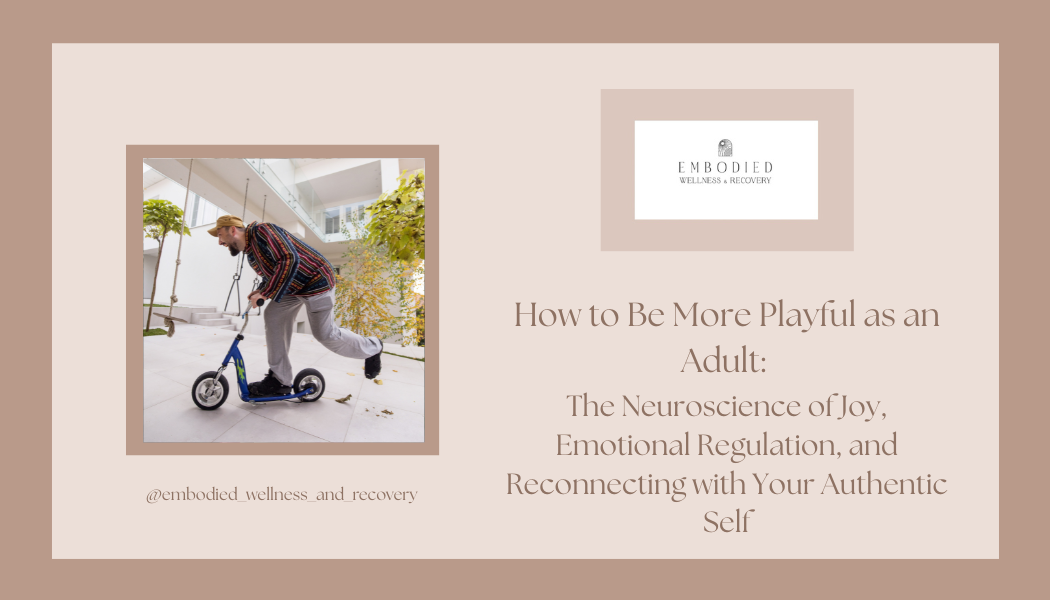
How to Be More Playful as an Adult: The Neuroscience of Joy, Emotional Regulation, and Reconnecting with Your Authentic Self
How to Be More Playful as an Adult: The Neuroscience of Joy, Emotional Regulation, and Reconnecting with Your Authentic Self
How to be playful as an adult: discover neuroscience-backed strategies to reconnect with joy, spontaneity, and emotional resilience. Learn how play supports nervous system regulation, relationships, intimacy, trauma recovery, and mental wellness.
When was the last time you laughed so hard your stomach hurt?
When did you last do something simply because it delighted you, not because it was productive, strategic, or necessary?
For many adults, playfulness feels like a luxury rather than a necessity. Somewhere between deadlines, responsibilities, caregiving, financial stress, and emotional survival, joy can start to feel frivolous. Many people begin to associate adulthood with seriousness, self-control, and constant achievement.
But what if taking yourself too seriously is actually keeping you stuck?
What if your nervous system, your relationships, your creativity, and even your healing depend on your ability to access play?
At Embodied Wellness and Recovery, we often help clients rediscover something they did not realize they had lost: the capacity for play. Through somatic therapy, EMDR, attachment work, and neuroscience-informed treatment, we see how reconnecting with playfulness can soften shame, regulate the nervous system, improve intimacy, and restore emotional vitality. Play is not childish. It is biological, and for many adults, learning how to be playful again is deeply therapeutic.
Why Adults Lose Their Sense of Play
Playfulness often disappears gradually. It happens when life is dominated by performance rather than presence. It happens when childhood environments taught you that being silly was unsafe, being emotional was embarrassing, or being spontaneous invited criticism.
For trauma survivors, especially, hypervigilance often replaces curiosity. Instead of asking, What feels fun? The nervous system asks, What keeps me safe? Instead of exploring, it monitors. Instead of relaxing, it braces.
Research from Dr. Stephen Porges’ Polyvagal Theory helps explain this. When the nervous system is stuck in chronic fight, flight, freeze, or shutdown states, play becomes neurologically inaccessible. Social engagement, laughter, spontaneity, and creative risk-taking require a sense of safety in the body (Porges, 2011).
This means that if play feels hard, it is not because you are boring. It may be because your nervous system has been working overtime trying to protect you.
The Neuroscience of Playfulness
Play activates some of the most important systems for mental and emotional health. Dr. Jaak Panksepp, a pioneer in affective neuroscience, identified PLAY as one of the brain’s primary emotional systems. Play stimulates social bonding, emotional flexibility, problem-solving, resilience, and pleasure (Panksepp, 2004).
When adults engage in playful behavior, the brain releases dopamine, which supports motivation and reward, and oxytocin, which strengthens connection and trust. Play also lowers cortisol, the body’s primary stress hormone. This means that playful activities can help reduce anxiety, improve mood, and increase emotional regulation.
From a trauma-informed perspective, play can also create corrective emotional experiences. It allows the body to experience safety, delight, and spontaneity without punishment or fear. That matters. Because many adults are not suffering from a lack of discipline. They are suffering from a lack of nervous system permission to feel alive.
Signs You May Be Taking Yourself Too Seriously
Sometimes seriousness looks responsible, but at other times it is disguised anxiety.
You may be overly serious if:
— You struggle to relax without feeling guilty
— You feel uncomfortable being silly or spontaneous
— You overthink social interactions
— You have difficulty receiving pleasure without productivity attached
— You feel embarrassed by joy, dancing, flirting, or laughter
— You interpret playfulness as immaturity
— Your relationships feel heavy, tense, or emotionally distant
Ask yourself:
Do I know how to enjoy myself without earning it?
Do I feel safe being lighthearted?
Can I tolerate laughter without self-consciousness?
These are not superficial questions. They often reveal attachment wounds, perfectionism, shame, and unresolved trauma patterns.
How to Be Playful as an Adult
Playfulness is not a personality trait reserved for extroverts. It is a skill, and like any skill, it can be practiced.
1. Start With Your Body, Not Your Mind
You cannot think your way into playfulness. Play begins in the body.
Try movement that feels non-performative:
— Dancing in your kitchen
— Walking barefoot in the grass
— Tossing a ball with your child or dog
— Swimming
— Stretching while listening to music
— Painting badly on purpose
Somatic therapy reminds us that joy often returns through sensation before cognition. Your body needs evidence that pleasure is safe. Not every moment needs optimization. Sometimes healing begins with music and sunlight.
2. Practice Micro-Moments of Delight
Many adults assume play must be dramatic. It does not.
Play often begins with tiny acts of delight:
— Ordering the dessert
— Buying fresh flowers
— Sending a ridiculous meme
— Trying a hobby you are bad at
— Laughing at your own mistakes
— Taking the scenic route home
Research on positive emotion by Barbara Fredrickson shows that small moments of joy broaden emotional resilience and improve psychological flexibility (Fredrickson, 2001). Tiny joy is still real joy. Do not underestimate it.
3. Notice Where Shame Interrupts Pleasure
Many people stop being playful because shame enters the room. You want to dance, but you feel stupid. You want to flirt, but you feel exposed. You want to laugh loudly, but you worry people will judge you. This is where deeper therapeutic work matters.
Often, playfulness is blocked by internalized messages:
“Be appropriate.”
“Do not be too much.”
“Stay in control.”
“Do not embarrass yourself.”
At Embodied Wellness and Recovery, we often use EMDR and parts workto help clients process these protective beliefs and reconnect with spontaneity without fear. Sometimes the adult who cannot play is still protecting the child who was punished for joy.
4. Choose Relationships That Welcome Lightness
Play is relational. Healthy intimacy requires not only vulnerability, but also levity. Couples who laugh together regulate together. Friendships that include teasing, humor, curiosity, and adventure often feel emotionally safer than relationships built only around crisis and seriousness.
Dr. John Gottman’s research on relationships found that shared positive affect, humor, and playful repair are strong predictors of relationship satisfaction and resilience (Gottman & Silver, 1999).
Ask yourself:
Who in my life makes me feel more alive?
Who invites softness instead of performance?
Playfulness thrives where authenticity is safe.
5. Give Yourself Permission to Be Bad at Something
Adults often avoid play because they are addicted to competence. Children play because they do not expect mastery. Adults hesitate because they do.
Take the class.
Try surfing.
Learn French badly.
Paint terribly.
Sing off-key.
Playfulness requires surrendering perfection, and perfectionism is often just fear wearing expensive clothes. Growth happens faster when shame is not driving.
Playfulness Is Not Avoidance
Being playful does not mean avoiding pain. It means refusing to let pain become your entire identity. Trauma work is serious. Grief is real. Healing requires courage, but nervous system repair also needs pleasure, novelty, laughter, and embodiment.
A life built only around survival eventually feels emotionally flat. Play restores dimension. It reminds us that we are more than our symptoms, more than our trauma history, and more than our productivity. We are human beings designed for connection, creativity, sensuality, and joy.
Joy Is a Form of Nervous System Regulation
Learning how to be playful as an adult is not about becoming frivolous. It is about becoming available to life again. It is about reclaiming access to wonder. It is about remembering that joy is not irresponsible; it is restorative.
At Embodied Wellness and Recovery, we help clients reconnect with emotional freedom through trauma-informed therapy, somatic work, EMDR intensives, and relational healing. Sometimes the work begins with grief. Sometimes it begins with boundaries.
And sometimes it begins with asking:
What used to make me feel most alive?
That question is worth answering because often, your healing is waiting there.
Reach out to schedule a complimentary 20-minute consultation with our team of therapists, trauma specialists, somatic practitioners, or relationship experts, and start working towards integrative, embodied healing today.
📞 Call us at (310) 651-8458
📱 Text us at (310) 210-7934
📩 Email us at admin@embodiedwellnessandrecovery.com
🔗 Visit us at www.embodiedwellnessandrecovery.com
👉 Check us out on Instagram @embodied_wellness_and_recovery
🌍 Explore our offerings at Linktr.ee: https://linktr.ee/laurendummit
References
1) Fredrickson, B. L. (2001). The role of positive emotions in positive psychology: The broaden and build theory of positive emotions. American Psychologist, 56(3), 218–226.
2) Gottman, J. M., & Silver, N. (1999). The seven principles for making marriage work. Crown Publishers.
3) Panksepp, J. (2004). Affective neuroscience: The foundations of human and animal emotions. Oxford University Press.
4) Porges, S. W. (2011). The polyvagal theory: Neurophysiological foundations of emotions, attachment, communication, and self-regulation. W. W. Norton & Company.

The Power of Self-Forgiveness: Why It’s So Hard and How to Release Shame for Good
The Power of Self-Forgiveness: Why It’s So Hard and How to Release Shame for Good
Struggling with self-forgiveness and stuck in the shame spiral? Discover why it’s so difficult and explore expert-backed steps to release shame, rebuild self-worth and restore emotional resilience.
Can You Relate?
Have you ever wondered why you can forgive others so easily, yet find it in yourself to forgive your own mistakes feels nearly impossible? Why do you keep looping in that internal voice of criticism, replaying the past, and sinking deeper into shame? Self-forgiveness is one of the most elusive yet powerful acts of healing, especially when trauma, nervous-system dysregulation, or relational wounding are involved. At Embodied Wellness and Recovery, we specialize in working with these underlying dynamics, helping clients move beyond self‐condemnation and toward embodied worth, emotional freedom, and genuine connection.
Why Self-Forgiveness Feels So Difficult
The Shame Spiral and Its Toll
You may ask:
— Why do I replay that moment I hurt someone over and over when I’ve apologised already?
— Why can’t I stop feeling like I’m defined by one bad choice or one failure?
— Why does feeling “less than” have more power than feeling hopeful in me?
These aren’t simple questions; they point to how shame and self-judgment work in our brains and bodies. Shame is not just guilt (“I made a mistake”) but a painful feeling about who we are (“I am bad”). And neuroscience shows that shame activates brain regions like the anterior cingulate cortex, parahippocampal gyrus, and medial frontal gyrus, areas tied to self-evaluation, moral emotions, and social threat.
The Brain Behind the Burden
Self-forgiveness research points to another layer: people who are better at forgiving themselves show stronger self-compassion, greater resilience, and even measurable brain differences. For example, a recent MRI study found that individuals with high self-forgiveness had greater gray matter volumes in regions associated with self-compassion and moral processing. This means that self-forgiveness is not just a “soft” concept; it is linked to tangible brain and nervous system shifts.
When shame dominates, the nervous system can stay locked in threat mode: high heart rate, tight muscles, foggy attention, and craving avoidance or escape. That physiological stress makes it nearly impossible to access safety, let alone compassion for ourselves.
The Key Obstacles to Self-Forgiveness
1) Unrelenting self-judgment
If your inner critic is louder than your inner ally, you’ll likely stay trapped in shame. The more you judge yourself, the more you activate threat networks in your brain.
2) Fear that forgiving yourself means you “let yourself off the hook”
Many people resist self-forgiveness because they believe accountability means punishment. In fact, unresolved self-shame often leads to self-sabotage.
3) Lack of nervous system regulation
Trauma, chronic stress, or emotional neglect diminishes our capacity to regulate. Without regulation, self-compassion and forgiveness feel unsafe or impossible.
4) Misunderstanding the process
Self-forgiveness is rarely a one-time event; it is a layered, ongoing stance of compassion, responsibility, and integration. Research shows it is best understood as a “mixed emotional experience” rather than a single moment of letting go.
Expert Advice for Releasing Shame and Cultivating Self-Forgiveness
Step 1: Ground your body
Begin by calming your nervous system. Before you even approach the memory or the thought:
— Take slow belly breaths, activating your vagus nerve and shifting the system toward safety.
— Scan your body and notice where tension, tightness, or contraction is held. Allow softening, shifting from fight or freeze mode into rest-and-digest.
Once the body is better regulated, the brain can engage in reflection without the immediate threat.
Step 2: Name and Witness Your Story
Ask yourself: What triggered the shame? What did I need at that moment that I did not receive or give myself? Use present-tense statements such as:
“I did X. I felt Y. I needed Z.”
The act of naming gives you agency and moves shame from implicit somatic memory into conscious narrative.
Step 3: Shift the Relationship to the Self
Replace condemnation with compassion. Self-compassion research (Neff, 2022) shows that treating ourselves with kindness allows for emotional regulation, neural flexibility, and healing.
Use mindful statements:
“I recognise that I acted from the best I knew at that time.”
“I choose to care for this part of me that carries the pain.”
These re-frames don’t undo the past, but they re-shape your nervous system’s story about the past—moving from threat to possibility.
Step 4: Repair and Re-engage with Your Values
Self-forgiveness also involves alignment with deeper values: integrity, kindness, and connection. Ask: “What can I do now (even in a small way) that affirms who I truly am, not who I fear I was?”
Making symbolic or practical reparative actions without waiting for perfection, but taking conscious steps toward values, gives your nervous system real data: you can choose differently now.
Step 5: When Trauma’s Tootprint Runs Deep
If you find yourself stuck: repeating shame loops, dissociation, overwhelming guilt, or you are unsure how to move forward, then a trauma-informed, somatic approach is essential. At Embodied Wellness and Recovery, we integrate somatic experiencing, nervous system regulation, EMDR, parts work, and relational therapy to help you reclaim your embodied life, restore boundaries, and nurture inner safety.
The Hope of Self-Forgiveness: Reclaiming Your Life
Imagine this: you're no longer defined by the mistake you made or the moment you regret. Your nervous system no longer lights up at the memory. Instead, you respond with: “I took responsibility, I learned, I am worthy of connection and rest.” That shift transforms not only how you feel about yourself, but how you show up relationally, how you live in your body, how you move through the world.
Self-forgiveness is not indulgence; it is an act of integration. When you forgive yourself, you free energy previously locked in shame. You reclaim your capacity for intimacy, pleasure, creativity, and connection. The burden of self-condemnation lifts, and you begin to live with internal freedom.
Why Embodied Wellness & Recovery Brings a Unique Approach
At Embodied Wellness and Recovery, we do more than talk about self-forgiveness. We practise it somatically, relationally, and neuro-scientifically. We help you:
— Feel safety in your nervous system.
— Rewrite the body’s memory of shame.
— Reconnect with parts of you you thought were lost.
— Build relational trust with yourself, your body, and others.
When shame dissolves and forgiveness takes root, your life becomes a place of curiosity and renewal rather than fear and concealment.
Reclaim a Life That Reflects Safety, Integrity, and Connection
Struggling with self-forgiveness is not a sign that you're “weak.” It often means your body, mind, and nervous system have carried too much for too long. The shame spiral is real, painful, but also a doorway to profound change. Through grounding, naming the story, softening self-criticism, aligning with values, and (when needed) trauma-informed support, you can shift your neural pathways, regulate your nervous system, and reclaim a life that reflects safety, integrity, and connection.
If you’re ready to explore this journey toward embodied self-compassion, clearer relationships, and nervous-system regulation in depth, discover how Embodied Wellness and Recovery can support you in reclaiming your wholeness.
Reach out to schedule a free 20-minute consultation with our team of therapists, trauma specialists, somatic practitioners, relationship experts and begin practicing self-compassion today.
📞 Call us at (310) 651-8458
📱 Text us at (310) 210-7934
📩 Email us at admin@embodiedwellnessandrecovery.com
🔗 Visit us at www.embodiedwellnessandrecovery.com
👉 Check us out on Instagram @embodied_wellness_and_recovery
🌍 Explore our offerings at Linktr.ee: https://linktr.ee/laurendummit
References
Kim, H.-J., & colleagues. (2023). Self-forgiveness is associated with increased volumes of … Scientific Reports. https://doi.org/10.1038/s41598-023-32731-0 Nature
Michl, P., et al. (2012). Neurobiological underpinnings of shame and guilt: A pilot functional magnetic resonance imaging study. Frontiers in Psychology. PMC
Woodyatt, L., & colleagues. (2025). What makes self-forgiveness so difficult? Self and Identity. Taylor & Francis Onlin