
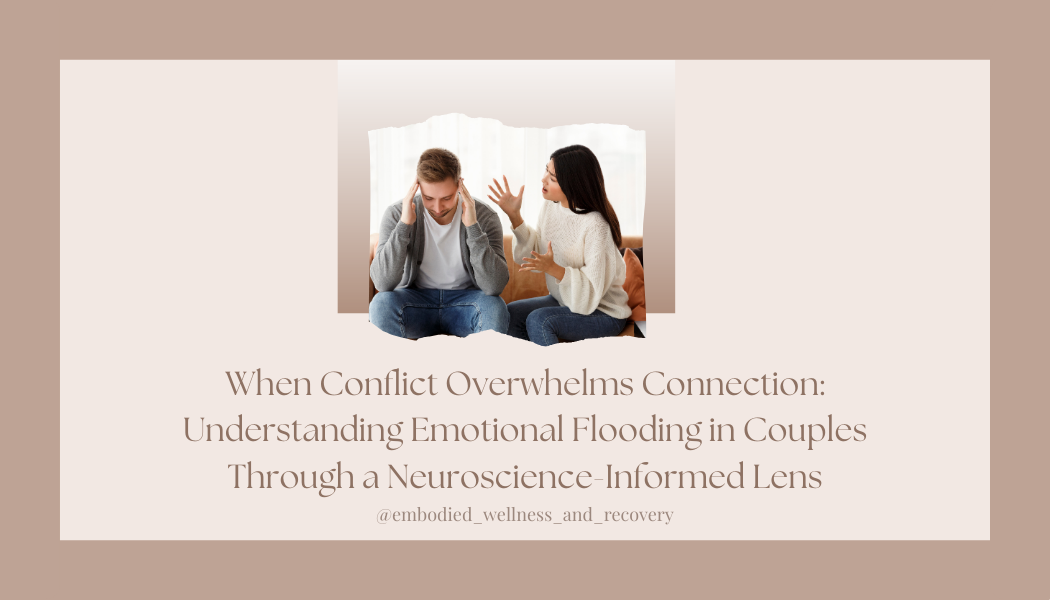
When Conflict Overwhelms Connection: Understanding Emotional Flooding in Couples Through a Neuroscience-Informed Lens
When Conflict Overwhelms Connection: Understanding Emotional Flooding in Couples Through a Neuroscience-Informed Lens
Learn what emotional flooding in couples is, why it happens during conflict, and how neuroscience-informed therapy helps restore safety and connection.
Have you ever found yourself in a disagreement with your partner where everything suddenly feels too much? Your heart races, your thoughts scatter, your body tightens, and words either spill out sharply or disappear altogether. Later, you may struggle to remember what was said, only that the conversation ended badly.
Many couples describe this experience as feeling hijacked, shut down, or out of control. This is not a communication failure. It is often emotional flooding, a nervous system response that makes constructive connection nearly impossible in the moment.
At Embodied Wellness and Recovery, we work with couples who care deeply about each other yet feel trapped in cycles of conflict fueled by emotional flooding. Understanding what flooding is and why it happens is a critical step toward repairing trust, intimacy, and emotional safety.
What Is Emotional Flooding in Relationships?
Emotional flooding occurs when the nervous system becomes overwhelmed during conflict. The body interprets relational distress as threat and shifts into survival mode.
This can look like:
— Rapid heartbeat or shallow breathing
— Feeling suddenly angry, panicked, or numb
— Losing access to language or logical thinking
— Becoming defensive, reactive, or withdrawn
— Wanting to escape the conversation at all costs
Flooding makes it difficult to listen, empathize, or problem-solve. Even well-intentioned conversations can escalate quickly once this threshold is crossed.
Why Emotional Flooding Happens in Couples
From a neuroscience perspective, emotional flooding is driven by the autonomic nervous system. When a relationship conflict activates perceived threat, the amygdala signals danger, and the body releases stress hormones. At the same time, the prefrontal cortex, which supports reasoning, empathy, and perspective, becomes less accessible. The nervous system prioritizes protection over connection.
For many people, relationship conflict is not just about the present moment. It taps into earlier experiences of rejection, abandonment, betrayal, or emotional neglect. The body responds as if the stakes are much higher than the immediate disagreement.
Common Triggers for Emotional Flooding
Emotional flooding is highly personal. Triggers often relate to attachment wounds or unresolved trauma.
Common triggers include:
— Feeling criticized or blamed
— Perceived withdrawal or emotional distance
— Raised voices or sharp tone
— Feeling misunderstood or dismissed
— Threats to the relationship or future
— Conversations about sex, money, or trust
One partner may flood quickly, while the other may appear calm or detached. This difference often leads to misunderstanding rather than compassion.
Emotional Flooding and Attachment Styles
Attachment patterns play a significant role in how flooding shows up. Anxiously attached partners may experience flooding as panic, urgency, or emotional overwhelm. They may pursue connection with intensity, fearing loss or abandonment.
Avoidantly attached partners may experience flooding as shutdown, numbness, or irritation. They may withdraw to restore a sense of control or safety.
Both responses are protective. Neither reflects a lack of care.
The Impact of Flooding on Communication
Once emotional flooding sets in, communication becomes distorted.
Partners may:
— Interrupt or escalate
— Say things they later regret
— Misinterpret neutral statements as hostile
— Shut down or stonewall
— Struggle to repair after conflict
Repeated flooding can erode trust and intimacy. Couples may either avoid difficult topics altogether or assume that conflict will always end badly.
Why Talking It Through Does Not Work During Flooding
Many couples are told to communicate better, use I statements, or stay calm. While these tools are helpful, they are ineffective when the nervous system is overwhelmed. Flooding is a physiological state, not a cognitive choice. Asking someone to reason while flooded is like asking them to swim while their body is stuck in freeze. Effective repair requires regulation before resolution.
Emotional Flooding and Trauma
Trauma history increases vulnerability to flooding. When earlier experiences taught the nervous system that closeness is dangerous or unpredictable, adult relationships can activate survival responses.
This is especially relevant in couples navigating:
— Childhood emotional neglect
— Betrayal or infidelity
— Sexual trauma
— Chronic conflict or emotional invalidation
Flooding is not a sign that a relationship is doomed. It is a sign that the nervous system needs support.
What Helps When Emotional Flooding Occurs
Healing emotional flooding does not mean eliminating conflict. It means learning how to recognize and respond to nervous system activation with care.
Helpful strategies include:
1. Naming Flooding Without Blame
Simply acknowledging what is happening can reduce escalation. Statements like "I feel overwhelmed and need a pause" shift the focus from winning to safety.
2. Taking Regulated Breaks
A break is effective only if it includes regulation. Walking, breathing slowly, or grounding the body helps stress hormones settle.
3. Returning When Both Systems Are Calmer
Repair conversations are far more successful once both partners have access to curiosity and empathy again.
4. Building Awareness of Early Signals
Learning to notice early signs of flooding enables couples to intervene before it escalates.
5. Practicing Co-Regulation
Safe eye contact, slower speech, and gentle tone can help nervous systems settle together.
How Couples Therapy Helps Address Emotional Flooding
At Embodied Wellness and Recovery, couples therapy focuses on the nervous system, not just behavior.
Our approach helps couples:
— Understand their unique flooding triggers
— Track bodily cues in real time
— Build tolerance for emotional intensity
— Repair attachment injuries
— Restore safety in conversations about intimacy, sexuality, and trust
When the nervous system feels safer, emotional expression becomes more flexible and connection more resilient.
Emotional Flooding and Sexual Intimacy
Flooding often impacts sexual connection. When the nervous system associates closeness with threat, desire, and arousal can shut down.
Couples may struggle with:
— Mismatched desire
— Avoidance of touch after conflict
— Feeling unsafe being vulnerable
— Confusion about consent and pacing
Trauma-informed couples therapy helps partners rebuild embodied safety so intimacy can emerge without pressure.
A Hopeful Perspective
If emotional flooding shows up in your relationship, it does not mean you are incompatible or that you are failing. It means your nervous system is reacting to a perceived threat. With understanding, regulation, and support, couples can learn to move through conflict with greater steadiness and care. Emotional flooding can become a signal to slow down rather than a force that drives partners apart.
Working With Embodied Wellness and Recovery
At Embodied Wellness and Recovery, we specialize in trauma-informed, neuroscience-based couples therapy. We support partners in healing nervous system patterns that interfere with communication, intimacy, and emotional connection. Our work integrates attachment theory, somatic therapy, and relational neuroscience to help couples create safer, more responsive relationships.
Reach out to schedule a complimentary 20-minute consultation with our team of therapists, trauma specialists, somatic practitioners, or relationship experts, and start working towards integrative, embodied healing today.
📞 Call us at (310) 651-8458
📱 Text us at (310) 210-7934
📩 Email us at admin@embodiedwellnessandrecovery.com
🔗 Visit us at www.embodiedwellnessandrecovery.com
👉 Check us out on Instagram @embodied_wellness_and_recovery
🌍 Explore our offerings at Linktr.ee: https://linktr.ee/laurendummit
References
1) Gottman, J. M., & Gottman, J. S. (2015). 10 principles for doing effective couples therapy. W. W. Norton & Company.
2) Johnson, S. M. (2019). Attachment theory in practice: Emotionally focused therapy with individuals, couples, and families. Guilford Press.
3) Porges, S. W. (2011). The polyvagal theory: Neurophysiological foundations of emotions, attachment, communication, and self-regulation. W. W. Norton & Company.
4) van der Kolk, B. A. (2014). The body keeps the score: Brain, mind, and body in the healing of trauma. Viking

Emotional Safety in Relationships: How Your Nervous System Shapes Trust, Intimacy, and Communication
Emotional Safety in Relationships: How Your Nervous System Shapes Trust, Intimacy, and Communication
Discover what emotional safety really means in a relationship, how emotional risk and nervous system responses shape communication, and what happens when emotional safety is missing. Learn neuroscience-backed tools to rebuild trust, strengthen intimacy, and repair relational patterns with guidance from Embodied Wellness and Recovery.
Emotional Safety in Relationships: What It Actually Means and Why It Matters
Why does communication with someone you love sometimes feel effortless, grounding, and warm, while other moments feel tense, confusing, or even unsafe? Why do some relationships help you feel seen and supported, while others keep you on edge, waiting for conflict, criticism, or emotional withdrawal?
If you have ever wondered why your nervous system reacts so quickly in relationships, or why certain partners feel unsafe even when you try to stay calm, you are not imagining it. Emotional safety is more than a psychological concept. It is a neurobiological experience that shapes every moment of connection or disconnection.
At Embodied Wellness and Recovery, we specialize in trauma-informed, nervous system-grounded relationship therapy that helps individuals and couples understand how emotional safety forms the foundation for healthy intimacy. This article examines what emotional safety truly means, how emotional risk disrupts communication, and the impact on your mind and body when emotional safety is absent.
What Emotional Safety Truly Means in a Relationship
Emotional safety is the felt sense that your relationship is a secure base where you can share your inner world without fear of punishment, criticism, or abandonment. It is the confidence that your partner will respond with curiosity rather than attack, understanding rather than defensiveness.
Emotional safety includes experiences such as:
— Feeling valued, respected, and emotionally held.
— Knowing your partner will respond rather than react.
— Feeling free to express needs, preferences, and emotions without fear.
— Trusting that conflict will be navigated with care rather than aggression.
— Having confidence that mistakes will be handled with repair instead of shame.
Contrast this with emotional risk.
Do you ever feel like you have to walk on eggshells?
Do you censor your truth because you fear anger, withdrawal, ridicule, or judgment?
Do your conversations turn into defensiveness, passive aggression, stonewalling, or emotional shutdown?
These are signs that emotional safety is missing, and your nervous system is absorbing the impact.
The Nervous System and Emotional Safety: How Your Body Detects Connection or Threat
According to Polyvagal Theory, your nervous system is constantly scanning your environment for cues of safety or danger. This process is called neuroception, and it happens faster than your conscious thoughts. Your body responds before your mind understands what is happening.
When your neuroception senses safety, your body shifts into the ventral vagal state, which supports:
— Open communication
— Empathy
— Curiosity
— Problem solving
— Playfulness
— Healthy physical intimacy
This is the physiological foundation of emotional safety.
However, when your neuroception detects even subtle cues of emotional threat, such as criticism, raised voices, facial tension, guilt tripping, or unpredictable moods, your body shifts into defense states like:
— Fight
— Flight
— Freeze
— Fawn
Instead of connection, your nervous system prepares for protection. This means that emotional safety is not simply about being with a “nice” partner. It is about how consistently your nervous system perceives the relationship as non-threatening.
How Emotional Safety vs Emotional Risk Shows Up in Communication
Communication patterns begin long before words are exchanged. They start with nervous system states.
When Emotional Safety Is Present
Communication feels natural. You can:
— Share vulnerably
— Disagree respectfully
— Ask for needs without fear
— Repair conflict with warmth
— Express boundaries without backlash
— Approach difficult conversations with stability.
There is spaciousness. There is room for both partners to exist entirely.
When Emotional Risk Is Present
Communication becomes reactive and fragile. You might experience:
— Shut down or emotional withdrawal
— Anger, defensiveness, or blame
— Misinterpretations and assumptions
— Feeling unfairly criticized or dismissed
— Partners competing rather than collaborating
— Fear of saying the wrong thing
— Escalation instead of resolution
When emotional safety is missing, even neutral comments can feel like criticism. A small disagreement can feel like a threat. Silence can feel like rejection. The nervous system starts speaking louder than words, and emotional risk becomes the default way of relating.
What Happens When Emotional Safety Is Missing
The absence of emotional safety can cause significant relational harm. Without it, intimacy, communication, and trust start to erode.
1. Intimacy Declines
A nervous system in survival mode cannot fully open to love. Partners become guarded, disconnected, or emotionally distant. Physical intimacy often decreases because the body no longer feels grounded enough to relax.
2. Communication Breaks Down
Conversations become filled with tension, misinterpretation, or shutdown. Conflict escalates quickly or gets swept under the rug. Partners start protecting themselves rather than turning toward each other.
3. Trust Weakens
Without emotional safety, trust cannot thrive. The relationship becomes unpredictable. You may start to wonder:
— Will they get angry if I bring this up
— Will they shut down if I tell the truth?
— Will they blame me instead of hearing me?
— Will they take responsibility or deflect
The relationship becomes confusing, painful, and exhausting.
4. The Nervous System Remains on High Alert
Over time, chronic emotional risk sensitizes the nervous system. You may experience:
— Anxiety
— Hypervigilance
— Insomnia
— Overthinking
— People pleasing
— Emotional numbness
— Difficulty regulating emotions
Your body begins to anticipate relational threat even before it occurs.
If You Are With a Partner Who Does Not Feel Emotionally Safe
Living in a relationship where emotional safety is inconsistent or absent can feel draining and destabilizing.
You might be asking yourself:
— Why do I feel tense even during calm moments?
— Why does my partner react with anger, withdrawal, or blame?
— Why does everything turn into conflict?
— Why do I feel criticized or misunderstood?
— Why do I silence myself to keep the peace?
These are not character flaws. They are nervous system signals.
And they can be healed.
Rebuilding Emotional Safety: Hope, Repair, and Support
Emotional safety is not built through force, pressure, or perfection. It is built through consistent experiences of co-regulation, nervous system repair, and relational attunement.
At Embodied Wellness and Recovery, we help individuals and couples:
— Understand their nervous system patterns.
— Rebuild emotional safety through somatic and relational practices.
— Heal trauma that shapes communication.
— Learn tools for conflict repair.
— Strengthen intimacy with nervous system awareness.
— Create healthier attachment patterns
— Develop emotionally safe communication skills
Through trauma-informed EMDR, somatic therapy, IFS, and relationship-focused work, clients learn to move from reactivity to connection, from emotional risk to safety, and from survival strategies to authentic intimacy.
You deserve a relationship where your nervous system can rest.
Emotional Safety as the Cornerstone of a Healthy Relationship
Emotional safety is the cornerstone of a healthy relationship. It shapes how you love, how you communicate, and how you show up with openness rather than defense. When emotional safety is missing, the relationship becomes a source of emotional risk. But with support, awareness, and nervous system repair, emotional safety can be rebuilt.
Embodied Wellness and Recovery specializes in helping individuals and couples restore emotional safety, deepen intimacy, and create relationships that honor both partners' nervous systems. If you would like support, our team is here.
Reach out to schedule a complimentary 20-minute consultation with our team of therapists, relationship experts,trauma specialists, or somatic practitioners, and start working towards integrative, embodied healing today.
📞 Call us at (310) 651-8458
📱 Text us at (310) 210-7934
📩 Email us at admin@embodiedwellnessandrecovery.com
🔗 Visit us at www.embodiedwellnessandrecovery.com
👉 Check us out on Instagram @embodied_wellness_and_recovery
🌍 Explore our offerings at Linktr.ee: https://linktr.ee/laurendummit
References:
Porges, S. W. (2011). The polyvagal theory: Neurophysiological foundations of emotions, attachment, communication, and self-regulation. W. W. Norton.
Siegel, D. J. (2012). The developing mind: How relationships and the brain interact to shape who we are. Guilford Press.
Levine, P. A. (2010). In an unspoken voice: How the body releases trauma and restores goodness. North Atlantic Books.
Criticism or Concern? How to Communicate Without Triggering Shame or Conflict in Your Relationship
Criticism or Concern? How to Communicate Without Triggering Shame or Conflict in Your Relationship
Learn the difference between criticism and concern in relationships—and how to communicate without triggering shame, defensiveness, or conflict. A neuroscience-informed guide to emotional intimacy and repair from Embodied Wellness and Recovery.
Criticism or Concern? Why the Difference Matters More Than You Think
Have you ever tried to express something that bothered you, only to have your partner shut down or lash out? Do you find yourself walking on eggshells, afraid to speak up because you don’t want to be seen as “too critical”? Or maybe you're on the receiving end, feeling like you can never do anything right, no matter how hard you try.
These painful moments are often not about the content of what’s being said, but how it’s being communicated and how it's being received by a nervous system that may be wired for shame.
At Embodied Wellness and Recovery, we frequently work with couples who struggle to communicate their needs without blame, express feedback without triggering shame, and repair relationships after conflicts that leave both partners feeling unseen and unsafe. Understanding the subtle difference between criticism and concern can radically shift how you relate to each other and yourself.
When Concern Feels Like an Attack: The Neuroscience of Shame and the Criticism Trap
From a neuroscience perspective, criticism is experienced as a threat. When someone perceives that they are being judged or attacked, the brain’s amygdala, its fear center, activates the fight-flight-freeze-fawn response (Porges, 2011). Even a well-intended comment like “I wish you’d help more around the house” can send a partner’s nervous system into a defensive posture if it’s received as criticism.
This is especially true for individuals with early attachment wounds, developmental trauma, orchronic shame narratives. If you grew up feeling like love was conditional, based on being perfect, useful, or emotionally attuned to others, you may experience even gentle feedback as proof that you're failing or not good enough.
What’s the Difference Between Criticism and Concern?
Here’s how you can begin to distinguish between the two:
Criticism Concern
Tone Blaming, shaming Curious, respectful
Focus What’s wrong with the other person What’s needed in the relationship
Language “You always…”, “You never…” “I feel…”, “Can we talk about…”, “I need…”
Intent To express frustration or judgment To improve connection or understanding
Impact Triggers defensiveness or shutdown Encourages collaboration or empathy
Criticism often includes global statements about character (e.g., "You're so selfish"), while concern stays behavior-focused and specific (e.g., "I felt hurt when you didn’t respond to my text").
Why Criticism Feels So Personal—Even When It’s Not Meant to Be
Criticism hurts because it triggers core beliefs about unworthiness, failure, or unlovability. These beliefs are often shaped long before our current relationship. According to Internal Family Systems (IFS) theory, we all carry protective “parts” that spring into action when these core wounds are touched. For example:
— A defensive part might say, “Well, you’re not perfect either!”
— A withdrawn part may shut down or retreat to avoid conflict.
— A fawning person might rush to apologize even when you feel unseen or hurt.
Understanding these reactions through a nervous system-informed and trauma-aware lens allows couples to recognize that much of their conflict isn’t personal; it’s protective.
How to Express Concern Without Blame
If you're the one bringing up an issue, here are a few steps to express your concern without making your partner feel criticized:
1. Check Your Nervous System First
Are you regulated enough to speak from your wise, grounded self, or are you activated?
Pause, breathe, and come into your body. Speak once your heart rate settles.
2. Use “I” Statements Instead of “You” Accusations
Instead of: “You never listen to me.”
Try: “I feel dismissed when I’m interrupted. Can we try something different?”
3. Describe the Impact, Not the Character
Keep the focus on how the behavior affects you, not who they are as a person.
Avoid generalizations (“always,” “never”) and stick to specific examples.
4. Name Your Intention
Let them know you’re bringing this up because you care about the relationship, not because you want to shame or change them.
If You Feel Criticized: What to Do Instead of Shutting Down
If you're the one who tends to feel criticized, even when your partner is trying to be thoughtful, you can try these nervous system-regulating tools:
1. Notice the Sensation of Shame
Shame is often felt somatically: a sensation of heat in the face, a sinking feeling in the belly, or a collapsed posture. Simply naming it (“I’m feeling shame right now”) can help you unblend from it.
2. Pause Before Reacting
Give yourself a moment to think before defending or withdrawing. Ask yourself, Is there any truth I can take in without abandoning myself?
3. Get Curious About the Message, Not Just the Tone
Try to listen for the underlying need rather than the delivery. Often, partners are expressing unmet needs through clumsy language.
4. Name and Repair
If you shut down or get reactive, own it gently:
“I think I got triggered and stopped listening. Can we try again?”
The Role of Couples Therapy in Rewriting the Criticism Loop
At Embodied Wellness and Recovery, we specialize in helping couples interrupt reactive cycles and reconnect with emotional safety, secure attachment, and co-regulation. Our integrative approach combines:
— Somatic Therapy to help each partner tune into their body’s cues and regulate during conflict
— Attachment-Focused Therapy to explore how early experiences shape current triggers
— EMDR and Parts Work (IFS) to reprocess shame and self-protective patterns
— Communication Coaching rooted in neuroscience and compassion
We don’t just teach you how to talk; we help you learn how to listen to your body, respond from your values, and connect with your partner without abandoning yourself.
Turning Criticism Into Connection
Every couple argues. Every couple hurts each other, intentionally or not. The difference between disconnection and intimacy isn’t in avoiding conflict; it’s in learning how to repair it skillfully.
When you learn to distinguish criticism from concern and understand how your nervous system responds to feedback, you open the door to deeper trust, collaboration, and mutual understanding.
You stop fighting against each other and start fighting for the relationship.
References
1. Gottman, J. M., & Silver, N. (2015). The Seven Principles for Making Marriage Work: A Practical Guide from the Country's Foremost Relationship Expert. Harmony.
2. Porges, S. W. (2011). The Polyvagal Theory: Neurophysiological Foundations of Emotions, Attachment, Communication, and Self-regulation. W. W. Norton & Company.
3. Schwartz, R. C. (2021). No Bad Parts: Healing Trauma and Restoring Wholeness with the Internal Family Systems Model. Sounds True

Is It Time to Get Married? Why Emotional Readiness Matters More Than Relationship Timelines
Is It Time to Get Married? Why Emotional Readiness Matters More Than Relationship Timelines
Feeling pressure to get married, even if it doesn't feel aligned? Discover how societal expectations can distort our sense of relational timing—and how to tell if you’re truly ready for marriage based on emotional safety, nervous system regulation, and mutual growth.
When Are You Really Ready for Marriage? The Science of Emotional Safety and Relational Resilience
Have you ever felt the quiet panic of being asked, “So… when are you two getting married?”
Maybe it’s your parents at a holiday gathering. A well-meaning friend who just got engaged. Or maybe it’s a voice inside your own head, ticking through an invisible timeline handed down by culture, religion, or social media.
And yet, despite loving your partner or desperately wanting partnership, you hesitate.
What if it’s not time yet? What if something in your body says wait, even if the world is telling you to say yes?
At Embodied Wellness and Recovery, we work with countless individuals and couples navigating the space between commitment and confusion. Through our work, we’ve learned that readiness for marriage isn’t measured in years but in emotional regulation, safety, and mutual growth.
Let’s explore how you can assess your own readiness and why cultural timelines may be leading you astray.
The Pressure to Marry—and the Pain It Creates
Cultural and societal norms often teach us that relationships follow a linear timeline:
Date → Move In → Get Married → Have Kids.
But life—and love—are rarely so tidy.
If you’re in a long-term relationship and still not married, you may find yourself asking:
– Is something wrong with me?
– Are we falling behind?
– What if they leave because I’m unsure?
– Am I afraid of commitment or just unsure we’re ready?
These questions aren’t irrational; they stem from deep, often unconscious programming. Societal norms, religious traditions, and family expectations shape our internal narratives about what should happen and when.
But these narratives rarely account for trauma, attachment wounds, or nervous system capacity, all of which influence how we love, trust, and connect.
The Neuroscience of Readiness: It’s in the Nervous System
What most cultural messaging overlooks is this: You cannot cognitively force readiness. Readiness lives in the body.
A healthy, secure partnership depends on the ability to:
– Co-regulate under stress
– Repair after rupture
– Stay emotionally present and self-aware
– Feel safe and open in emotional and physical intimacy
These are nervous system processes, not intellectual ones.
According to Polyvagal Theory (Porges, 2011), a regulated nervous system enables us to remain connected even in moments of fear or vulnerability. When partners are in a ventral vagal state—calm, connected, and grounded—they can access curiosity, empathy, and resilience.
If instead you’re frequently in fight, flight, or freeze states in your relationship, your nervous system may be signaling this is not safe enough yet, no matter how long you’ve been together.
What True Readiness Looks Like
Rather than relying on a timeline, consider these questions to assess relational readiness for marriage:
🧠 1. Can we co-regulate?
Can you and your partner soothe yourselves and each other when one or both of you is triggered? Or do you spiral into defensiveness, withdrawal, or escalation?
💬 2. How do we handle conflict?
Do you feel emotionally safe expressing difficult truths, or do disagreements lead to rupture without repair?
❤️ 3. Are we emotionally intimate?
Do you share fears, dreams, and inner experiences? Or do you stay in roles or routines, avoiding emotional depth?
🪞 4. Do we both take responsibility for our own healing?
Healthy marriages aren’t about fixing each other—they’re about growing alongside one another. Is there mutual commitment to therapy, self-awareness, or healing past trauma?
🔄 5. Can we move through discomfort without shutting down or acting out?
Real intimacy requires tolerance for emotional discomfort. If your bond dissolves at the first sign of difficulty, it may not be resilient enough yet for the complexity of marriage.
What Gets in the Way of Embodied Decision-Making
People often override their inner knowing because of:
– Fear of disappointing others (especially family)
– Fear of being alone or starting over
– Social media comparison pressure
– Biological or societal clock anxiety
– Unhealed childhood trauma driving urgency or avoidance
In our work with clients, we help them distinguish between internal wisdom and external pressure. This process is deeply somatic, often involving slowing down, grounding, and tuning into the body’s 'yes' or 'no'.
You Don’t Have to Decide Alone
Whether you’re questioning if your relationship is ready for the next step or trying to understand why your body feels uncertain, support is available.
At Embodied Wellness and Recovery, we help individuals and couples:
– Explore relational ambivalence without judgment
– Heal nervous system dysregulation and attachment trauma
– Navigate marriage, commitment, and intimacy decisions with clarity
– Create emotionally safe, resilient partnerships
Through somatic therapy, EMDR, intimacy coaching, and trauma-informed couples work, we guide clients back to their inner truth so their relationships can evolve from a place of alignment, not obligation.
Follow the Rhythm Within
Marriage is not a performance. It’s a profound relational container that asks for honesty, vulnerability, and emotional maturity.
If you feel unsure, that doesn’t mean you’re broken. It may mean you’re finally listening, not to culture, but to yourself.
The real question isn’t “How long have we been together?”
It’s: How well do we know ourselves and each other when things get hard?
And from that place, you’ll know what kind of partnership you’re building—and whether it’s time to say “yes.”
Reach out to schedule a free 20-minute consultation with our team of top-rated therapists, relationship experts, somatic practitioners, and trauma specialists for support in connecting to your inner truth today.
📞 Call us at (310) 651-8458
📱 Text us at (310) 210-7934
📩 Email us at admin@embodiedwellnessandrecovery.com
🔗 Visit us at www.embodiedwellnessandrecovery.com
👉 Check us out on Instagram @embodied_wellness_and_recovery
🌍 Explore our offerings at Linktr.ee: https://linktr.ee/laurendummit
References:
– Levine, A., & Heller, R. S. (2010). Attached: The New Science of Adult Attachment and How It Can Help You Find—and Keep—Love. TarcherPerigee.
– Porges, S. W. (2011). The Polyvagal Theory: Neurophysiological Foundations of Emotions, Attachment, Communication, and Self-Regulation. W. W. Norton & Company.
– Siegel, D. J. (2010). The Mindful Therapist: A Cinician’s Guide to Mindsight and Neural Integration. W. W. Norton & Company.