
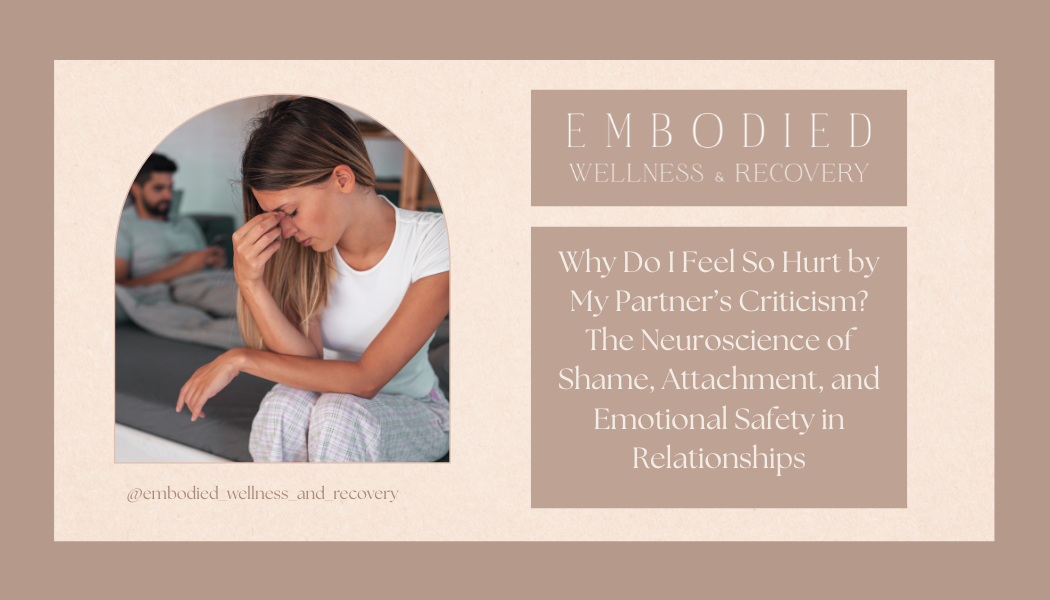
Why Do I Feel So Hurt by My Partner’s Criticism? The Neuroscience of Shame, Attachment, and Emotional Safety in Relationships
Why Do I Feel So Hurt by My Partner’s Criticism? The Neuroscience of Shame, Attachment, and Emotional Safety in Relationships
Do you feel constantly criticized by your partner? Discover how criticism affects the brain, nervous system, attachment, and self-worth, and learn how trauma-informed couples therapy and emotional repair can help rebuild connection and trust.
You forgot to unload the dishwasher. You arrived home later than expected. You misunderstood a text message.
Your partner sighs, rolls their eyes, or says, “Why do you always do this?”
The comment may seem minor on the surface, yet your body reacts as though something much bigger has happened. Your chest tightens. Your stomach drops. You replay the conversation for hours. You begin questioning yourself and wondering if you are failing the person you love.
If this sounds familiar, you may be experiencing more than frustration. You may be experiencing the profound emotional impact of chronic criticism.
Does Every Conversation Leave You Feeling Like You Are Falling Short?
Have you started walking on eggshells around your partner? Do you find yourself apologizing for things that are not your fault? Do you constantly second guess your decisions because you fear they will be criticized? Do you feel like nothing you do is ever good enough? Do you notice your confidence shrinking over time?
When criticism becomes a recurring feature of a relationship, it can quietly erode self-esteem, emotional safety, and intimacy. For individuals with trauma histories or insecure attachment patterns, its effects may be even more profound.
Criticism Is More Than Negative Feedback
Healthy relationships include feedback, accountability, and difficult conversations.
Criticism is different.
Constructive feedback focuses on a specific behavior and leaves room for growth:
“I felt hurt when you interrupted me.”
Criticism often attacks character or identity:
“You’re so selfish.”
“You never think about anyone else.”
“You always mess things up.”
According to decades of research by relationship expert John Gottman, persistent criticism is one of the strongest predictors of relationship distress because it shifts the conversation from behavior to personal defect.
Why Criticism Hurts So Much
Humans are wired for connection. Our closest relationships are not simply sources of companionship. They are attachment bonds that influence our sense of safety, belonging, and identity. When a trusted partner criticizes us repeatedly, the nervous system may interpret that experience as a threat to connection itself.
The result is often not just hurt feelings. It is physiological activation. Heart rate increases. Stress hormones rise. Attention narrows. The body prepares to defend, withdraw, or appease.
The Neuroscience of Emotional Pain
Neuroimaging research suggests that social rejection and emotional pain activate many of the same neural networks involved in processing physical pain (Eisenberger, 2012). From an evolutionary perspective, this makes sense. Maintaining close relationships has long been essential for survival.
When criticism feels relentless or deeply personal, the brain may respond as though social belonging itself is at risk. This is one reason seemingly small comments can produce disproportionately intense reactions.
Trauma Changes the Meaning of Criticism
For someone with a history of emotional neglect, bullying, perfectionism, or chronic invalidation, present-day criticism may awaken memories and physiological responses rooted in the past.
A simple comment such as:
“You forgot to call.”
may be experienced internally as:
“I disappoint everyone.”
“I’m not enough.”
“I always fail.”
The nervous system is not responding only to the current interaction. It is responding to years of accumulated learning.
Shame Grows in Relationships Where Safety Shrinks
Guilt says:
“I made a mistake.”
Shame says:
“I am the mistake.”
Over time, chronic shame can undermine confidence, authenticity, and emotional openness. People begin censoring themselves, avoiding vulnerability, or abandoning their own needs in an attempt to avoid further criticism. Ironically, these protective strategies often create even greater emotional distance between partners.
The Pursue Defend Withdraw Cycle
Many couples unknowingly become trapped in a predictable pattern. One partner criticizes because they long for change or connection. The other partner becomes defensive, shuts down, or withdraws. The criticism intensifies. The withdrawal deepens. Neither partner feels heard. Neither partner feels emotionally safe. Without intervention, the cycle repeats until resentment replaces curiosity and fear replaces intimacy.
The Cost of Walking on Eggshells
Living under chronic criticism often creates subtle but significant psychological consequences.
You may notice:
— Anxiety
— Emotional numbing
— Difficulty making decisions
— Decreased sexual desire
— Increased people-pleasing
— Reduced confidence
— Feeling lonely within the relationship
Many individuals begin shrinking themselves in an attempt to preserve harmony. Unfortunately, self-abandonment rarely strengthens intimacy.
What Emotional Safety Actually Looks Like
Emotionally safe relationships are not relationships without conflict. They are relationships in which both partners believe they can make mistakes without losing love or respect.
Emotional safety includes:
— Curiosity instead of contempt
— Accountability instead of blame
— Repair after conflict
— Compassion during vulnerability
— Respectful communication
— The ability to disagree without attacking character
Safety allows the nervous system to relax enough for authentic connection to emerge.
Replacing Criticism with Curiosity
Consider the difference:
Instead of:
“You never listen.”
Try:
“I miss feeling heard when we talk.”
Instead of:
“You’re impossible.”
Try:
“I’m feeling overwhelmed and want us to solve this together.”
Small shifts in language can dramatically alter how feedback is received. The goal is not to avoid difficult conversations. It is to make those conversations safer.
Healing the Wounds Beneath the Words
For many couples, the issue is not simply communication skills. It is unresolved attachment pain, trauma, or nervous system dysregulation.
Body based approaches such as somatic therapy and Eye Movement Desensitization and Reprocessing (EMDR), along with attachment-focused couples therapy, can help individuals process old wounds that amplify present day criticism and strengthen their capacity for emotional regulation and repair. When partners understand the physiology beneath conflict, they often move from blame to empathy.
How Embodied Wellness and Recovery Can Help
At Embodied Wellness and Recovery, we understand that feeling constantly criticized is about more than hurt feelings. It can activate old attachment wounds, reinforce shame, dysregulate the nervous system, and create profound disconnection in relationships.
Our clinicians integrate neuroscience-informed psychotherapy, somatic therapy, EMDR, attachment-based interventions, and evidence-based couples therapy to help individuals and partners understand the deeper mechanisms driving criticism, defensiveness, and emotional pain. We also specialize in trauma recovery, nervous system repair, sexuality, intimacy, and relationship healing, creating a space where insight is paired with meaningful relational change.
Thriving relationships are not built by eliminating conflict. They are built by creating enough emotional safety that conflict no longer threatens each person's sense of worth. Sometimes the most transformative words a partner can hear are not, “You need to change.” They are, “I want to understand what this experience is like for you.”
Reach out to schedule a complimentary 20-minute consultation with our team of therapists, trauma specialists, somatic practitioners, or relationship experts, and start working towards integrative, embodied healing today.
📞 Call us at (310) 651-8458
📱 Text us at (310) 210-7934
📩 Email us at admin@embodiedwellnessandrecovery.com
🔗 Visit us at www.embodiedwellnessandrecovery.com
👉 Check us out on Instagram @embodied_wellness_and_recovery
🌍 Explore our offerings at Linktr.ee: https://linktr.ee/laurendummit
References
Eisenberger, N. I. (2012). The pain of social disconnection: Examining the shared neural underpinnings of physical and social pain. Nature Reviews Neuroscience, 13(6), 421-434.
Gottman, J. M., & Silver, N. (2015). The seven principles for making marriage work (Revised ed.). Harmony Books.
Johnson, S. M. (2019). Attachment theory in practice: Emotionally focused therapy (EFT) with individuals, couples, and families. Guilford Press.
Porges, S. W. (2011). The polyvagal theory: Neurophysiological foundations of emotions, attachment, communication, and self-regulation. W. W. Norton & Company.
van der Kolk, B. A. (2014). The body keeps the score: Brain, mind, and body in the healing of trauma. Viking.
The Quiet Erosion of Love: How to Heal Micro Hurts That Add Up in Long-Term Relationships
The Quiet Erosion of Love: How to Heal Micro Hurts That Add Up in Long-Term Relationships
Micro-hurts in long-term relationships can quietly build into resentment and emotional distance. Learn how nervous system repair, relational repair, and trauma-informed therapy help couples heal minor wounds before they harden.
The Quiet Isidiousness of Unspoken Hurts
Most long-term relationships do not fall apart because of one catastrophic betrayal. They unravel through something quieter and more insidious. Small disappointments. Missed bids for connection. Unspoken hurts. Subtle dismissals. Over time, these moments accumulate, shaping resentment, emotional distance, and a sense that something precious has been lost.
You might recognize the feeling. Why do I feel irritated over small things? Why does my partner’s tone feel loaded? Why does affection feel harder to access? Why do I keep replaying old arguments that were supposedly resolved?
These questions point to what relationship researchers and trauma-informed clinicians call micro hurts. They are minor relational injuries that do not seem significant in isolation, but when left unaddressed, they reshape the nervous system and the emotional climate of a partnership.
At Embodied Wellness and Recovery, we work with couples and individuals who lack love, commitment, or effort. They are struggling with the cumulative weight of unresolved micro hurts that have never had space to be metabolized.
What Are Micro Hurts in Relationships?
Micro hurts are subtle relational wounds that often go unnamed. They include moments like:
— Feeling unheard or interrupted repeatedly
— A partner forgetting something meaningful
— Emotional bids being met with distraction or defensiveness
— Sarcasm that lands as contempt
— Sexual advances that are ignored or misread
— Conflict that ends without repair
These moments do not register as major betrayals, yet the body records them. Each one sends a small signal of unsafety, disappointment, or disconnection.
Over time, the nervous system learns to brace.
Why Micro Hurts Create Such Lasting Damage
From a neuroscience perspective, the brain is not designed to track events based on logical importance. It tracks emotional and relational significance. When moments of disconnection happen repeatedly with the same attachment figure, the brain begins to predict threat.
This process involves:
— Increased amygdala activation, heightening sensitivity to tone and facial expression
— Reduced access to the prefrontal cortex, making reflection and empathy harder during conflict
— Activation of the autonomic nervous system into fight, flight, or shutdown.
When these patterns repeat, partners stop responding to the present moment and start reacting to an entire history stored in the nervous system.
This is why arguments escalate so quickly. The nervous system is not responding to this disagreement. It is responding to everything that came before.
How Pent Up Resentment Develops
Resentment is not anger that is too big. It is anger that has been too contained for too long.
Many people in long-term relationships silence their discomfort in the name of harmony, loyalty, or fear of conflict. They tell themselves it is not worth bringing up. They rationalize. They adapt.
But the body does not forget.
Over time, resentment shows up as:
— Emotional withdrawal or numbness
— Chronic irritability
— Loss of sexual desire
— Passive aggression
— Fantasizing about being alone or understood elsewhere
Resentment is a signal that repair has been deferred for too long.
The Role of Attachment and Trauma History
Micro hurts land differently depending on attachment history and unresolved trauma. For someone with developmental trauma or inconsistent caregiving, small moments of dismissal can echo early experiences of emotional abandonment.
This does not mean the current partner is causing the pain. It means the nervous system is layering present experiences onto old templates.
Without understanding this dynamic, couples often get stuck in blame cycles that miss the deeper repair that is needed.
Why Talking It Out Often Is Not Enough
Many couples attempt to heal micro hurts through conversation alone. While communication matters, words alone cannot override a dysregulated nervous system.
When partners are in survival states, they may:
— Defend rather than listen
— Minimize impact to protect themselves from shame
— Struggle to access empathy even when they want to
Proper repair requires addressing the physiological state underneath the conversation.
This is where trauma-informed, nervous system-centered couples therapy becomes essential.
How to Begin Healing Micro Hurts
Healing does not start with revisiting every past slight. It begins with creating enough safety for the nervous system to stand down.
Key elements include:
1. Slowing Down the Nervous System
Before repair can happen, both partners need support in regulating arousal. This may include breathwork, grounding, pacing conversations, or learning to pause when escalation begins.
2. Naming Impact Without Blame
Repair focuses on impact rather than intent. This shifts the conversation from proving who is right to understanding how the nervous system was affected.
3. Repairing in the Present
Each successful repair teaches the nervous system that rupture does not equal abandonment. This rewires expectation over time.
4. Tending to the Accumulated Story
Micro hurts often carry themes. Feeling unseen. Feeling unchosen. Feeling alone. Therapy helps identify and tend to these themes with compassion.
Micro Hurts and Sexual Intimacy
Sexual distance in long-term relationships is often not about desire mismatch alone. It is about unresolved relational injury.
The body cannot access openness, pleasure, or vulnerability when it does not feel emotionally safe. Micro hurts that go unaddressed often settle in the body as tension, avoidance, or shutdown around intimacy.
Sex therapy that integrates attachment and nervous system repair helps couples restore safety and erotic connection without pressure or performance.
Why Avoidance Makes Things Worse
Avoiding conflict does not prevent harm. It delays repair. When micro hurts are avoided, the nervous system fills in the gaps with meaning. Silence becomes interpreted as indifference. Distance becomes interpreted as rejection. Over time, partners begin living alongside each other rather than with each other.
At Embodied Wellness and Recovery, we help couples and individuals understand that resentment is not a failure of love. It is a sign that care has been deferred.
Our approach integrates:
— Trauma-informed couples therapy
— Somatic and nervous system-based interventions
— Attachment-focused repair work
— Sex and intimacy therapy grounded in safety and consent
Healing micro hurts is not about perfection. It is about building a relationship that can metabolize rupture and return to connection.
What Changes When Micro Hurts Are Repaired
When repair becomes consistent, couples often report:
— Less reactivity during conflict
— Increased emotional closeness
— Renewed sexual connection
— Greater trust in the relationship’s resilience
— A felt sense of being on the same team
The nervous system begins to learn that connection can be restored, even after disappointment.
More than Commitment
Long-term relationships require more than commitment. They require ongoing repair. Micro hurts do not disappear when ignored. They accumulate in the nervous system, shaping how love is experienced.
When couples learn how to recognize, regulate, and repair these minor wounds, intimacy becomes more sustainable and less fragile.
Reach out to schedule a complimentary 20-minute consultation with our team of therapists, trauma specialists, somatic practitioners, or relationship experts, and start working towards integrative, embodied healing today.
📞 Call us at (310) 651-8458
📱 Text us at (310) 210-7934
📩 Email us at admin@embodiedwellnessandrecovery.com
🔗 Visit us at www.embodiedwellnessandrecovery.com
👉 Check us out on Instagram @embodied_wellness_and_recovery
🌍 Explore our offerings at Linktr.ee: https://linktr.ee/laurendummit
References
1) Gottman, J. M., & Silver, N. (2015). The seven principles for making marriage work. Harmony Books.
2) Porges, S. W. (2011). The polyvagal theory: Neurophysiological foundations of emotions, attachment, communication, and self-regulation. W. W. Norton & Company.
3) Siegel, D. J. (2012). The developing mind: How relationships and the brain interact to shape who we are. Guilford Press.
4) Van der Kolk, B. A. (2014). The body keeps the score: Brain, mind, and body in the healing of trauma. Viking.