
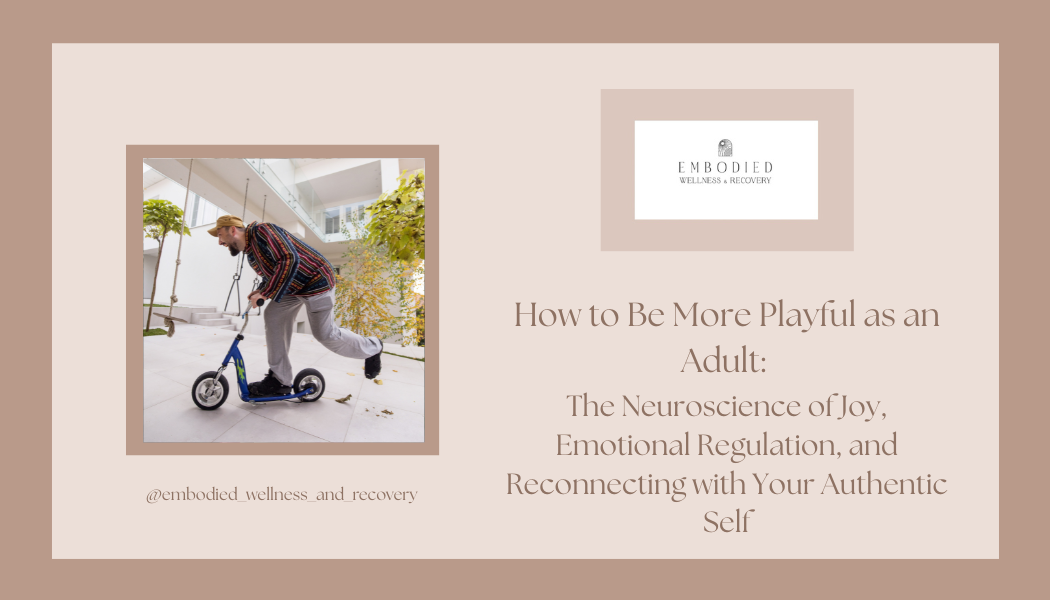
How to Be More Playful as an Adult: The Neuroscience of Joy, Emotional Regulation, and Reconnecting with Your Authentic Self
How to Be More Playful as an Adult: The Neuroscience of Joy, Emotional Regulation, and Reconnecting with Your Authentic Self
How to be playful as an adult: discover neuroscience-backed strategies to reconnect with joy, spontaneity, and emotional resilience. Learn how play supports nervous system regulation, relationships, intimacy, trauma recovery, and mental wellness.
When was the last time you laughed so hard your stomach hurt?
When did you last do something simply because it delighted you, not because it was productive, strategic, or necessary?
For many adults, playfulness feels like a luxury rather than a necessity. Somewhere between deadlines, responsibilities, caregiving, financial stress, and emotional survival, joy can start to feel frivolous. Many people begin to associate adulthood with seriousness, self-control, and constant achievement.
But what if taking yourself too seriously is actually keeping you stuck?
What if your nervous system, your relationships, your creativity, and even your healing depend on your ability to access play?
At Embodied Wellness and Recovery, we often help clients rediscover something they did not realize they had lost: the capacity for play. Through somatic therapy, EMDR, attachment work, and neuroscience-informed treatment, we see how reconnecting with playfulness can soften shame, regulate the nervous system, improve intimacy, and restore emotional vitality. Play is not childish. It is biological, and for many adults, learning how to be playful again is deeply therapeutic.
Why Adults Lose Their Sense of Play
Playfulness often disappears gradually. It happens when life is dominated by performance rather than presence. It happens when childhood environments taught you that being silly was unsafe, being emotional was embarrassing, or being spontaneous invited criticism.
For trauma survivors, especially, hypervigilance often replaces curiosity. Instead of asking, What feels fun? The nervous system asks, What keeps me safe? Instead of exploring, it monitors. Instead of relaxing, it braces.
Research from Dr. Stephen Porges’ Polyvagal Theory helps explain this. When the nervous system is stuck in chronic fight, flight, freeze, or shutdown states, play becomes neurologically inaccessible. Social engagement, laughter, spontaneity, and creative risk-taking require a sense of safety in the body (Porges, 2011).
This means that if play feels hard, it is not because you are boring. It may be because your nervous system has been working overtime trying to protect you.
The Neuroscience of Playfulness
Play activates some of the most important systems for mental and emotional health. Dr. Jaak Panksepp, a pioneer in affective neuroscience, identified PLAY as one of the brain’s primary emotional systems. Play stimulates social bonding, emotional flexibility, problem-solving, resilience, and pleasure (Panksepp, 2004).
When adults engage in playful behavior, the brain releases dopamine, which supports motivation and reward, and oxytocin, which strengthens connection and trust. Play also lowers cortisol, the body’s primary stress hormone. This means that playful activities can help reduce anxiety, improve mood, and increase emotional regulation.
From a trauma-informed perspective, play can also create corrective emotional experiences. It allows the body to experience safety, delight, and spontaneity without punishment or fear. That matters. Because many adults are not suffering from a lack of discipline. They are suffering from a lack of nervous system permission to feel alive.
Signs You May Be Taking Yourself Too Seriously
Sometimes seriousness looks responsible, but at other times it is disguised anxiety.
You may be overly serious if:
— You struggle to relax without feeling guilty
— You feel uncomfortable being silly or spontaneous
— You overthink social interactions
— You have difficulty receiving pleasure without productivity attached
— You feel embarrassed by joy, dancing, flirting, or laughter
— You interpret playfulness as immaturity
— Your relationships feel heavy, tense, or emotionally distant
Ask yourself:
Do I know how to enjoy myself without earning it?
Do I feel safe being lighthearted?
Can I tolerate laughter without self-consciousness?
These are not superficial questions. They often reveal attachment wounds, perfectionism, shame, and unresolved trauma patterns.
How to Be Playful as an Adult
Playfulness is not a personality trait reserved for extroverts. It is a skill, and like any skill, it can be practiced.
1. Start With Your Body, Not Your Mind
You cannot think your way into playfulness. Play begins in the body.
Try movement that feels non-performative:
— Dancing in your kitchen
— Walking barefoot in the grass
— Tossing a ball with your child or dog
— Swimming
— Stretching while listening to music
— Painting badly on purpose
Somatic therapy reminds us that joy often returns through sensation before cognition. Your body needs evidence that pleasure is safe. Not every moment needs optimization. Sometimes healing begins with music and sunlight.
2. Practice Micro-Moments of Delight
Many adults assume play must be dramatic. It does not.
Play often begins with tiny acts of delight:
— Ordering the dessert
— Buying fresh flowers
— Sending a ridiculous meme
— Trying a hobby you are bad at
— Laughing at your own mistakes
— Taking the scenic route home
Research on positive emotion by Barbara Fredrickson shows that small moments of joy broaden emotional resilience and improve psychological flexibility (Fredrickson, 2001). Tiny joy is still real joy. Do not underestimate it.
3. Notice Where Shame Interrupts Pleasure
Many people stop being playful because shame enters the room. You want to dance, but you feel stupid. You want to flirt, but you feel exposed. You want to laugh loudly, but you worry people will judge you. This is where deeper therapeutic work matters.
Often, playfulness is blocked by internalized messages:
“Be appropriate.”
“Do not be too much.”
“Stay in control.”
“Do not embarrass yourself.”
At Embodied Wellness and Recovery, we often use EMDR and parts workto help clients process these protective beliefs and reconnect with spontaneity without fear. Sometimes the adult who cannot play is still protecting the child who was punished for joy.
4. Choose Relationships That Welcome Lightness
Play is relational. Healthy intimacy requires not only vulnerability, but also levity. Couples who laugh together regulate together. Friendships that include teasing, humor, curiosity, and adventure often feel emotionally safer than relationships built only around crisis and seriousness.
Dr. John Gottman’s research on relationships found that shared positive affect, humor, and playful repair are strong predictors of relationship satisfaction and resilience (Gottman & Silver, 1999).
Ask yourself:
Who in my life makes me feel more alive?
Who invites softness instead of performance?
Playfulness thrives where authenticity is safe.
5. Give Yourself Permission to Be Bad at Something
Adults often avoid play because they are addicted to competence. Children play because they do not expect mastery. Adults hesitate because they do.
Take the class.
Try surfing.
Learn French badly.
Paint terribly.
Sing off-key.
Playfulness requires surrendering perfection, and perfectionism is often just fear wearing expensive clothes. Growth happens faster when shame is not driving.
Playfulness Is Not Avoidance
Being playful does not mean avoiding pain. It means refusing to let pain become your entire identity. Trauma work is serious. Grief is real. Healing requires courage, but nervous system repair also needs pleasure, novelty, laughter, and embodiment.
A life built only around survival eventually feels emotionally flat. Play restores dimension. It reminds us that we are more than our symptoms, more than our trauma history, and more than our productivity. We are human beings designed for connection, creativity, sensuality, and joy.
Joy Is a Form of Nervous System Regulation
Learning how to be playful as an adult is not about becoming frivolous. It is about becoming available to life again. It is about reclaiming access to wonder. It is about remembering that joy is not irresponsible; it is restorative.
At Embodied Wellness and Recovery, we help clients reconnect with emotional freedom through trauma-informed therapy, somatic work, EMDR intensives, and relational healing. Sometimes the work begins with grief. Sometimes it begins with boundaries.
And sometimes it begins with asking:
What used to make me feel most alive?
That question is worth answering because often, your healing is waiting there.
Reach out to schedule a complimentary 20-minute consultation with our team of therapists, trauma specialists, somatic practitioners, or relationship experts, and start working towards integrative, embodied healing today.
📞 Call us at (310) 651-8458
📱 Text us at (310) 210-7934
📩 Email us at admin@embodiedwellnessandrecovery.com
🔗 Visit us at www.embodiedwellnessandrecovery.com
👉 Check us out on Instagram @embodied_wellness_and_recovery
🌍 Explore our offerings at Linktr.ee: https://linktr.ee/laurendummit
References
1) Fredrickson, B. L. (2001). The role of positive emotions in positive psychology: The broaden and build theory of positive emotions. American Psychologist, 56(3), 218–226.
2) Gottman, J. M., & Silver, N. (1999). The seven principles for making marriage work. Crown Publishers.
3) Panksepp, J. (2004). Affective neuroscience: The foundations of human and animal emotions. Oxford University Press.
4) Porges, S. W. (2011). The polyvagal theory: Neurophysiological foundations of emotions, attachment, communication, and self-regulation. W. W. Norton & Company.
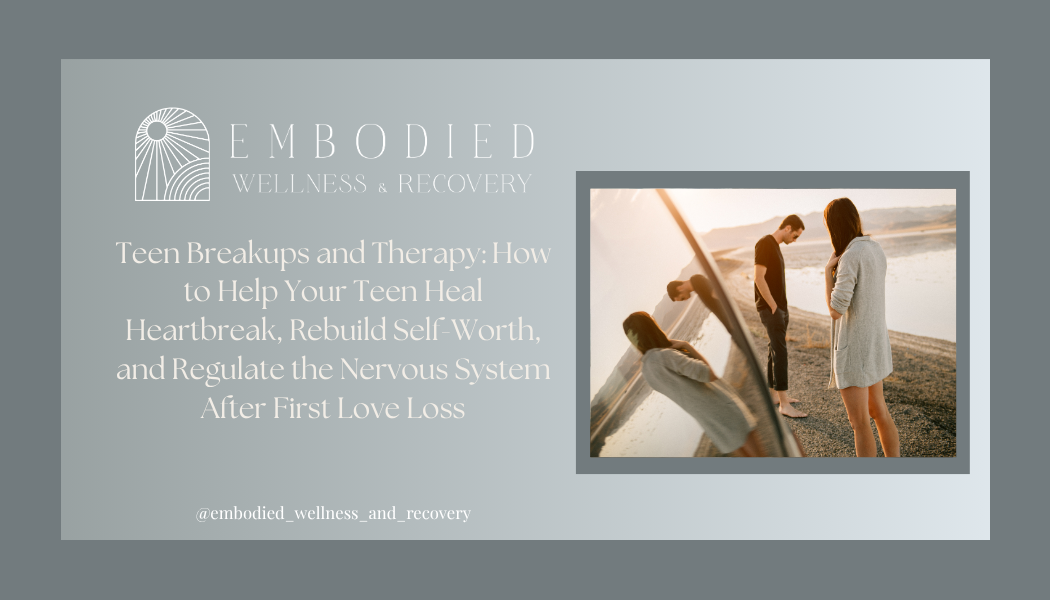
Teen Breakups and Therapy: How to Help Your Teen Heal Heartbreak, Rebuild Self-Worth, and Regulate the Nervous System After First Love Loss
Teen Breakups and Therapy: How to Help Your Teen Heal Heartbreak, Rebuild Self-Worth, and Regulate the Nervous System After First Love Loss
Is your teen devastated after a breakup? Learn how therapy helps teens process heartbreak, regulate emotions, rebuild confidence, and heal attachment wounds after first love and relationship loss.
For many teens, a breakup is not “just puppy love.” It can feel like the first major emotional loss of their lives.
As a parent, watching your teen move through heartbreak can be excruciating. Maybe they are crying in their room, obsessively checking social media, unable to sleep, skipping meals, losing motivation, or spiraling into self-doubt. Maybe they are acting angry, shut down, or pretending not to care, while their body tells a different story.
You may be asking yourself:
— How do I help my teenager cope with a breakup without minimizing their pain?
— Is this level of sadness normal, or should I be worried?
— Why does my teen seem so dysregulated after the relationship ended?
— Why are they obsessing over texts, posts, and what their ex is doing?
— How can therapy help a teen heal after their first heartbreak?
— What if this breakup is triggering deeper anxiety, depression, or self-esteem wounds?
These questions matter.
At Embodied Wellness and Recovery, we help teens and families navigate breakups through a trauma-informed, neuroscience-based, somatic therapy lens, supporting emotional regulation, self-worth repair, and healthy relationship development during one of adolescence’s most painful rites of passage.
Why Breakups Hit Teens So Hard
A teen breakup often feels like a nervous system emergency. Adolescence is a developmental period during which the brain is still wiring for emotional regulation, reward sensitivity, and identity formation. Research shows the adolescent limbic system, especially the amygdala and reward circuitry, is highly reactive, while the prefrontal cortex, responsible for perspective and impulse control, is still developing (Casey et al., 2008).
This means heartbreak can feel:
— All-consuming
— Physically painful
— Identity-shaking
— Socially catastrophic
— Impossible to imagine surviving
When teens say:
— I’ll never get over this
— No one will ever love me again
— My life is over
— I feel sick
— I can’t stop thinking about them
They are not being dramatic. Their nervous system is experiencing real attachment loss. Neuroscience research even suggests romantic rejection activates some of the same pain pathways involved in physical pain (Kross et al., 2011). The heartbreak is happening in the brain and the body.
What Teen Heartbreak May Look Like
Not all teens cry openly.
Breakup pain can show up as:
— Obsessive texting or checking social media
— Panic about what the ex is doing
— Appetite changes
— Sleep disruption
— Irritability
— Rage
— Isolation
— Academic decline
— Loss of confidence
— Shame about being rejected
— Body image distress
— Risky behavior
— Rebound dating
— Depression symptoms
— Hopeless thoughts
Forteens with pre-existing:
— Trauma
— Anxiety
— ADHD
— Rejection sensitivity
A breakup may activate much deeper emotional material. This is where therapy can become especially important.
How Therapy Helps Teens Cope with Breakups
The goal is not to “help them get over it fast.” The goal is to help them process the emotional experience in a way that strengthens resilience, self-trust, and relational health.
1) Naming the grief without minimizing it
Many teens hear versions of:
— You’re young
— There are plenty of fish in the sea
— It was not serious anyway
— You’ll laugh about this later
Even when well-intended, this can increase shame. Therapy helpsteens understand that breakup griefis a valid attachment loss. Naming the experience as grief reduces confusion and helps the brain organize what feels chaotic.
2) Regulating the nervous system after rejection
Breakups can push teens into:
—Sympathetic hyperarousal→ panic, rumination, compulsive checking
— Dorsal shutdown → numbness, hopelessness, social withdrawal
Somatic and neuroscience-informed therapy helps teens learn:
— Paced breathing
— Distress tolerance
— Urge surfing around texting/social media
— Body-based emotional regulation
— Sleep repair
— Movement-based discharge of grief and anger
This is particularly effective for teens whose bodies feel hijacked by heartbreak.
3) Rebuilding self-worth after rejection
A breakup often gets translated into:
— I am not enough
— Something is wrong with me
— I was too much
— I was not attractive enough
— No one will choose me
Therapy helps teens separate relationship loss from identity collapse. This is where self-esteem work, attachment-based reflection, and body image support become central.
At Embodied Wellness and Recovery, we help teens rebuild confidence through:
— Self-worth interventions
— Shame resilience
— Identity development
— Healthy relational boundaries
— Social media reality testing
4) Helping parents support without overstepping
Parents often feel helpless. Should you comfort them? Give advice? Set phone limits? Encourage distraction?Let them stay home from school?
Therapy helps families find the balance between:
— Emotional validation
— Structure
— Sleep and nutrition support
— Social reconnection
— Reduced social media retraumatization
Sometimes the most powerful parental response is: calm presence without problem-solving too quickly.
5) Preventing long-term relationship wounds
One of the most important reasons therapy matters is that the first heartbreak can shape future attachment patterns.
Without support, teens may begin to form beliefs like:
— Love is unsafe
— Vulnerability leads to humiliation
— I need to cling harder
— I should never need anyone
— People always leave
— I must perform to be loved
These beliefs can follow them into adult relationships.
Therapy helps transform heartbreak into:
— Emotional intelligence
— Secure attachment skills
— Better boundaries
— Insight into red flags
— Improved communication
— Resilience after rejection
— Healthier future partner selection
Research on adolescent relationships suggests that early romantic experiences shape later relationship expectations and attachment templates (Furman & Shaffer, 2003).
When to Seek Therapy Quickly
Consider therapy sooner if your teen is showing:
— Severe appetite loss
— Insomnia
— Hopelessness
— School refusal
— Social isolation
— Self-harm urges
— Substance use
— Fixation on the ex
— Humiliation after a public breakup or online betrayal
— Trauma history that the breakup may be reactivating
The breakup may be the visible event, but therapy often uncovers deeper wounds.
Helping Heartbreak Become Growth
A breakup can become more than pain.
With the right support, it can become a developmental turning point where your teen learns:
— How to tolerate grief
— How to regulate rejection
— How to maintain self-worth
— How to trust their body
— How to choose healthier partners
— How to communicate needs
— How to recover from loss without losing identity
At Embodied Wellness and Recovery, we specialize in helping teens process heartbreak through somatic therapy, attachment repair, nervous system regulation, and trauma-informed psychotherapy, so the experience strengthens emotional resilience rather than becoming a blueprint for future relational fear. Sometimes the first heartbreak is also the first opportunity to learn what healthy love, grief, and recovery can look like.
Reach out to schedule a complimentary 20-minute consultation with our team of therapists, trauma specialists, somatic practitioners, or relationship experts, and start working towards integrative, embodied healing today.
📞 Call us at (310) 651-8458
📱 Text us at (310) 210-7934
📩 Email us at admin@embodiedwellnessandrecovery.com
🔗 Visit us at www.embodiedwellnessandrecovery.com
👉 Check us out on Instagram @embodied_wellness_and_recovery
🌍 Explore our offerings at Linktr.ee: https://linktr.ee/laurendummit
References
1) Casey, B. J., Jones, R. M., & Hare, T. A. (2008). The adolescent brain. Annals of the New York Academy of Sciences, 1124(1), 111-126.
2) Furman, W., & Shaffer, L. (2003). The role of romantic relationships in adolescent development. Adolescent romantic relations and sexual behavior, 3-22.
3) Kross, E., Berman, M. G., Mischel, W., Smith, E. E., & Wager, T. D. (2011). Social rejection shares somatosensory representations with physical pain. Proceedings of the National Academy of Sciences, 108(15), 6270-6275.
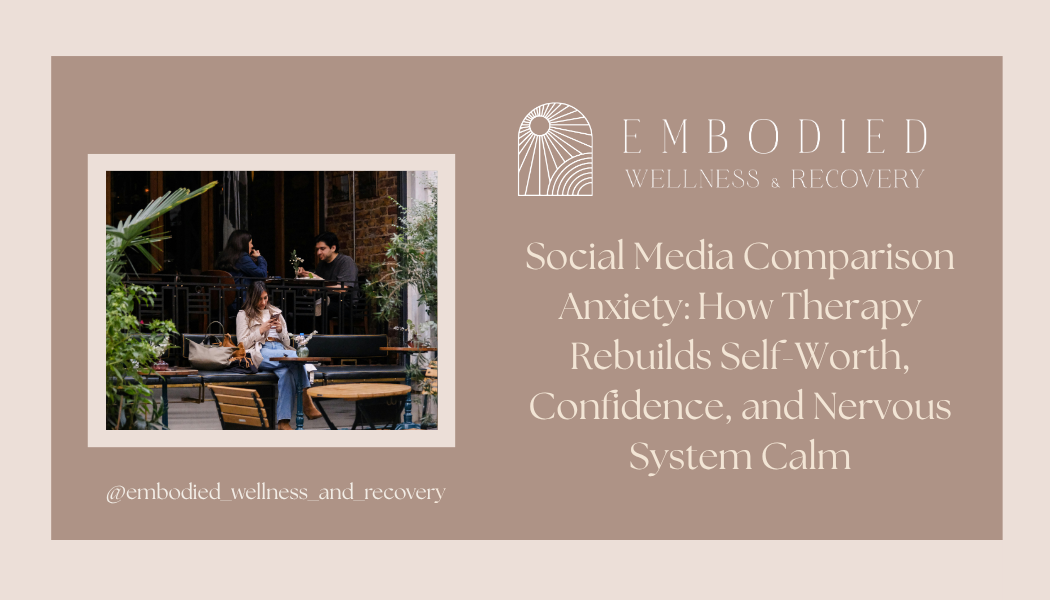
Social Media Comparison Anxiety: How Therapy Rebuilds Self-Worth, Confidence, and Nervous System Calm
Social Media Comparison Anxiety: How Therapy Rebuilds Self-Worth, Confidence, and Nervous System Calm
Struggling with anxiety, low self-worth, or self-doubt after scrolling social media? Learn how anxiety therapy, somatic healing, and neuroscience-informed strategies can help reduce comparison anxiety, rebuild confidence, and restore nervous system regulation.
How many times have you opened Instagram, TikTok, or Facebook for “just a minute,” only to walk away feeling smaller? Smaller than someone else’s body. Smaller than someone else’s success.Smaller than someone else’s relationship. Smaller than someone else’s parenting, confidence, home, vacation, or seemingly effortless joy. In a world of curated perfection, it is easy for the nervous system to interpret someone else’s highlight reel as evidence that you are falling behind.
Do you find yourself asking:
— Why does everyone else seem happier than I am?
— Why do I feel anxious after scrolling?
— Why does social media make me question my looks, career, relationship, or worth?
— Why does comparison trigger such a fast collapse in confidence?
— Why do I intellectually know it’s curated, yet still feel emotionally impacted?
These are some of the most common questions people bring into anxiety therapy for social media comparison, and they reveal something deeper than insecurity.
This is often about nervous system threat, attachment wounds, shame, and the brain’s comparison circuitry.
At Embodied Wellness and Recovery, we help clients understand how social media comparison anxiety affects the brain and body, and we offer somatic, neuroscience-informed therapy that restores self-worth, emotional regulation, and relational security.
Why Social Media Comparison Triggers Anxiety
The human brain is wired for social ranking, belonging, and threat detection.
From an evolutionary perspective, our brains constantly scan for cues that tell us:
— Am I safe?
— Do I belong?
— Am I enough?
— Am I accepted by the group?
Social media intensifies these ancient survival systems by giving the brain thousands of rapid-fire opportunities to compare. Research on social comparison theory suggests that repeated upward comparison, comparing yourself to people you perceive as more attractive, successful, or fulfilled, can significantly increase anxiety, depressive symptoms, and reduced self-esteem (Vogel et al., 2014).
What begins as passive scrolling can quickly become:
— Anxiety after Instagram
— Body image anxiety
— Fear of missing out (FOMO)
— Career comparison stress
— Loneliness
— Emotional reactivity
For people with trauma histories or attachment wounds, these effects can be even more pronounced.
The Neuroscience of Comparison Anxiety
Social media comparison not only affects thoughts. It affects the nervous system. The brain’s amygdala, which detects emotional threat, can interpret comparisons as a form of social danger.
When the brain perceives:
— Exclusion
— Inferiority
— Rejection
— Not-enoughness
…it may activate a stress response similar to that elicited by interpersonal threat.
At the same time, dopamine-driven reward loops keep the cycle going. Variable social rewards, likes, comments, views, and validation, reinforce compulsive checking behaviors and heighten emotional dependence on external approval. Neuroscience research suggests that social rejection and negative comparison activate some of the same neural pain pathways involved in physical pain (Eisenberger, 2012). This is why social media comparison can feel visceral. The tight chest.The sinking stomach.The sudden shame.The collapse in confidence.The urge to withdraw. These are body-based anxiety responses, not just “overthinking.”
Why Low Self-Worth Makes Comparison Worse
If you already struggle with:
— Perfectionism
— Trauma
— Shame
— Rejection sensitivity
Social media comparison often lands on preexisting emotional bruises.
The feed becomes a mirror for old narratives:
— I’m not enough
— I’m behind
— I’m less lovable
— My life should look different
— Everyone else figured it out
— I have to perform to matter
This is where therapy becomes transformative. The issue is rarely just the app. The issue is how the app interacts with stored beliefs, attachment templates, nervous system conditioning, and unresolved shame.
How Anxiety Therapy Helps Reduce Social Media Comparison
Effective anxiety therapy for social media comparison focuses on both the brain and the body.
At Embodied Wellness and Recovery, we use a neuroscience-informed and somatic approach to help clients:
1) Identify the deeper trigger
What exactly gets activated?
— Body image shame?
— Fear of abandonment?
— Financial insecurity?
— Loneliness?
— Grief over life not matching expectations?
The comparison is often a doorway into the deeper wound.
2) Regulate the nervous system
Therapy teaches the body how to return to a state of safety after activation.
This may include:
— Grounding skills
— Breathwork
— Orienting
— Vagal regulation
— Media boundaries
As the nervous system becomes more regulated, the emotional charge of comparison decreases.
3) Rewire internal worth
Research on self-compassion suggests that strengthening internal validation reduces the impact of social comparison and improves emotional resilience (Neff, 2003).
Instead of asking, “How do I measure up?” therapy helps shift toward:“What is true for me?”What matters to my values?” ‘What actually nourishes my life?”
4) Heal attachment wounds
For many clients, social media comparison activates deeper relational fears.
Questions like:
— Why am I still single?
— Why does everyone else seem desired?
— Why does my relationship not look like theirs?
— Why do I feel threatened by my partner’s online interactions?
These concerns often reflect attachment insecurity, relational trauma, and unmet needs for emotional safety.
This is one of the reasons our work at Embodied Wellness and Recovery integrates relationships, sexuality, intimacy, and trauma healing into anxiety treatment.
What a Regulated Relationship with Social Media Looks Like
The goal is not necessarily deleting every app. The goal is developing enough self-worth, emotional regulation, and nervous system flexibility that social media no longer dictates your value.
A healthier relationship with social media may look like:
— Scrolling without spiraling
— Noticing activation sooner
— Pausing before self-judgment
— Feeling happy for others without self-attack
— Staying connected to your own timeline
— Using media intentionally rather than compulsively
— Protecting your nervous system with boundaries
— Choosing real-life connection over digital validation
This is what therapy helps restore: inner steadiness in the face of external noise.
When Social Media Comparison Is Really About Trauma
For some people, comparison anxiety is a trauma response.
Trauma can sensitize the brain toward hypervigilance, rejection sensitivity, and identity instability.
When this happens, every post can feel like evidence that:
— You are unsafe
— You are excluded
— You are undesirable
— You are failing
— You are losing time
This is why somatic trauma therapy, EMDR, attachment work, and nervous system repair can be profoundly effective for comparison-based anxiety.
At Embodied Wellness and Recovery, we help clients heal the deeper roots of anxiety, whether it shows up in social media, relationships, sexuality, perfectionism, or self-worth. Your peace should never be at the mercy of someone else’s curated feed.
From Digital Comparison to Embodied Confidence
Social media comparison anxiety is not vanity. It is often a convergence of brain circuitry, attachment wounds, trauma, shame, and nervous system activation. Therapy can help you move from reactivity to reflection, from self-judgment to self-trust, and from digital comparison to embodied confidence. When the nervous system learns safety, your sense of worth no longer rises and falls with the algorithm.
At Embodied Wellness and Recovery, our anxiety therapy integrates neuroscience, somatic healing, trauma repair, and relational work to help clients rebuild confidence, emotional regulation, and deeper inner peace.
Reach out to schedule a complimentary 20-minute consultation with our team of therapists, trauma specialists, somatic practitioners, or relationship experts, and start working towards integrative, embodied healing today.
📞 Call us at (310) 651-8458
📱 Text us at (310) 210-7934
📩 Email us at admin@embodiedwellnessandrecovery.com
🔗 Visit us at www.embodiedwellnessandrecovery.com
👉 Check us out on Instagram @embodied_wellness_and_recovery
🌍 Explore our offerings at Linktr.ee: https://linktr.ee/laurendummit
References
1) Eisenberger, N. I. (2012). The neural bases of social pain: Evidence for shared representations with physical pain. Psychosomatic Medicine, 74(2), 126-135.
2) Neff, K. D. (2003). Self-compassion: An alternative conceptualization of a healthy attitude toward oneself. Self and Identity, 2(2), 85-101.
3) Vogel, E. A., Rose, J. P., Roberts, L. R., & Eckles, K. (2014). Social comparison, social media, and self-esteem. Psychology of Popular Media Culture, 3(4), 206-222.