
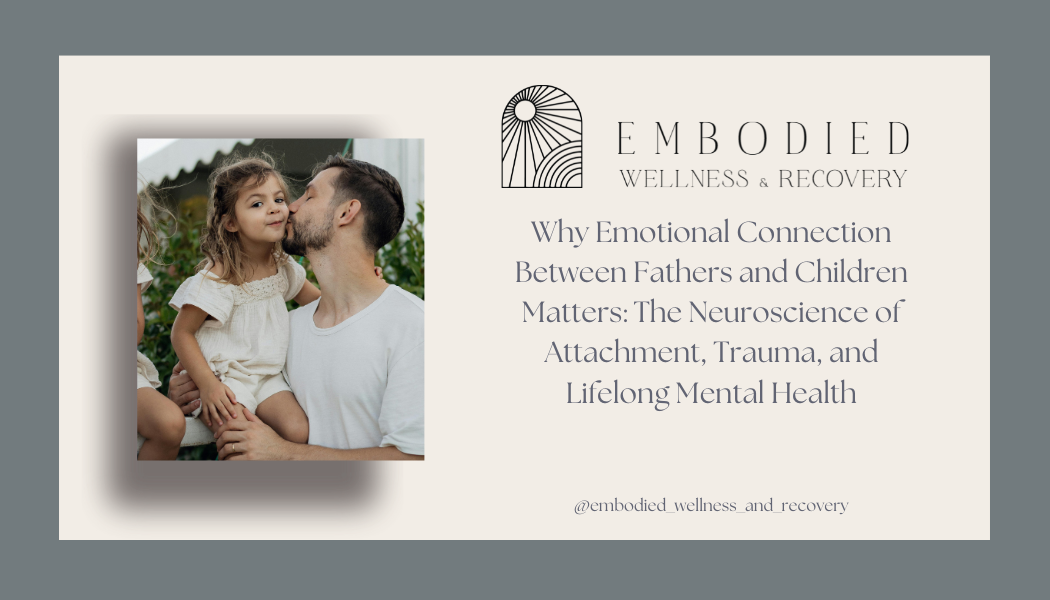
Why Emotional Connection Between Fathers and Children Matters: The Neuroscience of Attachment, Trauma, and Lifelong Mental Health
Why Emotional Connection Between Fathers and Children Matters: The Neuroscience of Attachment, Trauma, and Lifelong Mental Health
How does a father's emotional connection shape a child's brain and relationships? Discover the neuroscience of father-child attachment, the effects of emotional distance, and how healing is possible at any stage of life through secure relationships and nervous system regulation.
A father can provide for his family financially, attend every sporting event, and make sure the bills are paid, yet his child may still grow up feeling emotionally unseen. Conversely, a father who is consistently curious, emotionally available, and engaged can profoundly shape a child's sense of safety, self-worth, and resilience.
If you grew up with an emotionally distant father, you may find yourself asking:
— Why do I struggle to trust people?
— Why do I constantly seek approval or validation?
— Why do I feel uncomfortable expressing emotions?
— Why do I crave closeness but fear rejection?
— Why do I choose emotionally unavailable partners?
— Why do I still long for something I never received?
These questions are not signs of weakness. They often reflect the enduring influence of early attachment experiences and the ways our nervous systems adapt to relational environments.
Fathers Shape More Than Childhood Memories
Historically, research focused heavily on mothers and early attachment. Today, developmental science demonstrates that fathers play a unique and significant role in children's emotional, cognitive, and social development. Children do not simply benefit from a father's physical presence.
They benefit from emotional presence. Feeling seen, comforted, encouraged, and accepted by a father can become part of the internal blueprint that guides future relationships.
Emotional Connection Helps Build the Developing Brain
Secure relationships help organize the developing nervous system.
When children experience responsive caregiving, their brains repeatedly learn:
— My emotions matter.
— Someone will help me when I am distressed.
— Relationships are safe.
— I can depend on others.
— I am worthy of care.
These repeated experiences strengthen emotional regulation, stress tolerance, and secure attachment. Over time, children internalize these interactions and begin regulating themselves more effectively.
When Emotional Distance Becomes the Norm
Some fathers deeply love their children but struggle to express affection due to their own upbringing, cultural expectations, trauma histories, depression, anxiety, or emotional suppression. Children rarely interpret this complexity accurately.
Instead, they may conclude:
— I'm too much.
— My feelings don't matter.
— I have to earn love.
— I shouldn't need anyone.
— Vulnerability is dangerous.
These beliefs often persist into adulthood unless intentionally examined.
The Nervous System Learns Relationships Through Experience
From a neuroscience perspective, attachment experiences influence how the brain predicts safety and connection. An emotionally attuned father can help regulate a child's stress response by providing reassurance, warmth, and consistency. When emotional attunement is missing, the child may become chronically vigilant, emotionally withdrawn, or excessively independent. These adaptations often make perfect sense in the context of early experiences.
Emotional Availability Is More Important Than Perfection
Children do not require flawless parents. They benefit from caregivers who notice their emotions, repair misunderstandings, and communicate genuine interest in their inner worlds.
Simple interactions matter:
— Listening without immediately solving.
— Validating disappointment.
— Offering physical affection when welcomed.
— Admitting mistakes.
— Returning after conflict to reconnect.
These moments teach children that relationships can survive imperfection.
How Father Wounds Can Influence Adult Relationships
Adults who lacked emotional connection with a father sometimes notice recurring patterns such as:
— Fear of abandonment
— Attraction to emotionally unavailable partners
— Difficulty setting boundaries
— Avoidance of vulnerability
— Excessive self-reliance
— Anxiety in close relationships
These patterns are not destiny. They often represent adaptive strategies learned early in life.
Sons and Daughters Are Both Affected
While experiences vary across families, emotionally engaged fathers contribute positively to children of all genders. Research has linked paternal warmth and involvement with improved emotional regulation, stronger self-esteem, better academic functioning, and healthier interpersonal relationships. The essential ingredient is not gender. It is connection.
Fathers Teach Emotional Literacy
Many adults grew up hearing messages like:
"Be tough."
"Stop crying."
"Get over it."
Although often well-intentioned, these messages can disconnect children from their emotional experiences. When fathers instead model emotional awareness, accountability, and empathy, children learn that strength includes the capacity to identify and express feelings.
Trauma Can Be Intergenerational
Emotionally distant fathers are not necessarily uncaring fathers. Some grew up in environments where emotional expression was discouraged or unsafe. Others experienced trauma that limited their own capacity for connection. Understanding these histories does not excuse harmful behavior, but it can create space for compassion and interrupt intergenerational patterns.
Can Adults Heal From Father Wounds?
Absolutely. The brain remains capable of change throughout life. Corrective emotional experiences in therapy, healthy friendships, romantic relationships, mentorships, and parenting can reshape expectations about safety and attachment. Healing often involves recognizing that the unmet needs of childhood deserve acknowledgment rather than dismissal. It also involves learning that emotional closeness can feel unfamiliar without being dangerous.
What Fathers Can Do Today
If you are a father, your greatest influence may not come from providing answers. It may come from providing presence. Ask questions. Stay curious. Repair after conflict. Make eye contact. Listen without immediately fixing. Tell your child you are proud of them for who they are, not only for what they accomplish. Small moments of emotional attunement accumulate into lifelong memories.
How Embodied Wellness and Recovery Can Help
At Embodied Wellness and Recovery, we understand that early relationships with caregivers. including fathers, shape the nervous system, attachment patterns, self-concept, and future intimacy. Experiences of emotional neglect or disconnection can influence mental health, relationships, sexuality, and the ability to feel safe with others long into adulthood.
Our clinicians integrate somatic therapy, EMDR, attachment-focused psychotherapy, and neuroscience-informed care to help individuals process relational wounds, strengthen emotional regulation, and cultivate healthier patterns of connection. We specialize in trauma, nervous system repair, relationships, sexuality, and intimacy, supporting clients in creating new experiences of trust and belonging that extend beyond their earliest family dynamics.
The presence of an emotionally connected father does not guarantee a perfect life. But the experience of feeling seen, soothed, valued, and understood can become a powerful foundation for resilience, secure attachment, and meaningful relationships throughout the lifespan.
Reach out to schedule a complimentary 20-minute consultation with our team of therapists, trauma specialists, somatic practitioners, or relationship experts, and start working towards integrative, embodied healing today.
📞 Call us at (310) 651-8458
📱 Text us at (310) 210-7934
📩 Email us at admin@embodiedwellnessandrecovery.com
🔗 Visit us at www.embodiedwellnessandrecovery.com
👉 Check us out on Instagram @embodied_wellness_and_recovery
🌍 Explore our offerings at Linktr.ee: https://linktr.ee/laurendummit
References
Grossmann, K., Grossmann, K. E., Kindler, H., & Zimmermann, P. (2008). A wider view of attachment and exploration: Stability and change during the years of immaturity. In J. Cassidy & P. R. Shaver (Eds.), Handbook of attachment: Theory, research, and clinical applications (2nd ed., pp. 857-879). Guilford Press.
Lamb, M. E. (2010). The role of the father in child development (5th ed.). Wiley.
Porges, S. W. (2011). The polyvagal theory: Neurophysiological foundations of emotions, attachment, communication, and self-regulation. W. W. Norton & Company.
Siegel, D. J., & Bryson, T. P. (2020). The power of showing up: How parental presence shapes who our kids become and how their brains get wired. Ballantine Books.
Sroufe, L. A. (2005). Attachment and development: A prospective, longitudinal study from birth to adulthood. Attachment & Human Development, 7(4), 349-367.
Authenticity Anxiety: Why Being Your True Self Feels Both Liberating and Scary (And What Neuroscience Reveals About the Fear of Rejection)
Authenticity Anxiety: Why Being Your True Self Feels Both Liberating and Scary (And What Neuroscience Reveals About the Fear of Rejection)
Why does being authentic feel so vulnerable? Learn the neuroscience behind authenticity, fear of rejection, people-pleasing, and self-expression. Discover how nervous system regulation, attachment healing, and self-trust can help you live more authentically and build deeper relationships.
The Paradox of Authenticity
Most people say they want to be authentic. They want to express their true thoughts, feelings, values, preferences, needs, and desires without constantly worrying about what others think. Yet when the opportunity arises to actually be authentic, many people experience anxiety.
Their stomach tightens. Their heart races. They hesitate. They second-guess themselves.
They wonder:
— What if people don't like the real me?
— What if I disappoint someone?
— What if I lose the relationship?
— What if I am judged?
— What if people think I'm selfish?
— What if being myself pushes people away?
Authenticity is often described as freedom. And it is, but authenticity can also feel frightening. In fact, from a neuroscience and attachment perspective, there are good reasons why being your true self may feel both liberating and terrifying at the same time.
Why Authenticity Feels So Good
Authenticity is often associated with psychological well-being, life satisfaction, self-esteem, and healthier relationships. Research suggests that individuals who experience greater authenticity tend to report higher levels of well-being, stronger interpersonal relationships, and greater emotional resilience (Wood et al., 2008).
Why?
Because authenticity reduces the exhausting burden of managing multiple versions of yourself.
When you are authentic:
— You spend less energy performing.
— You experience greater self-trust.
— Your relationships become more genuine.
— You feel more aligned with your values.
— Emotional intimacy becomes possible.
There is a profound relief that comes from no longer constantly asking:
"Who do I need to be for everyone else?"
Instead, authenticity allows you to ask:
"Who am I?"
Why Authenticity Feels So Scary
If authenticity feels healthy, why does it create so much anxiety? The answer often lies in our evolutionary history. Human beings evolved in groups. Belonging increased the likelihood of survival. Rejection threatened it.
Research has demonstrated that social rejection activates many of the same neural networks associated with physical pain (Eisenberger et al., 2003). The brain does not treat rejection as a minor inconvenience. It often experiences it as a threat. When authenticity carries even a small possibility of rejection, the nervous system may respond accordingly.
The fear is not simply:
"What if they disagree?"
The deeper fear is often:
"What if I lose connection?"
The Attachment Roots of Authenticity Anxiety
For many people, authenticity was not consistently welcomed during childhood. Perhaps expressing emotions resulted in criticism. Maybe setting boundaries led to punishment. Perhaps individuality was discouraged. Some children learn that acceptance depends upon compliance. Others learn that love feels safer when they prioritize other people's needs over their own.
Over time, they develop strategies designed to preserve connection:
— Perfectionism
— Caretaking
— Conflict avoidance
— Emotional suppression
— Shape-shifting to fit different environments
These strategies often begin as adaptive responses. The problem occurs when they continue long after the original circumstances have changed. Adults may find themselves automatically prioritizing acceptance over authenticity.
When Being Liked Becomes More Important Than Being Known
Many people spend years becoming highly skilled at being liked. They become agreeable, helpful, accommodating, easy-going, adaptable, yet beneath these qualities may be a painful question:
"Would people still choose me if they knew what I really think, feel, want, or need?"
This question sits at the heart of authenticity anxiety. Because being liked and being known are not always the same thing. Someone can like a carefully edited version of you. True intimacy requires something deeper. It requires being seen, and being seen always involves vulnerability.
The Neuroscience of Self-Censorship
The brain constantly evaluates social safety. When authenticity feels risky, the nervous system may activate protective responses.
You might:
— Stay silent instead of speaking up.
— Agree when you actually disagree.
— Hide preferences.
— Avoid setting boundaries.
— Minimize your accomplishments.
— Suppress emotions.
— Avoid difficult conversations.
From the outside, these behaviors may appear harmless.
Internally, however, chronic self-censorship often creates:
— Anxiety
— Resentment
— Emotional exhaustion
— Identity confusion
— Relationship dissatisfaction
— Disconnection from self
Over time, many people begin feeling disconnected not only from others, but from themselves.
Authenticity Does Not Mean Oversharing
One common misconception is that authenticity requires complete transparency. It does not. Healthy authenticity involves discernment.
Being authentic does not mean:
— Sharing every thought
—Ignoring boundaries
— Being impulsively honest
— Expressing emotions without regulation
Authenticity means your external behavior is increasingly aligned with your internal reality. You can be authentic and private, authentic and professional, authentic and boundaries. Authenticity is not about saying everything. It is about not abandoning yourself.
The Hidden Cost of Inauthenticity
Many individuals become so focused on avoiding rejection that they rarely consider the cost of self-abandonment. When authenticity is repeatedly sacrificed, people often experience:
Chronic Anxiety
Monitoring and managing how others perceive you requires constant vigilance.
Resentment
When personal needs are consistently ignored, frustration often follows.
Emotional Numbness
Suppressing unwanted emotions frequently suppresses desired emotions as well.
Relationship Dissatisfaction
Relationships cannot become deeply intimate when significant portions of the self remain hidden.
Loss of Identity
Many people eventually wonder:
"Who am I when I'm not trying to please everyone else?"
How to Become More Authentic Without Overwhelming Your Nervous System
Authenticity does not require a dramatic transformation. For many individuals, it develops gradually.
1. Start Small
Practice expressing low-risk preferences.
Examples include:
— Choosing the restaurant
— Declining an invitation
— Asking for what you need
Small moments of authenticity create new experiences of safety.
2. Notice Where You Shape-Shift
Pay attention to situations where you automatically become someone different.
Ask:
— What am I afraid will happen if I am fully myself?
— What am I protecting?
— Whose approval am I seeking?
Awareness often precedes change.
3. Regulate Before Expressing
Authenticity becomes easier when the nervous system feels safe.
Helpful somatic practices include:
— Slow breathing
— Movement
— Self-touch practices such as placing a hand on your heart
Regulation helps reduce fear-based decision-making.
4. Build Relationships That Welcome Authenticity
Healthy relationships allow room for differences. They tolerate disagreement. They support boundaries. They encourage individuality. A relationship that requires you to consistently abandon yourself is not asking for connection. It is asking for compliance.
5. Expect Some Discomfort
Many people assume authenticity should feel immediately empowering. Often it feels vulnerable first. That vulnerability is not evidence you are doing something wrong. It may simply mean you are practicing something unfamiliar.
The Role of Trauma and the Nervous System
At Embodied Wellness and Recovery, we frequently see authenticity struggles rooted in trauma, attachment wounds, and nervous system dysregulation. Many individuals learned early in life that authenticity carried risks. As a result, their nervous systems became organized around adaptation, approval-seeking, and self-protection.
Through trauma-informed therapy, EMDR, somatic psychology, attachment-focused work, and nervous system regulation, people can begin developing greater capacity for self-expression, emotional honesty, and self-trust. Authenticity becomes less frightening when the nervous system learns that connection and self-expression do not have to be mutually exclusive.
Developing Self-Trust
Authenticity often feels liberating because it allows you to live in alignment with who you truly are. It often feels scary because it risks exposing you to judgment, disappointment, or rejection. Both experiences can exist simultaneously. The goal is not to eliminate fear. The goal is to develop enough self-trust that fear no longer determines your choices.
The question is not whether everyone will like the authentic version of you. The question is whether you are willing to build a life and relationships that allow the real you to exist. That is where genuine connection begins.
Reach out to schedule a complimentary 20-minute consultation with our team of therapists, trauma specialists, somatic practitioners, or relationship experts, and start working towards integrative, embodied healing today.
📞 Call us at (310) 651-8458
📱 Text us at (310) 210-7934
📩 Email us at admin@embodiedwellnessandrecovery.com
🔗 Visit us at www.embodiedwellnessandrecovery.com
👉 Check us out on Instagram @embodied_wellness_and_recovery
🌍 Explore our offerings at Linktr.ee: https://linktr.ee/laurendummit
References
1) Eisenberger, N. I., Lieberman, M. D., & Williams, K. D. (2003). Does rejection hurt? An fMRI study of social exclusion. Science, 302(5643), 290-292.
2) Neff, K. D. (2011). Self-compassion: The proven power of being kind to yourself. William Morrow.
3) Porges, S. W. (2011). The polyvagal theory: Neurophysiological foundations of emotions, attachment, communication, and self-regulation. W.W. Norton & Company.
4) Siegel, D. J. (2020). The developing mind: How relationships and the brain interact to shape who we are (3rd ed.). Guilford Press.
5) Wood, A. M., Linley, P. A., Maltby, J., Baliousis, M., & Joseph, S. (2008). The authentic personality: A theoretical and empirical conceptualization and the development of the Authenticity Scale. Journal of Counseling Psychology, 55(3), 385-399.
The Lost Art of Listening: 5 Neuroscience-Backed Ways to Re-Tune Your Ears for Deeper Connection, Better Relationships, and a More Meaningful Life
The Lost Art of Listening: 5 Neuroscience-Backed Ways to Re-Tune Your Ears for Deeper Connection, Better Relationships, and a More Meaningful Life
Are we losing the ability to listen? Discover the neuroscience of conscious listening, how noise, technology, stress, and trauma impact attention, and five powerful ways to improve listening skills, strengthen relationships, and reconnect with the world around you.
When was the last time you truly listened?
Not waiting for your turn to speak.
Not checking your phone.
Not mentally rehearsing a response.
Not half-listening while scrolling, driving, working, or multitasking.
Just listening.
If that question gives you pause, you are not alone in the experience.
Research suggests that we spend approximately 60% of our communication time listening, yet we retain only about 25% of what we hear (Nichols, 1961). In a world saturated with notifications, podcasts, social media feeds, advertisements, emails, texts, headlines, and constant noise, listening has become one of the most overlooked skills in modern life.
And the consequences extend far beyond missed information. Poor listening affects relationships, intimacy, emotional connection, workplace communication, conflict resolution, parenting, and even mental health. Many people today feel profoundly disconnected despite being more digitally connected than ever. Could part of the problem be that we are no longer listening?
The Modern Epidemic of Noise
Take a moment to consider the sheer volume of information your brain processes each day. Your phone vibrates. Emails arrive. News alerts appear. Social media platforms compete for your attention. Televisions play in waiting rooms. Music streams in stores. Podcasts fill quiet moments. Conversations occur while multitasking.
Our nervous systems rarely experience silence. The result is what researchers call cognitive overload. The brain evolved to process information selectively. Yet modern environments bombard us with more auditory and visual stimulation than previous generations could have imagined. This constant stimulation has consequences. Listening requires attention. Attention requires energy. And energy is finite.
When the brain becomes overwhelmed, listening quality declines. We hear words without absorbing meaning. We respond without understanding. We become physically present but psychologically absent.
Why Listening Matters More Than Ever
Listening is not merely a communication skill. It is a relationship skill. It is an emotional regulation skill. It is a nervous system skill.
At its core, listening communicates:
"You matter."
"I want to understand."
"Your experience is important."
Research in attachment theory suggests that feeling heard and understood is a foundational element of emotional safety (Feeley, 2023). In romantic relationships, friendships, families, and therapeutic settings, people are often less concerned with whether someone agrees and more concerned with whether someone genuinely understands.
Listening creates connection. Listening builds trust. Listening regulates the nervous system. Listening strengthens intimacy. Yet many of us are losing the capacity for sustained attention. We have become accustomed to sound bites rather than conversations.
Personal broadcasting often replaces genuine dialogue. We speak more. We listen less. And many people feel increasingly lonely because of it.
The Neuroscience of Listening
Listening is far more complex than simply hearing sounds. Hearing is passive. Listening is active. Effective listening requires coordination between multiple brain regions involved in attention, emotional regulation, language processing, empathy, and memory.
The prefrontal cortex helps sustain attention. The limbic system helps interpret emotional meaning. Mirror neuron systems contribute to empathy and social understanding. When we listen deeply, we are engaging complex neural networks that support human connection. Interestingly, chronic stress and trauma can interfere with listening. When the nervous system perceives threat, attention narrows toward survival.
People become more focused on self-protection and less able to remain curious about another person's experience. This is one reason why nervous system regulation is so critical for healthy communication. When we feel safe, we listen differently.
Are We Becoming Desensitized?
Another challenge facing modern listeners is desensitization. To capture attention, media platforms often rely on outrage, sensationalism, urgency, and emotional intensity. Headlines scream. Notifications demand. Algorithms reward extremes.
Over time, the nervous system adapts. The dramatic captures attention. The subtle becomes harder to notice. The quiet voice. The nuanced perspective. The emotional undertone in someone's words. The beauty of birdsong. The sound of rain. The silence between thoughts. When our attention becomes conditioned toward stimulation, we can lose sensitivity to life's quieter experiences. Yet many of the most meaningful aspects of life exist in those quieter spaces.
Five Ways to Re-Tune Your Ears for Conscious Listening
The good news is that listening is a skill. And like any skill, it can be strengthened.
1. Practice Three Minutes of Intentional Silence Daily
Most people have become uncomfortable with silence. Yet silence is where listening begins.
For three minutes each day:
— Turn off music
— Put away your phone
— Stop multitasking
— Simply listen
— Notice distant sounds
— Notice subtle sounds.
— Notice your own breathing
This simple practice helps recalibrate attention and trains the brain to tolerate stillness.
2. Listen to Understand Rather Than Respond
Many conversations become competitions for airtime. Instead, experiment with a different goal.
When someone is speaking, ask yourself:
"What is this person trying to communicate beyond their words?"
Focus on understanding rather than preparing a reply.
Research suggests that active listening improves relationship satisfaction, conflict resolution, and emotional intimacy (Sathyamurthy et al., 2024).
3. Notice the Emotional Content Beneath the Words
People rarely communicate only information. They communicate emotions.
The statement:
"I'm fine."
Can mean:
— I'm hurt.
— I'm overwhelmed.
— I'm disappointed.
— I don't feel safe sharing more.
Conscious listening involves paying attention to tone, pacing, facial expressions, and emotional energy. This deeper level of listening strengthens empathy and connection.
4. Create Technology-Free Conversations
Technology fragments attention. Even the presence of a smartphone can reduce the perceived quality of conversations.
Consider creating intentional technology-free spaces:
— During meals
— Before bed
— During walks
— During date nights
— During family conversations
These moments provide opportunities for deeper listening and meaningful connection.
5. Listen to the World Around You
Conscious listening extends beyond relationships.
It includes listening to:
— Nature
— Music
— Silence
— Your emotions
Research demonstrates that spending time in nature can reduce stress, improve attention, and support nervous system regulation (Yao, Zhang, & Gong, 2021). Listening to birds, wind, rain, or ocean waves helps activate parasympathetic nervous system responses associated with calm and restoration. Sometimes the world is communicating in ways we have forgotten how to hear.
Listening to Your Own Nervous System
Perhaps the most important form of listening is learning to listen inward. Many people can identify the needs of everyone around them while remaining disconnected from their own internal experience.
What is your body trying to tell you?
What emotions have you been avoiding?
What signals of fatigue, grief, stress, loneliness, or longing have been drowned out by busyness?
Trauma often teaches people to disconnect from internal cues. Healing often involves relearning how to listen. Not only to others. But to ourselves.
The Future of Connection Depends on Listening
The ability to listen deeply may become one of the most valuable skills of the modern era. In a culture that rewards speed, reaction, distraction, and performance, listening offers something increasingly rare:
Presence.
Connection.
Understanding.
At Embodied Wellness and Recovery, we often help clients explore how trauma, nervous system dysregulation, attachment wounds, relationship challenges, sexuality concerns, and emotional overwhelm can interfere with the capacity to listen, connect, and feel fully present.
Through EMDR, somatic therapy, attachment-focused treatment, couples therapy, and nervous system-informed approaches, individuals and couples can strengthen their ability to communicate with greater awareness, empathy, and authenticity. Listening is not merely hearing what is said. It is creating enough space for something meaningful to be received.
Reach out to schedule a complimentary 20-minute consultation with our team of therapists, trauma specialists, somatic practitioners, or relationship experts, and start working towards integrative, embodied healing today.
📞 Call us at (310) 651-8458
📱 Text us at (310) 210-7934
📩 Email us at admin@embodiedwellnessandrecovery.com
🔗 Visit us at www.embodiedwellnessandrecovery.com
👉 Check us out on Instagram @embodied_wellness_and_recovery
🌍 Explore our offerings at Linktr.ee: https://linktr.ee/laurendummit
References
1) Feeley, C. (2023). Cultivating emotional safety, the cornerstone of safe, relational care. In Skilled heartfelt midwifery practice: safe, relational care for alternative physiological births (pp. 39-59). Cham: Springer International Publishing.
2) Goleman, D. (2013). Focus: The Hidden Driver of Excellence. Harper.
3) Nichols, R. G. (1961). Do we know how to listen? Practical helps in a modern age. Communication Education, 10(2), 118-124.
4) Rogers, C. R., & Farson, R. E. (1987). Active Listening. Industrial Relations Center, University of Chicago.
5) Sathyamurthy, M., Nair, V. V., Mohamed, I. S., & TS, D. (2024). Interpersonal communication, emotional intelligence, conflict resolution, and relational satisfaction among intimate partners. Public Administration and Law Review, (4 (20)), 65-72.
6) Siegel, D. J. (2020). The Developing Mind: How Relationships and the Brain Interact to Shape Who We Are (3rd ed.). Guilford Press.
7) Turkle, S. (2015). Reclaiming Conversation: The Power of Talk in a Digital Age. Penguin Press.
8) Weger, H., Castle Bell, G., Minei, E. M., & Robinson, M. C. (2014). The relative effectiveness of active listening in initial interactions. International Journal of Listening, 28(1), 13-31.
9) Yao, W., Zhang, X., & Gong, Q. (2021). The effect of exposure to the natural environment on stress reduction: A meta-analysis. Urban forestry & urban greening, 57, 126932.

The Difference Between Solving Problems and Providing Emotional Support: The Neuroscience of Connection, Communication, and Conflict in Relationships
The Difference Between Solving Problems and Providing Emotional Support: The Neuroscience of Connection, Communication, and Conflict in Relationships
Why do couples struggle when one partner wants solutions, and the other wants emotional support? Learn the neuroscience behind emotional validation, nervous system regulation, communication, attachment, and healthy relationship boundaries.
Why Do So Many Couples Feel Misunderstood During Conflict?
Have you ever opened up emotionally to your partner only to receive advice when what you truly wanted was comfort?
Have you ever thought:
— “Why are they trying to fix me instead of listening?”
— “Why does every emotional conversation turn into problem-solving?”
— “Why do I feel emotionally dismissed?”
— “Why does my partner get frustrated when I simply need support?”
— “Why do our conversations escalate into conflict even when we both care about each other?”
One of the most common yet misunderstood relationship dynamics involves the difference between:
— Solving a problem and
— Providing emotional support
Many couples deeply love one another but repeatedly miss each other emotionally because they are operating from different nervous system needs during moments of distress.
At Embodied Wellness and Recovery, we frequently help couples understand how trauma, attachment wounds, nervous system dysregulation, emotional communication patterns, and blurred relational boundaries contribute to conflict, emotional disconnection, and misunderstanding. Often, the issue is not a lack of love. It is a lack of attunement.
The Difference Between Emotional Support and Problem Solving
Problem-solving focuses on:
— Fixing
— Strategizing
— Analyzing
— Offering solutions
— Reducing uncertainty
— Restoring control
Emotional support focuses on:
— Listening
— Validating
— Attuning
— Emotionally staying present
— Creating safety
— Helping someone feel emotionally understood
Both are valuable. The challenge arises when partners offer solutions instead of the emotional connection that is actually needed.
For example:
Problem Solving
“Here’s what you should do.”
“You are overthinking this.”
“Why don’t you just talk to them?”
“There’s an easy fix.”
Emotional Support
“That sounds really overwhelming.”
“I can understand why you feel hurt.”
“I’m here with you.”
“Tell me more about what this feels like.”
One approach primarily addresses the situation. The other addresses the nervous system.
Why People Try to Solve Instead of Support
Many individuals genuinely believe they are helping when they offer solutions.
In fact, problem-solving is often rooted in:
— Care
— Love
— Anxiety reduction
— Helplessness
— Discomfort with emotional distress
Some people become solution-oriented because:
— Emotions were minimized in their family system
— Vulnerability felt unsafe
— They learned to value productivity over emotional processing
— Emotional discomfort triggered anxiety
— They feel responsible for fixing pain quickly
For some individuals, witnessing a loved one’s distress activates their own nervous system discomfort. Problem-solving becomes an unconscious attempt to regulate anxiety.
The Neuroscience of Emotional Validation
From a neuroscience perspective, emotional attunement and validation help regulate the nervous system. Research related to attachment and interpersonal neurobiology suggests that humans are biologically wired for co-regulation through emotionally safe connection (Siegel, 2012).
When someone feels:
— Emotionally seen
— Understood
— Validated
— Emotionally accompanied
The nervous system often becomes less defensive and less dysregulated.
Emotional validation can reduce:
— Stress responses
— Emotional flooding
— Shame
— Loneliness
In contrast, feeling emotionally dismissed or “fixed” too quickly can unintentionally increase:
— Defensiveness
— Shame
— Frustration
— Emotional disconnection
Why “Fixing” Can Feel Invalidating
Many people interpret immediate advice giving as:
— “Your emotions are a problem.”
— “You should not feel this way.”
— “Your distress makes me uncomfortable.”
— “I need you to stop feeling this.”
Even when the intention is loving, the emotional impact may feel distancing. This is especially true for individuals with trauma histories or attachment wounds. If someone grew up feeling emotionally unheard, dismissed, criticized, or emotionally abandoned, they may become highly sensitive to interactions that feel emotionally minimizing.
Trauma and Emotional Safety in Relationships
Trauma often affects how people experience emotional connection and support.
Some trauma survivors learned:
— Emotions overwhelm people
— Vulnerability creates rejection
— Emotional expression is unsafe
— They must solve problems alone
— Needing support is a weakness
Others learned to survive by becoming hyperfunctional problem solvers themselves.
This can create relationship dynamics where:
— One partner seeks an emotional connection
— The other seeks emotional control through fixing
Both individuals may care deeply for each other while still feeling emotionally disconnected.
Emotional Support Is Not the Same as Enabling
One common misconception is that emotional support means agreeing with everything someone says or avoiding accountability.
Healthy emotional support does not require:
— Rescuing
— Overfunctioning
— Emotional caretaking
— Abandoning boundaries
Instead, emotional support means:
— Emotionally staying present
— Validating feelings
— Listening without immediately correcting
— Creating emotional safety
Problem-solving can still happen. But timing matters.
The Nervous System Often Needs Regulation Before Solutions
From a Polyvagal perspective, the nervous system processes information differently depending on whether it feels safe or threatened (Porges, 2011). When someone is emotionally flooded, anxious, or dysregulated, the brain is often less capable of:
— Reasoning
— Perspective taking
— Processing solutions
— Integrating advice
In many situations, emotional connection must come before effective problem-solving.
This is why phrases such as:
— “I’m here.”
— “I understand.”
— “That sounds painful.”
— “You make sense to me.”
can feel profoundly regulating. The nervous system calms through connection.
Blurred Boundaries and Relationship Conflict
Many couples become stuck in cycles where:
— One partner feels emotionally unheard
— The other feels chronically responsible for fixing everything
This often creates:
— Resentment
— Emotional exhaustion
— Withdrawal
— Communication breakdown
Healthy relational boundaries involve understanding:
— When emotional support is needed
— When problem-solving is needed
— When advice is welcome
— When emotional presence matters more
Sometimes asking: “Do you want support right now or help solving this?” can dramatically improve communication.
How Couples Can Improve Emotional Attunement
Pause Before Offering Advice
Ask yourself:
— “What does my partner emotionally need right now?”
— “Am I listening or trying to control discomfort?”
Validate Before Solving
Validation does not mean agreement.
It means acknowledging emotional reality.
Learn to Tolerate Emotional Discomfort
Some individuals rush to fix because distress feels intolerable.
Emotional presence often requires slowing down.
Clarify Needs Explicitly
Encourage conversations such as:
— “I need comfort right now.”
— “I’m not asking you to fix this.”
— “Can you just listen for a minute?”
Strengthen Nervous System Regulation
The more each partner becomes individually regulated, the easier emotional attunement often becomes relationally.
How Therapy Can Help
At Embodied Wellness and Recovery, we help couples explore:
— Communication patterns
— Emotional attunement
— Attachment dynamics
— Conflict cycles
— Emotional safety
— Intimacy struggles
Treatment may include:
— Attachment-focused interventions
— EMDR
— Nervous system regulation work
— Communication skill building
As couples learn to differentiate between fixing and emotionally supporting, many experience:
— Deeper intimacy
— Reduced conflict
— Improved communication
— Increased emotional safety
— Stronger relational connection
Different Nervous System Needs
Problem-solving and emotional support are both important in healthy relationships. But they serve different nervous system needs. Many people do not need immediate solutions during moments of distress.
They need:
— Emotional presence
— Attunement
— Validation
— Connection
— Reassurance that their emotional experience matters
Sometimes the most healing response is not: “Here’s how to fix it.”
Sometimes it is: “I’m here with you while you move through it.”
Reach out to schedule a complimentary 20-minute consultation with our team of therapists, trauma specialists, somatic practitioners, or relationship experts, and start working towards integrative, embodied healing today.
📞 Call us at (310) 651-8458
📱 Text us at (310) 210-7934
📩 Email us at admin@embodiedwellnessandrecovery.com
🔗 Visit us at www.embodiedwellnessandrecovery.com
👉 Check us out on Instagram @embodied_wellness_and_recovery
🌍 Explore our offerings at Linktr.ee: https://linktr.ee/laurendummit
References
1) Gottman, J. M., & Silver, N. (2015). The seven principles for making marriage work. Harmony Books.
2) Porges, S. W. (2011). The polyvagal theory: Neurophysiological foundations of emotions, attachment, communication, and self-regulation. Norton.
3) Siegel, D. J. (2012). The developing mind: How relationships and the brain interact to shape who we are. Guilford Press.
4) Sue Johnson, S. M. (2019). Attachment theory in practice: Emotionally focused therapy (EFT) with individuals, couples, and families. Guilford Press.
Understanding Nonverbal Emotional Cues in Couples: The Neuroscience of Attunement, Conflict, and Emotional Connection
Understanding Nonverbal Emotional Cues in Couples: The Neuroscience of Attunement, Conflict, and Emotional Connection
Discover how nonverbal emotional cues affect communication, conflict, intimacy, and emotional safety in relationships. Learn the neuroscience behind facial expressions, tone of voice, body language, and nervous system attunement in couples therapy.
Why Do Couples So Often Misunderstand Each Other?
Have you ever said, “That’s not what I meant,” after your partner reacted strongly to your tone or facial expression?
Have you ever felt hurt because your partner seemed cold, dismissive, distant, irritated, or emotionally unavailable, even though they insisted nothing was wrong?
Do you find yourself constantly trying to “read” your partner’s mood, body language, silence, or energy?
Many relationship conflicts are not caused solely by words. They are shaped by nonverbal emotional communication.
In fact, research suggests that much of human emotional communication occurs nonverbally through facial expressions, posture, tone of voice, eye contact, nervous system activation, touch, timing, and body language. Couples often believe they are arguing about chores, finances, parenting, sex, or communication. But beneath many conflicts is a deeper issue: emotional attunement.
At Embodied Wellness and Recovery, we frequently help couples understand how trauma, attachment wounds, nervous system dysregulation, and unconscious nonverbal cues shape emotional connection, intimacy, and conflict patterns.
What Are Nonverbal Emotional Cues?
Nonverbal emotional cues are the subtle signals people communicate without words.
These include:
— Facial expressions
— Tone of voice
— Eye contact
— Physical proximity
— Body posture
— Touch
— Timing
— Energy shifts
— Silence
— Facial tension
— Vocal intensity
Humans are biologically wired to constantly monitor these cues.
Long before language fully developed, survival depended on accurately reading others' emotional signals. As a result, the brain remains highly sensitive to perceived changes in emotional safety and connection. This is especially true in intimate relationships.
The Neuroscience of Emotional Attunement
From a neuroscience perspective, emotional attunement refers to the ability to recognize, interpret, and respond to another person’s emotional state.
Healthy attunement helps individuals feel:
— Seen
— Emotionally safe
— Understood
— Connected
— Valued
Research involving mirror neurons suggests humans are neurologically wired for interpersonal resonance and emotional synchronization (Iacoboni, 2009). Additionally, Polyvagal Theory proposes that the nervous system continuously scans for cues of safety or danger through a process called neuroception (Porges, 2011).
This means your partner’s:
— Facial expression
— Tone
— Eye contact
— Emotional responsiveness
— Tension level
— Body posture
may unconsciously influence your nervous system state.
You may logically know your partner loves you, while your body simultaneously interprets emotional distance, criticism, withdrawal, or irritation as danger.
Why Nonverbal Miscommunication Happens in Relationships
Many couples unintentionally send mixed emotional signals.
For example:
— Saying “I’m fine” with an angry tone
— Appearing emotionally distant due to stress or exhaustion
— Crossing arms defensively during conflict
— Avoiding eye contact during vulnerable conversations
— Sighing heavily without realizing its emotional impact
— Speaking sharply while believing they are being “direct.”
Often, partners respond more strongly to the nervous system message beneath the words than to the actual words themselves.
One partner may think: “I was just tired.”
The other partner’s nervous system may interpret: “You are upset with me.” “You do not want connection.” “I am emotionally unsafe right now.”
These misunderstandings can escalate quickly when couples are already emotionally dysregulated.
Trauma and Hypervigilance to Emotional Cues
Individuals with trauma histories are often especially sensitive to nonverbal communication.
If someone grew up around:
— Emotional unpredictability
— Rage
— Neglect
— Emotional withdrawal
— Inconsistency
— Conflict
Their nervous system may become hypervigilant to subtle shifts in mood, tone, or expression.
This can create patterns such as:
— Overanalyzing facial expressions
— Assuming rejection quickly
— Fear of conflict
— Emotional shutdown
— Anxious attachment
— Walking on eggshells
Research suggests trauma can increase amygdala activation, making individuals more sensitive to perceived interpersonal threat (Van der Kolk, 2014). As a result, some partners may react intensely to emotional cues that others barely notice.
The Role of Tone of Voice in Couples Communication
The tone of voice often conveys more emotional information than words alone.
A simple phrase like: “Okay”
can sound:
— Loving
— Annoyed
— Dismissive
— Sarcastic
— Hurt
— Emotionally disconnected
Depending on vocal tone and nervous system state.
Research by relationship expert Dr. John Gottman found that emotional tone and physiological regulation strongly predict relationship satisfaction and conflict outcomes (Gottman & Levenson, 2000). When couples become emotionally flooded, their nervous systems often shift into fight, flight, freeze, or shutdown responses.
This may appear as:
— Raised voices
— Defensiveness
— Withdrawal
— Contempt
— Emotional numbness
— Stonewalling
In these moments, the nervous system becomes less able to accurately interpret emotions.
Emotional Safety and Nonverbal Connection
Couples who feel emotionally connected often engage in subtle regulating behaviors without consciously realizing it.
Examples include:
— Soft eye contact
— Affectionate touch
— Gentle tone
— Responsive facial expressions
— Leaning toward each other
— Relaxed body posture
— Validating expressions
— Warm vocal pacing
These cues help regulate the nervous system and increase emotional safety.
In contrast, emotional disconnection often involves:
— Flat tone
— Lack of responsiveness
— Emotional absence
— Tension
— Rigid posture
— Minimal eye contact
Sometimes, couples focus heavily on “communication skills” while overlooking the nervous system dynamics underneath communicationitself.
Why Emotional Attunement Matters for Intimacy
Emotional attunement is deeply connected to:
— Trust
— Vulnerability
— Attachment
— Emotional safety
Many couples struggling sexually are also struggling emotionally. When partners feel chronically misunderstood, emotionally dismissed, criticized, or unsafe, the nervous system may become less receptive to closeness and vulnerability. From a somatic perspective, intimacy requires a degree of nervous system openness and safety. Emotional attunement helps create the physiological conditions necessary for deeper connection.
How Couples Can Improve Nonverbal Communication
The good news is that emotional attunement can be strengthened. Small shifts in awareness often create meaningful relational change.
Slow Down During Conflict
When nervous systems become overwhelmed, communication accuracy declines dramatically. Pausing, breathing, and regulating before responding can reduce escalation.
Become Curious About Emotional Cues
Instead of assuming intent, couples can ask:
— “You seem tense. Are you feeling stressed?”
— “Your tone sounded hurt to me. Is that what you were feeling?”
— “Did something I said feel critical?”
Curiosity often reduces defensiveness.
Improve Nervous System Regulation
Individuals who feel chronically dysregulated may unintentionally communicate tension, irritation, or emotional withdrawal through their body languageand tone.
Somatic practices, mindfulness, therapy, sleep support, and stress reduction can improve emotional presence.
Increase Repair Attempts
Research shows healthy couples are not conflict-free. They are better at repair (Meyer, 2012).
Small gestures matter:
— Softening tone
— Making eye contact
— Reaching for touch
— Validating feelings
— Expressing warmth
How Therapy Can Help Couples Improve Attunement
At Embodied Wellness and Recovery, we help couples understand how trauma, attachment dynamics, nervous system activation, and nonverbal communication patterns affect emotional and relational functioning.
Treatment may include:
— EMDR
— Nervous system regulation work
— Intimacy-focused interventions
As couples become more emotionally attuned, many report:
— Reduced conflict
— Greater emotional safety
— Improved communication
— Increased trust
— Deeperintimacy
— Stronger connection
Toward Deeper Emotional Attunement and Connection
Relationships are shaped not only by what partners say, but by how their nervous systems communicate beneath the surface. Facial expressions, tone of voice, body posture, emotional responsiveness, and nervous system regulation all influence how safe, connected, and understood people feel in intimate relationships.
Understanding nonverbal emotional cues can help couples move away from cycles of misunderstanding and toward deeper emotional attunement and connection. Sometimes the most powerful communication in a relationship is not verbal at all.It is the nervous system’s quiet experience of feeling emotionally safe in another person’s presence.
Reach out to schedule a complimentary 20-minute consultation with our team of therapists, trauma specialists, somatic practitioners, or relationship experts, and start working towards integrative, embodied healing today.
📞 Call us at (310) 651-8458
📱 Text us at (310) 210-7934
📩 Email us at admin@embodiedwellnessandrecovery.com
🔗 Visit us at www.embodiedwellnessandrecovery.com
👉 Check us out on Instagram @embodied_wellness_and_recovery
🌍 Explore our offerings at Linktr.ee: https://linktr.ee/laurendummit
References
1) Gottman, J. M., & Levenson, R. W. (2000). The timing of divorce: Predicting when a couple will divorce over a 14-year period. Journal of Marriage and Family, 62(3), 737-745.
2) Iacoboni, M. (2009). Mirroring people: The science of empathy and how we connect with others. Picador.
3) Meyer, J. (2012). Conflict Free Living: How to Build Healthy Relationships for Life. Charisma Media.
4) Porges, S. W. (2011). The polyvagal theory: Neurophysiological foundations of emotions, attachment, communication, and self-regulation. Norton.
5) Van der Kolk, B. A. (2014). The body keeps the score: Brain, mind, and body in the healing of trauma. Viking.
What Makes Someone Likable? 5 Key Factors That Shape How People Perceive You
What Makes Someone Likable? 5 Key Factors That Shape How People Perceive You
What makes someone likable? Explore five neuroscience-informed factors that shape how others perceive you and how nervous system regulation, authenticity, and relational safety matter more than people pleasing.
Why does likability seem to matter so much?
Whether we are talking about friendships, romantic relationships, leadership, parenting, or professional success, many people quietly carry the belief that being likable is the price of belonging. If others approve of me, I will be safe. If I am easy, agreeable, or pleasant, I will be valued. If I am not likable, I risk rejection, exclusion, or failure.
These beliefs do not arise in a vacuum. They are shaped by culture, attachment history, power dynamics, and nervous system conditioning. And while likability does influence social outcomes, the way most people try to achieve it often works against genuine connection and long-term well-being.
At Embodied Wellness and Recovery, we see the cost of likability-driven living every day. Anxiety, burnout, resentment, relational exhaustion, sexual shutdown, and loss of self are common consequences of trying to manage others’ perceptions rather than inhabiting one’s own embodied presence.
The good news is this. Neuroscience and relational psychology show that genuine likability is not about performance. It is about regulation, authenticity, and emotional safety.
Why We Are Conditioned to Chase Likability
From early childhood, many people learn that approval equals safety. Caregivers may have been overwhelmed, inconsistent, or emotionally unavailable. In those environments, being agreeable, helpful, or invisible often became a survival strategy.
As adults, this conditioning shows up as questions like:
— Why do I feel anxious about how I come across?
— Why do I edit myself constantly in relationships?
— Why does conflict feel so threatening?
— Why am I exhausted from trying to be liked at work or socially?
In a culture that rewards charm, productivity, and emotional labor, likability becomes currency. But the nervous system cannot sustain constant self-monitoring without cost. Understanding what actually makes someone likable requires shifting from a personality lens to a nervous system and relational lens.
Factor One: Nervous System Regulation
One of the most potent drivers of likability is not charisma or confidence. It is nervous system regulation.
Humans are biologically wired to sense safety in others. Long before words are processed, the nervous system picks up cues through facial expression, tone of voice, posture, pacing, and breath.
According to Stephen Porges, the social engagement system allows us to detect whether someone feels safe or threatening. A regulated nervous system communicates calm, presence, and attunement. A dysregulated nervous system communicates urgency, anxiety, or withdrawal.
People often describe regulated individuals as:
— Easy to be around
— Grounded
— Trustworthy
— Good listeners
This is not because they are trying to be likable. It is because their nervous system signals safety.
When therapy focuses on nervous system repair rather than social performance, clients often notice that relationships begin to shift organically.
Factor Two: Authentic Emotional Presence
Authenticity is often misunderstood as saying everything you think or feel. In reality, authentic presence means being internally congruent. People tend to trust and feel drawn to individuals whose words, emotions, and body language align. When someone is overly curated, agreeable, or performative, the nervous system senses the mismatch.
This mismatch can show up as:
— Forced positivity
— Chronic people pleasing
— Over-sharing without grounding
— Emotional caretaking at the expense of self
Neuroscience shows that emotional incongruence creates subtle relational tension. Even when intentions are good, the body registers something as off.
Authenticity does not mean being unfiltered. It means being self-connected.
Factor Three: Attuned Listening
One of the most consistent predictors of likability is the experience of being felt and understood.
Attuned listening involves:
— Eye contact that is present but not invasive
— Reflecting emotion rather than fixing
— Allowing pauses without rushing
— Curiosity without interrogation
According to Daniel Siegel, attunement supports neural integration and relational safety. When someone feels listened to at a nervous system level, their body relaxes. People often mistake likability for being interesting. In reality, people feel most drawn to those who help them feel more themselves.
Factor Four: Boundaries and Self Respect
This may sound counterintuitive, but clear boundaries increase likability.
When someone has a stable sense of self and appropriate limits, others feel safer. Boundaries reduce resentment, confusion, and emotional volatility. They also signal self-respect.
Chronic accommodation, on the other hand, often leads to:
— Passive resentment
— Emotional burnout
— Inauthentic connection
— Sudden withdrawal or anger
According to Gabor Maté, when people are unable to say no, the body often does it for them through illness, anxiety, or shutdown. Boundaries are not relational threats. They are relational stabilizers.
Factor Five: Emotional Responsibility
Likable people tend to take responsibility for their internal states without making others responsible for regulating them.
This includes:
— Naming feelings without blaming
— Managing stress responses rather than acting them out
— Repairing ruptures rather than avoiding them
— Apologizing without collapsing into shame
Relational neuroscience shows that repair builds trust more than perfection. When someone can acknowledge impact and stay present, relationships deepen.
This is especially important in romantic and professional settings, where unaddressed emotional reactivity often erodes connection over time.
The Cost of Confusing Likability With Worth
Many people equate being likable with being lovable, successful, or safe. This belief often develops in environments where approval was conditional.
Over time, this confusion can lead to:
— Chronic anxiety
— Loss of identity
— Sexual disconnection
— Relational exhaustion
— Difficulty accessing anger or desire
Therapy that addresses trauma and attachment helps untangle this equation. Likability becomes a byproduct of presence rather than a goal.
Likability, Sexuality, and Intimacy
In intimate relationships, likability often shows up as sexual compliance, emotional overavailability, or fear of disappointing a partner. When desire is shaped by approval rather than agency, sexuality becomes disconnected from embodiment. Nervous system informed sex therapy helps restore choice, safety, and authentic desire. True intimacy thrives not on likability but on mutual regulation, honesty, and repair.
A Nervous System-Informed Path Forward
At Embodied Wellness and Recovery, we help clients shift from performing likability to inhabiting presence.
Our work integrates:
— Trauma-informed psychotherapy
— Somatic and nervous system-based interventions
— Attachment-focused relational work
— Sex and intimacy therapy grounded in safety and agency
When the nervous system learns that authenticity does not threaten connection, social and professional relationships often improve naturally.
When Regulation Replaces Reactivity
Likability does influence social and professional outcomes. That reality does not have to trap people in performance. When regulation replaces reactivity, authenticity replaces self-monitoring, and boundaries replace appeasement, connection becomes sustainable. Being likable stops being something you chase and starts being something others experience.
Reach out to schedule a complimentary 20-minute consultation with our team of therapists, trauma specialists, somatic practitioners, or relationship experts, and start working towards integrative, embodied healing today.
📞 Call us at (310) 651-8458
📱 Text us at (310) 210-7934
📩 Email us at admin@embodiedwellnessandrecovery.com
🔗 Visit us at www.embodiedwellnessandrecovery.com
👉 Check us out on Instagram @embodied_wellness_and_recovery
🌍 Explore our offerings at Linktr.ee: https://linktr.ee/laurendummit
References
Brown, B. (2018). Dare to lead. Random House.
Maté, G. (2022). The myth of normal: Trauma, illness, and healing in a toxic culture. Avery.
Porges, S. W. (2011). The polyvagal theory: Neurophysiological foundations of emotions, attachment, communication, and self regulation. W. W. Norton & Company.
Siegel, D. J. (2012). The developing mind: How relationships and the brain interact to shape who we are. Guilford Press