
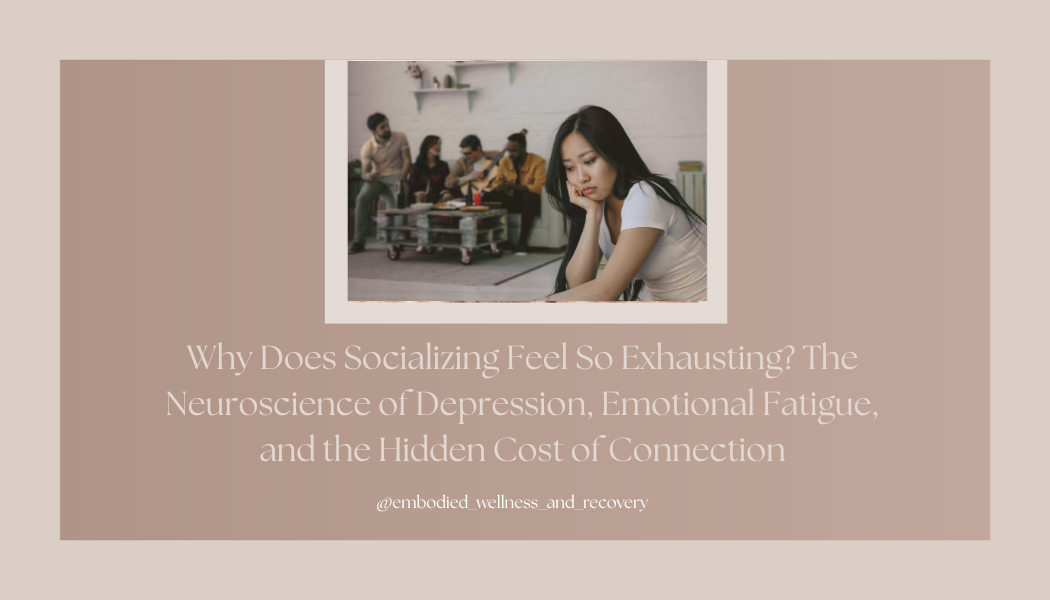
Why Does Socializing Feel So Exhausting? The Neuroscience of Depression, Emotional Fatigue, and the Hidden Cost of Connection
Why Does Socializing Feel So Exhausting? The Neuroscience of Depression, Emotional Fatigue, and the Hidden Cost of Connection
Why does depression make socializing feel exhausting? Discover the neuroscience behind depression, emotional fatigue, low energy, and social withdrawal, and learn how trauma-informed therapy, nervous system regulation, and meaningful connection can support recovery.
You used to enjoy spending time with friends. Now, even answering a text message feels overwhelming. You cancel plans at the last minute, not because you do not care, but because you simply cannot imagine finding the energy to engage. The thought of making conversation, smiling politely, or deciding what to wear feels surprisingly draining. Then the guilt sets in.
You wonder:
“Why am I avoiding people I love?”
“Am I becoming antisocial?”
“Why does everyone else seem to have energy for this except me?”
“Is something wrong with me?”
If you struggle with depression, trauma, chronic stress, or nervous system dysregulation, social exhaustion is not uncommon. In fact, what may look like isolation from the outside is often the result of a brain and body working incredibly hard simply to make it through the day.
Depression Does Not Just Affect Mood
One of the biggest misconceptions about depression is that it is simply prolonged sadness. Depression often affects motivation, concentration, memory, decision making, physical energy, sleep, appetite, and the ability to experience pleasure. Many individuals describe it less as feeling sad and more as feeling emotionally and physically depleted. Research has shown that major depressive disorder is associated with alterations in motivation, reward processing, cognitive function, and psychomotor activity, all of which can make even ordinary tasks feel effortful (Cléry-Melin et al., 2019).
Why Being Around People Can Feel So Draining
Social interaction requires remarkable neurological coordination.
Your brain is constantly:
— Reading facial expressions
— Interpreting tone of voice
— Monitoring social cues
— Regulating emotions
— Generating responses
— Suppressing distractions
— Tracking conversations
— Managing self-awareness
When depression is present, these processes may require significantly more effort. What once felt natural can begin to feel like running a marathon.
The Brain Conserves Energy
From a neuroscience perspective, depression may involve changes in brain networks responsible for motivation, reward, attention, and executive functioning. When these systems are affected, the brain often shifts into energy conservation. This is one reason everyday activities such as showering, grocery shopping, returning messages, or attending social gatherings may feel disproportionately exhausting. The issue is rarely laziness. It is often reduced access to cognitive and emotional resources.
Social Withdrawal Can Become a Painful Cycle
Ironically, while depression often leads people to withdraw, meaningful social connection is one of the factors associated with psychological resilience and emotional well-being.
The cycle frequently looks like this:
Depression leads to low energy. Low energy leads to canceled plans. Canceled plans increase isolation. Isolation intensifies loneliness. Loneliness deepens depressive symptoms. Over time, individuals may begin to believe they no longer belong or that others would be better off without them, despite evidence to the contrary.
Trauma Can Intensify Social Fatigue
For individuals with unresolved trauma or attachment wounds, social interaction may involve additional hidden labor. You may unconsciously monitor whether others are judging you. You may scan for rejection or conflict. You may overthink every conversationafterward. You may work hard to appear “fine” even while struggling internally. This constant vigilance consumes mental and physiological resources. What appears to others as introversion may actually reflect nervous system activation.
Masking Is Exhausting
Many people living with depression become experts at masking. They smile. They make jokes. They appear successful. Then they return home completely depleted. Masking requires suppressing internal experiences while presenting a socially acceptable version of oneself. Over time, this disconnect between internal reality and external presentation can increase emotional fatigue.
The Nervous System and Social Engagement
According to Polyvagal Theory, feelings of safety play an important role in social engagement. When the nervous system perceives safety, individuals are more likely to connect, communicate, and remain emotionally present. When the body detects threat, even subtle interpersonal stressors can trigger withdrawal, shutdown, or avoidance. For some people, depression is accompanied by a physiological state that makes connection feel effortful rather than restorative.
Why You Might Want Connection but Avoid It Anyway
Many people with depression experience a confusing contradiction. They desperately want closeness. They simply lack the energy to pursue it. This discrepancy often creates shame. Friends may interpret canceled plans as disinterest. Family members may assume avoidance reflects indifference. In reality, the individual may care deeply while struggling with profound emotional fatigue.
The Difference Between Solitude and Isolation
Choosing occasional solitude can be healthy. Isolation driven by hopelessness, fear, or depletion is different. Healthy solitude restores. Depression-driven withdrawal often leaves people feeling even more disconnected from themselves and others. Recognizing this distinction can help reduce self-criticism and encourage intentional choices about connection.
What Actually Helps?
Well-meaning advice such as "just get out more" rarely addresses the underlying problem. Instead, recovery often involves gradually increasing experiences of manageable, meaningful connection while simultaneously addressing the biological, emotional, and relational factors contributing to depression.
Helpful interventions may include:
—Trauma-informed psychotherapy
— EMDR
— Nervous system regulation
— Behavioral activation
— Sleep optimization
— Movement appropriate to one's capacity
— Compassionate social support
Importantly, quality of connection often matters more than quantity. One emotionally safe conversation may be more restorative than attending a crowded event.
Give Yourself Permission to Start Small
If socializing feels overwhelming, consider lowering the threshold.
Perhaps connection today looks like:
— Sending one text message
— Meeting a trusted friend for coffee
— Taking a brief walk with someone you love
— Having a ten-minute phone call
— Sitting quietly with another person without pressure to entertain
These moments still count.
How Embodied Wellness and Recovery Can Help
At Embodied Wellness and Recovery, we recognize that depression is not simply a disorder of mood. It often reflects complex interactions among trauma, attachment experiences, nervous system dysregulation, relationships, and the body itself.
Our clinicians integrate somatic therapy, EMDR, neuroscience-informed psychotherapy, attachment-focused care, and evidence-based interventions to help clients better understand the roots of emotional exhaustion while strengthening resilience, connection, and self-compassion. We also specialize in relationship challenges, sexuality, intimacy, and trauma recovery, recognizing that meaningful healing often occurs within safe and attuned relationships.
Because forcing yourself to be more social is rarely the answer. Understanding why connection feels so difficult and helping your nervous system experience safety again can create space for relationships to become nourishing rather than depleting. And sometimes, the most courageous social step is simply allowing another person to sit beside you exactly as you are.
Reach out to schedule a complimentary 20-minute consultation with our team of therapists, trauma specialists, somatic practitioners, or relationship experts, and start working towards integrative, embodied healing today.
📞 Call us at (310) 651-8458
📱 Text us at (310) 210-7934
📩 Email us at admin@embodiedwellnessandrecovery.com
🔗 Visit us at www.embodiedwellnessandrecovery.com
👉 Check us out on Instagram @embodied_wellness_and_recovery
🌍 Explore our offerings at Linktr.ee: https://linktr.ee/laurendummit
American Psychiatric Association. (2022). Diagnostic and statistical manual of mental disorders (5th ed., text rev.).
Cacioppo, J. T., & Cacioppo, S. (2018). Loneliness: Human nature and the need for social connection. W. W. Norton & Company.
Cléry-Melin, M. L., Jollant, F., & Gorwood, P. (2019). Reward systems and cognitions in Major Depressive Disorder. CNS spectrums, 24(1), 64-77
Disner, S. G., Beevers, C. G., Haigh, E. A. P., & Beck, A. T. (2011). Neural mechanisms of the cognitive model of depression. Nature Reviews Neuroscience, 12(8), 467-477. https://doi.org/10.1038/nrn3027
Porges, S. W. (2011). The polyvagal theory: Neurophysiological foundations of emotions, attachment, communication, and self-regulation. W. W. Norton & Company.
van der Kolk, B. A. (2014). The body keeps the score: Brain, mind, and body in the healing of trauma. Viking.

Grief or Depression? How Therapy Helps You Understand the Difference and Find Your Way Forward
Grief or Depression? How Therapy Helps You Understand the Difference and Find Your Way Forward
Are you experiencing grief or depression? Learn the key differences between grief and depression, how the brain and nervous system respond to loss, and how therapy can help you process emotions, reduce suffering, and regain a sense of connection and meaning.
When Loss Feels Like Depression
After a significant loss, many people find themselves asking a difficult question:
"Am I grieving, or am I depressed?"
Perhaps you have lost a loved one, experienced the end of a relationship, watched a dream fall apart, received a life-changing diagnosis, become an empty nester, or experienced a major transition that left you feeling untethered.
You feel exhausted. You cry unexpectedly. Your motivation has disappeared. You struggle to concentrate. Things that once brought joy feel flat.
You may even wonder:
— Is this normal grief?
— Why am I still feeling this way?
— Shouldn't I be doing better by now?
— Has my grief turned into depression?
— Is something wrong with me?
— How do I know if I need therapy?
These questions are incredibly common. The challenge is that grief and depression share many symptoms. Both can involve sadness, sleep disturbances, appetite changes, difficulty concentrating, fatigue, social withdrawal, and a diminished sense of pleasure.
Yet despite their similarities, grief and depression are not the same thing. Understanding the difference can reduce confusion, self-judgment, and fear while helping you determine what type of support may be most beneficial.
Grief Is a Natural Response to Loss
Grief is not a disorder. Grief is a normal human response to losing someone or something meaningful.
While many people associate grief exclusively with death, grief can emerge after:
— Infertility
— Miscarriage
— Loss of health
— Retirement
— Career changes
— Relocation
— Friendship loss
— Family estrangement
— Trauma
— Identity shifts
— Life transitions
In many ways, grief is the emotional expression of love, attachment, and meaning. We grieve because something mattered. The greater the attachment, the greater the potential grief.
The Neuroscience of Grief
Grief is not only emotional. It is neurological and physiological. Research suggests that loss activates many of the same brain networks involved in attachment, reward, memory, and emotional processing (O'Connor, 2019). The brain continues expecting the person, relationship, or experience to exist. This creates a painful mismatch between expectation and reality.
You may find yourself:
— Reaching for the phone to call someone who has died
— Expecting a former partner to text
— Looking for someone in a crowd
— Feeling disoriented by their absence
From a neuroscience perspective, grief involves the brain slowly adapting to a new reality. This process takes time. It cannot be rushed.
What Does Grief Typically Feel Like?
Although grief looks different for everyone, several characteristics are common.
Waves of Emotion
Grief often comes in waves. A person may feel relatively stable one moment and overwhelmed the next. Memories, anniversaries, photographs, songs, smells, or places can trigger intense emotional responses.
Emotional Variability
People experiencing grief may still experience moments of joy, laughter, gratitude, or connection. Even amid profound sadness, positive emotions remain accessible.
Focus on the Loss
Grief tends to revolve around the specific loss. The emotional pain is often directly connected to what has been lost and what that loss means.
Longing and Yearning
Many grieving individuals experience longing, yearning, and a desire to reconnect with the person, relationship, or life chapter they have lost. These experiences are painful, but they are also part of the normal grieving process.
What Does Depression Typically Feel Like?
Depression extends beyond sadness. Major depressive disorder often involves a more pervasive alteration in mood, motivation, cognition, and self-perception.
Common symptoms include:
— Persistent hopelessness
— Loss of interest in previously enjoyable activities
— Feelings of worthlessness
— Excessive guilt
— Low energy
— Sleep disturbances
— Appetite changes
— Social withdrawal
— Emotional numbness
Unlike grief, depression often affects how a person feels about themselves rather than solely focusing on what was lost.
Individuals experiencing depression may find themselves thinking:
— I am a burden.
— I am worthless.
— Nothing will ever improve.
— There is no point in trying.
Research consistently shows that depression is associated with negative self-evaluation and cognitive distortions that extend beyond a specific loss (American Psychiatric Association, 2022).
When Grief and Depression Overlap
One reason this distinction becomes complicated is that grief and depression can occur simultaneously. A person may be grieving a profound loss while also meeting criteria for clinical depression. The death of a loved one, divorce, traumatic event, or major life transition can increase vulnerability to depression, particularly when there is a history of trauma, previous depressive episodes, limited social support, chronic stress, or nervous system dysregulation.
This is why professional assessment can be so valuable. Therapy is not simply about determining whether your experience is grief or depression. It is about understanding what your mind, body, and nervous system are communicating.
Signs Your Grief May Need Additional Support
While there is no universal timeline for grief, certain experiences may indicate that additional support could be beneficial.
Consider seeking therapy if:
— Symptoms continue worsening over time
— Daily functioning becomes significantly impaired
— You feel persistently hopeless
— You experience chronic emotional numbness
— You isolate from supportive relationships
— Substance use increases
— Intense guilt dominates your thoughts
— You struggle to find meaning or purpose
— Thoughts of self-harm or suicide emerge
These experiences do not mean you are failing at grief. They simply suggest that more support may be needed.
Why Grief Can Feel "Stuck"
Many individuals believe grief should move through predictable stages. In reality, grief is often nonlinear. Sometimes grief feels stuck because the nervous system is overwhelmed.
Traumatic losses, complicated relationships, unresolved attachment wounds, and previous trauma can all interfere with the grieving process.
When emotions feel too overwhelming, the nervous system may shift into protective states such as:
— Numbness
— Avoidance
— Emotional shutdown
From a somatic perspective, grief is not only held in thoughts. It is often held in the body. This is one reason talking alone may not always feel sufficient.
How Therapy Helps You Sort Through Grief and Depression
Therapy provides a space to explore what is happening beneath the surface.
1. Clarifying What You Are Experiencing
A skilled therapist can help differentiate grief, depression, trauma responses, and nervous system dysregulation. This understanding often brings enormous relief.
2. Supporting Emotional Processing
Many people attempt to suppress painful emotions because they feel overwhelming. Therapy helps create enough safety for those emotions to be experienced and integrated.
3. Addressing Nervous System Dysregulation
Loss affects the entire body. Somatic therapies help regulate physiological responses associated with grief, trauma, and depression.
4. Exploring Meaning
Research suggests that meaning-making plays an important role in adaptation following loss (Neimeyer, 2016). Therapy can help individuals explore how loss has changed them and how they want to move forward.
5. Strengthening Connection
Grief often creates isolation. Therapeutic relationships provide attunement, validation, and connection during periods of profound vulnerability.
A Trauma-Informed and Somatic Approach to Grief
At Embodied Wellness and Recovery, we recognize that grief rarely exists in isolation. Loss often intersects with attachment wounds, trauma histories, relationship struggles, identity shifts, and nervous system dysregulation.
Our integrative approach combines:
— EMDR
— Trauma-informed psychotherapy
— Mindfulness-based interventions
This approach helps clients understand not only what they are feeling, but how those experiences are being held within the body and nervous system. The goal is not to eliminate grief. The goal is to help individuals move through grief without becoming overwhelmed, disconnected, or trapped by it.
Moving Toward Compassion Instead of Self-Judgment
One of the most painful aspects of grief is the tendency to judge ourselves for how we are grieving.
Many people ask:
"Shouldn't I be over this by now?"
"Why am I still struggling?"
"What's wrong with me?"
Often, nothing is wrong. You may be grieving. You may be depressed. You may be experiencing both simultaneously. What matters is not forcing a label. What matters is approaching your experience with curiosity, compassion, and support. Understanding what you are carrying is often the first step toward finding relief.
Reach out to schedule a complimentary 20-minute consultation with our team of therapists, trauma specialists, somatic practitioners, or relationship experts, and start working towards integrative, embodied healing today.
📞 Call us at (310) 651-8458
📱 Text us at (310) 210-7934
📩 Email us at admin@embodiedwellnessandrecovery.com
🔗 Visit us at www.embodiedwellnessandrecovery.com
👉 Check us out on Instagram @embodied_wellness_and_recovery
🌍 Explore our offerings at Linktr.ee: https://linktr.ee/laurendummit
References
1) American Psychiatric Association. (2022). Diagnostic and statistical manual of mental disorders (5th ed., text rev.; DSM-5-TR). American Psychiatric Publishing.
2) Neimeyer, R. A. (2016). Meaning reconstruction in the wake of loss: Evolution of a research program. Behaviour Change, 33(2), 65-79.
3) O'Connor, M. F. (2019). The grieving brain: The surprising science of how we learn from love and loss. HarperOne.
4) Shear, M. K. (2015). Complicated grief. New England Journal of Medicine, 372(2), 153-160.
5) Stroebe, M., Schut, H., & Boerner, K. (2017). Cautioning health-care professionals: Bereaved persons are misguided through the stages of grief. Omega: Journal of Death and Dying, 74(4), 455-473.
Why Cleaning Feels So Difficult During Depression: The Neuroscience of Motivation, Exhaustion, and Emotional Overwhelm
Why Cleaning Feels So Difficult During Depression: The Neuroscience of Motivation, Exhaustion, and Emotional Overwhelm
Why does cleaning feel impossible during depression? Learn how depression, trauma, nervous system dysregulation, executive dysfunction, and emotional exhaustion affect motivation, energy, and the ability to complete everyday tasks through a neuroscience-informed lens.
Why Does Cleaning Feel So Hard During Depression?
Have you ever looked around your home and felt completely overwhelmed by tasks that once felt manageable?
Do you find yourself:
— Staring at clutter without knowing where to start?
— Feeling exhausted before beginning?
— Avoiding cleaning because it feels emotionally overwhelming?
— Struggling with guilt or shame about your environment?
— Wanting to clean but feeling physically unable to initiate action?
— Feeling paralyzed by simple household tasks?
Many people experiencing depression quietly struggle with:
Lack of motivation
— Lethargy
— Emotional exhaustion
— Executive dysfunction
— Difficulty maintaining routines
— Difficulty completing basic tasks
At Embodied Wellness and Recovery, we often help individuals understand that difficulty cleaning during depression is not simply laziness, irresponsibility, or lack of discipline.
From a neuroscience and trauma-informed perspective, depression can profoundly impact the brain, nervous system, energy levels, attention, emotional regulation, and task initiation. For many individuals, the nervous system is not refusing to function. It is overwhelmed.
Depression Is More Than “Feeling Sad”
Depression often affects the entire body and nervous system.
It may involve:
— Emotional numbness
— Hopelessness
— Fatigue
— Low energy
— Cognitive slowing
— Sleep disruption
— Loss of pleasure
— Emotional shutdown
— Reduced motivation
Tasks that require:
— Organization
— Planning
— Sequencing
— Energy
can suddenly feel incredibly difficult.
This is especially confusing for individuals who were once highly productive, organized, or achievement-oriented.
The Neuroscience of Motivation and Depression
From a neuroscience perspective, depression affects several brain regions involved in:
Motivation
— Reward processing
— Energy regulation
— Emotional processing
The Prefrontal Cortex
The prefrontal cortex helps with:
— Planning
— Organization
— Task initiation
— Decision making
— Prioritization
Depression can impair prefrontal functioning, making even small tasks feel mentally overwhelming.
This is why individuals may:
— Know what needs to be done
— Want to do it
— Yet still feel unable to begin
Dopamine and Reward Systems
Depression may also affect dopamine-related pathways involved in:
— Motivation
— Anticipation
— Reward
— Goal-directed behavior
Cleaning often requires sustained effort before reward is experienced. When reward systems become dysregulated, the nervous system may struggle to generate enough motivational energy to begin or complete tasks.
Why Mess and Clutter Can Feel Emotionally Paralyzing
For some individuals, clutter becomes more than a practical issue. It becomes emotionally loaded.
People may experience:
— Shame
— Overwhelm
— Hopelessness
— Embarrassment
— Anxiety
The more overwhelmed someone feels, the harder it may become to initiate action.
This often creates a painful cycle:
— Depression reduces motivation
— Tasks accumulate
— Clutter increases stress
— Shame increases
— Overwhelm deepens
— Task avoidance increases further
Over time, even looking at the environment may trigger nervous system dysregulation.
Trauma, Nervous System Shutdown, and Executive Dysfunction
For some individuals, depression is closely tied to unresolved trauma or chronic nervous system activation.
According to Polyvagal Theory, the nervous system may move into states of:
— Shutdown
— Collapse
— Emotional numbness
— Exhaustion
when stress becomes overwhelming or chronic (Porges, 2011).
This state can feel like:
— Heaviness
— Paralysis
— Lack of energy
— Apathy
— Inability to mobilize
From the outside, it may appear like “not trying.” Internally, however, the nervous system may feel profoundly depleted.
Why Small Tasks Can Feel Huge
When the nervous system is dysregulated, the brain may lose the ability to effectively organize tasks into manageable pieces.
Instead of seeing:
— “I will wash a few dishes.”
The brain may perceive:
— “The entire house is a disaster.”
This creates:
— Cognitive overwhelm
— Paralysis
— Avoidance
— Emotional flooding
Perfectionism can worsen this dynamic.
Some individuals feel:
— “If I cannot clean everything perfectly, why start at all?”
This all-or-nothing thinking frequently increases shutdown and avoidance.
Depression Often Reduces Physical Energy Too
Depression is not solely psychological.
Research suggests depression can significantly impact:
— Sleep quality
— Inflammatory responses
— Energy metabolism
— Physical stamina
Many individuals genuinely experience profound fatigue.
Simple tasks such as:
— Folding laundry
— Vacuuming
— Organizing
— Doing dishes
may feel physically exhausting.
This is particularly true when depression coexists with:
— Anxiety
— Chronic stress
— Trauma
— Burnout
— ADHD
— Grief
— Nervous system dysregulation
Shame Often Makes Depression Worse
Many individuals judge themselves harshly for struggling with cleaning and organization.
They may think:
— “Why can everyone else do this?”
— “I’m lazy.”
— “I should be able to handle basic tasks.”
— “What is wrong with me?”
Shame often increases nervous system activation and emotional shutdown. Self-criticism rarely improves motivation long-term. In many cases, compassionate understanding creates more movement than harsh self-judgment.
The Emotional Meaning of Home Environments
For some people, cleaning difficulties are connected to emotional experiences associated with home itself.
Individuals with trauma histories may unconsciously associate home environments with:
— Chaos
— Unpredictability
— Control
— Overwhelm
Cleaning may unconsciously activate:
— Shame
— Fear of criticism
— Feelings of inadequacy
This can make practical tasks feel emotionally loaded.
How Therapy Can Help
At Embodied Wellness and Recovery, we help individuals understand the relationship between:
— Depression
— Trauma
— Nervous system dysregulation
— Executive dysfunction
— Emotional overwhelm
— Burnout
— Motivation difficulties
Treatment may include:
— EMDR
— Nervous system regulation work
— Behavioral activation
— Self-compassion work
— Emotional regulation skills
As the nervous system becomes more regulated, many individuals notice improvements in:
— Motivation
— Energy
— Organization
— Task completion
— Emotional resilience
Gentle Strategies That May Help
Reduce the Size of the Task
The nervous system often responds better to:
— “Clean for five minutes.” than:
— “Clean the entire house.”
Focus on Regulation First
Sometimes:
— Hydration
— Sleep
— Nourishment
— Sunlight
— Movement
must come before productivity.
Avoid Perfectionism
Small progress still matters.
Use Co-Regulation
Some people clean more easily:
— With music
— While talking to someone
— Alongside another person
— With emotional support
Humans regulate through connection.
Practice Self-Compassion
Motivation often grows more effectively through understanding than shame.
Replacing Shame with Compassion and Curiosity
Difficulty cleaning during depression is often not a reflection of laziness or lack of character.
Depression can profoundly affect:
— Brain functioning
— Emotional energy
— Motivation
— Physical stamina
Understanding the neuroscience behind these struggles can help individuals replace shame with compassion and curiosity. Sometimes the nervous system is not resisting productivity. Sometimes it is asking for restoration, regulation, safety, and support.
Reach out to schedule a complimentary 20-minute consultation with our team of therapists, trauma specialists, somatic practitioners, or relationship experts, and start working towards integrative, embodied healing today.
📞 Call us at (310) 651-8458
📱 Text us at (310) 210-7934
📩 Email us at admin@embodiedwellnessandrecovery.com
🔗 Visit us at www.embodiedwellnessandrecovery.com
👉 Check us out on Instagram @embodied_wellness_and_recovery
🌍 Explore our offerings at Linktr.ee: https://linktr.ee/laurendummit
References
1) American Psychiatric Association. (2022). Diagnostic and statistical manual of mental disorders (5th ed., text rev.).
2) McEwen, B. S. (2017). Neurobiological and systemic effects of chronic stress. Chronic Stress, 1, 1-11.
3) Porges, S. W. (2011). The polyvagal theory: Neurophysiological foundations of emotions, attachment, communication, and self-regulation. Norton.
4) Treadway, M. T., & Zald, D. H. (2011). Reconsidering anhedonia in depression: Lessons from translational neuroscience. Neuroscience & Biobehavioral Reviews, 35(3), 537-555.