
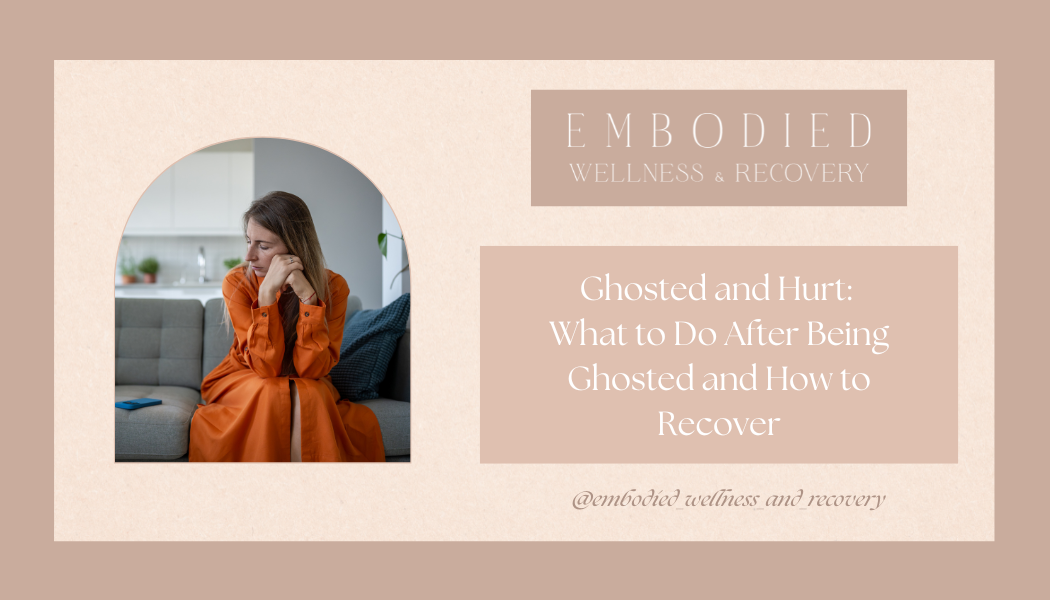
Ghosted and Hurt: What to Do After Being Ghosted and How to Recover
Ghosted and Hurt: What to Do After Being Ghosted and How to Recover
Struggling after being ghosted? Learn why ghosting feels devastating from a neuroscience and attachment lens—and discover compassionate, effective steps to recover your sense of self, rebuild safety in relationships, and heal relational wounds.
It stings. You’ve been texting, opening your heart, showing up, and then, silence. No message. No explanation. One moment, there was a connection; the next, nothing. You feel rejected, powerless, confused, and even ashamed. How do you move from that raw hurt into clarity, repair, and relational grounding?
In this article, you’ll explore why ghosting is so painful in both the brain and body, the emotional terrain it opens up (including anger, shame, grief, and rumination), and practical, neuroscience-informed steps to reclaim your sense of safety and trust in relationships. We’ll also position Embodied Wellness & Recovery as a guide in healing relational trauma, repairing nervous system dysregulation, and fostering intimacy after loss.
Why Ghosting Feels Devastating
The brain treats social rejection as physical pain
Neuroscience research indicates that social rejection activates the same brain areas as physical pain; the anterior cingulate cortex and insula become activated when we experience exclusion, loss, or humiliation. So ghosting hurts deeply because your brain literally registers it as threat and injury. When someone vanishes without explanation, your brain is left lacking information. It seeks meaning, replays every interaction, scans for errors, and often ends with self-blame. That kind of rumination keeps your system in a state of hyperarousal, unable to settle into rest.
Ambiguous loss and lack of closure
Unlike a clear breakup, ghosting is an ambiguous loss, a relational ending with no confirmation, no goodbye, no narrative. You don’t know what happened. Your mind loops in “What did I do wrong? Why did they disappear?” That infinite loop can fuel shame, powerlessness, and resentment.
Activation of old wounds and attachment trauma
If you grew up experiencing inconsistency, abandonment, or emotional unavailability, being ghosted can reopen those wounds. Your nervous system may perceive this new ghosting as an echo of earlier relational betrayals. You may find yourself oscillating between anger, grief, self-criticism, and desperation.
Emotional fallout: confusion, shame, anger, self-doubt
— Confusion & rumination: You review texts, reanalyze tone, and imagine scenarios.
— Shame & self-blame: You conclude “I wasn’t enough,” or “I did something wrong.”
— Anger & resentment: At the ghoster and at yourself for letting it matter so much.
— Powerlessness & abandonment fear: The absence of control can feel terrifying, triggering survival circuits.
In short, ghosting can unsettle your sense of relational safety, erode your faith in people, and alter your internal baseline for how you show up in intimate relationships.
Key Questions You May Be Asking Yourself
— Why did they vanish instead of talking to me?
— What did I do wrong? Am I unlovable?
— Is this always going to happen in my relationships?
— How do I trust again after being erased without a goodbye?
— How do I carry my wounded heart forward, not broken, not bitter, but open?
These questions are not just mental; they ripple through your nervous system. Recovery requires more than cognitive answers; it needs somatic repair, relational stabilization, and meaning-making.
A Path to Recovery: Steps Toward Repair and Relational Resilience
1. Name and accept your pain
You have a right to grief. To anger. To confusion. Denying your emotional reaction only prolongs suffering. Journal, voice memo, painting, or movement can help you name what you feel. Naming is the first step to regulation.
2. Establish clear boundaries with your internal loop
— Timebox the rumination: Give your mind a 10-minute window to journal or replay, then kindly redirect elsewhere.
— Grounding interventions: Use breath, body scans, and physical sensations to re-anchor into your present moment.
— Self-compassion cues: Speak to yourself as you would to a close friend. “This isn’t your fault. This hurt is real.”
3. Reestablish relational safety in your sphere
Because ghosting can erode trust, focus first on relationships that are predictable, reliable, and mutual: a friend who returns your texts, a therapist who keeps time, a family member you can lean on. Relearn “safe relating” before venturing into new vulnerability.
4. Integrate nervous system regulation practices
Your brain and body need to be resourced to shift from fight-or-flight to rest. Some practices include:
— Slow breathing / vagal toning (e.g., 5 to 6 breaths per minute)
— Somatic tracking (noticing tension, subtle shifts in body)
— Movement or dance to discharge stuck activation
— Guided imagery or grounding anchor practices (touchstones in your body or environment)
These practices gradually rebuild your baseline of safety, so your system doesn’t panic in the face of relational uncertainty.
5. Reflect & reauthor the narrative
Ghosting doesn’t define your worth. Start shifting from “They left me because I’m flawed” to a narrative of relational maturation. Ask: What are you learning about your boundaries, your relational needs, or your capacity to choose safer connection going forward?
6. Seek relational or trauma-informed therapy
If ghosting dredges up deep attachment wounds or leaves you anxious about dating again, therapy can help you repair the relational soil, rewire patterns, and rebuild trust. At Embodied Wellness & Recovery, we specialize in trauma, nervous system repair, attachment work, and relational intimacy. We guide clients through story repair, somatic resourcing, and reclaiming relational agency.
7. Create your own symbolic closure
When someone disappears without a goodbye, closure won’t come from them. You can write a letter (not to send), speak aloud the goodbye you never received, or create a ritual marking release. Symbolic acts help the brain and body complete the loop.
What Recovery Looks Like Over Time
— The sting softens. You stop obsessing over the unanswered text.
— Your body becomes less tense at the thought of that ghosting.
— You allow yourself to trust small relational acts again, simple checking in, setting boundaries.
—You date from presence rather than reactivity.
— You integrate the experience into your life story, not as a wound you carry forever but as one chapter among many.
Why This Approach Transforms Rather Than Just Bandages
— It addresses both emotional wound and bodily dysregulation, not just cognitive reframing.
— It is rooted in neuroscience and attachment theory, so your healing aligns with your brain’s capacity.
— It is relational and developmental, not quick fixes, but about rebuilding trust in community and intimacy.
— It honors your experience while guiding toward integration, not suppression or avoidance.
Final Invitation
Being ghosted is painful, confusing, and destabilizing. The absence of explanation can shake the foundations of how you relate, trust, and feel safe. Yet from that ungrounding, there is a path forward: one built on naming, regulation, relational calibration, and narrative transformation.
At Embodied Wellness & Recovery, we accompany those navigating relational rupture, shame, grief, and complexity, helping you repair your nervous system and relationality so that your next chapter can hold more presence, sovereignty, and connection. Your value isn’t tied to someone else’s silence.
Reach out to schedule a free 20-minute consultation with our team of trauma specialists, somatic practitioners, and relationship experts, and begin the process of reconnecting to a sense of internal safety today.
📞 Call us at (310) 651-8458
📱 Text us at (310) 210-7934
📩 Email us at admin@embodiedwellnessandrecovery.com
🔗 Visit us at www.embodiedwellnessandrecovery.com
👉 Check us out on Instagram @embodied_wellness_and_recovery
🌍 Explore our offerings at Linktr.ee: https://linktr.ee/laurendummit
References
1) Freedman, G., Powell, D. N., Le, B., & Williams, K. D. (2022). Emotional experiences of ghosting. Journal of Social and Personal Relationships.
“Why Ghosting Hurts More Than You Think.” (n.d.). Psychotherapy for Young Women.
2)https://psychotherapyforyoungwomen.com/blog/why-ghosting-hurts-more-than-you-think-according-to-a-therapist Psychotherapy for Young Women
“Why Partners Disappear: The Psychology of Ghosting.” (2025, August 13). Psychology Today. 3)https://www.psychologytoday.com/us/blog/the-psychology-of-relationships/202508/why-partners-disappear-the-psychology-of-ghosting psychologytoday.com