
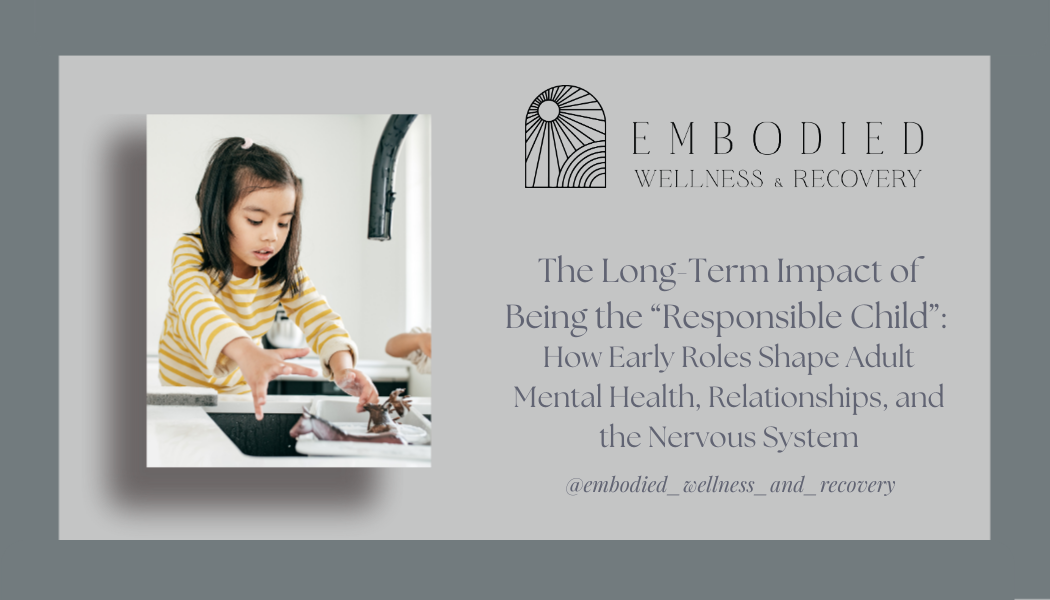
The Long-Term Impact of Being the “Responsible Child”: How Early Roles Shape Adult Mental Health, Relationships, and the Nervous System
The Long-Term Impact of Being the “Responsible Child”: How Early Roles Shape Adult Mental Health, Relationships, and the Nervous System
Growing up as the responsible child can shape identity, relationships, and nervous system functioning well into adulthood. Learn the long-term psychological and physiological impact and how therapy supports repair and balance.
Many adults arrive in therapy with a familiar story. They were the dependable ones. The mature one. The child who never caused trouble, who handled responsibility early, who noticed what others needed and responded without being asked. From the outside, this role often looked admirable. Inside, it usually carried hidden costs that were never named.
If you grew up as the responsible child, you may find yourself asking:
— Why do I feel exhausted even when I am doing well?
— Why is it hard to rest or ask for help?
— Why do I feel overly responsible for others’ emotions?
— Why do relationships feel draining or unbalanced?
— Why does intimacy feel complicated or performative?
These questions are not signs of personal failure. They are often the long-term effects of an early survival role.
At Embodied Wellness and Recovery, we understand the responsible child not as a personality trait, but as an adaptive response to family dynamics, attachment disruption, and nervous system conditioning.
What Does It Mean to Be the Responsible Child?
The responsible child is often the one who:
— Took on adult-like duties at a young age
— Managed siblings or household tasks
— Provided emotional support to caregivers
— Stayed hyperaware of family moods
— Avoided conflict to keep the peace
— Learned to be competent, reliable, and self-controlled
This role frequently emerges in families impacted by:
— Emotional neglect
— Chronic stress or instability
— Addiction or mental illness
— Divorce or loss
— Immature or overwhelmed caregivers
— High achievement or perfectionistic expectations
The responsible child learns early that safety comes from being useful, mature, and non-needy.
Parentification and Early Role Reversal
Clinically, the responsible-child role is often associated with parentification. Parentification occurs when a child takes on emotional or practical responsibilities that exceed their developmental capacity.
There are two common forms:
— Instrumental parentification, where the child manages tasks or caregiving
— Emotional parentification, where the child regulates a caregiver’s emotions or provides psychological support
While some degree of responsibility can build skills, chronic parentification can shift the child’s nervous system into a state of long-term vigilance. The child learns to monitor, anticipate, and respond rather than explore, rest, or receive care.
How the Responsible Child Role Shapes the Nervous System
From a neuroscience perspective, the responsible child often develops a nervous system organized around threat prevention and performance.
Key patterns include:
— Chronic sympathetic activation focused on problem-solving and control
— Difficulty accessing parasympathetic states associated with rest and play
— Heightened sensitivity to others’ emotional cues
— Suppression of personal needs to maintain stability
Over time, the nervous system associates safety with competence rather than connection. This can lead to long-term stress physiology even in objectively safe environments.
Psychological Traits That Often Develop
Adults who were responsible children frequently present with:
— Perfectionism
— High self-criticism
— Over-functioning in relationships
— Difficulty delegating or trusting others
— Guilt when resting or saying no
— A strong inner critic
— Fear of disappointing others
— Difficulty identifying personal desires
These traits once served a protective function. In adulthood, they can limit flexibility, spontaneity, and emotional freedom.
The Impact on Adult Relationships
Over-Responsibility in Intimate Partnerships
Responsible children often become the emotional managers in adult relationships. They anticipate needs, smooth tension, and carry the emotional labor.
This can lead to:
— One-sided relational dynamics
— Resentment that feels hard to name
— Attraction to partners who need caretaking
— Difficulty receiving care without discomfort
Difficulty With Emotional Vulnerability
Because the responsible child learned that emotions could destabilize the system, vulnerability may feel risky. Intimacy can become performance-based rather than reciprocal.
You may appear emotionally available while internally monitoring, managing, or self-editing.
Sexuality and Intimacy Challenges
The responsible child role can also shape sexual experiences and desire.
Common patterns include:
— Feeling responsible for a partner’s satisfaction
— Difficulty accessing pleasure without performance
— Trouble relaxing into bodily sensations
— Confusion between intimacy and obligation
— Reduced libido during stress or relational imbalance
Sexuality thrives in nervous systems that feel safe, playful, and embodied. Responsibility-driven nervous systems often struggle to access these states without therapeutic support.
The Cost to Identity and Desire
One of the most profound impacts of being a responsible child is disrupting authentic self-development.
Because attention was focused outward, many adults struggle with:
— Knowing what they want
— Identifying personal preferences
— Feeling entitled to rest, joy, or pleasure
— Making decisions without guilt
Desire may feel muted or dangerous because it was once secondary to family stability.
Why Success Does Not Always Feel Satisfying
Many responsible children grow into high-achieving adults. They are capable, respected, and outwardly successful. Yet internal satisfaction may remain elusive.
This is because achievement was often tied to safety rather than fulfillment. The nervous system learned to perform to prevent disruption, not to express authentic values. Without meaning and internal alignment, success can feel hollow.
Emotional and Physical Health Consequences
Long-term nervous system overactivation can contribute to:
— Anxiety disorders
— Depression
— Burnout
— Chronic fatigue
— Autoimmune or stress-related conditions
— Sleep disturbances
— Difficulty relaxing or feeling present
These outcomes are not character flaws. They are the cumulative effect of prolonged self-suppression and vigilance.
Why Letting Go of the Role Feels So Hard
The responsible child role is often deeply intertwined with identity. Letting go can evoke:
— Fear of chaos or abandonment
— Guilt about prioritizing self
— Anxiety about being perceived as selfish
— Grief for the childhood that was missed
Therapy helps untangle these emotions while preserving the strengths developed through responsibility.
How Therapy Supports Repair and Balance
At Embodied Wellness and Recovery, we work with responsible children through trauma-informed, attachment-focused, and somatic approaches.
Therapy supports healing by:
— Regulating the nervous system and reducing hypervigilance
— Differentiating responsibility from self-worth
— Processing grief and anger safely
— Reconnecting with bodily cues and desire
— Building tolerance for rest and receptivity
— Establishing boundaries without shame
— Cultivating reciprocal relationships
Rather than eliminating competence, therapy restores choice.
Reclaiming Agency Without Losing Strength
Being responsible developed resilience, intelligence, and empathy. Healing does not require abandoning these strengths. It involves learning when to use them and when to rest.
Over time, many clients discover:
— Increased emotional flexibility
— More balanced relationships
— Improved intimacy and pleasure
— Greater clarity around values and purpose
— A more profound sense of internal permission
The nervous system learns that safety can coexist with ease.
A Compassionate Reframe
If you were the responsible child, you adapted brilliantly to the environment you were given. Your nervous system learned what it needed to know to survive.
Now, with the proper support, it can learn something new.
At Embodied Wellness and Recovery, we help adults gently reorient from a survival-based sense of responsibility toward an understanding of regulation, connection, and authenticity. The goal is not to undo who you became, but to expand who you are allowed to be.
Reach out to schedule a complimentary 20-minute consultation with our team of therapists, trauma specialists, somatic practitioners, or relationship experts, and start working towards integrative, embodied healing today.
📞 Call us at (310) 651-8458
📱 Text us at (310) 210-7934
📩 Email us at admin@embodiedwellnessandrecovery.com
🔗 Visit us at www.embodiedwellnessandrecovery.com
👉 Check us out on Instagram @embodied_wellness_and_recovery
🌍 Explore our offerings at Linktr.ee: https://linktr.ee/laurendummit
References
1) Boszormenyi-Nagy, I., & Spark, G. M. (1973). Invisible loyalties: Reciprocity in intergenerational family therapy. Harper & Row.
2) Hooper, L. M. (2007). The application of attachment theory and family systems theory to the phenomenon of parentification. The Family Journal, 15(3), 217–223.
3) Porges, S. W. (2011). The polyvagal theory: Neurophysiological foundations of emotions, attachment, communication, and self-regulation. W. W. Norton & Company.
4) Schore, A. N. (2012). The science of the art of psychotherapy. W. W. Norton & Company.

Trauma Recovery Is Not Linear: What Your Therapist Really Means and Why It Matters
Trauma Recovery Is Not Linear: What Your Therapist Really Means and Why It Matters
Trauma recovery is rarely a straight line. Learn what therapists mean when they say trauma recovery is not linear, how the nervous system heals, and how therapy supports sustainable progress.
If you are in therapy for trauma, you may have heard your therapist say something like, “Trauma recovery is not linear.” While the phrase is well-intentioned, it can feel confusing or even discouraging when you are doing everything you can to feel better. One week, you feel grounded and hopeful. The following old symptoms return, emotions intensify, or your body feels hijacked by sensations you thought you had already worked through.
You may find yourself asking:
— Why am I struggling again after making progress?
— Does this mean therapy is not working?
— Why do triggers come back when I thought I had processed them?
— Am I failing at trauma recovery?
Understanding what “not linear” actually means from a neuroscience and trauma-informed perspective can reduce shame, restore hope, and help you recognize real progress as it happens.
At Embodied Wellness and Recovery, we work with trauma as a nervous system experience, not a checklist of symptoms. Recovery does not move in a straight upward line. It unfolds in cycles, layers, and rhythms that reflect how the brain and body learn safety.
Why Trauma Recovery Does Not Follow a Straight Line
Trauma is not stored as a single memory that gets erased once talked about. It is encoded across multiple systems, including the brain, the autonomic nervous system, muscles, hormones, and sensory networks. Because of this, healing unfolds gradually and often revisits similar themes at deeper levels.
Neuroscience shows that the brain learns through repetition and pattern recognition. The nervous system does not shift from threat to safety all at once. It tests safety, retreats, and re-engages. This is not regression. It is how learning occurs.
Trauma recovery looks less like climbing a ladder and more like walking a spiral. You may revisit familiar emotions, memories, or relational patterns, but each time with slightly more awareness, capacity, or choice.
The Nervous System and Cycles of Healing
From a nervous system perspective, trauma recovery involves moving between states of activation and regulation. According to polyvagal theory, the autonomic nervous system constantly scans for safety or threat. When safety increases, regulation improves. When stress or reminders arise, the system may temporarily revert to protective responses.
This can look like:
— Increased anxiety after a period of calm
— Emotional flooding following insight
— Numbness after vulnerability
— A return of hypervigilance during relational stress
These shifts are not signs of failure. They are signs that the nervous system is learning to be flexible.
A regulated nervous system is not one that never gets activated. It is one that can move in and out of activation and return to baseline.
Why Symptoms Can Resurface After Progress
Many people are surprised when symptoms return after meaningful therapeutic work. This can be deeply discouraging without the proper framework.
Symptoms resurface for several reasons:
— New layers of trauma emerge as safety increases
— The nervous system tests whether regulation is reliable
— Life stress activates old neural pathways
— Relationship dynamics mirror early attachment wounds
— The body releases stored material in stages
In trauma therapy, improvement often creates enough stability for deeper material to surface. What feels like going backward is frequently a sign that the system trusts the process enough to reveal more.
Trauma Memory Is State Dependent
Trauma memory is not accessed randomly. It is often state-dependent. This means certain emotional or relational states activate specific memories or body responses.
For example:
— Intimacy may activate attachment trauma
— Conflict may trigger early powerlessness
— Rest may bring up grief that was previously suppressed
— Success may activate fear or shame
When these responses arise, they are not evidence that you have not healed. They provide information about what is still in need of integration.
Therapy helps you recognize these patterns and respond with curiosity rather than self-criticism.
The Difference Between Symptom Reduction and Integration
Many people equate healing with the absence of symptoms. While symptom relief is essential, trauma recovery is more accurately measured by integration.
Integration means:
— You notice triggers sooner
— You recover faster after activation.
— You have more choices in how you respond.
— You can feel emotions without being overwhelmed.
— You experience more internal coherence.
You may still have reactions, but they no longer define you or control your life in the same way.
Why Trauma Recovery Often Feels Messy
Healing disrupts old survival strategies. As those strategies loosen, there can be a temporary sense of disorientation.
You may notice:
— Shifts in identity
— Changes in relationships
— Grief for what was lost
— Anger you were not allowed to feel before
— Sadness that had been held at bay
This phase can feel unsettling, but it often precedes deeper stability.
Trauma recovery is not about becoming someone new. It is about reclaiming parts of yourself that were organized around survival.
Trauma Recovery and Relationships
Trauma healing rarely happens in isolation. As you change internally, your relationships may change as well.
You may:
— Set new boundaries.
— Tolerate less emotional inconsistency.
— Feel discomfort with old relational patterns.
— Grieve relationships that no longer fit.
— Experience conflict as you assert needs.
These shifts can temporarily increase distress even as they move you toward healthier connection. Therapy supports navigating relational change with clarity and compassion. At Embodied Wellness and Recovery, we pay close attention to how trauma recovery intersects with intimacy, sexuality, attachment, and partnership.
Why Linear Thinking Increases Shame
When people expect recovery to be linear, they often interpret normal fluctuations as personal failure. This can lead to:
— Self-blame
— Hopelessness
— Premature termination of therapy
— Avoidance of deeper work
— Suppression of emotion
Understanding the nonlinear nature of healing reduces shame and fosters patience.
Progress is not defined by never struggling again. It is characterized by increased capacity to meet struggles with support and skill.
What Actually Signals Progress in Trauma Recovery
Signs of progress may include:
— You name what is happening instead of dissociating.
— You ask for support sooner.
— You feel safer in your body more often.
— You tolerate uncertainty with less panic.
— You experience more self-compassion.
— You repair relational ruptures more effectively.
These changes are subtle but profound. They often go unnoticed if you measure progress only by symptom elimination.
How Therapy Supports Nonlinear Healing
Trauma-informed therapy provides:
— A regulated relational environment
— Tools for nervous system regulation
— Meaning-making for confusing experiences
— A framework that normalizes fluctuation
— Support for pacing and integration
A
t Embodied Wellness and Recovery, we use attachment-focused, somatic, and neuroscience-based approaches to help clients understand and trust their own process. Rather than pushing for constant forward movement, we support stabilization, curiosity, and integration. This allows the nervous system to reorganize at its own pace.
A More Accurate Way to Think About Trauma Recovery
Instead of asking, “Why am I not over this yet?” consider asking:
— What is my nervous system learning right now?
— What is this reaction protecting?
— What support do I need in this moment?
— How is this different from last time?
These questions shift the focus from judgment to understanding. Trauma recovery is not linear because humans are not machines. We are adaptive systems shaped by experience, relationship, and meaning.
Moving Forward With Compassion and Perspective
If trauma recovery feels uneven, it does not mean you are doing it wrong. It means your nervous system is doing what it was designed to do: learn through experience.
Therapy offers a steady anchor as you navigate the ups and downs of healing. With the proper support, the overall trajectory moves toward greater safety, connection, and choice even when the path curves.
At Embodied Wellness and Recovery, we are honored to offer attuned, ongoing care and steady therapeutic presence as individuals and couples make sense of their healing process and reconnect with their bodies, relationships, and inner resilience.
Reach out to schedule a complimentary 20-minute consultation with our team of therapists, trauma specialists, somatic practitioners, or relationship experts, and start working towards integrative, embodied healing today.
📞 Call us at (310) 651-8458
📱 Text us at (310) 210-7934
📩 Email us at admin@embodiedwellnessandrecovery.com
🔗 Visit us at www.embodiedwellnessandrecovery.com
👉 Check us out on Instagram @embodied_wellness_and_recovery
🌍 Explore our offerings at Linktr.ee: https://linktr.ee/laurendummit
References
1) Herman, J. L. (1992). Trauma and recovery: The aftermath of violence from domestic abuse to political terror. Basic Books.
2) Porges, S. W. (2011). The polyvagal theory: Neurophysiological foundations of emotions, attachment, communication, and self-regulation. W. W. Norton & Company.
3) Schore, A. N. (2012). The science of the art of psychotherapy. W. W. Norton & Company.
4) van der Kolk, B. A. (2014). The body keeps the score: Brain, mind, and body in the healing of trauma. Viking.

High-Functioning but Hurting: How Achievement Can Mask Deep Emotional Pain
High-Functioning but Hurting: How Achievement Can Mask Deep Emotional Pain
Do you appear successful on the outside but feel emotionally empty or exhausted on the inside? Learn how high-functioning individuals often use achievement to mask trauma and discover how somatic therapy at Embodied Wellness and Recovery can help you reconnect with your emotional truth.
High-Functioning but Hurting: How Achievement Can Mask Deep Emotional Pain
You have the degrees, the career, the relationships, maybe even the social media presence that suggests everything is in place. And yet, when you pause long enough to listen inward, there is a quiet ache. A restlessness. A persistent sense of loneliness or emotional flatness you can’t quite explain.
You might be what many clinicians refer to as high-functioning but hurting, an individual whose external success conceals a complex web of internal emotional pain. It's more common than most people realize, especially among those who have experienced relational trauma, neglect, or chronic stress early in life.
Are You Using Success to Survive?
— Do you feel uncomfortable with stillness or rest?
— Is your self-worth tied to productivity, performance, or praise?
— Do you excel at taking care of others but struggle to identify your own needs?
— Do you often feel disconnected from your body, emotions, or even joy?
If any of this resonates, your high achievement may be functioning as a protective strategy. In many trauma-informed frameworks, this is understood not as pathology, but as adaptation, a sophisticated, unconscious way your nervous system learned to ensure safety and belonging in an unpredictable world.
The Neuroscience Behind High-Functioning Coping
When the nervous system has been shaped by chronic emotional neglect, relational trauma, or inconsistent caregiving, it adapts. The brain learns to prioritize external validation as astand-in for emotional attunement. This is often linked to a sympathetic dominance in the autonomic nervous system: a perpetual state of doing, striving, proving.
The prefrontal cortex may become overactive while the body remains in a hypervigilant state. This internal disconnection can lead to symptoms such as:
— Chronic anxiety
— Difficulty accessing pleasure or joy
— Somatic complaints like headaches or digestive issues
— Feeling "numb" or "on autopilot"
— Sexual disconnection or performance anxiety. Achievement provides momentary relief, a dopamine hit of validation, but it rarely satisfies the deeper need for connection, rest, or emotional authenticity.
Trauma and the Drive to Excel
At Embodied Wellness and Recovery, we often work with individuals who have learned to perform strength because vulnerability felt unsafe in childhood. High-achieving adults may have grown up in environments where love was conditional, emotions were dismissed, or chaos required them to become the "responsible one."
This creates a false binary: be perfect or be rejected. Succeed or disappear. For many, especially women, LGBTQIA+ individuals, and those raised in high-demand families or communities, excellence became armor.
But under that armor often lives a neglected inner child longing to be seen without needing to earn worthiness.
The Somatic Cost of Suppressed Emotion
When emotional pain is never given space, the body carries the burden. Suppressed emotions become tension, insomnia, digestive issues, chronic fatigue, or sexual numbness. The nervous system gets stuck in survival mode and is unable to access the ventral vagal state of safety, connection, and presence as described in Polyvagal Theory.
This dysregulation often shows up in intimacy: — Avoiding emotional closeness even with a partner
— Struggling to relax during physical touch
— Going through the motions sexually without real connection
— Feeling a strong inner critic that judges vulnerability as weakness
What Somatic Therapy Offers That Talk Therapy Alone May Not
Many high-functioning clients are skilled at intellectualizing their emotions. They can name their patterns, quote Brene Brown, and check off growth milestones. But they often haven’t learned to feel their emotions in the body.
Somatic therapy gently helps the body feel safe enough to release stored survival responses. At Embodied Wellness and Recovery, we integrate:
— Body tracking to identify where emotions live in the body
— Nervous system mapping to recognize survival states (fight/flight/freeze/fawn)
— Somatic resourcing to build internal safety and resilience
— Guided movement and breathwork to support emotional release
— Parts work and inner child reconnection to foster wholeness
This integrative approach helps clients not only understand their trauma but also metabolize it.
You Don't Have to Choose Between Success and Authenticity
One of the great myths of trauma is that you can only be safe if you hide your truth. But it is possible to remain high-functioning and live a more emotionally congruent, embodied life.
When clients begin to regulate their nervous systems, feel their feelings, and reconnect with their bodies, they find:
— Deeper intimacy in relationships
— Greater capacity for pleasure
— Freedom from chronic over-functioning
— A more authentic connection to their work and purpose
Success Doesn't Have to Hurt
You don’t have to abandon your ambition. But the drive to achieve doesn’t need to come at the expense of your emotional and physical well-being. When you slow down enough to listen to your body’s cues, you may find a rich inner world that no resume or accolade can replace. At Embodied Wellness and Recovery, we specialize in working with high-functioning individuals who carry hidden emotional pain. Through somatic therapy, nervous system healing, and trauma-informed care, we help you move beyond survival and into embodied self-connection. Reach out to schedule a free 20-minute consultation with our team of top-rated somatic therapists and take the next step toward a more regulated nervous system today.
📞 Call us at (310) 651-8458
📱 Text us at (310) 210-7934
📩 Email us at admin@embodiedwellnessandrecovery.com
🔗 Visit us at www.embodiedwellnessandrecovery.com
👉 Check us out on Instagram @embodied_wellness_and_recovery
🌍 Explore our offerings at Linktr.ee: https://linktr.ee/laurendummit
References:
Brown, B. (2012). Daring greatly: How the courage to be vulnerable transforms the way we live, love, parent, and lead. Gotham Books.
Dana, D. (2018). The polyvagal theory in therapy: Engaging the rhythm of regulation. W.W. Norton & Company.
Van der Kolk, B. (2014). The body keeps the score: Brain, mind, and body in the healing of trauma. Viking.