
Why Feeling Unappreciated in a Relationship Can Slowly Destroy Love: The Neuroscience of Emotional Neglect, Resentment, and Lasting Connection
Why Feeling Unappreciated in a Relationship Can Slowly Destroy Love: The Neuroscience of Emotional Neglect, Resentment, and Lasting Connection
Feeling unappreciated in your relationship can quietly erode intimacy, trust, and emotional safety over time. Discover the neuroscience behind feeling taken for granted and learn practical ways to rebuild appreciation, strengthen attachment, and restore connection.
Why Does Feeling Unappreciated Hurt So Much?
Have you ever thought:
— Why do I feel invisible in my own relationship?
— Why am I doing everything for my partner without feeling valued?
— Why do small acts of neglect hurt more than major arguments?
— Why have I become resentful when nothing "big" seems wrong?
— Why does my partner seem oblivious to everything I contribute?
For many couples, relationships do not unravel because of one catastrophic event. Instead, they slowly deteriorate over thousands of unnoticed moments in which effort goes unrecognized, emotional labor goes unseen, and gratitude fades into expectation.
Feeling unappreciated is not merely an inconvenience. It can become a chronic relational stressor that changes how partners think, feel, communicate, and even how their nervous systems respond to one another.
At Embodied Wellness and Recovery, we frequently help individuals and couples understand that appreciation is more than politeness. It is an essential ingredient for emotional security, nervous system regulation, healthy sexuality, and long-term relationship satisfaction.
Why Appreciation Matters to the Human Brain
From an evolutionary perspective, humans survived through connection and cooperation. Feeling valued within close relationships signals safety, belonging, and mutual investment.
Neuroscience suggests that positive social interactions activate reward pathways involving dopamine and oxytocin while helping regulate stress responses mediated by cortisol and the amygdala. Expressions of gratitude and recognition can reinforce attachment bonds and increase feelings of trust and emotional closeness.
When appreciation disappears, the opposite may occur. The brain begins scanning for evidence of rejection, unfairness, or emotional abandonment. Over time, repeated disappointment can strengthen negative cognitive biases and increase emotional vigilance.
A person who once eagerly helped their partner may eventually think:
"Why bother? Nothing I do seems to matter anyway."
Emotional Neglect Is Often Quiet
Most people imagine relationship damage occurring through betrayal, explosive conflict, or major deception. Yet emotional neglect often whispers instead of screams.
It appears in everyday moments:
— The dinner that receives no acknowledgment.
— The parent carrying the invisible mental load without thanks.
— The spouse who works tirelessly while their sacrifices go unnoticed.
— The partner whose emotional support is expected but rarely reciprocated.
— The countless acts of service that slowly become viewed as obligations instead of gifts.
Over months or years, appreciation quietly transforms into assumption. Assumption breeds entitlement. Entitlement leads to resentment. Resentment erodes connection.
The Neuroscience of Feeling Taken for Granted
Our nervous systems are constantly evaluating whether relationships feel safe and reciprocal. When appreciation consistently disappears, many individuals experience a subtle activation of the body's threat-detection systems. The brain may interpret repeated emotional dismissal as social exclusion, which can activate neural circuits that overlap with those involved in physical pain processing.
As stress accumulates:
— Cortisol levels may remain elevated.
— Emotional regulation becomes more difficult.
— Irritability increases.
— Defensive communication becomes more likely.
— Intimacy may decline.
— Sexual desire may diminish.
For trauma survivors or individuals with attachment wounds, feeling chronically unappreciated may reactivate earlier experiences of invisibility, neglect, criticism, or conditional love. The present relationship begins carrying echoes of the past.
Why Resentment Builds So Slowly
One fascinating aspect of resentment is that it rarely arrives overnight. Instead, it accumulates through repeated unmet expectations.
A partner may initially think:
"It's okay. They're busy."
Months later:
"I wish they noticed how hard I'm trying."
Eventually:
"I don't think they care about me anymore."
By the time resentment surfaces openly, the emotional bank account may already be significantly depleted. This gradual erosion often surprises couples who insist they "never really fought."
The Hidden Cost to Intimacy and Sexual Connection
Feeling appreciated is deeply intertwined with emotional and physical intimacy. When people feel emotionally unseen, they often become less interested in vulnerability, affection, and sexual connection. This is particularly true when one partner carries disproportionate household responsibilities, parenting duties, or emotional labor. Desire frequently flourishes in environments where people feel cherished, respected, admired, and emotionally safe. Feeling consistently taken for granted can create emotional distance that extends into the bedroom.
Trauma Can Magnify the Experience
People with histories of childhood emotional neglect, family conflict, abandonment, or relational trauma may experience perceived lack of appreciation more intensely.
Their nervous systems may already be sensitized to cues suggesting:
— "I don't matter."
— "My needs are too much."
— "I'm only valuable for what I provide."
— "Love has to be earned."
Without realizing it, current disappointments become layered upon old attachment injuries. This does not mean their reactions are irrational. Rather, their brains are integrating present experiences with prior learning.
Five Signs Feeling Unappreciated Is Damaging Your Relationship
1. You keep score.
You mentally track chores, sacrifices, or emotional labor because reciprocity feels absent.
2. Small disappointments create outsized reactions.
Minor oversights trigger surprisingly intense frustration because they symbolize a larger unmet need.
3. Gratitude has disappeared from daily conversations.
Interactions become transactional rather than relational.
4. You withdraw emotionally.
Instead of asking for appreciation, you stop offering effort altogether.
5. Affection and intimacy decline.
Emotional disconnection often precedes physical distance.
Appreciation Is More Than Saying "Thank You"
Healthy appreciation involves consistent recognition of another person's humanity, effort, and internal experience.
This can include:
— Verbal gratitude.
— Genuine curiosity.
— Physical affection.
— Validation of invisible labor.
— Public acknowledgment.
— Emotional responsiveness.
— Acts of kindness that communicate, "I see you."
The goal is not perfection. The goal is to help your partner feel emotionally witnessed.
How Couples Can Rebuild Appreciation
Small changes practiced consistently often create significant improvements.
Consider trying these exercises:
Name one thing every day.
Before bed, each partner identifies one specific action they appreciated that day.
Replace assumptions with acknowledgment.
Instead of expecting contributions, intentionally notice them.
Express admiration out loud.
Research consistently demonstrates that positive sentiment strengthens relational resilience (Stephens et al., 2013).
Become curious.
Ask questions about your partner's emotional world rather than focusing solely on logistics.
Repair quickly.
When appreciation has been absent, sincere acknowledgment paired with behavioral change often matters more than grand gestures.
A Nervous System Perspective
At Embodied Wellness and Recovery, we recognize that relationship distress is not solely about communication skills. Sometimes partners intellectually understand one another while their nervous systems remain chronically activated.
Trauma-informed therapy, somatic interventions, attachment-focused work, EMDR, and neuroscience-informed couples treatment can help individuals identify old relational patterns that continue influencing present-day interactions. When the body begins to experience greater safety, appreciation often becomes easier to both express and receive.
Hope for Couples Feeling Stuck
If appreciation has faded from your relationship, it does not necessarily mean love has disappeared. Many couples become trapped in cycles in which both partners feel unseen yet long to be recognized. One withdraws because they feel unvalued. The other becomes defensive because they feel criticized. The resulting distance reinforces itself until neither partner feels emotionally nourished.
Fortunately, awareness can interrupt that cycle. By intentionally cultivating gratitude, strengthening emotional attunement, understanding attachment dynamics, and addressing underlying nervous system patterns, couples often rediscover warmth that had quietly faded over time.
At Embodied Wellness and Recovery, our clinicians integrate neuroscience, trauma-informed care, somatic approaches, relationship expertise, and evidence-based interventions to help individuals and couples restore emotional connection, deepen intimacy, and build relationships in which appreciation becomes part of daily life rather than an occasional afterthought.
When people consistently feel seen, valued, and emotionally understood, relationships become more resilient, conflicts become more manageable, and love gains the conditions it needs to thrive.
Reach out to schedule a complimentary 20-minute consultation with our team of therapists, trauma specialists, somatic practitioners, or relationship experts, and start working towards integrative, embodied healing today.
📞 Call us at (310) 651-8458
📱 Text us at (310) 210-7934
📩 Email us at admin@embodiedwellnessandrecovery.com
🔗 Visit us at www.embodiedwellnessandrecovery.com
👉 Check us out on Instagram @embodied_wellness_and_recovery
🌍 Explore our offerings at Linktr.ee: https://linktr.ee/laurendummit
References
Algoe, S. B. (2012). Find, remind, and bind: The functions of gratitude in everyday relationships. Social and Personality Psychology Compass, 6(6), 455 to 469.
Coan, J. A., & Sbarra, D. A. (2015). Social baseline theory: The social regulation of risk and effort. Current Opinion in Psychology, 1, 87 to 91.
Gottman, J. M., & Silver, N. (2015). The seven principles for making marriage work (Revised ed.). Harmony Books.
Porges, S. W. (2021). Polyvagal safety: Attachment, communication, self-regulation. W. W. Norton & Company.
Stephens, J. P., Heaphy, E. D., Carmeli, A., Spreitzer, G. M., & Dutton, J. E. (2013). Relationship quality and virtuousness: Emotional carrying capacity as a source of individual and team resilience. The Journal of Applied Behavioral Science, 49(1), 13-41.
Why Do I Feel So Hurt by My Partner’s Criticism? The Neuroscience of Shame, Attachment, and Emotional Safety in Relationships
Why Do I Feel So Hurt by My Partner’s Criticism? The Neuroscience of Shame, Attachment, and Emotional Safety in Relationships
Do you feel constantly criticized by your partner? Discover how criticism affects the brain, nervous system, attachment, and self-worth, and learn how trauma-informed couples therapy and emotional repair can help rebuild connection and trust.
You forgot to unload the dishwasher. You arrived home later than expected. You misunderstood a text message.
Your partner sighs, rolls their eyes, or says, “Why do you always do this?”
The comment may seem minor on the surface, yet your body reacts as though something much bigger has happened. Your chest tightens. Your stomach drops. You replay the conversation for hours. You begin questioning yourself and wondering if you are failing the person you love.
If this sounds familiar, you may be experiencing more than frustration. You may be experiencing the profound emotional impact of chronic criticism.
Does Every Conversation Leave You Feeling Like You Are Falling Short?
Have you started walking on eggshells around your partner? Do you find yourself apologizing for things that are not your fault? Do you constantly second guess your decisions because you fear they will be criticized? Do you feel like nothing you do is ever good enough? Do you notice your confidence shrinking over time?
When criticism becomes a recurring feature of a relationship, it can quietly erode self-esteem, emotional safety, and intimacy. For individuals with trauma histories or insecure attachment patterns, its effects may be even more profound.
Criticism Is More Than Negative Feedback
Healthy relationships include feedback, accountability, and difficult conversations.
Criticism is different.
Constructive feedback focuses on a specific behavior and leaves room for growth:
“I felt hurt when you interrupted me.”
Criticism often attacks character or identity:
“You’re so selfish.”
“You never think about anyone else.”
“You always mess things up.”
According to decades of research by relationship expert John Gottman, persistent criticism is one of the strongest predictors of relationship distress because it shifts the conversation from behavior to personal defect.
Why Criticism Hurts So Much
Humans are wired for connection. Our closest relationships are not simply sources of companionship. They are attachment bonds that influence our sense of safety, belonging, and identity. When a trusted partner criticizes us repeatedly, the nervous system may interpret that experience as a threat to connection itself.
The result is often not just hurt feelings. It is physiological activation. Heart rate increases. Stress hormones rise. Attention narrows. The body prepares to defend, withdraw, or appease.
The Neuroscience of Emotional Pain
Neuroimaging research suggests that social rejection and emotional pain activate many of the same neural networks involved in processing physical pain (Eisenberger, 2012). From an evolutionary perspective, this makes sense. Maintaining close relationships has long been essential for survival.
When criticism feels relentless or deeply personal, the brain may respond as though social belonging itself is at risk. This is one reason seemingly small comments can produce disproportionately intense reactions.
Trauma Changes the Meaning of Criticism
For someone with a history of emotional neglect, bullying, perfectionism, or chronic invalidation, present-day criticism may awaken memories and physiological responses rooted in the past.
A simple comment such as:
“You forgot to call.”
may be experienced internally as:
“I disappoint everyone.”
“I’m not enough.”
“I always fail.”
The nervous system is not responding only to the current interaction. It is responding to years of accumulated learning.
Shame Grows in Relationships Where Safety Shrinks
Guilt says:
“I made a mistake.”
Shame says:
“I am the mistake.”
Over time, chronic shame can undermine confidence, authenticity, and emotional openness. People begin censoring themselves, avoiding vulnerability, or abandoning their own needs in an attempt to avoid further criticism. Ironically, these protective strategies often create even greater emotional distance between partners.
The Pursue Defend Withdraw Cycle
Many couples unknowingly become trapped in a predictable pattern. One partner criticizes because they long for change or connection. The other partner becomes defensive, shuts down, or withdraws. The criticism intensifies. The withdrawal deepens. Neither partner feels heard. Neither partner feels emotionally safe. Without intervention, the cycle repeats until resentment replaces curiosity and fear replaces intimacy.
The Cost of Walking on Eggshells
Living under chronic criticism often creates subtle but significant psychological consequences.
You may notice:
— Anxiety
— Emotional numbing
— Difficulty making decisions
— Decreased sexual desire
— Increased people-pleasing
— Reduced confidence
— Feeling lonely within the relationship
Many individuals begin shrinking themselves in an attempt to preserve harmony. Unfortunately, self-abandonment rarely strengthens intimacy.
What Emotional Safety Actually Looks Like
Emotionally safe relationships are not relationships without conflict. They are relationships in which both partners believe they can make mistakes without losing love or respect.
Emotional safety includes:
— Curiosity instead of contempt
— Accountability instead of blame
— Repair after conflict
— Compassion during vulnerability
— Respectful communication
— The ability to disagree without attacking character
Safety allows the nervous system to relax enough for authentic connection to emerge.
Replacing Criticism with Curiosity
Consider the difference:
Instead of:
“You never listen.”
Try:
“I miss feeling heard when we talk.”
Instead of:
“You’re impossible.”
Try:
“I’m feeling overwhelmed and want us to solve this together.”
Small shifts in language can dramatically alter how feedback is received. The goal is not to avoid difficult conversations. It is to make those conversations safer.
Healing the Wounds Beneath the Words
For many couples, the issue is not simply communication skills. It is unresolved attachment pain, trauma, or nervous system dysregulation.
Body based approaches such as somatic therapy and Eye Movement Desensitization and Reprocessing (EMDR), along with attachment-focused couples therapy, can help individuals process old wounds that amplify present day criticism and strengthen their capacity for emotional regulation and repair. When partners understand the physiology beneath conflict, they often move from blame to empathy.
How Embodied Wellness and Recovery Can Help
At Embodied Wellness and Recovery, we understand that feeling constantly criticized is about more than hurt feelings. It can activate old attachment wounds, reinforce shame, dysregulate the nervous system, and create profound disconnection in relationships.
Our clinicians integrate neuroscience-informed psychotherapy, somatic therapy, EMDR, attachment-based interventions, and evidence-based couples therapy to help individuals and partners understand the deeper mechanisms driving criticism, defensiveness, and emotional pain. We also specialize in trauma recovery, nervous system repair, sexuality, intimacy, and relationship healing, creating a space where insight is paired with meaningful relational change.
Thriving relationships are not built by eliminating conflict. They are built by creating enough emotional safety that conflict no longer threatens each person's sense of worth. Sometimes the most transformative words a partner can hear are not, “You need to change.” They are, “I want to understand what this experience is like for you.”
Reach out to schedule a complimentary 20-minute consultation with our team of therapists, trauma specialists, somatic practitioners, or relationship experts, and start working towards integrative, embodied healing today.
📞 Call us at (310) 651-8458
📱 Text us at (310) 210-7934
📩 Email us at admin@embodiedwellnessandrecovery.com
🔗 Visit us at www.embodiedwellnessandrecovery.com
👉 Check us out on Instagram @embodied_wellness_and_recovery
🌍 Explore our offerings at Linktr.ee: https://linktr.ee/laurendummit
References
Eisenberger, N. I. (2012). The pain of social disconnection: Examining the shared neural underpinnings of physical and social pain. Nature Reviews Neuroscience, 13(6), 421-434.
Gottman, J. M., & Silver, N. (2015). The seven principles for making marriage work (Revised ed.). Harmony Books.
Johnson, S. M. (2019). Attachment theory in practice: Emotionally focused therapy (EFT) with individuals, couples, and families. Guilford Press.
Porges, S. W. (2011). The polyvagal theory: Neurophysiological foundations of emotions, attachment, communication, and self-regulation. W. W. Norton & Company.
van der Kolk, B. A. (2014). The body keeps the score: Brain, mind, and body in the healing of trauma. Viking.
Why Couples Become Emotionally Disconnected and How to Find Your Way Back
Why Couples Become Emotionally Disconnected and How to Find Your Way Back
Feeling disconnected from your partner? Discover how attachment wounds, nervous system patterns, and couples therapy can help you reconnect.
You didn't fall out of love. You fell out of safety.
That distinction, subtle as it sounds, changes everything about how couples understand disconnection, and what it actually takes to heal it.
If you and your partner have been feeling more like roommates than romantic partners, or if the same arguments keep surfacing without resolution, or if one of you has gone quiet while the other keeps reaching, you're experiencing one of the most common patterns couples face. And you're not necessarily in a relationship that's beyond repair.
You may simply be in a relationship where the nervous system has stopped feeling safe enough to stay open.
What Is Emotional Disconnection?
Emotional disconnection doesn't usually happen all at once. It accumulates, in small moments of missing each other, in bids for connection that go unmet, in conversations that feel increasingly risky to have.
Over time, the nervous system begins to associate vulnerability in the relationship with threat. And when the nervous system perceives threat, it does what it's always done: it protects.
This is not a character flaw. It's not a sign that you chose the wrong person. It's biology doing exactly what it was designed to do.
The Pursue-Withdraw Cycle
One of the most well-documented patterns in couples therapy is what researchers call the pursue-withdraw cycle. When disconnection grows, partners typically fall into one of two protective roles: the pursuer and the withdrawer.
The pursuer, sensing the growing distance, reaches harder. They initiate conversations, express frustration, and push for resolution. From the outside, this can look like neediness or criticism. Underneath, it's an attachment system in alarm. It's someone terrified of losing connection.
The withdrawer, feeling overwhelmed or flooded by the pursuit, pulls back. They go quiet, shut down, or disengage. From the outside, this can look like indifference or emotional unavailability. Underneath, it's a nervous system overwhelmed and seeking regulation.
Here's what makes this cycle so painful: the pursuer's urgency triggers more withdrawal. The withdrawer's distance triggers more pursuit. Both partners are trying to feel safe. Neither strategy is working.
Neither person is the villain. Both people are scared.
What's Really Driving the Disconnection
Most couples try to solve disconnection at the level of the argument, the finances, the parenting disagreement, the intimacy, the household responsibilities.
But the argument is rarely what it seems to be about.
Beneath almost every recurring conflict is an unspoken attachment question:
Are you still there for me?
Do I still matter to you?
Am I safe with you?
These are not questions we ask out loud. They live in the nervous system, in the body, in the way we brace before a difficult conversation or shut down when we feel criticized.
Until those underlying questions are addressed, until both partners feel genuinely safe enough to be vulnerable, the surface arguments will keep returning.
Disconnection is a signal, not a verdict.
The most important reframe I offer couples in therapy is this: emotional disconnection is not evidence that your relationship is over. It's a signal that your relationship needs a different kind of safety.
Not more effort. Not better arguments. A deeper understanding of what each of you actually needs to feel secure and a new way of reaching for each other that the nervous system can actually receive.
Reconnection is possible. But it requires going beneath the conflict, the silence, and the resentment to the vulnerability underneath.
How Couples Therapy Can Help
At Embodied Wellness and Recovery, our approach to couples therapy is grounded in attachment theory, neuroscience, and somatic psychology. We don't simply teach communication skills. We help partners understand their own nervous system responses, recognize each other's attachment needs, and build the kind of safety that allows genuine intimacy to return.
This work is particularly effective for couples navigating:
— Emotional disconnection and growing distance
— The pursue-withdraw cycle
— Recurring conflict without resolution
— Intimacy and desire challenges
— Recovery from betrayal or infidelity
— Major life transitions affecting the relationship
We offer couples therapy in Nashville, West LA, and virtually. If you and your partner are ready to find your way back to each other, we'd love to support you.
Reach out to schedule a complimentary 20-minute consultation with our team of therapists, trauma specialists, somatic practitioners, or relationship experts, and start working towards integrative, embodied healing today.
📞 Call us at (310) 651-8458
📱 Text us at (310) 210-7934
📩 Email us at admin@embodiedwellnessandrecovery.com
🔗 Visit us at www.embodiedwellnessandrecovery.com
👉 Check us out on Instagram @embodied_wellness_and_recovery
🌍 Explore our offerings at Linktr.ee: https://linktr.ee/laurendummit
—
Dr. Lauren Dummit, LMFT, CSAT-S. Clinical Sexologist
Founder, Embodied Wellness and Recovery
embodiedwellnessandrecovery.com
References
Bowlby, J. (1988). A secure base: Parent-child attachment and healthy human development. Basic Books.
Gottman, J. M., Coan, J., Carrere, S., & Swanson, C. (1998). Predicting marital happiness and stability from newlywed interactions. Journal of Marriage and Family, 60(1), 5-22.
Gottman, J. M., & Silver, N. (2015). The seven principles for making marriage work (Revised ed.). Harmony Books.
Johnson, S. M., & Greenberg, L. S. (1985). Emotionally focused couples therapy: An outcome study. Journal of Marital and Family Therapy, 11(3), 313-317.
Johnson, S. M. (2019). Attachment theory in practice: Emotionally focused therapy (EFT) with individuals, couples, and families. Guilford Press.
Porges, S. W. (2011). The polyvagal theory: Neurophysiological foundations of emotions, attachment, communication, and self-regulation. W. W. Norton & Company.
Siegel, D. J. (2020). The developing mind: How relationships and the brain interact to shape who we are (3rd ed.). Guilford Press.
Tatkin, S. (2012). Wired for love: How understanding your partner's brain and attachment style can help you defuse conflict and build a secure relationship. New Harbinger Publications.
van der Kolk, B. A. (2014). The body keeps the score: Brain, mind, and body in the healing of trauma. Viking.
Understanding Nonverbal Emotional Cues in Couples: The Neuroscience of Attunement, Conflict, and Emotional Connection
Understanding Nonverbal Emotional Cues in Couples: The Neuroscience of Attunement, Conflict, and Emotional Connection
Discover how nonverbal emotional cues affect communication, conflict, intimacy, and emotional safety in relationships. Learn the neuroscience behind facial expressions, tone of voice, body language, and nervous system attunement in couples therapy.
Why Do Couples So Often Misunderstand Each Other?
Have you ever said, “That’s not what I meant,” after your partner reacted strongly to your tone or facial expression?
Have you ever felt hurt because your partner seemed cold, dismissive, distant, irritated, or emotionally unavailable, even though they insisted nothing was wrong?
Do you find yourself constantly trying to “read” your partner’s mood, body language, silence, or energy?
Many relationship conflicts are not caused solely by words. They are shaped by nonverbal emotional communication.
In fact, research suggests that much of human emotional communication occurs nonverbally through facial expressions, posture, tone of voice, eye contact, nervous system activation, touch, timing, and body language. Couples often believe they are arguing about chores, finances, parenting, sex, or communication. But beneath many conflicts is a deeper issue: emotional attunement.
At Embodied Wellness and Recovery, we frequently help couples understand how trauma, attachment wounds, nervous system dysregulation, and unconscious nonverbal cues shape emotional connection, intimacy, and conflict patterns.
What Are Nonverbal Emotional Cues?
Nonverbal emotional cues are the subtle signals people communicate without words.
These include:
— Facial expressions
— Tone of voice
— Eye contact
— Physical proximity
— Body posture
— Touch
— Timing
— Energy shifts
— Silence
— Facial tension
— Vocal intensity
Humans are biologically wired to constantly monitor these cues.
Long before language fully developed, survival depended on accurately reading others' emotional signals. As a result, the brain remains highly sensitive to perceived changes in emotional safety and connection. This is especially true in intimate relationships.
The Neuroscience of Emotional Attunement
From a neuroscience perspective, emotional attunement refers to the ability to recognize, interpret, and respond to another person’s emotional state.
Healthy attunement helps individuals feel:
— Seen
— Emotionally safe
— Understood
— Connected
— Valued
Research involving mirror neurons suggests humans are neurologically wired for interpersonal resonance and emotional synchronization (Iacoboni, 2009). Additionally, Polyvagal Theory proposes that the nervous system continuously scans for cues of safety or danger through a process called neuroception (Porges, 2011).
This means your partner’s:
— Facial expression
— Tone
— Eye contact
— Emotional responsiveness
— Tension level
— Body posture
may unconsciously influence your nervous system state.
You may logically know your partner loves you, while your body simultaneously interprets emotional distance, criticism, withdrawal, or irritation as danger.
Why Nonverbal Miscommunication Happens in Relationships
Many couples unintentionally send mixed emotional signals.
For example:
— Saying “I’m fine” with an angry tone
— Appearing emotionally distant due to stress or exhaustion
— Crossing arms defensively during conflict
— Avoiding eye contact during vulnerable conversations
— Sighing heavily without realizing its emotional impact
— Speaking sharply while believing they are being “direct.”
Often, partners respond more strongly to the nervous system message beneath the words than to the actual words themselves.
One partner may think: “I was just tired.”
The other partner’s nervous system may interpret: “You are upset with me.” “You do not want connection.” “I am emotionally unsafe right now.”
These misunderstandings can escalate quickly when couples are already emotionally dysregulated.
Trauma and Hypervigilance to Emotional Cues
Individuals with trauma histories are often especially sensitive to nonverbal communication.
If someone grew up around:
— Emotional unpredictability
— Rage
— Neglect
— Emotional withdrawal
— Inconsistency
— Conflict
Their nervous system may become hypervigilant to subtle shifts in mood, tone, or expression.
This can create patterns such as:
— Overanalyzing facial expressions
— Assuming rejection quickly
— Fear of conflict
— Emotional shutdown
— Anxious attachment
— Walking on eggshells
Research suggests trauma can increase amygdala activation, making individuals more sensitive to perceived interpersonal threat (Van der Kolk, 2014). As a result, some partners may react intensely to emotional cues that others barely notice.
The Role of Tone of Voice in Couples Communication
The tone of voice often conveys more emotional information than words alone.
A simple phrase like: “Okay”
can sound:
— Loving
— Annoyed
— Dismissive
— Sarcastic
— Hurt
— Emotionally disconnected
Depending on vocal tone and nervous system state.
Research by relationship expert Dr. John Gottman found that emotional tone and physiological regulation strongly predict relationship satisfaction and conflict outcomes (Gottman & Levenson, 2000). When couples become emotionally flooded, their nervous systems often shift into fight, flight, freeze, or shutdown responses.
This may appear as:
— Raised voices
— Defensiveness
— Withdrawal
— Contempt
— Emotional numbness
— Stonewalling
In these moments, the nervous system becomes less able to accurately interpret emotions.
Emotional Safety and Nonverbal Connection
Couples who feel emotionally connected often engage in subtle regulating behaviors without consciously realizing it.
Examples include:
— Soft eye contact
— Affectionate touch
— Gentle tone
— Responsive facial expressions
— Leaning toward each other
— Relaxed body posture
— Validating expressions
— Warm vocal pacing
These cues help regulate the nervous system and increase emotional safety.
In contrast, emotional disconnection often involves:
— Flat tone
— Lack of responsiveness
— Emotional absence
— Tension
— Rigid posture
— Minimal eye contact
Sometimes, couples focus heavily on “communication skills” while overlooking the nervous system dynamics underneath communicationitself.
Why Emotional Attunement Matters for Intimacy
Emotional attunement is deeply connected to:
— Trust
— Vulnerability
— Attachment
— Emotional safety
Many couples struggling sexually are also struggling emotionally. When partners feel chronically misunderstood, emotionally dismissed, criticized, or unsafe, the nervous system may become less receptive to closeness and vulnerability. From a somatic perspective, intimacy requires a degree of nervous system openness and safety. Emotional attunement helps create the physiological conditions necessary for deeper connection.
How Couples Can Improve Nonverbal Communication
The good news is that emotional attunement can be strengthened. Small shifts in awareness often create meaningful relational change.
Slow Down During Conflict
When nervous systems become overwhelmed, communication accuracy declines dramatically. Pausing, breathing, and regulating before responding can reduce escalation.
Become Curious About Emotional Cues
Instead of assuming intent, couples can ask:
— “You seem tense. Are you feeling stressed?”
— “Your tone sounded hurt to me. Is that what you were feeling?”
— “Did something I said feel critical?”
Curiosity often reduces defensiveness.
Improve Nervous System Regulation
Individuals who feel chronically dysregulated may unintentionally communicate tension, irritation, or emotional withdrawal through their body languageand tone.
Somatic practices, mindfulness, therapy, sleep support, and stress reduction can improve emotional presence.
Increase Repair Attempts
Research shows healthy couples are not conflict-free. They are better at repair (Meyer, 2012).
Small gestures matter:
— Softening tone
— Making eye contact
— Reaching for touch
— Validating feelings
— Expressing warmth
How Therapy Can Help Couples Improve Attunement
At Embodied Wellness and Recovery, we help couples understand how trauma, attachment dynamics, nervous system activation, and nonverbal communication patterns affect emotional and relational functioning.
Treatment may include:
— EMDR
— Nervous system regulation work
— Intimacy-focused interventions
As couples become more emotionally attuned, many report:
— Reduced conflict
— Greater emotional safety
— Improved communication
— Increased trust
— Deeperintimacy
— Stronger connection
Toward Deeper Emotional Attunement and Connection
Relationships are shaped not only by what partners say, but by how their nervous systems communicate beneath the surface. Facial expressions, tone of voice, body posture, emotional responsiveness, and nervous system regulation all influence how safe, connected, and understood people feel in intimate relationships.
Understanding nonverbal emotional cues can help couples move away from cycles of misunderstanding and toward deeper emotional attunement and connection. Sometimes the most powerful communication in a relationship is not verbal at all.It is the nervous system’s quiet experience of feeling emotionally safe in another person’s presence.
Reach out to schedule a complimentary 20-minute consultation with our team of therapists, trauma specialists, somatic practitioners, or relationship experts, and start working towards integrative, embodied healing today.
📞 Call us at (310) 651-8458
📱 Text us at (310) 210-7934
📩 Email us at admin@embodiedwellnessandrecovery.com
🔗 Visit us at www.embodiedwellnessandrecovery.com
👉 Check us out on Instagram @embodied_wellness_and_recovery
🌍 Explore our offerings at Linktr.ee: https://linktr.ee/laurendummit
References
1) Gottman, J. M., & Levenson, R. W. (2000). The timing of divorce: Predicting when a couple will divorce over a 14-year period. Journal of Marriage and Family, 62(3), 737-745.
2) Iacoboni, M. (2009). Mirroring people: The science of empathy and how we connect with others. Picador.
3) Meyer, J. (2012). Conflict Free Living: How to Build Healthy Relationships for Life. Charisma Media.
4) Porges, S. W. (2011). The polyvagal theory: Neurophysiological foundations of emotions, attachment, communication, and self-regulation. Norton.
5) Van der Kolk, B. A. (2014). The body keeps the score: Brain, mind, and body in the healing of trauma. Viking.
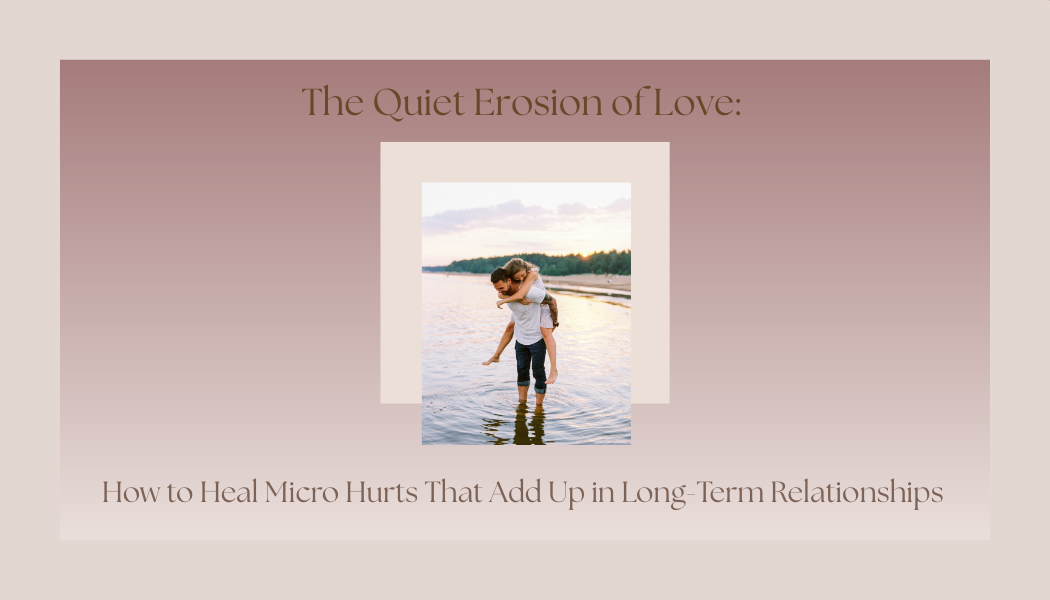
The Quiet Erosion of Love: How to Heal Micro Hurts That Add Up in Long-Term Relationships
The Quiet Erosion of Love: How to Heal Micro Hurts That Add Up in Long-Term Relationships
Micro-hurts in long-term relationships can quietly build into resentment and emotional distance. Learn how nervous system repair, relational repair, and trauma-informed therapy help couples heal minor wounds before they harden.
The Quiet Isidiousness of Unspoken Hurts
Most long-term relationships do not fall apart because of one catastrophic betrayal. They unravel through something quieter and more insidious. Small disappointments. Missed bids for connection. Unspoken hurts. Subtle dismissals. Over time, these moments accumulate, shaping resentment, emotional distance, and a sense that something precious has been lost.
You might recognize the feeling. Why do I feel irritated over small things? Why does my partner’s tone feel loaded? Why does affection feel harder to access? Why do I keep replaying old arguments that were supposedly resolved?
These questions point to what relationship researchers and trauma-informed clinicians call micro hurts. They are minor relational injuries that do not seem significant in isolation, but when left unaddressed, they reshape the nervous system and the emotional climate of a partnership.
At Embodied Wellness and Recovery, we work with couples and individuals who lack love, commitment, or effort. They are struggling with the cumulative weight of unresolved micro hurts that have never had space to be metabolized.
What Are Micro Hurts in Relationships?
Micro hurts are subtle relational wounds that often go unnamed. They include moments like:
— Feeling unheard or interrupted repeatedly
— A partner forgetting something meaningful
— Emotional bids being met with distraction or defensiveness
— Sarcasm that lands as contempt
— Sexual advances that are ignored or misread
— Conflict that ends without repair
These moments do not register as major betrayals, yet the body records them. Each one sends a small signal of unsafety, disappointment, or disconnection.
Over time, the nervous system learns to brace.
Why Micro Hurts Create Such Lasting Damage
From a neuroscience perspective, the brain is not designed to track events based on logical importance. It tracks emotional and relational significance. When moments of disconnection happen repeatedly with the same attachment figure, the brain begins to predict threat.
This process involves:
— Increased amygdala activation, heightening sensitivity to tone and facial expression
— Reduced access to the prefrontal cortex, making reflection and empathy harder during conflict
— Activation of the autonomic nervous system into fight, flight, or shutdown.
When these patterns repeat, partners stop responding to the present moment and start reacting to an entire history stored in the nervous system.
This is why arguments escalate so quickly. The nervous system is not responding to this disagreement. It is responding to everything that came before.
How Pent Up Resentment Develops
Resentment is not anger that is too big. It is anger that has been too contained for too long.
Many people in long-term relationships silence their discomfort in the name of harmony, loyalty, or fear of conflict. They tell themselves it is not worth bringing up. They rationalize. They adapt.
But the body does not forget.
Over time, resentment shows up as:
— Emotional withdrawal or numbness
— Chronic irritability
— Loss of sexual desire
— Passive aggression
— Fantasizing about being alone or understood elsewhere
Resentment is a signal that repair has been deferred for too long.
The Role of Attachment and Trauma History
Micro hurts land differently depending on attachment history and unresolved trauma. For someone with developmental trauma or inconsistent caregiving, small moments of dismissal can echo early experiences of emotional abandonment.
This does not mean the current partner is causing the pain. It means the nervous system is layering present experiences onto old templates.
Without understanding this dynamic, couples often get stuck in blame cycles that miss the deeper repair that is needed.
Why Talking It Out Often Is Not Enough
Many couples attempt to heal micro hurts through conversation alone. While communication matters, words alone cannot override a dysregulated nervous system.
When partners are in survival states, they may:
— Defend rather than listen
— Minimize impact to protect themselves from shame
— Struggle to access empathy even when they want to
Proper repair requires addressing the physiological state underneath the conversation.
This is where trauma-informed, nervous system-centered couples therapy becomes essential.
How to Begin Healing Micro Hurts
Healing does not start with revisiting every past slight. It begins with creating enough safety for the nervous system to stand down.
Key elements include:
1. Slowing Down the Nervous System
Before repair can happen, both partners need support in regulating arousal. This may include breathwork, grounding, pacing conversations, or learning to pause when escalation begins.
2. Naming Impact Without Blame
Repair focuses on impact rather than intent. This shifts the conversation from proving who is right to understanding how the nervous system was affected.
3. Repairing in the Present
Each successful repair teaches the nervous system that rupture does not equal abandonment. This rewires expectation over time.
4. Tending to the Accumulated Story
Micro hurts often carry themes. Feeling unseen. Feeling unchosen. Feeling alone. Therapy helps identify and tend to these themes with compassion.
Micro Hurts and Sexual Intimacy
Sexual distance in long-term relationships is often not about desire mismatch alone. It is about unresolved relational injury.
The body cannot access openness, pleasure, or vulnerability when it does not feel emotionally safe. Micro hurts that go unaddressed often settle in the body as tension, avoidance, or shutdown around intimacy.
Sex therapy that integrates attachment and nervous system repair helps couples restore safety and erotic connection without pressure or performance.
Why Avoidance Makes Things Worse
Avoiding conflict does not prevent harm. It delays repair. When micro hurts are avoided, the nervous system fills in the gaps with meaning. Silence becomes interpreted as indifference. Distance becomes interpreted as rejection. Over time, partners begin living alongside each other rather than with each other.
At Embodied Wellness and Recovery, we help couples and individuals understand that resentment is not a failure of love. It is a sign that care has been deferred.
Our approach integrates:
— Trauma-informed couples therapy
— Somatic and nervous system-based interventions
— Attachment-focused repair work
— Sex and intimacy therapy grounded in safety and consent
Healing micro hurts is not about perfection. It is about building a relationship that can metabolize rupture and return to connection.
What Changes When Micro Hurts Are Repaired
When repair becomes consistent, couples often report:
— Less reactivity during conflict
— Increased emotional closeness
— Renewed sexual connection
— Greater trust in the relationship’s resilience
— A felt sense of being on the same team
The nervous system begins to learn that connection can be restored, even after disappointment.
More than Commitment
Long-term relationships require more than commitment. They require ongoing repair. Micro hurts do not disappear when ignored. They accumulate in the nervous system, shaping how love is experienced.
When couples learn how to recognize, regulate, and repair these minor wounds, intimacy becomes more sustainable and less fragile.
Reach out to schedule a complimentary 20-minute consultation with our team of therapists, trauma specialists, somatic practitioners, or relationship experts, and start working towards integrative, embodied healing today.
📞 Call us at (310) 651-8458
📱 Text us at (310) 210-7934
📩 Email us at admin@embodiedwellnessandrecovery.com
🔗 Visit us at www.embodiedwellnessandrecovery.com
👉 Check us out on Instagram @embodied_wellness_and_recovery
🌍 Explore our offerings at Linktr.ee: https://linktr.ee/laurendummit
References
1) Gottman, J. M., & Silver, N. (2015). The seven principles for making marriage work. Harmony Books.
2) Porges, S. W. (2011). The polyvagal theory: Neurophysiological foundations of emotions, attachment, communication, and self-regulation. W. W. Norton & Company.
3) Siegel, D. J. (2012). The developing mind: How relationships and the brain interact to shape who we are. Guilford Press.
4) Van der Kolk, B. A. (2014). The body keeps the score: Brain, mind, and body in the healing of trauma. Viking.