
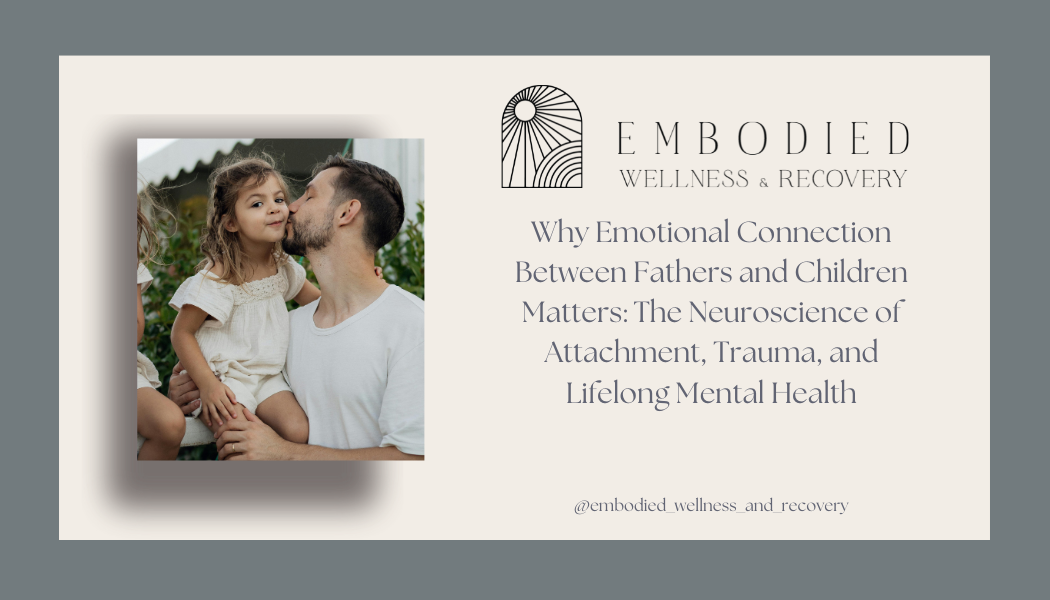
Why Emotional Connection Between Fathers and Children Matters: The Neuroscience of Attachment, Trauma, and Lifelong Mental Health
Why Emotional Connection Between Fathers and Children Matters: The Neuroscience of Attachment, Trauma, and Lifelong Mental Health
How does a father's emotional connection shape a child's brain and relationships? Discover the neuroscience of father-child attachment, the effects of emotional distance, and how healing is possible at any stage of life through secure relationships and nervous system regulation.
A father can provide for his family financially, attend every sporting event, and make sure the bills are paid, yet his child may still grow up feeling emotionally unseen. Conversely, a father who is consistently curious, emotionally available, and engaged can profoundly shape a child's sense of safety, self-worth, and resilience.
If you grew up with an emotionally distant father, you may find yourself asking:
— Why do I struggle to trust people?
— Why do I constantly seek approval or validation?
— Why do I feel uncomfortable expressing emotions?
— Why do I crave closeness but fear rejection?
— Why do I choose emotionally unavailable partners?
— Why do I still long for something I never received?
These questions are not signs of weakness. They often reflect the enduring influence of early attachment experiences and the ways our nervous systems adapt to relational environments.
Fathers Shape More Than Childhood Memories
Historically, research focused heavily on mothers and early attachment. Today, developmental science demonstrates that fathers play a unique and significant role in children's emotional, cognitive, and social development. Children do not simply benefit from a father's physical presence.
They benefit from emotional presence. Feeling seen, comforted, encouraged, and accepted by a father can become part of the internal blueprint that guides future relationships.
Emotional Connection Helps Build the Developing Brain
Secure relationships help organize the developing nervous system.
When children experience responsive caregiving, their brains repeatedly learn:
— My emotions matter.
— Someone will help me when I am distressed.
— Relationships are safe.
— I can depend on others.
— I am worthy of care.
These repeated experiences strengthen emotional regulation, stress tolerance, and secure attachment. Over time, children internalize these interactions and begin regulating themselves more effectively.
When Emotional Distance Becomes the Norm
Some fathers deeply love their children but struggle to express affection due to their own upbringing, cultural expectations, trauma histories, depression, anxiety, or emotional suppression. Children rarely interpret this complexity accurately.
Instead, they may conclude:
— I'm too much.
— My feelings don't matter.
— I have to earn love.
— I shouldn't need anyone.
— Vulnerability is dangerous.
These beliefs often persist into adulthood unless intentionally examined.
The Nervous System Learns Relationships Through Experience
From a neuroscience perspective, attachment experiences influence how the brain predicts safety and connection. An emotionally attuned father can help regulate a child's stress response by providing reassurance, warmth, and consistency. When emotional attunement is missing, the child may become chronically vigilant, emotionally withdrawn, or excessively independent. These adaptations often make perfect sense in the context of early experiences.
Emotional Availability Is More Important Than Perfection
Children do not require flawless parents. They benefit from caregivers who notice their emotions, repair misunderstandings, and communicate genuine interest in their inner worlds.
Simple interactions matter:
— Listening without immediately solving.
— Validating disappointment.
— Offering physical affection when welcomed.
— Admitting mistakes.
— Returning after conflict to reconnect.
These moments teach children that relationships can survive imperfection.
How Father Wounds Can Influence Adult Relationships
Adults who lacked emotional connection with a father sometimes notice recurring patterns such as:
— Fear of abandonment
— Attraction to emotionally unavailable partners
— Difficulty setting boundaries
— Avoidance of vulnerability
— Excessive self-reliance
— Anxiety in close relationships
These patterns are not destiny. They often represent adaptive strategies learned early in life.
Sons and Daughters Are Both Affected
While experiences vary across families, emotionally engaged fathers contribute positively to children of all genders. Research has linked paternal warmth and involvement with improved emotional regulation, stronger self-esteem, better academic functioning, and healthier interpersonal relationships. The essential ingredient is not gender. It is connection.
Fathers Teach Emotional Literacy
Many adults grew up hearing messages like:
"Be tough."
"Stop crying."
"Get over it."
Although often well-intentioned, these messages can disconnect children from their emotional experiences. When fathers instead model emotional awareness, accountability, and empathy, children learn that strength includes the capacity to identify and express feelings.
Trauma Can Be Intergenerational
Emotionally distant fathers are not necessarily uncaring fathers. Some grew up in environments where emotional expression was discouraged or unsafe. Others experienced trauma that limited their own capacity for connection. Understanding these histories does not excuse harmful behavior, but it can create space for compassion and interrupt intergenerational patterns.
Can Adults Heal From Father Wounds?
Absolutely. The brain remains capable of change throughout life. Corrective emotional experiences in therapy, healthy friendships, romantic relationships, mentorships, and parenting can reshape expectations about safety and attachment. Healing often involves recognizing that the unmet needs of childhood deserve acknowledgment rather than dismissal. It also involves learning that emotional closeness can feel unfamiliar without being dangerous.
What Fathers Can Do Today
If you are a father, your greatest influence may not come from providing answers. It may come from providing presence. Ask questions. Stay curious. Repair after conflict. Make eye contact. Listen without immediately fixing. Tell your child you are proud of them for who they are, not only for what they accomplish. Small moments of emotional attunement accumulate into lifelong memories.
How Embodied Wellness and Recovery Can Help
At Embodied Wellness and Recovery, we understand that early relationships with caregivers. including fathers, shape the nervous system, attachment patterns, self-concept, and future intimacy. Experiences of emotional neglect or disconnection can influence mental health, relationships, sexuality, and the ability to feel safe with others long into adulthood.
Our clinicians integrate somatic therapy, EMDR, attachment-focused psychotherapy, and neuroscience-informed care to help individuals process relational wounds, strengthen emotional regulation, and cultivate healthier patterns of connection. We specialize in trauma, nervous system repair, relationships, sexuality, and intimacy, supporting clients in creating new experiences of trust and belonging that extend beyond their earliest family dynamics.
The presence of an emotionally connected father does not guarantee a perfect life. But the experience of feeling seen, soothed, valued, and understood can become a powerful foundation for resilience, secure attachment, and meaningful relationships throughout the lifespan.
Reach out to schedule a complimentary 20-minute consultation with our team of therapists, trauma specialists, somatic practitioners, or relationship experts, and start working towards integrative, embodied healing today.
📞 Call us at (310) 651-8458
📱 Text us at (310) 210-7934
📩 Email us at admin@embodiedwellnessandrecovery.com
🔗 Visit us at www.embodiedwellnessandrecovery.com
👉 Check us out on Instagram @embodied_wellness_and_recovery
🌍 Explore our offerings at Linktr.ee: https://linktr.ee/laurendummit
References
Grossmann, K., Grossmann, K. E., Kindler, H., & Zimmermann, P. (2008). A wider view of attachment and exploration: Stability and change during the years of immaturity. In J. Cassidy & P. R. Shaver (Eds.), Handbook of attachment: Theory, research, and clinical applications (2nd ed., pp. 857-879). Guilford Press.
Lamb, M. E. (2010). The role of the father in child development (5th ed.). Wiley.
Porges, S. W. (2011). The polyvagal theory: Neurophysiological foundations of emotions, attachment, communication, and self-regulation. W. W. Norton & Company.
Siegel, D. J., & Bryson, T. P. (2020). The power of showing up: How parental presence shapes who our kids become and how their brains get wired. Ballantine Books.
Sroufe, L. A. (2005). Attachment and development: A prospective, longitudinal study from birth to adulthood. Attachment & Human Development, 7(4), 349-367.
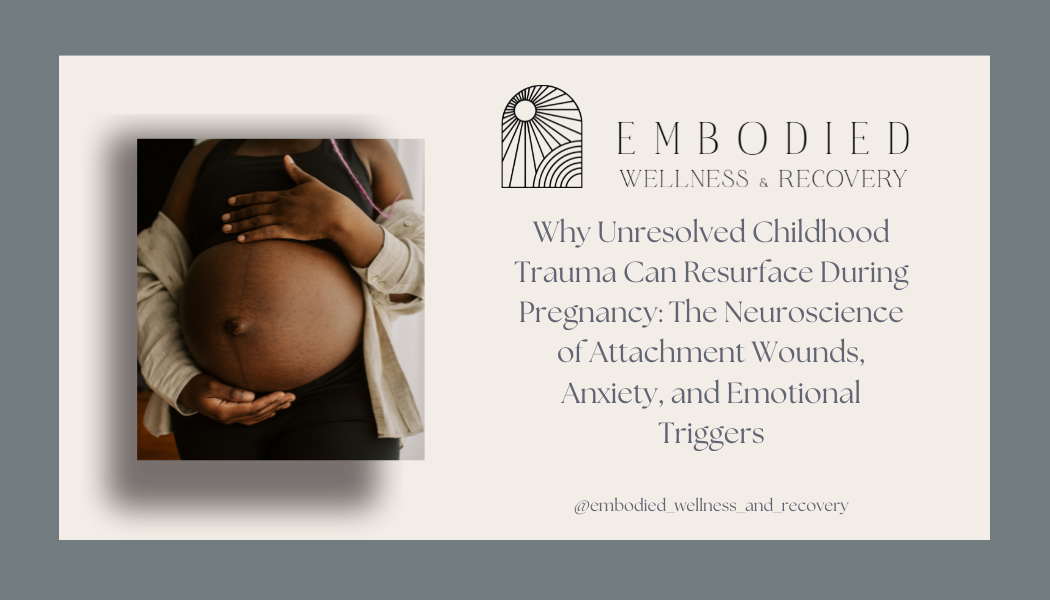
Why Unresolved Childhood Trauma Can Resurface During Pregnancy: The Neuroscience of Attachment Wounds, Anxiety, and Emotional Triggers
Why Unresolved Childhood Trauma Can Resurface During Pregnancy: The Neuroscience of Attachment Wounds, Anxiety, and Emotional Triggers
Can pregnancy trigger unresolved childhood trauma? Discover the neuroscience behind pregnancy-related trauma activation, attachment wounds, anxiety, and emotional overwhelm. Learn how EMDR, somatic therapy, and trauma-informed care can help support nervous system regulation during pregnancy.
Pregnancy is often portrayed as a joyful and exciting season of life. Yet for many women, it can also be a surprisingly emotional, vulnerable, and psychologically complex experience.
Have you found yourself feeling more anxious than expected?
Do old memories seem to surface out of nowhere?
Have you become more sensitive to criticism, rejection, conflict, or feelings of abandonment?
Do you find yourself worrying about becoming a parent because of experiences you had with your own mother or father?
Perhaps you expected to spend your pregnancy decorating a nursery and imagining the future, but instead find yourself confronting emotions that seem connected to the past. If so, there may be a reason.
Research suggests that pregnancy often activates unresolved childhood trauma, attachment wounds, and deeply stored nervous system responses that may have remained dormant for years (Kamara, 2015). This is not a sign that something is wrong with you. In many ways, pregnancy can become an invitation to revisit unfinished emotional experiences that your mind and body have carried for decades.
Why Pregnancy Can Trigger Childhood Trauma
Pregnancy represents one of the most significant developmental transitions a person experiences. Psychologists sometimes refer to this transformation as matrescence, the process of becoming a mother. Just as adolescence reshapes identity, pregnancy can dramatically alter how a woman sees herself, her relationships, her body, and her future.
From a neuroscience perspective, pregnancy creates substantial hormonal, neurobiological, and emotional changes that increase sensitivity to attachment experiences and relational memories. As women prepare to nurture a child, their brains naturally begin to revisit internal models of caregiving formed during childhood.
Questions may emerge:
— What kind of mother will I be?
— Will I repeat my parents' mistakes?
— Can I provide emotional safety for my child?
— What if I am not enough?
— What if I fail?
For women who experienced neglect, emotional abuse, criticism, abandonment, parentification, domestic violence, addiction in the home, or inconsistent caregiving, these questions can activate unresolved trauma networks. Experiences that once felt distant may suddenly feel intensely present.
The Brain's Memory Networks Never Fully Forget
One of the most important concepts in trauma therapy is understanding that traumatic experiences are not stored like ordinary memories. According to the Adaptive Information Processing model developed by Francine Shapiro, distressing experiences can become stored in isolated neural networks that remain emotionally charged long after the original event has ended. When current experiences resemble aspects of past experiences, these networks can reactivate.
Pregnancy often contains many triggers that resemble childhood experiences:
— Increased dependency on others
— Changes in identity
— Concerns about safety
— Medical vulnerability
— Physical touch and body awareness
— Fear of abandonment
— Feelings of uncertainty
When these experiences activate old neural networks, women may experience anxiety, sadness, irritability, panic, intrusive memories, nightmares, or emotional flooding without fully understanding why. The body may remember what the conscious mind has forgotten.
The Nervous System and Pregnancy
Trauma is not simply stored in thoughts. It is stored within the nervous system. Research from the fields of neuroscience, attachment theory, and somatic psychology demonstrates that traumatic experiences can alter stress response systems, including the amygdala, hippocampus, hypothalamic-pituitary-adrenal axis, and autonomic nervous system. For individuals with unresolved childhood trauma, the nervous system may become conditioned to anticipate danger even when no threat is present (Goldsmith, Barlow, & Freyd, 2004).
During pregnancy, this can manifest as:
— Excessive worry
— Difficulty sleeping
— Fear of childbirth
— Emotional reactivity
— Feelings of shame or inadequacy
Many women become frustrated because they believe they "should" be happy. Instead, they find themselves overwhelmed by emotions they cannot explain. Often, what they are experiencing is not weakness. It is a nervous system responding to old experiences that were never fully processed.
Attachment Wounds Often Surface During Pregnancy
Pregnancy frequently activates attachment trauma. Attachment theory suggests that early relationships teach us what to expect from ourselves and others. If caregivers were emotionally available, children generally develop a sense of security. If caregiverswere inconsistent, critical, emotionally unavailable, abusive, or unpredictable, children may develop insecure attachment patterns. Pregnancy often reawakens these attachment experiences.
Women may begin remembering:
— Feeling unseen
— Feeling emotionally neglected
— Walking on eggshells around a parent
— Being expected to care for others' emotions
— Never feeling good enough
— Longing for protection that never came
Some women notice increased conflict with their partners during pregnancy. Others become more fearful of rejection or abandonment. These reactions often make sense when viewed through the lens of attachment trauma.
Childhood Trauma and the Fear of Becoming Your Parents
One of the most painful experiences many pregnant women describe is the fear of repeating generational patterns.
Questions like these often emerge:
— What if I become emotionally unavailable like my mother?
— What if I lose my temper like my father?
— What if I damage my child the way I was damaged?
These fears can be profound. Ironically, the very fact that someone worries about repeating harmful patterns often reflects a heightened awareness and a commitment to doing things differently. Research on intergenerational trauma suggests that insight, emotional processing, and reflective functioning significantly reduce the likelihood of transmitting unresolved trauma to future generations. Awareness creates opportunity for change.
The Impact on Relationships, Sexuality, and Intimacy
Pregnancy can also affect intimacy. Women with trauma histories may notice changes in sexual desire, comfort with touch, body image, vulnerability, and emotional closeness. For some, physical changes can trigger memories of past violations or experiences of shame. Others may feel disconnected from their bodies or struggle to communicate their needs.
Partners may misinterpret these changes as rejection when they are actually manifestations of nervous system activation. This is why trauma-informed couples therapy can be especially beneficial during pregnancy. When partners understand the underlying neurobiology of trauma, they can respond with greater empathy and attunement.
How Trauma-Informed Therapy Can Help
The encouraging news is that unresolved trauma does not need to dictate your pregnancy experience. Evidence-based therapies can help the brain and nervous system process unresolved experiences and develop greater resilience. At Embodied Wellness and Recovery, we often integrate approaches such as:
EMDR Therapy
EMDR helps the brain reprocess traumatic experiences so they become less emotionally distressing and less likely to trigger present-day symptoms.
Somatic Therapy
Somatic approaches help individuals reconnect with their bodies, regulate their nervous systems, and release survival responses that remain stuck in the body.
Attachment-Focused Therapy
Attachment-focused treatment explores how early relational experiences continue influencing emotional responses, relationships, parenting expectations, and self-worth.
Couples Therapy
Couples therapy helps partners understand trauma responses, improve communication, strengthen emotional connection, and prepare for the transition into parenthood.
Pregnancy Can Become an Opportunity for Growth
Many women initially feel discouraged when old wounds emerge during pregnancy. Yet what appears to be a setback is often a signal that deeper healing is seeking attention. Pregnancy has a unique way of illuminating what matters most. It often brings unresolved pain into awareness not to punish us, but to create an opportunity for reflection, repair, and transformation.
When trauma is addressed with compassion, evidence-based treatment, and nervous system support, women frequently discover a deeper sense of self-understanding, emotional regulation, and confidence as they prepare to welcome a child into the world.
At Embodied Wellness and Recovery, we specialize in helping individuals and couples navigate trauma, attachment wounds, nervous system dysregulation,sexuality, intimacy concerns, and major life transitions through a neuroscience-informed, compassionate approach that honors both the mind and the body.
Reach out to schedule a complimentary 20-minute consultation with our team of therapists, trauma specialists, somatic practitioners, or relationship experts, and start working towards integrative, embodied healing today.
📞 Call us at (310) 651-8458
📱 Text us at (310) 210-7934
📩 Email us at admin@embodiedwellnessandrecovery.com
🔗 Visit us at www.embodiedwellnessandrecovery.com
👉 Check us out on Instagram @embodied_wellness_and_recovery
🌍 Explore our offerings at Linktr.ee: https://linktr.ee/laurendummit
References
1) Alhusen, J. L., Hayat, M. J., & Gross, D. (2013). A longitudinal study of maternal attachment and infant developmental outcomes. Archives of Women's Mental Health, 16(6), 521-529.
2) Goldsmith, R. E., Barlow, M. R., & Freyd, J. J. (2004). Knowing and not knowing about trauma: Implications for therapy. Psychotherapy: Theory, research, practice, training, 41(4), 448.
3) Kamara, J. W. (2015). Pregnancy, an opportunity for empowerment: a trauma and attachment-informed approach to creating a corrective relationship for mothers with trauma histories and subsequent substance abuse.
4) Seng, J. S., Low, L. K., Sperlich, M., Ronis, D. L., & Liberzon, I. (2011). Prevalence, trauma history, and risk for posttraumatic stress disorder among nulliparous women in maternity care. Obstetrics & Gynecology, 114(4), 839-847.
5) Shapiro, F. (2018). Eye Movement Desensitization and Reprocessing (EMDR) Therapy: Basic Principles, Protocols, and Procedures (3rd ed.). Guilford Press.
6) Slade, A., Cohen, L. J., Sadler, L. S., & Miller, M. (2009). The psychology and psychopathology of pregnancy. In C. H. Zeanah (Ed.), Handbook of Infant Mental Health (3rd ed., pp. 22-39). Guilford Press.
7) Van der Kolk, B. A. (2014). The Body Keeps the Score: Brain, Mind, and Body in the Healing of Trauma. Viking.