
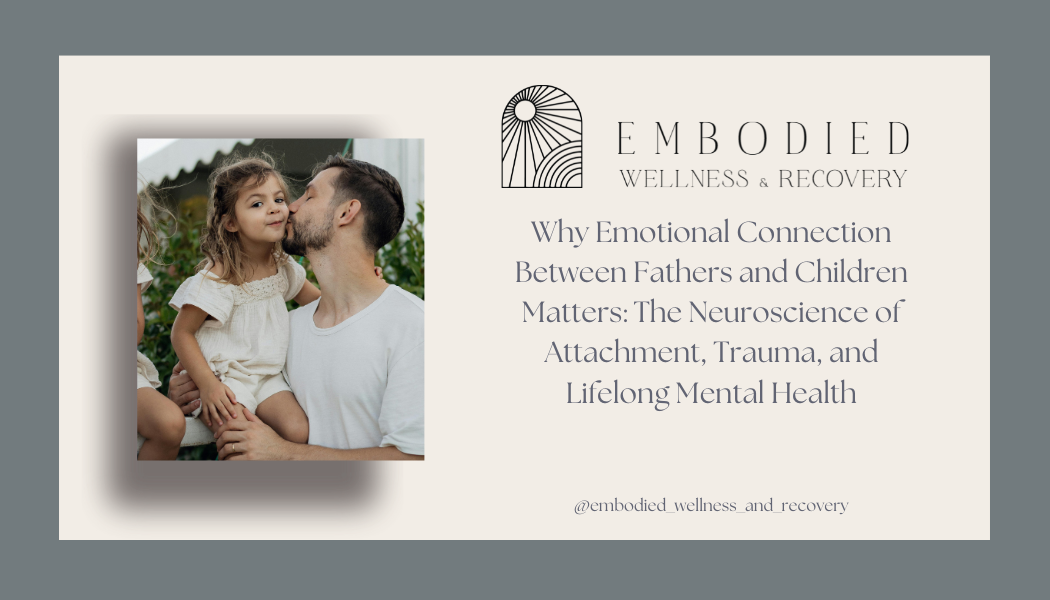
Why Emotional Connection Between Fathers and Children Matters: The Neuroscience of Attachment, Trauma, and Lifelong Mental Health
Why Emotional Connection Between Fathers and Children Matters: The Neuroscience of Attachment, Trauma, and Lifelong Mental Health
How does a father's emotional connection shape a child's brain and relationships? Discover the neuroscience of father-child attachment, the effects of emotional distance, and how healing is possible at any stage of life through secure relationships and nervous system regulation.
A father can provide for his family financially, attend every sporting event, and make sure the bills are paid, yet his child may still grow up feeling emotionally unseen. Conversely, a father who is consistently curious, emotionally available, and engaged can profoundly shape a child's sense of safety, self-worth, and resilience.
If you grew up with an emotionally distant father, you may find yourself asking:
— Why do I struggle to trust people?
— Why do I constantly seek approval or validation?
— Why do I feel uncomfortable expressing emotions?
— Why do I crave closeness but fear rejection?
— Why do I choose emotionally unavailable partners?
— Why do I still long for something I never received?
These questions are not signs of weakness. They often reflect the enduring influence of early attachment experiences and the ways our nervous systems adapt to relational environments.
Fathers Shape More Than Childhood Memories
Historically, research focused heavily on mothers and early attachment. Today, developmental science demonstrates that fathers play a unique and significant role in children's emotional, cognitive, and social development. Children do not simply benefit from a father's physical presence.
They benefit from emotional presence. Feeling seen, comforted, encouraged, and accepted by a father can become part of the internal blueprint that guides future relationships.
Emotional Connection Helps Build the Developing Brain
Secure relationships help organize the developing nervous system.
When children experience responsive caregiving, their brains repeatedly learn:
— My emotions matter.
— Someone will help me when I am distressed.
— Relationships are safe.
— I can depend on others.
— I am worthy of care.
These repeated experiences strengthen emotional regulation, stress tolerance, and secure attachment. Over time, children internalize these interactions and begin regulating themselves more effectively.
When Emotional Distance Becomes the Norm
Some fathers deeply love their children but struggle to express affection due to their own upbringing, cultural expectations, trauma histories, depression, anxiety, or emotional suppression. Children rarely interpret this complexity accurately.
Instead, they may conclude:
— I'm too much.
— My feelings don't matter.
— I have to earn love.
— I shouldn't need anyone.
— Vulnerability is dangerous.
These beliefs often persist into adulthood unless intentionally examined.
The Nervous System Learns Relationships Through Experience
From a neuroscience perspective, attachment experiences influence how the brain predicts safety and connection. An emotionally attuned father can help regulate a child's stress response by providing reassurance, warmth, and consistency. When emotional attunement is missing, the child may become chronically vigilant, emotionally withdrawn, or excessively independent. These adaptations often make perfect sense in the context of early experiences.
Emotional Availability Is More Important Than Perfection
Children do not require flawless parents. They benefit from caregivers who notice their emotions, repair misunderstandings, and communicate genuine interest in their inner worlds.
Simple interactions matter:
— Listening without immediately solving.
— Validating disappointment.
— Offering physical affection when welcomed.
— Admitting mistakes.
— Returning after conflict to reconnect.
These moments teach children that relationships can survive imperfection.
How Father Wounds Can Influence Adult Relationships
Adults who lacked emotional connection with a father sometimes notice recurring patterns such as:
— Fear of abandonment
— Attraction to emotionally unavailable partners
— Difficulty setting boundaries
— Avoidance of vulnerability
— Excessive self-reliance
— Anxiety in close relationships
These patterns are not destiny. They often represent adaptive strategies learned early in life.
Sons and Daughters Are Both Affected
While experiences vary across families, emotionally engaged fathers contribute positively to children of all genders. Research has linked paternal warmth and involvement with improved emotional regulation, stronger self-esteem, better academic functioning, and healthier interpersonal relationships. The essential ingredient is not gender. It is connection.
Fathers Teach Emotional Literacy
Many adults grew up hearing messages like:
"Be tough."
"Stop crying."
"Get over it."
Although often well-intentioned, these messages can disconnect children from their emotional experiences. When fathers instead model emotional awareness, accountability, and empathy, children learn that strength includes the capacity to identify and express feelings.
Trauma Can Be Intergenerational
Emotionally distant fathers are not necessarily uncaring fathers. Some grew up in environments where emotional expression was discouraged or unsafe. Others experienced trauma that limited their own capacity for connection. Understanding these histories does not excuse harmful behavior, but it can create space for compassion and interrupt intergenerational patterns.
Can Adults Heal From Father Wounds?
Absolutely. The brain remains capable of change throughout life. Corrective emotional experiences in therapy, healthy friendships, romantic relationships, mentorships, and parenting can reshape expectations about safety and attachment. Healing often involves recognizing that the unmet needs of childhood deserve acknowledgment rather than dismissal. It also involves learning that emotional closeness can feel unfamiliar without being dangerous.
What Fathers Can Do Today
If you are a father, your greatest influence may not come from providing answers. It may come from providing presence. Ask questions. Stay curious. Repair after conflict. Make eye contact. Listen without immediately fixing. Tell your child you are proud of them for who they are, not only for what they accomplish. Small moments of emotional attunement accumulate into lifelong memories.
How Embodied Wellness and Recovery Can Help
At Embodied Wellness and Recovery, we understand that early relationships with caregivers. including fathers, shape the nervous system, attachment patterns, self-concept, and future intimacy. Experiences of emotional neglect or disconnection can influence mental health, relationships, sexuality, and the ability to feel safe with others long into adulthood.
Our clinicians integrate somatic therapy, EMDR, attachment-focused psychotherapy, and neuroscience-informed care to help individuals process relational wounds, strengthen emotional regulation, and cultivate healthier patterns of connection. We specialize in trauma, nervous system repair, relationships, sexuality, and intimacy, supporting clients in creating new experiences of trust and belonging that extend beyond their earliest family dynamics.
The presence of an emotionally connected father does not guarantee a perfect life. But the experience of feeling seen, soothed, valued, and understood can become a powerful foundation for resilience, secure attachment, and meaningful relationships throughout the lifespan.
Reach out to schedule a complimentary 20-minute consultation with our team of therapists, trauma specialists, somatic practitioners, or relationship experts, and start working towards integrative, embodied healing today.
📞 Call us at (310) 651-8458
📱 Text us at (310) 210-7934
📩 Email us at admin@embodiedwellnessandrecovery.com
🔗 Visit us at www.embodiedwellnessandrecovery.com
👉 Check us out on Instagram @embodied_wellness_and_recovery
🌍 Explore our offerings at Linktr.ee: https://linktr.ee/laurendummit
References
Grossmann, K., Grossmann, K. E., Kindler, H., & Zimmermann, P. (2008). A wider view of attachment and exploration: Stability and change during the years of immaturity. In J. Cassidy & P. R. Shaver (Eds.), Handbook of attachment: Theory, research, and clinical applications (2nd ed., pp. 857-879). Guilford Press.
Lamb, M. E. (2010). The role of the father in child development (5th ed.). Wiley.
Porges, S. W. (2011). The polyvagal theory: Neurophysiological foundations of emotions, attachment, communication, and self-regulation. W. W. Norton & Company.
Siegel, D. J., & Bryson, T. P. (2020). The power of showing up: How parental presence shapes who our kids become and how their brains get wired. Ballantine Books.
Sroufe, L. A. (2005). Attachment and development: A prospective, longitudinal study from birth to adulthood. Attachment & Human Development, 7(4), 349-367.
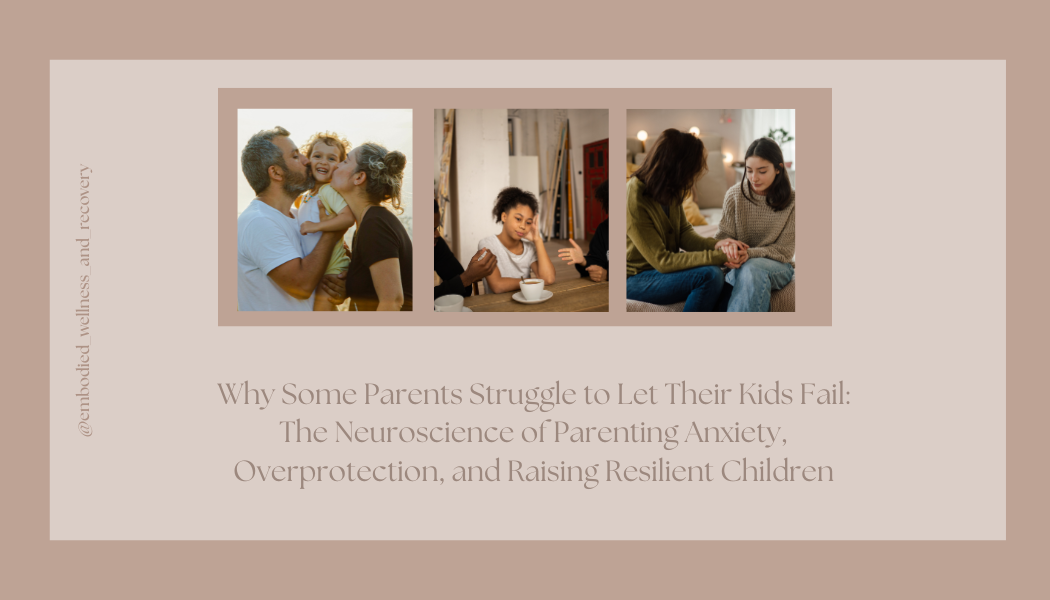
Why Some Parents Struggle to Let Their Kids Fail: The Neuroscience of Parenting Anxiety, Overprotection, and Raising Resilient Children
Why Some Parents Struggle to Let Their Kids Fail: The Neuroscience of Parenting Anxiety, Overprotection, and Raising Resilient Children
Why is it so hard to let your child fail? Learn how parenting anxiety, trauma, attachment, and nervous system responses can lead to overprotection and discover how allowing age-appropriate failure fosters resilience, confidence, and emotional growth.
Your child forgot their homework. Your teenager bombed a test. Your college student made a costly mistake. And somehow, your heart feels as though it is happening to you.
You replay every decision. You wonder whether you should have stepped in sooner. You feel an overwhelming urge to fix the problem, call the teacher, solve the conflict, or protect your child from disappointment. If this sounds familiar, you are far from unusual.
Many loving parents struggle to tolerate their children's failures, not because they are controlling or permissive, but because their own nervous systems experience their child's distress as a threat.
Do You Feel Responsible for Preventing Every Mistake?
Have you ever found yourself asking:
— "What if this failure ruins their future?"
— "Should I intervene before they get hurt?"
— "Am I being a bad parent if I let this happen?"
— "What if they lose confidence?"
— "What if they resent me for not helping?"
If so, your anxiety may be rooted in something deeper than parenting philosophy. It may reflect attachment, past experiences, and the way your brain and body have learned to respond to uncertainty.
Why Failure Feels So Threatening to Parents
Parents are biologically wired to protect their children. The attachment system motivates caregivers to respond quickly when a child is in distress, increasing the likelihood of safety and survival. But modern parenting often presents emotional rather than physical threats, such as a disappointing grade, a friendship conflict, a sports loss, a college rejection.
For some parents, these experiences activate the same physiological alarm systems that once evolved to respond to genuine danger. The result is an intense urge to rescue.
The Neuroscience of Parenting Anxiety
The brain is constantly scanning for potential threats. When parents perceive their child is struggling, regions involved in emotional processing and threat detection may become highly activated, prompting a cascade of stress hormones and sympathetic nervous system arousal.
This can create a powerful internal message:
"Do something now."
The challenge is that not every uncomfortable experience is harmful. In many cases, it is precisely these experiences that foster resilience, adaptability, and self-confidence.
Trauma Can Make Letting Go Feel Impossible
Parents with unresolved trauma or chronic anxiety may find it especially difficult to tolerate uncertainty. Perhaps you grew up in chaos. Perhaps mistakes were punished harshly. Perhaps no one protected you when you needed support. In response, your nervous system may have learned that constant vigilance is necessary to prevent catastrophe.
Without realizing it, you may begin trying to create safety by controlling every variable in your child's life. Ironically, this often increases anxiety for both parent and child.
The Difference Between Protection and Overprotection
Healthy parenting provides guidance, structure, and emotional support while allowing children to develop competence through experience. Overprotection occurs when adults repeatedly remove age-appropriate challenges or consequences in an attempt to reduce discomfort.
Examples include:
— Completing school projects for a child.
— Frequently intervening in peer conflicts.
— Preventing natural consequences.
— Solving problems before a child attempts to.
— Avoiding situations where failure is possible.
Although well intentioned, these behaviors may unintentionally communicate:
"I don't believe you can handle this."
Why Children Need Opportunities to Fail
Research in developmental psychology consistently suggests that resilience develops not from avoiding adversity but from successfully navigating manageable challenges with appropriate support.
Failure teaches children to:
— Solve problems independently.
— Tolerate frustration.
— Build persistence.
— Develop emotional regulation.
— Increase self-efficacy.
— Learn flexibility.
— Recover from setbacks.
Confidence is not created by never struggling. It is created by discovering, "I struggled and found my way through."
The Hidden Message of Constant Rescue
When parents consistently remove obstacles, children may internalize beliefs such as:
— "I can't do hard things."
— "Someone else has to fix my problems."
— "Mistakes are dangerous."
— "Failure means I'm inadequate."
Over time, these beliefs can contribute to perfectionism, anxiety, avoidance, and diminished self-confidence.
Your Child's Nervous System Is Learning From Yours
Children are remarkably sensitive to their caregivers' emotional states. When a parent responds to setbacks with panic, catastrophizing, or intense distress, children may absorb the message that ordinary failures are emergencies.
Conversely, when parents remain regulated and communicate calm confidence, children learn that disappointment is survivable. In this way, resilience is often co-regulated before it is self-regulated.
What Letting Them Fail Actually Looks Like
Allowing failure does not mean withholding support. It means offering support without removing every obstacle.
For example, instead of fixing the forgotten homework assignment, help your child reflect on how to remember it next time. Instead of calling the coach after your teenager loses playing time, encourage them to discuss it respectfully themselves. Instead of preventing disappointment, help them process disappointment. The goal is not to eliminate struggle. It is to increase capability.
The Parent's Work Is Often Internal
Many parents discover that their greatest challenge is not managing their child's emotions but regulating their own.
Ask yourself:
— Is this situation truly dangerous, or is it merely uncomfortable?
— Am I responding to my child's needs or to my own anxiety?
— What belief gets activated when my child struggles?
— What would happen if I trusted them to work through this?
These questions invite reflection rather than reactivity.
How Nervous System Regulation Changes Parenting
When parents cultivate greater emotional regulation, remarkable shifts often occur. They pause before intervening. They tolerate uncertainty. They communicate confidence rather than fear. They become a secure base from which children can explore, fail, recover, and grow. Rather than rescuing every time their child falls, they remain close enough to offer encouragement while allowing the child to stand back up.
How Embodied Wellness and Recovery Can Help
At Embodied Wellness and Recovery, we recognize that parenting anxiety often extends beyond concerns about a child's behavior. It may reflect unresolved trauma, attachment patterns, perfectionism, or a nervous system conditioned to anticipate danger.
Our clinicians integrate somatic therapy, EMDR, neuroscience-informed psychotherapy, attachment-based approaches, and evidence-based parenting support to help adults regulate anxiety, strengthen resilience, and foster healthier family relationships. We also specialize in trauma recovery, nervous system repair, relationships, sexuality, and intimacy, recognizing that the way we parent is often deeply connected to the way we ourselves were parented.
The ultimate goal of parenting is not to ensure a child never fails. It is to help them discover that setbacks, disappointment, and mistakes can become opportunities for learning, resilience, and growth. Sometimes the most loving response is not stepping in. It is standing beside your child with quiet confidence while they discover their own capacity to rise.
Reach out to schedule a complimentary 20-minute consultation with our team of therapists, trauma specialists, somatic practitioners, or relationship experts, and start working towards integrative, embodied healing today.
📞 Call us at (310) 651-8458
📱 Text us at (310) 210-7934
📩 Email us at admin@embodiedwellnessandrecovery.com
🔗 Visit us at www.embodiedwellnessandrecovery.com
👉 Check us out on Instagram @embodied_wellness_and_recovery
🌍 Explore our offerings at Linktr.ee: https://linktr.ee/laurendummit
References
Dweck, C. S. (2006). Mindset: The new psychology of success. Random House.
Masten, A. S. (2014). Ordinary magic: Resilience in development. Guilford Press.
Porges, S. W. (2011). The polyvagal theory: Neurophysiological foundations of emotions, attachment, communication, and self-regulation. W. W. Norton & Company.
Siegel, D. J., & Bryson, T. P. (2020). The power of showing up: How parental presence shapes who our kids become and how their brains get wired. Ballantine Books.
Sroufe, L. A. (2005). Attachment and development: A prospective, longitudinal study from birth to adulthood. Attachment & Human Development, 7(4), 349-367.