
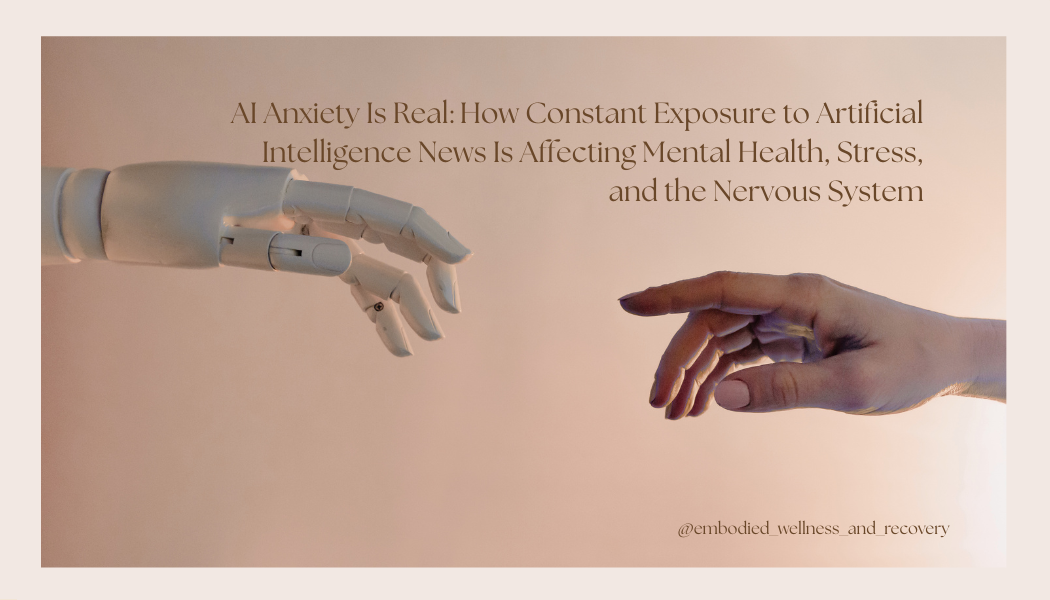
AI Anxiety Is Real: How Constant Exposure to Artificial Intelligence News Is Affecting Mental Health, Stress, and the Nervous System
AI Anxiety Is Real: How Constant Exposure to Artificial Intelligence News Is Affecting Mental Health, Stress, and the Nervous System
Constant exposure to AI news can increase anxiety, overwhelm, uncertainty, and nervous system dysregulation. Learn the neuroscience behind AI anxiety, information overload, and practical strategies for protecting mental health in an age of rapid technological change.
Why Does AI News Feel So Emotionally Overwhelming?
Artificial intelligence is everywhere.
Every day, headlines warn that AI may replace jobs, transform relationships, disrupt education, reshape healthcare, alter creativity, and fundamentally change the future of humanity. Social media feeds are saturated with predictions ranging from extraordinary optimism to existential catastrophe. For many people, keeping up with AI developments feels less like staying informed and more like riding an emotional roller coaster.
Have you found yourself asking:
— Am I going to lose my job because of AI?
— Will my skills become obsolete?
— Why do I feel anxious every time I read AI news?
— Why can't I stop checking for updates about artificial intelligence?
— Why do I feel overwhelmed by how quickly technology is changing?
— Why do I feel exhausted, distracted, or hopeless after scrolling through AI content?
If so, you are experiencing something increasingly recognized by psychologists and mental health professionals: the emotional impact of chronic exposure to uncertainty, technological disruption, and information overload.
The issue is not simply artificial intelligence itself. The issue is how our brains and nervous systems respond to constant exposure to rapid, unpredictable change.
The Human Brain Was Not Designed for Infinite Information
One of the defining characteristics of modern life is the unprecedented volume of information available at every moment. Research has consistently demonstrated that excessive information consumption can contribute to stress, anxiety, cognitive fatigue, and emotional overwhelm (Bawden & Robinson, 2020). The human brain evolved to process manageable amounts of information within relatively stable environments. Today's reality is dramatically different.
Every hour brings new headlines:
— AI replacing workers
— AI transforming healthcare
— AI-generated misinformation
— AI companions and relationships
— AI breakthroughs
— AI safety concerns
— AI regulations
— AI existential risk
The nervous system struggles to distinguish between information that requires immediate action and information that is merely interesting. As a result, many people remain in a chronic state of vigilance.
The Neuroscience of AI Anxiety
From a neuroscience perspective, uncertainty is one of the most powerful triggers of stress. The brain's threat detection system, particularly the amygdala, is constantly scanning for potential danger. When future outcomes feel unpredictable, the brain often responds by increasing attention, vigilance, and worry.
Researchers have found that uncertainty can activate neural circuits associated with fear and anxiety (Grupe & Nitschke, 2013). In some cases, uncertainty may be experienced as more stressful than known negative outcomes because the brain continues searching for answers that do not yet exist.
AI news creates a perfect storm of uncertainty because:
— The technology is evolving rapidly.
— Experts often disagree about future outcomes.
— Predictions range from utopian to catastrophic.
— Individuals feel they have limited control over the changes.
When uncertainty becomes chronic, the nervous system may remain activated long after the news article has been read.
Doomscrolling Meets Artificial Intelligence
Many people report compulsively checking AI news despite feeling worse afterward.
Why?
The answer involves dopamine and the brain's reward system. Novel information activates reward pathways that encourage learning and exploration. Each new AI announcement promises potentially important information about the future. The brain begins seeking updates in the hope of gaining certainty. Ironically, each new update often introduces additional uncertainty.
This creates a cycle:
Anxiety about AI.
Search for information.
Temporary relief.
Exposure to more uncertainty.
Increased anxiety.
Return to information seeking.
Over time, this pattern can resemble other forms of compulsive digital consumption.
How AI News Can Affect Mental Health
Increased Anxiety
Many individuals experience heightened anxiety about employment, financial security, education, and societal change.
Information Overload
The sheer volume of AI content can create cognitive fatigue, making concentration and decision-making more difficult.
Existential Worry
Questions about human identity, purpose, creativity, and meaning often emerge when discussing artificial intelligence.
Sleep Disturbance
Consuming stimulating or anxiety-provoking information before bedtime can interfere with sleep quality and nervous system recovery.
Feelings of Helplessness
Constant exposure to large-scale societal issues can create a sense that personal actions no longer matter.
Why Trauma Survivors May Be Especially Vulnerable
At Embodied Wellness and Recovery, we often see how trauma influences responses to uncertainty.
Individuals with histories of:
— Emotional neglect
— Chronic stress
— Attachment trauma
— Family instability
may experience technological uncertainty differently.
Trauma can sensitize the nervous system to unpredictability. When AI headlines repeatedly signal that the future is uncertain, the body may respond as though a threat is imminent. What appears to be an overreaction may actually reflect a nervous system attempting to protect itself in light of prior experiences.
The Relationship Between AI Anxiety and Nervous System Dysregulation
Many people focus exclusively on their thoughts. However, anxiety is not solely a cognitive experience. It is also physiological.
You may notice:
— Muscle tension
— Digestive issues
— Fatigue
— Irritability
— Sleep disruption
These symptoms reflect nervous system activation. When the body remains in prolonged states of sympathetic arousal, stress becomes harder to regulate. This is why simply telling yourself to "stop worrying" rarely works The nervous system must also experience safety.
How AI News Is Affecting Relationships
An often overlooked consequence of AI anxiety is its impact on relationships.
When individuals become preoccupied with fear, uncertainty, or excessive information consumption, emotional availability may decrease.
Couples may argue about:
— Technology use
— Career decisions
— Financial planning
— Future security
Some individuals withdraw emotionally, while others become consumed with researching future threats. The result can be increased disconnection at the very moment human connection is most needed. Healthy relationships remain one of the strongest protective factors against chronic stress.
Five Ways to Protect Your Mental Health in the Age of AI
1. Limit AI News Consumption
Being informed does not require constant exposure. Consider establishing designated times for consuming technology news.
2. Notice What Happens in Your Body
Pay attention to physical signs of activation. Awareness is often the first step toward regulation.
3. Strengthen Real Human Connection
The antidote to technological overwhelm is often meaningful human connection. Prioritize conversations, relationships, and experiences that reinforce a sense of belonging.
4. Focus on What You Can Control
The brain feels safer when attention shifts toward actionable steps rather than hypothetical futures.
5. Support Nervous System Regulation
Activities such as exercise, mindfulness, somatic therapy, breathwork, yoga, exposure to nature, and adequate sleep can help restore physiological balance.
A More Balanced Relationship With AI
Artificial intelligence will likely continue influencing every aspect of modern life, but constant fear and hypervigilance are not requirements for adaptation. The healthiest approach often involves remaining informed without becoming consumed. Curious without becoming obsessive. Prepared without becoming paralyzed. Technology will continue evolving. The question is whether our nervous systems will be given opportunities to adapt alongside it.
Finding Stability in an Uncertain Future
At Embodied Wellness and Recovery, we help individuals understand how trauma, anxiety, chronic stress, attachment patterns, and nervous system dysregulation influence their responses to uncertainty and change.
Whether the source of distress is AI, career concerns, relationship challenges, or broader societal shifts, lasting well-being often requires more than changing thoughts. It involves supporting the brain, the body, and the nervous system simultaneously.
When individuals learn to regulate stress, cultivate emotional resilience, strengthen relationships, and reconnect with a sense of agency, they become better equipped to navigate uncertainty without being overwhelmed by it. The future may remain uncertain, but your relationship with uncertainty does not have to.
Reach out to schedule a complimentary 20-minute consultation with our team of therapists, trauma specialists, somatic practitioners, or relationship experts, and start working towards integrative, embodied healing today.
📞 Call us at (310) 651-8458
📱 Text us at (310) 210-7934
📩 Email us at admin@embodiedwellnessandrecovery.com
🔗 Visit us at www.embodiedwellnessandrecovery.com
👉 Check us out on Instagram @embodied_wellness_and_recovery
🌍 Explore our offerings at Linktr.ee: https://linktr.ee/laurendummit
References
Bawden, D., & Robinson, L. (2020). Information overload: An overview.
Brosschot, J. F., Gerin, W., & Thayer, J. F. (2006). The perseverative cognition hypothesis: A review of worry, prolonged stress-related physiological activation, and health. Journal of Psychosomatic Research, 60(2), 113-124.
Grupe, D. W., & Nitschke, J. B. (2013). Uncertainty and anticipation in anxiety: an integrated neurobiological and psychological perspective. Nature Reviews Neuroscience, 14(7), 488-501.
Hirsh, J. B., Mar, R. A., & Peterson, J. B. (2012). Psychological entropy: A framework for understanding uncertainty-related anxiety. Psychological Review, 119(2), 304-320.
LeDoux, J. E. (2000). Emotion circuits in the brain. Annual Review of Neuroscience, 23, 155-184.
Rosen, L. D., Lim, A. F., Carrier, L. M., & Cheever, N. A. (2011). An empirical examination of the educational impact of text message-induced task switching in the classroom. Educational Psychology, 31(6), 793-807.
Sapolsky, R. M. (2004). Why zebras don't get ulcers (3rd ed.). Henry Holt and Company.
What Are Safety Behaviors in Anxiety? The Hidden Habits That Keep Fear Alive and Prevent Lasting Relief
What Are Safety Behaviors in Anxiety? The Hidden Habits That Keep Fear Alive and Prevent Lasting Relief
Do you constantly seek reassurance, avoid uncertainty, or rely on rituals to feel safe? Learn how safety behaviors maintain anxiety, affect the nervous system, and discover neuroscience-informed approaches to build lasting confidence and resilience.
You check that the front door is locked. Then you check again. You rehearse every conversation before it happens. You always sit near the exit. You carry medication "just in case." You text a loved one for reassurance before making a decision. You avoid driving on the freeway, speaking up in meetings, or attending crowded events because it simply feels safer not to.
If these behaviors sound familiar, you are not weak or irrational. You may be relying on what psychologists call safety behaviors: strategies designed to reduce anxiety or prevent feared outcomes. While these habits often provide temporary relief, they can unintentionally reinforce fear and keep anxiety disorders alive.
Do You Feel Like You're Constantly Trying to Stay Safe?
Have you ever wondered:
— Why do I need constant reassurance?
— Why can't I stop checking, planning, or preparing?
— Why does avoiding stressful situations make me feel better in the moment but worse in the long run?
— Why does my body never seem to believe that I'm actually safe?
— Why do I know logically that I'm okay but still feel anxious?
These questions reflect a common struggle among people living with anxiety, panic, trauma, obsessive compulsive symptoms, and chronic stress. The answer often lies in understanding how the brain learns safety and threat.
What Are Safety Behaviors?
Safety behaviors are actions intended to reduce perceived danger or prevent feared consequences.
Examples include:
— Repeatedly seeking reassurance
— Checking locks, appliances, or health symptoms
— Avoiding certain places or situations
— Constantly carrying "just in case" items
— Overpreparing for conversations or presentations
— Sitting near exits
— Monitoring bodily sensations
— Excessively researching medical concerns
— Needing another person nearby to feel comfortable
— Avoiding emotional vulnerability
In the short term, these behaviors decrease anxiety. In the long term, they often strengthen it.
Why the Brain Keeps Using Them
The brain is designed to repeat behaviors that appear to increase survival. Imagine someone experiences panic while driving over a bridge. The next time they avoid the bridge, their anxiety immediately decreases.
The brain concludes:
"Avoiding the bridge kept me safe."
The relief becomes reinforcing. Soon, more bridges are avoided. Then highways. Then driving altogether. This process, known as negative reinforcement, teaches the nervous system that avoidance rather than capability prevents disaster.
The Neuroscience of Feeling Unsafe
Anxiety is deeply connected to the brain's threat detection systems. The amygdala rapidly evaluates potential danger and activates physiological responses such as increased heart rate, muscle tension, and hypervigilance. When repeated safety behaviors prevent corrective experiences, the brain never receives evidence that feared situations can be tolerated successfully. The nervous system remains stuck in prediction mode, continually expecting catastrophe.
The Body Wants Certainty
One of anxiety's defining characteristics is intolerance of uncertainty. Safety behaviors often function as attempts to create predictability. You might repeatedly review an email before sending it. Call your partner multiple times to ensure they arrived safely. Research every possible outcome before making a decision. Unfortunately, certainty is impossible. The more you chase it, the more elusive it becomes.
Trauma and Safety Behaviors
For individuals with trauma histories, safety behaviors often make perfect sense. If your environment was once unpredictable, dangerous, or emotionally invalidating, your nervous system adapted by becoming highly vigilant. Checking, preparing, scanning, and avoiding were not irrational. They were adaptive. The challenge arises when these same strategies persist long after circumstances have changed. The body continues responding to past threats rather than present reality.
Common Safety Behaviors You Might Not Recognize
Many behaviors appear responsible or conscientious but may actually be anxiety-driven.
Examples include:
— Excessive apologizing
— Constant list making
— Avoiding disagreement
— Needing immediate text replies
— Repeatedly asking others if everything is okay
— Delaying decisions until absolute certainty exists
The key question is not whether the behavior is useful. It is whether you believe you cannot cope without it.
Why Safety Behaviors Feel So Effective
Safety behaviors work. At least temporarily. Your anxiety decreases. You feel calmer. The problem is that your brain credits the behavior rather than your own resilience.
Instead of learning:
"I handled that."
It learns:
"I survived because I checked five times."
This distinction matters enormously. One builds confidence. The other builds dependence.
The Cost of Constant Protection
Over time, excessive safety behaviors can shrink your world. You may begin avoiding travel, relationships, career opportunities, public speaking, intimacy, or new experiences. Anxiety starts making decisions on your behalf. The nervous system becomes increasingly convinced that life is dangerous and that constant vigilance is required. Ironically, the pursuit of safety often produces chronic fear.
What Actually Helps?
Research consistently supports treatments that help individuals gradually experience feared situations while reducing reliance on safety behaviors (Helbig-Lang & Petermann, 2010). This allows the brain to update its predictions and learn that discomfort is tolerable and catastrophe is far less likely than expected. At the same time, many individuals benefit from approaches that address the body's physiological responses to fear.
Bottom-Up Healing and Nervous System Regulation
For people with trauma or chronic anxiety, lasting change often requires more than intellectual insight.
Somatic therapy, Eye Movement Desensitization and Reprocessing (EMDR), mindfulness practices, and other body-based interventions help regulate autonomic arousal while increasing tolerance for uncertainty and internal sensations. As the nervous system becomes more regulated, many safety behaviors naturally lose their grip.
The body begins to trust what the mind has long understood:
"I can handle this."
Safety Comes From Within
Perhaps the greatest misconception about anxiety is that safety comes from eliminating every possible risk. In reality, emotional resilience develops by learning that uncertainty can be tolerated and that difficult emotions can be survived. True confidence does not come from controlling every outcome. It comes from trusting your capacity to respond when life is unpredictable.
How Embodied Wellness and Recovery Can Help
At Embodied Wellness and Recovery, we recognize that anxiety and safety behaviors are often rooted in trauma, attachment experiences, nervous system dysregulation, and deeply learned survival strategies rather than personal weakness.
Our clinicians integrate somatic therapy, EMDR, neuroscience-informed psychotherapy, attachment-focused interventions, and evidence-based treatment to help clients understand the origins of their anxiety while cultivating greater flexibility, emotional regulation, and self-trust. We also specialize in relationships, sexuality, intimacy, and trauma recovery, helping individuals reconnect with a sense of safety that arises from within rather than from rituals or avoidance.
The goal is not to eliminate uncertainty from life. It is to help your brain and body discover that you are capable of navigating uncertainty with resilience, wisdom, and courage. Lasting safety is not found in checking one more time. It is found in learning that you can trust yourself, even when the future cannot be guaranteed.
Reach out to schedule a complimentary 20-minute consultation with our team of therapists, trauma specialists, somatic practitioners, or relationship experts, and start working towards integrative, embodied healing today.
📞 Call us at (310) 651-8458
📱 Text us at (310) 210-7934
📩 Email us at admin@embodiedwellnessandrecovery.com
🔗 Visit us at www.embodiedwellnessandrecovery.com
👉 Check us out on Instagram @embodied_wellness_and_recovery
🌍 Explore our offerings at Linktr.ee: https://linktr.ee/laurendummit
References
1) Craske, M. G., Treanor, M., Conway, C. C., Zbozinek, T., & Vervliet, B. (2014). Maximizing exposure therapy: An inhibitory learning approach. Behaviour Research and Therapy, 58, 10-23.
2) Helbig-Lang, S., & Petermann, F. (2010). Tolerate or eliminate? A systematic review on the effects of safety behavior across anxiety disorders. Clinical Psychology: Science and Practice, 17(3), 218.
3) Porges, S. W. (2011). The polyvagal theory: Neurophysiological foundations of emotions, attachment, communication, and self-regulation. W. W. Norton & Company.
4) Salkovskis, P. M. (1991). The importance of behaviour in the maintenance of anxiety and panic: A cognitive account. Behavioural Psychotherapy, 19(1), 6-19.
5) van der Kolk, B. A. (2014). The body keeps the score: Brain, mind, and body in the healing of trauma. Viking.
Anxiety and Emotional Contagion: The Neuroscience of Absorbing Other People’s Stress, Energy, and Nervous System States
Anxiety and Emotional Contagion: The Neuroscience of Absorbing Other People’s Stress, Energy, and Nervous System States
Do you absorb other people’s stress, anxiety, or emotions? Learn the neuroscience behind emotional contagion, empathy, nervous system sensitivity, trauma, and emotional overwhelm, along with trauma-informed strategies for emotional boundaries, regulation, and self-protection.
Why Do Some People Absorb Other People’s Stress So Deeply?
Have you ever walked into a room and immediately felt tension in your body before anyone even spoke? Do you notice yourself becoming anxious around stressed, angry, emotionally dysregulated, or emotionally heavy people?
Have you ever left a conversation feeling emotionally drained, overwhelmed, exhausted, or dysregulated without fully understanding why?
Do you often feel:
— Emotionally flooded by other people’s problems
— Hyperaware of emotional shifts in others
— Responsible for calming or helping people
— Anxious after spending time around conflict or negativity
— Deeply affected by other people’s moods or energy
Many highly empathetic individuals struggle with emotional contagion, a phenomenon in which the nervous system unconsciously absorbs and mirrors others' emotional states.
From a neuroscience and trauma-informed perspective, emotional sensitivity is not simply “being dramatic” or “too emotional.”
It is often connected to:
— Trauma adaptation
— Attachment experiences
— Hypervigilance
— Empathy
At Embodied Wellness and Recovery, we frequently help individuals understand how anxiety, trauma, attachment wounds, and nervous system sensitivity affect emotional boundaries, relationships, self-regulation, and emotional well-being.
What Is Emotional Contagion?
Emotional contagion refers to the tendency for humans to unconsciously absorb, mirror, or synchronize with others' emotions and nervous system states. Research suggests humans are biologically wired for emotional attunement and interpersonal synchronization (Hatfield, Cacioppo, & Rapson, 1993).
This means people often unconsciously pick up on:
— Tone of voice
— Facial expressions
— Emotional intensity
— Pacing
— Tension
— Stress signals
The brain and body continuously scan social environments for cues of:
— Safety
— Danger
— Connection
— Emotional threat
This process happens rapidly and often outside conscious awareness.
The Neuroscience of Absorbing Other People’s Emotions
From a neuroscience perspective, emotional contagion involves several systems related to empathy, attachment, and nervous system regulation.
Mirror Neurons
Research on mirror neurons suggests humans are neurologically wired to internally simulate or mirror the emotional states and behaviors of others (Iacoboni, 2009).
This helps explain why:
— Someone else’s anxiety can make your body tense
— Another person’s panic can increase your heart rate
— Calm, grounded people can feel regulating
— Conflict can feel physically activating
Polyvagal Theory
According to Polyvagal Theory, the nervous system constantly engages in “neuroception,” an unconscious process of detecting cues of safety or danger (Porges, 2011).
Highly sensitive individuals may unconsciously track:
— Subtle emotional shifts
— Tension
— Irritation
— Sadness
— Stress
— Emotional withdrawal
— Conflict energy
The body may respond before the mind fully processes what is happening.
Why Trauma Survivors Often Absorb Stress More Intensely
Individuals with trauma histories are often especially sensitive to emotional environments.
If someone grew up around:
— Unpredictability
— Emotional volatility
— Addiction
— Conflict
— Rage
Their nervous system may have adapted by becoming highly attuned to other people’s emotional states. This adaptation once served a survival function.
For example:
— Noticing subtle emotional shifts may have helped avoid danger
— Anticipating moods may have helped maintain emotional safety
— Monitoring others may have reduced conflict or rejection
Over time, however, this hypervigilance can become exhausting. Many people become so focused on tracking other people’s emotions that they lose connection with their own internal experience.
Signs You May Be Absorbing Other People’s Anxiety
Emotional contagion may show up as:
— Feeling anxious around stressed people
— Difficulty separating your emotions from others.’
— Emotional exhaustion after social interaction
— Overfunctioning
— Hyperresponsibility
— Becoming emotionally flooded during conflict
— Chronic nervous system activation
— Emotional overwhelm in crowds
— Feeling emotionally “heavy” after conversations
— Difficulty emotionally decompressing
Some people describe this as: “I feel everything around me.”
The Difference Between Empathy and Emotional Absorption
Empathy itself is not unhealthy.
Empathy allows humans to:
Morgane Stapleton
— Connect
— Care
— Attune
— Love
— Understand others emotionally
The challenge occurs when empathy becomes emotional overidentification.
Healthy empathy sounds like: “I care about what you are feeling.”
Emotional absorption sounds like: “I am now carrying your emotional state inside my own body.”
Without boundaries and regulation, highly empathetic individuals may become chronically overwhelmed.
Anxiety, Burnout, and Nervous System Exhaustion
When individuals consistently absorb stress from others without adequate emotional regulation, the nervous system may remain in a state of prolonged activation.
This can contribute to:
— Anxiety
— Burnout
— Emotional exhaustion
— Sleep disruption
— Irritability
— Emotional numbness
— Chronic stress
— Difficulty relaxing
— Overwhelm
— Fatigue
Research suggests chronic stress affects cortisol regulation, emotional processing, and nervous system functioning (McEwen, 2007). Many emotionally sensitive people become depleted because their nervous system rarely fully rests.
Why Boundaries Feel Difficult for Highly Sensitive People
Many emotionally attuned individuals struggle with boundaries because they fear:
— Disappointing others
— Seeming selfish
— Conflict
— Rejection
— Hurting people emotionally
Trauma and attachment wounds can intensify this pattern.
Some individuals learned early in life that:
— Other people’s emotions were their responsibility
— Emotional caretaking created safety
— Self-abandonment maintained connection
— Hyperawareness prevented conflict
As adults, they may unconsciously continue prioritizing other people’s emotional states over their own regulation and well-being.
How to Protect Your Nervous System Without Losing Compassion
Healing emotional contagion does not mean becoming emotionally cold or disconnected. It means learning how to remain compassionate without chronically absorbing emotional overwhelm.
Increase Self Awareness
Begin noticing:
— What emotions actually belong to me?
— What happens in my body around emotionally intense people?
— When do I lose connection with myself?
Strengthen Nervous System Regulation
Practices that support regulation may include:
— Mindfulness
— Movement
— Breathwork
— Sleep support
— Reducing overstimulation
— Nervous system calming practices
Learn Emotional Boundaries
Healthy boundaries may involve:
— Limiting emotional overexposure
— Stepping away from chronically dysregulated environments
— Reducing people pleasing
— Recognizing that empathy does not require self-abandonment
Reconnect With Your Own Internal Experience
Highly empathetic individuals often become externally focused.
Healing involves strengthening awareness of:
— Your own feelings
— Your own needs
— Your own body
— Your own nervous system signals
How Therapy Can Help
At Embodied Wellness and Recovery, we help individuals explore the relationship between:
— Trauma
— Anxiety
— Emotional sensitivity
— Attachment wounds
— Nervous system dysregulation
— Empathy
— Emotional overwhelm
Treatment may include:
— EMDR
— Mindfulness-based interventions
As individuals become more regulated internally, many report:
— Reduced anxiety
— Improved emotional boundaries
— Less emotional exhaustion
— Greater clarity
— Increased self-trust
— Stronger sense of self
— Healthier relationships
Attunement vs. Chronic Emotional Absorption
Emotional sensitivity is not weakness. The ability to deeply attune to others can be a profound strength. But when empathy becomes chronic emotional absorption, the nervous system may become overwhelmed, anxious, and emotionally depleted. Understanding emotional contagion through a neuroscience and trauma-informed lens can help individuals approach themselves with greater compassion rather than shame.
Sometimes the goal is not to become less caring. Sometimes the goal is learning how to stay connected to yourself while caring for others.
Reach out to schedule a complimentary 20-minute consultation with our team of therapists, trauma specialists, somatic practitioners, or relationship experts, and start working towards integrative, embodied healing today.
📞 Call us at (310) 651-8458
📱 Text us at (310) 210-7934
📩 Email us at admin@embodiedwellnessandrecovery.com
🔗 Visit us at www.embodiedwellnessandrecovery.com
👉 Check us out on Instagram @embodied_wellness_and_recovery
🌍 Explore our offerings at Linktr.ee: https://linktr.ee/laurendummit
References
Hatfield, E., Cacioppo, J. T., & Rapson, R. L. (1993). Emotional contagion. Current Directions in Psychological Science, 2(3), 96-100.
Iacoboni, M. (2009). Mirroring people: The science of empathy and how we connect with others. Picador.
McEwen, B. S. (2007). Physiology and neurobiology of stress and adaptation: Central role of the brain. Physiological Reviews, 87(3), 873-904.
Porges, S. W. (2011). The polyvagal theory: Neurophysiological foundations of emotions, attachment, communication, and self regulation. Norton.

The Avoidance Trap: How Anxiety Grows in Silence and What Therapy Can Do to Help
The Avoidance Trap: How Anxiety Grows in Silence and What Therapy Can Do to Help
Avoidance is a natural response to anxiety, but it’s also what makes anxiety worse. Learn how anxiety hijacks the nervous system, why avoidance keeps you stuck, and how therapy offers lasting relief from chronic overwhelm, paralysis, and fear-based patterns.
Anxiety doesn’t always look like racing thoughts or panic attacks. Sometimes, it’s the invisible wall between you and the life you want to live: the unread email you dread opening, the conversation you keep postponing, or the tasks that pile up while your body shuts down. Avoidance is one of the most common and most misunderstood manifestations of anxiety. While it may offer temporary relief, it reinforces the very fear it seeks to reduce.
But how does avoidance feed anxiety? Why does it so often lead to shutdown, numbness, or even physical exhaustion? And how can therapy help interrupt the cycle?
At Embodied Wellness and Recovery, we specialize in treating anxiety with a holistic, neuroscience-informed approach that integrates somatic therapy, trauma resolution, and relational healing. Let’s explore how avoidance reinforces anxiety and how therapy helps you reclaim your nervous system, your relationships, and your peace of mind.
What Is Avoidance, and Why Do We Do It?
Avoidance is the act of steering clear of situations, thoughts, emotions, or sensations that we associate with discomfort or fear. For someone with anxiety, avoidance might mean:
—- Not returning texts or emails
—- Avoiding social interactions
—- Procrastinating on essential tasks
—- Staying in bed all day
—- Distracting with substances, food, or screen time
In the short term, avoidance offers relief. But in the long term, it teaches your brain that the feared situation is, in fact, dangerous. This keeps your nervous system on high alert, reinforcing the very anxiety you’re trying to escape.
Why Avoidance Feels Like Survival
From a neuroscience perspective, avoidance is linked to the threat-detection system in the brain, specifically, the amygdala and insula, which are responsible for identifying and reacting to danger (Shin & Liberzon, 2010). When the brain perceives a threat, it activates the sympathetic nervous system (fight-or-flight) or the dorsal vagal branch of the parasympathetic nervous system (freeze or shutdown).
In trauma survivors, these systems are often hypersensitive. You may feel paralyzed by tasks others view as mundane. Even a simple confrontation or decision may feel like a life-or-death threat. Avoidance, then, becomes a nervous system strategy, not a character flaw.
How Avoidance Reinforces Anxiety
Here’s the paradox: the more you avoid a feared situation, the scarier it becomes.
1. The Anxiety-Avoidance Loop
Each time you avoid something that makes you anxious, your brain learns that avoidance = safety. The feared situation becomes more threatening in your mind because you’ve never given your nervous system the chance to recalibrate in its presence.
Over time, this creates a feedback loop:
Perceived threat → Avoidance → Temporary relief → Increased fear next time → More avoidance.
2. Shrinkage of Your World
What starts as a way to avoid anxiety ends up shrinking your life. You may stop going out, taking risks, pursuing relationships, or setting boundaries. Your life becomes organized around minimizing fear, not maximizing joy.
3. Reinforcement of Shame and Self-Blame
Avoidance often comes with guilt: “Why can’t I just do it?” The internal critic grows louder, and so does shame, which is also processed in the same areas of the brain impacted by trauma and anxiety (Bergland, 2013). The result? More shutdown. More freeze. More avoidance.
Dorsal Vagal Shutdown: When Anxiety Feels Like Numbness
Many people associate anxiety with overactivation, but in reality, it can also lead to underactivation, especially in those with unresolved trauma. This is known as dorsal vagal shutdown, a branch of the parasympathetic nervous system responsible for conservation and collapse.
Signs of dorsal vagal shutdown include:
— Fatigue or exhaustion
— Brain fog
— Dissociation or numbness
— Feeling frozen or paralyzed
— Social withdrawal
Rather than panic, you feel disconnected from others, from your purpose, and even from your own body.
This shutdown is often misinterpreted as a sign of laziness, depression, or a lack of motivation. But it’s actually your nervous system trying to protect you when it believes escape or fight isn’t an option.
How Therapy Interrupts the Cycle of Avoidance
You don’t have to force your way out of avoidance. In fact, trying to bulldoze through shutdown or fear can retraumatize the system. The goal isn’t to power through; it’s to co-regulate, repattern, and restore choice.
Here’s how therapy helps:
1. Somatic Therapy: Rewiring the Nervous System
At Embodied Wellness and Recovery, we utilize somatic therapy to help clients reconnect with their body’s cues and gradually expand their tolerance for discomfort. Techniques like body tracking, orienting, and pendulation gently guide clients out of dorsal vagal shutdown and back into connection with themselves and the world.
2. EMDR and Trauma Resolution
Eye Movement Desensitization and Reprocessing (EMDR) enables clients to reprocess past experiences that have trained their nervous system to associate specific triggers with fear and anxiety. As clients rewire their responses to trauma, avoidance behaviors begin to soften naturally.
3. Parts Work and Internal Family Systems (IFS)
Avoidance often arises from inner parts of us that are scared or protective. Through IFS, clients learn to build compassionate relationships with these parts instead of fighting or rejecting them. When the protective part feels understood and supported, it no longer has to run the show.
4. Psychoeducation and Mindfulness
Understanding the neurobiology of anxiety reduces shame. Clients learn how their brains are working to protect them and how they can partner with their bodies through practices like mindfulness, breathwork, and grounding to shift their state.
Questions to Reflect On
— What do you tend to avoid, and how does that avoidance impact your life?
— When you feel anxious or overwhelmed, do you notice yourself shutting down or numbing out?
— What would your life look like if you didn’t have to organize it around avoiding fear?
A New Relationship with Anxiety
Anxiety doesn’t go away by ignoring it or by pretending it’s not there. It changes when you develop a new relationship with fear: one rooted in curiosity, compassion, and somatic awareness. Therapy offers more than symptom relief; it provides a path back to yourself.
At Embodied Wellness and Recovery, we understand the deep connection between trauma, nervous system dysregulation, and anxiety. Our integrative approach honors your pace, your story, and your body’s innate wisdom. You don’t have to keep shrinking your world to feel safe. You can learn to live fully, courageously, and connected even in the presence of uncertainty.
Contact us today to schedule a free 20-minute consultation and begin your journey toward embodied connection, clarity, and confidence.
📞 Call us at (310) 651-8458
📱 Text us at (310) 210-7934
📩 Email us at admin@embodiedwellnessandrecovery.com
🔗 Visit us at www.embodiedwellnessandrecovery.com
👉 Check us out on Instagram @embodied_wellness_and_recovery
🌍 Explore our offerings at Linktr. ee: https://linktr.ee/laurendummit
References:
1. Bergland, C. (2013). The Neuroscience of Shame. Psychology Today. https://www.psychologytoday.com/us/blog/the-athletes-way/201309/the-neuroscience-shame
2. Porges, S. W. (2011). The Polyvagal Theory: Neurophysiological Foundations of Emotions, Attachment, Communication, and Self-Regulation. W. W. Norton & Company.
3. Shin, L. M., & Liberzon, I. (2010). The Neurocircuitry of Fear, Stress, and Anxiety Disorders. Neuropsychopharmacology, 35(1), 169–191.