
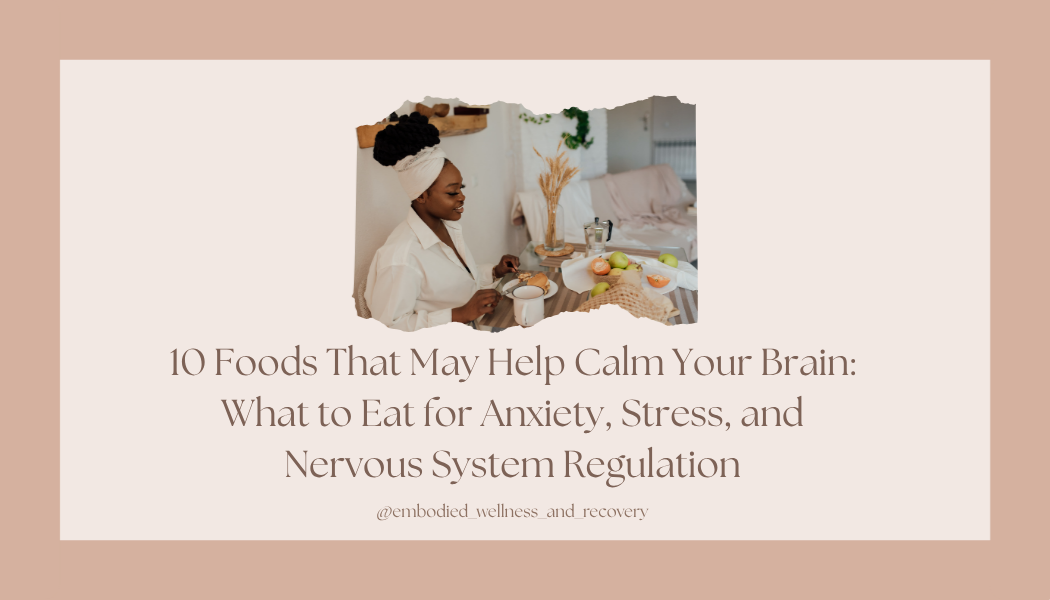
10 Foods That May Help Calm Your Brain: What to Eat for Anxiety, Stress, and Nervous System Regulation
10 Foods That May Help Calm Your Brain: What to Eat for Anxiety, Stress, and Nervous System Regulation
Feeling anxious, wired, or overwhelmed? Discover 8 foods that may support a calmer brain, reduce stress, and nourish your nervous system through the gut-brain connection.
Have you ever felt wired but exhausted, unable to quiet your thoughts even when your body desperately needs rest? Does your anxiety seem worse when you have skipped a meal, had too much coffee, or spent the day grabbing whatever food was convenient? When your nervous system feels constantly “on,” it is understandable to wonder: Can certain foods actually help calm the brain?
No single food can treat anxiety, resolve trauma, or instantly regulate an overwhelmed nervous system. But emerging research in nutritional psychiatry, neuroscience, and the gut-brain axis suggests that what we eat can influence processes involved in mood, stress, inflammation, neurotransmitter function, and brain health. Recent evidence also links higher-quality dietary patterns with lower rates of anxiety and depression, although diet is only one part of the picture.
Here are eight foods worth putting on your plate.
1. Salmon and Other Fatty Fish
Salmon, sardines, trout, and mackerel provide omega-3 fatty acids, particularly EPA and DHA, which are important components of brain-cell membranes and participate in inflammatory and neuronal signaling. Rather than thinking of salmon as an “anti-anxiety food,” think of omega-3-rich fish as providing some of the raw materials the brain needs to function well.
Try: salmon with roasted vegetables, sardines on whole-grain toast, or trout over greens.
2. Leafy Greens
Spinach, kale, Swiss chard, and other dark leafy greens provide magnesium, folate, fiber, and other micronutrients involved in neurological health. Magnesium participates in hundreds of biochemical reactions and has roles in neuronal signaling and the body's stress-response systems. Leafy vegetables also feature prominently in Mediterranean-style dietary patterns, which have been associated with better mental-health outcomes.
Try: adding spinach to eggs, smoothies, soups, pasta, or salads.
3. Plain Greek Yogurt or Kefir
Your brain and gut communicate constantly through what is often called the gut-brain axis.
Fermented foods such as yogurt and kefir contain live microorganisms, although the strains and amounts vary considerably by product. Research increasingly suggests that the gut microbiome may interact with immune signaling, microbial metabolites, and pathways relevant to psychological health. The science is promising, but that doesn't mean probiotics are a stand-alone anxiety treatment. Choose products containing live and active cultures and relatively little added sugar.
4. Oats
A bowl of oatmeal may sound less exciting than a trendy “brain food,” but oats provide complex carbohydrates and soluble fiber. One reason regular meals matter for some anxious people is surprisingly practical. Hunger, shakiness, fatigue, and other physical sensations can overlap with sensations associated with anxiety. A meal containing complex carbohydrates, fiber, protein, and fat can provide more sustained energy than highly refined carbohydrates eaten alone.
Try: oatmeal topped with berries, walnuts, and Greek yogurt.
5. Berries
Blueberries, strawberries, raspberries, and blackberries provide fiber along with polyphenols and other antioxidant compounds. Rather than searching for one magical antioxidant, the broader goal is dietary diversity. Fruits, vegetables, whole grains, legumes, nuts, fish, and olive oil repeatedly appear in dietary patterns associated with better overall health and, increasingly, psychological health.
6. Almonds and Pumpkin Seeds
Nuts and seeds are nutrient-dense sources of magnesium, healthy fats, protein, fiber, and minerals. They also make an excellent practical tool for someone whose anxiety intensifies after going too long without eating. Keep almonds, walnuts, pumpkin seeds, or another preferred nut or seed somewhere accessible so nourishing yourself doesn't require an elaborate meal when life gets hectic.
7. Eggs
Eggs provide high-quality protein as well as choline, vitamin B12, selenium, and other nutrients important to neurological function. Choline is especially interesting because it is required to produce acetylcholine, a neurotransmitter involved in memory, attention, and nervous-system function. Eggs also pair well with whole grains and vegetables for a balanced breakfast, rather than starting the morning on caffeine alone.
8. Beans and Lentils
Lentils, chickpeas, black beans, and other legumes offer an impressive combination of fiber, complex carbohydrates, plant protein, magnesium, folate, and prebiotic substrates that help nourish the intestinal microbiome. They are also staples of Mediterranean-style and other plant-forward dietary patterns. A 2026 meta-analysis found that greater adherence to a healthy, plant-forward dietary pattern was associated with lower odds of both depression and anxiety (Fang et al., 2026). Because those studies were observational, they cannot prove that the diet itself caused the difference.
9. Avocados
There is a reason avocados frequently appear on lists of foods associated with brain health. They provide monounsaturated fats, magnesium, folate, potassium, fiber, and B vitamins, nutrients that support cardiovascular health, neurological function, and normal cellular signaling.
Magnesium is particularly relevant to the nervous system because it participates in neuronal communication and mechanisms involved in the body's response to stress. Avocados also pair healthy fat and fiber, making them an easy way to create a more satisfying, nutrient-dense meal.
Try: avocado on whole-grain toast with pumpkin seeds, added to a grain bowl, or sliced alongside eggs and leafy greens.
10. Sweet Potatoes
When anxiety leaves you feeling shaky, irritable, depleted, or unable to concentrate, your brain may not always need another supplement. Sometimes it needs adequate nourishment. Sweet potatoes provide complex carbohydrates, fiber, potassium, vitamin B6, and beta-carotene.
Carbohydrates also interact with pathways involved in tryptophan availability and serotonin production, one reason eliminating carbohydrates entirely is not necessarily synonymous with eating for better mental health. Because sweet potatoes contain fiber and complex carbohydrates, they can also be part of a balanced meal that provides more sustained energy than highly refined carbohydrates eaten alone.
Try: a roasted sweet potato topped with Greek yogurt and pumpkin seeds, sweet potato with salmon and leafy greens, or roasted cubes added to a grain bowl
The Bigger Question: What Is Your Nervous System Asking For?
Nutrition matters, but food is not a substitute for understanding why your nervous system is activated in the first place. If you live with trauma, chronic anxiety, attachment wounds, relationship distress, or prolonged stress, your brain may have become exceptionally efficient at detecting and preparing for threat. No amount of salmon or spinach can resolve an unsafe relationship, process traumatic memory, or teach the nervous system that the present is different from the past.
At Embodied Wellness and Recovery, we approach mental health through a neuroscience-informed, trauma-informed lens. Our work addresses trauma, nervous system repair, anxiety, relationships, sexuality, intimacy, and attachment, helping clients understand not simply what they are feeling, but what their brains and bodies may be communicating. Food can be one piece of that larger process.
Instead of asking, “What can I eat to make my anxiety disappear?” consider a gentler and more useful question: “How can I nourish my brain and body in ways that give my nervous system greater support?”
Sometimes regulation is not one dramatic intervention. It is the cumulative effect of adequate nourishment, sleep, movement, meaningful relationships, therapy, boundaries, rest, medication when appropriate, and repeatedly giving the brain and body experiences of predictability and safety.
Reach out to schedule a complimentary 20-minute consultation with our team of therapists, trauma specialists, somatic practitioners, or relationship experts, and start working towards integrative, embodied healing today.
📞 Call us at (310) 651-8458
📱 Text us at (310) 210-7934
📩 Email us at admin@embodiedwellnessandrecovery.com
🔗 Visit us at www.embodiedwellnessandrecovery.com
👉 Check us out on Instagram @embodied_wellness_and_recovery
🌍 Explore our offerings at Linktr.ee: https://linktr.ee/laurendummit
References
1) Fang, K. H., Lv, Y., Zhang, X. H., Liu, H., Zhai, B. Z., Yao, Y., Hu, T., & Xu, H. (2026). Adherence to the EAT-Lancet diet and its association with depression and anxiety: A systematic review and meta-analysis of observational studies. Nutrients, 18(4), 684.
2) Gibson-Smith, D., Bot, M., Brouwer, I. A., Visser, M., & Penninx, B. W. J. H. (2018). Diet quality in persons with and without depressive and anxiety disorders. Journal of Psychiatric Research, 106, 1–7.
3) Jacka, F. N., O'Neil, A., Opie, R., Itsiopoulos, C., Cotton, S., Mohebbi, M., Castle, D., Dash, S., Mihalopoulos, C., Chatterton, M. L., Brazionis, L., Dean, O. M., Hodge, A. M., & Berk, M. (2017). A randomized controlled trial of dietary improvement for adults with major depression (the SMILES trial). BMC Medicine, 15, 23.
4) Marx, W., Lane, M., Hockey, M., Aslam, H., Berk, M., Walder, K., Borsini, A., Firth, J., & Jacka, F. N. (2021). Diet and depression: Exploring the biological mechanisms of action. Molecular Psychiatry, 26, 134–150.