
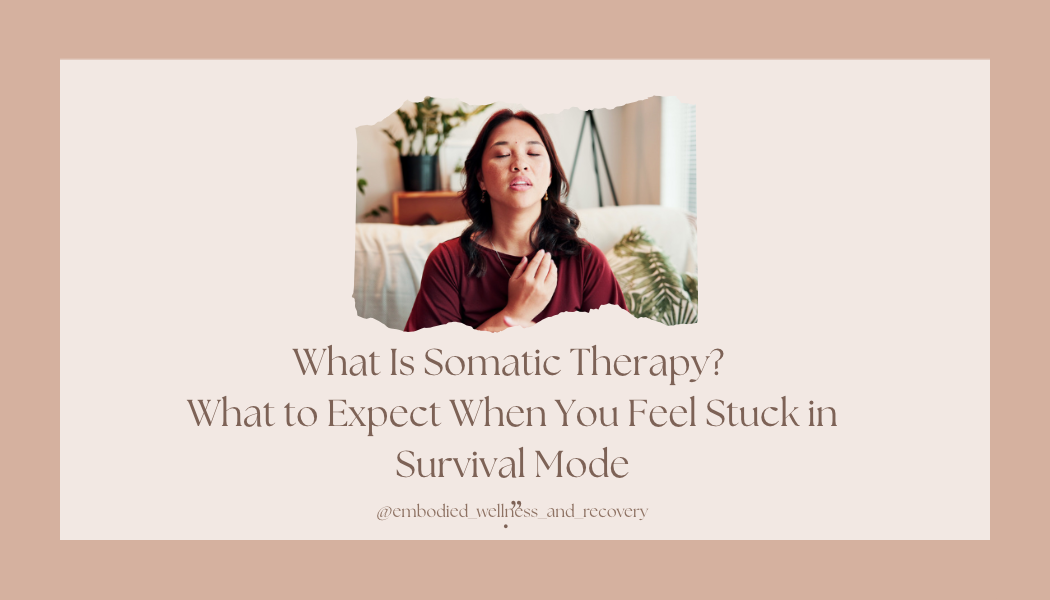
What Is Somatic Therapy? What to Expect When You Feel Stuck in Survival Mode
What Is Somatic Therapy? What to Expect When You Feel Stuck in Survival Mode
What happens in somatic therapy? Explore body-based techniques, trauma research, and how therapy can support choice when you feel stuck in survival mode.
You understand why you are anxious. You can explain your childhood, identify your triggers, and recognize when your reaction feels bigger than the situation. Yet your shoulders stay tense. Your stomach drops during disagreement. Rest feels strangely uncomfortable.
Why does insight sometimes arrive before relief? For people who feel stuck in survival mode, somatic therapy offers a way to explore how thoughts, emotions, physical sensations, and relationships interact. Understanding what actually happens in a session can make this approach feel less mysterious.
What Is Somatic Therapy?
“Somatic” refers to the body. Somatic psychotherapy combines conversation with attention to physical experience, such as muscle tension, posture, movement, or breathing. It is an umbrella term, not one standardized treatment. Approaches include Somatic Experiencing and Sensorimotor Psychotherapy, which use different methods and draw on different evidence bases.
You may still discuss memories, beliefs, and relationships. Your therapist might also ask, “What do you notice in your body as you say that?”
The purpose is to expand awareness and choice, rather than require a dramatic emotional release.
What Does Being in Survival Mode Feel Like?
“Survival mode” is an everyday description, not a diagnosis. People use it to describe feeling constantly braced, urgently busy, emotionally numb, or unable to settle.
Do you say yes before noticing that you want to decline? Does your body tense when someone moves closer? Can you get through a demanding day, then feel disconnected at home?
These experiences can occur with trauma, anxiety, ongoing stress, and other conditions. They deserve individualized assessment. Physical symptoms also warrant medical attention when appropriate, rather than automatically being attributed to trauma.
What Happens in a Somatic Therapy Session?
Sessions vary, but the following sequence illustrates common possibilities.
1. You discuss your goals and preferences
A first session typically includes your history, current concerns, safety, and what you hope will change. You might want to sleep better, stay engaged during disagreements, or feel more in control around intimacy.
Your therapist should explain their approach and invite questions. You can decline an exercise or ask why it is being suggested.
2. You notice something manageable
You might look around the room, feel the chair supporting you, or notice your hands resting on your lap.
If inward attention feels uncomfortable, the therapist can begin with something external, such as an object or sound. You can keep your eyes open. Body awareness should be adapted to you.
3. You explore a small piece of an experience
Suppose you describe freezing when your partner sounds disappointed. The therapist may invite you to notice what happens as you discuss a manageable part of that interaction.
Perhaps your throat tightens. Perhaps you notice nothing. Both are useful information. Some approaches call working in small increments titration. Attention may shift between discomfort and something steadier, rather than remaining fixed on distress.
4. You experiment with a different response
You might press your feet into the floor, change position, or practice saying, “I need a moment.”
The therapist may ask whether anything changes. Does speaking feel easier? Do you want more space? An exercise that feels unhelpful can be modified or stopped.
5. You review and prepare to leave
You discuss what you noticed and how you are feeling before ending. Together, you identify realistic ways to use the learning between sessions. A useful outcome might be recognizing tension sooner and asking for a pause before becoming overwhelmed.
Does Somatic Therapy Involve Touch?
It does not have to. Many sessions involve no touch. Some practitioners offer touch within their training and professional scope. This requires clear explanation, specific consent, appropriate boundaries, and the ability to withdraw consent. Agreeing to therapy is not blanket permission to be touched. You can ask for an entirely touch-free approach. That preference deserves respect.
The Neuroscience Behind Body Awareness
Interoception means sensing internal bodily signals, including heartbeat and breathing. Critchley et al. (2004) used functional MRI during a heartbeat-detection task. Activity in the right anterior insular region correlated with participants’ accuracy, helping explain how the brain represents internal signals.
This research helps explain why physical sensation is relevant to emotional experience. It did not test somatic therapy or establish that greater inward attention is always helpful. The brain and body continually exchange information. Therapy can explore this interaction without assuming that sensations reveal hidden memories or that trauma is literally trapped in muscles.
What Does Research Say About Somatic Therapy for Trauma?
Brom et al. (2017) randomized 63 adults with PTSD to 15 sessions of Somatic Experiencing or a waitlist. The treatment group showed significant improvements in PTSD and depression symptoms. However, a small study comparing it to a waitlist cannot establish superiority over another active therapy.
Kuhfuß et al. (2021) reviewed research on Somatic Experiencing and found preliminary evidence of benefit, while emphasizing limitations in study quality and the need for more rigorous research.
The findings justify continued investigation and thoughtful clinical use. They do not establish equal effectiveness across every intervention marketed as “somatic.”
Finding Support That Respects Your Pace
At Embodied Wellness and Recovery, our expertise spans trauma, nervous system regulation, relationships, sexuality, and intimacy. Our approach to nervous system repair emphasizes greater flexibility and agency. We integrate somatic and trauma-focused approaches according to your goals and clinical needs.
Progress may mean noticing discomfort before automatically agreeing, communicating a boundary, or remaining connected during a difficult conversation. You do not need to become perfectly calm to benefit from therapy. You can start by noticing one experience, expressing one preference, and discovering that your response matters.
Reach out to schedule a free 20-minute consultation with our team of therapists, trauma specialists, somatic practitioners, or relationship experts, and begin reconnecting with your life force energy today.
📞 Call us at (310) 651-8458
📱 Text us at (310) 210-7934
📩 Email us at admin@embodiedwellnessandrecovery.com
🔗 Visit us at www.embodiedwellnessandrecovery.com
👉 Check us out on Instagram @embodied_wellness_and_recovery
🌍 Explore our offerings at Linktr.ee: https://linktr.ee/laurendummit
References
Brom, D., Stokar, Y., Lawi, C., Nuriel-Porat, V., Ziv, Y., Lerner, K., & Ross, G. (2017). Somatic Experiencing for posttraumatic stress disorder: A randomized controlled outcome study. Journal of Traumatic Stress, 30(3), 304-312.
Critchley, H. D., Wiens, S., Rotshtein, P., Öhman, A., & Dolan, R. J. (2004). Neural systems supporting interoceptive awareness. Nature Neuroscience, 7(2), 189-195.
Kuhfuß, M., Maldei, T., Hetmanek, A., & Baumann, N. (2021). Somatic experiencing - effectiveness and key factors of a body-oriented trauma therapy: A scoping literature review. European Journal of Psychotraumatology, 12(1), Article 1929023.
Why Do I Freeze During Sex? Sexual Trauma, Intimacy, and Finding Your Way Back to Choice
Why Do I Freeze During Sex? Sexual Trauma, Intimacy, and Finding Your Way Back to Choice
Freezing during sex can feel confusing. Explore trauma responses, dissociation, consent, and ways to rebuild safety and intimacy with supportive therapy.
You want to feel close to your partner. Perhaps you were enjoying the moment. Then something shifts. Your body stiffens, your mind goes blank, or speaking becomes unexpectedly difficult. Afterward, you wonder: Why couldn’t I say anything? Does this mean I don’t want my partner? Why does intimacy sometimes feel frightening?
Freezing during sex can feel confusing, especially when affection and distress exist together. It can sometimes reflect a trauma response, but freezing alone does not establish a trauma history or a PTSD diagnosis.
Understanding what happens and creating conditions that support choice can help you approach intimacy with less shame and greater clarity.
What Does Freezing During Sex Feel Like?
People use “freezing” to describe several experiences: becoming still, struggling to speak, feeling tense, or being unable to respond as they normally would. Others describe dissociation during sex, such as feeling distant from their body or surroundings. Freezing and dissociation can overlap, but they are not interchangeable.
Fear, pain, pressure, anxiety, and past experiences may contribute. An individualized assessment can help clarify what is happening without assuming a single explanation.
Most importantly, silence, immobility, and lack of resistance are not consent. A partner who notices that you have become unresponsive should stop sexual activity and check in.
The Neuroscience Behind Trauma Responses
Why might your body react before you can explain what feels wrong? Defensive responses involve interacting brain and nervous system processes that evaluate threat and organize action. Kozlowska et al. (2015) describe a “defense cascade” that includes arousal, fight-or-flight, freezing, and forms of immobility. These responses differ; they are not simply stages everyone moves through in the same order.
After sexual trauma, certain sensations or circumstances may evoke fear even during wanted intimacy. A position, tone of voice, unexpected touch, or feeling unable to leave may become distressing. However, the present situation matters too. If a partner ignores boundaries or applies pressure, don't explain discomfort away as merely a reaction to the past.
Freezing Is Not a Personal Failure
Have you blamed yourself for not speaking, moving, or resisting during an unwanted experience?
Möller et al. (2017) studied women seeking care after sexual assault and found that involuntary immobility was common and associated with later PTSD and severe depression. The study concerned responses during assault, not freezing during consensual sex, so its findings should not be treated as identical to your current experience. It nevertheless underscores that immobility can be involuntary. Responsibility for sexual violence belongs to the person who violated consent. Your defensive response does not make you responsible.
Five Ways to Support Safety and Intimacy
1. Stop When Connection Becomes Overwhelming
You don't need to finish an encounter or give a convincing explanation. If possible, say “stop,” “pause,” or “I need space.” Partners should also respond to changes in engagement, not just a spoken signal. After stopping, ask before touching again. A hug may feel comforting to one person and overwhelming to another.
2. Talk Outside the Sexual Moment
Choose a time when neither of you is expecting sex.
You might say:
“Sometimes I become quiet when I feel overwhelmed. Please stop if that happens.”
“I want closeness, but I need to know affection will not automatically lead to sex.”
You can describe your present needs without sharing details of your trauma history. Disclosure should remain your choice.
3. Explore Grounding That Feels Comfortable
Looking around the room, noticing a familiar object, or feeling your feet against the floor may help you reconnect with your surroundings. Some people prefer movement or a drink of water. Others need quiet and distance. Treat grounding as an invitation, not another performance requirement. Its purpose is to support orientation and choice, not to make you continue sexual activity.
4. Make Room for Closeness Without Escalation
Can you enjoy conversation, shared laughter, or sitting together without wondering what's expected next? If you both want it, explore forms of affection with clear limits. You might agree that holding hands or cuddling will remain exactly that. No one required sequence or timetable. Greater intimacy can come with clearer boundaries and more confidence in saying no.
5. Seek Care That Addresses Sexual Concerns Directly
Trauma treatment and sexual well-being deserve attention together.
O’Driscoll and Flanagan’s (2016) meta-analysis found that PTSD-focused psychological treatments did not show clear benefits over control conditions for sexual concerns in the limited trials available. The authors highlighted the need to address sexual difficulties more directly. This does not mean treatment cannot help; it means improvements in PTSD should not be assumed to resolve intimacy concerns automatically. Pain, medication effects, and other health concerns may also warrant assessment.
How Trauma-Informed Sex Therapy Can Help
Therapy can help you identify distressing patterns, reduce self-blame, communicate boundaries, and explore intimacy at a tolerable pace. Somatic work may support awareness of bodily cues and recovery after activation. Here, “Nervous system repair” best means developing regulation and flexibility, rather than promising a permanent reset.
Couples work may help when both partners respect consent. When coercion or abuse is ongoing, individual support and safety take priority.
Support at Embodied Wellness and Recovery
At Embodied Wellness and Recovery, we bring expertise in trauma, somatic approaches, relationships, sexuality, and intimacy to concerns that affect both mind and body. Our compassionate, sex-positive approach makes room for your experiences without measuring progress by sexual frequency or performance. Progress might mean recognizing discomfort sooner, trusting your boundaries, or experiencing affection more easily. The goal is intimacy shaped by your choices.
Contact us today to schedule a free 20-minute consultation with our team of somatic practitioners, trauma specialists, and relationship experts, and begin your journey toward embodied connection with yourself and others.
📞 Call us at (310) 651-8458
📱 Text us at (310) 210-7934
📩 Email us at admin@embodiedwellnessandrecovery.com
🔗 Visit us at www.embodiedwellnessandrecovery.com
👉 Check us out on Instagram @embodied_wellness_and_recovery
🌍 Explore our offerings at Linktr. ee: https://linktr.ee/laurendummit
References
1) Kozlowska, K., Walker, P., McLean, L., & Carrive, P. (2015). Fear and the defense cascade: Clinical implications and management. Harvard Review of Psychiatry, 23(4), 263-287.
2) Möller, A., Söndergaard, H. P., & Helström, L. (2017). Tonic immobility during sexual assault: A common reaction predicting post-traumatic stress disorder and severe depression. Acta Obstetricia et Gynecologica Scandinavica, 96(8), 932-938.
3) O’Driscoll, C., & Flanagan, E. (2016). Sexual problems and post-traumatic stress disorder following sexual trauma: A meta-analytic review. Psychology and Psychotherapy: Theory, Research and Practice, 89(3), 351-367.
The Hidden Burden: Exploring Shame and Guilt Stemming from Generational Trauma
The Hidden Burden: Exploring Shame and Guilt Stemming from Generational Trauma
Discover how shame and guilt play a crucial role in generational trauma. Learn how to break free from these emotional burdens with insights from Embodied Wellness and Recovery.
Generational trauma is a deeply rooted issue that often passes silently from one generation to the next. At the core of this trauma are powerful emotions like shame and guilt, which can shape the way individuals perceive themselves and interact with the world. Understanding the role of shame and guilt in generational trauma, and how to heal from these emotional burdens, is key to breaking the cycle and finding lasting peace.
The Painful Problem: Living with Shame and Guilt
Shame and guilt are two of the most debilitating emotions a person can experience. They often serve as the hidden engines behind the transmission of trauma from one generation to the next. When shame and guilt are embedded in a person’s psyche, they create a deep sense of unworthiness, leading to self-destructive behaviors and strained relationships.
Do you ever feel that no matter what you do, you’re never good enough? Do you carry a sense of guilt for things that are beyond your control? These feelings can be overwhelming, leaving you stuck in a cycle of self-blame and despair. For those grappling with generational trauma, these emotions can feel like an inescapable part of their identity, passed down from their parents and grandparents.
Neuroscience Behind Shame and Guilt
Neuroscience provides critical insights into how shame and guilt affect the brain and contribute to the perpetuation of trauma. Both emotions engage the brain’s limbic system, particularly the amygdala, which processes emotions like fear and threat (LeDoux, 2000). When experiences trigger shame or guilt, the amygdala can overwhelm the prefrontal cortex, which supports rational thought and emotional regulation (Davidson, 2015).
This neural imbalance can make it difficult for individuals to process their emotions in a healthy way. Instead of moving past feelings of shame and guilt, they may become stuck in a cycle of negative self-perception and anxiety. Over time, these emotions can become internalized, affecting a person’s self-esteem and perpetuating the trauma across generations.
Relating to the Struggle
Imagine carrying the weight of shame and guilt from your childhood into your adult life, never feeling worthy of love or success. You might find yourself sabotaging relationships or avoiding opportunities out of fear of failure or rejection. These behaviors are not just personal failings; they are the manifestations of deep-seated trauma that has been passed down through generations.
Shame and guilt often lead to isolation, as individuals may feel too ashamed to seek help or share their struggles with others. This isolation only reinforces the cycle of trauma, making it harder to break free and heal.
Offering Hope: Healing from Generational Trauma
While the burden of generational trauma can feel overwhelming, there is hope for healing and breaking the cycle. By understanding the role that shame and guilt play in perpetuating trauma, individuals can begin to address these emotions and find a path to recovery.
Tips for Healing Shame and Guilt
1. Self-Compassion Practice: One of the most powerful tools for healing shame and guilt is self-compassion. By treating yourself with kindness and understanding, you can begin to counteract the negative self-talk that fuels these emotions. Mindfulness-based practices, such as meditation, can help cultivate self-compassion and reduce the impact of shame and guilt (Neff, 2003).
2. Therapy: Engaging in therapy with a trauma-informed therapist can provide a safe space to explore the roots of shame and guilt. Therapies such as Eye Movement Desensitization and Reprocessing (EMDR) and Cognitive Behavioral Therapy (CBT) have been shown to be effective in processing trauma and reducing the intensity of these emotions (Shapiro, 2017).
3. Intergenerational Dialogue: Sometimes, healing from generational trauma involves open conversations with family members about the trauma they have experienced. By acknowledging the shared pain and understanding its origins, families can work together to break the cycle and support each other’s healing.
Embodied Wellness and Recovery: Your Partner in Healing
At Embodied Wellness and Recovery, we understand the complex and painful nature of generational trauma. Our holistic approach integrates neuroscience, psychotherapy, and somatic wellness practices to support individuals on their healing journey. We offer personalized care designed to address the underlying causes of shame and guilt, helping you to break free from the cycle of trauma and build a life rooted in self-compassion and resilience.
Our team of experts is dedicated to providing a compassionate and supportive environment where you can explore your trauma and find the tools you need to heal. Whether through individual therapy, group sessions, or family counseling, we are here to guide you every step of the way.
A Path to Healing and Freedom
Imagine a life where shame and guilt no longer dictate your actions or define your self-worth. With the right support and strategies, this vision is attainable.
Are you ready to break the cycle of generational trauma and embrace a future free from shame and guilt? At Embodied Wellness and Recovery, we are here to help you navigate this journey with compassion and expertise.
Reach out to schedule a complimentary 20-minute consultation with our team of therapists, trauma specialists, somatic practitioners, or relationship experts, and start working towards integrative, embodied healing today.
📞 Call us at (310) 651-8458
📱 Text us at (310) 210-7934
📩 Email us at admin@embodiedwellnessandrecovery.com
🔗 Visit us at www.embodiedwellnessandrecovery.com
👉 Check us out on Instagram @embodied_wellness_and_recovery
🌍 Explore our offerings at Linktr.ee: https://linktr.ee/laurendummit
References:
Davidson, R. J. (2015). The Emotional Life of Your Brain: How Its Unique Patterns Affect the Way You Think, Feel, and Live—and How You Can Change Them. Plume.
LeDoux, J. (2000). The Emotional Brain: The Mysterious Underpinnings of Emotional Life. Simon & Schuster.
Neff, K. D. (2003). The development and validation of a scale to measure self-compassion. Self and Identity, 2(3), 223-250.
Shapiro, F. (2017). Eye Movement Desensitization and Reprocessing (EMDR) Therapy: Basic Principles, Protocols, and Procedures. Guilford Press.
Why Do I Never Feel Good Enough? How Childhood Trauma Creates Low Self-Esteem, Chronic Self-Doubt, and Conditional Self-Worth
Why Do I Never Feel Good Enough? How Childhood Trauma Creates Low Self-Esteem, Chronic Self-Doubt, and Conditional Self-Worth
Why do you never feel good enough? Learn how childhood trauma, emotional neglect, criticism, and conditional love can create low self-esteem, chronic self-doubt, perfectionism, and difficulty recognizing your own worth.
You can be successful and still feel inadequate. You can receive a compliment and immediately dismiss it. You can accomplish something remarkable and, within minutes, begin thinking about what you should have done better. You can be loved and still quietly wonder when someone will discover that you are not quite as worthy as they think.
If this sounds familiar, you may have spent years trying to build self-esteem by becoming more accomplished, attractive, helpful, productive, successful, or desirable. But what if the problem isn't that you haven't done enough to feel good about yourself? What if you learned very early that being “good enough” was something you had to earn?
For many adults struggling with low self-esteem, chronic self-doubt, perfectionism, and feelings of inadequacy, the roots extend far beyond confidence. Childhood trauma, emotional neglect, criticism, comparison, conditional love, and unpredictable caregiving can profoundly influence how we learn to understand our own worth.
Where Does the Feeling of “Not Good Enough” Come From?
Children do not develop their sense of self in isolation. We initially learn who we are through relationships. When caregivers consistently communicate warmth, interest, emotional attunement, protection, and acceptance, children gradually internalize an important message:
“I matter because I exist.”
But what happens when love or attention feels conditional?
Maybe you received affection when you performed well but criticism when you struggled. Perhaps another sibling was constantly held up as the standard. Maybe your caregiver was emotionally unavailable, unpredictable, highly critical, overwhelmed, or difficult to please. Or perhaps nothing obviously terrible happened. Your physical needs may have been met while your emotional world was largely unnoticed.
Research has consistently linked childhood maltreatment and emotional neglect with poorer self-esteem later in life. Studies also suggest that emotional abuse and neglect can influence the development of negative beliefs about oneself and contribute to vulnerability for later psychological difficulties (McCrory & Viding, 2015; van Harmelen et al., 2010).
A child rarely concludes:
My caregiver has limited emotional capacity.
Instead, the developing mind may decide:
“There must be something wrong with me.”
When Self-Worth Becomes Conditional
This is where conditional self-worth can develop.
Instead of:
“I am worthy.”
The belief becomes:
I am worthy when I succeed.
I am lovable when I am easy.
I am valuable when I am useful.
I am attractive when someone desires me.
I am good when nobody is disappointed in me.
I matter when I achieve.
This can create adults who appear highly competent while privately struggling with low self-esteem and self-doubt. You might earn another degree, get promoted, change your body, receive praise, become indispensable to everyone around you, or find a partner who loves you deeply. And still, somehow, it is never enough.
Why?
Because achievement can temporarily reassure conditional self-worth, but it cannot permanently resolve it. The finish line keeps moving.
The Neuroscience of Childhood Trauma and Self-Esteem
Childhood adversity does not simply influence what we remember. It can affect developing neural systems involved in threat detection, emotion regulation, social evaluation, and self-referential processing. Research suggests that childhood maltreatment may sensitize neural systems to social threat, creating what researchers have described as a form of latent vulnerability to later mental health difficulties (McCrory & Viding, 2015).
In practical terms, the brain may become exceptionally attentive to cues of rejection, criticism, anger, or disapproval. A neutral comment feels critical. Constructive feedback feels humiliating. Someone else's success feels like evidence of your inadequacy. A partner needing space feels like rejection. A mistake feels like exposure. The nervous system is not simply processing what is happening now. It may also be that the present is being interpreted through expectations formed in earlier relationships.
Why Criticism Can Become an Inner Critic
Children repeatedly exposed to criticism do not simply remember critical words. They may internalize the critic. Eventually, nobody has to tell you that you should have done better. You tell yourself. You notice the flaw before anyone else can. You criticize yourself before someone else gets the opportunity. You anticipate rejection before it arrives.
This can create a painful paradox: self-criticism may begin as an attempt at self-protection. If I identify every weakness first, maybe nobody can surprise me with it. If I become perfect, maybe I cannot be rejected. If I never become complacent, maybe I will finally be enough.
Research has found important relationships among childhood maltreatment, self-criticism, shame, and psychological distress, suggesting that negative self-relating can become one pathway through which adverse childhood experiences continue affecting adults (Irons et al., 2006).
Emotional Neglect: When What Didn't Happen Matters
Some childhood wounds are defined not by what happened, but by what was missing.
Were your feelings noticed?
Were you comforted when you were frightened?
Could you make mistakes without fearing humiliation?
Did someone delight in who you were rather than primarily what you accomplished?
Could you disagree and remain connected?
Were your boundaries respected?
Did anyone teach you that your needs mattered too?
Emotional neglect can be particularly difficult to recognize because there may be no dramatic event to point toward. Yet repeatedly experiencing your emotions, needs, preferences, or vulnerabilities as irrelevant can quietly shape self-worth. You may become remarkably good at functioning while remaining disconnected from yourself.
How Low Self-Esteem Shows Up in Adulthood
Low self-worth does not always look like insecurity. Sometimes it looks like perfectionism, overworking, people-pleasing, difficulty receiving compliments, staying in relationships where you are undervalued, comparing yourself constantly to other people, needing reassurance, struggling to set boundaries, feeling uncomfortable being seen sexually or emotionally, choosing unavailable partners, believing you have to earn love, or feeling deeply unsettled whenever someone is disappointed in you.
You may even wonder:
Why does everyone else seem more confident than I am?
Why can't I believe compliments?
Why do I constantly compare myself to other people?
Why does one criticism outweigh ten compliments?
Why do I feel worthless when I'm not productive?
Why do I keep choosing relationships where I have to prove my value?
These questions are not superficial concerns about confidence. They often point toward the deeper architecture of self-worth, attachment, trauma, and nervous system safety.
You Cannot Perform Your Way Into Unconditional Worth
One of the most important shifts in rebuilding self-esteem is recognizing that self-worth and achievement are not the same thing. Healthy self-esteem does not mean believing you are exceptional at everything. It means being able to experience failure, rejection, imperfection, disappointment, and uncertainty without turning those experiences into a verdict about your worth.
Instead of:
“I failed, therefore I am a failure.”
The nervous system gradually learns:
“Something went badly, and I am still me.”
That distinction is profound.
Rebuilding Self-Esteem After Childhood Trauma
At Embodied Wellness and Recovery, we understand that low self-esteem often cannot be resolved through affirmations or positive thinking alone. When feelings of inadequacy developed through relationships, trauma, emotional neglect, criticism, or conditional love, meaningful change often requires working with both the mind and nervous system.
Our approach integrates trauma-informed psychotherapy, somatic awareness, attachment work, nervous system regulation, relationships, sexuality, and intimacy to help clients recognize the old adaptations that continue shaping how they experience themselves.
Trauma-focused approaches such as EMDR, somatic therapies, attachment-focused psychotherapy, mindfulness, and self-compassion practices may help people develop a more integrated and less punitive relationship with themselves. The goal is not to convince yourself that you are perfect.
It is something far more sustainable:
Learning that you do not have to be perfect to remain worthy.
Perhaps the question is no longer:
“What do I need to accomplish, change, fix, or prove before I finally feel good enough?”
Perhaps it becomes:
“Who might I become if I stopped treating my worth as something I have to earn?”
Reach out to schedule a complimentary 20-minute consultation with our team of therapists, trauma specialists, somatic practitioners, or relationship experts, and start working towards integrative, embodied healing today.
📞 Call us at (310) 651-8458
📱 Text us at (310) 210-7934
📩 Email us at admin@embodiedwellnessandrecovery.com
🔗 Visit us at www.embodiedwellnessandrecovery.com
👉 Check us out on Instagram @embodied_wellness_and_recovery
🌍 Explore our offerings at Linktr.ee: https://linktr.ee/laurendummit
References
Irons, C., Gilbert, P., Baldwin, M. W., Baccus, J. R., & Palmer, M. (2006). Parental recall, attachment relating and self-attacking/self-reassurance: Their relationship with depression. British Journal of Clinical Psychology, 45(3), 297-308.
McCrory, E. J., & Viding, E. (2015). The theory of latent vulnerability: Reconceptualizing the link between childhood maltreatment and psychiatric disorder. Development and Psychopathology, 27(2), 493-505.
van Harmelen, A. L., de Jong, P. J., Glashouwer, K. A., Spinhoven, P., Penninx, B. W. J. H., & Elzinga, B. M. (2010). Child abuse and negative explicit and automatic self-associations: The cognitive scars of emotional maltreatment. Behavior Research and Therapy, 48(6), 486-494.
Young, J. E., Klosko, J. S., & Weishaar, M. E. (2003). Schema therapy: A practitioner's guide. Guilford Press.
Why Does Kindness Make Me Uncomfortable? How Trauma Can Make Love, Compliments, and Care Feel Unsafe
Why Does Kindness Make Me Uncomfortable? How Trauma Can Make Love, Compliments, and Care Feel Unsafe
Why does kindness make you uncomfortable? Learn how trauma, attachment wounds, and nervous system dysregulation can make compliments, love, care, and healthy relationships feel unsafe.
What if you are wonderful at caring for everyone else, but the moment someone tries to care for you, something inside you tightens? Someone compliments you, and you immediately dismiss it. Someone offers to help, and your automatic response is, “I’ve got it.” Someone treats you with tenderness, and instead of relaxing, you become suspicious. Someone loves you consistently, and part of you wants to pull away.
You may desperately want love, care, tenderness, and emotional connection. Yet when kindness actually arrives, your nervous system does not seem to know what to do with it.
This confusing response can leave you wondering:
Why does kindness make me uncomfortable? Why can't I accept compliments? Why do I distrust people who are nice to me? Why is it easier to give love than receive it?
For some people with unresolved trauma or attachment wounds, the answer may have less to do with rejecting love and more to do with what the brain and nervous system learned about safety, trust, vulnerability, and relationships.
Why Can Trauma Make Kindness Feel Uncomfortable?
We tend to imagine that kindness should automatically feel good, but the brain does not evaluate relationships based solely on what is objectively healthy. It also relies on previous experience to predict what will happen next.
If affection, attention, or care was historically followed by criticism, manipulation, abandonment, intrusion, punishment, or disappointment, receiving kindness may carry an unconscious question:
“What is this going to cost me?”
Perhaps someone was generous and later reminded you of everything they had done for you. Maybe affection disappeared when you disappointed a caregiver. Perhaps praise was rare, unpredictable, or conditional on achievement. Maybe you learned that seeking comfort led to rejection. Or perhaps the people who were supposed to make you feel safe were also the people you had to protect yourself from.
Research on childhood maltreatment supports this connection between adverse relational experiences and later interpersonal distrust. One study found that greater childhood maltreatment was associated with perceiving interaction partners as less trustworthy and with negatively biased emotion processing (Hepp et al., 2021).
Your adult mind may recognize kindness. Your nervous system may still be waiting for what historically came afterward.
Trauma Changes the Brain's Predictions About Relationships
The brain is constantly making predictions.
Is this safe?
Can I trust this person?
What does this expression mean?
What happens if I let my guard down?
Attachment experiences help shape these predictions.
A neuroscience review of adult attachment found that attachment patterns can influence how the brain processes social safety, threat, reward, and emotional information. These processes involve interconnected regions including the amygdala, hippocampus, striatum, insula, cingulate cortex, and prefrontal regions (Vrticka & Vuilleumier, 2012).
More recent research continues to demonstrate that childhood trauma can have lasting effects on neural systems involved in emotion, social information, reward, and threat detection. This helps explain why a trauma response does not always look like obvious fear.
Sometimes it looks like:
“I don't need anything.”
“I'd rather do it myself.”
“They're probably just being polite.”
“I don't trust people who are too nice.”
“I feel weird when someone compliments me.”
“I owe them now.”
“This relationship feels boring.”
“Something must be wrong because they're treating me so well.”
These responses may represent attempts to preserve predictability and control.
Why Compliments Can Feel So Uncomfortable After Trauma
Consider what happens when someone says:
“You look beautiful.”
Do you allow yourself to receive it?
Or do you immediately respond:
“No, I look exhausted.”
Do you joke?
Change the subject?
Compliment them back?
Explain why they are wrong?
A compliment creates a surprisingly intimate psychological moment. Someone is directing positive attention toward you, and for a few seconds, you are being seen. For someone carrying shame, chronic criticism, or a belief that worth must be earned, that visibility can feel uncomfortable.
Neuroscience research shows that compliments between romantic partners engage brain regions involved in reward and social processing (Flores et al., 2023). Positive social experiences are not trivial. The brain is designed to respond to them. But trauma may alter how easily positive experiences are integrated.
Research examining PTSD and reward processing suggests that trauma-related disorders can affect the way people interact with and respond to positive stimuli, although researchers emphasize that this area still requires further investigation (Seidemann et al., 2021). In other words, receiving something good may itself require practice.
When Hyper-Independence Is a Trauma Response
Hyper-independence is often celebrated. You handle things. You don't ask for help. You solve problems. You take care of everyone else. You rarely need anything.
From the outside, this can look like strength, and sometimes it is. But there is an important question worth asking:
Do I choose independence, or do I feel unsafe depending on anyone?
There is a profound difference. If relying on others once led to disappointment, neglect, humiliation, or loss of control, the nervous system may conclude: Depending on myself is safer than needing someone else.
That strategy can be extraordinarily adaptive until intimacy requires something different. Healthy relationships involve interdependence. We need the capacity both to give and receive, support and be supported, care and be cared for. When receiving feels dangerous, relationships can quietly become one-sided. You become indispensable to everyone while allowing almost no one to become indispensable to you.
Why Healthy Love Can Feel Uncomfortable After Trauma
This is one of the most confusing consequences of relational trauma. Someone is emotionally available, consistent, respectful, kind, and interested. They honor your boundaries. They communicate.
And instead of feeling relieved, you think:
“Where's the chemistry?”
Sometimes there genuinely isn't chemistry, but sometimes something more complicated is happening. The nervous system can become accustomed to particular relationship patterns. Uncertainty, pursuit, withdrawal, criticism, emotional unpredictability, or intermittent affection may become deeply familiar.
Then a consistently available person feels different, and we can mistakenly interpret unfamiliarity as incompatibility. This does not mean people should force themselves to remain in relationships that do not feel right. It means that when healthy intimacy repeatedly creates discomfort, curiosity can be more informative than immediate judgment.
Ask:
Am I uninterested, or am I unactivated?
Does this person feel wrong, or simply unfamiliar?
Have I historically mistaken anxiety for chemistry?
What happens in my body when someone is consistently available to me?
These questions can reveal relationship patterns that intellectual insight alone may miss.
The Body May Say “No” Before the Mind Understands Why
Trauma is not merely a memory of something that happened. It can influence patterns of attention, emotion, expectation, physiological activation, and behavior.
This is why someone may intellectually know:
“This person is safe.”
while their body responds:
“Don't get too close.”
You may notice tension in your chest when someone expresses affection, an urge to pull away during tenderness, restlessness when someone takes care of you, numbness during emotional intimacy, embarrassment when receiving praise, or suspicion when someone offers something without asking for anything in return. The body is not necessarily reporting present-day danger accurately. It may be responding according to an older template.
Learning to Receive Kindness Without Feeling Unsafe
The goal is not to force yourself to trust everyone or eliminate healthy discernment. It is to develop greater flexibility so that your nervous system can distinguish present safety from past danger.
Start small.
When someone compliments you, experiment with simply saying:
“Thank you.”
Then notice what happens in your body.
Do you tense?
Want to explain?
Feel embarrassed?
Experience an urge to return the compliment immediately?
Try allowing the positive experience to remain for a few seconds longer than usual. When someone offers help, consider accepting something small. When someone is kind, notice whether you immediately search for hidden motives. When your partner offers affection, observe whether you soften toward it or unconsciously brace against it. The goal is curiosity, not self-criticism. You are gathering information about what your nervous system has learned.
Safe Relationships Can Create New Experiences
The encouraging part of understanding the brain is recognizing that it is not static. Research on social connection demonstrates that positive interpersonal experiences engage systems involved in reward, emotional closeness, and affiliation. Research also suggests that positive interactions between attachment partners can influence neural synchrony, highlighting the brain's responsiveness to relational experience (Djalovski et al., 2021).
Repeated experiences matter. Being cared for without owing anything. Setting a boundary and discovering the relationship survives. Expressing a need and being met with compassion. Receiving affection without manipulation. Being vulnerable without being humiliated. Allowing yourself to be supported without surrendering your autonomy. Over time, experiences like these can provide the nervous system with new information: Kindness does not always have a hidden cost.
Trauma Therapy Can Help When Receiving Love Feels Unsafe
At Embodied Wellness and Recovery, we understand that trauma treatment involves more than intellectually understanding the past. Our work addresses trauma, attachment, nervous system repair, relationships, sexuality, and intimacy through an integrative, neuroscience-informed, and somatically oriented approach.
Sometimes the challenge is not understanding that you deserve healthy relationships. It is developing the embodied capacity to experience care without bracing against it. Therapy can help identify the relationship templates that developed through earlier experiences while supporting greater awareness of present-day sensations, emotions, boundaries, and attachment responses.
The goal is not indiscriminate trust. It is discernment. It is learning the difference between vulnerability and danger. Between dependence and healthy interdependence. Between intensity and intimacy. Between someone wanting something from you and someone simply wanting to give something to you.
Perhaps most importantly, it is learning that you do not always have to earn care by being useful, easy, accomplished, attractive, accommodating, or endlessly strong. Sometimes someone is kind because they care about you. And slowly, the nervous system can learn to let that experience in.
Reach out to schedule a complimentary 20-minute consultation with our team of therapists, trauma specialists, somatic practitioners, or relationship experts, and start working towards integrative, embodied healing today.
📞 Call us at (310) 651-8458
📱 Text us at (310) 210-7934
📩 Email us at admin@embodiedwellnessandrecovery.com
🔗 Visit us at www.embodiedwellnessandrecovery.com
👉 Check us out on Instagram @embodied_wellness_and_recovery
🌍 Explore our offerings at Linktr.ee: https://linktr.ee/laurendummit
References
Chambers, J., & Sullivan, R. (2026). Trauma in attachment: Understanding the first relationship through neurobiology and psychodynamics. Psychodynamic Psychiatry, 54(2), 249-282.
Djalovski, A., Dumas, G., Kinreich, S., & Feldman, R. (2021). Human attachments shape interbrain synchrony to efficiently achieve social goals. NeuroImage, 226, 117600.
Flores, L. E., Eckstrand, K. L., Silk, J. S., Allen, N. B., Ambrosia, M., Healey, K. L., & Forbes, E. E. (2018). Adolescents' neural responses to social reward, real-world emotional closeness, and positive affect. Cognitive, Affective, & Behavioral Neuroscience, 18(4), 705-717.
Hepp, J., Schmitz, S. E., Urbild, J., Zauner, K., Niedtfeld, I., & Bertsch, K. (2021). Childhood maltreatment is associated with distrust and negatively biased emotion processing. Borderline
Seidemann, R., Duek, O., Jia, R., Levy, I., & Harpaz-Rotem, I. (2021). The reward system and post-traumatic stress disorder: Does trauma affect the way we interact with positive stimuli? Chronic Stress, 5, 2470547021996006.
Vrticka, P., & Vuilleumier, P. (2012). Neuroscience of human social interactions and adult
Why Small Things Feel So Big After Trauma: How to Expand Your Window of Tolerance and Regulate Your Nervous System
Why Small Things Feel So Big After Trauma: How to Expand Your Window of Tolerance and Regulate Your Nervous System
Why do small stressors feel overwhelming after trauma? Learn how trauma narrows your window of tolerance, causes hyperarousal or shutdown, and how nervous system regulation can help expand your capacity for stress.
Have you ever had a seemingly minor problem send your entire body into panic? A delayed text makes your heart race. A change in someone's tone leaves you analyzing the conversation for hours. A disagreement with your partner feels catastrophic. You cannot sleep because your mind will not stop. Or instead of becoming anxious, you suddenly go blank. You feel exhausted, disconnected, numb, or unable to think.
Then comes the second layer of distress:
Why am I reacting this strongly?
Why can everyone else handle things that completely overwhelm me?
Why do I either become intensely anxious or shut down altogether?
The answer may have less to do with the size of the current stressor and more to do with the amount of stress your nervous system has learned it can safely hold. This is where understanding your window of tolerance can fundamentally change the way you understand trauma, anxiety, emotional regulation, and yourself.
What Is the Window of Tolerance?
Psychiatrist Daniel J. Siegel popularized the term window of tolerance to describe the range of nervous system activation within which we can remain emotionally present, think clearly, process information, and respond flexibly to what is happening around us.
Within your window, you can experience stress without becoming completely overwhelmed. You can be angry without exploding. Sad without collapsing. Anxious without panicking. Hurt without immediately assuming a relationship is ending. Your nervous system becomes activated, responds to the challenge, and eventually settles.
But trauma can narrow this window. When your nervous system has repeatedly experienced danger, unpredictability, neglect, betrayal, abuse, loss, or chronic stress, it can become increasingly sensitive to potential threat. Experiences that might otherwise be manageable can push you rapidly outside your optimal range of arousal. This is one reason trauma can make small things feel enormous. The problem is not necessarily that you are "too sensitive." Your nervous system may simply be working with a much smaller margin for stress.
When You're Above Your Window: Hyperarousal
When activation exceeds your nervous system's capacity, you may enter hyperarousal, commonly associated with fight-or-flight responses.
You might experience:
— Racing thoughts or panic attacks
— Extreme irritability, anger, or rage
— Hypervigilance or constantly feeling on edge
— A racing heart
— Shallow or rapid breathing
— Muscle tension, trembling, or tightness in your chest
— Trouble falling or staying asleep
— An urgent need to fix, escape, control, or resolve something
Your brain and body are essentially saying:
Something is wrong. Do something. NOW.
A partner's distracted expression becomes "They're pulling away from me."
Constructive criticism becomes "I'm failing."
An unanswered message becomes "I've been rejected."
A small mistake becomes "Everything is falling apart."
The nervous system can respond to perceived danger before the thinking brain has fully evaluated whether the present situation is actually dangerous.
When You're Below Your Window: Hypoarousal
Not every nervous system responds to overwhelm by speeding up. Sometimes it does the opposite. When stress exceeds what feels manageable, you may move below your window of tolerance into hypoarousal, a state associated with immobilization, collapse, or shutdown.
You may experience:
— Emotional numbness or emptiness
— Dissociation, spacing out, or feeling unreal
— Heavy fatigue or unusually low energy
— Depression or hopelessness
— Low motivation
— Social withdrawal
— Brain fog
— Difficulty processing information
— Feeling disconnected from your body
— Wanting to sleep or disappear from the demands around you
Instead of:
"I have to do something!"
the nervous system seems to say:
"I can't do anything."
Some people predominantly experience hyperarousal. Others tend toward hypoarousal. Many move between both. You might spend hours anxiously trying to solve a relationship problem and then suddenly feel completely exhausted and detached. That shift can be confusing until you recognize both states as different responses to nervous system overwhelm.
Why Trauma Makes Your Window of Tolerance Smaller
Trauma does not live exclusively in our thoughts about the past. Trauma-related disorders involve changes across interconnected systems responsible for threat detection, attention, emotion, memory, and physiological arousal.
After trauma, the brain can become especially attentive to cues that resemble previous danger.
A facial expression.
Someone raising their voice.
Feeling excluded.
Not knowing what will happen.
Feeling trapped.
Someone becoming emotionally unavailable.
The present-day situation may be objectively different from what happened in the past, but the nervous system is extraordinarily good at pattern recognition.
It asks:
"Have I encountered something like this before?"
And sometimes the body begins preparing for danger before conscious thought catches up. This is why telling yourself to "just calm down" often does very little. You cannot always think your way out of a physiological survival response.
How Do You Expand Your Window of Tolerance?
Expanding your window of tolerance does not mean becoming so regulated that nothing bothers you. It means gradually developing greater capacity.
The goal is not:
"How do I never get triggered?"
A more useful question is:
"How can my nervous system learn that I can experience activation without becoming overwhelmed by it?"
Here are several places to begin.
1. Learn Your Early Warning Signs
Do not wait until anxiety reaches a 10. Learn what a 3 or 4 feels like. Maybe your jaw tightens. Your breathing becomes shallower. You start checking your phone repeatedly. Your thoughts speed up. You become unusually quiet. Your shoulders rise. You suddenly feel exhausted. These are valuable pieces of information. The earlier you recognize nervous system activation, the more choices you have.
2. Regulate Through the Body, Not Just the Mind
When the nervous system is activated, bottom-up strategies can complement cognitive approaches.
Depending on your state, regulation might include:
— Slowing and lengthening your breathing
— Feeling your feet against the floor
— Orienting visually to the room around you
— Walking or gentle movement
— Stretching
— Noticing physical sensations without immediately interpreting them
— Using temperature or sensory input
— Connecting with a safe person
If you are in hypoarousal, what helps may look different. Gentle movement, sensory stimulation, music, daylight, standing, or connecting with another person may be more useful than trying to become even calmer.
3. Stop Treating Regulation as the Absence of Emotion
A wide window of tolerance does not mean feeling peaceful all the time. It means developing the ability to experience more emotion without losing access to yourself. You can feel anger and remain curious. You can experience fear and stay present. You can feel disappointment without collapsing into hopelessness. You can experience conflict without assuming the relationship is doomed. That is emotional regulation.
4. Use Movement as Part of Trauma Recovery
Movement can provide another pathway for working with physiological activation. Research examining randomized trials has found that exercise interventions can reduce PTSD symptoms, although researchers continue to investigate which approaches and dosages work best for different individuals.
Movement does not need to mean an intense workout. Walking, yoga, strength training, dancing, stretching, or other tolerable forms of physical activity may help support regulation.
5. Practice Regulation in Relationships
Nervous systems regulate in relationship. A calm voice, safe eye contact, predictable behavior, appropriate touch, and the experience of being understood can communicate safety at a physiological level.
This matters particularly when trauma occurred within relationships. Learning to remain present during vulnerability, conflict, intimacy, boundary setting, and repair can gradually increase our capacity to tolerate the very experiences that once triggered protection.
Your Window Can Become Wider
Perhaps you have spent years thinking:
"Why am I so reactive?"
"Why do I shut down?"
"Why does conflict completely overwhelm me?"
"Why can't I let little things go?"
A more compassionate and clinically useful question may be:
"What happens to my nervous system when I feel threatened, and what does it need in order to regain flexibility?" Expanding your window of tolerance happens gradually.
Every time you notice activation before automatically reacting, return attention to your body, tolerate a manageable amount of discomfort, communicate instead of disappearing, allow someone safe to support you, or come back into connection after becoming dysregulated, you are practicing a different response.
The goal is not to eliminate your nervous system's protective responses. It is to help your system become more flexible about when protection is actually necessary.
Trauma Therapy and Nervous System Regulation at Embodied Wellness and Recovery
At Embodied Wellness and Recovery, we understand trauma as more than a collection of distressing memories. Our work integrates trauma-informed psychotherapy with an understanding of the nervous system, attachment, relationships, sexuality, and intimacy. We help clients recognize their patterns of hyperarousal and hypoarousal, develop greater capacity for nervous system regulation, and explore the experiences that taught the body to remain on guard or shut down.
Because sometimes the most important question is not:
"Why am I making such a big deal out of this?"
It is:
"Why does my nervous system experience this as such a big deal?" That shift replaces judgment with curiosity, and curiosity gives us somewhere to begin.
Reach out to schedule a complimentary 20-minute consultation with our team of therapists, trauma specialists, somatic practitioners, or relationship experts and start working towards integrative, embodied healing today.
📞 Call us at (310) 651-8458
📱 Text us at (310) 210-7934
📩 Email us at admin@embodiedwellnessandrecovery.com
🔗 Visit us at www.embodiedwellnessandrecovery.com
👉 Check us out on Instagram @embodied_wellness_and_recovery
🌍 Explore our offerings at Linktr.ee: https://linktr.ee/laurendummit
References
Corrigan, F. M., Fisher, J. J., & Nutt, D. J. (2011). Autonomic dysregulation and the Window of Tolerance model of the effects of complex emotional trauma. Journal of Psychopharmacology, 25(1), 17–25.
Siegel, D. J. (1999). The developing mind: Toward a neurobiology of interpersonal experience. Guilford Press.
Van der Kolk, B. A. (2014). The body keeps the score: Brain, mind, and body in the healing of trauma. Viking.
Wang, H., Chen, S., Gou, W., Huang, J., & Han, X. (2026). Impact of physical exercise interventions on post-traumatic stress disorder symptoms: A systematic review and meta-analysis. Complementary Therapies in Medicine, 100, 103400.
Emotional Dependence vs. Healthy Interdependence in Relationships: The Neuroscience of Neediness, Attachment, and Lasting Love
Emotional Dependence vs. Healthy Interdependence in Relationships: The Neuroscience of Neediness, Attachment, and Lasting Love
Do you feel too needy in relationships, or worry that your partner is overly dependent on you? Learn the difference between emotional dependence and healthy interdependence, how attachment styles and trauma influence relationship dynamics, and what neuroscience reveals about building secure, lasting intimacy.
Have you ever worried that you’re “too needy” in a relationship? Do you find yourself constantly seeking reassurance, feeling anxious when your partner doesn’t respond quickly, or struggling to feel secure when you’re apart? Or perhaps you’re on the other side of the equation. Do you feel overwhelmed by a partner who seems excessively dependent on you for validation, emotional regulation, or a sense of self-worth?
Questions about emotional dependence are among the most common concerns people bring into therapy and relationship counseling, yet many people misunderstand what healthy relationships actually require. Contrary to popular belief, healthy relationships are not built on complete independence. Nor are they built on emotional fusion.
The strongest relationships are built on something in between: healthy interdependence. Understanding the difference between emotional dependence and healthy interdependence can transform not only your relationships, but also your relationship with yourself.
Why the Fear of Being “Too Needy” Is So Common
Modern culture often glorifies independence.
Many people receive messages such as:
— Don’t need anyone.
— Be self-sufficient.
— Never rely on another person for happiness.
— Strong people handle everything themselves.
While self-reliance is valuable, humans are fundamentally relational beings. Research in attachment science consistently demonstrates that emotional connection and secure relationships are essential for psychological well-being (Mikulincer & Shaver, 2016). The desire for closeness, comfort, reassurance, and connection is not a weakness. It is part of being human. The problem arises when emotional needs become the primary source of stability, identity, or self-worth.
What Is Emotional Dependence?
Emotional dependence occurs when a person’s sense of security, value, or emotional stability becomes overly reliant on another person.
Common signs include:
— Constant reassurance seeking
— Fear of abandonment
— Difficulty making decisions independently
— Feeling emotionally devastated when a partner is unavailable
— Losing touch with personal interests, friendships, or goals
— Feeling incomplete without a relationship
For someone experiencing emotional dependence, the relationship can begin to feel less like a partnership and more like a lifeline. The nervous system begins to treat connection as a necessity for survival rather than a source of support.
What Is Healthy Interdependence?
Healthy interdependence looks very different.
Interdependent partners:
— Maintain a strong sense of self
— Support one another emotionally
— Value connection without losing individuality
— Communicate needs directly
— Respect boundaries
— Have lives both together and apart
— Can self-regulate while also seeking support
In healthy interdependence, both partners contribute to the relationship without expecting the other person to manage all emotional needs. The relationship becomes a source of strength rather than a substitute for internal stability.
The Neuroscience of Attachment and Neediness
To understand emotional dependence, it helps to understand attachment. Attachment is the biological system that drives humans to seek safety and connection with trusted others.
From infancy onward, our brains are shaped through relationships. When caregivers are consistently available, responsive, and attuned, children tend to develop secure attachment. When caregivers are inconsistent, unpredictable, emotionally unavailable, or frightening, attachment insecurity may develop.
Research has identified several attachment styles:
Secure Attachment
Individuals generally feel comfortable with intimacy and independence.
Anxious Attachment
Individuals often fear rejection, abandonment, or emotional distance.
Avoidant Attachment
Individuals tend to minimize emotional needs and prioritize self-reliance.
Disorganized Attachment
Individuals experience both a desire for closeness and a fear of it. Many people who describe themselves as “needy” are actually experiencing anxious attachment patterns rather than excessive need.
Why Trauma Can Intensify Emotional Dependence
Relationship anxiety often has deeper roots than the current relationship. Trauma, attachment injuries, childhood emotional neglect, betrayal,and inconsistent caregiving can shape how the nervous system experiences connection. If love once felt unpredictable, the brain may become hypervigilant for signs of rejection.
You may find yourself asking:
— Why do I panic when my partner pulls away?
— Why do I need constant reassurance?
— Why does a delayed text message feel so upsetting?
— Why do I feel insecure even in a loving relationship?
The answer is often found in the nervous system rather than logic. The brain is attempting to prevent future pain by monitoring for potential threats to connection.
Why Emotional Dependence Can Strain Relationships
Ironically, the more someone seeks constant reassurance, the more strain it often places on the relationship.
Partners may begin to feel:
— Responsible for another person’s emotions
— Overwhelmed
— Pressured
— Guilty
— Emotionally exhausted
Over time, this can create a cycle in which one partner pursues, and the other withdraws. The more one partner seeks closeness, the more the other creates distance. The greater the distance, the more anxiety increases. This pattern is one of the most common dynamics seen in couples therapy.
The Difference Between Having Needs and Being Dependent
One of the most important distinctions is this:
Having emotional needs is healthy. Expecting another person to meet all emotional needs is not.
Healthy needs include:
— Affection
— Emotional support
— Connection
— Trust
— Reliability
Problems arise when a partner becomes the sole source of:
— Identity
— Emotional regulation
— Purpose
— Security
Healthy relationships involve mutual support without emotional overreliance.
The Nervous System’s Role in Relationship Security
Many people try to solve relationship anxiety cognitively.
They tell themselves:
“I shouldn’t feel this way.”
“I need to stop being needy.”
“I need more confidence.”
While insight is helpful, nervous system regulation is often equally important. When the nervous system is activated, the brain becomes more likely to interpret ambiguity as danger.
A partner needing space may feel like rejection. A delayed response may feel like abandonment. A disagreement may feel like a threat to the relationship. Helping the nervous system feel safe can dramatically reduce relationship anxiety.
How to Build Healthy Interdependence
1. Strengthen Your Relationship With Yourself
Healthy partnerships are easier when you maintain:
— Personal interests
— Friendships
— Goals
— Hobbies
— Individual identity
A fulfilling life creates stability that does not depend entirely on the relationship.
2. Learn to Regulate Anxiety
Practices such as:
— EMDR
— Nervous system regulation exercises
can help reduce attachment-related distress.
3. Communicate Needs Directly
Rather than seeking reassurance indirectly through criticism, testing, or protest behaviors, communicate openly.
For example:
“I’m feeling disconnected and would love some quality time together.”
4. Challenge Shame About Having Needs
Healthy intimacy requires vulnerability. Needing connection does not make you weak. It makes you human.
5. Address Underlying Trauma
Many patterns of emotional dependence originate long before the current relationship. Working through attachment wounds often changes relationship dynamics in profound ways.
At Embodied Wellness and Recovery, we understand that relationship struggles rarely exist in isolation. Difficulty trusting, fears of abandonment, emotional dependence, intimacy challenges, and relationship anxiety are often connected to deeper attachment patterns and nervous system dysregulation. Our trauma-informed approach integrates neuroscience, attachment theory, EMDR, somatic therapies, and relationship-focused treatmentto help individuals and couples build greater emotional security.
The goal is not to become completely independent. Nor is it to rely entirely on another person. The goal is healthy interdependence. A relationship where two people can lean on one another without losing themselves.A relationship where connection and individuality coexist. A relationship where love feels supportive rather than suffocating. That balance is often where lasting intimacy begins.
Reach out to schedule a complimentary 20-minute consultation with our team of therapists, trauma specialists, somatic practitioners, or relationship experts, and start working towards integrative, embodied healing today.
📞 Call us at (310) 651-8458
📱 Text us at (310) 210-7934
📩 Email us at admin@embodiedwellnessandrecovery.com
🔗 Visit us at www.embodiedwellnessandrecovery.com
👉 Check us out on Instagram @embodied_wellness_and_recovery
🌍 Explore our offerings at Linktr.ee: https://linktr.ee/laurendummit
References
1) Bowlby, J. (1988). A secure base: Parent-child attachment and healthy human development. Basic Books.
2) Coan, J. A., & Sbarra, D. A. (2015). Social baseline theory: The social regulation of risk and effort. Current Opinion in Psychology, 1, 87-91.
3) Johnson, S. M. (2019). Attachment theory in practice: Emotionally focused therapy (EFT) with individuals, couples, and families. Guilford Press.
4) Mikulincer, M., & Shaver, P. R. (2016). Attachment in adulthood: Structure, dynamics, and change (2nd ed.). Guilford Press.
5) Siegel, D. J. (2020). The developing mind: How relationships and the brain interact to shape who we are (3rd ed.). Guilford Press.
Why Anxiety Makes It Hard to Trust Your Own Decisions: The Neuroscience of Overthinking, Self-Doubt, and Decision Paralysis
Why Anxiety Makes It Hard to Trust Your Own Decisions: The Neuroscience of Overthinking, Self-Doubt, and Decision Paralysis
Why does anxiety make it so hard to trust your own decisions? Discover the neuroscience behind indecision, overthinking, self-doubt, and anxiety. Learn how trauma, nervous system dysregulation, and chronic uncertainty affect decision-making and what helps restore confidence in yourself.
Have you ever spent hours agonizing over a decision that seemed simple to everyone else?
Should I stay in this relationship or leave?
Should I accept the job offer?
Should I speak up about what I need?
Should I move, invest, commit, confront, or wait?
Perhaps you make a decision only to spend the next several days replaying it in your mind, questioning whether you made the wrong choice. If this sounds familiar, you may not have a decision-making problem. You may just have anxiety.
Many people assume that anxiety primarily affects emotions. In reality, anxiety profoundly influences how the brain processes uncertainty, risk, prediction, and choice. When anxiety becomes chronic, trusting your own judgment can feel nearly impossible. Understanding why this happens can help you develop a more compassionate relationship with yourself and begin rebuilding confidence in your decision-making abilities.
The Hidden Relationship Between Anxiety and Indecision
One of the most common symptoms of anxiety is persistent uncertainty. The anxious brain constantly scans for potential threats, mistakes, and future problems. While this system evolved to protect us from danger, it can become overactive in modern life.
Instead of helping us make wise decisions, anxiety often traps us in cycles of:
— Overthinking
— Analysis paralysis
— Reassurance seeking
— Fear of making mistakes
— Difficulty committing to choices
Research suggests that individuals with anxiety tend to perceive uncertainty as particularly distressing and threatening, causing them to spend excessive cognitive resources attempting to predict and control future outcomes (Grupe & Nitschke, 2013). The result? The more important a decision feels, the harder it may become to make.
Why the Anxious Brain Craves Certainty
From a neuroscience perspective, anxiety is closely linked to the brain's threat detection system.
Several key regions are involved:
The Amygdala
The amygdala acts as an alarm system, constantly scanning for potential danger. When anxiety is elevated, the amygdala becomes more reactive, causing neutral situations to feel threatening.
The Prefrontal Cortex
The prefrontal cortex is responsible for planning, reasoning, judgment, and decision-making. Under stress, communication between the prefrontal cortex and emotional centers can become disrupted. As anxiety rises, clear thinking often becomes more difficult.
The Anterior Cingulate Cortex
This region helps monitor conflict and detect potential errors. Research suggests that anxious individuals may show heightened error monitoring, meaning the brain becomes exceptionally focused on avoiding mistakes (Shackman et al., 2011). In practical terms, this means every decision can feel loaded with risk.
When Trauma Teaches You Not to Trust Yourself
For many people, anxiety about decision-making extends beyond genetics or temperament. It is rooted in life experiences.
If you grew up in an environment where:
— Your feelings were dismissed
— Your perceptions were questioned
— You were criticized for mistakes
— You experienced emotional abuse
— Your needs were consistently ignored
— Caregivers were unpredictable
You may have learned to distrust your own internal experience.
Over time, this creates a painful internal narrative:
"What if I'm wrong?"
"What if I can't trust my judgment?"
"What if I miss something important?"
The nervous system becomes conditioned to associate decision-making with danger rather than confidence. Many trauma survivors are not simply afraid of making the wrong choice. They are afraid of the emotional consequences that historically followed mistakes.
The Paradox of Overthinking
Many anxious individuals believe that more thinking will eventually create certainty. Unfortunately, the opposite often occurs.
The brain begins generating endless possibilities:
What if this happens?
What if that happens?
What if I regret it?
What if there's a better option?
What if I'm overlooking something?
The search for certainty becomes a moving target. Research onanxiety consistently demonstrates that attempts to eliminate uncertainty often increase anxiety rather than reduce it (Dugas et al., 1998). The anxious mind seeks a level of certainty that simply does not exist in most real-life decisions.
Why Reassurance Never Fully Works
Do you frequently ask friends, family members, partners, or therapists what they think you should do? While seeking support is healthy, chronic reassurance seeking can become another manifestation of anxiety.
Why? Because reassurance temporarily lowers distress without addressing the underlying fear. Soon after receiving reassurance, uncertainty returns.
The brain begins asking:
"But what if they're wrong?"
"What if they don't understand the whole situation?"
"What if circumstances change?"
The cycle continues. True confidence is not built through certainty. It is built through learning to tolerate uncertainty.
The Nervous System's Role in Decision-Making
Decision-making is not solely a cognitive process. It is also a physiological process. When the nervous system is chronically activated, the body remains in a state of protection.
Signs of nervous system dysregulation may include:
— Muscle tension
— Difficulty sleeping
— Emotional overwhelm
In this state, the brain prioritizes survival over clarity.
The question becomes:
"How do I stay safe?"
rather than
"What feels aligned with my values?"
This is one reason why individuals often find it easier to make decisions after engaging in activities that calm the nervous system.
The Neuroscience of Learning to Trust Yourself
The encouraging news is that self-trust is not a personality trait. It is a skill. Like any skill, it can be strengthened. Neuroplasticity research demonstrates that the brain continually adapts in response to experience.
Each time you:
— Make a decision
— Tolerate uncertainty
— Survive discomfort
— Learn from outcomes
— Practice self-compassion
You provide your brain with evidence that you can navigate life's challenges. Confidence is not created by always making the perfect choice. Confidence develops through repeated experiences of handling whatever comes next.
Practical Strategies for Decision Anxiety
1. Regulate Before You Evaluate
When your nervous system is activated, decision-making becomes more difficult.
Before making an important choice, consider:
— Walking
— Yoga
A regulated nervous system often sees options more clearly.
2. Ask Different Questions
Instead of asking:
"What is the perfect decision?"
Try asking:
"Which choice feels most aligned with my values right now?"
No decision can eliminate all uncertainty.
3. Limit Excessive Research
Many anxious individuals spend enormous amounts of time gathering information. At some point, additional information stops improving decision quality and starts fueling anxiety.
4. Practice Small Acts of Trust
Self-trust grows incrementally.
Start with smaller decisions:
— Choosing a restaurant
— Setting a boundary
— Expressing a preference
These seemingly minor moments teach the brain that your perspective matters.
5. Address the Underlying Trauma
If chronic self-doubt stems from attachment wounds, developmental trauma, betrayal, or emotionally invalidating relationships, deeper therapeutic work may be necessary. Often, the issue is not the decision itself. The issue is the nervous system's learned expectation that making decisions is unsafe.
How Embodied Wellness and Recovery Helps
At Embodied Wellness and Recovery, we understand that chronic indecision is often about much more than uncertainty.
It may reflect:
— Attachment injuries
— Nervous system dysregulation
— Shame
— Loss of self-trust
Our approach integrates neuroscience, trauma-informed care, somatic therapy, EMDR, attachment-focused treatment, and nervous system regulation to help clients reconnect with their internal wisdom. Rather than teaching people how to make perfect decisions, we help them cultivate something far more valuable: The ability to trust themselves even when certainty is unavailable.
Confidence is not the absence of uncertainty. Confidence is the belief that you can navigate uncertainty with resilience, self-awareness, and self-compassion. When that shift occurs, decision-making becomes less about finding guarantees and more about honoring your values, your needs, and your authentic experience. And that is often where genuine self-trust begins.
Reach out to schedule a complimentary 20-minute consultation with our team of therapists, trauma specialists, somatic practitioners, or relationship experts, and start working towards integrative, embodied healing today.
📞 Call us at (310) 651-8458
📱 Text us at (310) 210-7934
📩 Email us at admin@embodiedwellnessandrecovery.com
🔗 Visit us at www.embodiedwellnessandrecovery.com
👉 Check us out on Instagram @embodied_wellness_and_recovery
🌍 Explore our offerings at Linktr.ee: https://linktr.ee/laurendummit
References
Dugas, M. J., Gagnon, F., Ladouceur, R., & Freeston, M. H. (1998). Generalized anxiety disorder: A preliminary test of a conceptual model. Behaviour Research and Therapy, 36(2), 215-226.
Grupe, D. W., & Nitschke, J. B. (2013). Uncertainty and anticipation in anxiety: An integrated neurobiological and psychological perspective. Nature Reviews Neuroscience, 14(7), 488-501.
Shackman, A. J., Salomons, T. V., Slagter, H. A., Fox, A. S., Winter, J. J., & Davidson, R. J. (2011). The integration of negative affect, pain, and cognitive control in the cingulate cortex. Nature Reviews Neuroscience, 12(3), 154-167.
Siegel, D. J. (2020). The developing mind: How relationships and the brain interact to shape who we are (3rd ed.). Guilford Press.
Why Do I Always Over-explain? The Hidden Link Between Trauma, People Pleasing, and the Need to Justify Yourself
Why Do I Always Overexplain? The Hidden Link Between Trauma, People Pleasing, and the Need to Justify Yourself
Do you constantly overexplain yourself or feel the need to justify your decisions? Learn how trauma, attachment wounds, and nervous system responses contribute to overexplaining and discover neuroscience-informed approaches for building confidence, healthy boundaries, and authentic communication.
Have you ever sent a text message, deleted it, rewrote it three times, and still worried it would be misunderstood?
Do you feel compelled to explain every decision you make, even when no explanation is required?
Do you apologize excessively, defend yourself before anyone questions you, or provide long justifications for setting even the smallest boundary?
If so, you may not be “too sensitive” or “bad at communication.” You may be experiencing a trauma-informed survival strategy known as overexplaining.
For many people with unresolved trauma, insecure attachment, or chronic experiences of criticism or invalidation, overexplaining is not a personality flaw. It is an adaptive response rooted in the nervous system and shaped by earlier experiences in which being misunderstood, rejected, or blamed carried significant emotional consequences.
What Is Overexplaining?
Overexplaining is the tendency to provide excessive detail, justification, or reassurance when communicating. It often stems from an internal belief that your thoughts, feelings, needs, or decisions will not be accepted unless they are thoroughly defended.
Common examples include:
— Writing lengthy emails to justify saying no
— Explaining why you cannot attend an event instead of simply declining
— Repeatedly apologizing for taking up space or asking for help
— Feeling anxious after sending a brief message because it seems “too blunt”
— Defending yourself before anyone has criticized you
At its core, overexplaining is often an attempt to create safety through certainty.
When Your Past Still Shapes Your Present
The human brain is designed to predict danger and avoid future harm. If your early experiences taught you that mistakes led to criticism, emotions were dismissed, or boundaries triggered conflict, your nervous system may have learned that staying safe requires constant explanation.
Research on adverse childhood experiences and trauma suggests that chronic stress can shape emotional regulation, social behavior, and threat detection long after the original events have passed. Rather than evaluating each situation from scratch, the brain relies on past learning to anticipate risk. This means your body may respond to a simple disagreement as though your belonging or safety is at stake.
The Neuroscience of the Need to Justify Yourself
From a neuroscience perspective, trauma can influence how the brain processes threat, emotion, and social evaluation. The amygdala plays a central role in detecting potential danger and can become more reactive following chronic stress or traumatic experiences. At the same time, stress may reduce the effectiveness of prefrontal cortical functions involved in perspective taking, cognitive flexibility, and emotional regulation.
As a result, a neutral interaction can feel loaded with risk. A delayed text response may trigger fears of rejection. A manager's brief email may feel like impending criticism. A partner's silence may activate fears of abandonment. Overexplaining becomes an attempt to prevent these feared outcomes before they happen.
Attachment Wounds and the Fear of Being Misunderstood
Children develop beliefs about themselves and others through repeated relational experiences.
If caregivers were unpredictable, highly critical, emotionally unavailable, or dismissive, a child may internalize messages such as:
— "I have to earn acceptance."
— "I need to prove my intentions."
— "My feelings are too much."
— "If I do not explain myself perfectly, I will be rejected."
These beliefs often persist into adulthood and influence friendships, romantic relationships, parenting, and workplace interactions. Ironically, the more someone overexplains, the less confident they may appear, even though their intention is to be understood.
Trauma and the Fawn Response
Many trauma survivors develop what is often referred to as the fawn response, a survival strategy characterized by excessive accommodation, conflict avoidance, and people pleasing. Overexplaining frequently accompanies this response.
Instead of trusting that "No, thank you" is sufficient, the nervous system urges:
"Explain more. Make sure they understand. Prevent disappointment. Avoid conflict at all costs."
The goal is protection. The cost is exhaustion.
Why Overexplaining Feels So Hard to Stop
People often tell themselves:
"I just need to be more confident."
But confidence is not simply a mindset.
It is also an embodied experience. If your nervous system associates brevity with danger, shortening your explanation may genuinely feel uncomfortable. The discomfort is not evidence that you are doing something wrong. It is evidence that your brain is encountering something unfamiliar.
The Hidden Cost of Overexplaining
While overexplaining often begins as self-protection, it can gradually erode emotional well-being.
It may contribute to:
— Chronic anxiety
— Decision fatigue
— Difficulty setting boundaries
— Burnout
— Reduced self-trust
It can also unintentionally communicate uncertainty, inviting further questioning when none was originally necessary.
You Do Not Have to Earn the Right to Take Up Space
One of the most transformative shifts in trauma recovery is recognizing that your needs do not become valid only after they have been justified.
You are allowed to:
— Decline an invitation without providing a lengthy explanation
— Change your mind
— Ask for rest
— Protect your energy
— Make decisions others may not understand
Healthy boundaries do not require exhaustive defense.
Why Insight Alone May Not Change the Pattern
Many therapy clients recognize that they overexplain. They understand where the behavior originated. Yet they continue doing it. This makes sense. Trauma-informed behaviors are often maintained by implicit learning and nervous system conditioning rather than conscious choice alone. Your thinking brain may know that you no longer need permission to say no. Your body may still anticipate consequences if you do.
A Bottom-Up Approach to Lasting Change
Because overexplaining often reflects embodied survival strategies, treatment may need to go beyond insight alone. Approaches such as somatic therapy, Eye Movement Desensitization and Reprocessing (EMDR), mindfulness, and nervous system regulation can help individuals notice physiological activation, increase tolerance for discomfort, and develop new relational experiences that challenge old expectations. With repeated experiences of safety, the nervous system gradually learns that authenticity does not automatically lead to rejection.
What Emotional Freedom Can Look Like
Imagine responding with:
"I won't be able to make it, but thank you for inviting me."
And stopping there.
Imagine trusting that your worth does not depend on persuading others to approve of your choices. Imagine believing that misunderstanding is uncomfortable but survivable. This is not about becoming indifferent. It is about becoming grounded.
How Embodied Wellness and Recovery Can Help
At Embodied Wellness and Recovery, we understand that patterns like overexplaining, people pleasing, perfectionism, and chronic self-justification are often rooted in trauma, attachment experiences, and nervous system adaptations rather than personal weakness.
Our clinicians integrate neuroscience-informed psychotherapy with somatic approaches, EMDR, attachment-focused treatment, and relational healing to address the deeper mechanisms driving these behaviors. We specialize in trauma recovery, nervous system repair, relationships, sexuality, intimacy, and helping individuals reconnect with a sense of safety, self-trust, and authenticity.
The goal is not simply to communicate differently. It is to reach the point where your nervous system no longer believes your value depends on convincing everyone else that your needs, choices, and feelings are acceptable.
Sometimes the most powerful sentence is also the shortest:
"No, thank you."
And trusting that it is enough.
Reach out to schedule a complimentary 20-minute consultation with our team of therapists, trauma specialists, somatic practitioners, or relationship experts, and start working towards integrative, embodied healing today.
📞 Call us at (310) 651-8458
📱 Text us at (310) 210-7934
📩 Email us at admin@embodiedwellnessandrecovery.com
🔗 Visit us at www.embodiedwellnessandrecovery.com
👉 Check us out on Instagram @embodied_wellness_and_recovery
🌍 Explore our offerings at Linktr.ee: https://linktr.ee/laurendummit
References
1) Anda, R. F., Felitti, V. J., Bremner, J. D., Walker, J. D., Whitfield, C., Perry, B. D., Dube, S. R., & Giles, W. H. (2006). The enduring effects of abuse and related adverse experiences in childhood. European Archives of Psychiatry and Clinical Neuroscience, 256(3), 174-186.
2) Porges, S. W. (2011). The polyvagal theory: Neurophysiological foundations of emotions, attachment, communication, and self-regulation. W. W. Norton & Company.
3) Siegel, D. J. (2020). The developing mind: How relationships and the brain interact to shape who we are (3rd ed.). Guilford Press.
4) van der Kolk, B. A. (2014). The body keeps the score: Brain, mind, and body in the healing of trauma. Viking.
5) Walker, P. (2013). Complex PTSD: From surviving to thriving. Azure Coyote Publishing.
How to Have Difficult Conversations: A Neuroscience-Based Guide to Honest Communication, Stronger Relationships, and Greater Emotional Resilience
How to Have Difficult Conversations: A Neuroscience-Based Guide to Honest Communication, Stronger Relationships, and Greater Emotional Resilience
Learn how to have difficult conversations with confidence, emotional intelligence, and nervous system awareness. Discover neuroscience-backed communication strategies that build trust, strengthen relationships, reduce conflict, and improve intimacy at work, in dating, and with family.
Difficult Conversations Are Uncomfortable. Avoiding Them Often Costs More.
Most people would rather postpone a difficult conversation than initiate one.
Whether it is addressing tension with a supervisor, discussing unmet needs with a romantic partner, confronting a friend about hurt feelings, setting boundaries with family members, or resolving conflict with a neighbor, difficult conversations often trigger anxiety, fear, and discomfort. You may find yourself wondering:
— What if I make things worse?
— What if they get angry?
— What if they reject me?
— What if they think less of me?
— What if I lose the relationship?
These fears are understandable. Human beings are wired for connection.
Research suggests that social rejection activates many of the same neural pathways associated with physical pain (Eisenberger et al., 2003). In other words, your nervous system may perceive relational conflict as a genuine threat. Yet avoiding difficult conversations rarely makes problems disappear. More often, avoidance allows resentment, misunderstanding, anxiety, and emotional distance to grow. Over time, what begins as a manageable issue can become a significant rupture.
Fortunately, effectively engaging in difficult conversations is a skill. Like any skill, it can be learned, practiced, and strengthened. When approached thoughtfully, difficult conversations can deepen trust, increase intimacy, improve workplace relationships, and create greater authenticity in every area of life.
Why Difficult Conversations Feel So Threatening
From a neuroscience perspective, difficult conversations often activate the brain's threat detection system. The amygdala constantly scans for signs of danger. When conflict feels possible, your nervous system may shift into survival responses:
— Fight
— Flight
— Freeze
— Fawn
You may become defensive, shut down emotionally, overexplain, people-please, or avoid the conversation altogether. At the same time, activity in the prefrontal cortex, the part of the brain responsible for rational thinking, empathy, perspective-taking, and problem-solving, may decrease.
This is why many people walk away from difficult conversations thinking:
"I wish I had said that differently."
The goal is not to eliminate discomfort. The goal is to regulate your nervous system enough that you can remain present, thoughtful, and connected while discussing something challenging.
The Hidden Cost of Avoidance
Many people believe avoiding conflict protects relationships. In reality, avoidance often causes more damage to relationships than honesty does.
When important issues remain unspoken:
— Resentment accumulates.
— Trust erodes.
— Emotional intimacy decreases.
— Assumptions replace understanding.
— Anxiety increases.
Research from relationship expert, John Gottman, demonstrates that successful relationships are not conflict-free. Instead, they are characterized by effective repair, open communication, and the ability to address difficult topics respectfully. Honesty may feel uncomfortable in the moment, but it creates long-term trust and a felt sense of safety.
Before the Conversation: Get Clear on the Core Issue
One of the biggest mistakes people make is entering a difficult conversation without clarity. Before speaking with someone, ask yourself:
— What is the actual issue?
— What outcome am I hoping for?
— What am I feeling?
— What need is not being met?
— What assumptions might I be making?
— What role have I played in this situation?
Self-reflection matters. Part of honesty involves being honest with yourself. Often, difficult conversations become unproductive because we focus exclusively on the other person's behavior while overlooking our own contributions to the problem. Taking responsibility for your part creates credibility and invites collaboration rather than defensiveness.
Give the Other Person a Heads-Up
Few people respond well to being blindsided. Whenever possible, provide advance notice or ask the other person when would be a good time for you to share something with them.
For example:
"There is something important I'd like to discuss with you. Is there a time later today or tomorrow when we can talk?"
This simple step helps the other person's nervous system prepare and demonstrates respect for their boundaries. Rather than feeling ambushed, they have an opportunity to organize themselves mentally and emotionally for the conversation. Preparation reduces threat and increases receptivity.
Choose the Right Time and Place
Timing matters. Avoid initiating difficult conversations:
— During moments of high stress
— Late at night
— When someone is distracted
— During emotionally charged situations
— Through text message
whenever possible.
Face-to-face communication is typically best because it allows for:
— Tone of voice
— Facial expressions
— Body language
— Emotional nuance
If direct eye contact feels overwhelming for either person, consider sitting side by side during a walk, car ride, or quiet activity. Research suggests that side-by-side positioning can reduce perceived threat and support more open dialogue (Gong et al., 2023).
Start With Empathy
People are far more likely to hear difficult feedback when they feel understood. Before expressing concerns, begin with empathy.
Examples include:
"I know you've been under a lot of stress lately."
"I care deeply about our relationship."
"I appreciate many things about working with you."
"I know this may be difficult to hear."
Empathy does not mean minimizing your concerns. It means creating common ground before addressing them. When people feel respected, their nervous systems are less likely to become defensive.
Use "I" Statements Instead of Blame
Compare these approaches:
Blaming Statement: "You never listen to me."
Ownership Statement: "I feel disconnected when I don't feel heard during our conversations."
The second approach invites dialogue. The first often triggers defensiveness. Research on conflict resolution consistently demonstrates that criticism activates threat responses, while ownership encourages collaboration (Williams, 2007).
Focus on:
— Your experience
— Your emotions
— Specific behaviors
— Concrete examplesAvoid:
— Character attacks
— Mind-reading
— Absolutes such as "always" and "never."
Regulate Your Nervous System During the Conversation
One of the most overlooked communication skills is nervous system regulation.
If you notice yourself becoming activated:
— Slow your breathing.
— Lengthen your exhale.
— Feel your feet on the floor.
— Relax your jaw and shoulders.
— Pause before responding.
These simple somatic interventions help signal safety to the brain and body. Research in interpersonal neurobiology suggests that regulated nervous systems support better emotional attunement, empathy, and communication(Schore, 2021). You do not need to be perfectly calm. You simply need to remain present enough to stay connected to yourself and the other person.
Listen to Understand, Not Just to Respond
Many people enter difficult conversations focused primarily on getting their point across.
Yet listening may be the most important skill in the room.Ask yourself:What is this person experiencing?
— What are they afraid of?
— What matters most to them?
— What am I missing?
Curiosity often creates breakthroughs that arguments never accomplish. Feeling heard is one of the most powerful regulators of the human nervous system.
Expect Discomfort Without Interpreting It as Failure
A common misconception is that successful conversations feel comfortable. Many do not. Discomfort is often a sign that meaningful growth is occurring.
Difficult conversations frequently involve:
— Vulnerability
— Uncertainty
— Emotional exposure
— Differing perspectives
The presence of discomfort does not mean the conversation is going badly. Sometimes it simply means you are discussing something important.
End With Appreciation and Collaboration
Before concluding the conversation, thank the person for engaging.
For example:
“Thank you for being willing to talk about this with me."
"I appreciate you listening."
"I know this wasn't an easy conversation."
If the issue remains unresolved, emphasize partnership.
"I care about this relationship and want us to keep working through it together."
"I don't expect us to solve everything today, but I want us to continue the conversation."
Collaboration communicates safety. It reminds both people that they are addressing a problem together rather than fighting against each other.
The Benefits of Difficult Conversations
While challenging in the moment, difficult conversations often lead to meaningful benefits:
Greater Trust
Honest communication builds credibility and reliability.
Stronger Relationships
Intimacy grows when people feel safe discussing difficult topics.
Reduced Anxiety
Avoidance often creates more stress than the conversation itself.
Increased Self-Respect
Speaking honestly reinforces personal integrity.
Better Conflict Resolution
Problems addressed early are easier to solve.
Emotional Maturity
Difficult conversations develop resilience, self-awareness, and emotional intelligence.
A Somatic Perspective: Connection Begins in the Body
At Embodied Wellness and Recovery, we recognize that communication challenges are often about more than words. Many individuals carry histories of relational trauma, attachment wounds, chronic criticism, emotional neglect, betrayal, or family conflict. These experiences can shape how the nervous system responds to confrontation and vulnerability.
When difficult conversations feel overwhelming, the issue may not be a lack of communication skills. It may be a nervous system that has learned to associate conflict with danger. By combining neuroscience, somatic psychology, trauma-informed care, and relationship-focused interventions, individuals can develop greater capacity for honesty, connection, and emotional regulation. When the nervous system experiences safety, communication becomes less about survival and more about authentic connection.
Creating Greater Trust with Honesty
Difficult conversations are rarely easy. They require courage, honesty, self-awareness, and emotional regulation. Yet some of the most meaningful moments in relationships emerge from conversations that initially felt uncomfortable to begin.
The conversation you are avoiding today may be the one that creates greater trust tomorrow. The goal is not perfection. The goal is connection, understanding, and a willingness to engage honestly with yourself and others. Relationships are not strengthened by avoiding hard truths. They are strengthened by learning how to discuss them with compassion, courage, and care.
Reach out to schedule a complimentary 20-minute consultation with our team of therapists, trauma specialists, somatic practitioners, or relationship experts, and start working towards integrative, embodied healing today.
📞 Call us at (310) 651-8458
📱 Text us at (310) 210-7934
📩 Email us at admin@embodiedwellnessandrecovery.com
🔗 Visit us at www.embodiedwellnessandrecovery.com
👉 Check us out on Instagram @embodied_wellness_and_recovery
🌍 Explore our offerings at Linktr.ee: https://linktr.ee/laurendummit
References
1) Eisenberger, N. I., Lieberman, M. D., & Williams, K. D. (2003). Does rejection hurt? An fMRI study of social exclusion. Science, 302(5643), 290-292.2)
2) Gong, J., Sun, J., Chu, M., Wang, X., Luo, M., Lu, Y., ... & Liu, C. (2023). Side-by-side vs face-to-face: Evaluating colocated collaboration via a transparent wall-sized display. Proceedings of the ACM on Human-Computer Interaction, 7(CSCW1), 1-293)
3) Gottman, J. M., & Silver, N. (2015). The seven principles for making marriage work. Harmony Books.
4) Porges, S. W. (2011). The polyvagal theory: Neurophysiological foundations of emotions, attachment, communication, and self-regulation. W.W. Norton & Company.5)
5) Rock, D. (2008). SCARF: A brain-based model for collaborating with and influencing others. NeuroLeadership Journal, 1(1), 44-52.6)
6) Schore, A. N. (2021). The interpersonal neurobiology of intersubjectivity. Frontiers in psychology, 12, 648616.7)
7) Siegel, D. J. (2020). The developing mind: How relationships and the brain interact to shape who we are (3rd ed.). Guilford Press.8)
8) Williams, M. (2007). Building genuine trust through interpersonal emotion management: A threat regulation model of trust and collaboration across boundaries. Academy of Management Review, 32(2), 595-621.