
Couples Therapy Intensive vs. Weekly Therapy: Can a Weekend Transform Months of Relationship Struggles?
Couples Therapy Intensive vs. Weekly Therapy: Can a Weekend Transform Months of Relationship Struggles?
Couples therapy intensive vs. weekly therapy: Learn how intensive couples counseling may help couples address communication problems, betrayal, intimacy, and recurring conflict with greater focus and momentum.
Do you leave couples therapy feeling like you finally reached the heart of the problem, only to hear, “We’ll have to pick this up next week”?
Maybe you and your partner have been attending weekly couples therapy for months, yet you keep returning to the same argument. You understand your communication patterns intellectually, but in the heat of conflict, everything falls apart. Or perhaps an affair, betrayal, sexual disconnection, or major relationship crisis has left you wondering whether one hour a week is enough. For some couples, it may not be.
A couples therapy intensive offers longer, concentrated blocks of therapeutic time, often over one or several days. Instead of replacing traditional couples counseling, an intensive provides a different treatment structure, one designed to create sustained focus around specific relationship goals. When a relationship feels stuck, that extra time can matter.
Does Couples Therapy Actually Work?
Before comparing formats, it helps to know this: couples therapy has strong research support. A meta-analysis of 58 studies involving 2,092 couples found that couples therapy produced large improvements in relationship satisfaction, as well as significant improvements in communication, emotional intimacy, and partner behavior (Roddy et al., 2020).
Research on Emotionally Focused Couple Therapy and behavioral couples therapy has likewise demonstrated meaningful improvements in relationship satisfaction. The question, then, is not simply whether couples therapy works. It is: What therapeutic format gives your particular relationship the best opportunity to do the work it needs to do?
What Is a Couples Therapy Intensive?
Traditional weekly couples therapy generally provides a recurring appointment in which partners explore relationship patterns, practice new skills, and integrate what they learn into everyday life.
A couples therapy intensive, sometimes called intensive marriage counseling or marathon couples therapy, concentrates multiple hours of therapy into a shorter period.
The Gottman Institute, for example, describes its marathon model as extended therapy over consecutive days, designed to provide couples with time to explore relationship difficulties in greater depth than may be possible in shorter weekly appointments. Research specifically comparing intensive and weekly formats is still developing, so it would be premature to claim that intensive therapy is universally more effective. Its potential advantage is something different: continuity.
Why Can 50 Minutes Feel So Short?
Consider what happens during a typical couples therapy session. You arrive carrying the stress of your day. One partner explains what happened. The other offers a different version. Defensiveness emerges. Your therapist slows the interaction down. Eventually, you begin moving beneath the argument.
The fight about dishes becomes a conversation about feeling unimportant. The conflict about sex reveals fear of rejection. The argument about a phone uncovers an attachment injury following betrayal. And then the session ends.
For some couples, weekly therapy provides exactly the pacing they need. It gives couples time between sessions to practice communication skills, regulate emotions, and notice relationship patterns in daily life. For others, repeatedly starting and stopping can make deeper work difficult.
The Neuroscience of Why Couples Get Stuck
Relationship conflict is not purely cognitive. When your brain detects relational threat, whether rejection, abandonment, criticism, betrayal, or emotional disconnection, the autonomic nervous system can shift toward protection. One partner may pursue, protest, criticize, or demand answers. The other may shut down, withdraw, become defensive, or emotionally disappear. At that point, telling yourselves to “communicate better” may accomplish very little.
Effective couples therapy helps partners recognize the cycle beneath the argument and develop different ways of responding to one another. Research on Emotionally Focused Couple Therapy, an attachment-based approach, has found meaningful improvements in relationship satisfaction and attachment-related outcomes (Wiebe et al., 2017). A longer therapeutic window may give some couples more time to move through activation rather than ending the session in the middle of it.
What Can You Accomplish in a Couples Therapy Intensive?
An intensive can create space to identify recurring conflict patterns, explore attachment wounds, address betrayal or infidelity, improve communication, work through sexual and emotional disconnection, practice repair, and establish concrete relationship goals.
Imagine spending several focused hours not simply discussing what you fight about, but understanding what happens inside each of you when the fight begins.
What does your body do?
What are you afraid will happen?
What are you trying to get from your partner?
What are you protecting yourself from?
What happens to intimacy when neither person feels emotionally safe?
These are often the conversations underneath the conversations.
Is an Intensive Better Than Weekly Couples Therapy?
Not necessarily. Different couples need different structures. Weekly couples counseling may be especially valuable when partners need ongoing support, time to practice new behaviors between sessions, or a slower pace for emotionally complex material.
Intensives may appeal to couples who feel stuck in repetitive patterns, have a clearly defined relationship issue, want concentrated therapeutic work, or find that standard sessions repeatedly end just as important material emerges. The relationship with the therapist also matters. A meta-analysis involving 1,545 couples found a significant association between therapeutic alliance and outcomes in couple and family therapy (Friedland et al., 2018).
The goal is not simply more therapy in less time. It is creating the conditions for meaningful therapeutic work.
Couples Therapy That Goes Beneath the Argument
At Embodied Wellness and Recovery, we approach relationships through a trauma-informed, attachment-focused, neuroscience-informed lens. Our work considers communication, but also what lives beneath communication: the nervous system, attachment history, trauma, sexuality, intimacy, betrayal, shame, emotional regulation, and the body's learned responses to connection and threat.
Whether therapy occurs weekly or through a carefully structured intensive, the goal is not to eliminate disagreement. It is to help couples understand what happens between them and within them when connection feels threatened, and to develop new ways of finding one another again. Sometimes couples do not need another conversation about the same problem. Instead, they need enough time, safety, and therapeutic depth to finally have a different conversation.
Read more about relationships, trauma, nervous system repair, sexuality, and intimacy at www.embodiedwellnessandrecovery.com/blog.
Contact us today to schedule a free 20-minute consultation with our team of somatic practitioners, trauma specialists, and relationship experts and begin your journey toward embodied connection with yourself and others.
📞 Call us at (310) 651-8458
📱 Text us at (310) 210-7934
📩 Email us at admin@embodiedwellnessandrecovery.com
🔗 Visit us at www.embodiedwellnessandrecovery.com
👉 Check us out on Instagram @embodied_wellness_and_recovery
🌍 Explore our offerings at Linktr. ee: https://linktr.ee/laurendummit
References
Friedlander, M. L., Escudero, V., Welmers-van de Poll, M. J., & Heatherington, L. (2018). Meta-analysis of the alliance-outcome relation in couple and family therapy. Psychotherapy, 55(4), 356–371.
Rathgeber, M., Bürkner, P. C., Schiller, E. M., & Holling, H. (2019). The efficacy of emotionally focused couples therapy and behavioral couples therapy: A meta-analysis. Journal of Marital and Family Therapy, 45(3), 447–463.
Roddy, M. K., Walsh, L. M., Rothman, K., Hatch, S. G., & Doss, B. D. (2020). Meta-analysis of couple therapy: Effects across outcomes, designs, timeframes, and other moderators. Journal of Consulting and Clinical Psychology, 88(7), 583–596.
Wiebe, S. A., Johnson, S. M., Lafontaine, M. F., Burgess Moser, M., Dalgleish, T. L., & Tasca, G. A. (2017). Two-year follow-up outcomes in emotionally focused couple therapy: An investigation of relationship satisfaction and attachment trajectories. Journal of Marital and Family Therapy, 43(2), 227–244.
Why Do I Feel Ashamed of My Sexuality? How Sexual Shame Affects Desire, Intimacy, and Relationships
Why Do I Feel Ashamed of My Sexuality? How Sexual Shame Affects Desire, Intimacy, and Relationships
Why do you feel ashamed of your sexuality even when you believe sex is healthy? Explore how sexual shame affects desire, intimacy, relationships, and the nervous system, and how sex therapy can help you reconnect with pleasure and sexual agency.
You can be sexually liberated in your beliefs and still carry sexual shame in your body. Perhaps you intellectually believe that sex is healthy and pleasure is normal, yet when intimacy becomes real, something changes. You become self-conscious. You struggle to tell your partner what you want. You feel embarrassed initiating sex. You disconnect from your body during intimacy. Maybe you experience pleasure in the moment, only to feel guilt or shame afterward.
You may find yourself wondering:
Why can't I relax during sex?
Why am I embarrassed to tell my partner what turns me on?
Why do I feel guilty for wanting sex?
Why does sexual attention make me uncomfortable even when I desire intimacy?
Why do I shut down when sex becomes vulnerable?
These experiences can be manifestations of sexual shame, and they are not necessarily resolved simply by developing more progressive beliefs about sexuality. Sometimes the conscious mind has changed while the nervous system is still responding to messages learned years ago.
What Is Sexual Shame?
Sexual shame is the internalized belief or felt sense that some aspect of your sexuality makes you bad, dirty, defective, inappropriate, undesirable, or unworthy of respect.
It can develop through explicit messages such as:
"Good girls don't do that."
"Men always want sex."
"Don't touch yourself."
"Sexis something you shouldn't talk about."
But sexual shame can also develop through subtler experiences. Silence around sexuality. Being teased during puberty. Body criticism. Rejection by a partner. Strict gender expectations.Sexual trauma. Cultural messages. Religious teachings interpreted through fear or punishment. Being shamed for sexual orientation, gender expression, desire, fantasy, or curiosity.
Research has linked sexual shame with difficulties in sexual functioning and sexual satisfaction, while broader research on shame demonstrates its powerful relationship with psychological distress and avoidance (Impett et al., 2008; Tangney & Dearing, 2002).
Sexual Shame Doesn't Always Feel Like Shame
One reason sexual shame can be difficult to recognize is that it doesn't necessarily sound like:
"I'm ashamed of my sexuality."
It may sound more like:
"I don't like being looked at during sex."
"I could never tell my partner that fantasy."
"I need the lights off."
"I don't know what I want."
"I feel ridiculous initiating."
"I can't stop thinking about how my body looks."
Or simply:
"I don't understand why I can't relax."
Sexual shame can masquerade as low sexual desire, performance anxiety, difficulty reaching orgasm, avoidance of intimacy, body image concerns, sexual anxiety, or relationship problems.
When Your Mind Says Yes but Your Body Says Something Else
This is where neuroscience becomes especially important. Our brains learn through association. When sexuality repeatedly becomes paired with fear, humiliation, punishment, rejection, secrecy, or danger, the nervous system may begin treating sexual vulnerability as something requiring protection.
Years later, you can consciously believe:
"There is nothing wrong with wanting sex."
At the same time, your body may still respond with tension, numbness, anxiety, dissociation, or an urge to withdraw. This does not mean the body is permanently "storing" shame in a literal location. Rather, emotional learning can influence autonomic responses, attention, bodily sensations, and expectations long after the original experiences have passed.
Sexual arousal itself depends partly upon the brain's ability to process erotic cues while experiencing sufficient safety. Anxiety, self-monitoring, and threat perception can interfere with that process (Barlow, 1986). In other words, pleasurebecomes difficult when part of the brain is busy monitoring for danger.
Sexual Shame Can Turn You Into a Spectator
Masters and Johnson famously described spectatoring, the tendency to observe and evaluate yourself during sex rather than fully experience it.
Instead of noticing:
What feels good?
You are thinking:
How does my stomach look?
Am I taking too long?
Do I sound weird?
Is my partner enjoying this?
Am I doing this correctly?
Your attention shifts from sensation to performance, which can interfere with arousal, orgasm, desire, and emotional intimacy. Sex becomes something you are evaluating rather than something you are experiencing.
How Sexual Shame Affects Relationships
Sexual shame rarely stays confined to the bedroom. When expressing desire feels dangerous, partners may stop communicating about sex altogether. One partner may interpret sexual avoidance as rejection. The other may feel pressured, inadequate, or misunderstood. Both can become increasingly lonely.
Sexual shame may also make boundaries surprisingly difficult. If you were never taught that your sexuality belongs to you, you may struggle not only to say "I want this," but also to say "I don't want this."
Healthy sexuality requires both. Sexual agency involves the capacity to experience desire, communicate preferences, establish boundaries, give and withdraw consent, and remain connected to yourself while being intimate with another person.
The Deeper Fear Beneath Sexual Shame
At its deepest level, sexual shame often contains an attachment question:
"If you really see this part of me, will I still be lovable?"
Sex requires a particular kind of vulnerability. We reveal our bodies, desires, preferences, insecurities, and needs. For someone whose sexuality has historically been associated with judgment or rejection, being sexually known can feel extraordinarily risky.
This is why reassurance alone may not resolve sexual shame. The work often involves developing an entirely different relationship with the sexual self.
How Do You Heal Sexual Shame?
Overcoming sexual shame is not about forcing yourself to become more sexual. It is about developing choice.
For some people, sex therapy can provide a confidential environment to examine the messages they learned about sexuality and distinguish inherited beliefs from authentic values. Trauma-informed and somatic approaches can also help people notice what happens in the body when intimacy, desire, or vulnerability activates anxiety.
Treatment may involve:
Identifying the origins of sexual shame. What did you learn about bodies, pleasure, desire, gender, and sex?
Developing body awareness. Learning to notice sensations without immediately judging them.
Reducing performance orientation. Shifting from "Am I doing this right?" toward "What am I experiencing?"
Practicingsexual communication. Learning to express desires, boundaries, curiosity, and uncertainty.
Building tolerance for pleasure. For some people, receiving pleasure itself requires practice.
Developing sexual agency. Discovering that you are allowed to want, not want, change your mind, explore, and define sexuality according to your own values.
Reconnecting With Sexuality at Embodied Wellness and Recovery
At Embodied Wellness and Recovery, we understand that sexuality cannot always be separated from attachment, trauma, relationships, identity, and the nervous system. Our work integrates sex therapy with neuroscience-informed and trauma-sensitive approaches to help individuals and couples understand not simply what is happening sexually, but why the mind and body may be responding as they do.
Sexual wellness is not measured by how frequently you have sex, how adventurous you are, or whether you conform to someone else's definition of desire. It includes the freedom to inhabit your body with greater authenticity, communicate honestly, establish boundaries, experience pleasure without self-condemnation, and build intimate relationships in which your sexuality does not have to remain hidden.
Perhaps the question is no longer:
"What is wrong with me sexually?"
A more compassionate and productive question may be:
"What did I learn about sexuality, and what would I like to believe about it now?"
That is where sexual agency can begin.
Reach out to schedule a complimentary 20-minute consultation with our team of therapists, trauma specialists, somatic practitioners, or relationship experts, and start working towards integrative, embodied healing today.
📞 Call us at (310) 651-8458
📱 Text us at (310) 210-7934
📩 Email us at admin@embodiedwellnessandrecovery.com
🔗 Visit us at www.embodiedwellnessandrecovery.com
👉 Check us out on Instagram @embodied_wellness_and_recovery
🌍 Explore our offerings at Linktr.ee: https://linktr.ee/laurendummit
References
Barlow, D. H. (1986). Causes of sexual dysfunction: The role of anxiety and cognitive interference. Journal of Consulting and Clinical Psychology, 54(2), 140-148.
Impett, E. A., Schooler, D., & Tolman, D. L. (2006). To be seen and not heard: Femininity ideology and adolescent girls' sexual health. Archives of Sexual Behavior, 35, 131-144.
Masters, W. H., & Johnson, V. E. (1970). Human sexual inadequacy. Little, Brown and Company.
Tangney, J. P., & Dearing, R. L. (2002). Shame and guilt. Guilford Press.
Woertman, L., & van den Brink, F. (2012). Body image and female sexual functioning and behavior: A review. Journal of Sex Research, 49(2-3), 184-211.
Relationship Therapy While Single: How to Heal Dating Patterns, Build Secure Attachment, and Find a Healthier Relationship
Relationship Therapy While Single: How to Heal Dating Patterns, Build Secure Attachment, and Find a Healthier Relationship
Relationship therapy isn't just for couples. Learn how therapy while single can help you understand attachment patterns, heal relationship trauma, improve dating choices, and prepare for a healthy, secure relationship
Most people think about relationship therapy after something has gone wrong. A couple can't communicate. Trust has been broken. Sex has disappeared. The same argument keeps happening. Someone is considering leaving.
But what if some of the most important relationship work happens before you're in a relationship?
If you are single and dating, you may already be encountering the very patterns that will eventually shape your next partnership.
Why are you intensely attracted to people who are emotionally unavailable?
Why do you lose interest when someone is consistent?
Why does a delayed text trigger anxiety?
Why do you ignore red flags when chemistry is strong?
Why do you become attached before you truly know someone?
Or perhaps you've become so protective of your independence that letting anyone close feels intrusive. Relationship therapy while single offers an opportunity to understand not simply who you date, but who you become when attachment enters the room.
You Don't Need a Partner to Work on Your Relationships
Relationship patterns don't begin when you meet someone new. They are shaped by years of experiences involving attachment, family relationships, rejection, abandonment, betrayal, trauma, sexuality, self-worth, and previous romantic relationships. Research on adult attachment suggests that early relational experiences can influence how we experience closeness, trust, dependency, rejection, and emotional intimacy in adulthood.
If connection was inconsistent or unpredictable, for example, you may become hypervigilant when dating. A change in someone's texting pattern can feel disproportionately significant. You may seek reassurance, overanalyze interactions, or become preoccupied with whether the relationship is secure.
Others adapt by becoming fiercely independent. Instead of worrying that someone will leave, you may unconsciously make sure you never need them enough for leaving to hurt. Neither response is simply a personality flaw. They may be protective strategies your nervous system learned long before you downloaded a dating app.
Why Do I Keep Choosing the Wrong People?
One of the most painful dating questions is, “Why do I keep ending up in the same relationship with a different person?” Maybe you repeatedly choose emotionally unavailable partners. Perhaps you become involved with people who need rescuing. Maybe you confuse intensity with intimacy, or you find yourself dating narcissistic, controlling, avoidant, or inconsistent partners despite promising yourself that this time will be different.
Relationship therapy can help identify the unconscious patterns influencing attraction and partner selection. Research has consistently linked attachment insecurity with differences in romantic relationship functioning and satisfaction. Attachment anxiety may involve heightened sensitivity to rejection and abandonment, while attachment avoidance can involve discomfort with dependency, vulnerability, and emotional closeness.
The goal isn't to diagnose every date as “avoidant” or “anxious.” It is to become more curious about your own relational nervous system.
Your Nervous System Has a Dating History Too
Dating isn't only psychological. It is physiological. Your brain continuously evaluates social information for signals of safety, reward, rejection, and threat. Research in social neuroscience demonstrates that social rejection engages neural systems associated with distress and threat processing. This helps explain why seemingly small dating experiences can sometimes produce surprisingly intense emotional reactions.
A text left unanswered may objectively be a text left unanswered, but if abandonment has been part of your history, your nervous system may experience uncertainty as threat. Likewise, if closeness once meant engulfment, control, criticism, or emotional unpredictability, a genuinely available partner may produce discomfort rather than relief.
This creates one of the great paradoxes of dating: What feels familiar can sometimes feel like chemistry, even when familiar isn't healthy, and what is healthy may initially feel unfamiliar, boring, suspicious, or strangely vulnerable.
Relationship Therapy Can Help You Date Differently
Therapy while single isn't about creating a checklist for the perfect partner. It's about increasing your capacity to recognize yourself as you relate to someone else.
That might mean learning to notice:
Chemistry versus activation.
Am I genuinely interested in this person, or am I intensely activated by uncertainty?
Intimacy versus intensity.
Are we slowly developing trust, or are we creating immediate emotional fusion?
Boundaries versus rejection.
Can I hear “no” without interpreting it as abandonment?
Independence versus avoidance.
Do I enjoy autonomy, or do I distance myself when someone gets emotionally close?
Discernment versus hypervigilance.
Am I noticing legitimate red flags, or searching constantly for evidence that something will go wrong?
These distinctions can fundamentally change how someone approaches dating and relationships.
Therapy Can Also Help You Understand Your Sexual Self
Healthy relationships aren't built only through communication and attachment. Sexuality matters too. Many people enter relationships without ever having explored their relationship with desire, pleasure, body image, sexual boundaries, sexual shame, performance anxiety, consent, fantasy, or emotional intimacy.
Relationship and sex therapy while single can provide a rare opportunity to ask:
What does satisfying intimacy actually mean to me?
Can I communicate what I want sexually?
Do I use sex to create closeness, reassurance, validation, or security?
Do I disconnect from my own desires in order to be desirable to someone else?
Understanding your sexual self before entering a partnership can create a much stronger foundation for authentic intimacy later.
Being Single Can Be an Opportunity for Relationship Work
There is a cultural tendency to treat singlehood as the waiting room before “real” relational life begins. It isn't. Being single can be one of the most valuable times to explore attachment patterns because you have the opportunity to observe yourself in real time without being fully embedded in an established partnership.
Dating becomes information.
Attraction becomes information.
Disappointment becomes information.
Boundaries become information.
Even heartbreak can become information.
The question shifts from:
“How do I get this person to choose me?”
to:
“Who am I choosing, and who do I become when I want to be chosen?”
That is a profoundly different way to date.
Preparing for the Relationship You Actually Want
At Embodied Wellness and Recovery, we approach relationship therapy through an integrated lens that includes trauma, attachment, nervous system regulation, sexuality, intimacy, and somatic awareness. Rather than focusing solely on changing thoughts or dating behaviors, we help clients understand the underlying emotional and physiological patterns that shape how they experience connection.
Finding a healthier relationship isn't simply about finding the “right” person. It is also about developing the capacity to recognize consistency, communicate honestly, tolerate vulnerability, maintain boundaries, experience healthy sexuality, and remain connected to yourself while becoming connected to someone else.
Perhaps relationship therapy doesn't need to begin when a relationship is falling apart. Perhaps it can begin while you're single, when you have the extraordinary opportunity to ask, “What would change if I prepared for the kind of love I want before it arrives?”
Reach out to schedule a complimentary 20-minute consultation with our team of therapists, trauma specialists, somatic practitioners, or relationship experts, and start working towards integrative, embodied healing today.
📞 Call us at (310) 651-8458
📱 Text us at (310) 210-7934
📩 Email us at admin@embodiedwellnessandrecovery.com
🔗 Visit us at www.embodiedwellnessandrecovery.com
👉 Check us out on Instagram @embodied_wellness_and_recovery
🌍 Explore our offerings at Linktr.ee: https://linktr.ee/laurendummit
References
Coan, J. A., & Sbarra, D. A. (2015). Social baseline theory: The social regulation of risk and effort. Current Opinion in Psychology, 1, 87-91.
Eisenberger, N. I. (2012). The pain of social disconnection: Examining the shared neural underpinnings of physical and social pain. Nature Reviews Neuroscience, 13(6), 421-434.
Hadden, B. W., Smith, C. V., & Webster, G. D. (2014). Relationship duration moderates associations between attachment and relationship quality: Meta-analytic support for the temporal adult romantic attachment model. Personality and Social Psychology Review, 18(1), 42-58.
Mikulincer, M., & Shaver, P. R. (2016). Attachment in adulthood: Structure, dynamics, and change (2nd ed.). Guilford Press.
Why Do Healthy Relationships Feel Boring? The Neuroscience of Trauma, Attachment, and Why Safe Love Can Feel Unfamiliar
Why Do Healthy Relationships Feel Boring? The Neuroscience of Trauma, Attachment, and Why Safe Love Can Feel Unfamiliar
Why do healthy relationships feel boring after trauma? Discover how attachment wounds, nervous system dysregulation, and emotional conditioning can make safe, stable love feel unfamiliar. Learn the neuroscience behind attraction, intimacy, and lasting connection.
"I finally met someone who treats me well... so why don't I feel excited?" It's one of the most painful questions people ask in therapy. You meet someone who is emotionally available. They communicate openly. They respect your boundaries. They are consistent, trustworthy, and kind. Instead of feeling butterflies, you feel... flat.
Maybe you find yourself wondering:
— Why do healthy relationships feel boring?
— Why am I only attracted to emotionally unavailable people?
— Why do I lose interest when someone actually likes me?
— Is something wrong with me?
— Am I incapable of real intimacy?
— Am I confusing chemistry with anxiety?
For many people, these questions trigger profound confusion and shame. They desperately want a healthy relationship, yet when they finally encounter one, it feels strangely unfamiliar. The answer often lies not in your character, but in your nervous system.
What If "Boring" Really Means "Unfamiliar"?
One of the greatest misunderstandings about attraction is the belief that chemistry always signals compatibility. In reality, chemistry is often shaped by familiarity.
If your earliest experiences of love involved inconsistency, emotional unpredictability, criticism, neglect, or earning affection, your brain and body may have learned that love feels activating rather than calming.
As adults, many trauma survivors unconsciously associate love with:
— Uncertainty
— Emotional intensity
— Mixed signals
— Chasing connection
— Fear of abandonment
— Constant emotional vigilance
When those elements are absent, healthy relationships can initially feel "boring." What your mind interprets as a lack of chemistry may actually be the absence of chronic nervous system activation.
The Neuroscience of Attraction
Our brains are prediction machines. According to neuroscience, the brain continuously searches for familiar patterns because familiarity feels efficient and, paradoxically, safe. Even when familiar experiences were painful, they remain neurologically recognizable. Research in attachment theory demonstrates that early caregiving experiences shape internal working models that influence expectations about relationships throughout adulthood (Bowlby, 1988).
If love once required constant emotional monitoring, your nervous system may interpret emotional stability as unfamiliar rather than comforting. This is not a conscious decision. It is implicit memory at work.
When Anxiety Feels Like Chemistry
Many people mistake activation for attraction. Consider two scenarios.
Relationship A
Your partner texts inconsistently. Sometimes they seem deeply invested. Other times they disappear. You constantly wonder where you stand. Your heart races every time your phone lights up.
Relationship B
Your partner communicates consistently. They follow through. They express affection openly. You rarely question where you stand. Many people describe Relationship A as "passionate." They describe Relationship B as "boring." But from a nervous system perspective, Relationship A may simply be activating old survival circuits.
Intermittent reinforcement, a well-documented principle in behavioral psychology, creates especially powerful emotional responses because the brain becomes conditioned to anticipate unpredictable rewards (Skinner, 1953). What feels like chemistry may actually be conditioned anticipation.
Attachment Trauma Changes the Way We Experience Love
Children adapt remarkably well to the environments in which they are raised. If emotional connection was unpredictable, conditional, or inconsistent, the developing brain learned to remain alert.
Questions such as:
"Are they upset with me?"
"Did I do something wrong?"
"How do I keep them close?"
became strategies for maintaining attachment.
Over time, hypervigilance became intertwined with love itself. As adults, emotional calm may feel strangely empty because it does not match the relational blueprint your nervous system recognizes.
Why Safety Can Feel Uncomfortable
One of the most surprising discoveries in trauma therapy is that safety itself can feel dysregulating. People often imagine that once life becomes peaceful, their body will immediately relax. Instead, they may notice discomfort. They become restless. They question the relationship. They search for problems that do not exist. They lose attraction.
Why?
Because a nervous system accustomed to chronic activation often experiences calm as unfamiliar territory. According to Polyvagal Theory, our autonomic nervous system constantly evaluates cues of safety and danger through a process called neuroception (Porges, 2011). When safety has rarely been experienced, the nervous system may initially struggle to recognize it.
Instead of thinking,
"I finally found someone emotionally secure,"
the brain may wonder,
"Something feels off."
Why Do I Keep Choosing Emotionally Unavailable Partners?
Many people blame themselves for repeatedly entering painful relationships. They assume they have poor judgment or low standards.
More often than not, the nervous system is drawn toward familiar emotional landscapes.
Emotionally unavailable partners create:
— Uncertainty
— Longing
— Hope
— Pursuit
— Emotional highs and lows
These states produce intense physiological activation.
Consistent, emotionally available partners create something entirely different:
— Predictability
— Trust
— Emotional safety
— Stability
— Secure attachment
Initially, stability may feel less stimulating because the nervous system is no longer operating in survival mode.
High Chemistry Does Not Always Mean High Compatibility
Popular culture often romanticizes emotional intensity. Movies portray love as obsession. Social media celebrates dramatic reconciliations. Many people internalize the belief that real love should feel overwhelming. Healthy relationships often look different.
They allow room for:
— Curiosity instead of hypervigilance
— Communication instead of mind reading
— Boundaries instead of self-abandonment
— Intimacy instead of emotional chaos
This quieter form of connection may not create the same adrenaline spikes, but research consistently demonstrates that secure attachment is associated with greater relationship satisfaction, emotional regulation, and psychological well-being (Mikulincer & Shaver, 2016).
Can Attraction Change?
This question offers tremendous hope. The answer is yes. Thanks to neuroplasticity, the brain remains capable of forming new neural pathways throughout life. Repeated experiences of emotional safety gradually teach the nervous system that love does not require constant vigilance.
Over time, many people notice profound shifts. They begin feeling more attracted to consistency. Conflict feels less exciting. Calm becomes comforting. Authenticity replaces performance.
Rather than chasing unavailable partners, they become increasingly drawn toward emotional reciprocity. The relationship has not become more exciting. Their nervous system has become more regulated.
How Trauma-Informed Therapy Can Help
Understanding these patterns intellectually is valuable. Experiencing them differently requires more than insight alone. Because attachment wounds live not only in thoughts but also in the nervous system, effective treatment often integrates both top-down and bottom-up approaches.
At Embodied Wellness and Recovery, we help individuals and couples understand how trauma, attachment experiences, and nervous system dysregulation influence relationships, sexuality, and intimacy.
Using evidence-based approaches including EMDR, somatic therapy, attachment-focused psychotherapy, and neuroscience-informed treatment, we help clients develop greater emotional awareness, increase nervous system flexibility, strengthen secure attachment, and experience relationships from a place of authenticity rather than survival.
As the nervous system learns that connection no longer requires earning love, anticipating abandonment, or managing another person's emotions, healthy relationships often begin to feel less unfamiliar and far more fulfilling.
A New Definition of Chemistry
Perhaps the most meaningful question is not,
"Why does healthy love feel boring?"
Perhaps it is,
"What if my definition of chemistry was shaped by survival rather than security?"
Healthy love is rarely devoid of passion. Rather, it offers something many trauma survivors have never consistently experienced: the freedom to be fully known without constantly wondering whether love will disappear.
As your nervous system begins to recognize emotional safety as familiar, what once felt boring may gradually become deeply satisfying, not because you lowered your standards, but because your brain and body learned that intimacy can exist without fear, that consistency can coexist with desire, and that genuine connection does not require emotional chaos to feel alive.
Reach out to schedule a complimentary 20-minute consultation with our team of therapists, trauma specialists, somatic practitioners, or relationship experts and start working towards integrative, embodied healing today.
📞 Call us at (310) 651-8458
📱 Text us at (310) 210-7934
📩 Email us at admin@embodiedwellnessandrecovery.com
🔗 Visit us at www.embodiedwellnessandrecovery.com
👉 Check us out on Instagram @embodied_wellness_and_recovery
🌍 Explore our offerings at Linktr.ee: https://linktr.ee/laurendummit
References
Bowlby, J. (1988). A secure base: Parent child attachment and healthy human development. Basic Books.
Mikulincer, M., & Shaver, P. R. (2016). Attachment in adulthood: Structure, dynamics, and change (2nd ed.). Guilford Press.
Porges, S. W. (2011). The polyvagal theory: Neurophysiological foundations of emotions, attachment, communication, self regulation. W. W. Norton & Company.
Skinner, B. F. (1953). Science and human behavior. Macmillan.
Siegel, D. J. (2020). The developing mind: How relationships and the brain interact to shape who we are (3rd ed.). Guilford Press.
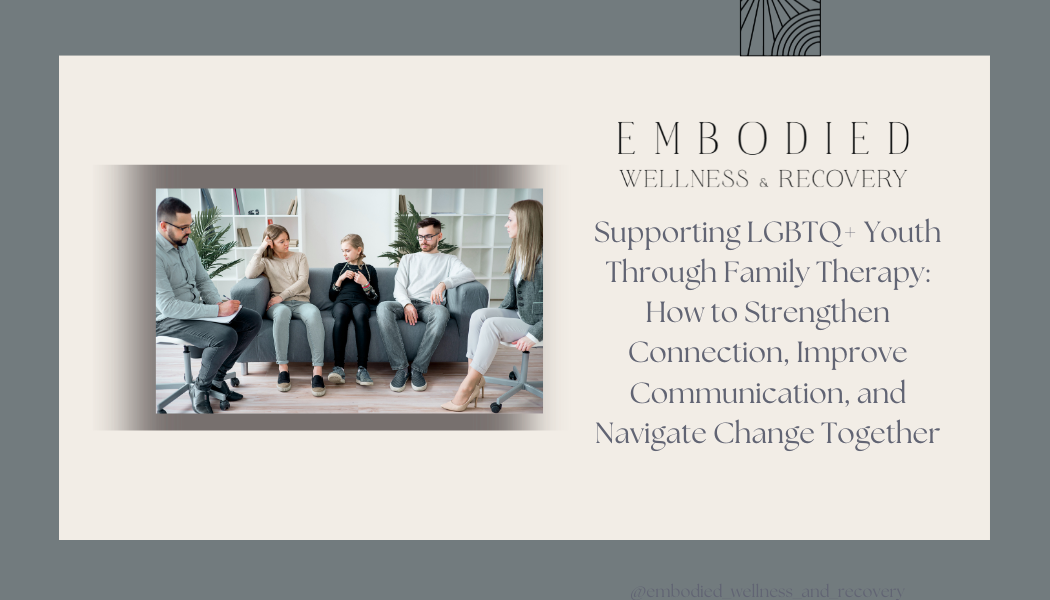
Supporting LGBTQ+ Youth Through Family Therapy: How to Strengthen Connection, Improve Communication, and Navigate Change Together
Supporting LGBTQ+ Youth Through Family Therapy: How to Strengthen Connection, Improve Communication, and Navigate Change Together
Supporting an LGBTQ+ child can bring questions, uncertainty, and emotional challenges for the entire family. Discover how family therapy, attachment science, and neuroscience can strengthen communication, rebuild trust, and preserve connection during times of change.
Learning that your child identifies as LGBTQ+ can bring a wide range of emotions. For many families, the first response is love. Soon after, however, other feelings may begin to surface.
Fear.
Confusion.
Grief over expectations that may be changing.
Worry about your child's future.
Uncertainty about what to say.
Concern that every conversation might make things worse.
Perhaps you have found yourself asking:
— How do I support my child without saying the wrong thing?
— Why do our conversations end in conflict?
— How do I stay connected when we seem to be growing apart?
— What if I accidentally push my child away?
— How can our family move through this together?
These questions are more common than many families realize. While much of the public conversation centers on identity, one of the most significant challenges families face is preserving emotional connection as they navigate change. Family therapy can provide a safe space to strengthen communication, rebuild trust, and help every family member feel heard without losing sight of what matters most: your relationship.
The Challenge Is Often About Connection, Not Love
Many parents deeply love their child while simultaneously feeling overwhelmed by unfamiliar emotions and questions. Likewise, many LGBTQ+ youth long for acceptance while fearing misunderstanding, disappointment, or rejection.
The result can be a painful cycle:
Parents become anxious. Children become guarded. Communication deteriorates. Both sides begin to protect themselves rather than connect with one another. The problem is rarely a lack of love. More often, it is a lack of emotional safety during difficult conversations.
Why Conversations Become So Difficult
From a neuroscience perspective, emotionally charged conversations activate the brain's threat detection system. When people perceive criticism, rejection, shame, or emotional danger, the amygdala becomes more active while the parts of the brain responsible for curiosity, empathy, flexible thinking, and problem-solving become less accessible (Siegel, 2020).
This happens to parents. It happens to children. Suddenly, everyone is reacting rather than listening. One person may withdraw. Another may become defensive. Someone else may attempt to fix, persuade, or avoid the conversation altogether.
Without realizing it, every member of the family is trying to protect themselves. Understanding this changes how we view conflict.
Rather than asking, "Who's right?"
We begin asking:
"What does each person's nervous system need in order to feel safe enough to connect?"
Family Therapy Helps Restore Emotional Safety
Family therapy is not about deciding who is correct. It is about strengthening the relationships that allow difficult conversations to occur with greater understanding and compassion.
Research consistently demonstrates that family acceptance is associated with better mental health outcomes, lower rates of depression, reduced suicide risk, and greater overall well-being among LGBTQ+ youth (Ryan et al., 2010).
Family therapy creates opportunities to:
— Improve communication
— Increase emotional safety
— Repair misunderstandings
— Strengthen attachment
— Reduce conflict
— Foster empathy
— Develop healthier patterns of interaction
The goal is not perfection. The goal is connection.
Understanding Attachment During Times of Change
Attachment theory reminds us that secure relationships are built when people consistently experience safety, responsiveness, and emotional availability. Periods of transition naturally place strain on attachment systems.
Parents may fear:
"Will my child still trust me?"
Children may fear:
"Will my family still accept me?"
These fears often remain unspoken. Instead, they appear as arguments, withdrawal, silence, or emotional distance. Family therapy helps bring these deeper concerns into the open where they can be explored with compassion rather than criticism.
Common Family Experiences
Many families entering therapy describe situations such as:
"We used to talk about everything."
"Now every conversation feels tense."
"I'm afraid of saying the wrong thing."
"My child doesn't tell me anything anymore."
"We're walking on eggshells."
"My spouse and I disagree about how to respond."
These experiences are understandable. They also represent opportunities for growth.
What Neuroscience Teaches About Emotional Safety
The nervous system constantly asks one question:
Am I safe?
When family members experience emotional safety, the brain becomes more capable of:
— Listening
— Reflecting
— Regulating emotions
— Showing empathy
— Solving problems
— Remaining curious
When emotional safety decreases, the nervous system shifts toward self-protection.
People become more likely to:
— Defend
— Criticize
— Withdraw
— Shut down
— Escalate conflict
Family therapy helps slow these interactions long enough for new patterns to develop.
Practical Ways Families Can Strengthen Connection
1. Lead With Curiosity
Replace assumptions with questions.
Instead of:
"Why would you do this?"
Try:
"Help me understand what this experience has been like for you."
Curiosity communicates respect.
2. Listen Before Solving
Many parents immediately search for solutions.
Children often need understanding first.
Feeling heard reduces defensiveness and creates space for meaningful dialogue.
3. Separate Intent From Impact
Families sometimes become stuck because everyone focuses on intentions.
Parents may say:
"I didn't mean to hurt you."
Children may respond:
"But it still hurt."
Both statements can be true. Repair begins when we acknowledge impact without assuming harmful intent.
4. Allow Room for Growth
Parents are learning. Children are learning. Families are learning together. Mistakes will happen. Repair matters more than perfection.
5. Protect the Relationship
Even during disagreement, remind one another:
"We're on the same team."
Shared humanity strengthens attachment.
When Trauma Is Part of the Story
For some families, conversations about identity occur alongside previous experiences of trauma, family conflict, rejection, or emotional wounds. These experiences can heighten sensitivity to misunderstanding and make conversations feel especially intense. Trauma-informed family therapy recognizes that current interactions are often influenced by past experiences. Rather than viewing emotional reactions as character flaws, therapy helps families understand them as nervous system responses that can become more flexible through safety, connection, and repair.
Family Therapy Is About More Than Identity
Although families may initially seek therapy because of LGBTQ+ concerns, many discover that therapy strengthens areas far beyond those conversations.
They develop:
— Better communication
— Greater empathy
— Stronger boundaries
— Healthier conflict resolution
— Increased emotional regulation
— More secure attachment
— Deepertrust
These skills benefit every relationship within the family.
How Embodied Wellness and Recovery Can Help
At Embodied Wellness and Recovery, we believe meaningful healing occurs within the context of safe relationships. Our clinicians specialize in trauma-informed, neuroscience-based care that integrates attachment theory, nervous system regulation, family systems, and evidence-based therapeutic approaches. Whether your family is navigating communication challenges, anxiety, trauma, parenting concerns, or supporting an LGBTQ+ loved one, we create a compassionate environment where every family member has the opportunity to feel seen, heard, and respected.
Our goal is not simply to reduce conflict. It is to help families cultivate deeper trust, stronger emotional bonds, and healthier patterns of connection that endure long after therapy ends.
Creating Safe, Supportive Relationships
Families do not grow stronger because they avoid difficult conversations. They grow stronger because they learn how to have them with honesty, curiosity, compassion, and respect. Supporting an LGBTQ+ child is not about having every answer. It is about creating a relationship where questions can be asked, emotions can be expressed, mistakes can be repaired, and love remains present through every season of change. The most enduring message a family can communicate is this: "Our relationship is strong enough to grow alongside us."
Reach out to schedule a complimentary 20-minute consultation with our team of therapists, trauma specialists, somatic practitioners, or relationship experts and start working towards integrative, embodied healing today.
📞 Call us at (310) 651-8458
📱 Text us at (310) 210-7934
📩 Email us at admin@embodiedwellnessandrecovery.com
🔗 Visit us at www.embodiedwellnessandrecovery.com
👉 Check us out on Instagram @embodied_wellness_and_recovery
🌍 Explore our offerings at Linktr.ee: https://linktr.ee/laurendummit
References
American Psychological Association. (2024). Guidelines for psychological practice with sexual minority persons and gender diverse people.
Diamond, G. M., Diamond, G. S., & Levy, S. (2014). Attachment-based family therapy for depressed adolescents. American Psychological Association.
Porges, S. W. (2021). Polyvagal safety: Attachment, communication, self-regulation. W. W. Norton & Company.
Ryan, C., Russell, S. T., Huebner, D., Diaz, R., & Sanchez, J. (2010). Family acceptance in adolescence and the health of LGBTQ young adults. Journal of Child and Adolescent Psychiatric Nursing, 23(4), 205-213.
Siegel, D. J. (2020). The developing mind: How relationships and the brain interact to shape who we are (3rd ed.). Guilford Press.
Why Is My Sex Drive So Low? The Neuroscience of Female Desire, Stress, Hormones, and the Nervous System
Why Is My Sex Drive So Low? The Neuroscience of Female Desire, Stress, Hormones, and the Nervous System
Wondering, "Why is my sex drive so low?" Learn how stress, hormones, perimenopause, trauma, and the nervous system influence female libido. Discover the neuroscience of desire and evidence-based strategies to support intimacy, emotional connection, and sexual well-being.
Understanding Low Libido in Women Through the Lens of Neuroscience, Perimenopause, and Emotional Well-Being
Have you found yourself wondering:
Why don't I want sex the way I used to?
Do you love your partner but rarely feel "in the mood"?
Has your interest in intimacy faded despite wanting to feel close?
Are you asking yourself whether stress, hormones, aging, or something deeper has changed you?
Perhaps you've tried scheduling date nights, reading relationship advice, or waiting for desire to return naturally, only to feel frustrated, confused, or even guilty.
For many women, a declining sex drive is not a reflection of diminished love or attraction. It is often the result of a complex interaction between the brain, nervous system, hormones, emotional health, relationship dynamics, and life circumstances. Understanding these factors can replace self-blame with insight and create opportunities for meaningful change.
Female Sexual Desire Is More Complex Than Most People Realize
One of the most persistent myths about female sexuality is that desire should appear spontaneously and consistently. In reality, women's sexual desire is influenced by numerous biological, psychological, relational, and environmental factors.
Research by sex educator and researcher Emily Nagoski highlights that female desire is highly context-dependent. Stress, emotional connection, physical comfort, relationship quality, and perceived safety all influence whether the brain experiences sexual interest or inhibition (Nagoski, 2021).
This means low libido is rarely explained by a single cause. It is often the product of several interacting systems.
Do Any of These Questions Sound Familiar?
— Has your sex drive declined over the past few years?
— Do you feel emotionally and physically exhausted by the end of the day?
— Are you constantly juggling work, caregiving, parenting, or household responsibilities?
— Have you entered perimenopause or menopause?
— Do you struggle to relax enough to feel sexually interested?
— Has anxiety replaced anticipation?
— Do you miss wanting sex but cannot seem to access desire?
— Has intimacy begun to feel like another item on your to-do list?
If so, your nervous system may be trying to tell you something.
The Brain Cannot Prioritize Survival and Sexual Desire at the Same Time
From a neuroscience perspective, sexual desire depends upon the brain perceiving sufficient safety. When stress becomes chronic, the brain shifts resources toward survival rather than reproduction. The hypothalamic-pituitary-adrenal axis increases the production of stress hormones such as cortisol.
While cortisol is essential for responding to challenges, chronically elevated levels can interfere with sexual desire, arousal, lubrication, and orgasm. Research consistently demonstrates that chronic stress is associated with lower sexual desire, reduced sexual satisfaction, and decreased relationship intimacy (Hamilton & Meston, 2013). In simple terms, a nervous system focused on survival has fewer resources available for pleasure.
Stress Does Not Stay at Work
Many women assume they should be able to "switch gears" once the workday ends. Unfortunately, the nervous system does not operate on a schedule. If your brain has spent the day responding to deadlines, caregiving responsibilities, financial concerns, conflict, or emotional labor, it may remain physiologically activated long after you leave the office.
This ongoing activation often contributes to:
— Mental fatigue
— Emotional exhaustion
— Difficulty relaxing
— Irritability
— Sleep disruption
— Reduced interest in intimacy
Desire often requires the very state chronic stress makes difficult to achieve: presence.
Hormones Matter, Especially During Perimenopause
Hormonal changes represent another important contributor to declining libido. During perimenopause, estrogen, progesterone, and testosterone fluctuate significantly.
These changes may influence:
— Genital blood flow
— Mood
— Energy
— Sleep quality
— Body temperature
Sleep disruption alone can substantially reduce sexual desire. Research indicates that hormonal changes interact with psychological and relational factors rather than acting independently (Righetti et al., 2020). This is why two women with similar hormone levels may experience very different sexual functioning.
The Mental Load Is Quietly Affecting Desire
Many women carry an invisible cognitive burden.
Managing schedules.
Planning meals.
Remembering appointments.
Organizing children's activities.
Tracking household responsibilities.
Supporting aging parents.
Maintaining professional responsibilities.
This ongoing mental load occupies valuable cognitive and emotional resources. The brain struggles to transition directly from constant planning into relaxed sexual engagement. Desireoften flourishes when the mind has permission to rest.
Trauma Can Influence Sexual Desire Long After the Event
For some women, low libido is connected to unresolved trauma. Trauma does not simply affect memory. It influences how the nervous system detects safety. Even when someone consciously wants intimacy, the body may remain guarded. This is not a conscious choice. It is an adaptive protective response.
Research on the Polyvagal Theory suggests that feelings of safety support social engagement, emotional connection, and intimacy, while chronic activation shifts the nervous system toward protection rather than openness (Porges, 2011).
Responsive Desire Is Completely Normal
Many women worry because they rarely experience spontaneous desire. However, research suggests that many women experience responsive desire, meaning sexual interest develops after emotional connection, affectionate touch, or initial arousal has already begun. Waiting to suddenly "feel in the mood" may actually create unnecessary frustration. Instead, desire often emerges within positive, emotionally safe experiences. Understanding this distinction can dramatically reduce shame and self-criticism.
Emotional Safety Is One of the Most Powerful Aphrodisiacs
Healthy sexuality extends far beyond hormones.
Women frequently report greater desire when they feel:
— Emotionally understood
— Appreciated
— Supported
— Respected
— Connected
— Safe expressing vulnerability
Relationship stress, unresolved conflict, resentment, or chronic criticism can significantly diminish sexual interest even when physical attraction remains.
The brain continually asks:
"Am I emotionally safe here?"
The answer influences desire more than many people realize.
What Can Help Restore Sexual Desire?
Improving female libido rarely involves addressing only one factor. Instead, consider supporting the systems that influence desire.
Prioritize Nervous System Regulation
Practices such as mindful breathing, yoga, walking, meditation, restorative movement, and adequate sleep help reduce the activation of chronic stress.
Address Hormonal Changes
If you are experiencing perimenopause or menopause, consult a qualified healthcare provider about whether hormonal evaluation or treatment may be appropriate.
Reduce the Mental Load
Discuss the invisible labor within your household. Sharing responsibilities often creates more emotional and cognitive space for connection.
Strengthen Emotional Intimacy
Meaningful conversations, shared laughter, affection, and emotional responsiveness frequently support desire more effectively than pressure or obligation.
Seek Specialized Therapy
Working with a therapist who understands trauma, sexuality, attachment, and neuroscience can help identify the unique factors influencing your experience.
How Embodied Wellness and Recovery Can Help
At Embodied Wellness and Recovery, we recognize that female sexuality cannot be understood by examining hormones alone. Desire is shaped by the interaction of the nervous system, trauma history, attachment patterns, relationship dynamics, emotional health, stress physiology, and hormonal changes.
Our trauma-informed, neuroscience-based approach integrates evidence-based psychotherapy with nervous system regulation to help women better understand their bodies, strengthen emotional connection, process unresolved experiences, and cultivate healthier, more satisfying intimate relationships.
Whether your concerns involve low libido, relationship challenges, perimenopause, trauma, anxiety, or sexual well-being, therapy offers an opportunity to explore the full picture rather than treating symptoms in isolation.
Listening to the Brain and Body
If your sex drive has changed, your body is not necessarily failing you.
More often, it is communicating important information about your stress levels, nervous system, emotional world, relationships, or hormonal health.
Female desire is remarkably adaptive. It responds to safety. It responds to connection. It responds to rest. It responds to feeling emotionally understood.
When we begin listening to what the brain and body are communicating, desire often becomes less mysterious and more understandable.
Rather than asking, "What's wrong with me?"
A more helpful question may be:
"What does my mind, body, and nervous system need in order to feel safe enough to experience desire again?"
Reach out to schedule a complimentary 20-minute consultation with our team of therapists, trauma specialists, somatic practitioners, Clinical Sexologists, or relationship experts and start working towards integrative, embodied healing today.
📞 Call us at (310) 651-8458
📱 Text us at (310) 210-7934
📩 Email us at admin@embodiedwellnessandrecovery.com
🔗 Visit us at www.embodiedwellnessandrecovery.com
👉 Check us out on Instagram @embodied_wellness_and_recovery
🌍 Explore our offerings at Linktr.ee: https://linktr.ee/laurendummit
References
Hamilton, L. D., & Meston, C. M. (2013). Chronic stress and sexual function in women. The Journal of Sexual Medicine, 10(10), 2443-2454.
Nagoski, E. (2021). Come as you are: Revised and updated. The surprising new science that will transform your sex life. Simon & Schuster.
Porges, S. W. (2011). The polyvagal theory: Neurophysiological foundations of emotions, attachment, communication, and self-regulation. W. W. Norton & Company.
Bancroft, J. (2009). Human sexuality and its problems (3rd ed.). Elsevier.
Basson, R. (2001). Using a different model for female sexual response to address women's problematic low sexual desire. Journal of Sex & Marital Therapy, 27(5), 395-403.