
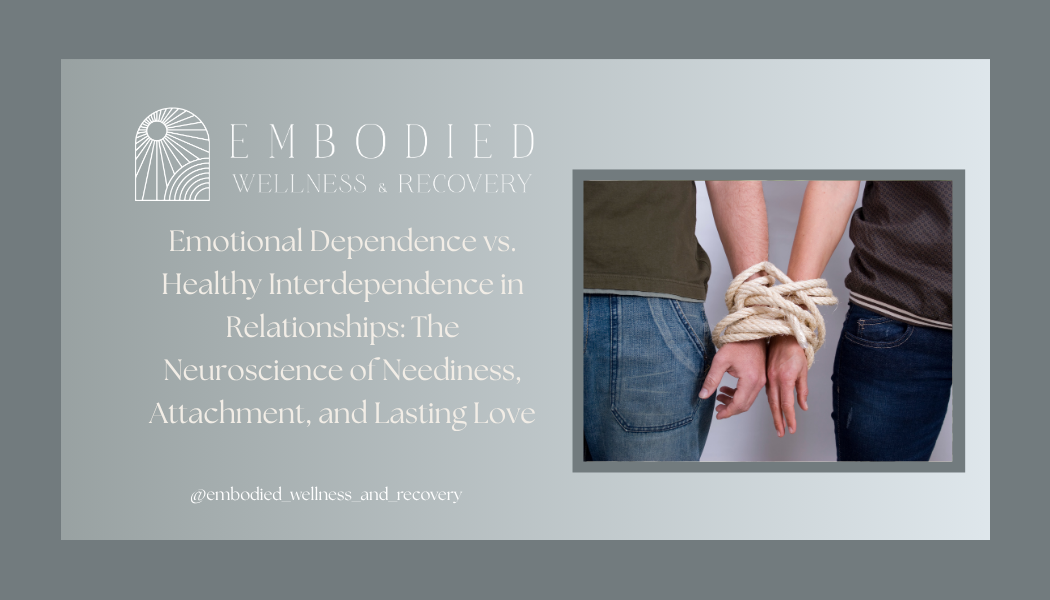
Emotional Dependence vs. Healthy Interdependence in Relationships: The Neuroscience of Neediness, Attachment, and Lasting Love
Emotional Dependence vs. Healthy Interdependence in Relationships: The Neuroscience of Neediness, Attachment, and Lasting Love
Do you feel too needy in relationships, or worry that your partner is overly dependent on you? Learn the difference between emotional dependence and healthy interdependence, how attachment styles and trauma influence relationship dynamics, and what neuroscience reveals about building secure, lasting intimacy.
Have you ever worried that you’re “too needy” in a relationship? Do you find yourself constantly seeking reassurance, feeling anxious when your partner doesn’t respond quickly, or struggling to feel secure when you’re apart? Or perhaps you’re on the other side of the equation. Do you feel overwhelmed by a partner who seems excessively dependent on you for validation, emotional regulation, or a sense of self-worth?
Questions about emotional dependence are among the most common concerns people bring into therapy and relationship counseling, yet many people misunderstand what healthy relationships actually require. Contrary to popular belief, healthy relationships are not built on complete independence. Nor are they built on emotional fusion.
The strongest relationships are built on something in between: healthy interdependence. Understanding the difference between emotional dependence and healthy interdependence can transform not only your relationships, but also your relationship with yourself.
Why the Fear of Being “Too Needy” Is So Common
Modern culture often glorifies independence.
Many people receive messages such as:
— Don’t need anyone.
— Be self-sufficient.
— Never rely on another person for happiness.
— Strong people handle everything themselves.
While self-reliance is valuable, humans are fundamentally relational beings. Research in attachment science consistently demonstrates that emotional connection and secure relationships are essential for psychological well-being (Mikulincer & Shaver, 2016). The desire for closeness, comfort, reassurance, and connection is not a weakness. It is part of being human. The problem arises when emotional needs become the primary source of stability, identity, or self-worth.
What Is Emotional Dependence?
Emotional dependence occurs when a person’s sense of security, value, or emotional stability becomes overly reliant on another person.
Common signs include:
— Constant reassurance seeking
— Fear of abandonment
— Difficulty making decisions independently
— Feeling emotionally devastated when a partner is unavailable
— Losing touch with personal interests, friendships, or goals
— Feeling incomplete without a relationship
For someone experiencing emotional dependence, the relationship can begin to feel less like a partnership and more like a lifeline. The nervous system begins to treat connection as a necessity for survival rather than a source of support.
What Is Healthy Interdependence?
Healthy interdependence looks very different.
Interdependent partners:
— Maintain a strong sense of self
— Support one another emotionally
— Value connection without losing individuality
— Communicate needs directly
— Respect boundaries
— Have lives both together and apart
— Can self-regulate while also seeking support
In healthy interdependence, both partners contribute to the relationship without expecting the other person to manage all emotional needs. The relationship becomes a source of strength rather than a substitute for internal stability.
The Neuroscience of Attachment and Neediness
To understand emotional dependence, it helps to understand attachment. Attachment is the biological system that drives humans to seek safety and connection with trusted others.
From infancy onward, our brains are shaped through relationships. When caregivers are consistently available, responsive, and attuned, children tend to develop secure attachment. When caregivers are inconsistent, unpredictable, emotionally unavailable, or frightening, attachment insecurity may develop.
Research has identified several attachment styles:
Secure Attachment
Individuals generally feel comfortable with intimacy and independence.
Anxious Attachment
Individuals often fear rejection, abandonment, or emotional distance.
Avoidant Attachment
Individuals tend to minimize emotional needs and prioritize self-reliance.
Disorganized Attachment
Individuals experience both a desire for closeness and a fear of it. Many people who describe themselves as “needy” are actually experiencing anxious attachment patterns rather than excessive need.
Why Trauma Can Intensify Emotional Dependence
Relationship anxiety often has deeper roots than the current relationship. Trauma, attachment injuries, childhood emotional neglect, betrayal,and inconsistent caregiving can shape how the nervous system experiences connection. If love once felt unpredictable, the brain may become hypervigilant for signs of rejection.
You may find yourself asking:
— Why do I panic when my partner pulls away?
— Why do I need constant reassurance?
— Why does a delayed text message feel so upsetting?
— Why do I feel insecure even in a loving relationship?
The answer is often found in the nervous system rather than logic. The brain is attempting to prevent future pain by monitoring for potential threats to connection.
Why Emotional Dependence Can Strain Relationships
Ironically, the more someone seeks constant reassurance, the more strain it often places on the relationship.
Partners may begin to feel:
— Responsible for another person’s emotions
— Overwhelmed
— Pressured
— Guilty
— Emotionally exhausted
Over time, this can create a cycle in which one partner pursues, and the other withdraws. The more one partner seeks closeness, the more the other creates distance. The greater the distance, the more anxiety increases. This pattern is one of the most common dynamics seen in couples therapy.
The Difference Between Having Needs and Being Dependent
One of the most important distinctions is this:
Having emotional needs is healthy. Expecting another person to meet all emotional needs is not.
Healthy needs include:
— Affection
— Emotional support
— Connection
— Trust
— Reliability
Problems arise when a partner becomes the sole source of:
— Identity
— Emotional regulation
— Purpose
— Security
Healthy relationships involve mutual support without emotional overreliance.
The Nervous System’s Role in Relationship Security
Many people try to solve relationship anxiety cognitively.
They tell themselves:
“I shouldn’t feel this way.”
“I need to stop being needy.”
“I need more confidence.”
While insight is helpful, nervous system regulation is often equally important. When the nervous system is activated, the brain becomes more likely to interpret ambiguity as danger.
A partner needing space may feel like rejection. A delayed response may feel like abandonment. A disagreement may feel like a threat to the relationship. Helping the nervous system feel safe can dramatically reduce relationship anxiety.
How to Build Healthy Interdependence
1. Strengthen Your Relationship With Yourself
Healthy partnerships are easier when you maintain:
— Personal interests
— Friendships
— Goals
— Hobbies
— Individual identity
A fulfilling life creates stability that does not depend entirely on the relationship.
2. Learn to Regulate Anxiety
Practices such as:
— EMDR
— Nervous system regulation exercises
can help reduce attachment-related distress.
3. Communicate Needs Directly
Rather than seeking reassurance indirectly through criticism, testing, or protest behaviors, communicate openly.
For example:
“I’m feeling disconnected and would love some quality time together.”
4. Challenge Shame About Having Needs
Healthy intimacy requires vulnerability. Needing connection does not make you weak. It makes you human.
5. Address Underlying Trauma
Many patterns of emotional dependence originate long before the current relationship. Working through attachment wounds often changes relationship dynamics in profound ways.
At Embodied Wellness and Recovery, we understand that relationship struggles rarely exist in isolation. Difficulty trusting, fears of abandonment, emotional dependence, intimacy challenges, and relationship anxiety are often connected to deeper attachment patterns and nervous system dysregulation. Our trauma-informed approach integrates neuroscience, attachment theory, EMDR, somatic therapies, and relationship-focused treatmentto help individuals and couples build greater emotional security.
The goal is not to become completely independent. Nor is it to rely entirely on another person. The goal is healthy interdependence. A relationship where two people can lean on one another without losing themselves.A relationship where connection and individuality coexist. A relationship where love feels supportive rather than suffocating. That balance is often where lasting intimacy begins.
Reach out to schedule a complimentary 20-minute consultation with our team of therapists, trauma specialists, somatic practitioners, or relationship experts, and start working towards integrative, embodied healing today.
📞 Call us at (310) 651-8458
📱 Text us at (310) 210-7934
📩 Email us at admin@embodiedwellnessandrecovery.com
🔗 Visit us at www.embodiedwellnessandrecovery.com
👉 Check us out on Instagram @embodied_wellness_and_recovery
🌍 Explore our offerings at Linktr.ee: https://linktr.ee/laurendummit
References
1) Bowlby, J. (1988). A secure base: Parent-child attachment and healthy human development. Basic Books.
2) Coan, J. A., & Sbarra, D. A. (2015). Social baseline theory: The social regulation of risk and effort. Current Opinion in Psychology, 1, 87-91.
3) Johnson, S. M. (2019). Attachment theory in practice: Emotionally focused therapy (EFT) with individuals, couples, and families. Guilford Press.
4) Mikulincer, M., & Shaver, P. R. (2016). Attachment in adulthood: Structure, dynamics, and change (2nd ed.). Guilford Press.
5) Siegel, D. J. (2020). The developing mind: How relationships and the brain interact to shape who we are (3rd ed.). Guilford Press.