
What Is Micro-Cheating and Why Does It Hurt So Much? The Neuroscience of Betrayal, Attachment, and Broken Trust
What Is Micro-Cheating and Why Does It Hurt So Much? The Neuroscience of Betrayal, Attachment, and Broken Trust
What is micro-cheating, and is it really cheating? Learn why secret texts, flirting, DMs, and emotional intimacy can trigger betrayal trauma, attachment anxiety, and broken trust.
Maybe there was no sex. No kiss. No hotel room. No conventional “affair.” But there were deleted messages. Flirtatious texts. A coworker who seemed to know too much. An ex who never quite disappeared. Private DMs your partner did not want you to see.
And now you cannot stop wondering:
Am I overreacting, or did my partner betray me?
If nothing physical happened, why does this hurt so much?
Why am I suddenly checking their phone, replaying conversations, and questioning things I never questioned before?
This increasingly common relationship gray area is often described as micro-cheating, and understanding why it hurts requires looking beyond the behavior itself.
What Is Micro-Cheating?
Micro-cheating is not a formal psychological diagnosis, nor is there a universally accepted clinical definition. The term generally describes small or ambiguous behaviors that direct romantic, sexual, or emotionally intimate energy outside a committed relationship in ways that may violate the couple's understood boundaries.
Examples might include:
— Secretly messaging an ex
— Flirting with a coworker
— Sending suggestive DMs or emojis
— Maintaining a dating profile
— Hiding or deleting conversations
— Seeking ongoing romantic validation from someone else
— Sharing intimate relationship details with someone you are attracted to
— Downplaying a relationship because you know your partner would be uncomfortable with it
— Engaging online in ways you would not comfortably do with your partner sitting beside you
None of these behaviors automatically constitutes infidelity in every relationship. Couples have different agreements around monogamy, flirting, friendships, sexuality, privacy, and social media.
The more useful question may not be “Does this technically count as cheating?”
It may be: “Did this violate the trust and boundaries of our relationship?”
Why Does Micro-Cheating Hurt So Much?
The brain doesn't evaluate relationship injuries by whether they qualify as “big” or “small.” It responds to meaning. Our closest relationships often become important sources of predictability, attachment, emotional regulation, and safety. When a trusted partner conceals something significant, the injury can disrupt the assumptions that helped the relationship feel secure.
Research on romantic betrayal has found meaningful associations with trust, attachment security, self-esteem, anxiety, depression, and post-traumatic stress symptoms. A 2021 qualitative study found that betrayed partners commonly described romantic betrayal as shocking and destabilizing, with some experiencing clinically significant psychological symptoms (Lonergan et al., 2021)
In other words, your nervous system may not be reacting simply to a text message. It may be reacting to what the text message changed about what you believed was true.
Your Brain Hates the Gap Between “I Trust You” and “Something Is Wrong”
Imagine believing your relationship is secure and then discovering information that contradicts that belief.
Your partner says, “It was nothing.”
Your nervous system says, “Then why was it hidden?”
That discrepancy can create a powerful drive to resolve uncertainty. You may find yourself reconstructing timelines, rereading messages, checking social media, asking the same questions repeatedly, or becoming intensely alert to subtle changes in your partner's behavior.
Research on infidelity-related distress helps explain why these reactions can become so intense. In one study of unmarried young adults who had experienced a partner's infidelity, 45.2% reported symptoms consistent with probable infidelity-related PTSD, although infidelity itself does not ordinarily meet the DSM's Criterion A requirement for a PTSD diagnosis (Roos et al., 2019)
This distinction matters. Feeling traumatized by betrayal does not automatically mean someone has PTSD. It does tell us that relational betrayal can produce substantial stress responses.
Attachment Makes Betrayal Personal
Attachment theory offers another piece of the puzzle. When we become emotionally bonded to someone, we develop expectations about their availability, responsiveness, and reliability. Betrayal can suddenly destabilize those expectations. Research has linked partner betrayal with disruptions in trust and with anxious and avoidant attachment patterns (Das & Jain, 2024)
This can transform a seemingly simple question such as “Why were you texting them?” into much deeper fears:
Am I enough?
Can I trust you when I'm not there?
Was our intimacy as exclusive as I believed?
What else don't I know?
Can I trust my own judgment anymore?
Digital Betrayal Can Still Affect Real-World Trust
Technology has made relationship boundaries considerably more complicated. A relationship can now be disrupted without two people ever occupying the same physical room. Recent research on partner phubbing, or prioritizing a phone over one's partner, illustrates how seemingly small digital behaviors can affect relationships. A 2025 meta-analysis encompassing 52 studies and 19,698 participants found associations between partner phubbing and lower relationship satisfaction, intimacy, and responsiveness, along with greater jealousy and conflict (Ni et al., 2025)
A separate 2025 study found that partner phubbing negatively predicted trust and romantic relationship quality (Doğru et al., 2025). These studies are not studies of micro-cheating itself, but they reinforce an important principle: digital behavior can carry genuine relational meaning.
Stop Asking Only, “Was It Cheating?”
Couples can become trapped in a courtroom-style argument.
One partner says, “I never cheated.”
The other says, “But I feel betrayed.”
Both become consumed with proving which interpretation is correct.
A more productive conversation asks:
What did we believe our boundaries were? What was hidden? Why was it hidden? What did this relationship or interaction provide? What impact did it have? And what needs to change for trust to become possible again?
Privacy is not inherently secrecy. Friendships outside a relationship are healthy. Attraction to other people can occur even in loving partnerships. A relationship should not require surveillance or control.
But trust also requires honesty about the boundaries two people have agreed to share.
Rebuilding Trust After Micro-Cheating
At Embodied Wellness and Recovery, we understand betrayal through a trauma-informed, attachment-focused, neuroscience-informed lens. Our work with betrayal trauma, nervous system repair, relationships, sexuality, intimacy, and attachment goes beyond deciding who was “right.”
Repair may involve understanding what happened, clarifying boundaries, restoring emotional safety, developing accountability, addressing attachment injuries, regulating the nervous system, and gradually rebuilding emotional and sexual intimacy.
The goal is not to erase what happened or demand immediate forgiveness.
It is to help both partners determine whether they can create a relationship in which words and behavior become trustworthy again. Sometimes the deepest wound of micro-cheating is not what happened between your partner and someone else.
It is what happened to your sense of safety between the two of you.
Read the full article at www.embodiedwellnessandrecovery.com/blog.
Reach out to schedule a complimentary 20-minute consultation with our team of therapists, trauma specialists, somatic practitioners, or relationship experts, and start working towards integrative, embodied healing today.
📞 Call us at (310) 651-8458
📱 Text us at (310) 210-7934
📩 Email us at admin@embodiedwellnessandrecovery.com
🔗 Visit us at www.embodiedwellnessandrecovery.com
👉 Check us out on Instagram @embodied_wellness_and_recovery
🌍 Explore our offerings at Linktr.ee: https://linktr.ee/laurendummit
References
Das, M., & Jain, N. (2024). Partner betrayal trauma and trust: Understanding the impact on attachment style and self-esteem. European Journal of Trauma & Dissociation, 8(2), 100409.
Doğru, M. C., Öge, R. M., Satıcı, S. A., & Deniz, M. E. (2025). Trust and romantic relationship quality as serial mediators of the link between partner phubbing and relationship satisfaction. Psychological Reports. Advance online publication.
Lonergan, M., Brunet, A., Rivest-Beauregard, M., & Groleau, D. (2021). Is romantic partner betrayal a form of traumatic experience? A qualitative study. Stress and Health, 37(1), 19–31.
Ni, X., et al. (2025). A meta-analytic study of partner phubbing and its antecedents and consequences. Frontiers in Psychology, 16, 1561159.
Roos, L. G., O'Connor, V., Canevello, A., & Bennett, J. M. (2019). Post-traumatic stress and psychological health following infidelity in unmarried young adults. Stress and Health, 35(4), 468–479.
Relationship Therapy While Single: How to Heal Dating Patterns, Build Secure Attachment, and Find a Healthier Relationship
Relationship Therapy While Single: How to Heal Dating Patterns, Build Secure Attachment, and Find a Healthier Relationship
Relationship therapy isn't just for couples. Learn how therapy while single can help you understand attachment patterns, heal relationship trauma, improve dating choices, and prepare for a healthy, secure relationship
Most people think about relationship therapy after something has gone wrong. A couple can't communicate. Trust has been broken. Sex has disappeared. The same argument keeps happening. Someone is considering leaving.
But what if some of the most important relationship work happens before you're in a relationship?
If you are single and dating, you may already be encountering the very patterns that will eventually shape your next partnership.
Why are you intensely attracted to people who are emotionally unavailable?
Why do you lose interest when someone is consistent?
Why does a delayed text trigger anxiety?
Why do you ignore red flags when chemistry is strong?
Why do you become attached before you truly know someone?
Or perhaps you've become so protective of your independence that letting anyone close feels intrusive. Relationship therapy while single offers an opportunity to understand not simply who you date, but who you become when attachment enters the room.
You Don't Need a Partner to Work on Your Relationships
Relationship patterns don't begin when you meet someone new. They are shaped by years of experiences involving attachment, family relationships, rejection, abandonment, betrayal, trauma, sexuality, self-worth, and previous romantic relationships. Research on adult attachment suggests that early relational experiences can influence how we experience closeness, trust, dependency, rejection, and emotional intimacy in adulthood.
If connection was inconsistent or unpredictable, for example, you may become hypervigilant when dating. A change in someone's texting pattern can feel disproportionately significant. You may seek reassurance, overanalyze interactions, or become preoccupied with whether the relationship is secure.
Others adapt by becoming fiercely independent. Instead of worrying that someone will leave, you may unconsciously make sure you never need them enough for leaving to hurt. Neither response is simply a personality flaw. They may be protective strategies your nervous system learned long before you downloaded a dating app.
Why Do I Keep Choosing the Wrong People?
One of the most painful dating questions is, “Why do I keep ending up in the same relationship with a different person?” Maybe you repeatedly choose emotionally unavailable partners. Perhaps you become involved with people who need rescuing. Maybe you confuse intensity with intimacy, or you find yourself dating narcissistic, controlling, avoidant, or inconsistent partners despite promising yourself that this time will be different.
Relationship therapy can help identify the unconscious patterns influencing attraction and partner selection. Research has consistently linked attachment insecurity with differences in romantic relationship functioning and satisfaction. Attachment anxiety may involve heightened sensitivity to rejection and abandonment, while attachment avoidance can involve discomfort with dependency, vulnerability, and emotional closeness.
The goal isn't to diagnose every date as “avoidant” or “anxious.” It is to become more curious about your own relational nervous system.
Your Nervous System Has a Dating History Too
Dating isn't only psychological. It is physiological. Your brain continuously evaluates social information for signals of safety, reward, rejection, and threat. Research in social neuroscience demonstrates that social rejection engages neural systems associated with distress and threat processing. This helps explain why seemingly small dating experiences can sometimes produce surprisingly intense emotional reactions.
A text left unanswered may objectively be a text left unanswered, but if abandonment has been part of your history, your nervous system may experience uncertainty as threat. Likewise, if closeness once meant engulfment, control, criticism, or emotional unpredictability, a genuinely available partner may produce discomfort rather than relief.
This creates one of the great paradoxes of dating: What feels familiar can sometimes feel like chemistry, even when familiar isn't healthy, and what is healthy may initially feel unfamiliar, boring, suspicious, or strangely vulnerable.
Relationship Therapy Can Help You Date Differently
Therapy while single isn't about creating a checklist for the perfect partner. It's about increasing your capacity to recognize yourself as you relate to someone else.
That might mean learning to notice:
Chemistry versus activation.
Am I genuinely interested in this person, or am I intensely activated by uncertainty?
Intimacy versus intensity.
Are we slowly developing trust, or are we creating immediate emotional fusion?
Boundaries versus rejection.
Can I hear “no” without interpreting it as abandonment?
Independence versus avoidance.
Do I enjoy autonomy, or do I distance myself when someone gets emotionally close?
Discernment versus hypervigilance.
Am I noticing legitimate red flags, or searching constantly for evidence that something will go wrong?
These distinctions can fundamentally change how someone approaches dating and relationships.
Therapy Can Also Help You Understand Your Sexual Self
Healthy relationships aren't built only through communication and attachment. Sexuality matters too. Many people enter relationships without ever having explored their relationship with desire, pleasure, body image, sexual boundaries, sexual shame, performance anxiety, consent, fantasy, or emotional intimacy.
Relationship and sex therapy while single can provide a rare opportunity to ask:
What does satisfying intimacy actually mean to me?
Can I communicate what I want sexually?
Do I use sex to create closeness, reassurance, validation, or security?
Do I disconnect from my own desires in order to be desirable to someone else?
Understanding your sexual self before entering a partnership can create a much stronger foundation for authentic intimacy later.
Being Single Can Be an Opportunity for Relationship Work
There is a cultural tendency to treat singlehood as the waiting room before “real” relational life begins. It isn't. Being single can be one of the most valuable times to explore attachment patterns because you have the opportunity to observe yourself in real time without being fully embedded in an established partnership.
Dating becomes information.
Attraction becomes information.
Disappointment becomes information.
Boundaries become information.
Even heartbreak can become information.
The question shifts from:
“How do I get this person to choose me?”
to:
“Who am I choosing, and who do I become when I want to be chosen?”
That is a profoundly different way to date.
Preparing for the Relationship You Actually Want
At Embodied Wellness and Recovery, we approach relationship therapy through an integrated lens that includes trauma, attachment, nervous system regulation, sexuality, intimacy, and somatic awareness. Rather than focusing solely on changing thoughts or dating behaviors, we help clients understand the underlying emotional and physiological patterns that shape how they experience connection.
Finding a healthier relationship isn't simply about finding the “right” person. It is also about developing the capacity to recognize consistency, communicate honestly, tolerate vulnerability, maintain boundaries, experience healthy sexuality, and remain connected to yourself while becoming connected to someone else.
Perhaps relationship therapy doesn't need to begin when a relationship is falling apart. Perhaps it can begin while you're single, when you have the extraordinary opportunity to ask, “What would change if I prepared for the kind of love I want before it arrives?”
Reach out to schedule a complimentary 20-minute consultation with our team of therapists, trauma specialists, somatic practitioners, or relationship experts, and start working towards integrative, embodied healing today.
📞 Call us at (310) 651-8458
📱 Text us at (310) 210-7934
📩 Email us at admin@embodiedwellnessandrecovery.com
🔗 Visit us at www.embodiedwellnessandrecovery.com
👉 Check us out on Instagram @embodied_wellness_and_recovery
🌍 Explore our offerings at Linktr.ee: https://linktr.ee/laurendummit
References
Coan, J. A., & Sbarra, D. A. (2015). Social baseline theory: The social regulation of risk and effort. Current Opinion in Psychology, 1, 87-91.
Eisenberger, N. I. (2012). The pain of social disconnection: Examining the shared neural underpinnings of physical and social pain. Nature Reviews Neuroscience, 13(6), 421-434.
Hadden, B. W., Smith, C. V., & Webster, G. D. (2014). Relationship duration moderates associations between attachment and relationship quality: Meta-analytic support for the temporal adult romantic attachment model. Personality and Social Psychology Review, 18(1), 42-58.
Mikulincer, M., & Shaver, P. R. (2016). Attachment in adulthood: Structure, dynamics, and change (2nd ed.). Guilford Press.
Why Does Someone Being Mad at Me Feel Like an Emergency? How Childhood Trauma, Hypervigilance, and People-Pleasing Create Conflict Anxiety
Why Does Someone Being Mad at Me Feel Like an Emergency? How Childhood Trauma, Hypervigilance, and People-Pleasing Create Conflict Anxiety
Why does someone being mad at you feel terrifying? Learn how childhood trauma, hypervigilance, people-pleasing, attachment anxiety, and the nervous system can turn ordinary conflict into a perceived threat.
Someone's tone changes. Their text seems shorter than usual. Your partner sighs, your friend seems distant, or your boss sounds irritated, and suddenly, your stomach drops.
Are they mad at me?
Within seconds, you may begin replaying the conversation, searching for what you did wrong. Maybe you send another text. You apologize. You explain yourself. You try to make them laugh. You soften the boundary you just set. You cannot seem to relax until you know everything is okay again.
Why does someone being upset with you feel so unbearable? Why does conflict make you anxious even when you know you haven't done anything wrong? Why do you feel compelled to fix someone's feelings immediately? Sometimes, you aren't actually afraid of conflict. You're afraid of what your nervous system learned conflict might cost you.
Why Does Someone Being Mad at Me Make Me So Anxious?
For some children, anger is simply an emotion. A parent can be frustrated and remain loving. A disagreement happens, repair follows, and connection remains intact.
But what if anger in your childhood meant something different?
Perhaps anger was followed by yelling, criticism, humiliation, punishment, withdrawal, the silent treatment, rejection, emotional unpredictability, or even violence. Maybe you had a parent whose mood determined the emotional climate of the entire house. You learned to notice footsteps, facial expressions, doors closing, the way someone put down a glass, or a subtle change in tone.
Your developing nervous system may have learned:
If someone is upset, pay attention. If someone is angry, something bad may happen. If someone is disappointed in me, connection may disappear. I need to fix this. This is how childhood trauma and hypervigilance can eventually become adult conflict anxiety.
When Hypervigilance Follows You Into Relationships
Hypervigilance is the nervous system's tendency to continuously scan the environment for potential threat. Research suggests that childhood emotional maltreatment can be associated with altered processing of emotional facial expressions, including heightened amygdala responsivity to emotional faces.
In childhood, becoming exceptionally skilled at detecting someone's emotional state may be adaptive. If Dad's facial expression tells you whether tonight will be peaceful or frightening, then noticing tiny changes in his mood matters, but the nervous system can continue to use an old survival strategy long after the original environment has changed. Now your partner's sigh may trigger the same internal alarm. A delayed text feels ominous.
Someone saying, “I'm disappointed” feels less like information and more like rejection. You aren't consciously deciding to overreact. Your nervous system may simply be responding to an old equation: Anger = danger.
The Neuroscience of Why Conflict Can Feel Like a Threat
The brain is designed to prioritize threat detection. The amygdala helps identify emotionally salient information, particularly potential danger, while interconnected cortical regions help provide context and determine whether a threat is actually occurring.
When early environments are chronically unpredictable or threatening, these systems can become shaped around detecting danger efficiently. Research on childhood adversity suggests differences in neural processing of emotional and potentially threatening social cues. In adulthood, childhood emotional maltreatment has also been associated with heightened amygdala responses to emotional facial expressions.
This helps explain why your rational mind may know:
“My partner is just frustrated.”
while your body is responding:
“Something is wrong. Fix it now.”
Conflict is not merely cognitive. It is physiological.
Studies of couples have found that attachment insecurity can influence cortisol, autonomic arousal, emotional experience, and physiological recovery during relationship conflict. In other words, relationships happen inside nervous systems.
People-Pleasing Can Be an Attempt to Restore Safety
When conflict feels dangerous, people-pleasing makes perfect sense. You apologize quickly. You agree when you don't agree. You over-explain. You change your boundary. You reassure the other person. You become exceptionally nice. You monitor their face until they smile again.
What is sometimes called the fawn response can be understood as an appeasement strategy: reducing interpersonal threat by becoming agreeable, helpful, accommodating, or emotionally useful.
The underlying message is often:
“If I can make you happy again, I can feel safe again.”
This is why people-pleasing is not always simply about wanting people to like you. Sometimes it is about needing other people to be okay so that your nervous system can be okay.
Signs You May Have Conflict Anxiety
You may recognize yourself if you:
Feel panicked when someone is disappointed in you.
Apologize even when you aren't sure you did anything wrong.
Need to resolve disagreements immediately.
Over-explain your intentions.
Replay conversations for hours afterward.
Struggle to sleep when someone is upset with you.
Change boundaries when another person reacts negatively.
Interpret someone's silence as rejection.
Feel responsible for restoring everyone's mood.
Avoid difficult conversations because you fear losing the relationship.
The painful paradox is that avoiding conflict to preserve relationships can eventually make authentic intimacy harder.
Healthy Relationships Require the Ability to Survive Disagreement
Real intimacy cannot require permanent agreement. Two emotionally healthy people will sometimes misunderstand each other, disappoint each other, irritate each other, want different things, and set boundaries the other person doesn't particularly like.
The goal isn't to eliminate conflict.
It is to teach your nervous system something new:
Someone can be upset with me and still love me. Someone can misunderstand me, and I can still trust myself. Someone can be disappointed, and I don't have to fix their disappointment. A boundary can create discomfort without creating abandonment. Conflict can happen without connection disappearing. This is one of the most important shifts in trauma recovery.
How to Stop Feeling Responsible for Someone Else's Anger
Begin by noticing the moment someone else's emotion becomes an emergency inside your body. Before apologizing, explaining, texting again, changing your boundary, or trying to repair the situation immediately, pause.
Ask yourself:
Is something actually unsafe, or am I uncomfortable because someone is unhappy with me?
Notice what happens physically. Perhaps your chest tightens, your stomach drops, your jaw clenches, or you feel an urgent need to do something. That pause creates space between another person's emotion and your response to it.
Somatic therapy, attachment-focused therapy, EMDR, mindfulness, and other trauma-informed approaches can help people recognize these automatic survival patterns while developing greater capacity to tolerate relational discomfort. Over time, the nervous system can learn that disagreement does not automatically equal danger.
From Hypervigilance to Relational Safety
At Embodied Wellness and Recovery, we understand conflict anxiety through a trauma-informed, attachment-based, and nervous system lens. Our work addresses the deeper patterns beneath people-pleasing, hypervigilance, relationship anxiety, difficulty setting boundaries, trauma, sexuality, and intimacy. Healthy relationships aren't relationships where nobody gets upset. They are relationships in which two people can remain connected to themselves while allowing each other to have their own feelings.
Perhaps the next time someone is disappointed, irritated, or unhappy with you, the question isn't:
“How do I make them okay again?”
It might be:
“Can I stay connected to myself while allowing someone else to be unhappy with me?”
Because sometimes the deepest form of nervous system repair is discovering that someone else's anger can be uncomfortable without becoming an emergency.
Reach out to schedule a complimentary 20-minute consultation with our team of therapists, trauma specialists, somatic practitioners, or relationship experts and start working towards integrative, embodied healing today.
📞 Call us at (310) 651-8458
📱 Text us at (310) 210-7934
📩 Email us at admin@embodiedwellnessandrecovery.com
🔗 Visit us at www.embodiedwellnessandrecovery.com
👉 Check us out on Instagram @embodied_wellness_and_recovery
🌍 Explore our offerings at Linktr.ee: https://linktr.ee/laurendummit
References
Ben-Naim, S., Hirschberger, G., Ein-Dor, T., & Mikulincer, M. (2013). An experimental study of emotion regulation during relationship conflict interactions: The moderating role of attachment orientations. Emotion, 13(3), 506-519.
McCrory, E. J., De Brito, S. A., Kelly, P. A., Bird, G., Sebastian, C. L., Mechelli, A., Samuel, S., & Viding, E. (2013). Amygdala activation in maltreated children during pre-attentive emotional processing. The British Journal of Psychiatry, 202(4), 269-276.
Powers, S. I., Pietromonaco, P. R., Gunlicks, M., & Sayer, A. (2006). Dating couples' attachment styles and patterns of cortisol reactivity and recovery in response to a relationship conflict. Journal of Personality and Social Psychology, 90(4), 613-628.
Taylor, N. C., Seedall, R. B., Robinson, W. D., & Bradford, K. (2018). The systemic interaction of attachment on psychophysiological arousal in couple conflict. Journal of Marital and Family Therapy, 44(1), 46-60.
Why Does Kindness Make Me Uncomfortable? How Trauma Can Make Love, Compliments, and Care Feel Unsafe
Why Does Kindness Make Me Uncomfortable? How Trauma Can Make Love, Compliments, and Care Feel Unsafe
Why does kindness make you uncomfortable? Learn how trauma, attachment wounds, and nervous system dysregulation can make compliments, love, care, and healthy relationships feel unsafe.
What if you are wonderful at caring for everyone else, but the moment someone tries to care for you, something inside you tightens? Someone compliments you, and you immediately dismiss it. Someone offers to help, and your automatic response is, “I’ve got it.” Someone treats you with tenderness, and instead of relaxing, you become suspicious. Someone loves you consistently, and part of you wants to pull away.
You may desperately want love, care, tenderness, and emotional connection. Yet when kindness actually arrives, your nervous system does not seem to know what to do with it.
This confusing response can leave you wondering:
Why does kindness make me uncomfortable? Why can't I accept compliments? Why do I distrust people who are nice to me? Why is it easier to give love than receive it?
For some people with unresolved trauma or attachment wounds, the answer may have less to do with rejecting love and more to do with what the brain and nervous system learned about safety, trust, vulnerability, and relationships.
Why Can Trauma Make Kindness Feel Uncomfortable?
We tend to imagine that kindness should automatically feel good, but the brain does not evaluate relationships based solely on what is objectively healthy. It also relies on previous experience to predict what will happen next.
If affection, attention, or care was historically followed by criticism, manipulation, abandonment, intrusion, punishment, or disappointment, receiving kindness may carry an unconscious question:
“What is this going to cost me?”
Perhaps someone was generous and later reminded you of everything they had done for you. Maybe affection disappeared when you disappointed a caregiver. Perhaps praise was rare, unpredictable, or conditional on achievement. Maybe you learned that seeking comfort led to rejection. Or perhaps the people who were supposed to make you feel safe were also the people you had to protect yourself from.
Research on childhood maltreatment supports this connection between adverse relational experiences and later interpersonal distrust. One study found that greater childhood maltreatment was associated with perceiving interaction partners as less trustworthy and with negatively biased emotion processing (Hepp et al., 2021).
Your adult mind may recognize kindness. Your nervous system may still be waiting for what historically came afterward.
Trauma Changes the Brain's Predictions About Relationships
The brain is constantly making predictions.
Is this safe?
Can I trust this person?
What does this expression mean?
What happens if I let my guard down?
Attachment experiences help shape these predictions.
A neuroscience review of adult attachment found that attachment patterns can influence how the brain processes social safety, threat, reward, and emotional information. These processes involve interconnected regions including the amygdala, hippocampus, striatum, insula, cingulate cortex, and prefrontal regions (Vrticka & Vuilleumier, 2012).
More recent research continues to demonstrate that childhood trauma can have lasting effects on neural systems involved in emotion, social information, reward, and threat detection. This helps explain why a trauma response does not always look like obvious fear.
Sometimes it looks like:
“I don't need anything.”
“I'd rather do it myself.”
“They're probably just being polite.”
“I don't trust people who are too nice.”
“I feel weird when someone compliments me.”
“I owe them now.”
“This relationship feels boring.”
“Something must be wrong because they're treating me so well.”
These responses may represent attempts to preserve predictability and control.
Why Compliments Can Feel So Uncomfortable After Trauma
Consider what happens when someone says:
“You look beautiful.”
Do you allow yourself to receive it?
Or do you immediately respond:
“No, I look exhausted.”
Do you joke?
Change the subject?
Compliment them back?
Explain why they are wrong?
A compliment creates a surprisingly intimate psychological moment. Someone is directing positive attention toward you, and for a few seconds, you are being seen. For someone carrying shame, chronic criticism, or a belief that worth must be earned, that visibility can feel uncomfortable.
Neuroscience research shows that compliments between romantic partners engage brain regions involved in reward and social processing (Flores et al., 2023). Positive social experiences are not trivial. The brain is designed to respond to them. But trauma may alter how easily positive experiences are integrated.
Research examining PTSD and reward processing suggests that trauma-related disorders can affect the way people interact with and respond to positive stimuli, although researchers emphasize that this area still requires further investigation (Seidemann et al., 2021). In other words, receiving something good may itself require practice.
When Hyper-Independence Is a Trauma Response
Hyper-independence is often celebrated. You handle things. You don't ask for help. You solve problems. You take care of everyone else. You rarely need anything.
From the outside, this can look like strength, and sometimes it is. But there is an important question worth asking:
Do I choose independence, or do I feel unsafe depending on anyone?
There is a profound difference. If relying on others once led to disappointment, neglect, humiliation, or loss of control, the nervous system may conclude: Depending on myself is safer than needing someone else.
That strategy can be extraordinarily adaptive until intimacy requires something different. Healthy relationships involve interdependence. We need the capacity both to give and receive, support and be supported, care and be cared for. When receiving feels dangerous, relationships can quietly become one-sided. You become indispensable to everyone while allowing almost no one to become indispensable to you.
Why Healthy Love Can Feel Uncomfortable After Trauma
This is one of the most confusing consequences of relational trauma. Someone is emotionally available, consistent, respectful, kind, and interested. They honor your boundaries. They communicate.
And instead of feeling relieved, you think:
“Where's the chemistry?”
Sometimes there genuinely isn't chemistry, but sometimes something more complicated is happening. The nervous system can become accustomed to particular relationship patterns. Uncertainty, pursuit, withdrawal, criticism, emotional unpredictability, or intermittent affection may become deeply familiar.
Then a consistently available person feels different, and we can mistakenly interpret unfamiliarity as incompatibility. This does not mean people should force themselves to remain in relationships that do not feel right. It means that when healthy intimacy repeatedly creates discomfort, curiosity can be more informative than immediate judgment.
Ask:
Am I uninterested, or am I unactivated?
Does this person feel wrong, or simply unfamiliar?
Have I historically mistaken anxiety for chemistry?
What happens in my body when someone is consistently available to me?
These questions can reveal relationship patterns that intellectual insight alone may miss.
The Body May Say “No” Before the Mind Understands Why
Trauma is not merely a memory of something that happened. It can influence patterns of attention, emotion, expectation, physiological activation, and behavior.
This is why someone may intellectually know:
“This person is safe.”
while their body responds:
“Don't get too close.”
You may notice tension in your chest when someone expresses affection, an urge to pull away during tenderness, restlessness when someone takes care of you, numbness during emotional intimacy, embarrassment when receiving praise, or suspicion when someone offers something without asking for anything in return. The body is not necessarily reporting present-day danger accurately. It may be responding according to an older template.
Learning to Receive Kindness Without Feeling Unsafe
The goal is not to force yourself to trust everyone or eliminate healthy discernment. It is to develop greater flexibility so that your nervous system can distinguish present safety from past danger.
Start small.
When someone compliments you, experiment with simply saying:
“Thank you.”
Then notice what happens in your body.
Do you tense?
Want to explain?
Feel embarrassed?
Experience an urge to return the compliment immediately?
Try allowing the positive experience to remain for a few seconds longer than usual. When someone offers help, consider accepting something small. When someone is kind, notice whether you immediately search for hidden motives. When your partner offers affection, observe whether you soften toward it or unconsciously brace against it. The goal is curiosity, not self-criticism. You are gathering information about what your nervous system has learned.
Safe Relationships Can Create New Experiences
The encouraging part of understanding the brain is recognizing that it is not static. Research on social connection demonstrates that positive interpersonal experiences engage systems involved in reward, emotional closeness, and affiliation. Research also suggests that positive interactions between attachment partners can influence neural synchrony, highlighting the brain's responsiveness to relational experience (Djalovski et al., 2021).
Repeated experiences matter. Being cared for without owing anything. Setting a boundary and discovering the relationship survives. Expressing a need and being met with compassion. Receiving affection without manipulation. Being vulnerable without being humiliated. Allowing yourself to be supported without surrendering your autonomy. Over time, experiences like these can provide the nervous system with new information: Kindness does not always have a hidden cost.
Trauma Therapy Can Help When Receiving Love Feels Unsafe
At Embodied Wellness and Recovery, we understand that trauma treatment involves more than intellectually understanding the past. Our work addresses trauma, attachment, nervous system repair, relationships, sexuality, and intimacy through an integrative, neuroscience-informed, and somatically oriented approach.
Sometimes the challenge is not understanding that you deserve healthy relationships. It is developing the embodied capacity to experience care without bracing against it. Therapy can help identify the relationship templates that developed through earlier experiences while supporting greater awareness of present-day sensations, emotions, boundaries, and attachment responses.
The goal is not indiscriminate trust. It is discernment. It is learning the difference between vulnerability and danger. Between dependence and healthy interdependence. Between intensity and intimacy. Between someone wanting something from you and someone simply wanting to give something to you.
Perhaps most importantly, it is learning that you do not always have to earn care by being useful, easy, accomplished, attractive, accommodating, or endlessly strong. Sometimes someone is kind because they care about you. And slowly, the nervous system can learn to let that experience in.
Reach out to schedule a complimentary 20-minute consultation with our team of therapists, trauma specialists, somatic practitioners, or relationship experts, and start working towards integrative, embodied healing today.
📞 Call us at (310) 651-8458
📱 Text us at (310) 210-7934
📩 Email us at admin@embodiedwellnessandrecovery.com
🔗 Visit us at www.embodiedwellnessandrecovery.com
👉 Check us out on Instagram @embodied_wellness_and_recovery
🌍 Explore our offerings at Linktr.ee: https://linktr.ee/laurendummit
References
Chambers, J., & Sullivan, R. (2026). Trauma in attachment: Understanding the first relationship through neurobiology and psychodynamics. Psychodynamic Psychiatry, 54(2), 249-282.
Djalovski, A., Dumas, G., Kinreich, S., & Feldman, R. (2021). Human attachments shape interbrain synchrony to efficiently achieve social goals. NeuroImage, 226, 117600.
Flores, L. E., Eckstrand, K. L., Silk, J. S., Allen, N. B., Ambrosia, M., Healey, K. L., & Forbes, E. E. (2018). Adolescents' neural responses to social reward, real-world emotional closeness, and positive affect. Cognitive, Affective, & Behavioral Neuroscience, 18(4), 705-717.
Hepp, J., Schmitz, S. E., Urbild, J., Zauner, K., Niedtfeld, I., & Bertsch, K. (2021). Childhood maltreatment is associated with distrust and negatively biased emotion processing. Borderline
Seidemann, R., Duek, O., Jia, R., Levy, I., & Harpaz-Rotem, I. (2021). The reward system and post-traumatic stress disorder: Does trauma affect the way we interact with positive stimuli? Chronic Stress, 5, 2470547021996006.
Vrticka, P., & Vuilleumier, P. (2012). Neuroscience of human social interactions and adult
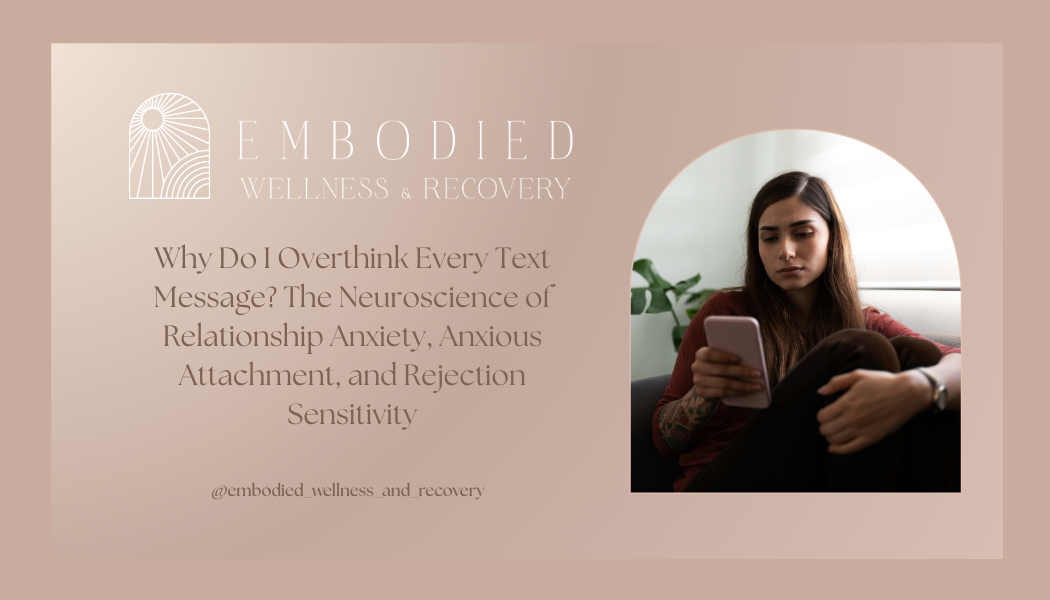
Why Do I Overthink Every Text Message? The Neuroscience of Relationship Anxiety, Anxious Attachment, and Rejection Sensitivity
Why Do I Overthink Every Text Message? The Neuroscience of Relationship Anxiety, Anxious Attachment, and Rejection Sensitivity
Why do you overthink text messages? Learn how relationship anxiety, anxious attachment, rejection sensitivity, trauma, and nervous system dysregulation can make delayed replies and subtle changes in texting feel threatening, plus how to stop overanalyzing every message.
You send the text. Then you read it again…and again. Was it too long? Did you sound too interested? Should you have used an emoji? Maybe the joke didn't land.
Then you notice they haven't responded. Twenty minutes pass. Then an hour. Suddenly, your brain is no longer thinking about a text message. It is trying to solve a relationship.
"Did I do something wrong?"
"Are they upset with me?"
"Are they losing interest?"
"Why are they online but not answering?"
"Should I text again, or will I seem needy?"
If you overthink text messages, the problem may not be that you are overly sensitive. You may be experiencing something much more complex: a nervous system attempting to find certainty in a form of communication filled with ambiguity.
For people with relationship anxiety, anxious attachment, trauma, rejection sensitivity, or histories of inconsistent relationships, texting can become the perfect environment for hypervigilance.
Why Do I Overthink Text Messages So Much?
Texting removes much of the information the human brain normally uses to understand another person. There is no facial expression. No tone of voice. No eye contact. No body language. No immediate opportunity to clarify what someone meant.
Instead, your brain receives:
"Sure."
And now it has to interpret it.
Does "sure" mean yes?
Or does it mean:
"I'm annoyed."
"I'm losing interest."
"Leave me alone."
The brain does not like missing information. Research on predictive processing suggests that our brains continuously use previous experiences to make predictions about what ambiguous information means (Friston, 2010). When your relationship history has taught you that connection can disappear unexpectedly, your brain may fill in missing information with threat.
Anxious Attachment Can Turn Texting Into an Emotional Minefield
Attachment theory helps explain why some people experience texting anxiety more intensely than others. Early relationships help create internal expectations about whether other people will be available, responsive, and emotionally safe. Research on adult attachment has found that people with higher attachment anxiety tend to be particularly sensitive to cues of rejection and abandonment and may engage in hyperactivating strategies when relational security feels threatened (Mikulincer & Shaver, 2016).
That means a delayed text response may not simply register as:
"They're probably busy."
It may activate a deeper fear:
"Something has changed between us."
Your conscious mind may understand that your partner is working. Your attachment system may still be sounding an alarm.
Why Tiny Changes in Texting Feel So Significant
Perhaps your partner normally writes:
"Goodnight ❤️"
Tonight they write:
"Night."
Your stomach drops. Nothing objectively threatening has happened, yet your brain immediately notices the deviation. Humans are remarkably skilled pattern detectors. When someone has experienced inconsistent caregiving, betrayal, abandonment, ghosting, or unpredictable relationships, subtle changes can become especially salient.
The nervous system learns:
Pay attention. Small changes might mean something. Hypervigilance that once helped you anticipate relational danger may now cause you to analyze punctuation, response times, emojis, and word choices as though they contain hidden information about the future of your relationship.
Why Haven't They Texted Me Back?
Few experiences activate texting anxiety more effectively than silence. When there is no information, the anxious brain creates information.
"They haven't responded."
becomes:
"They're avoiding me."
Then:
"They're losing interest."
Then:
"I knew this would happen."
This process resembles what cognitive psychology describes as intolerance of uncertainty, the tendency to experience uncertain situations as particularly distressing. Research has linked intolerance of uncertainty with worry and anxiety across multiple psychological conditions (Carleton, 2016).
Overthinking becomes an attempt to eliminate uncertainty. Unfortunately, thinking harder rarely produces the missing information. It simply generates more possible explanations.
Your Phone Can Become an Attachment Regulation Device
Notice what happens when the message finally arrives. Relief. Your shoulders soften. Your attention returns. Everything suddenly feels okay again. This cycle can gradually teach your brain to use communication from another person to regulate internal distress. No message creates activation. A message creates relief.
Soon you may find yourself checking your phone repeatedly, watching typing bubbles, monitoring read receipts, checking someone's social media activity, rereading previous conversations, sending screenshots to friends, or asking, "What do you think this means?" The phone becomes less of a communication tool and more of a device for monitoring relational safety.
Rejection Sensitivity and ADHD Can Intensify Texting Anxiety
For some people with ADHD, emotional dysregulation and heightened sensitivity to perceived rejection can make ambiguous social interactions particularly difficult. Although the popular term "rejection sensitive dysphoria" is not itself a formal DSM diagnosis, research has documented significant emotional regulation difficulties among many individuals with ADHD (Shaw et al., 2014). A delayed response may therefore trigger a rapid emotional reaction before there is time to evaluate alternative explanations.
You may intellectually know:
"They're probably busy."
while your body feels:
"I'm being rejected."
Both experiences can exist simultaneously.
Trauma Can Teach You That Small Changes Matter
Texting anxiety may also make more sense when viewed through a trauma-informed lens. Perhaps a previous partner suddenly disappeared. Maybe someone cheated, and you discovered subtle changes in their communication beforehand.
Perhaps affection was routinely withdrawn when someone was angry with you. Maybe silence was used as punishment during childhood. Your nervous system learned from experience. Small changes sometimes did predict pain. The problem is that protective learning can become generalized. Your brain may begin responding to harmless ambiguity as though it carries the same meaning as previous relational danger.
Why You Analyze Your Own Messages Too
The anxiety does not end with interpreting other people's texts. You may scrutinize your own. Was I too vulnerable? Did I sound desperate? Should I have waited longer to reply? Did I use too many exclamation points? Should I send another message explaining what I meant? Texting becomes performance rather than communication.
Underneath the editing is often an unconscious belief:
"If I communicate perfectly, I can prevent rejection." But relationships cannot be made completely safe through perfect wording. Trying to eliminate relational risk through carefully constructed messages often increases anxiety rather than reducing it.
When Reassurance Seeking Becomes a Cycle
As anxiety rises, reassurance feels irresistible. You ask friends what the message means. You text again.
You ask your partner:
"Are you mad at me?"
They reassure you. You feel better but only temporarily.
Research on anxiety suggests that reassurance seeking can reduce distress in the short term while maintaining anxiety over time because the brain never learns that uncertainty can be tolerated without external confirmation. The deeper task becomes developing the capacity to remain connected to yourself while connection with someone else temporarily feels uncertain.
How to Stop Overthinking Text Messages
The goal is not to become indifferent. It is to create enough internal security that every ambiguous message does not become an emergency. Start by separating activation from interpretation. Before deciding what a message means, notice what is happening in your body.
Is your chest tight?
Are you holding your breath?
Is your heart racing?
Do you feel compelled to respond immediately?
Your nervous system may need regulation before your brain needs analysis. Next, distinguish facts from stories.
Fact:
"They haven't responded for two hours."
Story:
"They're losing interest."
That distinction sounds simple, but it can profoundly change how you respond to uncertainty. It can also help to delay reassurance seeking, communicaterelationship needs directly, reduce compulsive checking, and explore the attachment experiences underlying the fear.
Nervous System Regulation Changes Relationship Anxiety
Understanding anxious attachment intellectually is valuable.
But attachment anxiety is also embodied.
At Embodied Wellness and Recovery, we help clients explore how trauma, attachment experiences, nervous system dysregulation, and relationship patterns influence emotional connection, sexuality, and intimacy.
Through trauma-informed psychotherapy, somatic approaches, EMDR, attachment-focused work, and relationship therapy, clients can develop greater capacity to recognize activation, tolerate uncertainty, strengthen self-trust, and communicate needs without allowing fear to control the interaction.
The goal is not to convince yourself that everyone will always respond exactly as you hope.
They won't.
It is learning that uncertainty does not have to mean danger.
You Don't Have to Decode Every Message
Perhaps the most important shift happens when you stop asking:
"What does this text mean?"
and begin asking:
"What is happening inside me that makes this uncertainty feel so threatening?"
That question moves you away from endlessly analyzing another person's punctuation and toward understanding your own nervous system.
Because secure connection does not come from finding the perfect text, responding at precisely the right moment, or successfully predicting whether someone might leave.
It grows through self-trust, direct communication, emotional regulation, reciprocal relationships, and repeated experiences of connection that do not require constant monitoring.
A text can simply become a text again.
Not a test of your desirability.
Not evidence of abandonment.
Not a puzzle you have to solve.
Just one small moment inside a relationship that is much larger than what appears on your screen.
Reach out to schedule a complimentary 20-minute consultation withour team of therapists,trauma specialists, somatic practitioners, orrelationship experts and start working towards integrative, embodied healing today.
📞 Call us at (310) 651-8458
📱 Text us at (310) 210-7934
📩 Email us at admin@embodiedwellnessandrecovery.com
🔗 Visit us at www.embodiedwellnessandrecovery.com
👉 Check us out on Instagram @embodied_wellness_and_recovery
🌍 Explore our offerings at Linktr.ee: https://linktr.ee/laurendummit
References
Carleton, R. N. (2016). Into the unknown: A review and synthesis of contemporary models involving uncertainty. Journal of Anxiety Disorders, 39, 30-43.
Friston, K. (2010). The free-energy principle: A unified brain theory? Nature Reviews Neuroscience, 11(2), 127-138.
Mikulincer, M., & Shaver, P. R. (2016). Attachment in adulthood: Structure, dynamics, and change (2nd ed.). Guilford Press.
Shaw, P., Stringaris, A., Nigg, J., & Leibenluft, E. (2014). Emotion dysregulation in attention deficit hyperactivity disorder. American Journal of Psychiatry, 171(3), 276-293.
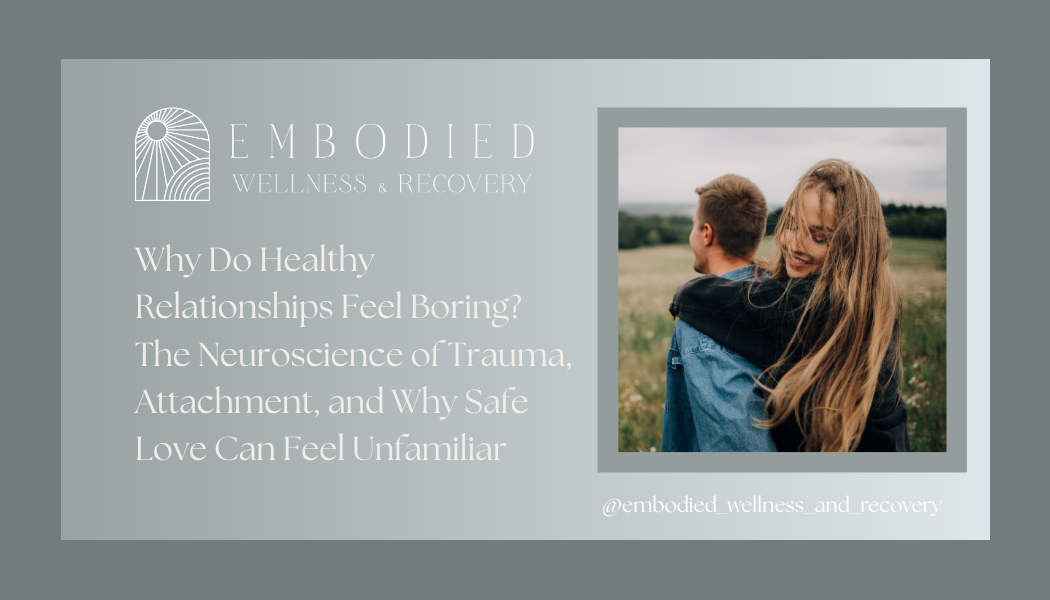
Why Do Healthy Relationships Feel Boring? The Neuroscience of Trauma, Attachment, and Why Safe Love Can Feel Unfamiliar
Why Do Healthy Relationships Feel Boring? The Neuroscience of Trauma, Attachment, and Why Safe Love Can Feel Unfamiliar
Why do healthy relationships feel boring after trauma? Discover how attachment wounds, nervous system dysregulation, and emotional conditioning can make safe, stable love feel unfamiliar. Learn the neuroscience behind attraction, intimacy, and lasting connection.
"I finally met someone who treats me well... so why don't I feel excited?" It's one of the most painful questions people ask in therapy. You meet someone who is emotionally available. They communicate openly. They respect your boundaries. They are consistent, trustworthy, and kind. Instead of feeling butterflies, you feel... flat.
Maybe you find yourself wondering:
— Why do healthy relationships feel boring?
— Why am I only attracted to emotionally unavailable people?
— Why do I lose interest when someone actually likes me?
— Is something wrong with me?
— Am I incapable of real intimacy?
— Am I confusing chemistry with anxiety?
For many people, these questions trigger profound confusion and shame. They desperately want a healthy relationship, yet when they finally encounter one, it feels strangely unfamiliar. The answer often lies not in your character, but in your nervous system.
What If "Boring" Really Means "Unfamiliar"?
One of the greatest misunderstandings about attraction is the belief that chemistry always signals compatibility. In reality, chemistry is often shaped by familiarity.
If your earliest experiences of love involved inconsistency, emotional unpredictability, criticism, neglect, or earning affection, your brain and body may have learned that love feels activating rather than calming.
As adults, many trauma survivors unconsciously associate love with:
— Uncertainty
— Emotional intensity
— Mixed signals
— Chasing connection
— Fear of abandonment
— Constant emotional vigilance
When those elements are absent, healthy relationships can initially feel "boring." What your mind interprets as a lack of chemistry may actually be the absence of chronic nervous system activation.
The Neuroscience of Attraction
Our brains are prediction machines. According to neuroscience, the brain continuously searches for familiar patterns because familiarity feels efficient and, paradoxically, safe. Even when familiar experiences were painful, they remain neurologically recognizable. Research in attachment theory demonstrates that early caregiving experiences shape internal working models that influence expectations about relationships throughout adulthood (Bowlby, 1988).
If love once required constant emotional monitoring, your nervous system may interpret emotional stability as unfamiliar rather than comforting. This is not a conscious decision. It is implicit memory at work.
When Anxiety Feels Like Chemistry
Many people mistake activation for attraction. Consider two scenarios.
Relationship A
Your partner texts inconsistently. Sometimes they seem deeply invested. Other times they disappear. You constantly wonder where you stand. Your heart races every time your phone lights up.
Relationship B
Your partner communicates consistently. They follow through. They express affection openly. You rarely question where you stand. Many people describe Relationship A as "passionate." They describe Relationship B as "boring." But from a nervous system perspective, Relationship A may simply be activating old survival circuits.
Intermittent reinforcement, a well-documented principle in behavioral psychology, creates especially powerful emotional responses because the brain becomes conditioned to anticipate unpredictable rewards (Skinner, 1953). What feels like chemistry may actually be conditioned anticipation.
Attachment Trauma Changes the Way We Experience Love
Children adapt remarkably well to the environments in which they are raised. If emotional connection was unpredictable, conditional, or inconsistent, the developing brain learned to remain alert.
Questions such as:
"Are they upset with me?"
"Did I do something wrong?"
"How do I keep them close?"
became strategies for maintaining attachment.
Over time, hypervigilance became intertwined with love itself. As adults, emotional calm may feel strangely empty because it does not match the relational blueprint your nervous system recognizes.
Why Safety Can Feel Uncomfortable
One of the most surprising discoveries in trauma therapy is that safety itself can feel dysregulating. People often imagine that once life becomes peaceful, their body will immediately relax. Instead, they may notice discomfort. They become restless. They question the relationship. They search for problems that do not exist. They lose attraction.
Why?
Because a nervous system accustomed to chronic activation often experiences calm as unfamiliar territory. According to Polyvagal Theory, our autonomic nervous system constantly evaluates cues of safety and danger through a process called neuroception (Porges, 2011). When safety has rarely been experienced, the nervous system may initially struggle to recognize it.
Instead of thinking,
"I finally found someone emotionally secure,"
the brain may wonder,
"Something feels off."
Why Do I Keep Choosing Emotionally Unavailable Partners?
Many people blame themselves for repeatedly entering painful relationships. They assume they have poor judgment or low standards.
More often than not, the nervous system is drawn toward familiar emotional landscapes.
Emotionally unavailable partners create:
— Uncertainty
— Longing
— Hope
— Pursuit
— Emotional highs and lows
These states produce intense physiological activation.
Consistent, emotionally available partners create something entirely different:
— Predictability
— Trust
— Emotional safety
— Stability
— Secure attachment
Initially, stability may feel less stimulating because the nervous system is no longer operating in survival mode.
High Chemistry Does Not Always Mean High Compatibility
Popular culture often romanticizes emotional intensity. Movies portray love as obsession. Social media celebrates dramatic reconciliations. Many people internalize the belief that real love should feel overwhelming. Healthy relationships often look different.
They allow room for:
— Curiosity instead of hypervigilance
— Communication instead of mind reading
— Boundaries instead of self-abandonment
— Intimacy instead of emotional chaos
This quieter form of connection may not create the same adrenaline spikes, but research consistently demonstrates that secure attachment is associated with greater relationship satisfaction, emotional regulation, and psychological well-being (Mikulincer & Shaver, 2016).
Can Attraction Change?
This question offers tremendous hope. The answer is yes. Thanks to neuroplasticity, the brain remains capable of forming new neural pathways throughout life. Repeated experiences of emotional safety gradually teach the nervous system that love does not require constant vigilance.
Over time, many people notice profound shifts. They begin feeling more attracted to consistency. Conflict feels less exciting. Calm becomes comforting. Authenticity replaces performance.
Rather than chasing unavailable partners, they become increasingly drawn toward emotional reciprocity. The relationship has not become more exciting. Their nervous system has become more regulated.
How Trauma-Informed Therapy Can Help
Understanding these patterns intellectually is valuable. Experiencing them differently requires more than insight alone. Because attachment wounds live not only in thoughts but also in the nervous system, effective treatment often integrates both top-down and bottom-up approaches.
At Embodied Wellness and Recovery, we help individuals and couples understand how trauma, attachment experiences, and nervous system dysregulation influence relationships, sexuality, and intimacy.
Using evidence-based approaches including EMDR, somatic therapy, attachment-focused psychotherapy, and neuroscience-informed treatment, we help clients develop greater emotional awareness, increase nervous system flexibility, strengthen secure attachment, and experience relationships from a place of authenticity rather than survival.
As the nervous system learns that connection no longer requires earning love, anticipating abandonment, or managing another person's emotions, healthy relationships often begin to feel less unfamiliar and far more fulfilling.
A New Definition of Chemistry
Perhaps the most meaningful question is not,
"Why does healthy love feel boring?"
Perhaps it is,
"What if my definition of chemistry was shaped by survival rather than security?"
Healthy love is rarely devoid of passion. Rather, it offers something many trauma survivors have never consistently experienced: the freedom to be fully known without constantly wondering whether love will disappear.
As your nervous system begins to recognize emotional safety as familiar, what once felt boring may gradually become deeply satisfying, not because you lowered your standards, but because your brain and body learned that intimacy can exist without fear, that consistency can coexist with desire, and that genuine connection does not require emotional chaos to feel alive.
Reach out to schedule a complimentary 20-minute consultation with our team of therapists, trauma specialists, somatic practitioners, or relationship experts and start working towards integrative, embodied healing today.
📞 Call us at (310) 651-8458
📱 Text us at (310) 210-7934
📩 Email us at admin@embodiedwellnessandrecovery.com
🔗 Visit us at www.embodiedwellnessandrecovery.com
👉 Check us out on Instagram @embodied_wellness_and_recovery
🌍 Explore our offerings at Linktr.ee: https://linktr.ee/laurendummit
References
Bowlby, J. (1988). A secure base: Parent child attachment and healthy human development. Basic Books.
Mikulincer, M., & Shaver, P. R. (2016). Attachment in adulthood: Structure, dynamics, and change (2nd ed.). Guilford Press.
Porges, S. W. (2011). The polyvagal theory: Neurophysiological foundations of emotions, attachment, communication, self regulation. W. W. Norton & Company.
Skinner, B. F. (1953). Science and human behavior. Macmillan.
Siegel, D. J. (2020). The developing mind: How relationships and the brain interact to shape who we are (3rd ed.). Guilford Press.
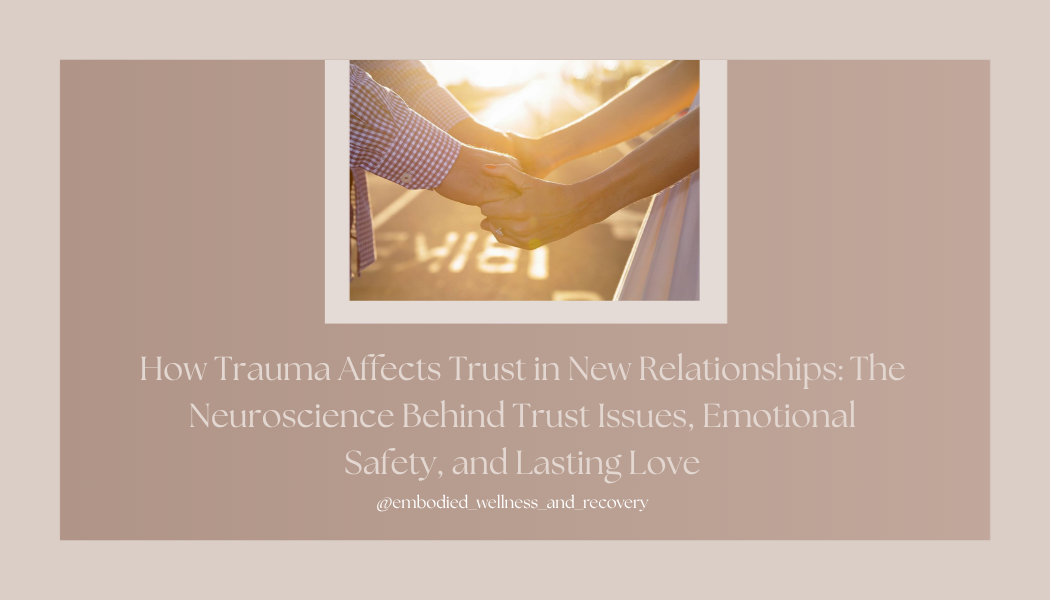
How Trauma Affects Trust in New Relationships: The Neuroscience Behind Trust Issues, Emotional Safety, and Lasting Love
How Trauma Affects Trust in New Relationships: The Neuroscience Behind Trust Issues, Emotional Safety, and Lasting Love
Struggling to trust in a new relationship after trauma? Discover how past experiences shape the brain, nervous system, and attachment patterns, and learn how trauma-informed therapy can help you build emotional safety, healthier relationships, and lasting intimacy.
You genuinely want to trust your new partner. They've been kind, consistent, and emotionally available. They've given you no obvious reason to doubt them. Yet your mind keeps asking questions:
What if they leave?
What if they're hiding something?
What if I'm missing the warning signs?
Perhaps you notice yourself overanalyzing text messages, seeking constant reassurance, withdrawing when you begin feeling vulnerable, or becoming anxious whenever your partner needs space. You may even find yourself sabotaging the very relationship you've been hoping to find.
If this sounds familiar, you're not simply "overthinking." Your nervous system may be doing exactly what it learned to do in order to protect you. When trauma shapes our early experiences of relationships, trust often becomes far more complicated than simply deciding to believe another person. Neuroscience demonstrates that trust is not merely a conscious choice. It is a physiological process involving the brain, the nervous system, memory, and attachment.
Understanding these processes can transform how you view yourself and your relationships.
Does Any of This Feel Familiar?
Perhaps you've found yourself wondering:
— Why do I struggle to trust people who treat me well?
— Why do I assume the worst in relationships?
— Why do I push people away when they get close?
— Why do I become anxious when my partner doesn't respond immediately?
— Why do I expect rejection even when things are going well?
— Why do I constantly need reassurance?
— Why do I lose myself trying to prevent someone from leaving?
— Why do I feel emotionally overwhelmed in healthy relationships?
These questions are more common than many people realize. They often reflect the lasting effects of trauma on the brain and nervous system.
Trust Begins in the Brain
We often think of trust as a decision. Neuroscience suggests it is also a prediction.
Your brain continuously asks:
"Is this person emotionally safe?"
To answer that question, it draws upon:
— Past relationships
— Childhood experiences
— Emotional memories
— Attachment patterns
— Previous betrayals
If your history taught your brain that closeness often led to pain, abandonment, criticism, inconsistency, or betrayal, your brain may continue expecting those outcomes, even in a healthy relationship. This is not irrational. It is adaptive learning.
Trauma Changes How the Brain Detects Safety
Traumatic experiences influence several brain regions involved in relationships. The amygdala becomes more sensitive to potential threats. The hippocampus influences how emotional memories are stored and retrieved. The prefrontal cortex, responsible for flexible thinking and emotional regulation, may have greater difficulty calming fear responses during periods of stress. As a result, seemingly neutral situations may trigger intense emotional reactions.
A delayed text.
A canceled date.
A change in tone.
The logical mind may recognize these events as relatively minor. The nervous system may interpret them very differently.
Your Nervous System Remembers What Your Mind May Not
According to Polyvagal Theory, developed by neuroscientist Stephen Porges, the nervous system constantly scans the environment for cues of safety or danger. This process occurs largely outside conscious awareness. When previous relationships involved betrayal, emotional neglect, criticism, manipulation, or abuse, the nervous system often becomes highly efficient at detecting possible threats.
Sometimes it detects danger accurately. Sometimes it mistakes unfamiliar safety for potential risk. Healthy love can initially feel surprisingly uncomfortable because it differs from what the nervous system has learned to expect.
Trauma Often Creates Protective Relationship Patterns
These protective strategies originally served an important purpose. Unfortunately, they can create challenges in healthy relationships.
Hypervigilance
Constantly scanning for signs that something is wrong.
Reading deeply into text messages.
Watching facial expressions.
Searching for hidden meanings.
Reassurance Seeking
Repeatedly asking:
"Are we okay?"
"Do you still love me?"
"Are you mad at me?"
Although reassurance provides temporary relief, the underlying anxiety often returns.
Emotional Withdrawal
Some individuals protect themselves differently. Rather than becoming anxious, they distance themselves emotionally. They avoid vulnerability. They minimize their needs. They convince themselves they don't need anyone.
Testing the Relationship
Some people unconsciously test whether a partner will stay.
They may withdraw.
Create conflict.
Push their partner away.
Not because they want the relationship to end.
But because they want reassurance that it won't.
Attachment Shapes Adult Relationships
Attachment research demonstrates that early caregiving experiences influence expectations about relationships throughout adulthood (Cassidy, 2000). When caregivers were consistently responsive, individuals often develop greater confidence that others can be trusted. When caregiving was unpredictable, frightening, emotionally unavailable, or inconsistent, attachment systems often become organized around protection rather than connection.
This does not determine your future. It simply helps explain your starting point. Fortunately, attachment patterns can change throughout life.
Why Healthy Relationships Can Feel So Uncomfortable
This surprises many people. A healthy relationship may actually activate anxiety.
Why?
Because predictability feels unfamiliar.
Consistency feels uncertain.
Kindness feels suspicious.
Respect feels unexpected.
The nervous system often prefers what is familiar rather than what is healthy. Healing frequently involves helping the nervous system recognize that these are not always the same thing.
The Difference Between Intuition and Trauma
One of the most difficult challenges after trauma is distinguishing intuition from fear.
Intuition tends to feel:
— Calm
— Grounded
— Clear
— Steady
Trauma responses often feel:
— Urgent
— Catastrophic
— Reactive
— Emotionally overwhelming
Therapy can help individuals learn to recognize these differences while strengthening trust in themselves.
The Neuroscience of Building Trust
Trust develops gradually. Each emotionally safe interaction creates new learning for the brain. Neuroplasticity allows the nervous system to update its predictions over time.
Moments such as:
— A reliable promise kept
— Honest communication
— Emotional responsiveness
— Respect for boundaries
become evidence that relationships can feel different from the past. The brain slowly begins replacing old predictions with new ones.
How Therapy Can Help
At Embodied Wellness and Recovery, we understand that trust is not simply a mindset. It is a nervous system experience.
Our trauma-informed, neuroscience-based approach helps individuals explore how attachment history, relational trauma, chronic stress, and the nervous system influence present-day relationships.
Through evidence-based therapies that integrate neuroscience, attachment theory, somatic approaches, and relationship counseling, clients learn to:
— Recognize trauma-driven relationship patterns.
— Regulate their nervous system during moments of relational stress.
— Strengthen emotional awareness.
— Build healthier boundaries.
— Increase self-trust.
— Develop greater capacity for vulnerability.
— Create more secure, connected relationships.
Healing trust is not about convincing yourself that everyone is safe. It is about helping your brain and body better recognize genuine safety when it is present.
How the Brain is Capable of Learning Trust
Trauma does not simply change what happened in the past. It can shape what feels possible in the present. The encouraging news is that the same brain capable of learning fear is also capable of learning trust.
Each emotionally safe relationship.
Each repaired conflict.
Each moment of vulnerability met with kindness.
Each opportunity to experience consistency rather than unpredictability.
These experiences gradually teach the nervous system a new story.
One in which closeness no longer automatically signals danger.
One in which trust becomes less about ignoring risk and more about recognizing safety.
Over time, relationships can become places where protection slowly gives way to connection, allowing intimacy, confidence, and emotional security to grow.
Reach out to schedule a complimentary 20-minute consultation with our team of therapists, trauma specialists, somatic practitioners, or relationship experts and start working towards integrative, embodied healing today.
📞 Call us at (310) 651-8458
📱 Text us at (310) 210-7934
📩 Email us at admin@embodiedwellnessandrecovery.com
🔗 Visit us at www.embodiedwellnessandrecovery.com
👉 Check us out on Instagram @embodied_wellness_and_recovery
🌍 Explore our offerings at Linktr.ee: https://linktr.ee/laurendummit
References
Bowlby, J. (1988). A secure base: Parent-child attachment and healthy human development. Basic Books.
Cassidy, J. (2000). Adult romantic attachments: A developmental perspective on individual differences. Review of general psychology, 4(2), 111-131.
Mikulincer, M., & Shaver, P. R. (2016). Attachment in adulthood: Structure, dynamics, and change (2nd ed.). Guilford Press.
Porges, S. W. (2022). Polyvagal theory: A science of safety. Frontiers in Integrative Neuroscience, 16, 871227.
Siegel, D. J. (2020). The developing mind: How relationships and the brain interact to shape who we are (3rd ed.). Guilford Press.
Van der Kolk, B. A. (2014). The body keeps the score: Brain, mind, and body in the healing of trauma. Viking.