
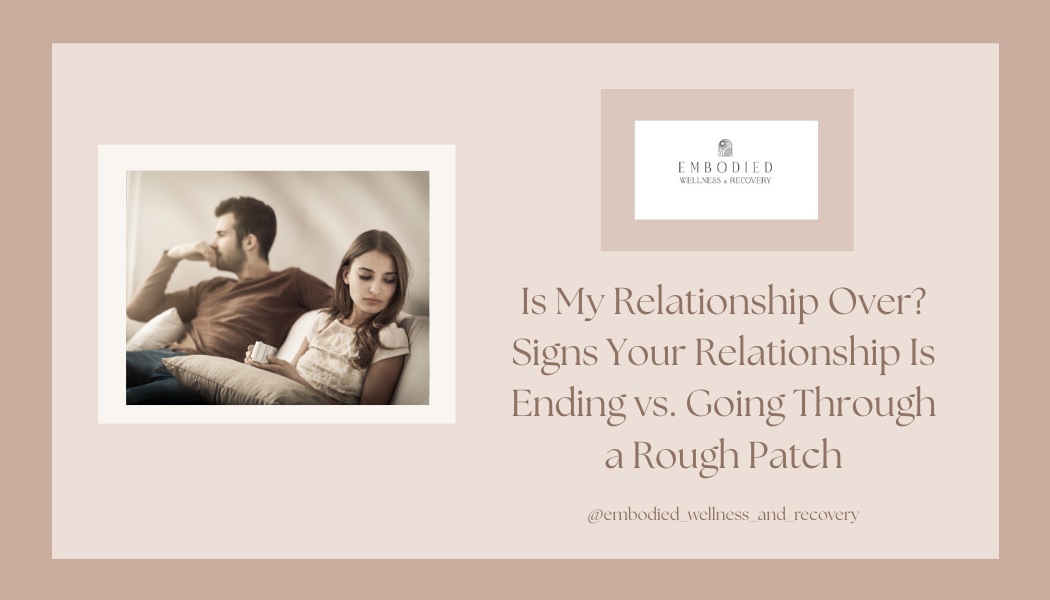
Is My Relationship Over? Signs Your Relationship Is Ending vs. Going Through a Rough Patch
Is My Relationship Over? Signs Your Relationship Is Ending vs. Going Through a Rough Patch
Wondering if your relationship is over or simply going through a rough patch? Learn the signs a relationship may be ending, what relationship problems can be repaired, and how attachment, intimacy, conflict, and the nervous system affect connection.
Maybe nothing catastrophic has happened. There hasn't been an affair. No one has packed a suitcase. You aren't screaming at each other every night, but something feels different.
Conversations have become logistical. Affection feels obligatory or nonexistent. Sex has disappeared or become another source of tension. You sit next to each other on the couch while feeling strangely alone.
And a question you may be afraid to say out loud keeps surfacing:
Is my relationship over, or are we just going through a rough patch?
It is one of the most painful questions someone can ask because uncertainty can be more distressing than a clear answer. You may still love your partner while simultaneously wondering whether love is enough.
Understanding the difference between normal relationship problems and signs that a relationship may be ending requires looking beyond how often you fight. What often matters more is what happens during conflicts.
Is My Relationship Over? Start With a Different Question
When couples struggle, they often ask:
“Are we fighting too much?”
A more revealing question may be:
“Can we still find our way back to each other?”
Conflict itself does not necessarily predict the end of a relationship. Decades of research by psychologist John Gottman and colleagues suggest that the way couples navigate conflict, particularly patterns involving criticism, contempt, defensiveness, and stonewalling, can provide important information about relationship distress and stability (Gottman & Levenson, 2000).
Healthy couples can become angry. They misunderstand each other. They say things poorly. They sometimes withdraw. The difference is often repair.
Can someone eventually say, “That came out wrong”?
Can you become curious about each other's experience?
Can you apologize?
Can you laugh again?
Can you reach for each other after the storm?
A rough patch may hurt deeply while still containing a desire for reconnection.
Signs Your Relationship May Be Going Through a Rough Patch
Stress can temporarily transform even strong relationships. Parenting, grief, career pressure, financial problems, illness, caregiving, infertility, relocation, hormonal changes, unresolved trauma, and chronic exhaustion can leave couples with fewer emotional resources for one another.
Your relationship may be struggling rather than ending if:
— You still care about your partner's emotional experience.
— Conflict hurts because the relationship still matters.
— You miss feeling close.
— Affection and warmth occasionally return.
— Both partners can acknowledge their contribution to problems.
— There is still curiosity about each other.
— You can repair after some arguments.
— Both partners are willing to try something different.
— You can imagine wanting intimacy again, even if you do not currently feel it.
One of the most important signs may be surprisingly simple:
You still want to find each other.
Signs a Relationship May Be Ending
There is no single definitive test for whether a relationship is over. However, certain patterns deserve serious attention, especially when they become chronic. One of the most concerning is contempt.
Contempt communicates superiority and disgust through ridicule, mockery, insults, eye-rolling, or treating a partner as fundamentally beneath consideration. Gottman's longitudinal research has repeatedly linked destructive conflict patterns with marital dissolution (Gottman & Levenson, 2000).
Other concerning signs may include:
— Chronic emotional disengagement
— Indifference rather than anger
— Repeated betrayal without meaningful accountability
— Persistent disrespect or contempt
— Refusal to discuss relationship problems
— Little or no interest in repair
— Feeling relieved whenever your partner is absent
— Fantasizing consistently about a life without the relationship
— Losing curiosity about your partner's internal world
— Feeling emotionally or sexually disconnected for an extended period with no willingness to address it
Perhaps most importantly, ask yourself:
If nothing about this relationship changed for the next five years, would I want to remain in it?
That question can reveal something very different from, “Do I still love this person?”
Why Relationship Problems Can Feel Like a Nervous System Emergency
When attachment is threatened, relationship conflict isn't experienced only intellectually. It can become physiological. Attachment research suggests that close relationships function partly as sources of emotional security and regulation. Perceived rejection, withdrawal, abandonment, or disconnection can activate powerful emotional and behavioral responses (Mikulincer & Shaver, 2016).
Your heart races. Your chest tightens. Your thoughts accelerate. You become desperate to resolve the argument immediately, or perhaps you experience the opposite. You go blank. You shut down. You want to leave the room.
One partner may pursue:
“Talk to me. Tell me what's wrong. Why won't you answer me?”
The other withdraws:
“I can't do this right now. Just leave me alone.”
The more one pursues, the more the other retreats. The more one retreats, the more urgently the other pursues.
Eventually, both partners may conclude:
“We are incompatible.”
But sometimes what appears to be incompatibility is actually a repetitive attachment and nervous system cycle that neither person knows how to interrupt. Research on emotionally focused couple therapy supports the importance of identifying and restructuring these negative interactional cycles while strengthening emotional accessibility and responsiveness between partners (Wiebe & Johnson, 2016).
When “We've Become Roommates” Doesn't Necessarily Mean It's Over
Another common reason people wonder whether their relationship is ending is the loss of intimacy. Maybe you still function beautifully as a team. You manage children, groceries, schedules, bills, vacations, and household responsibilities, but you no longer feel like lovers.
Sex becomes infrequent. Touch decreases. Conversations revolve around logistics. Curiosity disappears. This can feel frightening, but loss of sexual desire does not automatically mean loss of love.
Sexual desire is influenced by stress, relationship quality, resentment, hormonal changes, body image, medication, parenting, sleep, trauma, novelty, emotional connection, and the nervous system. Research on sexual desire increasingly recognizes that desire is contextual rather than simply a spontaneous internal drive (Mark & Lasslo, 2018).
The better question may not be:
“Why don't I want sex anymore?”
It may be:
“What conditions does my body need in order to experience desire?”
The Difference Between Disconnection and Indifference
This distinction can be enormously important.
Disconnection says: “I can't seem to reach you, and that hurts.”
Indifference says: “I no longer care whether I reach you.”
Anger can sometimes exist precisely because attachment remains strong. You may be furious because you desperately want your partner to understand you. Chronic indifference is different. When couples stop protesting, asking, reaching, arguing, touching, or attempting to repair, emotional disengagement may be more advanced.
But even emotional withdrawal deserves curiosity before it becomes a verdict. Sometimes people detach because they have stopped caring. Other times they detach because caring has become too painful. Those are not the same thing.
Before Deciding Whether to Stay or Leave
When someone asks, “Should I end my relationship?”, the temptation is to immediately make a list of reasons to stay rather than leave. Sometimes that is useful. But first, it may help to understand what is actually happening between you.
At Embodied Wellness and Recovery, our approach to couples work considers more than communication techniques. We examine how trauma, attachment wounds, nervous system dysregulation, sexuality, intimacy, betrayal, emotional safety, and previous relationship experiences can become embedded in a couple's current dynamic.
Sometimes couples need help communicating. Sometimes they need help feeling safe enough to communicate. Those are very different interventions.
When both partners are willing, couples therapy can create space to slow down the cycle, understand what each person's nervous system is protecting, rebuild emotional connection, address sexual and relational wounds, and determine whether the relationship can become something both people genuinely want to inhabit. And sometimes therapy helps partners recognize that ending a relationship is the healthier decision. The purpose isn't to preserve every relationship at any cost. It is to help people make decisions from clarity rather than reactivity.
Maybe the Question Isn't “Is My Relationship Over?”
Perhaps the more useful questions are:
Is there still respect between us?
Is there still emotional safety?
Are we both willing to look at ourselves?
Can we repair after we hurt each other?
Is there something underneath our anger that still wants connection?
Are we willing to build a different relationship rather than desperately trying to recreate the one we used to have?
A rough patch and the end of a relationship can sometimes look remarkably similar from the inside. The difference may not be how much pain exists today. It may be whether two people still possess the willingness, safety, accountability, and emotional investment necessary to create something different tomorrow.
Reach out to schedule a complimentary 20-minute consultation with our team of therapists, trauma specialists, somatic practitioners, or relationship experts, and start working towards integrative, embodied healing today.
📞 Call us at (310) 651-8458
📱 Text us at (310) 210-7934
📩 Email us at admin@embodiedwellnessandrecovery.com
🔗 Visit us at www.embodiedwellnessandrecovery.com
👉 Check us out on Instagram @embodied_wellness_and_recovery
🌍 Explore our offerings at Linktr.ee: https://linktr.ee/laurendummit
References
1) Gottman, J. M., & Levenson, R. W. (2000). The timing of divorce: Predicting when a couple will divorce over a 14-year period. Journal of Marriage and Family, 62(3), 737-745.
2) Mark, K. P., & Lasslo, J. A. (2018). Maintaining sexual desire in long-term relationships: A systematic review and conceptual model. The Journal of Sex Research, 55(4-5), 563-581.
3) Mikulincer, M., & Shaver, P. R. (2016). Attachment in adulthood: Structure, dynamics, and change (2nd ed.). Guilford Press.
4) Wiebe, S. A., & Johnson, S. M. (2016). A review of the research in emotionally focused therapy for couples. Family Process, 55(3), 390-407.
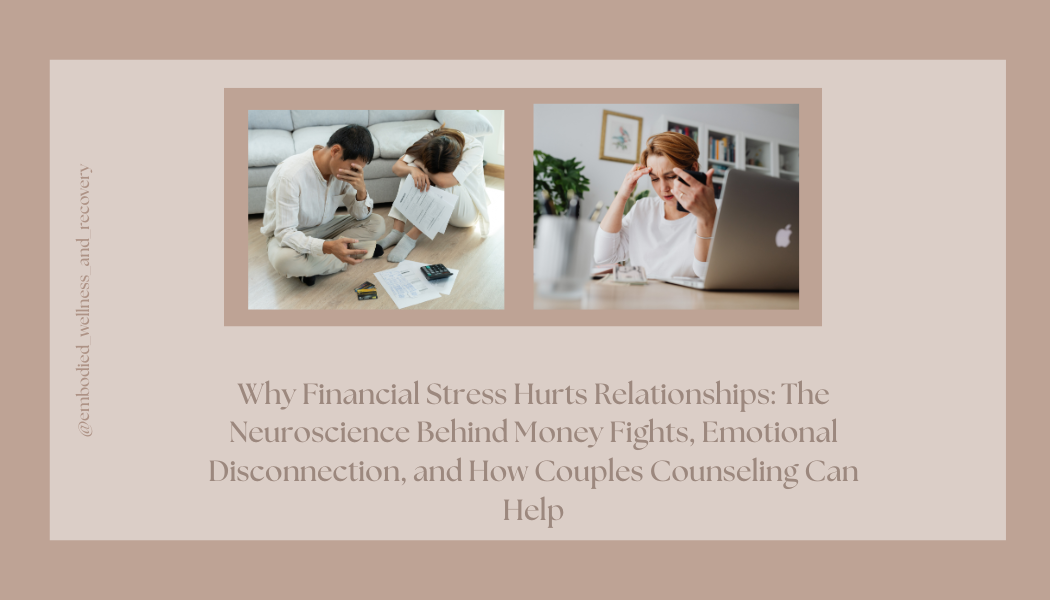
Why Financial Stress Hurts Relationships: The Neuroscience Behind Money Fights, Emotional Disconnection, and How Couples Counseling Can Help
Why Financial Stress Hurts Relationships: The Neuroscience Behind Money Fights, Emotional Disconnection, and How Couples Counseling Can Help
Financial stress can strain even the strongest relationships. Learn how money anxiety affects the brain, communication, intimacy, and emotional safety, and discover how couples counseling can help partners reconnect through neuroscience-informed care.
Money is rarely just about money.
For many couples, financial stress quietly becomes one of the most painful and persistent sources of conflictin their relationship. What may begin as disagreements over budgeting, debt, spending, or saving can gradually evolve into criticism, defensiveness, emotional withdrawal, resentment, and loneliness.
Perhaps you've caught yourself wondering:
Why do we keep having the same argument about money?
Why does every financial conversation end in frustration?
Why do I feel so alone, even though we're facing the same financial challenges?
Why do we seem more like opponents than teammates?
Why has financial stress affected our emotional and physical intimacy?
If these questions feel familiar, you are far from alone. Financial stress is consistently ranked among the leading sources of conflict in long-term relationships. Yet the issue often extends far beyond dollars and cents.
More often, money arguments reflect something much deeper.
Safety.
Security.
Control.
Identity.
Hope for the future.
Understanding what happens inside the brain during periods of financial stress can help couples approach these conversations with greater compassion and insight.
Financial Stress Changes More Than Your Bank Account
When finances become uncertain, many couples notice changes they never expected. They become more irritable. Small disagreements escalate more quickly. Patience becomes harder to access. Communication feels increasingly strained. Affection decreases. Sexual desire often declines. Decision-making becomes exhausting. Partners begin assuming the worst about each other's intentions.
Over time, many couples describe feeling emotionally disconnected despite deeply loving one another. This pattern is not simply about poor communication. It is often the result of chronic stress affecting the brain and nervous system.
Why Money Activates the Brain's Threat Response
From a neuroscience perspective, financial uncertainty represents more than an economic concern. The brain frequently interprets it as a potential survival threat. Throughout human history, access to resources has been closely connected to safety, shelter, food, and protection. Although modern financial concerns may look different, the brain often responds in remarkably similar ways.
When financial uncertainty increases, the amygdala becomes more vigilant. Stress hormones such as cortisol rise. The nervous system shifts toward protection rather than connection. In this state, the brain becomes increasingly focused on detecting problems rather than nurturing relationships. Partners may become more reactive, less patient, and more likely to misinterpret one another's intentions. This is why financial conversations that begin calmly can quickly become emotionally charged.
Why Couples Often Fight About Different Things Than They Think
Many couples believe they are arguing about spending habits.
Or budgeting.
Or credit card debt.
Or retirement planning.
In reality, those conversations often represent deeper emotional concerns.
One partner may be asking:
"Will we be okay?"
Another may be wondering:
"Can I trust you?"
Someone else may be thinking:
"Why don't you understand how scared I am?"
Money often becomes the languagecouples use to express fears they struggle to articulate directly. Without recognizing these underlying emotions, partners often remain stuck arguing about numbers instead of addressing the emotional needs beneath them.
Financial Stress Often Triggers Old Wounds
Our relationship with money rarely begins in adulthood. It often begins in childhood. Some people grew up in homes where money was scarce. Others witnessed frequent conflict about finances. Some experienced financial instability. Others learned that achievement and income determined worth. Still others grew up believing that discussing money was shameful or dangerous.
These early experiences shape the nervous system's expectations around financial security. As adults, current financial stress may reactivate those earlier emotional experiences. Someone raised in poverty may experience intense anxiety over relatively minor financial setbacks. Someone who grew up with financially controlling parents may react strongly when a partner questions spending. Neither response necessarily reflects the present moment alone. Often, it reflects both the present and the past.
Attachment Styles Influence Financial Conflict
Attachment theory also helps explain why couples experience money differently. Individuals with anxious attachment may become increasingly worried about future security. They may seek reassurance through frequent financial discussions. Partners with more avoidant attachment patterns may withdraw from these conversations altogether, particularly if they feel criticized or overwhelmed.
Unfortunately, these responses often reinforce one another. One partner pursues. The other withdraws. The more one partner pushes for answers, the more the other shuts down. Eventually, both individuals feel misunderstood. The conflict appears to be about finances, yet the deeper issue is emotional safety.
Financial Anxiety Can Affect Physical Intimacy
Many couples are surprised to discover that financial stress also affects their sex life. This relationship makes perfect sense from a neuroscience perspective.Sexual desire generally flourishes when the nervous system experiences safety, connection, curiosity, and relaxation. Chronic financial stress often produces the opposite experience. When stress hormones remain elevated, the brain prioritizes protection rather than pleasure.
Partners may notice:
— Decreased sexual desire
— Less affection
— Reduced emotional availability
— Difficulty relaxing
— Increased irritability
— Feeling emotionally distant
The problem is rarely that couples have stopped loving one another. More often, their nervous systems have become overwhelmed by chronic stress.
The Hidden Cost of Financial Stress
Perhaps the greatest cost of financial stress is not the money itself. It is what chronic stress slowly steals from the relationship.
Laughter.
Emotional connection.
Teamwork.
Curiosity.
Playfulness.
Hope.
Many couples begin viewing each other as obstacles rather than allies.
They stop asking:
"How can we solve this together?"
Instead, they begin asking:
"Why are you making this harder?"
That subtle shift can gradually erode emotional safety, making productive conversations feel increasingly difficult. The encouraging news is that this pattern is not permanent. Understanding how the brain and nervous system respond to financial stress creates opportunities for couples to interrupt these cycles and reconnect in healthier, more compassionate ways.
Emotional Safety Matters More Than Financial Perfection
Many couples believe their relationship will improve once they earn more money, eliminate debt, or finally feel financially secure. While improving financial circumstances can certainly reduce stress, research suggests that the quality of a couple's relationship often depends less on the size of their bank account and more on how they navigate stress together.
In other words, emotional safety matters. When partners feel emotionally safe, they are more likely to approach financial conversations with curiosity rather than criticism, collaboration rather than competition, and empathy rather than defensiveness. Emotional safety allows the brain to remain engaged in thoughtful problem solving instead of shifting into survival mode. This is one of the most important goals of couples counseling.
What Happens When Couples Feel Emotionally Safe?
When emotional safety increases, the nervous system begins to settle. The brain becomes less focused on detecting threats and more capable of perspective taking, empathy, and flexible thinking.
Partners are more likely to:
— Listen without immediately preparing a defense.
— Express vulnerability instead of blame.
— Ask questions instead of making assumptions.
— Work together to solve problems.
— Repair misunderstandings more quickly.
— Maintain emotional and physical intimacy despite ongoing stress.
Financial problems may still exist. The relationship begins to feel stronger because the couple experiences themselves as a team.
From "Me Versus You" to "Us Versus the Problem"
One of the most powerful shifts couples make in therapy is changing the question.
Instead of asking:
"Who's responsible for this?"
They begin asking:
"How can we face this together?"
This subtle change transforms the emotional tone of financial conversations. The problem is no longer your partner. The problem becomes the financial challenge itself. This collaborative mindset reduces defensiveness while strengthening trust and partnership.
Understanding Your Money Story
Every individual carries a personal "money story." These stories develop through early family experiences, cultural messages, significant life events, and previous relationships.
For example:
— Was money associated with fear?
— Was financial success tied to self-worth?
— Were emotions discussed openly in your family?
— Did one parent control all financial decisions?
— Was spending viewed as irresponsible?
— Was saving associated with security?
Most couples bring two very different money stories into the same relationship. Neither story is inherently right or wrong. The challenge arises when partners assume their perspective is the only logical one. Couples counseling helps partners explore these narratives with curiosity rather than judgment.
Nervous System Regulation Before Problem Solving
One of the biggest mistakes couples make is attempting to solve financial problems while both nervous systems are highly activated. When heart rate increases and stress hormones rise, the brain becomes less capable of logical reasoning. This is whyconversations often become repetitive. Partners stop listening. They misunderstand each other's intentions. They repeat the same arguments. Effective couples therapy often begins with regulation before resolution.
This may involve:
— Slowing the pace of the conversation.
— Taking intentional breaks when emotions become overwhelming.
— Practicing calming breathing techniques.
— Naming emotions instead of acting them out.
— Returning to the discussion once both partners feel more grounded.
A regulated brain is far more capable of collaborative problem solving.
Communication That Builds Connection
Financial conversations become more productive when partners shift from accusation to vulnerability.
Instead of saying:
"You spend too much money."
A partner might say:
"I'm feeling scared about our financial future, and I'd like us to figure this out together."
Instead of:
"You never think ahead."
They might say:
"Financial uncertainty makes me anxious because stability is very important to me."
This type of communication invites connection rather than defensiveness. It helps partners understand the emotions beneath the behavior.
Financial Stress Does Not Mean Relationship Failure
Many couples interpret ongoing financial conflict as evidence that something is fundamentally wrong with their relationship. In reality, financial stress places enormous pressure on even healthy partnerships. The question is not whether stress will occur. Every relationship encounters seasons of uncertainty.
The more meaningful question is how partners respond when stress arrives. Couples who remain curious, emotionally responsive, and committed to repairing misunderstandings often emerge from difficult seasons feeling even more connected than before.
How Couples Counseling Can Help
Couples therapy provides far more than communication techniques. It offers a space where both partners can better understand themselves and each other.
At Embodied Wellness and Recovery, we help couples recognize that many financial conflicts are rooted in nervous system responses rather than character flaws. Using neuroscience-informed, trauma-informed, and attachment-based approaches, we help couples:
— Understand how chronic stress affects communication.
— Identify emotional triggers beneath money conflicts.
— Improve nervous system regulation.
— Increase emotional safety.
— Strengthen trust and teamwork.
— Reduce criticism, defensiveness, and withdrawal.
— Rebuild emotional and physical intimacy.
— Develop healthier patterns for discussing finances.
— Approach future challenges as partners rather than adversaries.
When couples understand the science behind their reactions, conflict often becomes less personal and easier to understand. That understanding creates space for compassion, collaboration, and meaningful change.
Remaining Emotional Connection
Financial stress can reshape how couples think, communicate, and connect, yet it does not have to define a relationship's future. The strongest relationships are not those that never encounter financial hardship. They are relationships in which partners learn to remain emotionally connected as they navigate life's inevitable uncertainties together.
When couples begin understanding the neuroscience of stress, attachment, and emotional safety, financial conversations become less about winning an argument and more about protecting the relationship. Over time, trust grows. Communication becomes more compassionate. The nervous system learns that difficult conversations do not have to threaten connection.
Money may remain an important topic, but it is no longer the measure of the relationship's strength. Instead, the relationship itself becomes the foundation from which couples face financial challenges with greater resilience, understanding, and hope.
Reach out to schedule a complimentary 20-minute consultation with our team of therapists, trauma specialists, somatic practitioners, or relationship experts and start working towards integrative, embodied healing today.
📞 Call us at (310) 651-8458
📱 Text us at (310) 210-7934
📩 Email us at admin@embodiedwellnessandrecovery.com
🔗 Visit us at www.embodiedwellnessandrecovery.com
👉 Check us out on Instagram @embodied_wellness_and_recovery
🌍 Explore our offerings at Linktr.ee: https://linktr.ee/laurendummit
References
Conger, R. D., Conger, K. J., & Martin, M. J. (2010). Socioeconomic status, family processes, and individual development. Journal of Marriage and Family, 72(3), 685-704.
Falconier, M. K., Jackson, J. B., Hilpert, P., & Bodenmann, G. (2015). Dyadic coping and relationship satisfaction: A meta-analysis. Clinical Psychology Review, 42, 28-46.
Gottman, J. M., & Silver, N. (2015). The seven principles for making marriage work (Revised ed.). Harmony Books.
Gottman, J. S., & Gottman, J. (2024). Fight right: How successful couples turn conflict into connection. Harmony.
Karney, B. R., & Bradbury, T. N. (2020). Research on marital satisfaction and stability in the 2010s: Challenging conventional wisdom. Journal of Marriage and Family, 82(1), 100-116.
Maslach, C., & Leiter, M. P. (2000). The truth about burnout: How organizations cause personal stress and what to do about it. John Wiley & Sons.
Porges, S. W. (2022). Polyvagal theory: A science of safety. Frontiers in Integrative Neuroscience, 16, 871227.
Siegel, D. J. (2020). The developing mind: How relationships and the brain interact to shape who we are (3rd ed.). Guilford Press.
van der Kolk, B. A. (2014). The body keeps the score: Brain, mind, and body in the healing of trauma. Viking.