
Why Taking Accountability Builds Self-Confidence: The Psychology of Self-Trust, Personal Agency, and Mental Health
Why Taking Accountability Builds Self-Confidence: The Psychology of Self-Trust, Personal Agency, and Mental Health
Discover how taking accountability can improve self-confidence, self-trust, relationships, and mental health. Learn the psychology and neuroscience of personal responsibility, shame, self-compassion, and personal agency.
Have you ever made a mistake and found yourself replaying it for hours, days, or even years? Maybe you struggle with low self-confidence and second-guess nearly every decision you make. Perhaps criticism sends you spiraling into shame. Or you find yourself explaining, defending, minimizing, blaming, or avoiding difficult conversations because admitting you were wrong feels almost unbearable.
There is a paradox at the heart of self-confidence that we rarely talk about:
Real confidence does not come from believing you are always right. It develops when you trust yourself enough to recognize when you are wrong, take responsibility, repair what you can, and know that you can survive being imperfect.
This is where accountability becomes surprisingly powerful. Healthy accountability is not self-punishment. It is the ability to look honestly at your behavior, recognize your impact, tolerate the emotions that arise, and decide what you want to do differently.
When practiced with self-compassion, accountability can strengthen self-esteem, self-efficacy, emotional regulation, personal agency, relationships, and mental health.
Why Avoiding Accountability Can Erode Self-Confidence
When we think about low self-esteem, we often imagine someone who constantly criticizes themselves. But low self-confidence can also appear as defensiveness.
It can sound like:
— “That wasn't really my fault.”
— “I only reacted that way because of what they did.”
— “They are being too sensitive.”
— “I didn't mean it that way, so why are they upset?”
— “Everyone makes mistakes. Why are we still talking about this?”
These reactions do not necessarily mean someone lacks empathy or integrity. Sometimes, they are protective responses.
If acknowledging a mistake immediately activates the belief, “I am bad,” the nervous system may perceive accountability as a threat rather than an opportunity for growth. Instead of examining what happened, we protect ourselves from the feelings it evokes.
The problem is that every time we avoid responsibility, we may unintentionally reinforce another message:
I cannot tolerate the truth about myself. Over time, that can undermine self-trust.
Accountability Is Not the Same as Shame
One of the most important distinctions in mental health is the difference between accountability and shame.
Accountability says:
“I did something I regret. What belongs to me, and what can I do about it?”
Shame says:
“I did something wrong; therefore, something is fundamentally wrong with me.”
These internal experiences lead us in very different directions. Research on self-compassion suggests that treating ourselves with compassion after failure does not necessarily make us less accountable. In fact, self-compassion can make it psychologically safer to acknowledge mistakes and take responsibility for them.
Research by Breines and Chen found that inducing self-compassion after a moral transgression increased participants' motivation to make amends and avoid repeating the behavior. In other words, being kinder to ourselves did not eliminate responsibility. It appeared to create conditions in which people could engage with responsibility more constructively.
This matters because shame often makes us want to hide, while healthy guilt can motivate repair. You can regret your behavior without rejecting yourself. You can acknowledge the harm you caused without deciding you are irredeemably harmful, and you can take responsibility without taking responsibility for everything.
How Accountability Builds Self-Trust
Think about someone you deeply trust. You probably do not trust them because they have never made a mistake. You trust them because you have learned something about what happens when they do.
They tell the truth. They listen. They apologize. They make repairs. They change their behavior. They do what they say they will do.
Self-trust develops similarly.
Every time you acknowledge reality rather than avoiding it, you teach yourself:
I can rely on myself to face difficult things.
Every time you make a repair, you reinforce:
I am capable of responding differently.
Every time you follow through on a commitment, you accumulate evidence:
My actions matter.
That evidence becomes the foundation of confidence.
The Psychology of Personal Agency and Self-Efficacy
Psychologist Albert Bandura's influential work on self-efficacy helps explain why accountability can be so psychologically transformative. Self-efficacy refers to our belief that we can take actions capable of influencing outcomes. Bandura argued that perceived self-efficacy plays a central role in human agency, shaping motivation, persistence, behavior, and responses to challenges.
There is an enormous psychological difference between:
“This keeps happening to me.”
and
“There are aspects of this situation I cannot control, but there are things I can influence.”
Accountability moves us toward the second position. This does not mean blaming ourselves for circumstances we did not create. Trauma, betrayal, discrimination, abuse, loss, illness, another person's choices, and countless other experiences can occur outside our control.
Personal agency asks a different question:
Given what is true, where do I have choice now?
That question can be extraordinarily powerful. A large systematic review and meta-analysis examining childhood maltreatment and resilience in adulthood found associations between maltreatment histories and areas including self-esteem, emotion regulation, self-efficacy, and psychological well-being. For people whose early experiences diminished their sense of control or competence, rebuilding agency can therefore become an especially meaningful part of psychological work.
Accountability is not about taking responsibility for what happened to you. It is about discovering where you have influence over what happens next.
The Neuroscience of Accountability: Moving From Threat to Choice
Why can admitting we are wrong feel physically uncomfortable?
Because accountability is not purely cognitive. The brain is constantly evaluating information for potential threats. Criticism, rejection, conflict, or perceived failure can activate defensive responses, particularly when similar experiences were historically associated with humiliation, abandonment, punishment, or emotional danger.
Your heart may race. Your stomach tightens. Your face becomes hot. Your thoughts accelerate. You suddenly feel an urgent need to explain yourself.
From a nervous system perspective, defensiveness can function as protection. When we are highly activated, our capacity for reflective thinking, perspective-taking, and flexible responding can become more difficult to access. We are more likely to react automatically.
This is why nervous system regulation matters in accountability. The goal is not simply to tell yourself, “Stop being defensive.” It is to increase your capacity to remain present with discomfort long enough to ask:
What actually happened here?
What am I feeling?
What part belongs to me?
What does not belong to me?
Is there something I need to repair?
What would I like to do differently next time?
That pause creates space between emotional activation and behavior. And inside that space is agency.
Why Accountability Can Feel Terrifying After Trauma
For someone with a history of trauma, emotional abuse, harsh criticism, or unpredictable caregiving, making a mistake may carry meaning far beyond the mistake itself. Perhaps mistakes once resulted in humiliation. Maybe love was withdrawn when you disappointed someone. Perhaps you learned that admitting fault meant surrendering your safety. Or maybe you became responsible for everyone's emotions and learned to apologize even when you had done nothing wrong.
Both extremes can interfere with healthy accountability. Some people protect themselves by taking responsibility for nothing. Others protect relationships by taking responsibility for everything. Neither creates genuine agency. Trauma-informed accountability asks us to locate our appropriate share of responsibility.
That may mean saying:
“I am responsible for how I spoke to you, but I am not responsible for managing your reaction.”
Or:
“I understand why I developed this coping strategy. And I can also acknowledge that it is hurting my relationship now.”
Compassion and accountability can coexist. In fact, they often need each other.
Accountability Can Transform Relationships and Intimacy
Accountability becomes especially important in romantic relationships, friendships, families, and sexual relationships. Conflict becomes difficult to resolve when both people are focused exclusively on proving who is right. Healthy intimacy requires something different. It requires the ability to become curious about impact as well as intention.
You may not have intended to hurt your partner, but their hurt still matters. You may have reasons for becoming defensive, withdrawing, yelling, lying, people-pleasing, shutting down, or crossing a boundary. Understanding those reasons is important.
But understanding a behavior and excusing it are not the same thing.
Accountability allows us to say:
“I understand why I did this, and I also recognize what it cost us.”
That is emotional maturity. It creates the possibility of repair, trust, vulnerability, and deeper intimacy.
Five Ways to Practice Accountability Without Falling Into Shame
1. Regulate before you evaluate.
If your nervous system is highly activated, give yourself enough time to become grounded before analyzing what happened. Accountability works better from reflection than panic.
2. Separate behavior from identity.
Instead of “I'm terrible,” try identifying the behavior specifically: “I interrupted her repeatedly because I felt defensive.” Specific behaviors can change. Global shame offers nowhere to go.
3. Ask what belongs to you.
Accountability does not require accepting responsibility for another person's behavior, emotions, or choices.
Ask: “What is my 100 percent of this, even if my part is only 10 percent of what happened?”
4. Repair through behavior, not just words.
An apology can be meaningful, but changed behavior builds trust.
If you continually apologize for the same behavior without addressing the underlying pattern, the apology eventually loses its power.
5. Notice what happens to your self-respect.
Pay attention to how you feel as your actions begin to align more closely with your values. Confidence often grows quietly through these moments.
Self-Confidence Is Built Through Evidence
We often think we need to feel confident before we act confidently. Frequently, the process works in reverse. We develop confidence by repeatedly experiencing ourselves doing difficult things.
Setting the boundary.
Telling the truth.
Acknowledging the mistake.
Having the uncomfortable conversation.
Making the repair.
Changing the behavior.
Trying again.
This creates evidence that you can depend on yourself. And perhaps that is one of the most durable forms of self-esteem.
Not:
“I never mess up.”
But:
“When I do, I know how to come back to myself.”
Building Self-Trust at Embodied Wellness and Recovery
At Embodied Wellness and Recovery, we understand that difficulties with accountability, shame, self-confidence, boundaries, and relationships often have deeper roots. Our work integrates neuroscience-informed and somatic approaches to explore how trauma, attachment experiences, nervous system dysregulation, relationships, sexuality, and intimacy shape the ways people protect themselves and relate to others.
Sometimes the work is learning to take more responsibility. Sometimes it is learning to stop taking responsibility for everyone else. And often, it involves developing enough internal safety to distinguish between the two.
Healthy accountability is not about becoming harder on yourself. It is about becoming more honest with yourself while maintaining compassion for the human being doing the learning. That is where accountability becomes something much larger than admitting you were wrong. It becomes a practice of self-trust, personal agency, emotional resilience, and self-respect. And slowly, confidence stops being something you are trying to convince yourself you have. It becomes something you have evidence for.
Reach out to schedule a complimentary 20-minute consultation with our team of therapists, trauma specialists, somatic practitioners, or relationship experts, and start working towards integrative, embodied healing today.
📞 Call us at (310) 651-8458
📱 Text us at (310) 210-7934
📩 Email us at admin@embodiedwellnessandrecovery.com
🔗 Visit us at www.embodiedwellnessandrecovery.com
👉 Check us out on Instagram @embodied_wellness_and_recovery
🌍 Explore our offerings at Linktr.ee: https://linktr.ee/laurendummit
References
1) Bandura, A. (1982). Self-efficacy mechanism in human agency. American Psychologist, 37(2), 122–147.
2) Breines, J. G., & Chen, S. (2012). Self-compassion increases self-improvement motivation. Personality and Social Psychology Bulletin, 38(9), 1133–1143.
3) Leary, M. R., Tate, E. B., Adams, C. E., Allen, A. B., & Hancock, J. (2007). Self-compassion and reactions to unpleasant self-relevant events: The implications of treating oneself kindly. Journal of Personality and Social Psychology, 92(5), 887–904.
4) Neff, K. D., & Germer, C. K. (2013). A pilot study and randomized controlled trial of the Mindful Self-Compassion program. Journal of Clinical Psychology, 69(1), 28–44.
Why We Misunderstand the People We Love: The Neuroscience of Different Communication Styles in Long-Term Relationships
Why We Misunderstand the People We Love: The Neuroscience of Different Communication Styles in Long-Term Relationships
Struggling with different communication styles in your relationship? Discover how neuroscience, attachment, and nervous system regulation influence communication, conflict, emotional intimacy, and lasting relationship satisfaction.
Have you ever walked away from a conversation with your partner thinking:
"That's not what I meant at all."
Or wondered:
"Why does every conversation seem to turn into an argument?"
Perhaps one of you wants to talk immediately while the other needs time to think. One partner values direct honesty, while the other experiences that honesty as criticism. One seeks reassurance through conversation.
The other becomes quiet when emotions intensify. These differences can leave both people feeling hurt, misunderstood, and emotionally alone. Over time, what begins as a difference in communication styles can gradually erode trust, emotional intimacy, and even physical closeness.
The encouraging news is that many relationship struggles are not, in fact, communication problems. They are nervous system and attachment problems expressed through communication. Understanding this distinction can completely change how couples approach conflict, connection, and lasting intimacy.
Do You Feel Like You're Speaking Different Languages?
Consider these questions:
— Do you often leave conversations feeling misunderstood?
— Does your partner think you're criticizing them when you're simply trying to solve a problem?
— Do you avoid difficult conversations because they rarely end well?
— Do small disagreements quickly become emotionally overwhelming?
— Do you feel lonely despite being in a committed relationship?
— Does one of you pursue conversations while the other shuts down?
— Have you started wondering whether you're simply incompatible?
If so, you're not necessarily incompatible. You may simply communicate through different nervous systems.
Communication Is About More Than Words
Many people believe communication is primarily about choosing the right words. In reality, communication is heavily influenced by the brain, nervous system, attachment history, emotional regulation, and previous life experiences.
Research by psychologist John Gottman has consistently demonstrated that relationship success depends less on avoiding conflict and more on how couples repair misunderstandings, regulate emotions, and remain emotionally connected during disagreements (Gottman & Silver, 2015). Healthy communication begins long before anyone speaks. It begins with whether each person's nervous system feels safe enough to listen.
The Neuroscience of Feeling Heard
When we feel emotionally safe, the prefrontal cortex remains engaged.
This area of the brain supports:
— Problem solving
— Empathy
— Perspective taking
— Emotional regulation
— Flexible thinking
When we feel criticized, rejected, or threatened, the brain shifts toward survival. Stress hormones increase. Heart rate rises. The amygdala becomes more active. The ability to listen objectively decreases.
Instead of hearing:
"Can we talk about this?"
The nervous system may hear:
"You're failing."
This explains why couples often argue about completely different conversations. The words may be the same. The nervous system's interpretation is not.
Different Communication Styles Are Often Different Regulation Styles
One of the most common relationship dynamics is the pursuer-withdrawer pattern. One partner feels calmer by talking. Conversation creates connection. Processing emotions aloud reduces anxiety. The other partner becomes overwhelmed during conflict. Silence creates regulation. Time allows emotional intensity to decrease before discussing the issue.
Neither approach is inherently unhealthy. Problems arise when each person assumes their style is the "correct" one.
The pursuer may think:
"If you loved me, you'd talk to me."
The withdrawer may think:
"If you loved me, you'd give me space."
Both partners are often trying to create safety. They're simply using different strategies.
When Communication Styles Trigger Old Wounds
Many communication habits develop long before we meet our partners. Someone raised in a highly critical household may hear constructive feedback as rejection. Someone who experienced emotional neglect may need verbal reassurance to feel connected. Someone who grew up around frequent conflict may instinctively withdraw whenever voices become tense. Someone raised in an unpredictable environment may become highly sensitive to delayed responses or emotional distance.
Attachment theory suggests that early caregiving experiences influence how we seek closeness, respond to conflict, and interpret our partner's behavior. As adults, we often mistake old survival strategies for present relationship realities.
Why Couples Misread Each Other's Intentions
One partner says:
"Can we talk?"
The other hears:
"I'm about to be criticized."
One partner says:
"I need some space."
The other hears:
"I'm being abandoned."
One partner offers solutions. The other wanted empathy. One partner asks questions. The other experiences interrogation. Research in interpersonal neurobiology suggests that our brains constantly interpret not only language but also facial expressions, tone of voice, body posture, and emotional cues (de Gelder et al., 2015). When the nervous system is activated, these signals are more likely to be interpreted negatively. This helps explain why loving couples can repeatedly misunderstand one another despite having good intentions.
Emotional Safety Changes Everything
Emotional safety is one of the strongest predictors of healthy communication. When people believe they can express thoughts, needs, emotions, and disagreements without fear of ridicule, rejection, or punishment, conversations become more collaborative.
They become curious rather than defensive. Open rather than guarded. Compassionate rather than reactive. Emotional safety does not require perfect agreement. It requires trust that the relationship can tolerate disagreement without threatening connection.
Five Ways to Strengthen Communication in Long-Term Relationships
1. Become Curious Before Becoming Correct
Instead of preparing your rebuttal, ask yourself:
"What might my partner be experiencing right now?"
Curiosity reduces defensiveness.
2. Learn Your Partner's Regulation Style
Ask:
— Do they process externally or internally?
— Do they need reassurance or reflection?
— Do they need immediate discussion or time to organize their thoughts?
Understanding differences in regulation often reduces unnecessary conflict.
3. Slow the Conversation Down
When emotions rise, the brain's ability to process information declines. Taking a brief pause can help both nervous systems return to regulation before continuing the discussion.
4. Respond to the Emotion Before the Content
Often, your partner is not asking you to solve the problem immediately. They are asking whether you understand how they feel. Feeling understood frequently decreases emotional intensity.
5. Repair More Than You Defend
According to Gottman's research, successful couples repair misunderstandings quickly (Gottman & Gottman, 2024).
Simple statements such as:
"I can see why that hurt."
"That wasn't my intention."
"Help me understand."
often strengthen connection more effectively than proving who was right.
Communication and Intimacy Are Closely Connected
Emotional intimacy and physical intimacy are deeply intertwined. When communication becomes characterized by criticism, defensiveness, emotional withdrawal, or unresolved conflict, many couples experience declining sexual desire, reduced affection, and increasing emotional distance.
Conversely, when partners consistently feel emotionally safe, respected, and understood, intimacy often becomes more natural and mutually fulfilling. The quality of communication influences far more than conflict resolution. It shapes the emotional climate of the entire relationship.
How Trauma-Informed Therapy Can Help
At Embodied Wellness and Recovery, we understand that communication challenges rarely exist in isolation. They are often connected to attachment wounds, trauma, nervous system dysregulation, perfectionism, emotional neglect, anxiety, sexuality, and relational patterns developed over decades.
Our trauma-informed, neuroscience-based approach helps individuals and couples move beyond simply learning communication techniques. Together, we explore the deeper emotional and physiological processes influencing how partners connect, protect themselves, repair conflict, and cultivate lasting intimacy. As nervous systems become more regulated, communication often becomes less reactive, more flexible, and significantly more compassionate.
Learning the Language of Your Partner’s Nervous System
Healthy relationships are not built because two people communicate in exactly the same way. They are built because two people become increasingly skilled at understanding the meaning beneath each other's communication. When couples learn to recognize that many disagreements are actually nervous system responses rather than character flaws, conflict begins to feel less like a threat and more like an opportunity for deeper understanding.
Sometimes the most important shift is not changing what you say. It is learning to understand what your partner's nervous system is trying to communicate before the words ever arrive.
Reach out to schedule a complimentary 20-minute consultation with our team of therapists, trauma specialists, somatic practitioners, or relationship experts and start working towards integrative, embodied healing today.
📞 Call us at (310) 651-8458
📱 Text us at (310) 210-7934
📩 Email us at admin@embodiedwellnessandrecovery.com
🔗 Visit us at www.embodiedwellnessandrecovery.com
👉 Check us out on Instagram @embodied_wellness_and_recovery
🌍 Explore our offerings at Linktr.ee: https://linktr.ee/laurendummit
References
Coan, J. A., Schaefer, H. S., & Davidson, R. J. (2006). Lending a hand: Social regulation of the neural response to threat. Psychological Science, 17(12), 1032-1039.
De Gelder, B., de Borst, A. W., & Watson, R. (2015). The perception of emotion in body expressions. Wiley Interdisciplinary Reviews: Cognitive Science, 6(2), 149-158.
Gottman, J. S., & Gottman, J. (2024). Fight right: How successful couples turn conflict into connection. Harmony.
Gottman, J. M., & Silver, N. (2015). The seven principles for making marriage work (Revised ed.). Harmony Books.
Johnson, S. M. (2019). Attachment theory in practice: Emotionally focused therapy (EFT) with individuals, couples, and families. Guilford Press.
Porges, S. W. (2011). The polyvagal theory: Neurophysiological foundations of emotions, attachment, communication, and self-regulation. W. W. Norton & Company.
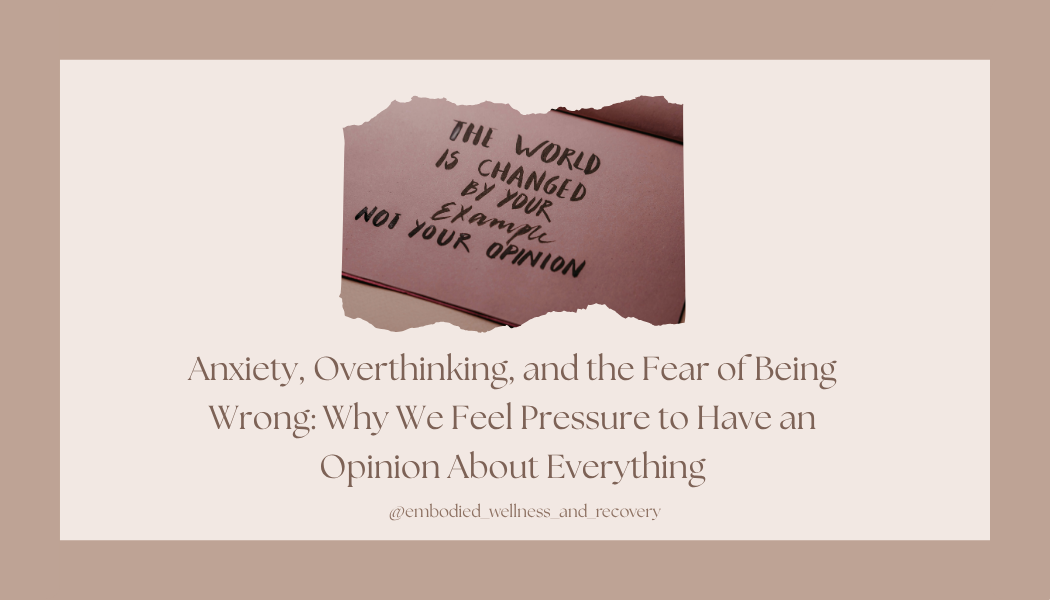
Anxiety, Overthinking, and the Fear of Being Wrong: Why We Feel Pressure to Have an Opinion About Everything
Anxiety, Overthinking, and the Fear of Being Wrong: Why We Feel Pressure to Have an Opinion About Everything
Feeling anxious about having the "right" opinion? Discover the neuroscience behind opinion anxiety, overthinking, information overload, fear of judgment, and social pressure in the digital age. Learn how uncertainty, trauma, and nervous system activation influence mental health and decision-making.
The Mental Health Cost of Living in an Age of Constant Commentary
What if one of the most exhausting parts of modern life is not what we think, but the pressure to always know what we think?
Every day, we are exposed to a relentless stream of news, social media posts, political debates, cultural controversies, expert opinions, and viral conversations. Within moments of a major event, people are often expected to formulate a position, articulate it publicly, defend it confidently, and remain consistent over time.
But what happens when you are not sure what you think?
What happens when you need more information?
What happens when your opinion evolves?
For many people, these situations trigger significant anxiety. They worry that remaining silent, changing their minds, asking questions, or expressing uncertainty will cause others to view them as uninformed, unintelligent, insensitive, or socially unacceptable. As a result, they may become trapped in cycles of overthinking, information overload, self-doubt, fear of criticism, and mental exhaustion.
In an age increasingly defined by hot takes, certainty has become a form of social currency. Yet neuroscience, psychology, and trauma research suggest that psychological health may require something very different: the ability to tolerate uncertainty.
Do You Feel Pressure to Always Have the "Right" Opinion?
Consider the following questions:
— Do you feel anxious when someone asks your opinion on a topic you have not fully researched?
— Do you spend excessive time reading articles, comments, or opposing viewpoints because you are afraid of being wrong?
— Do you worry that people will judge you if your views differ from theirs?
— Have you ever felt guilty for not having a strong opinion about a social, political, or cultural issue?
— Do you find yourself mentally rehearsing conversations before expressing your perspective?
— Do you frequently second-guess opinions you have already shared?
— Does social media leave you feeling mentally drained, overwhelmed, or emotionally exhausted?
If so, you may be experiencing what could be described as opinion anxiety, a growing psychological phenomenon fueled by information overload, social pressure, fear of judgment, and the human need for belonging.
Why the Brain Dislikes Uncertainty
From a neuroscience perspective, uncertainty is often experienced as a threat. The brain evolved to predict outcomes because predictability increases survival. When information is incomplete or outcomes are unclear, the nervous system may become more vigilant.
Research by Hirsh, Mar, and Peterson (2012) suggests that uncertainty can activate neural systems associated with anxiety because the brain perceives ambiguity as a potential risk. In other words, uncertainty can feel uncomfortable not because something is wrong, but because the brain naturally seeks resolution.
This tendency becomes amplified in today's information environment. When we encounter complex issues, conflicting viewpoints, or rapidly changing information, our brains often respond by seeking certainty, even when it may not be available.
Social Media and the Demand for Instant Expertise
Historically, people were not expected to have immediate opinions about every major event occurring around the world. Today, social media platforms reward rapid responses. The first opinion often receives more attention than the most thoughtful one. Algorithms frequently prioritize engagement over nuance. Outrage, certainty, and confidence tend to generate more interaction than curiosity or complexity.
As a result, many people internalize the belief that they should:
— Stay informed about everything
— Form opinions quickly
— Express those opinions publicly
— Defend those opinions consistently
This can create tremendous psychological pressure. Research on information overload suggests that excessive exposure to information can impair decision-making, increase stress, and contribute to cognitive fatigue (Bawden & Robinson, 2020). The human brain was not designed to process an endless stream of competing viewpoints every waking hour.
The Fear of Being Wrong Is Often the Fear of Rejection
Many people assume their anxiety revolves around being incorrect. In reality, the deeper fear is often social.
The nervous system may ask:
— What if people think I'm ignorant?
— What if I offend someone?
— What if I lose respect?
— What if I disappoint people?
— What if I am criticized?
— What if I no longer belong?
Humans are profoundly social beings. Research in social neuroscience has consistently shown that social rejection activates many of the same neural pathways involved in physical pain.
For the brain, belonging matters. This helps explain why disagreement can feel surprisingly distressing, even when the topic itself is relatively minor. Often, the anxiety is not about the opinion. It is about connection.
Trauma, Perfectionism, and Opinion Anxiety
For individuals with histories of trauma, criticism, emotional invalidation, or perfectionism, the pressure to have the "right" answer may become especially intense. Many people learned early in life that mistakes carried consequences. Perhaps they were criticized for being wrong. Perhaps disagreement led to conflict. Perhaps uncertainty was interpreted as weakness.
Over time, the nervous system may begin associating:
— Mistakes with shame
— Disagreement with rejection
— Uncertainty with danger
— Questions with vulnerability
When this occurs, expressing opinions can feel less like a conversation and more like a performance evaluation. The result is often chronic self-monitoring, overthinking, and emotional exhaustion.
The Hidden Relationship Between Anxiety and Overthinking
Many people respond to uncertainty by gathering more information. At first, this strategy feels productive. Eventually, however, it can become overwhelming. The individual continues to read articles, watch videos, compare perspectives, and search for the perfect answer.
Yet certainty never fully arrives. This pattern reflects a common feature of anxiety. Anxious minds often seek absolute certainty before taking action. The challenge is that certainty is rarely attainable. Psychological flexibility involves learning to make thoughtful decisions despite uncertainty, rather than waiting for it to disappear entirely.
Why Changing Your Mind Is a Sign of Psychological Health
One of the most harmful cultural messages of the modern era is the idea that changing your mind indicates weakness. In reality, changing your mind often reflects growth. New experiences create new information. New information creates opportunities for revised understanding.
Science itself depends upon this principle. Researchers continually update theories based on emerging evidence. Healthy psychological functioning operates similarly. People who can revise beliefs when presented with new information tend to demonstrate greater cognitive flexibility, emotional resilience, and openness. The goal is not rigid certainty. The goal is thoughtful adaptability.
The Neuroscience of Mental Clarity
When the nervous system becomes overwhelmed, the brain's capacity for nuanced thinking decreases. Under stress, the brain shifts resources toward threat detection and survival. This makes it more difficult to tolerate ambiguity, consider multiple perspectives, and engage in reflective decision-making.
By contrast, a regulated nervous system supports:
Critical thinking
— Emotional regulation
— Perspective-taking
— Curiosity
— Thoughtful decision-making
This is one reason why nervous system regulation is such an important component of mental health. A calmer nervous system creates more space for complexity.
What If You Don't Need an Opinion Right Now?
Consider how often you give yourself permission to say:
— "I need more information."
— "I'm still thinking about that."
— "I don't know enough to have an informed opinion."
— "My perspective is evolving."
— "I'm open to learning."
These responses are not signs of ignorance. They are signs of intellectual humility. Research suggests that intellectual humility is associated with greater openness, improved learning, and healthier interpersonal relationships. Perhaps one of the most radical acts in today's culture is allowing yourself not to know.
Building a Healthier Relationship With Uncertainty
At Embodied Wellness and Recovery, we frequently work with individuals who struggle with anxiety, trauma, perfectionism, people-pleasing, relationship concerns, and chronic nervous system activation. Many discover that the pressure to always be informed, always be correct, and always have an opinion is connected to deeper concerns about safety, belonging, self-worth, and acceptance.
Through trauma-informed therapy, nervous system regulation, attachment-focused work, and neuroscience-informed interventions, individuals can develop greater comfort with uncertainty and greater trust in their own internal experience. The goal is not to become indifferent. The goal is to become grounded enough to engage thoughtfully without becoming overwhelmed.
A Work in Progress
The healthiest minds are not necessarily the ones that possess the strongest opinions. They are often the ones capable of curiosity, reflection, flexibility, and growth. In a world that increasingly rewards certainty, there is tremendous value in remembering that wisdom often begins with the willingness to say:
"I'm still learning."
And sometimes, that may be the most psychologically healthy response of all.
Reach out to schedule a complimentary 20-minute consultation with our team of therapists, trauma specialists, somatic practitioners, or relationship experts and start working towards integrative, embodied healing today.
📞 Call us at (310) 651-8458
📱 Text us at (310) 210-7934
📩 Email us at admin@embodiedwellnessandrecovery.com
🔗 Visit us at www.embodiedwellnessandrecovery.com
👉 Check us out on Instagram @embodied_wellness_and_recovery
🌍 Explore our offerings at Linktr.ee: https://linktr.ee/laurendummit
References
Bawden, D., & Robinson, L. (2020). Information overload: An overview. In D. Bawden & L. Robinson (Eds.), The Oxford Handbook of Information and Communication Technologies (pp. 1-20). Oxford University Press.
Hirsh, J. B., Mar, R. A., & Peterson, J. B. (2012). Psychological entropy: A framework for understanding uncertainty-related anxiety. Psychological Review, 119(2), 304-320.
Leary, M. R., Diebels, K. J., Davisson, E. K., Jongman-Sereno, K. P., Isherwood, J. C., Raimi, K. T., Deffler, S. A., & Hoyle, R. H. (2017). Cognitive and interpersonal features of intellectual humility. Personality and Social Psychology Bulletin, 43(6), 793-813.
Porges, S. W. (2011). The polyvagal theory: Neurophysiological foundations of emotions, attachment, communication, and self-regulation. W. W. Norton & Company.
Why Can't I Let It Go? The Neuroscience of Resentment and How to Effectively Work Through It
Why Can't I Let It Go? The Neuroscience of Resentment and How to Effectively Work Through It
Struggling to let go of resentment? Learn the neuroscience behind resentment, why grudges linger, and evidence-based strategies to process anger, heal emotional wounds, regulate your nervous system, and improve your relationships.
Do you find yourself replaying the same conversation over and over?
Do you imagine what you should have said?
Do you feel consumed by anger toward a former partner, family member, friend, colleague, or even yourself?
Have you ever noticed that a resentment can occupy your thoughts for days, months, or even years?
Resentment is one of the most common and emotionally exhausting experiences people bring into therapy. While resentment often begins as a natural response to hurt, betrayal, injustice, or disappointment, it can gradually become a source of chronic emotional distress that affects mental health, physical health, relationships, intimacy, and overall well-being.
The good news is that resentment is not simply a character flaw or a sign of unwillingness to move forward. Research suggests that resentment is often deeply connected to unresolved emotional pain, nervous system activation, attachment wounds, and the brain's attempts to protect us from future harm (Bhardwaj, Ali, & Paul, 2026). Understanding how resentment works can help you move from emotional captivity toward greater freedom, clarity, and peace.
What Is Resentment?
Resentment is a persistent emotional response to a perceived wrong, injustice, betrayal, disappointment, or unmet expectation. Unlike momentary anger, resentment tends to linger. It often involves repeatedly revisiting painful memories, mentally rehearsing grievances, and remaining emotionally attached to the injury long after the original event occurred.
People struggling with resentment often ask:
— Why can't I stop thinking about what happened?
— Why do I feel angry years later?
— Why do I keep replaying the conversation?
— Why does this still affect me?
— How do I forgive someone who hurt me?
— How do I let go of a grudge?
These questions reflect an important reality: resentment is rarely just about the event itself.
The Neuroscience of Resentment
From a neuroscience perspective, resentment involves several interconnected brain systems.
The Amygdala: Detecting Threat
The amygdala functions as the brain's alarm system. When someone hurts, rejects, betrays, humiliates, or disappoints us, the amygdala interprets the experience as a threat. Research shows that emotionally painful experiences activate many of the same neural pathways involved in physical pain (Eisenberger et al., 2003). In other words, emotional injuries can literally hurt.
The Hippocampus: Storing Emotional Memories
The hippocampus helps organize and store memories. When an event carries strong emotional significance, the brain often prioritizes remembering it in order to prevent similar harm in the future. This explains why certain painful experiences remain vivid long after they occur.
The Default Mode Network: The Rumination Loop
The brain's Default Mode Network becomes active when we are internally focused. While this system supports reflection and self-awareness, it can also contribute to rumination.
When resentment takes hold, the mind repeatedly returns to the same story:
— What happened
— Why it happened
— Who was wrong
— What should have been different
Over time, this repetitive cycle reinforces emotional distress and strengthens neural pathways associated with anger and hurt.
Why Resentments Are Often About More Than the Present
One of the most important discoveries many clients make is that current resentments often connect to older wounds. Perhaps your partner's criticism triggers childhood experiences of inadequacy. Perhaps a friend's rejection touches an earlier fear of abandonment. Perhaps a betrayal reawakens unresolved attachment injuries.
Research in attachment theory demonstrates that current relationship conflicts often trigger deeply rooted emotional experiences formed during earlier developmental periods (Mikulincer & Shaver, 2016). When this occurs, the intensity of a resentment may be amplified by both past and present pain.
The Hidden Cost of Holding Onto Resentment
Many people assume resentment protects them.
They believe:
"If I stay angry, I won't get hurt again."
"If I keep remembering, I won't forget what happened."
"If I let go, it means what they did was okay."
Yet research consistently shows that chronic resentment is associated with:
— Increased anxiety
— Depression
— Elevated stress hormones
— Poor sleep quality
— Increased cardiovascular risk
— Relationship dissatisfaction
— Reduced emotional well-being
Holding onto resentment often hurts the person carrying it more than the person who caused the injury.
Why "Just Forgive" Doesn't Work
Well-meaning advice often encourages people to simply forgive and move on. Unfortunately, this approach can be ineffective and sometimes harmful. Forgiveness cannot be forced.
Before genuine forgiveness becomes possible, many people need opportunities to:
— Acknowledge the hurt
— Validate their emotional experience
— Process anger safely
— Establish boundaries
— Understand the impact of the injury
— Rebuild a sense of safety
Without these steps, attempts at forgiveness may become forms of emotional avoidance rather than authentic healing.
How to Effectively Work Through Resentments
1. Identify the Underlying Emotion
Resentment is often a secondary emotion.
Beneath resentment may be:
— Grief
— Shame
— Fear
— Sadness
— Rejection
— Loneliness
— Powerlessness
Ask yourself, “What am I actually feeling underneath my anger?” When people access the primary emotions beneath resentment, meaningful healing often begins.
2. Explore the Story You Are Telling Yourself
Our suffering is often influenced not only by what happened, but also by the meaning we assign to it.
Consider:
— What story am I telling myself?
— What assumptions am I making?
— Are there alternative explanations?
— Am I viewing the situation through the lens of past experiences?
This does not excuse harmful behavior. It simply allows greater flexibility and perspective.
3. Work With the Nervous System
Resentment is not just a cognitive process. It is a physiological experience. When resentment is activated, the body may remain stuck in states of fight, flight, freeze, or collapse.
Effective healing often requires nervous system regulation strategies such as:
— EMDR
As the nervous system becomes more regulated, emotional flexibility often increases.
4. Establish Healthy Boundaries
Sometimes resentment persists because boundaries remain unclear.
Ask yourself:
— What boundary was violated?
— What boundary needs strengthening?
— What would self-respect look like here?
Boundaries help transform resentment into action. Rather than remaining stuck in anger, individuals can begin protecting themselves more effectively moving forward.
5. Practice Self-Compassion
Many people carry significant resentment toward themselves. They regret decisions, relationships, behaviors, or missed opportunities. Research by Neff (2023) suggests that self-compassion is associated with lower anxiety, depression, and emotional distress.
Instead of asking:
"Why did I do that?"
Try asking:
"What was I struggling with at that time?"
Compassion creates space for accountability without self-condemnation.
6. Consider What Letting Go Actually Means
Letting go does not mean:
— Forgetting
— Approving
— Reconciling
— Excusing abuse
— Abandoning boundaries
Letting go means releasing the ongoing emotional burden that keeps you tethered to the injury. It is about reclaiming your emotional energy rather than continuing to invest it in the wound.
When Professional Support Can Help
Some resentments are rooted in complex trauma, attachment injuries, betrayal trauma, infidelity, family dysfunction, abuse, or chronic relational pain. In these situations, deeper therapeutic work is often necessary.
At Embodied Wellness and Recovery, we help individuals and couples understand the intersection of trauma, neuroscience, attachment, nervous system regulation, sexuality, intimacy, and emotional healing.
Using evidence-based and experiential approaches including EMDR, Somatic Experiencing, NeuroAffective Touch®, attachment-focused therapy, and trauma-informed relationship work, we help clients address the deeper roots of persistent emotional suffering rather than simply managing symptoms.
Moving Forward
Resentment often begins as an understandable response to pain. But when it becomes a permanent residence rather than a temporary visitor, it can consume emotional energy, strain relationships, and limit personal growth.
The goal is not to deny what happened. The goal is to understand it, process it, learn from it, and ultimately loosen its grip on your life. Every resentment contains valuable information. The question is whether that information becomes a catalyst for growth or a story that keeps repeating itself. With awareness, support, nervous system regulation, and compassionate self-exploration, it becomes possible to transform resentment into insight, resilience, and deeper emotional freedom.
Reach out to schedule a complimentary 20-minute consultation with our team of therapists, trauma specialists, somatic practitioners, or relationship experts, and start working towards integrative, embodied healing today.
📞 Call us at (310) 651-8458
📱 Text us at (310) 210-7934
📩 Email us at admin@embodiedwellnessandrecovery.com
🔗 Visit us at www.embodiedwellnessandrecovery.com
👉 Check us out on Instagram @embodied_wellness_and_recovery
🌍 Explore our offerings at Linktr.ee: https://linktr.ee/laurendummit
References
Bhardwaj, S., Ali, A., & Paul, F. A. (2026). From use to abuse: psychological, neurobiological, and spiritual pathways in relational harm and recovery. Frontiers in Behavioral Neuroscience, 20, 1805594.
Eisenberger, N. I., Lieberman, M. D., & Williams, K. D. (2003). Does rejection hurt? An fMRI study of social exclusion. Science, 302(5643), 290-292.
Mikulincer, M., & Shaver, P. R. (2016). Attachment in adulthood: Structure, dynamics, and change (2nd ed.). Guilford Press.
Neff, K. D. (2023). Self-compassion: The proven power of being kind to yourself (Updated ed.). William Morrow.
Worthington, E. L., Jr., & Scherer, M. (2004). Forgiveness is an emotion-focused coping strategy that can reduce health risks and promote health resilience. Psychology & Health, 19(3), 385-405. https://doi.org/10.1080/0887044042000196674
Van der Kolk, B. A. (2014). The body keeps the score: Brain, mind, and body in the healing of trauma. Viking.
Why Anxiety Makes It Hard to Trust Your Own Decisions: The Neuroscience of Overthinking, Self-Doubt, and Decision Paralysis
Why Anxiety Makes It Hard to Trust Your Own Decisions: The Neuroscience of Overthinking, Self-Doubt, and Decision Paralysis
Why does anxiety make it so hard to trust your own decisions? Discover the neuroscience behind indecision, overthinking, self-doubt, and anxiety. Learn how trauma, nervous system dysregulation, and chronic uncertainty affect decision-making and what helps restore confidence in yourself.
Have you ever spent hours agonizing over a decision that seemed simple to everyone else?
Should I stay in this relationship or leave?
Should I accept the job offer?
Should I speak up about what I need?
Should I move, invest, commit, confront, or wait?
Perhaps you make a decision only to spend the next several days replaying it in your mind, questioning whether you made the wrong choice. If this sounds familiar, you may not have a decision-making problem. You may just have anxiety.
Many people assume that anxiety primarily affects emotions. In reality, anxiety profoundly influences how the brain processes uncertainty, risk, prediction, and choice. When anxiety becomes chronic, trusting your own judgment can feel nearly impossible. Understanding why this happens can help you develop a more compassionate relationship with yourself and begin rebuilding confidence in your decision-making abilities.
The Hidden Relationship Between Anxiety and Indecision
One of the most common symptoms of anxiety is persistent uncertainty. The anxious brain constantly scans for potential threats, mistakes, and future problems. While this system evolved to protect us from danger, it can become overactive in modern life.
Instead of helping us make wise decisions, anxiety often traps us in cycles of:
— Overthinking
— Analysis paralysis
— Reassurance seeking
— Fear of making mistakes
— Difficulty committing to choices
Research suggests that individuals with anxiety tend to perceive uncertainty as particularly distressing and threatening, causing them to spend excessive cognitive resources attempting to predict and control future outcomes (Grupe & Nitschke, 2013). The result? The more important a decision feels, the harder it may become to make.
Why the Anxious Brain Craves Certainty
From a neuroscience perspective, anxiety is closely linked to the brain's threat detection system.
Several key regions are involved:
The Amygdala
The amygdala acts as an alarm system, constantly scanning for potential danger. When anxiety is elevated, the amygdala becomes more reactive, causing neutral situations to feel threatening.
The Prefrontal Cortex
The prefrontal cortex is responsible for planning, reasoning, judgment, and decision-making. Under stress, communication between the prefrontal cortex and emotional centers can become disrupted. As anxiety rises, clear thinking often becomes more difficult.
The Anterior Cingulate Cortex
This region helps monitor conflict and detect potential errors. Research suggests that anxious individuals may show heightened error monitoring, meaning the brain becomes exceptionally focused on avoiding mistakes (Shackman et al., 2011). In practical terms, this means every decision can feel loaded with risk.
When Trauma Teaches You Not to Trust Yourself
For many people, anxiety about decision-making extends beyond genetics or temperament. It is rooted in life experiences.
If you grew up in an environment where:
— Your feelings were dismissed
— Your perceptions were questioned
— You were criticized for mistakes
— You experienced emotional abuse
— Your needs were consistently ignored
— Caregivers were unpredictable
You may have learned to distrust your own internal experience.
Over time, this creates a painful internal narrative:
"What if I'm wrong?"
"What if I can't trust my judgment?"
"What if I miss something important?"
The nervous system becomes conditioned to associate decision-making with danger rather than confidence. Many trauma survivors are not simply afraid of making the wrong choice. They are afraid of the emotional consequences that historically followed mistakes.
The Paradox of Overthinking
Many anxious individuals believe that more thinking will eventually create certainty. Unfortunately, the opposite often occurs.
The brain begins generating endless possibilities:
What if this happens?
What if that happens?
What if I regret it?
What if there's a better option?
What if I'm overlooking something?
The search for certainty becomes a moving target. Research onanxiety consistently demonstrates that attempts to eliminate uncertainty often increase anxiety rather than reduce it (Dugas et al., 1998). The anxious mind seeks a level of certainty that simply does not exist in most real-life decisions.
Why Reassurance Never Fully Works
Do you frequently ask friends, family members, partners, or therapists what they think you should do? While seeking support is healthy, chronic reassurance seeking can become another manifestation of anxiety.
Why? Because reassurance temporarily lowers distress without addressing the underlying fear. Soon after receiving reassurance, uncertainty returns.
The brain begins asking:
"But what if they're wrong?"
"What if they don't understand the whole situation?"
"What if circumstances change?"
The cycle continues. True confidence is not built through certainty. It is built through learning to tolerate uncertainty.
The Nervous System's Role in Decision-Making
Decision-making is not solely a cognitive process. It is also a physiological process. When the nervous system is chronically activated, the body remains in a state of protection.
Signs of nervous system dysregulation may include:
— Muscle tension
— Difficulty sleeping
— Emotional overwhelm
In this state, the brain prioritizes survival over clarity.
The question becomes:
"How do I stay safe?"
rather than
"What feels aligned with my values?"
This is one reason why individuals often find it easier to make decisions after engaging in activities that calm the nervous system.
The Neuroscience of Learning to Trust Yourself
The encouraging news is that self-trust is not a personality trait. It is a skill. Like any skill, it can be strengthened. Neuroplasticity research demonstrates that the brain continually adapts in response to experience.
Each time you:
— Make a decision
— Tolerate uncertainty
— Survive discomfort
— Learn from outcomes
— Practice self-compassion
You provide your brain with evidence that you can navigate life's challenges. Confidence is not created by always making the perfect choice. Confidence develops through repeated experiences of handling whatever comes next.
Practical Strategies for Decision Anxiety
1. Regulate Before You Evaluate
When your nervous system is activated, decision-making becomes more difficult.
Before making an important choice, consider:
— Walking
— Yoga
A regulated nervous system often sees options more clearly.
2. Ask Different Questions
Instead of asking:
"What is the perfect decision?"
Try asking:
"Which choice feels most aligned with my values right now?"
No decision can eliminate all uncertainty.
3. Limit Excessive Research
Many anxious individuals spend enormous amounts of time gathering information. At some point, additional information stops improving decision quality and starts fueling anxiety.
4. Practice Small Acts of Trust
Self-trust grows incrementally.
Start with smaller decisions:
— Choosing a restaurant
— Setting a boundary
— Expressing a preference
These seemingly minor moments teach the brain that your perspective matters.
5. Address the Underlying Trauma
If chronic self-doubt stems from attachment wounds, developmental trauma, betrayal, or emotionally invalidating relationships, deeper therapeutic work may be necessary. Often, the issue is not the decision itself. The issue is the nervous system's learned expectation that making decisions is unsafe.
How Embodied Wellness and Recovery Helps
At Embodied Wellness and Recovery, we understand that chronic indecision is often about much more than uncertainty.
It may reflect:
— Attachment injuries
— Nervous system dysregulation
— Shame
— Loss of self-trust
Our approach integrates neuroscience, trauma-informed care, somatic therapy, EMDR, attachment-focused treatment, and nervous system regulation to help clients reconnect with their internal wisdom. Rather than teaching people how to make perfect decisions, we help them cultivate something far more valuable: The ability to trust themselves even when certainty is unavailable.
Confidence is not the absence of uncertainty. Confidence is the belief that you can navigate uncertainty with resilience, self-awareness, and self-compassion. When that shift occurs, decision-making becomes less about finding guarantees and more about honoring your values, your needs, and your authentic experience. And that is often where genuine self-trust begins.
Reach out to schedule a complimentary 20-minute consultation with our team of therapists, trauma specialists, somatic practitioners, or relationship experts, and start working towards integrative, embodied healing today.
📞 Call us at (310) 651-8458
📱 Text us at (310) 210-7934
📩 Email us at admin@embodiedwellnessandrecovery.com
🔗 Visit us at www.embodiedwellnessandrecovery.com
👉 Check us out on Instagram @embodied_wellness_and_recovery
🌍 Explore our offerings at Linktr.ee: https://linktr.ee/laurendummit
References
Dugas, M. J., Gagnon, F., Ladouceur, R., & Freeston, M. H. (1998). Generalized anxiety disorder: A preliminary test of a conceptual model. Behaviour Research and Therapy, 36(2), 215-226.
Grupe, D. W., & Nitschke, J. B. (2013). Uncertainty and anticipation in anxiety: An integrated neurobiological and psychological perspective. Nature Reviews Neuroscience, 14(7), 488-501.
Shackman, A. J., Salomons, T. V., Slagter, H. A., Fox, A. S., Winter, J. J., & Davidson, R. J. (2011). The integration of negative affect, pain, and cognitive control in the cingulate cortex. Nature Reviews Neuroscience, 12(3), 154-167.
Siegel, D. J. (2020). The developing mind: How relationships and the brain interact to shape who we are (3rd ed.). Guilford Press.