
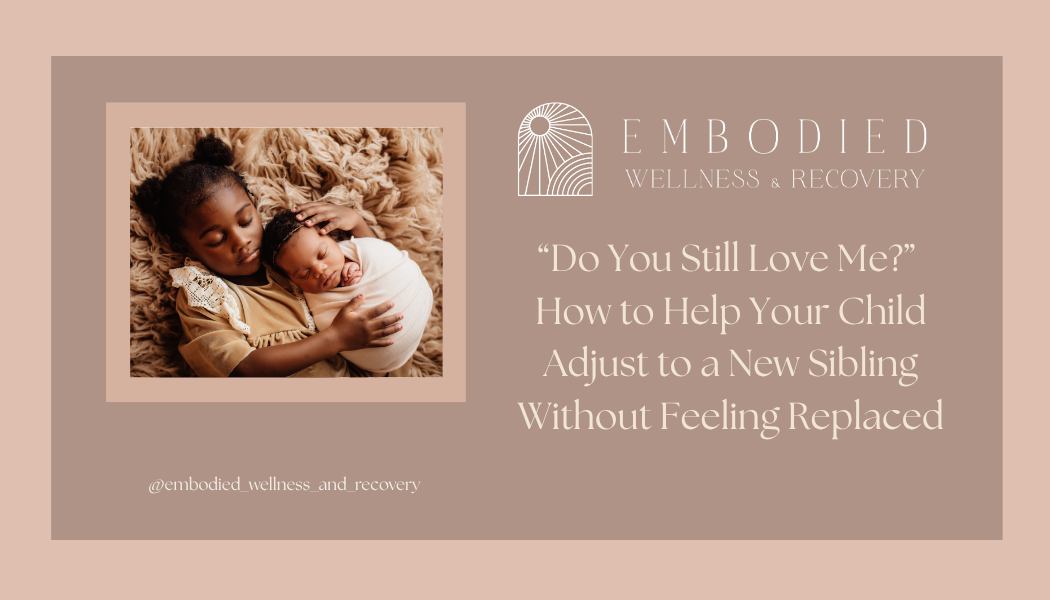
“Do You Still Love Me?” How to Help Your Child Adjust to a New Sibling Without Feeling Replaced
“Do You Still Love Me?” How to Help Your Child Adjust to a New Sibling Without Feeling Replaced
Help your child adjust to a new sibling with practical ways to respond to jealousy, regression, and big feelings while protecting your connection.
Your child kisses the baby’s forehead, then demands that you put the baby down. A previously smooth bedtime becomes a tearful negotiation. Your independent preschooler suddenly wants help getting dressed. You prepared them to become a big brother or sister. Why does your older child seem so unsettled? For some children, welcoming a sibling brings an unspoken question, “Is there still room for me?”
Helping your child adjust to a new sibling involves more than encouraging excitement. It means making space for mixed feelings while showing, through everyday interactions, that their place in your family remains secure.
Why a New Baby Can Bring Big Feelings
A newborn changes familiar routines, parental availability, and the atmosphere at home. Your older child may enjoy the baby while also missing how life felt before. Sibling jealousy, clinginess, or resistance can reflect difficulty navigating those changes. However, distress is not inevitable. Volling’s (2012) review of 30 studies found considerable variation in children’s adjustment, rather than evidence that becoming an older sibling creates a crisis for most children.
In a subsequent longitudinal investigation, many children maintained low levels of behavioral difficulties throughout the transition. The community sample was relatively low risk, so these findings cannot represent every family’s experience (Volling, 2017). Your child can struggle with change and still develop a loving sibling relationship.
The Neuroscience of Feeling Secure
Young children rely on caregivers to help them manage distress. This process, often called co-regulation, involves responsive interactions that support emotional regulation. Gunnar and Donzella’s (2002) review examined how caregiving relationships influence children’s cortisol responses, part of the body’s stress-response system. Their work supports the importance of social support in early stress regulation. It does not suggest that every tantrum signals an abnormal cortisol level. The practical implication is compassionate. When family life changes, familiar connection can help your child find their footing.
Six Ways to Help Your Child Adjust to a New Sibling
1. Prepare Them for Real Life With a Baby
Does your child expect an instant playmate? Have you explained what will happen while you are at the hospital?
Use simple, age-appropriate language: “Babies sleep, cry, and need lots of help. At first, they cannot play the way you do.”
Explain who will care for your child during the birth and which routines will continue. Books and pretend play can make the transition easier to understand. When possible, introduce major changes, such as a new bed, before the baby arrives (American Academy of Pediatrics [AAP], n.d.).
2. Welcome Feelings Without Requiring Excitement
When your child says, “I wish the baby would go away,” you may feel pressure to correct them.
Try: “You miss having more time with me. It is okay to tell me that.”
They can love their sibling and dislike sharing your attention. Invite involvement without making affection or helpfulness an obligation. ZERO TO THREE specifically advises against forcing children to help with the baby. Accepting a feeling gives you information about what your child needs.
3. Protect Predictable Time Together
Does your older child receive most of your attention when something goes wrong?
Create a small, dependable ritual: a morning cuddle, a bedtime story, or a few minutes of child-led play while another adult holds the baby. The AAP recommends dedicated attention for older children during this transition (AAP, n.d.).
Try naming it: “After lunch, we have our special time.”
Consistency matters more than creating an elaborate activity. Choose something realistic enough to repeat.
4. Respond to Regression With Patience
Why is your toddler acting like a baby again? Why have toileting accidents or bedtime difficulties returned?
Some children temporarily seek younger forms of care after a sibling arrives, including wanting to be carried or needing additional help. These changes are described in ZERO TO THREE’s sibling-adjustment guidance.
Offer reassurance without shame: “You want help today. Let’s do this together.”
Maintain supportive routines. Persistent skill loss, painful toileting, or significant sleep disruption deserves a conversation with your pediatrician, not the assumption that sibling jealousy explains everything.
5. Set Calm Limits Around Unsafe Behavior
What if your child hits, squeezes, or pushes the baby?
Move close, protect the baby, and state the limit clearly: “I will not let you hit. You can be angry, and I will help you.”
Stay nearby during interactions and offer alternatives, such as telling you what they want or stepping away with another caregiver. Understanding distress does not require allowing harm. A calm boundary can protect both children while preserving your older child’s dignity.
6. Let Them Be a Child, Too
“You’re the big one now” can unintentionally suggest that comfort belongs primarily to the baby.
Invite small contributions, such as choosing a song, while allowing your child to decline. Continue noticing interests and accomplishments unrelated to siblinghood. They are still learning, still dependent, and still deserving of care.
When Your Family Needs More Support
If distress persists, aggression escalates, or family interactions become increasingly strained, professional support can help you understand the pattern.
At Embodied Wellness and Recovery, our expertise spans trauma, nervous system regulation and repair, relationships, sexuality, and intimacy. Our work with children, parents, and families attends to attachment, emotional regulation, and the pressures shaping connection at home. Becoming an older sibling is a normal developmental transition, and support can be tailored without treating it as trauma.
Your child does not need constant attention or perfect parenting. They benefit from repeated experiences of being noticed, comforted, and included.
“You still matter here” becomes believable through the moments you share.
Explore parenting support and family therapy at Embodied Wellness and Recovery.
Contact us today to schedule a free 20-minute consultation with our team of somatic practitioners, trauma specialists, and relationship experts and begin your journey toward embodied connection with yourself and others.
📞 Call us at (310) 651-8458
📱 Text us at (310) 210-7934
📩 Email us at admin@embodiedwellnessandrecovery.com
🔗 Visit us at www.embodiedwellnessandrecovery.com
👉 Check us out on Instagram @embodied_wellness_and_recovery
🌍 Explore our offerings at Linktr. ee: https://linktr.ee/laurendummit
References
American Academy of Pediatrics. (n.d.). Preparing your older child for a new baby: How to help siblings adjust. HealthyChildren.org.
Gunnar, M. R., & Donzella, B. (2002). Social regulation of the cortisol levels in early human development. Psychoneuroendocrinology, 27(1–2), 199–220.
Volling, B. L. (2012). Family transitions following the birth of a sibling: An empirical review of changes in the firstborn’s adjustment. Psychological Bulletin, 138(3), 497–528.
Volling, B. L. (2017). XI. General discussion: Children’s adjustment and adaptation following the birth of a sibling. Monographs of the Society for Research in Child Development, 82(3), 142–158.
I’m Bored!” How to Teach Children Healthy Ways to Cope With Boredom in a Screen-Saturated World
“I’m Bored!” How to Teach Children Healthy Ways to Cope With Boredom in a Screen-Saturated World
Is your child always bored? Learn how to help children cope with boredom without constantly entertaining them, while supporting creativity, emotional regulation, attention, independence, and a healthier relationship with screens.
What if your child's boredom isn't a problem you need to solve, but a skill they need to learn how to navigate?
You've suggested going outside.
No.
Reading?
Boring.
Drawing?
No.
A game?
Not interested.
And then comes the inevitable:
"Can I have my phone?"
If your child or teenager seems chronically bored, parenting can start to feel like an endless search for enough stimulation to keep them engaged.
You may wonder:
Why is my child bored all the time?
Why does nothing seem interesting anymore?
Have screens shortened my child's attention span?
Should I entertain my child when they're bored, or let them figure it out?
Is this normal boredom, or could it be ADHD, anxiety, or depression?
The answer begins with understanding something surprisingly important: boredom itself isn't necessarily bad for children.
What Is Boredom Actually Telling Us?
Boredom is not simply "having nothing to do." Psychologists Erin Westgate and Timothy Wilson describe boredom as a signal that we are having difficulty successfully engaging our attention in an activity that feels meaningful.
In other words, boredom may be the brain's way of saying:
"This isn't engaging me. What else could I do?"
That second question matters. When children are immediately rescued from boredom, they don't have to answer it. A parent provides an activity. A device provides entertainment. A streaming service automatically starts the next episode. The uncomfortable space disappears before the child has a chance to generate anything from within it.
Why Can't My Child Tolerate Being Bored?
Modern children have unprecedented access to stimulation. Games, videos, social media, texts, streaming entertainment, and endless scrolling can provide novelty within seconds. This doesn't mean technology "ruins" a child's brain. But it does create an environment in which children rarely have to remain understimulated for very long. Boredom tolerance requires practice.
Research increasingly finds an association between proneness to boredom and problematic technology use. A 2026 meta-analysis of 25 studies involving more than 15,000 participants found a moderate positive association between trait boredom and problematic use of digital technologies (Tagliaferri et al., 2026).
The relationship is likely complex. Bored children may reach for technology more frequently, while habitual access to rapid stimulation may make lower-stimulation activities comparatively difficult to tolerate. Rather than declaring screens the enemy, parents can ask a more useful question, "Does my child or teen still know how to create engagement when entertainment isn't immediately provided?"
Stop Becoming Your Child's Entertainment Director
When your child announces, "I'm bored," you don't necessarily need to produce a solution. Constantly generating activities can unintentionally communicate the message that boredom is uncomfortable and that someone else should make it go away. Instead, consider responding with, "I hear you. I wonder what you'll come up with."
You can also create a family boredom menu when everyone is regulated. Children might add drawing, biking, baking, building something, music, puzzles, playing outside, writing a story, calling a friend, gardening, crafts, or learning something new. Then when boredom appears, point them toward the menu rather than becoming the menu yourself. The goal isn't refusing connection. Sometimes children genuinely want interaction with us.
The goal is distinguishing:
"I want time with you"
from
"I need you to eliminate this uncomfortable feeling for me."
Boredom Can Build Frustration Tolerance
From a nervous system perspective, boredom is a mild state of discomfort. Nothing terrible is happening, and yet the child feels restless, irritated, understimulated, or uncomfortable. That makes boredom an everyday opportunity to practice an essential regulatory skill: experiencing discomfort without immediately escaping it. A child who learns, "I can feel bored and eventually find something to do," is developing more than just boredom tolerance. They are practicing agency.
The nervous system learns:
"I can have an uncomfortable internal state without needing someone or something to immediately change it."
That capacity can later support frustration tolerance, emotional regulation, delayed gratification, and independence.
But Isn't Boredom Supposed to Make Children More Creative?
Possibly, but the science is more nuanced than popular parenting advice sometimes suggests. A 2024 review examining 27 empirical studies found mixed relationships between boredom and creativity. Some studies showed positive associations, others negative associations, and others no significant relationship (Zeißig et al., 2024).
So boredom doesn't automatically produce creativity. A better way to think about it is that unstructured time creates an opportunity for self-directed engagement. The child still has to learn what to do with that opportunity.
When “I'm Bored” May Mean Something Else
Not all chronic boredom should simply be ignored.
Sometimes "I'm bored" means:
"I can't focus."
"I don't know how to start."
"This feels too difficult."
"Nothing feels enjoyable."
"I'm anxious."
"I need connection."
"My brain needs more stimulation."
This distinction is particularly important with ADHD. A 2026 meta-analysis of 18 studies involving 22,365 participants found a significant positive association between ADHD and boredom (Muris et al., 2026). Research involving children ages 9 to 16 has also found higher boredom proneness and delay aversion among children with ADHD compared with typically developing peers (Hsu et al., 2025).
If boredom is persistent and accompanied by significant problems with attention, motivation, mood, sleep, school performance, relationships, or previously enjoyed activities, it may warrant further evaluation rather than simply more activities.
Teach Children to Ask: “What Do I Need?”
Instead of immediately asking "What can I do?", help children become curious about what their body and brain might need.
Do I need movement?
Do I need challenge?
Do I need creativity?
Do I need connection?
Do I need quiet?
Do I need something meaningful to work toward?
This transforms boredom from an emergency into information. Over time, children begin learning to recognize and respond to their own internal states rather than depending entirely on external stimulation.
Sometimes the Healthiest Response to “I'm Bored” Is Not Fixing It
At Embodied Wellness and Recovery, we understand children's behavior through the interconnected lenses of nervous system regulation, trauma, attachment, relationships, emotional development, and neuroscience. Our broader work also encompasses sexuality and intimacy as developmentally appropriate aspects of relational health across the lifespan.
When chronic boredom is connected to ADHD, anxiety, depression, trauma, executive functioning difficulties, or emotional dysregulation, therapy can help families understand what the behavior is communicating, rather than simply trying to eliminate it. The goal isn't to raise children who never experience boredom. It is to raise children who can encounter an empty afternoon and gradually discover that they don't need someone else to fill every empty space for them. They can become curious about what they might put there.
Perhaps boredom isn't always an empty space parents need to fill. Sometimes it is the space where children begin discovering themselves.
Reach out to schedule a complimentary 20-minute consultation with our team of therapists, trauma specialists, somatic practitioners, or relationship experts, and start working towards integrative, embodied healing today.
📞 Call us at (310) 651-8458
📱 Text us at (310) 210-7934
📩 Email us at admin@embodiedwellnessandrecovery.com
🔗 Visit us at www.embodiedwellnessandrecovery.com
👉 Check us out on Instagram @embodied_wellness_and_recovery
🌍 Explore our offerings at Linktr.ee: https://linktr.ee/laurendummit
References
Hsu, C. F., et al. (2025). Boredom proneness and inattention in children with and without ADHD: The mediating role of delay aversion. Frontiers in Psychiatry, 16, 1526089.
Muris, P., Otgaar, H., & Donkers, F. (2026). The boredom-ADHD nexus: A narrative and meta-analytic review of the evidence. Clinical Child and Family Psychology Review.
Pérez-Díaz, P. A., et al. (2026). Trait boredom and problematic use of new technologies: A meta-analysis. Addictive Behaviors.
Tagliaferri, G., Hidalgo-Fuentes, S., Frisari, F. V., Cricenti, C., & Martí-Vilar, M. (2026). Trait boredom and problematic use of new technologies: A meta-analysis. Psychological Reports. Advance online publication.
Westgate, E. C., & Wilson, T. D. (2018). Boring thoughts and bored minds: The MAC model of boredom and cognitive engagement. Psychological Review, 125(5), 689–713.
Zeißig, L. (2024). The association between boredom and creativity in educational contexts: A scoping review on research approaches and empirical findings. Review of Education, 12.
Helping Children Cope With Embarrassment and Social Setbacks: How to Build Confidence, Emotional Regulation, and Resilience
Helping Children Cope With Embarrassment and Social Setbacks: How to Build Confidence, Emotional Regulation, and Resilience
Learn how to help a child cope with embarrassment, rejection, friendship problems, and social setbacks using neuroscience-informed strategies that build emotional regulation, confidence, and resilience.
Your child comes home from school unusually quiet. Maybe they gave the wrong answer in front of the class, and everyone laughed. They weren't invited to a birthday party. They tripped during a game. A friend suddenly stopped sitting with them at lunch. They said something awkward and now cannot stop replaying it.
You see the hurt on their face, and something inside you hurts too. You want to say the right thing. You want to make the embarrassment disappear. You may even feel an almost instinctive urge to call the teacher, contact another parent, solve the friendship problem, or convince your child that what happened "wasn't a big deal."
But what if your child doesn't need you to make the uncomfortable feeling disappear?
What if one of the most important things you can teach them is:
“I can feel embarrassed, rejected, disappointed, or left out, and I can get through it.”
Helping children cope with embarrassment and social setbacks isn't about protecting them from uncomfortable emotions. It is about helping their developing brain and nervous system learn how to experience those emotions without becoming overwhelmed by them.
Why Does Embarrassment Feel So Big to Children?
Adults sometimes underestimate how intensely children experience their social worlds. To an adult, forgetting the words during a school presentation might seem like a small event. To a child, it can feel catastrophic.
“Everyone saw me.”
“They're going to remember forever.”
“Nobody is going to like me now.”
Social acceptance is enormously important during childhood and becomes increasingly salient as children move toward adolescence. Neuroimaging research shows that social exclusion engages brain regions involved in processing emotional distress and regulating responses to rejection. Research with adolescents has also found that a history of chronic peer rejection is associated with heightened neural responses to later social exclusion (Will et al., 2016).
In other words, when your child says being excluded or embarrassed "really hurt," their distress is not necessarily dramatic or irrational. Their social brain is doing exactly what developing social brains do: paying close attention to belonging.
The Painful Part for Parents: You Can't Always Fix It
Perhaps the hardest part is witnessing your child's pain while feeling powerless to remove it.
What do you do when your daughter wasn't invited?
What do you say when your son was laughed at?
Should you contact the school?
Should you encourage them to confront the friend?
Should you tell them to ignore it?
And what happens when every suggestion you make is answered with:
“You don't understand!”
Your own nervous system may become activated alongside theirs. You might feel angry, anxious, protective, or rejected on your child's behalf. That matters. A 2024 systematic review found that parents' own capacity for self-regulation influences how they engage in children's emotional socialization, including how they respond to emotions and discuss emotional experiences.
Before helping your child regulate, therefore, it can be useful to notice what is happening inside you. Are you trying to solve the problem because your child needs intervention? Or because witnessing their discomfort is unbearable for you? Those are very different situations.
Validate Before You Reassure
Imagine your child says:
“Everyone laughed at me. I'm never going back to school.”
Your instinct might be:
“Oh honey, nobody is thinking about it anymore.”
Although well-intentioned, reassurance can accidentally bypass the child's emotional experience.
Instead, begin with connection:
“That sounds really embarrassing. I can understand why you wanted to disappear in that moment.”
Validation doesn't mean agreeing with catastrophic conclusions such as "everyone hates me."
It means communicating:
“I understand why this feels painful.”
Research supports the importance of parents' responses to children's emotions. A meta-analysis of randomized trials found that interventions that taught parents emotion-socialization strategies improved parenting practices and children's emotional competence and behavioral adjustment.
Your child learns emotional regulation partly through repeated experiences of having difficult emotions recognized, tolerated, and safely accompanied.
Help Them Separate What Happened From What It Means
Embarrassment has a remarkable ability to turn an event into an identity. “I made a mistake” becomes “I'm stupid.”
“ They didn't invite me” becomes “Nobody likes me.”
“I said something awkward” becomes “I'm weird.”
This is where parents can gently help children develop perspective.
Try separating three things:
What happened? “I forgot what I was going to say during my presentation.”
What did you feel? “I felt embarrassed and scared everyone was judging me.”
What did your brain decide it meant? “I'm terrible at presentations, and everyone thinks I'm stupid.”
That final interpretation is where flexibility can begin.
You might ask:
“Is there another possible explanation?”
Not to talk them out of their feelings, but to help the developing brain discover that feelings are real without every thought generated by those feelings necessarily being true.
Resist the Urge to Rescue Too Quickly
There are absolutely situations in which adults need to intervene, particularly with bullying, harassment, persistent exclusion, threats, discrimination, or safety concerns.
But ordinary social disappointment is different. If parents immediately repair every friendship rupture, contact every coach, challenge every disappointing outcome, or prevent every embarrassing situation, children may unintentionally receive the message:
“This feeling is too much for you to handle.”
Resilience develops partly through manageable experiences of difficulty followed by recovery.
Instead of immediately asking, “How can I fix this?”, try:
“Do you want me to listen, help you think through what to do, or help you decide whether an adult needs to get involved?” That question preserves connection while returning some agency to your child.
Teach the Nervous System That Embarrassment Is Survivable
Embarrassment isn't only cognitive. Children may experience a racing heart, hot face, tight stomach, trembling, tears, freezing, or an overwhelming urge to escape. This is where nervous system regulation becomes useful. Before analyzing the social situation, help the body settle. That might mean walking together, slowing the breath, getting outside, stretching, cuddling a pet, listening to music, eating something, or simply sitting quietly beside a trusted adult.
The message is not:
“Calm down.”
It is:
“Your body is having a big response. We can stay with it until it settles.”
Children gradually learn that emotional activation rises and falls. They do not have to escape every uncomfortable feeling.
Don't Accidentally Teach Them to Fear Embarrassment
Sometimes the most powerful response is allowing yourself to be imperfect in front of your child. Tell them about the time you forgot someone's name. Laugh gently when you spill something. Admit when you were wrong.
Say:
“Wow, that was embarrassing.”
And then continue with your day.
Children need to see adults survive ordinary imperfection. If every mistake becomes something to hide, embarrassment acquires enormous power. If mistakes become part of being human, embarrassment becomes an emotion rather than an emergency.
Secure Connection Builds Emotional Resilience
One of the strongest protective resources children have is a relationship in which difficult emotions can be expressed safely. A large meta-analytic review found that more securely attached children showed better emotion regulation and greater use of adaptive coping strategies, including seeking social support. The goal, therefore, isn't raising a child who never feels rejected.
It's raising a child who increasingly knows that they can be left out without believing they are unlovable. I can make a mistake without deciding I am a failure. Someone can dislike me without determining my worth. I can feel embarrassed without needing to disappear. I can ask for help when something genuinely isn't okay. That is resilience.
When Social Setbacks Become Something More
Occasional embarrassment, friendship conflict, and rejection are normal parts of development. But consider seeking professional support when your child's distress becomes persistent or begins to interfere with everyday life.
Watch for increasing school avoidance, social withdrawal, significant anxiety, persistent sadness, sleep or appetite changes, frequent physical complaints, intense fear of judgment, or giving up activities because embarrassment feels intolerable.
Research suggests that repeated peer rejection can have meaningful effects. Children experiencing peer rejection have shown differences in emotional and neural responses to negative social feedback, and chronic rejection has been associated with heightened sensitivity to later exclusion. Early support can help prevent painful experiences from becoming rigid beliefs about identity and belonging.
Helping Your Child Discover: “I Can Handle This”
At Embodied Wellness and Recovery, we understand children's emotional struggles through a relational, trauma-informed, neuroscience-informed, and nervous-system-oriented lens. Our broader work with children, adolescents, adults, couples, and families recognizes that emotional regulation develops within relationships.
Experiences involving shame, rejection, attachment, trauma, identity, and belonging can influence how people relate to themselves and others long after the original experience has passed. Parents cannot protect children from every awkward moment, friendship rupture, rejection, or disappointment. Nor should they have to.
What parents can provide is something potentially more enduring: a relationship in which children discover that painful emotions can be felt without being feared.
So the next time your child comes home devastated by something you cannot undo, perhaps the question isn't:
“How do I make this stop hurting?”
Perhaps it is:
“How can I help my child discover that they can feel this, move through it, learn from it, and still be okay?”
That lesson can travel with them far beyond childhood.
Reach out to schedule a complimentary 20-minute consultation with our team of therapists, trauma specialists, somatic practitioners, or relationship experts, and start working towards integrative, embodied healing today.
📞 Call us at (310) 651-8458
📱 Text us at (310) 210-7934
📩 Email us at admin@embodiedwellnessandrecovery.com
🔗 Visit us at www.embodiedwellnessandrecovery.com
👉 Check us out on Instagram @embodied_wellness_and_recovery
🌍 Explore our offerings at Linktr.ee: https://linktr.ee/laurendummit
References
Edler, K., & Valentino, K. (2024). Parental self-regulation and engagement in emotion socialization: A systematic review. Psychological Bulletin, 150(2), 154–191. https://doi.org/10.1037/bul0000423
Masten, C. L., Eisenberger, N. I., Borofsky, L. A., Pfeifer, J. H., McNealy, K., Mazziotta, J. C., & Dapretto, M. (2009). Neural correlates of social exclusion during adolescence: Understanding the distress of peer rejection. Social Cognitive and Affective Neuroscience, 4(2), 143–157.
Pallini, S., Baiocco, R., Schneider, B. H., Madigan, S., & Atkinson, L. (2014). Early child-parent attachment and peer relations: A meta-analysis of recent research. Journal of Family Psychology, 28(1), 118–123. https://doi.org/10.1037/a0035736
Will, G. J., van Lier, P. A. C., Crone, E. A., & Güroğlu, B. (2016). Chronic childhood peer rejection is associated with heightened neural responses to social exclusion during adolescence. Journal of Abnormal Child Psychology, 44(1), 43–55. https://doi.org/10.1007/s10802-015-9983-0

How to Talk to Your Teen About Screen Time Without a Fight: What Neuroscience Reveals About Connection, Boundaries, and the Adolescent Brain
How to Talk to Your Teen About Screen Time Without a Fight: What Neuroscience Reveals About Connection, Boundaries, and the Adolescent Brain
Struggling with constant battles over your teen's phone? Discover the neuroscience behind screen time, teen brain development, and practical parenting strategies to reduce conflict, strengthen connection, and set healthy digital boundaries.
Does every conversation about your teen's phone end in an argument?
Do you feel like you're constantly reminding, negotiating, or enforcing limits while your teen becomes increasingly defensive?
Have you found yourself wondering whether you're being too strict or not strict enough?
Perhaps you've noticed your teenspending hours scrolling social media, watching videos, gaming, or texting friends, and you're worried about what it's doing to their mental health, sleep, motivation, or relationships. Many parentsassume the conflict is about screens. Often, it is about something much deeper.
When parents and teens become locked in power struggles over technology, both sides can begin feeling misunderstood, frustrated, and emotionally disconnected. Understanding what is happening inside the adolescent brain can transform these conversations from battles into opportunities for greater trust and connection.
Why Screen Time Conversations Feel So Emotional
If you've ever asked your teen to put down their phone only to receive eye rolls, anger, or silence, you are not imagining the intensity. Adolescence is a period of profound neurological development.
During these years, the brain's reward system develops more rapidly than the areas responsible for planning, impulse control, and long-term decision-making. At the same time, teenagers become increasingly sensitive to peer relationships, social feedback, novelty, and belonging (Blakemore & Mills, 2014).
Social media platforms, gaming apps, and digital notifications are intentionally designed to engage these developing reward systems. To an adult, putting away a phone may feel like a simple request. To an adolescent brain, it can feel like being disconnected from an important social world. Recognizing this difference does not mean abandoning boundaries; it means approaching them with greater understanding.
The Real Problem Is Often Disconnection
Many parents tell us:
"I feel like I'm losing my child."
"They're always on their phone."
"We barely talk anymore."
"Everything turns into a fight."
These concerns reflect something deeper than screen time. They reflect a longing for connection. When conversations revolve only around rules, consequences, and monitoring, parents and teens often become trapped in a cycle of criticism and defensiveness. The goal is not simply to reduce screen time. The goal is to strengthen the relationship that enables healthy limits.
What Neuroscience Tells Us About Conflict
When your teen feels criticized, shamed, or controlled, their nervous system may shift into a defensive state.
Rather than engaging the parts of the brain responsible for reflection, empathy, and problem-solving, they may respond with:
— Arguing
— Shutting down
— Withdrawing
— Becoming sarcastic
— Escalating emotionally
The same is true for parents.
When you become frightened, frustrated, or overwhelmed, your own nervous system can shift into protection mode. Suddenly, the conversation is no longer about screen time. It becomes two nervous systems reacting to one another. This is why regulation matters as much as rules.
Five Ways to Talk About Screen Time Without a Fight
1. Connect Before You Correct
Before discussing limits, strengthen the relationship. Spend time together withouttalking about phones. Go for a walk. Cook dinner together. Ask about their interests. Research consistently shows that warm, supportive parent-child relationships are associated with healthier adolescent adjustment and greater openness to parental guidance(Steinberg, 2014). Children are more likely to accept influence from people with whom they feel emotionally connected.
2. Get Curious Instead of Assuming
Rather than beginning with:
"You're always on your phone."
Try:
"Help me understand what you enjoy most about being online."
You may discover that your teen is:
— Maintaining friendships
— Relieving stress
— Seeking belonging
— Escaping anxiety
— Exploring interests
Curiosity lowers defensiveness and opens the door to collaboration.
3. Explain the "Why"
Teens are far more likely to cooperate when they understand the reasoning behind expectations.
Instead of saying:
"Because I said so."
Try:
"I'm concerned about how late-night scrolling affects your sleep, mood, and concentration."
This communicates care rather than control.
4. Create Boundaries Together
Whenever possible, involve your teen in developing family technology guidelines.
Consider discussing:
— Device-free meals
— Phone-free bedrooms overnight
— Homework before entertainment
— Screen-free family time
— Healthy social media habits
Collaboration increases ownership.
5. Model the Behavior You Want to See
Children notice far more than they hear.
Ask yourself:
— Do I check my phone during conversations?
— Do I bring my phone to the dinner table?
— Am I fully present when my teen wants to talk?
Healthy technology habits begin with the adults in the home.
Address the Need Beneath the Screen
Technology often meets important emotional needs.
For some teens, screens provide:
— Connection
— Entertainment
— Escape
— Predictability
Simply removing the device without addressing those underlying needs often creates more conflict.
Instead, ask:
— What relationships help my teen feel connected?
— What activities help them feel confident?
— Where do they experience belonging offline?
When meaningful alternatives increase, excessive screen dependence often decreases.
What Parents Can Say Instead
Instead of:
"You're addicted to your phone."
Try:
"I've noticed you've seemed more stressed lately. How are you feeling?"
Instead of:
"Put your phone away right now."
Try:
"Let's take a break from screens and spend a little time together."
Instead of:
"You're wasting your life."
Try:
"I miss spending time with you."
These small shifts communicate connection rather than criticism.
When Screen Time Is a Symptom
Sometimes excessive screen use reflects more than habit.
It may be connected to:
— Anxiety
— Depression
— Loneliness
— Social difficulties
— Trauma
In these situations, focusing only on screen limits may overlook the deeper struggle. Understanding what your teen is seeking online can provide valuable insight into what they may need offline.
Supporting Families Through Connection
At Embodied Wellness and Recovery, we understand that parenting in the digital age can feel overwhelming. Our clinicians work with parents, teens, couples, and families using neuroscience-informed, trauma-sensitive approaches that strengthen communication, improve emotional regulation, and foster healthier relationships.
Whether your family is navigating anxiety, attachment challenges, conflict, or the growing influence of technology, our goal is to help parents move from power struggles toward meaningful connection.
Shifting Conversations with Your Teen from Winning to Guiding
The conversation about screen time is rarely just about screens. It is about trust, influence, belonging, and the relationship you are building with your teen. When parents approach these discussions with curiosity, empathy, clear boundaries, and an understanding of the adolescent brain, conversations become less about winning an argument and more about guiding a young person toward lifelong digital balance. Your influence grows not because you control every screen, but because your teen experiences you as a safe, steady, and trusted guide.
Reach out to schedule a complimentary 20-minute consultation with our team of therapists, trauma specialists, somatic practitioners, or relationship experts and start working towards integrative, embodied healing today.
📞 Call us at (310) 651-8458
📱 Text us at (310) 210-7934
📩 Email us at admin@embodiedwellnessandrecovery.com
🔗 Visit us at www.embodiedwellnessandrecovery.com
👉 Check us out on Instagram @embodied_wellness_and_recovery
🌍 Explore our offerings at Linktr.ee: https://linktr.ee/laurendummit
References
Blakemore, S. J., & Mills, K. L. (2014). Is adolescence a sensitive period for sociocultural processing? Annual Review of Psychology, 65, 187-207.
Odgers, C. L., & Jensen, M. R. (2020). Annual Research Review: Adolescent mental health in the digital age. Journal of Child Psychology and Psychiatry, 61(3), 336-348.
Porges, S. W. (2021). Polyvagal safety: Attachment, communication, self-regulation. W. W. Norton & Company.
Steinberg, L. (2014). Age of opportunity: Lessons from the new science of adolescence. Houghton Mifflin Harcourt.
Siegel, D. J. (2020). The developing mind: How relationships and the brain interact to shape who we are (3rd ed.). Guilford Press.