

Why Do Compliments Make Me Uncomfortable? The Neuroscience of Praise, Shame, Self-Worth, and the Fear of Being Seen
Why Do Compliments Make Me Uncomfortable? The Neuroscience of Praise, Shame, Self-Worth, and the Fear of Being Seen
Why do compliments make you uncomfortable? Discover how low self-esteem, shame, trauma, people pleasing, attachment, and the nervous system can make praise feel surprisingly difficult to receive.
Someone tells you, “You look beautiful.”
Before you can even absorb the words, you respond:
"Oh God, no. I look terrible today."
Someone says, “You're incredibly talented.”
You immediately explain why what you accomplished really wasn't that impressive. Your boss tells you that you did an exceptional job. You point out everything you could have done better. A friend compliments your outfit, and within seconds you are complimenting hers.
Why can something intended to make us feel good create such profound discomfort? If you've ever wondered, “Why do compliments make me uncomfortable?” the answer may have much less to do with modesty than you think. For some people, positive attention activates embarrassment, anxiety, shame, skepticism, or even an instinctive desire to disappear. Understanding why requires looking beneath the social interaction and into self-esteem, attachment, trauma, people pleasing, and the nervous system'srelationship with being seen.
Why Can't I Just Accept a Compliment?
Compliments provide information about how another person sees us. When that information fits comfortably with our existing self-concept, receiving it tends to feel relatively easy.
But imagine someone saying:
“You're beautiful.”
while an internal voice immediately responds:
"No, I'm not."
Or:
“You're really good at what you do.”
while another part of you thinks:
"If they really knew me, they wouldn't think that."
Now the brain has two conflicting pieces of information. Psychologists call this cognitive dissonance, the discomfort that occurs when we encounter information that conflicts with established beliefs.
Research on self-verification suggests that people are often motivated to maintain familiar beliefs about themselves, even when those beliefs are negative (Swann et al., 1989). Familiarity creates predictability.
This can create a strange psychological paradox:
A negative belief about yourself can sometimes feel more believable than a positive truth about yourself.
When Praise Collides With Low Self-Esteem
Researchers have found that people with lower self-esteem may have difficulty benefiting from positive feedback in the same way people with more secure self-esteem do.
A compliment may not simply land as:
"Someone appreciates me."
Instead, the mind interrogates it.
"Do they really mean that?"
"Are they just being nice?"
"What do they want?"
"If they knew the real me, would they still say that?"
Research by Kwang and Swann (2010) suggests that people with negative self-views can experience tension between wanting positive evaluation and wantingfeedback that confirms their existing self-concept. In other words, part of you may desperately want affirmation while another part distrusts it when it arrives.
Why Compliments Can Trigger Shame
Shame does not simply say:
“I did something wrong.”
It whispers:
“Something is wrong with me.”
For someone carrying deeply internalized shame, praise can shine attention directly onto the self, and attention can feel dangerous.
Instead of experiencing:
“They see something wonderful in me,”
the nervous system may register:
“They are looking at me.”
That subtle distinction matters. Being positively seen still requires being seen. For people with histories of chronic criticism, bullying, emotional neglect, conditional approval, perfectionism, or relational trauma, visibility may historically have been associated with evaluation. The body remembers that pattern.
The Neuroscience of Why Positive Attention Can Feel Unsafe
The nervous system is constantly predicting what happens next. Rather than evaluating every situation from scratch, the brain relies on previous experiences to anticipate whether something is safe, threatening, rewarding, or uncertain. This predictive function helps us navigate the world efficiently, but it also means that familiarity can sometimes feel safer than positivity. If attention historically preceded criticism, demands, embarrassment, manipulation, or disappointment, attention itself may become activating.
Your rational brain may understand:
"This person is complimenting me."
Meanwhile, your body responds:
"Everyone is looking at us. Get out of here."
You laugh. You minimize. You change the subject. You compliment the other person, and within seconds, the spotlight has moved away. Relief. What looks like social awkwardness may actually be a subtle nervous system regulation strategy.
When Compliments Feel Like Expectations
Sometimes praise doesn't feel uncomfortable because you disagree with it. It feels uncomfortable because of what you believe comes next.
“You're so successful.”
becomes:
"Now I have to keep succeeding."
“You're always so put together.”
becomes:
"I can't let anyone see me struggling."
“You're such an amazing mother.”
becomes:
"I can't make mistakes."
This is particularly relevant for people whose childhood environments emphasized achievement, performance, appearance, caretaking, or being "the good one."Praise may have been conditional. You were celebrated when you performed well. You received approval when you were agreeable. You felt valuable when you made other people happy.
Over time, admiration can become psychologically intertwined with expectation. The compliment isn't simply received. It becomes another standard to maintain.
People Pleasing Can Make Receiving Especially Difficult
People pleasers are often exceptionally comfortable directing positive energy outward. They compliment, support, encourage, help, accommodate, and notice what everyone else needs. Receiving reverses that relational direction. Suddenly, someone is appreciatingyou. There is nothing to accomplish, nothing to fix, nothing to reciprocate, and nothing to earn. That can feel surprisingly vulnerable.
So you immediately say:
“Thanks, but YOU look amazing!”
The attention moves away from you, and your nervous system settles.
Trauma Can Make Positive Experiences Difficult to Absorb
Trauma is commonly associated with fear and distress, but it can also interfere with our capacity to tolerate positive emotional experiences. Research has explored the concept of fear of positive emotions, in which experiences such as happiness, pride, intimacy, or positive attention can evoke anxiety or discomfort rather than uncomplicated pleasure (Gilbert et al., 2012). This can be especially relevant when positive experiences historically felt unpredictable or were followed by disappointment.
The nervous system may quietly learn:
Don't get too comfortable.
Don't get too excited.
Don't draw attention to yourself.
Don't believe something good will last.
These protective strategies may persist long after the environment that created them has changed.
Learning to Receive Without Deflecting
If compliments make you uncomfortable, forcing yourself to "be more confident" may miss the deeper issue. Instead, practice something much smaller.
Someone says:
“You look beautiful.”
Notice what happens inside your body before responding.
Does your chest tighten?
Do you feel heat in your face?
Do you immediately want to explain something?
Do you feel an urge to make yourself smaller?
Do you want to compliment them back?
Pause.
Then experiment with two words:
“Thank you.”
Nothing else. You do not have to agree completely. You do not have to suddenly feel confident. You are simply practicing allowing positive information to remain in the room without immediately pushing it away. Over time, this can become a powerful exercise in nervous system flexibility.
What If the Compliment Isn't the Problem?
At Embodied Wellness and Recovery, we work with individuals and couples navigating trauma, attachment wounds, nervous system dysregulation, relationship difficulties, sexuality, intimacy, shame, and patterns of self-worth.
Through neuroscience-informed, somatic, relational, and trauma-focused approaches, therapy can help uncover why visibility, praise, receiving, vulnerability, or positive attention became uncomfortable in the first place.
Because sometimes the deeper question isn't:
“Why am I so bad at taking compliments?”
It is:
“When did being seen start feeling dangerous?”
And perhaps an even more powerful question:
What if the discomfort isn't because the compliment is untrue, but because believing it would require you to update the story you've learned to tell about yourself? Learning to receive a compliment is a small interpersonal moment.
Underneath it may be something much larger:
The gradual discovery that you can be seen, appreciated, valued, and celebrated without having to perform, minimize yourself, or disappear.
Reach out to schedule a complimentary 20-minute consultation with our team of therapists, trauma specialists, somatic practitioners, or relationship experts and start working towards integrative, embodied healing today.
📞 Call us at (310) 651-8458
📱 Text us at (310) 210-7934
📩 Email us at admin@embodiedwellnessandrecovery.com
🔗 Visit us at www.embodiedwellnessandrecovery.com
👉 Check us out on Instagram @embodied_wellness_and_recovery
🌍 Explore our offerings at Linktr.ee: https://linktr.ee/laurendummit
References
Gilbert, P., McEwan, K., Catarino, F., Baião, R., & Palmeira, L. (2012). Fears of happiness and compassion in relationship with depression, alexithymia, and attachment security in a depressed sample. British Journal of Clinical Psychology, 53(2), 228-244.
Kwang, T., & Swann, W. B., Jr. (2010). Do people embrace praise even when they feel unworthy? A review of critical tests of self-enhancement versus self-verification. Personality and Social Psychology Review, 14(3), 263-280.
Swann, W. B., Jr., Pelham, B. W., & Krull, D. S. (1989). Agreeable fancy or disagreeable truth? Reconciling self-enhancement and self-verification. Journal of Personality and Social Psychology, 57(5), 782-791.
Wood, J. V., Perunovic, W. Q. E., & Lee, J. W. (2009). Positive self-statements: Power for some, peril for others. Psychological Science, 20(7), 860-866.
Why Some People Can Lie Without Remorse: Narcissism, Psychopathy, and the Neuroscience of Deception
Why Some People Can Lie Without Remorse: Narcissism, Psychopathy, and the Neuroscience of Deception
Why can some people lie without remorse? Explore the neuroscience of deception, narcissism, psychopathy, gaslighting, chronic infidelity, and how betrayal trauma affects the brain, nervous system, relationships, and ability to trust again.
How could someone who says they love me look me in the eyes, lie convincingly, watch me suffer, and seemingly feel little or no remorse? For people who discover chronic infidelity, financial secrecy, repeated manipulation, gaslighting, or an entire double life, this question can become consuming.
Perhaps you discovered one affair and then learned there were others. Maybe financial records revealed years of hidden behavior. Perhaps your partner repeatedly assured you that your suspicions were irrational, only for you to discover that your intuition had been remarkably accurate.
Suddenly, you are trying to reconcile two apparently incompatible people:
The person I thought I knew.
And:
The person capable of doing this.
The psychological injury of chronic deception goes far beyond discovering that someone lied. It can destabilize your understanding of your relationship, your memories, your judgment, and even your ability to recognize what is real. Understanding the psychology and neuroscience of deception can help explain how some people maintain elaborate lies, but it is equally important to understand what chronic deception does to the person on the receiving end.
Why Do Some People Lie Without Feeling Guilty?
Most people lie occasionally. They may avoid an uncomfortable conversation, conceal something because they feel ashamed, or distort the truth because they fear consequences. That is different from chronic, calculated deception.
Some individuals can maintain multiple realities for months or even years. They may compartmentalize affairs, sexual behavior, financial secrets, substance use, or other relationships while continuing to participate convincingly in family life.
Research suggests that repeated dishonesty may actually change how the brain responds to lying. Garrett and colleagues (2016) found that repeated self-serving dishonesty was associated with decreasing activation in the amygdala, a brain region involved in emotional salience. In other words, the emotional discomfort associated with dishonesty appeared to diminish as dishonest behavior was repeated.
A lie that initially creates anxiety may become easier to tell the tenth, fiftieth, or hundredth time. This does not mean that everyone who lies repeatedly has narcissistic personality disorder or psychopathy. But it helps explain an unsettling possibility: Deception can become psychologically easier with repetition.
Narcissism, Psychopathy, and Deception
The words narcissist, sociopath, and psychopath are frequently used interchangeably online, but clinically they describe different concepts. Narcissistic personality disorder is a recognized diagnosis characterized by patterns that can include grandiosity, entitlement, need for admiration, interpersonal exploitation, and impaired empathy.
“Psychopathy,” by contrast, is not a standalone DSM diagnosis. It is a researched personality construct involving traits that may include superficial charm, manipulativeness, callousness, diminished affective empathy, impulsivity, and limited remorse. Sociopathy is primarily an informal term commonly associated with antisocial personality traits.
Research on psychopathy has identified differences in neural systems involved in emotional processing, moral decision-making, fear learning, and empathy (Blair, 2007). But this distinction matters: A person does not need to be a narcissist or psychopath to lie, cheat, manipulate, or cause profound relational harm. The behavior deserves attention even when the diagnosis is unknown.
How Can Someone Lie to Someone They Love?
One reason chronic deception is so difficult to comprehend is that we naturally assume another person's mind operates similarly to our own.
You may think:
"I couldn't watch someone I love suffer like this."
"I would feel unbearably guilty."
"I could never come home and behave normally after doing that."
And therefore:
"How could they?"
The answer may involve differences in empathy, entitlement, shame, reward processing, attachment, compartmentalization, or capacity for remorse. Someone with pronounced narcissistic traits may lie to protect their self-image, avoid shame, maintain admiration, preserve entitlement, or escape consequences.
Someone with significant psychopathic traits may understand intellectually that another person is hurting while experiencing considerably less emotional resonance with that suffering. This distinction is sometimes described as the difference between cognitive empathy and affective empathy.
A person may understand exactly what you are feeling without emotionally experiencing your pain alongside you. In some individuals, that understanding can even make manipulation more effective.
Why Chronic Deception and Gaslighting Can Make You Question Reality
The deepest injury may begin after the truth comes out. Suddenly, your brain starts reconstructing the past.
Was that business trip really for work?
Was that person actually "just a friend"?
Why did they become defensive when I asked that question?
What else don't I know?
Were the good moments real?
Your brain is essentially discovering that its previous model of reality was unreliable.
The human brain is fundamentally predictive. It continuously uses previous experiences to anticipate what will happen next. Predictability helps the nervous system determine whether the environment is safe.
Chronic deception disrupts that process.
The result can resemble a betrayal trauma response, including:
— checking phones or financial accounts
— replaying conversations
— sleep disruption
— anxiety
— emotional flooding
— difficulty trusting your own perceptions
Research on betrayal trauma suggests that violations committed by someone upon whom we depend can have particularly significant psychological consequences because the source of attachment and the source of threat become intertwined (Freyd, 1996).
Your nervous system is no longer simply asking, "Can I trust this person?"
It may begin asking:
"Can I trust myself to know when something is wrong?"
Why Does Someone Keep Lying Even After Being Caught?
This can be one of the most bewildering aspects of chronic deception. You finally have evidence, yet the person minimizes, denies, changes details, blames you, or admits only what you can prove.
Why?
For some people, telling the truth requires tolerating shame, accountability, loss of control, and consequences. Continued deception can function as an attempt to preserve control over the narrative. Gaslighting can intensify this injury. When someone repeatedly tells you that what you observed did not happen, your feelings are irrational, or your perception cannot be trusted, the conflict is no longer simply about behavior. It becomes a conflict over reality itself.
You Do Not Need a Diagnosis to Trust the Pattern
After discovering chronic deception, it can become tempting to spend hours researching:
Is my partner a narcissist?
Is my spouse a psychopath?
Do narcissists feel remorse?
Can psychopaths love?
Understanding personality patterns can provide valuable context. But eventually, another set of questions becomes more important:
What has repeatedly happened to me?
Does this person take meaningful accountability?
Do their actions consistently match their words?
Do I feel pressured to abandon my own perceptions to maintain this relationship?
What would I need in order to feel emotionally and relationally safe again?
The label matters less than the pattern.
Rebuilding Self-Trust After Betrayal and Chronic Deception
Recovery from betrayal is not simply about deciding whether to stay or leave. It is about restoring the relationship with your own perception.
At Embodied Wellness and Recovery, we specialize in treating trauma, betrayal trauma, relationship difficulties, sexuality, intimacy, and nervous system dysregulation through an integrative, neuroscience-informed approach.
Treatment may involve learning to regulate the nervous system, processing traumatic discoveries, understanding attachment dynamics, establishing boundaries, rebuilding trust in your intuition, and separating what you know from what you have been conditioned to doubt.
Somatic therapies can be particularly valuable because betrayal is not experienced only cognitively. The body may remain vigilant long after the mind understands what happened. The goal is not to become better at detecting every possible lie. It is to become increasingly capable of recognizing your internal signals, evaluating behavior clearly, tolerating difficult truths, and responding in ways that protect your psychological integrity.
Sometimes the most devastating part of discovering a lie is not learning what someone did. It is realizing how long they were able to watch you believe something that wasn't true. Understanding why someone could do that may provide context. But rebuilding your ability to trust what you see, what you feel, and what you know is where recovery begins.
Reach out to schedule a complimentary 20-minute consultation withour team of therapists,trauma specialists, somatic practitioners, orrelationship experts and start working towards integrative, embodied healing today.
📞 Call us at (310) 651-8458
📱 Text us at (310) 210-7934
📩 Email us at admin@embodiedwellnessandrecovery.com
🔗 Visit us at www.embodiedwellnessandrecovery.com
👉 Check us out on Instagram @embodied_wellness_and_recovery
🌍 Explore our offerings at Linktr.ee: https://linktr.ee/laurendummit
References
Blair, R. J. R. (2007). The amygdala and ventromedial prefrontal cortex in morality and psychopathy. Trends in Cognitive Sciences, 11(9), 387–392.
Freyd, J. J. (1996). Betrayal trauma: The logic of forgetting childhood abuse. Harvard University Press.
Garrett, N., Lazzaro, S. C., Ariely, D., & Sharot, T. (2016). The brain adapts to dishonesty. Nature Neuroscience, 19(12), 1727–1732.
Hare, R. D. (2003). Manual for the Revised Psychopathy Checklist (2nd ed.). Multi-Health Systems.
Why Do Healthy Relationships Feel Boring? The Neuroscience of Trauma, Attachment, and Why Safe Love Can Feel Unfamiliar
Why Do Healthy Relationships Feel Boring? The Neuroscience of Trauma, Attachment, and Why Safe Love Can Feel Unfamiliar
Why do healthy relationships feel boring after trauma? Discover how attachment wounds, nervous system dysregulation, and emotional conditioning can make safe, stable love feel unfamiliar. Learn the neuroscience behind attraction, intimacy, and lasting connection.
"I finally met someone who treats me well... so why don't I feel excited?" It's one of the most painful questions people ask in therapy. You meet someone who is emotionally available. They communicate openly. They respect your boundaries. They are consistent, trustworthy, and kind. Instead of feeling butterflies, you feel... flat.
Maybe you find yourself wondering:
— Why do healthy relationships feel boring?
— Why am I only attracted to emotionally unavailable people?
— Why do I lose interest when someone actually likes me?
— Is something wrong with me?
— Am I incapable of real intimacy?
— Am I confusing chemistry with anxiety?
For many people, these questions trigger profound confusion and shame. They desperately want a healthy relationship, yet when they finally encounter one, it feels strangely unfamiliar. The answer often lies not in your character, but in your nervous system.
What If "Boring" Really Means "Unfamiliar"?
One of the greatest misunderstandings about attraction is the belief that chemistry always signals compatibility. In reality, chemistry is often shaped by familiarity.
If your earliest experiences of love involved inconsistency, emotional unpredictability, criticism, neglect, or earning affection, your brain and body may have learned that love feels activating rather than calming.
As adults, many trauma survivors unconsciously associate love with:
— Uncertainty
— Emotional intensity
— Mixed signals
— Chasing connection
— Fear of abandonment
— Constant emotional vigilance
When those elements are absent, healthy relationships can initially feel "boring." What your mind interprets as a lack of chemistry may actually be the absence of chronic nervous system activation.
The Neuroscience of Attraction
Our brains are prediction machines. According to neuroscience, the brain continuously searches for familiar patterns because familiarity feels efficient and, paradoxically, safe. Even when familiar experiences were painful, they remain neurologically recognizable. Research in attachment theory demonstrates that early caregiving experiences shape internal working models that influence expectations about relationships throughout adulthood (Bowlby, 1988).
If love once required constant emotional monitoring, your nervous system may interpret emotional stability as unfamiliar rather than comforting. This is not a conscious decision. It is implicit memory at work.
When Anxiety Feels Like Chemistry
Many people mistake activation for attraction. Consider two scenarios.
Relationship A
Your partner texts inconsistently. Sometimes they seem deeply invested. Other times they disappear. You constantly wonder where you stand. Your heart races every time your phone lights up.
Relationship B
Your partner communicates consistently. They follow through. They express affection openly. You rarely question where you stand. Many people describe Relationship A as "passionate." They describe Relationship B as "boring." But from a nervous system perspective, Relationship A may simply be activating old survival circuits.
Intermittent reinforcement, a well-documented principle in behavioral psychology, creates especially powerful emotional responses because the brain becomes conditioned to anticipate unpredictable rewards (Skinner, 1953). What feels like chemistry may actually be conditioned anticipation.
Attachment Trauma Changes the Way We Experience Love
Children adapt remarkably well to the environments in which they are raised. If emotional connection was unpredictable, conditional, or inconsistent, the developing brain learned to remain alert.
Questions such as:
"Are they upset with me?"
"Did I do something wrong?"
"How do I keep them close?"
became strategies for maintaining attachment.
Over time, hypervigilance became intertwined with love itself. As adults, emotional calm may feel strangely empty because it does not match the relational blueprint your nervous system recognizes.
Why Safety Can Feel Uncomfortable
One of the most surprising discoveries in trauma therapy is that safety itself can feel dysregulating. People often imagine that once life becomes peaceful, their body will immediately relax. Instead, they may notice discomfort. They become restless. They question the relationship. They search for problems that do not exist. They lose attraction.
Why?
Because a nervous system accustomed to chronic activation often experiences calm as unfamiliar territory. According to Polyvagal Theory, our autonomic nervous system constantly evaluates cues of safety and danger through a process called neuroception (Porges, 2011). When safety has rarely been experienced, the nervous system may initially struggle to recognize it.
Instead of thinking,
"I finally found someone emotionally secure,"
the brain may wonder,
"Something feels off."
Why Do I Keep Choosing Emotionally Unavailable Partners?
Many people blame themselves for repeatedly entering painful relationships. They assume they have poor judgment or low standards.
More often than not, the nervous system is drawn toward familiar emotional landscapes.
Emotionally unavailable partners create:
— Uncertainty
— Longing
— Hope
— Pursuit
— Emotional highs and lows
These states produce intense physiological activation.
Consistent, emotionally available partners create something entirely different:
— Predictability
— Trust
— Emotional safety
— Stability
— Secure attachment
Initially, stability may feel less stimulating because the nervous system is no longer operating in survival mode.
High Chemistry Does Not Always Mean High Compatibility
Popular culture often romanticizes emotional intensity. Movies portray love as obsession. Social media celebrates dramatic reconciliations. Many people internalize the belief that real love should feel overwhelming. Healthy relationships often look different.
They allow room for:
— Curiosity instead of hypervigilance
— Communication instead of mind reading
— Boundaries instead of self-abandonment
— Intimacy instead of emotional chaos
This quieter form of connection may not create the same adrenaline spikes, but research consistently demonstrates that secure attachment is associated with greater relationship satisfaction, emotional regulation, and psychological well-being (Mikulincer & Shaver, 2016).
Can Attraction Change?
This question offers tremendous hope. The answer is yes. Thanks to neuroplasticity, the brain remains capable of forming new neural pathways throughout life. Repeated experiences of emotional safety gradually teach the nervous system that love does not require constant vigilance.
Over time, many people notice profound shifts. They begin feeling more attracted to consistency. Conflict feels less exciting. Calm becomes comforting. Authenticity replaces performance.
Rather than chasing unavailable partners, they become increasingly drawn toward emotional reciprocity. The relationship has not become more exciting. Their nervous system has become more regulated.
How Trauma-Informed Therapy Can Help
Understanding these patterns intellectually is valuable. Experiencing them differently requires more than insight alone. Because attachment wounds live not only in thoughts but also in the nervous system, effective treatment often integrates both top-down and bottom-up approaches.
At Embodied Wellness and Recovery, we help individuals and couples understand how trauma, attachment experiences, and nervous system dysregulation influence relationships, sexuality, and intimacy.
Using evidence-based approaches including EMDR, somatic therapy, attachment-focused psychotherapy, and neuroscience-informed treatment, we help clients develop greater emotional awareness, increase nervous system flexibility, strengthen secure attachment, and experience relationships from a place of authenticity rather than survival.
As the nervous system learns that connection no longer requires earning love, anticipating abandonment, or managing another person's emotions, healthy relationships often begin to feel less unfamiliar and far more fulfilling.
A New Definition of Chemistry
Perhaps the most meaningful question is not,
"Why does healthy love feel boring?"
Perhaps it is,
"What if my definition of chemistry was shaped by survival rather than security?"
Healthy love is rarely devoid of passion. Rather, it offers something many trauma survivors have never consistently experienced: the freedom to be fully known without constantly wondering whether love will disappear.
As your nervous system begins to recognize emotional safety as familiar, what once felt boring may gradually become deeply satisfying, not because you lowered your standards, but because your brain and body learned that intimacy can exist without fear, that consistency can coexist with desire, and that genuine connection does not require emotional chaos to feel alive.
Reach out to schedule a complimentary 20-minute consultation with our team of therapists, trauma specialists, somatic practitioners, or relationship experts and start working towards integrative, embodied healing today.
📞 Call us at (310) 651-8458
📱 Text us at (310) 210-7934
📩 Email us at admin@embodiedwellnessandrecovery.com
🔗 Visit us at www.embodiedwellnessandrecovery.com
👉 Check us out on Instagram @embodied_wellness_and_recovery
🌍 Explore our offerings at Linktr.ee: https://linktr.ee/laurendummit
References
Bowlby, J. (1988). A secure base: Parent child attachment and healthy human development. Basic Books.
Mikulincer, M., & Shaver, P. R. (2016). Attachment in adulthood: Structure, dynamics, and change (2nd ed.). Guilford Press.
Porges, S. W. (2011). The polyvagal theory: Neurophysiological foundations of emotions, attachment, communication, self regulation. W. W. Norton & Company.
Skinner, B. F. (1953). Science and human behavior. Macmillan.
Siegel, D. J. (2020). The developing mind: How relationships and the brain interact to shape who we are (3rd ed.). Guilford Press.
Why Depression Makes You Want Connection While Avoiding It: The Neuroscience Behind Loneliness, Isolation, and Emotional Withdrawal
Why Depression Makes You Want Connection While Avoiding It: The Neuroscience Behind Loneliness, Isolation, and Emotional Withdrawal
Depression often makes people crave connection while simultaneously making it difficult to seek it. Learn how depression affects motivation, loneliness, relationships, and the brain, and discover neuroscience-informed strategies to rebuild meaningful connection and emotional well-being.
Have you ever found yourself longing for connection while ignoring texts, canceling plans, or avoiding phone calls?
Do you desperately miss feeling close to people, yet the thought of socializing feels exhausting?
Have you wondered why you feel lonely, but cannot seem to find the motivation to reach out to someone you love?
Maybe you've caught yourself thinking:
"I don't have the energy."
"I'll just bring everyone down."
"They probably don't want to hear from me."
"I'll respond tomorrow."
Days become weeks. Weeks become months.
What began as a need for a little space quietly transforms into isolation.
One of the cruelest aspects of depression is that it often steals the very thing that helps people recover: meaningful human connection.
Understanding why this happens can replace self-criticism with something far more productive: curiosity.
Depression Does Not Simply Affect Mood
When people think about depression, they often imagine sadness, but depression affects far more than emotions. It changes motivation. It alters attention. It reduces energy. It influences decision-making. It changes how the brain predicts future experiences. From a neuroscience perspective, depression disrupts multiple brain networks involved in reward, emotional regulation, and social connection.
Activities that once felt enjoyable often no longer generate the same anticipation or satisfaction. This phenomenon, known as anhedonia, reduces motivation to pursue experiences that would normally feel rewarding, including spending time with people you care about. In other words, depression doesn't simply make you feel sad. It makes connection feel less possible.
Why Loneliness and Depression Reinforce Each Other
Humans are biologically wired for connection. Supportive relationships help regulate the nervous system, lower stress hormones, increase oxytocin, and provide emotional safety during difficult times. Unfortunately, depression often interrupts this natural process. The more isolated someone becomes, the fewer opportunities the brain has to experience positive social interactions. Without those experiences, depression often deepens.
Researchers have consistently found a bidirectional relationship between loneliness and depression. Loneliness increases the risk of depressive symptoms, while depression increases withdrawal from meaningful relationships.
This creates a painful cycle. Depression decreases motivation. Isolation increases. Loneliness grows. Depression worsens. The problem isn't that someone no longer values relationships. Their brain has temporarily lost access to the motivation needed to pursue them.
The Hidden Beliefs That Keep People Isolated
Depression rarely whispers the truth. Instead, it often tells convincing stories.
"They're too busy."
"They're better off without me."
"I'll be a burden."
"No one would understand."
"I have nothing interesting to say."
These thoughts often feel like facts, yet depression changes how the brain interprets social information. Research suggests that depression increases negative cognitive bias, making people more likely to notice rejection, underestimate acceptance, and assume others are judging them more harshly than they actually are (Fennell, 1997).
As a result, reaching out begins to feel emotionally risky, not because people no longer care, but because depression has convinced the brain they won't.
Trauma Can Make Isolation Feel Safer
For many individuals, depression is not the entire story. Trauma often shapes how the nervous system experiences relationships. If previous relationships involved rejection, criticism, emotional neglect, abuse, betrayal, or unpredictability, the brain may begin associating closeness with danger rather than comfort. The nervous system adapts. Withdrawal becomes protection. Isolation becomes predictable. Connection begins to feel uncertain.
At Embodied Wellness and Recovery, we frequently help clients understand that emotional withdrawal is often less about lacking social skills and more about a nervous system trying to reduce perceived threat.
The Brain Conserves Energy During Depression
Depression affects motivation because the brain shifts into an energy-conserving state.
Tasks that once seemed effortless suddenly require enormous effort.
Replying to a text.
Scheduling dinner.
Returning a phone call.
Getting dressed.
Driving somewhere.
Even enjoyable activities can feel overwhelmingly demanding. This does not reflect laziness. It reflects changes in neural circuits involved in motivation, reward processing, and executive functioning. Understanding this distinction often reduces shame.
Why Relationships Still Matter
Although depression decreases motivation for connection, relationships remain one of the most powerful regulators of emotional health. Emotionally safe relationships help reduce stress responses, improve emotional regulation, and remind the brain that support is available.
One meaningful conversation.
One supportive friend.
One emotionally attuned therapist.
These experiences provide the nervous system with evidence that connection remains possible. Repeated often enough, they begin reshaping the brain's expectations.
Small Steps Matter More Than Big Ones
When depression is severe, telling yourself to "get out more" often feels impossible.
Instead, think smaller.
Could you:
— Send one text instead of planning an evening out?
— Sit beside someone instead of carrying the conversation?
— Meet a friend for coffee instead of attending a large gathering?
— Spend ten minutes outside with someone you trust?
Small moments of connection are still connection. From a neuroscience perspective, repeated experiences of safety gradually strengthen neural pathways associated with reward, trust, and belonging. The brain changes through repetition, not perfection.
Connection Begins With Your Nervous System
Many people assume they need to feel motivated before reaching out. Often, the opposite is true. The nervous system often needs to be connected before motivation returns. This is why trauma-informed therapy emphasizes both top-down and bottom-up healing.
We work with thoughts, emotions, and the body. As nervous system regulation improves, many clients notice something remarkable. Reaching out begins requiring less effort. Social interactions feel less draining. Laughter returns more naturally. The desire for connection slowly reawakens.
How Embodied Wellness and Recovery Can Help
At Embodied Wellness and Recovery, we understand that depression is rarely just about mood. It affects relationships, sexuality, intimacy, self-worth, and the ability to feel emotionally connected. Our clinicians integrate neuroscience-informed psychotherapy with EMDR, somatic therapies, attachment-focused treatment, and evidence-based approaches to address both the psychological and physiological effectsof depression.
Rather than asking why someone is isolating, we ask:
"What has your brain and nervous system learned about connection?"
That question often opens the door to meaningful change.
Connect to Recover
Depression has a remarkable ability to convince people that isolation is safer than connection, yet the very relationships depression encourages us to avoid often become part of what helps our nervous systemsrecover. If connecting feels difficult right now, begin gently.
One message.
One walk.
One conversation.
One therapy appointment.
One small reminder to your brain that connection remains possible. Over time, those moments accumulate, and with each safe relational experience, the brain has another opportunity to update its expectations about belonging, trust, and hope.
Reach out to schedule a complimentary 20-minute consultation with our team of therapists, trauma specialists, somatic practitioners, or relationship experts and start working towards integrative, embodied healing today.
📞 Call us at (310) 651-8458
📱 Text us at (310) 210-7934
📩 Email us at admin@embodiedwellnessandrecovery.com
🔗 Visit us at www.embodiedwellnessandrecovery.com
👉 Check us out on Instagram @embodied_wellness_and_recovery
🌍 Explore our offerings at Linktr.ee: https://linktr.ee/laurendummit
References
Cacioppo, J. T., & Cacioppo, S. (2018). The growing problem of loneliness. The Lancet, 391(10119), 426.
Fennell, M. J. (1997). Low self-esteem: A cognitive perspective. Behavioral and Cognitive Psychotherapy, 25(1), 1-26.
Kupferberg, A., Bicks, L., & Hasler, G. (2016). Social functioning in major depressive disorder. Neuroscience and Biobehavioral Reviews, 69, 313-332.
Porges, S. W. (2011). The polyvagal theory: Neurophysiological foundations of emotions, attachment, communication, and self-regulation. W. W. Norton & Company.
Slavich, G. M., & Irwin, M. R. (2014). From stress to inflammation and major depressive disorder. Psychological Bulletin, 140(3), 774-815.
van der Kolk, B. A. (2014). The body keeps the score: Brain, mind, and body in the healing of trauma. Viking.
Emotional Processing vs. Rumination: The Critical Difference That Changes Everything for Trauma Recovery, Anxiety, and Emotional Healing
Emotional Processing vs. Rumination: The Critical Difference That Changes Everything for Trauma Recovery, Anxiety, and Emotional Healing
Wondering whether you're processing your emotions or stuck in rumination? Learn the neuroscience behind emotional processing vs. overthinking, why suppressing feelings can backfire, and how to move toward genuine healing through nervous system regulation.
Have you ever wondered:
— Am I actually processing my emotions, or am I just replaying the same painful story over and over?
— If I stop thinking about what happened, am I suppressing my feelings?
— How do I honor my emotions without becoming consumed by them?
— Where is the line between self-compassion and self-pity?
— Can I acknowledge what happened to me while still taking responsibility for how I move forward?
These questions arise every day in therapy.
Many people have heard the advice, "Feel your feelings." While well-intentioned, this guidance often leaves out an essential piece of the puzzle. Feeling your emotions and repeatedly reliving them are not the same thing.
In fact, one of the biggest obstacles to emotional healing is confusing emotional processing with rumination. Although both involve thinking about painful experiences, they affect the brain, body, and nervous system in profoundly different ways.
Understanding the difference can change not only how you relate to your emotions, but also how you recover from trauma, navigate relationships, regulate anxiety, and cultivate emotional resilience.
What Is Emotional Processing?
Emotional processing is the healthy, adaptive ability to experience emotions without avoiding, suppressing, or becoming overwhelmed by them.
Rather than asking, "How do I stop feeling this?" emotional processing asks:
— What am I experiencing right now?
— Where do I notice this emotion in my body?
— What is this feeling trying to tell me?
— What do I need in this moment?
Emotional processing allows emotions to move through the nervous system rather than becoming trapped within it.
Research suggests that naming and acknowledging emotions can reduce activity in the amygdala, the brain's threat detection center, while increasing activity in regions of the prefrontal cortex involved in emotional regulation and decision-making (Lieberman et al., 2007). In other words, recognizing your emotions does not make them stronger. It often helps your brain organize and regulate them.
What Is Rumination?
Rumination is different. Rumination involves repeatedly replaying distressing experiences without moving toward understanding, resolution, or meaningful action.
It often sounds like:
— "Why did this happen?"
— "What is wrong with me?"
— "I should have done something differently."
— "I'll never get over this."
— "If only I had..."
Although rumination can feel productive, it rarely produces clarity. Instead, it keeps the brain cycling through the same threat signals, reinforcing anxiety, depression, shame, and emotional distress. Studies have consistently linked rumination to depression, anxiety disorders, posttraumatic stress symptoms, and prolonged emotional suffering (Nolen-Hoeksema et al., 2008).
Why Your Brain Gets Stuck
From a neuroscience perspective, the brain is designed to prioritize survival over comfort.
When something painful happens, your nervous system asks one question:
"Am I safe?"
If the answer feels uncertain, your brain continues scanning for danger. For trauma survivors, this process often becomes chronic. Rather than storing difficult experiences as events that happened in the past, the nervous system continues responding as though the danger remains present.
This is why trauma often feels less like remembering and more like reliving. The body reacts with muscle tension, shallow breathing, racing thoughts, digestive problems, hypervigilance, emotional numbness, or difficulty sleeping. The problem is not simply thinking about the trauma. The problem is that the nervous system continues experiencing it.
Emotional Processing Involves the Whole Nervous System
Many people assume healing happens through insight alone. Insight matters. Understanding matters.
But insight without nervous system regulation often leaves people saying:
"I understand why I react this way, but I still feel the same."
That is because trauma is not stored only as thoughts. It is also stored as physiological patterns involving muscle tension, autonomic arousal, breathing, posture, movement, and implicit memory. True emotional processing includes the body. As the nervous system becomes more regulated, emotions become more tolerable, flexible, and integrated. Instead of feeling trapped inside them, you develop the capacity to experience them without becoming overwhelmed.
Emotional Processing Versus Rumination
Emotional processing tends to:
— Increase self-awareness
— Promote nervous system regulation
— Encourage curiosity
— Improve emotional flexibility
— Lead to insight and meaningful action
— Strengthen resilience
Rumination tends to:
— Increase anxiety
— Reinforce helplessness
— Intensify shame
— Keep the body activated
— Narrow perception
— Leave people feeling emotionally exhausted
One moves emotions through the body. The other keeps them circling inside the mind.
Does This Mean You Should Ignore Your Pain?
Absolutely not. There is an important difference between acknowledging suffering and becoming defined by it.
Acknowledging pain says:
"This happened, and it affected me."
Victim identification often says:
"What happened completely defines who I am and determines what is possible for my future."
This distinction is especially important for trauma survivors. Recognizing the impact of trauma is not an excuse. It is not weakness. It is not self-pity. It is an honest recognition of how profoundly overwhelming experiences can shape the brain, nervous system, relationships, and sense of self.
At the same time, accountability and compassion are not opposites. They can exist together. You can acknowledge that your past influenced you while also recognizing that you have choices in how you respond today.
What Emotional Processing Looks Like in Everyday Life
Imagine a painful argument with your partner.
Rumination might sound like:
"I always ruin everything."
"They never understand me."
"I'll replay this conversation all day."
Emotional processing might sound like:
"I notice my chest feels tight."
"My body feels anxious."
"Part of me feels rejected."
"What do I need before continuing this conversation?"
Notice the difference. One keeps you trapped inside the story. The other helps you reconnect with your present experience.
The Role of Self-Compassion
Many people worry that self-compassion will lead to complacency. Research suggests the opposite. Self-compassion has been associated with greater emotional resilience, increased motivation, healthier coping, and lower levels of anxiety and depression (Neff, 2003).
Self-compassion does not remove responsibility. It creates the emotional safety necessary to take responsibility without becoming overwhelmed by shame. Growth is rarely sustained through self-criticism alone.
How Somatic Therapy Supports Emotional Processing
At Embodied Wellness and Recovery, we recognize that emotional healing is not simply a cognitive process. The nervous system must participate. Our work integrates neuroscience, trauma research, attachment theory, and body-based therapies to help clients move beyond simply understanding their experiences.
Through approaches such as Somatic Experiencing, trauma-informed psychotherapy, EMDR, and nervous system regulation, clients learn to:
— Notice emotions without becoming overwhelmed
— Recognize survival responses such as fight, flight, freeze, and collapse
— Increase emotional regulation
— Restore a sense of safety within the body
— Strengthen healthy relationships
— Develop greater self-trust
— Cultivate intimacy and connection
— Respond intentionally rather than react automatically
When the nervous system becomes more flexible, emotions become less frightening. They become information rather than emergencies.
A Different Question to Ask Yourself
Instead of asking:
"How do I stop feeling this?"
Consider asking:
— What is my nervous system trying to communicate?
— What emotion needs acknowledgment?
— What action aligns with my values?
— What support would help me move forward?
— Am I processing this experience, or am I replaying it?
These questions invite curiosity rather than judgment. They create space for both compassion and accountability.
The Takeaway
Feeling your emotions is not the same as becoming consumed by them. Suppressing emotions often prolongs distress. Rumination often deepens it. Emotional processing offers another path. It allows you to acknowledge pain without allowing pain to become your identity. It honors your experiences while creating room for growth, healthier relationships, greater emotional flexibility, and a more regulated nervous system.
At Embodied Wellness and Recovery, we believe that lasting change happens when insight is paired with nervous system repair. As the brain and body learn that the present is different from the past, emotions become easier to navigate, relationships become more secure, and life becomes guided less by survival and more by intention.
Read more neuroscience-informed articles on trauma, relationships, emotional wellness, sexuality, and nervous system regulation at: www.embodiedwellnessandrecovery.com/blog
Reach out to schedule a complimentary 20-minute consultation with our team of therapists, trauma specialists, somatic practitioners, or relationship experts and start working towards integrative, embodied healing today.
📞 Call us at (310) 651-8458
📱 Text us at (310) 210-7934
📩 Email us at admin@embodiedwellnessandrecovery.com
🔗 Visit us at www.embodiedwellnessandrecovery.com
👉 Check us out on Instagram @embodied_wellness_and_recovery
🌍 Explore our offerings at Linktr.ee: https://linktr.ee/laurendummit
References
Lieberman, M. D., Eisenberger, N. I., Crockett, M. J., Tom, S. M., Pfeifer, J. H., & Way, B. M. (2007). Putting feelings into words: Affect labeling disrupts amygdala activity in response to affective stimuli. Psychological Science, 18(5), 421-428.
Neff, K. D. (2003). Self-compassion: An alternative conceptualization of a healthy attitude toward oneself. Self and Identity, 2(2), 85-101.
Nolen-Hoeksema, S., Wisco, B. E., & Lyubomirsky, S. (2008). Rethinking rumination. Perspectives on Psychological Science, 3(5), 400-424.
Porges, S. W. (2011). The Polyvagal Theory: Neurophysiological foundations of emotions, attachment, communication, and self-regulation. W. W. Norton & Company.
van der Kolk, B. A. (2014). The body keeps the score: Brain, mind, and body in the healing of trauma. Viking.
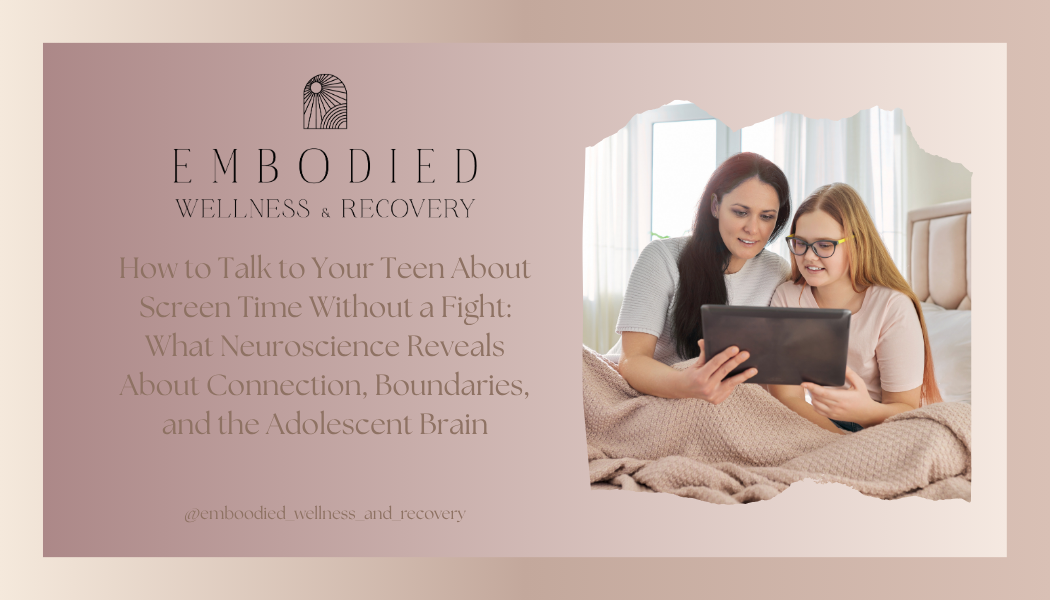
How to Talk to Your Teen About Screen Time Without a Fight: What Neuroscience Reveals About Connection, Boundaries, and the Adolescent Brain
How to Talk to Your Teen About Screen Time Without a Fight: What Neuroscience Reveals About Connection, Boundaries, and the Adolescent Brain
Struggling with constant battles over your teen's phone? Discover the neuroscience behind screen time, teen brain development, and practical parenting strategies to reduce conflict, strengthen connection, and set healthy digital boundaries.
Does every conversation about your teen's phone end in an argument?
Do you feel like you're constantly reminding, negotiating, or enforcing limits while your teen becomes increasingly defensive?
Have you found yourself wondering whether you're being too strict or not strict enough?
Perhaps you've noticed your teenspending hours scrolling social media, watching videos, gaming, or texting friends, and you're worried about what it's doing to their mental health, sleep, motivation, or relationships. Many parentsassume the conflict is about screens. Often, it is about something much deeper.
When parents and teens become locked in power struggles over technology, both sides can begin feeling misunderstood, frustrated, and emotionally disconnected. Understanding what is happening inside the adolescent brain can transform these conversations from battles into opportunities for greater trust and connection.
Why Screen Time Conversations Feel So Emotional
If you've ever asked your teen to put down their phone only to receive eye rolls, anger, or silence, you are not imagining the intensity. Adolescence is a period of profound neurological development.
During these years, the brain's reward system develops more rapidly than the areas responsible for planning, impulse control, and long-term decision-making. At the same time, teenagers become increasingly sensitive to peer relationships, social feedback, novelty, and belonging (Blakemore & Mills, 2014).
Social media platforms, gaming apps, and digital notifications are intentionally designed to engage these developing reward systems. To an adult, putting away a phone may feel like a simple request. To an adolescent brain, it can feel like being disconnected from an important social world. Recognizing this difference does not mean abandoning boundaries; it means approaching them with greater understanding.
The Real Problem Is Often Disconnection
Many parents tell us:
"I feel like I'm losing my child."
"They're always on their phone."
"We barely talk anymore."
"Everything turns into a fight."
These concerns reflect something deeper than screen time. They reflect a longing for connection. When conversations revolve only around rules, consequences, and monitoring, parents and teens often become trapped in a cycle of criticism and defensiveness. The goal is not simply to reduce screen time. The goal is to strengthen the relationship that enables healthy limits.
What Neuroscience Tells Us About Conflict
When your teen feels criticized, shamed, or controlled, their nervous system may shift into a defensive state.
Rather than engaging the parts of the brain responsible for reflection, empathy, and problem-solving, they may respond with:
— Arguing
— Shutting down
— Withdrawing
— Becoming sarcastic
— Escalating emotionally
The same is true for parents.
When you become frightened, frustrated, or overwhelmed, your own nervous system can shift into protection mode. Suddenly, the conversation is no longer about screen time. It becomes two nervous systems reacting to one another. This is why regulation matters as much as rules.
Five Ways to Talk About Screen Time Without a Fight
1. Connect Before You Correct
Before discussing limits, strengthen the relationship. Spend time together withouttalking about phones. Go for a walk. Cook dinner together. Ask about their interests. Research consistently shows that warm, supportive parent-child relationships are associated with healthier adolescent adjustment and greater openness to parental guidance(Steinberg, 2014). Children are more likely to accept influence from people with whom they feel emotionally connected.
2. Get Curious Instead of Assuming
Rather than beginning with:
"You're always on your phone."
Try:
"Help me understand what you enjoy most about being online."
You may discover that your teen is:
— Maintaining friendships
— Relieving stress
— Seeking belonging
— Escaping anxiety
— Exploring interests
Curiosity lowers defensiveness and opens the door to collaboration.
3. Explain the "Why"
Teens are far more likely to cooperate when they understand the reasoning behind expectations.
Instead of saying:
"Because I said so."
Try:
"I'm concerned about how late-night scrolling affects your sleep, mood, and concentration."
This communicates care rather than control.
4. Create Boundaries Together
Whenever possible, involve your teen in developing family technology guidelines.
Consider discussing:
— Device-free meals
— Phone-free bedrooms overnight
— Homework before entertainment
— Screen-free family time
— Healthy social media habits
Collaboration increases ownership.
5. Model the Behavior You Want to See
Children notice far more than they hear.
Ask yourself:
— Do I check my phone during conversations?
— Do I bring my phone to the dinner table?
— Am I fully present when my teen wants to talk?
Healthy technology habits begin with the adults in the home.
Address the Need Beneath the Screen
Technology often meets important emotional needs.
For some teens, screens provide:
— Connection
— Entertainment
— Escape
— Predictability
Simply removing the device without addressing those underlying needs often creates more conflict.
Instead, ask:
— What relationships help my teen feel connected?
— What activities help them feel confident?
— Where do they experience belonging offline?
When meaningful alternatives increase, excessive screen dependence often decreases.
What Parents Can Say Instead
Instead of:
"You're addicted to your phone."
Try:
"I've noticed you've seemed more stressed lately. How are you feeling?"
Instead of:
"Put your phone away right now."
Try:
"Let's take a break from screens and spend a little time together."
Instead of:
"You're wasting your life."
Try:
"I miss spending time with you."
These small shifts communicate connection rather than criticism.
When Screen Time Is a Symptom
Sometimes excessive screen use reflects more than habit.
It may be connected to:
— Anxiety
— Depression
— Loneliness
— Social difficulties
— Trauma
In these situations, focusing only on screen limits may overlook the deeper struggle. Understanding what your teen is seeking online can provide valuable insight into what they may need offline.
Supporting Families Through Connection
At Embodied Wellness and Recovery, we understand that parenting in the digital age can feel overwhelming. Our clinicians work with parents, teens, couples, and families using neuroscience-informed, trauma-sensitive approaches that strengthen communication, improve emotional regulation, and foster healthier relationships.
Whether your family is navigating anxiety, attachment challenges, conflict, or the growing influence of technology, our goal is to help parents move from power struggles toward meaningful connection.
Shifting Conversations with Your Teen from Winning to Guiding
The conversation about screen time is rarely just about screens. It is about trust, influence, belonging, and the relationship you are building with your teen. When parents approach these discussions with curiosity, empathy, clear boundaries, and an understanding of the adolescent brain, conversations become less about winning an argument and more about guiding a young person toward lifelong digital balance. Your influence grows not because you control every screen, but because your teen experiences you as a safe, steady, and trusted guide.
Reach out to schedule a complimentary 20-minute consultation with our team of therapists, trauma specialists, somatic practitioners, or relationship experts and start working towards integrative, embodied healing today.
📞 Call us at (310) 651-8458
📱 Text us at (310) 210-7934
📩 Email us at admin@embodiedwellnessandrecovery.com
🔗 Visit us at www.embodiedwellnessandrecovery.com
👉 Check us out on Instagram @embodied_wellness_and_recovery
🌍 Explore our offerings at Linktr.ee: https://linktr.ee/laurendummit
References
Blakemore, S. J., & Mills, K. L. (2014). Is adolescence a sensitive period for sociocultural processing? Annual Review of Psychology, 65, 187-207.
Odgers, C. L., & Jensen, M. R. (2020). Annual Research Review: Adolescent mental health in the digital age. Journal of Child Psychology and Psychiatry, 61(3), 336-348.
Porges, S. W. (2021). Polyvagal safety: Attachment, communication, self-regulation. W. W. Norton & Company.
Steinberg, L. (2014). Age of opportunity: Lessons from the new science of adolescence. Houghton Mifflin Harcourt.
Siegel, D. J. (2020). The developing mind: How relationships and the brain interact to shape who we are (3rd ed.). Guilford Press.
Summer Burnout Is Real: The Neuroscience Behind Social Overload, Anxiety, and Why Too Much Fun Can Leave You Emotionally Exhausted
Summer Burnout Is Real: The Neuroscience Behind Social Overload, Anxiety, and Why Too Much Fun Can Leave You Emotionally Exhausted
Feeling exhausted by summer parties, vacations, weddings, and endless social plans? Discover the neuroscience behind summer social burnout, why your nervous system feels overwhelmed, and how to protect your mental health while staying connected.
Summer is often portrayed as the happiest season of the year.
Long evenings.
Family vacations.
Barbecues.
Pool parties.
Weekend trips.
Neighborhood gatherings.
Children's activities.
Weddings.
Reunions.
Celebrations.
From the outside, it can seem like everyone else is enjoying every moment, yet many people quietly experience something very different.
Exhaustion.
Overwhelm.
Guilt.
A growing desire to cancel plans and simply stay home.
Have you ever found yourself wondering:
Why do I feel stressed when I'm supposed to be having fun?
Why does my social battery seem completely drained?
Why do I secretly hope plans get canceled?
Why do I feel guilty saying no to invitations?
Why do I need so much time alone after spending time with people I genuinely love?
If these questions resonate, you are experiencing something many people rarely talk about: summer social burnout. The problem isn't that you dislike people. The problem may be that your nervous system has reached its capacity.
Why Summer Can Feel Emotionally Exhausting
Unlike the structured routines of much of the year, summer often brings an explosion of social obligations.
Birthday parties.
Graduation celebrations.
Holiday weekends.
Travel.
Hosting guests.
Neighborhood events.
Family reunions.
Children home from school.
The calendar fills quickly, often leaving very little time for rest or recovery. Although these experiences can be meaningful, they also require energy.
Every conversation.
Every decision.
Every crowded gathering.
Every change in routine asks something of your brain.
Without enough recovery time, emotional fatigue begins to accumulate.
Your Brain Was Never Designed for Constant Social Stimulation
From a neuroscience perspective, every social interaction requires significant cognitive and emotional resources. Your brain is continuously interpreting facial expressions, tone of voice, body language, social expectations, and emotional cues. At the same time, it is regulating your own emotions, monitoring conversations, making decisions, and adapting to constantly changing environments.
Large gatherings, travel, noise, disrupted sleep, and unpredictable schedules further increase the brain's workload. Eventually, your nervous system begins signaling that it needs rest. Unfortunately, many people interpret these signals as laziness, selfishness, or social failure. In reality, they are often signs of nervous system fatigue.
When Your Nervous System Never Gets a Chance to Recover
Stress itself is not necessarily harmful. The nervous system is designed to move into activation when life requires extra energy. The challenge arises when activation never has a chance to settle.
Imagine spending every weekend at social events.
Every evening meeting friends.
Every holiday traveling.
Every free afternoon running errands or attending children's activities. Even enjoyable experiences can become physiologically demanding when they occur without adequate restoration. Research suggests that chronic stress and insufficient recovery contribute to emotional exhaustion, reduced concentration, irritability, sleep disruption, and burnout (Khammissa et al., 2022). Sometimes the problem isn't doing difficult things. It's doing too many things without enough space in between.
Why Saying "No" Feels So Difficult
Many people recognize they are overwhelmed. Yet they continue saying yes.
Why?
For some, declining an invitation creates anxiety. They worry about disappointing others, being perceived as selfish, missing out, damaging relationships. appearing antisocial. For individuals with histories of trauma, people pleasing, or insecure attachment, saying no may activate fears of rejection, abandonment, or conflict.
The nervous system quietly concludes:
"If I disappoint someone, the relationship may no longer feel safe."
As a result, people continue accepting invitations despite feeling emotionally depleted. Over time, resentment often replaces enjoyment.
Summer Burnout Can Affect Relationships
Ironically, excessive socializing can begin reducing the very connection we hope to create. When the nervous system becomes overwhelmed, we often become:
Less patient.
More irritable.
Emotionally unavailable.
Easily overstimulated.
Less interested in physical intimacy.
More likely to withdraw.
Partners may mistakenly assume these changes reflect problems within the relationship. Often they reflect a nervous system that simply needs recovery. Emotional connection thrives when both individuals have enough internal resources to be fully present.
Social Exhaustion Does Not Mean You're an Introvert
Social burnout affects both introverts and extroverts. The difference often lies in how each person restores energy. Some recover through quiet solitude. Others do so through exercise, time outdoors. reading, creative hobbies, mindfulness, or meaningful one-on-one conversations. The goal is not to eliminate social connection; it’s to balance connection with restoration. Your nervous system needs both.
What Neuroscience Suggests Helps
Protecting your mental health during busy seasons does not require withdrawing from life. It requires becoming more intentional.
Ask yourself:
"Do I actually want to attend this event?"
"Am I saying yes because I feel obligated?"
"Have I scheduled any recovery time this week?"
"What helps my nervous system feel calm?"
Small changes can make a remarkable difference. Consider scheduling quiet mornings after busy evenings or leaving some weekends completely unscheduled. Take walks without your phone. Spend time in nature. Practice slow breathing. Allow yourself permission to decline invitations that exceed your emotional capacity. Boundaries are not barriers to connection. They are often what make genuine connection sustainable.
Therapy Can Help You Understand Why Rest Feels So Hard
For many individuals, burnout is not simply about having too many commitments. It reflects deeper patterns.
Perfectionism.
Fear of disappointing others.
Difficulty identifying personal needs.
Chronic hypervigilance.
Therapy provides an opportunity to understand how these patterns developed and to help the nervous system discover healthier ways of responding.
At Embodied Wellness and Recovery, we integrate neuroscience, trauma-informed care, attachment theory, and nervous system regulation to help individuals create lives that include both meaningful relationships and meaningful rest. When people begin to understand the biology behind burnout, they often replace self-criticism with curiosity. That shift creates space for healthier boundaries, greater emotional resilience, and deeper connection with themselves and the people they love.
Final Thoughts
Summer offers beautiful opportunities for connection, celebration, and joy. It also asks a great deal of our brains and nervous systems. Feeling emotionally exhausted does not necessarily mean you're doing something wrong. It may simply mean your nervous system is asking for the same care and attention you so generously offer everyone else.
Sometimes the healthiest decision is not accepting one more invitation. Sometimes it is creating enough space for your mind, body, and relationships to recover. Ironically, those moments of rest often make it possible to enjoy the next gathering with greater presence, energy, and genuine connection.
At Embodied Wellness and Recovery, we believe wellness is not measured by how full your calendar becomes. It is reflected in your ability to remain emotionally present, physically regulated, and authentically connected to yourself and the people who matter most.
Recovery Is Not a Luxury. It Is a Biological Need
Many people believe they simply need to become "better" at managing a busy social calendar. In reality, your brain and nervous system were never designed for constant stimulation without periods of recovery. Just as your muscles need rest after exercise, your nervous system needs opportunities to downshift after sustained activation.
Recovery is where the brain processes experiences, regulates emotions, restores attention, and recalibrates the stress response. Without it, emotional fatigue accumulates, making even enjoyable activities begin to feel draining. Ironically, protecting your energy often allows you to become more present for the people and experiences you value most.
The Difference Between Solitude and Isolation
When people begin feeling socially burned out, they sometimes worry that wanting time alone means something is wrong. It does not. There is an important difference between healthy solitude and emotional isolation. Healthy solitude restores your nervous system. Isolation disconnects you from meaningful relationships.
Restorative solitude may include:
— Reading a book.
— Walking in nature.
— Practicing yoga or mindfulness.
— Gardening.
— Listening to music.
— Spending quiet time with your pet.
— Journaling.
— Sitting outside without an agenda.
These moments allow the brain to shift away from constant social processing and return to a more regulated state.
Protect Your "Social Battery"
Think of your emotional energy as a rechargeable battery. Every interaction requires some amount of energy. Large parties may require more. Travel may require even more. Hosting guests may require the most. If you continue giving without intentionally recharging, your battery eventually reaches empty.
Instead of waiting until you feel completely exhausted, ask yourself throughout the week:
How full is my social battery today?
What would help me recharge before my next commitment?
Checking in with yourself before automatically saying yes can prevent burnout before it begins.
Boundaries Protect Relationships
Many people fear that setting boundaries will disappoint others. In reality, healthy boundaries often strengthen relationships because they allow us to show up with greater patience, authenticity, and presence.
Consider replacing:
"I have to go."
With:
"I'd love to join you for a couple of hours."
Or:
"Thank you for thinking of me. I'm going to stay home and recharge tonight."
Boundaries communicated with warmth and honesty often deepen trust rather than diminish it. They teach others what helps you remain emotionally healthy.
Reducing the Pressure to Do It All
Social media often creates the illusion that everyone else is saying yes to every opportunity.
The vacations.
The concerts.
The festivals.
The weekend trips.
The neighborhood gatherings.
What we rarely see are the moments afterward.
The exhaustion.
The overstimulation.
The need for recovery.
Remember that your life does not have to resemble someone else's highlight reel. Choosing fewer experiences that you genuinely enjoy is often far more nourishing than trying to attend everything.
Small Daily Practices That Calm the Nervous System
The nervous system responds best to consistency rather than intensity. Simple daily practices can make a meaningful difference.
Try incorporating:
— Five minutes of slow diaphragmatic breathing.
— Morning sunlight exposure.
— Gentle movement or stretching.
— Walking outdoors.
— Consistent sleep routines.
— Limiting digital stimulation before bed.
— Brief moments of intentional stillness throughout the day.
These practices help shift the nervous system out of chronic activation and create greater resilience during busy seasons.
When Burnout Reflects Something Deeper
Sometimes social exhaustion is not solely about an overbooked calendar. It may reflect longstanding patterns that deserve compassionate attention. Perhaps you've spent years believing your worth depends on being available to everyone. Perhaps you've learned to prioritize other people's comfort over your own needs. Perhaps slowing down feels unfamiliar because your nervous system has become accustomed to constant activity. Perhaps rest feels uncomfortable because silence leaves space for emotions you've been avoiding.
Therapy offers an opportunity to gently explore these patterns while developing healthier ways of caring for yourself. Understanding why boundaries feel difficult often makes them easier to practice.
How Therapy Can Help
At Embodied Wellness and Recovery, we recognize that burnout is rarely just about time management. It is often about the relationship between the brain, the nervous system, trauma history, attachment experiences, and emotional safety.
Our approach integrates neuroscience, trauma-informed therapy, attachment theory, and nervous system regulation to help individuals:
— Recognize the early signs of burnout.
— Understand their unique stress responses.
— Reduce people-pleasing and perfectionistic patterns.
— Develop healthier boundaries.
— Strengthen emotional regulation.
— Improve communication in relationships.
— Create sustainable rhythms of connection and restoration.
Rather than simply helping people become more productive, we help them build lives that support emotional well-being, meaningful relationships, and lasting resilience.
Investing in Yourself
Summer offers countless opportunities to celebrate, reconnect, and create lasting memories. It can also become one of the busiest and most emotionally demanding seasons of the year. If your calendar feels full but your emotional reserves feel empty, your nervous system may be asking for something profoundly important.
Rest.
Recovery.
Space to breathe.
Choosing to slow down is not selfish.
It is an investment in your mental health, your relationships, and your ability to remain fully present for the experiences that matter most. When your nervous system feels supported, connection becomes less exhausting and more fulfilling. The goal of summer is not to attend every gathering; it’s to create a life that allows you to enjoy the moments you choose with genuine presence, energy, and joy.
Reach out to schedule a complimentary 20-minute consultation with our team of therapists, trauma specialists, somatic practitioners, or relationship experts and start working towards integrative, embodied healing today.
📞 Call us at (310) 651-8458
📱 Text us at (310) 210-7934
📩 Email us at admin@embodiedwellnessandrecovery.com
🔗 Visit us at www.embodiedwellnessandrecovery.com
👉 Check us out on Instagram @embodied_wellness_and_recovery
🌍 Explore our offerings at Linktr.ee: https://linktr.ee/laurendummit
References
American Psychological Association. (2023). Stress in America™ 2023: A nation recovering from collective trauma.
Maslach, C., & Leiter, M. P. (2000). The truth about burnout: How organizations cause personal stress and what to do about it. John Wiley & Sons.
Porges, S. W. (2022). Polyvagal theory: A science of safety. Frontiers in Integrative Neuroscience, 16, 871227.
Siegel, D. J. (2020). The developing mind: How relationships and the brain interact to shape who we are (3rd ed.). Guilford Press.
van der Kolk, B. A. (2014). The body keeps the score: Brain, mind, and body in the healing of trauma. Viking.
World Health Organization. (2019). Burn-out an "occupational phenomenon": International Classification of Diseases.
Why Financial Stress Hurts Relationships: The Neuroscience Behind Money Fights, Emotional Disconnection, and How Couples Counseling Can Help
Why Financial Stress Hurts Relationships: The Neuroscience Behind Money Fights, Emotional Disconnection, and How Couples Counseling Can Help
Financial stress can strain even the strongest relationships. Learn how money anxiety affects the brain, communication, intimacy, and emotional safety, and discover how couples counseling can help partners reconnect through neuroscience-informed care.
Money is rarely just about money.
For many couples, financial stress quietly becomes one of the most painful and persistent sources of conflictin their relationship. What may begin as disagreements over budgeting, debt, spending, or saving can gradually evolve into criticism, defensiveness, emotional withdrawal, resentment, and loneliness.
Perhaps you've caught yourself wondering:
Why do we keep having the same argument about money?
Why does every financial conversation end in frustration?
Why do I feel so alone, even though we're facing the same financial challenges?
Why do we seem more like opponents than teammates?
Why has financial stress affected our emotional and physical intimacy?
If these questions feel familiar, you are far from alone. Financial stress is consistently ranked among the leading sources of conflict in long-term relationships. Yet the issue often extends far beyond dollars and cents.
More often, money arguments reflect something much deeper.
Safety.
Security.
Control.
Identity.
Hope for the future.
Understanding what happens inside the brain during periods of financial stress can help couples approach these conversations with greater compassion and insight.
Financial Stress Changes More Than Your Bank Account
When finances become uncertain, many couples notice changes they never expected. They become more irritable. Small disagreements escalate more quickly. Patience becomes harder to access. Communication feels increasingly strained. Affection decreases. Sexual desire often declines. Decision-making becomes exhausting. Partners begin assuming the worst about each other's intentions.
Over time, many couples describe feeling emotionally disconnected despite deeply loving one another. This pattern is not simply about poor communication. It is often the result of chronic stress affecting the brain and nervous system.
Why Money Activates the Brain's Threat Response
From a neuroscience perspective, financial uncertainty represents more than an economic concern. The brain frequently interprets it as a potential survival threat. Throughout human history, access to resources has been closely connected to safety, shelter, food, and protection. Although modern financial concerns may look different, the brain often responds in remarkably similar ways.
When financial uncertainty increases, the amygdala becomes more vigilant. Stress hormones such as cortisol rise. The nervous system shifts toward protection rather than connection. In this state, the brain becomes increasingly focused on detecting problems rather than nurturing relationships. Partners may become more reactive, less patient, and more likely to misinterpret one another's intentions. This is why financial conversations that begin calmly can quickly become emotionally charged.
Why Couples Often Fight About Different Things Than They Think
Many couples believe they are arguing about spending habits.
Or budgeting.
Or credit card debt.
Or retirement planning.
In reality, those conversations often represent deeper emotional concerns.
One partner may be asking:
"Will we be okay?"
Another may be wondering:
"Can I trust you?"
Someone else may be thinking:
"Why don't you understand how scared I am?"
Money often becomes the languagecouples use to express fears they struggle to articulate directly. Without recognizing these underlying emotions, partners often remain stuck arguing about numbers instead of addressing the emotional needs beneath them.
Financial Stress Often Triggers Old Wounds
Our relationship with money rarely begins in adulthood. It often begins in childhood. Some people grew up in homes where money was scarce. Others witnessed frequent conflict about finances. Some experienced financial instability. Others learned that achievement and income determined worth. Still others grew up believing that discussing money was shameful or dangerous.
These early experiences shape the nervous system's expectations around financial security. As adults, current financial stress may reactivate those earlier emotional experiences. Someone raised in poverty may experience intense anxiety over relatively minor financial setbacks. Someone who grew up with financially controlling parents may react strongly when a partner questions spending. Neither response necessarily reflects the present moment alone. Often, it reflects both the present and the past.
Attachment Styles Influence Financial Conflict
Attachment theory also helps explain why couples experience money differently. Individuals with anxious attachment may become increasingly worried about future security. They may seek reassurance through frequent financial discussions. Partners with more avoidant attachment patterns may withdraw from these conversations altogether, particularly if they feel criticized or overwhelmed.
Unfortunately, these responses often reinforce one another. One partner pursues. The other withdraws. The more one partner pushes for answers, the more the other shuts down. Eventually, both individuals feel misunderstood. The conflict appears to be about finances, yet the deeper issue is emotional safety.
Financial Anxiety Can Affect Physical Intimacy
Many couples are surprised to discover that financial stress also affects their sex life. This relationship makes perfect sense from a neuroscience perspective.Sexual desire generally flourishes when the nervous system experiences safety, connection, curiosity, and relaxation. Chronic financial stress often produces the opposite experience. When stress hormones remain elevated, the brain prioritizes protection rather than pleasure.
Partners may notice:
— Decreased sexual desire
— Less affection
— Reduced emotional availability
— Difficulty relaxing
— Increased irritability
— Feeling emotionally distant
The problem is rarely that couples have stopped loving one another. More often, their nervous systems have become overwhelmed by chronic stress.
The Hidden Cost of Financial Stress
Perhaps the greatest cost of financial stress is not the money itself. It is what chronic stress slowly steals from the relationship.
Laughter.
Emotional connection.
Teamwork.
Curiosity.
Playfulness.
Hope.
Many couples begin viewing each other as obstacles rather than allies.
They stop asking:
"How can we solve this together?"
Instead, they begin asking:
"Why are you making this harder?"
That subtle shift can gradually erode emotional safety, making productive conversations feel increasingly difficult. The encouraging news is that this pattern is not permanent. Understanding how the brain and nervous system respond to financial stress creates opportunities for couples to interrupt these cycles and reconnect in healthier, more compassionate ways.
Emotional Safety Matters More Than Financial Perfection
Many couples believe their relationship will improve once they earn more money, eliminate debt, or finally feel financially secure. While improving financial circumstances can certainly reduce stress, research suggests that the quality of a couple's relationship often depends less on the size of their bank account and more on how they navigate stress together.
In other words, emotional safety matters. When partners feel emotionally safe, they are more likely to approach financial conversations with curiosity rather than criticism, collaboration rather than competition, and empathy rather than defensiveness. Emotional safety allows the brain to remain engaged in thoughtful problem solving instead of shifting into survival mode. This is one of the most important goals of couples counseling.
What Happens When Couples Feel Emotionally Safe?
When emotional safety increases, the nervous system begins to settle. The brain becomes less focused on detecting threats and more capable of perspective taking, empathy, and flexible thinking.
Partners are more likely to:
— Listen without immediately preparing a defense.
— Express vulnerability instead of blame.
— Ask questions instead of making assumptions.
— Work together to solve problems.
— Repair misunderstandings more quickly.
— Maintain emotional and physical intimacy despite ongoing stress.
Financial problems may still exist. The relationship begins to feel stronger because the couple experiences themselves as a team.
From "Me Versus You" to "Us Versus the Problem"
One of the most powerful shifts couples make in therapy is changing the question.
Instead of asking:
"Who's responsible for this?"
They begin asking:
"How can we face this together?"
This subtle change transforms the emotional tone of financial conversations. The problem is no longer your partner. The problem becomes the financial challenge itself. This collaborative mindset reduces defensiveness while strengthening trust and partnership.
Understanding Your Money Story
Every individual carries a personal "money story." These stories develop through early family experiences, cultural messages, significant life events, and previous relationships.
For example:
— Was money associated with fear?
— Was financial success tied to self-worth?
— Were emotions discussed openly in your family?
— Did one parent control all financial decisions?
— Was spending viewed as irresponsible?
— Was saving associated with security?
Most couples bring two very different money stories into the same relationship. Neither story is inherently right or wrong. The challenge arises when partners assume their perspective is the only logical one. Couples counseling helps partners explore these narratives with curiosity rather than judgment.
Nervous System Regulation Before Problem Solving
One of the biggest mistakes couples make is attempting to solve financial problems while both nervous systems are highly activated. When heart rate increases and stress hormones rise, the brain becomes less capable of logical reasoning. This is whyconversations often become repetitive. Partners stop listening. They misunderstand each other's intentions. They repeat the same arguments. Effective couples therapy often begins with regulation before resolution.
This may involve:
— Slowing the pace of the conversation.
— Taking intentional breaks when emotions become overwhelming.
— Practicing calming breathing techniques.
— Naming emotions instead of acting them out.
— Returning to the discussion once both partners feel more grounded.
A regulated brain is far more capable of collaborative problem solving.
Communication That Builds Connection
Financial conversations become more productive when partners shift from accusation to vulnerability.
Instead of saying:
"You spend too much money."
A partner might say:
"I'm feeling scared about our financial future, and I'd like us to figure this out together."
Instead of:
"You never think ahead."
They might say:
"Financial uncertainty makes me anxious because stability is very important to me."
This type of communication invites connection rather than defensiveness. It helps partners understand the emotions beneath the behavior.
Financial Stress Does Not Mean Relationship Failure
Many couples interpret ongoing financial conflict as evidence that something is fundamentally wrong with their relationship. In reality, financial stress places enormous pressure on even healthy partnerships. The question is not whether stress will occur. Every relationship encounters seasons of uncertainty.
The more meaningful question is how partners respond when stress arrives. Couples who remain curious, emotionally responsive, and committed to repairing misunderstandings often emerge from difficult seasons feeling even more connected than before.
How Couples Counseling Can Help
Couples therapy provides far more than communication techniques. It offers a space where both partners can better understand themselves and each other.
At Embodied Wellness and Recovery, we help couples recognize that many financial conflicts are rooted in nervous system responses rather than character flaws. Using neuroscience-informed, trauma-informed, and attachment-based approaches, we help couples:
— Understand how chronic stress affects communication.
— Identify emotional triggers beneath money conflicts.
— Improve nervous system regulation.
— Increase emotional safety.
— Strengthen trust and teamwork.
— Reduce criticism, defensiveness, and withdrawal.
— Rebuild emotional and physical intimacy.
— Develop healthier patterns for discussing finances.
— Approach future challenges as partners rather than adversaries.
When couples understand the science behind their reactions, conflict often becomes less personal and easier to understand. That understanding creates space for compassion, collaboration, and meaningful change.
Remaining Emotional Connection
Financial stress can reshape how couples think, communicate, and connect, yet it does not have to define a relationship's future. The strongest relationships are not those that never encounter financial hardship. They are relationships in which partners learn to remain emotionally connected as they navigate life's inevitable uncertainties together.
When couples begin understanding the neuroscience of stress, attachment, and emotional safety, financial conversations become less about winning an argument and more about protecting the relationship. Over time, trust grows. Communication becomes more compassionate. The nervous system learns that difficult conversations do not have to threaten connection.
Money may remain an important topic, but it is no longer the measure of the relationship's strength. Instead, the relationship itself becomes the foundation from which couples face financial challenges with greater resilience, understanding, and hope.
Reach out to schedule a complimentary 20-minute consultation with our team of therapists, trauma specialists, somatic practitioners, or relationship experts and start working towards integrative, embodied healing today.
📞 Call us at (310) 651-8458
📱 Text us at (310) 210-7934
📩 Email us at admin@embodiedwellnessandrecovery.com
🔗 Visit us at www.embodiedwellnessandrecovery.com
👉 Check us out on Instagram @embodied_wellness_and_recovery
🌍 Explore our offerings at Linktr.ee: https://linktr.ee/laurendummit
References
Conger, R. D., Conger, K. J., & Martin, M. J. (2010). Socioeconomic status, family processes, and individual development. Journal of Marriage and Family, 72(3), 685-704.
Falconier, M. K., Jackson, J. B., Hilpert, P., & Bodenmann, G. (2015). Dyadic coping and relationship satisfaction: A meta-analysis. Clinical Psychology Review, 42, 28-46.
Gottman, J. M., & Silver, N. (2015). The seven principles for making marriage work (Revised ed.). Harmony Books.
Gottman, J. S., & Gottman, J. (2024). Fight right: How successful couples turn conflict into connection. Harmony.
Karney, B. R., & Bradbury, T. N. (2020). Research on marital satisfaction and stability in the 2010s: Challenging conventional wisdom. Journal of Marriage and Family, 82(1), 100-116.
Maslach, C., & Leiter, M. P. (2000). The truth about burnout: How organizations cause personal stress and what to do about it. John Wiley & Sons.
Porges, S. W. (2022). Polyvagal theory: A science of safety. Frontiers in Integrative Neuroscience, 16, 871227.
Siegel, D. J. (2020). The developing mind: How relationships and the brain interact to shape who we are (3rd ed.). Guilford Press.
van der Kolk, B. A. (2014). The body keeps the score: Brain, mind, and body in the healing of trauma. Viking.
How Trauma Affects Trust in New Relationships: The Neuroscience Behind Trust Issues, Emotional Safety, and Lasting Love
How Trauma Affects Trust in New Relationships: The Neuroscience Behind Trust Issues, Emotional Safety, and Lasting Love
Struggling to trust in a new relationship after trauma? Discover how past experiences shape the brain, nervous system, and attachment patterns, and learn how trauma-informed therapy can help you build emotional safety, healthier relationships, and lasting intimacy.
You genuinely want to trust your new partner. They've been kind, consistent, and emotionally available. They've given you no obvious reason to doubt them. Yet your mind keeps asking questions:
What if they leave?
What if they're hiding something?
What if I'm missing the warning signs?
Perhaps you notice yourself overanalyzing text messages, seeking constant reassurance, withdrawing when you begin feeling vulnerable, or becoming anxious whenever your partner needs space. You may even find yourself sabotaging the very relationship you've been hoping to find.
If this sounds familiar, you're not simply "overthinking." Your nervous system may be doing exactly what it learned to do in order to protect you. When trauma shapes our early experiences of relationships, trust often becomes far more complicated than simply deciding to believe another person. Neuroscience demonstrates that trust is not merely a conscious choice. It is a physiological process involving the brain, the nervous system, memory, and attachment.
Understanding these processes can transform how you view yourself and your relationships.
Does Any of This Feel Familiar?
Perhaps you've found yourself wondering:
— Why do I struggle to trust people who treat me well?
— Why do I assume the worst in relationships?
— Why do I push people away when they get close?
— Why do I become anxious when my partner doesn't respond immediately?
— Why do I expect rejection even when things are going well?
— Why do I constantly need reassurance?
— Why do I lose myself trying to prevent someone from leaving?
— Why do I feel emotionally overwhelmed in healthy relationships?
These questions are more common than many people realize. They often reflect the lasting effects of trauma on the brain and nervous system.
Trust Begins in the Brain
We often think of trust as a decision. Neuroscience suggests it is also a prediction.
Your brain continuously asks:
"Is this person emotionally safe?"
To answer that question, it draws upon:
— Past relationships
— Childhood experiences
— Emotional memories
— Attachment patterns
— Previous betrayals
If your history taught your brain that closeness often led to pain, abandonment, criticism, inconsistency, or betrayal, your brain may continue expecting those outcomes, even in a healthy relationship. This is not irrational. It is adaptive learning.
Trauma Changes How the Brain Detects Safety
Traumatic experiences influence several brain regions involved in relationships. The amygdala becomes more sensitive to potential threats. The hippocampus influences how emotional memories are stored and retrieved. The prefrontal cortex, responsible for flexible thinking and emotional regulation, may have greater difficulty calming fear responses during periods of stress. As a result, seemingly neutral situations may trigger intense emotional reactions.
A delayed text.
A canceled date.
A change in tone.
The logical mind may recognize these events as relatively minor. The nervous system may interpret them very differently.
Your Nervous System Remembers What Your Mind May Not
According to Polyvagal Theory, developed by neuroscientist Stephen Porges, the nervous system constantly scans the environment for cues of safety or danger. This process occurs largely outside conscious awareness. When previous relationships involved betrayal, emotional neglect, criticism, manipulation, or abuse, the nervous system often becomes highly efficient at detecting possible threats.
Sometimes it detects danger accurately. Sometimes it mistakes unfamiliar safety for potential risk. Healthy love can initially feel surprisingly uncomfortable because it differs from what the nervous system has learned to expect.
Trauma Often Creates Protective Relationship Patterns
These protective strategies originally served an important purpose. Unfortunately, they can create challenges in healthy relationships.
Hypervigilance
Constantly scanning for signs that something is wrong.
Reading deeply into text messages.
Watching facial expressions.
Searching for hidden meanings.
Reassurance Seeking
Repeatedly asking:
"Are we okay?"
"Do you still love me?"
"Are you mad at me?"
Although reassurance provides temporary relief, the underlying anxiety often returns.
Emotional Withdrawal
Some individuals protect themselves differently. Rather than becoming anxious, they distance themselves emotionally. They avoid vulnerability. They minimize their needs. They convince themselves they don't need anyone.
Testing the Relationship
Some people unconsciously test whether a partner will stay.
They may withdraw.
Create conflict.
Push their partner away.
Not because they want the relationship to end.
But because they want reassurance that it won't.
Attachment Shapes Adult Relationships
Attachment research demonstrates that early caregiving experiences influence expectations about relationships throughout adulthood (Cassidy, 2000). When caregivers were consistently responsive, individuals often develop greater confidence that others can be trusted. When caregiving was unpredictable, frightening, emotionally unavailable, or inconsistent, attachment systems often become organized around protection rather than connection.
This does not determine your future. It simply helps explain your starting point. Fortunately, attachment patterns can change throughout life.
Why Healthy Relationships Can Feel So Uncomfortable
This surprises many people. A healthy relationship may actually activate anxiety.
Why?
Because predictability feels unfamiliar.
Consistency feels uncertain.
Kindness feels suspicious.
Respect feels unexpected.
The nervous system often prefers what is familiar rather than what is healthy. Healing frequently involves helping the nervous system recognize that these are not always the same thing.
The Difference Between Intuition and Trauma
One of the most difficult challenges after trauma is distinguishing intuition from fear.
Intuition tends to feel:
— Calm
— Grounded
— Clear
— Steady
Trauma responses often feel:
— Urgent
— Catastrophic
— Reactive
— Emotionally overwhelming
Therapy can help individuals learn to recognize these differences while strengthening trust in themselves.
The Neuroscience of Building Trust
Trust develops gradually. Each emotionally safe interaction creates new learning for the brain. Neuroplasticity allows the nervous system to update its predictions over time.
Moments such as:
— A reliable promise kept
— Honest communication
— Emotional responsiveness
— Respect for boundaries
become evidence that relationships can feel different from the past. The brain slowly begins replacing old predictions with new ones.
How Therapy Can Help
At Embodied Wellness and Recovery, we understand that trust is not simply a mindset. It is a nervous system experience.
Our trauma-informed, neuroscience-based approach helps individuals explore how attachment history, relational trauma, chronic stress, and the nervous system influence present-day relationships.
Through evidence-based therapies that integrate neuroscience, attachment theory, somatic approaches, and relationship counseling, clients learn to:
— Recognize trauma-driven relationship patterns.
— Regulate their nervous system during moments of relational stress.
— Strengthen emotional awareness.
— Build healthier boundaries.
— Increase self-trust.
— Develop greater capacity for vulnerability.
— Create more secure, connected relationships.
Healing trust is not about convincing yourself that everyone is safe. It is about helping your brain and body better recognize genuine safety when it is present.
How the Brain is Capable of Learning Trust
Trauma does not simply change what happened in the past. It can shape what feels possible in the present. The encouraging news is that the same brain capable of learning fear is also capable of learning trust.
Each emotionally safe relationship.
Each repaired conflict.
Each moment of vulnerability met with kindness.
Each opportunity to experience consistency rather than unpredictability.
These experiences gradually teach the nervous system a new story.
One in which closeness no longer automatically signals danger.
One in which trust becomes less about ignoring risk and more about recognizing safety.
Over time, relationships can become places where protection slowly gives way to connection, allowing intimacy, confidence, and emotional security to grow.
Reach out to schedule a complimentary 20-minute consultation with our team of therapists, trauma specialists, somatic practitioners, or relationship experts and start working towards integrative, embodied healing today.
📞 Call us at (310) 651-8458
📱 Text us at (310) 210-7934
📩 Email us at admin@embodiedwellnessandrecovery.com
🔗 Visit us at www.embodiedwellnessandrecovery.com
👉 Check us out on Instagram @embodied_wellness_and_recovery
🌍 Explore our offerings at Linktr.ee: https://linktr.ee/laurendummit
References
Bowlby, J. (1988). A secure base: Parent-child attachment and healthy human development. Basic Books.
Cassidy, J. (2000). Adult romantic attachments: A developmental perspective on individual differences. Review of general psychology, 4(2), 111-131.
Mikulincer, M., & Shaver, P. R. (2016). Attachment in adulthood: Structure, dynamics, and change (2nd ed.). Guilford Press.
Porges, S. W. (2022). Polyvagal theory: A science of safety. Frontiers in Integrative Neuroscience, 16, 871227.
Siegel, D. J. (2020). The developing mind: How relationships and the brain interact to shape who we are (3rd ed.). Guilford Press.
Van der Kolk, B. A. (2014). The body keeps the score: Brain, mind, and body in the healing of trauma. Viking.
Menopause Brain Fog Is Real: New Research Reveals What Happens to the Brain During Perimenopause and Menopause
Menopause Brain Fog Is Real: New Research Reveals What Happens to the Brain During Perimenopause and Menopause
Struggling with menopause brain fog, memory problems, or difficulty concentrating? Discover what new neuroscience research reveals about the menopausal brain, why cognitive changes occur during perimenopause and menopause, and evidence-based strategies that support brain health, nervous system regulation, and emotional well-being.
Have you ever walked into a room and forgotten why?
Lost your train of thought halfway through a sentence?
Struggled to remember names, appointments, or the right word at exactly the wrong moment?
Do you find yourself wondering:
Is this normal?
Am I developing dementia?
Why can't I think as clearly as I used to?
Is menopause affecting my brain?
For millions of women, these experiences are not simply frustrating. They can feel frightening.
The encouraging news is that a growing body of neuroscience research confirms what many women have been saying for years:
“Menopause brain fog is real.”
Researchers are now uncovering remarkable changes occurring within the brain during perimenopause and menopause. These discoveries are helping clinicians better understand why cognitive symptoms occur and, perhaps more importantly, why they are often temporary and treatable.
What Is Menopause Brain Fog?
Brain fog is not a medical diagnosis.
Instead, it describes a collection of cognitive symptoms that commonly occur during perimenopause and menopause.
Women frequently report:
— Forgetfulness
— Trouble finding words
— Mental fatigue
— Slower processing speed
— Difficulty multitasking
— Reduced attention
— Losing track of conversations
— Feeling mentally "foggy"
Although these symptoms vary in severity, studies suggest they affect a substantial proportion of women during the menopausal transition.
What Scientists Recently Discovered About the Menopausal Brain
Recent neuroimaging research has transformed our understanding of menopause. Researchers have observed measurable changes in brain structure, connectivity, and energy metabolism during perimenopause and menopause.
One groundbreaking study led by neuroscientist Dr. Lisa Mosconi found that menopause is associated with dynamic brain changes involving regions responsible for memory, learning, attention, and executive functioning.
Importantly, these findings suggest that many of the changes represent adaptation rather than permanent decline. Rather than signaling that the brain is deteriorating, menopause appears to represent a period of neurological remodeling as the brain adjusts to changing hormone levels (Mosconi et al., 2021).
Why Estrogen Matters for Brain Health
Estrogen does much more than regulate reproduction. It also plays an important role in brain function.
Estrogen helps support:
— Memory formation
— Learning
— Neural communication
— Brain energy metabolism
— Synaptic plasticity
— Emotional regulation
As estrogen levels fluctuate during perimenopause and decline during menopause, the brain must adapt to a new hormonal environment. Researchers believe these changes contribute to many of the cognitive symptoms women experience.
Why Brain Fog Often Feels Worse During Perimenopause
Perimenopause is characterized by fluctuating hormone levels rather than consistently low estrogen. Ironically, these unpredictable hormonal shifts may contribute to greater cognitive disruption than menopause itself.
Many women describe good days and bad days.
One morning, they feel mentally sharp.
The next day, they struggle to remember simple words.
These fluctuations often reflect changing neurobiology rather than personal shortcomings.
Brain Fog Is About More Than Hormones
Hormonal changes tell only part of the story. Several additional factors commonly amplify cognitive symptoms during midlife.
Sleep Disruption
Night sweats, insomnia, and fragmented sleep reduce the brain's ability to consolidate memories and restore cognitive functioning. Even modest sleep deprivation can impair attention, working memory, and decision making.
Chronic Stress
Many women navigating menopause are simultaneously caring for children, aging parents, demanding careers, and changing relationships. Chronic stress activates the body's stress response systems, increasing cortisol levels that may interfere with memory and executive functioning.
Anxiety and Depression
Mood changes frequently accompany hormonal transitions. Anxietyitself consumes cognitive resources. When the brain is busy scanning for potential threats, fewer resources remain available for concentration, planning, and memory.
Nervous System Dysregulation
The brain and nervous system function as an integrated system.
When the nervous system remains chronically activated, many women notice worsening:
— Brain fog
— Emotional overwhelm
— Decision fatigue
— Forgetfulness
— Irritability
Understanding this connection helps explain why nervous system regulation can significantly influence cognitive performance.
Could It Be ADHD?
Many women are surprised to discover that menopause can produce symptoms resembling Attention Deficit Hyperactivity Disorder.
They report:
— Losing focus
— Difficulty organizing tasks
— Increased distractibility
— Mental clutter
— Trouble completing projects
For women with previously undiagnosed ADHD, menopause may magnify existing executive functioning challenges. Others experience ADHD-like symptoms for the first time because hormonal changes temporarily affect attention networks. This does not necessarily mean they have ADHD. It reflects the powerful influence estrogen has on brain function.
Is Menopause Brain Fog a Sign of Dementia?
One of the most common fears women express is:
"Am I developing Alzheimer's disease?"
Fortunately, menopause brain fog differs from dementia in several important ways. Most women experiencing menopause-related cognitive changes continue to function independently, learn new information, and maintain insight into their memory difficulties. Researchers increasingly emphasize that menopausal brain fog is generally considered a normal aspect of the menopausal transition rather than evidence of neurodegenerative disease. However, persistent or worsening cognitive symptoms should always be evaluated by a qualified healthcare provider.
The Impact on Relationships
Brain fog rarely affects cognition alone. Many women report feeling frustrated, embarrassed, and misunderstood. They worry that coworkers perceive them as less competent. They become impatient with themselves. They withdraw socially.
Some experience changes in intimacy because exhaustion, anxiety, poor sleep, and cognitive overload reduce emotional availability and sexual desire. These experiences can create unnecessary shame. Understanding the neurobiology behind these symptoms often replaces self-criticism with self-compassion.
Supporting Brain Health During Menopause
Although no single intervention eliminates brain fog entirely, research suggests several strategies may improve cognitive functioning.
Prioritize Sleep
Sleep remains one of the most powerful supports for memory consolidation, emotional regulation, and cognitive performance.
Move Your Body
Regular aerobic exercise increases blood flow to the brain and supports neuroplasticity. Exercise has consistently been associated with improved cognitive functioning during midlife.
Reduce Chronic Stress
Mindfulness, breathwork, somatic therapies, yoga, and relaxation practices help regulate the nervous system and reduce cognitive overload.
Nourish the Brain
A Mediterranean-style eating pattern rich in healthy fats, vegetables, fruits, whole grains, and lean proteins has been associated with better cognitive health.
Consider Hormone Therapy
For some women, menopause hormone therapy may improve cognitive symptoms, particularly when initiated during the appropriate therapeutic window. Decisions regarding hormone therapy should always be made in consultation with a qualified healthcare professional who understands your medical history and risk factors.
How Trauma May Intensify Menopause Symptoms
One emerging area of interest involves the relationship between trauma and menopause. Women with histories of chronic stress or unresolved trauma often enter menopause with nervous systems that have already spent years adapting to heightened physiological stress.
Hormonal transitions may amplify these existing vulnerabilities. This is one reason a comprehensive approach to menopause often includes more than hormone management alone. Supporting nervous system regulation can be an important component of improving emotional and cognitive functioning.
How Embodied Wellness and Recovery Can Help
At Embodied Wellness and Recovery, we recognize that menopause is not solely a hormonal transition. It is also a neurological, psychological, relational, and emotional transition.
Our neuroscience-informed approach integrates trauma therapy, nervous system regulation, EMDR, somatic therapies, attachment work, relationship counseling, and sex therapy to help women navigate the many changes that accompany perimenopause and menopause. Whether you are experiencing brain fog, anxiety, emotional overwhelm, changes in intimacy, or difficulty feeling like yourself, understanding what is happening inside the brain can provide a more compassionate and scientifically grounded perspective.
The goal is not simply to reduce symptoms. It supports the brain's remarkable adaptability while helping women reconnect with clarity, confidence, meaningful relationships, and a greater sense of well-being. Menopause is not the end of cognitive vitality. It is a period of transition during which the brain demonstrates an extraordinary capacity to adapt.
Reach out to schedule a complimentary 20-minute consultation with our team of therapists, trauma specialists, somatic practitioners, or relationship experts and start working towards integrative, embodied healing today.
📞 Call us at (310) 651-8458
📱 Text us at (310) 210-7934
📩 Email us at admin@embodiedwellnessandrecovery.com
🔗 Visit us at www.embodiedwellnessandrecovery.com
👉 Check us out on Instagram @embodied_wellness_and_recovery
🌍 Explore our offerings at Linktr.ee: https://linktr.ee/laurendummit
References
Brinton, R. D. (2008). The healthy cell bias of estrogen action: Mitochondrial bioenergetics and neurological implications. Trends in Neurosciences, 31(10), 529-537.
Greendale, G. A., Karlamangla, A. S., Maki, P. M., & Karlamangla, A. S. (2020). The menopause transition and cognition. The Journal of the American Medical Association, 323(15), 1491-1492.
Maki, P. M., & Henderson, V. W. (2016). Cognition and the menopause transition. Obstetrics and Gynecology Clinics of North America, 43(3), 519-535.
Mosconi, L., Rahman, A., Diaz, I., et al. (2021). Menopause affects human brain structure, connectivity, energy metabolism, and amyloid-beta deposition. Scientific Reports, 11, 10867.
The Menopause Society. (2024). How menopause restructures a woman's brain.
Why Is My Sex Drive So Low? The Neuroscience of Female Desire, Stress, Hormones, and the Nervous System
Why Is My Sex Drive So Low? The Neuroscience of Female Desire, Stress, Hormones, and the Nervous System
Wondering, "Why is my sex drive so low?" Learn how stress, hormones, perimenopause, trauma, and the nervous system influence female libido. Discover the neuroscience of desire and evidence-based strategies to support intimacy, emotional connection, and sexual well-being.
Understanding Low Libido in Women Through the Lens of Neuroscience, Perimenopause, and Emotional Well-Being
Have you found yourself wondering:
Why don't I want sex the way I used to?
Do you love your partner but rarely feel "in the mood"?
Has your interest in intimacy faded despite wanting to feel close?
Are you asking yourself whether stress, hormones, aging, or something deeper has changed you?
Perhaps you've tried scheduling date nights, reading relationship advice, or waiting for desire to return naturally, only to feel frustrated, confused, or even guilty.
For many women, a declining sex drive is not a reflection of diminished love or attraction. It is often the result of a complex interaction between the brain, nervous system, hormones, emotional health, relationship dynamics, and life circumstances. Understanding these factors can replace self-blame with insight and create opportunities for meaningful change.
Female Sexual Desire Is More Complex Than Most People Realize
One of the most persistent myths about female sexuality is that desire should appear spontaneously and consistently. In reality, women's sexual desire is influenced by numerous biological, psychological, relational, and environmental factors.
Research by sex educator and researcher Emily Nagoski highlights that female desire is highly context-dependent. Stress, emotional connection, physical comfort, relationship quality, and perceived safety all influence whether the brain experiences sexual interest or inhibition (Nagoski, 2021).
This means low libido is rarely explained by a single cause. It is often the product of several interacting systems.
Do Any of These Questions Sound Familiar?
— Has your sex drive declined over the past few years?
— Do you feel emotionally and physically exhausted by the end of the day?
— Are you constantly juggling work, caregiving, parenting, or household responsibilities?
— Have you entered perimenopause or menopause?
— Do you struggle to relax enough to feel sexually interested?
— Has anxiety replaced anticipation?
— Do you miss wanting sex but cannot seem to access desire?
— Has intimacy begun to feel like another item on your to-do list?
If so, your nervous system may be trying to tell you something.
The Brain Cannot Prioritize Survival and Sexual Desire at the Same Time
From a neuroscience perspective, sexual desire depends upon the brain perceiving sufficient safety. When stress becomes chronic, the brain shifts resources toward survival rather than reproduction. The hypothalamic-pituitary-adrenal axis increases the production of stress hormones such as cortisol.
While cortisol is essential for responding to challenges, chronically elevated levels can interfere with sexual desire, arousal, lubrication, and orgasm. Research consistently demonstrates that chronic stress is associated with lower sexual desire, reduced sexual satisfaction, and decreased relationship intimacy (Hamilton & Meston, 2013). In simple terms, a nervous system focused on survival has fewer resources available for pleasure.
Stress Does Not Stay at Work
Many women assume they should be able to "switch gears" once the workday ends. Unfortunately, the nervous system does not operate on a schedule. If your brain has spent the day responding to deadlines, caregiving responsibilities, financial concerns, conflict, or emotional labor, it may remain physiologically activated long after you leave the office.
This ongoing activation often contributes to:
— Mental fatigue
— Emotional exhaustion
— Difficulty relaxing
— Irritability
— Sleep disruption
— Reduced interest in intimacy
Desire often requires the very state chronic stress makes difficult to achieve: presence.
Hormones Matter, Especially During Perimenopause
Hormonal changes represent another important contributor to declining libido. During perimenopause, estrogen, progesterone, and testosterone fluctuate significantly.
These changes may influence:
— Genital blood flow
— Mood
— Energy
— Sleep quality
— Body temperature
Sleep disruption alone can substantially reduce sexual desire. Research indicates that hormonal changes interact with psychological and relational factors rather than acting independently (Righetti et al., 2020). This is why two women with similar hormone levels may experience very different sexual functioning.
The Mental Load Is Quietly Affecting Desire
Many women carry an invisible cognitive burden.
Managing schedules.
Planning meals.
Remembering appointments.
Organizing children's activities.
Tracking household responsibilities.
Supporting aging parents.
Maintaining professional responsibilities.
This ongoing mental load occupies valuable cognitive and emotional resources. The brain struggles to transition directly from constant planning into relaxed sexual engagement. Desireoften flourishes when the mind has permission to rest.
Trauma Can Influence Sexual Desire Long After the Event
For some women, low libido is connected to unresolved trauma. Trauma does not simply affect memory. It influences how the nervous system detects safety. Even when someone consciously wants intimacy, the body may remain guarded. This is not a conscious choice. It is an adaptive protective response.
Research on the Polyvagal Theory suggests that feelings of safety support social engagement, emotional connection, and intimacy, while chronic activation shifts the nervous system toward protection rather than openness (Porges, 2011).
Responsive Desire Is Completely Normal
Many women worry because they rarely experience spontaneous desire. However, research suggests that many women experience responsive desire, meaning sexual interest develops after emotional connection, affectionate touch, or initial arousal has already begun. Waiting to suddenly "feel in the mood" may actually create unnecessary frustration. Instead, desire often emerges within positive, emotionally safe experiences. Understanding this distinction can dramatically reduce shame and self-criticism.
Emotional Safety Is One of the Most Powerful Aphrodisiacs
Healthy sexuality extends far beyond hormones.
Women frequently report greater desire when they feel:
— Emotionally understood
— Appreciated
— Supported
— Respected
— Connected
— Safe expressing vulnerability
Relationship stress, unresolved conflict, resentment, or chronic criticism can significantly diminish sexual interest even when physical attraction remains.
The brain continually asks:
"Am I emotionally safe here?"
The answer influences desire more than many people realize.
What Can Help Restore Sexual Desire?
Improving female libido rarely involves addressing only one factor. Instead, consider supporting the systems that influence desire.
Prioritize Nervous System Regulation
Practices such as mindful breathing, yoga, walking, meditation, restorative movement, and adequate sleep help reduce the activation of chronic stress.
Address Hormonal Changes
If you are experiencing perimenopause or menopause, consult a qualified healthcare provider about whether hormonal evaluation or treatment may be appropriate.
Reduce the Mental Load
Discuss the invisible labor within your household. Sharing responsibilities often creates more emotional and cognitive space for connection.
Strengthen Emotional Intimacy
Meaningful conversations, shared laughter, affection, and emotional responsiveness frequently support desire more effectively than pressure or obligation.
Seek Specialized Therapy
Working with a therapist who understands trauma, sexuality, attachment, and neuroscience can help identify the unique factors influencing your experience.
How Embodied Wellness and Recovery Can Help
At Embodied Wellness and Recovery, we recognize that female sexuality cannot be understood by examining hormones alone. Desire is shaped by the interaction of the nervous system, trauma history, attachment patterns, relationship dynamics, emotional health, stress physiology, and hormonal changes.
Our trauma-informed, neuroscience-based approach integrates evidence-based psychotherapy with nervous system regulation to help women better understand their bodies, strengthen emotional connection, process unresolved experiences, and cultivate healthier, more satisfying intimate relationships.
Whether your concerns involve low libido, relationship challenges, perimenopause, trauma, anxiety, or sexual well-being, therapy offers an opportunity to explore the full picture rather than treating symptoms in isolation.
Listening to the Brain and Body
If your sex drive has changed, your body is not necessarily failing you.
More often, it is communicating important information about your stress levels, nervous system, emotional world, relationships, or hormonal health.
Female desire is remarkably adaptive. It responds to safety. It responds to connection. It responds to rest. It responds to feeling emotionally understood.
When we begin listening to what the brain and body are communicating, desire often becomes less mysterious and more understandable.
Rather than asking, "What's wrong with me?"
A more helpful question may be:
"What does my mind, body, and nervous system need in order to feel safe enough to experience desire again?"
Reach out to schedule a complimentary 20-minute consultation with our team of therapists, trauma specialists, somatic practitioners, Clinical Sexologists, or relationship experts and start working towards integrative, embodied healing today.
📞 Call us at (310) 651-8458
📱 Text us at (310) 210-7934
📩 Email us at admin@embodiedwellnessandrecovery.com
🔗 Visit us at www.embodiedwellnessandrecovery.com
👉 Check us out on Instagram @embodied_wellness_and_recovery
🌍 Explore our offerings at Linktr.ee: https://linktr.ee/laurendummit
References
Hamilton, L. D., & Meston, C. M. (2013). Chronic stress and sexual function in women. The Journal of Sexual Medicine, 10(10), 2443-2454.
Nagoski, E. (2021). Come as you are: Revised and updated. The surprising new science that will transform your sex life. Simon & Schuster.
Porges, S. W. (2011). The polyvagal theory: Neurophysiological foundations of emotions, attachment, communication, and self-regulation. W. W. Norton & Company.
Bancroft, J. (2009). Human sexuality and its problems (3rd ed.). Elsevier.
Basson, R. (2001). Using a different model for female sexual response to address women's problematic low sexual desire. Journal of Sex & Marital Therapy, 27(5), 395-403.
Why We Misunderstand the People We Love: The Neuroscience of Different Communication Styles in Long-Term Relationships
Why We Misunderstand the People We Love: The Neuroscience of Different Communication Styles in Long-Term Relationships
Struggling with different communication styles in your relationship? Discover how neuroscience, attachment, and nervous system regulation influence communication, conflict, emotional intimacy, and lasting relationship satisfaction.
Have you ever walked away from a conversation with your partner thinking:
"That's not what I meant at all."
Or wondered:
"Why does every conversation seem to turn into an argument?"
Perhaps one of you wants to talk immediately while the other needs time to think. One partner values direct honesty, while the other experiences that honesty as criticism. One seeks reassurance through conversation.
The other becomes quiet when emotions intensify. These differences can leave both people feeling hurt, misunderstood, and emotionally alone. Over time, what begins as a difference in communication styles can gradually erode trust, emotional intimacy, and even physical closeness.
The encouraging news is that many relationship struggles are not, in fact, communication problems. They are nervous system and attachment problems expressed through communication. Understanding this distinction can completely change how couples approach conflict, connection, and lasting intimacy.
Do You Feel Like You're Speaking Different Languages?
Consider these questions:
— Do you often leave conversations feeling misunderstood?
— Does your partner think you're criticizing them when you're simply trying to solve a problem?
— Do you avoid difficult conversations because they rarely end well?
— Do small disagreements quickly become emotionally overwhelming?
— Do you feel lonely despite being in a committed relationship?
— Does one of you pursue conversations while the other shuts down?
— Have you started wondering whether you're simply incompatible?
If so, you're not necessarily incompatible. You may simply communicate through different nervous systems.
Communication Is About More Than Words
Many people believe communication is primarily about choosing the right words. In reality, communication is heavily influenced by the brain, nervous system, attachment history, emotional regulation, and previous life experiences.
Research by psychologist John Gottman has consistently demonstrated that relationship success depends less on avoiding conflict and more on how couples repair misunderstandings, regulate emotions, and remain emotionally connected during disagreements (Gottman & Silver, 2015). Healthy communication begins long before anyone speaks. It begins with whether each person's nervous system feels safe enough to listen.
The Neuroscience of Feeling Heard
When we feel emotionally safe, the prefrontal cortex remains engaged.
This area of the brain supports:
— Problem solving
— Empathy
— Perspective taking
— Emotional regulation
— Flexible thinking
When we feel criticized, rejected, or threatened, the brain shifts toward survival. Stress hormones increase. Heart rate rises. The amygdala becomes more active. The ability to listen objectively decreases.
Instead of hearing:
"Can we talk about this?"
The nervous system may hear:
"You're failing."
This explains why couples often argue about completely different conversations. The words may be the same. The nervous system's interpretation is not.
Different Communication Styles Are Often Different Regulation Styles
One of the most common relationship dynamics is the pursuer-withdrawer pattern. One partner feels calmer by talking. Conversation creates connection. Processing emotions aloud reduces anxiety. The other partner becomes overwhelmed during conflict. Silence creates regulation. Time allows emotional intensity to decrease before discussing the issue.
Neither approach is inherently unhealthy. Problems arise when each person assumes their style is the "correct" one.
The pursuer may think:
"If you loved me, you'd talk to me."
The withdrawer may think:
"If you loved me, you'd give me space."
Both partners are often trying to create safety. They're simply using different strategies.
When Communication Styles Trigger Old Wounds
Many communication habits develop long before we meet our partners. Someone raised in a highly critical household may hear constructive feedback as rejection. Someone who experienced emotional neglect may need verbal reassurance to feel connected. Someone who grew up around frequent conflict may instinctively withdraw whenever voices become tense. Someone raised in an unpredictable environment may become highly sensitive to delayed responses or emotional distance.
Attachment theory suggests that early caregiving experiences influence how we seek closeness, respond to conflict, and interpret our partner's behavior. As adults, we often mistake old survival strategies for present relationship realities.
Why Couples Misread Each Other's Intentions
One partner says:
"Can we talk?"
The other hears:
"I'm about to be criticized."
One partner says:
"I need some space."
The other hears:
"I'm being abandoned."
One partner offers solutions. The other wanted empathy. One partner asks questions. The other experiences interrogation. Research in interpersonal neurobiology suggests that our brains constantly interpret not only language but also facial expressions, tone of voice, body posture, and emotional cues (de Gelder et al., 2015). When the nervous system is activated, these signals are more likely to be interpreted negatively. This helps explain why loving couples can repeatedly misunderstand one another despite having good intentions.
Emotional Safety Changes Everything
Emotional safety is one of the strongest predictors of healthy communication. When people believe they can express thoughts, needs, emotions, and disagreements without fear of ridicule, rejection, or punishment, conversations become more collaborative.
They become curious rather than defensive. Open rather than guarded. Compassionate rather than reactive. Emotional safety does not require perfect agreement. It requires trust that the relationship can tolerate disagreement without threatening connection.
Five Ways to Strengthen Communication in Long-Term Relationships
1. Become Curious Before Becoming Correct
Instead of preparing your rebuttal, ask yourself:
"What might my partner be experiencing right now?"
Curiosity reduces defensiveness.
2. Learn Your Partner's Regulation Style
Ask:
— Do they process externally or internally?
— Do they need reassurance or reflection?
— Do they need immediate discussion or time to organize their thoughts?
Understanding differences in regulation often reduces unnecessary conflict.
3. Slow the Conversation Down
When emotions rise, the brain's ability to process information declines. Taking a brief pause can help both nervous systems return to regulation before continuing the discussion.
4. Respond to the Emotion Before the Content
Often, your partner is not asking you to solve the problem immediately. They are asking whether you understand how they feel. Feeling understood frequently decreases emotional intensity.
5. Repair More Than You Defend
According to Gottman's research, successful couples repair misunderstandings quickly (Gottman & Gottman, 2024).
Simple statements such as:
"I can see why that hurt."
"That wasn't my intention."
"Help me understand."
often strengthen connection more effectively than proving who was right.
Communication and Intimacy Are Closely Connected
Emotional intimacy and physical intimacy are deeply intertwined. When communication becomes characterized by criticism, defensiveness, emotional withdrawal, or unresolved conflict, many couples experience declining sexual desire, reduced affection, and increasing emotional distance.
Conversely, when partners consistently feel emotionally safe, respected, and understood, intimacy often becomes more natural and mutually fulfilling. The quality of communication influences far more than conflict resolution. It shapes the emotional climate of the entire relationship.
How Trauma-Informed Therapy Can Help
At Embodied Wellness and Recovery, we understand that communication challenges rarely exist in isolation. They are often connected to attachment wounds, trauma, nervous system dysregulation, perfectionism, emotional neglect, anxiety, sexuality, and relational patterns developed over decades.
Our trauma-informed, neuroscience-based approach helps individuals and couples move beyond simply learning communication techniques. Together, we explore the deeper emotional and physiological processes influencing how partners connect, protect themselves, repair conflict, and cultivate lasting intimacy. As nervous systems become more regulated, communication often becomes less reactive, more flexible, and significantly more compassionate.
Learning the Language of Your Partner’s Nervous System
Healthy relationships are not built because two people communicate in exactly the same way. They are built because two people become increasingly skilled at understanding the meaning beneath each other's communication. When couples learn to recognize that many disagreements are actually nervous system responses rather than character flaws, conflict begins to feel less like a threat and more like an opportunity for deeper understanding.
Sometimes the most important shift is not changing what you say. It is learning to understand what your partner's nervous system is trying to communicate before the words ever arrive.
Reach out to schedule a complimentary 20-minute consultation with our team of therapists, trauma specialists, somatic practitioners, or relationship experts and start working towards integrative, embodied healing today.
📞 Call us at (310) 651-8458
📱 Text us at (310) 210-7934
📩 Email us at admin@embodiedwellnessandrecovery.com
🔗 Visit us at www.embodiedwellnessandrecovery.com
👉 Check us out on Instagram @embodied_wellness_and_recovery
🌍 Explore our offerings at Linktr.ee: https://linktr.ee/laurendummit
References
Coan, J. A., Schaefer, H. S., & Davidson, R. J. (2006). Lending a hand: Social regulation of the neural response to threat. Psychological Science, 17(12), 1032-1039.
De Gelder, B., de Borst, A. W., & Watson, R. (2015). The perception of emotion in body expressions. Wiley Interdisciplinary Reviews: Cognitive Science, 6(2), 149-158.
Gottman, J. S., & Gottman, J. (2024). Fight right: How successful couples turn conflict into connection. Harmony.
Gottman, J. M., & Silver, N. (2015). The seven principles for making marriage work (Revised ed.). Harmony Books.
Johnson, S. M. (2019). Attachment theory in practice: Emotionally focused therapy (EFT) with individuals, couples, and families. Guilford Press.
Porges, S. W. (2011). The polyvagal theory: Neurophysiological foundations of emotions, attachment, communication, and self-regulation. W. W. Norton & Company.
Anxiety, Overthinking, and the Fear of Being Wrong: Why We Feel Pressure to Have an Opinion About Everything
Anxiety, Overthinking, and the Fear of Being Wrong: Why We Feel Pressure to Have an Opinion About Everything
Feeling anxious about having the "right" opinion? Discover the neuroscience behind opinion anxiety, overthinking, information overload, fear of judgment, and social pressure in the digital age. Learn how uncertainty, trauma, and nervous system activation influence mental health and decision-making.
The Mental Health Cost of Living in an Age of Constant Commentary
What if one of the most exhausting parts of modern life is not what we think, but the pressure to always know what we think?
Every day, we are exposed to a relentless stream of news, social media posts, political debates, cultural controversies, expert opinions, and viral conversations. Within moments of a major event, people are often expected to formulate a position, articulate it publicly, defend it confidently, and remain consistent over time.
But what happens when you are not sure what you think?
What happens when you need more information?
What happens when your opinion evolves?
For many people, these situations trigger significant anxiety. They worry that remaining silent, changing their minds, asking questions, or expressing uncertainty will cause others to view them as uninformed, unintelligent, insensitive, or socially unacceptable. As a result, they may become trapped in cycles of overthinking, information overload, self-doubt, fear of criticism, and mental exhaustion.
In an age increasingly defined by hot takes, certainty has become a form of social currency. Yet neuroscience, psychology, and trauma research suggest that psychological health may require something very different: the ability to tolerate uncertainty.
Do You Feel Pressure to Always Have the "Right" Opinion?
Consider the following questions:
— Do you feel anxious when someone asks your opinion on a topic you have not fully researched?
— Do you spend excessive time reading articles, comments, or opposing viewpoints because you are afraid of being wrong?
— Do you worry that people will judge you if your views differ from theirs?
— Have you ever felt guilty for not having a strong opinion about a social, political, or cultural issue?
— Do you find yourself mentally rehearsing conversations before expressing your perspective?
— Do you frequently second-guess opinions you have already shared?
— Does social media leave you feeling mentally drained, overwhelmed, or emotionally exhausted?
If so, you may be experiencing what could be described as opinion anxiety, a growing psychological phenomenon fueled by information overload, social pressure, fear of judgment, and the human need for belonging.
Why the Brain Dislikes Uncertainty
From a neuroscience perspective, uncertainty is often experienced as a threat. The brain evolved to predict outcomes because predictability increases survival. When information is incomplete or outcomes are unclear, the nervous system may become more vigilant.
Research by Hirsh, Mar, and Peterson (2012) suggests that uncertainty can activate neural systems associated with anxiety because the brain perceives ambiguity as a potential risk. In other words, uncertainty can feel uncomfortable not because something is wrong, but because the brain naturally seeks resolution.
This tendency becomes amplified in today's information environment. When we encounter complex issues, conflicting viewpoints, or rapidly changing information, our brains often respond by seeking certainty, even when it may not be available.
Social Media and the Demand for Instant Expertise
Historically, people were not expected to have immediate opinions about every major event occurring around the world. Today, social media platforms reward rapid responses. The first opinion often receives more attention than the most thoughtful one. Algorithms frequently prioritize engagement over nuance. Outrage, certainty, and confidence tend to generate more interaction than curiosity or complexity.
As a result, many people internalize the belief that they should:
— Stay informed about everything
— Form opinions quickly
— Express those opinions publicly
— Defend those opinions consistently
This can create tremendous psychological pressure. Research on information overload suggests that excessive exposure to information can impair decision-making, increase stress, and contribute to cognitive fatigue (Bawden & Robinson, 2020). The human brain was not designed to process an endless stream of competing viewpoints every waking hour.
The Fear of Being Wrong Is Often the Fear of Rejection
Many people assume their anxiety revolves around being incorrect. In reality, the deeper fear is often social.
The nervous system may ask:
— What if people think I'm ignorant?
— What if I offend someone?
— What if I lose respect?
— What if I disappoint people?
— What if I am criticized?
— What if I no longer belong?
Humans are profoundly social beings. Research in social neuroscience has consistently shown that social rejection activates many of the same neural pathways involved in physical pain.
For the brain, belonging matters. This helps explain why disagreement can feel surprisingly distressing, even when the topic itself is relatively minor. Often, the anxiety is not about the opinion. It is about connection.
Trauma, Perfectionism, and Opinion Anxiety
For individuals with histories of trauma, criticism, emotional invalidation, or perfectionism, the pressure to have the "right" answer may become especially intense. Many people learned early in life that mistakes carried consequences. Perhaps they were criticized for being wrong. Perhaps disagreement led to conflict. Perhaps uncertainty was interpreted as weakness.
Over time, the nervous system may begin associating:
— Mistakes with shame
— Disagreement with rejection
— Uncertainty with danger
— Questions with vulnerability
When this occurs, expressing opinions can feel less like a conversation and more like a performance evaluation. The result is often chronic self-monitoring, overthinking, and emotional exhaustion.
The Hidden Relationship Between Anxiety and Overthinking
Many people respond to uncertainty by gathering more information. At first, this strategy feels productive. Eventually, however, it can become overwhelming. The individual continues to read articles, watch videos, compare perspectives, and search for the perfect answer.
Yet certainty never fully arrives. This pattern reflects a common feature of anxiety. Anxious minds often seek absolute certainty before taking action. The challenge is that certainty is rarely attainable. Psychological flexibility involves learning to make thoughtful decisions despite uncertainty, rather than waiting for it to disappear entirely.
Why Changing Your Mind Is a Sign of Psychological Health
One of the most harmful cultural messages of the modern era is the idea that changing your mind indicates weakness. In reality, changing your mind often reflects growth. New experiences create new information. New information creates opportunities for revised understanding.
Science itself depends upon this principle. Researchers continually update theories based on emerging evidence. Healthy psychological functioning operates similarly. People who can revise beliefs when presented with new information tend to demonstrate greater cognitive flexibility, emotional resilience, and openness. The goal is not rigid certainty. The goal is thoughtful adaptability.
The Neuroscience of Mental Clarity
When the nervous system becomes overwhelmed, the brain's capacity for nuanced thinking decreases. Under stress, the brain shifts resources toward threat detection and survival. This makes it more difficult to tolerate ambiguity, consider multiple perspectives, and engage in reflective decision-making.
By contrast, a regulated nervous system supports:
Critical thinking
— Emotional regulation
— Perspective-taking
— Curiosity
— Thoughtful decision-making
This is one reason why nervous system regulation is such an important component of mental health. A calmer nervous system creates more space for complexity.
What If You Don't Need an Opinion Right Now?
Consider how often you give yourself permission to say:
— "I need more information."
— "I'm still thinking about that."
— "I don't know enough to have an informed opinion."
— "My perspective is evolving."
— "I'm open to learning."
These responses are not signs of ignorance. They are signs of intellectual humility. Research suggests that intellectual humility is associated with greater openness, improved learning, and healthier interpersonal relationships. Perhaps one of the most radical acts in today's culture is allowing yourself not to know.
Building a Healthier Relationship With Uncertainty
At Embodied Wellness and Recovery, we frequently work with individuals who struggle with anxiety, trauma, perfectionism, people-pleasing, relationship concerns, and chronic nervous system activation. Many discover that the pressure to always be informed, always be correct, and always have an opinion is connected to deeper concerns about safety, belonging, self-worth, and acceptance.
Through trauma-informed therapy, nervous system regulation, attachment-focused work, and neuroscience-informed interventions, individuals can develop greater comfort with uncertainty and greater trust in their own internal experience. The goal is not to become indifferent. The goal is to become grounded enough to engage thoughtfully without becoming overwhelmed.
A Work in Progress
The healthiest minds are not necessarily the ones that possess the strongest opinions. They are often the ones capable of curiosity, reflection, flexibility, and growth. In a world that increasingly rewards certainty, there is tremendous value in remembering that wisdom often begins with the willingness to say:
"I'm still learning."
And sometimes, that may be the most psychologically healthy response of all.
Reach out to schedule a complimentary 20-minute consultation with our team of therapists, trauma specialists, somatic practitioners, or relationship experts and start working towards integrative, embodied healing today.
📞 Call us at (310) 651-8458
📱 Text us at (310) 210-7934
📩 Email us at admin@embodiedwellnessandrecovery.com
🔗 Visit us at www.embodiedwellnessandrecovery.com
👉 Check us out on Instagram @embodied_wellness_and_recovery
🌍 Explore our offerings at Linktr.ee: https://linktr.ee/laurendummit
References
Bawden, D., & Robinson, L. (2020). Information overload: An overview. In D. Bawden & L. Robinson (Eds.), The Oxford Handbook of Information and Communication Technologies (pp. 1-20). Oxford University Press.
Hirsh, J. B., Mar, R. A., & Peterson, J. B. (2012). Psychological entropy: A framework for understanding uncertainty-related anxiety. Psychological Review, 119(2), 304-320.
Leary, M. R., Diebels, K. J., Davisson, E. K., Jongman-Sereno, K. P., Isherwood, J. C., Raimi, K. T., Deffler, S. A., & Hoyle, R. H. (2017). Cognitive and interpersonal features of intellectual humility. Personality and Social Psychology Bulletin, 43(6), 793-813.
Porges, S. W. (2011). The polyvagal theory: Neurophysiological foundations of emotions, attachment, communication, and self-regulation. W. W. Norton & Company.
How Daily Routines Improve Mental Health: The Neuroscience Behind Healthy Habits That Actually Stick
How Daily Routines Improve Mental Health: The Neuroscience Behind Healthy Habits That Actually Stick
Discover how daily routines improve mental health, reduce anxiety, support nervous system regulation, and create lasting habits. Learn the neuroscience behind healthy routines that stick and how consistent structure can reduce stress, overwhelm, and burnout.
Do you wake up feeling behind before the day has even started?
Do you find yourself constantly juggling responsibilities, putting out fires, and wondering why life feels so overwhelming?
Have you ever created a new self-care routine with the best of intentions, only to abandon it a few weeks later and feel disappointed in yourself?
If so, the problem may not be a lack of motivation, discipline, or willpower. The issue may be that your nervous system is exhausted.
In a culture that celebrates productivity and hustle, routines are often dismissed as boring or restrictive. Yet neuroscience and psychology suggest something very different. Consistent daily routines can reduce anxiety, improve mental health, strengthen emotional regulation, and create a greater sense of stability during times of stress and uncertainty.
For many people, especially those with histories of trauma, chronic stress, ADHD, anxiety, or burnout, healthy routines are not simply organizational tools. They are nervous system interventions.
Why Life Feels So Overwhelming
Many people live in a near-constant state of activation. Their minds race from one responsibility to the next. Their calendars feel packed. Their attention feels fragmented. Even when they accomplish important tasks, there is often a lingering feeling that they should be doing more.
This chronic sense of overwhelm can create symptoms such as:
— Increased anxiety
— Emotional reactivity
— Sleep disturbances
— Decision fatigue
— Low motivation
— Burnout
— Feelings of guilt or inadequacy
When the brain perceives life as unpredictable or threatening, it prioritizes survival over long-term planning and self-care.
According to neuroscientist and psychiatrist Dr. Bruce Perry, predictable experiences help regulate the nervous system and create a sense of safety. In contrast, chronic unpredictability can keep the brain focused on scanning for threats rather than engaging in higher-order thinking and emotional regulation.
This helps explain why people who feel overwhelmed often struggle to maintain routines. The problem is not laziness. The nervous system may be working overtime simply trying to get through the day.
The Neuroscience of Routine and Mental Health
The human brain is designed to conserve energy whenever possible. Every decision we make requires cognitive resources. What should I eat? When should I exercise? What should I work on first? How do I fit everything into my day?
Over time, these countless decisions contribute to decision fatigue, a phenomenon in which the quality of our choices deteriorates as mental energy becomes depleted. Healthy routines reduce the number of decisions the brain must make. When certain behaviors become habitual, the brain relies more heavily on structures such as the basal ganglia, which help automate repeated actions. This frees up mental resources for creativity, problem-solving, emotional regulation, and meaningful relationships.
Research published in Nature Reviews Neuroscience suggests that habits make behaviors more automatic over time, reducing cognitive effort and increasing consistency. In other words, routines help the brain operate more efficiently (Buabang et al., 2025). Less mental clutter often translates into greater emotional clarity.
Why Predictability Calms the Nervous System
Many people think freedom comes from having complete flexibility, yet the nervous system often experiences freedom through safety and predictability. When daily life feels chaotic, the brain must remain alert. This heightened state of vigilance can contribute to anxiety, irritability, sleep difficulties, and emotional exhaustion. Predictable routines send a different message.
They communicate:
— I know what comes next.
— I have a plan.
— I can meet my needs consistently.
— I am safe enough to slow down.
Research has found that predictable routines are associated with lower stress levels, improved emotional well-being, and better overall mental health (Schneider & Harknett, 2019). For individuals recovering from trauma, this can be especially important.
Trauma often disrupts an individual's sense of safety, predictability, and trust. Consistent daily habits can help restore these experiences, creating opportunities for the nervous system to develop greater regulation and resilience.
Why Healthy Habits Often Fail
If routines are so beneficial, why do so many people struggle to maintain them? One reason is that many habit-building strategies ignore the nervous system.
People often attempt dramatic life overhauls:
— Waking up two hours earlier
— Exercising every day
— Completely changing their diet
— Meditating for 30 minutes daily
— Eliminating every unhealthy behavior at once
These plans may look impressive on paper, but they often exceed the nervous system's capacity for sustainable change. When habits are built on pressure, perfectionism, or self-criticism, they become difficult to maintain.
Research by behavior scientist Dr. B.J. Fogg suggests that small, achievable behaviors are far more likely to become lasting habits than ambitious lifestyle transformations (Chang, 2013). Consistency matters more than intensity. A five-minute walk repeated regularly may have a greater long-term impact than an intense workout performed sporadically.
The Hidden Role of Shame in Habit Formation
Many people carry significant shame around productivity.
They tell themselves:
— I should be doing more.
— Why can't I stay consistent?
— What's wrong with me?
— Everyone else seems to have it together.
Unfortunately, shame rarely creates sustainable motivation. Instead, it often increases stress, self-criticism, and avoidance. Neuroscience research indicates that self-compassion supports emotional resilience and adaptive behavior change more effectively than harsh self-judgment. Lasting routines are often built through curiosity rather than criticism.
Instead of asking:
"Why am I failing?"
Try asking:
"What does my nervous system need in order to succeed?" That subtle shift can create entirely different outcomes.
Five Neuroscience-Based Strategies for Creating Habits That Stick
1. Start Smaller Than You Think You Need To
The brain responds well to achievable success. Instead of committing to an hour of exercise, begin with five minutes. Instead of meditating for thirty minutes, start with two. Small wins build trust and momentum.
2. Attach New Habits to Existing Routines
Behavioral psychology research shows that habit stacking can increase consistency.
For example:
— Stretch after brushing your teeth.
— Practice gratitude while drinking your morning coffee.
— Take a brief walk after lunch.
Connecting new habits to existing behaviors creates stronger neural pathways.
3. Focus on Regulation Before Productivity
A regulated nervous system performs better than a stressed one.
Before tackling your to-do list, consider practices that support regulation:
— Deep breathing
— Mindful movement
— Time in nature
— Grounding exercises
— Brief moments of stillness
Productivity often improves when regulation comes first.
4. Create Predictable Morning and Evening Anchors
The beginning and end of the day have a powerful impact on emotional well-being.
Simple rituals can help create structure:
Morning:
— Hydration
— Light movement
— Setting intentions
Evening:
— Limiting screens
— Reflection or journaling
— Consistent sleep routines
These anchors help signal safety and predictability to the brain.
5. Measure Progress Differently
Many people evaluate habits based solely on outcomes. A healthier approach is to evaluate consistency.
Ask yourself:
— Did I show up?
— Did I practice?
— Did I take one small step?
Progress is often less about perfection and more about repetition.
When Routine Feels Difficult Because of Trauma
For some individuals, inconsistency is not simply a time management problem. Growing up in unpredictable environments can make structure feel unfamiliar or even uncomfortable. If chaos was normal, calm may initially feel strange. If survival required constant adaptation, predictability may feel vulnerable. This is where trauma-informed care becomes essential.
At Embodied Wellness and Recovery, we understand that creating sustainable habits often requires more than productivity tips. It involves understanding the relationship between trauma, the nervous system, attachment patterns, emotional regulation, and self-trust.
Through therapies that address both the mind and body, individuals can develop greater capacity for consistency, resilience, connection, and emotional well-being.
The Goal Is Not Perfection
A healthy routine is not about maximizing productivity every minute of the day. It is about creating enough structure to support your mental health, relationships, and overall quality of life. The most effective routines are not rigid. They are flexible, compassionate, and aligned with your actual needs.
Over time, small acts of consistency can help transform overwhelm into stability, anxiety into clarity, and burnout into sustainable energy. The path forward often begins with one simple question: What is one small habit I can repeat tomorrow that would help me feel a little more grounded today?
Reach out to schedule a complimentary 20-minute consultation with our team of therapists, trauma specialists, somatic practitioners, or relationship experts and start working towards integrative, embodied healing today.
📞 Call us at (310) 651-8458
📱 Text us at (310) 210-7934
📩 Email us at admin@embodiedwellnessandrecovery.com
🔗 Visit us at www.embodiedwellnessandrecovery.com
👉 Check us out on Instagram @embodied_wellness_and_recovery
🌍 Explore our offerings at Linktr.ee: https://linktr.ee/laurendummit
References
Pretty, J., Rogerson, M., & Barton, J. (2017). Green mind theory: How brain-body-behavior links into natural and social environments for healthy habits. International journal of environmental research and public health, 14(7), 706.
Chang, J. (2013). Tiny habits: behavior scientist BJ Fogg explains a painless strategy to personal growth. Success, 54-58.
Duhigg, C. (2012). The power of habit: Why we do what we do in life and business. Random House.
Fogg, B. J. (2020). Tiny habits: The small changes that change everything. Houghton Mifflin Harcourt.
Graybiel, A. M. (2008). Habits, rituals, and the evaluative brain. Annual Review of Neuroscience, 31(1), 359-387.
Lally, P., van Jaarsveld, C. H. M., Potts, H. W. W., & Wardle, J. (2010). How are habits formed? Modeling habit formation in the real world. European Journal of Social Psychology, 40(6), 998-1009.
Perry, B. D., & Winfrey, O. (2021). What happened to you? Conversations on trauma, resilience, and healing. Flatiron Books.
Schneider, D., & Harknett, K. (2019). Consequences of routine work-schedule instability for worker health and well-being. American Sociological Review, 84(1), 82-114.
Why Financial Stress Makes Everyday Decisions Feel Overwhelming: The Neuroscience of Economic Uncertainty, Anxiety, and Decision Fatigue
Why Financial Stress Makes Everyday Decisions Feel Overwhelming: The Neuroscience of Economic Uncertainty, Anxiety, and Decision Fatigue
Why does financial uncertainty make even simple decisions feel overwhelming? Learn how economic stress affects the brain, nervous system, relationships, and daily decision-making, and discover neuroscience-informed strategies for navigating uncertainty with greater clarity and resilience.
Have you noticed that lately even small decisions feel harder than they used to?
Should you make that purchase?
Take that vacation?
Change jobs?
Invest in your business?
Hire help?
Start therapy?
Move forward with a major life decision?
When economic uncertainty increases, many people find themselves second-guessing choices they would have made confidently in the past. What often appears to be indecisiveness is frequently something deeper. It may be your brain and nervous system responding to perceived financial threat.
Economic uncertainty does not merely affect bank accounts. It affects attention, emotions, relationships, physical health, and the way we evaluate risk and make decisions. Understanding the neuroscience behind financial stress can help explainwhy everyday choices suddenly feel exhausting and what you can do to regain a sense of clarity and stability.
Why Economic Uncertainty Feels So Personal
Humans are wired to seek predictability.
The brain constantly scans the environment, asking:
— Am I safe?
— Can I meet my needs?
— What threats should I prepare for?
— What happens if things get worse?
Economic instability activates many of these same survival systems. Whether the concern involves inflation, job security, market volatility, rising living expenses, business uncertainty, retirement savings, or debt, the brain often interprets financial uncertainty as a potential threat to safety and survival. This is not irrational.
Throughout human history, access to resources has been directly connected to survival. As a result, financial insecurity often triggers powerful emotional and physiological responses.
Why You Suddenly Overthink Every Purchase
Have you found yourself asking questions like:
— Should I really spend money on this?
— What if I need that money later?
— Am I making a mistake?
— What if the economy gets worse?
— What if I lose my job?
—What if I can't recover financially?
These concerns can create a cycle of overthinking and decision paralysis.
Research suggests that uncertainty itself is often more stressful than a known negative outcome because the brain struggles to prepare for unpredictable threats (Grupe & Nitschke, 2013). When uncertainty increases, many people begin scrutinizing every choice more intensely. What once felt like a simple decision becomes a source of anxiety.
The Neuroscience of Financial Stress
When financial uncertainty persists, several important brain systems become involved.
The Amygdala: The Brain's Threat Detector
The amygdala plays a critical role in identifying potential threats. When economic concerns arise, the amygdala may become more reactive, increasing vigilance, worry, and anxiety. This can make neutral situations feel more urgent and everyday decisions feel higher-stakes.
The Prefrontal Cortex: Decision-Making Under Pressure
The prefrontal cortex helps with planning, reasoning, impulse control, and decision-making. Unfortunately, chronic stress can reduce the efficiency of these executive functions. Research has shown that stress can impair cognitive flexibility, working memory, and decision-making abilities (Arnsten, 2009).
The result?
You may find yourself:
— Second-guessing decisions
— Struggling to prioritize
— Feeling mentally exhausted
— Avoiding important choices
— Becoming stuck in analysis paralysis
The Nervous System
When the nervous system perceives threat, it shifts resources toward survival. This response can be adaptive in the event of immediate danger. However, chronic financial stress may keep the nervous system activated for weeks, months, or even years.
Over time, this can contribute to:
— Anxiety
— Sleep difficulties
— Irritability
— Emotional exhaustion
— Increased conflict in relationships
Scarcity Changes How the Brain Functions
One of the most fascinating findings in behavioral economics and psychology involves the concept of scarcity. Research by Mullainathan and Shafir (2013) suggests that scarcity can consume cognitive resources and narrow attention.
When financial concerns dominate mental space, less energy remains available for:
— Creativity
— Long-term planning
— Emotional regulation
— Problem-solving
People often assume they are becoming less capable. In reality, the brain may simply be operating under a heavy cognitive load.
Why Financial Stress Affects Relationships
Money remains one of the most common sources of relationship conflict.
Economic uncertainty can increase:
— Anxiety
— Defensiveness
— Irritability
— Withdrawal
— Differences in spending behavior
Partners may respond differently to stress. One person may become highly cautious. Another may seek comfort through spending. One partner may want detailed planning. The other may avoid discussing finances entirely. Without understanding the underlying dynamics of the nervous system, these differences can easily be misinterpreted as irresponsibility, control, selfishness, or a lack of caring. In many cases, both individuals are attempting to create safety, just in different ways.
Why Trauma Can Intensify Financial Anxiety
For individuals with histories of trauma, economic uncertainty may activate experiences that extend far beyond current finances.
Past experiences involving:
— Poverty
— Housing instability
— Food insecurity
— Family conflict about money
— Sudden loss
Can increase sensitivity to financial stress later in life.
The nervous system often responds not only to present circumstances but also to memories and survival strategies developed earlier in life. This helps explain why two people facing similar financial situations may experience dramatically different levels of anxiety.
Signs Financial Stress Is Affecting Your Decision-Making
You may notice:
— Constantly checking financial accounts
— Difficulty making purchases
— Excessive reassurance-seeking
— Obsessive research before decisions
— Avoiding financial conversations
— Feeling overwhelmed by choices
— Chronic worry about worst-case scenarios
— Difficulty enjoying positive experiences
These responses are often signs that the nervous system is struggling with uncertainty rather than evidence that something is wrong with you.
How to Make Better Decisions During Economic Uncertainty
1. Recognize the Difference Between Risk and Threat
Not every financial decision represents danger. Anxiety tends to treat uncertainty as proof of threat.
Pause and ask:
"Is this truly dangerous, or is it simply uncertain?"
That distinction matters.
2. Reduce Information Overload
Constant exposure to economic news can increase anxiety and reinforce threat perception. Research on information overload suggests that excessive information often worsens decision-making rather than improving it. Staying informed is valuable, but remaining immersed in financial news all day rarely is.
3. Focus on What Is Within Your Control
The nervous system responds positively to action. You may not control markets, inflation, or economic policy.
You can influence:
— Budgeting
— Savings habits
— Spending decisions
— Professional development
— Communication with loved ones
4. Support Nervous System Regulation
Financial resilience is not only about numbers. It is also about physiology.
Practices such as:
— Exercise
— Quality sleep
— Social connection
Can help restore access to clearer thinking and better decision-making.
5. Avoid Making Major Decisions From a State of Panic
The brain tends to make its worst decisions when operating out of fear. Whenever possible, allow your nervous system to settle before making significant financial choices.
How Embodied Wellness and Recovery Can Help
At Embodied Wellness and Recovery, we understand that economic stress affects far more than finances.
It impacts:
— Anxiety
— Emotional regulation
— Intimacy
— Decision-making
Our neuroscience-informed approach integrates trauma therapy, attachment work, somatic therapies, EMDR, nervous system regulation, and relationship counseling to help individuals navigate uncertainty with greater resilience and clarity. The goal is not to eliminate every source of uncertainty. Life will always contain unknowns. The goal is to help your brain and body develop the capacity to tolerate uncertainty without becoming overwhelmed by it. Because confidence is not the absence of uncertainty. It is the ability to make thoughtful decisions even when certainty is unavailable.
Reach out to schedule a complimentary 20-minute consultation with our team of therapists, trauma specialists, somatic practitioners, or relationship experts and start working towards integrative, embodied healing today.
📞 Call us at (310) 651-8458
📱 Text us at (310) 210-7934
📩 Email us at admin@embodiedwellnessandrecovery.com
🔗 Visit us at www.embodiedwellnessandrecovery.com
👉 Check us out on Instagram @embodied_wellness_and_recovery
🌍 Explore our offerings at Linktr.ee: https://linktr.ee/laurendummit
References
Arnsten, A. F. T. (2009). Stress signaling pathways that impair prefrontal cortex structure and function. Nature Reviews Neuroscience, 10(6), 410-422.
Grupe, D. W., & Nitschke, J. B. (2013). Uncertainty and anticipation in anxiety: An integrated neurobiological and psychological perspective. Nature Reviews Neuroscience, 14(7), 488-501.Mullainathan, S., & Shafir, E. (2013). Scarcity: Why having too little means so much. Times Books.
Bawden, D., & Robinson, L. (2020). Information overload: An overview. In Oxford Research Encyclopedia of Politics. Oxford University Press.
Why Do I Feel Like I Don't Belong Anywhere? The Neuroscience of Loneliness, Community, and the Human Need for Connection
Why Do I Feel Like I Don't Belong Anywhere? The Neuroscience of Loneliness, Community, and the Human Need for Connection
Do you feel like you don't fully belong anywhere? Discover the psychology and neuroscience of belonging, loneliness, social connection, and community. Learn how feeling disconnected affects mental health, relationships, trauma recovery, and nervous system regulation, and explore practical ways to cultivate meaningful connection.
Have you ever sat in a room full of people and still felt alone?
Do you have friends, family, coworkers, or even a partner, yet find yourself carrying a quiet sense that you don't fully belong anywhere?
Perhaps you feel caught between communities. Not quite fitting in with one group, but not entirely identifying with another. Maybe you've moved frequently, experienced significant life changes, recovered from addiction, left a religious community, changed careers, survived trauma, or simply never found a place where you feel fully understood.
Many people describe it this way:
"I have people in my life, but I don't feel connected."
"I never feel like I completely fit in."
"Everyone else seems to have their tribe. I don't."
"I feel lonely even when I'm surrounded by people."
If these thoughts resonate, you are touching on one of the most fundamental human needs: the need to belong. When that need goes unmet, the effects can be far more profound than many people realize.
The Human Brain Is Wired for Belonging
Belonging is not merely a social preference. It is a biological necessity. Researchers Roy Baumeister and Mark Leary proposed that humans possess a fundamental need to belong and form meaningful social bonds (Baumeister & Leary, 1995).
From an evolutionary perspective, belonging increased survival. For most of human history, exclusion from the group could mean vulnerability, isolation, and danger. As a result, our brains evolved to monitor social connection very closely. This means that feeling disconnected from community is not simply emotionally painful. It is something the brain often interprets as a threat.
Why Loneliness Hurts So Much
Have you ever wondered why loneliness can feel physically painful? Neuroscience offers a fascinating answer. Research conducted by Eisenberger and colleagues found that social rejection activates some of the same brain regions involved in processing physical pain (Eisenberger et al., 2003). In other words, the distress associated with social disconnection is not "all in your head." The brain treats social pain as highly significant.
This helps explain why feeling excluded, misunderstood, or disconnected can affect:
— Mental health
— Stress levels
— Physical health
— Overall quality of life
The pain is real because connection matters.
The Hidden Experience of Not Fully Belonging
Many discussions about loneliness focus on having no relationships. But another form of loneliness often receives less attention. The loneliness of partial belonging. This occurs when you have social connections but still feel fundamentally disconnected.
You may:
— Participate in groups but feel different from everyone else
— Feel misunderstood by friends or family
— Struggle to find people who share your values
— Feel disconnected from your cultural background
— Experience imposter syndrome
— Feel like you are always adapting yourself to fit in
This type of loneliness can be particularly confusing because, from the outside, your life may appear socially connected, yet internally something feels missing.
Trauma and the Sense of Not Belonging
For many individuals, feelings of not belonging are closely linked to earlier life experiences. Trauma, attachment wounds, bullying, neglect, rejection, family dysfunction, or chronic criticism can shape how we relate to groups and relationships later in life.
When belonging feels unsafe, the nervous system often develops protective strategies.
You may:
— Stay emotionally guarded
— Avoid vulnerability
— Keep parts of yourself hidden
— Assume others won't understand you
— Fear rejection or abandonment
— Struggle to trust connection
Over time, these adaptations can create a painful cycle. The desire for connection remains strong. The fear of connection remains strong as well.
The Neuroscience of Social Safety
According to research on attachment and nervous system regulation, humans do not merely seek connection; we seek safe connection (Cacioppo & Patrick, 2008). The nervous system is constantly evaluating whether relationships feel emotionally secure. When people feel accepted, understood, and valued, the nervous system tends to move toward regulation.
When people feel excluded, judged, or unseen, stress responses often increase. This is one reason community can have such a powerful effect on well-being. Healthy relationships help regulate the nervous system. They create experiences of co-regulation, where safety is reinforced through connection with others.
Why Modern Life Can Intensify Disconnection
Ironically, many people report feeling more disconnected than ever despite unprecedented technological connectivity. Social media allows us to observe countless communities while simultaneously feeling excluded from them. We can see everyone else's friendships, celebrations, milestones, and gatherings.
What we often do not see are their struggles, insecurities, and moments of loneliness. Research consistently demonstrates that perceived social connection is often more important than the sheer number of social interactions (Segrin & Passalacqua, 2010). Quality matters more than quantity. A thousand online connections cannot replace feeling deeply known by a few trusted people.
Signs You May Be Struggling With a Lack of Belonging
Sometimes the impact of disconnection appears in subtle ways.
You may notice:
— Chronic loneliness
— Anxiety in social situations
— Depression or emotional numbness
— Feeling like an outsider
— Persistent self-doubt
— Relationship dissatisfaction
— Difficulty asking for support
Many individuals mistakenly interpret these experiences as personal flaws. Often they are responses to unmet relational needs.
How Lack of Community Affects Mental Health
Research consistently links loneliness and social isolation with increased risk for:
— Depression
— Anxiety
— Substance misuse
— Chronic stress
— Sleep disturbances
— Physical health problems
Holt-Lunstad and colleagues found that social isolation and loneliness are associated with significant health risks, comparable to many well-established medical risk factors (Holt-Lunstad et al., 2015). Humans are relational beings. When meaningful connection is absent, both the brain and body are affected.
What Creates a Genuine Sense of Belonging?
Many people spend years trying to fit in. Belonging is something different. Fitting in often requires changing ourselves to gain acceptance. Belonging allows us to bring our authentic selves into relationships.
True belonging often includes:
— Being seen accurately
— Feeling emotionally safe
— Sharing values with others
— Experiencing mutual support
— Being accepted despite imperfections
— Having opportunities for meaningful contribution
Belonging is less about popularity and more about authenticity.
Rebuilding Connection and Community
If you have spent years feeling disconnected, it can be tempting to assume that community simply isn't available to you.
Yet belonging often develops gradually.
Consider asking yourself:
— Where do I feel most like myself?
— Which relationships leave me feeling energized rather than depleted?
— What communities align with my values?
— Where am I hiding parts of myself to gain acceptance?
— What would authentic connection look like for me?
Small steps matter. Community is often built through repeated experiences of genuine connection rather than dramatic transformations.
How Embodied Wellness and Recovery Can Help
At Embodied Wellness and Recovery, we understand that loneliness and disconnection are often far more complex than simply "needing more friends."
They may involve:
— Trauma
— Attachment wounds
— Nervous system dysregulation
— Shame
— Identity transitions
— Grief and loss
Our approach integrates neuroscience, attachment theory, trauma-informed therapy, EMDR, somatic therapies, relationship counseling, and nervous system regulation to help individuals cultivate deeper connection with themselves and others. Belonging begins long before we find the right community. It begins with creating enough internal safety to allow ourselves to be known. The goal is not to fit into every room. The goal is to discover the places, relationships, and communities where you can bring your full self and feel welcomed there.
Reach out to schedule a complimentary 20-minute consultation with our team of therapists, trauma specialists, somatic practitioners, or relationship experts and start working towards integrative, embodied healing today.
📞 Call us at (310) 651-8458
📱 Text us at (310) 210-7934
📩 Email us at admin@embodiedwellnessandrecovery.com
🔗 Visit us at www.embodiedwellnessandrecovery.com
👉 Check us out on Instagram @embodied_wellness_and_recovery
🌍 Explore our offerings at Linktr.ee: https://linktr.ee/laurendummit
References
Baumeister, R. F., & Leary, M. R. (1995). The need to belong: Desire for interpersonal attachments as a fundamental human motivation. Psychological Bulletin, 117(3), 497-529.
Cacioppo, J. T., & Patrick, W. (2008). Loneliness: Human nature and the need for social connection. WW Norton & Company.
Eisenberger, N. I., Lieberman, M. D., & Williams, K. D. (2003). Does rejection hurt? An fMRI study of social exclusion. Science, 302(5643), 290-292.
Holt-Lunstad, J., Smith, T. B., Baker, M., Harris, T., & Stephenson, D. (2015). Loneliness and social isolation as risk factors for mortality: A meta-analytic review. Perspectives on Psychological Science, 10(2), 227-237.
Porges, S. W. (2021). Polyvagal safety: Attachment, communication, self-regulation. W. W. Norton & Company.
Segrin, C., & Passalacqua, S. A. (2010). Functions of loneliness, social support, health behaviors, and stress in association with poor health. Health communication, 25(4), 312-322.
Why Anxiety Makes You Constantly Rehearse Conversations in Your Head: The Neuroscience of Overthinking and Mental Replays
Why Anxiety Makes You Constantly Rehearse Conversations in Your Head: The Neuroscience of Overthinking and Mental Replays
Why do you keep replaying conversations in your head? Discover the neuroscience behind anxiety, rumination, overthinking, and social anxiety, and learn practical strategies to quiet mental rehearsals, regulate your nervous system, and find greater peace.
Have you ever spent hours replaying a conversation after it ended?
Do you analyze every word you said, wondering whether you sounded awkward, insensitive, unintelligent, or too emotional?
Do you mentally rehearse future conversations before they happen, imagining every possible response and outcome?
Have you ever found yourself lying awake at night reliving an interaction from earlier that day?
If so, you are experiencing something many people with anxiety know well: conversational rumination.
Whether it shows up as social anxiety, generalized anxiety, relationship anxiety, or trauma-related hypervigilance, the tendency to repeatedly rehearse conversations can feel exhausting. It can consume mental energy, increase stress, interfere with sleep, and make it difficult to stay present in daily life.
The good news is that this pattern is not a personal failing. It is often the result of the anxious brain and nervous system's attempts to create safety, predictability, and control in an uncertain world. Understanding why this happens is the first step toward changing your relationship with it.
Why Do I Constantly Replay Conversations in My Head?
Many people assume that overthinking conversations is simply a bad habit. Neuroscience suggests something more complex. The brain evolved to identify potential threats and help us avoid future danger. For individuals experiencing anxiety, this protective system often becomes overactive. When a conversation feels emotionally significant, the brain may continue analyzing it long after it has ended.
Questions begin to emerge:
— Did I say the wrong thing?
— What did they mean by that comment?
— Do they think less of me now?
— Should I have responded differently?
— What if I embarrassed myself?
— What if I hurt someone's feelings?
— What if they reject me?
The brain mistakenly believes that continued analysis will prevent future mistakes. Unfortunately, it often produces the opposite result.
The Neuroscience of Mental Rehearsal
The Brain's Threat Detection System
At the center of anxiety is the amygdala, a structure involved in detecting potential threats. While the amygdala is essential for survival, it does not distinguish between physical and social threats particularly well. Research shows that social rejection, criticism, embarrassment, and interpersonal conflict activate many of the same brain regions associated with physical pain (Eisenberger et al., 2003).
To the anxious brain, a difficult conversation may feel far more dangerous than it objectively is. As a result, the brain continues reviewing the interaction in an attempt to prevent future harm.
The Default Mode Network and Rumination
The brain contains a collection of interconnected regions known as the Default Mode Network (DMN). This network becomes active when we are not focused on the outside world and instead turn our attention inward. The DMN supports self-reflection, planning, memory, and meaning-making. However, when anxiety is present, the DMN can become a breeding ground for rumination.
Instead of constructive reflection, people become trapped in repetitive thought loops:
— Replaying conversations
— Imagining worst-case scenarios
— Rehearsing future interactions
— Critiquing their own behavior
Research has linked excessive rumination to anxiety disorders, depression, and increased emotional distress (Hamilton et al., 2015).
Why Anxiety Treats Conversations Like Problems to Solve
One of the most frustrating aspects of anxiety is that it disguises itself as productivity.
The brain convinces us:
"If I think about this long enough, I'll figure it out."
"If I rehearse every possibility, I'll be prepared."
"If I analyze the conversation carefully enough, I'll feel better."
Yet many people discover the opposite happens. The more they think, the more uncertain they become. This occurs because anxiety often seeks certainty in situations where certainty is impossible. Human relationships are inherently unpredictable No amount of mental rehearsal can guarantee a perfect outcome.
How Trauma Can Intensify Conversation Rehearsal
For individuals with trauma histories, conversational rumination often serves a deeper purpose. Many trauma survivors grew up in environments where emotional safety was inconsistent.
Perhaps they learned to:
— Monitor others' moods
— Anticipate conflict
— Avoid criticism
— Prevent rejection
— Manage other people's emotions
Over time, the nervous system becomes conditioned to scan constantly for relational threats. This process, known as hypervigilance, can persist long after the original circumstances have ended. A simple text message, disagreement, or ambiguous facial expression may trigger extensive mental analysis.
The goal is not perfection. The goal is safety. Unfortunately, the nervous system often remains trapped in old survival strategies that no longer serve current relationships.
The Hidden Relationship Between Anxiety and People-Pleasing
Many individuals who rehearse conversations struggle with people-pleasing tendencies.
They worry excessively about:
— Being misunderstood
— Disappointing others
— Causing conflict
— Appearing selfish
— Being disliked
As a result, they repeatedly review interactions to determine whether they met everyone else's expectations. This can create tremendous emotional exhaustion.
The underlying question is often, "Am I safe if someone is unhappy with me?"
Until that question is addressed, conversational rumination may continue.
Why Rehearsing Conversations Rarely Brings Relief
Although mental rehearsal initially feels protective, it often reinforces anxiety.
Each time the brain revisits a conversation, it receives the message, "This situation is important and potentially dangerous."
The nervous system responds accordingly. Stress hormones remain elevated. The mind becomes increasingly vigilant. The conversation gains even greater emotional significance.
This creates a self-perpetuating cycle:
Anxiety → Rumination → Temporary Relief → More Anxiety → More Rumination
Without intervention, the cycle continues.
How to Stop Replaying Conversations in Your Head
1. Recognize the Difference Between Reflection and Rumination
Reflection is purposeful and productive. Rumination is repetitive and circular.
Ask yourself:
— Am I learning something new?
— Is this helping me solve a problem?
— Or am I reviewing the same thoughts repeatedly?
Awareness is often the first step toward interrupting the cycle.
2. Shift Attention From the Mind to the Body
Anxiety is not just a thinking problem.
It is also a nervous system experience.
When caught in mental rehearsal, try asking:
— What sensations do I notice in my body?
— Where am I holding tension?
— What emotions are present beneath the thoughts?
Research increasingly supports body-based approaches for reducing anxiety and improving emotional regulation (van der Kolk, 2014).
3. Practice Nervous System Regulation
Helpful strategies may include:
— Slow diaphragmatic breathing
— Walking in nature
These interventions help communicate safety to the nervous system, reducing the need for constant mental monitoring.
4. Challenge the Need for Certainty
Many anxious thoughts revolve around unanswered questions.
Consider asking yourself:
— What if I never know exactly what they meant?
— What if I cannot control their opinion of me?
— What if uncertainty is uncomfortable but survivable?
Learning to tolerate uncertainty is a powerful antidote to anxiety.
5. Strengthen Self-Trust
People who constantly rehearse conversations often believe they must perform perfectly to remain accepted.
Instead, consider:
— Can I trust myself to handle future situations as they arise?
— Can I survive making mistakes?
— Can I remain worthy even when someone disagrees with me?
Self-trust reduces the brain's perceived need to prepare endlessly for every possibility.
When Professional Support Can Help
If conversational rumination feels relentless, it may reflect deeper patterns involving anxiety, trauma, attachment wounds, perfectionism, relationship distress, or nervous system dysregulation.
At Embodied Wellness and Recovery, we help individuals and couples explore the root causes of anxiety through a compassionate, neuroscience-informed lens.
Our clinicians integrate trauma-informed therapy, EMDR, Somatic Experiencing, NeuroAffective Touch®, attachment-focused therapy, and evidence-based approaches designed to address both the mind and the nervous system. Meaningful change often requires more than simply challenging thoughts. It involves helping the body learn that it no longer has to remain on high alert.
A Different Way Forward
If you find yourself replaying conversations, remember that your brain is not trying to sabotage you. It is trying to protect you. The challenge is that an anxious brain often uses strategies that create more distress rather than less. The goal is not to eliminate reflection entirely. The goal is to develop the ability to reflect without becoming trapped in endless mental rehearsal.
With greater self-awareness, nervous system regulation, and support, it becomes possible to spend less time reliving conversations and more time participating fully in the life unfolding right in front of you.
Reach out to schedule a complimentary 20-minute consultation with our team of therapists, trauma specialists, somatic practitioners, or relationship experts and start working towards integrative, embodied healing today.
📞 Call us at (310) 651-8458
📱 Text us at (310) 210-7934
📩 Email us at admin@embodiedwellnessandrecovery.com
🔗 Visit us at www.embodiedwellnessandrecovery.com
👉 Check us out on Instagram @embodied_wellness_and_recovery
🌍 Explore our offerings at Linktr.ee: https://linktr.ee/laurendummit
References
Eisenberger, N. I., Lieberman, M. D., & Williams, K. D. (2003). Does rejection hurt? An fMRI study of social exclusion. Science, 302(5643), 290-292.
Hamilton, J. P., Farmer, M., Fogelman, P., & Gotlib, I. H. (2015). Depressive rumination, the default-mode network, and the dark matter of clinical neuroscience. Biological Psychiatry, 78(4), 224-230. https://doi.org/10.1016/j.biopsych.2015.02.020
Neff, K. D. (2023). Self-compassion: The proven power of being kind to yourself (Updated ed.). William Morrow.
Siegel, D. J. (2020). The developing mind: How relationships and the brain interact to shape who we are (3rd ed.). Guilford Press.
van der Kolk, B. A. (2014). The body keeps the score: Brain, mind, and body in the healing of trauma. Viking.
Why Can't I Let It Go? The Neuroscience of Resentment and How to Effectively Work Through It
Why Can't I Let It Go? The Neuroscience of Resentment and How to Effectively Work Through It
Struggling to let go of resentment? Learn the neuroscience behind resentment, why grudges linger, and evidence-based strategies to process anger, heal emotional wounds, regulate your nervous system, and improve your relationships.
Do you find yourself replaying the same conversation over and over?
Do you imagine what you should have said?
Do you feel consumed by anger toward a former partner, family member, friend, colleague, or even yourself?
Have you ever noticed that a resentment can occupy your thoughts for days, months, or even years?
Resentment is one of the most common and emotionally exhausting experiences people bring into therapy. While resentment often begins as a natural response to hurt, betrayal, injustice, or disappointment, it can gradually become a source of chronic emotional distress that affects mental health, physical health, relationships, intimacy, and overall well-being.
The good news is that resentment is not simply a character flaw or a sign of unwillingness to move forward. Research suggests that resentment is often deeply connected to unresolved emotional pain, nervous system activation, attachment wounds, and the brain's attempts to protect us from future harm (Bhardwaj, Ali, & Paul, 2026). Understanding how resentment works can help you move from emotional captivity toward greater freedom, clarity, and peace.
What Is Resentment?
Resentment is a persistent emotional response to a perceived wrong, injustice, betrayal, disappointment, or unmet expectation. Unlike momentary anger, resentment tends to linger. It often involves repeatedly revisiting painful memories, mentally rehearsing grievances, and remaining emotionally attached to the injury long after the original event occurred.
People struggling with resentment often ask:
— Why can't I stop thinking about what happened?
— Why do I feel angry years later?
— Why do I keep replaying the conversation?
— Why does this still affect me?
— How do I forgive someone who hurt me?
— How do I let go of a grudge?
These questions reflect an important reality: resentment is rarely just about the event itself.
The Neuroscience of Resentment
From a neuroscience perspective, resentment involves several interconnected brain systems.
The Amygdala: Detecting Threat
The amygdala functions as the brain's alarm system. When someone hurts, rejects, betrays, humiliates, or disappoints us, the amygdala interprets the experience as a threat. Research shows that emotionally painful experiences activate many of the same neural pathways involved in physical pain (Eisenberger et al., 2003). In other words, emotional injuries can literally hurt.
The Hippocampus: Storing Emotional Memories
The hippocampus helps organize and store memories. When an event carries strong emotional significance, the brain often prioritizes remembering it in order to prevent similar harm in the future. This explains why certain painful experiences remain vivid long after they occur.
The Default Mode Network: The Rumination Loop
The brain's Default Mode Network becomes active when we are internally focused. While this system supports reflection and self-awareness, it can also contribute to rumination.
When resentment takes hold, the mind repeatedly returns to the same story:
— What happened
— Why it happened
— Who was wrong
— What should have been different
Over time, this repetitive cycle reinforces emotional distress and strengthens neural pathways associated with anger and hurt.
Why Resentments Are Often About More Than the Present
One of the most important discoveries many clients make is that current resentments often connect to older wounds. Perhaps your partner's criticism triggers childhood experiences of inadequacy. Perhaps a friend's rejection touches an earlier fear of abandonment. Perhaps a betrayal reawakens unresolved attachment injuries.
Research in attachment theory demonstrates that current relationship conflicts often trigger deeply rooted emotional experiences formed during earlier developmental periods (Mikulincer & Shaver, 2016). When this occurs, the intensity of a resentment may be amplified by both past and present pain.
The Hidden Cost of Holding Onto Resentment
Many people assume resentment protects them.
They believe:
"If I stay angry, I won't get hurt again."
"If I keep remembering, I won't forget what happened."
"If I let go, it means what they did was okay."
Yet research consistently shows that chronic resentment is associated with:
— Increased anxiety
— Depression
— Elevated stress hormones
— Poor sleep quality
— Increased cardiovascular risk
— Relationship dissatisfaction
— Reduced emotional well-being
Holding onto resentment often hurts the person carrying it more than the person who caused the injury.
Why "Just Forgive" Doesn't Work
Well-meaning advice often encourages people to simply forgive and move on. Unfortunately, this approach can be ineffective and sometimes harmful. Forgiveness cannot be forced.
Before genuine forgiveness becomes possible, many people need opportunities to:
— Acknowledge the hurt
— Validate their emotional experience
— Process anger safely
— Establish boundaries
— Understand the impact of the injury
— Rebuild a sense of safety
Without these steps, attempts at forgiveness may become forms of emotional avoidance rather than authentic healing.
How to Effectively Work Through Resentments
1. Identify the Underlying Emotion
Resentment is often a secondary emotion.
Beneath resentment may be:
— Grief
— Shame
— Fear
— Sadness
— Rejection
— Loneliness
— Powerlessness
Ask yourself, “What am I actually feeling underneath my anger?” When people access the primary emotions beneath resentment, meaningful healing often begins.
2. Explore the Story You Are Telling Yourself
Our suffering is often influenced not only by what happened, but also by the meaning we assign to it.
Consider:
— What story am I telling myself?
— What assumptions am I making?
— Are there alternative explanations?
— Am I viewing the situation through the lens of past experiences?
This does not excuse harmful behavior. It simply allows greater flexibility and perspective.
3. Work With the Nervous System
Resentment is not just a cognitive process. It is a physiological experience. When resentment is activated, the body may remain stuck in states of fight, flight, freeze, or collapse.
Effective healing often requires nervous system regulation strategies such as:
— EMDR
As the nervous system becomes more regulated, emotional flexibility often increases.
4. Establish Healthy Boundaries
Sometimes resentment persists because boundaries remain unclear.
Ask yourself:
— What boundary was violated?
— What boundary needs strengthening?
— What would self-respect look like here?
Boundaries help transform resentment into action. Rather than remaining stuck in anger, individuals can begin protecting themselves more effectively moving forward.
5. Practice Self-Compassion
Many people carry significant resentment toward themselves. They regret decisions, relationships, behaviors, or missed opportunities. Research by Neff (2023) suggests that self-compassion is associated with lower anxiety, depression, and emotional distress.
Instead of asking:
"Why did I do that?"
Try asking:
"What was I struggling with at that time?"
Compassion creates space for accountability without self-condemnation.
6. Consider What Letting Go Actually Means
Letting go does not mean:
— Forgetting
— Approving
— Reconciling
— Excusing abuse
— Abandoning boundaries
Letting go means releasing the ongoing emotional burden that keeps you tethered to the injury. It is about reclaiming your emotional energy rather than continuing to invest it in the wound.
When Professional Support Can Help
Some resentments are rooted in complex trauma, attachment injuries, betrayal trauma, infidelity, family dysfunction, abuse, or chronic relational pain. In these situations, deeper therapeutic work is often necessary.
At Embodied Wellness and Recovery, we help individuals and couples understand the intersection of trauma, neuroscience, attachment, nervous system regulation, sexuality, intimacy, and emotional healing.
Using evidence-based and experiential approaches including EMDR, Somatic Experiencing, NeuroAffective Touch®, attachment-focused therapy, and trauma-informed relationship work, we help clients address the deeper roots of persistent emotional suffering rather than simply managing symptoms.
Moving Forward
Resentment often begins as an understandable response to pain. But when it becomes a permanent residence rather than a temporary visitor, it can consume emotional energy, strain relationships, and limit personal growth.
The goal is not to deny what happened. The goal is to understand it, process it, learn from it, and ultimately loosen its grip on your life. Every resentment contains valuable information. The question is whether that information becomes a catalyst for growth or a story that keeps repeating itself. With awareness, support, nervous system regulation, and compassionate self-exploration, it becomes possible to transform resentment into insight, resilience, and deeper emotional freedom.
Reach out to schedule a complimentary 20-minute consultation with our team of therapists, trauma specialists, somatic practitioners, or relationship experts, and start working towards integrative, embodied healing today.
📞 Call us at (310) 651-8458
📱 Text us at (310) 210-7934
📩 Email us at admin@embodiedwellnessandrecovery.com
🔗 Visit us at www.embodiedwellnessandrecovery.com
👉 Check us out on Instagram @embodied_wellness_and_recovery
🌍 Explore our offerings at Linktr.ee: https://linktr.ee/laurendummit
References
Bhardwaj, S., Ali, A., & Paul, F. A. (2026). From use to abuse: psychological, neurobiological, and spiritual pathways in relational harm and recovery. Frontiers in Behavioral Neuroscience, 20, 1805594.
Eisenberger, N. I., Lieberman, M. D., & Williams, K. D. (2003). Does rejection hurt? An fMRI study of social exclusion. Science, 302(5643), 290-292.
Mikulincer, M., & Shaver, P. R. (2016). Attachment in adulthood: Structure, dynamics, and change (2nd ed.). Guilford Press.
Neff, K. D. (2023). Self-compassion: The proven power of being kind to yourself (Updated ed.). William Morrow.
Worthington, E. L., Jr., & Scherer, M. (2004). Forgiveness is an emotion-focused coping strategy that can reduce health risks and promote health resilience. Psychology & Health, 19(3), 385-405. https://doi.org/10.1080/0887044042000196674
Van der Kolk, B. A. (2014). The body keeps the score: Brain, mind, and body in the healing of trauma. Viking.
Depression and Emotional Flatness: Why You Don't Feel Sad, Just Disconnected
Depression and Emotional Flatness: Why You Don't Feel Sad, Just Disconnected
Do you feel emotionally numb, disconnected, or unable to experience joy, even if you don't feel sad? Learn the neuroscience behind emotional flatness, depression, anhedonia, trauma, and nervous system dysregulation, and discover pathways toward greater connection with yourself and others.
Have you ever looked at your life and thought:
"Nothing is terribly wrong, so why do I feel nothing?"
Perhaps you're functioning at work, caring for your family, and checking all the boxes of daily life. Yet something feels missing.
You don't feel deeply sad.
You don't necessarily cry.
You may not even identify with the word "depressed."
Instead, you feel emotionally flat.
Disconnected.
Numb.
Detached from yourself, your relationships, and the experiences that once brought meaning and joy. If this sounds familiar, you are experiencing something that many people struggle to recognize: depression does not always look like sadness. In many cases, depression feels like the absence of feeling altogether.
When Depression Doesn't Look Like Depression
Popular culture often portrays depression as overwhelming sadness, frequent crying, or visible despair. While those experiences certainly occur, many individuals experience depression differently.
They describe:
— Emotional numbness
— Feeling disconnected from loved ones
— Difficulty experiencing joy
— Loss of interest in hobbies
— Feeling emotionally "shut down"
— Reduced motivation
— Feeling empty or detached
— Going through the motions of life
Many people begin asking themselves:
— Why do I feel emotionally numb?
— Why don't I enjoy things anymore?
— Why do I feel disconnected from everyone?
— Why can't I access my emotions?
— Am I depressed if I don't feel sad?
These questions often point toward a phenomenon known as anhedonia, one of the hallmark symptoms of depression.
What Is Anhedonia?
Anhedonia refers to a diminished ability to experience pleasure, interest, motivation, or reward. Research suggests that anhedonia is a core feature of many depressive disorders and may involve disruptions in the brain's reward systems (Treadway & Zald, 2011).
In practical terms, anhedonia can feel like:
— Spending time with people you love but feeling emotionally absent
— Accomplishing goals without satisfaction
— Losing interest in activities that once mattered
— Feeling disconnected from your passions
— Experiencing life in grayscale rather than color
Many clients describe it as:
"I know I should care. I just can't feel it."
The Neuroscience of Emotional Flatness
Emotions are not simply psychological experiences. They are biological processes that involve complex communication among multiple brain regions.
Several neural systems play important roles in emotional engagement:
The Reward System
The brain's reward circuitry, including structures such as the nucleus accumbens and ventral striatum, helps generate feelings of pleasure, motivation, anticipation, and engagement. Research suggests that depression may alter activity within these networks, making rewarding experiences feel less rewarding than they once did (Russo & Nestler, 2013).
The Prefrontal Cortex
The prefrontal cortex helps regulate emotions, evaluate experiences, and direct attention. When depression is present, patterns of activity within this region can shift, affecting emotional processing and motivation.
The Nervous System
Many individuals experiencing emotional flatness are not simply dealing with depression. They may also be experiencing chronic nervous system dysregulation. When the nervous system remains overwhelmed for extended periods, emotional shutdown can emerge as a protective adaptation.
Emotional Flatness and Trauma
This is where many people become confused. Not all emotional numbness originates from depression alone. Trauma can produce remarkably similar experiences. When overwhelming stress exceeds the nervous system's capacity to cope, the body may move into protective states designed to reduce emotional pain.
From a survival perspective, emotional numbing can be adaptive. If emotional pain feels too intense, the nervous system may reduce access not only to painful emotions but also to positive emotions.
Unfortunately, this protective mechanism often creates an unintended consequence; when we disconnect from painful feelings, we frequently disconnect from joy, connection, curiosity, and pleasure as well.
Many trauma survivors report:
— Feeling emotionally detached
— Struggling with intimacy
— Difficulty accessing desire
— Feeling disconnected during relationships
— A sense of "living behind glass"
These experiences often reflect nervous system adaptations rather than personal weakness.
Why Relationships Feel Different
One of the most painful aspects of emotional flatness is its impact on relationships.
Many individuals describe feeling disconnected from:
— Friends
— Their children
— Themselves
You may love someone deeply yet struggle to feel emotionally present. You may know intellectually that you care while simultaneously feeling emotionally distant. This disconnect often creates guilt, confusion, and shame. The reality is that emotional availability depends heavily on nervous system capacity. When the brain is focused on survival, connection often becomes more difficult.
Emotional Flatness and Sexuality
Emotional numbness frequently affects sexual desire and intimacy as well.
Many individuals seek therapy because they notice:
— Difficulty experiencing pleasure
— Feeling disconnected during intimacy
— Lack of desire despite loving their partner
The nervous system plays a significant role in sexual functioning. When emotional shutdown is present, desire, arousal, and pleasure may become more difficult to access. This does not necessarily indicate a relationship problem. It may indicate a nervous system problem.
The Hidden Cost of Functioning While Disconnected
One reason emotional flatness often goes unnoticed is that many individuals continue functioning at a high level. They go to work. They care for their families. They meet responsibilities. They remain productive.
Yet internally, they feel disconnected from the very experiences they are working so hard to maintain. Because emotional numbness lacks the dramatic appearance of sadness, it is frequently overlooked by both individuals and their loved ones.
But functioning is not the same thing as thriving.
Why Emotional Flatness Persists
Many people attempt to solve emotional numbness through willpower.
They tell themselves:
"I should be grateful."
"I should feel happier."
"I need to try harder."
Unfortunately, emotional flatness is rarely resolved through self-criticism. The issue is not a lack of effort. The issue is often a nervous system and brain that have become stuck in protective patterns.
Research on neuroplasticity demonstrates that the brain remains capable of change throughout life. New emotional experiences, healthy relationships, therapeutic interventions, and nervous system regulation practices can gradually create new pathways for connection and engagement.
What Helps Restore Emotional Connection?
Recovery often involves addressing both the mind and the body.
Helpful approaches may include:
Nervous System Regulation
Practices that support regulation may include:
— Mindfulness
— Breathwork
— Somatic therapy
— Trauma-sensitive yoga
— Movement-based interventions
Trauma-Informed Therapy
For individuals with unresolved trauma, therapies such as:
— EMDR
— Trauma-informed psychotherapy
can help address the underlying drivers of emotional disconnection.
Rebuilding Reward Pathways
Engaging in meaningful experiences, relationships, creativity, movement, and purpose-driven activities can gradually support the brain's reward systems.
Connection Before Perfection
Many people wait until they "feel better" before reconnecting with others. Ironically, a healthy connection is often part of what helps emotional engagement return.
How Embodied Wellness and Recovery Can Help
At Embodied Wellness and Recovery, we understand that emotional flatness is often more complex than depression alone.
It may involve:
— Trauma
— Chronic stress
— Nervous system dysregulation
— Unresolved grief
— Burnout
Our neuroscience-informed approach integrates trauma therapy, somatic therapies, EMDR, attachment work, nervous system regulation, relationship therapy, and sex therapy to help clients reconnect with themselves and the people they care about most. The goal is not simply symptom reduction. The goal is to help individuals regain access to the emotional experiences that make life meaningful: connection, curiosity, pleasure, intimacy, purpose, and engagement.
Emotional flatness is not always the absence of feeling. Sometimes it is a signal that the mind and body have been working hard to protect you for a very long time. Understanding that distinction can become the beginning of a very different relationship with yourself.
Reach out to schedule a complimentary 20-minute consultation with our team of therapists, trauma specialists, somatic practitioners, or relationship experts, and start working towards integrative, embodied healing today.
📞 Call us at (310) 651-8458
📱 Text us at (310) 210-7934
📩 Email us at admin@embodiedwellnessandrecovery.com
🔗 Visit us at www.embodiedwellnessandrecovery.com
👉 Check us out on Instagram @embodied_wellness_and_recovery
🌍 Explore our offerings at Linktr.ee: https://linktr.ee/laurendummit
References
Russo, S. J., & Nestler, E. J. (2013). The brain reward circuitry in mood disorders. Nature Reviews Neuroscience, 14(9), 609-625.
Treadway, M. T., & Zald, D. H. (2011). Reconsidering anhedonia in depression: Lessons from translational neuroscience. Neuroscience & Biobehavioral Reviews, 35(3), 537-555.
American Psychiatric Association. (2022). Diagnostic and statistical manual of mental disorders (5th ed., text rev.; DSM-5-TR). American Psychiatric Publishing.
Porges, S. W. (2021). Polyvagal safety: Attachment, communication, self-regulation. W. W. Norton & Company.
Emotional Dependence vs. Healthy Interdependence in Relationships: The Neuroscience of Neediness, Attachment, and Lasting Love
Emotional Dependence vs. Healthy Interdependence in Relationships: The Neuroscience of Neediness, Attachment, and Lasting Love
Do you feel too needy in relationships, or worry that your partner is overly dependent on you? Learn the difference between emotional dependence and healthy interdependence, how attachment styles and trauma influence relationship dynamics, and what neuroscience reveals about building secure, lasting intimacy.
Have you ever worried that you’re “too needy” in a relationship? Do you find yourself constantly seeking reassurance, feeling anxious when your partner doesn’t respond quickly, or struggling to feel secure when you’re apart? Or perhaps you’re on the other side of the equation. Do you feel overwhelmed by a partner who seems excessively dependent on you for validation, emotional regulation, or a sense of self-worth?
Questions about emotional dependence are among the most common concerns people bring into therapy and relationship counseling, yet many people misunderstand what healthy relationships actually require. Contrary to popular belief, healthy relationships are not built on complete independence. Nor are they built on emotional fusion.
The strongest relationships are built on something in between: healthy interdependence. Understanding the difference between emotional dependence and healthy interdependence can transform not only your relationships, but also your relationship with yourself.
Why the Fear of Being “Too Needy” Is So Common
Modern culture often glorifies independence.
Many people receive messages such as:
— Don’t need anyone.
— Be self-sufficient.
— Never rely on another person for happiness.
— Strong people handle everything themselves.
While self-reliance is valuable, humans are fundamentally relational beings. Research in attachment science consistently demonstrates that emotional connection and secure relationships are essential for psychological well-being (Mikulincer & Shaver, 2016). The desire for closeness, comfort, reassurance, and connection is not a weakness. It is part of being human. The problem arises when emotional needs become the primary source of stability, identity, or self-worth.
What Is Emotional Dependence?
Emotional dependence occurs when a person’s sense of security, value, or emotional stability becomes overly reliant on another person.
Common signs include:
— Constant reassurance seeking
— Fear of abandonment
— Difficulty making decisions independently
— Feeling emotionally devastated when a partner is unavailable
— Losing touch with personal interests, friendships, or goals
— Feeling incomplete without a relationship
For someone experiencing emotional dependence, the relationship can begin to feel less like a partnership and more like a lifeline. The nervous system begins to treat connection as a necessity for survival rather than a source of support.
What Is Healthy Interdependence?
Healthy interdependence looks very different.
Interdependent partners:
— Maintain a strong sense of self
— Support one another emotionally
— Value connection without losing individuality
— Communicate needs directly
— Respect boundaries
— Have lives both together and apart
— Can self-regulate while also seeking support
In healthy interdependence, both partners contribute to the relationship without expecting the other person to manage all emotional needs. The relationship becomes a source of strength rather than a substitute for internal stability.
The Neuroscience of Attachment and Neediness
To understand emotional dependence, it helps to understand attachment. Attachment is the biological system that drives humans to seek safety and connection with trusted others.
From infancy onward, our brains are shaped through relationships. When caregivers are consistently available, responsive, and attuned, children tend to develop secure attachment. When caregivers are inconsistent, unpredictable, emotionally unavailable, or frightening, attachment insecurity may develop.
Research has identified several attachment styles:
Secure Attachment
Individuals generally feel comfortable with intimacy and independence.
Anxious Attachment
Individuals often fear rejection, abandonment, or emotional distance.
Avoidant Attachment
Individuals tend to minimize emotional needs and prioritize self-reliance.
Disorganized Attachment
Individuals experience both a desire for closeness and a fear of it. Many people who describe themselves as “needy” are actually experiencing anxious attachment patterns rather than excessive need.
Why Trauma Can Intensify Emotional Dependence
Relationship anxiety often has deeper roots than the current relationship. Trauma, attachment injuries, childhood emotional neglect, betrayal,and inconsistent caregiving can shape how the nervous system experiences connection. If love once felt unpredictable, the brain may become hypervigilant for signs of rejection.
You may find yourself asking:
— Why do I panic when my partner pulls away?
— Why do I need constant reassurance?
— Why does a delayed text message feel so upsetting?
— Why do I feel insecure even in a loving relationship?
The answer is often found in the nervous system rather than logic. The brain is attempting to prevent future pain by monitoring for potential threats to connection.
Why Emotional Dependence Can Strain Relationships
Ironically, the more someone seeks constant reassurance, the more strain it often places on the relationship.
Partners may begin to feel:
— Responsible for another person’s emotions
— Overwhelmed
— Pressured
— Guilty
— Emotionally exhausted
Over time, this can create a cycle in which one partner pursues, and the other withdraws. The more one partner seeks closeness, the more the other creates distance. The greater the distance, the more anxiety increases. This pattern is one of the most common dynamics seen in couples therapy.
The Difference Between Having Needs and Being Dependent
One of the most important distinctions is this:
Having emotional needs is healthy. Expecting another person to meet all emotional needs is not.
Healthy needs include:
— Affection
— Emotional support
— Connection
— Trust
— Reliability
Problems arise when a partner becomes the sole source of:
— Identity
— Emotional regulation
— Purpose
— Security
Healthy relationships involve mutual support without emotional overreliance.
The Nervous System’s Role in Relationship Security
Many people try to solve relationship anxiety cognitively.
They tell themselves:
“I shouldn’t feel this way.”
“I need to stop being needy.”
“I need more confidence.”
While insight is helpful, nervous system regulation is often equally important. When the nervous system is activated, the brain becomes more likely to interpret ambiguity as danger.
A partner needing space may feel like rejection. A delayed response may feel like abandonment. A disagreement may feel like a threat to the relationship. Helping the nervous system feel safe can dramatically reduce relationship anxiety.
How to Build Healthy Interdependence
1. Strengthen Your Relationship With Yourself
Healthy partnerships are easier when you maintain:
— Personal interests
— Friendships
— Goals
— Hobbies
— Individual identity
A fulfilling life creates stability that does not depend entirely on the relationship.
2. Learn to Regulate Anxiety
Practices such as:
— EMDR
— Nervous system regulation exercises
can help reduce attachment-related distress.
3. Communicate Needs Directly
Rather than seeking reassurance indirectly through criticism, testing, or protest behaviors, communicate openly.
For example:
“I’m feeling disconnected and would love some quality time together.”
4. Challenge Shame About Having Needs
Healthy intimacy requires vulnerability. Needing connection does not make you weak. It makes you human.
5. Address Underlying Trauma
Many patterns of emotional dependence originate long before the current relationship. Working through attachment wounds often changes relationship dynamics in profound ways.
At Embodied Wellness and Recovery, we understand that relationship struggles rarely exist in isolation. Difficulty trusting, fears of abandonment, emotional dependence, intimacy challenges, and relationship anxiety are often connected to deeper attachment patterns and nervous system dysregulation. Our trauma-informed approach integrates neuroscience, attachment theory, EMDR, somatic therapies, and relationship-focused treatmentto help individuals and couples build greater emotional security.
The goal is not to become completely independent. Nor is it to rely entirely on another person. The goal is healthy interdependence. A relationship where two people can lean on one another without losing themselves.A relationship where connection and individuality coexist. A relationship where love feels supportive rather than suffocating. That balance is often where lasting intimacy begins.
Reach out to schedule a complimentary 20-minute consultation with our team of therapists, trauma specialists, somatic practitioners, or relationship experts, and start working towards integrative, embodied healing today.
📞 Call us at (310) 651-8458
📱 Text us at (310) 210-7934
📩 Email us at admin@embodiedwellnessandrecovery.com
🔗 Visit us at www.embodiedwellnessandrecovery.com
👉 Check us out on Instagram @embodied_wellness_and_recovery
🌍 Explore our offerings at Linktr.ee: https://linktr.ee/laurendummit
References
1) Bowlby, J. (1988). A secure base: Parent-child attachment and healthy human development. Basic Books.
2) Coan, J. A., & Sbarra, D. A. (2015). Social baseline theory: The social regulation of risk and effort. Current Opinion in Psychology, 1, 87-91.
3) Johnson, S. M. (2019). Attachment theory in practice: Emotionally focused therapy (EFT) with individuals, couples, and families. Guilford Press.
4) Mikulincer, M., & Shaver, P. R. (2016). Attachment in adulthood: Structure, dynamics, and change (2nd ed.). Guilford Press.
5) Siegel, D. J. (2020). The developing mind: How relationships and the brain interact to shape who we are (3rd ed.). Guilford Press.